
RUKANUZZAMAN KHAN
6 Публикации

RUKANUZZAMAN KHAN
Отправить жалобу
Заблокировать пользователя
3 подписок(и/а)
1 подписчиков(а)
9 понравилось
Посты
·
--
Падение
Market Price & Statistics
Current Price: ~$1.14 USD
24-Hour Change: Down by approximately 3.9% to 4.2%
Market Capitalization: ~$321 Million USD
Ranking: Ranked #101 among active cryptocurrencies on CoinMarketCap
Circulating Supply: ~281.8 Million tokens (out of a 1 Billion max supply)
Key News & Market Sentiment
Post-Election Slump & Record Lows: The token has faced severe downward pressure, plunging significantly from its all-time highs (around $49 in January 2025). The recent downturn was heavily accelerated following political shifts in Washington, where Democrats secured key congressional control, raising fears of tighter regulatory scrutiny.
Regulatory & Political Pressure: Lawmakers have raised concerns and prepared probes into Trump-affiliated crypto ventures, weighing heavily on investor confidence and sentiment.
Technical Outlook: With the Relative Strength Index (RSI) dipping near oversold territory, the market remains heavily divided. While some speculative traders are watching for a potential short-term relief bounce near current support levels ($1.12), others warn of continued bearish momentum.
$TRUMP #TrumpCrypto
{spot}(TRUMPUSDT)
Market Price & Statistics
Current Price: ~$1.14 USD
24-Hour Change: Down by approximately 3.9% to 4.2%
Market Capitalization: ~$321 Million USD
Ranking: Ranked #101 among active cryptocurrencies on CoinMarketCap
Circulating Supply: ~281.8 Million tokens (out of a 1 Billion max supply)
Key News & Market Sentiment
Post-Election Slump & Record Lows: The token has faced severe downward pressure, plunging significantly from its all-time highs (around $49 in January 2025). The recent downturn was heavily accelerated following political shifts in Washington, where Democrats secured key congressional control, raising fears of tighter regulatory scrutiny.
Regulatory & Political Pressure: Lawmakers have raised concerns and prepared probes into Trump-affiliated crypto ventures, weighing heavily on investor confidence and sentiment.
Technical Outlook: With the Relative Strength Index (RSI) dipping near oversold territory, the market remains heavily divided. While some speculative traders are watching for a potential short-term relief bounce near current support levels ($1.12), others warn of continued bearish momentum.
$TRUMP #TrumpCrypto
1
301
Статья
Market Insights & Investor Advice: Focus on Fundamentals Amid Inflationary PressuresToday's Stock Market Article (November 9, 2026)
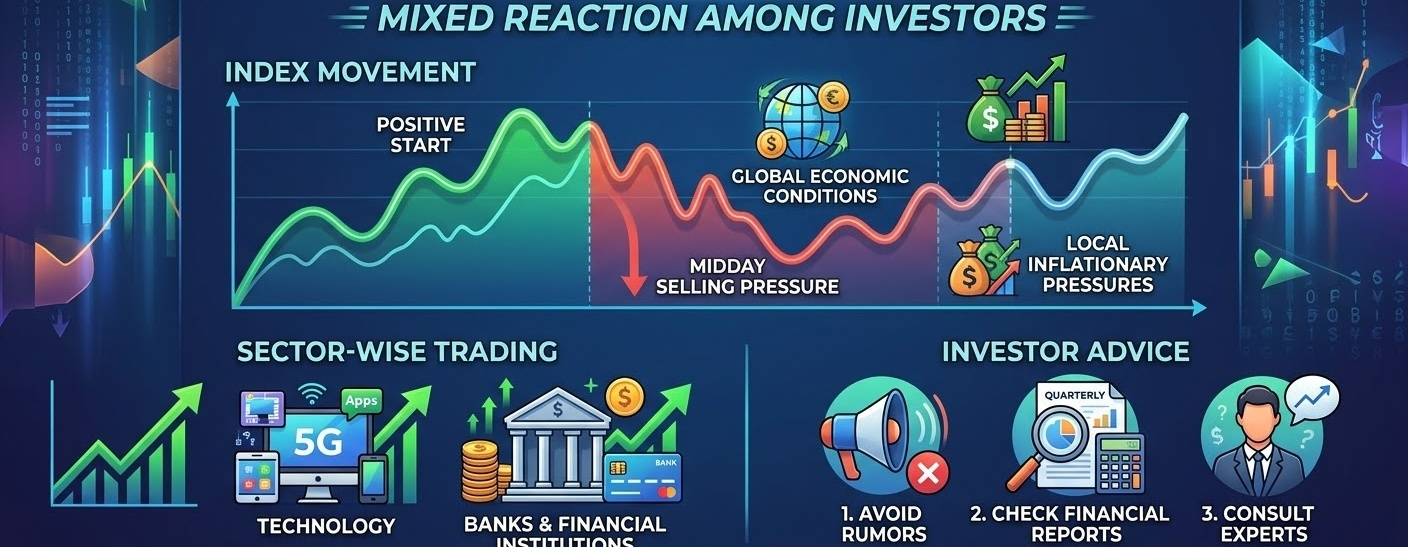
A mixed reaction was observed among investors in today's stock market. Due to global economic conditions and local inflationary pressures, indices fluctuated slightly. According to market analysts, long-term investment in fundamentally strong company stocks is comparatively safer during this period.
The main characteristics of the market are given below:
Index Movement: Although the market started positively, a slight downward trend was observed around midday due to selling pressure.
Sector-wise Trading: Good interest was seen today in technology sector shares alongside banks and financial institutions.
Advice for Investors: Investors should avoid rumors, check companies' quarterly financial reports, and make decisions based on expert advice
Market Insights & Investor Advice: Focus on Fundamentals Amid Inflationary Pressures
Today's Stock Market Article (November 9, 2026)
A mixed reaction was observed among investors in today's stock market. Due to global economic conditions and local inflationary pressures, indices fluctuated slightly. According to market analysts, long-term investment in fundamentally strong company stocks is comparatively safer during this period.
The main characteristics of the market are given below:
Index Movement: Although the market started positively, a slight downward trend was observed around midday due to selling pressure.
Sector-wise Trading: Good interest was seen today in technology sector shares alongside banks and financial institutions.
Advice for Investors: Investors should avoid rumors, check companies' quarterly financial reports, and make decisions based on expert advice
1
72
Статья
The Power of XRP: Bridging Currencies in a Digital WorldWhat is XRP? A Comprehensive Guide to Ripple’s Digital Asset
Cryptocurrency has revolutionized how we perceive money, and among the thousands of digital assets available today, XRP stands out as one of the most prominent and widely discussed coins. Created by Ripple Labs, XRP was designed with a very specific and ambitious goal in mind: to transform global financial transactions.
Understanding XRP and Ripple
To understand XRP, it is essential to distinguish between the cryptocurrency itself and the company behind its promotion:
XRP: The native digital asset of the XRP Ledger (XRPL). It is a decentralized, public blockchain designed to facilitate fast and low-cost international payments.
Ripple Labs: A technology company that builds payment solutions for financial institutions using XRP and the XRP Ledger.
While Ripple promotes the use of XRP in the banking sector, the XRP Ledger operates independently, meaning the cryptocurrency can exist and function without Ripple Labs.
Key Features of XRP
XRP was built to solve the major inefficiencies of traditional banking systems, such as slow settlement times and high fees. Its core features include:
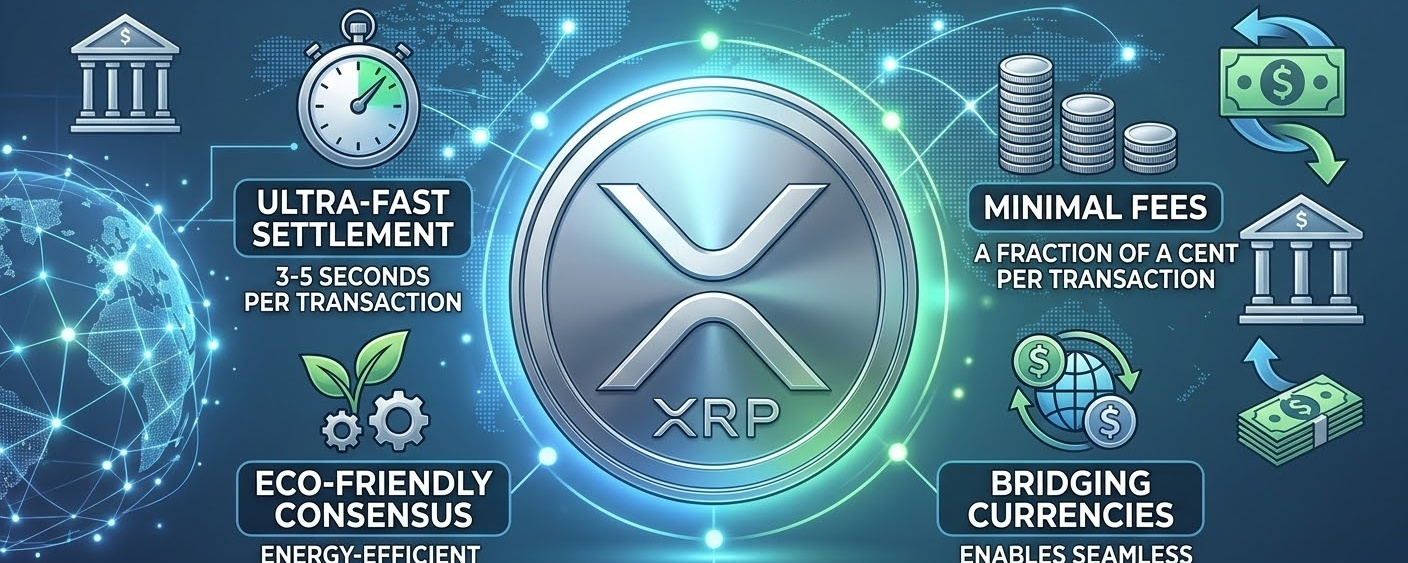
Blazing Speed: Traditional international bank transfers (like SWIFT) can take anywhere from 3 to 5 business days. In contrast, an XRP transaction settles in 3 to 5 seconds.
Incredible Scalability: The XRP Ledger can handle around 1,500 transactions per second (TPS), making it vastly superior to older blockchains like Bitcoin.
Low Transaction Costs: The cost of sending XRP is a fraction of a cent (typically around $0.0002 per transaction), making microtransactions and high-volume transfers highly efficient.
Eco-Friendly Consensus Mechanism: Unlike Bitcoin, which relies on energy-intensive Proof-of-Work (PoW), the XRPL uses a unique consensus protocol that requires very little energy, making it environmentally sustainable.
How XRP Works: The Consensus Protocol
Most cryptocurrencies rely on miners to validate transactions. XRP, however, uses a Consensus Protocol managed by a diverse network of independent validators.
When a transaction is initiated, validators across the network must agree on its validity. Because it does not rely on mining or a single central authority, transactions are validated almost instantaneously and with high security.
Use Cases: Bridging Currencies
The primary use case for XRP is acting as a bridge currency for international remittances and foreign exchange.
Imagine a bank in Japan wants to send money to a bank in Kenya. Traditionally, this requires holding pre-funded accounts in both countries' local currencies, tying up massive amounts of capital. With Ripple’s On-Demand Liquidity (ODL) service, the Japanese Yen is converted into XRP, sent across the globe in seconds, and instantly converted into Kenyan Shillings. This eliminates the need for costly pre-funded accounts and drastically reduces settlement times.
Challenges and Controversies
Despite its technological advantages, XRP has faced significant hurdles, most notably its prolonged legal battle with the U.S. Securities and Exchange Commission (SEC). The SEC filed a lawsuit alleging that XRP was an unregistered security. This regulatory uncertainty impacted XRP's adoption and market performance for years. However, recent legal clarifications have provided more stability and renewed confidence within the crypto community.
Conclusion
XRP is much more than just another digital coin; it is a serious enterprise-grade solution aimed at modernizing the global financial infrastructure. By offering unmatched speed, scalability, and cost-efficiency, XRP continues to carve out a unique space in the evolving world of decentralized finance
The Power of XRP: Bridging Currencies in a Digital World
What is XRP? A Comprehensive Guide to Ripple’s Digital Asset
Cryptocurrency has revolutionized how we perceive money, and among the thousands of digital assets available today, XRP stands out as one of the most prominent and widely discussed coins. Created by Ripple Labs, XRP was designed with a very specific and ambitious goal in mind: to transform global financial transactions.
Understanding XRP and Ripple
To understand XRP, it is essential to distinguish between the cryptocurrency itself and the company behind its promotion:
XRP: The native digital asset of the XRP Ledger (XRPL). It is a decentralized, public blockchain designed to facilitate fast and low-cost international payments.
Ripple Labs: A technology company that builds payment solutions for financial institutions using XRP and the XRP Ledger.
While Ripple promotes the use of XRP in the banking sector, the XRP Ledger operates independently, meaning the cryptocurrency can exist and function without Ripple Labs.
Key Features of XRP
XRP was built to solve the major inefficiencies of traditional banking systems, such as slow settlement times and high fees. Its core features include:
Blazing Speed: Traditional international bank transfers (like SWIFT) can take anywhere from 3 to 5 business days. In contrast, an XRP transaction settles in 3 to 5 seconds.
Incredible Scalability: The XRP Ledger can handle around 1,500 transactions per second (TPS), making it vastly superior to older blockchains like Bitcoin.
Low Transaction Costs: The cost of sending XRP is a fraction of a cent (typically around $0.0002 per transaction), making microtransactions and high-volume transfers highly efficient.
Eco-Friendly Consensus Mechanism: Unlike Bitcoin, which relies on energy-intensive Proof-of-Work (PoW), the XRPL uses a unique consensus protocol that requires very little energy, making it environmentally sustainable.
How XRP Works: The Consensus Protocol
Most cryptocurrencies rely on miners to validate transactions. XRP, however, uses a Consensus Protocol managed by a diverse network of independent validators.
When a transaction is initiated, validators across the network must agree on its validity. Because it does not rely on mining or a single central authority, transactions are validated almost instantaneously and with high security.
Use Cases: Bridging Currencies
The primary use case for XRP is acting as a bridge currency for international remittances and foreign exchange.
Imagine a bank in Japan wants to send money to a bank in Kenya. Traditionally, this requires holding pre-funded accounts in both countries' local currencies, tying up massive amounts of capital. With Ripple’s On-Demand Liquidity (ODL) service, the Japanese Yen is converted into XRP, sent across the globe in seconds, and instantly converted into Kenyan Shillings. This eliminates the need for costly pre-funded accounts and drastically reduces settlement times.
Challenges and Controversies
Despite its technological advantages, XRP has faced significant hurdles, most notably its prolonged legal battle with the U.S. Securities and Exchange Commission (SEC). The SEC filed a lawsuit alleging that XRP was an unregistered security. This regulatory uncertainty impacted XRP's adoption and market performance for years. However, recent legal clarifications have provided more stability and renewed confidence within the crypto community.
Conclusion
XRP is much more than just another digital coin; it is a serious enterprise-grade solution aimed at modernizing the global financial infrastructure. By offering unmatched speed, scalability, and cost-efficiency, XRP continues to carve out a unique space in the evolving world of decentralized finance
1
4
755
"I have 6 dollars, which coin should I buy to make a profit?"
"I have 6 dollars, which coin should I buy to make a profit?"
1
67

Статья
If Bitcoin is Digital Gold, Ethereum is the Digital EconomyThe Powerhouse of the Crypto World: Ethereum ($ETH) and Its Future Potential
When people think of cryptocurrency, Bitcoin ($BTC) is usually the first name that comes to mind. However, when it comes to the practical applications of blockchain technology, decentralized finance (DeFi), and smart contracts, one name stands above the rest: Ethereum ($ETH). If Bitcoin is the digital gold of the crypto market, Ethereum is the engine driving its digital economy.
What is Ethereum?
Ethereum is not just a cryptocurrency; it is a decentralized, open-source blockchain platform. Proposed in 2014 by Vitalik Buterin and co-founders, it officially launched in 2015. While Bitcoin was primarily created as a digital currency and medium of exchange, Ethereum serves as a foundational platform upon which thousands of other crypto tokens and applications can be built.
Smart Contracts and dApps
Ethereum's biggest revolution is the Smart Contract. These are self-executing computer codes where the terms of the agreement are directly written into lines of code. This allows secure transactions and agreements to be executed between parties without the need for intermediaries (such as banks or brokers).
Powered by this technology, the ecosystem has expanded into:
DeFi (Decentralized Finance): Allowing users to borrow, lend, and earn interest without traditional banking systems.
NFTs (Non-Fungible Tokens): A medium for buying and selling digital art, music, and unique assets.
dApps: Thousands of decentralized applications running globally.
Why is Ethereum So Crucial in the Market?
Proof-of-Stake (PoS): Through "The Merge" update, Ethereum successfully transitioned to an energy-efficient Proof-of-Stake mechanism. This reduced the network's energy consumption by roughly 99.95%.
Layer 2 Solutions: To address gas fee (transaction cost) and speed challenges on the mainnet, Layer 2 networks like Arbitrum, Optimism, and Polygon have made the Ethereum ecosystem much faster and more cost-effective.
Institutional Interest: Major financial institutions and global investors are increasingly showing deep interest in Ethereum-based funds and infrastructure projects alongside Bitcoin.
Future Potential and a Note for Investors
The crypto market is highly volatile and risky. However, among developers, the Ethereum network consistently maintains the highest adoption and activity. Ethereum serves as a primary pillar for Web3, the metaverse, and Real-World Asset (RWA) tokenization.
From a long-term perspective and real-world utility standpoint, $ETH remains one of the strongest pillars of the crypto industry. As always, it is wise to do your own research (DYOR) before making any investment decisions in the crypto market.
Let me know if you need any adjustments or want to add specific angles (like technical analysis or trading metrics)!
If Bitcoin is Digital Gold, Ethereum is the Digital Economy
The Powerhouse of the Crypto World: Ethereum ($ETH) and Its Future Potential
When people think of cryptocurrency, Bitcoin ($BTC) is usually the first name that comes to mind. However, when it comes to the practical applications of blockchain technology, decentralized finance (DeFi), and smart contracts, one name stands above the rest: Ethereum ($ETH). If Bitcoin is the digital gold of the crypto market, Ethereum is the engine driving its digital economy.
What is Ethereum?
Ethereum is not just a cryptocurrency; it is a decentralized, open-source blockchain platform. Proposed in 2014 by Vitalik Buterin and co-founders, it officially launched in 2015. While Bitcoin was primarily created as a digital currency and medium of exchange, Ethereum serves as a foundational platform upon which thousands of other crypto tokens and applications can be built.
Smart Contracts and dApps
Ethereum's biggest revolution is the Smart Contract. These are self-executing computer codes where the terms of the agreement are directly written into lines of code. This allows secure transactions and agreements to be executed between parties without the need for intermediaries (such as banks or brokers).
Powered by this technology, the ecosystem has expanded into:
DeFi (Decentralized Finance): Allowing users to borrow, lend, and earn interest without traditional banking systems.
NFTs (Non-Fungible Tokens): A medium for buying and selling digital art, music, and unique assets.
dApps: Thousands of decentralized applications running globally.
Why is Ethereum So Crucial in the Market?
Proof-of-Stake (PoS): Through "The Merge" update, Ethereum successfully transitioned to an energy-efficient Proof-of-Stake mechanism. This reduced the network's energy consumption by roughly 99.95%.
Layer 2 Solutions: To address gas fee (transaction cost) and speed challenges on the mainnet, Layer 2 networks like Arbitrum, Optimism, and Polygon have made the Ethereum ecosystem much faster and more cost-effective.
Institutional Interest: Major financial institutions and global investors are increasingly showing deep interest in Ethereum-based funds and infrastructure projects alongside Bitcoin.
Future Potential and a Note for Investors
The crypto market is highly volatile and risky. However, among developers, the Ethereum network consistently maintains the highest adoption and activity. Ethereum serves as a primary pillar for Web3, the metaverse, and Real-World Asset (RWA) tokenization.
From a long-term perspective and real-world utility standpoint, $ETH remains one of the strongest pillars of the crypto industry. As always, it is wise to do your own research (DYOR) before making any investment decisions in the crypto market.
Let me know if you need any adjustments or want to add specific angles (like technical analysis or trading metrics)!
1
109
Статья
"Mastering ETHUSDT Long Futures: The Essential Decision ChecklistGoing long ETH futures means you’re betting that ETHUSDT will rise from here.
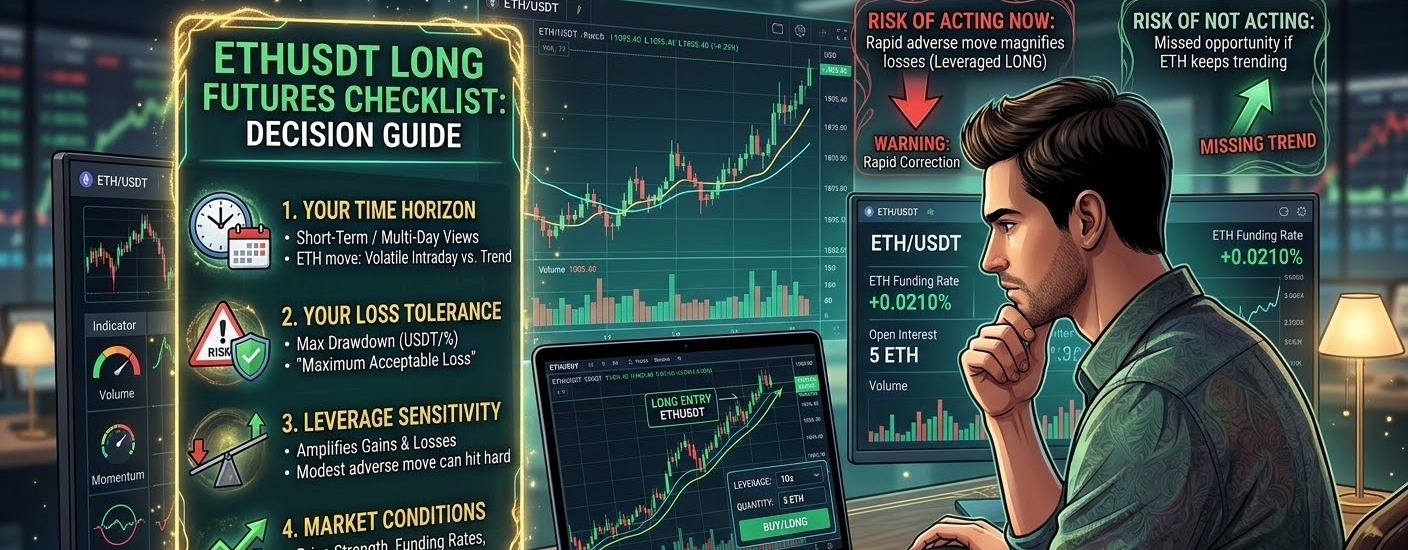
What decides whether that setup fits you is mainly this checklist:
Your time horizon: ETH futures can move fast intraday, so a short-term trade and a multi-day view are very different bets.
Your loss tolerance: before acting, be clear on the maximum drawdown in USDT or % that you can accept without disrupting the rest of your capital.
Leverage sensitivity: with futures, even a modest adverse move can have a much bigger impact than spot because leverage amplifies both gains and losses.
Market conditions you’re relying on: if your thesis depends on momentum continuing, then price strength, funding behavior, and position crowding matter more than the headline “bullish/bearish” narrative.
The main risk of acting now is that ETH can move against a leveraged long quickly and magnify losses.
The main risk of not acting now is that if ETH keeps trending higher, you may miss the move you were trying to capture.
以上仅为市场分析,不构成投资建议。
"Mastering ETHUSDT Long Futures: The Essential Decision Checklist
Going long ETH futures means you’re betting that ETHUSDT will rise from here.
What decides whether that setup fits you is mainly this checklist:
Your time horizon: ETH futures can move fast intraday, so a short-term trade and a multi-day view are very different bets.
Your loss tolerance: before acting, be clear on the maximum drawdown in USDT or % that you can accept without disrupting the rest of your capital.
Leverage sensitivity: with futures, even a modest adverse move can have a much bigger impact than spot because leverage amplifies both gains and losses.
Market conditions you’re relying on: if your thesis depends on momentum continuing, then price strength, funding behavior, and position crowding matter more than the headline “bullish/bearish” narrative.
The main risk of acting now is that ETH can move against a leveraged long quickly and magnify losses.
The main risk of not acting now is that if ETH keeps trending higher, you may miss the move you were trying to capture.
以上仅为市场分析,不构成投资建议。
1
187
Войдите, чтобы посмотреть больше материала
Присоединяйтесь к пользователям криптовалют по всему миру на Binance Square
⚡️ Получайте новейшую и полезную информацию о криптоактивах.
💬 Нам доверяет крупнейшая в мире криптобиржа.
👍 Получите достоверные аналитические данные от верифицированных создателей контента.
Эл. почта/номер телефона
В тренде
HotCPIDecemberHikePriced
Просмотров: 48,888
808 обсуждают
CPI Market Watch | US CPI Rises 0.4% in October, Hotter Than 0.3% Forecast
Binance News
·Лайков: 21
·Просмотров: 37.5k
AnthropicRejectsIPODelayValuationinQuestion
Просмотров: 183,788
1,620 обсуждают
NvidiaInvestigatesAfterHuang’sAffairApology
Просмотров: 458,383
3,079 обсуждают