

RIO_X
4k Публикации

RIO_X
Отправить жалобу
Заблокировать пользователя
Markets by morning, life by afternoon. ... I trade to fund my freedom, not to lose my mind. Let’s make some money and actually enjoy it.
Открытая сделка
Трейдер с частыми сделками
4.9 г
2.0K+ подписок(и/а)
9.8K+ подписчиков(а)
4.5K+ понравилось
Посты
Портфель
Все
Цитирования
Активно
·
--
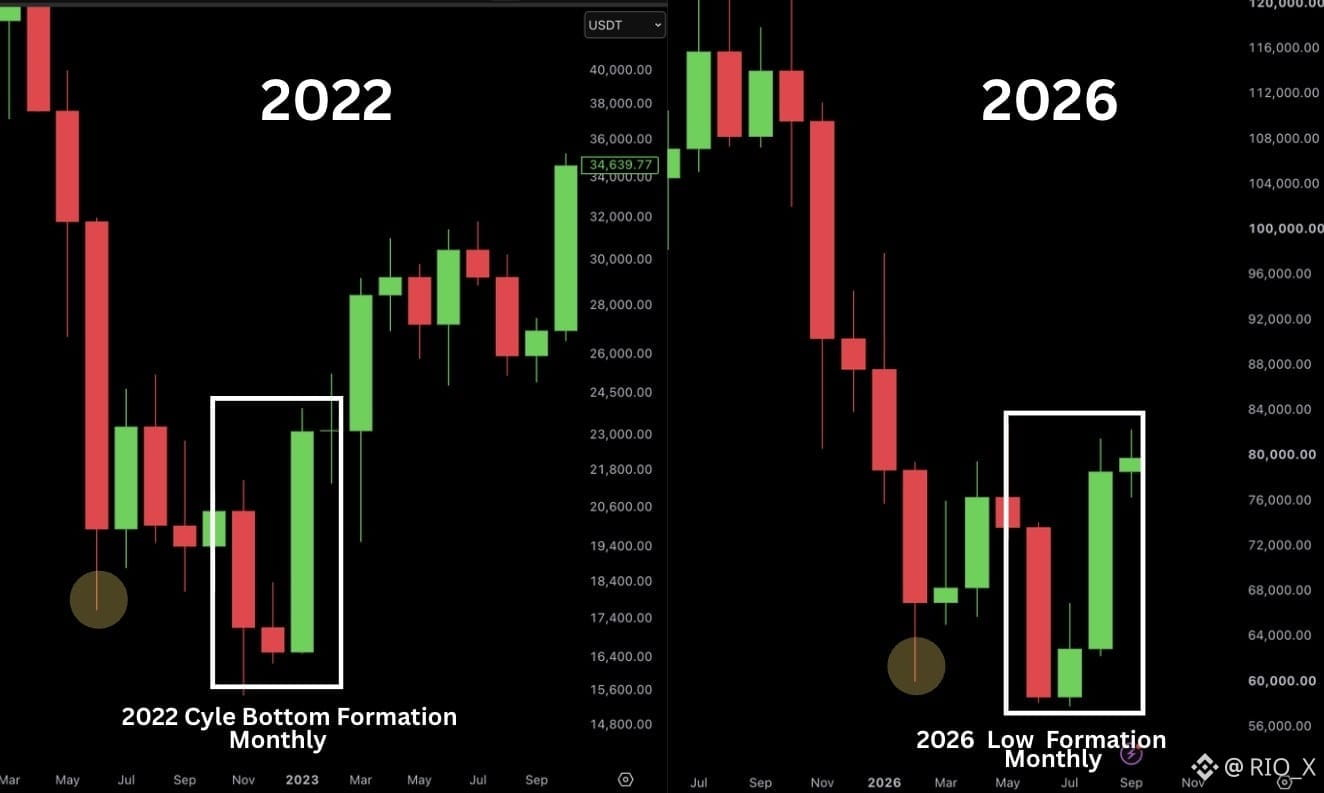
2026 monthly candle pattern looks very similar to the 2022 cycle bottom.
Could history be repeating itself?
$BULLA
$ARB
$MARSCOIN
{future}(MARSCOINUSDT)
2026 monthly candle pattern looks very similar to the 2022 cycle bottom.
Could history be repeating itself?
$BULLA
$ARB
$MARSCOIN
Could history be repeating itself?
$BULLA
$ARB
$MARSCOIN
2
101
·
--
#dusk $DUSK @Dusk_Foundation
was clearing out old browser tabs on Wednesday and found the Dusk Trade page still open from weeks ago 🤔
reread it and noticed the status. building.
not live. not testnet. building.
and I have been writing about the investor onboarding flow and wallet binding and controlled transfers as though I could go and do them today. I cannot. Nobody can yet.
what the page describes is the intended shape of a neobroker for tokenized financial assets. discovery. onboarding. eligibility. controlled transfers. payment coordination. compliant settlement.
that is a specification more than a product right now.
which is fine honestly. a regulated trading venue should not ship fast. but I should have been clearer about it and I was not.
my caveat on my own caveat is that building can mean six months or three years and the page does not say which.
do you find status labels on project sites useful or too vague to trust
@Dusk_Foundation #dusk $DUSK
{future}(DUSKUSDT)
#dusk $DUSK @Dusk
was clearing out old browser tabs on Wednesday and found the Dusk Trade page still open from weeks ago 🤔
reread it and noticed the status. building.
not live. not testnet. building.
and I have been writing about the investor onboarding flow and wallet binding and controlled transfers as though I could go and do them today. I cannot. Nobody can yet.
what the page describes is the intended shape of a neobroker for tokenized financial assets. discovery. onboarding. eligibility. controlled transfers. payment coordination. compliant settlement.
that is a specification more than a product right now.
which is fine honestly. a regulated trading venue should not ship fast. but I should have been clearer about it and I was not.
my caveat on my own caveat is that building can mean six months or three years and the page does not say which.
do you find status labels on project sites useful or too vague to trust
@Dusk #dusk $DUSK
was clearing out old browser tabs on Wednesday and found the Dusk Trade page still open from weeks ago 🤔
reread it and noticed the status. building.
not live. not testnet. building.
and I have been writing about the investor onboarding flow and wallet binding and controlled transfers as though I could go and do them today. I cannot. Nobody can yet.
what the page describes is the intended shape of a neobroker for tokenized financial assets. discovery. onboarding. eligibility. controlled transfers. payment coordination. compliant settlement.
that is a specification more than a product right now.
which is fine honestly. a regulated trading venue should not ship fast. but I should have been clearer about it and I was not.
my caveat on my own caveat is that building can mean six months or three years and the page does not say which.
do you find status labels on project sites useful or too vague to trust
@Dusk #dusk $DUSK
AGREE
100%
DISAGREE
0%
1 проголосовали • Голосование закрыто
1
1
167
·
--
#dusk $DUSK @Dusk_Foundation
I was trying to connect a wallet today and somehow managed to click the wrong option twice.😅 That’s when I remembered how much of crypto depends on little pieces of infrastructure you barely notice when they work.
That’s what I found interesting about Dusk Connect. It isn’t the wallet itself. It’s the layer that helps a Dusk dApp discover compatible wallets, let the user choose one,request account access, track the active account and network, and send transactions for the user to approve. It also isn’t locked to one wallet provider,which means an app can support multiple compatible wallets instead of hardcoding one.
{future}(DUSKUSDT)
DOCS +1
There’s another small detail I like: the wallet keeps control of the keys and the user still approves the actions. The dApp can request access, but it doesn’t simply get to act on your behalf.
DOCS
The price is the obvious thing to look at. Sometimes the more interesting story is the boring layer underneath that makes everything work.
#dusk $DUSK @Dusk
I was trying to connect a wallet today and somehow managed to click the wrong option twice.😅 That’s when I remembered how much of crypto depends on little pieces of infrastructure you barely notice when they work.
That’s what I found interesting about Dusk Connect. It isn’t the wallet itself. It’s the layer that helps a Dusk dApp discover compatible wallets, let the user choose one,request account access, track the active account and network, and send transactions for the user to approve. It also isn’t locked to one wallet provider,which means an app can support multiple compatible wallets instead of hardcoding one.
DOCS +1
There’s another small detail I like: the wallet keeps control of the keys and the user still approves the actions. The dApp can request access, but it doesn’t simply get to act on your behalf.
DOCS
The price is the obvious thing to look at. Sometimes the more interesting story is the boring layer underneath that makes everything work.
I was trying to connect a wallet today and somehow managed to click the wrong option twice.😅 That’s when I remembered how much of crypto depends on little pieces of infrastructure you barely notice when they work.
That’s what I found interesting about Dusk Connect. It isn’t the wallet itself. It’s the layer that helps a Dusk dApp discover compatible wallets, let the user choose one,request account access, track the active account and network, and send transactions for the user to approve. It also isn’t locked to one wallet provider,which means an app can support multiple compatible wallets instead of hardcoding one.
DOCS +1
There’s another small detail I like: the wallet keeps control of the keys and the user still approves the actions. The dApp can request access, but it doesn’t simply get to act on your behalf.
DOCS
The price is the obvious thing to look at. Sometimes the more interesting story is the boring layer underneath that makes everything work.
AGREE
100%
DISAGREE
0%
1 проголосовали • Голосование закрыто
1
3
309
·
--
#dusk $DUSK @Dusk_Foundation
I once spent five minutes trying to connect a wallet, only to realize I was clicking the wrong button the whole time. 😅
That’s why Dusk Connect caught my attention. It gives DuskDS apps a standard way to discover compatible wallets, request accounts and ask users to sign transactions. The point sounds simple, but wallet connection is one of those boring pieces that has to work before anything else can.
Dusk is also building its own wallet for browser, desktop and mobile, so the front end isn't being treated as an afterthought. ???
Dusk
Sometimes the infrastructure people notice least is what makes everything else usable.
#dusk $DUSK @Dusk
I once spent five minutes trying to connect a wallet, only to realize I was clicking the wrong button the whole time. 😅
That’s why Dusk Connect caught my attention. It gives DuskDS apps a standard way to discover compatible wallets, request accounts and ask users to sign transactions. The point sounds simple, but wallet connection is one of those boring pieces that has to work before anything else can.
Dusk is also building its own wallet for browser, desktop and mobile, so the front end isn't being treated as an afterthought. ???
Dusk
Sometimes the infrastructure people notice least is what makes everything else usable.
I once spent five minutes trying to connect a wallet, only to realize I was clicking the wrong button the whole time. 😅
That’s why Dusk Connect caught my attention. It gives DuskDS apps a standard way to discover compatible wallets, request accounts and ask users to sign transactions. The point sounds simple, but wallet connection is one of those boring pieces that has to work before anything else can.
Dusk is also building its own wallet for browser, desktop and mobile, so the front end isn't being treated as an afterthought. ???
Dusk
Sometimes the infrastructure people notice least is what makes everything else usable.
Dusk Connect
100%
compatible wallets
0%
1 проголосовали • Голосование закрыто
3
1
338
·
--
Everyone talks about Dusk's privacy tech. Almost nobody talks about how a block actually travels across the network.
I went looking, and found something called Kadcast.
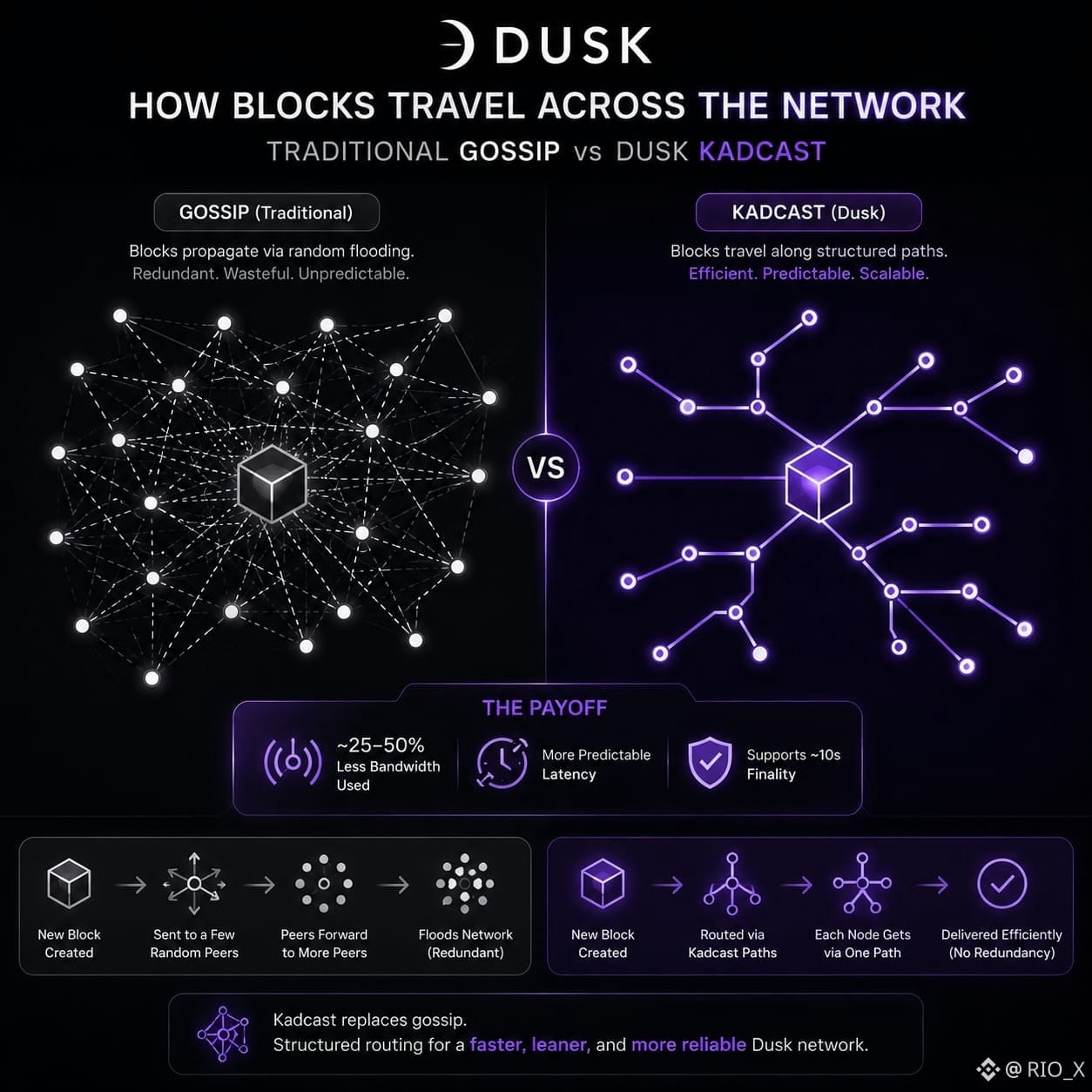
Most blockchains Bitcoin, Ethereum included— spread new blocks through "gossip." A node tells a few peers, those peers tell a few more, and it floods outward. Simple, but wasteful. The same data gets sent to the same nodes over and over.
Dusk replaced that entirely. $TUT
Kadcast routes messages along structured paths instead, based on a well-known peer-to-peer technique originally built for file-sharing networks. Every node has a clear, defined path to reach every other node no random flooding.
The payoff: roughly 25 to 50% less bandwidth used, and more predictable latency, according to Dusk's own published research. $TRUMP
That's not just a nice efficiency stat. Remember the 10-second finality I wrote about last time? None of that works if votes and blocks can't move across the network fast and predictably. Kadcast is the quiet piece making that possible.
Limitation I noticed: most of the detailed technical writeups on Kadcast's real-world performance are a couple years old now. Would like to see fresher benchmarks from mainnet, not just the original research.
Anyone know of newer data on this?
@Dusk_Foundation $DUSK
{future}(DUSKUSDT)
#dusk
Everyone talks about Dusk's privacy tech. Almost nobody talks about how a block actually travels across the network.
I went looking, and found something called Kadcast.
Most blockchains Bitcoin, Ethereum included— spread new blocks through "gossip." A node tells a few peers, those peers tell a few more, and it floods outward. Simple, but wasteful. The same data gets sent to the same nodes over and over.
Dusk replaced that entirely. $TUT
Kadcast routes messages along structured paths instead, based on a well-known peer-to-peer technique originally built for file-sharing networks. Every node has a clear, defined path to reach every other node no random flooding.
The payoff: roughly 25 to 50% less bandwidth used, and more predictable latency, according to Dusk's own published research. $TRUMP
That's not just a nice efficiency stat. Remember the 10-second finality I wrote about last time? None of that works if votes and blocks can't move across the network fast and predictably. Kadcast is the quiet piece making that possible.
Limitation I noticed: most of the detailed technical writeups on Kadcast's real-world performance are a couple years old now. Would like to see fresher benchmarks from mainnet, not just the original research.
Anyone know of newer data on this?
@Dusk $DUSK
#dusk
I went looking, and found something called Kadcast.
Most blockchains Bitcoin, Ethereum included— spread new blocks through "gossip." A node tells a few peers, those peers tell a few more, and it floods outward. Simple, but wasteful. The same data gets sent to the same nodes over and over.
Dusk replaced that entirely. $TUT
Kadcast routes messages along structured paths instead, based on a well-known peer-to-peer technique originally built for file-sharing networks. Every node has a clear, defined path to reach every other node no random flooding.
The payoff: roughly 25 to 50% less bandwidth used, and more predictable latency, according to Dusk's own published research. $TRUMP
That's not just a nice efficiency stat. Remember the 10-second finality I wrote about last time? None of that works if votes and blocks can't move across the network fast and predictably. Kadcast is the quiet piece making that possible.
Limitation I noticed: most of the detailed technical writeups on Kadcast's real-world performance are a couple years old now. Would like to see fresher benchmarks from mainnet, not just the original research.
Anyone know of newer data on this?
@Dusk $DUSK
#dusk
3
8
201

·
--
#dusk $DUSK @Dusk_Foundation
Been sitting with this since a conversation last Thursday that I handled badly at the time.
A building goes up under one set of fire regulations. Twenty years later the code changes. The building doesnt become illegal— it stands, grandfathered, until somebody touches it . Then the new rules apply to whatever you altered ,and sometimes to the whole structure.
Everyone accepts this. Nobody thinks its strange that a wall built legally in 1998 might need to come down in 2026.
Now put a regulated security on a settlement layer where the compliance rules live inside the contract.
Dusk describe compliance checks enforced in smart contracts rather than manual back office processes, and thats a genuine improvement —the rule applies when the transfer happens instead of getting reviewed afterwards.eligibility, limits, transfer restrictions, all executing rather tha being checked
but rules written into an issued asset were written under the regulation that existed on the day it was issued
Where the building comparison stops working is inspection. an fire officer can walk into a structure, see the old wiring, and require it changed. theres a physical thing to look at and a person with authority to look
an issued asset with compliance logic already executing has no equivalent walk-through. the rule isnt a wall someone can point at, its behaviour, and updating it means either upgradeability that weakens the guarantee or a migration nobody planned for
the strange part is that putting compliance in code makes it MORE reliable and less revisable at the same time, and I dont know anyone who has solved that
whats your take
@Dusk_Foundation #dusk $DUSK
{future}(DUSKUSDT)
$MAGMA
{future}(MAGMAUSDT)
#dusk $DUSK @Dusk
Been sitting with this since a conversation last Thursday that I handled badly at the time.
A building goes up under one set of fire regulations. Twenty years later the code changes. The building doesnt become illegal— it stands, grandfathered, until somebody touches it . Then the new rules apply to whatever you altered ,and sometimes to the whole structure.
Everyone accepts this. Nobody thinks its strange that a wall built legally in 1998 might need to come down in 2026.
Now put a regulated security on a settlement layer where the compliance rules live inside the contract.
Dusk describe compliance checks enforced in smart contracts rather than manual back office processes, and thats a genuine improvement —the rule applies when the transfer happens instead of getting reviewed afterwards.eligibility, limits, transfer restrictions, all executing rather tha being checked
but rules written into an issued asset were written under the regulation that existed on the day it was issued
Where the building comparison stops working is inspection. an fire officer can walk into a structure, see the old wiring, and require it changed. theres a physical thing to look at and a person with authority to look
an issued asset with compliance logic already executing has no equivalent walk-through. the rule isnt a wall someone can point at, its behaviour, and updating it means either upgradeability that weakens the guarantee or a migration nobody planned for
the strange part is that putting compliance in code makes it MORE reliable and less revisable at the same time, and I dont know anyone who has solved that
whats your take
@Dusk #dusk $DUSK
$MAGMA
Been sitting with this since a conversation last Thursday that I handled badly at the time.
A building goes up under one set of fire regulations. Twenty years later the code changes. The building doesnt become illegal— it stands, grandfathered, until somebody touches it . Then the new rules apply to whatever you altered ,and sometimes to the whole structure.
Everyone accepts this. Nobody thinks its strange that a wall built legally in 1998 might need to come down in 2026.
Now put a regulated security on a settlement layer where the compliance rules live inside the contract.
Dusk describe compliance checks enforced in smart contracts rather than manual back office processes, and thats a genuine improvement —the rule applies when the transfer happens instead of getting reviewed afterwards.eligibility, limits, transfer restrictions, all executing rather tha being checked
but rules written into an issued asset were written under the regulation that existed on the day it was issued
Where the building comparison stops working is inspection. an fire officer can walk into a structure, see the old wiring, and require it changed. theres a physical thing to look at and a person with authority to look
an issued asset with compliance logic already executing has no equivalent walk-through. the rule isnt a wall someone can point at, its behaviour, and updating it means either upgradeability that weakens the guarantee or a migration nobody planned for
the strange part is that putting compliance in code makes it MORE reliable and less revisable at the same time, and I dont know anyone who has solved that
whats your take
@Dusk #dusk $DUSK
$MAGMA
Complaince is the key
33%
migration
67%
3 проголосовали • Голосование закрыто
8
8
692
·
--
#termmax @termmax
The more I read about @termmax the more I think the secondary market matters almost as much as the original lending market.
Why?
Because FT isn't necessarilymeant to sit untouched until maturity.
It can be transferred and traded before then.
That gives holders another option.
But an option is onlyuseful if the market is liquid enough.
I was thinking about this while reading the FT mechanics and realised the fixed claim itself is only half the story.
The other half is price discovery.
What does the market think that future claim is worth today?
How much does the remaining maturity matter?
What happens when broader interest rates move?
Those questions turn a simple fixed claim into an actual financial instrument.
That's why I'm more interested in the market around FT than just the headline rate.
Liquidity will tell us a LOT.
#TermMax
#termmax @TermMax
The more I read about @TermMax the more I think the secondary market matters almost as much as the original lending market.
Why?
Because FT isn't necessarilymeant to sit untouched until maturity.
It can be transferred and traded before then.
That gives holders another option.
But an option is onlyuseful if the market is liquid enough.
I was thinking about this while reading the FT mechanics and realised the fixed claim itself is only half the story.
The other half is price discovery.
What does the market think that future claim is worth today?
How much does the remaining maturity matter?
What happens when broader interest rates move?
Those questions turn a simple fixed claim into an actual financial instrument.
That's why I'm more interested in the market around FT than just the headline rate.
Liquidity will tell us a LOT.
#TermMax
The more I read about @TermMax the more I think the secondary market matters almost as much as the original lending market.
Why?
Because FT isn't necessarilymeant to sit untouched until maturity.
It can be transferred and traded before then.
That gives holders another option.
But an option is onlyuseful if the market is liquid enough.
I was thinking about this while reading the FT mechanics and realised the fixed claim itself is only half the story.
The other half is price discovery.
What does the market think that future claim is worth today?
How much does the remaining maturity matter?
What happens when broader interest rates move?
Those questions turn a simple fixed claim into an actual financial instrument.
That's why I'm more interested in the market around FT than just the headline rate.
Liquidity will tell us a LOT.
#TermMax
FT
100%
XT
0%
3 проголосовали • Голосование закрыто
4
145
·
--
#dusk $DUSK @Dusk_Foundation
I once bought something online and then realized I had skipped the one box that actually mattered. 😅 Turns out, getting the asset is often the easy part.
That’s what I find interesting about Dusk. For regulated assets, putting something onchain is not enough. The system also needs to handle who can own it, who can transfer it, what information should stay private, and when the transaction is finally settled.
That’s the part of Dusk I’m paying attention to: building the rules around the asset, not just putting a token on a blockchain.
In the middle of it, the tokenomics are simple: DUSK is used for gas and staking, and the maximum supply is 1 billion DUSK.
Today yesterday
A token is easy to create. Making it work inside a real financial market is the harder problem.
@Dusk_Foundation $DUSK #dusk
#dusk $DUSK @Dusk
I once bought something online and then realized I had skipped the one box that actually mattered. 😅 Turns out, getting the asset is often the easy part.
That’s what I find interesting about Dusk. For regulated assets, putting something onchain is not enough. The system also needs to handle who can own it, who can transfer it, what information should stay private, and when the transaction is finally settled.
That’s the part of Dusk I’m paying attention to: building the rules around the asset, not just putting a token on a blockchain.
In the middle of it, the tokenomics are simple: DUSK is used for gas and staking, and the maximum supply is 1 billion DUSK.
Today yesterday
A token is easy to create. Making it work inside a real financial market is the harder problem.
@Dusk $DUSK #dusk
I once bought something online and then realized I had skipped the one box that actually mattered. 😅 Turns out, getting the asset is often the easy part.
That’s what I find interesting about Dusk. For regulated assets, putting something onchain is not enough. The system also needs to handle who can own it, who can transfer it, what information should stay private, and when the transaction is finally settled.
That’s the part of Dusk I’m paying attention to: building the rules around the asset, not just putting a token on a blockchain.
In the middle of it, the tokenomics are simple: DUSK is used for gas and staking, and the maximum supply is 1 billion DUSK.
Today yesterday
A token is easy to create. Making it work inside a real financial market is the harder problem.
@Dusk $DUSK #dusk
1 Billion dusk 😁
100%
should be Less than 1B
0%
3 проголосовали • Голосование закрыто
2
4
192
·
--
I spent some time breaking down TermMax’s three-token model, and one idea from the docs really clicked for me: the system is built around a value equation where Collateral Value is made up of GT Value plus the Loan Value, while GT Value itself is the Collateral minus the Value of Debt.
That makes the three tokens feel less like separate assets and more like connected parts of the same financial structure.
FT is an ERC-20 that works like a zero-coupon bond. For example, 110 FT-USDC can redeem for 110 USDC at maturity, meaning a 100 USDC purchase creates a 10% return over a one-year term. What’s interesting is how maturity changes the annualized return. With the same discount over 180 days, the annualized return is around 20%, rather than 10%.
XT is where things get even more interesting. It isn’t simply the leftover portion after FT. XT represents the present value of the interest owed by the borrower, giving interest its own distinct financial exposure apart from principal.
Then there’s GT, the ERC-721 position wrapper that combines collateral and debt into a single position, subject to MLTV.
For me, the key insight is XT. It represents interest risk as its own instrument, while FT carries the principal side. Separating those two exposures at the token level is what allows the overall system to stay balanced without value appearing or disappearing along the way.
The big question now is secondary-market liquidity for XT. If XT is specifically pricing short-term interest risk, how deep can that market actually become?
Which TermMax token do you think matters most?
#TermMax @termmax
I spent some time breaking down TermMax’s three-token model, and one idea from the docs really clicked for me: the system is built around a value equation where Collateral Value is made up of GT Value plus the Loan Value, while GT Value itself is the Collateral minus the Value of Debt.
That makes the three tokens feel less like separate assets and more like connected parts of the same financial structure.
FT is an ERC-20 that works like a zero-coupon bond. For example, 110 FT-USDC can redeem for 110 USDC at maturity, meaning a 100 USDC purchase creates a 10% return over a one-year term. What’s interesting is how maturity changes the annualized return. With the same discount over 180 days, the annualized return is around 20%, rather than 10%.
XT is where things get even more interesting. It isn’t simply the leftover portion after FT. XT represents the present value of the interest owed by the borrower, giving interest its own distinct financial exposure apart from principal.
Then there’s GT, the ERC-721 position wrapper that combines collateral and debt into a single position, subject to MLTV.
For me, the key insight is XT. It represents interest risk as its own instrument, while FT carries the principal side. Separating those two exposures at the token level is what allows the overall system to stay balanced without value appearing or disappearing along the way.
The big question now is secondary-market liquidity for XT. If XT is specifically pricing short-term interest risk, how deep can that market actually become?
Which TermMax token do you think matters most?
#TermMax @TermMax
That makes the three tokens feel less like separate assets and more like connected parts of the same financial structure.
FT is an ERC-20 that works like a zero-coupon bond. For example, 110 FT-USDC can redeem for 110 USDC at maturity, meaning a 100 USDC purchase creates a 10% return over a one-year term. What’s interesting is how maturity changes the annualized return. With the same discount over 180 days, the annualized return is around 20%, rather than 10%.
XT is where things get even more interesting. It isn’t simply the leftover portion after FT. XT represents the present value of the interest owed by the borrower, giving interest its own distinct financial exposure apart from principal.
Then there’s GT, the ERC-721 position wrapper that combines collateral and debt into a single position, subject to MLTV.
For me, the key insight is XT. It represents interest risk as its own instrument, while FT carries the principal side. Separating those two exposures at the token level is what allows the overall system to stay balanced without value appearing or disappearing along the way.
The big question now is secondary-market liquidity for XT. If XT is specifically pricing short-term interest risk, how deep can that market actually become?
Which TermMax token do you think matters most?
#TermMax @TermMax
XT
100%
GT
0%
2 проголосовали • Голосование закрыто
3
3
170
·
--
#dusk $DUSK @Dusk_Foundation
I once confidently explained something to a friend, then realized halfway through I’d misunderstood the one important part. 😅 That’s basically why I like reading the actual mechanics instead of stopping at the headline.
What caught my attention in Dusk’s current architecture is Hedger. It brings confidential workflows into the EVM environment, using homomorphic encryption and zero-knowledge proofs so regulated applications can work with sensitive information while still allowing authorized review. The interesting part isn’t simply “private transactions.” It’s trying to make privacy something an application can actually program around. $BTW
Right in the middle of that, the tokenomics are easy to overlook: DUSK is the native gas and staking token, with a maximum supply of 1 billion DUSK.
On the chart, DUSK is at 0.0703, up 4.77% over 24h, with 10.97M DUSK in 24h volume. The 1H RSI(6) is 39.6467. $ACE
The more I dig into Dusk, the more the interesting question becomes: how do you keep financial information private without making it impossible to verify?
#dusk $DUSK @Dusk
I once confidently explained something to a friend, then realized halfway through I’d misunderstood the one important part. 😅 That’s basically why I like reading the actual mechanics instead of stopping at the headline.
What caught my attention in Dusk’s current architecture is Hedger. It brings confidential workflows into the EVM environment, using homomorphic encryption and zero-knowledge proofs so regulated applications can work with sensitive information while still allowing authorized review. The interesting part isn’t simply “private transactions.” It’s trying to make privacy something an application can actually program around. $BTW
Right in the middle of that, the tokenomics are easy to overlook: DUSK is the native gas and staking token, with a maximum supply of 1 billion DUSK.
On the chart, DUSK is at 0.0703, up 4.77% over 24h, with 10.97M DUSK in 24h volume. The 1H RSI(6) is 39.6467. $ACE
The more I dig into Dusk, the more the interesting question becomes: how do you keep financial information private without making it impossible to verify?
I once confidently explained something to a friend, then realized halfway through I’d misunderstood the one important part. 😅 That’s basically why I like reading the actual mechanics instead of stopping at the headline.
What caught my attention in Dusk’s current architecture is Hedger. It brings confidential workflows into the EVM environment, using homomorphic encryption and zero-knowledge proofs so regulated applications can work with sensitive information while still allowing authorized review. The interesting part isn’t simply “private transactions.” It’s trying to make privacy something an application can actually program around. $BTW
Right in the middle of that, the tokenomics are easy to overlook: DUSK is the native gas and staking token, with a maximum supply of 1 billion DUSK.
On the chart, DUSK is at 0.0703, up 4.77% over 24h, with 10.97M DUSK in 24h volume. The 1H RSI(6) is 39.6467. $ACE
The more I dig into Dusk, the more the interesting question becomes: how do you keep financial information private without making it impossible to verify?
Amazing pump
100%
Going high soon
0%
2 проголосовали • Голосование закрыто
3
2
179
·
--
#dusk $DUSK @Dusk_Foundation
I once watched a payment screen for five minutes, only to realize I’d been staring at the wrong tab. Slightly embarrassing. 😅
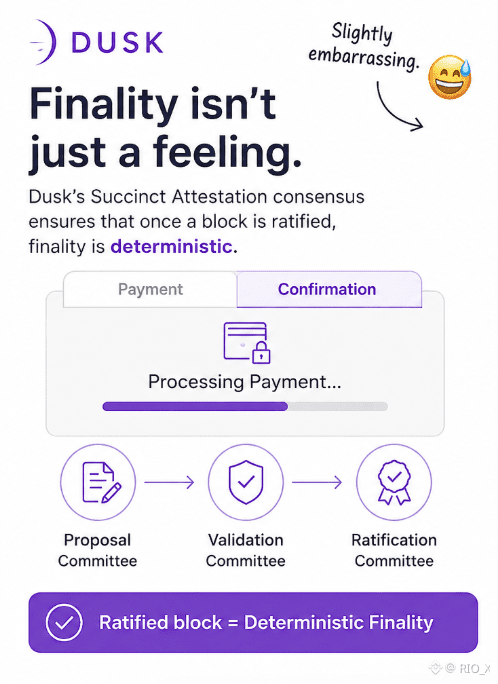
That got me thinking about Dusk’s idea of finality. Its Succinct Attestation consensus uses proposal, validation and ratification committees, and once a block is ratified, the docs describe its finality as deterministic. For financial markets, that distinction matters: there’s a difference between a transaction looking finished and the network having actually finalized it.
In the middle of that, the tokenomics detail is simple: DUSK is used for both gas and staking.
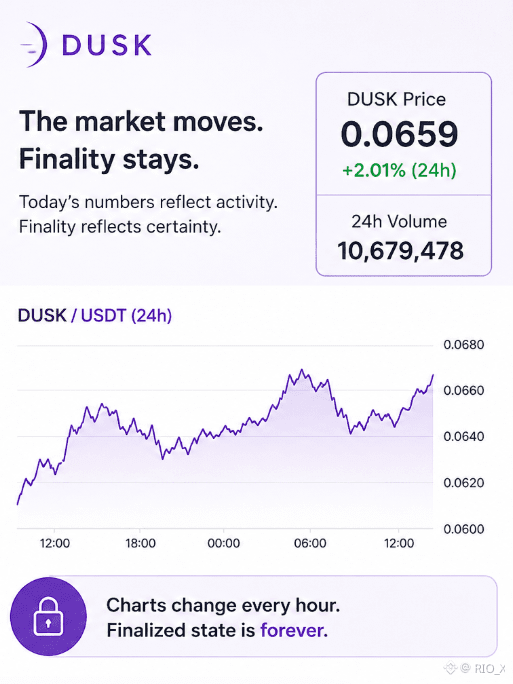
Today’s chart has DUSK at 0.0659, up 2.01% over 24h, with 24h volume at 10,679,478.
The chart changes every hour. A finalized state is supposed to mean something much more definite.
{future}(DUSKUSDT)
$BTW $RICE
#dusk $DUSK @Dusk
I once watched a payment screen for five minutes, only to realize I’d been staring at the wrong tab. Slightly embarrassing. 😅
That got me thinking about Dusk’s idea of finality. Its Succinct Attestation consensus uses proposal, validation and ratification committees, and once a block is ratified, the docs describe its finality as deterministic. For financial markets, that distinction matters: there’s a difference between a transaction looking finished and the network having actually finalized it.
In the middle of that, the tokenomics detail is simple: DUSK is used for both gas and staking.
Today’s chart has DUSK at 0.0659, up 2.01% over 24h, with 24h volume at 10,679,478.
The chart changes every hour. A finalized state is supposed to mean something much more definite.
$BTW $RICE
I once watched a payment screen for five minutes, only to realize I’d been staring at the wrong tab. Slightly embarrassing. 😅
That got me thinking about Dusk’s idea of finality. Its Succinct Attestation consensus uses proposal, validation and ratification committees, and once a block is ratified, the docs describe its finality as deterministic. For financial markets, that distinction matters: there’s a difference between a transaction looking finished and the network having actually finalized it.
In the middle of that, the tokenomics detail is simple: DUSK is used for both gas and staking.
Today’s chart has DUSK at 0.0659, up 2.01% over 24h, with 24h volume at 10,679,478.
The chart changes every hour. A finalized state is supposed to mean something much more definite.
$BTW $RICE
Dusk’s idea of finality
75%
DUSK at 0.0659
25%
4 проголосовали • Голосование закрыто
29
13
403
·
--
TermMax made me rethink what a loan position actually is.
It isn’t just a number sitting in a balance sheet.
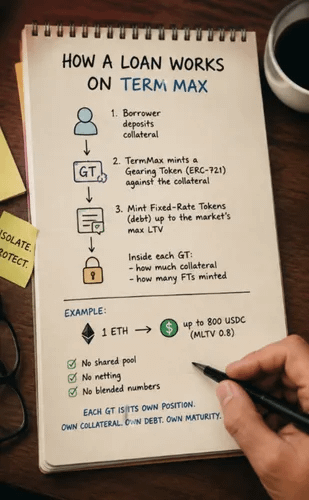
A borrower deposits collateral, and TermMax wraps that position into a Gearing Token, an ERC-721. The market already defines the collateral, debt asset, fixed-rate token and maturity before the GT is created.
Inside each GT, the logic stays simple: collateral deposited and Fixed-Rate Tokens minted against it, subject to the market’s maximum LTV.
With an MLTV of 80%, 1 ETH can support up to 800 USDC of debt.
There’s no shared pool quietly blending positions together.
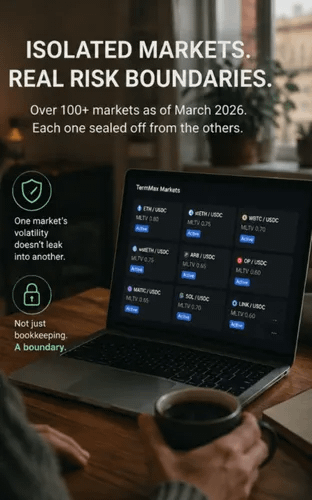
That isolation matters. TermMax had 100+ separate markets in its March 2026 update, with each market operating independently. A collateral event in one market doesn’t automatically spill into GTs from another. $BTW
Repayment can happen by returning the debt tokens directly, or by buying the FTs and returning them. Once the position is settled, the GT closes and the collateral is released.
So the mental model changes:
You don’t have one giant loan balance. $RICE
You have individual GTs, each carrying its own collateral, debt and maturity.
The tradeoff is obvious: does this per-position structure make risk easier to understand, or does managing hundreds of isolated positions become the harder problem?
$CUDIS
@termmax #TermMax
TermMax made me rethink what a loan position actually is.
It isn’t just a number sitting in a balance sheet.
A borrower deposits collateral, and TermMax wraps that position into a Gearing Token, an ERC-721. The market already defines the collateral, debt asset, fixed-rate token and maturity before the GT is created.
Inside each GT, the logic stays simple: collateral deposited and Fixed-Rate Tokens minted against it, subject to the market’s maximum LTV.
With an MLTV of 80%, 1 ETH can support up to 800 USDC of debt.
There’s no shared pool quietly blending positions together.
That isolation matters. TermMax had 100+ separate markets in its March 2026 update, with each market operating independently. A collateral event in one market doesn’t automatically spill into GTs from another. $BTW
Repayment can happen by returning the debt tokens directly, or by buying the FTs and returning them. Once the position is settled, the GT closes and the collateral is released.
So the mental model changes:
You don’t have one giant loan balance. $RICE
You have individual GTs, each carrying its own collateral, debt and maturity.
The tradeoff is obvious: does this per-position structure make risk easier to understand, or does managing hundreds of isolated positions become the harder problem?
$CUDIS
@TermMax #TermMax
It isn’t just a number sitting in a balance sheet.
A borrower deposits collateral, and TermMax wraps that position into a Gearing Token, an ERC-721. The market already defines the collateral, debt asset, fixed-rate token and maturity before the GT is created.
Inside each GT, the logic stays simple: collateral deposited and Fixed-Rate Tokens minted against it, subject to the market’s maximum LTV.
With an MLTV of 80%, 1 ETH can support up to 800 USDC of debt.
There’s no shared pool quietly blending positions together.
That isolation matters. TermMax had 100+ separate markets in its March 2026 update, with each market operating independently. A collateral event in one market doesn’t automatically spill into GTs from another. $BTW
Repayment can happen by returning the debt tokens directly, or by buying the FTs and returning them. Once the position is settled, the GT closes and the collateral is released.
So the mental model changes:
You don’t have one giant loan balance. $RICE
You have individual GTs, each carrying its own collateral, debt and maturity.
The tradeoff is obvious: does this per-position structure make risk easier to understand, or does managing hundreds of isolated positions become the harder problem?
$CUDIS
@TermMax #TermMax
MLTV of 80%
100%
ERC-721
0%
4 проголосовали • Голосование закрыто
24
17
295
·
--
Проверено
#dusk $DUSK @Dusk_Foundation
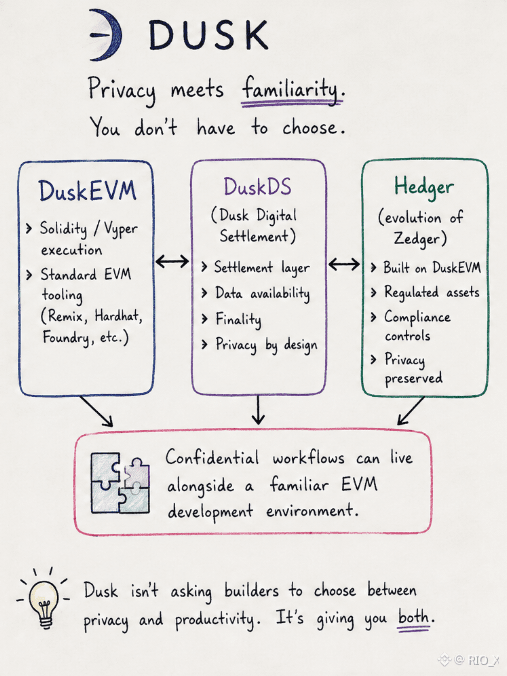
I was looking at DuskEVM today and one detail made me stop: Dusk isn’t asking developers to choose between familiar EVM tooling and the privacy requirements of regulated assets.
DuskEVM gives builders Solidity/Vyper execution and standard EVM tooling, while DuskDS remains the settlement and data-availability layer. Then there’s Hedger, the evolution of Zedger, built on DuskEVM for regulated assets with compliance and privacy constraints. The interesting bit is that confidential workflows can live alongside a familiar EVM development environment. $TUT
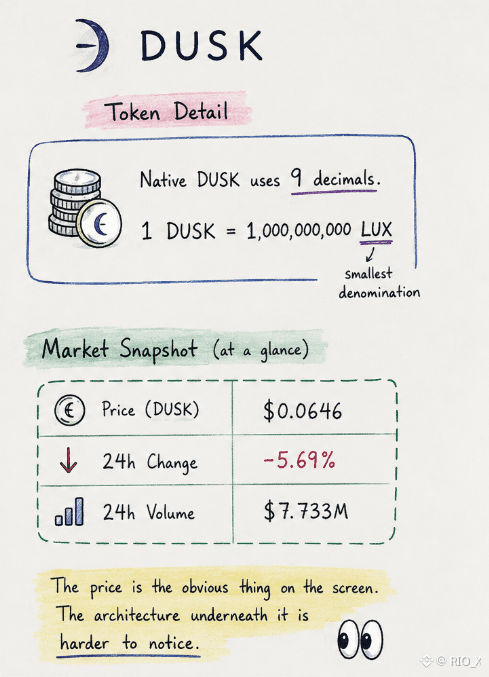
The token detail I hadn’t noticed before is that native DUSK uses 9 decimals, with LUX as its smallest denomination: 1 DUSK equals 1,000,000,000 LUX. $ACE
On the chart, DUSK is at 0.0646, down 5.69% over 24h, with 24h volume at 7.733M.
The price is the obvious thing on the screen. The architecture underneath it is harder to notice.
{future}(ACEUSDT)
{future}(TUTUSDT)
{future}(DUSKUSDT)
#dusk $DUSK @Dusk
I was looking at DuskEVM today and one detail made me stop: Dusk isn’t asking developers to choose between familiar EVM tooling and the privacy requirements of regulated assets.
DuskEVM gives builders Solidity/Vyper execution and standard EVM tooling, while DuskDS remains the settlement and data-availability layer. Then there’s Hedger, the evolution of Zedger, built on DuskEVM for regulated assets with compliance and privacy constraints. The interesting bit is that confidential workflows can live alongside a familiar EVM development environment. $TUT
The token detail I hadn’t noticed before is that native DUSK uses 9 decimals, with LUX as its smallest denomination: 1 DUSK equals 1,000,000,000 LUX. $ACE
On the chart, DUSK is at 0.0646, down 5.69% over 24h, with 24h volume at 7.733M.
The price is the obvious thing on the screen. The architecture underneath it is harder to notice.
I was looking at DuskEVM today and one detail made me stop: Dusk isn’t asking developers to choose between familiar EVM tooling and the privacy requirements of regulated assets.
DuskEVM gives builders Solidity/Vyper execution and standard EVM tooling, while DuskDS remains the settlement and data-availability layer. Then there’s Hedger, the evolution of Zedger, built on DuskEVM for regulated assets with compliance and privacy constraints. The interesting bit is that confidential workflows can live alongside a familiar EVM development environment. $TUT
The token detail I hadn’t noticed before is that native DUSK uses 9 decimals, with LUX as its smallest denomination: 1 DUSK equals 1,000,000,000 LUX. $ACE
On the chart, DUSK is at 0.0646, down 5.69% over 24h, with 24h volume at 7.733M.
The price is the obvious thing on the screen. The architecture underneath it is harder to notice.
1 DUSK equals 1000,000000 LUX.
86%
familiar EVM tooling
0%
the evolution of Zedger
14%
7 проголосовали • Голосование закрыто
34
24
1.8k
Войдите, чтобы посмотреть больше материала
Присоединяйтесь к пользователям криптовалют по всему миру на Binance Square
⚡️ Получайте новейшую и полезную информацию о криптоактивах.
💬 Нам доверяет крупнейшая в мире криптобиржа.
👍 Получите достоверные аналитические данные от верифицированных создателей контента.
Эл. почта/номер телефона
В тренде
BinanceKZ
Просмотров: 8,896
50 обсуждают
Как я потерял 180 000 тенге на «менеджере Binance» из WhatsApp — и почему всё равно остался в крипте
phpdead
·Лайков: 6
·Просмотров: 2k
UKFCAWinsCourtOrderToRecover851400Pounds
Просмотров: 3,357
291 обсуждают
ChainlinkLaunchesCCIP2WithEnterpriseVerification
Просмотров: 14,577
574 обсуждают