
Sigma Mind
4.5k Публикации

Sigma Mind
Отправить жалобу
Заблокировать пользователя
Открытая сделка
Трейдер с регулярными сделками
1.1 г
356 подписок(и/а)
13.2K+ подписчиков(а)
4.1K+ понравилось
Посты
Портфель
Все
Цитирования
Активно
·
--
On November 28–29, Binance Blockchain Week 2026 is set to bring the global blockchain community together in Bangkok. With this year’s theme, “EVOLVE,” the spotlight is on how blockchain and artificial intelligence are coming together to shape the next phase of digital innovation.
One area that deserves particular attention is AI Agents. These technologies are becoming an important part of the way businesses and industries operate, helping simplify on-chain processes, improve risk management, support asset management, and make data analysis more efficient. What once seemed like an emerging concept is now becoming a practical part of real-world applications.
The event will create an opportunity for industry experts, developers, and community members to exchange perspectives on innovation, regulatory progress, and the future direction of the blockchain ecosystem. More importantly, it will highlight how collaboration can help turn new ideas into meaningful developments.
The industry never stands still. As technology advances, new opportunities emerge, and the way we understand and exchange value continues to change. Bangkok will be an exciting place to explore these developments, connect with the people building the future, and discover how AI Agents and blockchain can grow together.
Looking forward to the conversations, fresh ideas, and new possibilities that Binance Blockchain Week 2026 will bring.
#BinanceBlockchainWeekEvolveWithYou
#EvolveAtBinanceBlockchainWeek

186
·
--
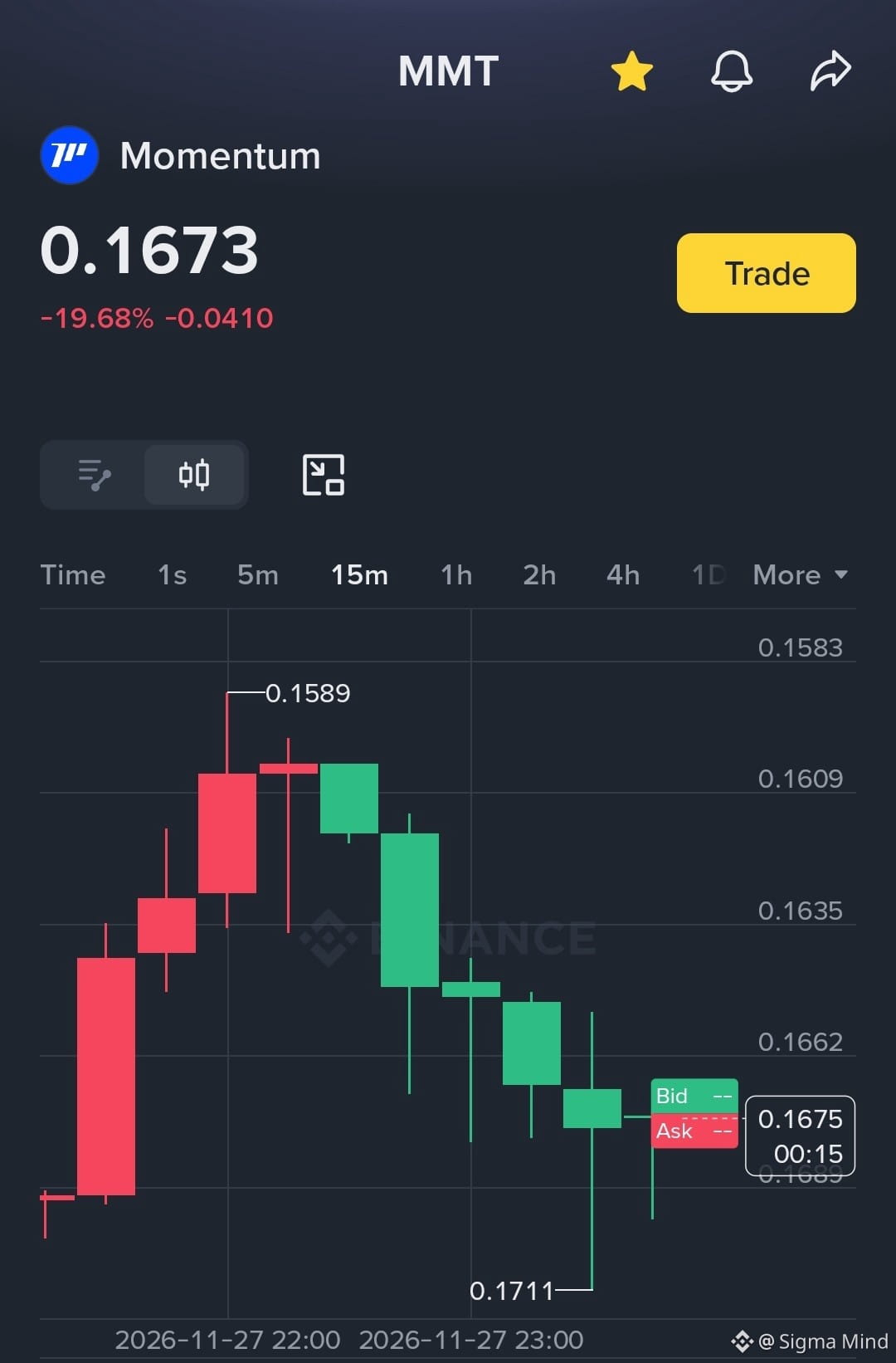
$MMT is showing a difficult side of market behaviour right now. After reaching around $0.1589, the price has moved sharply lower, with the token trading near $0.1673 and showing a reported 19.68% decline. What catches my attention is not simply the size of the move, but the way price has reacted along the way. There are signs of buyers attempting to respond, yet the overall candle structure still reflects considerable selling pressure. The lower wick around $0.1711 suggests that price has experienced some strong rejection, but one reaction is not enough to establish a meaningful change in direction. I think this is where separating a temporary bounce from genuine demand becomes important. Can MMT build enough stability to challenge the recent selling trend, or are buyers stepping in before the market has finished correcting? I'd be watching volume and the next few candle closes rather than getting carried away by a short-lived recovery. Markets often reveal their real condition through what happens after the first bounce, not during it.
{spot}(MMTUSDT)
$MMT is showing a difficult side of market behaviour right now. After reaching around $0.1589, the price has moved sharply lower, with the token trading near $0.1673 and showing a reported 19.68% decline. What catches my attention is not simply the size of the move, but the way price has reacted along the way. There are signs of buyers attempting to respond, yet the overall candle structure still reflects considerable selling pressure. The lower wick around $0.1711 suggests that price has experienced some strong rejection, but one reaction is not enough to establish a meaningful change in direction. I think this is where separating a temporary bounce from genuine demand becomes important. Can MMT build enough stability to challenge the recent selling trend, or are buyers stepping in before the market has finished correcting? I'd be watching volume and the next few candle closes rather than getting carried away by a short-lived recovery. Markets often reveal their real condition through what happens after the first bounce, not during it.
1
494
·
--
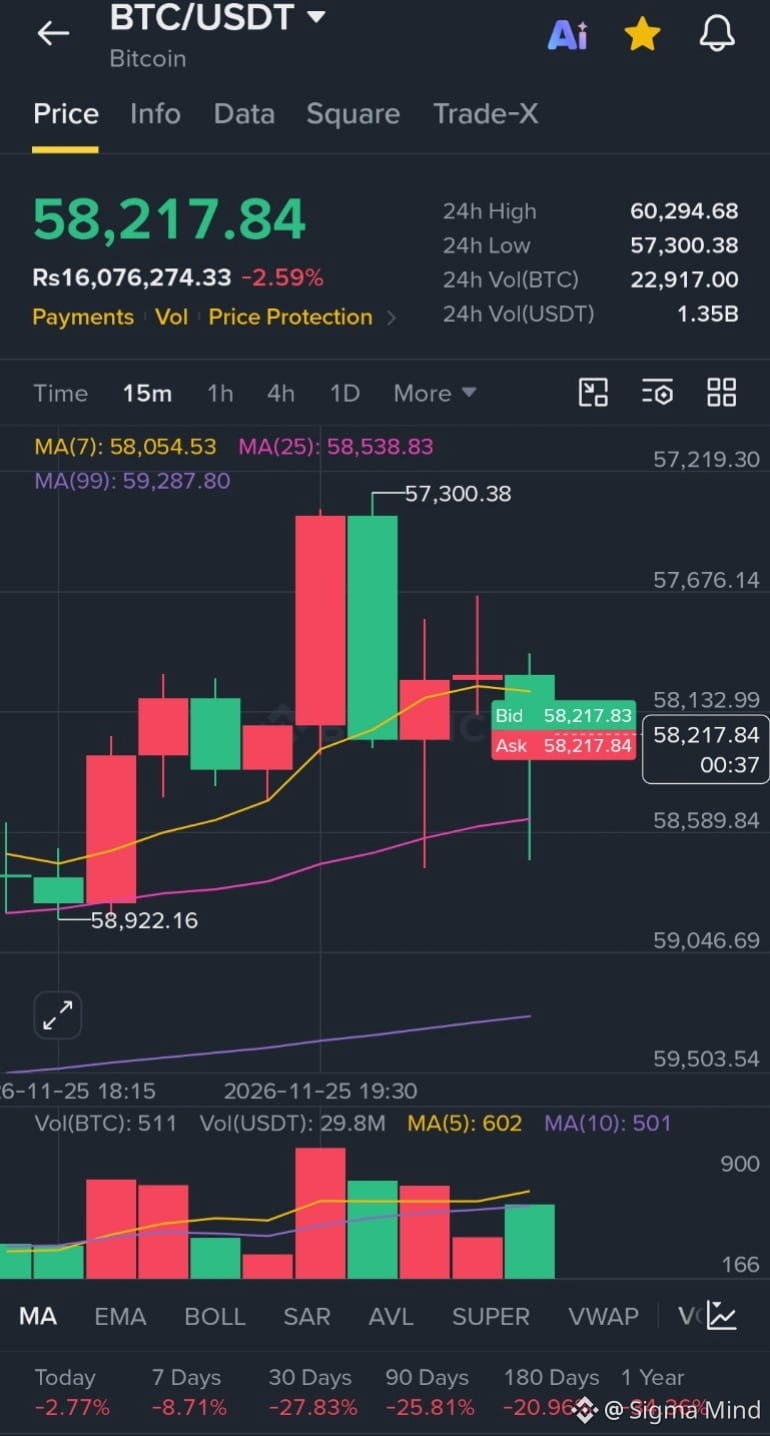
Bitcoin is in an interesting position right now, but the broader picture deserves more attention than the latest candle. Trading around $58,217, $BTC is still down nearly 2.6% over 24 hours, with the weekly decline reaching 8.71%. What stands out to me is the difference between short-term recovery attempts and actual market strength. Buyers have managed to respond after the drop toward $57,300, but price is still struggling around the MA(25) near $58,539 and remains below the MA(99) near $59,288. That tells me the market has not yet earned the benefit of the doubt. I’m particularly interested in whether this consolidation becomes a foundation for recovery or simply gives sellers time to regain control. A green candle can change the mood for a few minutes, but rebuilding confidence takes more than that. For now, I would pay closer attention to how BTC reacts around $58,500 and whether buying volume supports any move higher. The market doesn't owe anyone an immediate recovery, and that's exactly why patience and risk awareness matter here.
Bitcoin is in an interesting position right now, but the broader picture deserves more attention than the latest candle. Trading around $58,217, $BTC is still down nearly 2.6% over 24 hours, with the weekly decline reaching 8.71%. What stands out to me is the difference between short-term recovery attempts and actual market strength. Buyers have managed to respond after the drop toward $57,300, but price is still struggling around the MA(25) near $58,539 and remains below the MA(99) near $59,288. That tells me the market has not yet earned the benefit of the doubt. I’m particularly interested in whether this consolidation becomes a foundation for recovery or simply gives sellers time to regain control. A green candle can change the mood for a few minutes, but rebuilding confidence takes more than that. For now, I would pay closer attention to how BTC reacts around $58,500 and whether buying volume supports any move higher. The market doesn't owe anyone an immediate recovery, and that's exactly why patience and risk awareness matter here.
97
·
--
$BNB is showing how quickly market sentiment can change when selling pressure starts building. Price is sitting around $535 after a sharp move lower, and although buyers have stepped in to create a small recovery, I’m not convinced that one bounce is enough to call it a reversal. The 15-minute chart still shows price struggling below the MA(7) at $537.19 and MA(25) at $539.58, while the volume spike suggests this move deserves attention. What interests me most is how the market behaves from here: will buyers defend the $532–$533 area, or will sellers use every recovery as another opportunity to push lower? I would rather see price reclaim the short-term averages with convincing volume before calling momentum bullish again. For now, patience matters more than predictions. The next few candles may reveal more than the recent drop itself.
#CorePCEBeatLiftsFedHikeOdds
#BitcoinAndStocksSlipAgainAmidTrump’sTariffPlans
#JensenHuangSaysNvidiaDoesn’tNeedASuccessionPlan
{spot}(BNBUSDT)
$BNB is showing how quickly market sentiment can change when selling pressure starts building. Price is sitting around $535 after a sharp move lower, and although buyers have stepped in to create a small recovery, I’m not convinced that one bounce is enough to call it a reversal. The 15-minute chart still shows price struggling below the MA(7) at $537.19 and MA(25) at $539.58, while the volume spike suggests this move deserves attention. What interests me most is how the market behaves from here: will buyers defend the $532–$533 area, or will sellers use every recovery as another opportunity to push lower? I would rather see price reclaim the short-term averages with convincing volume before calling momentum bullish again. For now, patience matters more than predictions. The next few candles may reveal more than the recent drop itself.
#CorePCEBeatLiftsFedHikeOdds
#BitcoinAndStocksSlipAgainAmidTrump’sTariffPlans
#JensenHuangSaysNvidiaDoesn’tNeedASuccessionPlan
#CorePCEBeatLiftsFedHikeOdds
#BitcoinAndStocksSlipAgainAmidTrump’sTariffPlans
#JensenHuangSaysNvidiaDoesn’tNeedASuccessionPlan
92
·
--
🔥Money is hard to earn, and it is even harder to lose in stupid ways.
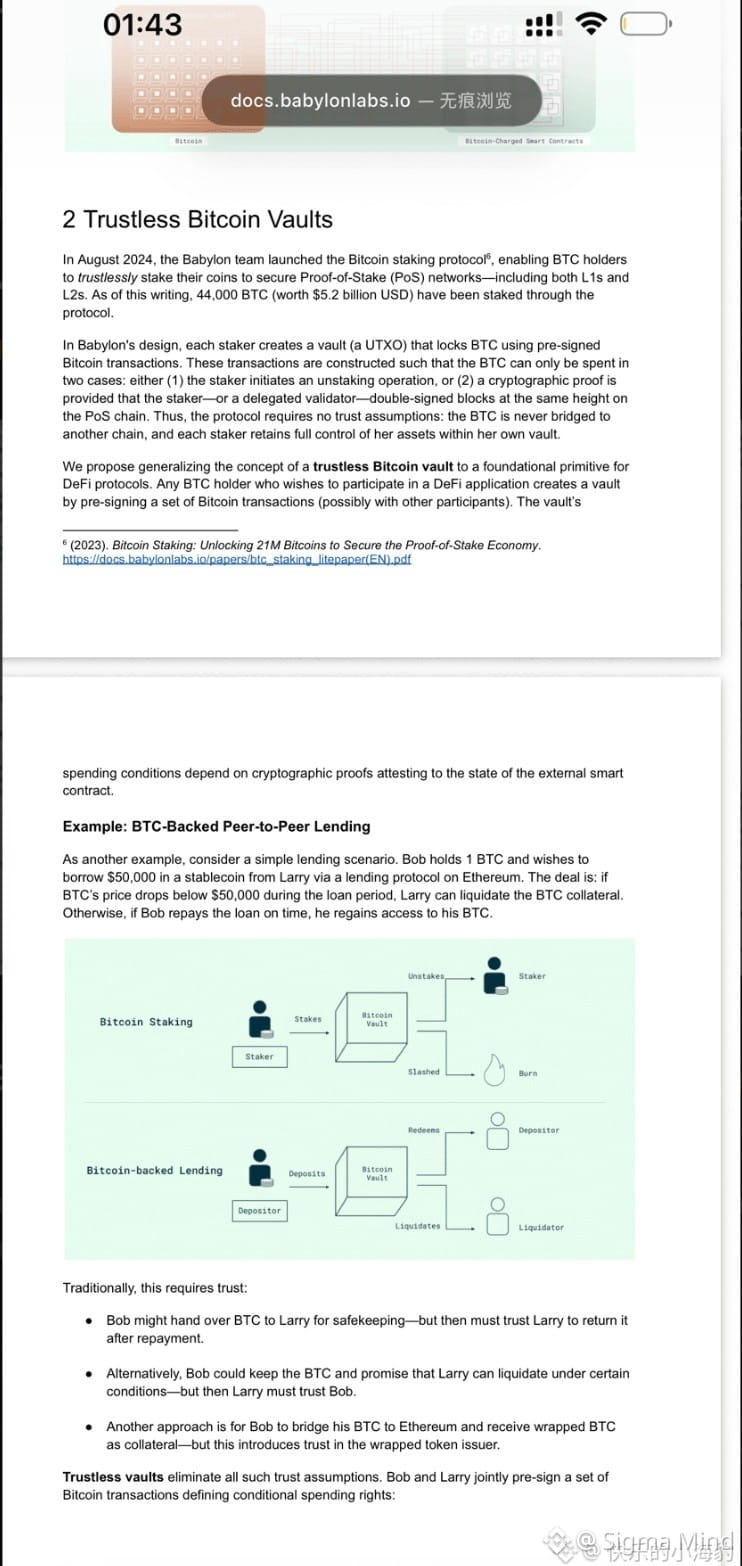
A lot of people still do not realize this: Bitcoin has always been “blind” and “deaf” to the outside world. It cannot easily see external state, and its programmability is very limited. That is why things like borrowing against BTC or automatically liquidating positions based on price changes are normal on Ethereum, but almost impossible on Bitcoin.
To unlock this sleeping “Gold Mountain,” BitVM was created.
The first BitVM, proposed by Robin Linus in 2023, tried to let Bitcoin verify some off-chain computation without breaking Satoshi’s original design. But it depended on multi-party signatures and an always-online challenger, so real-world use was still messy.
BitVM2 pushed zero-knowledge proofs directly onto Bitcoin, but the cost became extreme. A single verification could cost tens of thousands of dollars, which made it unrealistic for ordinary users.
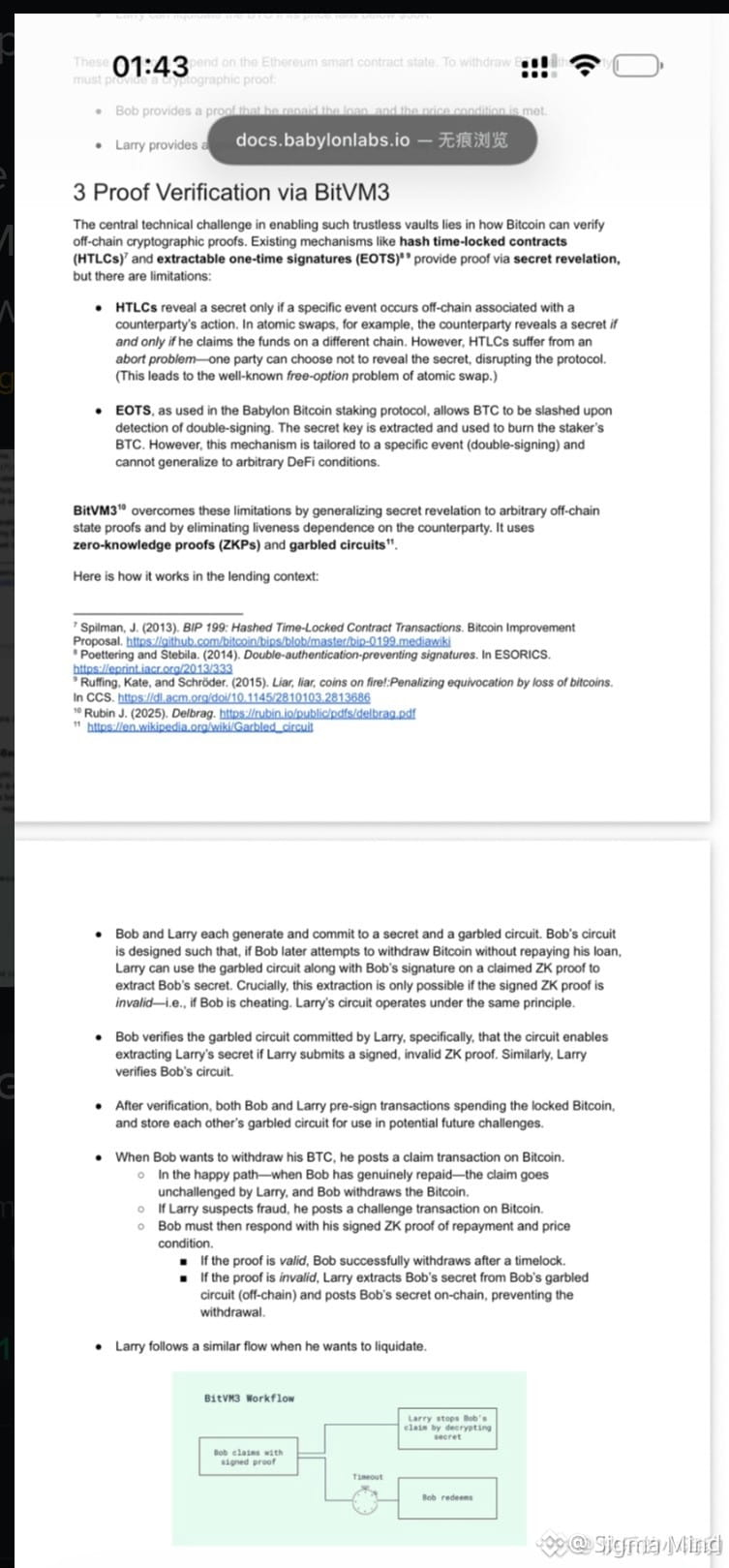
Then came BitVM3, the version used by @BabylonLabs_io $BABY Trustless Bitcoin Vaults (TBV). This is where the design became much more practical. Most verification moves off-chain, and Bitcoin only does a small amount of on-chain work when needed. That cuts challenge costs from over ten thousand dollars to roughly tens or low hundreds of dollars, while also reducing the need for challengers to stay online all the time.
So what is the challenge mechanism? If you lock BTC in a TBV vault and later claim you repaid a loan and want your BTC back, others can challenge that claim: “Show the proof.” If you cannot produce a valid zero-knowledge proof, you do not get your Bitcoin back. That is the anti-fraud layer.
Through BitVM3, TBV makes native BTC participate in lending and collateralized DeFi without bridging out and without giving control to an intermediary.
Cold Gold Mountain may finally be waking up.
@babylonlabs_io #baby $BABY
🔥Money is hard to earn, and it is even harder to lose in stupid ways.
A lot of people still do not realize this: Bitcoin has always been “blind” and “deaf” to the outside world. It cannot easily see external state, and its programmability is very limited. That is why things like borrowing against BTC or automatically liquidating positions based on price changes are normal on Ethereum, but almost impossible on Bitcoin.
To unlock this sleeping “Gold Mountain,” BitVM was created.
The first BitVM, proposed by Robin Linus in 2023, tried to let Bitcoin verify some off-chain computation without breaking Satoshi’s original design. But it depended on multi-party signatures and an always-online challenger, so real-world use was still messy.
BitVM2 pushed zero-knowledge proofs directly onto Bitcoin, but the cost became extreme. A single verification could cost tens of thousands of dollars, which made it unrealistic for ordinary users.
Then came BitVM3, the version used by @BabylonLabs_io $BABY Trustless Bitcoin Vaults (TBV). This is where the design became much more practical. Most verification moves off-chain, and Bitcoin only does a small amount of on-chain work when needed. That cuts challenge costs from over ten thousand dollars to roughly tens or low hundreds of dollars, while also reducing the need for challengers to stay online all the time.
So what is the challenge mechanism? If you lock BTC in a TBV vault and later claim you repaid a loan and want your BTC back, others can challenge that claim: “Show the proof.” If you cannot produce a valid zero-knowledge proof, you do not get your Bitcoin back. That is the anti-fraud layer.
Through BitVM3, TBV makes native BTC participate in lending and collateralized DeFi without bridging out and without giving control to an intermediary.
Cold Gold Mountain may finally be waking up.
@BabylonLabs_io #baby $BABY
6
1
140
·
--
Brothers Big Mao is here Today #ALPHA Supposedly there is a new coin airdrop at 6 PM this afternoon With the current market anyone willing to list now is probably not simple So hold the bigger picture
Today I checked $BSB trade volume at 66000 and ended up with a loss of about 3 bucks
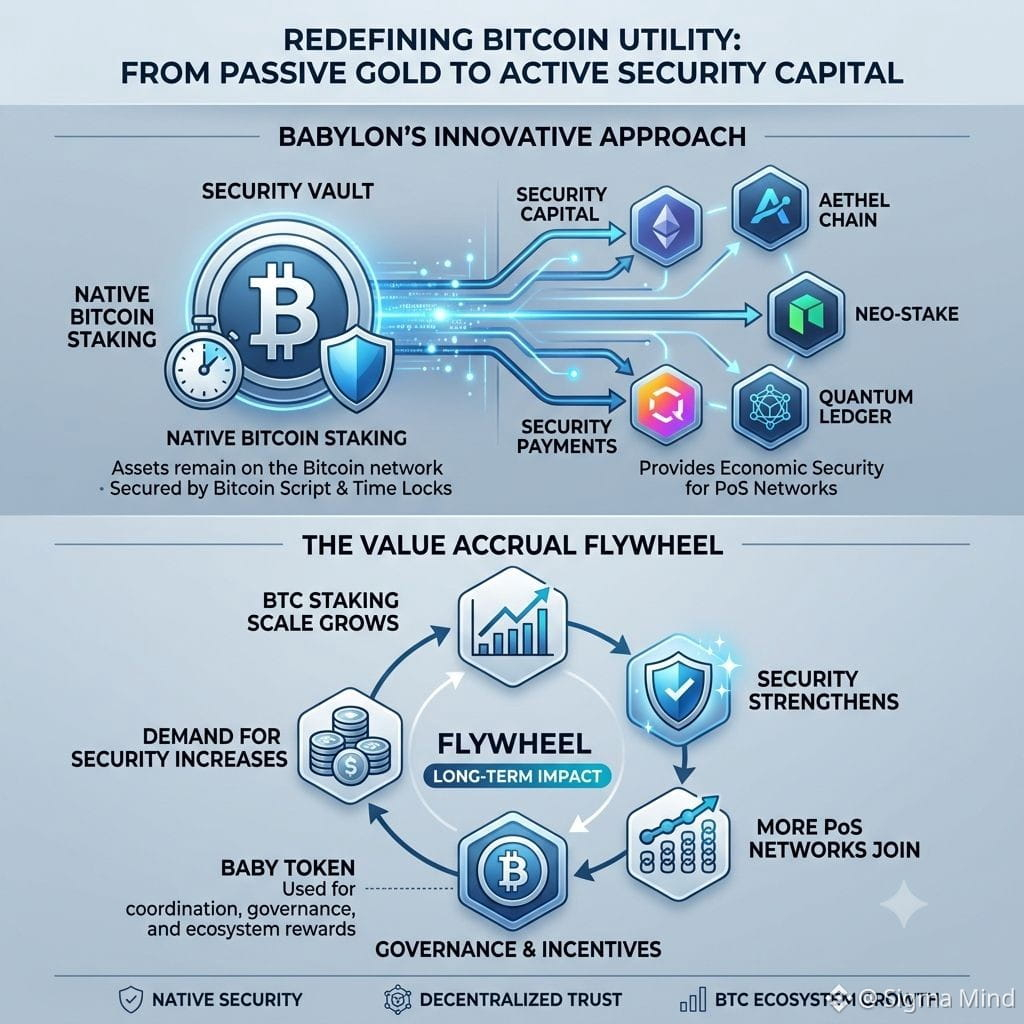
I re read the Babylon whitepaper and I think its real goal is not just giving BTC an investment entry point or focusing on staking rewards The deeper problem it wants to solve is activating Bitcoin’s security power
Babylon’s core idea is native Bitcoin staking Bitcoin does not leave the Bitcoin network or rely on cross chain bridges Through Bitcoin Script the UTXO model and time lock mechanisms users lock BTC directly to provide economic security for PoS networks
Unlike traditional BTCFi which moves BTC into wrapped assets and DeFi through bridges adding custody risk Babylon keeps BTC within Bitcoin’s rules and uses cryptographic mechanisms for security services
Babylon offers another model BTC as secure capital and PoS chains paying for security
The BABY token has a total supply of 10 billion and is mainly used for governance ecosystem incentives and participant coordination
The flywheel is simple BTC staking grows security strengthens more PoS networks join security demand increases and more BTC participates
What matters next is BTC staking scale the number of connected networks and the validator ecosystem size
Risks still exist but based on the whitepaper Babylon is not betting on a short term narrative It is betting that BTC can become not only digital gold but also a security collateral asset for the broader blockchain world
If this direction holds Babylon could change how BTC is used for decades@babylonlabs_io #baby $BABY
Brothers Big Mao is here Today #ALPHA Supposedly there is a new coin airdrop at 6 PM this afternoon With the current market anyone willing to list now is probably not simple So hold the bigger picture
Today I checked $BSB trade volume at 66000 and ended up with a loss of about 3 bucks
I re read the Babylon whitepaper and I think its real goal is not just giving BTC an investment entry point or focusing on staking rewards The deeper problem it wants to solve is activating Bitcoin’s security power
Babylon’s core idea is native Bitcoin staking Bitcoin does not leave the Bitcoin network or rely on cross chain bridges Through Bitcoin Script the UTXO model and time lock mechanisms users lock BTC directly to provide economic security for PoS networks
Unlike traditional BTCFi which moves BTC into wrapped assets and DeFi through bridges adding custody risk Babylon keeps BTC within Bitcoin’s rules and uses cryptographic mechanisms for security services
Babylon offers another model BTC as secure capital and PoS chains paying for security
The BABY token has a total supply of 10 billion and is mainly used for governance ecosystem incentives and participant coordination
The flywheel is simple BTC staking grows security strengthens more PoS networks join security demand increases and more BTC participates
What matters next is BTC staking scale the number of connected networks and the validator ecosystem size
Risks still exist but based on the whitepaper Babylon is not betting on a short term narrative It is betting that BTC can become not only digital gold but also a security collateral asset for the broader blockchain world
If this direction holds Babylon could change how BTC is used for decades@BabylonLabs_io #baby $BABY
3
1
244
·
--
Проверено
let's try to understand what is the real story iS
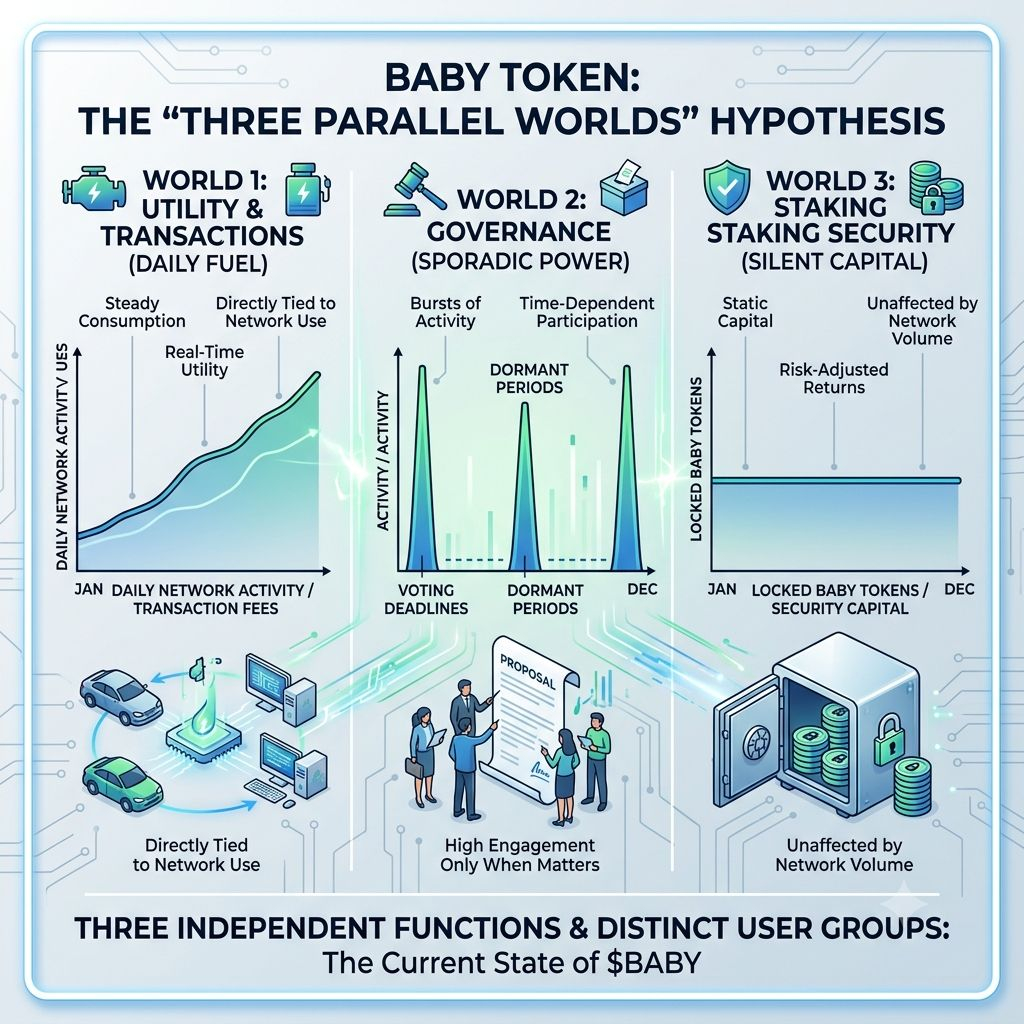
A token is often designed as a coherent system: people who pay fees with it are likely to use it for governance as well, and also to stake it to earn security-related returns. These three functions reinforce each other, forming a closed loop. I originally thought BABY followed the same logic—until I looked at its three uses—fuel for network transactions, protocol governance, and Bitcoin staking security—and realized that it’s completely not the case.
The active rhythms of these three parts, as I see it, run independently: everyday trading consumption is almost directly tied to the network’s real activity, following a mechanical, steady curve; governance activity likely spikes only around the time proposals are close to their voting deadline and is mostly dormant otherwise; and the portion of tokens locked for staking security is essentially unaffected by any fluctuations in the first two—it just sits there quietly. The three curves barely overlap, and it’s rare that the same batch of token holders deeply participates in all three.
My view is this: this might not necessarily be a design flaw. More likely, in the early stages, utility naturally got split among three different types of user groups—users who want convenience only use it for trading; users who care about having a say only participate in governance; and users seeking stable, risk-adjusted returns only stake. This “each fights its own battle” state doesn’t disrupt the protocol’s normal operation in the short term. But in the long run, if there never becomes a use case strong enough to attract the other two groups as well, the token’s value-capture ability could be diluted by this fragmentation. The valuation logic would also become more complex—not something that can be neatly calculated by a simple “total supply multiplied by a certain use.”
@babylonlabs_io #baby $BABY
Do you think a token’s multiple uses will ultimately converge into a coordinated system, or will it remain three parallel worlds?
let's try to understand what is the real story iS
A token is often designed as a coherent system: people who pay fees with it are likely to use it for governance as well, and also to stake it to earn security-related returns. These three functions reinforce each other, forming a closed loop. I originally thought BABY followed the same logic—until I looked at its three uses—fuel for network transactions, protocol governance, and Bitcoin staking security—and realized that it’s completely not the case.
The active rhythms of these three parts, as I see it, run independently: everyday trading consumption is almost directly tied to the network’s real activity, following a mechanical, steady curve; governance activity likely spikes only around the time proposals are close to their voting deadline and is mostly dormant otherwise; and the portion of tokens locked for staking security is essentially unaffected by any fluctuations in the first two—it just sits there quietly. The three curves barely overlap, and it’s rare that the same batch of token holders deeply participates in all three.
My view is this: this might not necessarily be a design flaw. More likely, in the early stages, utility naturally got split among three different types of user groups—users who want convenience only use it for trading; users who care about having a say only participate in governance; and users seeking stable, risk-adjusted returns only stake. This “each fights its own battle” state doesn’t disrupt the protocol’s normal operation in the short term. But in the long run, if there never becomes a use case strong enough to attract the other two groups as well, the token’s value-capture ability could be diluted by this fragmentation. The valuation logic would also become more complex—not something that can be neatly calculated by a simple “total supply multiplied by a certain use.”
@BabylonLabs_io #baby $BABY
Do you think a token’s multiple uses will ultimately converge into a coordinated system, or will it remain three parallel worlds?
1
3
807
·
--
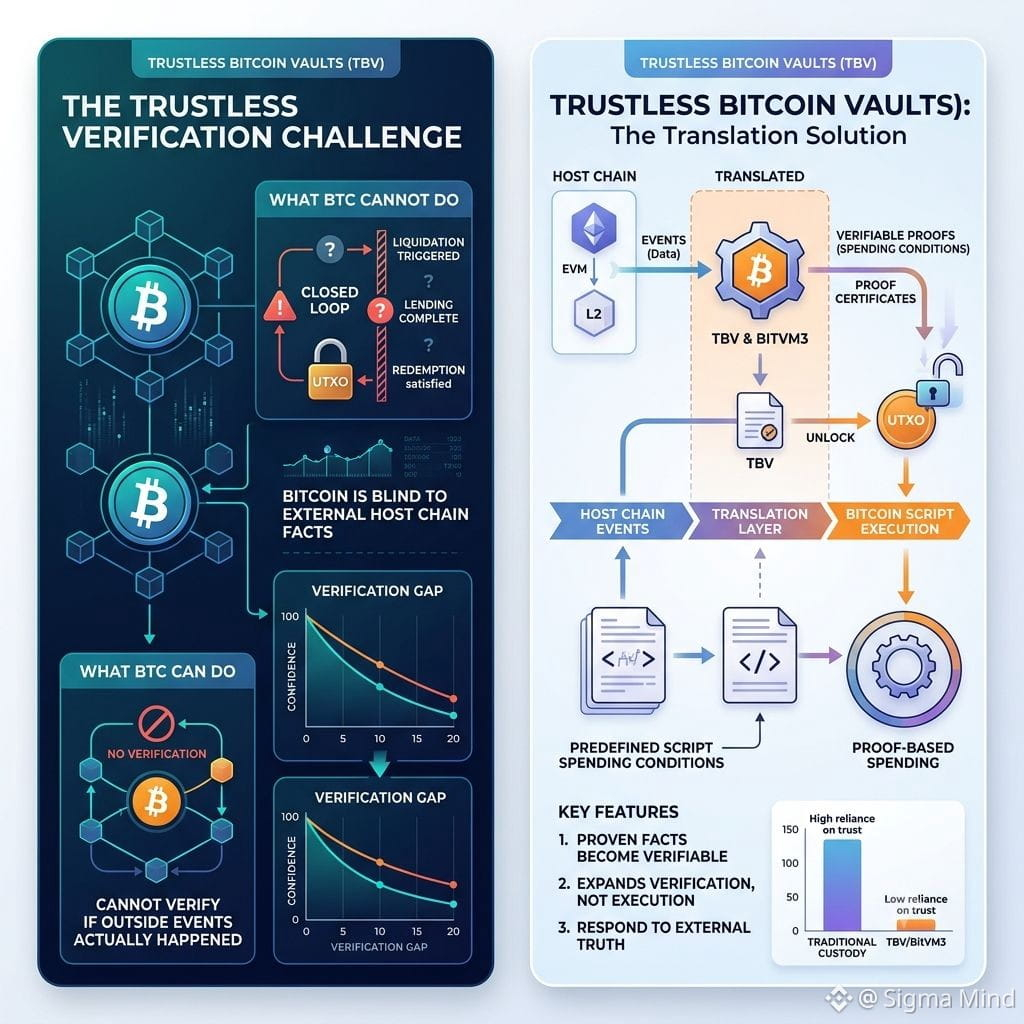
#baby $BABY I re-read the technical documentation on Trustless Bitcoin Vaults (TBV) from @babylonlabs_io over the past few days. I originally wanted to confirm the redemption process, but I kept getting stuck on the word “translation.” After going back through BitVM3 and the official flowchart, I realized something important: the “translation” described by the source does not change data transmission itself. It changes how Bitcoin verifies that external events have actually happened.
I used to think the biggest obstacle for BTC in more financial applications was cross-chain interoperability and custody. The more I researched, the more I realized I had misunderstood the problem. What Bitcoin cannot do is not receiving external information. What it cannot do is verify whether an event that already happened on the Host Chain is actually true. Whether lending has been completed, liquidation has been triggered, or redemption conditions have been satisfied, all of that happens outside Bitcoin consensus.
That is why TBV matters to me. It does not move BTC into another system. It turns already proven Host Chain events into proofs that Bitcoin can verify, so they can satisfy predefined Script spending conditions. Bitcoin does not change its consensus rules. It simply checks proofs it can verify before deciding whether a UTXO can be spent.
That is also why @BabylonLabs_io building TBV around BitVM3 makes sense. It is not trying to turn Bitcoin into a smart contract platform. It is making it possible, for the first time, for Bitcoin to respond to native BTC spending based on externally proven events. TBV does not extend Bitcoin’s execution capability; it expands Bitcoin’s ability to verify and respond to external facts.
#baby $BABY I re-read the technical documentation on Trustless Bitcoin Vaults (TBV) from @BabylonLabs_io over the past few days. I originally wanted to confirm the redemption process, but I kept getting stuck on the word “translation.” After going back through BitVM3 and the official flowchart, I realized something important: the “translation” described by the source does not change data transmission itself. It changes how Bitcoin verifies that external events have actually happened.
I used to think the biggest obstacle for BTC in more financial applications was cross-chain interoperability and custody. The more I researched, the more I realized I had misunderstood the problem. What Bitcoin cannot do is not receiving external information. What it cannot do is verify whether an event that already happened on the Host Chain is actually true. Whether lending has been completed, liquidation has been triggered, or redemption conditions have been satisfied, all of that happens outside Bitcoin consensus.
That is why TBV matters to me. It does not move BTC into another system. It turns already proven Host Chain events into proofs that Bitcoin can verify, so they can satisfy predefined Script spending conditions. Bitcoin does not change its consensus rules. It simply checks proofs it can verify before deciding whether a UTXO can be spent.
That is also why @BabylonLabs_io building TBV around BitVM3 makes sense. It is not trying to turn Bitcoin into a smart contract platform. It is making it possible, for the first time, for Bitcoin to respond to native BTC spending based on externally proven events. TBV does not extend Bitcoin’s execution capability; it expands Bitcoin’s ability to verify and respond to external facts.
4
3
166
·
--
When I went through the technical materials for “Trustless Bitcoin Vaults (TBV)” under @BabylonLabs_io, I first saw it as another BTC custody design. But the idea that “each Vault corresponds to an independent UTXO” made me rethink the problem it is trying to solve.
As Bitcoin moves into more financial use cases, the real challenge is not whether BTC has value, but how it can support richer control logic while still staying within Bitcoin’s constraints. Many BTCFi designs try to gain functionality by moving BTC into other execution environments through bridges, wrapped assets, or custody systems. That expands utility, but it also adds new trust assumptions.
What stands out to me about TBV is that it does not move BTC elsewhere. Instead, it redesigns the Vault inside Bitcoin’s native rules. Each Vault maps to an independent UTXO, so BTC never enters a shared pool. The ownership state remains on Bitcoin itself, which feels important because it preserves Bitcoin’s core asset model.
TBV also changes how BTC state transitions work. Rather than relying on a manager, redemption requires proof of the target chain’s state, with a challenge window for incorrect states. For me, that is the real value of TBV: native control under Bitcoin’s existing rules.
@babylonlabs_io #baby $BABY
When I went through the technical materials for “Trustless Bitcoin Vaults (TBV)” under @BabylonLabs_io, I first saw it as another BTC custody design. But the idea that “each Vault corresponds to an independent UTXO” made me rethink the problem it is trying to solve.
As Bitcoin moves into more financial use cases, the real challenge is not whether BTC has value, but how it can support richer control logic while still staying within Bitcoin’s constraints. Many BTCFi designs try to gain functionality by moving BTC into other execution environments through bridges, wrapped assets, or custody systems. That expands utility, but it also adds new trust assumptions.
What stands out to me about TBV is that it does not move BTC elsewhere. Instead, it redesigns the Vault inside Bitcoin’s native rules. Each Vault maps to an independent UTXO, so BTC never enters a shared pool. The ownership state remains on Bitcoin itself, which feels important because it preserves Bitcoin’s core asset model.
TBV also changes how BTC state transitions work. Rather than relying on a manager, redemption requires proof of the target chain’s state, with a challenge window for incorrect states. For me, that is the real value of TBV: native control under Bitcoin’s existing rules.
@BabylonLabs_io #baby $BABY
1 UTXO = 1 Vault (No pooling)
33%
Native state verification
0%
Self-custody / No wrapping
67%
Eliminates bridge risk
0%
3 проголосовали • Голосование закрыто
2
1
146
·
--
let's try to understand what is the real story iS
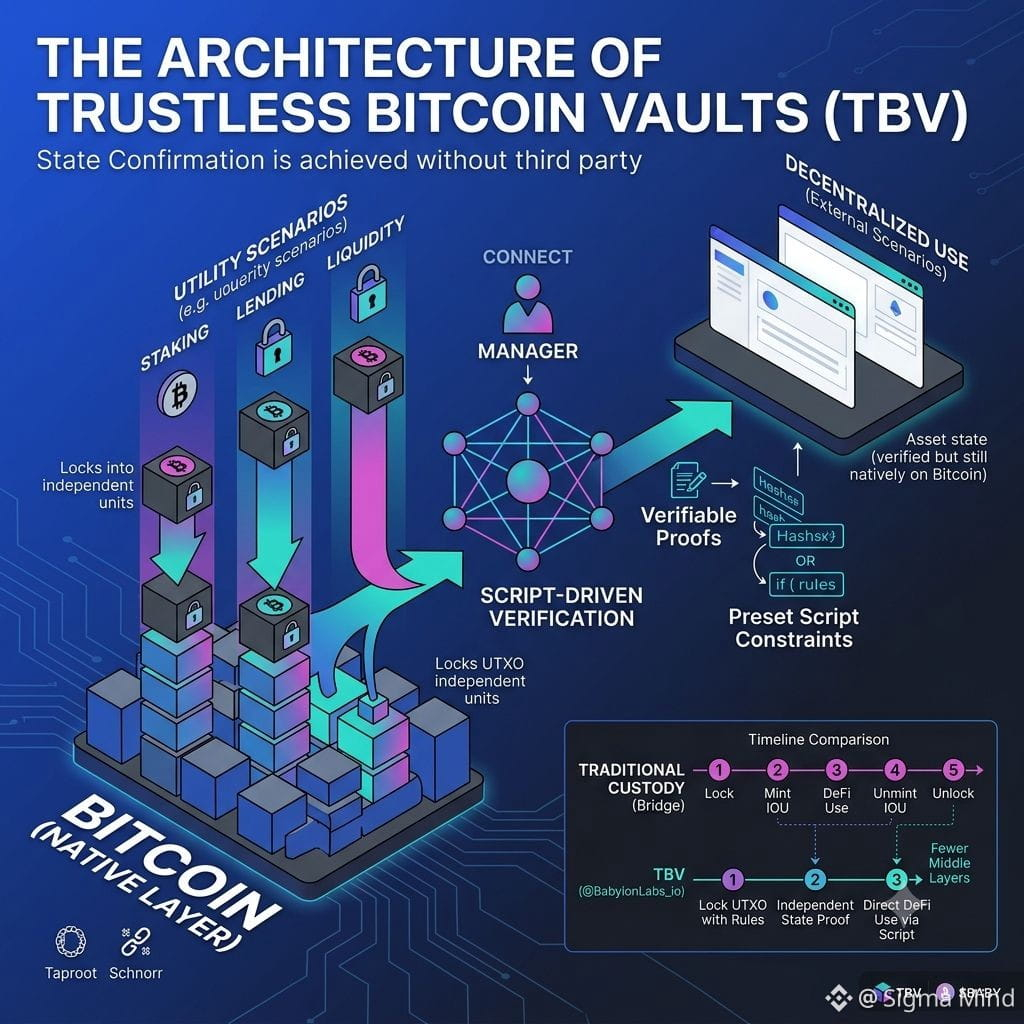
#baby $BABY When reexamining Trustless Bitcoin Vaults, for @babylonlabs_io the same question is still turning in my head: as Bitcoin moves into more financial scenarios, is what’s really being constrained liquidity, or is there a missing way to use it that doesn’t require trusting someone else all over again.
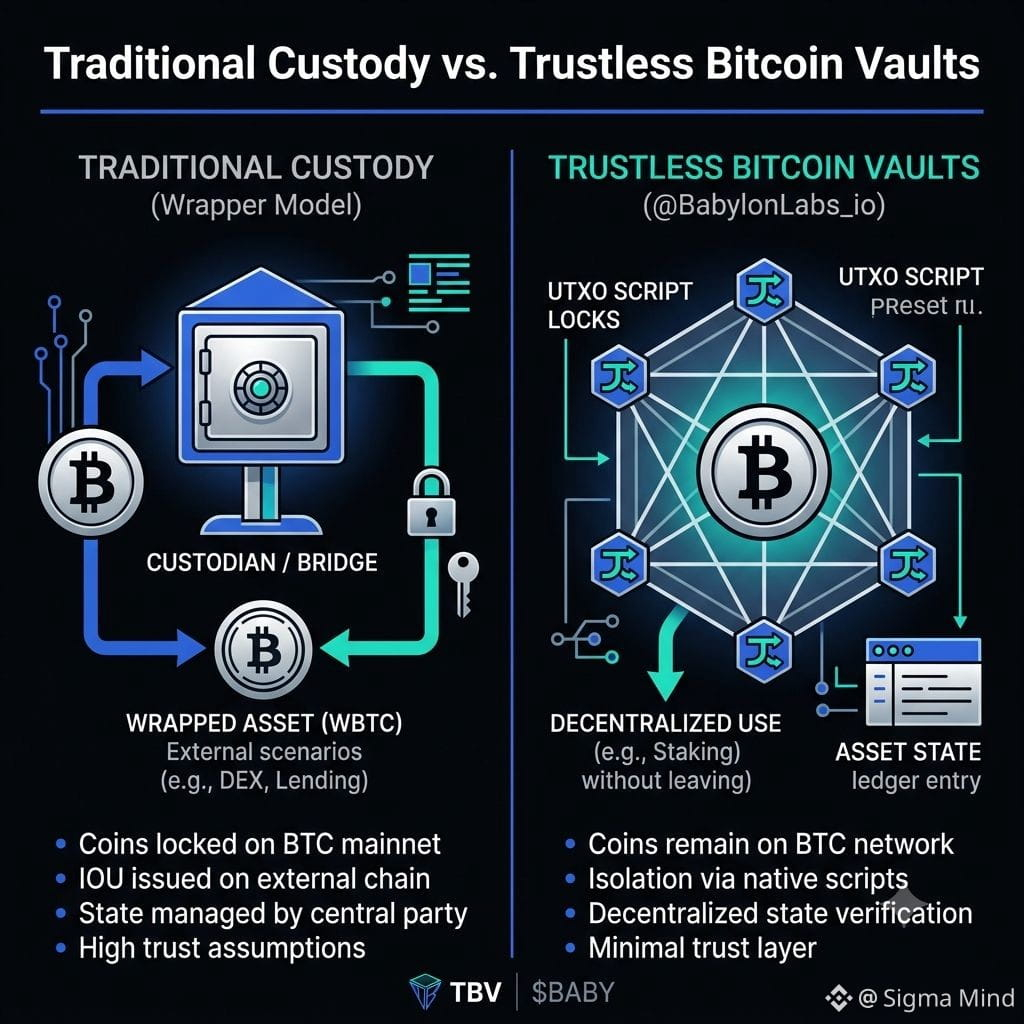
Right now, most approaches—let’s be honest—still start by moving the coins into another system. Bridges, wrappers, custody—at the end of the day someone has to prove, “the coins are still there.” The game gets more varied, but you also quietly add another layer of trust. I went through something similar before. Later, I gradually realized that this layer of dependency has always been hanging there. #baby
What made me stop and look more closely with Babylon’s TBV is not that it rushed to change where the coins sit, but that it rethought how state should be confirmed. The coins remain on the Bitcoin network; they’re turned into independent UTXO-locked units via scripts and Taproot. They’re isolated from one another and don’t enter a shared pool. More importantly, state changes are no longer decided by any single management party; instead they’re driven by preset rules, script constraints, and verifiable proofs. External applications can see state that can be independently verified, not a promise from some party. When I modeled it myself, I really felt the middle layer had been reduced quite a bit. $BABY
Of course, efficiency, integration costs, and the latency of the challenge window—these frictions still need the market to slowly grind them down. At the moment, it’s more like pushing the problem into a cleaner layer rather than having solved everything already. But I think the core issue is worth watching long-term: can we open up usage scenarios while doing our best not to hand control back to centralized mechanisms? The answer will take time, but at least I’ve started taking the direction seriously.
let's try to understand what is the real story iS
#baby $BABY When reexamining Trustless Bitcoin Vaults, for @BabylonLabs_io the same question is still turning in my head: as Bitcoin moves into more financial scenarios, is what’s really being constrained liquidity, or is there a missing way to use it that doesn’t require trusting someone else all over again.
Right now, most approaches—let’s be honest—still start by moving the coins into another system. Bridges, wrappers, custody—at the end of the day someone has to prove, “the coins are still there.” The game gets more varied, but you also quietly add another layer of trust. I went through something similar before. Later, I gradually realized that this layer of dependency has always been hanging there. #baby
What made me stop and look more closely with Babylon’s TBV is not that it rushed to change where the coins sit, but that it rethought how state should be confirmed. The coins remain on the Bitcoin network; they’re turned into independent UTXO-locked units via scripts and Taproot. They’re isolated from one another and don’t enter a shared pool. More importantly, state changes are no longer decided by any single management party; instead they’re driven by preset rules, script constraints, and verifiable proofs. External applications can see state that can be independently verified, not a promise from some party. When I modeled it myself, I really felt the middle layer had been reduced quite a bit. $BABY
Of course, efficiency, integration costs, and the latency of the challenge window—these frictions still need the market to slowly grind them down. At the moment, it’s more like pushing the problem into a cleaner layer rather than having solved everything already. But I think the core issue is worth watching long-term: can we open up usage scenarios while doing our best not to hand control back to centralized mechanisms? The answer will take time, but at least I’ve started taking the direction seriously.
9
5
163
·
--
let's try to understand what is the real story iS
I’ve been sorting through BTC lending and borrowing solutions, and one problem keeps standing out: if you want your Bitcoin to participate in DeFi and generate yield, most options still require you to give up control of your assets. Custodial risk is hard to avoid.
After looking into the TBV trustless Bitcoin vault at @BabylonLabs_io, I saw a different approach. TBV does not rely on wrapped tokens, cross-chain custody, or a third party holding private keys. Instead, users lock BTC in a cryptographically controlled UTXO vault, while the assets remain on the Bitcoin mainnet. With this setup, users can deposit BTC as collateral and borrow stablecoins on Ethereum Aave v4, with room to expand into derivatives and cross-chain lending.
The architecture separates the asset layer, verification layer, and application layer. Babylon verifies collateral status, while Aave handles the lending logic. If one component has an issue, it does not automatically create cascading risk. The main innovation here is trust replacement: removing intermediaries and relying on cryptography and economic consensus instead of centralized custody.
In my view, this is more than just a new protocol. It allows native BTC to serve as a collateral base layer for DeFi without leaving its own ecosystem or trusting a third party. That kind of Bitcoin-native financial channel may have more long-term potential than many L2 scaling approaches. $BABY
Of course, strong architecture does not guarantee smooth deployment. Capital efficiency, ecosystem integration, and extreme-case resilience still need long-term on-chain validation.
I’ve had one question in mind: can this TBV at @BabylonLabs_io truly break the long-standing custody bottleneck in BTCFi? Let’s talk—do you think TBV’s model will see ecosystem growth over the next year?
@babylonlabs_io #baby $BABY
let's try to understand what is the real story iS
I’ve been sorting through BTC lending and borrowing solutions, and one problem keeps standing out: if you want your Bitcoin to participate in DeFi and generate yield, most options still require you to give up control of your assets. Custodial risk is hard to avoid.
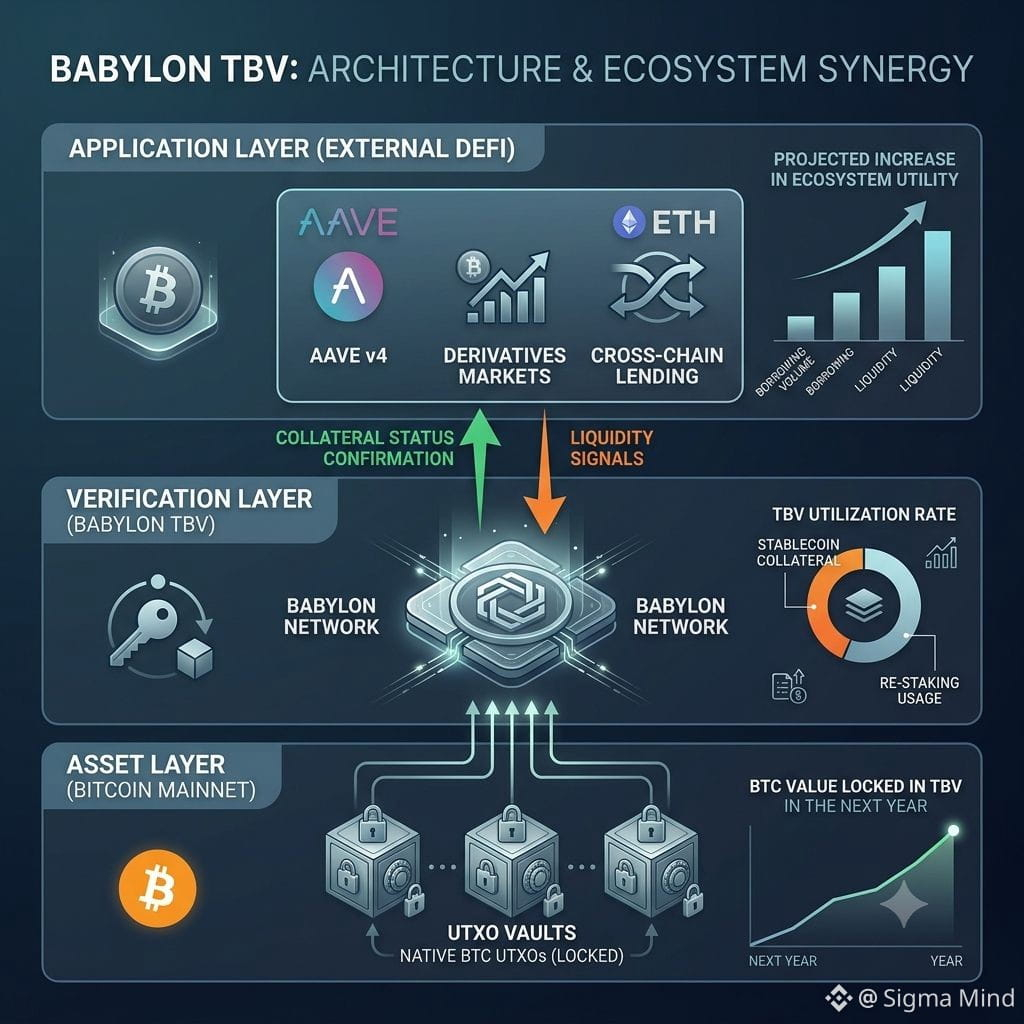
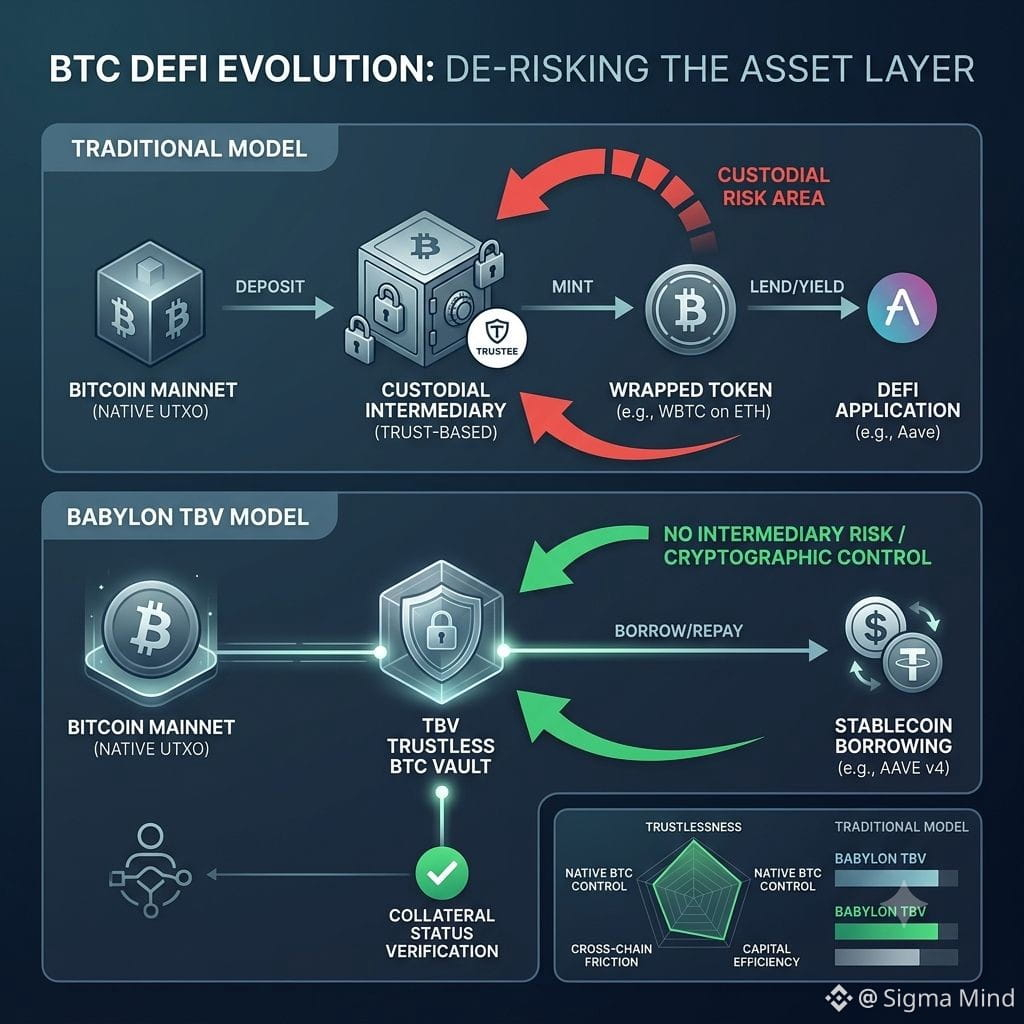
After looking into the TBV trustless Bitcoin vault at @BabylonLabs_io, I saw a different approach. TBV does not rely on wrapped tokens, cross-chain custody, or a third party holding private keys. Instead, users lock BTC in a cryptographically controlled UTXO vault, while the assets remain on the Bitcoin mainnet. With this setup, users can deposit BTC as collateral and borrow stablecoins on Ethereum Aave v4, with room to expand into derivatives and cross-chain lending.
The architecture separates the asset layer, verification layer, and application layer. Babylon verifies collateral status, while Aave handles the lending logic. If one component has an issue, it does not automatically create cascading risk. The main innovation here is trust replacement: removing intermediaries and relying on cryptography and economic consensus instead of centralized custody.
In my view, this is more than just a new protocol. It allows native BTC to serve as a collateral base layer for DeFi without leaving its own ecosystem or trusting a third party. That kind of Bitcoin-native financial channel may have more long-term potential than many L2 scaling approaches. $BABY
Of course, strong architecture does not guarantee smooth deployment. Capital efficiency, ecosystem integration, and extreme-case resilience still need long-term on-chain validation.
I’ve had one question in mind: can this TBV at @BabylonLabs_io truly break the long-standing custody bottleneck in BTCFi? Let’s talk—do you think TBV’s model will see ecosystem growth over the next year?
@BabylonLabs_io #baby $BABY
2
1
262
·
--
let's try to understand what is the real story iS
Here are the most biting data comparisons: Bitcoin’s $1.8 trillion market cap—yet native BTC that can safely participate in DeFi is less than 1%.
Bridging requires private keys, while wrapped assets rely on custodians. That is still a trust game. Anyone who has spent enough time in crypto knows that systems built on “trust me” eventually become targets.
After testing Babylon’s TBV solution, I think this approach may finally be different.
@BabylonLabs_io lets BTC stay where it is while becoming programmable collateral for an external chain. No cross-chain transfer, no wrapped asset. BitVM3 embeds the logic into Bitcoin, while BABE uses zero-knowledge proofs to verify that the BTC is genuinely locked before collateral is accepted.
Instead of trusting custodians, bridges, or multisigs, the model shifts verification toward mathematics.
$BABY
That said, I am still keeping only a small position.
Even with flawless cryptographic proofs, liquidation and execution still depend on the external chain’s sequencer. If the sequencer stalls during volatile markets, price can cross the liquidation threshold before execution. The proof is correct, but timing becomes the weak point.
For now, decentralized BTC finance still has to fight an enemy called time.
Do you think ZK-Rollups can eventually eliminate this friction? Let’s discuss in the comments.
@babylonlabs_io #baby $BABY
let's try to understand what is the real story iS
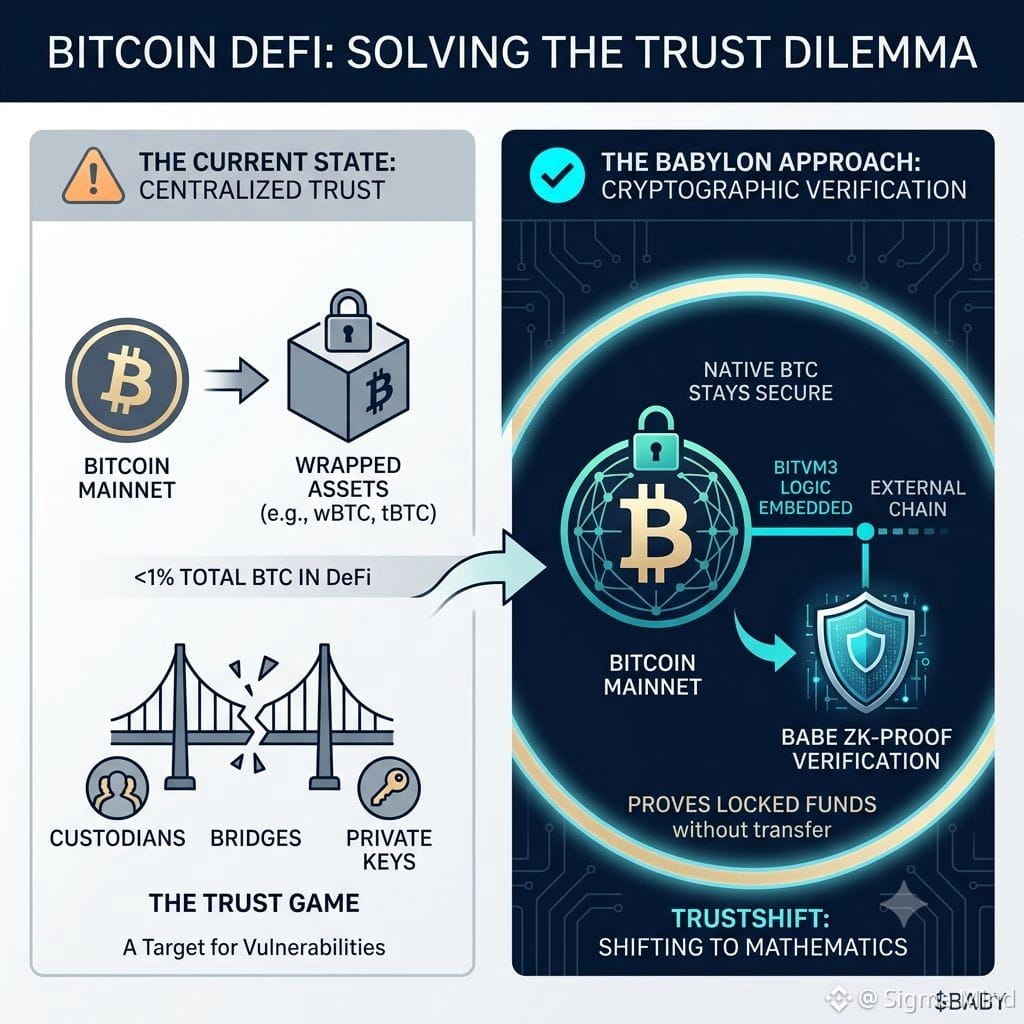
Here are the most biting data comparisons: Bitcoin’s $1.8 trillion market cap—yet native BTC that can safely participate in DeFi is less than 1%.
Bridging requires private keys, while wrapped assets rely on custodians. That is still a trust game. Anyone who has spent enough time in crypto knows that systems built on “trust me” eventually become targets.
After testing Babylon’s TBV solution, I think this approach may finally be different.
@BabylonLabs_io lets BTC stay where it is while becoming programmable collateral for an external chain. No cross-chain transfer, no wrapped asset. BitVM3 embeds the logic into Bitcoin, while BABE uses zero-knowledge proofs to verify that the BTC is genuinely locked before collateral is accepted.
Instead of trusting custodians, bridges, or multisigs, the model shifts verification toward mathematics.
$BABY
That said, I am still keeping only a small position.
Even with flawless cryptographic proofs, liquidation and execution still depend on the external chain’s sequencer. If the sequencer stalls during volatile markets, price can cross the liquidation threshold before execution. The proof is correct, but timing becomes the weak point.
For now, decentralized BTC finance still has to fight an enemy called time.
Do you think ZK-Rollups can eventually eliminate this friction? Let’s discuss in the comments.
@BabylonLabs_io #baby $BABY
2
2
164
·
--
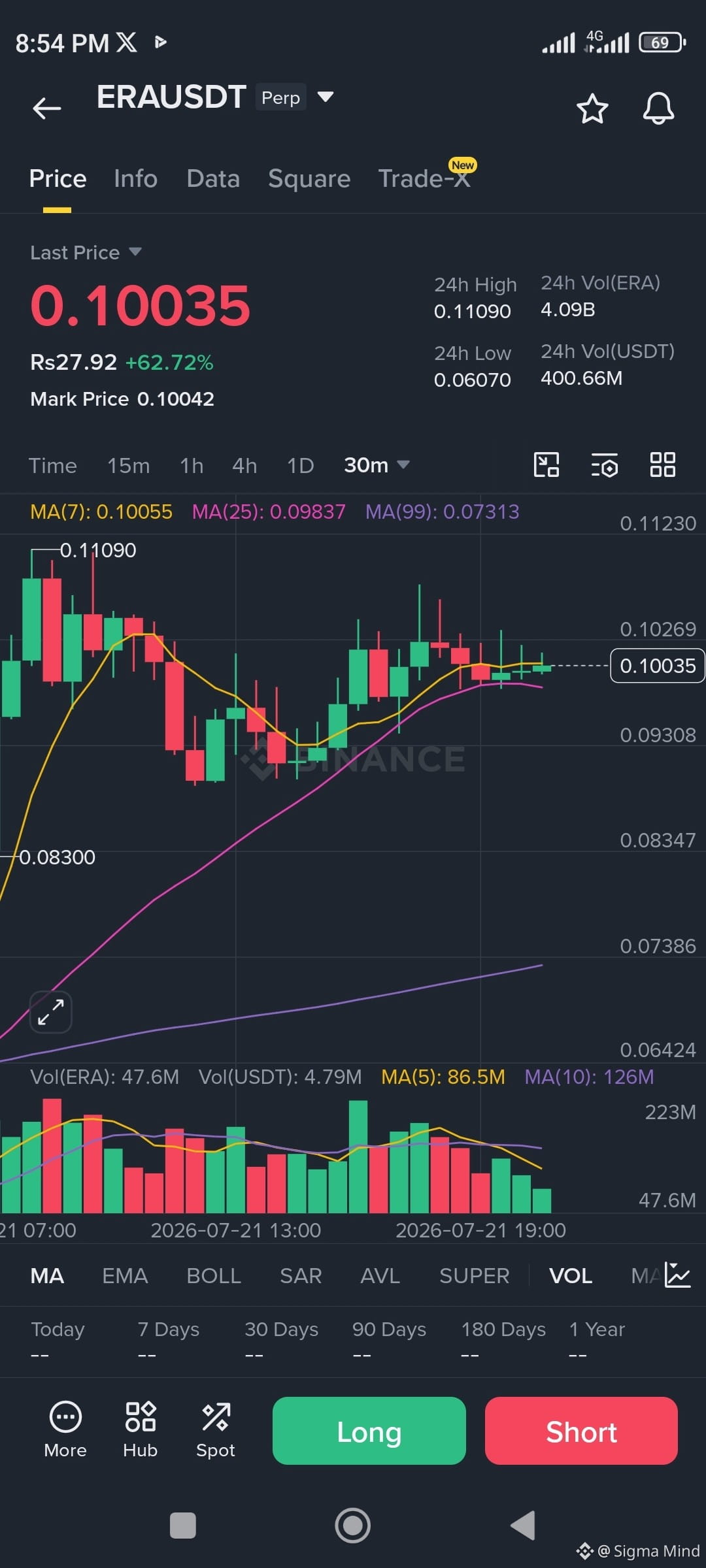
$ERA
After an explosive rally of more than 60%, price is now consolidating around 0.100. The candles are holding above the 25 MA, while the 7 MA is flattening, suggesting the market is cooling rather than immediately reversing. A breakout above the recent consolidation range could trigger another momentum leg.
Market Outlook: Bullish with high volatility.
Entry Zone: 0.0995–0.1015
TG1: 0.1045
TG2: 0.1085
TG3: 0.1135
Key Support: 0.0980
Key Resistance: 0.1030 / 0.1109 (24h High)
Stop Loss: 0.0960
Pro Tip for Traders: After a 60%+ rally, avoid chasing green candles. Let price either confirm a breakout above resistance with strong volume or retest support before entering. Managing risk is more important than catching every move.
#FedSeenHoldingRatesJuly29
#BitcoinETFsPostLongestInflowStreakSinceMay
#GoldAndSilverExtendGains
#SpaceXFirstMajorShareUnlockSetForAug6
#KoreanTradersCutLeverageToThreeMonthLow
234
·
--
$BANK
{spot}(BANKUSDT)
Strong pumps often create the hardest decisions. After a massive rally, the first sharp pullback always raises the same question: is this just a healthy correction, or the beginning of a much deeper drop?
I've seen this pattern many times across different coins. Sometimes price shakes out late buyers before continuing higher, and sometimes that pullback turns into a full trend reversal.
For now, I'm not rushing into a position. I'd rather wait for confirmation than trade based on emotions.
What do you think? Can this move still fall much lower from here, or is this just another trap to scare traders before the next leg up?
Share your view in the comments.
#FootballSeason2026
#BrentCrudeUp4.6%
#CaspianPipelineHaltsOilLoadings
#CLARITYActAwaitsSenateProgress
#TokenizedStocksSeeRisingOnchainUse
$BANK
Strong pumps often create the hardest decisions. After a massive rally, the first sharp pullback always raises the same question: is this just a healthy correction, or the beginning of a much deeper drop?
I've seen this pattern many times across different coins. Sometimes price shakes out late buyers before continuing higher, and sometimes that pullback turns into a full trend reversal.
For now, I'm not rushing into a position. I'd rather wait for confirmation than trade based on emotions.
What do you think? Can this move still fall much lower from here, or is this just another trap to scare traders before the next leg up?
Share your view in the comments.
#FootballSeason2026
#BrentCrudeUp4.6%
#CaspianPipelineHaltsOilLoadings
#CLARITYActAwaitsSenateProgress
#TokenizedStocksSeeRisingOnchainUse
Just a healthy correction 🚀
52%
Beginning of a deeper drop 📉
24%
Sideways chop/crab market 🦀
10%
Waiting for confirmation 🛑
14%
29 проголосовали • Голосование закрыто
1
2
1.7k
·
--
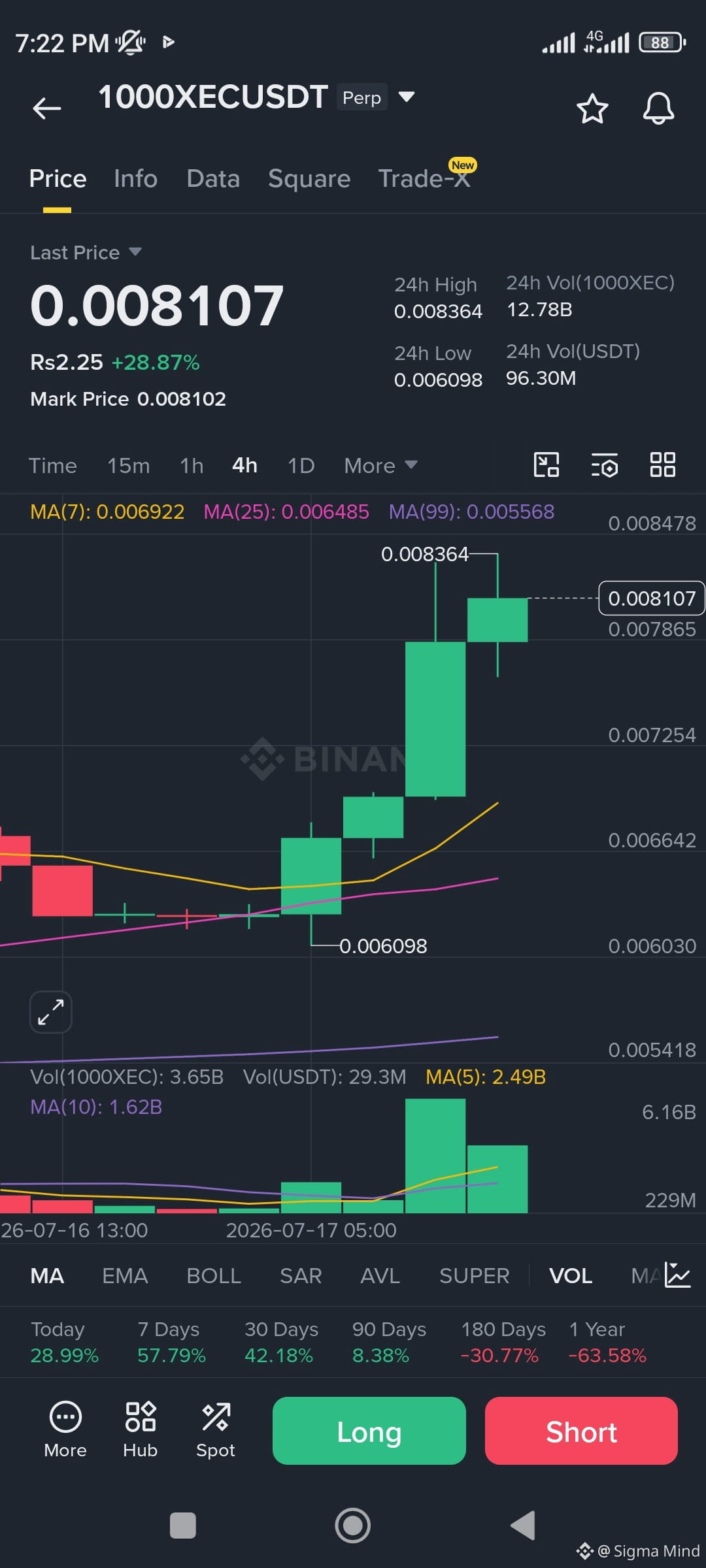
$1000XEC – Bullish (Momentum Strong, But Don't Chase)
Based on the screenshots you shared:
Current Price: 0.008107
24H Change: +28.9%
24H High / Low: 0.008364 / 0.006098
Funding Rate: -0.0406% (slightly negative)
Open Interest: Rising steadily
Timeframe Analyzed: 4H + derivatives data
Market Analysis
The market structure is strongly bullish.
Price has broken above the MA7, MA25, and MA99, confirming a bullish trend.
Open Interest is climbing together with price, indicating fresh money entering the market rather than just a short squeeze.
Taker Buy Volume is slightly stronger than sell volume, showing buyers remain active.
A negative funding rate while price is rising is generally supportive because longs are not overcrowded yet.
Trade Setup
Market Outlook: Bullish
Entry Zone: 0.00790 – 0.00805 (prefer a pullback rather than buying after a 29% rally)
Targets:
TG1: 0.00835
TG2: 0.00860
TG3: 0.00900
Support: 0.00780, then 0.00720
Resistance: 0.00836, then 0.00900
Stop-Loss: 0.00755
Pro Tip
The trend favors buyers, but after a nearly 29% daily gain, avoid FOMO entries. Wait for a healthy pullback or a clean breakout above 0.00836 with strong volume. If Open Interest keeps increasing while price holds above 0.00780, the bullish momentum is more likely to continue.
{future}(1000XECUSDT)
#BrentRises12%Weekly
#HYPEFalls8%
#HormuzTransitsDropToThreeWeekLow
#CardanoHardForkUpgradeSetForJuly18
$1000XEC – Bullish (Momentum Strong, But Don't Chase)
Based on the screenshots you shared:
Current Price: 0.008107
24H Change: +28.9%
24H High / Low: 0.008364 / 0.006098
Funding Rate: -0.0406% (slightly negative)
Open Interest: Rising steadily
Timeframe Analyzed: 4H + derivatives data
Market Analysis
The market structure is strongly bullish.
Price has broken above the MA7, MA25, and MA99, confirming a bullish trend.
Open Interest is climbing together with price, indicating fresh money entering the market rather than just a short squeeze.
Taker Buy Volume is slightly stronger than sell volume, showing buyers remain active.
A negative funding rate while price is rising is generally supportive because longs are not overcrowded yet.
Trade Setup
Market Outlook: Bullish
Entry Zone: 0.00790 – 0.00805 (prefer a pullback rather than buying after a 29% rally)
Targets:
TG1: 0.00835
TG2: 0.00860
TG3: 0.00900
Support: 0.00780, then 0.00720
Resistance: 0.00836, then 0.00900
Stop-Loss: 0.00755
Pro Tip
The trend favors buyers, but after a nearly 29% daily gain, avoid FOMO entries. Wait for a healthy pullback or a clean breakout above 0.00836 with strong volume. If Open Interest keeps increasing while price holds above 0.00780, the bullish momentum is more likely to continue.
#BrentRises12%Weekly
#HYPEFalls8%
#HormuzTransitsDropToThreeWeekLow
#CardanoHardForkUpgradeSetForJuly18
209
·
--
Статья
Tear Off the AI Trading Hype Filter! Newton’s real ace—90% of people got it wrongRecently, everyone in the industry has been hyping Newton. The talk track is all the same: AI smart trading, automated rebalancing, fully automated on-chain wealth management. Honestly, these gimmicks sound great, but after I repeatedly tested them in my real trading and dissected the underlying logic, I want to say one plain truth: everyone is focused on superficial stuff, and nobody sees the real core value.
@NewtonProtocol The reason it can stand on the AI DeFi boom isn’t because it runs fast or aggressively auto-trades coins. Instead, it solves the biggest pain point the on-chain industry has struggled with for years: automated trading has no brakes. Once the market moves to extremes, the principal simply can’t be protected.
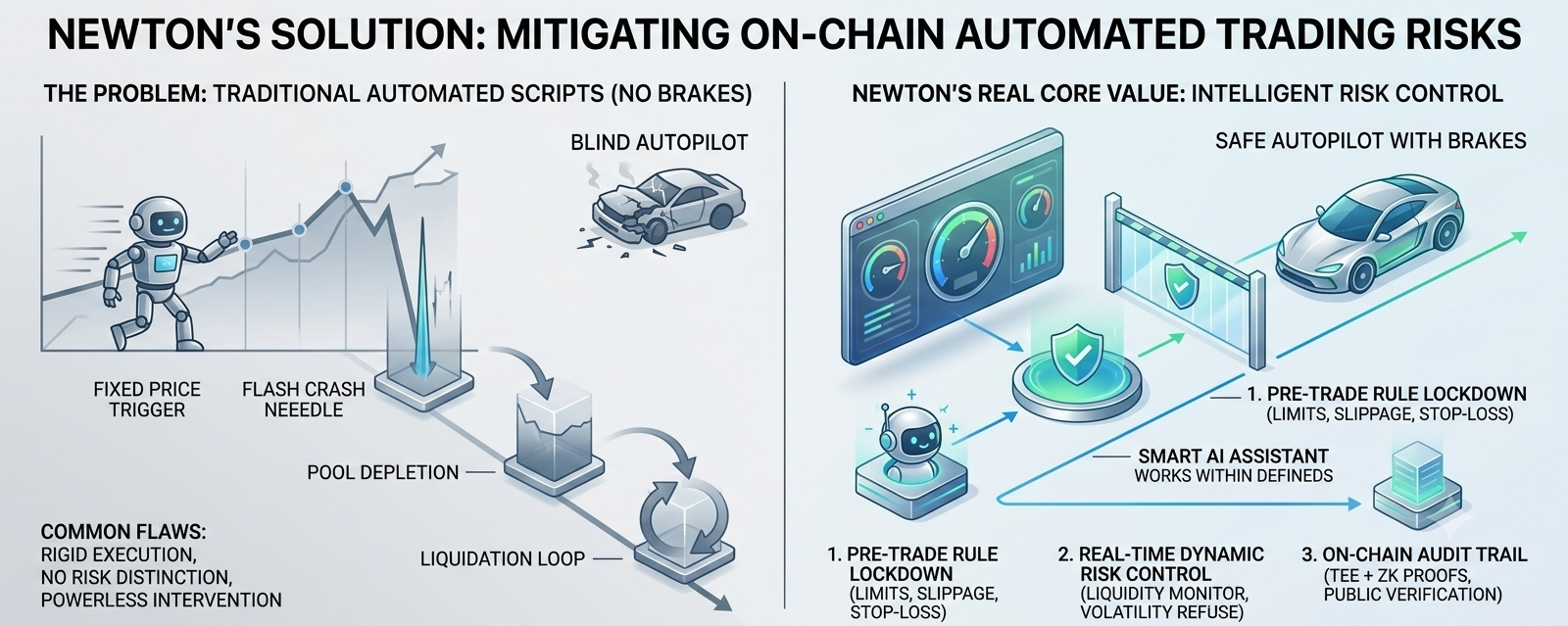
Anyone who’s played with on-chain stop-loss scripts or quantitative trading robots should have felt this firsthand. Traditional automation tools are extremely rigid: they only watch a fixed price and execute orders. They don’t understand how to distinguish market risk. When faced with a flash crash with a needle-like drop, pool depletion, on-chain congestion, oracle price jumps, and the like, ordinary scripts just blindly repeat placing orders, endlessly triggering liquidations—until slippage fully drains the assets, leaving users completely powerless to intervene.
That’s the common flaw of all the past on-chain AI tools: they only know how to work, not how to avoid danger; they only execute, not how to do risk control.
And with Newton’s arrival, it directly closes this loophole completely.
It’s not just about doing automated trading. It builds an on-chain risk control execution system that can be constrained, validated, and traced. Simply put: AI can help you trade, but the boundaries of every action, the risks, and the upper limits are all set by you. The system locks down the entire process to prevent any rule-violating operations.
I break down its operating logic into three straightforward closed-loop segments, so everyone can understand.
First, lock down the rules in advance. You can set your own trading limits, the protocols that are allowed to interact, the maximum slippage, stop-loss thresholds, and expiration conditions. It’s like putting shackles on the AI—defining prohibited zones, and stopping immediately if it crosses the line.
Second, real-time dynamic risk control. The system doesn’t just execute commands in a rigid way; it refreshes on-chain prices, liquidity, and liquidation risks at every moment. As soon as the market shows abnormal volatility, the system immediately terminates the strategy, refuses dangerous trades, and prevents your principal from being harvested by market movements.
Third, keep an on-chain audit trail for evidence. All judgment, calculations, execution, and termination actions are stored on-chain through a trusted TEE environment plus ZK proofs. Every operation can be traced and verified publicly, completely solving the black-box issue with AI actions.
In my view: before, automation was like blind autopilot—when it crashes, it’s mostly luck. Newton is intelligent driving with brakes, monitoring, and a risk-avoidance system. Keep safe first, then talk about returns.
Although I strongly agree with the direction of this track, I won’t hype it blindly—I’ll lay out the real risks as well.
At the moment, the entire system is highly dependent on external oracles and off-chain node networks. When extreme black-swan market conditions hit, when the whole network is congested with blocks, or when different platforms provide inconsistent quotes, issues like node delays, data discrepancies, or proof timeouts can easily occur. In these high-pressure scenarios, it hasn’t yet been validated in real market conditions, so the stability remains questionable.
Here’s a most realistic problem: the threshold is too high.
Fine-grained risk-control strategies require professional syntax configuration. Ordinary retail investors simply can’t play it. At this stage, typical users can only use simple templates, which prevents them from fully leveraging the protocol’s real capabilities. It’s more suitable for institutions and professional quantitative teams.
Based on all my hands-on test experiences, my conclusion is very clear: Newton is taking the path that DeFi must take in the future—but it’s still in the early stages of refinement.
Taking over on-chain assets by AI is an inevitable trend, but the industry has long lacked the corresponding risk-control infrastructure. Newton fills this gap, and the growth potential is definitely more than enough.
But in my current operations, I’m still cautious: tracking with small amounts, continuously observing, and absolutely never going heavy.
Once it goes through extreme market tests, lowers the entry barrier for ordinary users, and improves data fault-tolerance mechanisms—that’s when the real explosion point comes.
Finally, let me ask everyone a core question:
With the era of AI asset custody coming, do you think pre-trade risk-control constraints are more important, or is post-trade traceability and accountability even more critical?
Honestly, I’d really like to hear your true thoughts, brothers! In your current stage, would you dare to hand over your position to AI for automated custody? Drop your comments in the section—I’ll read every one!
@NewtonProtocol #Newt $NEWT
Tear Off the AI Trading Hype Filter! Newton’s real ace—90% of people got it wrong
Recently, everyone in the industry has been hyping Newton. The talk track is all the same: AI smart trading, automated rebalancing, fully automated on-chain wealth management. Honestly, these gimmicks sound great, but after I repeatedly tested them in my real trading and dissected the underlying logic, I want to say one plain truth: everyone is focused on superficial stuff, and nobody sees the real core value.
@NewtonProtocol The reason it can stand on the AI DeFi boom isn’t because it runs fast or aggressively auto-trades coins. Instead, it solves the biggest pain point the on-chain industry has struggled with for years: automated trading has no brakes. Once the market moves to extremes, the principal simply can’t be protected.
Anyone who’s played with on-chain stop-loss scripts or quantitative trading robots should have felt this firsthand. Traditional automation tools are extremely rigid: they only watch a fixed price and execute orders. They don’t understand how to distinguish market risk. When faced with a flash crash with a needle-like drop, pool depletion, on-chain congestion, oracle price jumps, and the like, ordinary scripts just blindly repeat placing orders, endlessly triggering liquidations—until slippage fully drains the assets, leaving users completely powerless to intervene.
That’s the common flaw of all the past on-chain AI tools: they only know how to work, not how to avoid danger; they only execute, not how to do risk control.
And with Newton’s arrival, it directly closes this loophole completely.
It’s not just about doing automated trading. It builds an on-chain risk control execution system that can be constrained, validated, and traced. Simply put: AI can help you trade, but the boundaries of every action, the risks, and the upper limits are all set by you. The system locks down the entire process to prevent any rule-violating operations.
I break down its operating logic into three straightforward closed-loop segments, so everyone can understand.
First, lock down the rules in advance. You can set your own trading limits, the protocols that are allowed to interact, the maximum slippage, stop-loss thresholds, and expiration conditions. It’s like putting shackles on the AI—defining prohibited zones, and stopping immediately if it crosses the line.
Second, real-time dynamic risk control. The system doesn’t just execute commands in a rigid way; it refreshes on-chain prices, liquidity, and liquidation risks at every moment. As soon as the market shows abnormal volatility, the system immediately terminates the strategy, refuses dangerous trades, and prevents your principal from being harvested by market movements.
Third, keep an on-chain audit trail for evidence. All judgment, calculations, execution, and termination actions are stored on-chain through a trusted TEE environment plus ZK proofs. Every operation can be traced and verified publicly, completely solving the black-box issue with AI actions.
In my view: before, automation was like blind autopilot—when it crashes, it’s mostly luck. Newton is intelligent driving with brakes, monitoring, and a risk-avoidance system. Keep safe first, then talk about returns.
Although I strongly agree with the direction of this track, I won’t hype it blindly—I’ll lay out the real risks as well.
At the moment, the entire system is highly dependent on external oracles and off-chain node networks. When extreme black-swan market conditions hit, when the whole network is congested with blocks, or when different platforms provide inconsistent quotes, issues like node delays, data discrepancies, or proof timeouts can easily occur. In these high-pressure scenarios, it hasn’t yet been validated in real market conditions, so the stability remains questionable.
Here’s a most realistic problem: the threshold is too high.
Fine-grained risk-control strategies require professional syntax configuration. Ordinary retail investors simply can’t play it. At this stage, typical users can only use simple templates, which prevents them from fully leveraging the protocol’s real capabilities. It’s more suitable for institutions and professional quantitative teams.
Based on all my hands-on test experiences, my conclusion is very clear: Newton is taking the path that DeFi must take in the future—but it’s still in the early stages of refinement.
Taking over on-chain assets by AI is an inevitable trend, but the industry has long lacked the corresponding risk-control infrastructure. Newton fills this gap, and the growth potential is definitely more than enough.
But in my current operations, I’m still cautious: tracking with small amounts, continuously observing, and absolutely never going heavy.
Once it goes through extreme market tests, lowers the entry barrier for ordinary users, and improves data fault-tolerance mechanisms—that’s when the real explosion point comes.
Finally, let me ask everyone a core question:
With the era of AI asset custody coming, do you think pre-trade risk-control constraints are more important, or is post-trade traceability and accountability even more critical?
Honestly, I’d really like to hear your true thoughts, brothers! In your current stage, would you dare to hand over your position to AI for automated custody? Drop your comments in the section—I’ll read every one!
@NewtonProtocol #Newt $NEWT
2
2
200
·
--
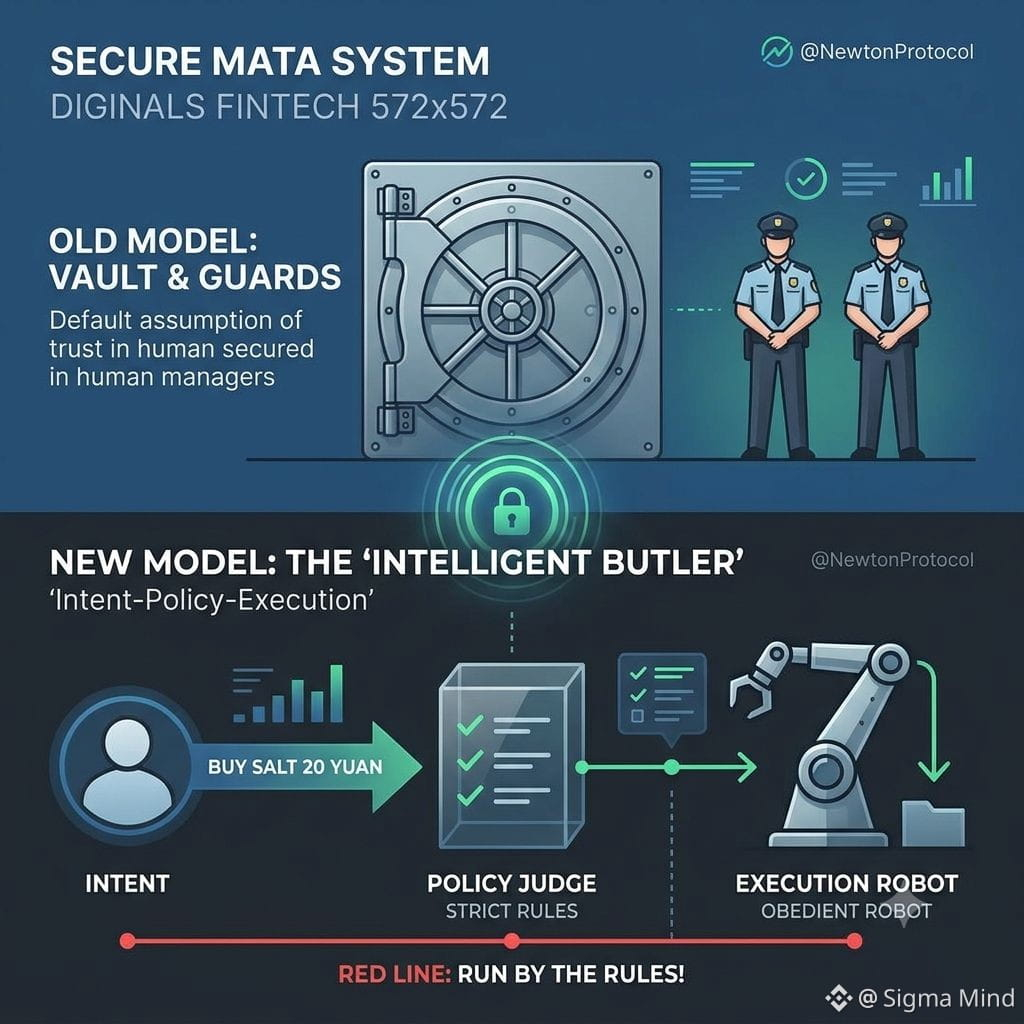
Back when we saved money, we always worried whether the vault door was sturdy enough and whether there were enough guards. But now I’ve realized that when something big happens, it’s often not because the door gets kicked in—it’s because the guy who manages the keys has turned bad! A lot of systems have a default assumption: “people who manage money are good guys.” Once that idea goes wrong, that’s several hundred million going down the drain.💸
Recently, I was digging through the mainnet code at @NewtonProtocol, and I found a solution for this problem that’s incredibly smart—almost like packaging the money with an “intelligent butler.”
This butler has three tricks:
First, you only tell it where you want to go (that’s the Intent).
Second, there’s a strict judge called “Policy” that sets the rules—no one is allowed to make exceptions.
Third, the “execution layer” that actually does the work is just an obedient robot. Unless it gets the judge’s approval slip, no one can touch the money.
It’s like your mom tells you to go buy salt and hands you a note that only says “20 yuan.” When you get to the store, the clerk (execution layer) only checks the note. You want to buy toys? If the note doesn’t mention it, they won’t sell it. That’s what “rules come before everything” means.
In the old code, the rules were tangled up with the business logic. Everyone was afraid to touch it because one change could break everything. Now Newton separates them. The rules are set aside on their own. Even if the business grows later, as long as the rules don’t change, no one will be able to do whatever they want.
Let’s not hype it blindly—whether this is good or not will depend on whether people follow the rules in the future. But in the coming era where there are automated robots everywhere, what we fear most isn’t slowness—it’s chaos and everyone grabbing for control. Newton’s logic is basically drawing a red line for these robots: you can run, but you must run by the rules!
@NewtonProtocol #newt $NEWT
2
200
·
--
I was just going through my usual routine when one thought about GRVT kept coming back to my mind. That curiosity led me to spend some time researching its architecture, and the more I looked into it, the more questions came up. Eventually, I ended up writing this post.
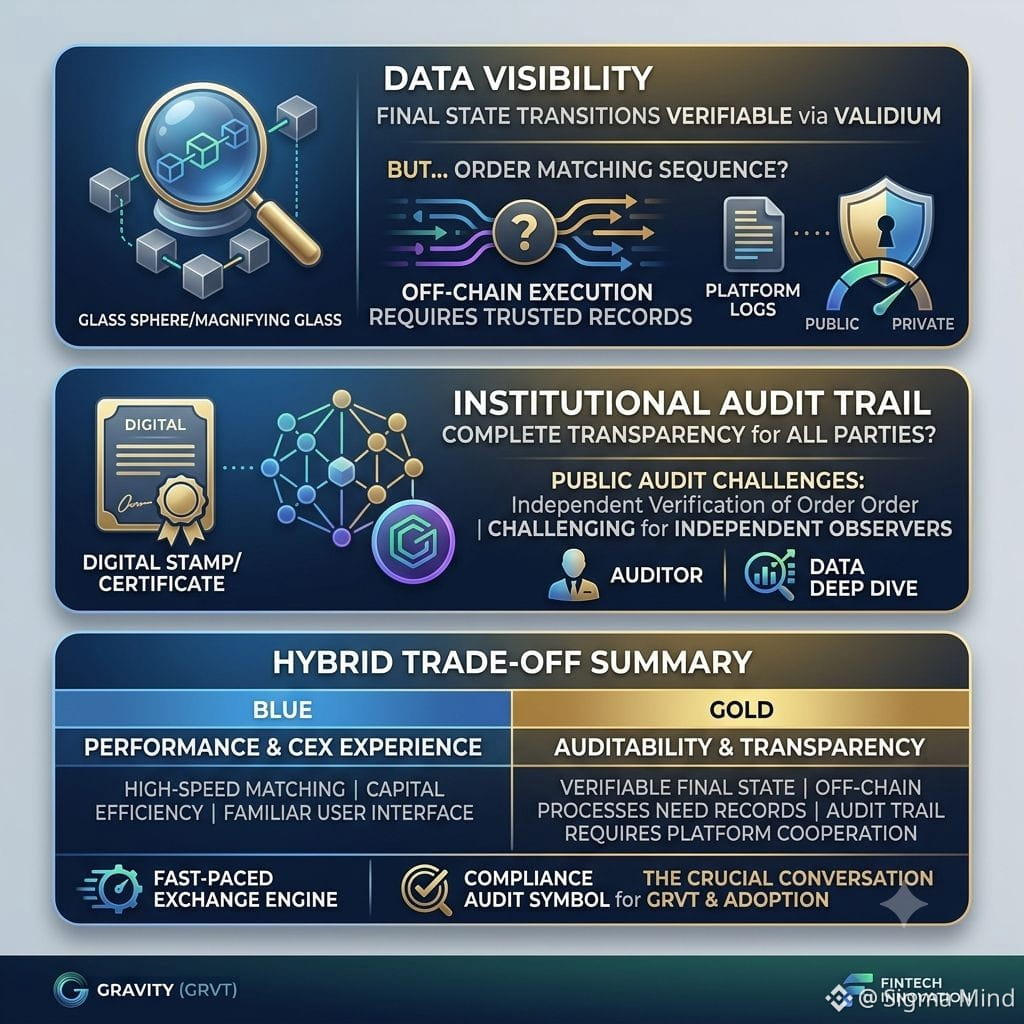
One thing that keeps drawing my attention about GRVT is not its funding, roadmap, or even the upcoming TGE. It is the architectural choice behind its hybrid model. The design clearly aims to deliver a trading experience close to a centralized exchange while allowing users to keep control of their assets through smart contracts. But does improving execution speed inevitably mean sacrificing part of the transparency?
GRVT relies on Validium and zero-knowledge proofs, which means fund ownership and state transitions remain verifiable. That sounds reassuring. Yet another question naturally follows: if the final state can be verified, does that automatically make the entire order execution process equally transparent?
This distinction feels important. External observers can verify where funds ended up, but rebuilding the complete matching sequence appears much harder once execution happens off-chain. If two orders reached the engine almost simultaneously, would publicly available data be enough to independently confirm the exact execution order, or does that still require trusting the platform's records?
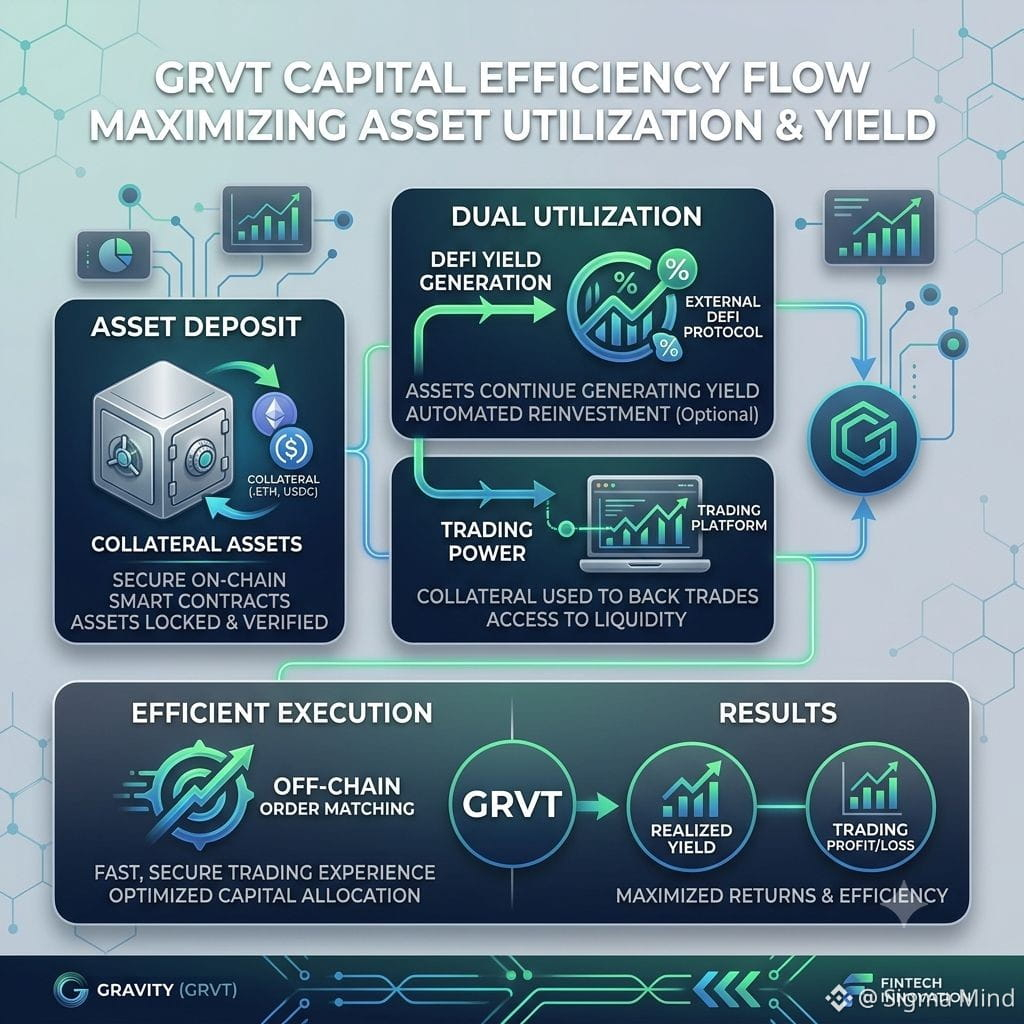
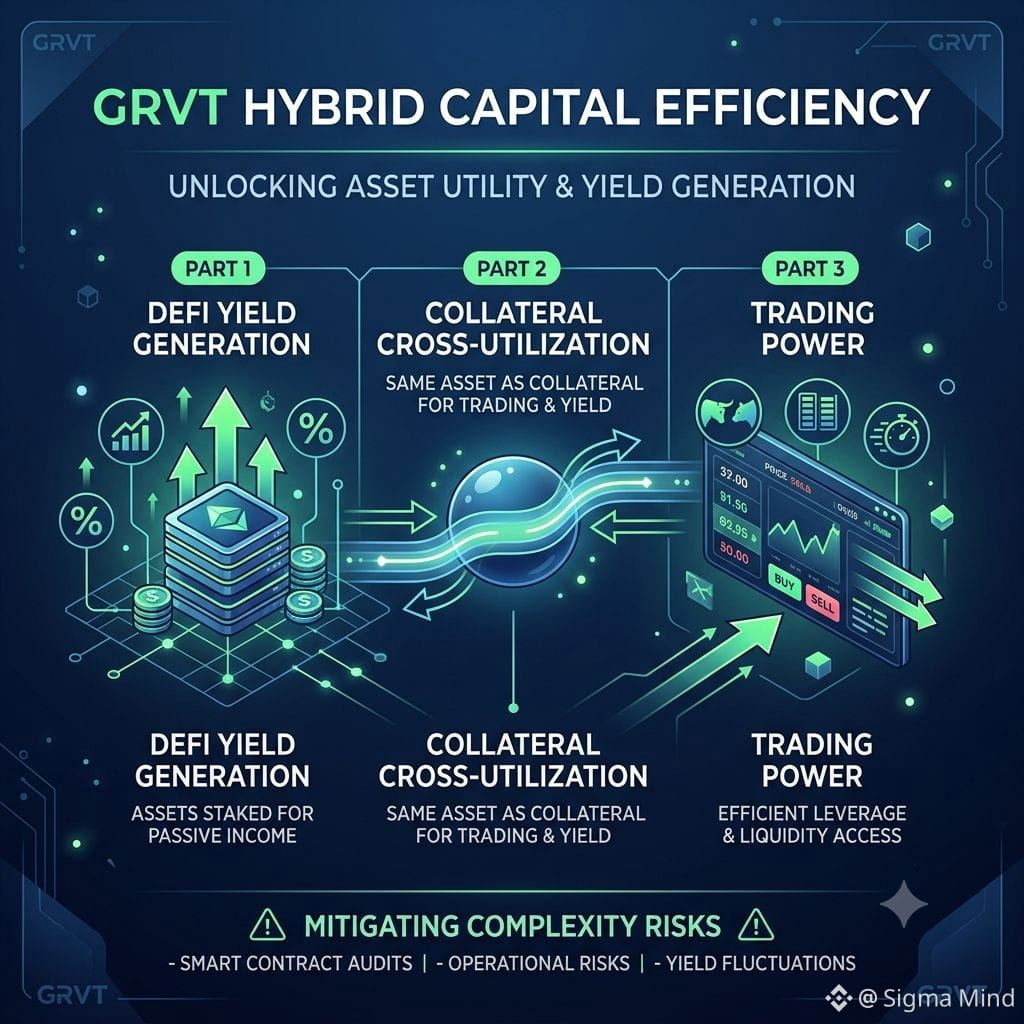
Its capital efficiency model is also worth discussing. Allowing collateral to continue generating DeFi yield while remaining usable for trading is an interesting approach. Still, does maximizing efficiency also introduce additional layers of complexity that users may underestimate?
These are not criticisms, but questions that naturally emerge when studying a hybrid architecture. Perhaps this trade-off is perfectly reasonable for most traders. The bigger question is whether the same level of visibility would satisfy institutions seeking a complete audit trail. That may be one of the most interesting discussions surrounding GRVT today.
@grvt_io #grvt

1
1
177
·
--
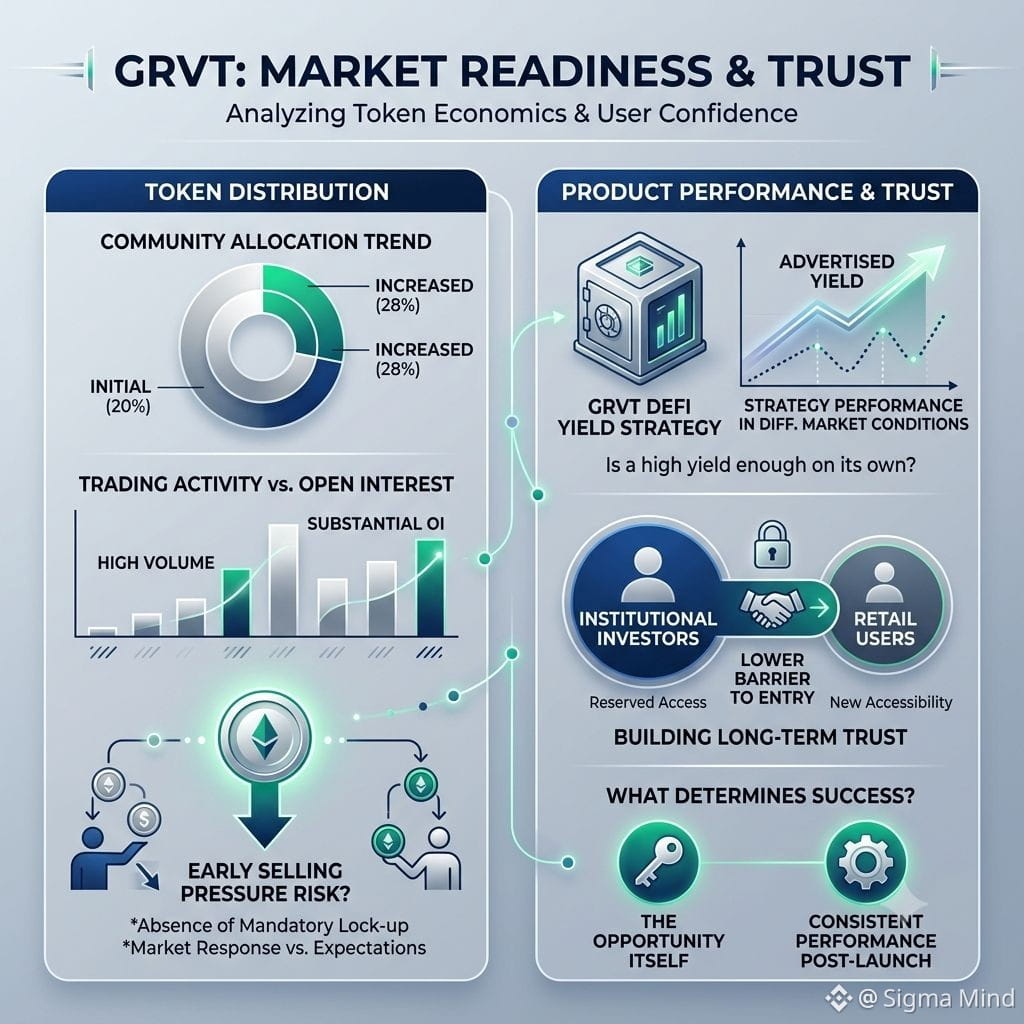
The biggest question around GRVT may not be whether the platform has a compelling vision, but whether the market is ready to absorb its token distribution. The community allocation has gradually increased from 20% to 28%, while trading activity and open interest remain substantial. If such a large portion of tokens reaches users without a mandatory lock-up, could early selling pressure become stronger than many expect?
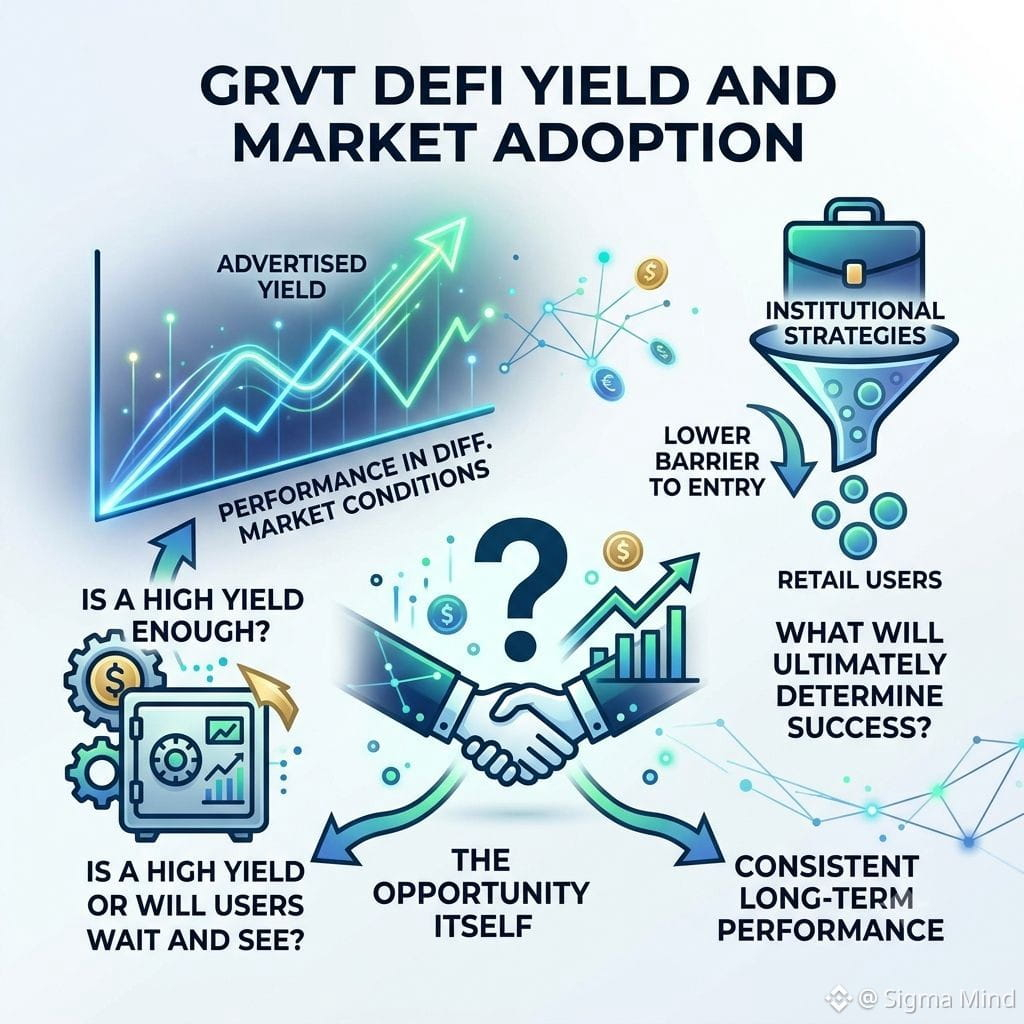
At the same time, the product itself presents an interesting idea. Automatically earning DeFi yield while funds remain usable is a feature that traditional exchange accounts often cannot match. But another question naturally follows: is a higher advertised yield enough on its own, or will users wait to see how the strategy performs across different market conditions before committing larger amounts?
The protocol also lowers the entry barrier to institutional-style strategies, making them accessible to smaller investors. Yet accessibility and long-term trust are not always the same thing. If retail users can now access products that were once reserved for large investors, what will ultimately determine success—the opportunity itself, or how consistently that opportunity performs after launch?
@grvt_io #grvt $LAB
4
2
99
Войдите, чтобы посмотреть больше материала
Присоединяйтесь к пользователям криптовалют по всему миру на Binance Square
⚡️ Получайте новейшую и полезную информацию о криптоактивах.
💬 Нам доверяет крупнейшая в мире криптобиржа.
👍 Получите достоверные аналитические данные от верифицированных создателей контента.
Эл. почта/номер телефона
В тренде
EvolveAtBinanceBlockchainWeek
Просмотров: 1.4M
15,240 обсуждают
Binance Blockchain Week starts tomorrow! 🌍
On November 28–29, whether you’re in Bangkok or joining from afar, tune in to the livestreams and join the conversation on Binance Square!
Here’s what’s in store 👇
📺 Watch the main stage live
Tune in throughout both days as industry speakers share their perspectives on this year’s theme, “Evolve” From technological innovation to real-world applications, explore what’s next for crypto.
⚔️ Watch two trading competitions
The Aster Open Qualifier and the Binance Trading Master Tournament will both be streamed live. Tune in to follow the traders in action.
🏆 Watch The Blockchain 100 Awards Ceremony
The Blockchain 100 list was selected by the community. Join us in celebrating the creators and the ideas they share!
💬 Join the community conversation
Use #EvolveAtBinanceBlockchainWeek in a post with a photo to share what you’re looking forward to, your views on the industry, or your favorite moments from the event.
The event page is now live! Subscribe to all livestreams with one click so you don’t miss a moment 👏
Binance Blockchain Week
·Лайков: 280
·Просмотров: 247.9k
EthereumGlamsterdamKeepsStorageFeeChange
Просмотров: 31,671
326 обсуждают
MoneroFalls13%OnDelistings
Просмотров: 75,384
599 обсуждают