
schrodinger
140 Публикации

schrodinger
Отправить жалобу
Заблокировать пользователя
Crypto _writer
Открытая сделка
Трейдер с частыми сделками
5.8 г
117 подписок(и/а)
63 подписчиков(а)
87 понравилось
Посты
Портфель
Все
Цитирования
·
--
Solana (SOL)
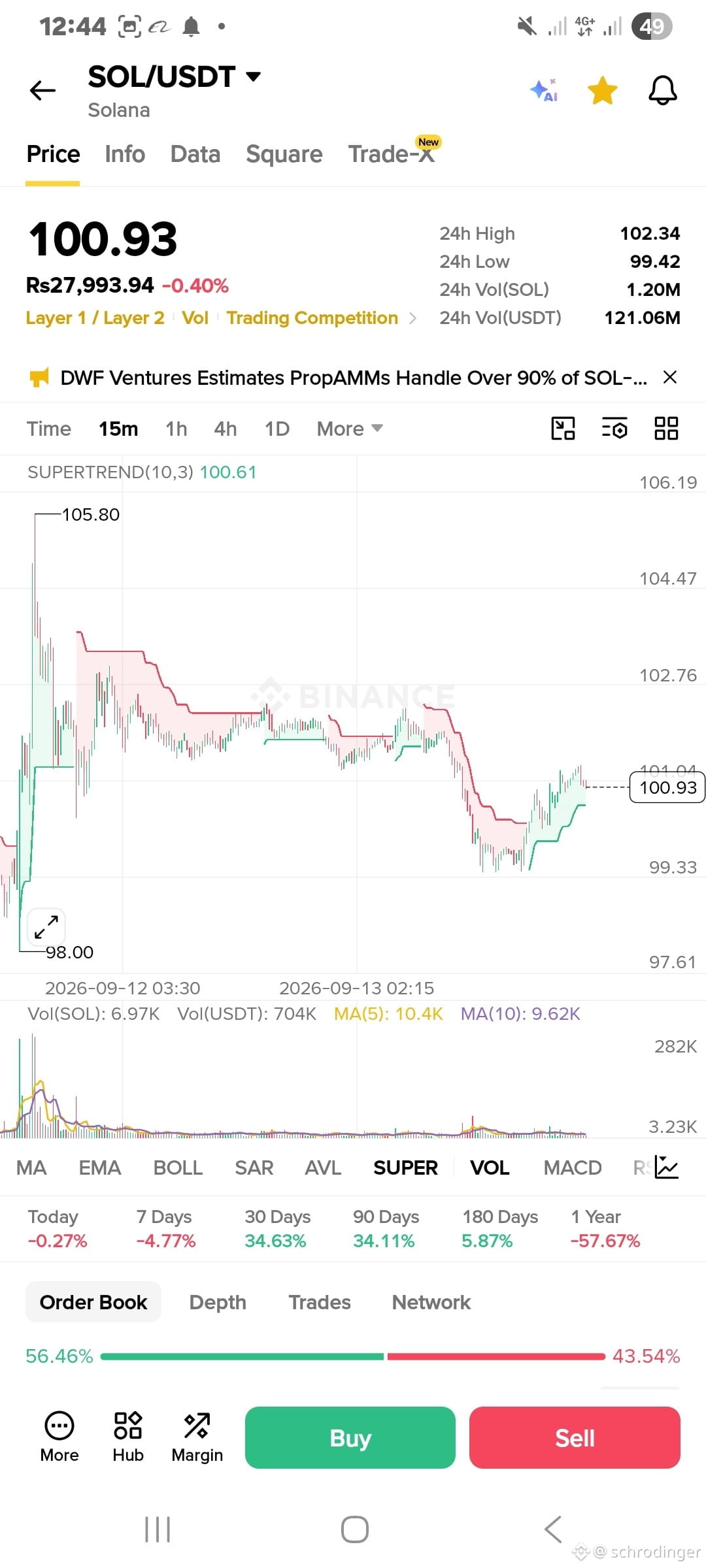
is trading at $100.93**, stuck in a tight range between **$99.42 and $102.34**. The 7-day trend is **-4.77%** (bearish), but the 30-day is **+34.63%** (bullish). The SUPERTREND line sits at **$100.61—right at the current price, signaling indecision.
Tip:
· Buy only if it breaks above $102.50 with volume.
· Sell/Short if it drops below $99.00**, targeting **$98.00.
· Waiting is safer now—the market is consolidating with no clear direction.
Not financial advice. Crypto is highly risky.
Solana (SOL)
is trading at $100.93**, stuck in a tight range between **$99.42 and $102.34**. The 7-day trend is **-4.77%** (bearish), but the 30-day is **+34.63%** (bullish). The SUPERTREND line sits at **$100.61—right at the current price, signaling indecision.
Tip:
· Buy only if it breaks above $102.50 with volume.
· Sell/Short if it drops below $99.00**, targeting **$98.00.
· Waiting is safer now—the market is consolidating with no clear direction.
Not financial advice. Crypto is highly risky.
is trading at $100.93**, stuck in a tight range between **$99.42 and $102.34**. The 7-day trend is **-4.77%** (bearish), but the 30-day is **+34.63%** (bullish). The SUPERTREND line sits at **$100.61—right at the current price, signaling indecision.
Tip:
· Buy only if it breaks above $102.50 with volume.
· Sell/Short if it drops below $99.00**, targeting **$98.00.
· Waiting is safer now—the market is consolidating with no clear direction.
Not financial advice. Crypto is highly risky.

Best wishes
От schrodinger
14
·
--
Tip to Sell or Buy
🔴 Sell / Short Scenario:
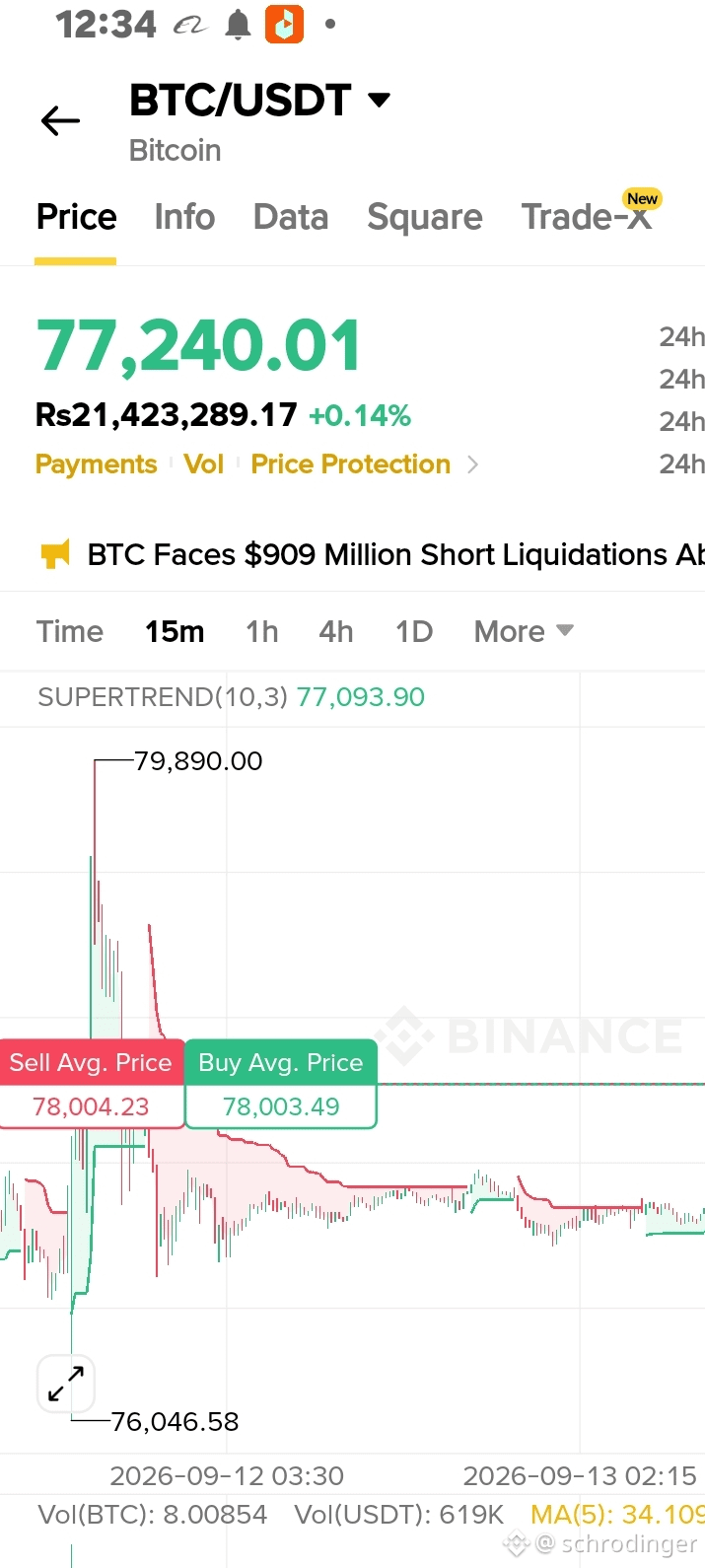
· If BTC breaks below $76,000**, it could drop to **$75,000 or even $70,000
· The chart shows weakness in the short term (7-day negative)
· If you're holding, consider taking partial profits or setting a stop-loss
🟢 Buy / Long Scenario:
· Bitcoin needs to close above $81,700 to confirm a new bullish trend
· Buying now is risky because it's stuck in a range
· Wait for a clear breakout above $78,500 before entering long
⚠️ Key Event to Watch:
· FOMC Meeting (Sept 15-16) — If the Fed hikes interest rates, crypto will face selling pressure. If they hold or cut rates, Bitcoin could pump.
---
My Honest Advice:
Action Price Level
Short (Sell) Near $78,000 – $78,500
Long (Buy) Near $76,000 – $76,500
Stop Loss Below $75,500 (for longs)
Take Profit $80,000+
Important: Always use stop-loss. The market is very volatile right now, especially with the FOMC meeting coming up.
#BTC
#Write2Earn!
Tip to Sell or Buy
🔴 Sell / Short Scenario:
· If BTC breaks below $76,000**, it could drop to **$75,000 or even $70,000
· The chart shows weakness in the short term (7-day negative)
· If you're holding, consider taking partial profits or setting a stop-loss
🟢 Buy / Long Scenario:
· Bitcoin needs to close above $81,700 to confirm a new bullish trend
· Buying now is risky because it's stuck in a range
· Wait for a clear breakout above $78,500 before entering long
⚠️ Key Event to Watch:
· FOMC Meeting (Sept 15-16) — If the Fed hikes interest rates, crypto will face selling pressure. If they hold or cut rates, Bitcoin could pump.
---
My Honest Advice:
Action Price Level
Short (Sell) Near $78,000 – $78,500
Long (Buy) Near $76,000 – $76,500
Stop Loss Below $75,500 (for longs)
Take Profit $80,000+
Important: Always use stop-loss. The market is very volatile right now, especially with the FOMC meeting coming up.
#BTC
#Write2Earn!
🔴 Sell / Short Scenario:
· If BTC breaks below $76,000**, it could drop to **$75,000 or even $70,000
· The chart shows weakness in the short term (7-day negative)
· If you're holding, consider taking partial profits or setting a stop-loss
🟢 Buy / Long Scenario:
· Bitcoin needs to close above $81,700 to confirm a new bullish trend
· Buying now is risky because it's stuck in a range
· Wait for a clear breakout above $78,500 before entering long
⚠️ Key Event to Watch:
· FOMC Meeting (Sept 15-16) — If the Fed hikes interest rates, crypto will face selling pressure. If they hold or cut rates, Bitcoin could pump.
---
My Honest Advice:
Action Price Level
Short (Sell) Near $78,000 – $78,500
Long (Buy) Near $76,000 – $76,500
Stop Loss Below $75,500 (for longs)
Take Profit $80,000+
Important: Always use stop-loss. The market is very volatile right now, especially with the FOMC meeting coming up.
#BTC
#Write2Earn!
1
247
·
--
CFG is at a critical decision point after a massive drop from $0.30.
🔍 Chart Analysis: What's Happening
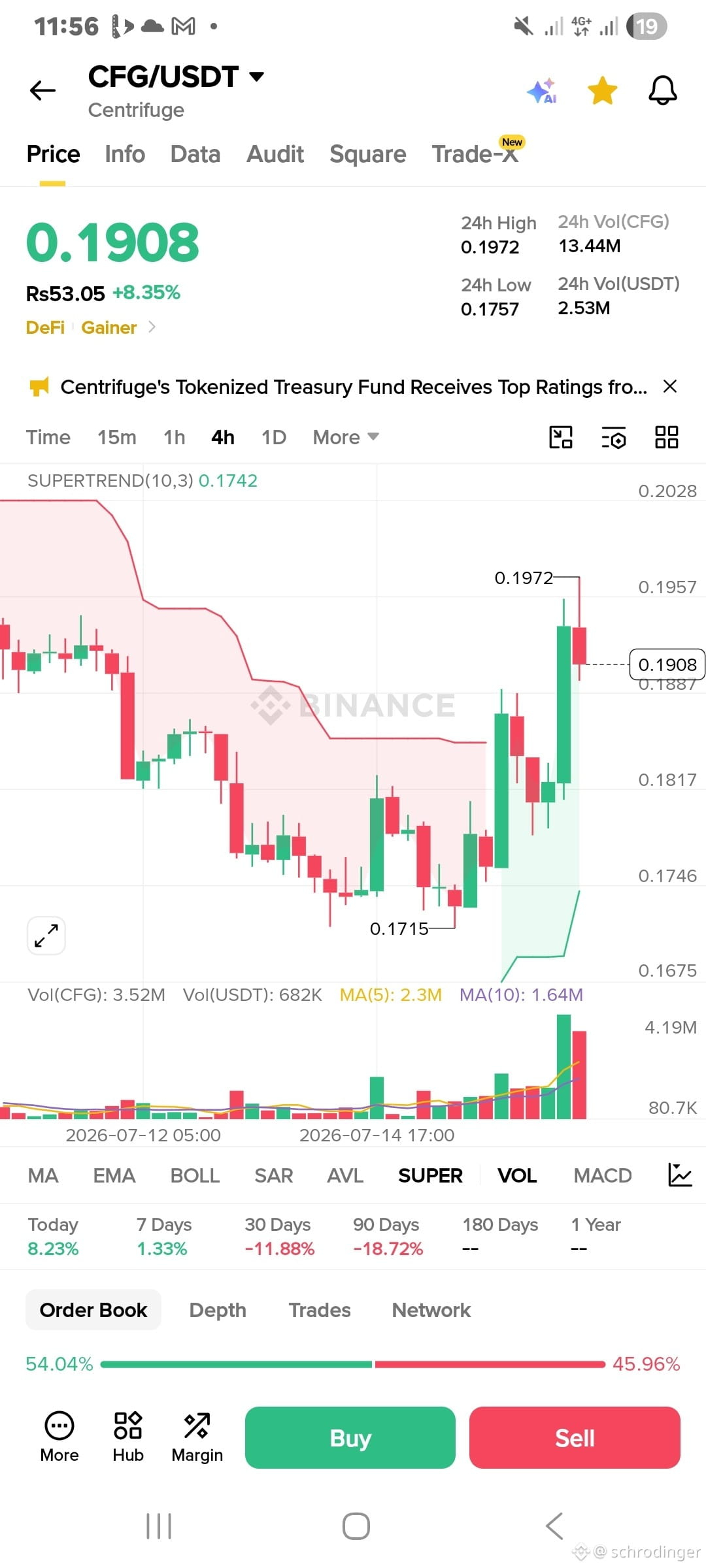
· Immediate Trend: Bearish in the short term. The price ($0.1908) is far below the Supertrend indicator (which acts as dynamic resistance), signaling sellers are still in control .
· Recent Momentum: The coin is down -11.88% over 30 days and -18.72% over 90 days, confirming a longer-term downtrend. The recent drop from $0.30 aligns with bearish structure analysis from earlier this month .
🚀 Bullish Scenario (The Bounce Play)
If buyers step in aggressively at this level:
· Immediate Resistance: The first major hurdle is the 24h High at $0.1972. A breakout above this with strong volume would be the first sign of strength.
· Primary Target: The Supertrend line near $0.2028. Reclaiming this would flip the short-term trend back to bullish .
· Swing Target: If momentum continues, the $0.218 - $0.220 zone becomes the next major resistance .
🐻 Bearish Scenario (Continuation)
Given the weak fundamentals (strong selling pressure), the path of least resistance is still down:
· Key Support: The 24h Low at $0.1757 must hold. If broken, the floor could drop significantly.
· Next Major Zone: The last major demand zone before a potential recovery is around $0.12 - $0.14 .
🛡️ My Trading Plan
1. Don't Chase: Avoid buying at the current price ($0.1908) without confirmation.
2. The "Wait and See" Entry: Only consider a spot entry if the price closes above $0.1972 (24h High) on the 1-hour or 4-hour chart. This confirms buyers are stepping in.
3. For Aggressive Traders: If the price retests the $0.1757 support and holds firm without breaking, you could enter a small position there with a stop-loss just below it.
4. In Case of Breakdown: If price breaks below **$0.1757**, step aside. Wait for it to find solid ground near the $0.14 zone before considering any long-term spot buys .
#Btc
#CFG_USDT
CFG is at a critical decision point after a massive drop from $0.30.
🔍 Chart Analysis: What's Happening
· Immediate Trend: Bearish in the short term. The price ($0.1908) is far below the Supertrend indicator (which acts as dynamic resistance), signaling sellers are still in control .
· Recent Momentum: The coin is down -11.88% over 30 days and -18.72% over 90 days, confirming a longer-term downtrend. The recent drop from $0.30 aligns with bearish structure analysis from earlier this month .
🚀 Bullish Scenario (The Bounce Play)
If buyers step in aggressively at this level:
· Immediate Resistance: The first major hurdle is the 24h High at $0.1972. A breakout above this with strong volume would be the first sign of strength.
· Primary Target: The Supertrend line near $0.2028. Reclaiming this would flip the short-term trend back to bullish .
· Swing Target: If momentum continues, the $0.218 - $0.220 zone becomes the next major resistance .
🐻 Bearish Scenario (Continuation)
Given the weak fundamentals (strong selling pressure), the path of least resistance is still down:
· Key Support: The 24h Low at $0.1757 must hold. If broken, the floor could drop significantly.
· Next Major Zone: The last major demand zone before a potential recovery is around $0.12 - $0.14 .
🛡️ My Trading Plan
1. Don't Chase: Avoid buying at the current price ($0.1908) without confirmation.
2. The "Wait and See" Entry: Only consider a spot entry if the price closes above $0.1972 (24h High) on the 1-hour or 4-hour chart. This confirms buyers are stepping in.
3. For Aggressive Traders: If the price retests the $0.1757 support and holds firm without breaking, you could enter a small position there with a stop-loss just below it.
4. In Case of Breakdown: If price breaks below **$0.1757**, step aside. Wait for it to find solid ground near the $0.14 zone before considering any long-term spot buys .
#Btc
#CFG_USDT
🔍 Chart Analysis: What's Happening
· Immediate Trend: Bearish in the short term. The price ($0.1908) is far below the Supertrend indicator (which acts as dynamic resistance), signaling sellers are still in control .
· Recent Momentum: The coin is down -11.88% over 30 days and -18.72% over 90 days, confirming a longer-term downtrend. The recent drop from $0.30 aligns with bearish structure analysis from earlier this month .
🚀 Bullish Scenario (The Bounce Play)
If buyers step in aggressively at this level:
· Immediate Resistance: The first major hurdle is the 24h High at $0.1972. A breakout above this with strong volume would be the first sign of strength.
· Primary Target: The Supertrend line near $0.2028. Reclaiming this would flip the short-term trend back to bullish .
· Swing Target: If momentum continues, the $0.218 - $0.220 zone becomes the next major resistance .
🐻 Bearish Scenario (Continuation)
Given the weak fundamentals (strong selling pressure), the path of least resistance is still down:
· Key Support: The 24h Low at $0.1757 must hold. If broken, the floor could drop significantly.
· Next Major Zone: The last major demand zone before a potential recovery is around $0.12 - $0.14 .
🛡️ My Trading Plan
1. Don't Chase: Avoid buying at the current price ($0.1908) without confirmation.
2. The "Wait and See" Entry: Only consider a spot entry if the price closes above $0.1972 (24h High) on the 1-hour or 4-hour chart. This confirms buyers are stepping in.
3. For Aggressive Traders: If the price retests the $0.1757 support and holds firm without breaking, you could enter a small position there with a stop-loss just below it.
4. In Case of Breakdown: If price breaks below **$0.1757**, step aside. Wait for it to find solid ground near the $0.14 zone before considering any long-term spot buys .
#Btc
#CFG_USDT
79
·
--
🚀 10 Coins Poised for Upside in the Next 24 Hours (Spot Trading)
Quick Overview: The Market Setup
🔥 Top 10 Coins to Watch for Spot Trading
1. ONDO (Ondo Finance) – RWA Sector Leader
· 24H Gain: +14.41% to +15.92%
· Catalyst: Launched the first US stock tokens directly backed by DTCC-custodied securities
· Why Now: The RWA sector is today's strongest performer
2. HYPE (Hyperliquid) – RWA + New Product Expansion
· Daily Volume Surge: +36% to $433 million
· Catalyst: Launched Pre-IPO Perpetual Market (IPOP) for tokenized assets; RWA Open Interest hit a record high of $2.13B
· Technical: Trading above all major moving averages; Stochastic RSI rebounding from oversold
· Why Now: Fundamentals and technicals aligned—new catalysts attracting fresh capital.
---
3. ZERO (ZeroLend) – DeFi Momentum Play
· 24H Gain: +28.87%
· Catalyst: DeFi sector rose 0.96% today, with ZERO leading the pack
· Why Now: Strongest performer in the DeFi space; high volatility offers quick scalping opportunities.
---
4. XEC (eCash) – PayFi Sector Standout
· 24H Gain: +13.68%
· Catalyst: PayFi sector up 0.32%, with XEC as top gainer
· Why Now: Strong volume spike; sector rotation into payment-focused projects.
5. INJ (Injective) – Layer 1 Strength
· 24H Gain: +3.24%
· Technical: Bullish aligned across multiple timeframes
· Why Now: Layer 1 sector saw INJ surge during the session; strong momentum indicators .
6. LDO (Lido DAO) – Bullish Breakout Setup
· Technical: Strong bullish alignment; ADX at 50.51, ROC at 5.50%, RSI at 72.81
· Why Now: All 6 key timeframes align bullish; momentum is accelerating.
7. RIF (RSK Infrastructure Framework) – Strongest Bullish Signal
· Technical: "Strong Bullish" across ALL 6 timeframes—15m, 30m, 1h, 4h, 1d, 1w, 1M
· ROC: 8.51% momentum
· Why Now: Rare to see this level of technical alignment. Spot
8. DGB (DigiByte) – High Momentum Play
· Technical: 49.83 ADX, 41.95% ROC, RSI at 93.83
· Why Now: Extreme momentum—for aggressive traders only.
9. GMX (GMX) – DeFi Perpetual Exchange
🚀 10 Coins Poised for Upside in the Next 24 Hours (Spot Trading)
Quick Overview: The Market Setup
🔥 Top 10 Coins to Watch for Spot Trading
1. ONDO (Ondo Finance) – RWA Sector Leader
· 24H Gain: +14.41% to +15.92%
· Catalyst: Launched the first US stock tokens directly backed by DTCC-custodied securities
· Why Now: The RWA sector is today's strongest performer
2. HYPE (Hyperliquid) – RWA + New Product Expansion
· Daily Volume Surge: +36% to $433 million
· Catalyst: Launched Pre-IPO Perpetual Market (IPOP) for tokenized assets; RWA Open Interest hit a record high of $2.13B
· Technical: Trading above all major moving averages; Stochastic RSI rebounding from oversold
· Why Now: Fundamentals and technicals aligned—new catalysts attracting fresh capital.
---
3. ZERO (ZeroLend) – DeFi Momentum Play
· 24H Gain: +28.87%
· Catalyst: DeFi sector rose 0.96% today, with ZERO leading the pack
· Why Now: Strongest performer in the DeFi space; high volatility offers quick scalping opportunities.
---
4. XEC (eCash) – PayFi Sector Standout
· 24H Gain: +13.68%
· Catalyst: PayFi sector up 0.32%, with XEC as top gainer
· Why Now: Strong volume spike; sector rotation into payment-focused projects.
5. INJ (Injective) – Layer 1 Strength
· 24H Gain: +3.24%
· Technical: Bullish aligned across multiple timeframes
· Why Now: Layer 1 sector saw INJ surge during the session; strong momentum indicators .
6. LDO (Lido DAO) – Bullish Breakout Setup
· Technical: Strong bullish alignment; ADX at 50.51, ROC at 5.50%, RSI at 72.81
· Why Now: All 6 key timeframes align bullish; momentum is accelerating.
7. RIF (RSK Infrastructure Framework) – Strongest Bullish Signal
· Technical: "Strong Bullish" across ALL 6 timeframes—15m, 30m, 1h, 4h, 1d, 1w, 1M
· ROC: 8.51% momentum
· Why Now: Rare to see this level of technical alignment. Spot
8. DGB (DigiByte) – High Momentum Play
· Technical: 49.83 ADX, 41.95% ROC, RSI at 93.83
· Why Now: Extreme momentum—for aggressive traders only.
9. GMX (GMX) – DeFi Perpetual Exchange
Quick Overview: The Market Setup
🔥 Top 10 Coins to Watch for Spot Trading
1. ONDO (Ondo Finance) – RWA Sector Leader
· 24H Gain: +14.41% to +15.92%
· Catalyst: Launched the first US stock tokens directly backed by DTCC-custodied securities
· Why Now: The RWA sector is today's strongest performer
2. HYPE (Hyperliquid) – RWA + New Product Expansion
· Daily Volume Surge: +36% to $433 million
· Catalyst: Launched Pre-IPO Perpetual Market (IPOP) for tokenized assets; RWA Open Interest hit a record high of $2.13B
· Technical: Trading above all major moving averages; Stochastic RSI rebounding from oversold
· Why Now: Fundamentals and technicals aligned—new catalysts attracting fresh capital.
---
3. ZERO (ZeroLend) – DeFi Momentum Play
· 24H Gain: +28.87%
· Catalyst: DeFi sector rose 0.96% today, with ZERO leading the pack
· Why Now: Strongest performer in the DeFi space; high volatility offers quick scalping opportunities.
---
4. XEC (eCash) – PayFi Sector Standout
· 24H Gain: +13.68%
· Catalyst: PayFi sector up 0.32%, with XEC as top gainer
· Why Now: Strong volume spike; sector rotation into payment-focused projects.
5. INJ (Injective) – Layer 1 Strength
· 24H Gain: +3.24%
· Technical: Bullish aligned across multiple timeframes
· Why Now: Layer 1 sector saw INJ surge during the session; strong momentum indicators .
6. LDO (Lido DAO) – Bullish Breakout Setup
· Technical: Strong bullish alignment; ADX at 50.51, ROC at 5.50%, RSI at 72.81
· Why Now: All 6 key timeframes align bullish; momentum is accelerating.
7. RIF (RSK Infrastructure Framework) – Strongest Bullish Signal
· Technical: "Strong Bullish" across ALL 6 timeframes—15m, 30m, 1h, 4h, 1d, 1w, 1M
· ROC: 8.51% momentum
· Why Now: Rare to see this level of technical alignment. Spot
8. DGB (DigiByte) – High Momentum Play
· Technical: 49.83 ADX, 41.95% ROC, RSI at 93.83
· Why Now: Extreme momentum—for aggressive traders only.
9. GMX (GMX) – DeFi Perpetual Exchange
233
·
--
Market Overview: A "Fearful" Rally
Today's crypto market presents a cautious picture. The Fear & Greed Index is at 26 ("Fear") . This is an environment where a safe approach is crucial.
Bitcoin (BTC): Around $64,750** .
**Ethereum (ETH):** Around **$1,918 .
🧐 Key Market Risks & Sentiment
· Hidden Fragility: BTC's price strength is fueled by extreme leverage, not genuine spot demand, creating high risk of a sharp correction .
· Macro Crosscurrents: Cooling US inflation (CPI/PPI) is positive, as it reduces rate hike fears . However, escalating US-Iran tensions are driving oil prices up and hurting broader risk appetite .
· Bullish Technicals: BTC has turned the $64,000 level into short-term support**. A sustained break above **$64,700 could open the door to $67,500-$68,000 . Key downside support sits at $61,100-$61,500 .
🔥 Promising Sector: RWA (Real-World Assets)
RWA is today's standout sector, up 6.40% . This trend is fueled by major institutions (DTCC, JPMorgan, BlackRock) advancing tokenization of real-world assets like stocks and US Treasuries .
Top Performer:
· ONDO (Ondo Finance): Surged over +14% after launching the first US stock tokens directly backed by DTCC-custodied securities .
🛡️ 3 Safety-First Rules for Today
1. Manage Position Size: Never risk more than 1-2% of your total capital on a single high-risk trade in this volatile environment .
2. Tighten Stop-Losses: Given the high leverage risk, use strict stop-losses. A break below $64,000 could trigger a quick sell-off .
3. Keep Cash Reserves: Maintain 10-20% of your portfolio in stablecoins. This lets you buy the dip if a correction happens and gives you a buffer during downturns .#BTC
Market Overview: A "Fearful" Rally
Today's crypto market presents a cautious picture. The Fear & Greed Index is at 26 ("Fear") . This is an environment where a safe approach is crucial.
Bitcoin (BTC): Around $64,750** .
**Ethereum (ETH):** Around **$1,918 .
🧐 Key Market Risks & Sentiment
· Hidden Fragility: BTC's price strength is fueled by extreme leverage, not genuine spot demand, creating high risk of a sharp correction .
· Macro Crosscurrents: Cooling US inflation (CPI/PPI) is positive, as it reduces rate hike fears . However, escalating US-Iran tensions are driving oil prices up and hurting broader risk appetite .
· Bullish Technicals: BTC has turned the $64,000 level into short-term support**. A sustained break above **$64,700 could open the door to $67,500-$68,000 . Key downside support sits at $61,100-$61,500 .
🔥 Promising Sector: RWA (Real-World Assets)
RWA is today's standout sector, up 6.40% . This trend is fueled by major institutions (DTCC, JPMorgan, BlackRock) advancing tokenization of real-world assets like stocks and US Treasuries .
Top Performer:
· ONDO (Ondo Finance): Surged over +14% after launching the first US stock tokens directly backed by DTCC-custodied securities .
🛡️ 3 Safety-First Rules for Today
1. Manage Position Size: Never risk more than 1-2% of your total capital on a single high-risk trade in this volatile environment .
2. Tighten Stop-Losses: Given the high leverage risk, use strict stop-losses. A break below $64,000 could trigger a quick sell-off .
3. Keep Cash Reserves: Maintain 10-20% of your portfolio in stablecoins. This lets you buy the dip if a correction happens and gives you a buffer during downturns .#BTC
Today's crypto market presents a cautious picture. The Fear & Greed Index is at 26 ("Fear") . This is an environment where a safe approach is crucial.
Bitcoin (BTC): Around $64,750** .
**Ethereum (ETH):** Around **$1,918 .
🧐 Key Market Risks & Sentiment
· Hidden Fragility: BTC's price strength is fueled by extreme leverage, not genuine spot demand, creating high risk of a sharp correction .
· Macro Crosscurrents: Cooling US inflation (CPI/PPI) is positive, as it reduces rate hike fears . However, escalating US-Iran tensions are driving oil prices up and hurting broader risk appetite .
· Bullish Technicals: BTC has turned the $64,000 level into short-term support**. A sustained break above **$64,700 could open the door to $67,500-$68,000 . Key downside support sits at $61,100-$61,500 .
🔥 Promising Sector: RWA (Real-World Assets)
RWA is today's standout sector, up 6.40% . This trend is fueled by major institutions (DTCC, JPMorgan, BlackRock) advancing tokenization of real-world assets like stocks and US Treasuries .
Top Performer:
· ONDO (Ondo Finance): Surged over +14% after launching the first US stock tokens directly backed by DTCC-custodied securities .
🛡️ 3 Safety-First Rules for Today
1. Manage Position Size: Never risk more than 1-2% of your total capital on a single high-risk trade in this volatile environment .
2. Tighten Stop-Losses: Given the high leverage risk, use strict stop-losses. A break below $64,000 could trigger a quick sell-off .
3. Keep Cash Reserves: Maintain 10-20% of your portfolio in stablecoins. This lets you buy the dip if a correction happens and gives you a buffer during downturns .#BTC

118
·
--
#XUAT
🎯 بہترین خریدی پوزیشن (Spot Buy Position)
موجودہ قیمت: 4,208.58
حکمت عملی: تھوڑا تھوڑا خریدو (DCA) — ایک ساتھ سارا مت خریدو
---
📥 تین حصوں میں خریدنے کا منصوبہ
ترجیح قیمت کی حد کتنا خریدو وجہ
پہلی خریداری (اب یا چھوٹی گراوٹ پر) 4,180 – 4,210 کل فنڈز کا 30% SUPERTREND سپورٹ + مڈل بینڈ
دوسری خریداری (اچھی گراوٹ پر) 4,050 – 4,080 کل فنڈز کا 40% بہترین ڈسکاؤنٹ زون
تیسری خریداری (گہری گراوٹ پر) 3,960 – 4,000 کل فنڈز کا 30% مضبوط ہسٹوریکل سپورٹ (گفٹ زون)
اگر آپ کے پاس کوئی پوزیشن نہیں ہے تو پہلی زون میں 30-40% پوزیشن بنا لیں۔
---
📊 تکنیکی وجوہات
· SUPERTREND (10,3): 4,180.51 — یہ مضبوط سپورٹ ہے
· وولیوم: گراوٹ پر وولیوم بڑھ رہا ہے → امکان ہے کہ اسمارٹ منی جمع کر رہی ہے
· KDJ انڈیکیٹر: نیچے (oversold) ہے → جلد اوپر جانے کا امکان
· مزاحمت (Resistance): 4,230 کے قریب — ابھی خریدنا تھوڑا مہنگا ہے
---
⚠️ خطرے سے بچاؤ (Risk Management)
· XAUT اچانک نیچے اوپر (wick) کر سکتا ہے → Limit Order لگاؤ، مارکیٹ آرڈر مت دو
· تمام رقم ایک قیمت پر مت لگاؤ
· کچھ USDT ہمیشہ بچا کر رکھو — اگر قیمت اور گرے تو خرید سکو
---
✅ خلاصہ (Final Advice)
سب سے بہترین خریداری زون = 4,050 – 4,080 ہے (یہ دوسری زون ہے)
· ابھی خریدنی ہے تو تھوڑی سی خریدو (30% فنڈز)
· باقی رقم نیچے والے زونز پر لگانے کے لیے رکھو
#XUAT
🎯 بہترین خریدی پوزیشن (Spot Buy Position)
موجودہ قیمت: 4,208.58
حکمت عملی: تھوڑا تھوڑا خریدو (DCA) — ایک ساتھ سارا مت خریدو
---
📥 تین حصوں میں خریدنے کا منصوبہ
ترجیح قیمت کی حد کتنا خریدو وجہ
پہلی خریداری (اب یا چھوٹی گراوٹ پر) 4,180 – 4,210 کل فنڈز کا 30% SUPERTREND سپورٹ + مڈل بینڈ
دوسری خریداری (اچھی گراوٹ پر) 4,050 – 4,080 کل فنڈز کا 40% بہترین ڈسکاؤنٹ زون
تیسری خریداری (گہری گراوٹ پر) 3,960 – 4,000 کل فنڈز کا 30% مضبوط ہسٹوریکل سپورٹ (گفٹ زون)
اگر آپ کے پاس کوئی پوزیشن نہیں ہے تو پہلی زون میں 30-40% پوزیشن بنا لیں۔
---
📊 تکنیکی وجوہات
· SUPERTREND (10,3): 4,180.51 — یہ مضبوط سپورٹ ہے
· وولیوم: گراوٹ پر وولیوم بڑھ رہا ہے → امکان ہے کہ اسمارٹ منی جمع کر رہی ہے
· KDJ انڈیکیٹر: نیچے (oversold) ہے → جلد اوپر جانے کا امکان
· مزاحمت (Resistance): 4,230 کے قریب — ابھی خریدنا تھوڑا مہنگا ہے
---
⚠️ خطرے سے بچاؤ (Risk Management)
· XAUT اچانک نیچے اوپر (wick) کر سکتا ہے → Limit Order لگاؤ، مارکیٹ آرڈر مت دو
· تمام رقم ایک قیمت پر مت لگاؤ
· کچھ USDT ہمیشہ بچا کر رکھو — اگر قیمت اور گرے تو خرید سکو
---
✅ خلاصہ (Final Advice)
سب سے بہترین خریداری زون = 4,050 – 4,080 ہے (یہ دوسری زون ہے)
· ابھی خریدنی ہے تو تھوڑی سی خریدو (30% فنڈز)
· باقی رقم نیچے والے زونز پر لگانے کے لیے رکھو
🎯 بہترین خریدی پوزیشن (Spot Buy Position)
موجودہ قیمت: 4,208.58
حکمت عملی: تھوڑا تھوڑا خریدو (DCA) — ایک ساتھ سارا مت خریدو
---
📥 تین حصوں میں خریدنے کا منصوبہ
ترجیح قیمت کی حد کتنا خریدو وجہ
پہلی خریداری (اب یا چھوٹی گراوٹ پر) 4,180 – 4,210 کل فنڈز کا 30% SUPERTREND سپورٹ + مڈل بینڈ
دوسری خریداری (اچھی گراوٹ پر) 4,050 – 4,080 کل فنڈز کا 40% بہترین ڈسکاؤنٹ زون
تیسری خریداری (گہری گراوٹ پر) 3,960 – 4,000 کل فنڈز کا 30% مضبوط ہسٹوریکل سپورٹ (گفٹ زون)
اگر آپ کے پاس کوئی پوزیشن نہیں ہے تو پہلی زون میں 30-40% پوزیشن بنا لیں۔
---
📊 تکنیکی وجوہات
· SUPERTREND (10,3): 4,180.51 — یہ مضبوط سپورٹ ہے
· وولیوم: گراوٹ پر وولیوم بڑھ رہا ہے → امکان ہے کہ اسمارٹ منی جمع کر رہی ہے
· KDJ انڈیکیٹر: نیچے (oversold) ہے → جلد اوپر جانے کا امکان
· مزاحمت (Resistance): 4,230 کے قریب — ابھی خریدنا تھوڑا مہنگا ہے
---
⚠️ خطرے سے بچاؤ (Risk Management)
· XAUT اچانک نیچے اوپر (wick) کر سکتا ہے → Limit Order لگاؤ، مارکیٹ آرڈر مت دو
· تمام رقم ایک قیمت پر مت لگاؤ
· کچھ USDT ہمیشہ بچا کر رکھو — اگر قیمت اور گرے تو خرید سکو
---
✅ خلاصہ (Final Advice)
سب سے بہترین خریداری زون = 4,050 – 4,080 ہے (یہ دوسری زون ہے)
· ابھی خریدنی ہے تو تھوڑی سی خریدو (30% فنڈز)
· باقی رقم نیچے والے زونز پر لگانے کے لیے رکھو
111
·
--
Based on recent reports, here is the most significant development causing major disruption in the market
🚨 Major Security Breach: Drift Protocol Exploit
The biggest story is the Drift Protocol attack on April 1, 2026. This Solana-based exchange suffered an exploit that sent shockwaves through the ecosystem .
· Estimated Losses: Loss estimates range widely, from approximately $136 million** (CertiK) to as high as **$285 million (TechCrunch/Arkham) .
· Market Impact: The protocol's Total Value Locked (TVL) was cut in half (a 55% drop), falling from $550 million to around $245 million . The native DRIFT token crashed over 36% in just 24 hours .
· Ripple Effect: The exploit didn't just hurt Drift; it impacted over 20 other Solana projects, highlighting the "domino effect" and fragility of interconnected DeFi systems .
· Current Status: The team froze deposits and withdrawals to contain the attack. As of early April, no official final post-mortem had been published .
📈 Market Sentiment Update
Despite the Drift hack, the broader market is showing signs of recovery due to other events. Bitcoin recently smashed through the $80,000 level to hit a four-month high . This rally was partly fueled by the Trump administration’s "Project Freedom" announcement, which eased geopolitical tensions, alongside strong institutional inflows into Bitcoin ETFs .
Based on recent reports, here is the most significant development causing major disruption in the market
🚨 Major Security Breach: Drift Protocol Exploit
The biggest story is the Drift Protocol attack on April 1, 2026. This Solana-based exchange suffered an exploit that sent shockwaves through the ecosystem .
· Estimated Losses: Loss estimates range widely, from approximately $136 million** (CertiK) to as high as **$285 million (TechCrunch/Arkham) .
· Market Impact: The protocol's Total Value Locked (TVL) was cut in half (a 55% drop), falling from $550 million to around $245 million . The native DRIFT token crashed over 36% in just 24 hours .
· Ripple Effect: The exploit didn't just hurt Drift; it impacted over 20 other Solana projects, highlighting the "domino effect" and fragility of interconnected DeFi systems .
· Current Status: The team froze deposits and withdrawals to contain the attack. As of early April, no official final post-mortem had been published .
📈 Market Sentiment Update
Despite the Drift hack, the broader market is showing signs of recovery due to other events. Bitcoin recently smashed through the $80,000 level to hit a four-month high . This rally was partly fueled by the Trump administration’s "Project Freedom" announcement, which eased geopolitical tensions, alongside strong institutional inflows into Bitcoin ETFs .
🚨 Major Security Breach: Drift Protocol Exploit
The biggest story is the Drift Protocol attack on April 1, 2026. This Solana-based exchange suffered an exploit that sent shockwaves through the ecosystem .
· Estimated Losses: Loss estimates range widely, from approximately $136 million** (CertiK) to as high as **$285 million (TechCrunch/Arkham) .
· Market Impact: The protocol's Total Value Locked (TVL) was cut in half (a 55% drop), falling from $550 million to around $245 million . The native DRIFT token crashed over 36% in just 24 hours .
· Ripple Effect: The exploit didn't just hurt Drift; it impacted over 20 other Solana projects, highlighting the "domino effect" and fragility of interconnected DeFi systems .
· Current Status: The team froze deposits and withdrawals to contain the attack. As of early April, no official final post-mortem had been published .
📈 Market Sentiment Update
Despite the Drift hack, the broader market is showing signs of recovery due to other events. Bitcoin recently smashed through the $80,000 level to hit a four-month high . This rally was partly fueled by the Trump administration’s "Project Freedom" announcement, which eased geopolitical tensions, alongside strong institutional inflows into Bitcoin ETFs .
1
180
·
--
Solana (SOL) Price Analysis: Battle for $90 – What’s Next?As of March 23, 2026, Solana is trading near $90, caught in a critical tug-of-war between bearish technicals and bullish on-chain accumulation. The next move depends on which side breaks first.
1. The Bearish Case: Technical Pressure Remains
The technical structure is still fragile. Key resistance levels are clustered above current price:
· $96–$97: Supertrend resistance zone that has kept sellers in control since October 2025
· $100: Critical psychological and structural level – SOL has failed to reclaim this, leaving higher-timeframe trends weak Analysts point to a completed head-and-shoulders pattern with a measured downside target near $70–$75. If SOL breaks below $85–$86 support, the path toward $70 opens up .
Adding to the pressure: a whale unstaked 1.8M SOL ($163M) on March 21, adding potential sell-side supply . DApp revenue also hit an 18-month low in March, signaling reduced on-chain economic activity .2. The Bullish Case: Accumulation Under the Surface
Despite the weak price action, on-chain data tells a different story. Over 11.8M SOL have been withdrawn from exchanges in recent days – a classic accumulation signal that reduces immediate selling pressure .
Additionally, a "golden cross" is forming on the charts, a technical pattern often preceding upside momentum . DeFi TVL remains steady around $6.9B, and institutional interest continues with spot SOL ETFs seeing positive inflows
3. The Verdict: Mixed Signals – Next Move Decisive
The market is at a pivot point. The bearish technical structure suggests downside risk toward $70–$75 if $85 support fails. However, the **strong accumulation** underway implies that if SOL can break above **$96–$100**, a sharper recovery toward **$115+** could follow
#Btc #ETH
Solana (SOL) Price Analysis: Battle for $90 – What’s Next?As of March 23, 2026, Solana is trading near $90, caught in a critical tug-of-war between bearish technicals and bullish on-chain accumulation. The next move depends on which side breaks first.
1. The Bearish Case: Technical Pressure Remains
The technical structure is still fragile. Key resistance levels are clustered above current price:
· $96–$97: Supertrend resistance zone that has kept sellers in control since October 2025
· $100: Critical psychological and structural level – SOL has failed to reclaim this, leaving higher-timeframe trends weak Analysts point to a completed head-and-shoulders pattern with a measured downside target near $70–$75. If SOL breaks below $85–$86 support, the path toward $70 opens up .
Adding to the pressure: a whale unstaked 1.8M SOL ($163M) on March 21, adding potential sell-side supply . DApp revenue also hit an 18-month low in March, signaling reduced on-chain economic activity .2. The Bullish Case: Accumulation Under the Surface
Despite the weak price action, on-chain data tells a different story. Over 11.8M SOL have been withdrawn from exchanges in recent days – a classic accumulation signal that reduces immediate selling pressure .
Additionally, a "golden cross" is forming on the charts, a technical pattern often preceding upside momentum . DeFi TVL remains steady around $6.9B, and institutional interest continues with spot SOL ETFs seeing positive inflows
3. The Verdict: Mixed Signals – Next Move Decisive
The market is at a pivot point. The bearish technical structure suggests downside risk toward $70–$75 if $85 support fails. However, the **strong accumulation** underway implies that if SOL can break above **$96–$100**, a sharper recovery toward **$115+** could follow
#Btc #ETH
1. The Bearish Case: Technical Pressure Remains
The technical structure is still fragile. Key resistance levels are clustered above current price:
· $96–$97: Supertrend resistance zone that has kept sellers in control since October 2025
· $100: Critical psychological and structural level – SOL has failed to reclaim this, leaving higher-timeframe trends weak Analysts point to a completed head-and-shoulders pattern with a measured downside target near $70–$75. If SOL breaks below $85–$86 support, the path toward $70 opens up .
Adding to the pressure: a whale unstaked 1.8M SOL ($163M) on March 21, adding potential sell-side supply . DApp revenue also hit an 18-month low in March, signaling reduced on-chain economic activity .2. The Bullish Case: Accumulation Under the Surface
Despite the weak price action, on-chain data tells a different story. Over 11.8M SOL have been withdrawn from exchanges in recent days – a classic accumulation signal that reduces immediate selling pressure .
Additionally, a "golden cross" is forming on the charts, a technical pattern often preceding upside momentum . DeFi TVL remains steady around $6.9B, and institutional interest continues with spot SOL ETFs seeing positive inflows
3. The Verdict: Mixed Signals – Next Move Decisive
The market is at a pivot point. The bearish technical structure suggests downside risk toward $70–$75 if $85 support fails. However, the **strong accumulation** underway implies that if SOL can break above **$96–$100**, a sharper recovery toward **$115+** could follow
#Btc #ETH
120
·
--
Midnight Network: The Privacy Layer Web3 Has Been Waiting ForFor years, the blockchain industry has operated under a difficult trade-off: transparency or privacy? Public ledgers offer immutability and auditability, but they also expose every transaction, every wallet balance, and every smart contract interaction to the world. For decentralized finance, this openness is a feature. But for enterprises, institutions, and individuals who require confidentiality, it has remained a significant barrier to adoption.
Enter @MidnightNetwork.
Midnight is not just another layer-1 blockchain. It is purpose-built to solve the privacy paradox without sacrificing compliance or decentralization. At its core, Midnight leverages advanced zero-knowledge cryptography—specifically a novel approach called Kachina—to give developers and users granular control over what data is shared on-chain and what remains private.
This distinction matters more than most realize. Consider a supply chain application: a company needs to prove that goods moved from point A to point B without revealing proprietary pricing or supplier identities. Or consider a healthcare data marketplace: a patient should be able to grant temporary access to their records without exposing their entire medical history to a public ledger. Midnight makes these scenarios not only possible but seamless.
The native token, $NIGHT, powers this ecosystem. It is used for transaction fees, staking to secure the network, and incentivizing the developers who are building the next generation of privacy-preserving dApps. But $NIGHT represents something larger: a shift toward a Web3 where users are no longer forced to choose between transparency and confidentiality.
What sets Midnight apart is its commitment to regulatory practicality. Privacy-focused blockchains have often been misunderstood or mischaracterized. Midnight’s architecture includes features that allow for selective disclosure—meaning participants can prove compliance with relevant regulations without revealing underlying sensitive data. This is the kind of thoughtful design that bridges the gap between crypto-native ideals and real-world business requirements.
As the digital economy matures, privacy is becoming a competitive advantage. Data breaches, identity theft, and corporate surveillance are eroding trust in centralized systems. Midnight offers an alternative: a decentralized network where confidentiality is programmable and sovereignty is the default.
For builders, the opportunity is clear. Midnight’s developer tooling is designed to lower the barrier to entry for those familiar with existing smart contract languages, making it accessible to a wide range of creators. For users, it offers peace of mind—knowing that their interactions are protected by cryptography, not corporate goodwill.
The journey of Web3 is still in its early chapters. As we look ahead, the projects that prioritize both utility and user rights will define the next wave of adoption. @MidnightNetwork, powered by $NIGHT, is positioning itself at the forefront of that movement—one where privacy is not an afterthought, but the foundation.
#night $NIGHT
Midnight Network: The Privacy Layer Web3 Has Been Waiting For
For years, the blockchain industry has operated under a difficult trade-off: transparency or privacy? Public ledgers offer immutability and auditability, but they also expose every transaction, every wallet balance, and every smart contract interaction to the world. For decentralized finance, this openness is a feature. But for enterprises, institutions, and individuals who require confidentiality, it has remained a significant barrier to adoption.
Enter @MidnightNetwork.
Midnight is not just another layer-1 blockchain. It is purpose-built to solve the privacy paradox without sacrificing compliance or decentralization. At its core, Midnight leverages advanced zero-knowledge cryptography—specifically a novel approach called Kachina—to give developers and users granular control over what data is shared on-chain and what remains private.
This distinction matters more than most realize. Consider a supply chain application: a company needs to prove that goods moved from point A to point B without revealing proprietary pricing or supplier identities. Or consider a healthcare data marketplace: a patient should be able to grant temporary access to their records without exposing their entire medical history to a public ledger. Midnight makes these scenarios not only possible but seamless.
The native token, $NIGHT , powers this ecosystem. It is used for transaction fees, staking to secure the network, and incentivizing the developers who are building the next generation of privacy-preserving dApps. But $NIGHT represents something larger: a shift toward a Web3 where users are no longer forced to choose between transparency and confidentiality.
What sets Midnight apart is its commitment to regulatory practicality. Privacy-focused blockchains have often been misunderstood or mischaracterized. Midnight’s architecture includes features that allow for selective disclosure—meaning participants can prove compliance with relevant regulations without revealing underlying sensitive data. This is the kind of thoughtful design that bridges the gap between crypto-native ideals and real-world business requirements.
As the digital economy matures, privacy is becoming a competitive advantage. Data breaches, identity theft, and corporate surveillance are eroding trust in centralized systems. Midnight offers an alternative: a decentralized network where confidentiality is programmable and sovereignty is the default.
For builders, the opportunity is clear. Midnight’s developer tooling is designed to lower the barrier to entry for those familiar with existing smart contract languages, making it accessible to a wide range of creators. For users, it offers peace of mind—knowing that their interactions are protected by cryptography, not corporate goodwill.
The journey of Web3 is still in its early chapters. As we look ahead, the projects that prioritize both utility and user rights will define the next wave of adoption. @MidnightNetwork, powered by $NIGHT , is positioning itself at the forefront of that movement—one where privacy is not an afterthought, but the foundation.
#night $NIGHT
Enter @MidnightNetwork.
Midnight is not just another layer-1 blockchain. It is purpose-built to solve the privacy paradox without sacrificing compliance or decentralization. At its core, Midnight leverages advanced zero-knowledge cryptography—specifically a novel approach called Kachina—to give developers and users granular control over what data is shared on-chain and what remains private.
This distinction matters more than most realize. Consider a supply chain application: a company needs to prove that goods moved from point A to point B without revealing proprietary pricing or supplier identities. Or consider a healthcare data marketplace: a patient should be able to grant temporary access to their records without exposing their entire medical history to a public ledger. Midnight makes these scenarios not only possible but seamless.
The native token, $NIGHT , powers this ecosystem. It is used for transaction fees, staking to secure the network, and incentivizing the developers who are building the next generation of privacy-preserving dApps. But $NIGHT represents something larger: a shift toward a Web3 where users are no longer forced to choose between transparency and confidentiality.
What sets Midnight apart is its commitment to regulatory practicality. Privacy-focused blockchains have often been misunderstood or mischaracterized. Midnight’s architecture includes features that allow for selective disclosure—meaning participants can prove compliance with relevant regulations without revealing underlying sensitive data. This is the kind of thoughtful design that bridges the gap between crypto-native ideals and real-world business requirements.
As the digital economy matures, privacy is becoming a competitive advantage. Data breaches, identity theft, and corporate surveillance are eroding trust in centralized systems. Midnight offers an alternative: a decentralized network where confidentiality is programmable and sovereignty is the default.
For builders, the opportunity is clear. Midnight’s developer tooling is designed to lower the barrier to entry for those familiar with existing smart contract languages, making it accessible to a wide range of creators. For users, it offers peace of mind—knowing that their interactions are protected by cryptography, not corporate goodwill.
The journey of Web3 is still in its early chapters. As we look ahead, the projects that prioritize both utility and user rights will define the next wave of adoption. @MidnightNetwork, powered by $NIGHT , is positioning itself at the forefront of that movement—one where privacy is not an afterthought, but the foundation.
#night $NIGHT
20
·
--
#night $NIGHT
Privacy isn't a feature—it's a foundation.
In a world where data leaks and surveillance are becoming the norm, @MidnightNetwork is building something different: a blockchain where what you do is your business, and yours alone.
Midnight leverages cutting-edge zero-knowledge proofs to ensure that while transactions and smart contracts remain verifiable on-chain, the sensitive details stay encrypted and private. This isn't just about anonymity; it's about giving developers and enterprises the tools to build compliant, real-world applications without exposing proprietary data or user identities to the public ledger.
For sectors like healthcare, finance, and supply chain—where confidentiality is non-negotiable—this is a game-changer. $NIGHT isn't just a token; it's the key to unlocking a new paradigm of utility-driven, privacy-first decentralized applications.
The future of Web3 belongs to those who respect user sovereignty. Midnight is leading that charge.
#night $NIGHT @MidnightNetwork
#night $NIGHT
Privacy isn't a feature—it's a foundation.
In a world where data leaks and surveillance are becoming the norm, @MidnightNetwork is building something different: a blockchain where what you do is your business, and yours alone.
Midnight leverages cutting-edge zero-knowledge proofs to ensure that while transactions and smart contracts remain verifiable on-chain, the sensitive details stay encrypted and private. This isn't just about anonymity; it's about giving developers and enterprises the tools to build compliant, real-world applications without exposing proprietary data or user identities to the public ledger.
For sectors like healthcare, finance, and supply chain—where confidentiality is non-negotiable—this is a game-changer. $NIGHT isn't just a token; it's the key to unlocking a new paradigm of utility-driven, privacy-first decentralized applications.
The future of Web3 belongs to those who respect user sovereignty. Midnight is leading that charge.
#night $NIGHT @MidnightNetwork
Privacy isn't a feature—it's a foundation.
In a world where data leaks and surveillance are becoming the norm, @MidnightNetwork is building something different: a blockchain where what you do is your business, and yours alone.
Midnight leverages cutting-edge zero-knowledge proofs to ensure that while transactions and smart contracts remain verifiable on-chain, the sensitive details stay encrypted and private. This isn't just about anonymity; it's about giving developers and enterprises the tools to build compliant, real-world applications without exposing proprietary data or user identities to the public ledger.
For sectors like healthcare, finance, and supply chain—where confidentiality is non-negotiable—this is a game-changer. $NIGHT isn't just a token; it's the key to unlocking a new paradigm of utility-driven, privacy-first decentralized applications.
The future of Web3 belongs to those who respect user sovereignty. Midnight is leading that charge.
#night $NIGHT @MidnightNetwork
2
1
32
·
--
: Digital Sovereignty: The Missing Link in the Middle East’s Economic Transformation#TrumpConsidersEndingIranConflict The Middle East is undergoing a historic economic metamorphosis. From the ambitious Vision 2030 plan in Saudi Arabia to the digital asset frameworks emerging in the UAE and Bahrain, the region is aggressively positioning itself as a global hub for innovation. But as we build these gleaming new economies, a fundamental question remains: Who truly owns the digital infrastructure?
For too long, the global digital economy has been built on a foundation of centralized control—where users are tenants, not owners, of their data, assets, and digital identities. For a region aiming for true economic independence and diversification, this model presents a critical vulnerability.
Enter @SignOfficial. Sign is not merely another blockchain project; it represents the foundational layer for what I believe will be the backbone of the next generation of Middle Eastern growth: Digital Sovereign Infrastructure.
So, what does "digital sovereignty" mean in the context of the Gulf economies? It means that businesses, governments, and individuals can interact in the digital realm with the same autonomy and security they expect in the physical world. It means self-custody of assets through $SIGN isn't just a technical feature—it is an economic right. It means that as the region attracts billions in foreign investment and launches mega-projects like NEOM, the underlying data and transactional infrastructure remains verifiable, secure, and, most importantly, independent from external centralized control.
Sign is building the tools to make this a reality. By focusing on secure, scalable infrastructure that prioritizes user sovereignty, Sign aligns perfectly with the region's strategic goals. Just as the Middle East invested heavily in physical ports and airports to become a global logistics hub, investing in sovereign digital infrastructure via protocols like Sign is how the region will become the undisputed capital of the Web3 economy.
We are at an inflection point. The convergence of regulatory foresight in the MENA region and the technological maturity of projects like $SIGN creates a unique opportunity. This isn't just about crypto trading; it is about laying the pipes for a self-sovereign digital economy that can withstand geopolitical shifts and technological disruptions.
As we look toward the future, the nations that prioritize digital sovereignty will be the ones that lead the next century. With @SignOfficial and $SIGN, the Middle East has a partner to build that future—block by block, key by key.
#SignDigitalSovereignInfra $SIGN
: Digital Sovereignty: The Missing Link in the Middle East’s Economic Transformation
#TrumpConsidersEndingIranConflict The Middle East is undergoing a historic economic metamorphosis. From the ambitious Vision 2030 plan in Saudi Arabia to the digital asset frameworks emerging in the UAE and Bahrain, the region is aggressively positioning itself as a global hub for innovation. But as we build these gleaming new economies, a fundamental question remains: Who truly owns the digital infrastructure?
For too long, the global digital economy has been built on a foundation of centralized control—where users are tenants, not owners, of their data, assets, and digital identities. For a region aiming for true economic independence and diversification, this model presents a critical vulnerability.
Enter @SignOfficial. Sign is not merely another blockchain project; it represents the foundational layer for what I believe will be the backbone of the next generation of Middle Eastern growth: Digital Sovereign Infrastructure.
So, what does "digital sovereignty" mean in the context of the Gulf economies? It means that businesses, governments, and individuals can interact in the digital realm with the same autonomy and security they expect in the physical world. It means self-custody of assets through $SIGN isn't just a technical feature—it is an economic right. It means that as the region attracts billions in foreign investment and launches mega-projects like NEOM, the underlying data and transactional infrastructure remains verifiable, secure, and, most importantly, independent from external centralized control.
Sign is building the tools to make this a reality. By focusing on secure, scalable infrastructure that prioritizes user sovereignty, Sign aligns perfectly with the region's strategic goals. Just as the Middle East invested heavily in physical ports and airports to become a global logistics hub, investing in sovereign digital infrastructure via protocols like Sign is how the region will become the undisputed capital of the Web3 economy.
We are at an inflection point. The convergence of regulatory foresight in the MENA region and the technological maturity of projects like $SIGN creates a unique opportunity. This isn't just about crypto trading; it is about laying the pipes for a self-sovereign digital economy that can withstand geopolitical shifts and technological disruptions.
As we look toward the future, the nations that prioritize digital sovereignty will be the ones that lead the next century. With @SignOfficial and $SIGN , the Middle East has a partner to build that future—block by block, key by key.
#SignDigitalSovereignInfra $SIGN
For too long, the global digital economy has been built on a foundation of centralized control—where users are tenants, not owners, of their data, assets, and digital identities. For a region aiming for true economic independence and diversification, this model presents a critical vulnerability.
Enter @SignOfficial. Sign is not merely another blockchain project; it represents the foundational layer for what I believe will be the backbone of the next generation of Middle Eastern growth: Digital Sovereign Infrastructure.
So, what does "digital sovereignty" mean in the context of the Gulf economies? It means that businesses, governments, and individuals can interact in the digital realm with the same autonomy and security they expect in the physical world. It means self-custody of assets through $SIGN isn't just a technical feature—it is an economic right. It means that as the region attracts billions in foreign investment and launches mega-projects like NEOM, the underlying data and transactional infrastructure remains verifiable, secure, and, most importantly, independent from external centralized control.
Sign is building the tools to make this a reality. By focusing on secure, scalable infrastructure that prioritizes user sovereignty, Sign aligns perfectly with the region's strategic goals. Just as the Middle East invested heavily in physical ports and airports to become a global logistics hub, investing in sovereign digital infrastructure via protocols like Sign is how the region will become the undisputed capital of the Web3 economy.
We are at an inflection point. The convergence of regulatory foresight in the MENA region and the technological maturity of projects like $SIGN creates a unique opportunity. This isn't just about crypto trading; it is about laying the pipes for a self-sovereign digital economy that can withstand geopolitical shifts and technological disruptions.
As we look toward the future, the nations that prioritize digital sovereignty will be the ones that lead the next century. With @SignOfficial and $SIGN , the Middle East has a partner to build that future—block by block, key by key.
#SignDigitalSovereignInfra $SIGN
45
·
--
#sign
🚀 The future of Middle East economic growth isn’t just about oil—it’s about digital sovereignty.
As the region accelerates toward a post-oil economy, the need for self-custody and verifiable digital identity becomes critical. @SignOfficial is building the backbone for this transition.
With $SIGN, we aren’t just speculating; we are securing the foundational infrastructure that allows businesses and individuals in the MENA region to own their data and assets without reliance on centralized intermediaries.
True economic independence starts with digital independence.
#SignDigitalSovereignInfra $SIGN
#sign
🚀 The future of Middle East economic growth isn’t just about oil—it’s about digital sovereignty.
As the region accelerates toward a post-oil economy, the need for self-custody and verifiable digital identity becomes critical. @SignOfficial is building the backbone for this transition.
With $SIGN, we aren’t just speculating; we are securing the foundational infrastructure that allows businesses and individuals in the MENA region to own their data and assets without reliance on centralized intermediaries.
True economic independence starts with digital independence.
#SignDigitalSovereignInfra $SIGN
🚀 The future of Middle East economic growth isn’t just about oil—it’s about digital sovereignty.
As the region accelerates toward a post-oil economy, the need for self-custody and verifiable digital identity becomes critical. @SignOfficial is building the backbone for this transition.
With $SIGN, we aren’t just speculating; we are securing the foundational infrastructure that allows businesses and individuals in the MENA region to own their data and assets without reliance on centralized intermediaries.
True economic independence starts with digital independence.
#SignDigitalSovereignInfra $SIGN

24
·
--
#Binance March Super Airdrop: $50,000 USDT Allocation, Complete Tasks & Farm Points https://www.binance.com/activity/trading-competition/march-super-airdrop?ref=59554247
#Binance March Super Airdrop: $50,000 USDT Allocation, Complete Tasks & Farm Points https://www.binance.com/activity/trading-competition/march-super-airdrop?ref=59554247
17
·
--
The Hallucination Problem is Killing AI's Potential—Here's How @mira_network Fixes It
We'veWe've all seen the screenshots: An AI confidently stating that the capital of Canada is Toronto (it's Ottawa), or inventing court cases out of thin air. We laugh it off as "hallucinations."
But what happens when these hallucinations start impacting the real world?
Imagine an AI Agent managing a supply chain, verifying an invoice, or executing a smart contract based on faulty information. A hallucination stops being funny and starts being expensive. This is the invisible wall AI is currently hitting: Unreliability.
Enter @mira_network.
Mira isn't building another chatbot. They are building the verification layer for artificial intelligence. Think of it as a decentralized court system for machine outputs.
Here is how it works: When an LLM (Large Language Model) produces an answer, you shouldn't just have to take its word for it. Mira's network allows node operators to stake $MIRA and vote on the correctness of that output. If the consensus says the AI is wrong, the node operators who called it out are rewarded. If a node operator validates a hallucination, they get slashed.
This creates a powerful economic incentive for truth.
Why does this matter right now?
Because we are moving toward a world of autonomous AI Agents. These agents will manage treasuries, trade assets, and interact with other agents. If Agent A tells Agent B that a transaction cleared, Agent B needs a way to verify that information without trusting a centralized server. Mira provides that trust layer.
The tokenomics of $MIRA are directly tied to this utility. It is the fuel for verification. Developers need to pay in $MIRA to have their AI outputs verified, and node operators earn $MIRA for providing honest verification services.
In a landscape flooded with memes and hype, Mira is building critical infrastructure. They are solving the "Oracle problem" but for AI logic rather than just data. As DePIN (Decentralized Physical Infrastructure Networks) and AI Agents converge, having a reliable source of truth isn't just a nice-to-have—it's a necessity.
The future isn't just smart AI; it's provably honest AI. And that future is being built by Mira.
#Mira $MIRA @mira_network
The Hallucination Problem is Killing AI's Potential—Here's How @mira_network Fixes It We've
We've all seen the screenshots: An AI confidently stating that the capital of Canada is Toronto (it's Ottawa), or inventing court cases out of thin air. We laugh it off as "hallucinations."
But what happens when these hallucinations start impacting the real world?
Imagine an AI Agent managing a supply chain, verifying an invoice, or executing a smart contract based on faulty information. A hallucination stops being funny and starts being expensive. This is the invisible wall AI is currently hitting: Unreliability.
Enter @mira_network.
Mira isn't building another chatbot. They are building the verification layer for artificial intelligence. Think of it as a decentralized court system for machine outputs.
Here is how it works: When an LLM (Large Language Model) produces an answer, you shouldn't just have to take its word for it. Mira's network allows node operators to stake $MIRA and vote on the correctness of that output. If the consensus says the AI is wrong, the node operators who called it out are rewarded. If a node operator validates a hallucination, they get slashed.
This creates a powerful economic incentive for truth.
Why does this matter right now?
Because we are moving toward a world of autonomous AI Agents. These agents will manage treasuries, trade assets, and interact with other agents. If Agent A tells Agent B that a transaction cleared, Agent B needs a way to verify that information without trusting a centralized server. Mira provides that trust layer.
The tokenomics of $MIRA are directly tied to this utility. It is the fuel for verification. Developers need to pay in $MIRA to have their AI outputs verified, and node operators earn $MIRA for providing honest verification services.
In a landscape flooded with memes and hype, Mira is building critical infrastructure. They are solving the "Oracle problem" but for AI logic rather than just data. As DePIN (Decentralized Physical Infrastructure Networks) and AI Agents converge, having a reliable source of truth isn't just a nice-to-have—it's a necessity.
The future isn't just smart AI; it's provably honest AI. And that future is being built by Mira.
#Mira $MIRA @mira_network
But what happens when these hallucinations start impacting the real world?
Imagine an AI Agent managing a supply chain, verifying an invoice, or executing a smart contract based on faulty information. A hallucination stops being funny and starts being expensive. This is the invisible wall AI is currently hitting: Unreliability.
Enter @mira_network.
Mira isn't building another chatbot. They are building the verification layer for artificial intelligence. Think of it as a decentralized court system for machine outputs.
Here is how it works: When an LLM (Large Language Model) produces an answer, you shouldn't just have to take its word for it. Mira's network allows node operators to stake $MIRA and vote on the correctness of that output. If the consensus says the AI is wrong, the node operators who called it out are rewarded. If a node operator validates a hallucination, they get slashed.
This creates a powerful economic incentive for truth.
Why does this matter right now?
Because we are moving toward a world of autonomous AI Agents. These agents will manage treasuries, trade assets, and interact with other agents. If Agent A tells Agent B that a transaction cleared, Agent B needs a way to verify that information without trusting a centralized server. Mira provides that trust layer.
The tokenomics of $MIRA are directly tied to this utility. It is the fuel for verification. Developers need to pay in $MIRA to have their AI outputs verified, and node operators earn $MIRA for providing honest verification services.
In a landscape flooded with memes and hype, Mira is building critical infrastructure. They are solving the "Oracle problem" but for AI logic rather than just data. As DePIN (Decentralized Physical Infrastructure Networks) and AI Agents converge, having a reliable source of truth isn't just a nice-to-have—it's a necessity.
The future isn't just smart AI; it's provably honest AI. And that future is being built by Mira.
#Mira $MIRA @mira_network
2
27
·
--
#mira $MIRA
When AI makes a mistake, who pays the price?
In today's world, we trust AI outputs blindly—even though LLMs are just probabilistic statement generators, not fact machines .
@mira_network is building something critical: a decentralized verification layer for AI. Instead of trusting a single model, Mira uses economic incentives and node consensus to validate whether an AI output is actually correct .
Node operators stake $MIRA to vouch for results. Get it right? Earn rewards. Get it wrong? Get slashed .
This transforms AI from a black box into accountable infrastructure. As AI agents start managing money and supply chains, we can't afford hallucinations anymore.
Trust isn't abstract anymore—it's economically enforced.
#Mira $MIRA @mira_network
#mira $MIRA
When AI makes a mistake, who pays the price?
In today's world, we trust AI outputs blindly—even though LLMs are just probabilistic statement generators, not fact machines .
@mira_network is building something critical: a decentralized verification layer for AI. Instead of trusting a single model, Mira uses economic incentives and node consensus to validate whether an AI output is actually correct .
Node operators stake $MIRA to vouch for results. Get it right? Earn rewards. Get it wrong? Get slashed .
This transforms AI from a black box into accountable infrastructure. As AI agents start managing money and supply chains, we can't afford hallucinations anymore.
Trust isn't abstract anymore—it's economically enforced.
#Mira $MIRA @mira_network
When AI makes a mistake, who pays the price?
In today's world, we trust AI outputs blindly—even though LLMs are just probabilistic statement generators, not fact machines .
@mira_network is building something critical: a decentralized verification layer for AI. Instead of trusting a single model, Mira uses economic incentives and node consensus to validate whether an AI output is actually correct .
Node operators stake $MIRA to vouch for results. Get it right? Earn rewards. Get it wrong? Get slashed .
This transforms AI from a black box into accountable infrastructure. As AI agents start managing money and supply chains, we can't afford hallucinations anymore.
Trust isn't abstract anymore—it's economically enforced.
#Mira $MIRA @mira_network
1
13
Войдите, чтобы посмотреть больше материала
Присоединяйтесь к пользователям криптовалют по всему миру на Binance Square
⚡️ Получайте новейшую и полезную информацию о криптоактивах.
💬 Нам доверяет крупнейшая в мире криптобиржа.
👍 Получите достоверные аналитические данные от верифицированных создателей контента.
Эл. почта/номер телефона
В тренде
BTCBreaks80K
Просмотров: 43,348
1,150 обсуждают
EL BOMBEO DE LA FED Y EL VACÍO DE LOS $80K: La trampa de liquidez en Bitcoin 🐋📊
El mercado está eufórico tras el ruido macroeconómico de la Reserva Federal, inyectando un latigazo alcista que catapultó a Bitcoin hasta marcar un máximo exacto de $80,989.99. Comprar en este nivel guiado por las noticias es saltar al vacío sin paracaídas matemático.
Los números fríos del escáner revelan una sobreextensión crítica:
🔥 Asfixia Cuantitativa (4H): La vela impulsiva rompió la gravedad. El oscilador KDJ en la temporalidad de 4 horas está ardiendo en sobrecompra extrema, con la línea 'J' reventando el límite en 100.83. El precio cotiza peligrosamente desconectado de su soporte estructural primario, la EMA 20, que quedó abandonada allá abajo en los $77,270.34.
📐 La Jaula de Fibonacci: Al trazar el retroceso matemático desde la base del impulso en $74,967.97 hasta el pico de los $80,989.99, el nivel clave del 38.2% de Fibonacci confluye con una precisión quirúrgica en los $78,689. ¿La confirmación de la terminal? Ese nivel empata exactamente con el piso dinámico del SuperTrend en 1H, ubicado en $78,702.50.
🩸 Drenaje a Corto Plazo (1H): La inercia ya comenzó a fracturarse. El KDJ de 1 hora muestra la línea 'J' retrocediendo a 87.22, confirmando que el combustible de la noticia se está agotando.
El Setup del Francotirador (Cero FOMO):
Operar el nivel de los $80,748 con las EMAs a más de $3,000 dólares de distancia destruye por completo cualquier gestión de riesgo.
🔴 Zona de Trampa: Comprar la euforia de la FED en el techo actual es regalar liquidez a los institucionales que ya están aprovechando para distribuir.
🟢 Zona de Caza Estructural: La disciplina dicta esperar la regresión a la media. Nuestras redes de pesca matemáticas se despliegan en la confluencia del 38.2% de Fibonacci y el SuperTrend de 1H, apuntando al bloque seguro de los $78,700.
La estadística no opera noticias, opera la estructura que dejan detrás. 📐
$BTC #BTCBreaks80K
RelatoCriptoPRO
·Лайков: 2
·Просмотров: 1.1k
比特币突破8万
Просмотров: 48,602
154 обсуждают
BuffettBecomesBerkshireChairmanEmeritus
Просмотров: 8,135
372 обсуждают