
Sanka_bro
323 Публикации
Sanka_bro
Отправить жалобу
Заблокировать пользователя
Im YouTube content creator
Открытая сделка
Случайный трейдер
4.1 г
21 подписок(и/а)
67 подписчиков(а)
180 понравилось
Посты
Портфель
Все
Цитирования
·
--
For me, Binance is more than just a place to trade crypto.
💛
It’s a place that has changed my life and become very close to my heart.
Today, I’m happily continuing my crypto journey with Binance because of the experiences, knowledge, and opportunities I’ve gained along the way.
With Binance, I can learn, trade, explore Web3, and manage my assets within one ecosystem.
That’s why Binance is not just a platform for me…
It’s a part of my crypto journey.
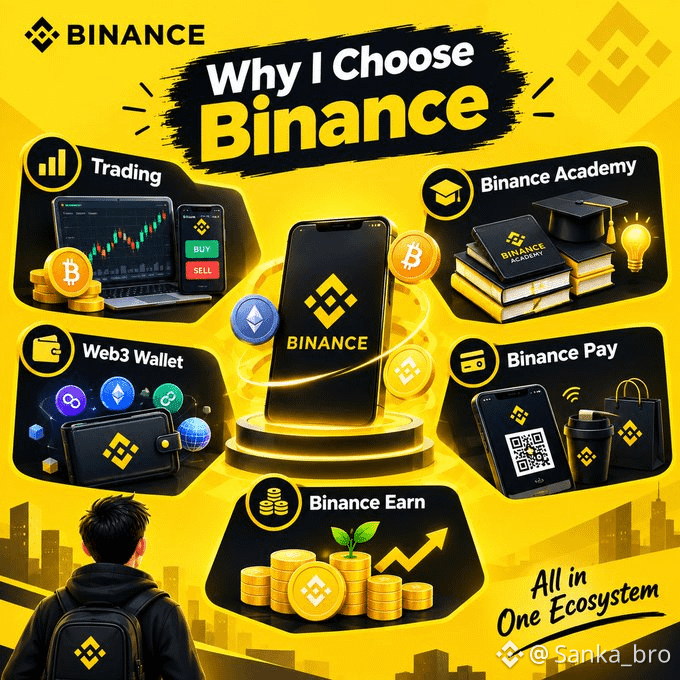
Reasons Why I Choose Binance
01/ Trading
One of the main reasons I use Binance is trading. Having access to Spot and other trading tools on one platform makes it easier for me to manage my trades.
02/ Binance Academy
For me, learning is just as important as trading. Binance Academy helps me continuously improve my knowledge of crypto, blockchain, and trading concepts.
03/ Web3 Wallet
Binance Wallet helps me explore Web3, DApps, and the on-chain ecosystem. I can explore the Web3 world without needing to rely on multiple separate platforms.
04/ Binance Pay
Binance Pay gives me a convenient way to use supported crypto assets for payments. Having crypto payment functionality within the same ecosystem is valuable to me.
05/ Binance Earn
Instead of simply leaving eligible assets unused, Binance Earn gives me opportunities to earn rewards through available Earn products.
@Binance_Angels @Binance_Academy #WhyBinance
For me, Binance is more than just a place to trade crypto.
💛
It’s a place that has changed my life and become very close to my heart.
Today, I’m happily continuing my crypto journey with Binance because of the experiences, knowledge, and opportunities I’ve gained along the way.
With Binance, I can learn, trade, explore Web3, and manage my assets within one ecosystem.
That’s why Binance is not just a platform for me…
It’s a part of my crypto journey.
Reasons Why I Choose Binance
01/ Trading
One of the main reasons I use Binance is trading. Having access to Spot and other trading tools on one platform makes it easier for me to manage my trades.
02/ Binance Academy
For me, learning is just as important as trading. Binance Academy helps me continuously improve my knowledge of crypto, blockchain, and trading concepts.
03/ Web3 Wallet
Binance Wallet helps me explore Web3, DApps, and the on-chain ecosystem. I can explore the Web3 world without needing to rely on multiple separate platforms.
04/ Binance Pay
Binance Pay gives me a convenient way to use supported crypto assets for payments. Having crypto payment functionality within the same ecosystem is valuable to me.
05/ Binance Earn
Instead of simply leaving eligible assets unused, Binance Earn gives me opportunities to earn rewards through available Earn products.
@Binance Angels @Binance Academy #WhyBinance
💛
It’s a place that has changed my life and become very close to my heart.
Today, I’m happily continuing my crypto journey with Binance because of the experiences, knowledge, and opportunities I’ve gained along the way.
With Binance, I can learn, trade, explore Web3, and manage my assets within one ecosystem.
That’s why Binance is not just a platform for me…
It’s a part of my crypto journey.
Reasons Why I Choose Binance
01/ Trading
One of the main reasons I use Binance is trading. Having access to Spot and other trading tools on one platform makes it easier for me to manage my trades.
02/ Binance Academy
For me, learning is just as important as trading. Binance Academy helps me continuously improve my knowledge of crypto, blockchain, and trading concepts.
03/ Web3 Wallet
Binance Wallet helps me explore Web3, DApps, and the on-chain ecosystem. I can explore the Web3 world without needing to rely on multiple separate platforms.
04/ Binance Pay
Binance Pay gives me a convenient way to use supported crypto assets for payments. Having crypto payment functionality within the same ecosystem is valuable to me.
05/ Binance Earn
Instead of simply leaving eligible assets unused, Binance Earn gives me opportunities to earn rewards through available Earn products.
@Binance Angels @Binance Academy #WhyBinance
1
54
·
--
What Is a Multisig Wallet
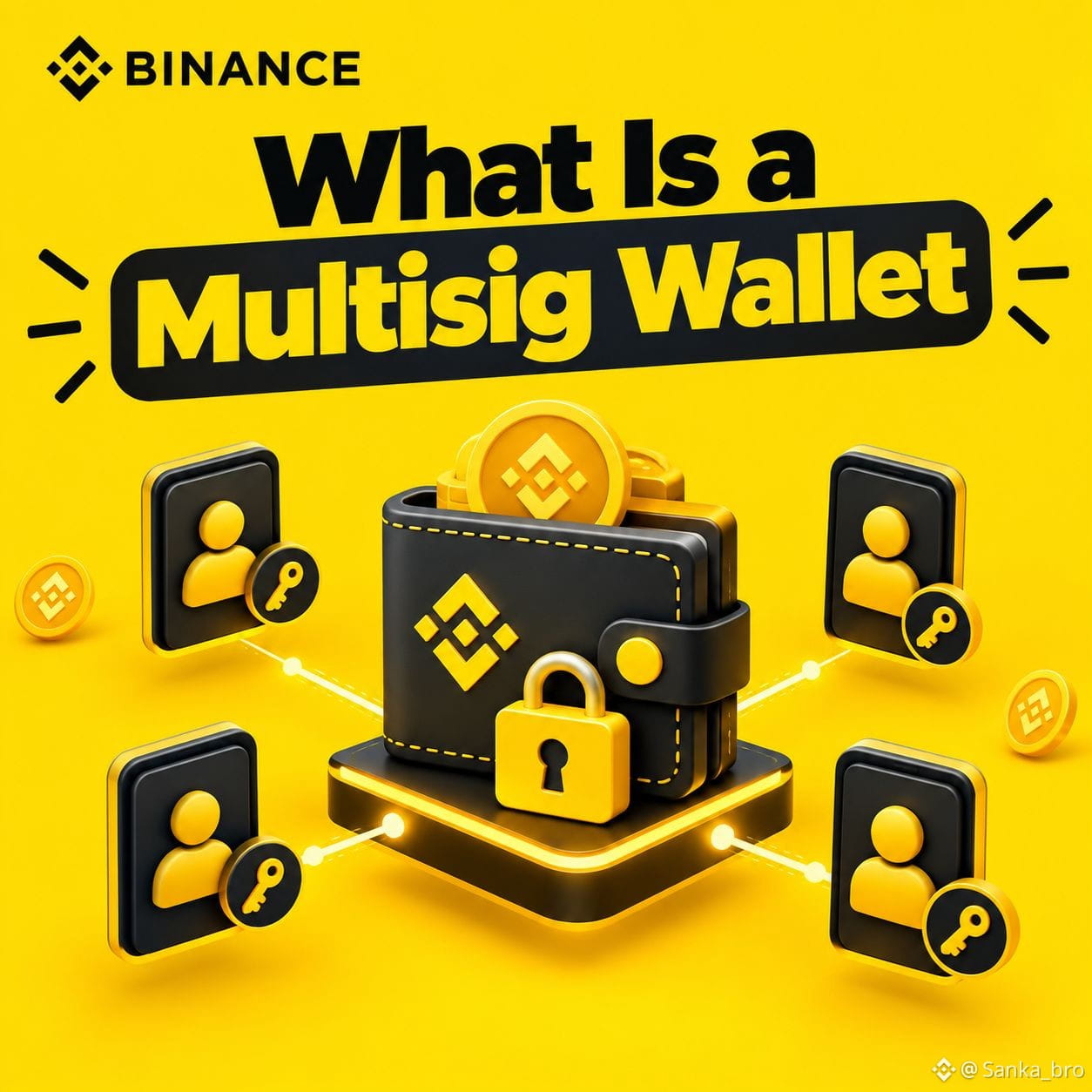
Imagine a bank vault that needs 3 keys to open.
That’s the basic idea behind a Multisig (Multi Signature) Wallet.
Instead of one private key controlling the funds, multiple keys are required to approve a transaction.
Example: 2-of-3 Multisig
• 3 keyholders
• At least 2 must approve
• 1 lost key doesn’t necessarily mean lost funds
Why use Multisig
✅ Reduces single points of failure
✅ Adds an extra security layer
✅ Useful for businesses & shared funds
✅ Can help protect against a single compromised key
But Multisig also requires careful key management and recovery planning.
Simple idea
One key , one point of failure
Multiple signatures , distributed control
Learn first. Secure your crypto better.
@Binance_Angels @Binance_Academy @BinanceTG @BinanceWallet
What Is a Multisig Wallet
Imagine a bank vault that needs 3 keys to open.
That’s the basic idea behind a Multisig (Multi Signature) Wallet.
Instead of one private key controlling the funds, multiple keys are required to approve a transaction.
Example: 2-of-3 Multisig
• 3 keyholders
• At least 2 must approve
• 1 lost key doesn’t necessarily mean lost funds
Why use Multisig
✅ Reduces single points of failure
✅ Adds an extra security layer
✅ Useful for businesses & shared funds
✅ Can help protect against a single compromised key
But Multisig also requires careful key management and recovery planning.
Simple idea
One key , one point of failure
Multiple signatures , distributed control
Learn first. Secure your crypto better.
@Binance Angels @Binance Academy @Binance TG Community @Binance Wallet
Imagine a bank vault that needs 3 keys to open.
That’s the basic idea behind a Multisig (Multi Signature) Wallet.
Instead of one private key controlling the funds, multiple keys are required to approve a transaction.
Example: 2-of-3 Multisig
• 3 keyholders
• At least 2 must approve
• 1 lost key doesn’t necessarily mean lost funds
Why use Multisig
✅ Reduces single points of failure
✅ Adds an extra security layer
✅ Useful for businesses & shared funds
✅ Can help protect against a single compromised key
But Multisig also requires careful key management and recovery planning.
Simple idea
One key , one point of failure
Multiple signatures , distributed control
Learn first. Secure your crypto better.
@Binance Angels @Binance Academy @Binance TG Community @Binance Wallet
2
94
·
--
What Is On Chain in Crypto
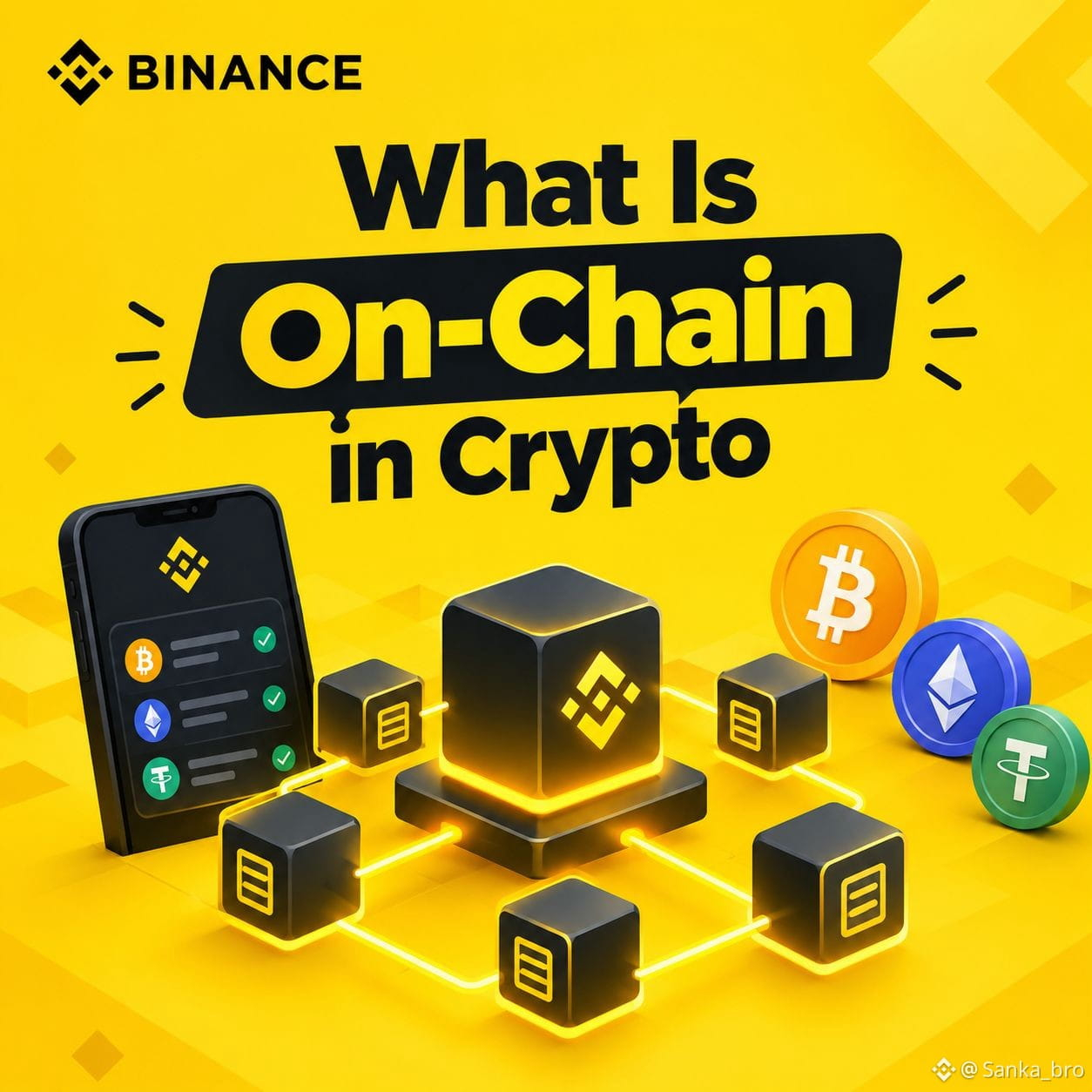
On chain refers to crypto transactions and activities that are directly recorded on a blockchain.
Examples
• Sending and receiving crypto
• Smart contract execution
• Token transfers
• Real world asset (RWA) tokenization
Because these activities are recorded on the blockchain, they can be transparent, verifiable, and immutable.
On Chain vs Off Chain
On-chain → Activity happens directly on the blockchain.
Off chain → Activity is processed outside the main blockchain and may later be settled on chain.
On chain data can also help analyze whale activity, wallet flows, transaction volume, and market behavior.
Simply put
If an activity is recorded directly on the blockchain, it’s On Chain.
@Binance_Angels @Binance_Academy @BinanceTG
What Is On Chain in Crypto
On chain refers to crypto transactions and activities that are directly recorded on a blockchain.
Examples
• Sending and receiving crypto
• Smart contract execution
• Token transfers
• Real world asset (RWA) tokenization
Because these activities are recorded on the blockchain, they can be transparent, verifiable, and immutable.
On Chain vs Off Chain
On-chain → Activity happens directly on the blockchain.
Off chain → Activity is processed outside the main blockchain and may later be settled on chain.
On chain data can also help analyze whale activity, wallet flows, transaction volume, and market behavior.
Simply put
If an activity is recorded directly on the blockchain, it’s On Chain.
@Binance Angels @Binance Academy @Binance TG Community
On chain refers to crypto transactions and activities that are directly recorded on a blockchain.
Examples
• Sending and receiving crypto
• Smart contract execution
• Token transfers
• Real world asset (RWA) tokenization
Because these activities are recorded on the blockchain, they can be transparent, verifiable, and immutable.
On Chain vs Off Chain
On-chain → Activity happens directly on the blockchain.
Off chain → Activity is processed outside the main blockchain and may later be settled on chain.
On chain data can also help analyze whale activity, wallet flows, transaction volume, and market behavior.
Simply put
If an activity is recorded directly on the blockchain, it’s On Chain.
@Binance Angels @Binance Academy @Binance TG Community
2
71
·
--
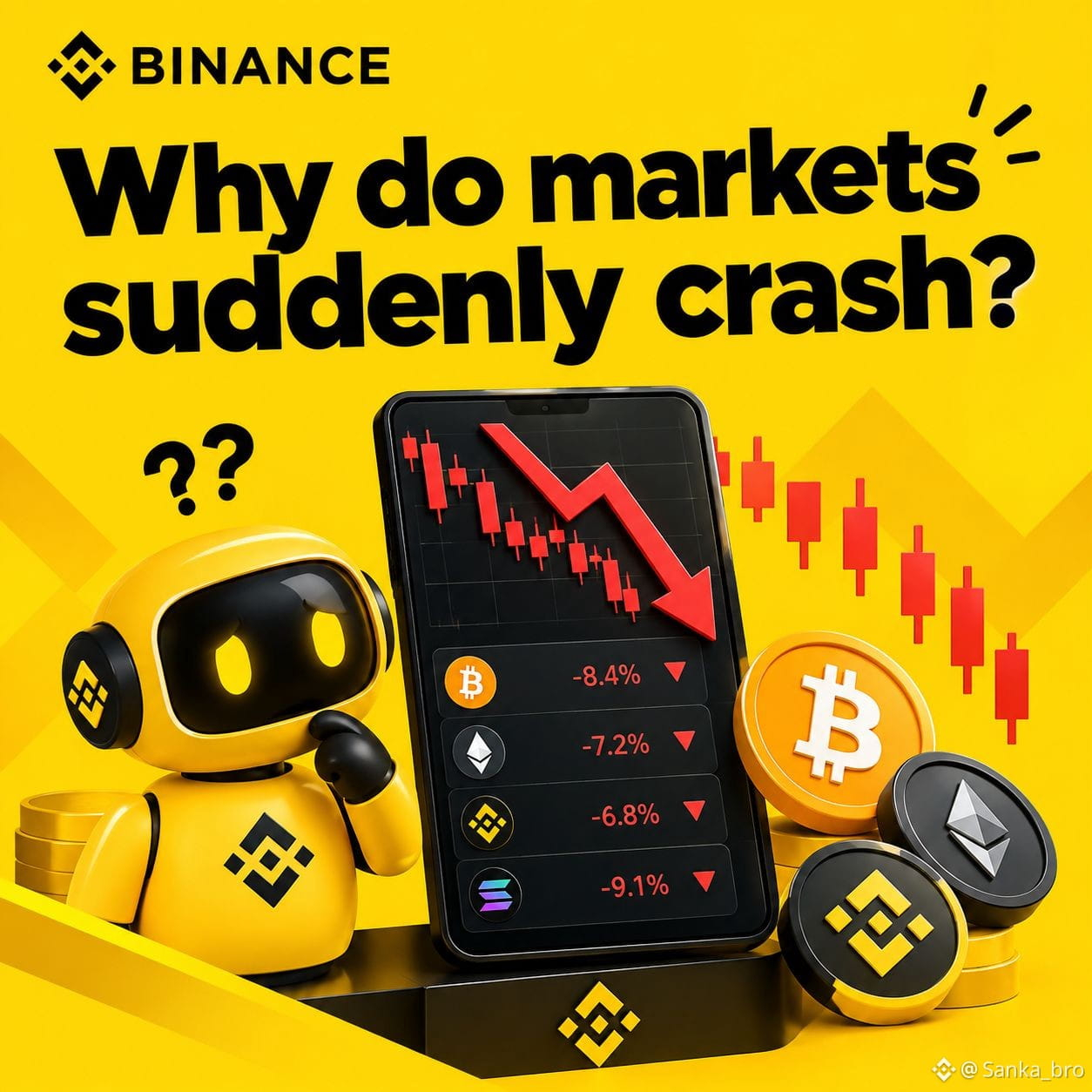
Black Monday Understanding Market Crashes
What happens when the market suddenly drops by a huge amount in a very short time?
That’s what we call a market crash.
One of the most famous examples is Black Monday October 19, 1987, when the Dow Jones Industrial Average fell by more than 22% in a single trading day.
But market crashes rarely happen because of just one reason.
Economic pressure, uncertainty, automated trading, and investor psychology can combine to create panic selling and accelerate a market decline.
What Are Circuit Breakers?
After the 1987 crash, circuit breakers were introduced to temporarily pause trading during extreme market declines.
For the S&P 500
🔹 -7% → 15-minute trading halt
🔹 -13% → another 15-minute halt
🔹 -20% → trading stops for the rest of the day
The goal is to give the market a short pause and help reduce panic-driven selling.
The Biggest Lesson From Market Crashes
We can’t control market volatility.
But we can control our risk.
✅ Have a clear trading plan
✅ Manage your position size
✅ Use stop losses when appropriate
✅ Avoid emotional decisions
✅ Never risk more than you can afford to lose
When the market is green, having a strategy is easy.
Following that strategy when the market turns red is the real challenge.
Keep learning with Binance Academy and build your understanding of market crashes, risk management, and trading psychology.
Learn → Plan → Manage Risk → Trade Smarter.
@Binance_Angels @Binance_Academy @BinanceWallet @BinanceTG
Black Monday Understanding Market Crashes
What happens when the market suddenly drops by a huge amount in a very short time?
That’s what we call a market crash.
One of the most famous examples is Black Monday October 19, 1987, when the Dow Jones Industrial Average fell by more than 22% in a single trading day.
But market crashes rarely happen because of just one reason.
Economic pressure, uncertainty, automated trading, and investor psychology can combine to create panic selling and accelerate a market decline.
What Are Circuit Breakers?
After the 1987 crash, circuit breakers were introduced to temporarily pause trading during extreme market declines.
For the S&P 500
🔹 -7% → 15-minute trading halt
🔹 -13% → another 15-minute halt
🔹 -20% → trading stops for the rest of the day
The goal is to give the market a short pause and help reduce panic-driven selling.
The Biggest Lesson From Market Crashes
We can’t control market volatility.
But we can control our risk.
✅ Have a clear trading plan
✅ Manage your position size
✅ Use stop losses when appropriate
✅ Avoid emotional decisions
✅ Never risk more than you can afford to lose
When the market is green, having a strategy is easy.
Following that strategy when the market turns red is the real challenge.
Keep learning with Binance Academy and build your understanding of market crashes, risk management, and trading psychology.
Learn → Plan → Manage Risk → Trade Smarter.
@Binance Angels @Binance Academy @Binance Wallet @Binance TG Community
What happens when the market suddenly drops by a huge amount in a very short time?
That’s what we call a market crash.
One of the most famous examples is Black Monday October 19, 1987, when the Dow Jones Industrial Average fell by more than 22% in a single trading day.
But market crashes rarely happen because of just one reason.
Economic pressure, uncertainty, automated trading, and investor psychology can combine to create panic selling and accelerate a market decline.
What Are Circuit Breakers?
After the 1987 crash, circuit breakers were introduced to temporarily pause trading during extreme market declines.
For the S&P 500
🔹 -7% → 15-minute trading halt
🔹 -13% → another 15-minute halt
🔹 -20% → trading stops for the rest of the day
The goal is to give the market a short pause and help reduce panic-driven selling.
The Biggest Lesson From Market Crashes
We can’t control market volatility.
But we can control our risk.
✅ Have a clear trading plan
✅ Manage your position size
✅ Use stop losses when appropriate
✅ Avoid emotional decisions
✅ Never risk more than you can afford to lose
When the market is green, having a strategy is easy.
Following that strategy when the market turns red is the real challenge.
Keep learning with Binance Academy and build your understanding of market crashes, risk management, and trading psychology.
Learn → Plan → Manage Risk → Trade Smarter.
@Binance Angels @Binance Academy @Binance Wallet @Binance TG Community
1
72
·
--
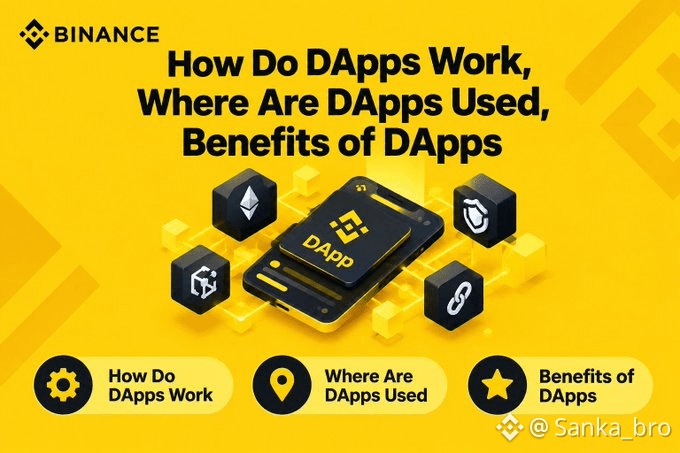
What Are DApps & How Do They Work?
Decentralized Applications (DApps) are applications that use blockchain technology and smart contracts instead of relying entirely on centralized servers.
How Do DApps Work?
DApps use smart contracts to automate rules and processes. When predefined conditions are met, smart contracts can execute actions automatically.
This reduces the need for intermediaries and allows transactions to be processed according to transparent, predefined rules.
Simple flow
User → Wallet → DApp → Smart Contract → Blockchain
Where Are DApps Used?
DApps are used across different areas of Web3, including
• DeFi — Decentralized Finance
• Gaming — Blockchain based games
• NFT Platforms — Digital asset creation & trading
• Governance — Decentralized voting & decision making
Benefits of DApps
✅ Greater transparency
✅ More user ownership
✅ Decentralized control
✅ Open access
✅ Reduced reliance on intermediaries
But DApps also have challenges
• Scalability
• User experience
• Smart contract & security risks
In simple terms
DApps combine applications + smart contracts + blockchain to create more decentralized and transparent digital services.
As Web3 continues to grow, DApps could play an important role in how we use financial services, games, digital assets, and online communities.
@Binance_Angels @Binance_Academy @BinanceTG @BinanceWallet
What Are DApps & How Do They Work?
Decentralized Applications (DApps) are applications that use blockchain technology and smart contracts instead of relying entirely on centralized servers.
How Do DApps Work?
DApps use smart contracts to automate rules and processes. When predefined conditions are met, smart contracts can execute actions automatically.
This reduces the need for intermediaries and allows transactions to be processed according to transparent, predefined rules.
Simple flow
User → Wallet → DApp → Smart Contract → Blockchain
Where Are DApps Used?
DApps are used across different areas of Web3, including
• DeFi — Decentralized Finance
• Gaming — Blockchain based games
• NFT Platforms — Digital asset creation & trading
• Governance — Decentralized voting & decision making
Benefits of DApps
✅ Greater transparency
✅ More user ownership
✅ Decentralized control
✅ Open access
✅ Reduced reliance on intermediaries
But DApps also have challenges
• Scalability
• User experience
• Smart contract & security risks
In simple terms
DApps combine applications + smart contracts + blockchain to create more decentralized and transparent digital services.
As Web3 continues to grow, DApps could play an important role in how we use financial services, games, digital assets, and online communities.
@Binance Angels @Binance Academy @Binance TG Community @Binance Wallet
Decentralized Applications (DApps) are applications that use blockchain technology and smart contracts instead of relying entirely on centralized servers.
How Do DApps Work?
DApps use smart contracts to automate rules and processes. When predefined conditions are met, smart contracts can execute actions automatically.
This reduces the need for intermediaries and allows transactions to be processed according to transparent, predefined rules.
Simple flow
User → Wallet → DApp → Smart Contract → Blockchain
Where Are DApps Used?
DApps are used across different areas of Web3, including
• DeFi — Decentralized Finance
• Gaming — Blockchain based games
• NFT Platforms — Digital asset creation & trading
• Governance — Decentralized voting & decision making
Benefits of DApps
✅ Greater transparency
✅ More user ownership
✅ Decentralized control
✅ Open access
✅ Reduced reliance on intermediaries
But DApps also have challenges
• Scalability
• User experience
• Smart contract & security risks
In simple terms
DApps combine applications + smart contracts + blockchain to create more decentralized and transparent digital services.
As Web3 continues to grow, DApps could play an important role in how we use financial services, games, digital assets, and online communities.
@Binance Angels @Binance Academy @Binance TG Community @Binance Wallet
3
51
·
--
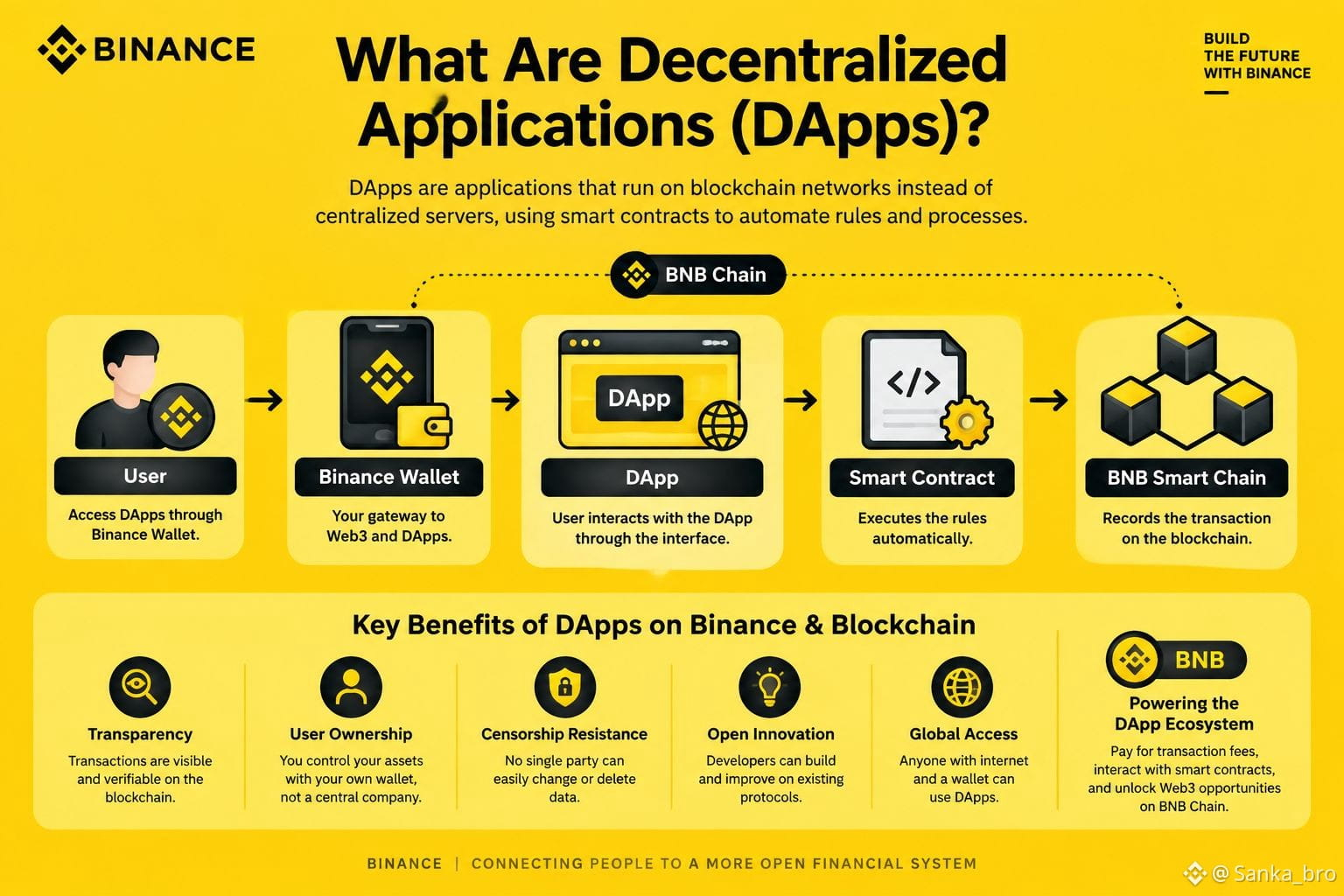
What Are Decentralized Applications (DApps)
In a traditional application, data and the main functions are stored on servers or databases controlled by a single company.
That company can control things like changing data, approving transactions, or denying access.
But with a DApp
Important rules & transactions → Smart Contracts
Processing & verification → Blockchain Network
Control → Decentralized Network
For example, if you want to swap crypto using a DeFi DApp:
You → Wallet → DApp → Smart Contract → Blockchain
Once you confirm the swap, the transaction is processed according to the predefined rules of the smart contract.
It’s not manually approved by a company employee. Instead, blockchain network nodes verify the transaction.
Simple idea
DApp = Application + Smart Contracts + Blockchain
In simple terms, a DApp is an application where important rules and transactions are handled through blockchain and smart contracts instead of relying entirely on a centralized company server.
@Binance_Angels @Binance_Academy @BinanceTG @BinanceWallet
What Are Decentralized Applications (DApps)
In a traditional application, data and the main functions are stored on servers or databases controlled by a single company.
That company can control things like changing data, approving transactions, or denying access.
But with a DApp
Important rules & transactions → Smart Contracts
Processing & verification → Blockchain Network
Control → Decentralized Network
For example, if you want to swap crypto using a DeFi DApp:
You → Wallet → DApp → Smart Contract → Blockchain
Once you confirm the swap, the transaction is processed according to the predefined rules of the smart contract.
It’s not manually approved by a company employee. Instead, blockchain network nodes verify the transaction.
Simple idea
DApp = Application + Smart Contracts + Blockchain
In simple terms, a DApp is an application where important rules and transactions are handled through blockchain and smart contracts instead of relying entirely on a centralized company server.
@Binance Angels @Binance Academy @Binance TG Community @Binance Wallet
In a traditional application, data and the main functions are stored on servers or databases controlled by a single company.
That company can control things like changing data, approving transactions, or denying access.
But with a DApp
Important rules & transactions → Smart Contracts
Processing & verification → Blockchain Network
Control → Decentralized Network
For example, if you want to swap crypto using a DeFi DApp:
You → Wallet → DApp → Smart Contract → Blockchain
Once you confirm the swap, the transaction is processed according to the predefined rules of the smart contract.
It’s not manually approved by a company employee. Instead, blockchain network nodes verify the transaction.
Simple idea
DApp = Application + Smart Contracts + Blockchain
In simple terms, a DApp is an application where important rules and transactions are handled through blockchain and smart contracts instead of relying entirely on a centralized company server.
@Binance Angels @Binance Academy @Binance TG Community @Binance Wallet
2
70
·
--
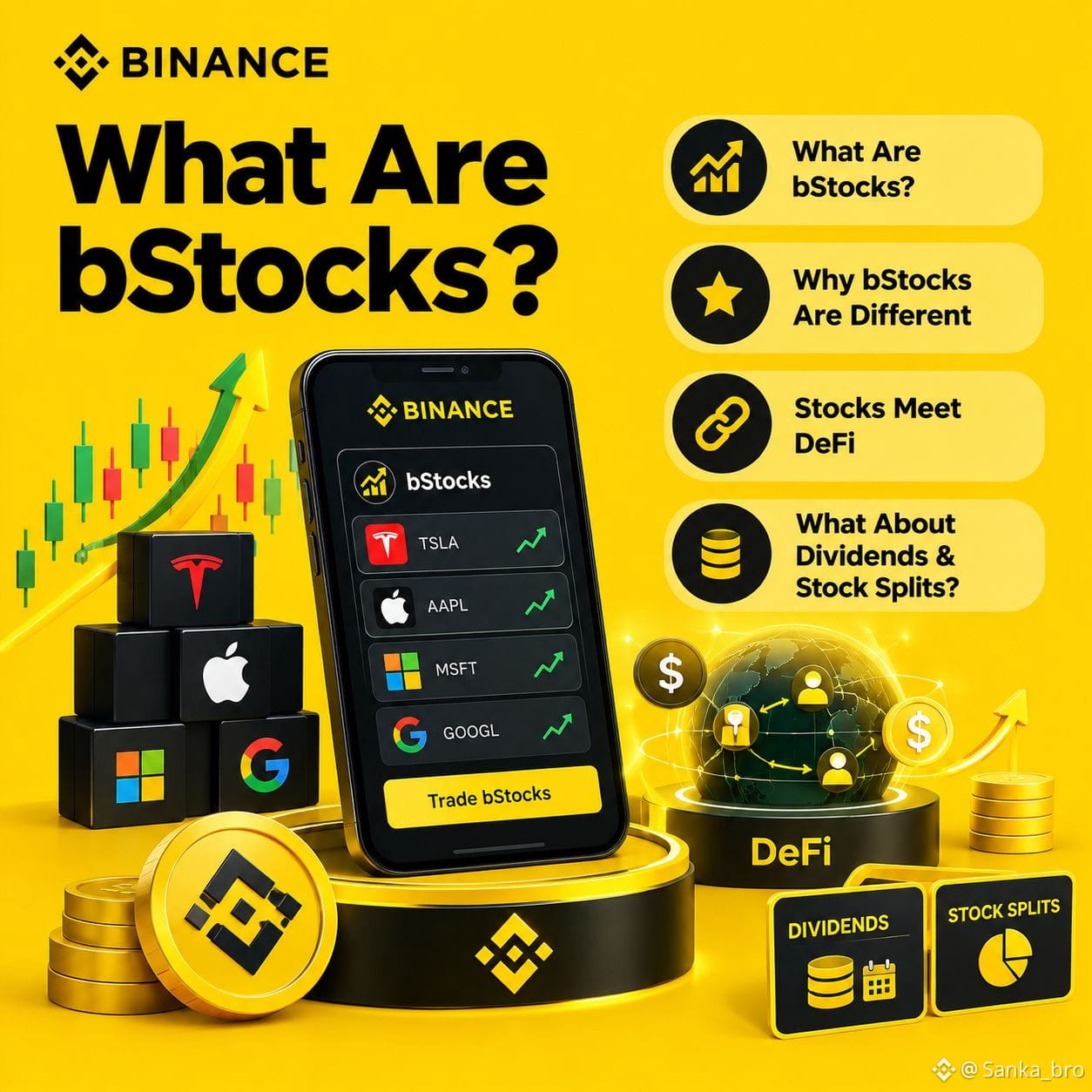
What Are bStocks? A New Way to Access US Stocks on Binance
What if you could get exposure to US stocks with the flexibility of crypto?
bStocks are tokenized securities on Binance, backed 1:1 by real US shares held with a regulated custodian.
Here’s what makes them interesting 👇
Trade 24/7
Unlike traditional stock markets, bStocks can be traded around the clock on Binance Spot.
Fast Settlement
Transactions can settle in under a second, without traditional T+1 settlement windows.
Start from $5
Fractional access makes it possible to gain stock exposure with a smaller amount.
Self Custody DeFi
As BEP-20 tokens on BNB Smart Chain, eligible users can withdraw bStocks to compatible wallets and explore DeFi use cases.
1:1 Backing & Conversion
Each bStock is backed 1:1 by the corresponding US share, with eligible users able to convert between the stock and bStock.
Dividends & Stock Splits
Corporate actions are handled automatically through the on chain Multiplier mechanism.
TradFi Blockchain Tokenized Stocks
bStocks show how traditional financial assets can become more accessible, programmable, and integrated with blockchain infrastructure.
Would you consider using tokenized stocks instead of traditional stock exposure?
@Binance_Angels @Binance_Academy @BinanceTG
What Are bStocks? A New Way to Access US Stocks on Binance
What if you could get exposure to US stocks with the flexibility of crypto?
bStocks are tokenized securities on Binance, backed 1:1 by real US shares held with a regulated custodian.
Here’s what makes them interesting 👇
Trade 24/7
Unlike traditional stock markets, bStocks can be traded around the clock on Binance Spot.
Fast Settlement
Transactions can settle in under a second, without traditional T+1 settlement windows.
Start from $5
Fractional access makes it possible to gain stock exposure with a smaller amount.
Self Custody DeFi
As BEP-20 tokens on BNB Smart Chain, eligible users can withdraw bStocks to compatible wallets and explore DeFi use cases.
1:1 Backing & Conversion
Each bStock is backed 1:1 by the corresponding US share, with eligible users able to convert between the stock and bStock.
Dividends & Stock Splits
Corporate actions are handled automatically through the on chain Multiplier mechanism.
TradFi Blockchain Tokenized Stocks
bStocks show how traditional financial assets can become more accessible, programmable, and integrated with blockchain infrastructure.
Would you consider using tokenized stocks instead of traditional stock exposure?
@Binance Angels @Binance Academy @Binance TG Community
What if you could get exposure to US stocks with the flexibility of crypto?
bStocks are tokenized securities on Binance, backed 1:1 by real US shares held with a regulated custodian.
Here’s what makes them interesting 👇
Trade 24/7
Unlike traditional stock markets, bStocks can be traded around the clock on Binance Spot.
Fast Settlement
Transactions can settle in under a second, without traditional T+1 settlement windows.
Start from $5
Fractional access makes it possible to gain stock exposure with a smaller amount.
Self Custody DeFi
As BEP-20 tokens on BNB Smart Chain, eligible users can withdraw bStocks to compatible wallets and explore DeFi use cases.
1:1 Backing & Conversion
Each bStock is backed 1:1 by the corresponding US share, with eligible users able to convert between the stock and bStock.
Dividends & Stock Splits
Corporate actions are handled automatically through the on chain Multiplier mechanism.
TradFi Blockchain Tokenized Stocks
bStocks show how traditional financial assets can become more accessible, programmable, and integrated with blockchain infrastructure.
Would you consider using tokenized stocks instead of traditional stock exposure?
@Binance Angels @Binance Academy @Binance TG Community
2
146
·
--
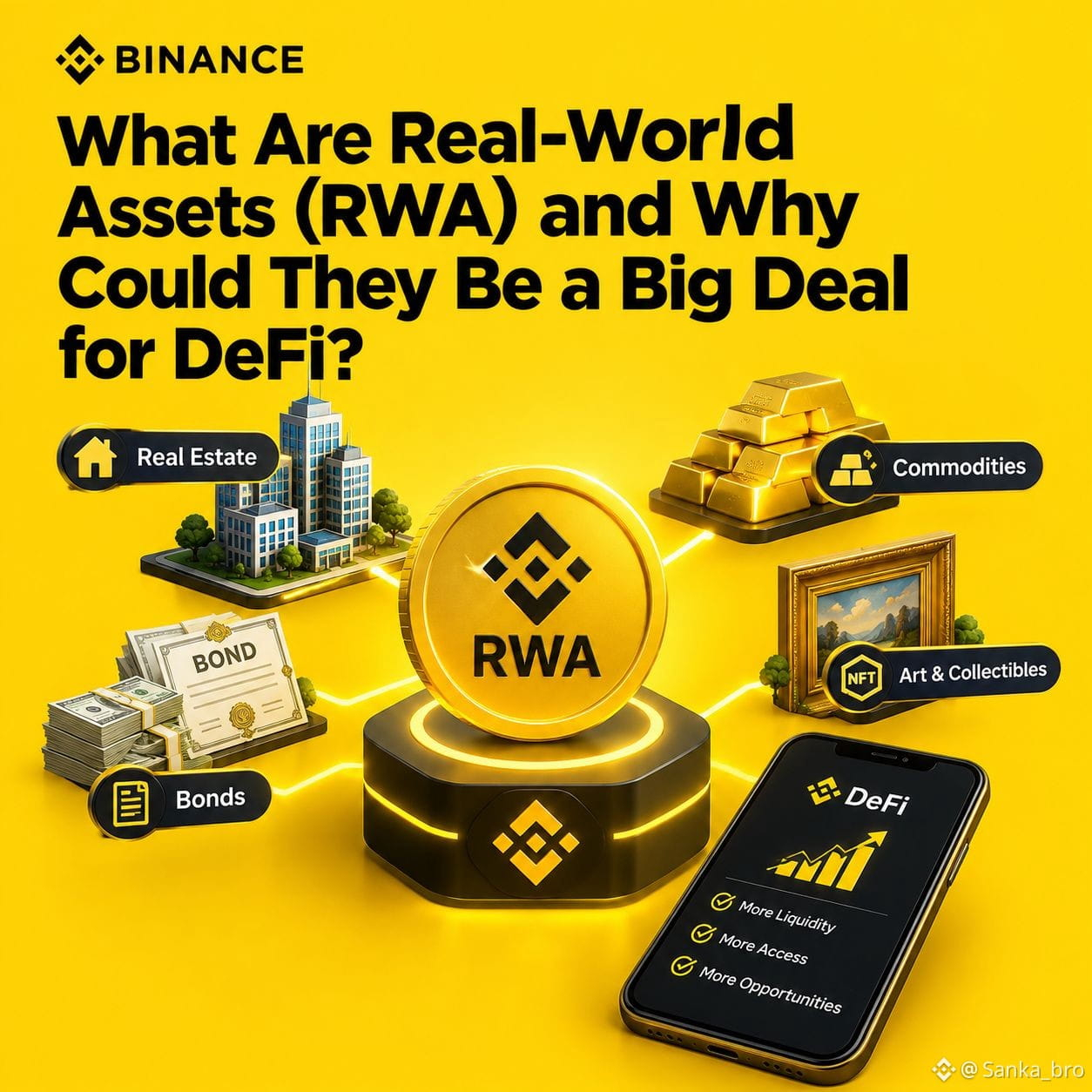
What Are Real World Assets RWA in Crypto?
What if traditional assets like U.S. Treasuries, gold, stocks, and real estate could live on the blockchain?
That’s the idea behind Real-World Asset (RWA) tokenization.
🔹 How it works
Real Asset → Custodian → Legal Framework → Blockchain Token → DeFi
By turning real world assets into blockchain-based tokens, RWA can enable
Faster settlement
Fractional ownership
On chain accessibility
Programmable yield
Blockchain based transfers
Use as DeFi collateral
The tokenized RWA market reached $193.2B in Q1 2026, showing how quickly traditional finance is moving toward on-chain infrastructure.
But RWA isn't risk free. Smart contract vulnerabilities, custody risks, regulatory uncertainty, and redemption limitations still matter.
RWA could become a major bridge between TradFi and DeFi.
Do you think tokenization will become one of the biggest narratives in crypto? 👇
@Binance_Angels @Binance_Academy @BinanceTG
What Are Real World Assets RWA in Crypto?
What if traditional assets like U.S. Treasuries, gold, stocks, and real estate could live on the blockchain?
That’s the idea behind Real-World Asset (RWA) tokenization.
🔹 How it works
Real Asset → Custodian → Legal Framework → Blockchain Token → DeFi
By turning real world assets into blockchain-based tokens, RWA can enable
Faster settlement
Fractional ownership
On chain accessibility
Programmable yield
Blockchain based transfers
Use as DeFi collateral
The tokenized RWA market reached $193.2B in Q1 2026, showing how quickly traditional finance is moving toward on-chain infrastructure.
But RWA isn't risk free. Smart contract vulnerabilities, custody risks, regulatory uncertainty, and redemption limitations still matter.
RWA could become a major bridge between TradFi and DeFi.
Do you think tokenization will become one of the biggest narratives in crypto? 👇
@Binance Angels @Binance Academy @Binance TG Community
What if traditional assets like U.S. Treasuries, gold, stocks, and real estate could live on the blockchain?
That’s the idea behind Real-World Asset (RWA) tokenization.
🔹 How it works
Real Asset → Custodian → Legal Framework → Blockchain Token → DeFi
By turning real world assets into blockchain-based tokens, RWA can enable
Faster settlement
Fractional ownership
On chain accessibility
Programmable yield
Blockchain based transfers
Use as DeFi collateral
The tokenized RWA market reached $193.2B in Q1 2026, showing how quickly traditional finance is moving toward on-chain infrastructure.
But RWA isn't risk free. Smart contract vulnerabilities, custody risks, regulatory uncertainty, and redemption limitations still matter.
RWA could become a major bridge between TradFi and DeFi.
Do you think tokenization will become one of the biggest narratives in crypto? 👇
@Binance Angels @Binance Academy @Binance TG Community
3
54
·
--
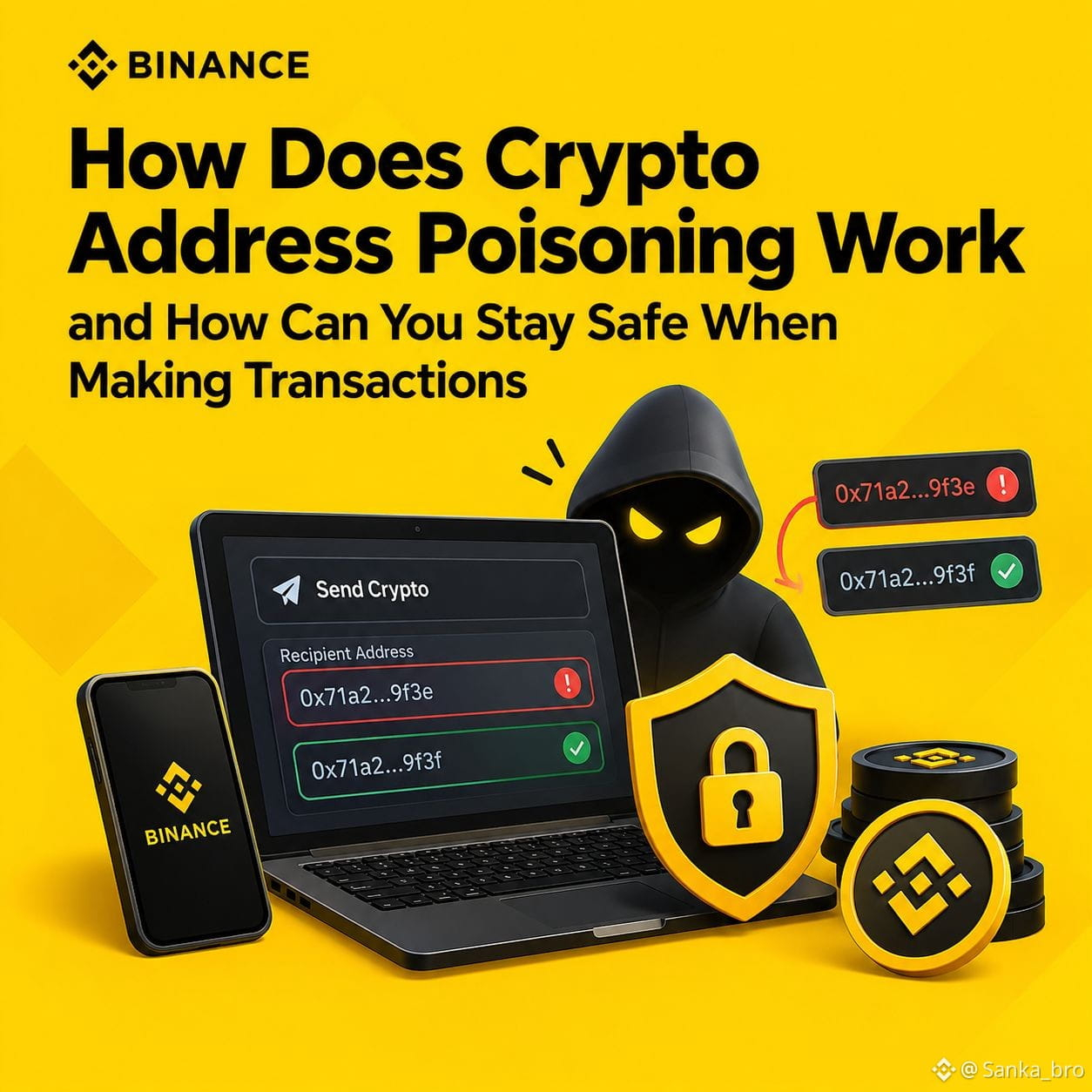
How Does Crypto Address Poisoning Work and How Can You Stay Safe When Making Transactions?
Crypto address poisoning is a scam where attackers create wallet addresses that look almost identical to addresses you regularly use.
They then send a tiny or zero value transaction to your wallet, hoping you’ll later copy the fake address from your transaction history and send your funds to them.
How to stay safe
✅ Always verify the full wallet address before sending
✅ Never blindly copy an address from recent transactions
✅ Use an Address Book Allowlist for trusted addresses
✅ Send a small test transaction before large transfers
✅ Be cautious of unexpected dust or zero value transactions
✅ For large amounts, confirm the address through a trusted channel
Remember
blockchain transactions are generally irreversible.
Don’t trust an address just because it looks familiar. Stop. Verify. Then Send.
@Binance_Angels @Binance_Academy @BinanceTG
How Does Crypto Address Poisoning Work and How Can You Stay Safe When Making Transactions?
Crypto address poisoning is a scam where attackers create wallet addresses that look almost identical to addresses you regularly use.
They then send a tiny or zero value transaction to your wallet, hoping you’ll later copy the fake address from your transaction history and send your funds to them.
How to stay safe
✅ Always verify the full wallet address before sending
✅ Never blindly copy an address from recent transactions
✅ Use an Address Book Allowlist for trusted addresses
✅ Send a small test transaction before large transfers
✅ Be cautious of unexpected dust or zero value transactions
✅ For large amounts, confirm the address through a trusted channel
Remember
blockchain transactions are generally irreversible.
Don’t trust an address just because it looks familiar. Stop. Verify. Then Send.
@Binance Angels @Binance Academy @Binance TG Community
Crypto address poisoning is a scam where attackers create wallet addresses that look almost identical to addresses you regularly use.
They then send a tiny or zero value transaction to your wallet, hoping you’ll later copy the fake address from your transaction history and send your funds to them.
How to stay safe
✅ Always verify the full wallet address before sending
✅ Never blindly copy an address from recent transactions
✅ Use an Address Book Allowlist for trusted addresses
✅ Send a small test transaction before large transfers
✅ Be cautious of unexpected dust or zero value transactions
✅ For large amounts, confirm the address through a trusted channel
Remember
blockchain transactions are generally irreversible.
Don’t trust an address just because it looks familiar. Stop. Verify. Then Send.
@Binance Angels @Binance Academy @Binance TG Community
2
43
·
--
Binance AI Agent Skills Making AI More Powerful
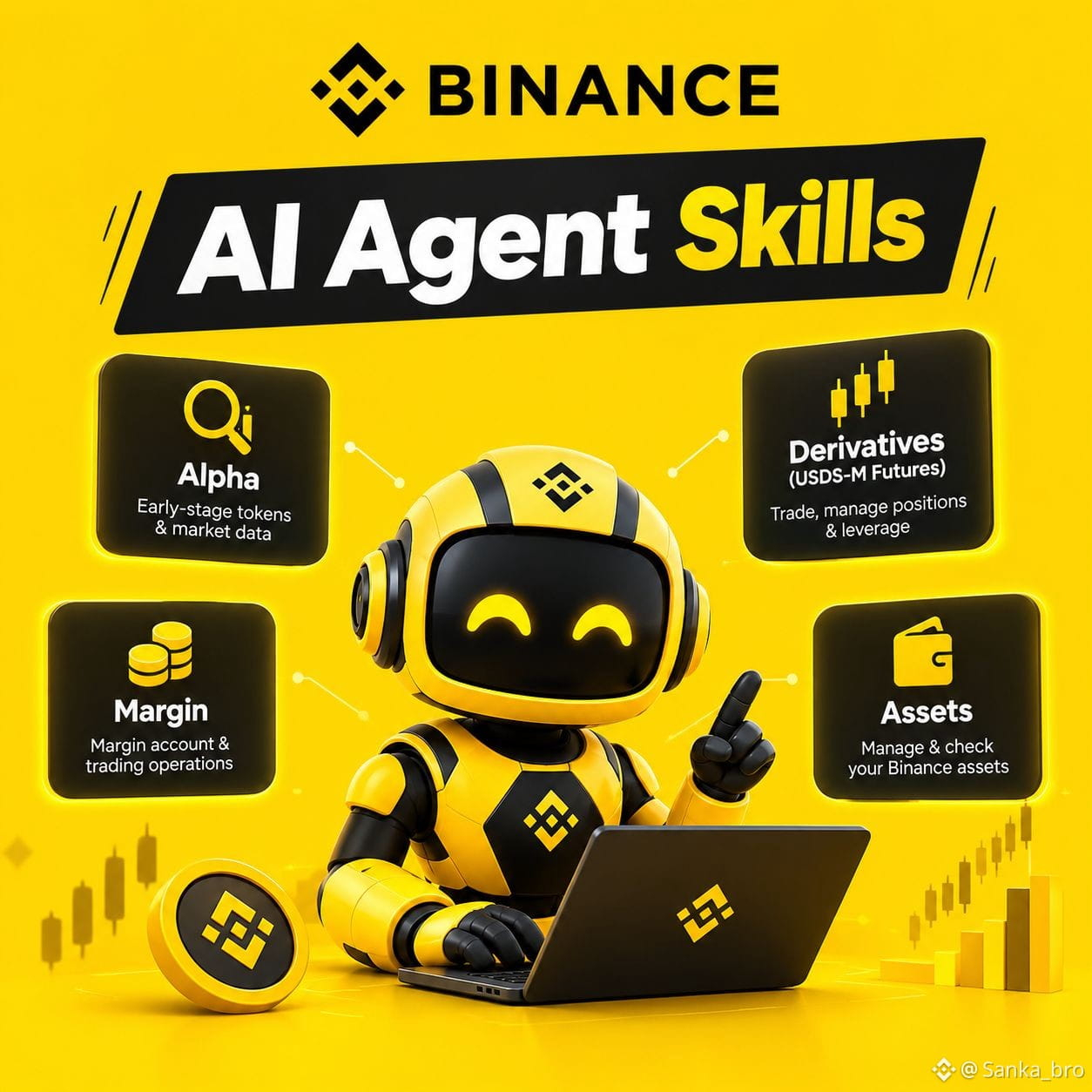
Binance has introduced 4 new AI Agent Skills: Alpha, Derivatives, Margin & Assets.
🔹 Alpha – Real time Alpha market data, token listings, K lines & 24H stats. No API key required.
🔹 Derivatives – USDS M Futures market data, order & position management, and leverage adjustments.
🔹 Margin – Access margin account data and trading operations.
🔹 Assets – Check balances, wallet information and manage Binance assets programmatically.
These skills allow AI Agents to go beyond simple analysis they can help monitor markets, automate trading workflows and manage assets.
Security matters Use only necessary API permissions, whitelist trusted IPs, protect your API keys, and be extra careful with leverage.
AI Binance Smarter automation.
@Binance_Angels @Binance_Academy @BinanceTG
Binance AI Agent Skills Making AI More Powerful
Binance has introduced 4 new AI Agent Skills: Alpha, Derivatives, Margin & Assets.
🔹 Alpha – Real time Alpha market data, token listings, K lines & 24H stats. No API key required.
🔹 Derivatives – USDS M Futures market data, order & position management, and leverage adjustments.
🔹 Margin – Access margin account data and trading operations.
🔹 Assets – Check balances, wallet information and manage Binance assets programmatically.
These skills allow AI Agents to go beyond simple analysis they can help monitor markets, automate trading workflows and manage assets.
Security matters Use only necessary API permissions, whitelist trusted IPs, protect your API keys, and be extra careful with leverage.
AI Binance Smarter automation.
@Binance Angels @Binance Academy @Binance TG Community
Binance has introduced 4 new AI Agent Skills: Alpha, Derivatives, Margin & Assets.
🔹 Alpha – Real time Alpha market data, token listings, K lines & 24H stats. No API key required.
🔹 Derivatives – USDS M Futures market data, order & position management, and leverage adjustments.
🔹 Margin – Access margin account data and trading operations.
🔹 Assets – Check balances, wallet information and manage Binance assets programmatically.
These skills allow AI Agents to go beyond simple analysis they can help monitor markets, automate trading workflows and manage assets.
Security matters Use only necessary API permissions, whitelist trusted IPs, protect your API keys, and be extra careful with leverage.
AI Binance Smarter automation.
@Binance Angels @Binance Academy @Binance TG Community
3
64
·
--
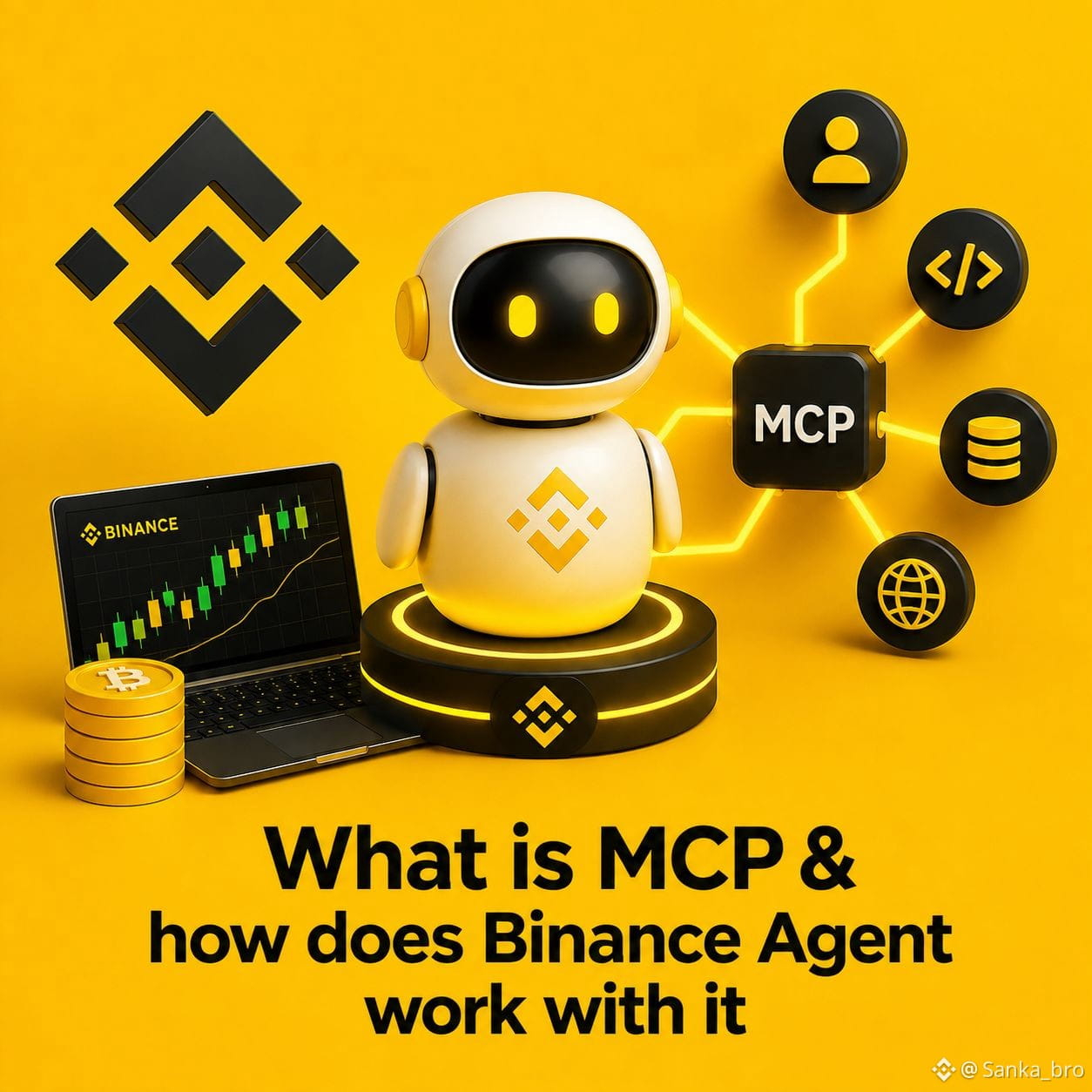
What Is MCP & How Can AI Agents Connect to Binance?
Have you ever wondered how an AI agent could do more than simply answer your questions?
That’s where MCP Model Context Protocol comes in.
MCP is an open standard that allows AI agents to connect with external apps and services. With the right permissions, an AI agent can interact with supported Binance features on your behalf.
🔹 What can a Binance connected AI agent do?
Check Market Data
• BTCUSDT price & 24h change
• Order books
• Candlesticks
• Funding rates
Check Account Information
• Agentic sub account balances
• Positions
• Bills
• Optional read only access to your main account
Trade
Depending on your permissions and account authorization, the agent can support:
• Spot
• Margin
• Convert
• USDⓈ-M Futures
• COIN-M Futures
Move Funds
You can move funds between wallets inside the same Agentic sub-account.
Important Security Protection
There is NO withdrawal scope.
Your AI agent cannot withdraw funds from your Agentic sub account to an external address.
How to Get Started
1️⃣ Log in to Binance.com using a desktop browser.
2️⃣ Open a supported AI client such as Claude Code, Claude Desktop, Codex CLI, ChatGPT, VS Code, or Grok Bot.
3️⃣ Connect the AI client to the Binance Agentic MCP server.
4️⃣ Grant only the permissions you need.
5️⃣ Start interacting with Binance through your AI agent.
For example
What’s the current BTCUSDT price and 24h change?
Or, if trading permissions are enabled
Buy $100 of BNB at market on Spot.
Always review the permissions you grant to an AI agent and understand what actions it can perform before using it for trading.
The future of trading could be more AI native, automated, and conversational.
@Binance_Angels @Binance_Academy @BinanceTG
What Is MCP & How Can AI Agents Connect to Binance?
Have you ever wondered how an AI agent could do more than simply answer your questions?
That’s where MCP Model Context Protocol comes in.
MCP is an open standard that allows AI agents to connect with external apps and services. With the right permissions, an AI agent can interact with supported Binance features on your behalf.
🔹 What can a Binance connected AI agent do?
Check Market Data
• BTCUSDT price & 24h change
• Order books
• Candlesticks
• Funding rates
Check Account Information
• Agentic sub account balances
• Positions
• Bills
• Optional read only access to your main account
Trade
Depending on your permissions and account authorization, the agent can support:
• Spot
• Margin
• Convert
• USDⓈ-M Futures
• COIN-M Futures
Move Funds
You can move funds between wallets inside the same Agentic sub-account.
Important Security Protection
There is NO withdrawal scope.
Your AI agent cannot withdraw funds from your Agentic sub account to an external address.
How to Get Started
1️⃣ Log in to Binance.com using a desktop browser.
2️⃣ Open a supported AI client such as Claude Code, Claude Desktop, Codex CLI, ChatGPT, VS Code, or Grok Bot.
3️⃣ Connect the AI client to the Binance Agentic MCP server.
4️⃣ Grant only the permissions you need.
5️⃣ Start interacting with Binance through your AI agent.
For example
What’s the current BTCUSDT price and 24h change?
Or, if trading permissions are enabled
Buy $100 of BNB at market on Spot.
Always review the permissions you grant to an AI agent and understand what actions it can perform before using it for trading.
The future of trading could be more AI native, automated, and conversational.
@Binance Angels @Binance Academy @Binance TG Community
Have you ever wondered how an AI agent could do more than simply answer your questions?
That’s where MCP Model Context Protocol comes in.
MCP is an open standard that allows AI agents to connect with external apps and services. With the right permissions, an AI agent can interact with supported Binance features on your behalf.
🔹 What can a Binance connected AI agent do?
Check Market Data
• BTCUSDT price & 24h change
• Order books
• Candlesticks
• Funding rates
Check Account Information
• Agentic sub account balances
• Positions
• Bills
• Optional read only access to your main account
Trade
Depending on your permissions and account authorization, the agent can support:
• Spot
• Margin
• Convert
• USDⓈ-M Futures
• COIN-M Futures
Move Funds
You can move funds between wallets inside the same Agentic sub-account.
Important Security Protection
There is NO withdrawal scope.
Your AI agent cannot withdraw funds from your Agentic sub account to an external address.
How to Get Started
1️⃣ Log in to Binance.com using a desktop browser.
2️⃣ Open a supported AI client such as Claude Code, Claude Desktop, Codex CLI, ChatGPT, VS Code, or Grok Bot.
3️⃣ Connect the AI client to the Binance Agentic MCP server.
4️⃣ Grant only the permissions you need.
5️⃣ Start interacting with Binance through your AI agent.
For example
What’s the current BTCUSDT price and 24h change?
Or, if trading permissions are enabled
Buy $100 of BNB at market on Spot.
Always review the permissions you grant to an AI agent and understand what actions it can perform before using it for trading.
The future of trading could be more AI native, automated, and conversational.
@Binance Angels @Binance Academy @Binance TG Community
2
102
·
--
What Is a Bitcoin ETF?
Have you ever wondered how someone can invest in Bitcoin without actually buying and storing BTC in a crypto wallet?
That’s where a Bitcoin ETF comes in.
Bitcoin ETF Bitcoin price exposure through a traditional stock exchange.
Instead of buying BTC directly, investors buy shares of an ETF through a brokerage account. The ETF is designed to track Bitcoin’s price.
🔹 Spot Bitcoin ETF
A spot ETF holds actual Bitcoin as its underlying asset.
🔹 Bitcoin Futures ETF
A futures ETF gets Bitcoin exposure through futures contracts, rather than directly holding BTC.
Why do investors use Bitcoin ETFs?
No need to manage private keys or seed phrases
Can be accessed through traditional brokerage platforms
Provides exposure to Bitcoin’s price movements
Management fees apply
Investors don't have direct self custody of the Bitcoin
So, owning a Bitcoin ETF is not exactly the same as owning BTC directly.
With self custody, you control the Bitcoin.
With an ETF, you own shares in an investment product that provides Bitcoin exposure.
The approval of US spot Bitcoin ETFs in January 2024 was a major milestone connecting Bitcoin with traditional finance. 🚀
Which would you choose?
Direct BTC ownership
Bitcoin ETF
@Binance_Angels @Binance_Academy @BinanceTG
What Is a Bitcoin ETF?
Have you ever wondered how someone can invest in Bitcoin without actually buying and storing BTC in a crypto wallet?
That’s where a Bitcoin ETF comes in.
Bitcoin ETF Bitcoin price exposure through a traditional stock exchange.
Instead of buying BTC directly, investors buy shares of an ETF through a brokerage account. The ETF is designed to track Bitcoin’s price.
🔹 Spot Bitcoin ETF
A spot ETF holds actual Bitcoin as its underlying asset.
🔹 Bitcoin Futures ETF
A futures ETF gets Bitcoin exposure through futures contracts, rather than directly holding BTC.
Why do investors use Bitcoin ETFs?
No need to manage private keys or seed phrases
Can be accessed through traditional brokerage platforms
Provides exposure to Bitcoin’s price movements
Management fees apply
Investors don't have direct self custody of the Bitcoin
So, owning a Bitcoin ETF is not exactly the same as owning BTC directly.
With self custody, you control the Bitcoin.
With an ETF, you own shares in an investment product that provides Bitcoin exposure.
The approval of US spot Bitcoin ETFs in January 2024 was a major milestone connecting Bitcoin with traditional finance. 🚀
Which would you choose?
Direct BTC ownership
Bitcoin ETF
@Binance Angels @Binance Academy @Binance TG Community
Have you ever wondered how someone can invest in Bitcoin without actually buying and storing BTC in a crypto wallet?
That’s where a Bitcoin ETF comes in.
Bitcoin ETF Bitcoin price exposure through a traditional stock exchange.
Instead of buying BTC directly, investors buy shares of an ETF through a brokerage account. The ETF is designed to track Bitcoin’s price.
🔹 Spot Bitcoin ETF
A spot ETF holds actual Bitcoin as its underlying asset.
🔹 Bitcoin Futures ETF
A futures ETF gets Bitcoin exposure through futures contracts, rather than directly holding BTC.
Why do investors use Bitcoin ETFs?
No need to manage private keys or seed phrases
Can be accessed through traditional brokerage platforms
Provides exposure to Bitcoin’s price movements
Management fees apply
Investors don't have direct self custody of the Bitcoin
So, owning a Bitcoin ETF is not exactly the same as owning BTC directly.
With self custody, you control the Bitcoin.
With an ETF, you own shares in an investment product that provides Bitcoin exposure.
The approval of US spot Bitcoin ETFs in January 2024 was a major milestone connecting Bitcoin with traditional finance. 🚀
Which would you choose?
Direct BTC ownership
Bitcoin ETF
@Binance Angels @Binance Academy @Binance TG Community
2
94
·
--
What Are Decentralized Derivatives in DeFi?
Decentralized derivatives are financial contracts that derive their value from an underlying asset but instead of relying on a centralized platform, they operate through smart contracts on blockchain networks.
With a crypto wallet, users can access these markets while maintaining greater control over their funds.
3 main types
🔹 Perpetual Futures — No expiry date
🔹 Options — Right, but not obligation, to buy or sell
🔹 Synthetic Assets — Track the value of other assets
🔹 Perpetual futures are especially popular in DeFi.
Funding rates help keep their price close to the underlying asset, while leverage allows traders to take larger positions with less capital.
But higher leverage also means higher liquidation risk. ⚠️
Other risks include
• Smart contract vulnerabilities
• Oracle/price feed failures
• Lower liquidity
• High leverage losses
DeFi derivatives offer more accessibility and control but with that freedom comes more responsibility.
Always understand the risks before trading.
@Binance_Angels @Binance_Academy @BinanceTG
What Are Decentralized Derivatives in DeFi?
Decentralized derivatives are financial contracts that derive their value from an underlying asset but instead of relying on a centralized platform, they operate through smart contracts on blockchain networks.
With a crypto wallet, users can access these markets while maintaining greater control over their funds.
3 main types
🔹 Perpetual Futures — No expiry date
🔹 Options — Right, but not obligation, to buy or sell
🔹 Synthetic Assets — Track the value of other assets
🔹 Perpetual futures are especially popular in DeFi.
Funding rates help keep their price close to the underlying asset, while leverage allows traders to take larger positions with less capital.
But higher leverage also means higher liquidation risk. ⚠️
Other risks include
• Smart contract vulnerabilities
• Oracle/price feed failures
• Lower liquidity
• High leverage losses
DeFi derivatives offer more accessibility and control but with that freedom comes more responsibility.
Always understand the risks before trading.
@Binance Angels @Binance Academy @Binance TG Community
Decentralized derivatives are financial contracts that derive their value from an underlying asset but instead of relying on a centralized platform, they operate through smart contracts on blockchain networks.
With a crypto wallet, users can access these markets while maintaining greater control over their funds.
3 main types
🔹 Perpetual Futures — No expiry date
🔹 Options — Right, but not obligation, to buy or sell
🔹 Synthetic Assets — Track the value of other assets
🔹 Perpetual futures are especially popular in DeFi.
Funding rates help keep their price close to the underlying asset, while leverage allows traders to take larger positions with less capital.
But higher leverage also means higher liquidation risk. ⚠️
Other risks include
• Smart contract vulnerabilities
• Oracle/price feed failures
• Lower liquidity
• High leverage losses
DeFi derivatives offer more accessibility and control but with that freedom comes more responsibility.
Always understand the risks before trading.
@Binance Angels @Binance Academy @Binance TG Community
2
62
·
--
What Is Binance Chat?
Have you ever wished you could discuss crypto and stay connected without leaving Binance?
That’s exactly where Binance Chat comes in. 👇
Binance Chat brings messaging, communities, crypto transfers, and trading related interactions together inside the Binance ecosystem.
🔹 Private Conversations
Connect with other Binance users through Chat ID, UID, or QR code.
🔹 Community Chatrooms
Join group conversations connected to creators and communities on Binance Square.
🔹 Crypto in Conversations
Features like Red Packets and Trade Cards add crypto functionality directly to chats.
🔹 Connected to Binance Square
Discover content → connect with creators → join discussions → engage with the community, all within the Binance ecosystem.
The bigger idea is simple
Crypto isn't only about buying and selling. It's also about people, communities, information, and how we interact with digital assets.
Would you use Binance Chat to connect with your crypto community?
@Binance_Angels @Binance_Academy
What Is Binance Chat?
Have you ever wished you could discuss crypto and stay connected without leaving Binance?
That’s exactly where Binance Chat comes in. 👇
Binance Chat brings messaging, communities, crypto transfers, and trading related interactions together inside the Binance ecosystem.
🔹 Private Conversations
Connect with other Binance users through Chat ID, UID, or QR code.
🔹 Community Chatrooms
Join group conversations connected to creators and communities on Binance Square.
🔹 Crypto in Conversations
Features like Red Packets and Trade Cards add crypto functionality directly to chats.
🔹 Connected to Binance Square
Discover content → connect with creators → join discussions → engage with the community, all within the Binance ecosystem.
The bigger idea is simple
Crypto isn't only about buying and selling. It's also about people, communities, information, and how we interact with digital assets.
Would you use Binance Chat to connect with your crypto community?
@Binance Angels @Binance Academy
Have you ever wished you could discuss crypto and stay connected without leaving Binance?
That’s exactly where Binance Chat comes in. 👇
Binance Chat brings messaging, communities, crypto transfers, and trading related interactions together inside the Binance ecosystem.
🔹 Private Conversations
Connect with other Binance users through Chat ID, UID, or QR code.
🔹 Community Chatrooms
Join group conversations connected to creators and communities on Binance Square.
🔹 Crypto in Conversations
Features like Red Packets and Trade Cards add crypto functionality directly to chats.
🔹 Connected to Binance Square
Discover content → connect with creators → join discussions → engage with the community, all within the Binance ecosystem.
The bigger idea is simple
Crypto isn't only about buying and selling. It's also about people, communities, information, and how we interact with digital assets.
Would you use Binance Chat to connect with your crypto community?
@Binance Angels @Binance Academy
1
70
·
--
Binance Wallet Prediction Markets What Is It & How Does It Work?
Ever wondered if you could trade based on what you think will happen in the future?
Prediction Markets let you take a YES or NO position on future events such as
Sports
Crypto
Economics
World Events
Culture
For example
👉 “Will BTC reach $100K?”
You can buy a YES or NO share.
💰 Shares are priced between $0.01 and $0.99.
The price represents the market’s implied probability.
For example, a YES share at $0.70 suggests roughly a 70% implied probability.
When the event is resolved
Correct prediction → $1.00 per winning share
Wrong prediction → $0
$Why Binance Wallet?
Binance Wallet integrates Predict.fun, a decentralized prediction market protocol built on BNB Smart Chain.
Key benefits
On chain execution
Trades are executed through the protocol on BSC.
Gasless experience
Binance Wallet sponsors gas fees for trading and settlement.
Keyless technology
No need to manually manage private keys.
Easy funding
Use funds from your existing Spot or Funding balance.
Convenient access
Prediction Markets are available directly through Binance Wallet.
In simple terms, Binance Wallet Prediction Markets let you turn your view on future events into a YES or NO market position.
⚠️ Remember Prediction markets involve risk. If your prediction is wrong, your share can become worthless.
If you had to choose one today YES or NO?
@Binance_Angels @Binance_Academy @BinanceWallet
Binance Wallet Prediction Markets What Is It & How Does It Work?
Ever wondered if you could trade based on what you think will happen in the future?
Prediction Markets let you take a YES or NO position on future events such as
Sports
Crypto
Economics
World Events
Culture
For example
👉 “Will BTC reach $100K?”
You can buy a YES or NO share.
💰 Shares are priced between $0.01 and $0.99.
The price represents the market’s implied probability.
For example, a YES share at $0.70 suggests roughly a 70% implied probability.
When the event is resolved
Correct prediction → $1.00 per winning share
Wrong prediction → $0
$Why Binance Wallet?
Binance Wallet integrates Predict.fun, a decentralized prediction market protocol built on BNB Smart Chain.
Key benefits
On chain execution
Trades are executed through the protocol on BSC.
Gasless experience
Binance Wallet sponsors gas fees for trading and settlement.
Keyless technology
No need to manually manage private keys.
Easy funding
Use funds from your existing Spot or Funding balance.
Convenient access
Prediction Markets are available directly through Binance Wallet.
In simple terms, Binance Wallet Prediction Markets let you turn your view on future events into a YES or NO market position.
⚠️ Remember Prediction markets involve risk. If your prediction is wrong, your share can become worthless.
If you had to choose one today YES or NO?
@Binance Angels @Binance Academy @Binance Wallet
Ever wondered if you could trade based on what you think will happen in the future?
Prediction Markets let you take a YES or NO position on future events such as
Sports
Crypto
Economics
World Events
Culture
For example
👉 “Will BTC reach $100K?”
You can buy a YES or NO share.
💰 Shares are priced between $0.01 and $0.99.
The price represents the market’s implied probability.
For example, a YES share at $0.70 suggests roughly a 70% implied probability.
When the event is resolved
Correct prediction → $1.00 per winning share
Wrong prediction → $0
$Why Binance Wallet?
Binance Wallet integrates Predict.fun, a decentralized prediction market protocol built on BNB Smart Chain.
Key benefits
On chain execution
Trades are executed through the protocol on BSC.
Gasless experience
Binance Wallet sponsors gas fees for trading and settlement.
Keyless technology
No need to manually manage private keys.
Easy funding
Use funds from your existing Spot or Funding balance.
Convenient access
Prediction Markets are available directly through Binance Wallet.
In simple terms, Binance Wallet Prediction Markets let you turn your view on future events into a YES or NO market position.
⚠️ Remember Prediction markets involve risk. If your prediction is wrong, your share can become worthless.
If you had to choose one today YES or NO?
@Binance Angels @Binance Academy @Binance Wallet
2
74
·
--
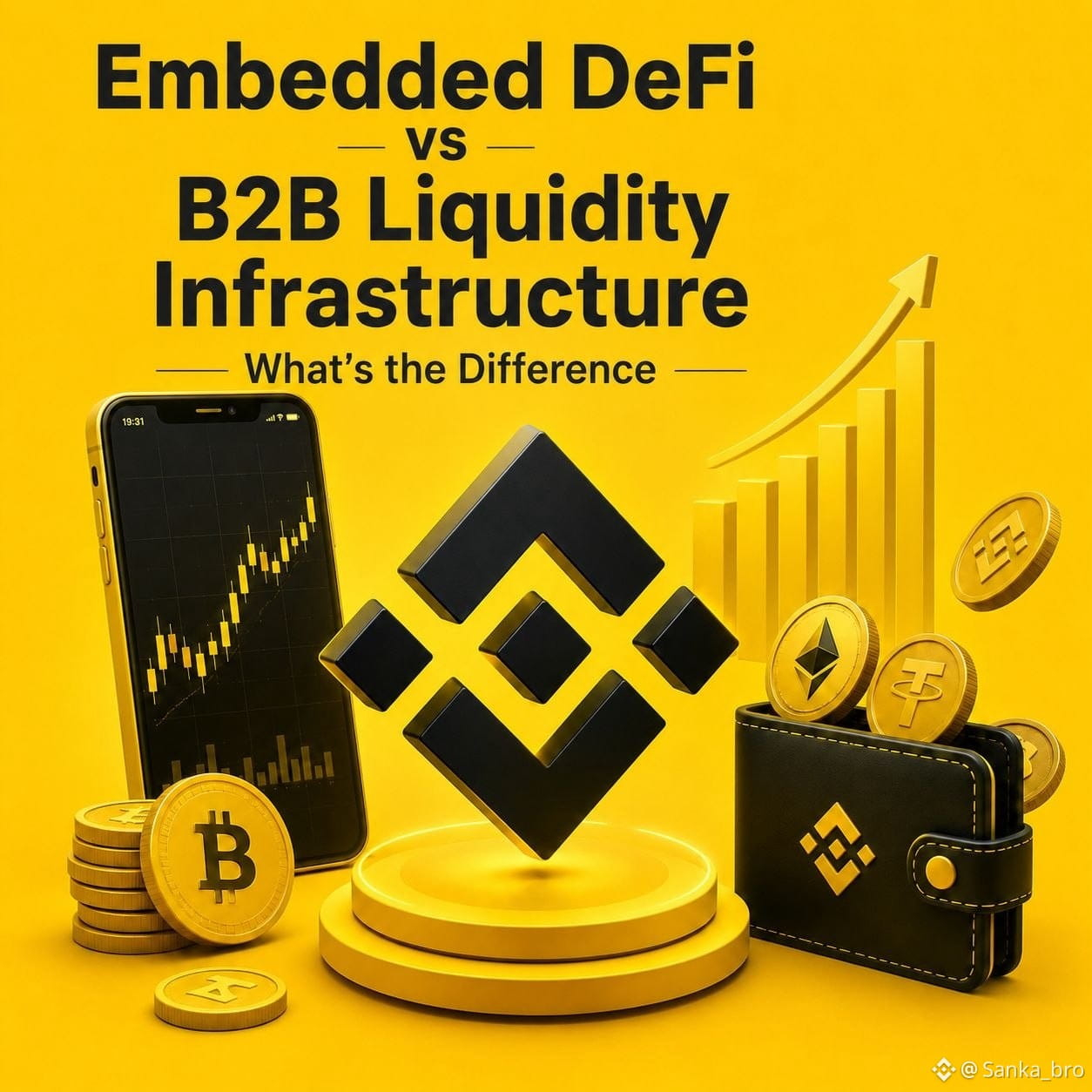
Embedded DeFi vs B2B Liquidity Infrastructure What’s the Difference?
Do you really need to visit a separate DEX every time you want to make a DeFi trade? 🤔
Embedded DeFi is changing that experience.
🔹 Embedded DeFi
Swap and trading features are integrated directly into apps.
👉 No need to leave the app
👉 No separate exchange interface
👉 DeFi becomes part of the user experience
🔹 B2B Liquidity Infrastructure
This is the infrastructure layer working behind the scenes.
APIs + SDKs + Routing Engines can check multiple liquidity sources, find better available prices, and route trades efficiently.
Simple way to remember
Embedded DeFi = What users experience
B2B Liquidity Infrastructure = What powers it
Imagine a travel website comparing hundreds of flights for you.
✈️ You choose the trip.
⚙️ The infrastructure handles the comparison.
DeFi works in a similar way.
Different liquidity pools & trading venues → Better route → Smart contract settlement
🔥 The future of DeFi may not be about making users visit more platforms.
It may be about making DeFi disappear into the apps people already use.
@Binance_Angels @Binance_Academy
Embedded DeFi vs B2B Liquidity Infrastructure What’s the Difference?
Do you really need to visit a separate DEX every time you want to make a DeFi trade? 🤔
Embedded DeFi is changing that experience.
🔹 Embedded DeFi
Swap and trading features are integrated directly into apps.
👉 No need to leave the app
👉 No separate exchange interface
👉 DeFi becomes part of the user experience
🔹 B2B Liquidity Infrastructure
This is the infrastructure layer working behind the scenes.
APIs + SDKs + Routing Engines can check multiple liquidity sources, find better available prices, and route trades efficiently.
Simple way to remember
Embedded DeFi = What users experience
B2B Liquidity Infrastructure = What powers it
Imagine a travel website comparing hundreds of flights for you.
✈️ You choose the trip.
⚙️ The infrastructure handles the comparison.
DeFi works in a similar way.
Different liquidity pools & trading venues → Better route → Smart contract settlement
🔥 The future of DeFi may not be about making users visit more platforms.
It may be about making DeFi disappear into the apps people already use.
@Binance Angels @Binance Academy
Do you really need to visit a separate DEX every time you want to make a DeFi trade? 🤔
Embedded DeFi is changing that experience.
🔹 Embedded DeFi
Swap and trading features are integrated directly into apps.
👉 No need to leave the app
👉 No separate exchange interface
👉 DeFi becomes part of the user experience
🔹 B2B Liquidity Infrastructure
This is the infrastructure layer working behind the scenes.
APIs + SDKs + Routing Engines can check multiple liquidity sources, find better available prices, and route trades efficiently.
Simple way to remember
Embedded DeFi = What users experience
B2B Liquidity Infrastructure = What powers it
Imagine a travel website comparing hundreds of flights for you.
✈️ You choose the trip.
⚙️ The infrastructure handles the comparison.
DeFi works in a similar way.
Different liquidity pools & trading venues → Better route → Smart contract settlement
🔥 The future of DeFi may not be about making users visit more platforms.
It may be about making DeFi disappear into the apps people already use.
@Binance Angels @Binance Academy
2
73
·
--
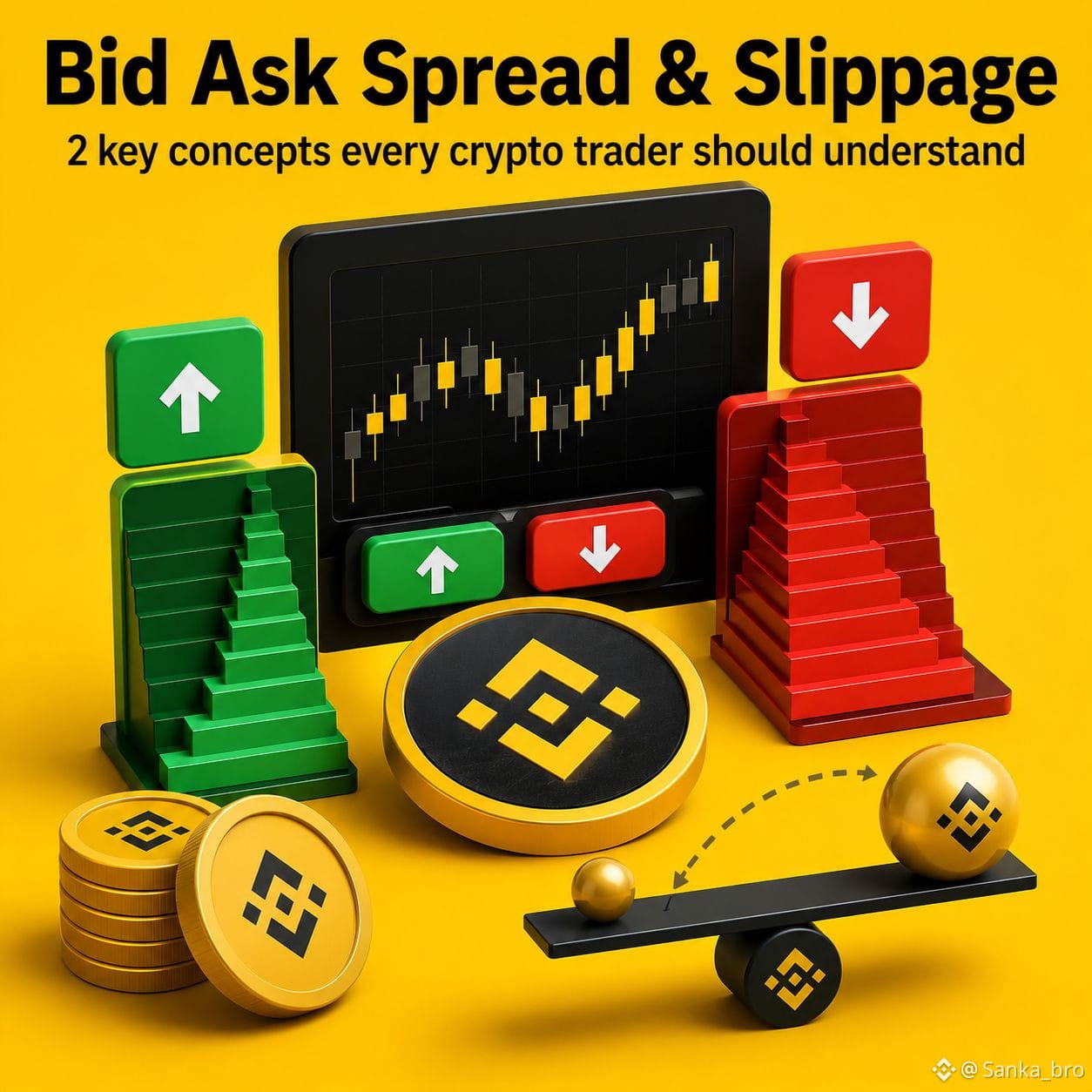
Bid Ask Spread & Slippage 2 Key Concepts Every Crypto Trader Should Understand
When you place a crypto trade, the price you see isn't always the exact price you get.
Two important concepts explain why
🔹 Bid Ask Spread
The difference between the highest price buyers are willing to pay and the lowest price sellers are willing to accept.
Example
Bid = $600
Ask = $601
➡️ Spread = $1
🔹 Slippage
The difference between the price you expect and the price your trade actually executes at.
This often happens when
• Liquidity is low
• Market volatility is high
• Your order is large compared with available liquidity
Why does this matter?
A liquid market usually has tighter spreads and lower slippage, making it easier to execute larger trades without significant price impact.
How can traders reduce slippage?
✅ Use limit orders when appropriate
✅ Check order book depth
✅ Trade in liquid markets
✅ Consider your order size
✅ On DEXs, use a sensible slippage tolerance
Simple takeaway
Don't look at the market price alone. Understanding the spread, liquidity, and potential slippage can help you make more informed trading decisions.
@Binance_Angels @Binance_Academy @BinanceTG #Binance
Bid Ask Spread & Slippage 2 Key Concepts Every Crypto Trader Should Understand
When you place a crypto trade, the price you see isn't always the exact price you get.
Two important concepts explain why
🔹 Bid Ask Spread
The difference between the highest price buyers are willing to pay and the lowest price sellers are willing to accept.
Example
Bid = $600
Ask = $601
➡️ Spread = $1
🔹 Slippage
The difference between the price you expect and the price your trade actually executes at.
This often happens when
• Liquidity is low
• Market volatility is high
• Your order is large compared with available liquidity
Why does this matter?
A liquid market usually has tighter spreads and lower slippage, making it easier to execute larger trades without significant price impact.
How can traders reduce slippage?
✅ Use limit orders when appropriate
✅ Check order book depth
✅ Trade in liquid markets
✅ Consider your order size
✅ On DEXs, use a sensible slippage tolerance
Simple takeaway
Don't look at the market price alone. Understanding the spread, liquidity, and potential slippage can help you make more informed trading decisions.
@Binance Angels @Binance Academy @Binance TG Community #Binance
When you place a crypto trade, the price you see isn't always the exact price you get.
Two important concepts explain why
🔹 Bid Ask Spread
The difference between the highest price buyers are willing to pay and the lowest price sellers are willing to accept.
Example
Bid = $600
Ask = $601
➡️ Spread = $1
🔹 Slippage
The difference between the price you expect and the price your trade actually executes at.
This often happens when
• Liquidity is low
• Market volatility is high
• Your order is large compared with available liquidity
Why does this matter?
A liquid market usually has tighter spreads and lower slippage, making it easier to execute larger trades without significant price impact.
How can traders reduce slippage?
✅ Use limit orders when appropriate
✅ Check order book depth
✅ Trade in liquid markets
✅ Consider your order size
✅ On DEXs, use a sensible slippage tolerance
Simple takeaway
Don't look at the market price alone. Understanding the spread, liquidity, and potential slippage can help you make more informed trading decisions.
@Binance Angels @Binance Academy @Binance TG Community #Binance
1
3
78
·
--
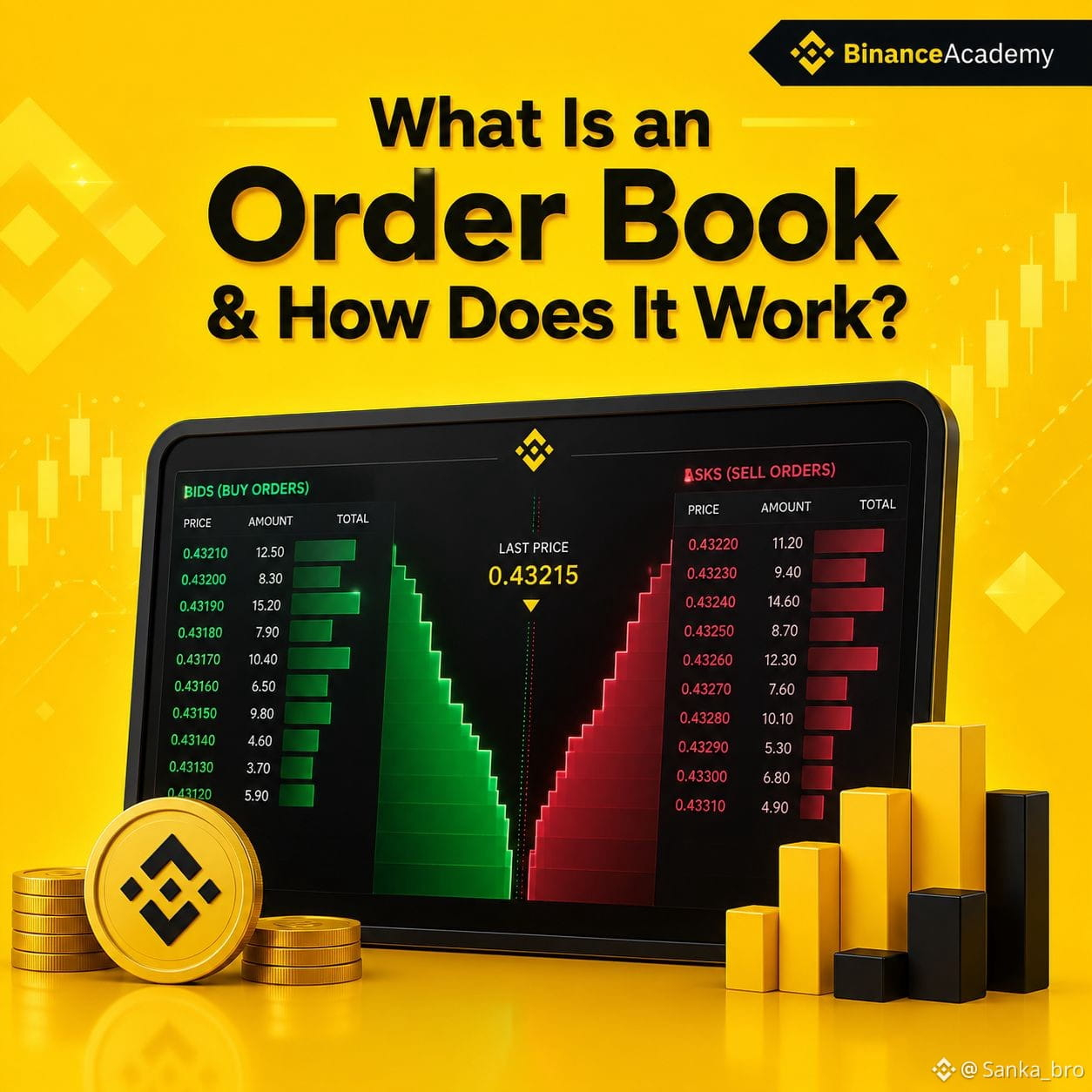
What Is an Order Book & How Does It Work👇
If you trade crypto, understanding the Order Book is an important skill.
🔹 Bids → Buy orders from traders
🔹 Asks → Sell orders from traders
🔹 Market Depth → Helps you understand buying and selling pressure
The Order Book updates in real time, giving traders insights into market liquidity, supply & demand, and potential support and resistance levels.
But be careful! Large Buy Walls and Sell Walls can sometimes create a false impression of market demand or supply.
That’s why it’s better to use the Order Book alongside other technical analysis tools.
👉 Learn to read the Order Book = Take another step toward understanding the market.
@Binance_Academy @Binance_Angels
What Is an Order Book & How Does It Work👇
If you trade crypto, understanding the Order Book is an important skill.
🔹 Bids → Buy orders from traders
🔹 Asks → Sell orders from traders
🔹 Market Depth → Helps you understand buying and selling pressure
The Order Book updates in real time, giving traders insights into market liquidity, supply & demand, and potential support and resistance levels.
But be careful! Large Buy Walls and Sell Walls can sometimes create a false impression of market demand or supply.
That’s why it’s better to use the Order Book alongside other technical analysis tools.
👉 Learn to read the Order Book = Take another step toward understanding the market.
@Binance Academy @Binance Angels
If you trade crypto, understanding the Order Book is an important skill.
🔹 Bids → Buy orders from traders
🔹 Asks → Sell orders from traders
🔹 Market Depth → Helps you understand buying and selling pressure
The Order Book updates in real time, giving traders insights into market liquidity, supply & demand, and potential support and resistance levels.
But be careful! Large Buy Walls and Sell Walls can sometimes create a false impression of market demand or supply.
That’s why it’s better to use the Order Book alongside other technical analysis tools.
👉 Learn to read the Order Book = Take another step toward understanding the market.
@Binance Academy @Binance Angels
4
78
·
--
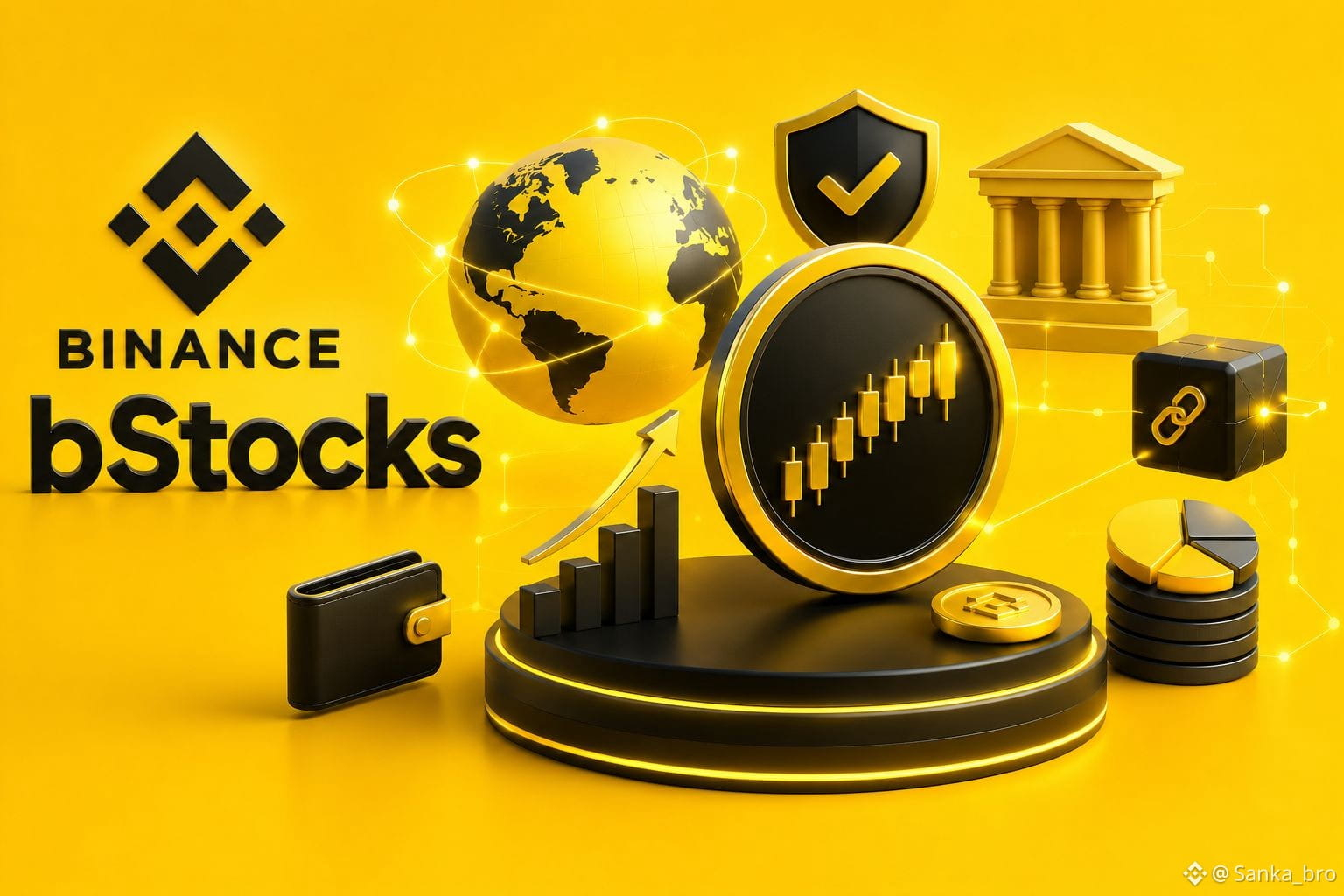
What are bStocks?
Imagine getting exposure to US stocks through blockchain technology that’s the idea behind bStocks.
bStocks are tokenized securities on Binance, backed 1:1 by real US shares held with a regulated custodian.
So,
what makes them interesting? 👇
🔹 24/7 Trading — Trade bStocks on Binance’s spot market around the clock.
🔹 Fast Settlement — Transactions can settle in under a second, without traditional T+1 settlement delays.
🔹 1:1 Backed — Each bStock is backed by the corresponding real US share.
🔹 Fractional Access — Start with as little as $5, making US stock exposure more accessible.
🔹 Self-Custody — bStocks are BEP-20 tokens on BNB Smart Chain, so eligible users can withdraw them to compatible wallets.
🔹 DeFi Compatibility — Because they are blockchain based assets, bStocks can potentially be used across supported DeFi applications for activities such as lending and other on chain use cases.
🔹 Corporate Actions — Dividends and stock splits are processed through an on chain mechanism called the Multiplier.
One important point
bStocks are not direct ownership of the underlying company’s shares. They provide exposure to the stock’s price performance and certain economic benefits.
In simple terms
Traditional stocks → Tokenized on-chain exposure → 24/7 access+ fractional ownership + DeFi compatibility
The bigger idea is the combination of traditional financial assets + blockchain infrastructure.
#Binance
@Binance_Angels @Binance_Academy
What are bStocks?
Imagine getting exposure to US stocks through blockchain technology that’s the idea behind bStocks.
bStocks are tokenized securities on Binance, backed 1:1 by real US shares held with a regulated custodian.
So,
what makes them interesting? 👇
🔹 24/7 Trading — Trade bStocks on Binance’s spot market around the clock.
🔹 Fast Settlement — Transactions can settle in under a second, without traditional T+1 settlement delays.
🔹 1:1 Backed — Each bStock is backed by the corresponding real US share.
🔹 Fractional Access — Start with as little as $5, making US stock exposure more accessible.
🔹 Self-Custody — bStocks are BEP-20 tokens on BNB Smart Chain, so eligible users can withdraw them to compatible wallets.
🔹 DeFi Compatibility — Because they are blockchain based assets, bStocks can potentially be used across supported DeFi applications for activities such as lending and other on chain use cases.
🔹 Corporate Actions — Dividends and stock splits are processed through an on chain mechanism called the Multiplier.
One important point
bStocks are not direct ownership of the underlying company’s shares. They provide exposure to the stock’s price performance and certain economic benefits.
In simple terms
Traditional stocks → Tokenized on-chain exposure → 24/7 access+ fractional ownership + DeFi compatibility
The bigger idea is the combination of traditional financial assets + blockchain infrastructure.
#Binance
@Binance Angels @Binance Academy
Imagine getting exposure to US stocks through blockchain technology that’s the idea behind bStocks.
bStocks are tokenized securities on Binance, backed 1:1 by real US shares held with a regulated custodian.
So,
what makes them interesting? 👇
🔹 24/7 Trading — Trade bStocks on Binance’s spot market around the clock.
🔹 Fast Settlement — Transactions can settle in under a second, without traditional T+1 settlement delays.
🔹 1:1 Backed — Each bStock is backed by the corresponding real US share.
🔹 Fractional Access — Start with as little as $5, making US stock exposure more accessible.
🔹 Self-Custody — bStocks are BEP-20 tokens on BNB Smart Chain, so eligible users can withdraw them to compatible wallets.
🔹 DeFi Compatibility — Because they are blockchain based assets, bStocks can potentially be used across supported DeFi applications for activities such as lending and other on chain use cases.
🔹 Corporate Actions — Dividends and stock splits are processed through an on chain mechanism called the Multiplier.
One important point
bStocks are not direct ownership of the underlying company’s shares. They provide exposure to the stock’s price performance and certain economic benefits.
In simple terms
Traditional stocks → Tokenized on-chain exposure → 24/7 access+ fractional ownership + DeFi compatibility
The bigger idea is the combination of traditional financial assets + blockchain infrastructure.
#Binance
@Binance Angels @Binance Academy
3
40
·
--
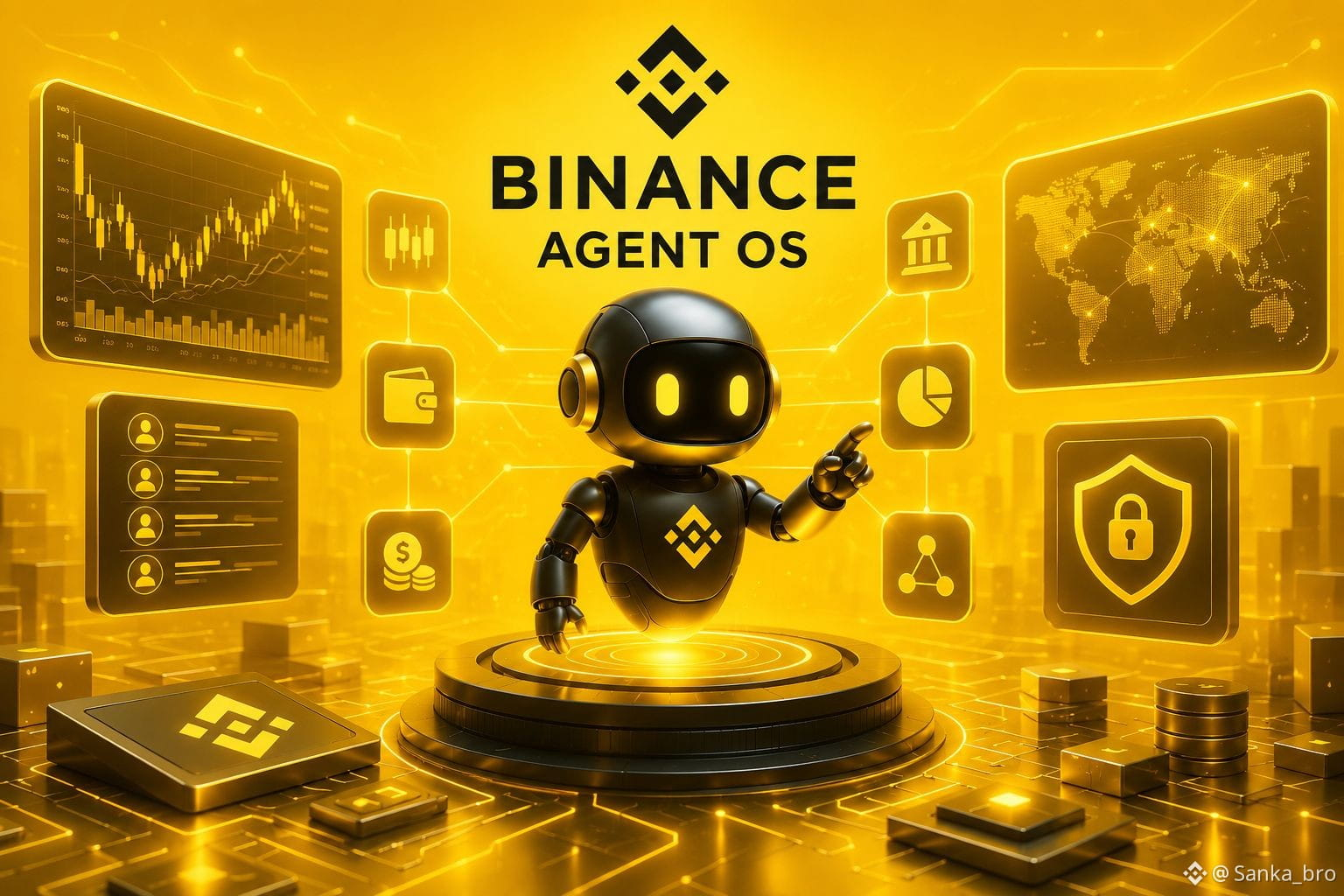
Binance Agent OS is bringing AI agents closer to real world finance.
Instead of building everything from scratch, developers can connect AI agents to Binance through MCP, APIs, and ready made agent skills.
What can agents do? 👇
🔹 Trade — monitor markets, react to signals & execute actions
🔹 Pay & Settle — automate payments and transactions
🔹 Read Markets — access market, on chain & account data
🔹 Track Portfolios — monitor balances, positions & movements
🔹 Operate On Chain — interact with supported wallets
🔹 Answer Questions — get market insights and configure agent parameters
You decide the permissions, accounts and limits for each AI agent.
So the idea is simple
CONNECT → BUILD → CONTROL → AUTOMATE
Binance Agent OS could be a major step toward agentic finance, where AI doesn't just analyze markets it can actually interact with financial infrastructure within rules set by the user.
#BinanceAcademy #Binance
@Binance_Angels @Binance_Research
Binance Agent OS is bringing AI agents closer to real world finance.
Instead of building everything from scratch, developers can connect AI agents to Binance through MCP, APIs, and ready made agent skills.
What can agents do? 👇
🔹 Trade — monitor markets, react to signals & execute actions
🔹 Pay & Settle — automate payments and transactions
🔹 Read Markets — access market, on chain & account data
🔹 Track Portfolios — monitor balances, positions & movements
🔹 Operate On Chain — interact with supported wallets
🔹 Answer Questions — get market insights and configure agent parameters
You decide the permissions, accounts and limits for each AI agent.
So the idea is simple
CONNECT → BUILD → CONTROL → AUTOMATE
Binance Agent OS could be a major step toward agentic finance, where AI doesn't just analyze markets it can actually interact with financial infrastructure within rules set by the user.
#BinanceAcademy #Binance
@Binance Angels @Binance Research
Instead of building everything from scratch, developers can connect AI agents to Binance through MCP, APIs, and ready made agent skills.
What can agents do? 👇
🔹 Trade — monitor markets, react to signals & execute actions
🔹 Pay & Settle — automate payments and transactions
🔹 Read Markets — access market, on chain & account data
🔹 Track Portfolios — monitor balances, positions & movements
🔹 Operate On Chain — interact with supported wallets
🔹 Answer Questions — get market insights and configure agent parameters
You decide the permissions, accounts and limits for each AI agent.
So the idea is simple
CONNECT → BUILD → CONTROL → AUTOMATE
Binance Agent OS could be a major step toward agentic finance, where AI doesn't just analyze markets it can actually interact with financial infrastructure within rules set by the user.
#BinanceAcademy #Binance
@Binance Angels @Binance Research
2
56
Войдите, чтобы посмотреть больше материала
Присоединяйтесь к пользователям криптовалют по всему миру на Binance Square
⚡️ Получайте новейшую и полезную информацию о криптоактивах.
💬 Нам доверяет крупнейшая в мире криптобиржа.
👍 Получите достоверные аналитические данные от верифицированных создателей контента.
Эл. почта/номер телефона
В тренде
BitcoinSurpasses$77000
Просмотров: 875
48 обсуждают
$BTC is ripping higher despite it all. 🚀
Today marked the first rate hike in over 3 years, while the CLARITY Act stalled again yesterday.
Setup big long again - thank me later
Entry : $75500 - $76500
Stoploss : $74900
Take profit : $77000 - $78000
Get ready for a crazy growth cycle. 🔥
TF_bnb
·Лайков: 15
·Просмотров: 6k
ParadigmDisclosesZECHolding
Просмотров: 334
53 обсуждают
BitcoinETFsShed$450M
Просмотров: 13,559
130 обсуждают