
Sophie_DeeBTC
907 Публикации

Sophie_DeeBTC
Отправить жалобу
Заблокировать пользователя
Calm mind , Steady gains
41 подписок(и/а)
2.1K+ подписчиков(а)
390 понравилось
Посты
Все
Цитирования
Активно
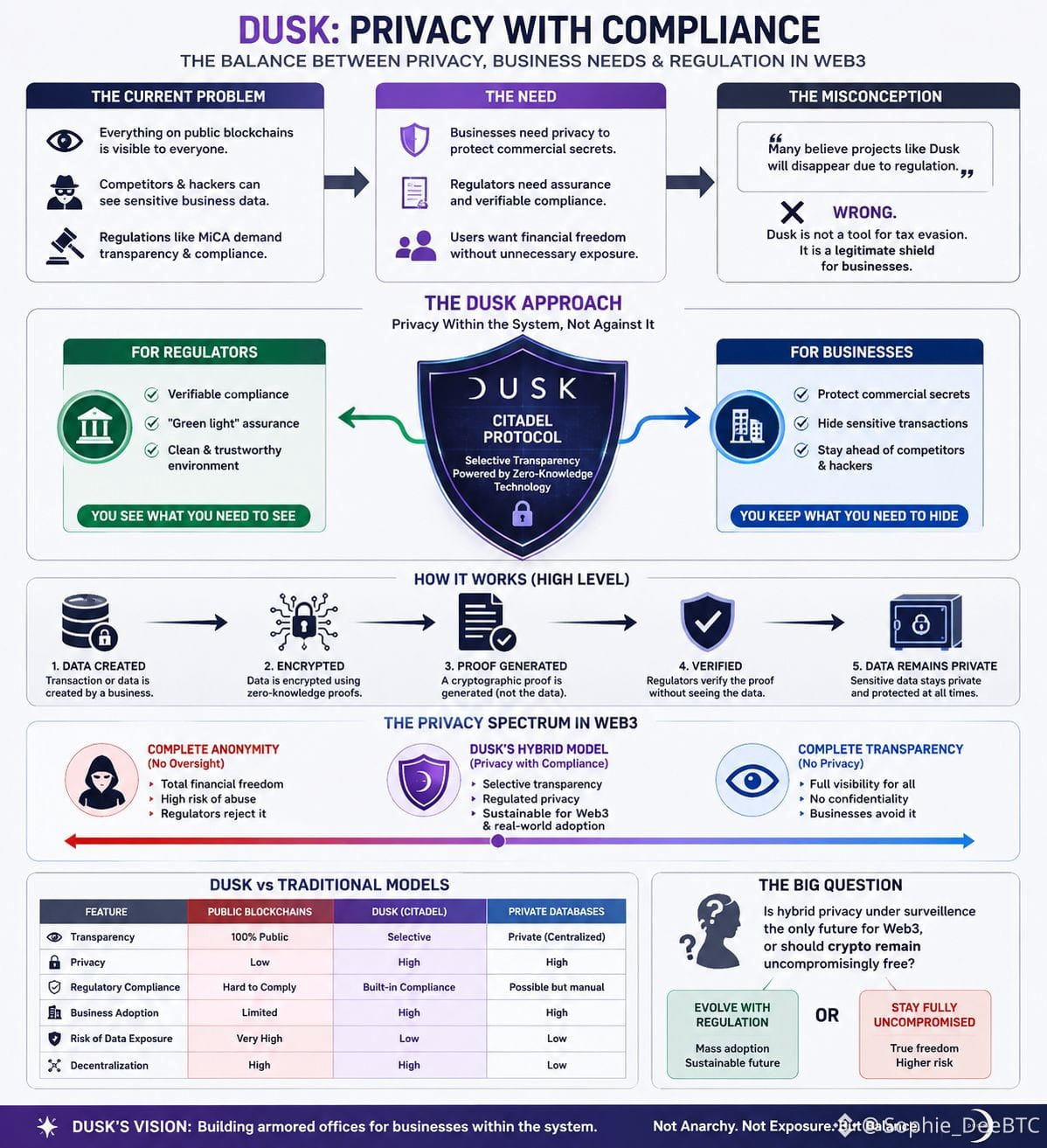
#dusk $DUSK @Dusk_Foundation The Next Battle in Crypto Might Be Over What We Reveal
For years, crypto has pushed one simple idea: your financial activity should not automatically become everyone else’s business.
But as regulation catches up, that idea is getting more complicated.
Businesses need compliance. Regulators need visibility. Users still want privacy.
So where does that leave Web3.
This is one reason I find Dusk interesting.
Its approach isn't about creating a black box where nobody can see anything. It's closer to creating a system where the right information can be verified without exposing everything else.
A company could potentially prove that it meets regulatory requirements without handing its competitors a complete picture of how it operates.
And that changes the meaning of privacy.
Privacy doesn't necessarily have to mean “no one can see anything.”
It could mean:
“You can verify what matters without exposing what doesn't.”
That distinction might become extremely important as blockchain moves from speculation toward real-world business use.
Because let's be honest — would a serious company put its entire financial and commercial activity on a completely transparent public ledger?
Probably not.
But would regulators accept a system where nothing can ever be verified?
Probably not either.
Maybe the real innovation is somewhere in between.
Not anonymous.
Not completely exposed.
But selectively transparent.
The bigger question is whether the crypto community will actually embrace that model.
Because if regulation makes Web3 more usable for institutions but less aligned with its original idea of unrestricted freedom…
are we evolving crypto or slowly changing what crypto was supposed to be?
That’s the part I’m still thinking about.
Hope it's supportive for all crypto users.
#dusk $DUSK @Dusk The Next Battle in Crypto Might Be Over What We Reveal
For years, crypto has pushed one simple idea: your financial activity should not automatically become everyone else’s business.
But as regulation catches up, that idea is getting more complicated.
Businesses need compliance. Regulators need visibility. Users still want privacy.
So where does that leave Web3.
This is one reason I find Dusk interesting.
Its approach isn't about creating a black box where nobody can see anything. It's closer to creating a system where the right information can be verified without exposing everything else.
A company could potentially prove that it meets regulatory requirements without handing its competitors a complete picture of how it operates.
And that changes the meaning of privacy.
Privacy doesn't necessarily have to mean “no one can see anything.”
It could mean:
“You can verify what matters without exposing what doesn't.”
That distinction might become extremely important as blockchain moves from speculation toward real-world business use.
Because let's be honest — would a serious company put its entire financial and commercial activity on a completely transparent public ledger?
Probably not.
But would regulators accept a system where nothing can ever be verified?
Probably not either.
Maybe the real innovation is somewhere in between.
Not anonymous.
Not completely exposed.
But selectively transparent.
The bigger question is whether the crypto community will actually embrace that model.
Because if regulation makes Web3 more usable for institutions but less aligned with its original idea of unrestricted freedom…
are we evolving crypto or slowly changing what crypto was supposed to be?
That’s the part I’m still thinking about.
Hope it's supportive for all crypto users.
For years, crypto has pushed one simple idea: your financial activity should not automatically become everyone else’s business.
But as regulation catches up, that idea is getting more complicated.
Businesses need compliance. Regulators need visibility. Users still want privacy.
So where does that leave Web3.
This is one reason I find Dusk interesting.
Its approach isn't about creating a black box where nobody can see anything. It's closer to creating a system where the right information can be verified without exposing everything else.
A company could potentially prove that it meets regulatory requirements without handing its competitors a complete picture of how it operates.
And that changes the meaning of privacy.
Privacy doesn't necessarily have to mean “no one can see anything.”
It could mean:
“You can verify what matters without exposing what doesn't.”
That distinction might become extremely important as blockchain moves from speculation toward real-world business use.
Because let's be honest — would a serious company put its entire financial and commercial activity on a completely transparent public ledger?
Probably not.
But would regulators accept a system where nothing can ever be verified?
Probably not either.
Maybe the real innovation is somewhere in between.
Not anonymous.
Not completely exposed.
But selectively transparent.
The bigger question is whether the crypto community will actually embrace that model.
Because if regulation makes Web3 more usable for institutions but less aligned with its original idea of unrestricted freedom…
are we evolving crypto or slowly changing what crypto was supposed to be?
That’s the part I’m still thinking about.
Hope it's supportive for all crypto users.
83
Been thinking about this for a few days now. We keep calling things "private" online when really they're just things nobody's looked at closely yet. Actual privacy, the kind that holds up under a real audit, always felt like a contradiction to me — you either hide something or you prove it's clean. Not both.
That's just how it worked, or so I thought.
But most of finance already lives inside that exact tension, quietly. Every KYC check, every settlement, every trade record is some compromise between showing enough and showing too much. We just treat that as normal. Not because it's good, but because nobody thought there was another option.
Watching @Dusk_Foundation build zero-knowledge compliance kind of breaks that assumption for me. The "impossible" part was never really the math. It was that nobody needed to solve it until on-chain finance forced the question.
If proving something's true without exposing what it is becomes normal, not clever, just normal I start wondering what else we've been treating as unsolvable that was actually just unexamined.
Not fully sure where that leads yet. Still sitting with it.
$DUSK #dusk
Been thinking about this for a few days now. We keep calling things "private" online when really they're just things nobody's looked at closely yet. Actual privacy, the kind that holds up under a real audit, always felt like a contradiction to me — you either hide something or you prove it's clean. Not both.
That's just how it worked, or so I thought.
But most of finance already lives inside that exact tension, quietly. Every KYC check, every settlement, every trade record is some compromise between showing enough and showing too much. We just treat that as normal. Not because it's good, but because nobody thought there was another option.
Watching @Dusk build zero-knowledge compliance kind of breaks that assumption for me. The "impossible" part was never really the math. It was that nobody needed to solve it until on-chain finance forced the question.
If proving something's true without exposing what it is becomes normal, not clever, just normal I start wondering what else we've been treating as unsolvable that was actually just unexamined.
Not fully sure where that leads yet. Still sitting with it.
$DUSK #dusk
That's just how it worked, or so I thought.
But most of finance already lives inside that exact tension, quietly. Every KYC check, every settlement, every trade record is some compromise between showing enough and showing too much. We just treat that as normal. Not because it's good, but because nobody thought there was another option.
Watching @Dusk build zero-knowledge compliance kind of breaks that assumption for me. The "impossible" part was never really the math. It was that nobody needed to solve it until on-chain finance forced the question.
If proving something's true without exposing what it is becomes normal, not clever, just normal I start wondering what else we've been treating as unsolvable that was actually just unexamined.
Not fully sure where that leads yet. Still sitting with it.
$DUSK #dusk
1
1
79
Something crossed my mind today while reading about @babylonlabs_io . It's funny how quickly we get used to doing things a certain way in crypto. After a while, we stop asking if those trade-offs were actually necessary in the first place.
Trustless Bitcoin Vaults didn't really leave me thinking about the technology. They made me think about the mindset. Maybe using Bitcoin in more places doesn't always have to mean giving up part of what makes it Bitcoin. $BABY #baby
I don't know if that's where the whole industry is heading, but I enjoy coming across ideas that make me question old habits instead of just chasing the next trend. Those are usually the ones I remember.
Something crossed my mind today while reading about @BabylonLabs_io . It's funny how quickly we get used to doing things a certain way in crypto. After a while, we stop asking if those trade-offs were actually necessary in the first place.
Trustless Bitcoin Vaults didn't really leave me thinking about the technology. They made me think about the mindset. Maybe using Bitcoin in more places doesn't always have to mean giving up part of what makes it Bitcoin. $BABY #baby
I don't know if that's where the whole industry is heading, but I enjoy coming across ideas that make me question old habits instead of just chasing the next trend. Those are usually the ones I remember.
Trustless Bitcoin Vaults didn't really leave me thinking about the technology. They made me think about the mindset. Maybe using Bitcoin in more places doesn't always have to mean giving up part of what makes it Bitcoin. $BABY #baby
I don't know if that's where the whole industry is heading, but I enjoy coming across ideas that make me question old habits instead of just chasing the next trend. Those are usually the ones I remember.
1
1
112
I had one of those small moments today where I caught myself questioning something I'd never really thought about before. In crypto, we've become so used to certain trade-offs that they almost feel normal.
While reading about @babylonlabs_io and Trustless Bitcoin Vaults, I kept wondering why I had always assumed Bitcoin needed to give something up before it could be useful elsewhere. $BABY #baby
I'm not saying I have the answer. It just made me realize how easily we accept old ideas without asking if they still make sense. Maybe that's how real changes begin—not with big announcements, but with small questions that stay in your mind long after you've finished reading.
I had one of those small moments today where I caught myself questioning something I'd never really thought about before. In crypto, we've become so used to certain trade-offs that they almost feel normal.
While reading about @BabylonLabs_io and Trustless Bitcoin Vaults, I kept wondering why I had always assumed Bitcoin needed to give something up before it could be useful elsewhere. $BABY #baby
I'm not saying I have the answer. It just made me realize how easily we accept old ideas without asking if they still make sense. Maybe that's how real changes begin—not with big announcements, but with small questions that stay in your mind long after you've finished reading.
While reading about @BabylonLabs_io and Trustless Bitcoin Vaults, I kept wondering why I had always assumed Bitcoin needed to give something up before it could be useful elsewhere. $BABY #baby
I'm not saying I have the answer. It just made me realize how easily we accept old ideas without asking if they still make sense. Maybe that's how real changes begin—not with big announcements, but with small questions that stay in your mind long after you've finished reading.
84
I had a random thought while scrolling through crypto today. Sometimes we accept the way things work simply because that's how they've always been done, not because it's the best way.
Reading about @babylonlabs_io and trustless Bitcoin Vaults made me stop for a minute. It got me thinking that maybe using Bitcoin in more places doesn't always have to mean giving something up first. That idea felt surprisingly simple, but I hadn't really looked at it that way before.$BABY
I'm still figuring out what this could mean over time. Maybe it's a small change, maybe it's a bigger shift. Either way, I like when a project leaves me thinking after I close the page instead of just giving me another chart to watch.
#baby
$BABY
I had a random thought while scrolling through crypto today. Sometimes we accept the way things work simply because that's how they've always been done, not because it's the best way.
Reading about @BabylonLabs_io and trustless Bitcoin Vaults made me stop for a minute. It got me thinking that maybe using Bitcoin in more places doesn't always have to mean giving something up first. That idea felt surprisingly simple, but I hadn't really looked at it that way before.$BABY
I'm still figuring out what this could mean over time. Maybe it's a small change, maybe it's a bigger shift. Either way, I like when a project leaves me thinking after I close the page instead of just giving me another chart to watch.
#baby
$BABY
Reading about @BabylonLabs_io and trustless Bitcoin Vaults made me stop for a minute. It got me thinking that maybe using Bitcoin in more places doesn't always have to mean giving something up first. That idea felt surprisingly simple, but I hadn't really looked at it that way before.$BABY
I'm still figuring out what this could mean over time. Maybe it's a small change, maybe it's a bigger shift. Either way, I like when a project leaves me thinking after I close the page instead of just giving me another chart to watch.
#baby
$BABY
57
Woke up this morning and the market felt completely different from last night. One headline was enough to change the mood, and suddenly everyone started talking about the downside again.
Moments like this remind me that crypto can switch from excitement to caution in just a few hours. I'm trying to spend less time reacting to every move and more time sticking to my plan. The market will always surprise us, but that's part of why I'm still here. #markrtupdate
Woke up this morning and the market felt completely different from last night. One headline was enough to change the mood, and suddenly everyone started talking about the downside again.
Moments like this remind me that crypto can switch from excitement to caution in just a few hours. I'm trying to spend less time reacting to every move and more time sticking to my plan. The market will always surprise us, but that's part of why I'm still here. #markrtupdate
Moments like this remind me that crypto can switch from excitement to caution in just a few hours. I'm trying to spend less time reacting to every move and more time sticking to my plan. The market will always surprise us, but that's part of why I'm still here. #markrtupdate
69
I caught myself thinking about something today. In crypto, we get so used to doing things a certain way that we rarely stop and ask if those trade-offs were ever necessary in the first place.
That was the feeling I had after spending some time with @babylonlabs_io and the idea of Trustless Bitcoin Vaults. It wasn't a "wow" moment. It was more like a quiet reminder that maybe Bitcoin doesn't always have to change its nature just to be useful somewhere else. $BABY #baby
I'm still not sure what that means in the bigger picture. Maybe nothing changes overnight. But I always find it interesting when a project leaves me questioning old assumptions instead of chasing new trends. Those thoughts usually stick with me the longest.
#baby $BABY
I caught myself thinking about something today. In crypto, we get so used to doing things a certain way that we rarely stop and ask if those trade-offs were ever necessary in the first place.
That was the feeling I had after spending some time with @BabylonLabs_io and the idea of Trustless Bitcoin Vaults. It wasn't a "wow" moment. It was more like a quiet reminder that maybe Bitcoin doesn't always have to change its nature just to be useful somewhere else. $BABY #baby
I'm still not sure what that means in the bigger picture. Maybe nothing changes overnight. But I always find it interesting when a project leaves me questioning old assumptions instead of chasing new trends. Those thoughts usually stick with me the longest.
#baby $BABY
That was the feeling I had after spending some time with @BabylonLabs_io and the idea of Trustless Bitcoin Vaults. It wasn't a "wow" moment. It was more like a quiet reminder that maybe Bitcoin doesn't always have to change its nature just to be useful somewhere else. $BABY #baby
I'm still not sure what that means in the bigger picture. Maybe nothing changes overnight. But I always find it interesting when a project leaves me questioning old assumptions instead of chasing new trends. Those thoughts usually stick with me the longest.
#baby $BABY
58
Funny how one piece of news can change the mood in crypto overnight. A few days ago everyone seemed confident, then ETF flow headlines and macro uncertainty showed up, and suddenly timelines felt completely different.
It's a good reminder for me that the market changes faster than emotions should. I'm trying to spend less time reacting to every headline and more time sticking to my own plan. That hasn't made me richer overnight, but it has definitely made me less stressed.#XRPLedgerUpgradeToRestorePulledFeatures
Funny how one piece of news can change the mood in crypto overnight. A few days ago everyone seemed confident, then ETF flow headlines and macro uncertainty showed up, and suddenly timelines felt completely different.
It's a good reminder for me that the market changes faster than emotions should. I'm trying to spend less time reacting to every headline and more time sticking to my own plan. That hasn't made me richer overnight, but it has definitely made me less stressed.#XRPLedgerUpgradeToRestorePulledFeatures
It's a good reminder for me that the market changes faster than emotions should. I'm trying to spend less time reacting to every headline and more time sticking to my own plan. That hasn't made me richer overnight, but it has definitely made me less stressed.#XRPLedgerUpgradeToRestorePulledFeatures
78
I had a random thought while reading about @babylonlabs_io today. Somewhere along the way, we got used to the idea that using Bitcoin in new ways usually means giving up a bit of control first. I never really questioned that until now.
The idea behind trustless Bitcoin Vaults didn't make me think about the technology as much as the mindset. Maybe we've accepted certain trade-offs simply because they've been around for so long. It made me wonder if the next step for crypto is actually about keeping things simpler instead of making them more complicated.
I don't know if this is the direction everything will move in, but I like when a project leaves me with more questions than answers. Those are usually the ideas I end up thinking about long after I close the app.$BABY #baby
I had a random thought while reading about @BabylonLabs_io today. Somewhere along the way, we got used to the idea that using Bitcoin in new ways usually means giving up a bit of control first. I never really questioned that until now.
The idea behind trustless Bitcoin Vaults didn't make me think about the technology as much as the mindset. Maybe we've accepted certain trade-offs simply because they've been around for so long. It made me wonder if the next step for crypto is actually about keeping things simpler instead of making them more complicated.
I don't know if this is the direction everything will move in, but I like when a project leaves me with more questions than answers. Those are usually the ideas I end up thinking about long after I close the app.$BABY #baby
The idea behind trustless Bitcoin Vaults didn't make me think about the technology as much as the mindset. Maybe we've accepted certain trade-offs simply because they've been around for so long. It made me wonder if the next step for crypto is actually about keeping things simpler instead of making them more complicated.
I don't know if this is the direction everything will move in, but I like when a project leaves me with more questions than answers. Those are usually the ideas I end up thinking about long after I close the app.$BABY #baby
73
Today I opened the charts a few times, closed them, and realized nothing had really changed except my mood. 😅
I'm slowly learning that not every day needs a trade. Sometimes the best move is just staying patient and letting the market do its thing. Crypto has a funny way of rewarding people who can wait, even though waiting is probably the hardest part.
Still learning, still making mistakes, but I think having a calm mindset is becoming more valuable than trying to catch every pump.
#FOMCWatching #USLaunchesFreshStrikesOnIRGC #SenatorsReachClarityActEthicsCompromise
Today I opened the charts a few times, closed them, and realized nothing had really changed except my mood. 😅
I'm slowly learning that not every day needs a trade. Sometimes the best move is just staying patient and letting the market do its thing. Crypto has a funny way of rewarding people who can wait, even though waiting is probably the hardest part.
Still learning, still making mistakes, but I think having a calm mindset is becoming more valuable than trying to catch every pump.
#FOMCWatching #USLaunchesFreshStrikesOnIRGC #SenatorsReachClarityActEthicsCompromise
I'm slowly learning that not every day needs a trade. Sometimes the best move is just staying patient and letting the market do its thing. Crypto has a funny way of rewarding people who can wait, even though waiting is probably the hardest part.
Still learning, still making mistakes, but I think having a calm mindset is becoming more valuable than trying to catch every pump.
#FOMCWatching #USLaunchesFreshStrikesOnIRGC #SenatorsReachClarityActEthicsCompromise
78
I didn't expect @babylonlabs_io to leave me thinking about trust more than technology. The longer I sat with the idea of Trustless Bitcoin Vaults, the more I realized how easily we've accepted handing control to someone else just because it's become the normal way of doing things. $BABY #baby
That made me wonder if convenience has quietly changed our expectations. We often talk about innovation as adding more layers, but maybe real progress is finding ways to remove the layers we stopped questioning. If Bitcoin can stay true to itself while still being useful in a wider ecosystem, that feels like a different direction altogether.
I'm still not sure where this shift leads. Maybe it's bigger than one project, or maybe I'm reading too much into it. Either way, I like when something makes me pause and rethink an assumption I didn't even know I had. Those moments usually stay with me longer than any announcement or trend.
I didn't expect @BabylonLabs_io to leave me thinking about trust more than technology. The longer I sat with the idea of Trustless Bitcoin Vaults, the more I realized how easily we've accepted handing control to someone else just because it's become the normal way of doing things. $BABY #baby
That made me wonder if convenience has quietly changed our expectations. We often talk about innovation as adding more layers, but maybe real progress is finding ways to remove the layers we stopped questioning. If Bitcoin can stay true to itself while still being useful in a wider ecosystem, that feels like a different direction altogether.
I'm still not sure where this shift leads. Maybe it's bigger than one project, or maybe I'm reading too much into it. Either way, I like when something makes me pause and rethink an assumption I didn't even know I had. Those moments usually stay with me longer than any announcement or trend.
That made me wonder if convenience has quietly changed our expectations. We often talk about innovation as adding more layers, but maybe real progress is finding ways to remove the layers we stopped questioning. If Bitcoin can stay true to itself while still being useful in a wider ecosystem, that feels like a different direction altogether.
I'm still not sure where this shift leads. Maybe it's bigger than one project, or maybe I'm reading too much into it. Either way, I like when something makes me pause and rethink an assumption I didn't even know I had. Those moments usually stay with me longer than any announcement or trend.
1
71

Статья
Fogo And The Quiet Power Of A Chain That Feels InstantWhen I first started digging into Fogo, I did not see it as just another fast chain trying to make noise. I saw a group of builders who seem almost obsessed with a very small but very human detail. The moment between you pressing confirm and the chain answering you. That tiny pause is where trust is born. If that moment stretches too long, people feel worry. If it feels instant, everything calms down and the whole system feels natural. Fogo was created with one main mission around this feeling. It wants to be the base layer for on chain trading where low latency and steady performance are not marketing lines, they are the foundation. It is an SVM based Layer one, fully compatible with the Solana Virtual Machine, so it can run the same style of programs but tuned from day one for trading and finance.
What really stayed with me is how focused the design is. Fogo is not trying to host every possible use case equally. The team is very clear that they are building for on chain markets, high frequency strategies and real time DeFi. They are not shy about saying it is for institutional level trading and tokenized assets that need fast and fair execution even when the market is wild. I am drawn to that honesty. I’m used to seeing projects that promise everything to everyone. Here, They’re saying very simply. We want to be the chain where serious trading can live fully on chain without feeling slow or fragile. That kind of focus usually means the small design choices are made with real users in mind, not just for slides and threads.
Inside the engine room, Fogo feels like someone took the lessons from Solana and then rebuilt the room around latency. Because it is SVM compatible, it uses an execution model that lets many independent transactions run in parallel instead of waiting in one long queue. That means if two trades touch different accounts, they can be processed at the same time. This sounds technical, but in practice it is simple. The network does not choke as quickly when activity explodes. On top of that, Fogo uses a client inspired by Firedancer, written for raw speed and efficient networking, which pushes block times toward the sub forty millisecond range and brings finality down to around one second on average. I find it interesting that they do not just chase a huge transactions per second headline. They care about how predictable and smooth execution feels when the book is moving fast and people are leaning into risk.
One of the clever parts of the design is how they treat geography like part of the protocol. Fogo uses what they call multi local consensus, where validator clusters are placed in major financial regions and the active zone rotates in a way that lines up with trading hours. That means a trader in Asia during their morning session is often closer, in real physical distance, to the block producers handling their orders. The same happens for Europe and the United States in their own peak times. If you care about every millisecond of delay between your strategy and the chain, this really matters. It becomes more than a technical trick. It is a quiet way of saying. We know where the real volume lives, and we are building our network to sit close to that heartbeat.
The token side of Fogo also carries this sense of planning. The total supply is set at ten billion tokens, with a slightly lower live total after an early burn, and only part of that is circulating at any given moment. A large share, more than sixty percent of the genesis amount, is locked and set to unlock slowly over four years for core contributors, backers and other long term roles. I feel this is important because it shows the team is willing to tie their own rewards to the long journey instead of just the launch phase. The token does the usual Layer one jobs that actually matter. It pays for gas, powers staking so the network can be secured, and will be used for governance as the ecosystem matures. There is nothing flashy about that, but sometimes simple and clear is what keeps a system healthy.
Community incentives are where the story gets more emotional for me. Fogo runs a program called Flames, and Season two has just gone live. The team has set aside two hundred million FOGO tokens for this season alone, which is two percent of the whole genesis supply, and they started handing it out within the last day. That is not a small gesture. It means If you actually use the chain, trade on its exchanges, lend, stake, provide liquidity or help grow the ecosystem, you are not only paying fees, you are also earning a deeper stake in the story. We’re seeing more and more users share their Flames progress and rewards, and it feels like a live scoreboard of who is really on chain instead of just watching from the sidelines. I’m honestly impressed by how direct the message is. If you show up and help stress test this system, you will not be ignored.
Real benefit shows up in the little everyday examples. Picture a trader running a strategy that depends on quick entries and exits, with tight stops and low tolerance for slippage. On many chains, that person has to fight both market risk and network risk. Transactions can sit waiting, prices can move before confirmation, and sometimes the whole idea breaks because the chain could not keep up. On Fogo, the goal is different. With sub forty millisecond blocks and fast finality, that trader can feel much closer to the chain, almost like they are plugged directly into the matching engine. For someone managing real capital, that difference is not cosmetic. It can decide whether a strategy is even possible on chain. And for builders, this opens the door to new types of protocols that rely on rapid liquidations, frequent rebalancing and real time hedging without constantly worrying that the base layer will become the bottleneck.
Another sign that Fogo is taken seriously is how quickly it has found its way onto big venues like Binance and other major exchanges, which brings deep liquidity and a wider audience. I do not think listings alone prove a project will succeed, but they do show that large parts of the market see enough substance to give it space. Backing from well known funds and builders adds to that picture, with millions of dollars committed to the vision of low latency, institutional grade trading running fully on chain. For me, this mix of technical ambition, careful token design and external trust creates a strong base, as long as the team keeps delivering and the community holds them to their own standards.
In the long run, I see Fogo as part of a quiet shift in how we think about blockchains. For years we have spoken mostly about decentralization, permissionlessness and composability, which are all vital. Now another layer is forming on top of that. The layer of pure experience. Does it feel instant when I act. Do I trust this chain when everything is moving fast. They’re trying to answer yes to those questions without throwing away the openness that made this space interesting in the first place. If they can keep that balance, Fogo can grow from a niche trading chain into a core piece of the wider financial fabric, especially as real world assets and more complex products start to live on chain.
When I step back and look at the whole journey, from the idea of fixing that tiny moment of latency to the launch of mainnet and the live Flames seasons, I feel a kind of quiet hope. This is not just a story about faster blocks. It is about trying to make decentralized markets feel calm, reliable and ready for real people, not only for early experimenters. It becomes a shared effort between builders, traders and everyday users to prove that on chain finance can be both powerful and gentle on the nerves. And it makes me want to ask you one simple thing. As We’re seeing this new wave of high performance chains appear, what matters most to you personally, the technical promises on paper, or the lived feeling you get in that split second after you press confirm and wait for the chain to answer.
@fogo #fogo $FOGO
Fogo And The Quiet Power Of A Chain That Feels Instant
When I first started digging into Fogo, I did not see it as just another fast chain trying to make noise. I saw a group of builders who seem almost obsessed with a very small but very human detail. The moment between you pressing confirm and the chain answering you. That tiny pause is where trust is born. If that moment stretches too long, people feel worry. If it feels instant, everything calms down and the whole system feels natural. Fogo was created with one main mission around this feeling. It wants to be the base layer for on chain trading where low latency and steady performance are not marketing lines, they are the foundation. It is an SVM based Layer one, fully compatible with the Solana Virtual Machine, so it can run the same style of programs but tuned from day one for trading and finance.
What really stayed with me is how focused the design is. Fogo is not trying to host every possible use case equally. The team is very clear that they are building for on chain markets, high frequency strategies and real time DeFi. They are not shy about saying it is for institutional level trading and tokenized assets that need fast and fair execution even when the market is wild. I am drawn to that honesty. I’m used to seeing projects that promise everything to everyone. Here, They’re saying very simply. We want to be the chain where serious trading can live fully on chain without feeling slow or fragile. That kind of focus usually means the small design choices are made with real users in mind, not just for slides and threads.
Inside the engine room, Fogo feels like someone took the lessons from Solana and then rebuilt the room around latency. Because it is SVM compatible, it uses an execution model that lets many independent transactions run in parallel instead of waiting in one long queue. That means if two trades touch different accounts, they can be processed at the same time. This sounds technical, but in practice it is simple. The network does not choke as quickly when activity explodes. On top of that, Fogo uses a client inspired by Firedancer, written for raw speed and efficient networking, which pushes block times toward the sub forty millisecond range and brings finality down to around one second on average. I find it interesting that they do not just chase a huge transactions per second headline. They care about how predictable and smooth execution feels when the book is moving fast and people are leaning into risk.
One of the clever parts of the design is how they treat geography like part of the protocol. Fogo uses what they call multi local consensus, where validator clusters are placed in major financial regions and the active zone rotates in a way that lines up with trading hours. That means a trader in Asia during their morning session is often closer, in real physical distance, to the block producers handling their orders. The same happens for Europe and the United States in their own peak times. If you care about every millisecond of delay between your strategy and the chain, this really matters. It becomes more than a technical trick. It is a quiet way of saying. We know where the real volume lives, and we are building our network to sit close to that heartbeat.
The token side of Fogo also carries this sense of planning. The total supply is set at ten billion tokens, with a slightly lower live total after an early burn, and only part of that is circulating at any given moment. A large share, more than sixty percent of the genesis amount, is locked and set to unlock slowly over four years for core contributors, backers and other long term roles. I feel this is important because it shows the team is willing to tie their own rewards to the long journey instead of just the launch phase. The token does the usual Layer one jobs that actually matter. It pays for gas, powers staking so the network can be secured, and will be used for governance as the ecosystem matures. There is nothing flashy about that, but sometimes simple and clear is what keeps a system healthy.
Community incentives are where the story gets more emotional for me. Fogo runs a program called Flames, and Season two has just gone live. The team has set aside two hundred million FOGO tokens for this season alone, which is two percent of the whole genesis supply, and they started handing it out within the last day. That is not a small gesture. It means If you actually use the chain, trade on its exchanges, lend, stake, provide liquidity or help grow the ecosystem, you are not only paying fees, you are also earning a deeper stake in the story. We’re seeing more and more users share their Flames progress and rewards, and it feels like a live scoreboard of who is really on chain instead of just watching from the sidelines. I’m honestly impressed by how direct the message is. If you show up and help stress test this system, you will not be ignored.
Real benefit shows up in the little everyday examples. Picture a trader running a strategy that depends on quick entries and exits, with tight stops and low tolerance for slippage. On many chains, that person has to fight both market risk and network risk. Transactions can sit waiting, prices can move before confirmation, and sometimes the whole idea breaks because the chain could not keep up. On Fogo, the goal is different. With sub forty millisecond blocks and fast finality, that trader can feel much closer to the chain, almost like they are plugged directly into the matching engine. For someone managing real capital, that difference is not cosmetic. It can decide whether a strategy is even possible on chain. And for builders, this opens the door to new types of protocols that rely on rapid liquidations, frequent rebalancing and real time hedging without constantly worrying that the base layer will become the bottleneck.
Another sign that Fogo is taken seriously is how quickly it has found its way onto big venues like Binance and other major exchanges, which brings deep liquidity and a wider audience. I do not think listings alone prove a project will succeed, but they do show that large parts of the market see enough substance to give it space. Backing from well known funds and builders adds to that picture, with millions of dollars committed to the vision of low latency, institutional grade trading running fully on chain. For me, this mix of technical ambition, careful token design and external trust creates a strong base, as long as the team keeps delivering and the community holds them to their own standards.
In the long run, I see Fogo as part of a quiet shift in how we think about blockchains. For years we have spoken mostly about decentralization, permissionlessness and composability, which are all vital. Now another layer is forming on top of that. The layer of pure experience. Does it feel instant when I act. Do I trust this chain when everything is moving fast. They’re trying to answer yes to those questions without throwing away the openness that made this space interesting in the first place. If they can keep that balance, Fogo can grow from a niche trading chain into a core piece of the wider financial fabric, especially as real world assets and more complex products start to live on chain.
When I step back and look at the whole journey, from the idea of fixing that tiny moment of latency to the launch of mainnet and the live Flames seasons, I feel a kind of quiet hope. This is not just a story about faster blocks. It is about trying to make decentralized markets feel calm, reliable and ready for real people, not only for early experimenters. It becomes a shared effort between builders, traders and everyday users to prove that on chain finance can be both powerful and gentle on the nerves. And it makes me want to ask you one simple thing. As We’re seeing this new wave of high performance chains appear, what matters most to you personally, the technical promises on paper, or the lived feeling you get in that split second after you press confirm and wait for the chain to answer.
@Fogo Official #fogo $FOGO
What really stayed with me is how focused the design is. Fogo is not trying to host every possible use case equally. The team is very clear that they are building for on chain markets, high frequency strategies and real time DeFi. They are not shy about saying it is for institutional level trading and tokenized assets that need fast and fair execution even when the market is wild. I am drawn to that honesty. I’m used to seeing projects that promise everything to everyone. Here, They’re saying very simply. We want to be the chain where serious trading can live fully on chain without feeling slow or fragile. That kind of focus usually means the small design choices are made with real users in mind, not just for slides and threads.
Inside the engine room, Fogo feels like someone took the lessons from Solana and then rebuilt the room around latency. Because it is SVM compatible, it uses an execution model that lets many independent transactions run in parallel instead of waiting in one long queue. That means if two trades touch different accounts, they can be processed at the same time. This sounds technical, but in practice it is simple. The network does not choke as quickly when activity explodes. On top of that, Fogo uses a client inspired by Firedancer, written for raw speed and efficient networking, which pushes block times toward the sub forty millisecond range and brings finality down to around one second on average. I find it interesting that they do not just chase a huge transactions per second headline. They care about how predictable and smooth execution feels when the book is moving fast and people are leaning into risk.
One of the clever parts of the design is how they treat geography like part of the protocol. Fogo uses what they call multi local consensus, where validator clusters are placed in major financial regions and the active zone rotates in a way that lines up with trading hours. That means a trader in Asia during their morning session is often closer, in real physical distance, to the block producers handling their orders. The same happens for Europe and the United States in their own peak times. If you care about every millisecond of delay between your strategy and the chain, this really matters. It becomes more than a technical trick. It is a quiet way of saying. We know where the real volume lives, and we are building our network to sit close to that heartbeat.
The token side of Fogo also carries this sense of planning. The total supply is set at ten billion tokens, with a slightly lower live total after an early burn, and only part of that is circulating at any given moment. A large share, more than sixty percent of the genesis amount, is locked and set to unlock slowly over four years for core contributors, backers and other long term roles. I feel this is important because it shows the team is willing to tie their own rewards to the long journey instead of just the launch phase. The token does the usual Layer one jobs that actually matter. It pays for gas, powers staking so the network can be secured, and will be used for governance as the ecosystem matures. There is nothing flashy about that, but sometimes simple and clear is what keeps a system healthy.
Community incentives are where the story gets more emotional for me. Fogo runs a program called Flames, and Season two has just gone live. The team has set aside two hundred million FOGO tokens for this season alone, which is two percent of the whole genesis supply, and they started handing it out within the last day. That is not a small gesture. It means If you actually use the chain, trade on its exchanges, lend, stake, provide liquidity or help grow the ecosystem, you are not only paying fees, you are also earning a deeper stake in the story. We’re seeing more and more users share their Flames progress and rewards, and it feels like a live scoreboard of who is really on chain instead of just watching from the sidelines. I’m honestly impressed by how direct the message is. If you show up and help stress test this system, you will not be ignored.
Real benefit shows up in the little everyday examples. Picture a trader running a strategy that depends on quick entries and exits, with tight stops and low tolerance for slippage. On many chains, that person has to fight both market risk and network risk. Transactions can sit waiting, prices can move before confirmation, and sometimes the whole idea breaks because the chain could not keep up. On Fogo, the goal is different. With sub forty millisecond blocks and fast finality, that trader can feel much closer to the chain, almost like they are plugged directly into the matching engine. For someone managing real capital, that difference is not cosmetic. It can decide whether a strategy is even possible on chain. And for builders, this opens the door to new types of protocols that rely on rapid liquidations, frequent rebalancing and real time hedging without constantly worrying that the base layer will become the bottleneck.
Another sign that Fogo is taken seriously is how quickly it has found its way onto big venues like Binance and other major exchanges, which brings deep liquidity and a wider audience. I do not think listings alone prove a project will succeed, but they do show that large parts of the market see enough substance to give it space. Backing from well known funds and builders adds to that picture, with millions of dollars committed to the vision of low latency, institutional grade trading running fully on chain. For me, this mix of technical ambition, careful token design and external trust creates a strong base, as long as the team keeps delivering and the community holds them to their own standards.
In the long run, I see Fogo as part of a quiet shift in how we think about blockchains. For years we have spoken mostly about decentralization, permissionlessness and composability, which are all vital. Now another layer is forming on top of that. The layer of pure experience. Does it feel instant when I act. Do I trust this chain when everything is moving fast. They’re trying to answer yes to those questions without throwing away the openness that made this space interesting in the first place. If they can keep that balance, Fogo can grow from a niche trading chain into a core piece of the wider financial fabric, especially as real world assets and more complex products start to live on chain.
When I step back and look at the whole journey, from the idea of fixing that tiny moment of latency to the launch of mainnet and the live Flames seasons, I feel a kind of quiet hope. This is not just a story about faster blocks. It is about trying to make decentralized markets feel calm, reliable and ready for real people, not only for early experimenters. It becomes a shared effort between builders, traders and everyday users to prove that on chain finance can be both powerful and gentle on the nerves. And it makes me want to ask you one simple thing. As We’re seeing this new wave of high performance chains appear, what matters most to you personally, the technical promises on paper, or the lived feeling you get in that split second after you press confirm and wait for the chain to answer.
@Fogo Official #fogo $FOGO
16
$BTC setup based on the current structure
Entry
Look for a calm long entry between 67k and 68k on Bitcoin
Take profit
First target near 69k
Second target near 71k if price holds strength
Stop loss
Cut the idea if price closes cleanly below 66k on your timeframe
Keep your size small, avoid greedy leverage, and always double check the chart yourself before taking any trade. This is just a trading idea, never a guarantee.
#BTC100kNext? #TrumpCanadaTariffsOverturned #CPIWatch #CPIWatch #TradeCryptosOnX
$BTC setup based on the current structure
Entry
Look for a calm long entry between 67k and 68k on Bitcoin
Take profit
First target near 69k
Second target near 71k if price holds strength
Stop loss
Cut the idea if price closes cleanly below 66k on your timeframe
Keep your size small, avoid greedy leverage, and always double check the chart yourself before taking any trade. This is just a trading idea, never a guarantee.
#BTC100kNext? #TrumpCanadaTariffsOverturned #CPIWatch #CPIWatch #TradeCryptosOnX
Entry
Look for a calm long entry between 67k and 68k on Bitcoin
Take profit
First target near 69k
Second target near 71k if price holds strength
Stop loss
Cut the idea if price closes cleanly below 66k on your timeframe
Keep your size small, avoid greedy leverage, and always double check the chart yourself before taking any trade. This is just a trading idea, never a guarantee.
#BTC100kNext? #TrumpCanadaTariffsOverturned #CPIWatch #CPIWatch #TradeCryptosOnX
1
43
FOGO is a high performance Layer 1 blockchain built around the Solana Virtual Machine. I’m drawn to it because its design focuses heavily on latency and parallel execution rather than just marketing claims about speed. At the core, it uses an execution model that allows independent transactions to run at the same time. That means when activity increases, the network does not easily become congested. They’re designing the chain so that real time applications such as trading platforms, gaming systems, and consumer apps can operate without noticeable delay.#fog $FOGO @fogo
FOGO is a high performance Layer 1 blockchain built around the Solana Virtual Machine. I’m drawn to it because its design focuses heavily on latency and parallel execution rather than just marketing claims about speed. At the core, it uses an execution model that allows independent transactions to run at the same time. That means when activity increases, the network does not easily become congested. They’re designing the chain so that real time applications such as trading platforms, gaming systems, and consumer apps can operate without noticeable delay.#fog $FOGO @Fogo Official
1
25
Статья
FOGO and the Race to Build a Blockchain That Feels InstantWhen I first began studying FOGO more seriously, I realized this project is not trying to compete on marketing noise or vague promises about future scalability. It is focused on one very specific problem that many people in crypto quietly experience every day but rarely describe clearly. Latency. That small but powerful delay between when you click and when the system responds. In traditional web applications we barely notice it because the systems are highly optimized. In blockchain, that delay becomes obvious. FOGO was created around the belief that if decentralized systems are going to power real time finance, gaming, and consumer applications, they must feel immediate. I am not talking about theoretical speed. I am talking about experience. If something feels slow, users leave. That is the starting point of this entire journey.
FOGO is built around the Solana Virtual Machine, often called SVM. This matters because SVM is designed for parallel execution. Instead of processing transactions one after another in a long queue, it allows independent transactions to run at the same time. That design dramatically increases throughput and reduces bottlenecks during traffic spikes. Industry research consistently shows that most blockchains struggle under heavy load because they serialize execution. FOGO’s architecture aims to avoid that limitation by structuring smart contracts in a way that supports concurrency. When network activity rises, it does not automatically translate into congestion. That design decision aligns directly with the project’s main objective, which is to create a high performance Layer 1 environment that can handle real world scale without sacrificing responsiveness.
What builds my confidence is that the project is not abstract. The token distribution model, including seasonal ecosystem campaigns, is structured around active participation. For example, allocating a defined percentage of genesis supply into community driven events encourages testing, liquidity provision, and real usage rather than passive speculation. It becomes an incentive structure that ties growth to engagement. They are not simply releasing tokens into the market. They are linking distribution to behavior that strengthens the network. From a systems perspective, this reduces short term imbalance and aligns early adopters with long term sustainability. If the incentives remain connected to utility and ecosystem contribution, the token economy supports the network instead of destabilizing it.
The practical use cases are where everything becomes clearer. In decentralized trading environments, even small confirmation delays can create slippage risk and missed execution opportunities. In gaming, latency directly affects fairness and user satisfaction. Studies in digital product design consistently show that users perceive systems as broken when response time exceeds a very small threshold. FOGO’s objective is to operate below that psychological barrier so interactions feel smooth. We are seeing a broader market shift toward chains that prioritize performance as a core feature rather than an afterthought. Developers want infrastructure that does not collapse under popularity. If an application suddenly scales from thousands to millions of transactions, the base layer must absorb that growth.
I also find it important that the community is not treated as an external audience but as part of the infrastructure. Incentive programs, ecosystem testing phases, and active engagement cycles create feedback loops that improve the protocol. Blockchain networks thrive when their early supporters feel ownership. If users are rewarded for participation and governance involvement, it becomes a shared journey rather than a product launch. The emotional layer matters. Technical strength without community belief rarely survives volatile market cycles.
Looking forward, the real test for FOGO will be adoption depth. High performance architecture provides potential, but sustained developer activity and real application growth provide proof. The long term objective appears clear. Deliver a blockchain that handles parallel execution efficiently, keeps latency low during peak demand, and aligns incentives between builders and users. If that execution continues with discipline and transparency, the project positions itself not as just another fast chain, but as infrastructure designed for the next generation of live digital experiences.
When I step back, what keeps me interested is not just the numbers. It is the clarity of focus. The project is built around a single idea that feels both technical and human. Speed that feels natural. If they continue refining this mission and grounding growth in real utility, FOGO has the foundation to become part of the deeper evolution of decentralized systems.
@fogo
#fogo
$FOGO
FOGO and the Race to Build a Blockchain That Feels Instant
When I first began studying FOGO more seriously, I realized this project is not trying to compete on marketing noise or vague promises about future scalability. It is focused on one very specific problem that many people in crypto quietly experience every day but rarely describe clearly. Latency. That small but powerful delay between when you click and when the system responds. In traditional web applications we barely notice it because the systems are highly optimized. In blockchain, that delay becomes obvious. FOGO was created around the belief that if decentralized systems are going to power real time finance, gaming, and consumer applications, they must feel immediate. I am not talking about theoretical speed. I am talking about experience. If something feels slow, users leave. That is the starting point of this entire journey.
FOGO is built around the Solana Virtual Machine, often called SVM. This matters because SVM is designed for parallel execution. Instead of processing transactions one after another in a long queue, it allows independent transactions to run at the same time. That design dramatically increases throughput and reduces bottlenecks during traffic spikes. Industry research consistently shows that most blockchains struggle under heavy load because they serialize execution. FOGO’s architecture aims to avoid that limitation by structuring smart contracts in a way that supports concurrency. When network activity rises, it does not automatically translate into congestion. That design decision aligns directly with the project’s main objective, which is to create a high performance Layer 1 environment that can handle real world scale without sacrificing responsiveness.
What builds my confidence is that the project is not abstract. The token distribution model, including seasonal ecosystem campaigns, is structured around active participation. For example, allocating a defined percentage of genesis supply into community driven events encourages testing, liquidity provision, and real usage rather than passive speculation. It becomes an incentive structure that ties growth to engagement. They are not simply releasing tokens into the market. They are linking distribution to behavior that strengthens the network. From a systems perspective, this reduces short term imbalance and aligns early adopters with long term sustainability. If the incentives remain connected to utility and ecosystem contribution, the token economy supports the network instead of destabilizing it.
The practical use cases are where everything becomes clearer. In decentralized trading environments, even small confirmation delays can create slippage risk and missed execution opportunities. In gaming, latency directly affects fairness and user satisfaction. Studies in digital product design consistently show that users perceive systems as broken when response time exceeds a very small threshold. FOGO’s objective is to operate below that psychological barrier so interactions feel smooth. We are seeing a broader market shift toward chains that prioritize performance as a core feature rather than an afterthought. Developers want infrastructure that does not collapse under popularity. If an application suddenly scales from thousands to millions of transactions, the base layer must absorb that growth.
I also find it important that the community is not treated as an external audience but as part of the infrastructure. Incentive programs, ecosystem testing phases, and active engagement cycles create feedback loops that improve the protocol. Blockchain networks thrive when their early supporters feel ownership. If users are rewarded for participation and governance involvement, it becomes a shared journey rather than a product launch. The emotional layer matters. Technical strength without community belief rarely survives volatile market cycles.
Looking forward, the real test for FOGO will be adoption depth. High performance architecture provides potential, but sustained developer activity and real application growth provide proof. The long term objective appears clear. Deliver a blockchain that handles parallel execution efficiently, keeps latency low during peak demand, and aligns incentives between builders and users. If that execution continues with discipline and transparency, the project positions itself not as just another fast chain, but as infrastructure designed for the next generation of live digital experiences.
When I step back, what keeps me interested is not just the numbers. It is the clarity of focus. The project is built around a single idea that feels both technical and human. Speed that feels natural. If they continue refining this mission and grounding growth in real utility, FOGO has the foundation to become part of the deeper evolution of decentralized systems.
@Fogo Official
#fogo
$FOGO
FOGO is built around the Solana Virtual Machine, often called SVM. This matters because SVM is designed for parallel execution. Instead of processing transactions one after another in a long queue, it allows independent transactions to run at the same time. That design dramatically increases throughput and reduces bottlenecks during traffic spikes. Industry research consistently shows that most blockchains struggle under heavy load because they serialize execution. FOGO’s architecture aims to avoid that limitation by structuring smart contracts in a way that supports concurrency. When network activity rises, it does not automatically translate into congestion. That design decision aligns directly with the project’s main objective, which is to create a high performance Layer 1 environment that can handle real world scale without sacrificing responsiveness.
What builds my confidence is that the project is not abstract. The token distribution model, including seasonal ecosystem campaigns, is structured around active participation. For example, allocating a defined percentage of genesis supply into community driven events encourages testing, liquidity provision, and real usage rather than passive speculation. It becomes an incentive structure that ties growth to engagement. They are not simply releasing tokens into the market. They are linking distribution to behavior that strengthens the network. From a systems perspective, this reduces short term imbalance and aligns early adopters with long term sustainability. If the incentives remain connected to utility and ecosystem contribution, the token economy supports the network instead of destabilizing it.
The practical use cases are where everything becomes clearer. In decentralized trading environments, even small confirmation delays can create slippage risk and missed execution opportunities. In gaming, latency directly affects fairness and user satisfaction. Studies in digital product design consistently show that users perceive systems as broken when response time exceeds a very small threshold. FOGO’s objective is to operate below that psychological barrier so interactions feel smooth. We are seeing a broader market shift toward chains that prioritize performance as a core feature rather than an afterthought. Developers want infrastructure that does not collapse under popularity. If an application suddenly scales from thousands to millions of transactions, the base layer must absorb that growth.
I also find it important that the community is not treated as an external audience but as part of the infrastructure. Incentive programs, ecosystem testing phases, and active engagement cycles create feedback loops that improve the protocol. Blockchain networks thrive when their early supporters feel ownership. If users are rewarded for participation and governance involvement, it becomes a shared journey rather than a product launch. The emotional layer matters. Technical strength without community belief rarely survives volatile market cycles.
Looking forward, the real test for FOGO will be adoption depth. High performance architecture provides potential, but sustained developer activity and real application growth provide proof. The long term objective appears clear. Deliver a blockchain that handles parallel execution efficiently, keeps latency low during peak demand, and aligns incentives between builders and users. If that execution continues with discipline and transparency, the project positions itself not as just another fast chain, but as infrastructure designed for the next generation of live digital experiences.
When I step back, what keeps me interested is not just the numbers. It is the clarity of focus. The project is built around a single idea that feels both technical and human. Speed that feels natural. If they continue refining this mission and grounding growth in real utility, FOGO has the foundation to become part of the deeper evolution of decentralized systems.
@Fogo Official
#fogo
$FOGO
21
Vanar feels like a bridge from normal internet life into Web3 powered by $VANRY built for gaming metaverse and real adoption #vanar #vanar $VANRY @Vanar
Vanar feels like a bridge from normal internet life into Web3 powered by $VANRY built for gaming metaverse and real adoption #vanar #vanar $VANRY @Vanarchain
1
29
Статья
A Quiet Kind of Web3 That Feels Like It Was Built for PeopleWhen I first came across Vanar I did what I always do with new blockchain projects I read the basics I tried to understand the why behind the tech and I asked myself one simple question would this make sense to someone who is not already deep in crypto. What surprised me is that Vanar did not feel like it was trying to win an argument. It felt like it was trying to build a bridge. There is something quietly reassuring about that approach because most people do not want to study a new system just to enjoy the internet. They want it to feel smooth they want it to feel safe and they want it to feel worth their time.
Vanar is a Layer 1 blockchain which means it is its own base network built from the ground up. That detail matters because it gives the team the freedom to design around real world use instead of forcing their vision into someone else’s structure. And Vanar keeps coming back to real world adoption in a way that feels less like marketing and more like intention. They talk about bringing the next three billion users into Web3 and I know that sounds huge but it also feels honest. If the goal is truly mass adoption then everything has to become simpler. It has to feel natural. It has to stop being only for insiders.
What made me pause and pay attention is the team’s experience in gaming entertainment and brand partnerships. That is not just a fun background story. It is a practical advantage. These industries understand people. They understand how communities form how excitement spreads and how a digital experience becomes something users return to because it feels good. If Web3 is going to grow it will not grow through technical perfection alone. It will grow through culture through habit and through experiences that feel human.
This is where the ecosystem starts to matter. Vanar is linked with products like Virtua and VGN which helps the project feel grounded. Virtua leans into metaverse environments and digital collectibles and I find this interesting because collecting is not new at all. Humans have always collected things that carry meaning. The difference now is that the internet is where we spend so much of our lives. If digital ownership becomes real and verifiable it changes how we think about identity belonging and value. It becomes less about owning a file and more about owning a piece of a world you care about.
VGN brings in the gaming layer and gaming feels like one of the most natural doors into Web3. Players already understand virtual items achievements skins and in game economies. What blockchain can change is ownership. If a player truly owns what they earn or buy then the relationship with the platform becomes deeper. It becomes less like renting and more like building something that stays with you. I feel that this shift is emotional as much as it is technical because people want their time to matter. They want their effort to last.
At the heart of the network is the VANRY token which powers the ecosystem. I always try to look beyond price and focus on purpose because long term value comes from real usage. In a healthy ecosystem the token supports activity connects applications and helps the system function. If the products and communities grow the token becomes part of that daily rhythm and that is where things start to feel organic.
Vanar also touches broader areas like AI eco initiatives and brand solutions which signals that the team is not thinking in one narrow lane. We are moving into a world where trust matters more than ever. People want proof. They want transparency. They want to know what is real. Blockchain can support authenticity verification and ownership in a way that traditional systems often struggle with. If Vanar can make those ideas usable and simple then the impact can extend beyond crypto communities and into everyday digital life.
One reflective insight I keep coming back to is this. The internet has become the place where we make memories build friendships and spend hours creating and playing yet so much of what we do online feels temporary like it can be taken away or locked behind platforms at any time. If projects like Vanar can help people own a small piece of their digital life in a way that feels safe and easy then that is not just a technical upgrade. It is a human one.
Another thought that stays with me is that adoption is not just about getting people to use a wallet. Adoption is about making them feel comfortable. It is about trust. It is about the quiet feeling that you belong in the experience without needing to understand every moving part. That is the kind of adoption Vanar seems to be reaching for and I respect the ambition behind it.
If you are curious about where Web3 is heading I think Vanar is worth looking at not because it promises magic but because it is trying to make the future feel normal. Explore the ecosystem learn about Virtua and VGN and take a moment to understand how VANRY fits into the bigger picture. If you find this interesting share it with someone who cares about gaming digital culture or the future of online ownership and let’s talk about it together because the next era of the internet will not be built by technology alone it will be built by the communities that choose to show up.
What part of Vanar feels most real to you the gaming angle the metaverse vision or the bigger mission of bringing everyday people into Web3
@Vanar #vanar $VANRY
A Quiet Kind of Web3 That Feels Like It Was Built for People
When I first came across Vanar I did what I always do with new blockchain projects I read the basics I tried to understand the why behind the tech and I asked myself one simple question would this make sense to someone who is not already deep in crypto. What surprised me is that Vanar did not feel like it was trying to win an argument. It felt like it was trying to build a bridge. There is something quietly reassuring about that approach because most people do not want to study a new system just to enjoy the internet. They want it to feel smooth they want it to feel safe and they want it to feel worth their time.
Vanar is a Layer 1 blockchain which means it is its own base network built from the ground up. That detail matters because it gives the team the freedom to design around real world use instead of forcing their vision into someone else’s structure. And Vanar keeps coming back to real world adoption in a way that feels less like marketing and more like intention. They talk about bringing the next three billion users into Web3 and I know that sounds huge but it also feels honest. If the goal is truly mass adoption then everything has to become simpler. It has to feel natural. It has to stop being only for insiders.
What made me pause and pay attention is the team’s experience in gaming entertainment and brand partnerships. That is not just a fun background story. It is a practical advantage. These industries understand people. They understand how communities form how excitement spreads and how a digital experience becomes something users return to because it feels good. If Web3 is going to grow it will not grow through technical perfection alone. It will grow through culture through habit and through experiences that feel human.
This is where the ecosystem starts to matter. Vanar is linked with products like Virtua and VGN which helps the project feel grounded. Virtua leans into metaverse environments and digital collectibles and I find this interesting because collecting is not new at all. Humans have always collected things that carry meaning. The difference now is that the internet is where we spend so much of our lives. If digital ownership becomes real and verifiable it changes how we think about identity belonging and value. It becomes less about owning a file and more about owning a piece of a world you care about.
VGN brings in the gaming layer and gaming feels like one of the most natural doors into Web3. Players already understand virtual items achievements skins and in game economies. What blockchain can change is ownership. If a player truly owns what they earn or buy then the relationship with the platform becomes deeper. It becomes less like renting and more like building something that stays with you. I feel that this shift is emotional as much as it is technical because people want their time to matter. They want their effort to last.
At the heart of the network is the VANRY token which powers the ecosystem. I always try to look beyond price and focus on purpose because long term value comes from real usage. In a healthy ecosystem the token supports activity connects applications and helps the system function. If the products and communities grow the token becomes part of that daily rhythm and that is where things start to feel organic.
Vanar also touches broader areas like AI eco initiatives and brand solutions which signals that the team is not thinking in one narrow lane. We are moving into a world where trust matters more than ever. People want proof. They want transparency. They want to know what is real. Blockchain can support authenticity verification and ownership in a way that traditional systems often struggle with. If Vanar can make those ideas usable and simple then the impact can extend beyond crypto communities and into everyday digital life.
One reflective insight I keep coming back to is this. The internet has become the place where we make memories build friendships and spend hours creating and playing yet so much of what we do online feels temporary like it can be taken away or locked behind platforms at any time. If projects like Vanar can help people own a small piece of their digital life in a way that feels safe and easy then that is not just a technical upgrade. It is a human one.
Another thought that stays with me is that adoption is not just about getting people to use a wallet. Adoption is about making them feel comfortable. It is about trust. It is about the quiet feeling that you belong in the experience without needing to understand every moving part. That is the kind of adoption Vanar seems to be reaching for and I respect the ambition behind it.
If you are curious about where Web3 is heading I think Vanar is worth looking at not because it promises magic but because it is trying to make the future feel normal. Explore the ecosystem learn about Virtua and VGN and take a moment to understand how VANRY fits into the bigger picture. If you find this interesting share it with someone who cares about gaming digital culture or the future of online ownership and let’s talk about it together because the next era of the internet will not be built by technology alone it will be built by the communities that choose to show up.
What part of Vanar feels most real to you the gaming angle the metaverse vision or the bigger mission of bringing everyday people into Web3
@Vanarchain #vanar $VANRY
Vanar is a Layer 1 blockchain which means it is its own base network built from the ground up. That detail matters because it gives the team the freedom to design around real world use instead of forcing their vision into someone else’s structure. And Vanar keeps coming back to real world adoption in a way that feels less like marketing and more like intention. They talk about bringing the next three billion users into Web3 and I know that sounds huge but it also feels honest. If the goal is truly mass adoption then everything has to become simpler. It has to feel natural. It has to stop being only for insiders.
What made me pause and pay attention is the team’s experience in gaming entertainment and brand partnerships. That is not just a fun background story. It is a practical advantage. These industries understand people. They understand how communities form how excitement spreads and how a digital experience becomes something users return to because it feels good. If Web3 is going to grow it will not grow through technical perfection alone. It will grow through culture through habit and through experiences that feel human.
This is where the ecosystem starts to matter. Vanar is linked with products like Virtua and VGN which helps the project feel grounded. Virtua leans into metaverse environments and digital collectibles and I find this interesting because collecting is not new at all. Humans have always collected things that carry meaning. The difference now is that the internet is where we spend so much of our lives. If digital ownership becomes real and verifiable it changes how we think about identity belonging and value. It becomes less about owning a file and more about owning a piece of a world you care about.
VGN brings in the gaming layer and gaming feels like one of the most natural doors into Web3. Players already understand virtual items achievements skins and in game economies. What blockchain can change is ownership. If a player truly owns what they earn or buy then the relationship with the platform becomes deeper. It becomes less like renting and more like building something that stays with you. I feel that this shift is emotional as much as it is technical because people want their time to matter. They want their effort to last.
At the heart of the network is the VANRY token which powers the ecosystem. I always try to look beyond price and focus on purpose because long term value comes from real usage. In a healthy ecosystem the token supports activity connects applications and helps the system function. If the products and communities grow the token becomes part of that daily rhythm and that is where things start to feel organic.
Vanar also touches broader areas like AI eco initiatives and brand solutions which signals that the team is not thinking in one narrow lane. We are moving into a world where trust matters more than ever. People want proof. They want transparency. They want to know what is real. Blockchain can support authenticity verification and ownership in a way that traditional systems often struggle with. If Vanar can make those ideas usable and simple then the impact can extend beyond crypto communities and into everyday digital life.
One reflective insight I keep coming back to is this. The internet has become the place where we make memories build friendships and spend hours creating and playing yet so much of what we do online feels temporary like it can be taken away or locked behind platforms at any time. If projects like Vanar can help people own a small piece of their digital life in a way that feels safe and easy then that is not just a technical upgrade. It is a human one.
Another thought that stays with me is that adoption is not just about getting people to use a wallet. Adoption is about making them feel comfortable. It is about trust. It is about the quiet feeling that you belong in the experience without needing to understand every moving part. That is the kind of adoption Vanar seems to be reaching for and I respect the ambition behind it.
If you are curious about where Web3 is heading I think Vanar is worth looking at not because it promises magic but because it is trying to make the future feel normal. Explore the ecosystem learn about Virtua and VGN and take a moment to understand how VANRY fits into the bigger picture. If you find this interesting share it with someone who cares about gaming digital culture or the future of online ownership and let’s talk about it together because the next era of the internet will not be built by technology alone it will be built by the communities that choose to show up.
What part of Vanar feels most real to you the gaming angle the metaverse vision or the bigger mission of bringing everyday people into Web3
@Vanarchain #vanar $VANRY
1
41
Lately I keep coming back to @Vanar because it feels very different from the usual hype projects we see on Binance. Vanar is an L1 blockchain created by people who spent years inside games entertainment and brands so they deeply understand how real users move through digital spaces. They saw players lose rare items when a game shut down and fans lose their loyalty trail when a campaign ended. Out of that pain they built a chain that is designed from the ground up to protect those digital stories instead of letting them disappear.
Vanar works as a fast low fee base chain where thousands of small actions can happen every day without scaring people away with cost or delay. I am talking about game moves item trades quest rewards metaverse events brand missions all the tiny things that make digital life feel alive. They are building for this constant flow. Developers can use familiar smart contracts then plug into a deeper stack that is made for data and artificial intelligence so apps can actually understand what has happened on chain rather than just record numbers. It becomes a place where a game can see your real history and a brand can see your real support in a way that everyone can verify.
At the center of this world is the $VANRY token which pays for transactions and powers activity across the ecosystem. When you see Vanar listed on Binance you are not just seeing another ticker you are looking at the fuel behind live products like gaming and metaverse experiences where users truly own what they earn. I am watching this project because they are quietly building a future where our time online finally stays in our own hands and that makes Vanar feel very special to me. #vanar
Lately I keep coming back to @Vanarchain because it feels very different from the usual hype projects we see on Binance. Vanar is an L1 blockchain created by people who spent years inside games entertainment and brands so they deeply understand how real users move through digital spaces. They saw players lose rare items when a game shut down and fans lose their loyalty trail when a campaign ended. Out of that pain they built a chain that is designed from the ground up to protect those digital stories instead of letting them disappear.
Vanar works as a fast low fee base chain where thousands of small actions can happen every day without scaring people away with cost or delay. I am talking about game moves item trades quest rewards metaverse events brand missions all the tiny things that make digital life feel alive. They are building for this constant flow. Developers can use familiar smart contracts then plug into a deeper stack that is made for data and artificial intelligence so apps can actually understand what has happened on chain rather than just record numbers. It becomes a place where a game can see your real history and a brand can see your real support in a way that everyone can verify.
At the center of this world is the $VANRY token which pays for transactions and powers activity across the ecosystem. When you see Vanar listed on Binance you are not just seeing another ticker you are looking at the fuel behind live products like gaming and metaverse experiences where users truly own what they earn. I am watching this project because they are quietly building a future where our time online finally stays in our own hands and that makes Vanar feel very special to me. #vanar
Vanar works as a fast low fee base chain where thousands of small actions can happen every day without scaring people away with cost or delay. I am talking about game moves item trades quest rewards metaverse events brand missions all the tiny things that make digital life feel alive. They are building for this constant flow. Developers can use familiar smart contracts then plug into a deeper stack that is made for data and artificial intelligence so apps can actually understand what has happened on chain rather than just record numbers. It becomes a place where a game can see your real history and a brand can see your real support in a way that everyone can verify.
At the center of this world is the $VANRY token which pays for transactions and powers activity across the ecosystem. When you see Vanar listed on Binance you are not just seeing another ticker you are looking at the fuel behind live products like gaming and metaverse experiences where users truly own what they earn. I am watching this project because they are quietly building a future where our time online finally stays in our own hands and that makes Vanar feel very special to me. #vanar
20
Статья
Vanar Chain A Gentle Brain For The Worlds We Love OnlineWhen I look at Vanar I feel like I am listening to a story that started long before anyone wrote the first line of code for the chain. The roots go back to Virtua a metaverse and digital collectibles project where the team spent years inside games and entertainment working with big brands and real communities. They watched people grind for rare items and build memories in virtual worlds then lose everything when a game shut down or a server wiped accounts. They saw fans follow a brand through campaign after campaign and end up with nothing they truly owned that showed that long shared journey. Out of that mix of love and pain they made a decision. If they were going to build a chain it had to make sense for real life. It had to hold gaming metaverse artificial intelligence eco projects and brand solutions on one base and it had to feel simple for normal people. That is how Vanar became a full Layer 1 chain created from the ground up for real world adoption with the clear goal of helping bring the next wave of users into Web3 through the things they already enjoy rather than through confusing tools.
Inside Vanar there is a very careful design that tries to hide the heavy work so the user only feels ease. At the core sits Vanar Chain an EVM compatible Layer 1 network that runs smart contracts with the same basic tooling many developers already know but tuned for speed and low cost. The chain is built to handle a large number of transactions with low fixed fees so games and applications can push thousands of small actions every day without making players feel any financial weight. In a real game people send items join matches claim rewards open boxes and make tiny payments all the time. If each action is slow or expensive they quietly stop playing no matter how smart the system looks on paper. I am drawn to Vanar because they are honest about this reality and they design for it. The network is built to keep confirmations fast and costs gentle so the chain almost disappears from view while still giving strong security and finality in the background. For builders the EVM style environment makes it easier to move from other chains while gaining a base that is tuned for entertainment and intelligent apps instead of only trading.
What really makes Vanar stand out is that they are not stopping at a simple ledger. They are turning the network into something closer to a quiet brain for digital life. Around the base chain they are shaping an intelligent data stack where information about ownership game history rewards brand engagement or even legal and impact records can be stored in highly compressed forms and indexed so that applications and agents can actually understand it. I am imagining a system where a file or history that would normally be far too large to live on chain becomes a small verifiable object that still carries meaning for contracts and artificial intelligence. That means a game could ask the chain whether a player has really completed a long quest line before granting a rare item instead of trusting a hidden server. A payment flow could ask if certain conditions are truly met before value moves. If this approach keeps growing It becomes a chain that does not just move tokens but can remember what happened and help apps reason about it. We are seeing Vanar aim for a future where Web3 is not only programmable but also context aware.
At the centre of this ecosystem is the VANRY token which acts like the bloodstream of the project. VANRY is the native token used to pay for transactions and smart contract calls across Vanar. Every time a player mints an item in a game buys land in a virtual world claims a reward from a brand campaign or interacts with a more advanced data aware contract there is almost always a small amount of VANRY flowing in the background. Validators who secure the network earn VANRY for the blocks they produce and people who believe in the long path of the project can stake their tokens to support those validators and share in rewards. Public data shows that the maximum supply of VANRY is clearly defined and that most of it is already in circulation which gives a simple transparent picture instead of endless hidden reserves. I am not seeing VANRY as just a price on a chart. I am seeing it as the shared language of value between players creators brands eco builders and intelligent apps that all stand on the same foundation. If adoption continues to grow in the areas Vanar cares about most It becomes natural for VANRY to track real use rather than short lived noise.
The meaning of all this structure becomes very real when you look at how Vanar already touches everyday users through products like Virtua Metaverse and the growing VGN games network. In Virtua people can explore detailed digital environments own land and collectibles and attend live events with friends and major partners while their key assets are anchored on Vanar instead of sitting in a private database. A rare item won during an event does not vanish when one platform changes direction. It is an on chain asset that belongs to the player. In the VGN games world studios can connect their titles to the same base chain so that progress and rewards can carry across experiences. I like to picture a player who once had a favourite game close overnight and felt that familiar sting of losing years of effort. Now that same kind of player can step into a new game inside this ecosystem and see that their history still has weight because their important items are written on Vanar. They are not starting again from zero. Their story is being carried by the infrastructure itself. They are building the same pattern for brands that issue digital passes and missions that fans truly own and for eco and finance builders who want to put impact or value flows on a chain that intelligent agents can later verify and reason about.
For me the most human part of Vanar is the community that surrounds it. Around this project you find gamers sharing moments from Virtua and early VGN titles developers talking through contract designs and data patterns and curious users who are simply tired of seeing their digital effort disappear each time a company changes plans. They talk about the relief of tiny fees that let them play and experiment without fear. They share the comfort of knowing their assets live on an L1 that was built for adoption not just for a single market moment. They enjoy the idea that future artificial intelligence tools will be able to act on real on chain truth instead of guessing in the dark. When something is not clear they ask direct questions and the team responds with long form updates and explanations rather than only short promotional lines. I am seeing a culture where there is space for honest curiosity and where people feel like partners in building this new base. If Vanar really wants to help bring a huge new wave of people into Web3 then this patient and open community may be one of its strongest advantages.
When I look ahead at Vanar I do not feel a rush of hype I feel a deep steady hope. The chain and the VANRY token already have access on major platforms including Binance which means people in many regions can reach the ecosystem when they are ready. But the project does not seem to be chasing attention for its own sake. They are putting their energy into building an L1 that can quietly sit under games metaverse experiences intelligent financial flows eco projects and brand programs without disturbing the people on top. If they keep fees gentle keep performance strong and keep refining the intelligent data layers We are seeing the outline of a world where many people use Vanar every day without even knowing its name. A child might earn a digital pet in a game a fan might hold a long term pass from a favourite brand a small business might rely on an AI assistant that checks real on chain records before releasing funds and under all of these stories the same calm chain would be doing the hard work.
In the end what touches me most about Vanar is the quiet ache it is trying to heal. For so long we have accepted that our progress in games can vanish overnight that our loyalty to brands can be forgotten with the next season and that our digital lives are lighter than air. Vanar looks at that and replies with a gentle structure. A base chain designed for real world adoption. A token that ties activity to shared value. A growing intelligent stack that can remember and understand what we do. Live products that let people feel the difference right now. And a community that talks about all of this in simple human language. If they keep walking this path with patience and honesty It becomes more than just another chain. It becomes a quiet brain for the worlds we love online and a safe place where our digital stories finally have the chance to last.
@Vanar #vanar $VANRY
Vanar Chain A Gentle Brain For The Worlds We Love Online
When I look at Vanar I feel like I am listening to a story that started long before anyone wrote the first line of code for the chain. The roots go back to Virtua a metaverse and digital collectibles project where the team spent years inside games and entertainment working with big brands and real communities. They watched people grind for rare items and build memories in virtual worlds then lose everything when a game shut down or a server wiped accounts. They saw fans follow a brand through campaign after campaign and end up with nothing they truly owned that showed that long shared journey. Out of that mix of love and pain they made a decision. If they were going to build a chain it had to make sense for real life. It had to hold gaming metaverse artificial intelligence eco projects and brand solutions on one base and it had to feel simple for normal people. That is how Vanar became a full Layer 1 chain created from the ground up for real world adoption with the clear goal of helping bring the next wave of users into Web3 through the things they already enjoy rather than through confusing tools.
Inside Vanar there is a very careful design that tries to hide the heavy work so the user only feels ease. At the core sits Vanar Chain an EVM compatible Layer 1 network that runs smart contracts with the same basic tooling many developers already know but tuned for speed and low cost. The chain is built to handle a large number of transactions with low fixed fees so games and applications can push thousands of small actions every day without making players feel any financial weight. In a real game people send items join matches claim rewards open boxes and make tiny payments all the time. If each action is slow or expensive they quietly stop playing no matter how smart the system looks on paper. I am drawn to Vanar because they are honest about this reality and they design for it. The network is built to keep confirmations fast and costs gentle so the chain almost disappears from view while still giving strong security and finality in the background. For builders the EVM style environment makes it easier to move from other chains while gaining a base that is tuned for entertainment and intelligent apps instead of only trading.
What really makes Vanar stand out is that they are not stopping at a simple ledger. They are turning the network into something closer to a quiet brain for digital life. Around the base chain they are shaping an intelligent data stack where information about ownership game history rewards brand engagement or even legal and impact records can be stored in highly compressed forms and indexed so that applications and agents can actually understand it. I am imagining a system where a file or history that would normally be far too large to live on chain becomes a small verifiable object that still carries meaning for contracts and artificial intelligence. That means a game could ask the chain whether a player has really completed a long quest line before granting a rare item instead of trusting a hidden server. A payment flow could ask if certain conditions are truly met before value moves. If this approach keeps growing It becomes a chain that does not just move tokens but can remember what happened and help apps reason about it. We are seeing Vanar aim for a future where Web3 is not only programmable but also context aware.
At the centre of this ecosystem is the VANRY token which acts like the bloodstream of the project. VANRY is the native token used to pay for transactions and smart contract calls across Vanar. Every time a player mints an item in a game buys land in a virtual world claims a reward from a brand campaign or interacts with a more advanced data aware contract there is almost always a small amount of VANRY flowing in the background. Validators who secure the network earn VANRY for the blocks they produce and people who believe in the long path of the project can stake their tokens to support those validators and share in rewards. Public data shows that the maximum supply of VANRY is clearly defined and that most of it is already in circulation which gives a simple transparent picture instead of endless hidden reserves. I am not seeing VANRY as just a price on a chart. I am seeing it as the shared language of value between players creators brands eco builders and intelligent apps that all stand on the same foundation. If adoption continues to grow in the areas Vanar cares about most It becomes natural for VANRY to track real use rather than short lived noise.
The meaning of all this structure becomes very real when you look at how Vanar already touches everyday users through products like Virtua Metaverse and the growing VGN games network. In Virtua people can explore detailed digital environments own land and collectibles and attend live events with friends and major partners while their key assets are anchored on Vanar instead of sitting in a private database. A rare item won during an event does not vanish when one platform changes direction. It is an on chain asset that belongs to the player. In the VGN games world studios can connect their titles to the same base chain so that progress and rewards can carry across experiences. I like to picture a player who once had a favourite game close overnight and felt that familiar sting of losing years of effort. Now that same kind of player can step into a new game inside this ecosystem and see that their history still has weight because their important items are written on Vanar. They are not starting again from zero. Their story is being carried by the infrastructure itself. They are building the same pattern for brands that issue digital passes and missions that fans truly own and for eco and finance builders who want to put impact or value flows on a chain that intelligent agents can later verify and reason about.
For me the most human part of Vanar is the community that surrounds it. Around this project you find gamers sharing moments from Virtua and early VGN titles developers talking through contract designs and data patterns and curious users who are simply tired of seeing their digital effort disappear each time a company changes plans. They talk about the relief of tiny fees that let them play and experiment without fear. They share the comfort of knowing their assets live on an L1 that was built for adoption not just for a single market moment. They enjoy the idea that future artificial intelligence tools will be able to act on real on chain truth instead of guessing in the dark. When something is not clear they ask direct questions and the team responds with long form updates and explanations rather than only short promotional lines. I am seeing a culture where there is space for honest curiosity and where people feel like partners in building this new base. If Vanar really wants to help bring a huge new wave of people into Web3 then this patient and open community may be one of its strongest advantages.
When I look ahead at Vanar I do not feel a rush of hype I feel a deep steady hope. The chain and the VANRY token already have access on major platforms including Binance which means people in many regions can reach the ecosystem when they are ready. But the project does not seem to be chasing attention for its own sake. They are putting their energy into building an L1 that can quietly sit under games metaverse experiences intelligent financial flows eco projects and brand programs without disturbing the people on top. If they keep fees gentle keep performance strong and keep refining the intelligent data layers We are seeing the outline of a world where many people use Vanar every day without even knowing its name. A child might earn a digital pet in a game a fan might hold a long term pass from a favourite brand a small business might rely on an AI assistant that checks real on chain records before releasing funds and under all of these stories the same calm chain would be doing the hard work.
In the end what touches me most about Vanar is the quiet ache it is trying to heal. For so long we have accepted that our progress in games can vanish overnight that our loyalty to brands can be forgotten with the next season and that our digital lives are lighter than air. Vanar looks at that and replies with a gentle structure. A base chain designed for real world adoption. A token that ties activity to shared value. A growing intelligent stack that can remember and understand what we do. Live products that let people feel the difference right now. And a community that talks about all of this in simple human language. If they keep walking this path with patience and honesty It becomes more than just another chain. It becomes a quiet brain for the worlds we love online and a safe place where our digital stories finally have the chance to last.
@Vanarchain #vanar $VANRY
Inside Vanar there is a very careful design that tries to hide the heavy work so the user only feels ease. At the core sits Vanar Chain an EVM compatible Layer 1 network that runs smart contracts with the same basic tooling many developers already know but tuned for speed and low cost. The chain is built to handle a large number of transactions with low fixed fees so games and applications can push thousands of small actions every day without making players feel any financial weight. In a real game people send items join matches claim rewards open boxes and make tiny payments all the time. If each action is slow or expensive they quietly stop playing no matter how smart the system looks on paper. I am drawn to Vanar because they are honest about this reality and they design for it. The network is built to keep confirmations fast and costs gentle so the chain almost disappears from view while still giving strong security and finality in the background. For builders the EVM style environment makes it easier to move from other chains while gaining a base that is tuned for entertainment and intelligent apps instead of only trading.
What really makes Vanar stand out is that they are not stopping at a simple ledger. They are turning the network into something closer to a quiet brain for digital life. Around the base chain they are shaping an intelligent data stack where information about ownership game history rewards brand engagement or even legal and impact records can be stored in highly compressed forms and indexed so that applications and agents can actually understand it. I am imagining a system where a file or history that would normally be far too large to live on chain becomes a small verifiable object that still carries meaning for contracts and artificial intelligence. That means a game could ask the chain whether a player has really completed a long quest line before granting a rare item instead of trusting a hidden server. A payment flow could ask if certain conditions are truly met before value moves. If this approach keeps growing It becomes a chain that does not just move tokens but can remember what happened and help apps reason about it. We are seeing Vanar aim for a future where Web3 is not only programmable but also context aware.
At the centre of this ecosystem is the VANRY token which acts like the bloodstream of the project. VANRY is the native token used to pay for transactions and smart contract calls across Vanar. Every time a player mints an item in a game buys land in a virtual world claims a reward from a brand campaign or interacts with a more advanced data aware contract there is almost always a small amount of VANRY flowing in the background. Validators who secure the network earn VANRY for the blocks they produce and people who believe in the long path of the project can stake their tokens to support those validators and share in rewards. Public data shows that the maximum supply of VANRY is clearly defined and that most of it is already in circulation which gives a simple transparent picture instead of endless hidden reserves. I am not seeing VANRY as just a price on a chart. I am seeing it as the shared language of value between players creators brands eco builders and intelligent apps that all stand on the same foundation. If adoption continues to grow in the areas Vanar cares about most It becomes natural for VANRY to track real use rather than short lived noise.
The meaning of all this structure becomes very real when you look at how Vanar already touches everyday users through products like Virtua Metaverse and the growing VGN games network. In Virtua people can explore detailed digital environments own land and collectibles and attend live events with friends and major partners while their key assets are anchored on Vanar instead of sitting in a private database. A rare item won during an event does not vanish when one platform changes direction. It is an on chain asset that belongs to the player. In the VGN games world studios can connect their titles to the same base chain so that progress and rewards can carry across experiences. I like to picture a player who once had a favourite game close overnight and felt that familiar sting of losing years of effort. Now that same kind of player can step into a new game inside this ecosystem and see that their history still has weight because their important items are written on Vanar. They are not starting again from zero. Their story is being carried by the infrastructure itself. They are building the same pattern for brands that issue digital passes and missions that fans truly own and for eco and finance builders who want to put impact or value flows on a chain that intelligent agents can later verify and reason about.
For me the most human part of Vanar is the community that surrounds it. Around this project you find gamers sharing moments from Virtua and early VGN titles developers talking through contract designs and data patterns and curious users who are simply tired of seeing their digital effort disappear each time a company changes plans. They talk about the relief of tiny fees that let them play and experiment without fear. They share the comfort of knowing their assets live on an L1 that was built for adoption not just for a single market moment. They enjoy the idea that future artificial intelligence tools will be able to act on real on chain truth instead of guessing in the dark. When something is not clear they ask direct questions and the team responds with long form updates and explanations rather than only short promotional lines. I am seeing a culture where there is space for honest curiosity and where people feel like partners in building this new base. If Vanar really wants to help bring a huge new wave of people into Web3 then this patient and open community may be one of its strongest advantages.
When I look ahead at Vanar I do not feel a rush of hype I feel a deep steady hope. The chain and the VANRY token already have access on major platforms including Binance which means people in many regions can reach the ecosystem when they are ready. But the project does not seem to be chasing attention for its own sake. They are putting their energy into building an L1 that can quietly sit under games metaverse experiences intelligent financial flows eco projects and brand programs without disturbing the people on top. If they keep fees gentle keep performance strong and keep refining the intelligent data layers We are seeing the outline of a world where many people use Vanar every day without even knowing its name. A child might earn a digital pet in a game a fan might hold a long term pass from a favourite brand a small business might rely on an AI assistant that checks real on chain records before releasing funds and under all of these stories the same calm chain would be doing the hard work.
In the end what touches me most about Vanar is the quiet ache it is trying to heal. For so long we have accepted that our progress in games can vanish overnight that our loyalty to brands can be forgotten with the next season and that our digital lives are lighter than air. Vanar looks at that and replies with a gentle structure. A base chain designed for real world adoption. A token that ties activity to shared value. A growing intelligent stack that can remember and understand what we do. Live products that let people feel the difference right now. And a community that talks about all of this in simple human language. If they keep walking this path with patience and honesty It becomes more than just another chain. It becomes a quiet brain for the worlds we love online and a safe place where our digital stories finally have the chance to last.
@Vanarchain #vanar $VANRY
1
41
Войдите, чтобы посмотреть больше материала
Присоединяйтесь к пользователям криптовалют по всему миру на Binance Square
⚡️ Получайте новейшую и полезную информацию о криптоактивах.
💬 Нам доверяет крупнейшая в мире криптобиржа.
👍 Получите достоверные аналитические данные от верифицированных создателей контента.
Эл. почта/номер телефона