

Muhammad Waris 06
225 Публикации

Muhammad Waris 06
Отправить жалобу
Заблокировать пользователя
I am here just for fun and earn
Открытая сделка
Трейдер с регулярными сделками
1.5 г
23 подписок(и/а)
82 подписчиков(а)
132 понравилось
Посты
Портфель
Все
Цитирования

Статья
Fed October Rate Hike Odds Fall Below 15% as Warsh Declines to Signal Policy PathMarket-implied probability of a October rate increase tumbled from over 25% to under 15% after Fed Chair Kevin Warsh refused to preview the FOMC's decision, despite inflation data running hot.
The odds of a Federal Reserve interest rate hike at the October 27–28 policy meeting have fallen below 15%, according to Bloomberg and CME FedWatch data, marking a sharp reversal from earlier expectations that briefly approached 50% following a stronger-than-expected September inflation report . The shift underscores a growing divergence between economic data—which many economists argue justifies further tightening—and the central bank's carefully calibrated communication strategy.
Warsh's Deliberate Silence
Speaking at the IMF-World Bank annual meetings in Bangkok on October 16, Fed Chair Kevin Warsh declined to signal any inclination toward a rate move. "I won't prejudge the outcome of the meeting," Warsh said. "I don't think it's appropriate to say now what I might do at the upcoming meeting" .
The remarks came just days after September CPI data showed headline inflation at 3.7% year-over-year, with core CPI rising 0.33% month-over-month for a second consecutive strong reading. Producer prices surged 6.3% annually, the fastest pace since March 2022, driven largely by a 9.1% monthly jump in gasoline prices .
Notably, Warsh did not reiterate his earlier characterization of inflation as "too high" a omission that strategists at Commonwealth Bank of Australia cited as a key factor weakening the dollar and unwinding rate-hike bets .
A Series of Coordinated Signals
Warsh's noncommittal stance was preceded by a series of remarks from other Fed officials that collectively dampened expectations for consecutive hikes. On September 29, New York Fed President John Williams said another increase "later this year" might be appropriate, prompting traders to cut October odds from 70% to roughly 50%. Two days later, Vice Chair Philip Jefferson suggested policymakers should take more time before deciding on further tightening, pushing the probability toward 25%. By October 8, Governor Christopher Waller explicitly stated that officials need not tighten at consecutive meetings .
"If they were watching the bond market, they probably said, 'Wow, the market is pricing in much more than we intended,'" said Kathy Bostjancic, chief economist at Nationwide, in reference to the Fed's communication strategy. "So I think it made them uncomfortable, and they decided, 'Okay, let's slow down'" .
Economists Split on the Path Forward
Major institutions have largely converged on a "pause now, hike later" baseline. Citic Securities expects the Fed to hold in October before raising rates by 25 basis points in December. Huatai Securities similarly maintains that financial conditions have tightened sufficiently to justify a wait-and-see approach, with one more hike likely in December . A Reuters poll of 100 economists conducted October 16–20 found 94 anticipating no move this week, while all 100 expected a December increase .
Still, some market participants warn that the data itself argues for action. "The data suggest a hike is imperative," said Ed Al Hussainy, portfolio manager at Threadneedle Investment. "The only thing standing in the way of a hike versus staying on hold is Fed rhetoric" .
Neil Dutta, head of economics at Renaissance Macro Research, pointed to the disconnect between Warsh's reluctance to provide guidance and his colleagues' more explicit signaling. "When you have that kind of disconnect, any meeting can cause a sharp market reaction" .
What to Watch
With no updated Summary of Economic Projections or dot plot scheduled for this meeting, attention will center on the policy statement's wording and Warsh's post-meeting press conference. Traders will parse whether the Committee retains a tightening bias and how Warsh characterizes the recent inflation prints relative to the Fed's 2% target. Current market pricing assigns roughly a 90% probability of a hold this week and a 69% probability of a 25-basis-point increase by December .
The October meeting thus shapes up as a tactical pause within a cycle that remains open a calibration of communication rather than a declaration that the inflation fight is won.
$BTC
#BTCNextMove
Fed October Rate Hike Odds Fall Below 15% as Warsh Declines to Signal Policy Path
Market-implied probability of a October rate increase tumbled from over 25% to under 15% after Fed Chair Kevin Warsh refused to preview the FOMC's decision, despite inflation data running hot.
The odds of a Federal Reserve interest rate hike at the October 27–28 policy meeting have fallen below 15%, according to Bloomberg and CME FedWatch data, marking a sharp reversal from earlier expectations that briefly approached 50% following a stronger-than-expected September inflation report . The shift underscores a growing divergence between economic data—which many economists argue justifies further tightening—and the central bank's carefully calibrated communication strategy.
Warsh's Deliberate Silence
Speaking at the IMF-World Bank annual meetings in Bangkok on October 16, Fed Chair Kevin Warsh declined to signal any inclination toward a rate move. "I won't prejudge the outcome of the meeting," Warsh said. "I don't think it's appropriate to say now what I might do at the upcoming meeting" .
The remarks came just days after September CPI data showed headline inflation at 3.7% year-over-year, with core CPI rising 0.33% month-over-month for a second consecutive strong reading. Producer prices surged 6.3% annually, the fastest pace since March 2022, driven largely by a 9.1% monthly jump in gasoline prices .
Notably, Warsh did not reiterate his earlier characterization of inflation as "too high" a omission that strategists at Commonwealth Bank of Australia cited as a key factor weakening the dollar and unwinding rate-hike bets .
A Series of Coordinated Signals
Warsh's noncommittal stance was preceded by a series of remarks from other Fed officials that collectively dampened expectations for consecutive hikes. On September 29, New York Fed President John Williams said another increase "later this year" might be appropriate, prompting traders to cut October odds from 70% to roughly 50%. Two days later, Vice Chair Philip Jefferson suggested policymakers should take more time before deciding on further tightening, pushing the probability toward 25%. By October 8, Governor Christopher Waller explicitly stated that officials need not tighten at consecutive meetings .
"If they were watching the bond market, they probably said, 'Wow, the market is pricing in much more than we intended,'" said Kathy Bostjancic, chief economist at Nationwide, in reference to the Fed's communication strategy. "So I think it made them uncomfortable, and they decided, 'Okay, let's slow down'" .
Economists Split on the Path Forward
Major institutions have largely converged on a "pause now, hike later" baseline. Citic Securities expects the Fed to hold in October before raising rates by 25 basis points in December. Huatai Securities similarly maintains that financial conditions have tightened sufficiently to justify a wait-and-see approach, with one more hike likely in December . A Reuters poll of 100 economists conducted October 16–20 found 94 anticipating no move this week, while all 100 expected a December increase .
Still, some market participants warn that the data itself argues for action. "The data suggest a hike is imperative," said Ed Al Hussainy, portfolio manager at Threadneedle Investment. "The only thing standing in the way of a hike versus staying on hold is Fed rhetoric" .
Neil Dutta, head of economics at Renaissance Macro Research, pointed to the disconnect between Warsh's reluctance to provide guidance and his colleagues' more explicit signaling. "When you have that kind of disconnect, any meeting can cause a sharp market reaction" .
What to Watch
With no updated Summary of Economic Projections or dot plot scheduled for this meeting, attention will center on the policy statement's wording and Warsh's post-meeting press conference. Traders will parse whether the Committee retains a tightening bias and how Warsh characterizes the recent inflation prints relative to the Fed's 2% target. Current market pricing assigns roughly a 90% probability of a hold this week and a 69% probability of a 25-basis-point increase by December .
The October meeting thus shapes up as a tactical pause within a cycle that remains open a calibration of communication rather than a declaration that the inflation fight is won.
$BTC
#BTCNextMove
The odds of a Federal Reserve interest rate hike at the October 27–28 policy meeting have fallen below 15%, according to Bloomberg and CME FedWatch data, marking a sharp reversal from earlier expectations that briefly approached 50% following a stronger-than-expected September inflation report . The shift underscores a growing divergence between economic data—which many economists argue justifies further tightening—and the central bank's carefully calibrated communication strategy.
Warsh's Deliberate Silence
Speaking at the IMF-World Bank annual meetings in Bangkok on October 16, Fed Chair Kevin Warsh declined to signal any inclination toward a rate move. "I won't prejudge the outcome of the meeting," Warsh said. "I don't think it's appropriate to say now what I might do at the upcoming meeting" .
The remarks came just days after September CPI data showed headline inflation at 3.7% year-over-year, with core CPI rising 0.33% month-over-month for a second consecutive strong reading. Producer prices surged 6.3% annually, the fastest pace since March 2022, driven largely by a 9.1% monthly jump in gasoline prices .
Notably, Warsh did not reiterate his earlier characterization of inflation as "too high" a omission that strategists at Commonwealth Bank of Australia cited as a key factor weakening the dollar and unwinding rate-hike bets .
A Series of Coordinated Signals
Warsh's noncommittal stance was preceded by a series of remarks from other Fed officials that collectively dampened expectations for consecutive hikes. On September 29, New York Fed President John Williams said another increase "later this year" might be appropriate, prompting traders to cut October odds from 70% to roughly 50%. Two days later, Vice Chair Philip Jefferson suggested policymakers should take more time before deciding on further tightening, pushing the probability toward 25%. By October 8, Governor Christopher Waller explicitly stated that officials need not tighten at consecutive meetings .
"If they were watching the bond market, they probably said, 'Wow, the market is pricing in much more than we intended,'" said Kathy Bostjancic, chief economist at Nationwide, in reference to the Fed's communication strategy. "So I think it made them uncomfortable, and they decided, 'Okay, let's slow down'" .
Economists Split on the Path Forward
Major institutions have largely converged on a "pause now, hike later" baseline. Citic Securities expects the Fed to hold in October before raising rates by 25 basis points in December. Huatai Securities similarly maintains that financial conditions have tightened sufficiently to justify a wait-and-see approach, with one more hike likely in December . A Reuters poll of 100 economists conducted October 16–20 found 94 anticipating no move this week, while all 100 expected a December increase .
Still, some market participants warn that the data itself argues for action. "The data suggest a hike is imperative," said Ed Al Hussainy, portfolio manager at Threadneedle Investment. "The only thing standing in the way of a hike versus staying on hold is Fed rhetoric" .
Neil Dutta, head of economics at Renaissance Macro Research, pointed to the disconnect between Warsh's reluctance to provide guidance and his colleagues' more explicit signaling. "When you have that kind of disconnect, any meeting can cause a sharp market reaction" .
What to Watch
With no updated Summary of Economic Projections or dot plot scheduled for this meeting, attention will center on the policy statement's wording and Warsh's post-meeting press conference. Traders will parse whether the Committee retains a tightening bias and how Warsh characterizes the recent inflation prints relative to the Fed's 2% target. Current market pricing assigns roughly a 90% probability of a hold this week and a 69% probability of a 25-basis-point increase by December .
The October meeting thus shapes up as a tactical pause within a cycle that remains open a calibration of communication rather than a declaration that the inflation fight is won.
$BTC
#BTCNextMove
91
Peter Schiff Says Bitcoin May Fall to $75,000Peter Schiff has spent over a decade predicting Bitcoin’s demise. So when he says the next stop is $75,000, the instinct for many crypto natives is to dismiss it outright. But this time, the call deserves a closer look not because Schiff has suddenly become a reliable oracle, but because the number he chose tells a story about how much the market has already changed, and what structural risks remain beneath the surface.
The Context: Bitcoin Already Broke $80K
Schiff’s warning came as Bitcoin slipped below the $80,000 mark on Saturday, October 24, trading as low as roughly $79,146 before settling near $80,300 . The drop represents a roughly one third decline from its 52-week high near $116,000 . In Schiff’s words: “Now that it’s below $80K, the next stop is likely $75K” .
The selloff was not merely a psychological milestone. Over $800 million in crypto positions were liquidated in roughly a day, with long positions accounting for the bulk of forced closures . U.S. spot Bitcoin ETFs recorded approximately $635.6 million in net outflows over the week, led by BlackRock’s IBIT and Fidelity’s FBTC .
Why $75,000 Is Not the “Doom” It Sounds Like
For years, Schiff’s Bitcoin target was effectively zero. He compared it to tulip mania at $350, called it a bubble at $20,000, and insisted on its inevitable collapse even as Bitcoin crossed $100,000 in December 2024 . A $75,000 target from Schiff is, paradoxically, a concession. It sits only about seven percent below a market that has already fallen roughly 31% from its peak .
More importantly, $75,000 aligns with technical and structural levels that independent analysts are watching not because Schiff said so, but because the data converges there.
Coinbase Institutional identified $80,000 $82,000 as key near-term support, anchored by the ETF cost basis near $81,300 and the 50-day moving average. If that zone fails, Coinbase’s strategists see the next support near $73,000 $75,000 . Blockchain.news data showed Bitcoin trading below all five short-term moving averages at the time of Schiff’s call, with the 200-day SMA sitting near $72,942 just below Schiff’s target .
In other words, Schiff picked a number that the market itself had already flagged as a plausible downside zone. That does not make it inevitable, but it makes it harder to dismiss as pure contrarianism.
The ETF Liquidity Trap Schiff Is Pointing At
The sharpest part of Schiff’s warning was not the price target itself, but his observation about who gets hurt and when. “A very long weekend for Bitcoiners,” he said, “especially for ETF investors who can’t sell until Monday” .
This is a structural critique that deserves serious attention. Bitcoin trades 24/7. U.S. listed spot Bitcoin ETFs do not. An investor holding IBIT or FBTC cannot react to a weekend crash until the market reopens on Monday. By then, the damage may already be done. For anyone using ETFs as their primary Bitcoin exposure a group that has grown substantially—this creates an asymmetry: they bear the downside of continuous trading without the ability to act on it.
Schiff also noted that a fall to $75,000 would narrow Strategy’s paper gains. Strategy holds over 640,000 BTC at an average cost of roughly $73,981, meaning $75,000 would leave only about $1,019 per coin in cushion before other considerations . The claim that it would “erase” Strategy’s gains is technically overstated, but the broader point that the most visible corporate holder’s margin for error is thinning is not unreasonable.
The Credibility Problem Cuts Both Ways
None of this makes Schiff a trustworthy forecaster. His track record is a graveyard of missed calls, each more extreme than the last . When someone has predicted zero for over a decade, a $75,000 target looks less like prescience and more like a reluctant adjustment to reality.
But the inverse is also true: dismissing a warning solely because of the messenger is its own form of bias. The $75,000 level is not Schiff’s invention. It is a zone where ETF cost bases, moving averages, and institutional support estimates overlap . The macro backdrop hot producer prices, rising odds of a December rate hike, and weakening demand from corporate treasuries as ETFs take over as the marginal buyer is genuinely challenging for risk assets .
What to Watch
The immediate question is whether $80,000 holds. If it does, Schiff’s call joins the long list of premature obituaries. If it fails, the $73,000-$75,000 zone becomes the next real test—not because Schiff predicted it, but because that is where the market’s structural supports sit.
For ETF holders, Schiff’s weekend warning is a reminder that convenience has a cost. Bitcoin never sleeps. Your brokerage account does. That gap is worth understanding, regardless of what happens next.
$BTC
#BTCNextMove
Peter Schiff Says Bitcoin May Fall to $75,000
Peter Schiff has spent over a decade predicting Bitcoin’s demise. So when he says the next stop is $75,000, the instinct for many crypto natives is to dismiss it outright. But this time, the call deserves a closer look not because Schiff has suddenly become a reliable oracle, but because the number he chose tells a story about how much the market has already changed, and what structural risks remain beneath the surface.
The Context: Bitcoin Already Broke $80K
Schiff’s warning came as Bitcoin slipped below the $80,000 mark on Saturday, October 24, trading as low as roughly $79,146 before settling near $80,300 . The drop represents a roughly one third decline from its 52-week high near $116,000 . In Schiff’s words: “Now that it’s below $80K, the next stop is likely $75K” .
The selloff was not merely a psychological milestone. Over $800 million in crypto positions were liquidated in roughly a day, with long positions accounting for the bulk of forced closures . U.S. spot Bitcoin ETFs recorded approximately $635.6 million in net outflows over the week, led by BlackRock’s IBIT and Fidelity’s FBTC .
Why $75,000 Is Not the “Doom” It Sounds Like
For years, Schiff’s Bitcoin target was effectively zero. He compared it to tulip mania at $350, called it a bubble at $20,000, and insisted on its inevitable collapse even as Bitcoin crossed $100,000 in December 2024 . A $75,000 target from Schiff is, paradoxically, a concession. It sits only about seven percent below a market that has already fallen roughly 31% from its peak .
More importantly, $75,000 aligns with technical and structural levels that independent analysts are watching not because Schiff said so, but because the data converges there.
Coinbase Institutional identified $80,000 $82,000 as key near-term support, anchored by the ETF cost basis near $81,300 and the 50-day moving average. If that zone fails, Coinbase’s strategists see the next support near $73,000 $75,000 . Blockchain.news data showed Bitcoin trading below all five short-term moving averages at the time of Schiff’s call, with the 200-day SMA sitting near $72,942 just below Schiff’s target .
In other words, Schiff picked a number that the market itself had already flagged as a plausible downside zone. That does not make it inevitable, but it makes it harder to dismiss as pure contrarianism.
The ETF Liquidity Trap Schiff Is Pointing At
The sharpest part of Schiff’s warning was not the price target itself, but his observation about who gets hurt and when. “A very long weekend for Bitcoiners,” he said, “especially for ETF investors who can’t sell until Monday” .
This is a structural critique that deserves serious attention. Bitcoin trades 24/7. U.S. listed spot Bitcoin ETFs do not. An investor holding IBIT or FBTC cannot react to a weekend crash until the market reopens on Monday. By then, the damage may already be done. For anyone using ETFs as their primary Bitcoin exposure a group that has grown substantially—this creates an asymmetry: they bear the downside of continuous trading without the ability to act on it.
Schiff also noted that a fall to $75,000 would narrow Strategy’s paper gains. Strategy holds over 640,000 BTC at an average cost of roughly $73,981, meaning $75,000 would leave only about $1,019 per coin in cushion before other considerations . The claim that it would “erase” Strategy’s gains is technically overstated, but the broader point that the most visible corporate holder’s margin for error is thinning is not unreasonable.
The Credibility Problem Cuts Both Ways
None of this makes Schiff a trustworthy forecaster. His track record is a graveyard of missed calls, each more extreme than the last . When someone has predicted zero for over a decade, a $75,000 target looks less like prescience and more like a reluctant adjustment to reality.
But the inverse is also true: dismissing a warning solely because of the messenger is its own form of bias. The $75,000 level is not Schiff’s invention. It is a zone where ETF cost bases, moving averages, and institutional support estimates overlap . The macro backdrop hot producer prices, rising odds of a December rate hike, and weakening demand from corporate treasuries as ETFs take over as the marginal buyer is genuinely challenging for risk assets .
What to Watch
The immediate question is whether $80,000 holds. If it does, Schiff’s call joins the long list of premature obituaries. If it fails, the $73,000-$75,000 zone becomes the next real test—not because Schiff predicted it, but because that is where the market’s structural supports sit.
For ETF holders, Schiff’s weekend warning is a reminder that convenience has a cost. Bitcoin never sleeps. Your brokerage account does. That gap is worth understanding, regardless of what happens next.
$BTC
#BTCNextMove
The Context: Bitcoin Already Broke $80K
Schiff’s warning came as Bitcoin slipped below the $80,000 mark on Saturday, October 24, trading as low as roughly $79,146 before settling near $80,300 . The drop represents a roughly one third decline from its 52-week high near $116,000 . In Schiff’s words: “Now that it’s below $80K, the next stop is likely $75K” .
The selloff was not merely a psychological milestone. Over $800 million in crypto positions were liquidated in roughly a day, with long positions accounting for the bulk of forced closures . U.S. spot Bitcoin ETFs recorded approximately $635.6 million in net outflows over the week, led by BlackRock’s IBIT and Fidelity’s FBTC .
Why $75,000 Is Not the “Doom” It Sounds Like
For years, Schiff’s Bitcoin target was effectively zero. He compared it to tulip mania at $350, called it a bubble at $20,000, and insisted on its inevitable collapse even as Bitcoin crossed $100,000 in December 2024 . A $75,000 target from Schiff is, paradoxically, a concession. It sits only about seven percent below a market that has already fallen roughly 31% from its peak .
More importantly, $75,000 aligns with technical and structural levels that independent analysts are watching not because Schiff said so, but because the data converges there.
Coinbase Institutional identified $80,000 $82,000 as key near-term support, anchored by the ETF cost basis near $81,300 and the 50-day moving average. If that zone fails, Coinbase’s strategists see the next support near $73,000 $75,000 . Blockchain.news data showed Bitcoin trading below all five short-term moving averages at the time of Schiff’s call, with the 200-day SMA sitting near $72,942 just below Schiff’s target .
In other words, Schiff picked a number that the market itself had already flagged as a plausible downside zone. That does not make it inevitable, but it makes it harder to dismiss as pure contrarianism.
The ETF Liquidity Trap Schiff Is Pointing At
The sharpest part of Schiff’s warning was not the price target itself, but his observation about who gets hurt and when. “A very long weekend for Bitcoiners,” he said, “especially for ETF investors who can’t sell until Monday” .
This is a structural critique that deserves serious attention. Bitcoin trades 24/7. U.S. listed spot Bitcoin ETFs do not. An investor holding IBIT or FBTC cannot react to a weekend crash until the market reopens on Monday. By then, the damage may already be done. For anyone using ETFs as their primary Bitcoin exposure a group that has grown substantially—this creates an asymmetry: they bear the downside of continuous trading without the ability to act on it.
Schiff also noted that a fall to $75,000 would narrow Strategy’s paper gains. Strategy holds over 640,000 BTC at an average cost of roughly $73,981, meaning $75,000 would leave only about $1,019 per coin in cushion before other considerations . The claim that it would “erase” Strategy’s gains is technically overstated, but the broader point that the most visible corporate holder’s margin for error is thinning is not unreasonable.
The Credibility Problem Cuts Both Ways
None of this makes Schiff a trustworthy forecaster. His track record is a graveyard of missed calls, each more extreme than the last . When someone has predicted zero for over a decade, a $75,000 target looks less like prescience and more like a reluctant adjustment to reality.
But the inverse is also true: dismissing a warning solely because of the messenger is its own form of bias. The $75,000 level is not Schiff’s invention. It is a zone where ETF cost bases, moving averages, and institutional support estimates overlap . The macro backdrop hot producer prices, rising odds of a December rate hike, and weakening demand from corporate treasuries as ETFs take over as the marginal buyer is genuinely challenging for risk assets .
What to Watch
The immediate question is whether $80,000 holds. If it does, Schiff’s call joins the long list of premature obituaries. If it fails, the $73,000-$75,000 zone becomes the next real test—not because Schiff predicted it, but because that is where the market’s structural supports sit.
For ETF holders, Schiff’s weekend warning is a reminder that convenience has a cost. Bitcoin never sleeps. Your brokerage account does. That gap is worth understanding, regardless of what happens next.
$BTC
#BTCNextMove
73
BTC and USDT Dominance Is Falling But This Is Not Altcoin Season YetTwo different dominance metrics are moving in opposite directions, and that divergence tells the real story.
As of late October 2026, the crypto market is flashing a signal that looks bullish on the surface: both Bitcoin dominance and USDT dominance are declining. Historically, falling stablecoin dominance has been read as "sideline capital entering the market," while a retreating Bitcoin share suggests money is rotating into altcoins.
But the data behind the headlines paints a messier picture. Bitcoin dominance has slipped from its recent highs, yet remains structurally elevated. USDT's exchange balances are shrinking, but Tether still dominates stablecoin payments by a wide margin. And the capital that is moving is not flowing into a broad altcoin rally it is concentrating in a narrow set of narratives.
Here is what is actually happening, and why the "dominance decline" narrative deserves more caution than excitement.
Bitcoin Dominance: Down From the Peak, Not Broken
Bitcoin's market share has cooled from its late-September and early-October highs. One report places BTC dominance at roughly 54%, described as a one-month low, with the share of crypto excluding BTC, ETH, and stablecoins rising to 24.68% . That shift coincided with an altcoin rally that was notably selective rather than broad-based — funds concentrated in projects with clear revenue, buyback or burn mechanisms, and tokens tied to Solana activity or institutional distribution .
Other data points complicate the picture. A separate market snapshot from mid-October put BTC dominance closer to 59%, with ETH at 10% and other assets at 29% . Another analysis from October 18 reported Bitcoin dominance climbing toward 60.7%, its highest daily level since at least late May .
The discrepancy reflects different calculation methodologies and timing, but the directional signal from the most recent readings is consistent: Bitcoin's grip on market share has loosened from its peak. The question is whether that loosening represents a genuine rotation or simply a pause.
The altcoin season index offers a sobering answer. The 30-day altcoin season metric dropped to 29, approaching the threshold of 25 that signals "Bitcoin season" . Blockchaincenter's 90-day gauge sat at a neutral 51. By the standard definition 75% of top-50 coins outperforming Bitcoin over 90 days, no altcoin season is underway.
USDT Dominance: Exchange Balances Are Shrinking, But Tether's Payments Moat Holds
The USDT story is more nuanced than a simple decline. Between early July and October 1, USDT balances at 19 major exchanges and lenders fell by $4.6 billion**, while rival stablecoins including USDC and RLUSD gained roughly **$1.9 billion .
The shift is partly mechanical. Exchanges and protocols are actively paying for stablecoin deposits. Bybit shed $1.66 billion in USDT while adding $315 million in RLUSD. Hyperliquid recorded a $1.5 billion increase in USDC deposits under an arrangement where Coinbase shares reserve income with the platform. Deribit added $365 million in USDC while rewarding customers directly . Circle, the issuer of USDC, spent 59% of its first-half 2026 revenue about $819 million on distribution and transaction costs, leaving roughly $103 million in net profit . This is not organic flight from Tether; it is subsidized migration.
Meanwhile, USDT's core franchise remains intact. Stablecoins processed 482 billion in classified payments between January and September, with USDT accounting for 84% of the total approximately $405 billion, versus $77 billion across all competitors . USDT's circulating supply dipped only 0.4% to about $184 billion. RLUSD grew 59% to $2.5 billion, but from a much smaller base .
The interpretation of falling USDT dominance depends heavily on where the money goes. When stablecoin dominance peaks and declines, analysts often read it as "parked capital entering the market" . But the critical question whether that capital flows into Bitcoin or into altcoins has no clear answer yet. The historical pattern of USDT dominance peaking and then falling has not reliably triggered broad altcoin rotations in this cycle .
What the Divergence Really Signals
Two forces are pulling the dominance metrics apart.
First, the ETF wall has changed the structure of Bitcoin demand. Spot Bitcoin ETFs have locked in billions of dollars of institutional exposure that remains effectively confined to the BTC ecosystem . In 2017, retail money flowed freely from Bitcoin into thousands of altcoins. This cycle, a large pool of capital is structurally unable or unwilling to rotate into smaller tokens. That caps how far Bitcoin dominance can fall, even during risk on periods.
Second, the altcoin rally that did occur was narrow. The DigitalToday report noted that gains were concentrated in tokens with identifiable fundamentals revenue, buybacks, burns rather than a tide that lifted all boats . The 30-day altcoin season index near 29 confirms that most altcoins are not outperforming Bitcoin . Over $134 billion left altcoins in the 15 days leading up to October 18, likely driven by profit-taking .
In other words, money is leaving stablecoins and leaving Bitcoin's relative dominance but it is not spreading evenly across the altcoin market. It is pooling in specific sectors: Solana-linked assets, Hyperliquid, Zcash, and NEAR, all of which posted extraordinary year-to-date gains in 2026 . Hyperliquid's HYPE is up over 200% year-to-date; Zcash has gained nearly 120%; NEAR is up over 200% . These are outliers, not a market-wide phenomenon.
The Bottom Line
BTC and USDT dominance are both declining, but for different reasons and with different implications.
Bitcoin's dominance retreat reflects a modest, selective rotation into a handful of high-conviction altcoin narratives. It does not yet signal a broad altcoin season, and the ETF-driven structure of institutional Bitcoin demand may prevent dominance from falling as far as it has in previous cycles.
USDT's decline is largely a story of exchange level incentives and competition for trading collateral, not a collapse of Tether's dominance in payments. The $4.6 billion in USDT that left major exchanges represents a fraction of the stablecoin's $184 billion circulating supply, and Tether still commands 84% of classified payment volume.
The metric that matters most is not either dominance figure in isolation, but whether Bitcoin dominance can break decisively below its recent range while the altcoin season index climbs toward 75. Until that happens, the "dominance decline" is a rotation within a Bitcoin-led market not a regime change.
$BTC
#BTCdominance
BTC and USDT Dominance Is Falling But This Is Not Altcoin Season Yet
Two different dominance metrics are moving in opposite directions, and that divergence tells the real story.
As of late October 2026, the crypto market is flashing a signal that looks bullish on the surface: both Bitcoin dominance and USDT dominance are declining. Historically, falling stablecoin dominance has been read as "sideline capital entering the market," while a retreating Bitcoin share suggests money is rotating into altcoins.
But the data behind the headlines paints a messier picture. Bitcoin dominance has slipped from its recent highs, yet remains structurally elevated. USDT's exchange balances are shrinking, but Tether still dominates stablecoin payments by a wide margin. And the capital that is moving is not flowing into a broad altcoin rally it is concentrating in a narrow set of narratives.
Here is what is actually happening, and why the "dominance decline" narrative deserves more caution than excitement.
Bitcoin Dominance: Down From the Peak, Not Broken
Bitcoin's market share has cooled from its late-September and early-October highs. One report places BTC dominance at roughly 54%, described as a one-month low, with the share of crypto excluding BTC, ETH, and stablecoins rising to 24.68% . That shift coincided with an altcoin rally that was notably selective rather than broad-based — funds concentrated in projects with clear revenue, buyback or burn mechanisms, and tokens tied to Solana activity or institutional distribution .
Other data points complicate the picture. A separate market snapshot from mid-October put BTC dominance closer to 59%, with ETH at 10% and other assets at 29% . Another analysis from October 18 reported Bitcoin dominance climbing toward 60.7%, its highest daily level since at least late May .
The discrepancy reflects different calculation methodologies and timing, but the directional signal from the most recent readings is consistent: Bitcoin's grip on market share has loosened from its peak. The question is whether that loosening represents a genuine rotation or simply a pause.
The altcoin season index offers a sobering answer. The 30-day altcoin season metric dropped to 29, approaching the threshold of 25 that signals "Bitcoin season" . Blockchaincenter's 90-day gauge sat at a neutral 51. By the standard definition 75% of top-50 coins outperforming Bitcoin over 90 days, no altcoin season is underway.
USDT Dominance: Exchange Balances Are Shrinking, But Tether's Payments Moat Holds
The USDT story is more nuanced than a simple decline. Between early July and October 1, USDT balances at 19 major exchanges and lenders fell by $4.6 billion**, while rival stablecoins including USDC and RLUSD gained roughly **$1.9 billion .
The shift is partly mechanical. Exchanges and protocols are actively paying for stablecoin deposits. Bybit shed $1.66 billion in USDT while adding $315 million in RLUSD. Hyperliquid recorded a $1.5 billion increase in USDC deposits under an arrangement where Coinbase shares reserve income with the platform. Deribit added $365 million in USDC while rewarding customers directly . Circle, the issuer of USDC, spent 59% of its first-half 2026 revenue about $819 million on distribution and transaction costs, leaving roughly $103 million in net profit . This is not organic flight from Tether; it is subsidized migration.
Meanwhile, USDT's core franchise remains intact. Stablecoins processed 482 billion in classified payments between January and September, with USDT accounting for 84% of the total approximately $405 billion, versus $77 billion across all competitors . USDT's circulating supply dipped only 0.4% to about $184 billion. RLUSD grew 59% to $2.5 billion, but from a much smaller base .
The interpretation of falling USDT dominance depends heavily on where the money goes. When stablecoin dominance peaks and declines, analysts often read it as "parked capital entering the market" . But the critical question whether that capital flows into Bitcoin or into altcoins has no clear answer yet. The historical pattern of USDT dominance peaking and then falling has not reliably triggered broad altcoin rotations in this cycle .
What the Divergence Really Signals
Two forces are pulling the dominance metrics apart.
First, the ETF wall has changed the structure of Bitcoin demand. Spot Bitcoin ETFs have locked in billions of dollars of institutional exposure that remains effectively confined to the BTC ecosystem . In 2017, retail money flowed freely from Bitcoin into thousands of altcoins. This cycle, a large pool of capital is structurally unable or unwilling to rotate into smaller tokens. That caps how far Bitcoin dominance can fall, even during risk on periods.
Second, the altcoin rally that did occur was narrow. The DigitalToday report noted that gains were concentrated in tokens with identifiable fundamentals revenue, buybacks, burns rather than a tide that lifted all boats . The 30-day altcoin season index near 29 confirms that most altcoins are not outperforming Bitcoin . Over $134 billion left altcoins in the 15 days leading up to October 18, likely driven by profit-taking .
In other words, money is leaving stablecoins and leaving Bitcoin's relative dominance but it is not spreading evenly across the altcoin market. It is pooling in specific sectors: Solana-linked assets, Hyperliquid, Zcash, and NEAR, all of which posted extraordinary year-to-date gains in 2026 . Hyperliquid's HYPE is up over 200% year-to-date; Zcash has gained nearly 120%; NEAR is up over 200% . These are outliers, not a market-wide phenomenon.
The Bottom Line
BTC and USDT dominance are both declining, but for different reasons and with different implications.
Bitcoin's dominance retreat reflects a modest, selective rotation into a handful of high-conviction altcoin narratives. It does not yet signal a broad altcoin season, and the ETF-driven structure of institutional Bitcoin demand may prevent dominance from falling as far as it has in previous cycles.
USDT's decline is largely a story of exchange level incentives and competition for trading collateral, not a collapse of Tether's dominance in payments. The $4.6 billion in USDT that left major exchanges represents a fraction of the stablecoin's $184 billion circulating supply, and Tether still commands 84% of classified payment volume.
The metric that matters most is not either dominance figure in isolation, but whether Bitcoin dominance can break decisively below its recent range while the altcoin season index climbs toward 75. Until that happens, the "dominance decline" is a rotation within a Bitcoin-led market not a regime change.
$BTC
#BTCdominance
As of late October 2026, the crypto market is flashing a signal that looks bullish on the surface: both Bitcoin dominance and USDT dominance are declining. Historically, falling stablecoin dominance has been read as "sideline capital entering the market," while a retreating Bitcoin share suggests money is rotating into altcoins.
But the data behind the headlines paints a messier picture. Bitcoin dominance has slipped from its recent highs, yet remains structurally elevated. USDT's exchange balances are shrinking, but Tether still dominates stablecoin payments by a wide margin. And the capital that is moving is not flowing into a broad altcoin rally it is concentrating in a narrow set of narratives.
Here is what is actually happening, and why the "dominance decline" narrative deserves more caution than excitement.
Bitcoin Dominance: Down From the Peak, Not Broken
Bitcoin's market share has cooled from its late-September and early-October highs. One report places BTC dominance at roughly 54%, described as a one-month low, with the share of crypto excluding BTC, ETH, and stablecoins rising to 24.68% . That shift coincided with an altcoin rally that was notably selective rather than broad-based — funds concentrated in projects with clear revenue, buyback or burn mechanisms, and tokens tied to Solana activity or institutional distribution .
Other data points complicate the picture. A separate market snapshot from mid-October put BTC dominance closer to 59%, with ETH at 10% and other assets at 29% . Another analysis from October 18 reported Bitcoin dominance climbing toward 60.7%, its highest daily level since at least late May .
The discrepancy reflects different calculation methodologies and timing, but the directional signal from the most recent readings is consistent: Bitcoin's grip on market share has loosened from its peak. The question is whether that loosening represents a genuine rotation or simply a pause.
The altcoin season index offers a sobering answer. The 30-day altcoin season metric dropped to 29, approaching the threshold of 25 that signals "Bitcoin season" . Blockchaincenter's 90-day gauge sat at a neutral 51. By the standard definition 75% of top-50 coins outperforming Bitcoin over 90 days, no altcoin season is underway.
USDT Dominance: Exchange Balances Are Shrinking, But Tether's Payments Moat Holds
The USDT story is more nuanced than a simple decline. Between early July and October 1, USDT balances at 19 major exchanges and lenders fell by $4.6 billion**, while rival stablecoins including USDC and RLUSD gained roughly **$1.9 billion .
The shift is partly mechanical. Exchanges and protocols are actively paying for stablecoin deposits. Bybit shed $1.66 billion in USDT while adding $315 million in RLUSD. Hyperliquid recorded a $1.5 billion increase in USDC deposits under an arrangement where Coinbase shares reserve income with the platform. Deribit added $365 million in USDC while rewarding customers directly . Circle, the issuer of USDC, spent 59% of its first-half 2026 revenue about $819 million on distribution and transaction costs, leaving roughly $103 million in net profit . This is not organic flight from Tether; it is subsidized migration.
Meanwhile, USDT's core franchise remains intact. Stablecoins processed 482 billion in classified payments between January and September, with USDT accounting for 84% of the total approximately $405 billion, versus $77 billion across all competitors . USDT's circulating supply dipped only 0.4% to about $184 billion. RLUSD grew 59% to $2.5 billion, but from a much smaller base .
The interpretation of falling USDT dominance depends heavily on where the money goes. When stablecoin dominance peaks and declines, analysts often read it as "parked capital entering the market" . But the critical question whether that capital flows into Bitcoin or into altcoins has no clear answer yet. The historical pattern of USDT dominance peaking and then falling has not reliably triggered broad altcoin rotations in this cycle .
What the Divergence Really Signals
Two forces are pulling the dominance metrics apart.
First, the ETF wall has changed the structure of Bitcoin demand. Spot Bitcoin ETFs have locked in billions of dollars of institutional exposure that remains effectively confined to the BTC ecosystem . In 2017, retail money flowed freely from Bitcoin into thousands of altcoins. This cycle, a large pool of capital is structurally unable or unwilling to rotate into smaller tokens. That caps how far Bitcoin dominance can fall, even during risk on periods.
Second, the altcoin rally that did occur was narrow. The DigitalToday report noted that gains were concentrated in tokens with identifiable fundamentals revenue, buybacks, burns rather than a tide that lifted all boats . The 30-day altcoin season index near 29 confirms that most altcoins are not outperforming Bitcoin . Over $134 billion left altcoins in the 15 days leading up to October 18, likely driven by profit-taking .
In other words, money is leaving stablecoins and leaving Bitcoin's relative dominance but it is not spreading evenly across the altcoin market. It is pooling in specific sectors: Solana-linked assets, Hyperliquid, Zcash, and NEAR, all of which posted extraordinary year-to-date gains in 2026 . Hyperliquid's HYPE is up over 200% year-to-date; Zcash has gained nearly 120%; NEAR is up over 200% . These are outliers, not a market-wide phenomenon.
The Bottom Line
BTC and USDT dominance are both declining, but for different reasons and with different implications.
Bitcoin's dominance retreat reflects a modest, selective rotation into a handful of high-conviction altcoin narratives. It does not yet signal a broad altcoin season, and the ETF-driven structure of institutional Bitcoin demand may prevent dominance from falling as far as it has in previous cycles.
USDT's decline is largely a story of exchange level incentives and competition for trading collateral, not a collapse of Tether's dominance in payments. The $4.6 billion in USDT that left major exchanges represents a fraction of the stablecoin's $184 billion circulating supply, and Tether still commands 84% of classified payment volume.
The metric that matters most is not either dominance figure in isolation, but whether Bitcoin dominance can break decisively below its recent range while the altcoin season index climbs toward 75. Until that happens, the "dominance decline" is a rotation within a Bitcoin-led market not a regime change.
$BTC
#BTCdominance
95
Bitcoin Slides, Triggering Nearly $950 Million in Liquidations: What’s the Next Move?What Happened
Bitcoin experienced a sharp intraday plunge on October 15, 2026. Following a hotter-than-expected US inflation report, BTC briefly dropped toward the $80,000 psychological level before recovering above $82,000. The sudden decline triggered a massive wave of forced liquidations across crypto derivatives markets nearly $950 million in total positions were wiped out over 24 hours, with long positions accounting for over 90% of the carnage. Approximately 178,000 to 184,000 traders were swept out of the market.
On the surface, this looks like a textbook "data-driven" selloff: the September Consumer Price Index (CPI) accelerated to 3.7% year-over-year, exceeding expectations and renewing fears that the Federal Reserve will keep rates higher for longer. Higher rates typically weigh on risk assets like crypto, and a crowded field of leveraged longs near $83,800–$84,000 became the trigger for a domino liquidation cascade.
But if you only see the macro headline, you’re missing the more important signals.
Why This Drop Is Different
This marks the second consecutive week that Bitcoin failed to break above the $87,000 resistance after briefly touching $87,336 earlier in October. Each failed attempt has been followed by a lower high, and the price now sits roughly 6% below that monthly peak.
More significantly, the market structure has shifted. Compared to the historic $19 billion liquidation event in October 2025, current leverage levels are noticeably lower. This means:
Liquidation cascades are less violent, but rallies also lack the explosive fuel that leveraged capital once provided.
ETF flows have reversed. US spot Bitcoin ETFs recorded $261.4 million in net outflows on October 14 alone, led by Fidelity’s FBTC and BlackRock’s IBIT. This follows $681 million in outflows the prior week, a stark contrast to the roughly $3 billion in net inflows seen during a strong stretch in September.
In short: the market has shifted from "leverage-driven" to "spot-driven," and spot buyers are currently on the sidelines.
Key Levels: The Battle Lines
According to technical analysts, Bitcoin’s path forward is defined by a few critical price zones:
Upside Resistance: $84,000 – $87,000
The $84,000 area holds a cluster of liquidity and is the first test for any bounce. A sustained break above it would open the door to $87,336—the monthly high and the level that would confirm a trend reversal.
Core Support: $81,300 – $81,500
This is the short-term line in the sand. Analysts identify this zone as the institutional ETF cost basis, and holding it is essential for any relief rally to remain viable. A breakdown here puts $80,300 and the $80,000 psychological floor back in play.
Deeper Support: $76,000 – $78,000
If volatility expands further, the 21-week and 50-week exponential moving averages in the $76,000–$78,000 region become the next defense. More bearish Elliott Wave scenarios point to a deeper correction toward $70,000, with one analyst flagging a conditional $65,000 risk if $80,108 is decisively lost.
What Institutions Are Doing
Despite the price weakness, some structural signals remain constructive.
The number of wallets holding between 10 and 10,000 BTC has reached an all-time high of 20,338, according to Santiment data. This suggests mid-tier holders—often viewed as "smart money"—are quietly accumulating during the dip.
Meanwhile, ETF outflows appear to reflect short-term macro hedging rather than a rejection of Bitcoin’s long-term thesis. The one-day reversal from a $175.7 million inflow on October 13 to a $261.4 million outflow on October 14 underscores how quickly sentiment flips in this environment, but it doesn’t necessarily signal capitulation among institutional allocators.
The real headwind is the US dollar. With Treasury yields surging and the Dollar Index climbing, Bitcoin faces a familiar macro adversary: a strong dollar that drains liquidity from risk assets.
What to Watch Next
Bitcoin’s direction over the coming weeks hinges on three variables:
First, the Fed’s signal. Markets are now pricing roughly even odds of a rate hike at the October 27–28 FOMC meeting. Any dovish shift in Fed communication could provide immediate relief; further hawkish rhetoric would likely pressure $80,000 support again.
Second, whether ETF flows stabilize. If institutional money returns at these levels, it would build a firmer price floor. Continued outflows, however, would leave $80,000 vulnerable to repeated tests.
Third, the tech-stock transmission channel. Bitcoin’s correlation with the Nasdaq remains elevated, and weakness in AI-related equities is feeding through to crypto via risk appetite.
In the near term, the $81,300–$81,500 zone is the battlefield. Holding it keeps a retest of $84,000 in play; losing it opens the door to a deeper correction. In a market with thinner leverage and cautious spot demand, patience may matter more than conviction.
$BTC
Bitcoin Slides, Triggering Nearly $950 Million in Liquidations: What’s the Next Move?
What Happened
Bitcoin experienced a sharp intraday plunge on October 15, 2026. Following a hotter-than-expected US inflation report, BTC briefly dropped toward the $80,000 psychological level before recovering above $82,000. The sudden decline triggered a massive wave of forced liquidations across crypto derivatives markets nearly $950 million in total positions were wiped out over 24 hours, with long positions accounting for over 90% of the carnage. Approximately 178,000 to 184,000 traders were swept out of the market.
On the surface, this looks like a textbook "data-driven" selloff: the September Consumer Price Index (CPI) accelerated to 3.7% year-over-year, exceeding expectations and renewing fears that the Federal Reserve will keep rates higher for longer. Higher rates typically weigh on risk assets like crypto, and a crowded field of leveraged longs near $83,800–$84,000 became the trigger for a domino liquidation cascade.
But if you only see the macro headline, you’re missing the more important signals.
Why This Drop Is Different
This marks the second consecutive week that Bitcoin failed to break above the $87,000 resistance after briefly touching $87,336 earlier in October. Each failed attempt has been followed by a lower high, and the price now sits roughly 6% below that monthly peak.
More significantly, the market structure has shifted. Compared to the historic $19 billion liquidation event in October 2025, current leverage levels are noticeably lower. This means:
Liquidation cascades are less violent, but rallies also lack the explosive fuel that leveraged capital once provided.
ETF flows have reversed. US spot Bitcoin ETFs recorded $261.4 million in net outflows on October 14 alone, led by Fidelity’s FBTC and BlackRock’s IBIT. This follows $681 million in outflows the prior week, a stark contrast to the roughly $3 billion in net inflows seen during a strong stretch in September.
In short: the market has shifted from "leverage-driven" to "spot-driven," and spot buyers are currently on the sidelines.
Key Levels: The Battle Lines
According to technical analysts, Bitcoin’s path forward is defined by a few critical price zones:
Upside Resistance: $84,000 – $87,000
The $84,000 area holds a cluster of liquidity and is the first test for any bounce. A sustained break above it would open the door to $87,336—the monthly high and the level that would confirm a trend reversal.
Core Support: $81,300 – $81,500
This is the short-term line in the sand. Analysts identify this zone as the institutional ETF cost basis, and holding it is essential for any relief rally to remain viable. A breakdown here puts $80,300 and the $80,000 psychological floor back in play.
Deeper Support: $76,000 – $78,000
If volatility expands further, the 21-week and 50-week exponential moving averages in the $76,000–$78,000 region become the next defense. More bearish Elliott Wave scenarios point to a deeper correction toward $70,000, with one analyst flagging a conditional $65,000 risk if $80,108 is decisively lost.
What Institutions Are Doing
Despite the price weakness, some structural signals remain constructive.
The number of wallets holding between 10 and 10,000 BTC has reached an all-time high of 20,338, according to Santiment data. This suggests mid-tier holders—often viewed as "smart money"—are quietly accumulating during the dip.
Meanwhile, ETF outflows appear to reflect short-term macro hedging rather than a rejection of Bitcoin’s long-term thesis. The one-day reversal from a $175.7 million inflow on October 13 to a $261.4 million outflow on October 14 underscores how quickly sentiment flips in this environment, but it doesn’t necessarily signal capitulation among institutional allocators.
The real headwind is the US dollar. With Treasury yields surging and the Dollar Index climbing, Bitcoin faces a familiar macro adversary: a strong dollar that drains liquidity from risk assets.
What to Watch Next
Bitcoin’s direction over the coming weeks hinges on three variables:
First, the Fed’s signal. Markets are now pricing roughly even odds of a rate hike at the October 27–28 FOMC meeting. Any dovish shift in Fed communication could provide immediate relief; further hawkish rhetoric would likely pressure $80,000 support again.
Second, whether ETF flows stabilize. If institutional money returns at these levels, it would build a firmer price floor. Continued outflows, however, would leave $80,000 vulnerable to repeated tests.
Third, the tech-stock transmission channel. Bitcoin’s correlation with the Nasdaq remains elevated, and weakness in AI-related equities is feeding through to crypto via risk appetite.
In the near term, the $81,300–$81,500 zone is the battlefield. Holding it keeps a retest of $84,000 in play; losing it opens the door to a deeper correction. In a market with thinner leverage and cautious spot demand, patience may matter more than conviction.
$BTC
Bitcoin experienced a sharp intraday plunge on October 15, 2026. Following a hotter-than-expected US inflation report, BTC briefly dropped toward the $80,000 psychological level before recovering above $82,000. The sudden decline triggered a massive wave of forced liquidations across crypto derivatives markets nearly $950 million in total positions were wiped out over 24 hours, with long positions accounting for over 90% of the carnage. Approximately 178,000 to 184,000 traders were swept out of the market.
On the surface, this looks like a textbook "data-driven" selloff: the September Consumer Price Index (CPI) accelerated to 3.7% year-over-year, exceeding expectations and renewing fears that the Federal Reserve will keep rates higher for longer. Higher rates typically weigh on risk assets like crypto, and a crowded field of leveraged longs near $83,800–$84,000 became the trigger for a domino liquidation cascade.
But if you only see the macro headline, you’re missing the more important signals.
Why This Drop Is Different
This marks the second consecutive week that Bitcoin failed to break above the $87,000 resistance after briefly touching $87,336 earlier in October. Each failed attempt has been followed by a lower high, and the price now sits roughly 6% below that monthly peak.
More significantly, the market structure has shifted. Compared to the historic $19 billion liquidation event in October 2025, current leverage levels are noticeably lower. This means:
Liquidation cascades are less violent, but rallies also lack the explosive fuel that leveraged capital once provided.
ETF flows have reversed. US spot Bitcoin ETFs recorded $261.4 million in net outflows on October 14 alone, led by Fidelity’s FBTC and BlackRock’s IBIT. This follows $681 million in outflows the prior week, a stark contrast to the roughly $3 billion in net inflows seen during a strong stretch in September.
In short: the market has shifted from "leverage-driven" to "spot-driven," and spot buyers are currently on the sidelines.
Key Levels: The Battle Lines
According to technical analysts, Bitcoin’s path forward is defined by a few critical price zones:
Upside Resistance: $84,000 – $87,000
The $84,000 area holds a cluster of liquidity and is the first test for any bounce. A sustained break above it would open the door to $87,336—the monthly high and the level that would confirm a trend reversal.
Core Support: $81,300 – $81,500
This is the short-term line in the sand. Analysts identify this zone as the institutional ETF cost basis, and holding it is essential for any relief rally to remain viable. A breakdown here puts $80,300 and the $80,000 psychological floor back in play.
Deeper Support: $76,000 – $78,000
If volatility expands further, the 21-week and 50-week exponential moving averages in the $76,000–$78,000 region become the next defense. More bearish Elliott Wave scenarios point to a deeper correction toward $70,000, with one analyst flagging a conditional $65,000 risk if $80,108 is decisively lost.
What Institutions Are Doing
Despite the price weakness, some structural signals remain constructive.
The number of wallets holding between 10 and 10,000 BTC has reached an all-time high of 20,338, according to Santiment data. This suggests mid-tier holders—often viewed as "smart money"—are quietly accumulating during the dip.
Meanwhile, ETF outflows appear to reflect short-term macro hedging rather than a rejection of Bitcoin’s long-term thesis. The one-day reversal from a $175.7 million inflow on October 13 to a $261.4 million outflow on October 14 underscores how quickly sentiment flips in this environment, but it doesn’t necessarily signal capitulation among institutional allocators.
The real headwind is the US dollar. With Treasury yields surging and the Dollar Index climbing, Bitcoin faces a familiar macro adversary: a strong dollar that drains liquidity from risk assets.
What to Watch Next
Bitcoin’s direction over the coming weeks hinges on three variables:
First, the Fed’s signal. Markets are now pricing roughly even odds of a rate hike at the October 27–28 FOMC meeting. Any dovish shift in Fed communication could provide immediate relief; further hawkish rhetoric would likely pressure $80,000 support again.
Second, whether ETF flows stabilize. If institutional money returns at these levels, it would build a firmer price floor. Continued outflows, however, would leave $80,000 vulnerable to repeated tests.
Third, the tech-stock transmission channel. Bitcoin’s correlation with the Nasdaq remains elevated, and weakness in AI-related equities is feeding through to crypto via risk appetite.
In the near term, the $81,300–$81,500 zone is the battlefield. Holding it keeps a retest of $84,000 in play; losing it opens the door to a deeper correction. In a market with thinner leverage and cautious spot demand, patience may matter more than conviction.
$BTC
64
PPI and CPI data Market expectationsInflation Double Whammy: CPI and PPI Both Beat Expectations, Bitcoin Briefly Dips Below $80K
Core Takeaway: U.S. September CPI and PPI data released on consecutive days both significantly exceeded market expectations, revealing inflation pressure spreading from the consumer side to the production side. Bitcoin briefly dropped below $80,000 following the PPI release, falling over 3.6% within 24 hours. However, a "decoupling" in bond yields and cautious Fed commentary have allowed the crypto market to show some resilience amid the turbulence.
I. The Data: Inflation Pressure Far Exceeds Expectations
CPI (September): The U.S. Consumer Price Index rose 3.7% year-over-year in September, above the expected 3.6% and August's 3.4%. On a monthly basis, CPI rose 0.6%. Core CPI increased 2.6% year-over-year and 0.3% month-over-month, both beating expectations. Energy prices were the primary driver—gasoline prices surged 9.1% during the month, accounting for roughly half of the overall CPI increase.
PPI (September): Following closely behind CPI, the Producer Price Index delivered an even more startling report. September PPI rose 1.3% month-over-month, far exceeding the expected 0.6% and marking the largest single-month increase since March 2022. Year-over-year, PPI reached 6.3%, significantly above the expected 5.3%. Core PPI climbed to 5% year-over-year, also well above the 4.4% forecast.
The energy price transmission in PPI was particularly dramatic. According to Bureau of Labor Statistics data, final demand goods prices rose 2.6% month-over-month in September—the largest increase since the series began in December 2009—with over 80% of the increase attributable to energy prices, as gasoline surged 20.3%. The ongoing U.S.-Iran conflict and heightened tensions in the Middle East have become the core geopolitical factors keeping oil prices elevated.
II. Bitcoin's Immediate Reaction: Briefly Losing $80K
Following the PPI release, the crypto market reacted swiftly. Bitcoin dropped rapidly from around $84,000 before the data to a 24-hour decline of 3.6%, touching a low of $80,443—briefly breaking below the key psychological level of $80,000. This marked Bitcoin's first touch of that level since September 18.
On-chain data showed concentrated leverage liquidations during the downturn. In the hour of Bitcoin's rapid decline, total liquidations across the network reached $484 million, with approximately $616 million liquidated over 12 hours. Major crypto assets including Ethereum and XRP came under simultaneous pressure, with XRP falling over 5%.
However, the decline did not persist. Bitcoin quickly rebounded above $81,000 after hitting its low, then further recovered into the $82,000 range. This "sharp drop, sharp recovery" pattern reflects the market's conflicted mindset amid macroeconomic shocks.
III. The Key Variable: The Bond Yield "Decoupling"
The most noteworthy aspect of the market reaction to this inflation data is not the price volatility itself, but the anomalous behavior of U.S. Treasury yields.
Under traditional logic, inflation beating expectations should push bond yields higher, thereby pressuring risk assets. But after this data release, the 10-year Treasury yield fell rather than rose, dropping nearly 3% to touch its lowest level since September 23. Economist Mohamed El-Erian described the PPI data as "more shocking than the CPI," while noting that the bond market was not behaving according to convention.
Former Goldman Sachs chief FX strategist Robin Brooks offered an explanation: the market's sensitivity to macroeconomic data is declining. Data shows that the 30-day correlation between U.S. economic data surprises and daily 10-year yield movements has dropped from nearly 0.6 earlier in 2026 to close to zero by late August. Brooks argues that market focus has shifted from daily inflation data to the trajectory of the federal budget deficit, with long-end yield movements reflecting more about fiscal sustainability concerns than reactions to any single inflation print.
This "decoupling" is significant for crypto. When bond yields no longer spike on inflation data, the direct valuation pressure on risk assets is relatively reduced, allowing Bitcoin to hold key support after violent swings.
IV. Policy Game: Rising Rate Hike Odds vs. Fed Caution
With inflation data repeatedly beating expectations, market pricing of the Fed's policy path adjusted rapidly. According to CME FedWatch data, the probability of a 25-basis-point hike in October climbed sharply after the CPI release and reached 34% following the PPI data, while the probability of holding rates steady stood at 66%. Previously, the market broadly expected the Fed to stay put in October.
However, signals from within the Fed are not uniform. New York Fed President Williams said an "additional hike" may be needed but stressed the need for more time to assess economic conditions. Other officials expressed similar cautious stances. This "hawkish rhetoric, cautious action" posture has provided some buffer for markets.
More critically, the retail sales data details reveal underlying fragility in U.S. consumption. September retail sales rose 0.8% month-over-month, appearing strong, but excluding gasoline and autos, the gain was only 0.2%, and the retail control group rose just 0.1%. This means the surface-level consumption resilience is largely nominal value inflated by higher oil prices, rather than genuine demand expansion. This structural weakness may become a reason for the Fed to remain restrained on rate hikes.
V. Technicals and Outlook
After this macroeconomic shock, key technical levels on Bitcoin's chart have become the market's focus.
Support Zone: Analysts widely watch the 21-week exponential moving average (around $76,144)** and the **50-week exponential moving average (around $78,459). Trader Rekt Capital noted that Bitcoin may need a "volatility retest" of these moving averages to confirm a correction bottom, a deviation that has occurred multiple times in early bull markets.
Short-Term Resistance: The $82,500–$82,800 zone was previously important support, and Bitcoin has yet to effectively reclaim it. Analyst Aksel Kibar believes that if the weekly close falls below this zone, Bitcoin could re-enter a broad consolidation range of $60,000 to $82,800.
Core Variable: The October 28 FOMC meeting will be the next decisive node. Against the complex backdrop of inflation data repeatedly beating expectations, bond markets reacting dully, and consumption data harboring hidden concerns, the Fed's policy choice will directly influence the crypto market's short-term direction.
Summary: The two September inflation reports paint an unsettling picture—energy-driven price pressure is spreading comprehensively from the production side to the consumer side. Bitcoin's brief dip below $80,000 was the market's instinctive reaction to "higher for longer" rate expectations. But the bond yield "decoupling" and the Fed's cautious posture have left room for risk assets to breathe. For crypto investors, the real test is not the impact of a single data point, but whether the Fed can find balance between inflation pressure and economic fragility.
$BTC
PPI and CPI data Market expectations
Inflation Double Whammy: CPI and PPI Both Beat Expectations, Bitcoin Briefly Dips Below $80K
Core Takeaway: U.S. September CPI and PPI data released on consecutive days both significantly exceeded market expectations, revealing inflation pressure spreading from the consumer side to the production side. Bitcoin briefly dropped below $80,000 following the PPI release, falling over 3.6% within 24 hours. However, a "decoupling" in bond yields and cautious Fed commentary have allowed the crypto market to show some resilience amid the turbulence.
I. The Data: Inflation Pressure Far Exceeds Expectations
CPI (September): The U.S. Consumer Price Index rose 3.7% year-over-year in September, above the expected 3.6% and August's 3.4%. On a monthly basis, CPI rose 0.6%. Core CPI increased 2.6% year-over-year and 0.3% month-over-month, both beating expectations. Energy prices were the primary driver—gasoline prices surged 9.1% during the month, accounting for roughly half of the overall CPI increase.
PPI (September): Following closely behind CPI, the Producer Price Index delivered an even more startling report. September PPI rose 1.3% month-over-month, far exceeding the expected 0.6% and marking the largest single-month increase since March 2022. Year-over-year, PPI reached 6.3%, significantly above the expected 5.3%. Core PPI climbed to 5% year-over-year, also well above the 4.4% forecast.
The energy price transmission in PPI was particularly dramatic. According to Bureau of Labor Statistics data, final demand goods prices rose 2.6% month-over-month in September—the largest increase since the series began in December 2009—with over 80% of the increase attributable to energy prices, as gasoline surged 20.3%. The ongoing U.S.-Iran conflict and heightened tensions in the Middle East have become the core geopolitical factors keeping oil prices elevated.
II. Bitcoin's Immediate Reaction: Briefly Losing $80K
Following the PPI release, the crypto market reacted swiftly. Bitcoin dropped rapidly from around $84,000 before the data to a 24-hour decline of 3.6%, touching a low of $80,443—briefly breaking below the key psychological level of $80,000. This marked Bitcoin's first touch of that level since September 18.
On-chain data showed concentrated leverage liquidations during the downturn. In the hour of Bitcoin's rapid decline, total liquidations across the network reached $484 million, with approximately $616 million liquidated over 12 hours. Major crypto assets including Ethereum and XRP came under simultaneous pressure, with XRP falling over 5%.
However, the decline did not persist. Bitcoin quickly rebounded above $81,000 after hitting its low, then further recovered into the $82,000 range. This "sharp drop, sharp recovery" pattern reflects the market's conflicted mindset amid macroeconomic shocks.
III. The Key Variable: The Bond Yield "Decoupling"
The most noteworthy aspect of the market reaction to this inflation data is not the price volatility itself, but the anomalous behavior of U.S. Treasury yields.
Under traditional logic, inflation beating expectations should push bond yields higher, thereby pressuring risk assets. But after this data release, the 10-year Treasury yield fell rather than rose, dropping nearly 3% to touch its lowest level since September 23. Economist Mohamed El-Erian described the PPI data as "more shocking than the CPI," while noting that the bond market was not behaving according to convention.
Former Goldman Sachs chief FX strategist Robin Brooks offered an explanation: the market's sensitivity to macroeconomic data is declining. Data shows that the 30-day correlation between U.S. economic data surprises and daily 10-year yield movements has dropped from nearly 0.6 earlier in 2026 to close to zero by late August. Brooks argues that market focus has shifted from daily inflation data to the trajectory of the federal budget deficit, with long-end yield movements reflecting more about fiscal sustainability concerns than reactions to any single inflation print.
This "decoupling" is significant for crypto. When bond yields no longer spike on inflation data, the direct valuation pressure on risk assets is relatively reduced, allowing Bitcoin to hold key support after violent swings.
IV. Policy Game: Rising Rate Hike Odds vs. Fed Caution
With inflation data repeatedly beating expectations, market pricing of the Fed's policy path adjusted rapidly. According to CME FedWatch data, the probability of a 25-basis-point hike in October climbed sharply after the CPI release and reached 34% following the PPI data, while the probability of holding rates steady stood at 66%. Previously, the market broadly expected the Fed to stay put in October.
However, signals from within the Fed are not uniform. New York Fed President Williams said an "additional hike" may be needed but stressed the need for more time to assess economic conditions. Other officials expressed similar cautious stances. This "hawkish rhetoric, cautious action" posture has provided some buffer for markets.
More critically, the retail sales data details reveal underlying fragility in U.S. consumption. September retail sales rose 0.8% month-over-month, appearing strong, but excluding gasoline and autos, the gain was only 0.2%, and the retail control group rose just 0.1%. This means the surface-level consumption resilience is largely nominal value inflated by higher oil prices, rather than genuine demand expansion. This structural weakness may become a reason for the Fed to remain restrained on rate hikes.
V. Technicals and Outlook
After this macroeconomic shock, key technical levels on Bitcoin's chart have become the market's focus.
Support Zone: Analysts widely watch the 21-week exponential moving average (around $76,144)** and the **50-week exponential moving average (around $78,459). Trader Rekt Capital noted that Bitcoin may need a "volatility retest" of these moving averages to confirm a correction bottom, a deviation that has occurred multiple times in early bull markets.
Short-Term Resistance: The $82,500–$82,800 zone was previously important support, and Bitcoin has yet to effectively reclaim it. Analyst Aksel Kibar believes that if the weekly close falls below this zone, Bitcoin could re-enter a broad consolidation range of $60,000 to $82,800.
Core Variable: The October 28 FOMC meeting will be the next decisive node. Against the complex backdrop of inflation data repeatedly beating expectations, bond markets reacting dully, and consumption data harboring hidden concerns, the Fed's policy choice will directly influence the crypto market's short-term direction.
Summary: The two September inflation reports paint an unsettling picture—energy-driven price pressure is spreading comprehensively from the production side to the consumer side. Bitcoin's brief dip below $80,000 was the market's instinctive reaction to "higher for longer" rate expectations. But the bond yield "decoupling" and the Fed's cautious posture have left room for risk assets to breathe. For crypto investors, the real test is not the impact of a single data point, but whether the Fed can find balance between inflation pressure and economic fragility.
$BTC
Core Takeaway: U.S. September CPI and PPI data released on consecutive days both significantly exceeded market expectations, revealing inflation pressure spreading from the consumer side to the production side. Bitcoin briefly dropped below $80,000 following the PPI release, falling over 3.6% within 24 hours. However, a "decoupling" in bond yields and cautious Fed commentary have allowed the crypto market to show some resilience amid the turbulence.
I. The Data: Inflation Pressure Far Exceeds Expectations
CPI (September): The U.S. Consumer Price Index rose 3.7% year-over-year in September, above the expected 3.6% and August's 3.4%. On a monthly basis, CPI rose 0.6%. Core CPI increased 2.6% year-over-year and 0.3% month-over-month, both beating expectations. Energy prices were the primary driver—gasoline prices surged 9.1% during the month, accounting for roughly half of the overall CPI increase.
PPI (September): Following closely behind CPI, the Producer Price Index delivered an even more startling report. September PPI rose 1.3% month-over-month, far exceeding the expected 0.6% and marking the largest single-month increase since March 2022. Year-over-year, PPI reached 6.3%, significantly above the expected 5.3%. Core PPI climbed to 5% year-over-year, also well above the 4.4% forecast.
The energy price transmission in PPI was particularly dramatic. According to Bureau of Labor Statistics data, final demand goods prices rose 2.6% month-over-month in September—the largest increase since the series began in December 2009—with over 80% of the increase attributable to energy prices, as gasoline surged 20.3%. The ongoing U.S.-Iran conflict and heightened tensions in the Middle East have become the core geopolitical factors keeping oil prices elevated.
II. Bitcoin's Immediate Reaction: Briefly Losing $80K
Following the PPI release, the crypto market reacted swiftly. Bitcoin dropped rapidly from around $84,000 before the data to a 24-hour decline of 3.6%, touching a low of $80,443—briefly breaking below the key psychological level of $80,000. This marked Bitcoin's first touch of that level since September 18.
On-chain data showed concentrated leverage liquidations during the downturn. In the hour of Bitcoin's rapid decline, total liquidations across the network reached $484 million, with approximately $616 million liquidated over 12 hours. Major crypto assets including Ethereum and XRP came under simultaneous pressure, with XRP falling over 5%.
However, the decline did not persist. Bitcoin quickly rebounded above $81,000 after hitting its low, then further recovered into the $82,000 range. This "sharp drop, sharp recovery" pattern reflects the market's conflicted mindset amid macroeconomic shocks.
III. The Key Variable: The Bond Yield "Decoupling"
The most noteworthy aspect of the market reaction to this inflation data is not the price volatility itself, but the anomalous behavior of U.S. Treasury yields.
Under traditional logic, inflation beating expectations should push bond yields higher, thereby pressuring risk assets. But after this data release, the 10-year Treasury yield fell rather than rose, dropping nearly 3% to touch its lowest level since September 23. Economist Mohamed El-Erian described the PPI data as "more shocking than the CPI," while noting that the bond market was not behaving according to convention.
Former Goldman Sachs chief FX strategist Robin Brooks offered an explanation: the market's sensitivity to macroeconomic data is declining. Data shows that the 30-day correlation between U.S. economic data surprises and daily 10-year yield movements has dropped from nearly 0.6 earlier in 2026 to close to zero by late August. Brooks argues that market focus has shifted from daily inflation data to the trajectory of the federal budget deficit, with long-end yield movements reflecting more about fiscal sustainability concerns than reactions to any single inflation print.
This "decoupling" is significant for crypto. When bond yields no longer spike on inflation data, the direct valuation pressure on risk assets is relatively reduced, allowing Bitcoin to hold key support after violent swings.
IV. Policy Game: Rising Rate Hike Odds vs. Fed Caution
With inflation data repeatedly beating expectations, market pricing of the Fed's policy path adjusted rapidly. According to CME FedWatch data, the probability of a 25-basis-point hike in October climbed sharply after the CPI release and reached 34% following the PPI data, while the probability of holding rates steady stood at 66%. Previously, the market broadly expected the Fed to stay put in October.
However, signals from within the Fed are not uniform. New York Fed President Williams said an "additional hike" may be needed but stressed the need for more time to assess economic conditions. Other officials expressed similar cautious stances. This "hawkish rhetoric, cautious action" posture has provided some buffer for markets.
More critically, the retail sales data details reveal underlying fragility in U.S. consumption. September retail sales rose 0.8% month-over-month, appearing strong, but excluding gasoline and autos, the gain was only 0.2%, and the retail control group rose just 0.1%. This means the surface-level consumption resilience is largely nominal value inflated by higher oil prices, rather than genuine demand expansion. This structural weakness may become a reason for the Fed to remain restrained on rate hikes.
V. Technicals and Outlook
After this macroeconomic shock, key technical levels on Bitcoin's chart have become the market's focus.
Support Zone: Analysts widely watch the 21-week exponential moving average (around $76,144)** and the **50-week exponential moving average (around $78,459). Trader Rekt Capital noted that Bitcoin may need a "volatility retest" of these moving averages to confirm a correction bottom, a deviation that has occurred multiple times in early bull markets.
Short-Term Resistance: The $82,500–$82,800 zone was previously important support, and Bitcoin has yet to effectively reclaim it. Analyst Aksel Kibar believes that if the weekly close falls below this zone, Bitcoin could re-enter a broad consolidation range of $60,000 to $82,800.
Core Variable: The October 28 FOMC meeting will be the next decisive node. Against the complex backdrop of inflation data repeatedly beating expectations, bond markets reacting dully, and consumption data harboring hidden concerns, the Fed's policy choice will directly influence the crypto market's short-term direction.
Summary: The two September inflation reports paint an unsettling picture—energy-driven price pressure is spreading comprehensively from the production side to the consumer side. Bitcoin's brief dip below $80,000 was the market's instinctive reaction to "higher for longer" rate expectations. But the bond yield "decoupling" and the Fed's cautious posture have left room for risk assets to breathe. For crypto investors, the real test is not the impact of a single data point, but whether the Fed can find balance between inflation pressure and economic fragility.
$BTC
103
Market OverviewGlobal financial markets are displaying a cautious posture today, characterized by selective risk-taking. While the cryptocurrency market holds steady, traditional US equities are showing mixed results as investors grapple with persistent inflation concerns and sector rotations.
Crypto Market Holds Steady at $2.76 Trillion
The cryptocurrency sector is demonstrating resilience, with the total market capitalization holding firm at $2.76 trillion, marking a modest 24-hour gain of 0.65%.
Despite the stability in price, trading activity has surged dramatically. The 24-hour volume spiked by 26.88% to reach $107.50 billion, indicating that traders are actively repositioning their portfolios. However, market sentiment remains tepid. The Fear & Greed Index sits at a neutral 51, reflecting an environment where investors are neither panic-selling nor aggressively buying the dip.
Key Takeaway: The market is currently watching for broader spot participation. Recent gains have been largely driven by specific altcoins, while the broader market awaits a catalyst to trigger a more unified rally.
US Stocks Mixed Amid Inflation and AI Rotation
Across the Atlantic, US stock indices painted a mixed picture, highlighting a divergence in market leadership:
· Dow Jones: Up 1.08%, showing strength in traditional value and industrial sectors.
· Nasdaq 100: Down 0.05%, as tech and growth stocks face headwinds.
The divergence suggests a rotation out of high-growth AI and tech names into more defensive or value-oriented positions. Investors are keeping a close eye on inflation data, which continues to be the primary driver of volatility. The phrase "higher for longer" regarding interest rates appears to be weighing heavily on the Nasdaq, while the Dow benefits from a shift in breadth.
The Bottom Line
The financial landscape on October 16, 2026, is defined by selectivity. In crypto, the "altcoin season" is picking winners rather than lifting all boats. In equities, the rotation from AI darlings to Dow components signals that investors are hedging their bets against persistent inflationary pressures. For now, the market is in a holding pattern, waiting for clearer macroeconomic signals.
$BTC
Market Overview
Global financial markets are displaying a cautious posture today, characterized by selective risk-taking. While the cryptocurrency market holds steady, traditional US equities are showing mixed results as investors grapple with persistent inflation concerns and sector rotations.
Crypto Market Holds Steady at $2.76 Trillion
The cryptocurrency sector is demonstrating resilience, with the total market capitalization holding firm at $2.76 trillion, marking a modest 24-hour gain of 0.65%.
Despite the stability in price, trading activity has surged dramatically. The 24-hour volume spiked by 26.88% to reach $107.50 billion, indicating that traders are actively repositioning their portfolios. However, market sentiment remains tepid. The Fear & Greed Index sits at a neutral 51, reflecting an environment where investors are neither panic-selling nor aggressively buying the dip.
Key Takeaway: The market is currently watching for broader spot participation. Recent gains have been largely driven by specific altcoins, while the broader market awaits a catalyst to trigger a more unified rally.
US Stocks Mixed Amid Inflation and AI Rotation
Across the Atlantic, US stock indices painted a mixed picture, highlighting a divergence in market leadership:
· Dow Jones: Up 1.08%, showing strength in traditional value and industrial sectors.
· Nasdaq 100: Down 0.05%, as tech and growth stocks face headwinds.
The divergence suggests a rotation out of high-growth AI and tech names into more defensive or value-oriented positions. Investors are keeping a close eye on inflation data, which continues to be the primary driver of volatility. The phrase "higher for longer" regarding interest rates appears to be weighing heavily on the Nasdaq, while the Dow benefits from a shift in breadth.
The Bottom Line
The financial landscape on October 16, 2026, is defined by selectivity. In crypto, the "altcoin season" is picking winners rather than lifting all boats. In equities, the rotation from AI darlings to Dow components signals that investors are hedging their bets against persistent inflationary pressures. For now, the market is in a holding pattern, waiting for clearer macroeconomic signals.
$BTC
Crypto Market Holds Steady at $2.76 Trillion
The cryptocurrency sector is demonstrating resilience, with the total market capitalization holding firm at $2.76 trillion, marking a modest 24-hour gain of 0.65%.
Despite the stability in price, trading activity has surged dramatically. The 24-hour volume spiked by 26.88% to reach $107.50 billion, indicating that traders are actively repositioning their portfolios. However, market sentiment remains tepid. The Fear & Greed Index sits at a neutral 51, reflecting an environment where investors are neither panic-selling nor aggressively buying the dip.
Key Takeaway: The market is currently watching for broader spot participation. Recent gains have been largely driven by specific altcoins, while the broader market awaits a catalyst to trigger a more unified rally.
US Stocks Mixed Amid Inflation and AI Rotation
Across the Atlantic, US stock indices painted a mixed picture, highlighting a divergence in market leadership:
· Dow Jones: Up 1.08%, showing strength in traditional value and industrial sectors.
· Nasdaq 100: Down 0.05%, as tech and growth stocks face headwinds.
The divergence suggests a rotation out of high-growth AI and tech names into more defensive or value-oriented positions. Investors are keeping a close eye on inflation data, which continues to be the primary driver of volatility. The phrase "higher for longer" regarding interest rates appears to be weighing heavily on the Nasdaq, while the Dow benefits from a shift in breadth.
The Bottom Line
The financial landscape on October 16, 2026, is defined by selectivity. In crypto, the "altcoin season" is picking winners rather than lifting all boats. In equities, the rotation from AI darlings to Dow components signals that investors are hedging their bets against persistent inflationary pressures. For now, the market is in a holding pattern, waiting for clearer macroeconomic signals.
$BTC
102
Saylor Says Strategy Still Has Room to Buy BTCMichael Saylor signals continued Bitcoin accumulation after September STRC buybacks, with the company holding 848,000 BTC and maintaining access to alternative financing channels.
Michael Saylor, Chairman of Strategy (formerly MicroStrategy), has indicated the company still has room to purchase more Bitcoin following its large STRC preferred stock buyback in September . The signal comes as Strategy holds approximately 848,000 BTC valued at roughly $70.48 billion, representing about 4.04% of all existing Bitcoin .
A Familiar Signal
On October 11, 2026, Saylor posted on X a message that has become a recurring signal for the company’s Bitcoin purchases: “There’s always room for more orange” . The post included an updated treasury chart featuring 117 purchase points, reinforcing expectations that Strategy may soon announce additional acquisitions .
Market participants closely watch Saylor’s weekend social media activity because similar posts have historically preceded official purchase announcements. On October 4, Saylor posted “More orange than ever,” and the following day, Strategy confirmed the purchase of 334 BTC for $28.7 million . A comparable pattern occurred in late September when Saylor’s post preceded the announcement of 1,665 BTC acquired in the week ending September 27 .
The STRC Constraint
The latest hint comes as Strategy navigates technical limitations in one of its primary financing channels. Between October 5 and October 9, the company’s STRC preferred shares fell below their $100 par value, trading in the range of $99.43 to $99.66 . Under Strategy’s internal rules, this triggered an automated “Buyback Zone” protocol that temporarily barred the company from issuing new STRC shares to fund Bitcoin purchases .
During this period, the company added zero Bitcoin through STRC financing and instead directed funds toward repurchasing discounted securities to support their price . According to its latest SEC filing, Strategy repurchased approximately 1.77 million STRC shares for $176.3 million between September 28 and October 4—significantly more than the $28.7 million spent on Bitcoin during the same window .
Alternative Financing Keeps the Engine Running
While STRC remains in a defensive posture, Strategy has demonstrated its ability to continue accumulating Bitcoin through alternative channels. Another preferred security, STRF, has traded steadily above par at $103.98, providing liquidity for continued purchases . The company recently completed a targeted purchase of 334 BTC at an average price of $85,838 per coin, demonstrating that the broader financing system remains operational .
Strategy’s total available credit lines across its various financing instruments reach approximately $12.69 billion, offering significant flexibility even when individual channels face temporary restrictions .
The Net Accumulation Doctrine
Saylor has consistently emphasized that Strategy remains a net buyer of Bitcoin, regardless of occasional tactical sales. In interviews earlier this year, he stated that even if the company were to sell one Bitcoin, it would purchase 10 to 20 more .
“You should be a net accumulator of Bitcoin,” Saylor said. “You want to end every year with more Bitcoin than you started the year” . He framed Bitcoin as capital rather than an asset to be liquidated, maintaining that net accumulation is the company’s core financial discipline .
Strategy CEO Phong Le reinforced this perspective, noting that the company evaluates Bitcoin sales against share issuance based on which option better serves the “Bitcoin per share” metric . This calculus reflects a pragmatic approach to balancing the company’s capital structure while maintaining its overall Bitcoin exposure.
What Comes Next
The timing of any official confirmation may be delayed by the Columbus Day federal holiday on October 12, which could push SEC filings to October 13 or later . Investors relying on formal documentation may need to wait for regulatory channels to confirm what Saylor’s social media signal suggests.
Strategy’s Bitcoin holdings carry an average acquisition cost of approximately $75,436 per coin. With Bitcoin trading above $83,000, the company’s position reflects substantial unrealized gains . The market currently values Strategy’s net asset value at a slight discount, with a market net asset value ratio of 0.92x, though ongoing share buybacks help manage this gap .
JPMorgan analysts have estimated that Strategy’s Bitcoin purchases could reach approximately $30 billion in 2026 if the current acquisition pace continues .
For now, Saylor’s message is unambiguous: the buying machine remains operational, and Strategy still has room to grow its Bitcoin treasury.
$BTC
#SaylorStrategy #BTC
Saylor Says Strategy Still Has Room to Buy BTC
Michael Saylor signals continued Bitcoin accumulation after September STRC buybacks, with the company holding 848,000 BTC and maintaining access to alternative financing channels.
Michael Saylor, Chairman of Strategy (formerly MicroStrategy), has indicated the company still has room to purchase more Bitcoin following its large STRC preferred stock buyback in September . The signal comes as Strategy holds approximately 848,000 BTC valued at roughly $70.48 billion, representing about 4.04% of all existing Bitcoin .
A Familiar Signal
On October 11, 2026, Saylor posted on X a message that has become a recurring signal for the company’s Bitcoin purchases: “There’s always room for more orange” . The post included an updated treasury chart featuring 117 purchase points, reinforcing expectations that Strategy may soon announce additional acquisitions .
Market participants closely watch Saylor’s weekend social media activity because similar posts have historically preceded official purchase announcements. On October 4, Saylor posted “More orange than ever,” and the following day, Strategy confirmed the purchase of 334 BTC for $28.7 million . A comparable pattern occurred in late September when Saylor’s post preceded the announcement of 1,665 BTC acquired in the week ending September 27 .
The STRC Constraint
The latest hint comes as Strategy navigates technical limitations in one of its primary financing channels. Between October 5 and October 9, the company’s STRC preferred shares fell below their $100 par value, trading in the range of $99.43 to $99.66 . Under Strategy’s internal rules, this triggered an automated “Buyback Zone” protocol that temporarily barred the company from issuing new STRC shares to fund Bitcoin purchases .
During this period, the company added zero Bitcoin through STRC financing and instead directed funds toward repurchasing discounted securities to support their price . According to its latest SEC filing, Strategy repurchased approximately 1.77 million STRC shares for $176.3 million between September 28 and October 4—significantly more than the $28.7 million spent on Bitcoin during the same window .
Alternative Financing Keeps the Engine Running
While STRC remains in a defensive posture, Strategy has demonstrated its ability to continue accumulating Bitcoin through alternative channels. Another preferred security, STRF, has traded steadily above par at $103.98, providing liquidity for continued purchases . The company recently completed a targeted purchase of 334 BTC at an average price of $85,838 per coin, demonstrating that the broader financing system remains operational .
Strategy’s total available credit lines across its various financing instruments reach approximately $12.69 billion, offering significant flexibility even when individual channels face temporary restrictions .
The Net Accumulation Doctrine
Saylor has consistently emphasized that Strategy remains a net buyer of Bitcoin, regardless of occasional tactical sales. In interviews earlier this year, he stated that even if the company were to sell one Bitcoin, it would purchase 10 to 20 more .
“You should be a net accumulator of Bitcoin,” Saylor said. “You want to end every year with more Bitcoin than you started the year” . He framed Bitcoin as capital rather than an asset to be liquidated, maintaining that net accumulation is the company’s core financial discipline .
Strategy CEO Phong Le reinforced this perspective, noting that the company evaluates Bitcoin sales against share issuance based on which option better serves the “Bitcoin per share” metric . This calculus reflects a pragmatic approach to balancing the company’s capital structure while maintaining its overall Bitcoin exposure.
What Comes Next
The timing of any official confirmation may be delayed by the Columbus Day federal holiday on October 12, which could push SEC filings to October 13 or later . Investors relying on formal documentation may need to wait for regulatory channels to confirm what Saylor’s social media signal suggests.
Strategy’s Bitcoin holdings carry an average acquisition cost of approximately $75,436 per coin. With Bitcoin trading above $83,000, the company’s position reflects substantial unrealized gains . The market currently values Strategy’s net asset value at a slight discount, with a market net asset value ratio of 0.92x, though ongoing share buybacks help manage this gap .
JPMorgan analysts have estimated that Strategy’s Bitcoin purchases could reach approximately $30 billion in 2026 if the current acquisition pace continues .
For now, Saylor’s message is unambiguous: the buying machine remains operational, and Strategy still has room to grow its Bitcoin treasury.
$BTC
#SaylorStrategy #BTC
Michael Saylor, Chairman of Strategy (formerly MicroStrategy), has indicated the company still has room to purchase more Bitcoin following its large STRC preferred stock buyback in September . The signal comes as Strategy holds approximately 848,000 BTC valued at roughly $70.48 billion, representing about 4.04% of all existing Bitcoin .
A Familiar Signal
On October 11, 2026, Saylor posted on X a message that has become a recurring signal for the company’s Bitcoin purchases: “There’s always room for more orange” . The post included an updated treasury chart featuring 117 purchase points, reinforcing expectations that Strategy may soon announce additional acquisitions .
Market participants closely watch Saylor’s weekend social media activity because similar posts have historically preceded official purchase announcements. On October 4, Saylor posted “More orange than ever,” and the following day, Strategy confirmed the purchase of 334 BTC for $28.7 million . A comparable pattern occurred in late September when Saylor’s post preceded the announcement of 1,665 BTC acquired in the week ending September 27 .
The STRC Constraint
The latest hint comes as Strategy navigates technical limitations in one of its primary financing channels. Between October 5 and October 9, the company’s STRC preferred shares fell below their $100 par value, trading in the range of $99.43 to $99.66 . Under Strategy’s internal rules, this triggered an automated “Buyback Zone” protocol that temporarily barred the company from issuing new STRC shares to fund Bitcoin purchases .
During this period, the company added zero Bitcoin through STRC financing and instead directed funds toward repurchasing discounted securities to support their price . According to its latest SEC filing, Strategy repurchased approximately 1.77 million STRC shares for $176.3 million between September 28 and October 4—significantly more than the $28.7 million spent on Bitcoin during the same window .
Alternative Financing Keeps the Engine Running
While STRC remains in a defensive posture, Strategy has demonstrated its ability to continue accumulating Bitcoin through alternative channels. Another preferred security, STRF, has traded steadily above par at $103.98, providing liquidity for continued purchases . The company recently completed a targeted purchase of 334 BTC at an average price of $85,838 per coin, demonstrating that the broader financing system remains operational .
Strategy’s total available credit lines across its various financing instruments reach approximately $12.69 billion, offering significant flexibility even when individual channels face temporary restrictions .
The Net Accumulation Doctrine
Saylor has consistently emphasized that Strategy remains a net buyer of Bitcoin, regardless of occasional tactical sales. In interviews earlier this year, he stated that even if the company were to sell one Bitcoin, it would purchase 10 to 20 more .
“You should be a net accumulator of Bitcoin,” Saylor said. “You want to end every year with more Bitcoin than you started the year” . He framed Bitcoin as capital rather than an asset to be liquidated, maintaining that net accumulation is the company’s core financial discipline .
Strategy CEO Phong Le reinforced this perspective, noting that the company evaluates Bitcoin sales against share issuance based on which option better serves the “Bitcoin per share” metric . This calculus reflects a pragmatic approach to balancing the company’s capital structure while maintaining its overall Bitcoin exposure.
What Comes Next
The timing of any official confirmation may be delayed by the Columbus Day federal holiday on October 12, which could push SEC filings to October 13 or later . Investors relying on formal documentation may need to wait for regulatory channels to confirm what Saylor’s social media signal suggests.
Strategy’s Bitcoin holdings carry an average acquisition cost of approximately $75,436 per coin. With Bitcoin trading above $83,000, the company’s position reflects substantial unrealized gains . The market currently values Strategy’s net asset value at a slight discount, with a market net asset value ratio of 0.92x, though ongoing share buybacks help manage this gap .
JPMorgan analysts have estimated that Strategy’s Bitcoin purchases could reach approximately $30 billion in 2026 if the current acquisition pace continues .
For now, Saylor’s message is unambiguous: the buying machine remains operational, and Strategy still has room to grow its Bitcoin treasury.
$BTC
#SaylorStrategy #BTC
86
September Payrolls Miss Every Forecast as Bitcoin Holds $86,500 Into the PrintThe September nonfarm payrolls report landed with a thud on Friday, and markets are still absorbing the shock. The U.S. economy added just 29,000 jobs last month a figure that missed the 90,000 consensus estimate, fell well below Bank of America's 60,000 floor, and undershot every published forecast by a wide margin. The unemployment rate ticked up to 4.2%, adding further weight to the narrative that the labor market is cooling faster than policymakers anticipated.
A Labor Market Losing Its Footing
The miss is significant not just for its size but for what it signals. Heading into the release, October rate hike odds had already crumbled from 71% to 30%, reflecting growing doubts about the Federal Reserve's willingness to tighten further. A 29,000 print effectively removes the labor market argument for another hike altogether. When job creation slows to a crawl and unemployment climbs, the case for holding rates steady — or even cutting — becomes much harder to argue against.
Bitcoin Shrugs - For Now
Crypto markets, meanwhile, showed a curious calm. Bitcoin held near $86,500 as the data dropped, refusing to break down despite the macro uncertainty. But beneath the surface, positioning tells a more aggressive story. Funding rates sat at 10% triple their September 30 level indicating that leveraged longs are paying handsomely to stay in the trade. Open interest stood at 653,000 BTC heading into the print, meaning a crowded field of traders was leaning bullish right as the macro picture darkened.
That combination elevated funding and heavy open interest is a double-edged sword. It reflects conviction, but it also raises the risk of a violent unwind if sentiment flips. For now, bulls are in control. Whether they stay there depends on how the next wave of data and Fed commentary lands.
BNB Chain's Tokenized Stock Push
Away from the macro noise, BNB Chain notched a notable milestone. The network crossed $1.1 billion in tokenized stocks, capturing roughly 30% of the $3.7 billion market. It's a quiet but meaningful signal that real-world asset tokenization is finding traction beyond Ethereum, and that BNB Chain is positioning itself as a serious contender in that arena.
SEC Moves on Custody
Regulatory news also broke this week, with the SEC proposing a crypto asset custody framework aimed at advisers and funds. The proposal, if finalized, would clarify how investment professionals can hold digital assets on behalf of clients — a long-standing gray area that has kept many institutions on the sidelines. It's not a green light, but it's a step toward structure, and structure is what institutional capital needs before it commits at scale.
The Bigger Picture
Friday's payroll miss complicates the Fed's path, energizes the rate-cut camp, and leaves risk assets in an uneasy holding pattern. Bitcoin's resilience is impressive, but with funding rates stretched and open interest bloated, the market is priced for perfection. Any hint of hawkish pushback from the Fed or a hotter-than-expected inflation print could force a sharp repricing.
For now, traders are watching $86,500 like a hawk. Hold it, and the bull case survives. Lose it, and the crowded long trade could get ugly fast.
$BTC
{spot}(BTCUSDT)
September Payrolls Miss Every Forecast as Bitcoin Holds $86,500 Into the Print
The September nonfarm payrolls report landed with a thud on Friday, and markets are still absorbing the shock. The U.S. economy added just 29,000 jobs last month a figure that missed the 90,000 consensus estimate, fell well below Bank of America's 60,000 floor, and undershot every published forecast by a wide margin. The unemployment rate ticked up to 4.2%, adding further weight to the narrative that the labor market is cooling faster than policymakers anticipated.
A Labor Market Losing Its Footing
The miss is significant not just for its size but for what it signals. Heading into the release, October rate hike odds had already crumbled from 71% to 30%, reflecting growing doubts about the Federal Reserve's willingness to tighten further. A 29,000 print effectively removes the labor market argument for another hike altogether. When job creation slows to a crawl and unemployment climbs, the case for holding rates steady — or even cutting — becomes much harder to argue against.
Bitcoin Shrugs - For Now
Crypto markets, meanwhile, showed a curious calm. Bitcoin held near $86,500 as the data dropped, refusing to break down despite the macro uncertainty. But beneath the surface, positioning tells a more aggressive story. Funding rates sat at 10% triple their September 30 level indicating that leveraged longs are paying handsomely to stay in the trade. Open interest stood at 653,000 BTC heading into the print, meaning a crowded field of traders was leaning bullish right as the macro picture darkened.
That combination elevated funding and heavy open interest is a double-edged sword. It reflects conviction, but it also raises the risk of a violent unwind if sentiment flips. For now, bulls are in control. Whether they stay there depends on how the next wave of data and Fed commentary lands.
BNB Chain's Tokenized Stock Push
Away from the macro noise, BNB Chain notched a notable milestone. The network crossed $1.1 billion in tokenized stocks, capturing roughly 30% of the $3.7 billion market. It's a quiet but meaningful signal that real-world asset tokenization is finding traction beyond Ethereum, and that BNB Chain is positioning itself as a serious contender in that arena.
SEC Moves on Custody
Regulatory news also broke this week, with the SEC proposing a crypto asset custody framework aimed at advisers and funds. The proposal, if finalized, would clarify how investment professionals can hold digital assets on behalf of clients — a long-standing gray area that has kept many institutions on the sidelines. It's not a green light, but it's a step toward structure, and structure is what institutional capital needs before it commits at scale.
The Bigger Picture
Friday's payroll miss complicates the Fed's path, energizes the rate-cut camp, and leaves risk assets in an uneasy holding pattern. Bitcoin's resilience is impressive, but with funding rates stretched and open interest bloated, the market is priced for perfection. Any hint of hawkish pushback from the Fed or a hotter-than-expected inflation print could force a sharp repricing.
For now, traders are watching $86,500 like a hawk. Hold it, and the bull case survives. Lose it, and the crowded long trade could get ugly fast.
$BTC
A Labor Market Losing Its Footing
The miss is significant not just for its size but for what it signals. Heading into the release, October rate hike odds had already crumbled from 71% to 30%, reflecting growing doubts about the Federal Reserve's willingness to tighten further. A 29,000 print effectively removes the labor market argument for another hike altogether. When job creation slows to a crawl and unemployment climbs, the case for holding rates steady — or even cutting — becomes much harder to argue against.
Bitcoin Shrugs - For Now
Crypto markets, meanwhile, showed a curious calm. Bitcoin held near $86,500 as the data dropped, refusing to break down despite the macro uncertainty. But beneath the surface, positioning tells a more aggressive story. Funding rates sat at 10% triple their September 30 level indicating that leveraged longs are paying handsomely to stay in the trade. Open interest stood at 653,000 BTC heading into the print, meaning a crowded field of traders was leaning bullish right as the macro picture darkened.
That combination elevated funding and heavy open interest is a double-edged sword. It reflects conviction, but it also raises the risk of a violent unwind if sentiment flips. For now, bulls are in control. Whether they stay there depends on how the next wave of data and Fed commentary lands.
BNB Chain's Tokenized Stock Push
Away from the macro noise, BNB Chain notched a notable milestone. The network crossed $1.1 billion in tokenized stocks, capturing roughly 30% of the $3.7 billion market. It's a quiet but meaningful signal that real-world asset tokenization is finding traction beyond Ethereum, and that BNB Chain is positioning itself as a serious contender in that arena.
SEC Moves on Custody
Regulatory news also broke this week, with the SEC proposing a crypto asset custody framework aimed at advisers and funds. The proposal, if finalized, would clarify how investment professionals can hold digital assets on behalf of clients — a long-standing gray area that has kept many institutions on the sidelines. It's not a green light, but it's a step toward structure, and structure is what institutional capital needs before it commits at scale.
The Bigger Picture
Friday's payroll miss complicates the Fed's path, energizes the rate-cut camp, and leaves risk assets in an uneasy holding pattern. Bitcoin's resilience is impressive, but with funding rates stretched and open interest bloated, the market is priced for perfection. Any hint of hawkish pushback from the Fed or a hotter-than-expected inflation print could force a sharp repricing.
For now, traders are watching $86,500 like a hawk. Hold it, and the bull case survives. Lose it, and the crowded long trade could get ugly fast.
$BTC
80
Why $SIREN has no fuel. Even 61% whales have bet on long. Can anyone explain
Why $SIREN has no fuel. Even 61% whales have bet on long. Can anyone explain
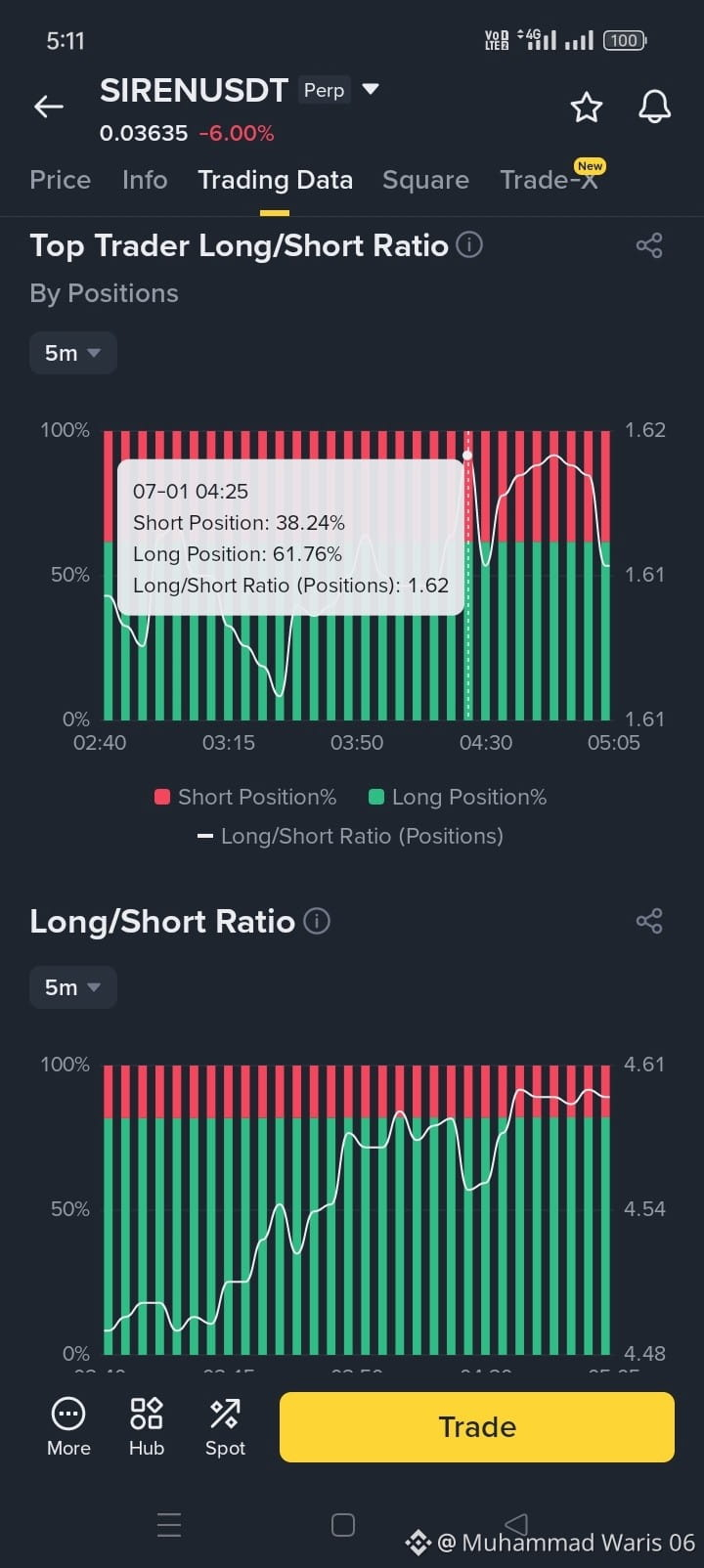
352
$LAB is somewhat acrobatic. It came down from almost $25 in one breath to $5.7. Now it is trading at $14.
$LAB is somewhat acrobatic. It came down from almost $25 in one breath to $5.7. Now it is trading at $14.
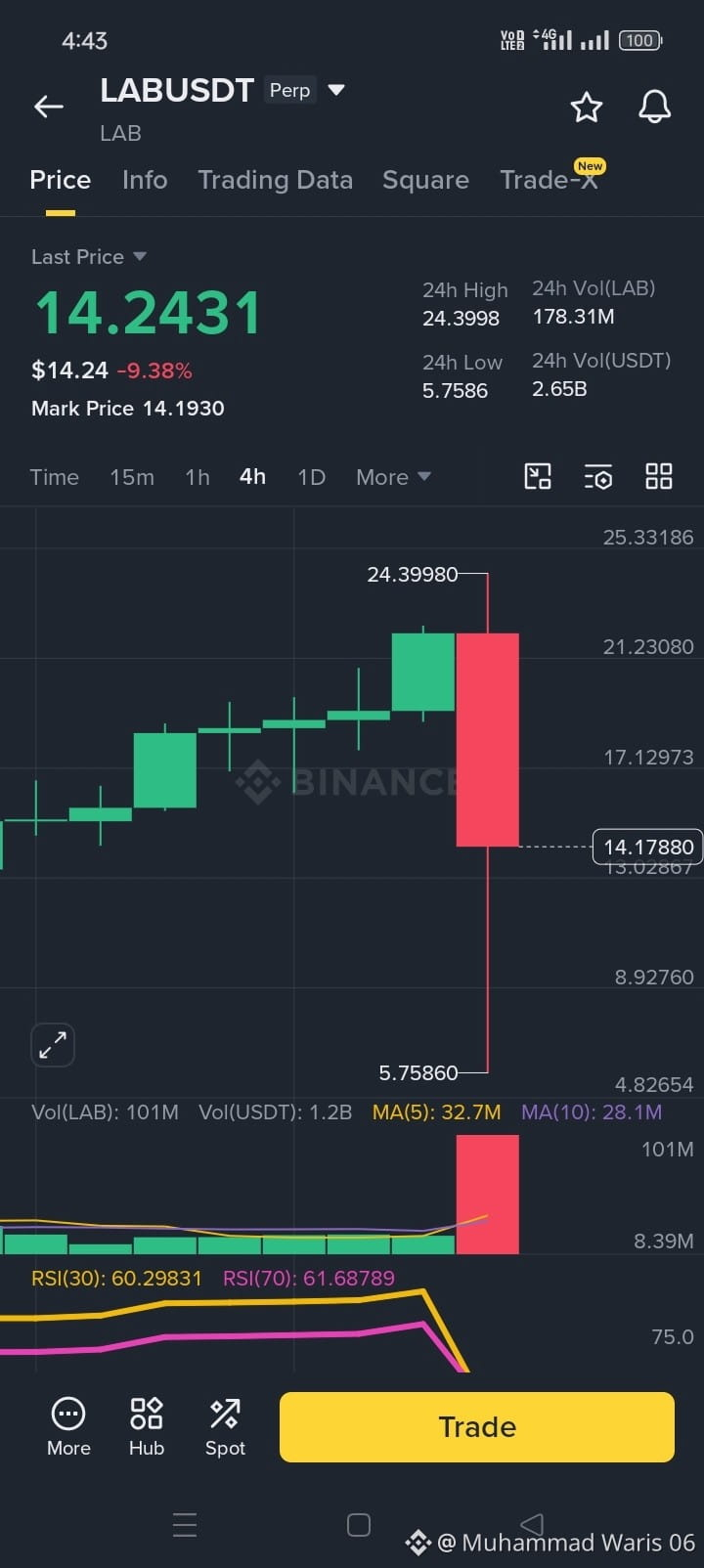
836
·
--
Падение
$BTC order book is thinning below $59k. Bid support stacking at $57.8k — if that gets eaten, expect a quick flush to $54k.
Spot CVD (Cumulative Volume Delta) still negative on 4H. No aggressive buyer absorption.
Liquidity clusters overhead at $61.5k, but price likely hunts lows first.
Position: Short, size small. Adding on breakdown below $57.5k.
$BTC order book is thinning below $59k. Bid support stacking at $57.8k — if that gets eaten, expect a quick flush to $54k.
Spot CVD (Cumulative Volume Delta) still negative on 4H. No aggressive buyer absorption.
Liquidity clusters overhead at $61.5k, but price likely hunts lows first.
Position: Short, size small. Adding on breakdown below $57.5k.
Spot CVD (Cumulative Volume Delta) still negative on 4H. No aggressive buyer absorption.
Liquidity clusters overhead at $61.5k, but price likely hunts lows first.
Position: Short, size small. Adding on breakdown below $57.5k.
17
The Final Capitulation? Reading Bitcoin’s Crash Through Its Own HistoryThe recent crash has ripped through the crypto market, leaving even seasoned holders questioning the cycle. But instead of panicking, one look at Bitcoin’s multi-year drawdown history—2011 through 2024—offers a cold, mathematical roadmap.
The question isn’t if this is a bear market. The question is: How deep will this one go?
What the Cycle Chart Actually Shows
Laying out the data from the provided charts, a clear (and recently broken) pattern emerges:
· 2011–2012: –91.4%
· 2014–2015: –83.3%
· 2017–2018: –61.9%
· 2020–2021: –61.9% to –49.6%
· 2023: –76.7%
For nearly a decade, drawdowns shrank dramatically—from apocalyptic -91% down to a manageable -49%. That was the hallmark of a maturing asset. Then 2023 broke the trend with a violent -76.7% decline, almost matching the 2014 crash.
That deviation is critical. It means the “gentler cycles” thesis is dead—at least for now.
The Crash in Context
Comparing the current price action to prior -76.7% events (late 2022 through 2023):
· Capitulation is missing. In 2015 and 2018, bottoms formed only after a volume spike—a final flush where sellers exhausted themselves. Current volume profiles show steady selling, not the explosive climax that marks a true bottom.
· Duration is stretching. Historical bear markets from the charts average 37 days of severe pain. The current downturn has already exceeded that in certain timeframes, suggesting this is either a structural breakdown or a delayed capitulation.
The Bull/Bear Asymmetry (From the Same Data)
The charts also show a critical rhythm:
· Bull market duration: 484 days / 52 months
· Bear market duration: 37 days / 8 months
Historically, bear markets are short and violent. If that pattern holds, the bottom should arrive soon. If it breaks, Bitcoin enters uncharted territory.
Estimated Bearish Bottom for BTC
Using the 2024 cycle high (approx. $73,750), here is where a continued bear market would likely land, based purely on historical drawdowns from your chart:
Drawdown Scenario Estimated Price
-61.9% (2020/2017 style) $28,100
-76.7% (2023 style) $17,150
-83.3% (2014 style) $12,300
-91.4% (2011 style) $6,340
Most probable bearish bottom: $17,000–$19,000
Why? Because -76.7% is the most recent severe drawdown (2023). It represents the new baseline for “worst case” in the post-2020 era. A drop from $73,750 to $17,150 would exactly repeat that pain.
A break below $17,000 would open the door to $12,000–$14,000, matching the 2014-style crash. That would require a complete loss of institutional confidence—unlikely but not impossible given current macro conditions.
The “Final Button” Condition
The market will signal a true bottom when three things happen (visible on any chart):
1. A capitulation volume spike – A single daily candle with 2–3x average volume closing with a long wick.
2. A reclaim of the 200-week moving average – Currently near $28,000–$30,000. Without that, any bounce is a dead cat.
3. The 37-day bear market duration – If selling extends past 60–90 days without a new low, the pattern changes.
Conclusion: Two Roads
· If $52,000–$55,000 holds → The historical 37-day bear pattern is intact. Bottom soon.
· If $52,000 breaks → The target becomes $17,000–$19,000, with $12,000 as the black swan floor.
The charts don’t lie: Bitcoin is either about to print the final button… or we’re only halfway down.
$BTC
The Final Capitulation? Reading Bitcoin’s Crash Through Its Own History
The recent crash has ripped through the crypto market, leaving even seasoned holders questioning the cycle. But instead of panicking, one look at Bitcoin’s multi-year drawdown history—2011 through 2024—offers a cold, mathematical roadmap.
The question isn’t if this is a bear market. The question is: How deep will this one go?
What the Cycle Chart Actually Shows
Laying out the data from the provided charts, a clear (and recently broken) pattern emerges:
· 2011–2012: –91.4%
· 2014–2015: –83.3%
· 2017–2018: –61.9%
· 2020–2021: –61.9% to –49.6%
· 2023: –76.7%
For nearly a decade, drawdowns shrank dramatically—from apocalyptic -91% down to a manageable -49%. That was the hallmark of a maturing asset. Then 2023 broke the trend with a violent -76.7% decline, almost matching the 2014 crash.
That deviation is critical. It means the “gentler cycles” thesis is dead—at least for now.
The Crash in Context
Comparing the current price action to prior -76.7% events (late 2022 through 2023):
· Capitulation is missing. In 2015 and 2018, bottoms formed only after a volume spike—a final flush where sellers exhausted themselves. Current volume profiles show steady selling, not the explosive climax that marks a true bottom.
· Duration is stretching. Historical bear markets from the charts average 37 days of severe pain. The current downturn has already exceeded that in certain timeframes, suggesting this is either a structural breakdown or a delayed capitulation.
The Bull/Bear Asymmetry (From the Same Data)
The charts also show a critical rhythm:
· Bull market duration: 484 days / 52 months
· Bear market duration: 37 days / 8 months
Historically, bear markets are short and violent. If that pattern holds, the bottom should arrive soon. If it breaks, Bitcoin enters uncharted territory.
Estimated Bearish Bottom for BTC
Using the 2024 cycle high (approx. $73,750), here is where a continued bear market would likely land, based purely on historical drawdowns from your chart:
Drawdown Scenario Estimated Price
-61.9% (2020/2017 style) $28,100
-76.7% (2023 style) $17,150
-83.3% (2014 style) $12,300
-91.4% (2011 style) $6,340
Most probable bearish bottom: $17,000–$19,000
Why? Because -76.7% is the most recent severe drawdown (2023). It represents the new baseline for “worst case” in the post-2020 era. A drop from $73,750 to $17,150 would exactly repeat that pain.
A break below $17,000 would open the door to $12,000–$14,000, matching the 2014-style crash. That would require a complete loss of institutional confidence—unlikely but not impossible given current macro conditions.
The “Final Button” Condition
The market will signal a true bottom when three things happen (visible on any chart):
1. A capitulation volume spike – A single daily candle with 2–3x average volume closing with a long wick.
2. A reclaim of the 200-week moving average – Currently near $28,000–$30,000. Without that, any bounce is a dead cat.
3. The 37-day bear market duration – If selling extends past 60–90 days without a new low, the pattern changes.
Conclusion: Two Roads
· If $52,000–$55,000 holds → The historical 37-day bear pattern is intact. Bottom soon.
· If $52,000 breaks → The target becomes $17,000–$19,000, with $12,000 as the black swan floor.
The charts don’t lie: Bitcoin is either about to print the final button… or we’re only halfway down.
$BTC
The question isn’t if this is a bear market. The question is: How deep will this one go?
What the Cycle Chart Actually Shows
Laying out the data from the provided charts, a clear (and recently broken) pattern emerges:
· 2011–2012: –91.4%
· 2014–2015: –83.3%
· 2017–2018: –61.9%
· 2020–2021: –61.9% to –49.6%
· 2023: –76.7%
For nearly a decade, drawdowns shrank dramatically—from apocalyptic -91% down to a manageable -49%. That was the hallmark of a maturing asset. Then 2023 broke the trend with a violent -76.7% decline, almost matching the 2014 crash.
That deviation is critical. It means the “gentler cycles” thesis is dead—at least for now.
The Crash in Context
Comparing the current price action to prior -76.7% events (late 2022 through 2023):
· Capitulation is missing. In 2015 and 2018, bottoms formed only after a volume spike—a final flush where sellers exhausted themselves. Current volume profiles show steady selling, not the explosive climax that marks a true bottom.
· Duration is stretching. Historical bear markets from the charts average 37 days of severe pain. The current downturn has already exceeded that in certain timeframes, suggesting this is either a structural breakdown or a delayed capitulation.
The Bull/Bear Asymmetry (From the Same Data)
The charts also show a critical rhythm:
· Bull market duration: 484 days / 52 months
· Bear market duration: 37 days / 8 months
Historically, bear markets are short and violent. If that pattern holds, the bottom should arrive soon. If it breaks, Bitcoin enters uncharted territory.
Estimated Bearish Bottom for BTC
Using the 2024 cycle high (approx. $73,750), here is where a continued bear market would likely land, based purely on historical drawdowns from your chart:
Drawdown Scenario Estimated Price
-61.9% (2020/2017 style) $28,100
-76.7% (2023 style) $17,150
-83.3% (2014 style) $12,300
-91.4% (2011 style) $6,340
Most probable bearish bottom: $17,000–$19,000
Why? Because -76.7% is the most recent severe drawdown (2023). It represents the new baseline for “worst case” in the post-2020 era. A drop from $73,750 to $17,150 would exactly repeat that pain.
A break below $17,000 would open the door to $12,000–$14,000, matching the 2014-style crash. That would require a complete loss of institutional confidence—unlikely but not impossible given current macro conditions.
The “Final Button” Condition
The market will signal a true bottom when three things happen (visible on any chart):
1. A capitulation volume spike – A single daily candle with 2–3x average volume closing with a long wick.
2. A reclaim of the 200-week moving average – Currently near $28,000–$30,000. Without that, any bounce is a dead cat.
3. The 37-day bear market duration – If selling extends past 60–90 days without a new low, the pattern changes.
Conclusion: Two Roads
· If $52,000–$55,000 holds → The historical 37-day bear pattern is intact. Bottom soon.
· If $52,000 breaks → The target becomes $17,000–$19,000, with $12,000 as the black swan floor.
The charts don’t lie: Bitcoin is either about to print the final button… or we’re only halfway down.
$BTC
102
The CLARITY Act: A New Hope for Crypto Regulation in the U.S.For years, the crypto industry has operated in a regulatory "gray area" in the United States. Businesses complain they don’t know which agency oversees them, while regulators—primarily the Securities and Exchange Commission (SEC) and the Commodity Futures Trading Commission (CFTC)—have wrestled over jurisdiction. This lack of clear rules has driven innovation overseas and left investors vulnerable to fraud.
Enter the Digital Asset Market Clarity Act of 2025, commonly known as the CLARITY Act.
In a landmark move on July 17, 2025, the U.S. House of Representatives passed this bipartisan bill with a decisive vote of 294 to 134 . While it still needs Senate approval, the legislation represents the most significant attempt by Congress to establish a functional regulatory framework for digital assets. Here is what the CLARITY Act is, how it works, and why it is a game-changer for crypto.
The Core Problem: "Is It a Security?"
Currently, the SEC regulates "securities" (like stocks), while the CFTC regulates "commodities" (like gold or oil). The SEC has argued that most crypto tokens are securities under the Howey Test, requiring strict registration. The industry argues tokens are commodities, like Bitcoin.
The CLARITY Act solves this by creating a legal bridge for tokens to move from one category to the other .
1. A New Asset Class: The "Investment Contract Asset"
Under the bill, when a company sells a token to raise funds, it is still an "investment contract" (a security). However, the Act legally separates the contract from the asset itself. If the blockchain network becomes sufficiently "mature" (decentralized), the token can "morph" into a Digital Commodity, freeing it from SEC oversight .
2. The CFTC Takes the Lead
Once a token is classified as a Digital Commodity, the CFTC becomes the primary regulator for the spot market . This gives the industry a single, primary cop on the beat rather than two arguing over jurisdiction.
3. Safe Harbor for Startups
The bill allows crypto projects to raise up to $75 million over 12 months without automatically triggering full securities registration, provided they file disclosure statements with the SEC .
4. New Rules for Exchanges
Centralized trading platforms would have to register with the CFTC as Digital Commodity Exchanges. They must follow core principles like segregating customer funds (preventing another FTX-style commingling of assets) and meeting anti-money laundering (AML) requirements .
5. Protection for Decentralized Finance (DeFi)
In a win for developers, the Act exempts non-custodial protocol participants (developers and validators) from being treated as money transmitters or brokers. However, anti-fraud rules still apply .
Why is the CLARITY Act Important?
The importance of this bill cannot be overstated. Here is why it matters for different stakeholders:
For the Industry (Exchanges & Issuers): It ends the "regulation by enforcement" era. Instead of the SEC suing a company for listing a token (like Ripple or Coinbase), the CLARITY Act provides a legal pathway for listing Digital Commodities on registered exchanges .
For Banks and Custodians: The bill explicitly states that regulators cannot force banks to list customers' crypto assets as liabilities on their balance sheets (effectively codifying the overturn of SAB 121). This removes a massive accounting barrier that prevented mainstream banks from holding crypto .
For Investors: By requiring exchanges to register with the CFTC and meet strict standards for custody and conflict of interest, the Act aims to reduce fraud and manipulation in the spot market .
For Innovation: The CLARITY Act provides a clear "decentralization" test. If a network is truly decentralized (no single insider controls more than 20% of the tokens), it is likely a commodity. This gives developers a goal to aim for .
The Debate and The Road Ahead
Despite the euphoria in the crypto community, the bill is not without its critics.
Wall Street Concerns: Some former regulators, like Timothy Massad, argue that rewriting securities laws to accommodate crypto could create loopholes that undermine the $120 trillion traditional capital markets .
Political Opposition: Some Democrats, like Rep. Sylvia Garcia, voted against the bill, calling it a "license for corruption" that weakens anti-money laundering protections .
The Senate Hurdle: The biggest challenge remains the Senate. While the House passed it with strong support, it needs 60 votes in the Senate to avoid a filibuster. Key Democrats like Senator Kirsten Gillibrand are involved in negotiations, but passage is not guaranteed .
Conclusion
The CLARITY Act is the most sophisticated legislative attempt to answer the question, "Who regulates crypto?" By dividing responsibilities between the SEC (for the fundraising phase) and the CFTC (for the trading phase), it attempts to balance innovation with investor protection.
If passed, the United States could finally move from a state of confusion to becoming a global hub for digital asset regulation. If it fails, the industry likely returns to the courts and enforcement actions to define the rules—one lawsuit at a time.
$BTC
#ClarityInCrypto
The CLARITY Act: A New Hope for Crypto Regulation in the U.S.
For years, the crypto industry has operated in a regulatory "gray area" in the United States. Businesses complain they don’t know which agency oversees them, while regulators—primarily the Securities and Exchange Commission (SEC) and the Commodity Futures Trading Commission (CFTC)—have wrestled over jurisdiction. This lack of clear rules has driven innovation overseas and left investors vulnerable to fraud.
Enter the Digital Asset Market Clarity Act of 2025, commonly known as the CLARITY Act.
In a landmark move on July 17, 2025, the U.S. House of Representatives passed this bipartisan bill with a decisive vote of 294 to 134 . While it still needs Senate approval, the legislation represents the most significant attempt by Congress to establish a functional regulatory framework for digital assets. Here is what the CLARITY Act is, how it works, and why it is a game-changer for crypto.
The Core Problem: "Is It a Security?"
Currently, the SEC regulates "securities" (like stocks), while the CFTC regulates "commodities" (like gold or oil). The SEC has argued that most crypto tokens are securities under the Howey Test, requiring strict registration. The industry argues tokens are commodities, like Bitcoin.
The CLARITY Act solves this by creating a legal bridge for tokens to move from one category to the other .
1. A New Asset Class: The "Investment Contract Asset"
Under the bill, when a company sells a token to raise funds, it is still an "investment contract" (a security). However, the Act legally separates the contract from the asset itself. If the blockchain network becomes sufficiently "mature" (decentralized), the token can "morph" into a Digital Commodity, freeing it from SEC oversight .
2. The CFTC Takes the Lead
Once a token is classified as a Digital Commodity, the CFTC becomes the primary regulator for the spot market . This gives the industry a single, primary cop on the beat rather than two arguing over jurisdiction.
3. Safe Harbor for Startups
The bill allows crypto projects to raise up to $75 million over 12 months without automatically triggering full securities registration, provided they file disclosure statements with the SEC .
4. New Rules for Exchanges
Centralized trading platforms would have to register with the CFTC as Digital Commodity Exchanges. They must follow core principles like segregating customer funds (preventing another FTX-style commingling of assets) and meeting anti-money laundering (AML) requirements .
5. Protection for Decentralized Finance (DeFi)
In a win for developers, the Act exempts non-custodial protocol participants (developers and validators) from being treated as money transmitters or brokers. However, anti-fraud rules still apply .
Why is the CLARITY Act Important?
The importance of this bill cannot be overstated. Here is why it matters for different stakeholders:
For the Industry (Exchanges & Issuers): It ends the "regulation by enforcement" era. Instead of the SEC suing a company for listing a token (like Ripple or Coinbase), the CLARITY Act provides a legal pathway for listing Digital Commodities on registered exchanges .
For Banks and Custodians: The bill explicitly states that regulators cannot force banks to list customers' crypto assets as liabilities on their balance sheets (effectively codifying the overturn of SAB 121). This removes a massive accounting barrier that prevented mainstream banks from holding crypto .
For Investors: By requiring exchanges to register with the CFTC and meet strict standards for custody and conflict of interest, the Act aims to reduce fraud and manipulation in the spot market .
For Innovation: The CLARITY Act provides a clear "decentralization" test. If a network is truly decentralized (no single insider controls more than 20% of the tokens), it is likely a commodity. This gives developers a goal to aim for .
The Debate and The Road Ahead
Despite the euphoria in the crypto community, the bill is not without its critics.
Wall Street Concerns: Some former regulators, like Timothy Massad, argue that rewriting securities laws to accommodate crypto could create loopholes that undermine the $120 trillion traditional capital markets .
Political Opposition: Some Democrats, like Rep. Sylvia Garcia, voted against the bill, calling it a "license for corruption" that weakens anti-money laundering protections .
The Senate Hurdle: The biggest challenge remains the Senate. While the House passed it with strong support, it needs 60 votes in the Senate to avoid a filibuster. Key Democrats like Senator Kirsten Gillibrand are involved in negotiations, but passage is not guaranteed .
Conclusion
The CLARITY Act is the most sophisticated legislative attempt to answer the question, "Who regulates crypto?" By dividing responsibilities between the SEC (for the fundraising phase) and the CFTC (for the trading phase), it attempts to balance innovation with investor protection.
If passed, the United States could finally move from a state of confusion to becoming a global hub for digital asset regulation. If it fails, the industry likely returns to the courts and enforcement actions to define the rules—one lawsuit at a time.
$BTC
#ClarityInCrypto
Enter the Digital Asset Market Clarity Act of 2025, commonly known as the CLARITY Act.
In a landmark move on July 17, 2025, the U.S. House of Representatives passed this bipartisan bill with a decisive vote of 294 to 134 . While it still needs Senate approval, the legislation represents the most significant attempt by Congress to establish a functional regulatory framework for digital assets. Here is what the CLARITY Act is, how it works, and why it is a game-changer for crypto.
The Core Problem: "Is It a Security?"
Currently, the SEC regulates "securities" (like stocks), while the CFTC regulates "commodities" (like gold or oil). The SEC has argued that most crypto tokens are securities under the Howey Test, requiring strict registration. The industry argues tokens are commodities, like Bitcoin.
The CLARITY Act solves this by creating a legal bridge for tokens to move from one category to the other .
1. A New Asset Class: The "Investment Contract Asset"
Under the bill, when a company sells a token to raise funds, it is still an "investment contract" (a security). However, the Act legally separates the contract from the asset itself. If the blockchain network becomes sufficiently "mature" (decentralized), the token can "morph" into a Digital Commodity, freeing it from SEC oversight .
2. The CFTC Takes the Lead
Once a token is classified as a Digital Commodity, the CFTC becomes the primary regulator for the spot market . This gives the industry a single, primary cop on the beat rather than two arguing over jurisdiction.
3. Safe Harbor for Startups
The bill allows crypto projects to raise up to $75 million over 12 months without automatically triggering full securities registration, provided they file disclosure statements with the SEC .
4. New Rules for Exchanges
Centralized trading platforms would have to register with the CFTC as Digital Commodity Exchanges. They must follow core principles like segregating customer funds (preventing another FTX-style commingling of assets) and meeting anti-money laundering (AML) requirements .
5. Protection for Decentralized Finance (DeFi)
In a win for developers, the Act exempts non-custodial protocol participants (developers and validators) from being treated as money transmitters or brokers. However, anti-fraud rules still apply .
Why is the CLARITY Act Important?
The importance of this bill cannot be overstated. Here is why it matters for different stakeholders:
For the Industry (Exchanges & Issuers): It ends the "regulation by enforcement" era. Instead of the SEC suing a company for listing a token (like Ripple or Coinbase), the CLARITY Act provides a legal pathway for listing Digital Commodities on registered exchanges .
For Banks and Custodians: The bill explicitly states that regulators cannot force banks to list customers' crypto assets as liabilities on their balance sheets (effectively codifying the overturn of SAB 121). This removes a massive accounting barrier that prevented mainstream banks from holding crypto .
For Investors: By requiring exchanges to register with the CFTC and meet strict standards for custody and conflict of interest, the Act aims to reduce fraud and manipulation in the spot market .
For Innovation: The CLARITY Act provides a clear "decentralization" test. If a network is truly decentralized (no single insider controls more than 20% of the tokens), it is likely a commodity. This gives developers a goal to aim for .
The Debate and The Road Ahead
Despite the euphoria in the crypto community, the bill is not without its critics.
Wall Street Concerns: Some former regulators, like Timothy Massad, argue that rewriting securities laws to accommodate crypto could create loopholes that undermine the $120 trillion traditional capital markets .
Political Opposition: Some Democrats, like Rep. Sylvia Garcia, voted against the bill, calling it a "license for corruption" that weakens anti-money laundering protections .
The Senate Hurdle: The biggest challenge remains the Senate. While the House passed it with strong support, it needs 60 votes in the Senate to avoid a filibuster. Key Democrats like Senator Kirsten Gillibrand are involved in negotiations, but passage is not guaranteed .
Conclusion
The CLARITY Act is the most sophisticated legislative attempt to answer the question, "Who regulates crypto?" By dividing responsibilities between the SEC (for the fundraising phase) and the CFTC (for the trading phase), it attempts to balance innovation with investor protection.
If passed, the United States could finally move from a state of confusion to becoming a global hub for digital asset regulation. If it fails, the industry likely returns to the courts and enforcement actions to define the rules—one lawsuit at a time.
$BTC
#ClarityInCrypto
108
·
--
Рост
🚨 B2USDT Perp – Buy the fear.
-25% drop. RSI near oversold (36).
Support holding at 0.50.
One active trade already up +19% ROI. TP at 0.73 = ~40% upside.
Entry: 0.5050–0.5150
Target: 0.59 → 0.695
Stop below 0.495
📉 Red is just a discount.
Go long before the rebound.
🚨 B2USDT Perp – Buy the fear.
-25% drop. RSI near oversold (36).
Support holding at 0.50.
One active trade already up +19% ROI. TP at 0.73 = ~40% upside.
Entry: 0.5050–0.5150
Target: 0.59 → 0.695
Stop below 0.495
📉 Red is just a discount.
Go long before the rebound.
-25% drop. RSI near oversold (36).
Support holding at 0.50.
One active trade already up +19% ROI. TP at 0.73 = ~40% upside.
Entry: 0.5050–0.5150
Target: 0.59 → 0.695
Stop below 0.495
📉 Red is just a discount.
Go long before the rebound.
290
This is *BTCUSDT Perp Trading Data* at 73,940.9 (-0.21%). Here’s what it’s telling you:
*1. Open Interest – Big flush at 18:45*
- *Yellow bars = Open Interest (contracts)*: Dropped from ∼99.9K → ∼97.6K contracts
- *White line = Notional Value*: Dropped from ∼7.50B → ∼7.16B USDT
*What happened*: Around 18:45 PKT, there was a sharp drop in both OI and notional value. That means ∼2.3K contracts worth ∼$340M got closed in minutes.
On the 4h chart you sent earlier, price wicked down at the same time. This was likely *long liquidations + panic closes* hitting. After the flush, OI is flat. No new positions are piling in yet.
*2. Top Trader Long/Short Ratio – Major flip*
- *Red = % of top trader accounts net short*
- *Green = % of top trader accounts net long*
- *White line = Ratio*: Jumped from ∼0.80 → ∼0.89
*What it shows*:
1. *Before 18:40*: Top traders were ∼80-90% short. Very bearish.
2. *After 18:40*: They flipped hard. Now it’s roughly 50/50 long vs short. Ratio at 0.89 means almost even.
This matches the OI flush. Top traders were heavily short, price dipped, they took profit/closed shorts, and some flipped long into the dip.
*Putting it together with your 4h chart*
1. *Price rejected 76k*, dumped to 73,256, and bounced
2. *That dump flushed $340M in OI* – mostly longs got liquidated
3. *Top traders covered shorts and went neutral/lean long* during the flush
4. *OI not recovering* – means the move down scared people. No fresh leverage stepping in yet
*Key takeaway*: The market just deleveraged. Top traders are no longer heavily short, which removes fuel for more downside. But OI staying low means conviction is weak. BTC is now in a “wait and see” zone.
If price reclaims 75k with OI rising, that’s bullish – new longs entering. If 73,250 breaks with OI rising, that’s bearish – new shorts piling in.
$BTC
This is *BTCUSDT Perp Trading Data* at 73,940.9 (-0.21%). Here’s what it’s telling you:
*1. Open Interest – Big flush at 18:45*
- *Yellow bars = Open Interest (contracts)*: Dropped from ∼99.9K → ∼97.6K contracts
- *White line = Notional Value*: Dropped from ∼7.50B → ∼7.16B USDT
*What happened*: Around 18:45 PKT, there was a sharp drop in both OI and notional value. That means ∼2.3K contracts worth ∼$340M got closed in minutes.
On the 4h chart you sent earlier, price wicked down at the same time. This was likely *long liquidations + panic closes* hitting. After the flush, OI is flat. No new positions are piling in yet.
*2. Top Trader Long/Short Ratio – Major flip*
- *Red = % of top trader accounts net short*
- *Green = % of top trader accounts net long*
- *White line = Ratio*: Jumped from ∼0.80 → ∼0.89
*What it shows*:
1. *Before 18:40*: Top traders were ∼80-90% short. Very bearish.
2. *After 18:40*: They flipped hard. Now it’s roughly 50/50 long vs short. Ratio at 0.89 means almost even.
This matches the OI flush. Top traders were heavily short, price dipped, they took profit/closed shorts, and some flipped long into the dip.
*Putting it together with your 4h chart*
1. *Price rejected 76k*, dumped to 73,256, and bounced
2. *That dump flushed $340M in OI* – mostly longs got liquidated
3. *Top traders covered shorts and went neutral/lean long* during the flush
4. *OI not recovering* – means the move down scared people. No fresh leverage stepping in yet
*Key takeaway*: The market just deleveraged. Top traders are no longer heavily short, which removes fuel for more downside. But OI staying low means conviction is weak. BTC is now in a “wait and see” zone.
If price reclaims 75k with OI rising, that’s bullish – new longs entering. If 73,250 breaks with OI rising, that’s bearish – new shorts piling in.
$BTC
*1. Open Interest – Big flush at 18:45*
- *Yellow bars = Open Interest (contracts)*: Dropped from ∼99.9K → ∼97.6K contracts
- *White line = Notional Value*: Dropped from ∼7.50B → ∼7.16B USDT
*What happened*: Around 18:45 PKT, there was a sharp drop in both OI and notional value. That means ∼2.3K contracts worth ∼$340M got closed in minutes.
On the 4h chart you sent earlier, price wicked down at the same time. This was likely *long liquidations + panic closes* hitting. After the flush, OI is flat. No new positions are piling in yet.
*2. Top Trader Long/Short Ratio – Major flip*
- *Red = % of top trader accounts net short*
- *Green = % of top trader accounts net long*
- *White line = Ratio*: Jumped from ∼0.80 → ∼0.89
*What it shows*:
1. *Before 18:40*: Top traders were ∼80-90% short. Very bearish.
2. *After 18:40*: They flipped hard. Now it’s roughly 50/50 long vs short. Ratio at 0.89 means almost even.
This matches the OI flush. Top traders were heavily short, price dipped, they took profit/closed shorts, and some flipped long into the dip.
*Putting it together with your 4h chart*
1. *Price rejected 76k*, dumped to 73,256, and bounced
2. *That dump flushed $340M in OI* – mostly longs got liquidated
3. *Top traders covered shorts and went neutral/lean long* during the flush
4. *OI not recovering* – means the move down scared people. No fresh leverage stepping in yet
*Key takeaway*: The market just deleveraged. Top traders are no longer heavily short, which removes fuel for more downside. But OI staying low means conviction is weak. BTC is now in a “wait and see” zone.
If price reclaims 75k with OI rising, that’s bullish – new longs entering. If 73,250 breaks with OI rising, that’s bearish – new shorts piling in.
$BTC
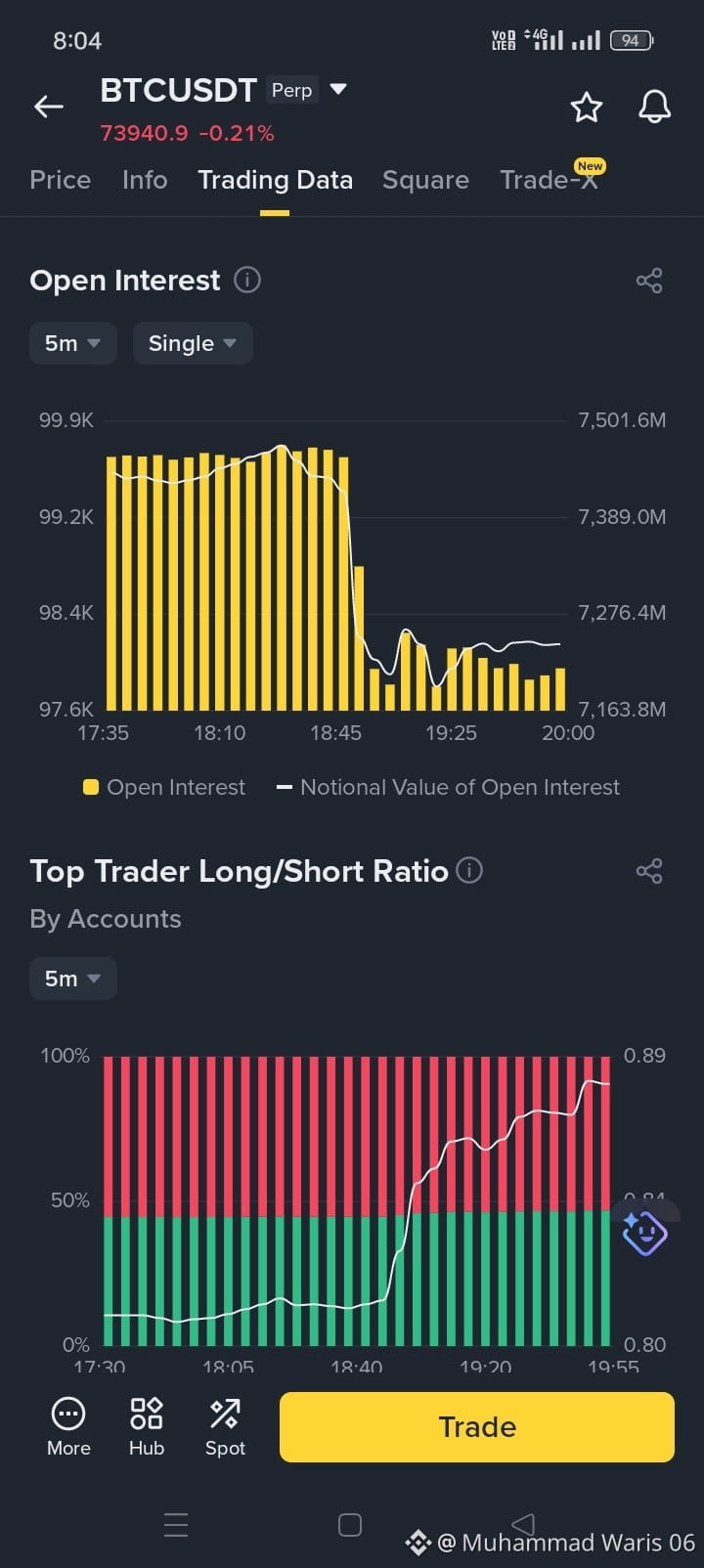
1
124
The Domino Effect: Why a Breakdown in Bitcoin Structure Signals a Plunge to $38,000The cryptocurrency market is standing on a precipice. For months, investors have clung to the hope of a sustained recovery, but the technical landscape is telling a different story. The charts are no longer signaling consolidation; they are signaling a fracture.
After analyzing the market structure, liquidity zones, and dominance trends, a sobering picture emerges. We are looking at a cascade lower, with Bitcoin (BTC) heading to $38,000, dragging Ethereum (ETH) and Solana (SOL) down with it. This is not merely a pullback; it is a structural breakdown.
The Technical Deterioration: A Structure Break to the Downside
To understand the severity of the current setup, we must examine the concept of market structure. In trading, a bullish structure is defined by higher highs and higher lows. A bearish structure—what we are witnessing now—is defined by lower highs and lower lows.
Bitcoin is currently experiencing a real-time frame break on the higher timeframes (HTF). The critical support levels that have held for weeks or months are now giving way. This is known as a "Structure Break." When price action breaks below a key swing low on the daily or weekly chart, the previous accumulation zone is invalidated.
We are seeing exactly that: Bitcoin is breaking down from its consolidation range. The measured move of this breakdown, based on the width of the previous trading range and the historical liquidity pockets below, points decisively to the downside.
The next logical target for this structural collapse is $38,000.
BTC Dominance: The Flight to Safety (or the Flight from Risk)
A market-wide decline is rarely uniform. To understand how this fall will unfold, we must look at BTC Dominance.
In a risk-off environment, a "dominance break" typically occurs to the upside. As fear grips the market, capital flows out of speculative altcoins and back into Bitcoin, which is still viewed as the "safe haven" within the volatile crypto ecosystem.
If we see BTC dominance break its current resistance levels while the total market capitalization is falling, it signals a brutal rotation. It means that while Bitcoin is falling to $38,000, altcoins are falling even faster. A rising dominance during a price drop is the classic hallmark of a "capitulation" phase, where holders of Ethereum, Solana, and other altcoins sell their bags to de-risk into Bitcoin, or simply exit the market entirely.
The Altcoin Carnage: ETH and SOL Targets
If Bitcoin is bleeding, the altcoin market will be hemorrhaging. The targets for the top altcoins reflect a complete unwind of the previous recovery attempts.
Ethereum (ETH) at $800
Ethereum is facing a critical liquidity crisis on the charts. The path to $800 is not just a price target; it is a zone of major historical support.
A fall to $800 represents a retest of levels not seen in over a year. For ETH to get there, the current support structures must fail entirely. As Bitcoin breaks its structure to the downside, Ethereum will likely follow with amplified volatility. Hitting $800 would wipe out a significant portion of open interest in the futures market, resetting the leverage that has built up during the consolidation phase.
Solana (SOL) at $30
Solana, often a proxy for retail risk appetite, faces the most precarious path. The target of $30 represents a fall back into the depths of its previous accumulation zone.
At $30, Solana would be testing a critical demand zone. If Bitcoin dominance breaks upward and BTC falls to $38,000, the selling pressure on SOL will be immense. A drop to $30 would invalidate the bullish narrative that Solana has tried to build over the last several months, signaling that the market is rejecting risk assets across the board.
The Road Ahead: A Cascade Lower
The convergence of these factors—a Bitcoin structure break to the downside, a spike in BTC dominance, and catastrophic targets for ETH and SOL—paints a picture of a market on the verge of a cascade.
Here is how the scenario is likely to unfold:
1. The Trigger: Bitcoin loses its key support level, confirming the real-time frame break.
2. The Flight: BTC dominance spikes as traders sell altcoins, exacerbating the drop in ETH and SOL.
3. The Target: Bitcoin accelerates downward to sweep liquidity at $38,000, taking the rest of the market with it.
For traders, the coming days require extreme caution. In a structural breakdown, "buying the dip" can be dangerous until the market shows signs of a reversal pattern. While a bounce may occur at $38,000, the current technical setup suggests that the path of least resistance is firmly downward.
The market structure has broken. The next target is clear.
The next target of BTC is $38,000.
Disclaimer: This article is for informational purposes only and does not constitute financial advice. Cryptocurrency markets are highly volatile and speculative. Always conduct your own research and consider your risk tolerance before making any investment decisions.
#bitcoin
$BTC $ETH $SOL
The Domino Effect: Why a Breakdown in Bitcoin Structure Signals a Plunge to $38,000
The cryptocurrency market is standing on a precipice. For months, investors have clung to the hope of a sustained recovery, but the technical landscape is telling a different story. The charts are no longer signaling consolidation; they are signaling a fracture.
After analyzing the market structure, liquidity zones, and dominance trends, a sobering picture emerges. We are looking at a cascade lower, with Bitcoin (BTC) heading to $38,000, dragging Ethereum (ETH) and Solana (SOL) down with it. This is not merely a pullback; it is a structural breakdown.
The Technical Deterioration: A Structure Break to the Downside
To understand the severity of the current setup, we must examine the concept of market structure. In trading, a bullish structure is defined by higher highs and higher lows. A bearish structure—what we are witnessing now—is defined by lower highs and lower lows.
Bitcoin is currently experiencing a real-time frame break on the higher timeframes (HTF). The critical support levels that have held for weeks or months are now giving way. This is known as a "Structure Break." When price action breaks below a key swing low on the daily or weekly chart, the previous accumulation zone is invalidated.
We are seeing exactly that: Bitcoin is breaking down from its consolidation range. The measured move of this breakdown, based on the width of the previous trading range and the historical liquidity pockets below, points decisively to the downside.
The next logical target for this structural collapse is $38,000.
BTC Dominance: The Flight to Safety (or the Flight from Risk)
A market-wide decline is rarely uniform. To understand how this fall will unfold, we must look at BTC Dominance.
In a risk-off environment, a "dominance break" typically occurs to the upside. As fear grips the market, capital flows out of speculative altcoins and back into Bitcoin, which is still viewed as the "safe haven" within the volatile crypto ecosystem.
If we see BTC dominance break its current resistance levels while the total market capitalization is falling, it signals a brutal rotation. It means that while Bitcoin is falling to $38,000, altcoins are falling even faster. A rising dominance during a price drop is the classic hallmark of a "capitulation" phase, where holders of Ethereum, Solana, and other altcoins sell their bags to de-risk into Bitcoin, or simply exit the market entirely.
The Altcoin Carnage: ETH and SOL Targets
If Bitcoin is bleeding, the altcoin market will be hemorrhaging. The targets for the top altcoins reflect a complete unwind of the previous recovery attempts.
Ethereum (ETH) at $800
Ethereum is facing a critical liquidity crisis on the charts. The path to $800 is not just a price target; it is a zone of major historical support.
A fall to $800 represents a retest of levels not seen in over a year. For ETH to get there, the current support structures must fail entirely. As Bitcoin breaks its structure to the downside, Ethereum will likely follow with amplified volatility. Hitting $800 would wipe out a significant portion of open interest in the futures market, resetting the leverage that has built up during the consolidation phase.
Solana (SOL) at $30
Solana, often a proxy for retail risk appetite, faces the most precarious path. The target of $30 represents a fall back into the depths of its previous accumulation zone.
At $30, Solana would be testing a critical demand zone. If Bitcoin dominance breaks upward and BTC falls to $38,000, the selling pressure on SOL will be immense. A drop to $30 would invalidate the bullish narrative that Solana has tried to build over the last several months, signaling that the market is rejecting risk assets across the board.
The Road Ahead: A Cascade Lower
The convergence of these factors—a Bitcoin structure break to the downside, a spike in BTC dominance, and catastrophic targets for ETH and SOL—paints a picture of a market on the verge of a cascade.
Here is how the scenario is likely to unfold:
1. The Trigger: Bitcoin loses its key support level, confirming the real-time frame break.
2. The Flight: BTC dominance spikes as traders sell altcoins, exacerbating the drop in ETH and SOL.
3. The Target: Bitcoin accelerates downward to sweep liquidity at $38,000, taking the rest of the market with it.
For traders, the coming days require extreme caution. In a structural breakdown, "buying the dip" can be dangerous until the market shows signs of a reversal pattern. While a bounce may occur at $38,000, the current technical setup suggests that the path of least resistance is firmly downward.
The market structure has broken. The next target is clear.
The next target of BTC is $38,000.
Disclaimer: This article is for informational purposes only and does not constitute financial advice. Cryptocurrency markets are highly volatile and speculative. Always conduct your own research and consider your risk tolerance before making any investment decisions.
#bitcoin
$BTC $ETH $SOL
After analyzing the market structure, liquidity zones, and dominance trends, a sobering picture emerges. We are looking at a cascade lower, with Bitcoin (BTC) heading to $38,000, dragging Ethereum (ETH) and Solana (SOL) down with it. This is not merely a pullback; it is a structural breakdown.
The Technical Deterioration: A Structure Break to the Downside
To understand the severity of the current setup, we must examine the concept of market structure. In trading, a bullish structure is defined by higher highs and higher lows. A bearish structure—what we are witnessing now—is defined by lower highs and lower lows.
Bitcoin is currently experiencing a real-time frame break on the higher timeframes (HTF). The critical support levels that have held for weeks or months are now giving way. This is known as a "Structure Break." When price action breaks below a key swing low on the daily or weekly chart, the previous accumulation zone is invalidated.
We are seeing exactly that: Bitcoin is breaking down from its consolidation range. The measured move of this breakdown, based on the width of the previous trading range and the historical liquidity pockets below, points decisively to the downside.
The next logical target for this structural collapse is $38,000.
BTC Dominance: The Flight to Safety (or the Flight from Risk)
A market-wide decline is rarely uniform. To understand how this fall will unfold, we must look at BTC Dominance.
In a risk-off environment, a "dominance break" typically occurs to the upside. As fear grips the market, capital flows out of speculative altcoins and back into Bitcoin, which is still viewed as the "safe haven" within the volatile crypto ecosystem.
If we see BTC dominance break its current resistance levels while the total market capitalization is falling, it signals a brutal rotation. It means that while Bitcoin is falling to $38,000, altcoins are falling even faster. A rising dominance during a price drop is the classic hallmark of a "capitulation" phase, where holders of Ethereum, Solana, and other altcoins sell their bags to de-risk into Bitcoin, or simply exit the market entirely.
The Altcoin Carnage: ETH and SOL Targets
If Bitcoin is bleeding, the altcoin market will be hemorrhaging. The targets for the top altcoins reflect a complete unwind of the previous recovery attempts.
Ethereum (ETH) at $800
Ethereum is facing a critical liquidity crisis on the charts. The path to $800 is not just a price target; it is a zone of major historical support.
A fall to $800 represents a retest of levels not seen in over a year. For ETH to get there, the current support structures must fail entirely. As Bitcoin breaks its structure to the downside, Ethereum will likely follow with amplified volatility. Hitting $800 would wipe out a significant portion of open interest in the futures market, resetting the leverage that has built up during the consolidation phase.
Solana (SOL) at $30
Solana, often a proxy for retail risk appetite, faces the most precarious path. The target of $30 represents a fall back into the depths of its previous accumulation zone.
At $30, Solana would be testing a critical demand zone. If Bitcoin dominance breaks upward and BTC falls to $38,000, the selling pressure on SOL will be immense. A drop to $30 would invalidate the bullish narrative that Solana has tried to build over the last several months, signaling that the market is rejecting risk assets across the board.
The Road Ahead: A Cascade Lower
The convergence of these factors—a Bitcoin structure break to the downside, a spike in BTC dominance, and catastrophic targets for ETH and SOL—paints a picture of a market on the verge of a cascade.
Here is how the scenario is likely to unfold:
1. The Trigger: Bitcoin loses its key support level, confirming the real-time frame break.
2. The Flight: BTC dominance spikes as traders sell altcoins, exacerbating the drop in ETH and SOL.
3. The Target: Bitcoin accelerates downward to sweep liquidity at $38,000, taking the rest of the market with it.
For traders, the coming days require extreme caution. In a structural breakdown, "buying the dip" can be dangerous until the market shows signs of a reversal pattern. While a bounce may occur at $38,000, the current technical setup suggests that the path of least resistance is firmly downward.
The market structure has broken. The next target is clear.
The next target of BTC is $38,000.
Disclaimer: This article is for informational purposes only and does not constitute financial advice. Cryptocurrency markets are highly volatile and speculative. Always conduct your own research and consider your risk tolerance before making any investment decisions.
#bitcoin
$BTC $ETH $SOL
37
The Power of the Sign Token
In the digital landscape, the Sign Token is the silent gatekeeper of trust. Acting as a cryptographic key, it verifies identity with mathematical precision.
Unlike simple passwords, a sign token confirms that a user is exactly who they claim to be—without exposing sensitive credentials. It validates the integrity of every transaction, ensuring data hasn’t been tampered with during transit.
As cyber threats evolve, tokens offer a robust defense. By shifting from static secrets to dynamic verification, they turn a simple "sign" into an unbreakable promise of security and authenticity.
$SIGN
The Power of the Sign Token
In the digital landscape, the Sign Token is the silent gatekeeper of trust. Acting as a cryptographic key, it verifies identity with mathematical precision.
Unlike simple passwords, a sign token confirms that a user is exactly who they claim to be—without exposing sensitive credentials. It validates the integrity of every transaction, ensuring data hasn’t been tampered with during transit.
As cyber threats evolve, tokens offer a robust defense. By shifting from static secrets to dynamic verification, they turn a simple "sign" into an unbreakable promise of security and authenticity.
$SIGN
In the digital landscape, the Sign Token is the silent gatekeeper of trust. Acting as a cryptographic key, it verifies identity with mathematical precision.
Unlike simple passwords, a sign token confirms that a user is exactly who they claim to be—without exposing sensitive credentials. It validates the integrity of every transaction, ensuring data hasn’t been tampered with during transit.
As cyber threats evolve, tokens offer a robust defense. By shifting from static secrets to dynamic verification, they turn a simple "sign" into an unbreakable promise of security and authenticity.
$SIGN
17
·
--
Рост
$CYBER is showing some strength. I hope it would pump
$CYBER is showing some strength. I hope it would pump
2
50
Войдите, чтобы посмотреть больше материала
Присоединяйтесь к пользователям криптовалют по всему миру на Binance Square
⚡️ Получайте новейшую и полезную информацию о криптоактивах.
💬 Нам доверяет крупнейшая в мире криптобиржа.
👍 Получите достоверные аналитические данные от верифицированных создателей контента.
Эл. почта/номер телефона
В тренде
BinancePick
Просмотров: 3.1M
152,749 обсуждают
Join #EarningsSeason: Predict Earnings on Binance Pick, Share Your Take on Binance Square!
Binance Square Official
·Лайков: 411
·Просмотров: 343k
EarningsSeason
Просмотров: 5.3M
25,978 обсуждают
AnthropicTTMRevenueGrewAbout1200%
Просмотров: 28,363
407 обсуждают