
M I N A
338 Публикации

M I N A
CONTENT CREATOR
72 подписок(и/а)
2.1K+ подписчиков(а)
1.6K+ понравилось
Посты
Все
Цитирования
#dusk $DUSK @Dusk Daybreak to Nocturne —mapped a few Dusk testnet names for a CreatorPad task today, expecting a straight timeline of features shipped. Instead the thing that actually stuck was way more recent than any of those names.
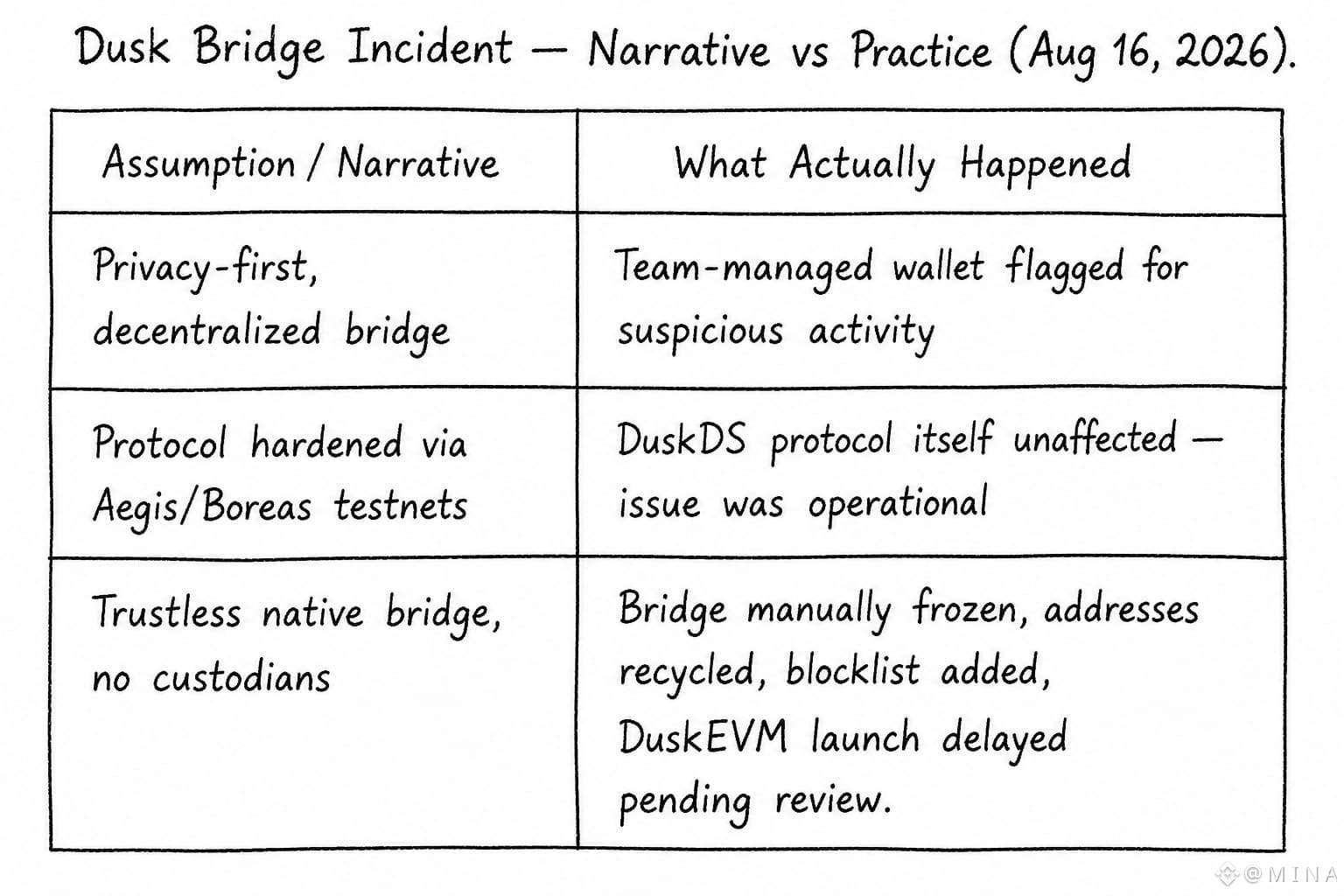
Aug 16, 2026 Dusk's team flagged suspicious activity on a team-managed wallet used for bridge ops. Not a DuskDS protocol bug, not a smart contract exploit… a custodial-style address doing something it shouldn't. Dusk froze the bridge, recycled the addresses, added a recipient blocklist, looped in Binance on the flow. Ten days later (today) the bridge is still closed, still "pending security review," still tied to when DuskEVM actually launches.
the part that stayed with me all those named testnets (Aegis, Boreas, whatever comes after Nocturne) exist specifically to harden the protocol layer before mainnet touches it. And that hardening worked, DuskDS itself wasn't the problem. But the actual point of failure was an operational wallet the team controls. So the "privacy-first, decentralized" pitch and the "who actually holds the keys during a bridge op" reality are… not quite the same picture yet.
Hmm. Makes me wonder if DUSK bridge incidents get counted the same way protocol bugs do, or if they just quietly become "an ops note" once the postmortem drops. Anyone tracking how long DuskEVM actually gets pushed because of this?
$STX $PROM
Aug 16, 2026 Dusk's team flagged suspicious activity on a team-managed wallet used for bridge ops. Not a DuskDS protocol bug, not a smart contract exploit… a custodial-style address doing something it shouldn't. Dusk froze the bridge, recycled the addresses, added a recipient blocklist, looped in Binance on the flow. Ten days later (today) the bridge is still closed, still "pending security review," still tied to when DuskEVM actually launches.
the part that stayed with me all those named testnets (Aegis, Boreas, whatever comes after Nocturne) exist specifically to harden the protocol layer before mainnet touches it. And that hardening worked, DuskDS itself wasn't the problem. But the actual point of failure was an operational wallet the team controls. So the "privacy-first, decentralized" pitch and the "who actually holds the keys during a bridge op" reality are… not quite the same picture yet.
Hmm. Makes me wonder if DUSK bridge incidents get counted the same way protocol bugs do, or if they just quietly become "an ops note" once the postmortem drops. Anyone tracking how long DuskEVM actually gets pushed because of this?
$STX $PROM
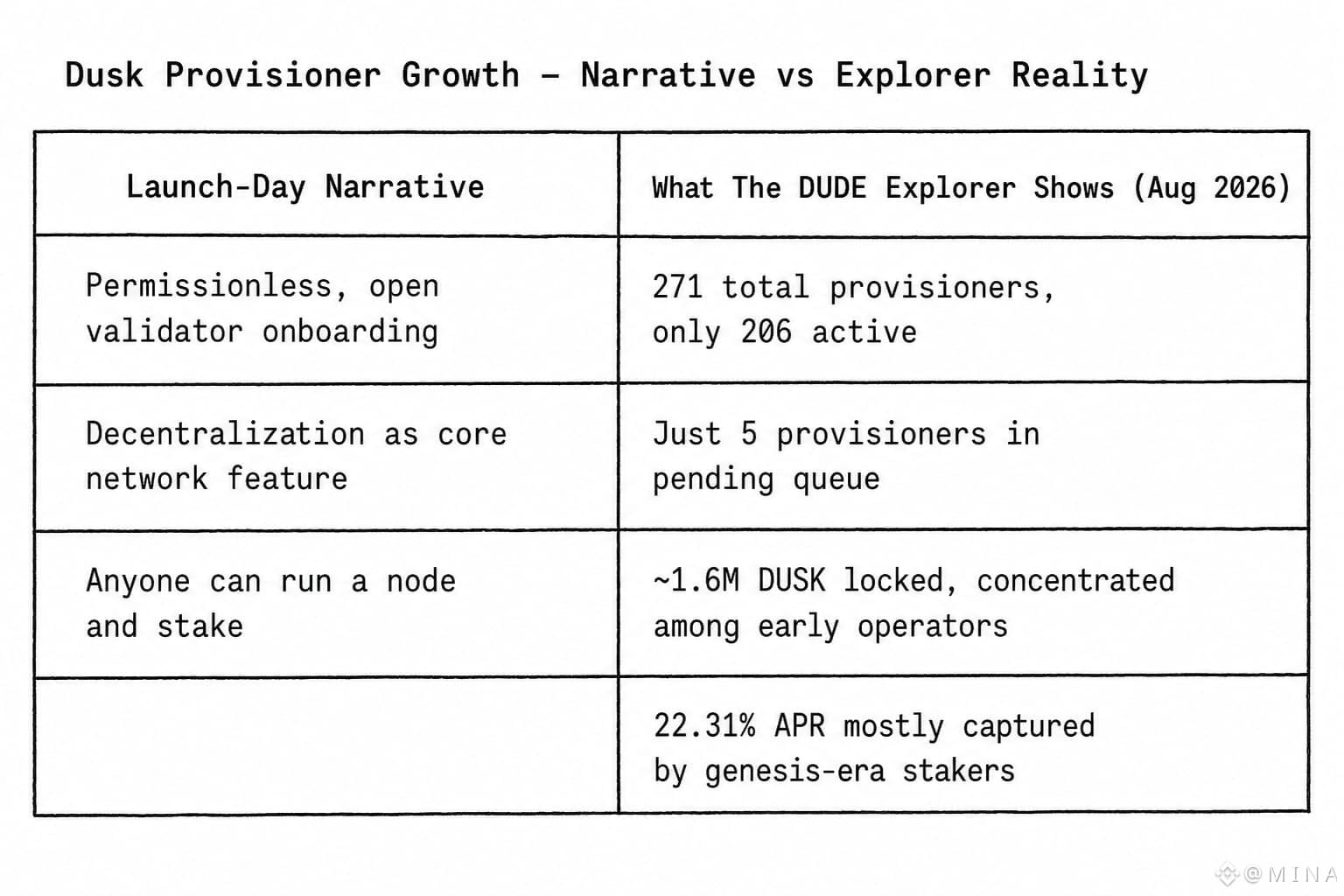
#dusk $DUSK @Dusk been staring at provisioner dusk list for the last hour instead of doing literally anything productive. wrapped a Dusk CreatorPad task and one number wouldn't leave my head: 206 active provisioners out of 271 total, per The DUDE explorer with only 5 sitting in the pending queue. Locked stake reads ~1.6M DUSK, staking APR at 22.31%.
Hold up that's... not much movement. Mainnet's been live since January. The launch-day pitch leaned hard on "permissionless validator onboarding," decentralization as a headline feature. Eight-plus months in, the line to join consensus is five nodes deep.
Here's the actual behavior I noticed: the early professional operators who staked at or near genesis are still the ones holding most of that locked stake, and by extension most of the yield. New entrants trickle in one at a time instead of in waves. Nothing scandalous PoS networks are basically always front loaded like this but the "anyone can run a node" framing reads different once you're watching the pending column sit at single digits for a full session.
Snack's gone, still chewing on it though. Is 271 provisioners "enough" decentralization for a chain built to carry regulated RWA settlement, or is that just a number nobody's supposed to stare at too closely yet…
$PROM $PORTAL
Hold up that's... not much movement. Mainnet's been live since January. The launch-day pitch leaned hard on "permissionless validator onboarding," decentralization as a headline feature. Eight-plus months in, the line to join consensus is five nodes deep.
Here's the actual behavior I noticed: the early professional operators who staked at or near genesis are still the ones holding most of that locked stake, and by extension most of the yield. New entrants trickle in one at a time instead of in waves. Nothing scandalous PoS networks are basically always front loaded like this but the "anyone can run a node" framing reads different once you're watching the pending column sit at single digits for a full session.
Snack's gone, still chewing on it though. Is 271 provisioners "enough" decentralization for a chain built to carry regulated RWA settlement, or is that just a number nobody's supposed to stare at too closely yet…
$PROM $PORTAL
#dusk $DUSK @Dusk DuskEVM testnet for a CreatorPad task, deploying a dummy Solidity contract with Hardhat. Everything felt familiar until I hit the mempool. the thing nobody puts in the deck DuskEVM runs sequencerbonly right now, no public mempool.
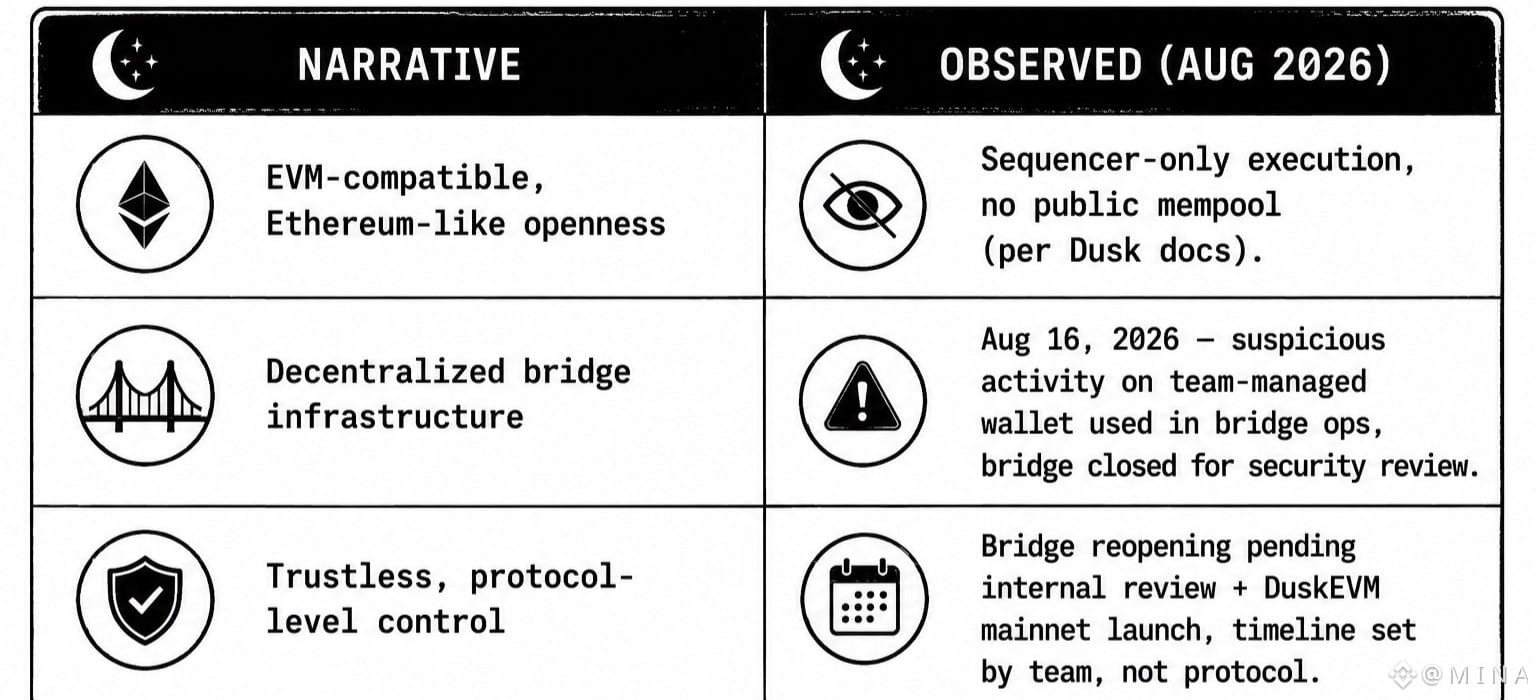
So all that EVM compatible, just like Ethereum framing… sure, the tooling is identical, but the actual transaction flow isn't decentralized the way people assume when they hear EVM. Someone's sequencer decides ordering.
That's not a knock, just not what the marketing copy implies and then there's the bridge. On Aug 16 the team flagged suspicious activity tied to a team managed wallet used in bridge ops and shut it down for a security review
still closed as of writing, pending the DuskEVM mainnet rollout. Again: team managed wallet doing bridge custody. Not a DAO multisig, not a decentralized relayer set. A wallet the team controls.
Neither of these is disqualifying at this stage testnets and pre mainnet bridges usually look like this everywhere.
But it's a pattern worth sitting with: the privacy/compliance narrative is the loud part, and the actual infrastructure underneath is still pretty centralized in the boring, operational places.
how much of that changes once DuskEVM mainnet actually ships, versus just moving the same trust assumptions one layer deeper.
$TUT $PORTAL
So all that EVM compatible, just like Ethereum framing… sure, the tooling is identical, but the actual transaction flow isn't decentralized the way people assume when they hear EVM. Someone's sequencer decides ordering.
That's not a knock, just not what the marketing copy implies and then there's the bridge. On Aug 16 the team flagged suspicious activity tied to a team managed wallet used in bridge ops and shut it down for a security review
still closed as of writing, pending the DuskEVM mainnet rollout. Again: team managed wallet doing bridge custody. Not a DAO multisig, not a decentralized relayer set. A wallet the team controls.
Neither of these is disqualifying at this stage testnets and pre mainnet bridges usually look like this everywhere.
But it's a pattern worth sitting with: the privacy/compliance narrative is the loud part, and the actual infrastructure underneath is still pretty centralized in the boring, operational places.
how much of that changes once DuskEVM mainnet actually ships, versus just moving the same trust assumptions one layer deeper.
$TUT $PORTAL
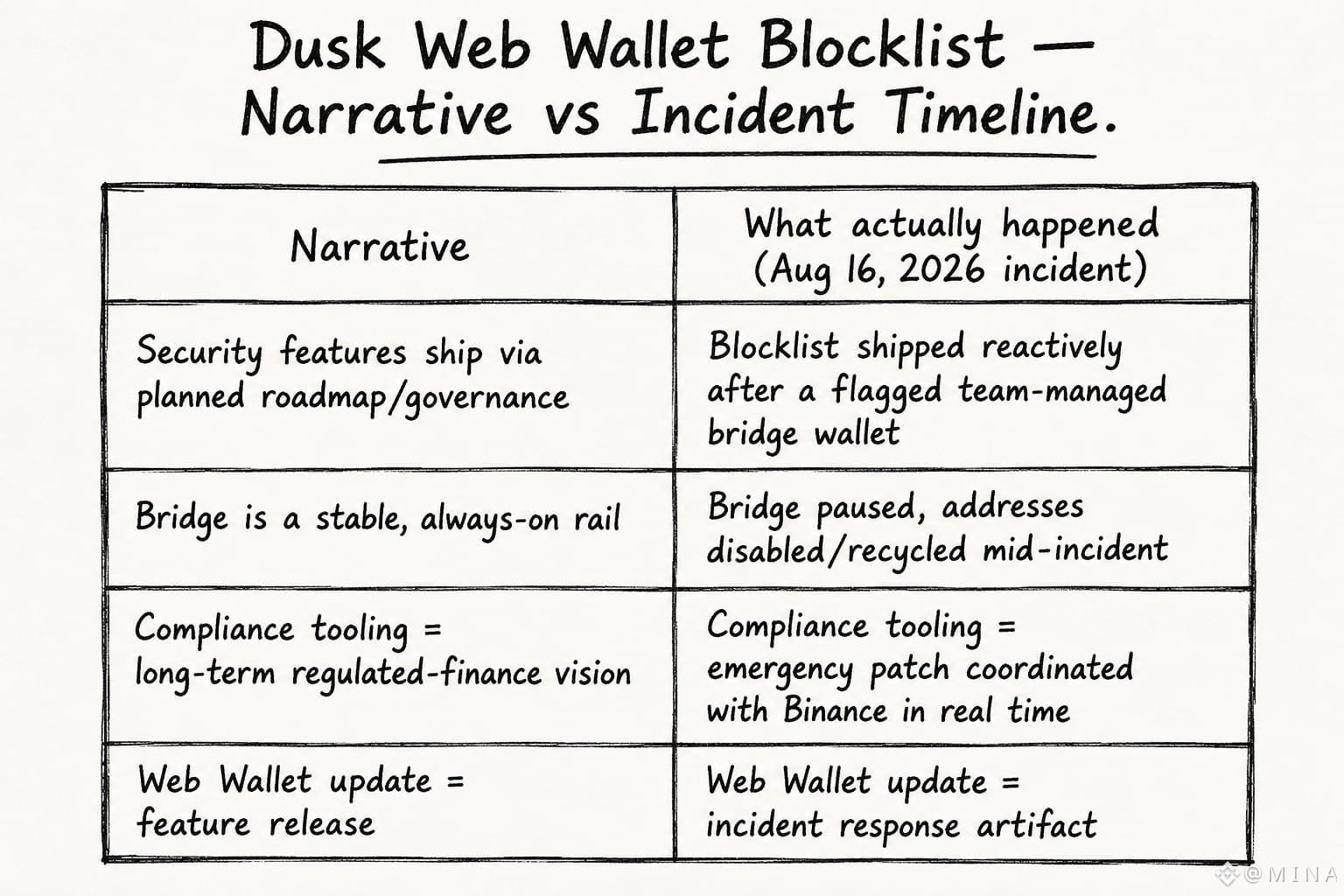
#dusk $DUSK @Dusk web wallet mitigation on Dusk shipped fast this week a recipient blocklist that stops transfers to flagged addresses before they even submit. Read the incident notice, then sat with it.
this wasn't a protocol upgrade or governance vote. It came out of a live incident: a team managed bridge wallet got flagged, addresses got recycled, bridge got paused, and within days the blocklist warning shipped to the web wallet. Hmm... that's the opposite of the usual "propose, discuss, deploy months later" cycle. Compliance by necessity, not compliance by roadmap. Makes you notice how much of regulated onchain finance messaging is actually reactive plumbing built under pressure, not some pre baked feature waiting for adoption.
I kept expecting to find a tidy governance trail behind it a forum post, a vote tally, something. Didn't find one. Just an ops team moving fast after Binance flagged part of the flow. That's not a knock, just it's different from the narrative of methodical, audited rollout you get from the docs.
Makes me wonder how many other features across this space are really just incident scars wearing a product-release costume.
this wasn't a protocol upgrade or governance vote. It came out of a live incident: a team managed bridge wallet got flagged, addresses got recycled, bridge got paused, and within days the blocklist warning shipped to the web wallet. Hmm... that's the opposite of the usual "propose, discuss, deploy months later" cycle. Compliance by necessity, not compliance by roadmap. Makes you notice how much of regulated onchain finance messaging is actually reactive plumbing built under pressure, not some pre baked feature waiting for adoption.
I kept expecting to find a tidy governance trail behind it a forum post, a vote tally, something. Didn't find one. Just an ops team moving fast after Binance flagged part of the flow. That's not a knock, just it's different from the narrative of methodical, audited rollout you get from the docs.
Makes me wonder how many other features across this space are really just incident scars wearing a product-release costume.
#termmax @TermMax pulled me in through the fixed supply angle 1B TMX no inflation switch to pull later. Neat on paper. Then I checked the actual numbers behind it and paused.
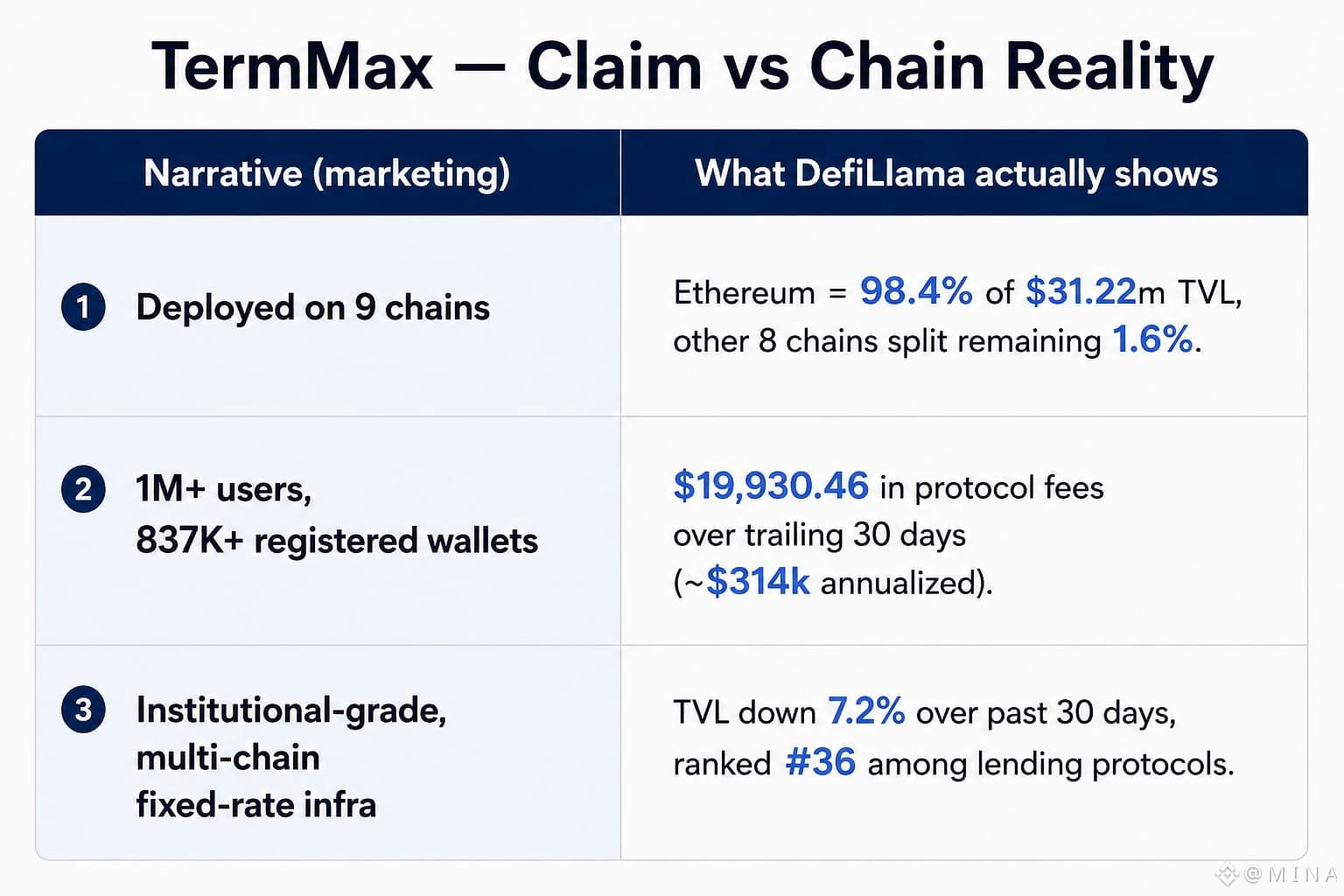
TVL sits at $31.22M right now, down 7.2% over the past 30 days per DefiLlama. Fees for that same stretch: $19,930.46.
Annualized that's roughly $314K against a fixed billion token supply. Hmm… that gap is the thing that stuck.
the pre mine program 4% of total supply, 40M $TMX closed out Aug 11. Early depositors already locked their allocation before the new XP system even launches Sept 12.
So the people who benefit first already benefited. Everyone staking or holding now is betting on fee growth catching up to a supply that's already fixed and already partly spoken for.
Not bearish, not bullish just noticed the sequencing. Rate certainty is the pitch. But certainty for who, exactly, and when in the timeline they showed up?
Makes me want to pull the fee chart against circulating supply next round and actually sit with it.
TVL sits at $31.22M right now, down 7.2% over the past 30 days per DefiLlama. Fees for that same stretch: $19,930.46.
Annualized that's roughly $314K against a fixed billion token supply. Hmm… that gap is the thing that stuck.
the pre mine program 4% of total supply, 40M $TMX closed out Aug 11. Early depositors already locked their allocation before the new XP system even launches Sept 12.
So the people who benefit first already benefited. Everyone staking or holding now is betting on fee growth catching up to a supply that's already fixed and already partly spoken for.
Not bearish, not bullish just noticed the sequencing. Rate certainty is the pitch. But certainty for who, exactly, and when in the timeline they showed up?
Makes me want to pull the fee chart against circulating supply next round and actually sit with it.
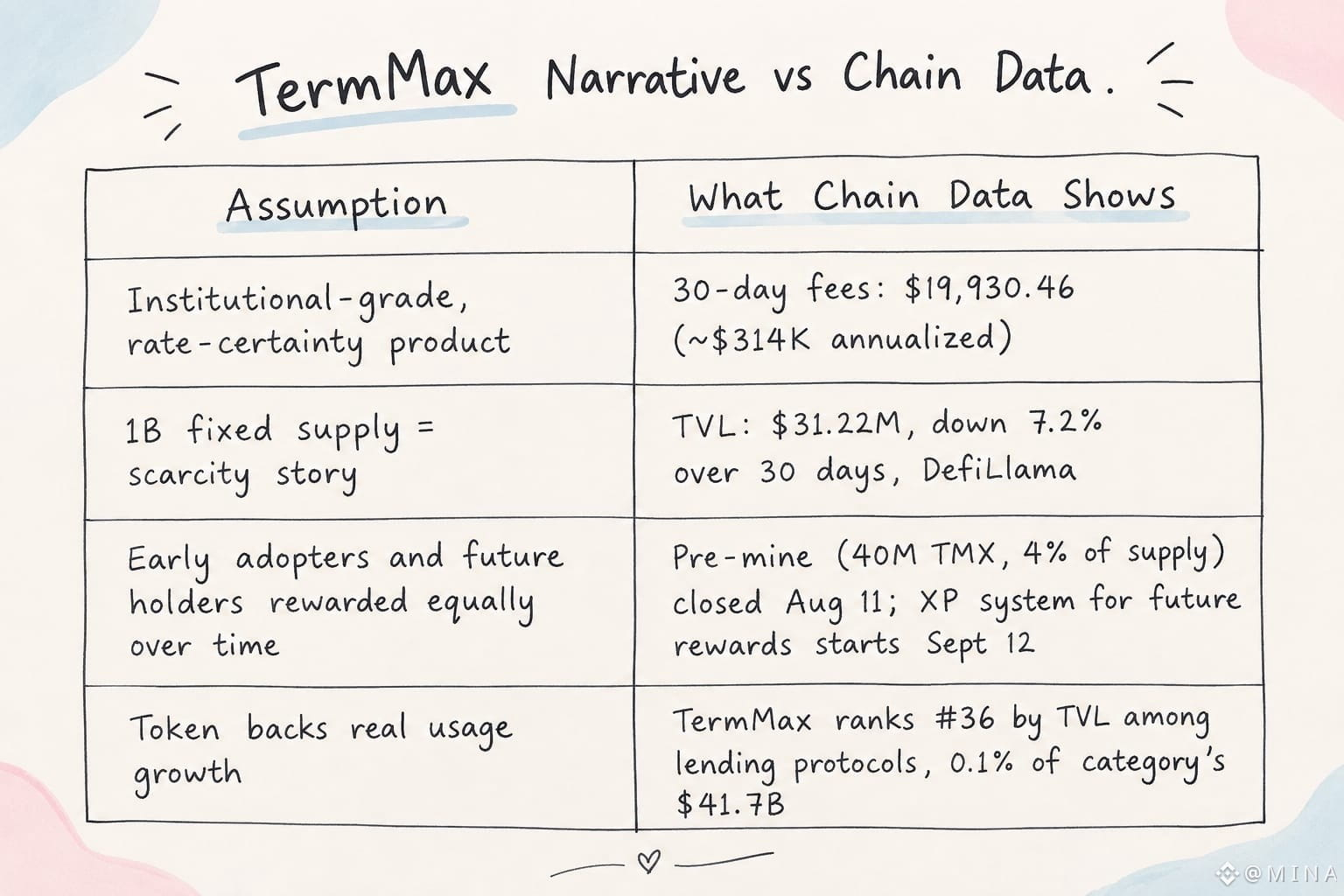
#dusk $DUSK @Dusk emission model the 36year geometric decay, halving every four years, block generator getting 70% + up to 10% bonus off certificate credits. Clean on paper.
But the thing that actually stuck with me happened outside the whitepaper.
On Aug 16, the Dusk team caught suspicious activity on a teamanaged bridge wallet. Within hours they disabled and recycled the affected bridge addresses, paused bridge services outright and pushed a Web Wallet recipient blocklist live.
They also looped in Binance once part of the flow touched their platform that's not slow-drip decentralized governance. That's a team with an admin key acting fast, on their own call, no vote, no delay.
Which is the actual insight, hmm. The emission schedule gets marketed as this long, trustless, algorithmically-decaying system running on autopilot for decades.
Meanwhile the parts that matter most in an emergency bridge control, address blocking, wallet recycling are still centralized levers the team holds and uses without hesitation. Not a criticism exactly. Just noticed the gap between decentralized by design and centralized when it counts.
$DUSK stakers earning off that 36year curve are trusting infrastructure that isn't nearly as handsoff as the tokenomics page suggests. Makes me wonder how much of any PoS project's decentralization os really just... untested until something breaks
But the thing that actually stuck with me happened outside the whitepaper.
On Aug 16, the Dusk team caught suspicious activity on a teamanaged bridge wallet. Within hours they disabled and recycled the affected bridge addresses, paused bridge services outright and pushed a Web Wallet recipient blocklist live.
They also looped in Binance once part of the flow touched their platform that's not slow-drip decentralized governance. That's a team with an admin key acting fast, on their own call, no vote, no delay.
Which is the actual insight, hmm. The emission schedule gets marketed as this long, trustless, algorithmically-decaying system running on autopilot for decades.
Meanwhile the parts that matter most in an emergency bridge control, address blocking, wallet recycling are still centralized levers the team holds and uses without hesitation. Not a criticism exactly. Just noticed the gap between decentralized by design and centralized when it counts.
$DUSK stakers earning off that 36year curve are trusting infrastructure that isn't nearly as handsoff as the tokenomics page suggests. Makes me wonder how much of any PoS project's decentralization os really just... untested until something breaks
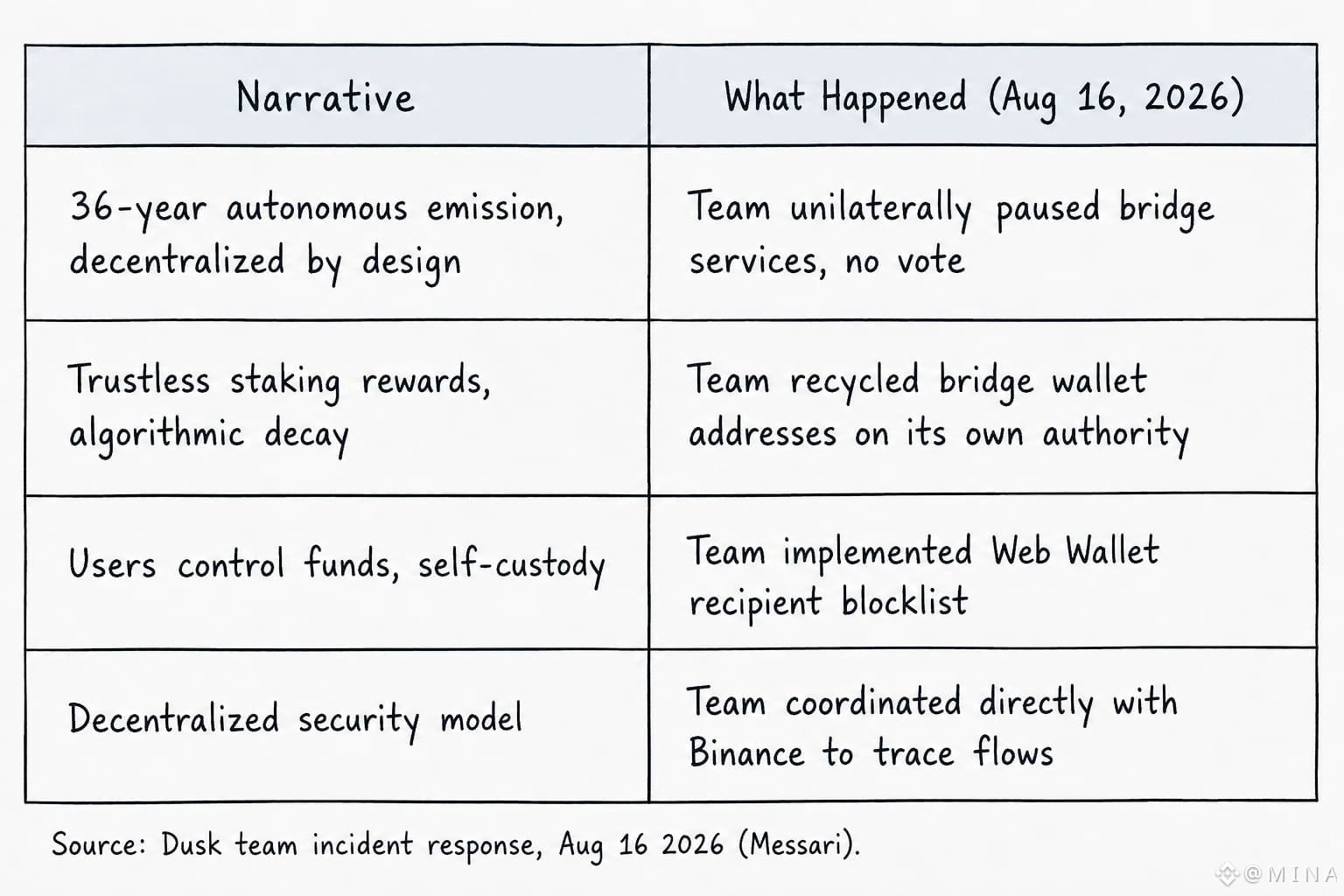
#dusk $DUSK @Dusk session digging through Dusk's own blog instead of the usual explorer scroll, and one line stopped me mid scroll. The Aug 15 piece on SME tokenization How Tokenization Opens Private Markets to SMEs, by Georgian Sgura says flat out tokenization cannot produce buyers, sellers or fair prices. Coming from the project's own writers, not a critic. That's the part that stuck. The whole sixstage ownership lifecycle they map structuring, onboarding, issuance, settlement, servicing, secondary trading reads like serious plumbing work. NPEX the Dutch MTF is named as the actual regulated venue doing the heavy lifting, while Dusk supplies the rails underneath. Meanwhile Dusk Trade, the retail facing app, is still... a waitlist.
So the sequencing is institutions first, provable compliance second, and retail access whenever the venue side is ready. Not hidden, actually stated pretty plainly in their own doc. Makes sense operationally you don't open a securities venue to randoms but it's a quiet contrast to how "access" usually gets pitched in these threads.
Grabbed my coffee halfway through rereading the before/after workflow table, went cold before I finished it, worth it though.
Who actually gets the first fill on Dusk Trade once it's live early NPEX linked investors, or the wider waitlist queue?
$HEMI $GRVT
So the sequencing is institutions first, provable compliance second, and retail access whenever the venue side is ready. Not hidden, actually stated pretty plainly in their own doc. Makes sense operationally you don't open a securities venue to randoms but it's a quiet contrast to how "access" usually gets pitched in these threads.
Grabbed my coffee halfway through rereading the before/after workflow table, went cold before I finished it, worth it though.
Who actually gets the first fill on Dusk Trade once it's live early NPEX linked investors, or the wider waitlist queue?
$HEMI $GRVT
#termmax @TermMax task today had me digging through DefiLlama numbers instead of the usual marketing page, and huh that's where the real story was.
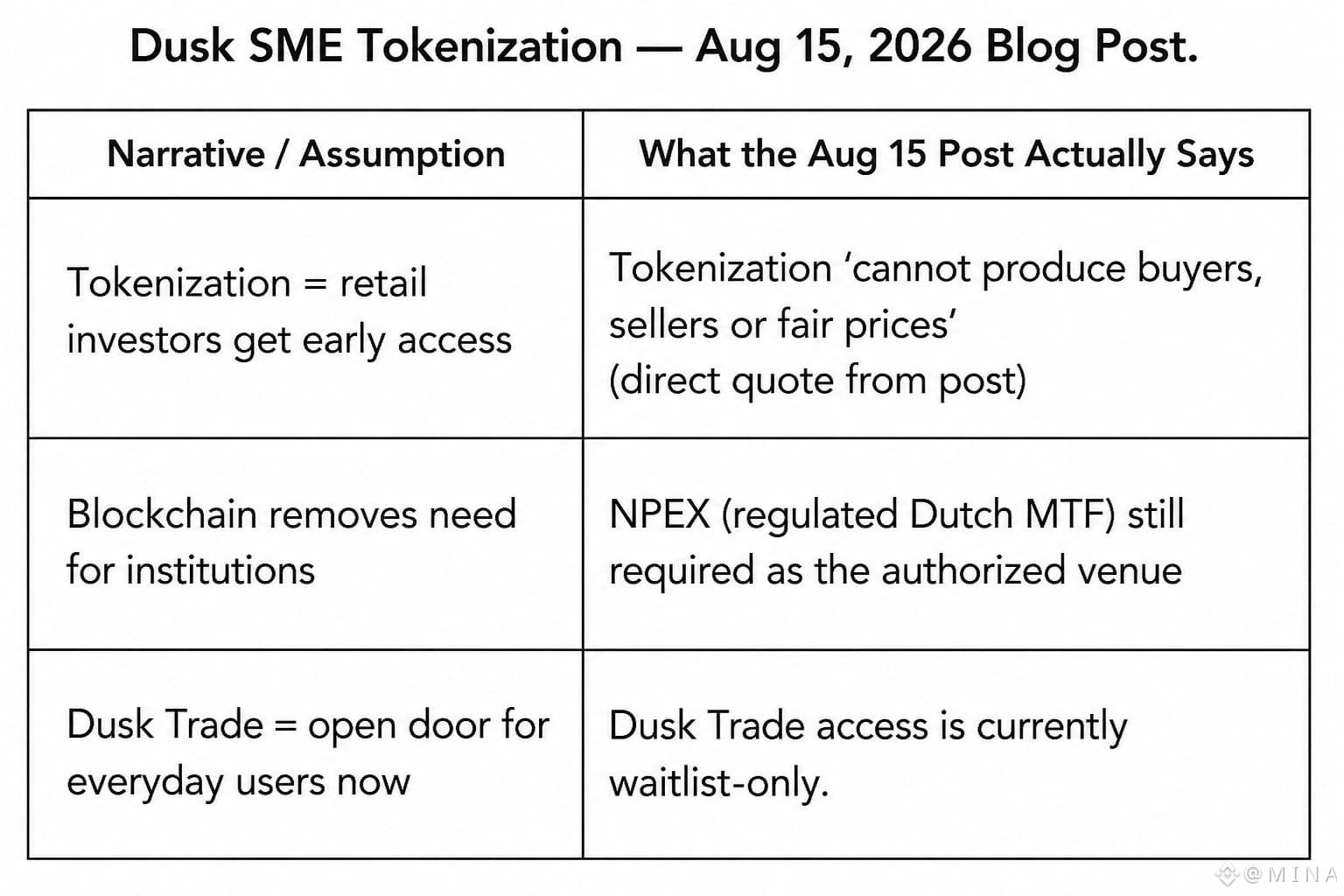
Termmax pitches itself as live across nine chains. Berachain, Arbitrum, BSquared, Robinhood Chain, the whole spread. Sounds properly multi-chain. But pull the actual TVL split and Ethereum is sitting at 98.4% of the $31.22m total. Everything else is basically a rounding error. So "nine chains" reads more like nine deployments than nine markets people actually use.
Fees told the same story, smaller scale. $19,930 generated over the past 30 days, annualizing to roughly $314k. For a protocol whose whitepaper leads with 1M+ users and 837K registered wallets, that's… a pretty thin trickle of real revenue underneath all that surface area. TVL's also down 7.2% over the month, which nobody's shouting about obviously.
Grabbed my coffee halfway through pulling these numbers and just sat there a second — not because it's bad, fixed-rate lending is a real niche worth building — but because the gap between "deployed everywhere" and "actually used somewhere" is wider than I expected going in. Multi-chain as a checklist item vs multi-chain as genuine liquidity, those aren't the same claim at all.
Makes me wonder how much of the eventual $TMX token demand ends up chasing that Ethereum concentration anyway, once it's tradable. Curious if the other eight chains ever catch up or just stay there for the pitch deck.
$ONG $ONT
Termmax pitches itself as live across nine chains. Berachain, Arbitrum, BSquared, Robinhood Chain, the whole spread. Sounds properly multi-chain. But pull the actual TVL split and Ethereum is sitting at 98.4% of the $31.22m total. Everything else is basically a rounding error. So "nine chains" reads more like nine deployments than nine markets people actually use.
Fees told the same story, smaller scale. $19,930 generated over the past 30 days, annualizing to roughly $314k. For a protocol whose whitepaper leads with 1M+ users and 837K registered wallets, that's… a pretty thin trickle of real revenue underneath all that surface area. TVL's also down 7.2% over the month, which nobody's shouting about obviously.
Grabbed my coffee halfway through pulling these numbers and just sat there a second — not because it's bad, fixed-rate lending is a real niche worth building — but because the gap between "deployed everywhere" and "actually used somewhere" is wider than I expected going in. Multi-chain as a checklist item vs multi-chain as genuine liquidity, those aren't the same claim at all.
Makes me wonder how much of the eventual $TMX token demand ends up chasing that Ethereum concentration anyway, once it's tradable. Curious if the other eight chains ever catch up or just stay there for the pitch deck.
$ONG $ONT
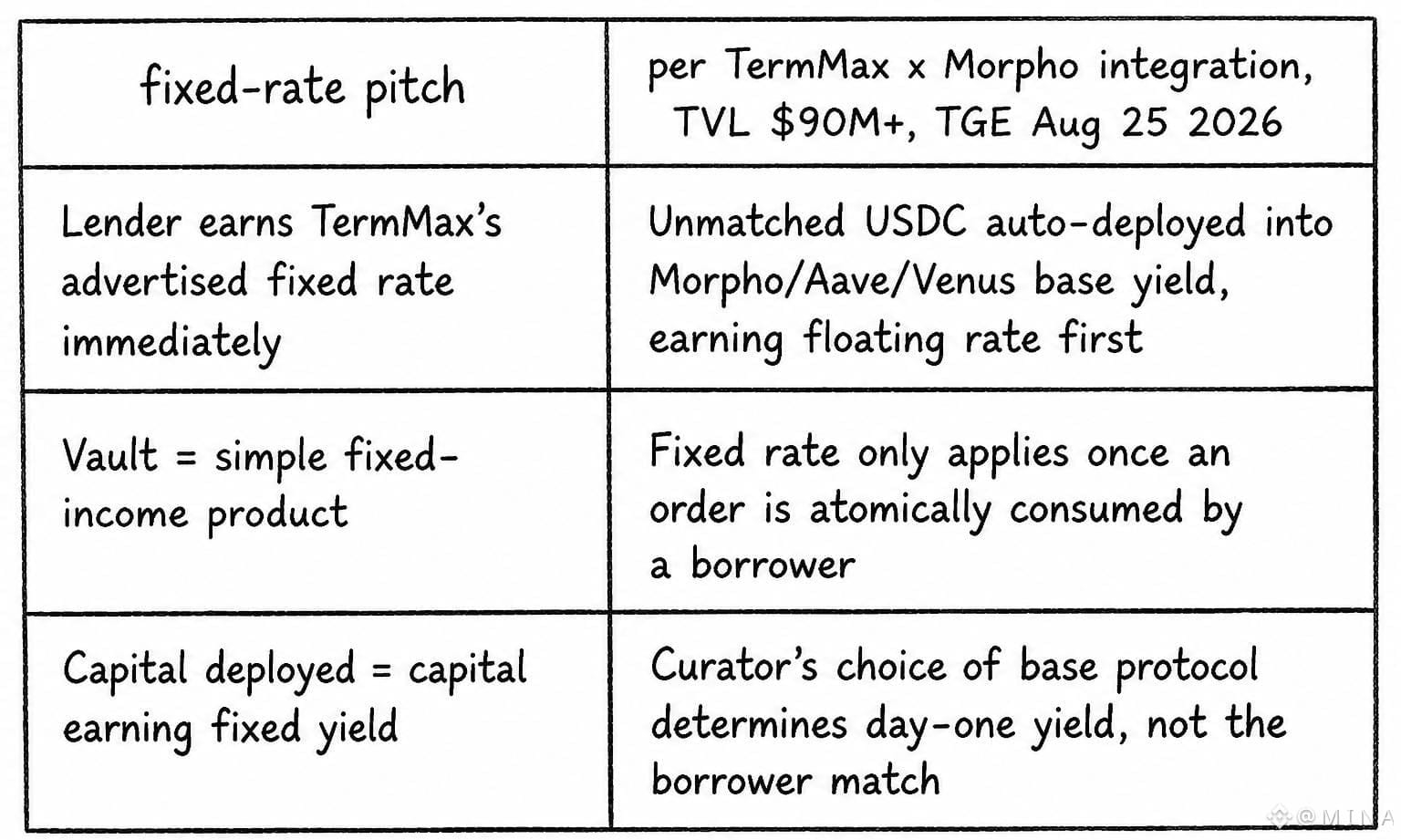
#termmax @TermMax TGE just got locked in for August 25 and right before that, the numbers quietly crossed something worth sitting with: $90M+ TVL, 1.5M registered wallets, 90K daily actives, spread across 10 EVM chains, with Morpho, Aave, Venus and Pendle all sitting underneath as base yield sources. the bit that stuck with me during the task, though not the TVL headline, the plumbing. When a curator spins up a TermMax vault, any USDC sitting unmatched doesn't just... wait. It gets auto-routed into whatever base protocol the curator picked (Morpho vault, Aave pool, Venus market) and pulled back atomically the second a borrower actually consumes the order. So depositors are earning floating yield before they're ever fixed rate matched.that's not what the pitch decks usually lead with.
Which flips the who benefits first question a little. The curator picking the yield source, and the underlying protocol absorbing idle flow, capture value immediately and automatically. The retail lender gets told about the fixed rate upfront, but in practice they're floating until matched the fixed part is the promise, the floating part is the reality of day one.
Not sure yet if that's a feature or just an honest description of how liquidity actually behaves anywhere. Still chewing on it.
What happens to that idle capital routing once TMX liquidity mining incentives taper off post-TGE?
$NVDAB $HEMI
Which flips the who benefits first question a little. The curator picking the yield source, and the underlying protocol absorbing idle flow, capture value immediately and automatically. The retail lender gets told about the fixed rate upfront, but in practice they're floating until matched the fixed part is the promise, the floating part is the reality of day one.
Not sure yet if that's a feature or just an honest description of how liquidity actually behaves anywhere. Still chewing on it.
What happens to that idle capital routing once TMX liquidity mining incentives taper off post-TGE?
$NVDAB $HEMI
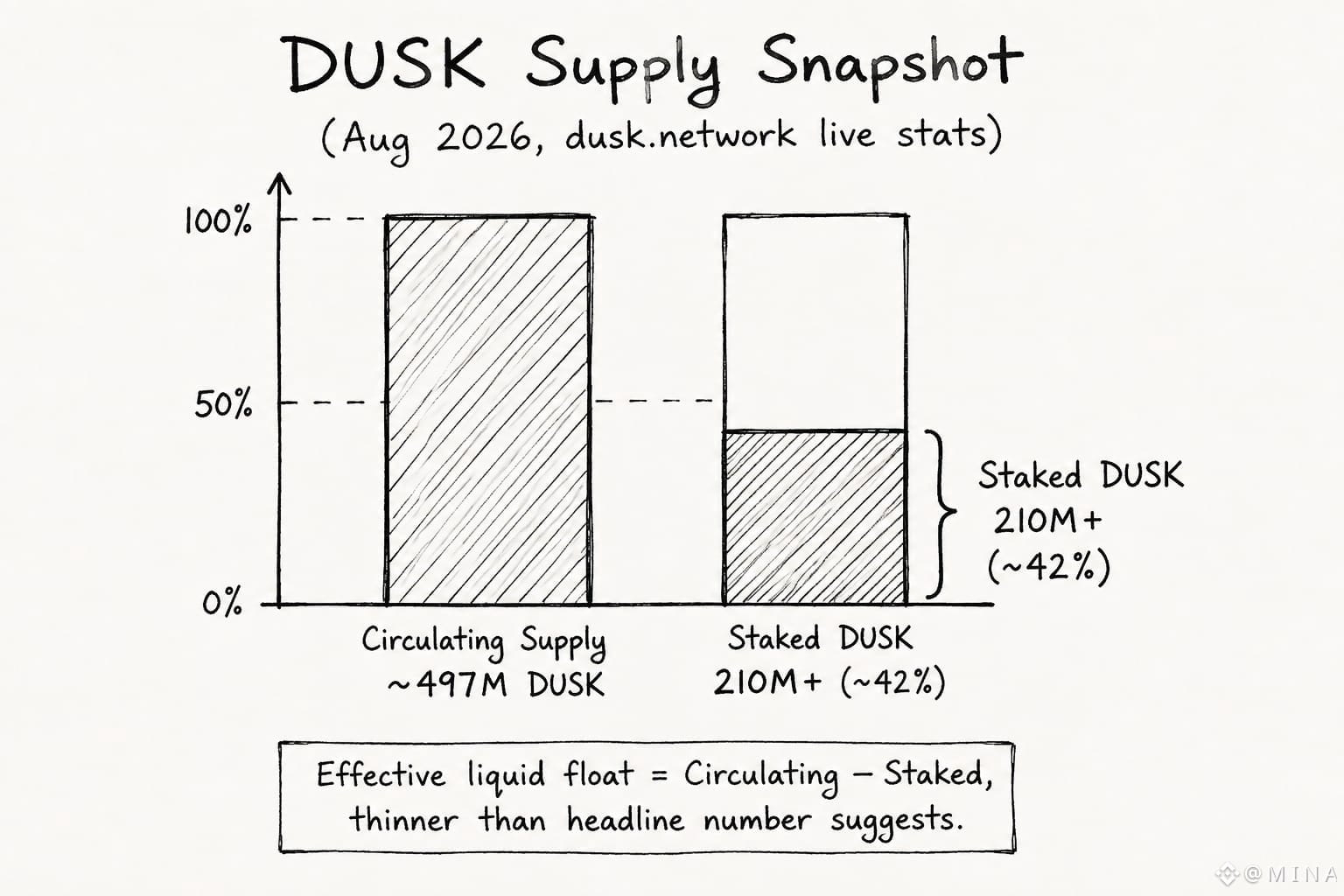
#dusk $DUSK @Dusk Wrapped up the Dusk task, grabbed a snack, came back and something didn't sit right so I dug more. Dusk checked the live stats panel on dusk.network and it's showing 210M+ DUSK staked right now, against a circulating supply sitting around 497M. That's roughly 42% of everything in circulation parked in consensus, not floating around exchanges.
Hmm... the pitch is always the 36-year emission schedule, halving every four years, sounds like slow controlled dilution, nothing to stress over.
But that's the narrative layer. In practice what actually moves price is how much of the existing float is liquid versus locked earning yield. With over 40% staked, the real sell-side supply is way thinner than the headline circulating number makes it look.
Small side note same page flagged a piece from Aug 15 on SME tokenization through NPEX, different topic, but it reminded me the same logic applies to their RWA issuance. Broad access gets promised, early liquidity concentrates with whoever's already positioned and staked in.
Not sure that 42% ratio holds once emissions season kicks in and reward payouts hit wallets that just sell instead of restake. Watching that number more than the price chart honestly.
Hmm... the pitch is always the 36-year emission schedule, halving every four years, sounds like slow controlled dilution, nothing to stress over.
But that's the narrative layer. In practice what actually moves price is how much of the existing float is liquid versus locked earning yield. With over 40% staked, the real sell-side supply is way thinner than the headline circulating number makes it look.
Small side note same page flagged a piece from Aug 15 on SME tokenization through NPEX, different topic, but it reminded me the same logic applies to their RWA issuance. Broad access gets promised, early liquidity concentrates with whoever's already positioned and staked in.
Not sure that 42% ratio holds once emissions season kicks in and reward payouts hit wallets that just sell instead of restake. Watching that number more than the price chart honestly.
#dusk $DUSK @Dusk how selective disclosure works on Dusk qalked through one transfer....
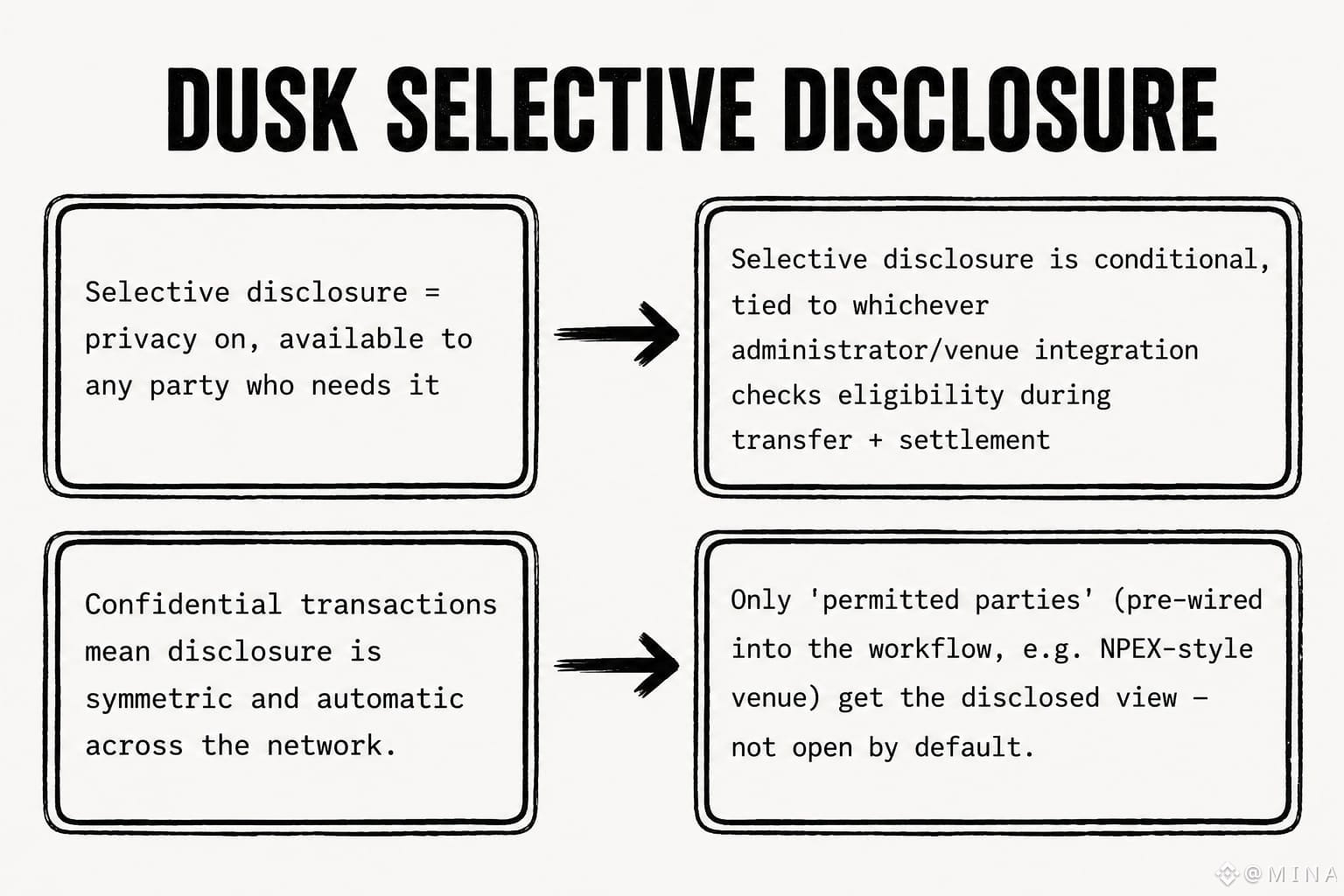
was digging through the CreatorPad task and landed on Dusk's Aug 15 piece on SME tokenization buried in the transfer and settlement row of their lifecycle table is this line about eligibility checks running with selective disclosure where supported. Read past it twice before it actually clicked. the thing that stayed with me: selective disclosure isn't a toggle you flip on a transfer.
it's conditional on the counterparty stack. The doc ties it to Dusk's confidential transaction layer Phoenix notes vs Moonlight accounts, but in the SME/NPEX flow it only activates when an administrator or venue is already wired to check eligibility against the ownership record.
So the private by default pitch is true at the protocol level… but at the application level, disclosure only fires where someone built the plumbing for it.
Made me pause on my own assumption I'd been picturing selective disclosure as symmetric, available to any counterparty on any transfer. It's not. It's a permissioned view, granted per integration.
Grabbed a snack mid thought and now I'm just sitting with: who's actually deciding, transfer by transfer, what "permitted party" means in practice?
was digging through the CreatorPad task and landed on Dusk's Aug 15 piece on SME tokenization buried in the transfer and settlement row of their lifecycle table is this line about eligibility checks running with selective disclosure where supported. Read past it twice before it actually clicked. the thing that stayed with me: selective disclosure isn't a toggle you flip on a transfer.
it's conditional on the counterparty stack. The doc ties it to Dusk's confidential transaction layer Phoenix notes vs Moonlight accounts, but in the SME/NPEX flow it only activates when an administrator or venue is already wired to check eligibility against the ownership record.
So the private by default pitch is true at the protocol level… but at the application level, disclosure only fires where someone built the plumbing for it.
Made me pause on my own assumption I'd been picturing selective disclosure as symmetric, available to any counterparty on any transfer. It's not. It's a permissioned view, granted per integration.
Grabbed a snack mid thought and now I'm just sitting with: who's actually deciding, transfer by transfer, what "permitted party" means in practice?
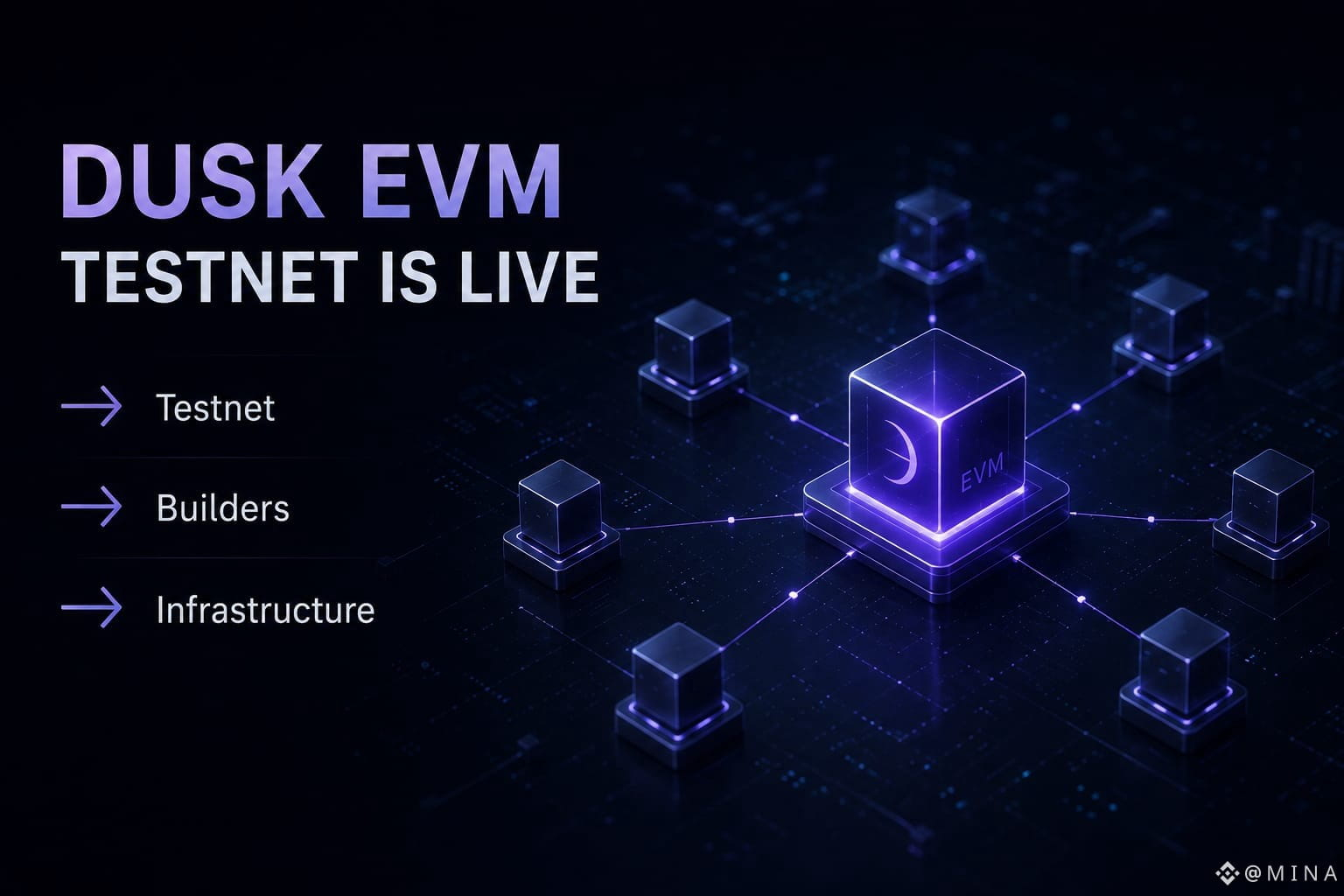
#dusk $DUSK @Dusk DuskEVM testnet went live on August 13, four days back announced by @Dusk and picked up by a community tracker account on X. That's the concrete thing here: a testnet deployment, not a mainnet one.
The framing around it leaned hard into future tense could unlock a new wave of DeFi, tokenized assets and on chain finance.
What's actually live is Solidity compatible tooling on a test network. Real progress, but it's infrastructure for builders right now, not anything an end user touches.
That gap tracks with how Dusk tends to operate generally. NPEX, the regulated Dutch trading venue, has had tokenized securities infrastructure running on Dusk for a while institutional access showed up before any retail facing EVM dApp did.
The privacy for everyone pitch and the institutions plug in first reality aren't really contradictory, they're just two products on different timelines, and the marketing tends to blur that.
Hold up & what I don't have here is testnet transaction counts, or whether developers are actually deploying contracts on it yet versus the launch tweet doing all the work by itself. That's the part worth watching before drawing conclusions.
Does builder activity show up on DuskEVM before mainnet, or does it stay quiet until an institutional partner needs it?
$PORTAL $BICO
The framing around it leaned hard into future tense could unlock a new wave of DeFi, tokenized assets and on chain finance.
What's actually live is Solidity compatible tooling on a test network. Real progress, but it's infrastructure for builders right now, not anything an end user touches.
That gap tracks with how Dusk tends to operate generally. NPEX, the regulated Dutch trading venue, has had tokenized securities infrastructure running on Dusk for a while institutional access showed up before any retail facing EVM dApp did.
The privacy for everyone pitch and the institutions plug in first reality aren't really contradictory, they're just two products on different timelines, and the marketing tends to blur that.
Hold up & what I don't have here is testnet transaction counts, or whether developers are actually deploying contracts on it yet versus the launch tweet doing all the work by itself. That's the part worth watching before drawing conclusions.
Does builder activity show up on DuskEVM before mainnet, or does it stay quiet until an institutional partner needs it?
$PORTAL $BICO
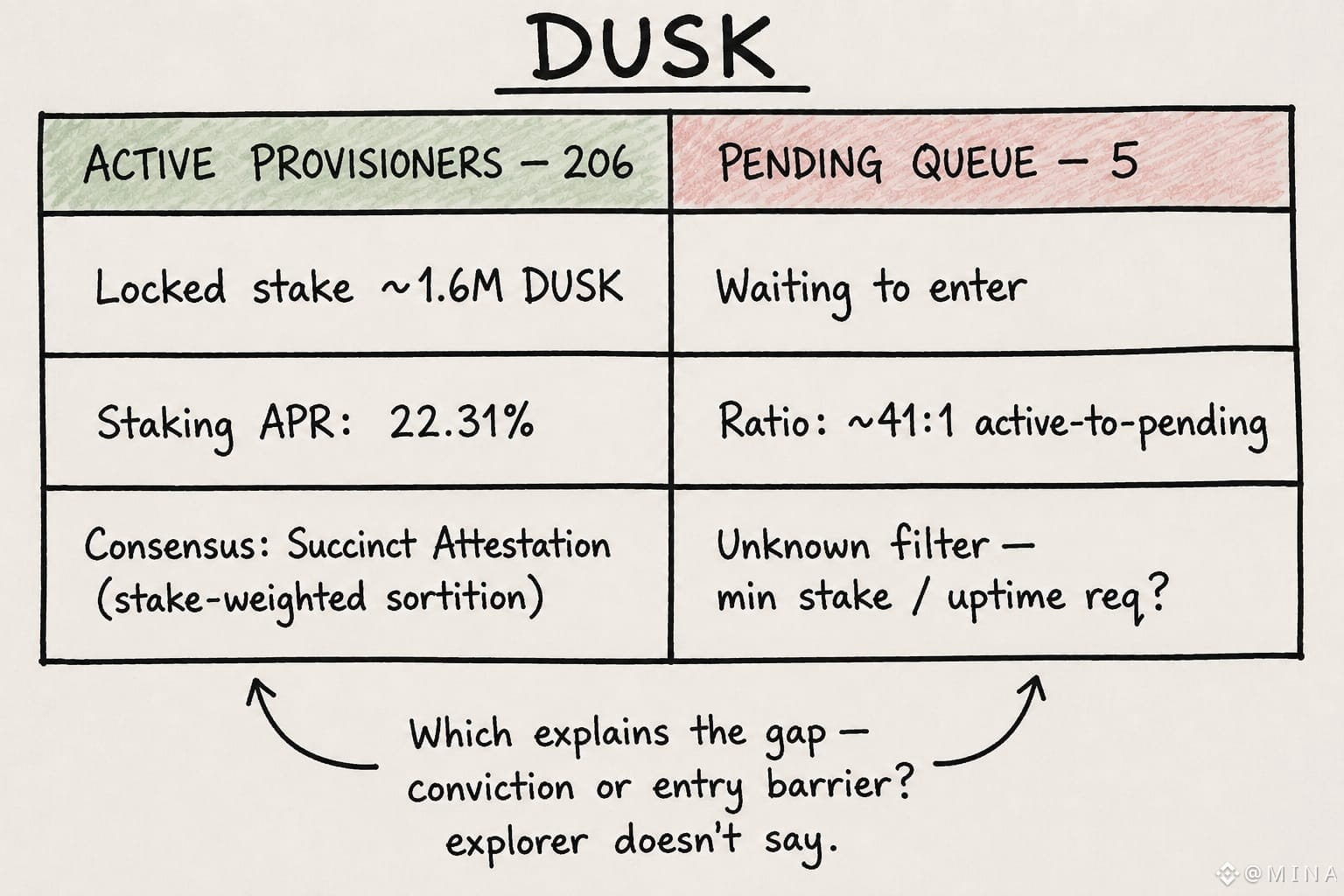
#dusk $DUSK @Dusk 206 active provisioners, 5 pending. That ratio is what actually stopped me scrolling through the Dusk explorer this week not the APR, not the price chart.
On most PoS chains I've checked, pending queues run fatter relative to the active set, a sign people are waiting on epoch timing or hedging entry. the queue's nearly empty.
Dusk runs on Succinct Attestation, stake weighted sortition picking small voting committees per block instead of one long validator race. DuskNetwork design is supposed to reward committed capital over opportunistic staking, and the provisioner numbers this week back that up more than any Dusk post would.
Locked stake sits around 1.6M DUSK, staking APR reading 22.31% at time of check high enough that I'd have expected a bigger pending line waiting to jump in.
here's where I paused, tbh, a thin pending queue could mean conviction. It could also mean the bar to enter minimum stake, node uptime requirements is quietly filtering people out before they even queue up.
Those two explanations look identical from the outside. The explorer doesn't tell you which one it is; you'd need to track rejected or failed provisioner registrations across a few epochs to know for sure, and I haven't found that data surfaced anywhere yet.
So, anyone running a provisioner node right now, was getting in easy, or did the setup filter you out before staking even mattered?
$HEMI $PIXEL
On most PoS chains I've checked, pending queues run fatter relative to the active set, a sign people are waiting on epoch timing or hedging entry. the queue's nearly empty.
Dusk runs on Succinct Attestation, stake weighted sortition picking small voting committees per block instead of one long validator race. DuskNetwork design is supposed to reward committed capital over opportunistic staking, and the provisioner numbers this week back that up more than any Dusk post would.
Locked stake sits around 1.6M DUSK, staking APR reading 22.31% at time of check high enough that I'd have expected a bigger pending line waiting to jump in.
here's where I paused, tbh, a thin pending queue could mean conviction. It could also mean the bar to enter minimum stake, node uptime requirements is quietly filtering people out before they even queue up.
Those two explanations look identical from the outside. The explorer doesn't tell you which one it is; you'd need to track rejected or failed provisioner registrations across a few epochs to know for sure, and I haven't found that data surfaced anywhere yet.
So, anyone running a provisioner node right now, was getting in easy, or did the setup filter you out before staking even mattered?
$HEMI $PIXEL
#dusk $DUSK @Dusk been staring at the Dusk explorer for way too long today, task deadline looming, and one number kept nagging at me...
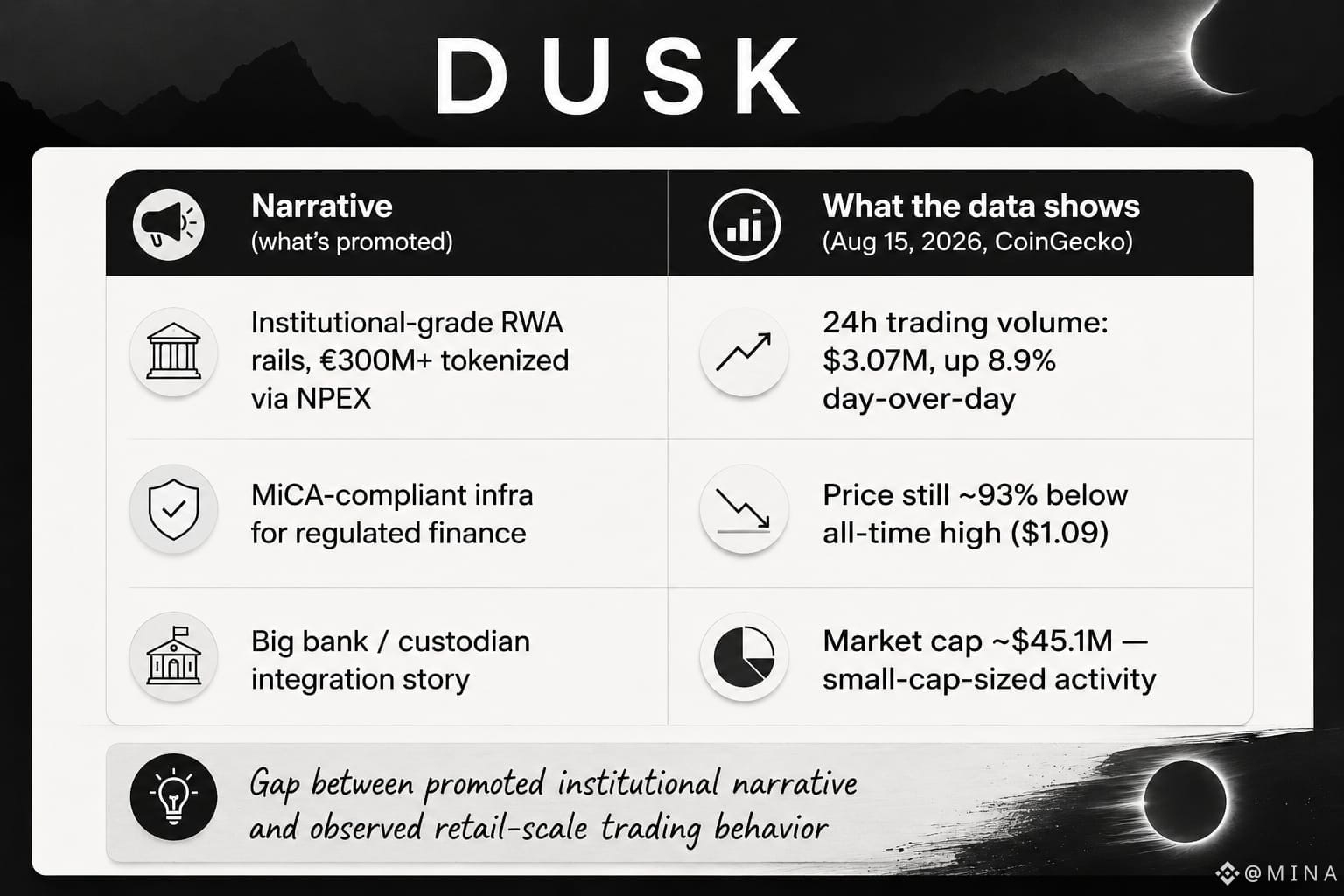
DUSK 24h volume just ticked up to about $3.07M, +8.9% day over day per CoinGecko, while price is still sitting roughly 93% below its all time high. Small bump, sure.
But it's happening quietly under a mountain of NPEX tokenization headlines and MiCA compliance talk the institutional rails are here narrative running full blast while actual trading activity looks... modest.
Like watching a highway billboard for a store that's got three cars in the parking lot.
That's the thing that stuck with me from this #dusk task the gap between what's marketed regulated finance, €300M+ tokenized, big bank energy and what's actually moving on chain right now, which is mostly retail sized volume nudges.
Doesn't mean the infra story is fake. Just means the who benefits first question has a boring answer: right now it's mostly traders reacting to headlines, not institutions actually settling size.
Grabbed my snack, kept scrolling the chart, and honestly is that gap normal for infra stage projects, or a sign the institutional side is still mostly promised rather than live?
$WAL $MOVR
DUSK 24h volume just ticked up to about $3.07M, +8.9% day over day per CoinGecko, while price is still sitting roughly 93% below its all time high. Small bump, sure.
But it's happening quietly under a mountain of NPEX tokenization headlines and MiCA compliance talk the institutional rails are here narrative running full blast while actual trading activity looks... modest.
Like watching a highway billboard for a store that's got three cars in the parking lot.
That's the thing that stuck with me from this #dusk task the gap between what's marketed regulated finance, €300M+ tokenized, big bank energy and what's actually moving on chain right now, which is mostly retail sized volume nudges.
Doesn't mean the infra story is fake. Just means the who benefits first question has a boring answer: right now it's mostly traders reacting to headlines, not institutions actually settling size.
Grabbed my snack, kept scrolling the chart, and honestly is that gap normal for infra stage projects, or a sign the institutional side is still mostly promised rather than live?
$WAL $MOVR
#dusk $DUSK spent the task poking around the chain instead of reading about it.
First thing that threw me, the explorer people are actually linking isn't even the official one.
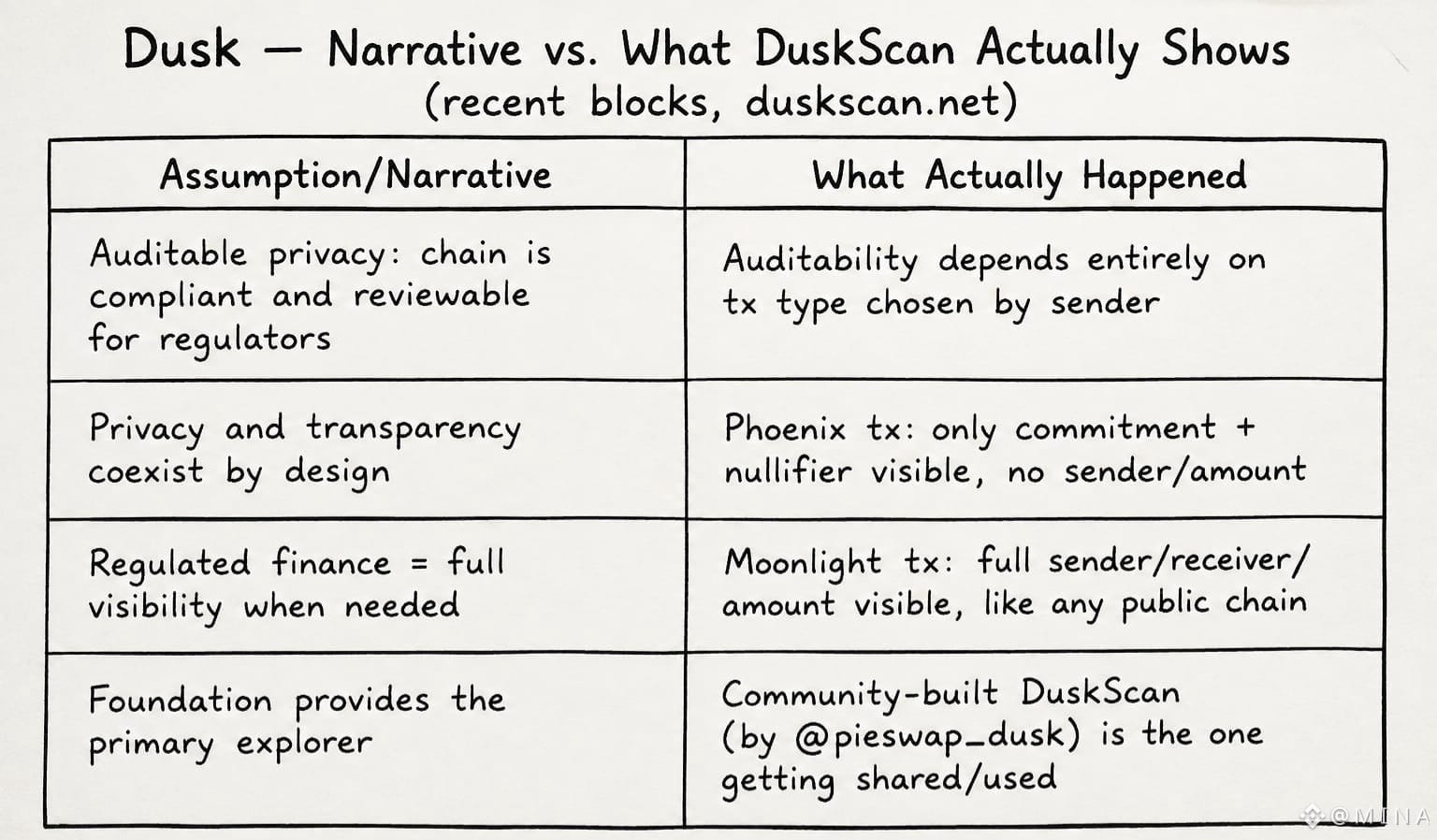
@Dusk just shared DuskScan, an independent explorer built by pieswapdusk, live for maybe a week now. Not the foundation shipping the tooling a community dev filling a gap nobody else got to yet.
So I pulled up a handful of recent blocks through it. Here's the thing that stuck click into a Phoenix transaction and you get a commitment and a nullifier, nothing else. No sender, no amount, nothing.
Click a Moonlight tx and it's all there, plain as any public chain. Same explorer, same network, wildly different amount of "auditability" depending on which mode the sender picked.
Kind of undercuts the pitch a little. The marketing leans hard on compliant, auditable privacy for regulated finance but on chain, auditability isn't a network property, it's a choice each user makes at send time.
Nobody's forced into visibility. Which… is maybe fine, probably even the point. But it's a different thing than what "auditable" sounds like when you first read the deck.
Makes me wonder how many institutional users end up defaulting to Moonlight just because it's simpler to integrate, and whether the private mode ends up mostly retail.
First thing that threw me, the explorer people are actually linking isn't even the official one.
@Dusk just shared DuskScan, an independent explorer built by pieswapdusk, live for maybe a week now. Not the foundation shipping the tooling a community dev filling a gap nobody else got to yet.
So I pulled up a handful of recent blocks through it. Here's the thing that stuck click into a Phoenix transaction and you get a commitment and a nullifier, nothing else. No sender, no amount, nothing.
Click a Moonlight tx and it's all there, plain as any public chain. Same explorer, same network, wildly different amount of "auditability" depending on which mode the sender picked.
Kind of undercuts the pitch a little. The marketing leans hard on compliant, auditable privacy for regulated finance but on chain, auditability isn't a network property, it's a choice each user makes at send time.
Nobody's forced into visibility. Which… is maybe fine, probably even the point. But it's a different thing than what "auditable" sounds like when you first read the deck.
Makes me wonder how many institutional users end up defaulting to Moonlight just because it's simpler to integrate, and whether the private mode ends up mostly retail.
Babylon docs and couldn't stop thinking about it, l the confirmation depth requirement before a BTC staking tx even counts. Not glamorous. But it's the whole trust model in one parameter.
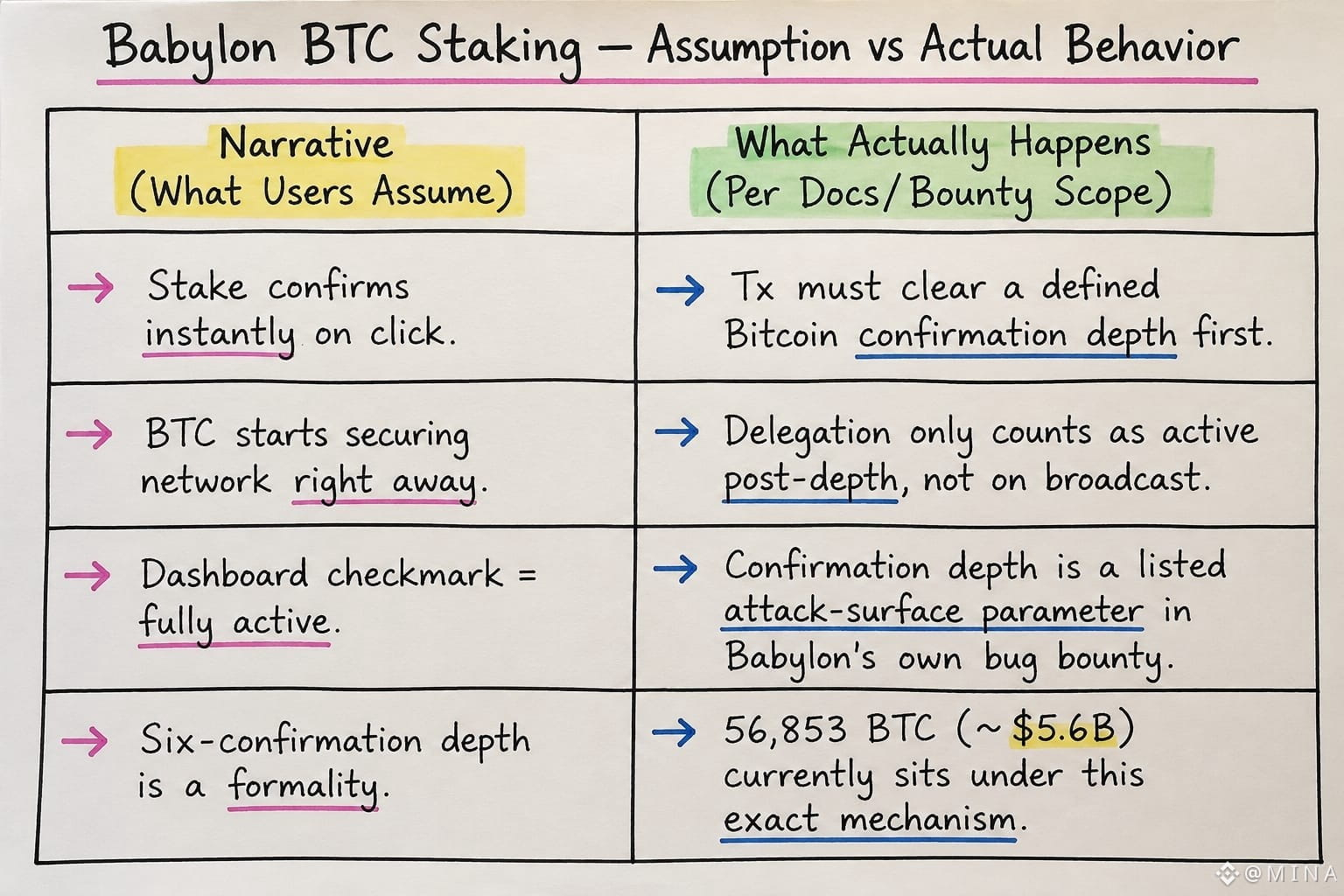
@BabylonLabs_io market the no bridge, no wrap pitch hard, and fair, that part's true. But the six confirmation style depth requirement Bitcoin's classic reorg safety threshold, baked directly into staking tx activation means your delegation isn't live the second it hits mempool , it's live once it's buried deep enough that a malicious reorg can't unwind it.
Babylon's own Immunefi bounty scope literally flags confirmation depth set to an improperly low value as a severity category. That's not marketing copy, that's an admitted attack surface.
With ~56,853 BTC sitting in staking vaults right now ~$5.6B, that confirmation window is quietly doing more security work than any finality provider slashing rule. Default behavior click stake, feel done vs advanced reality your BTC is in limbo for a defined block depth before it's actually contributing security or earning anything real.
Grabbed my coffee mid task and just… sat with that gap for a minute. Kept expecting some flashy mechanism to be the aha, and instead it was a boring depth counter nobody screenshots.
Makes me wonder how many stakers ever check whether their tx actually cleared that depth, or just assume the dashboard checkmark means done.
$BABY #baby
@BabylonLabs_io market the no bridge, no wrap pitch hard, and fair, that part's true. But the six confirmation style depth requirement Bitcoin's classic reorg safety threshold, baked directly into staking tx activation means your delegation isn't live the second it hits mempool , it's live once it's buried deep enough that a malicious reorg can't unwind it.
Babylon's own Immunefi bounty scope literally flags confirmation depth set to an improperly low value as a severity category. That's not marketing copy, that's an admitted attack surface.
With ~56,853 BTC sitting in staking vaults right now ~$5.6B, that confirmation window is quietly doing more security work than any finality provider slashing rule. Default behavior click stake, feel done vs advanced reality your BTC is in limbo for a defined block depth before it's actually contributing security or earning anything real.
Grabbed my coffee mid task and just… sat with that gap for a minute. Kept expecting some flashy mechanism to be the aha, and instead it was a boring depth counter nobody screenshots.
Makes me wonder how many stakers ever check whether their tx actually cleared that depth, or just assume the dashboard checkmark means done.
$BABY #baby
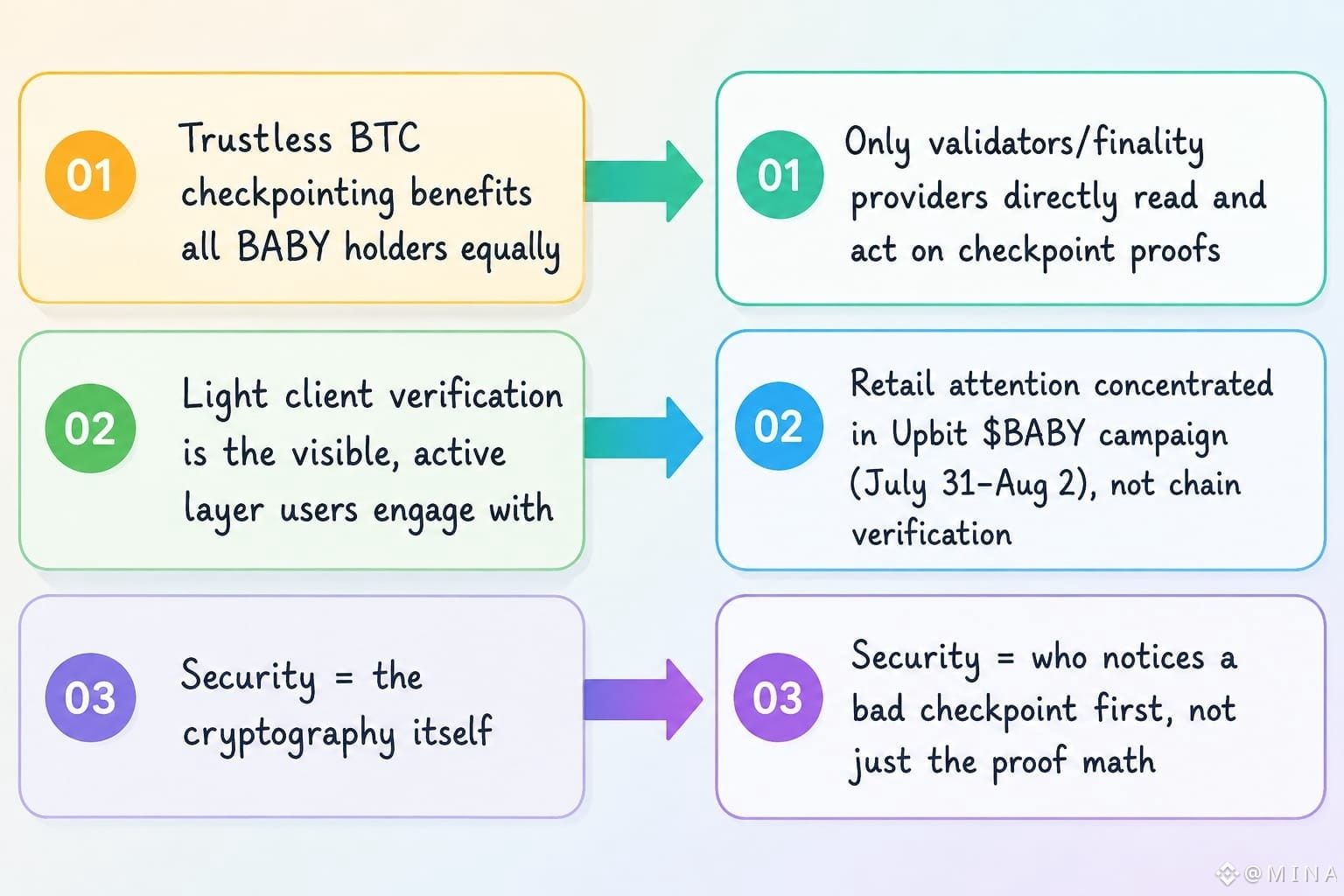
@BabylonLabs_io light clients actually verify BTC checkpoints, and ended up somewhere I didn't expect staring at the campaign instead of the finality provider dashboard. #baby $BABY
the light client proof stuff is genuinely elegant on paper Bitcoin checkpoints get verified without wrapping, without a custodian, without trusting some multisig. But almost nobody touches that layer directly.
The people actually exercising it are validators and finality providers reading BLS signatures off checkpoint headers. Meanwhile retail activity leaderboards, lucky draws, volume spikes happens one layer up, completely disconnected from whether a light client is doing its job correctly underneath.
Kind of funny, honestly. I went in expecting here's how trustless verification works, and came out thinking more about who's positioned to notice if it breaks.
Finality providers would catch a bad checkpoint almost instantly. A regular BABY holder trading during a campaign window wouldn't know anything was wrong until price told them.
how much of security in these systems is actually about who's watching, not just what's cryptographically true underneath.
$HEI $HFT
the light client proof stuff is genuinely elegant on paper Bitcoin checkpoints get verified without wrapping, without a custodian, without trusting some multisig. But almost nobody touches that layer directly.
The people actually exercising it are validators and finality providers reading BLS signatures off checkpoint headers. Meanwhile retail activity leaderboards, lucky draws, volume spikes happens one layer up, completely disconnected from whether a light client is doing its job correctly underneath.
Kind of funny, honestly. I went in expecting here's how trustless verification works, and came out thinking more about who's positioned to notice if it breaks.
Finality providers would catch a bad checkpoint almost instantly. A regular BABY holder trading during a campaign window wouldn't know anything was wrong until price told them.
how much of security in these systems is actually about who's watching, not just what's cryptographically true underneath.
$HEI $HFT
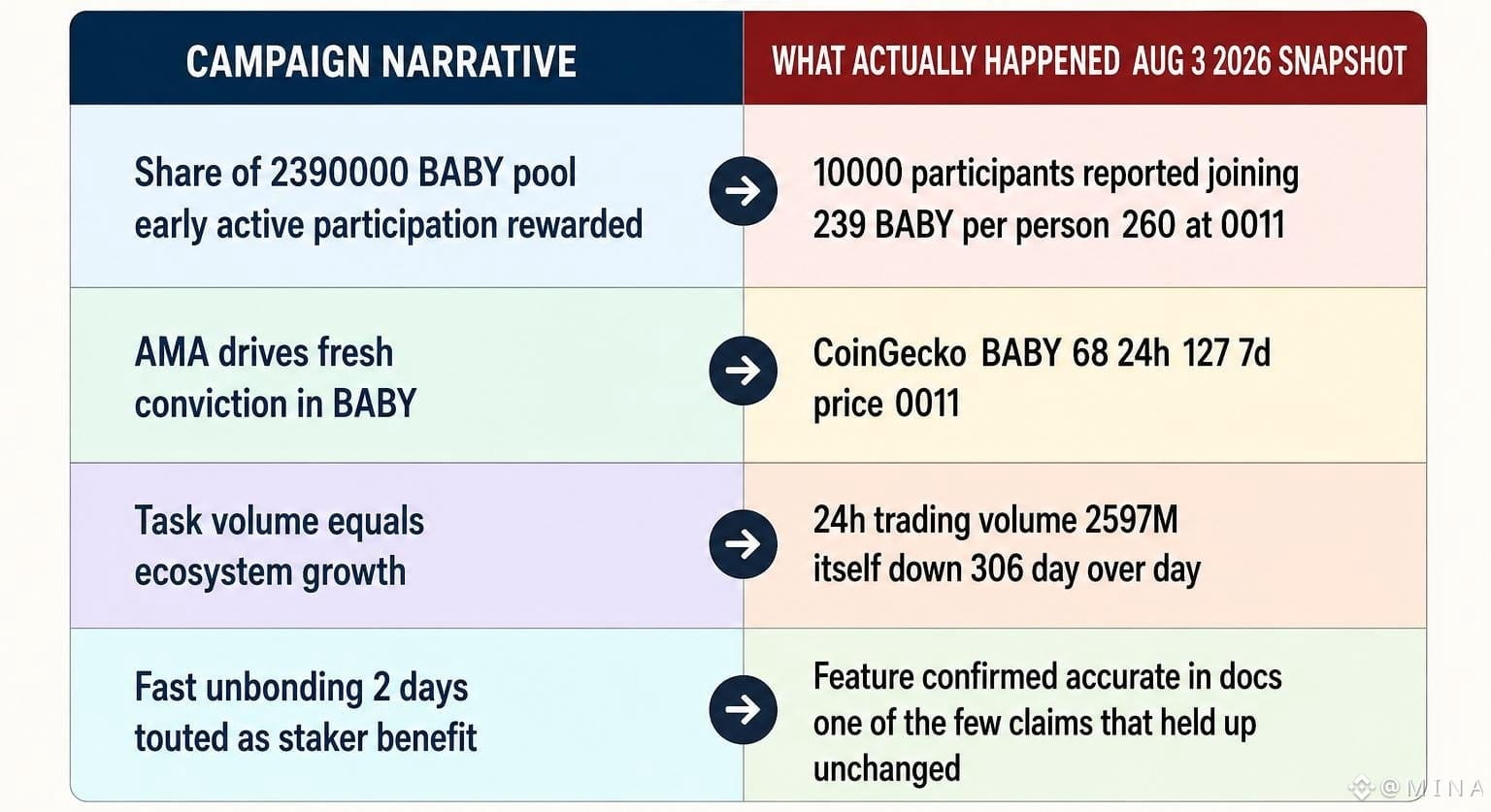
Grabbed some noodles after finishing the $BABY task and something kept nagging at me. @BabylonLabs_io ran this BinanceZH.linked AMA push with a shared pool of 2,390,000 #baby for task completers saw a thread claiming roughly 10k people had already joined within days.
Did the math on my phone: split ten thousand ways, that's about 239 BABY each. At today's CoinGecko print, $0.011, BABY down 6.8% on the day and almost 13% over the week... that's roughly $2.60 a head.
Not nothing but not exactly the get in early energy the campaign copy implies.
That's the part that stuck with me. The AMA and CreatorPad task genuinely pull people into the ecosystem new wallets, more eyes on the docs, maybe a few new stakers who stay for the ~2 day unbonding versus the usual 21 day PoS wait, which honestly is solid design in practice.
But the reward math and the price action during the same window tell a much quieter story than the campaign framing suggests. Task volume up, individual payout tiny, token still bleeding on the weekly chart.
Is this AMA plus task pool format actually building conviction, or just recycling the same few thousand task farmers across every CreatorPad drop this month?
Did the math on my phone: split ten thousand ways, that's about 239 BABY each. At today's CoinGecko print, $0.011, BABY down 6.8% on the day and almost 13% over the week... that's roughly $2.60 a head.
Not nothing but not exactly the get in early energy the campaign copy implies.
That's the part that stuck with me. The AMA and CreatorPad task genuinely pull people into the ecosystem new wallets, more eyes on the docs, maybe a few new stakers who stay for the ~2 day unbonding versus the usual 21 day PoS wait, which honestly is solid design in practice.
But the reward math and the price action during the same window tell a much quieter story than the campaign framing suggests. Task volume up, individual payout tiny, token still bleeding on the weekly chart.
Is this AMA plus task pool format actually building conviction, or just recycling the same few thousand task farmers across every CreatorPad drop this month?
It's been sitting in the back of my head since I closed the task tab an hour ago...
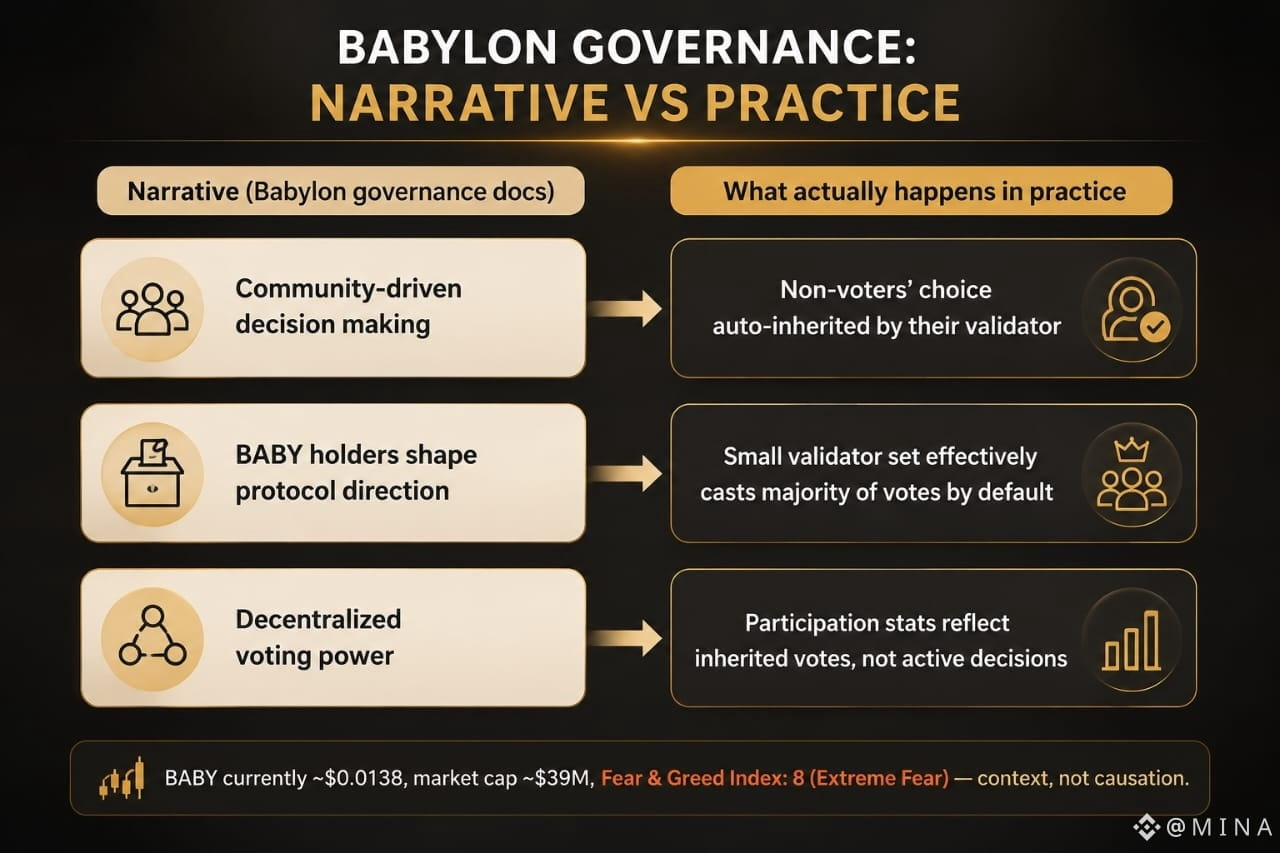
was digging into $BABY governance and got stuck on one small line in @BabylonLabs_io docs: if a #baby staker never votes, their validator's vote is automatically inherited. Not flagged, not paused just silently counted.
Meanwhile the token itself is trading around $0.0138 right now, market cap near $39M, with the fear index reading straight extreme fear. Still sitting close to its March cycle low of $0.0107.
that actually stuck with me. Everywhere I looked, the pitch is community driven governance, BABY holders decide the network's future. cool line but in practice, most of the actual voting weight flows through validators by default, because most people just... don't vote.
So the community deciding things is really a small set of validators inheriting silence at scale. Not malicious, just how defaults work, the quiet majority hands over their say without meaning to. grabbed a coffee mid research and kept circling back to this. Governance dashboards love to show participation percentages.
But they don't really tell you how much of that is active choice versus passive inheritance feels like a gap between what's marketed as decentralized decision making and what's actually just... validators doing the deciding by default and how many BABY stakers even know their vote is being cast for them right now.
was digging into $BABY governance and got stuck on one small line in @BabylonLabs_io docs: if a #baby staker never votes, their validator's vote is automatically inherited. Not flagged, not paused just silently counted.
Meanwhile the token itself is trading around $0.0138 right now, market cap near $39M, with the fear index reading straight extreme fear. Still sitting close to its March cycle low of $0.0107.
that actually stuck with me. Everywhere I looked, the pitch is community driven governance, BABY holders decide the network's future. cool line but in practice, most of the actual voting weight flows through validators by default, because most people just... don't vote.
So the community deciding things is really a small set of validators inheriting silence at scale. Not malicious, just how defaults work, the quiet majority hands over their say without meaning to. grabbed a coffee mid research and kept circling back to this. Governance dashboards love to show participation percentages.
But they don't really tell you how much of that is active choice versus passive inheritance feels like a gap between what's marketed as decentralized decision making and what's actually just... validators doing the deciding by default and how many BABY stakers even know their vote is being cast for them right now.
$BABY task wrapped, cross legged on the floor eating crackers, staring at the CoinGecko tab longer than planned.
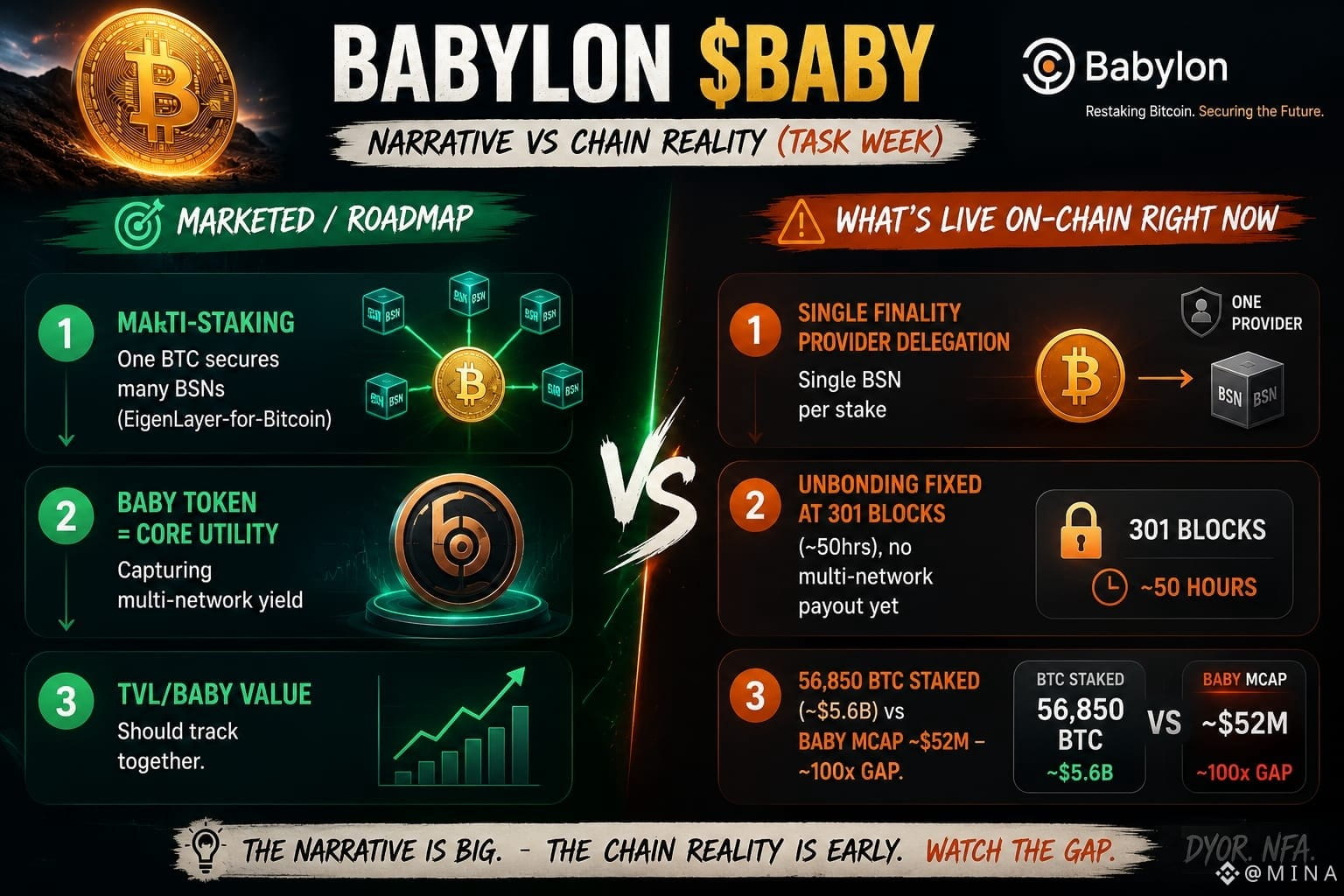
here's what actually stopped me. The protocol's sitting on roughly 56,850 BTC staked call it $5.6B while #baby itself trades around $0.013 with a market cap barely north of $52M.
TVL vs token value, ~100x apart. Docs and decks push multi staking hard, the "one BTC secures many chains" pitch, EigenLayer for Bitcoin energy. But when you actually trace a delegation on mainnet right now, it's still one finality provider, one BSN, unbonding sitting at 301 blocks 50 hours before your BTC is spendable again.
Multi staking is real in the roadmap, not yet in the muscle memory of the chain.
So the BTC holder gets the security provider role today. The multi network yield stacking the thing that actually makes BABY interesting as a token, not just BTC as a deposit is still "coming soon" in the fine print. Hmm… felt like reading a menu where half the dishes aren't cooked yet, but the kitchen's clearly busy.
Not knocking it, just noting the gap between what's live and what's loud. Wonder how much of that $5.6B actually reprices once multi staking rewards start hitting wallets instead of roadmaps.
@BabylonLabs_io
here's what actually stopped me. The protocol's sitting on roughly 56,850 BTC staked call it $5.6B while #baby itself trades around $0.013 with a market cap barely north of $52M.
TVL vs token value, ~100x apart. Docs and decks push multi staking hard, the "one BTC secures many chains" pitch, EigenLayer for Bitcoin energy. But when you actually trace a delegation on mainnet right now, it's still one finality provider, one BSN, unbonding sitting at 301 blocks 50 hours before your BTC is spendable again.
Multi staking is real in the roadmap, not yet in the muscle memory of the chain.
So the BTC holder gets the security provider role today. The multi network yield stacking the thing that actually makes BABY interesting as a token, not just BTC as a deposit is still "coming soon" in the fine print. Hmm… felt like reading a menu where half the dishes aren't cooked yet, but the kitchen's clearly busy.
Not knocking it, just noting the gap between what's live and what's loud. Wonder how much of that $5.6B actually reprices once multi staking rewards start hitting wallets instead of roadmaps.
@BabylonLabs_io
Войдите, чтобы посмотреть больше материала