

H A N II
1.8k Публикации

H A N II
Отправить жалобу
Заблокировать пользователя
📊 Crypto Market Analyst | Spot & Futures Trader | Charting the path to profits | Turning trends into income 💰
Открытая сделка
Трейдер с регулярными сделками
2.1 г
136 подписок(и/а)
1.1K+ подписчиков(а)
5.0K+ понравилось
Посты
Портфель
Все
Цитирования
·
--
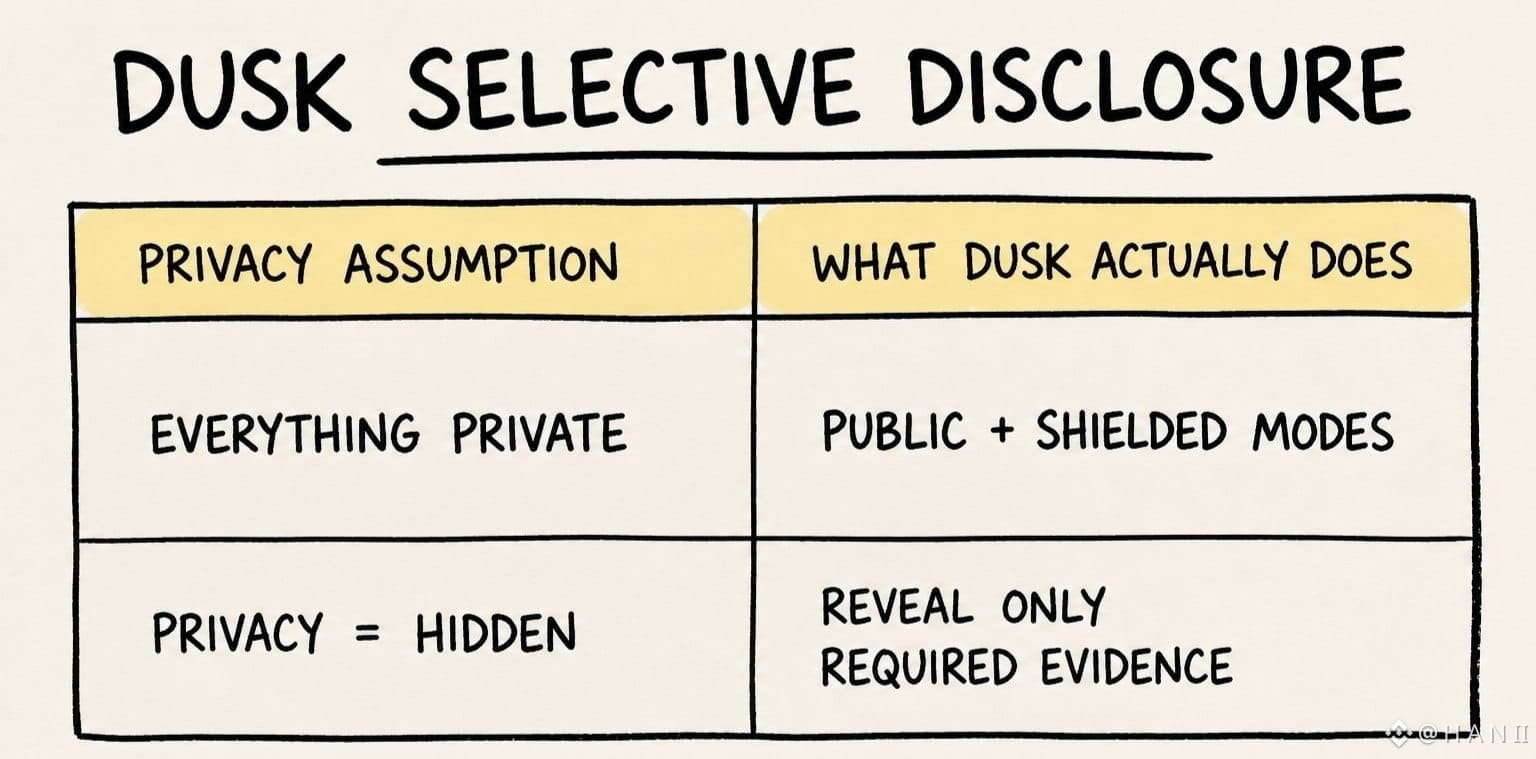
Dusk task was how little privacy actually means if everything is private by default. With @Dusk the interesting part is the selective bit.
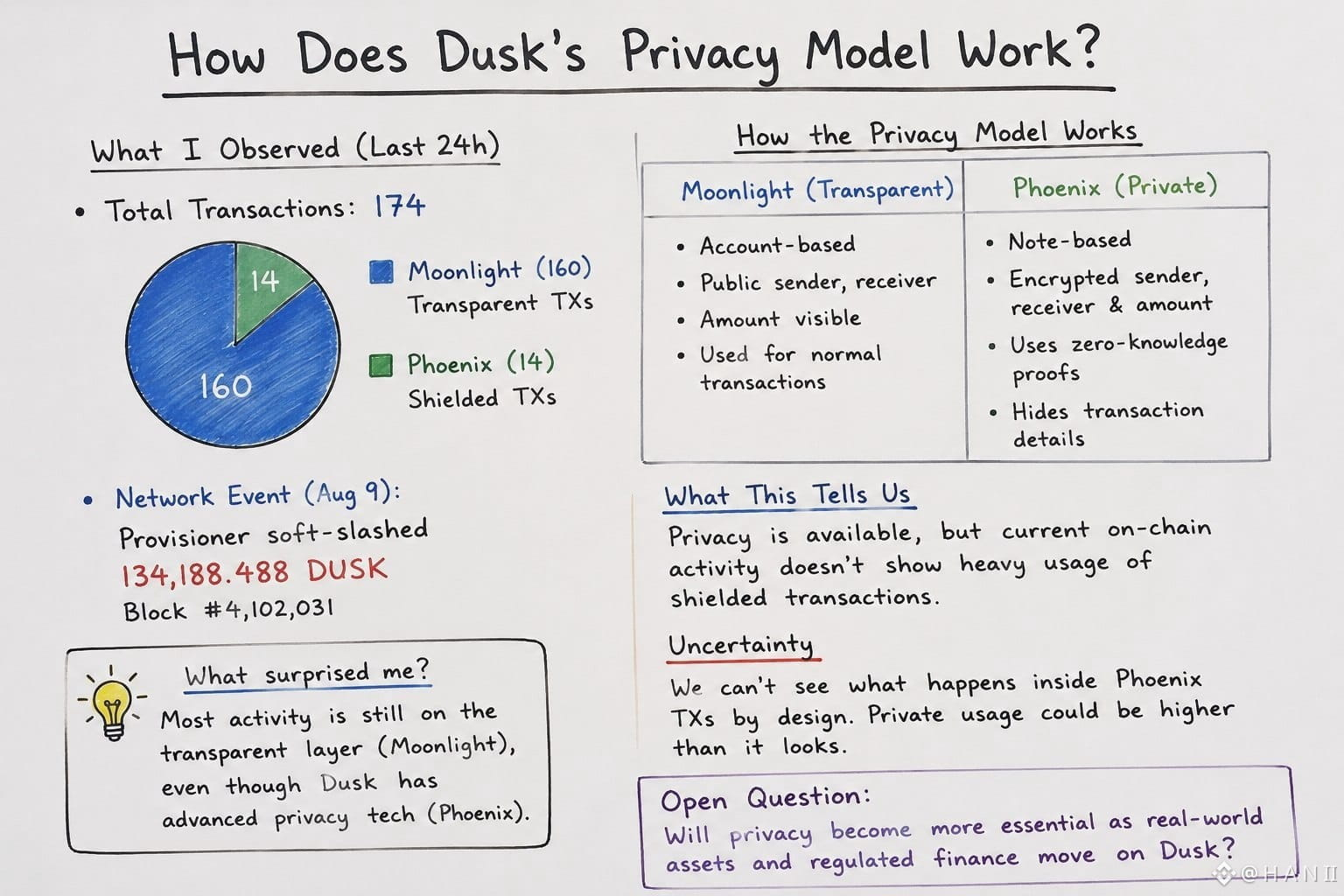
Looking at the network around Aug 18, DUSK was trading around $0.0671 with roughly $9.94M in 24h volume. That’s not a protocol transaction by itself, but it was a useful reality check: the public market layer is still very visible while Dusk’s actual privacy design is about choosing what gets revealed, not disappearing from the chain.
I kept coming back to that distinction. Dusk supports public Moonlight accounts alongside shielded Phoenix transfers, with selective disclosure when a specific party needs evidence. I initially expected the privacy angle to feel like an on/off switch. It doesn’t. It feels more like deciding who gets which piece of information.
Maybe that’s the more useful design choice for regulated finance but I’m still wondering how often real applications will actually use that middle ground rather than defaulting back to transparency.
@Dusk_Foundation $DUSK #dusk
Dusk task was how little privacy actually means if everything is private by default. With @Dusk the interesting part is the selective bit.
Looking at the network around Aug 18, DUSK was trading around $0.0671 with roughly $9.94M in 24h volume. That’s not a protocol transaction by itself, but it was a useful reality check: the public market layer is still very visible while Dusk’s actual privacy design is about choosing what gets revealed, not disappearing from the chain.
I kept coming back to that distinction. Dusk supports public Moonlight accounts alongside shielded Phoenix transfers, with selective disclosure when a specific party needs evidence. I initially expected the privacy angle to feel like an on/off switch. It doesn’t. It feels more like deciding who gets which piece of information.
Maybe that’s the more useful design choice for regulated finance but I’m still wondering how often real applications will actually use that middle ground rather than defaulting back to transparency.
@Dusk $DUSK #dusk
Looking at the network around Aug 18, DUSK was trading around $0.0671 with roughly $9.94M in 24h volume. That’s not a protocol transaction by itself, but it was a useful reality check: the public market layer is still very visible while Dusk’s actual privacy design is about choosing what gets revealed, not disappearing from the chain.
I kept coming back to that distinction. Dusk supports public Moonlight accounts alongside shielded Phoenix transfers, with selective disclosure when a specific party needs evidence. I initially expected the privacy angle to feel like an on/off switch. It doesn’t. It feels more like deciding who gets which piece of information.
Maybe that’s the more useful design choice for regulated finance but I’m still wondering how often real applications will actually use that middle ground rather than defaulting back to transparency.
@Dusk $DUSK #dusk
11
13
134
·
--
@Dusk_Foundation Foundation was how private doesn’t actually mean invisible.
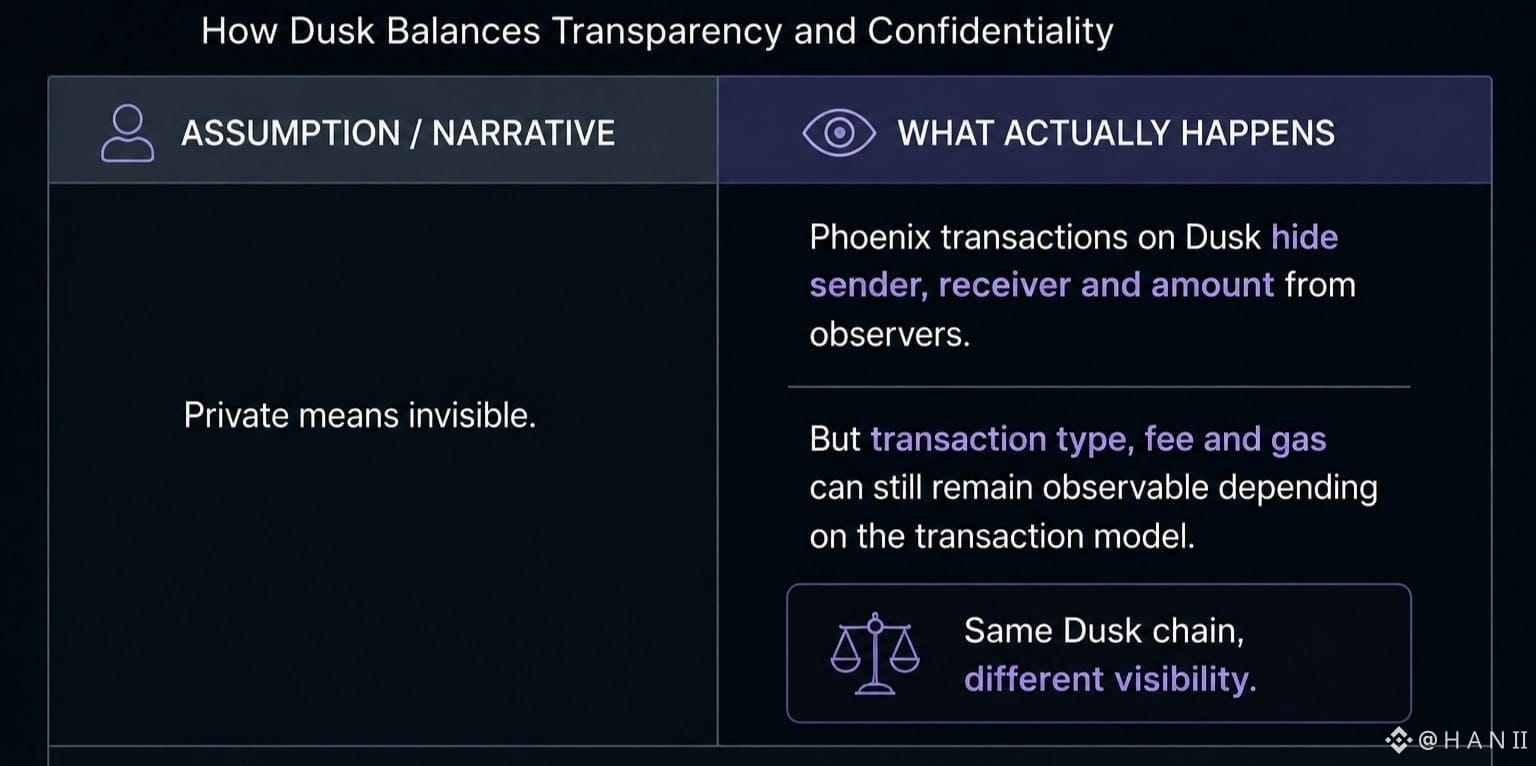
I kept coming back to the split in $DUSK, Moonlight exposes sender, receiver and amount, while Phoenix hides those details but still lets the transaction settle on the same chain.
And the recent chain activity made that distinction feel less theoretical.
On Aug 13, Dusk’s own explorer docs still describe Phoenix transactions as hiding sender, receiver and amount from observers, while the explorer can expose transaction type, fee and gas depending on the transaction model. So the transparency is not simply switched off. It is scoped.
I initially thought the interesting question was how private is Dusk? Then, after poking through the transaction models, it became more about what remains observable when privacy is being used.
That feels more relevant for financial workflows than just making everything opaque.
I’m still wondering how this plays out once real institutional activity starts filling those different visibility paths.
Does selective visibility stay clean when the number of parties and compliance requirements gets messy
@Dusk_Foundation $DUSK #dusk
@Dusk Foundation was how private doesn’t actually mean invisible.
I kept coming back to the split in $DUSK , Moonlight exposes sender, receiver and amount, while Phoenix hides those details but still lets the transaction settle on the same chain.
And the recent chain activity made that distinction feel less theoretical.
On Aug 13, Dusk’s own explorer docs still describe Phoenix transactions as hiding sender, receiver and amount from observers, while the explorer can expose transaction type, fee and gas depending on the transaction model. So the transparency is not simply switched off. It is scoped.
I initially thought the interesting question was how private is Dusk? Then, after poking through the transaction models, it became more about what remains observable when privacy is being used.
That feels more relevant for financial workflows than just making everything opaque.
I’m still wondering how this plays out once real institutional activity starts filling those different visibility paths.
Does selective visibility stay clean when the number of parties and compliance requirements gets messy
@Dusk $DUSK #dusk
I kept coming back to the split in $DUSK , Moonlight exposes sender, receiver and amount, while Phoenix hides those details but still lets the transaction settle on the same chain.
And the recent chain activity made that distinction feel less theoretical.
On Aug 13, Dusk’s own explorer docs still describe Phoenix transactions as hiding sender, receiver and amount from observers, while the explorer can expose transaction type, fee and gas depending on the transaction model. So the transparency is not simply switched off. It is scoped.
I initially thought the interesting question was how private is Dusk? Then, after poking through the transaction models, it became more about what remains observable when privacy is being used.
That feels more relevant for financial workflows than just making everything opaque.
I’m still wondering how this plays out once real institutional activity starts filling those different visibility paths.
Does selective visibility stay clean when the number of parties and compliance requirements gets messy
@Dusk $DUSK #dusk
10
10
126
·
--
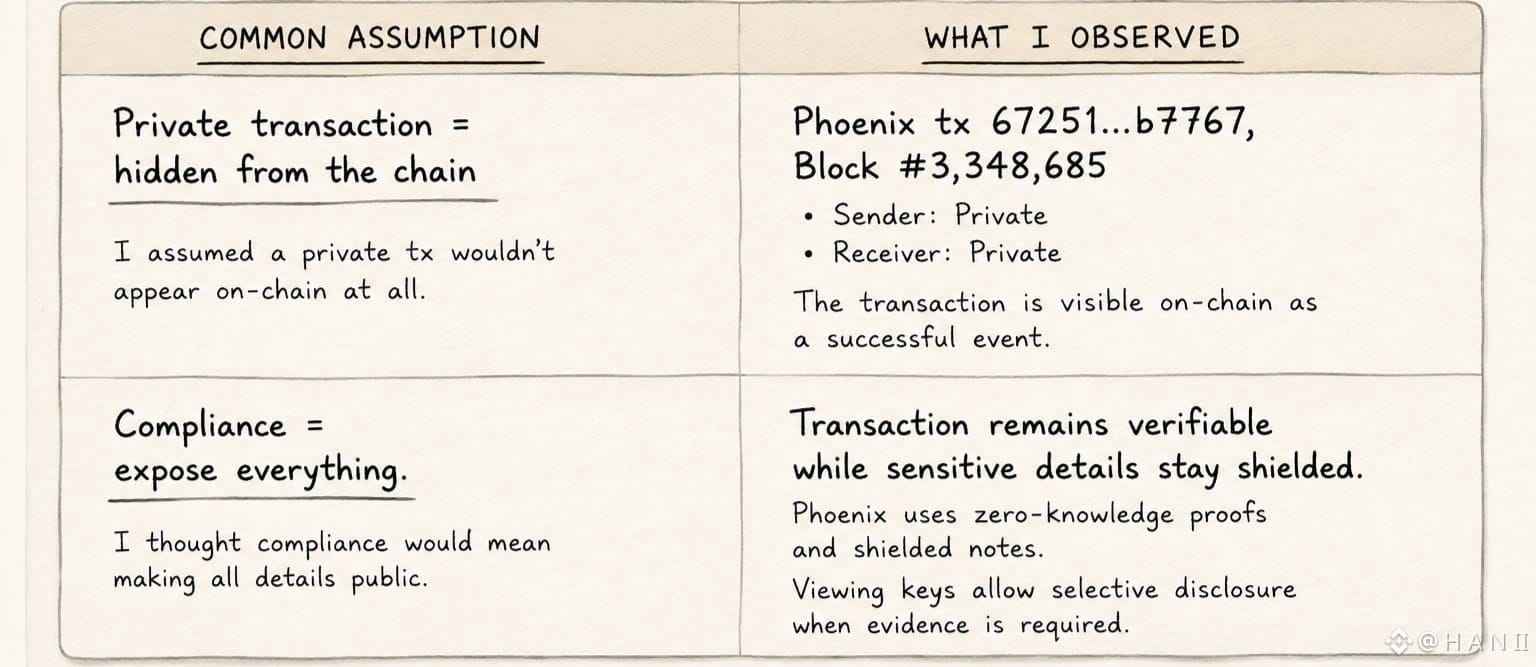
Dusk was how different private looks once you actually inspect a Phoenix transaction. the privacy isn’t simply hiding the whole chain. It’s choosing what the observer gets to see.
In the explorer, Phoenix transaction in block #3,348,685 shows the transfer with the sender and receiver marked Private, while the transaction itself still appears on.chain as a successful event.
That distinction is easy to miss. The chain can prove that something valid happened without handing every observer the underlying financial details.
Dusk’s docs describe the same model: Phoenix uses zero-knowledge proofs and shielded notes, while viewing keys can provide selective visibility when evidence is required.
I initially thought compliance would mean adding more visibility back into a privacy system. After looking at this, I’m leaning the other way. The interesting part is that disclosure can be treated as permissioned access rather than the default state of every transaction.
That feels much closer to how sensitive financial data actually works.
Still, I’m wondering how this balance behaves once larger regulated workflows start producing enough activity for the privacy model to face real operational pressure…
@Dusk_Foundation $DUSK #dusk
Dusk was how different private looks once you actually inspect a Phoenix transaction. the privacy isn’t simply hiding the whole chain. It’s choosing what the observer gets to see.
In the explorer, Phoenix transaction in block #3,348,685 shows the transfer with the sender and receiver marked Private, while the transaction itself still appears on.chain as a successful event.
That distinction is easy to miss. The chain can prove that something valid happened without handing every observer the underlying financial details.
Dusk’s docs describe the same model: Phoenix uses zero-knowledge proofs and shielded notes, while viewing keys can provide selective visibility when evidence is required.
I initially thought compliance would mean adding more visibility back into a privacy system. After looking at this, I’m leaning the other way. The interesting part is that disclosure can be treated as permissioned access rather than the default state of every transaction.
That feels much closer to how sensitive financial data actually works.
Still, I’m wondering how this balance behaves once larger regulated workflows start producing enough activity for the privacy model to face real operational pressure…
@Dusk $DUSK #dusk
In the explorer, Phoenix transaction in block #3,348,685 shows the transfer with the sender and receiver marked Private, while the transaction itself still appears on.chain as a successful event.
That distinction is easy to miss. The chain can prove that something valid happened without handing every observer the underlying financial details.
Dusk’s docs describe the same model: Phoenix uses zero-knowledge proofs and shielded notes, while viewing keys can provide selective visibility when evidence is required.
I initially thought compliance would mean adding more visibility back into a privacy system. After looking at this, I’m leaning the other way. The interesting part is that disclosure can be treated as permissioned access rather than the default state of every transaction.
That feels much closer to how sensitive financial data actually works.
Still, I’m wondering how this balance behaves once larger regulated workflows start producing enough activity for the privacy model to face real operational pressure…
@Dusk $DUSK #dusk
20
11
126
·
--
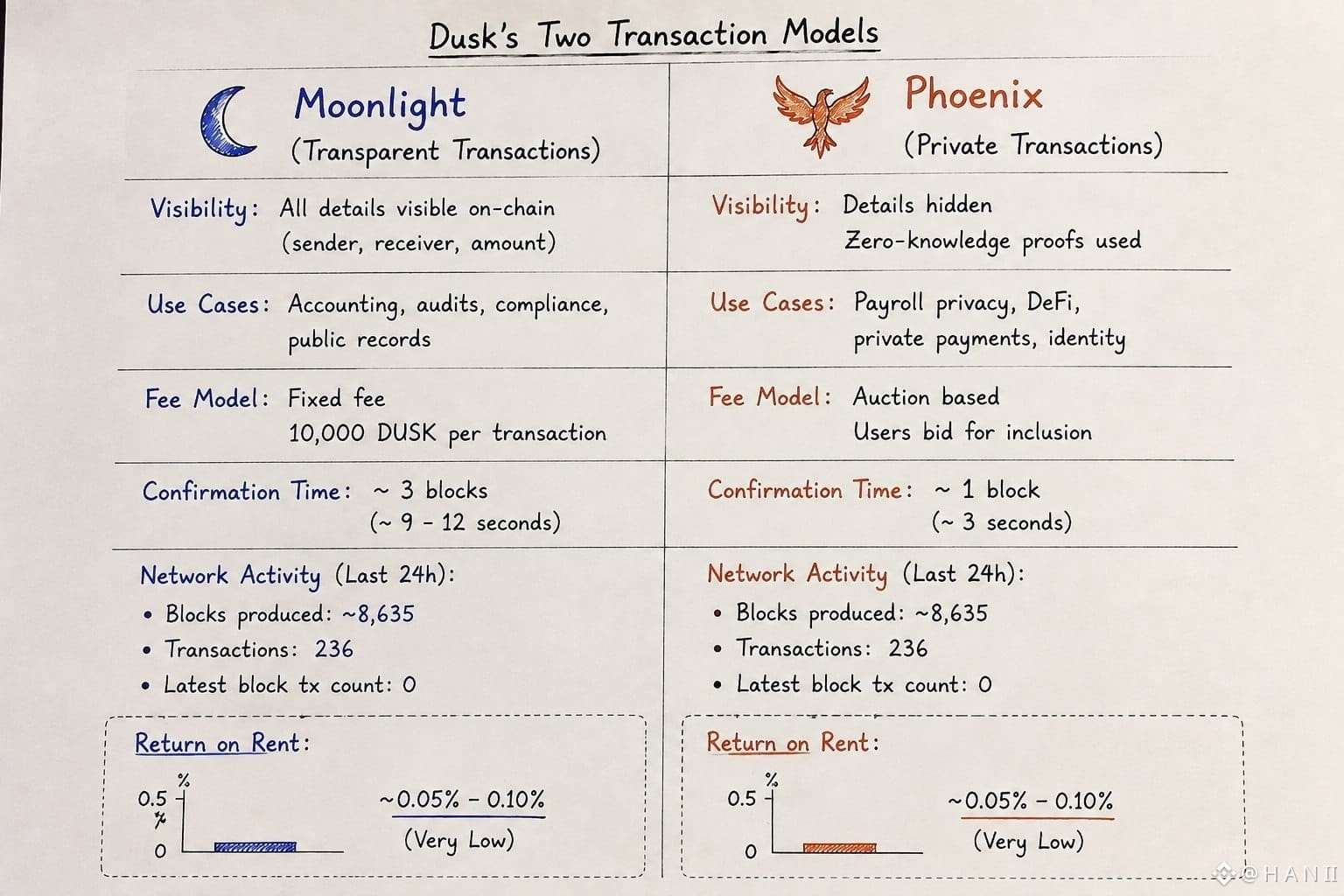
Moonlight vs Phoenix: Dusk’s Two Transaction Models
The interesting part isn’t simply public vs private. The two models are built around different assumptions about what a transaction should reveal.
Moonlight is account-based and transparent: balances, sender, receiver and amount can be inspected. Phoenix uses shielded notes and zero-knowledge proofs, so the network can verify validity without exposing the underlying transfer details.
The recent explorer snapshot around block #4,178,605 shows Dusk producing roughly 8,635 blocks/day, while the latest block itself carried 0 transactions. The explorer also showed only 236 transactions over 24h at that snapshot. That gap between block production and transaction activity is more interesting to me than the raw TPS narrative.
It suggests the network is currently doing far more consensus work than user-transfer work.
My uncertainty is whether that changes materially as Dusk’s regulated-asset applications mature.
@Dusk_Foundation $DUSK #dusk
Moonlight vs Phoenix: Dusk’s Two Transaction Models
The interesting part isn’t simply public vs private. The two models are built around different assumptions about what a transaction should reveal.
Moonlight is account-based and transparent: balances, sender, receiver and amount can be inspected. Phoenix uses shielded notes and zero-knowledge proofs, so the network can verify validity without exposing the underlying transfer details.
The recent explorer snapshot around block #4,178,605 shows Dusk producing roughly 8,635 blocks/day, while the latest block itself carried 0 transactions. The explorer also showed only 236 transactions over 24h at that snapshot. That gap between block production and transaction activity is more interesting to me than the raw TPS narrative.
It suggests the network is currently doing far more consensus work than user-transfer work.
My uncertainty is whether that changes materially as Dusk’s regulated-asset applications mature.
@Dusk $DUSK #dusk
The interesting part isn’t simply public vs private. The two models are built around different assumptions about what a transaction should reveal.
Moonlight is account-based and transparent: balances, sender, receiver and amount can be inspected. Phoenix uses shielded notes and zero-knowledge proofs, so the network can verify validity without exposing the underlying transfer details.
The recent explorer snapshot around block #4,178,605 shows Dusk producing roughly 8,635 blocks/day, while the latest block itself carried 0 transactions. The explorer also showed only 236 transactions over 24h at that snapshot. That gap between block production and transaction activity is more interesting to me than the raw TPS narrative.
It suggests the network is currently doing far more consensus work than user-transfer work.
My uncertainty is whether that changes materially as Dusk’s regulated-asset applications mature.
@Dusk $DUSK #dusk
14
11
115
·
--
@Dusk_Foundation $DUSK #dusk
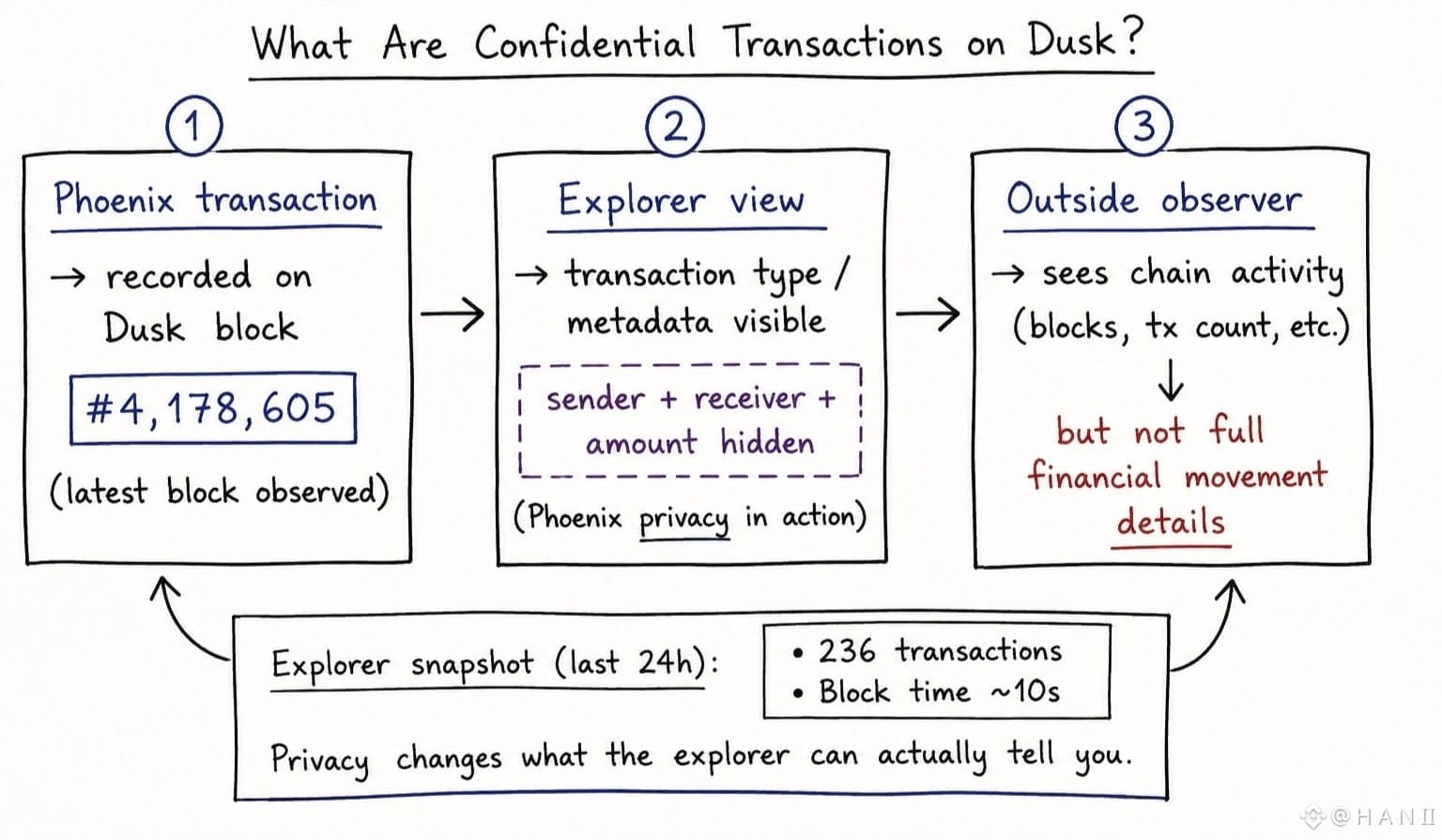
Dusk wasn’t the word confidential itself. It was seeing how little a Phoenix transaction actually tells you from the outside.
While checking Dusk that’s the interesting part: the chain is still producing blocks normally, but a Phoenix transfer can hide the sender, receiver, and amount from everyone except the relevant parties or someone holding the view key. The explorer can still expose the transaction type and metadata, but not the private transfer details themselves.
I had to reread that because I’m so used to explorers being basically public receipts. Here, the receipt exists, but the useful financial details can sit behind the privacy boundary.
That makes the privacy feel less like an optional interface setting and more like a property of how the transaction is represented on-chain.
Still, it left me wondering about the practical side… when activity is this visible at the block level but the actual value movement isn’t, how much of the network’s real usage can an outside observer ever confidently measure?
@Dusk $DUSK #dusk
Dusk wasn’t the word confidential itself. It was seeing how little a Phoenix transaction actually tells you from the outside.
While checking Dusk that’s the interesting part: the chain is still producing blocks normally, but a Phoenix transfer can hide the sender, receiver, and amount from everyone except the relevant parties or someone holding the view key. The explorer can still expose the transaction type and metadata, but not the private transfer details themselves.
I had to reread that because I’m so used to explorers being basically public receipts. Here, the receipt exists, but the useful financial details can sit behind the privacy boundary.
That makes the privacy feel less like an optional interface setting and more like a property of how the transaction is represented on-chain.
Still, it left me wondering about the practical side… when activity is this visible at the block level but the actual value movement isn’t, how much of the network’s real usage can an outside observer ever confidently measure?
Dusk wasn’t the word confidential itself. It was seeing how little a Phoenix transaction actually tells you from the outside.
While checking Dusk that’s the interesting part: the chain is still producing blocks normally, but a Phoenix transfer can hide the sender, receiver, and amount from everyone except the relevant parties or someone holding the view key. The explorer can still expose the transaction type and metadata, but not the private transfer details themselves.
I had to reread that because I’m so used to explorers being basically public receipts. Here, the receipt exists, but the useful financial details can sit behind the privacy boundary.
That makes the privacy feel less like an optional interface setting and more like a property of how the transaction is represented on-chain.
Still, it left me wondering about the practical side… when activity is this visible at the block level but the actual value movement isn’t, how much of the network’s real usage can an outside observer ever confidently measure?
10
8
109
·
--
The thing that made me pause while digging into Dusk was that the privacy isn’t just about hiding a balance. It changes what the network actually has to verify.
I was looking at @Dusk_Foundation Network and $DUSK again today, and the Aug 15 provisioner explorer snapshot showed 206 active provisioners out of 271, with 1.7M DUSK sitting as unclaimed rewards. That wasn’t the number I expected to notice, but it made me look closer at how the underlying transaction model works.
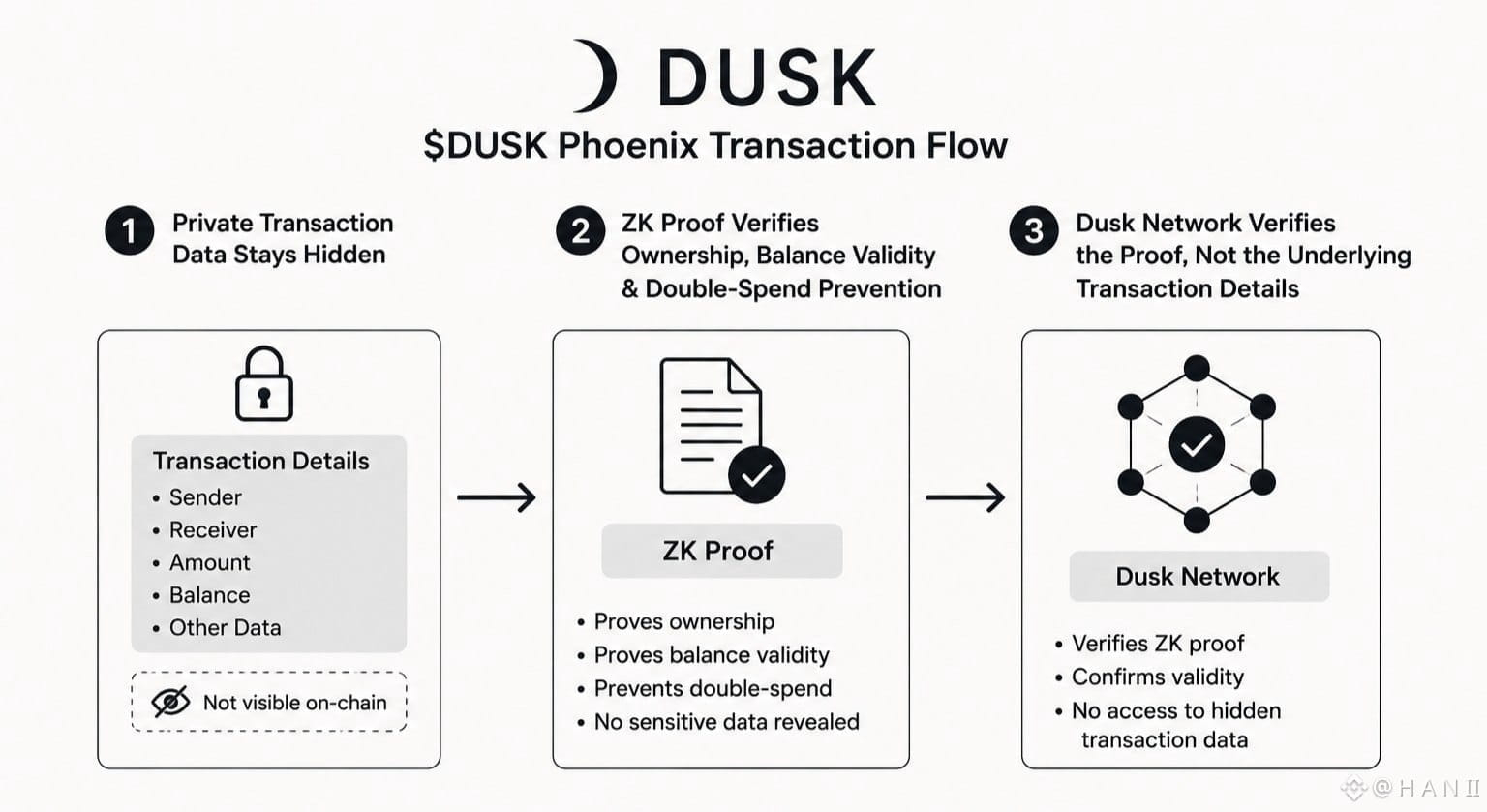
In Phoenix, a private transaction can still prove ownership, balance validity and double-spend prevention through a ZK proof without exposing the transaction details themselves. That distinction matters. The network isn’t simply “seeing less”; it is verifying a different kind of evidence. I caught myself rereading that part because it feels very different from the usual privacy pitch.
The question I’m left with is simpler: as actual usage grows, will this ZK heavy design remain mostly an advanced privacy path, or become the normal way people transact on Dusk?
@Dusk_Foundation $DUSK #dusk
The thing that made me pause while digging into Dusk was that the privacy isn’t just about hiding a balance. It changes what the network actually has to verify.
I was looking at @Dusk Network and $DUSK again today, and the Aug 15 provisioner explorer snapshot showed 206 active provisioners out of 271, with 1.7M DUSK sitting as unclaimed rewards. That wasn’t the number I expected to notice, but it made me look closer at how the underlying transaction model works.
In Phoenix, a private transaction can still prove ownership, balance validity and double-spend prevention through a ZK proof without exposing the transaction details themselves. That distinction matters. The network isn’t simply “seeing less”; it is verifying a different kind of evidence. I caught myself rereading that part because it feels very different from the usual privacy pitch.
The question I’m left with is simpler: as actual usage grows, will this ZK heavy design remain mostly an advanced privacy path, or become the normal way people transact on Dusk?
@Dusk $DUSK #dusk
I was looking at @Dusk Network and $DUSK again today, and the Aug 15 provisioner explorer snapshot showed 206 active provisioners out of 271, with 1.7M DUSK sitting as unclaimed rewards. That wasn’t the number I expected to notice, but it made me look closer at how the underlying transaction model works.
In Phoenix, a private transaction can still prove ownership, balance validity and double-spend prevention through a ZK proof without exposing the transaction details themselves. That distinction matters. The network isn’t simply “seeing less”; it is verifying a different kind of evidence. I caught myself rereading that part because it feels very different from the usual privacy pitch.
The question I’m left with is simpler: as actual usage grows, will this ZK heavy design remain mostly an advanced privacy path, or become the normal way people transact on Dusk?
@Dusk $DUSK #dusk
31
23
238
·
--
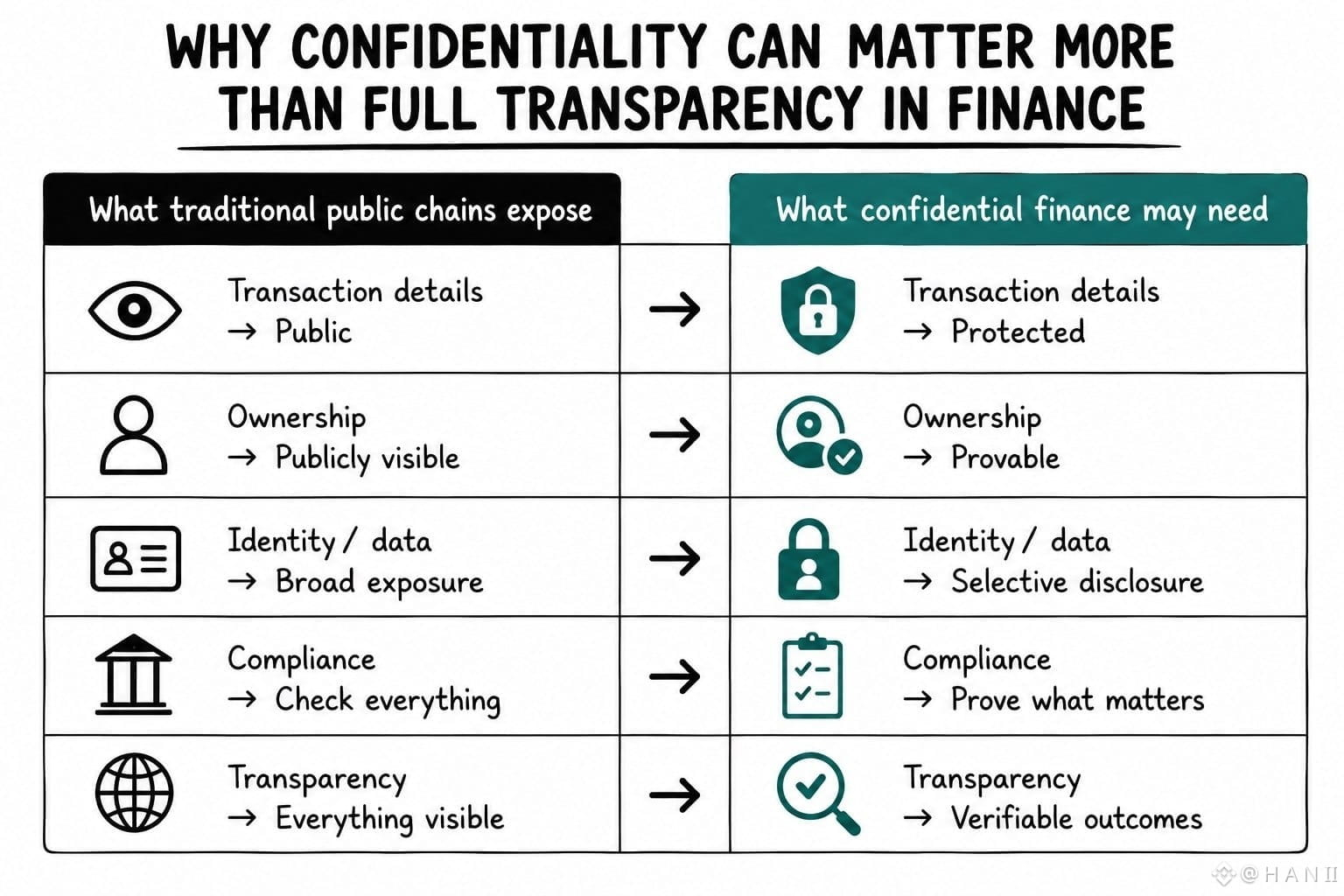
Finance probably doesn’t need more transparency. It needs better control over what becomes public.
That was the main thing that stood out to me while digging into DUSK.
Think about a normal financial transaction.
You may need to prove that you own an asset, meet certain requirements, or have permission to participate. But that doesn’t mean the whole market needs to see your balance, identity details, or transaction history.
That’s where Dusk’s approach gets interesting.
Its architecture is built around confidential financial activity, using privacy-preserving technology while keeping room for compliance and selective verification.
And the timing caught my attention.
On August 10, 2026, DuskEVM testnet went live, allowing developers to deploy and test Solidity and Hardhat applications on Dusk.
For me, the interesting part isn’t simply “EVM is coming.”
It’s whether developers can actually build financial applications where:
Sensitive data stays confidential
Ownership can still be prove
Compliance doesn’t require exposing everything
Smart contracts can handle financial logic
DUSK supports the underlying network economy
I still can’t tell from a testnet launch whether real financial usage will follow.
But it made me rethink one thing: maybe the real value of transparency in finance isn’t showing everything, it’s proving what needs to be proven.
Is that the better model for on chain finance?
@Dusk_Foundation $DUSK #dusk
Finance probably doesn’t need more transparency. It needs better control over what becomes public.
That was the main thing that stood out to me while digging into DUSK.
Think about a normal financial transaction.
You may need to prove that you own an asset, meet certain requirements, or have permission to participate. But that doesn’t mean the whole market needs to see your balance, identity details, or transaction history.
That’s where Dusk’s approach gets interesting.
Its architecture is built around confidential financial activity, using privacy-preserving technology while keeping room for compliance and selective verification.
And the timing caught my attention.
On August 10, 2026, DuskEVM testnet went live, allowing developers to deploy and test Solidity and Hardhat applications on Dusk.
For me, the interesting part isn’t simply “EVM is coming.”
It’s whether developers can actually build financial applications where:
Sensitive data stays confidential
Ownership can still be prove
Compliance doesn’t require exposing everything
Smart contracts can handle financial logic
DUSK supports the underlying network economy
I still can’t tell from a testnet launch whether real financial usage will follow.
But it made me rethink one thing: maybe the real value of transparency in finance isn’t showing everything, it’s proving what needs to be proven.
Is that the better model for on chain finance?
@Dusk $DUSK #dusk
That was the main thing that stood out to me while digging into DUSK.
Think about a normal financial transaction.
You may need to prove that you own an asset, meet certain requirements, or have permission to participate. But that doesn’t mean the whole market needs to see your balance, identity details, or transaction history.
That’s where Dusk’s approach gets interesting.
Its architecture is built around confidential financial activity, using privacy-preserving technology while keeping room for compliance and selective verification.
And the timing caught my attention.
On August 10, 2026, DuskEVM testnet went live, allowing developers to deploy and test Solidity and Hardhat applications on Dusk.
For me, the interesting part isn’t simply “EVM is coming.”
It’s whether developers can actually build financial applications where:
Sensitive data stays confidential
Ownership can still be prove
Compliance doesn’t require exposing everything
Smart contracts can handle financial logic
DUSK supports the underlying network economy
I still can’t tell from a testnet launch whether real financial usage will follow.
But it made me rethink one thing: maybe the real value of transparency in finance isn’t showing everything, it’s proving what needs to be proven.
Is that the better model for on chain finance?
@Dusk $DUSK #dusk
6
8
158
·
--
Dusk explorer this week instead of just reading the NPEX headlines again, and one number stood out: unclaimed staking rewards are sitting at roughly 1.7M DUSK slightly more than the 1.6M DUSK currently shown as locked stake across active provisioners.
Out of 271 total registered provisioners, only 206 are active; the rest are pending, inactive, or historical. Staking APR is posted at 22.31%.
That rewards vs locked stake ratio surprised me. I expected unclaimed rewards to trail locked stake by a wide margin, not sit almost 1:1 with it.
So I checked a few individual provisioner pages reward accrual is steady, but claim transactions look infrequent relative to epoch cadence.
What this tells us: a meaningful share of provisioners aren't actively harvesting rewards on a regular basis. What it doesn't tell us: why. Could be automated compounding, inactive nodes still accruing, or just operators batching claims less often than epochs turn over.
The explorer doesn't expose intent, and I couldn't confirm which explanation dominates.
#dusk @Dusk_Foundation $DUSK
Dusk explorer this week instead of just reading the NPEX headlines again, and one number stood out: unclaimed staking rewards are sitting at roughly 1.7M DUSK slightly more than the 1.6M DUSK currently shown as locked stake across active provisioners.
Out of 271 total registered provisioners, only 206 are active; the rest are pending, inactive, or historical. Staking APR is posted at 22.31%.
That rewards vs locked stake ratio surprised me. I expected unclaimed rewards to trail locked stake by a wide margin, not sit almost 1:1 with it.
So I checked a few individual provisioner pages reward accrual is steady, but claim transactions look infrequent relative to epoch cadence.
What this tells us: a meaningful share of provisioners aren't actively harvesting rewards on a regular basis. What it doesn't tell us: why. Could be automated compounding, inactive nodes still accruing, or just operators batching claims less often than epochs turn over.
The explorer doesn't expose intent, and I couldn't confirm which explanation dominates.
#dusk @Dusk $DUSK
Out of 271 total registered provisioners, only 206 are active; the rest are pending, inactive, or historical. Staking APR is posted at 22.31%.
That rewards vs locked stake ratio surprised me. I expected unclaimed rewards to trail locked stake by a wide margin, not sit almost 1:1 with it.
So I checked a few individual provisioner pages reward accrual is steady, but claim transactions look infrequent relative to epoch cadence.
What this tells us: a meaningful share of provisioners aren't actively harvesting rewards on a regular basis. What it doesn't tell us: why. Could be automated compounding, inactive nodes still accruing, or just operators batching claims less often than epochs turn over.
The explorer doesn't expose intent, and I couldn't confirm which explanation dominates.
#dusk @Dusk $DUSK
2
4
100
·
--
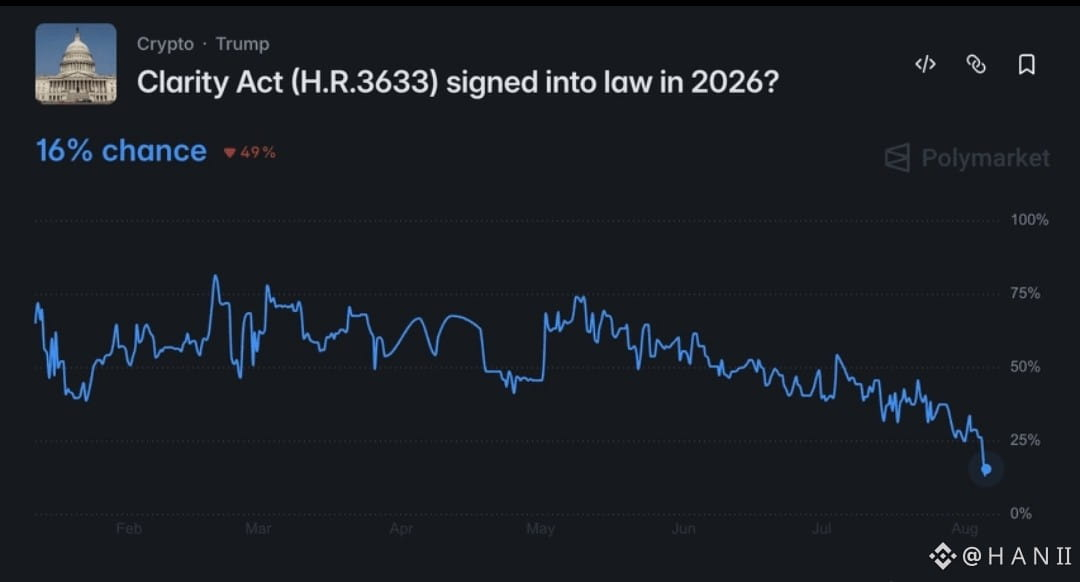
The CLARITY Act falling from 82% to just 16% odds isn't the market saying crypto regulation is dead.
It's the market saying the 2026 timeline is becoming much harder to achieve.
The bill has already passed the House and cleared the Senate Banking Committee. But it still needs a full Senate vote and may require reconciliation before reaching the president. That's a lot to get done with limited time left.
For crypto, the delay matters because uncertainty keeps exchanges, builders, and institutions operating without a complete market-structure framework.
But prediction markets aren't final decisions. They reflect expectations, not outcomes.
One breakthrough in negotiations could shift sentiment quickly. Until then, traders are pricing political timing—not the end of the CLARITY Act.
The industry is still waiting for clear rules.
Washington is still trying to deliver them.
want, I can also .make it more Binance Square-friendly with a stronger hook and higher engagement potential#HYPEGains79%InQ2 #JapanRegulatorsUrgeCryptoWithdrawalLimits #ColdcardExploitFundsSentToMixers
The CLARITY Act falling from 82% to just 16% odds isn't the market saying crypto regulation is dead.
It's the market saying the 2026 timeline is becoming much harder to achieve.
The bill has already passed the House and cleared the Senate Banking Committee. But it still needs a full Senate vote and may require reconciliation before reaching the president. That's a lot to get done with limited time left.
For crypto, the delay matters because uncertainty keeps exchanges, builders, and institutions operating without a complete market-structure framework.
But prediction markets aren't final decisions. They reflect expectations, not outcomes.
One breakthrough in negotiations could shift sentiment quickly. Until then, traders are pricing political timing—not the end of the CLARITY Act.
The industry is still waiting for clear rules.
Washington is still trying to deliver them.
want, I can also .make it more Binance Square-friendly with a stronger hook and higher engagement potential#HYPEGains79%InQ2 #JapanRegulatorsUrgeCryptoWithdrawalLimits #ColdcardExploitFundsSentToMixers
It's the market saying the 2026 timeline is becoming much harder to achieve.
The bill has already passed the House and cleared the Senate Banking Committee. But it still needs a full Senate vote and may require reconciliation before reaching the president. That's a lot to get done with limited time left.
For crypto, the delay matters because uncertainty keeps exchanges, builders, and institutions operating without a complete market-structure framework.
But prediction markets aren't final decisions. They reflect expectations, not outcomes.
One breakthrough in negotiations could shift sentiment quickly. Until then, traders are pricing political timing—not the end of the CLARITY Act.
The industry is still waiting for clear rules.
Washington is still trying to deliver them.
want, I can also .make it more Binance Square-friendly with a stronger hook and higher engagement potential#HYPEGains79%InQ2 #JapanRegulatorsUrgeCryptoWithdrawalLimits #ColdcardExploitFundsSentToMixers
73
·
--
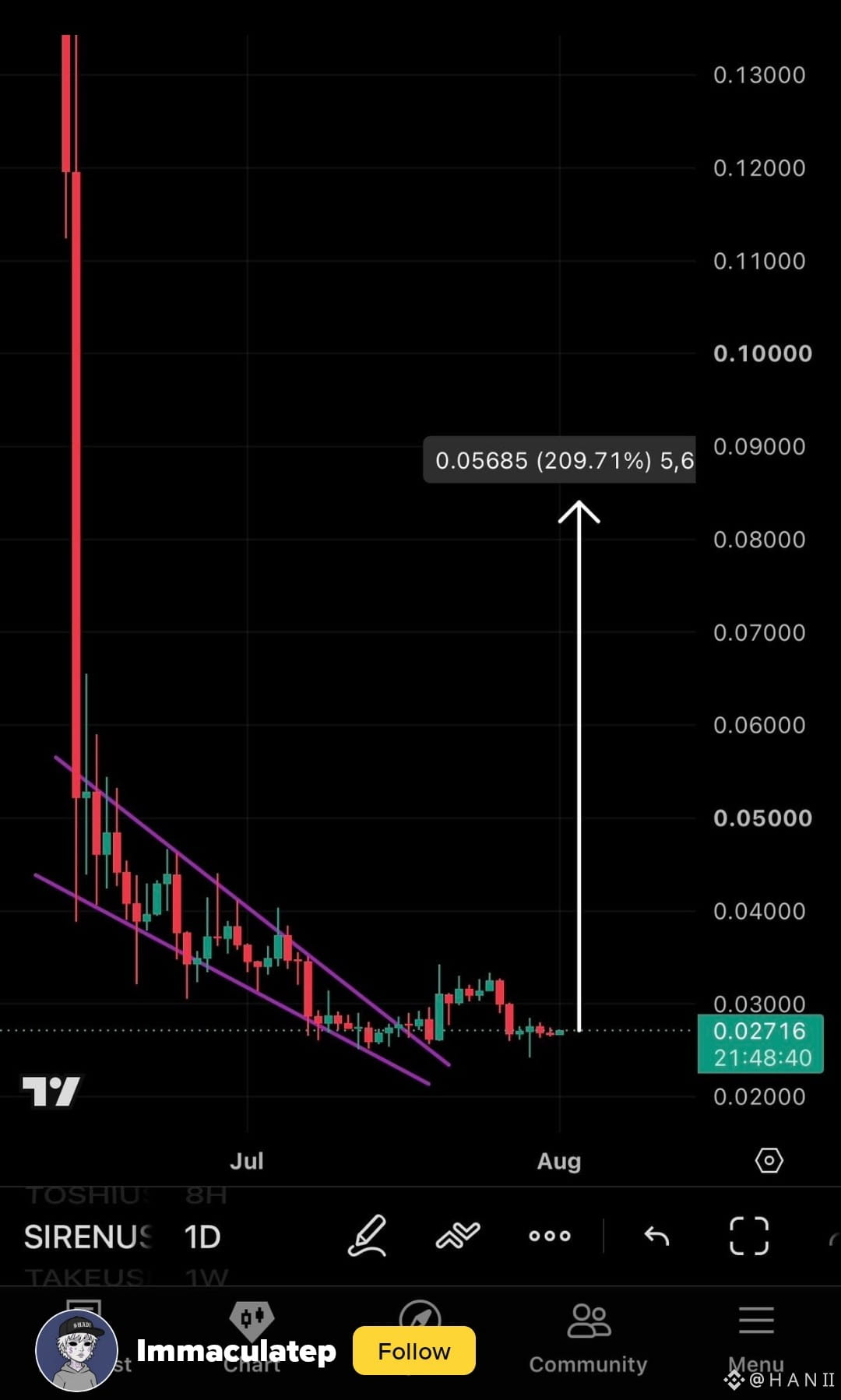
Just noticed $SIREN has been added to Binance Alpha.
BNB Chain meme coin with a relatively low market cap, and the chart looks heavily oversold at current levels.
If momentum returns, this could be one of those coins that moves fast. Definitely one to keep on the watchlist.
Let's see how it plays out from here. 👇
$SIREN #Binance #BNBChainHackathon2024 #BitcoinMiningDifficultyFalls14%FromYearHigh
Just noticed $SIREN has been added to Binance Alpha.
BNB Chain meme coin with a relatively low market cap, and the chart looks heavily oversold at current levels.
If momentum returns, this could be one of those coins that moves fast. Definitely one to keep on the watchlist.
Let's see how it plays out from here. 👇
$SIREN #Binance #BNBChainHackathon2024 #BitcoinMiningDifficultyFalls14%FromYearHigh
BNB Chain meme coin with a relatively low market cap, and the chart looks heavily oversold at current levels.
If momentum returns, this could be one of those coins that moves fast. Definitely one to keep on the watchlist.
Let's see how it plays out from here. 👇
$SIREN #Binance #BNBChainHackathon2024 #BitcoinMiningDifficultyFalls14%FromYearHigh
88
·
--
it's amazing
it's amazing

Z O Y A
·
--
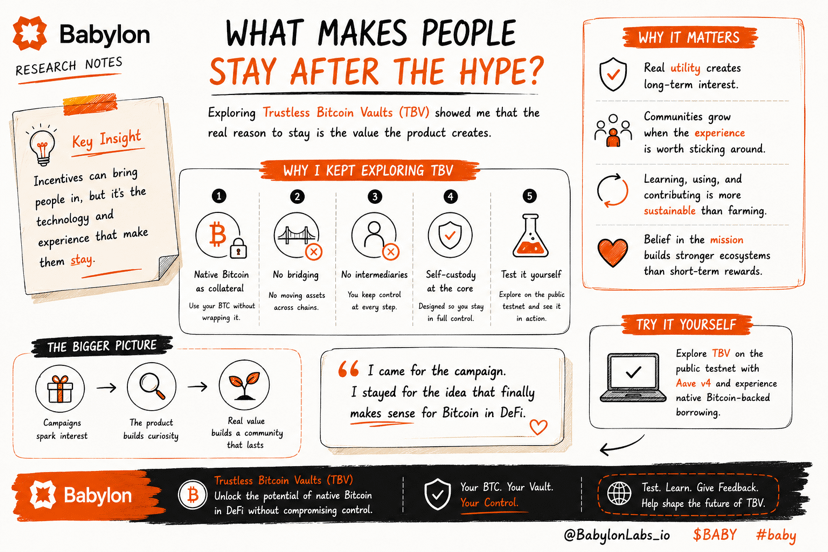
I don’t know if anyone else does this 😅, but whenever I see a new testnet or campaign, I always ask myself the same question… “Would I still be interested if there weren’t any rewards involved?” I caught myself thinking exactly that while reading about Trustless Bitcoin Vaults (TBV), and honestly, it made me stop for a second.
So I spent a little more time exploring @BabylonLabs_io and the more I read, the more I realized the rewards weren’t actually the part holding my attention. What kept me reading was understanding how TBV lets native Bitcoin be used as collateral without wrapping it, bridging it, or handing control to someone else. At first, I thought the campaign was simply encouraging people to try the testnet. The more I explored, the more I felt it was also an opportunity to understand why the technology is being built this way. 🤯
Then I started thinking about how most of us discover new crypto projects. Sometimes a campaign is what catches our attention, but whether we stay usually depends on whether the product itself makes sense. Reading about Babylon reminded me that incentives can introduce people to an ecosystem, but it’s the experience and the ideas behind it that make someone want to keep learning.
I still have plenty to explore on the TBV testnet 😂, and I’m sure my perspective will keep changing as I spend more time with it. But I walked away feeling like the most valuable part wasn’t the campaign itself. It was finding a project that made me curious enough to keep digging after the first impression. I guess that’s the part I’ll be keeping an eye on.
@BabylonLabs_io #baby $BABY
So I spent a little more time exploring @BabylonLabs_io and the more I read, the more I realized the rewards weren’t actually the part holding my attention. What kept me reading was understanding how TBV lets native Bitcoin be used as collateral without wrapping it, bridging it, or handing control to someone else. At first, I thought the campaign was simply encouraging people to try the testnet. The more I explored, the more I felt it was also an opportunity to understand why the technology is being built this way. 🤯
Then I started thinking about how most of us discover new crypto projects. Sometimes a campaign is what catches our attention, but whether we stay usually depends on whether the product itself makes sense. Reading about Babylon reminded me that incentives can introduce people to an ecosystem, but it’s the experience and the ideas behind it that make someone want to keep learning.
I still have plenty to explore on the TBV testnet 😂, and I’m sure my perspective will keep changing as I spend more time with it. But I walked away feeling like the most valuable part wasn’t the campaign itself. It was finding a project that made me curious enough to keep digging after the first impression. I guess that’s the part I’ll be keeping an eye on.
@BabylonLabs_io #baby $BABY
6
·
--
interesting post
interesting post

Elayaa
·
--
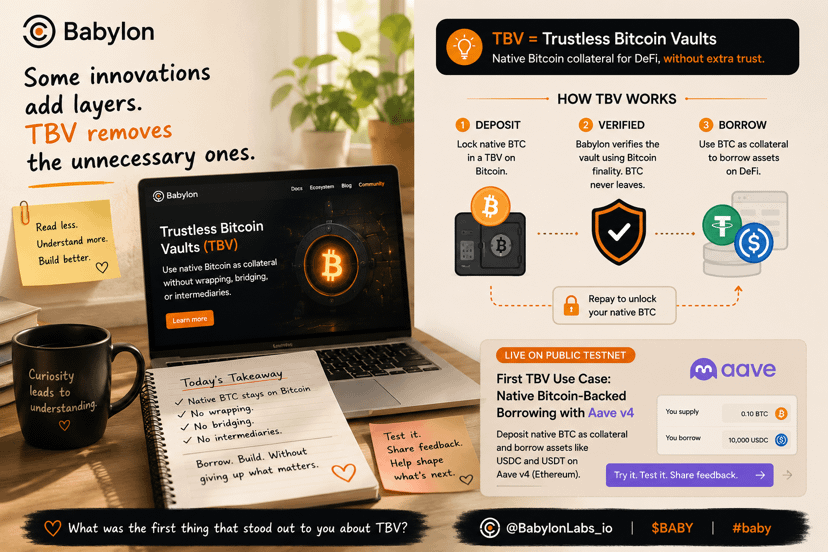
I was cleaning my laptop today and found a folder called “Read Later.” It had dozens of crypto articles and documents I’d saved over the past few months but never opened. I laughed because I realized I keep collecting information faster than I actually learn it. Instead of opening another new tab, I picked one project and decided to read it properly from start to finish.
That project happened to be @BabylonLabs_io . While reading about Trustless Bitcoin Vaults (TBV), I kept thinking about how often we’ve accepted wrapping or bridging Bitcoin as if it’s just part of the process. TBV takes a different direction by letting native Bitcoin be used as collateral without wrapping, bridging, or relying on intermediaries. It made me realize that sometimes innovation isn’t about adding another layer it’s about removing the ones that were never meant to be there.
The first TBV use case is already live on the public testnet with Aave v4, where users can try native Bitcoin-backed borrowing and share feedback while the product continues to evolve. I actually enjoy campaigns that leave me with a new perspective instead of just another post to publish. This one did exactly that, and now I’m curious to see how the experience feels after trying the testnet myself. What was the first thing that stood out to you about TBV? @BabylonLabs_io $BABY #baby
That project happened to be @BabylonLabs_io . While reading about Trustless Bitcoin Vaults (TBV), I kept thinking about how often we’ve accepted wrapping or bridging Bitcoin as if it’s just part of the process. TBV takes a different direction by letting native Bitcoin be used as collateral without wrapping, bridging, or relying on intermediaries. It made me realize that sometimes innovation isn’t about adding another layer it’s about removing the ones that were never meant to be there.
The first TBV use case is already live on the public testnet with Aave v4, where users can try native Bitcoin-backed borrowing and share feedback while the product continues to evolve. I actually enjoy campaigns that leave me with a new perspective instead of just another post to publish. This one did exactly that, and now I’m curious to see how the experience feels after trying the testnet myself. What was the first thing that stood out to you about TBV? @BabylonLabs_io $BABY #baby
1
72
·
--
TRUMP:
"We're going to respond very strongly to Iran because now it's our turn. They knew this was coming and hoped we wouldn't act, but they launched five rockets at us last night. Those rockets were traveling around 8,500 mph, and all five were intercepted. Even so, they still made the attempt. Now we'll respond forcefully. We'll see if a deal is possible down the road, but first we're going to hit them very hard."
Trump also claimed:
"The Iranians apologized for yesterday's attack, but we're still going to respond with force."#CitadelBuysSituationalAwarenessEquities #SaudiOilTankersRerouteAroundAfrica
TRUMP:
"We're going to respond very strongly to Iran because now it's our turn. They knew this was coming and hoped we wouldn't act, but they launched five rockets at us last night. Those rockets were traveling around 8,500 mph, and all five were intercepted. Even so, they still made the attempt. Now we'll respond forcefully. We'll see if a deal is possible down the road, but first we're going to hit them very hard."
Trump also claimed:
"The Iranians apologized for yesterday's attack, but we're still going to respond with force."#CitadelBuysSituationalAwarenessEquities #SaudiOilTankersRerouteAroundAfrica
"We're going to respond very strongly to Iran because now it's our turn. They knew this was coming and hoped we wouldn't act, but they launched five rockets at us last night. Those rockets were traveling around 8,500 mph, and all five were intercepted. Even so, they still made the attempt. Now we'll respond forcefully. We'll see if a deal is possible down the road, but first we're going to hit them very hard."
Trump also claimed:
"The Iranians apologized for yesterday's attack, but we're still going to respond with force."#CitadelBuysSituationalAwarenessEquities #SaudiOilTankersRerouteAroundAfrica

1
98
·
--
I don’t know if it’s just me… but most games today feel like they just want numbers 🤔
More downloads… more signups… more hype. But after that? People leave. Nothing really stays.
And that’s why something about Pixels feels a bit different to me.
Like… instead of just pushing growth, it feels like they’re trying to filter it.
The referral system is a good example. You don’t just invite and earn instantly. You actually benefit when the person you bring stays, plays, and contributes. Which sounds strict… but at the same time, it protects the whole system. Less spam, more real players.
Same with sharing. It’s not just random promotion. It feels like players are becoming part of the growth itself. You share, you help the game expand… and you get rewarded for it. That’s kind of rare.
And then there’s this focus on real engagement. Not just clicks or fake activity… but actual participation. That means people who really spend time in the game are the ones getting value.
I’m not saying it’s perfect… maybe it’s still early 🤔
But it feels like they’re trying to build something more stable. Something where players actually matter, not just numbers.
Not sure how it plays out long-term… but yeah, this approach feels more real than most 🚀
@pixels #pixel $PIXEL
I don’t know if it’s just me… but most games today feel like they just want numbers 🤔
More downloads… more signups… more hype. But after that? People leave. Nothing really stays.
And that’s why something about Pixels feels a bit different to me.
Like… instead of just pushing growth, it feels like they’re trying to filter it.
The referral system is a good example. You don’t just invite and earn instantly. You actually benefit when the person you bring stays, plays, and contributes. Which sounds strict… but at the same time, it protects the whole system. Less spam, more real players.
Same with sharing. It’s not just random promotion. It feels like players are becoming part of the growth itself. You share, you help the game expand… and you get rewarded for it. That’s kind of rare.
And then there’s this focus on real engagement. Not just clicks or fake activity… but actual participation. That means people who really spend time in the game are the ones getting value.
I’m not saying it’s perfect… maybe it’s still early 🤔
But it feels like they’re trying to build something more stable. Something where players actually matter, not just numbers.
Not sure how it plays out long-term… but yeah, this approach feels more real than most 🚀
@Pixels #pixel $PIXEL
More downloads… more signups… more hype. But after that? People leave. Nothing really stays.
And that’s why something about Pixels feels a bit different to me.
Like… instead of just pushing growth, it feels like they’re trying to filter it.
The referral system is a good example. You don’t just invite and earn instantly. You actually benefit when the person you bring stays, plays, and contributes. Which sounds strict… but at the same time, it protects the whole system. Less spam, more real players.
Same with sharing. It’s not just random promotion. It feels like players are becoming part of the growth itself. You share, you help the game expand… and you get rewarded for it. That’s kind of rare.
And then there’s this focus on real engagement. Not just clicks or fake activity… but actual participation. That means people who really spend time in the game are the ones getting value.
I’m not saying it’s perfect… maybe it’s still early 🤔
But it feels like they’re trying to build something more stable. Something where players actually matter, not just numbers.
Not sure how it plays out long-term… but yeah, this approach feels more real than most 🚀
@Pixels #pixel $PIXEL
2
59
·
--
Is Gaming Quietly Becoming a Value System Instead of Just Entertainment?I don’t know if anyone else feels this… but lately when I spend time in Pixels, it doesn’t feel like I’m just playing a game anymore. It feels like I’m interacting with something that’s slowly building itself around players.
At first, everything looks simple. You log in, you play, you earn rewards. Same loop we’ve seen many times before. Nothing surprising. But if you stay a little longer and really pay attention, you start noticing that the loop isn’t fixed.
It shifts.
Some days your effort feels more rewarding. Other days, it feels slightly reduced… even though you’re doing the same things. And that’s when it hits you… maybe this system isn’t static at all. Maybe it’s reacting.
That’s where the idea of sinks and faucets becomes real. Not just a concept, but something you actually feel while playing. When too many players are earning, the system slowly pulls value back through spending. When activity drops, it opens up again. It’s not aggressive, not obvious… just enough to keep things moving.
And honestly, that’s probably why it hasn’t collapsed like many other play-to-earn models.
But here’s where it gets more interesting.
It doesn’t feel like it’s just balancing anymore… it feels like it’s learning.
There’s a layer most people don’t think about much. The data side. The game is constantly observing behavior. What players do, what they ignore, how long they stay, where they spend. From the outside, it looks like simple tracking. But inside, it feels more like prediction.
Almost like the system is trying to understand players… and then quietly adjusting around them.
And that changes everything.
Because now rewards don’t feel random. They feel intentional. Not in a way you can fully see, but enough that you start noticing patterns over time.
Same goes for spending.
Before, spending felt like losing progress. Now it feels more like a decision point. Do you invest here to unlock better flow later… or do you hold and wait? That choice actually matters more than just grinding harder.
Then comes ownership.
Land, for example, completely changes how the game feels. If you have it, your progress feels smoother, more stable. There’s a passive layer working for you. If you don’t, every move feels more direct. More effort-based. More dependent on your decisions.
Same system… but two very different experiences.
And that’s not random either.
It creates roles inside the economy.
But what really makes this feel bigger than a game is what’s happening around it. It’s not just about one environment anymore. It’s slowly turning into a space where other games can connect, where developers can plug in and build using the same structure.
That’s a big shift.
Because now it’s not just a game economy… it’s starting to look like a network. A place where value, identity, and activity can move across different experiences.
For players, that means your time isn’t isolated anymore. For developers, it means they don’t have to start from zero. The system, the tools, the data… it’s already there.
That kind of structure is powerful.
But at the same time… it raises a quiet question.
When a system becomes this structured, this aware… does it start guiding players instead of just supporting them?
Because there’s a difference.
A system that reacts keeps things alive. But a system that guides too much can slowly reduce randomness. And randomness is a big part of what makes games feel real.
If everything becomes predictable… does it still feel like a game?
Or does it start feeling like something you’re trying to optimize?
I don’t think there’s a clear answer yet.
Maybe this is just the next step. A mix of both. A place where you can still play and enjoy… but also participate in something that has real structure behind it.
If it works, gaming won’t just be entertainment anymore. It will become a layer where time, behavior, and value all connect.
If it doesn’t… it becomes another experiment that teaches us what doesn’t work.
Either way, something is definitely changing.
It doesn’t feel loud. It’s not obvious. But it’s happening slowly… and if you pay attention, you can feel it.
And maybe that’s the most interesting part.
We’re not just playing anymore… we’re part of something that’s still figuring itself out.
Anyway… only time will tell 🤔
@pixels $PIXEL #pixel
Is Gaming Quietly Becoming a Value System Instead of Just Entertainment?
I don’t know if anyone else feels this… but lately when I spend time in Pixels, it doesn’t feel like I’m just playing a game anymore. It feels like I’m interacting with something that’s slowly building itself around players.
At first, everything looks simple. You log in, you play, you earn rewards. Same loop we’ve seen many times before. Nothing surprising. But if you stay a little longer and really pay attention, you start noticing that the loop isn’t fixed.
It shifts.
Some days your effort feels more rewarding. Other days, it feels slightly reduced… even though you’re doing the same things. And that’s when it hits you… maybe this system isn’t static at all. Maybe it’s reacting.
That’s where the idea of sinks and faucets becomes real. Not just a concept, but something you actually feel while playing. When too many players are earning, the system slowly pulls value back through spending. When activity drops, it opens up again. It’s not aggressive, not obvious… just enough to keep things moving.
And honestly, that’s probably why it hasn’t collapsed like many other play-to-earn models.
But here’s where it gets more interesting.
It doesn’t feel like it’s just balancing anymore… it feels like it’s learning.
There’s a layer most people don’t think about much. The data side. The game is constantly observing behavior. What players do, what they ignore, how long they stay, where they spend. From the outside, it looks like simple tracking. But inside, it feels more like prediction.
Almost like the system is trying to understand players… and then quietly adjusting around them.
And that changes everything.
Because now rewards don’t feel random. They feel intentional. Not in a way you can fully see, but enough that you start noticing patterns over time.
Same goes for spending.
Before, spending felt like losing progress. Now it feels more like a decision point. Do you invest here to unlock better flow later… or do you hold and wait? That choice actually matters more than just grinding harder.
Then comes ownership.
Land, for example, completely changes how the game feels. If you have it, your progress feels smoother, more stable. There’s a passive layer working for you. If you don’t, every move feels more direct. More effort-based. More dependent on your decisions.
Same system… but two very different experiences.
And that’s not random either.
It creates roles inside the economy.
But what really makes this feel bigger than a game is what’s happening around it. It’s not just about one environment anymore. It’s slowly turning into a space where other games can connect, where developers can plug in and build using the same structure.
That’s a big shift.
Because now it’s not just a game economy… it’s starting to look like a network. A place where value, identity, and activity can move across different experiences.
For players, that means your time isn’t isolated anymore. For developers, it means they don’t have to start from zero. The system, the tools, the data… it’s already there.
That kind of structure is powerful.
But at the same time… it raises a quiet question.
When a system becomes this structured, this aware… does it start guiding players instead of just supporting them?
Because there’s a difference.
A system that reacts keeps things alive. But a system that guides too much can slowly reduce randomness. And randomness is a big part of what makes games feel real.
If everything becomes predictable… does it still feel like a game?
Or does it start feeling like something you’re trying to optimize?
I don’t think there’s a clear answer yet.
Maybe this is just the next step. A mix of both. A place where you can still play and enjoy… but also participate in something that has real structure behind it.
If it works, gaming won’t just be entertainment anymore. It will become a layer where time, behavior, and value all connect.
If it doesn’t… it becomes another experiment that teaches us what doesn’t work.
Either way, something is definitely changing.
It doesn’t feel loud. It’s not obvious. But it’s happening slowly… and if you pay attention, you can feel it.
And maybe that’s the most interesting part.
We’re not just playing anymore… we’re part of something that’s still figuring itself out.
Anyway… only time will tell 🤔
@Pixels $PIXEL #pixel
At first, everything looks simple. You log in, you play, you earn rewards. Same loop we’ve seen many times before. Nothing surprising. But if you stay a little longer and really pay attention, you start noticing that the loop isn’t fixed.
It shifts.
Some days your effort feels more rewarding. Other days, it feels slightly reduced… even though you’re doing the same things. And that’s when it hits you… maybe this system isn’t static at all. Maybe it’s reacting.
That’s where the idea of sinks and faucets becomes real. Not just a concept, but something you actually feel while playing. When too many players are earning, the system slowly pulls value back through spending. When activity drops, it opens up again. It’s not aggressive, not obvious… just enough to keep things moving.
And honestly, that’s probably why it hasn’t collapsed like many other play-to-earn models.
But here’s where it gets more interesting.
It doesn’t feel like it’s just balancing anymore… it feels like it’s learning.
There’s a layer most people don’t think about much. The data side. The game is constantly observing behavior. What players do, what they ignore, how long they stay, where they spend. From the outside, it looks like simple tracking. But inside, it feels more like prediction.
Almost like the system is trying to understand players… and then quietly adjusting around them.
And that changes everything.
Because now rewards don’t feel random. They feel intentional. Not in a way you can fully see, but enough that you start noticing patterns over time.
Same goes for spending.
Before, spending felt like losing progress. Now it feels more like a decision point. Do you invest here to unlock better flow later… or do you hold and wait? That choice actually matters more than just grinding harder.
Then comes ownership.
Land, for example, completely changes how the game feels. If you have it, your progress feels smoother, more stable. There’s a passive layer working for you. If you don’t, every move feels more direct. More effort-based. More dependent on your decisions.
Same system… but two very different experiences.
And that’s not random either.
It creates roles inside the economy.
But what really makes this feel bigger than a game is what’s happening around it. It’s not just about one environment anymore. It’s slowly turning into a space where other games can connect, where developers can plug in and build using the same structure.
That’s a big shift.
Because now it’s not just a game economy… it’s starting to look like a network. A place where value, identity, and activity can move across different experiences.
For players, that means your time isn’t isolated anymore. For developers, it means they don’t have to start from zero. The system, the tools, the data… it’s already there.
That kind of structure is powerful.
But at the same time… it raises a quiet question.
When a system becomes this structured, this aware… does it start guiding players instead of just supporting them?
Because there’s a difference.
A system that reacts keeps things alive. But a system that guides too much can slowly reduce randomness. And randomness is a big part of what makes games feel real.
If everything becomes predictable… does it still feel like a game?
Or does it start feeling like something you’re trying to optimize?
I don’t think there’s a clear answer yet.
Maybe this is just the next step. A mix of both. A place where you can still play and enjoy… but also participate in something that has real structure behind it.
If it works, gaming won’t just be entertainment anymore. It will become a layer where time, behavior, and value all connect.
If it doesn’t… it becomes another experiment that teaches us what doesn’t work.
Either way, something is definitely changing.
It doesn’t feel loud. It’s not obvious. But it’s happening slowly… and if you pay attention, you can feel it.
And maybe that’s the most interesting part.
We’re not just playing anymore… we’re part of something that’s still figuring itself out.
Anyway… only time will tell 🤔
@Pixels $PIXEL #pixel
3
152
·
--
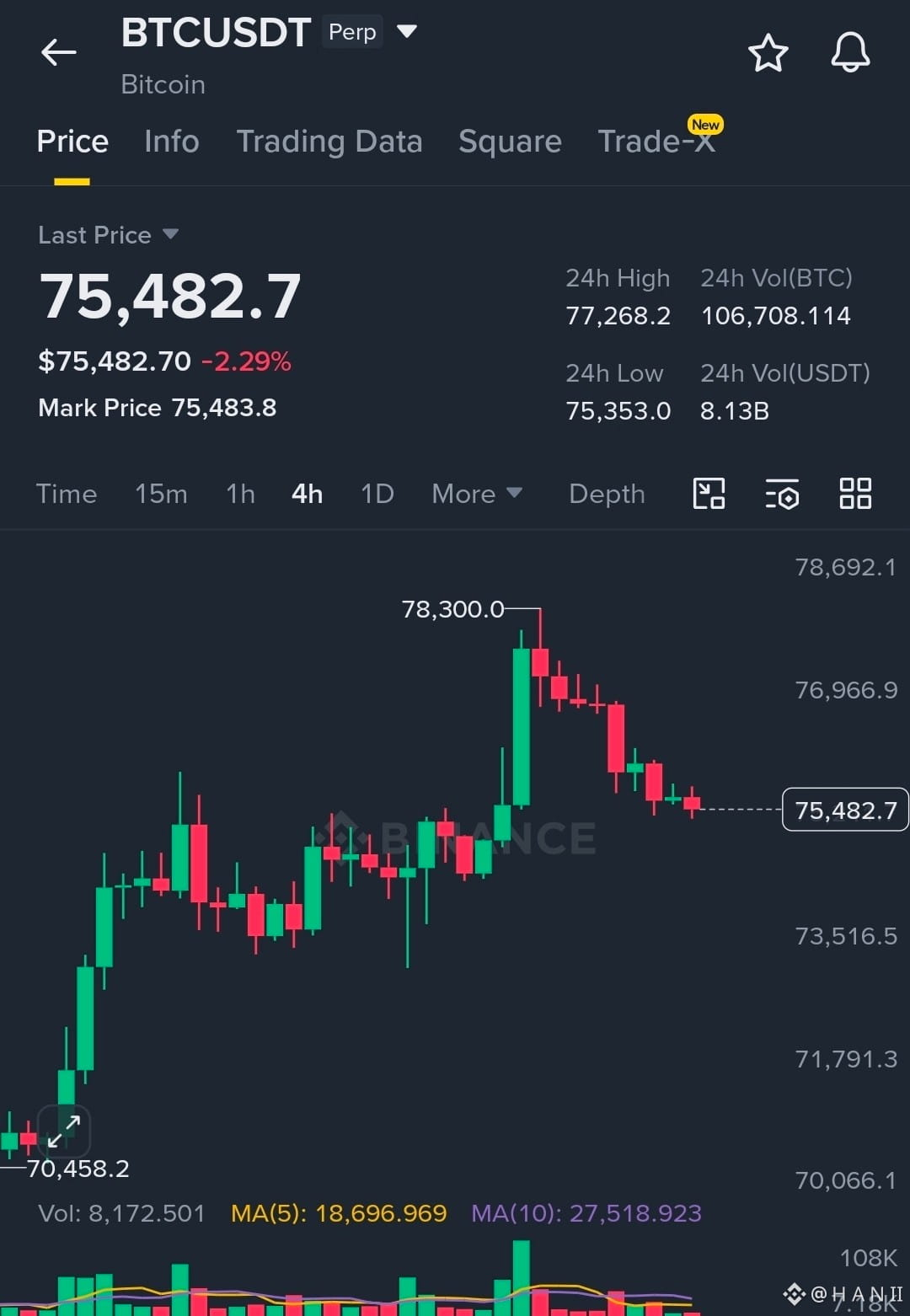
As mentioned earlier, $BTC can tap the 74K level if it dips. No need to panic at all stay calm.
This zone looks strong for a potential reversal, so just wait patiently. Since it’s low volume right now, moves can be slow.
A proper reversal and pump can come from this area
As mentioned earlier, $BTC can tap the 74K level if it dips. No need to panic at all stay calm.
This zone looks strong for a potential reversal, so just wait patiently. Since it’s low volume right now, moves can be slow.
A proper reversal and pump can come from this area
This zone looks strong for a potential reversal, so just wait patiently. Since it’s low volume right now, moves can be slow.
A proper reversal and pump can come from this area
1
2
115
·
--
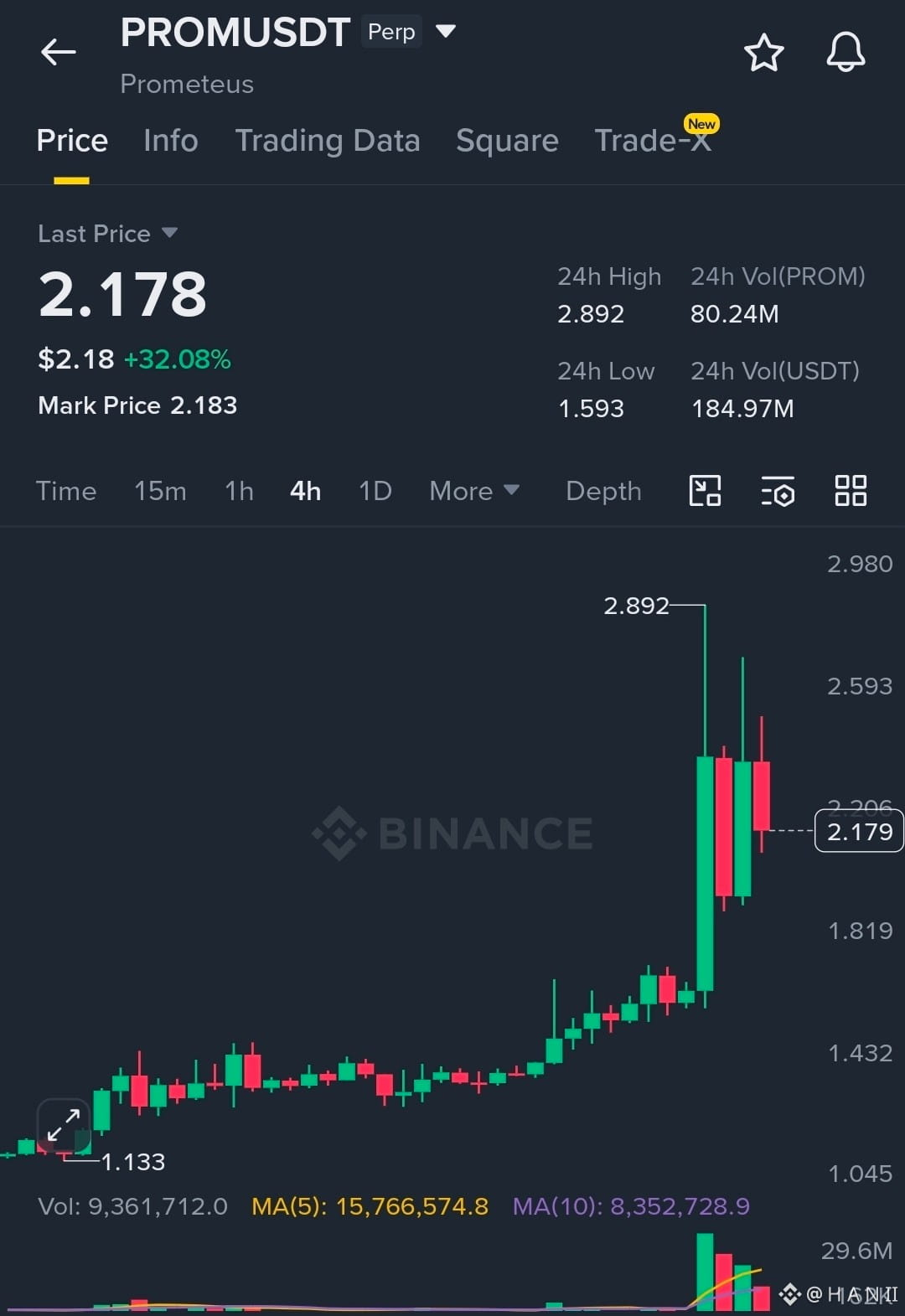
$PROM USDT is also one to watch. As price comes to retest the low of the green candle, we’ll look for an entry from that zone.
Wait for proper confirmation I’ll share the exact entry. No rush, no FOMO.
Stay patient for the best setup 🚀
$PROM USDT is also one to watch. As price comes to retest the low of the green candle, we’ll look for an entry from that zone.
Wait for proper confirmation I’ll share the exact entry. No rush, no FOMO.
Stay patient for the best setup 🚀
Wait for proper confirmation I’ll share the exact entry. No rush, no FOMO.
Stay patient for the best setup 🚀
2
172
·
--
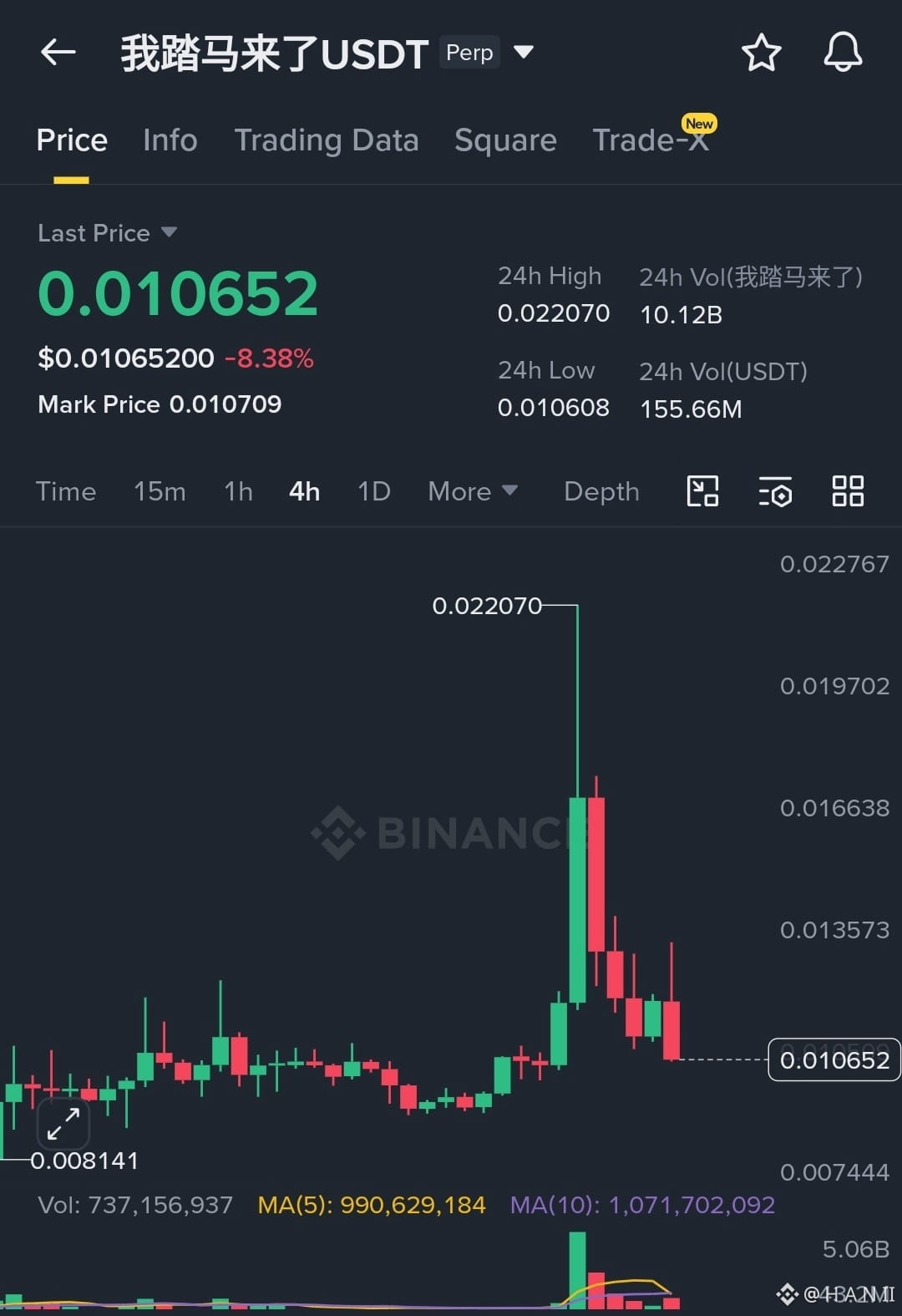
$我踏马来了 is looking good for a potential entry, but patience is key. Price is near the demand zone and may dip a bit more today.
Wait for proper confirmation I’ll share the entry, then you can follow. No rush, no FOMO.
🎯 Targets: 0.0135 → 0.0165 → 0.0200
Strong reward potential from this area if it holds
$我踏马来了 is looking good for a potential entry, but patience is key. Price is near the demand zone and may dip a bit more today.
Wait for proper confirmation I’ll share the entry, then you can follow. No rush, no FOMO.
🎯 Targets: 0.0135 → 0.0165 → 0.0200
Strong reward potential from this area if it holds
Wait for proper confirmation I’ll share the entry, then you can follow. No rush, no FOMO.
🎯 Targets: 0.0135 → 0.0165 → 0.0200
Strong reward potential from this area if it holds
2
385
·
--
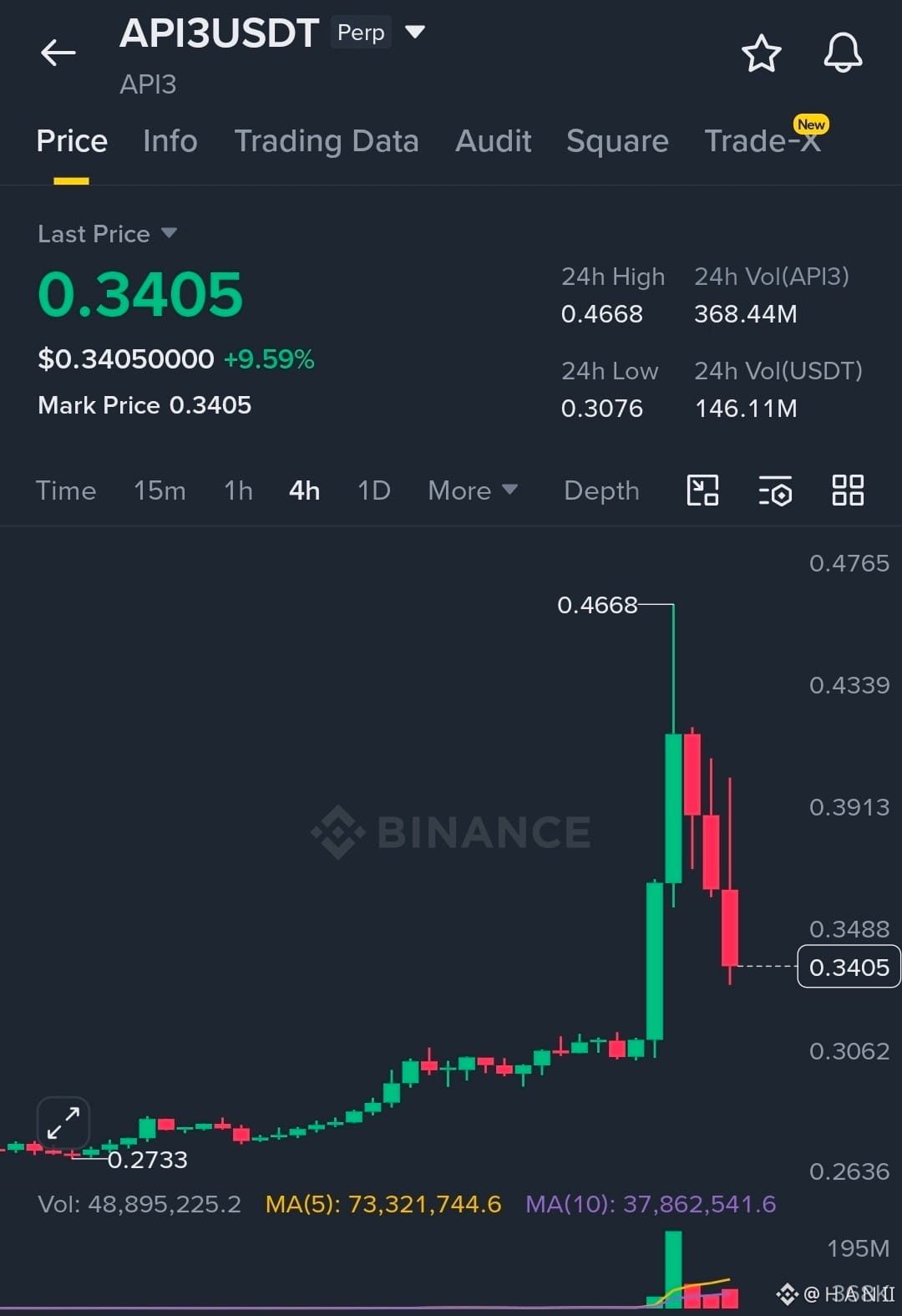
Keep $API3 on your watchlist. As price pulls back, look to catch it near the demand zone.
We’ll wait for proper confirmation before taking any entry.
I’ll share the exact entry, then you can follow no rush, no FOMO.
Patience = better trades
Keep $API3 on your watchlist. As price pulls back, look to catch it near the demand zone.
We’ll wait for proper confirmation before taking any entry.
I’ll share the exact entry, then you can follow no rush, no FOMO.
Patience = better trades
We’ll wait for proper confirmation before taking any entry.
I’ll share the exact entry, then you can follow no rush, no FOMO.
Patience = better trades
4
119
·
--
Рост
Hello my community, good morning everyone
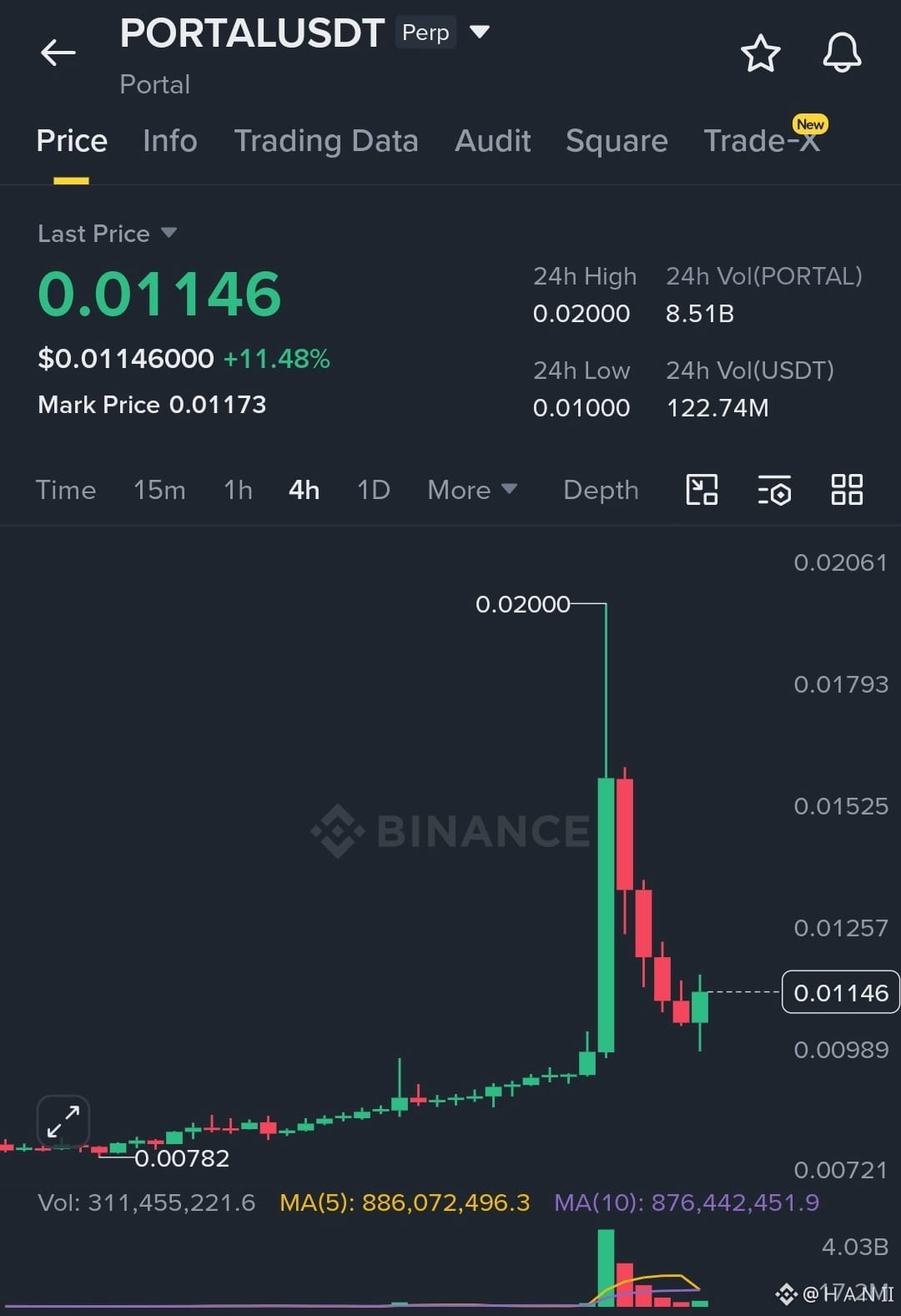
$PORTAL is slightly up but still giving a dip opportunity here. This area looks good to catch an entry.
Set your stop loss just below the green wick for safety.
🎯 Targets: 0.0130 → 0.0155 → 0.0180
Since it’s Sunday, if this zone holds today, Monday could bring a strong move up.
Wait for confirmation and only enter on a clean setup. Good RR from here
Hello my community, good morning everyone
$PORTAL is slightly up but still giving a dip opportunity here. This area looks good to catch an entry.
Set your stop loss just below the green wick for safety.
🎯 Targets: 0.0130 → 0.0155 → 0.0180
Since it’s Sunday, if this zone holds today, Monday could bring a strong move up.
Wait for confirmation and only enter on a clean setup. Good RR from here
$PORTAL is slightly up but still giving a dip opportunity here. This area looks good to catch an entry.
Set your stop loss just below the green wick for safety.
🎯 Targets: 0.0130 → 0.0155 → 0.0180
Since it’s Sunday, if this zone holds today, Monday could bring a strong move up.
Wait for confirmation and only enter on a clean setup. Good RR from here
1
202
Войдите, чтобы посмотреть больше материала
Присоединяйтесь к пользователям криптовалют по всему миру на Binance Square
⚡️ Получайте новейшую и полезную информацию о криптоактивах.
💬 Нам доверяет крупнейшая в мире криптобиржа.
👍 Получите достоверные аналитические данные от верифицированных создателей контента.
Эл. почта/номер телефона
В тренде
BitcoinParesGainsAfterRallyTo$86.5K
Просмотров: 8,684
56 обсуждают
🔥 $BTC on the Edge: $86K Showdown!
Nurul Hasnat Samir
·Лайков: 0
·Просмотров: 146
CerebrasSinksNearly20%OnReportNvidiaToPowerOpenAI
Просмотров: 18,231
264 обсуждают
SECProposesCryptoCustodyRules
Просмотров: 43,581
435 обсуждают