
las newr
27 Публикации

las newr
Отправить жалобу
Заблокировать пользователя
3 подписок(и/а)
2 подписчиков(а)
8 понравилось
Посты
·
--
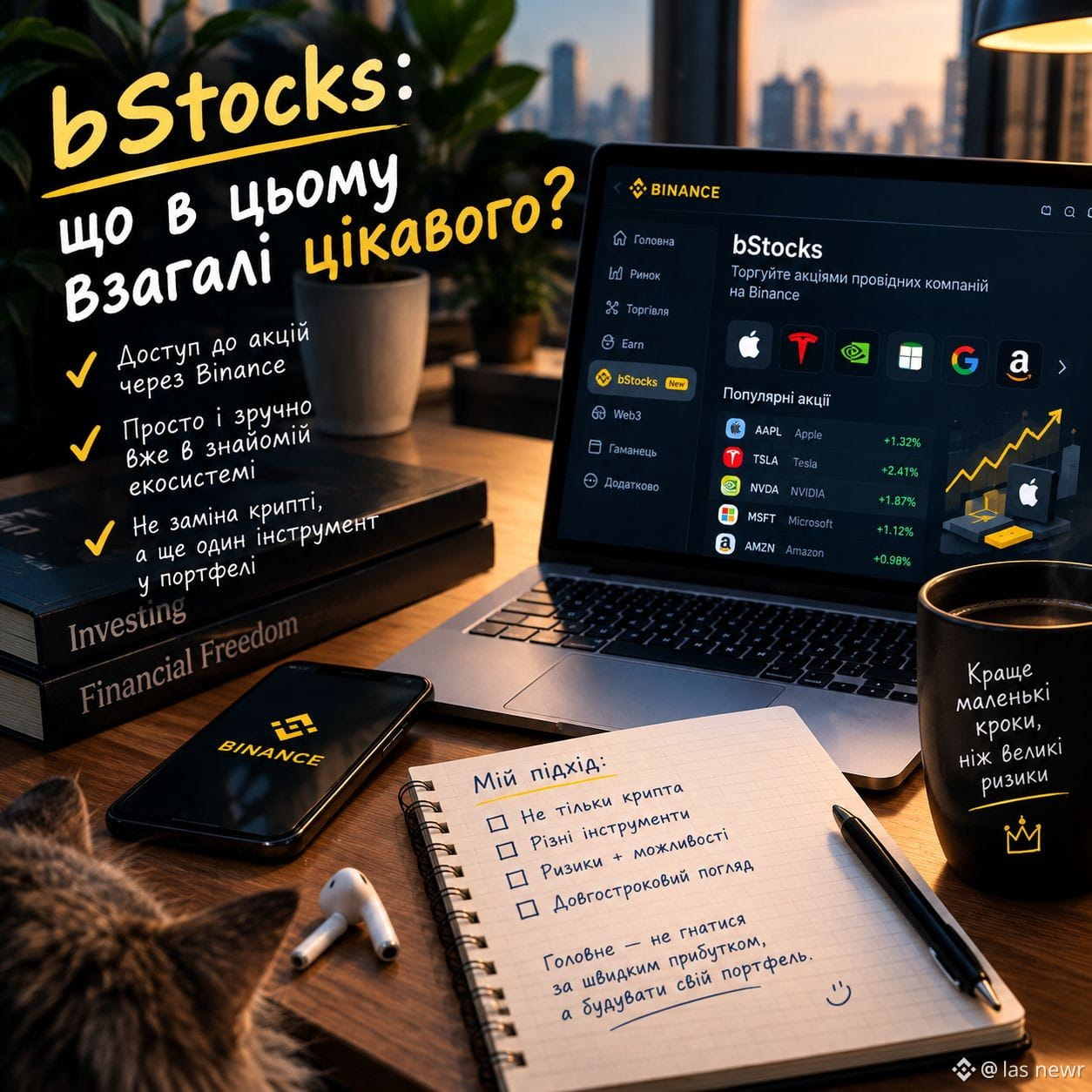
Раніше, коли чув про інвестиції в акції, уявляв собі окремого брокера, купу документів і ще один додаток, у якому треба розбиратися 😅
А тут мені сподобався сам підхід bStocks — доступ до традиційних акцій через звичну екосистему Binance.
Для мене найбільший плюс — простота.
Якщо я вже користуюся Binance для крипти, логічно хоча б розібратися, що ще можна робити всередині платформи.
Але є важливий момент: я б не сприймав це як «акції = гарантований прибуток».
Tesla, NVIDIA, Apple та інші великі компанії теж можуть падати. Іноді дуже неприємно 😄
Тому для мене bStocks — це не заміна крипті, а ще один інструмент, який можна використовувати разом з іншими.
#bStocks #Binance #акції #TradF #крипта
Раніше, коли чув про інвестиції в акції, уявляв собі окремого брокера, купу документів і ще один додаток, у якому треба розбиратися 😅
А тут мені сподобався сам підхід bStocks — доступ до традиційних акцій через звичну екосистему Binance.
Для мене найбільший плюс — простота.
Якщо я вже користуюся Binance для крипти, логічно хоча б розібратися, що ще можна робити всередині платформи.
Але є важливий момент: я б не сприймав це як «акції = гарантований прибуток».
Tesla, NVIDIA, Apple та інші великі компанії теж можуть падати. Іноді дуже неприємно 😄
Тому для мене bStocks — це не заміна крипті, а ще один інструмент, який можна використовувати разом з іншими.
#bStocks #Binance #акції #TradF #крипта
А тут мені сподобався сам підхід bStocks — доступ до традиційних акцій через звичну екосистему Binance.
Для мене найбільший плюс — простота.
Якщо я вже користуюся Binance для крипти, логічно хоча б розібратися, що ще можна робити всередині платформи.
Але є важливий момент: я б не сприймав це як «акції = гарантований прибуток».
Tesla, NVIDIA, Apple та інші великі компанії теж можуть падати. Іноді дуже неприємно 😄
Тому для мене bStocks — це не заміна крипті, а ще один інструмент, який можна використовувати разом з іншими.
#bStocks #Binance #акції #TradF #крипта
82
·
--
#termmax @termmax
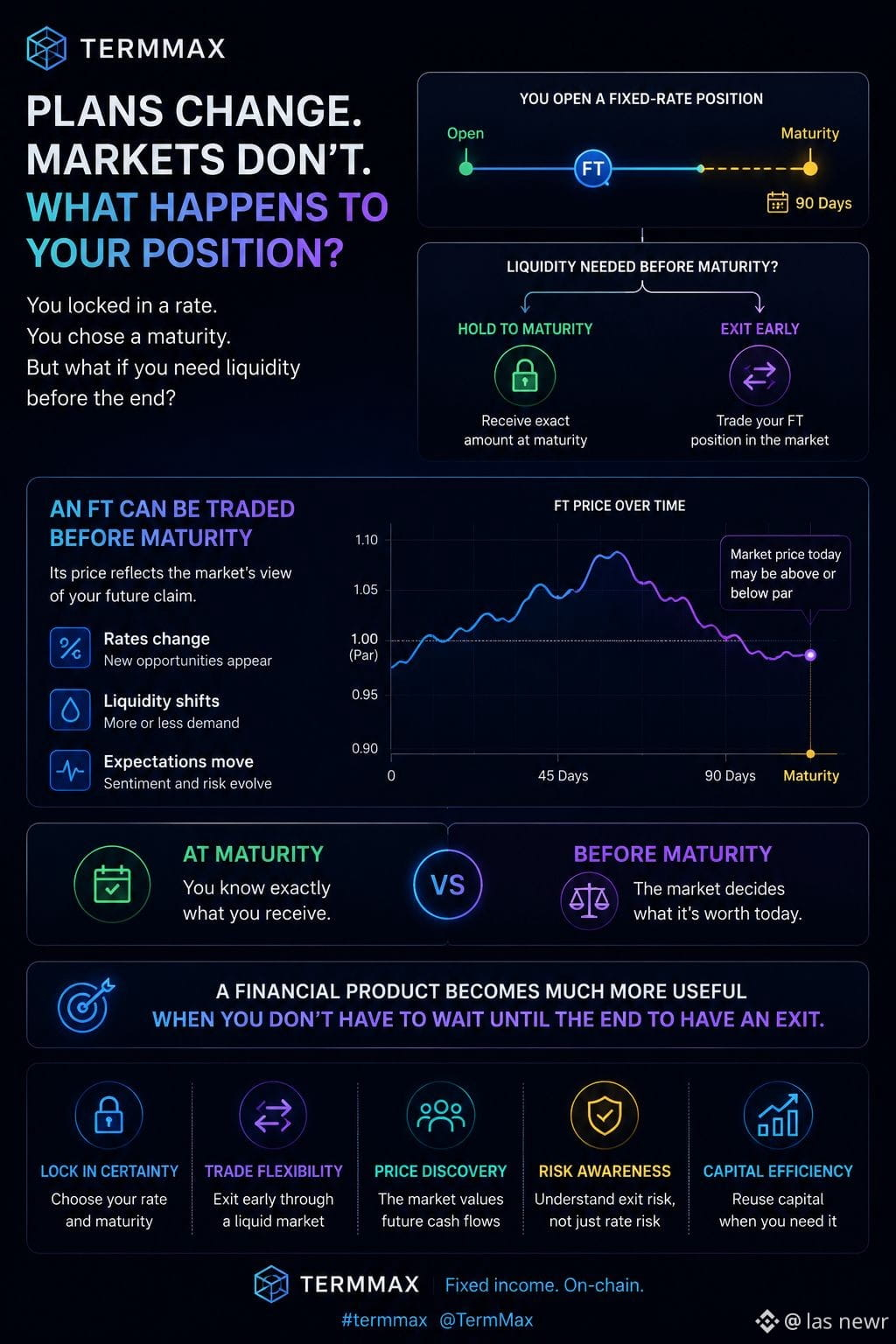
The part of fixed-rate DeFi I find hardest to ignore is what happens when plans change.
Entering a position is easy when everything goes according to plan.
You choose a rate.
You choose a maturity.
You deploy capital.
But markets rarely care about your original plan.
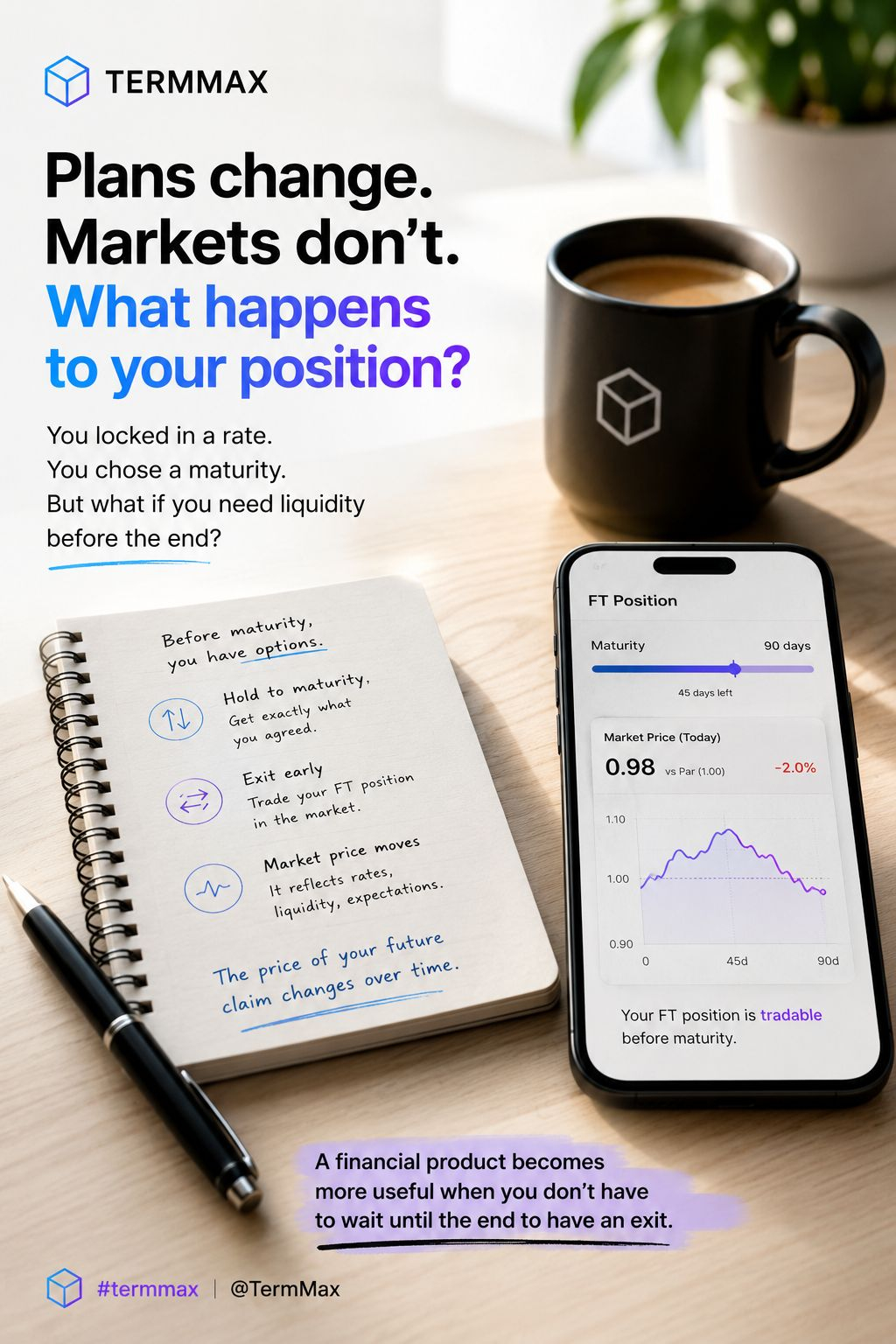
What if you suddenly need liquidity three weeks before maturity?
This is where I think the real test for TermMax begins.
A fixed-term position shouldn't only be attractive when you hold it until the end.
There needs to be a meaningful market for the position itself.
Because once an FT can be traded before maturity, its price starts telling a story.
The market is constantly asking:
How much is this future claim worth today?
And that price can move.
Rates can change.
Liquidity can disappear.
Expectations can shift.
So the FT becomes more than a way to lock in yield.
It becomes something whose value can be discovered in the market before its final settlement.
That's a much more interesting design to me.
It introduces a second layer of risk that isn't obvious from the headline APR:
exit risk.
You might know exactly what you receive at maturity.
But do you know what someone will be willing to pay for your position tomorrow?
That's where I think fixed-income DeFi gets genuinely interesting.
The next question isn't just whether TermMax can create fixed-rate products.
It's whether a healthy secondary market can form around them.
Because a financial product becomes much more useful when you don't have to wait until the end to have an exit.
#termmax @TermMax
The part of fixed-rate DeFi I find hardest to ignore is what happens when plans change.
Entering a position is easy when everything goes according to plan.
You choose a rate.
You choose a maturity.
You deploy capital.
But markets rarely care about your original plan.
What if you suddenly need liquidity three weeks before maturity?
This is where I think the real test for TermMax begins.
A fixed-term position shouldn't only be attractive when you hold it until the end.
There needs to be a meaningful market for the position itself.
Because once an FT can be traded before maturity, its price starts telling a story.
The market is constantly asking:
How much is this future claim worth today?
And that price can move.
Rates can change.
Liquidity can disappear.
Expectations can shift.
So the FT becomes more than a way to lock in yield.
It becomes something whose value can be discovered in the market before its final settlement.
That's a much more interesting design to me.
It introduces a second layer of risk that isn't obvious from the headline APR:
exit risk.
You might know exactly what you receive at maturity.
But do you know what someone will be willing to pay for your position tomorrow?
That's where I think fixed-income DeFi gets genuinely interesting.
The next question isn't just whether TermMax can create fixed-rate products.
It's whether a healthy secondary market can form around them.
Because a financial product becomes much more useful when you don't have to wait until the end to have an exit.
The part of fixed-rate DeFi I find hardest to ignore is what happens when plans change.
Entering a position is easy when everything goes according to plan.
You choose a rate.
You choose a maturity.
You deploy capital.
But markets rarely care about your original plan.
What if you suddenly need liquidity three weeks before maturity?
This is where I think the real test for TermMax begins.
A fixed-term position shouldn't only be attractive when you hold it until the end.
There needs to be a meaningful market for the position itself.
Because once an FT can be traded before maturity, its price starts telling a story.
The market is constantly asking:
How much is this future claim worth today?
And that price can move.
Rates can change.
Liquidity can disappear.
Expectations can shift.
So the FT becomes more than a way to lock in yield.
It becomes something whose value can be discovered in the market before its final settlement.
That's a much more interesting design to me.
It introduces a second layer of risk that isn't obvious from the headline APR:
exit risk.
You might know exactly what you receive at maturity.
But do you know what someone will be willing to pay for your position tomorrow?
That's where I think fixed-income DeFi gets genuinely interesting.
The next question isn't just whether TermMax can create fixed-rate products.
It's whether a healthy secondary market can form around them.
Because a financial product becomes much more useful when you don't have to wait until the end to have an exit.
92
·
--
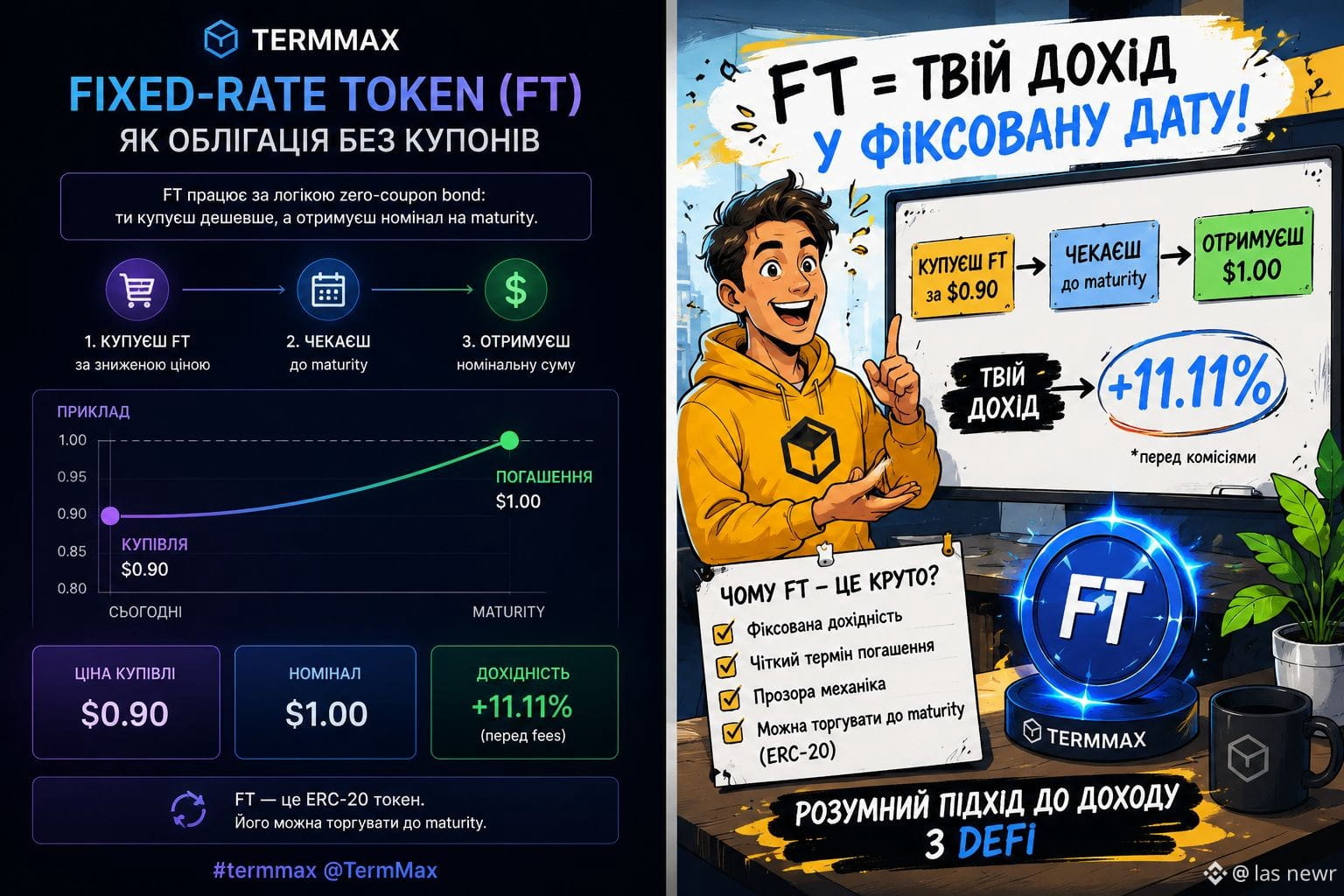
#termmax @termmax Я довго дивився на TermMax і зрозумів одну цікаву річ.
Його Fixed-rate Token (FT) можна сприймати майже як облігацію без купонних виплат.
Механіка проста:
Ти купуєш FT дешевше за його майбутню номінальну вартість.
Потім чекаєш maturity.
І в момент погашення отримуєш повну номінальну суму.
Наприклад:
FT коштує $0.90 сьогодні.
На maturity він погашається за $1.
Різниця між ціною покупки та номіналом — твій дохід.
І тут мені подобається сама ідея.
У DeFi ми звикли думати:
«Скільки APY я можу отримати?»
А TermMax дозволяє дивитися інакше:
«Скільки я заплачу сьогодні і скільки отримаю в конкретну дату?»
Це вже дуже схоже на логіку традиційних fixed-income інструментів, але реалізовану on-chain.
Причому FT — це ERC-20, тому його можна торгувати до maturity.
Тобто ти не обов'язково маєш просто купити й забути про нього до дати погашення.
На мій погляд, саме такі примітиви й можуть поступово зробити DeFi більш схожим на повноцінний фінансовий ринок.
Не черговий «вищий APY».
А новий спосіб структурувати дохід.
#termmax @TermMax Я довго дивився на TermMax і зрозумів одну цікаву річ.
Його Fixed-rate Token (FT) можна сприймати майже як облігацію без купонних виплат.
Механіка проста:
Ти купуєш FT дешевше за його майбутню номінальну вартість.
Потім чекаєш maturity.
І в момент погашення отримуєш повну номінальну суму.
Наприклад:
FT коштує $0.90 сьогодні.
На maturity він погашається за $1.
Різниця між ціною покупки та номіналом — твій дохід.
І тут мені подобається сама ідея.
У DeFi ми звикли думати:
«Скільки APY я можу отримати?»
А TermMax дозволяє дивитися інакше:
«Скільки я заплачу сьогодні і скільки отримаю в конкретну дату?»
Це вже дуже схоже на логіку традиційних fixed-income інструментів, але реалізовану on-chain.
Причому FT — це ERC-20, тому його можна торгувати до maturity.
Тобто ти не обов'язково маєш просто купити й забути про нього до дати погашення.
На мій погляд, саме такі примітиви й можуть поступово зробити DeFi більш схожим на повноцінний фінансовий ринок.
Не черговий «вищий APY».
А новий спосіб структурувати дохід.
Його Fixed-rate Token (FT) можна сприймати майже як облігацію без купонних виплат.
Механіка проста:
Ти купуєш FT дешевше за його майбутню номінальну вартість.
Потім чекаєш maturity.
І в момент погашення отримуєш повну номінальну суму.
Наприклад:
FT коштує $0.90 сьогодні.
На maturity він погашається за $1.
Різниця між ціною покупки та номіналом — твій дохід.
І тут мені подобається сама ідея.
У DeFi ми звикли думати:
«Скільки APY я можу отримати?»
А TermMax дозволяє дивитися інакше:
«Скільки я заплачу сьогодні і скільки отримаю в конкретну дату?»
Це вже дуже схоже на логіку традиційних fixed-income інструментів, але реалізовану on-chain.
Причому FT — це ERC-20, тому його можна торгувати до maturity.
Тобто ти не обов'язково маєш просто купити й забути про нього до дати погашення.
На мій погляд, саме такі примітиви й можуть поступово зробити DeFi більш схожим на повноцінний фінансовий ринок.
Не черговий «вищий APY».
А новий спосіб структурувати дохід.
87
·
--
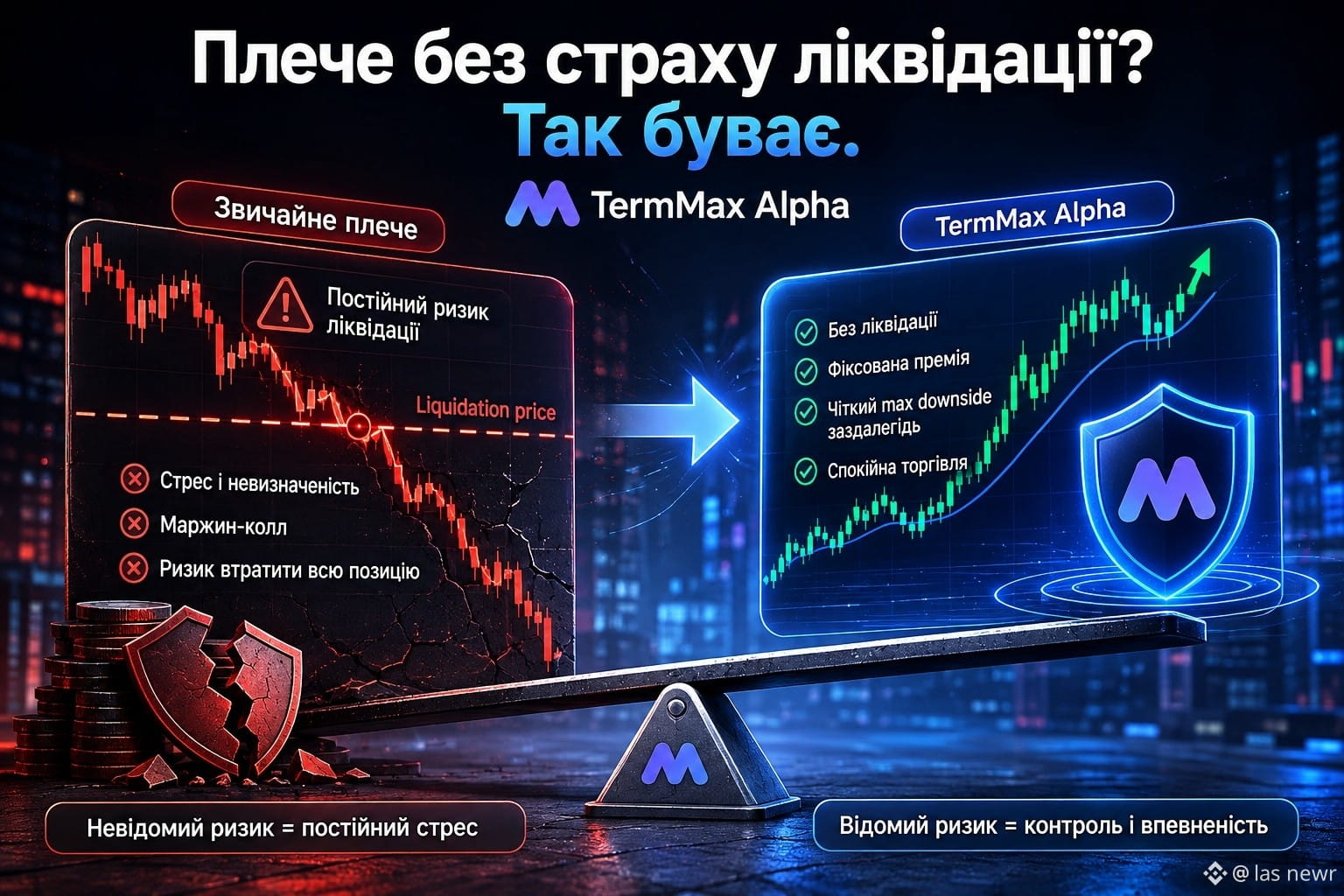
Є одна цифра, яку трейдери з плечем точно не хочуть бачити.
Liquidation price.
Ти можеш правильно спрогнозувати рух ETH, але короткий рух проти позиції — і вся угода закривається.
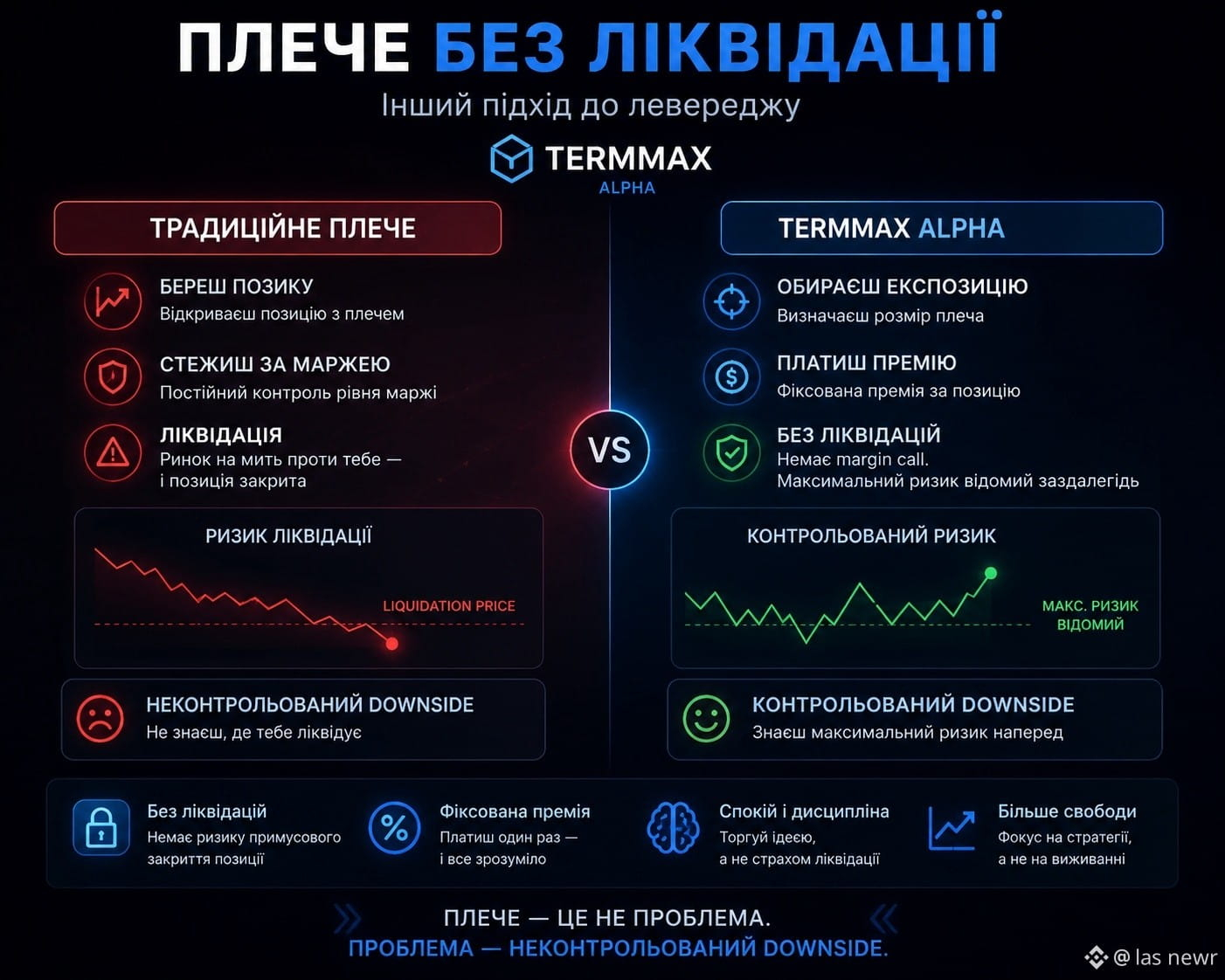
Саме тому мені цікавий підхід TermMax Alpha.
Тут ідея інша: замість постійного контролю маржі та ризику ліквідації ти заздалегідь платиш премію за плече.
Тобто логіка змінюється:
Звичайне плече: → відкрив позицію
→ стежиш за margin
→ переживаєш за liquidation price
TermMax Alpha: → обираєш експозицію
→ платиш премію
→ заздалегідь знаєш максимальний downside
І це змінює головне питання.
Не:
«Де мене ліквідує?»
А:
«Чи варта ця угода тієї премії, яку я плачу?»
Для волатильного ринку це, на мій погляд, набагато цікавіший підхід.
Проблема плеча не завжди в самому плечі.
Проблема — у неконтрольованому downside.
#termmax @termmax
{spot}(ETHUSDT)
Є одна цифра, яку трейдери з плечем точно не хочуть бачити.
Liquidation price.
Ти можеш правильно спрогнозувати рух ETH, але короткий рух проти позиції — і вся угода закривається.
Саме тому мені цікавий підхід TermMax Alpha.
Тут ідея інша: замість постійного контролю маржі та ризику ліквідації ти заздалегідь платиш премію за плече.
Тобто логіка змінюється:
Звичайне плече: → відкрив позицію
→ стежиш за margin
→ переживаєш за liquidation price
TermMax Alpha: → обираєш експозицію
→ платиш премію
→ заздалегідь знаєш максимальний downside
І це змінює головне питання.
Не:
«Де мене ліквідує?»
А:
«Чи варта ця угода тієї премії, яку я плачу?»
Для волатильного ринку це, на мій погляд, набагато цікавіший підхід.
Проблема плеча не завжди в самому плечі.
Проблема — у неконтрольованому downside.
#termmax @TermMax
Liquidation price.
Ти можеш правильно спрогнозувати рух ETH, але короткий рух проти позиції — і вся угода закривається.
Саме тому мені цікавий підхід TermMax Alpha.
Тут ідея інша: замість постійного контролю маржі та ризику ліквідації ти заздалегідь платиш премію за плече.
Тобто логіка змінюється:
Звичайне плече: → відкрив позицію
→ стежиш за margin
→ переживаєш за liquidation price
TermMax Alpha: → обираєш експозицію
→ платиш премію
→ заздалегідь знаєш максимальний downside
І це змінює головне питання.
Не:
«Де мене ліквідує?»
А:
«Чи варта ця угода тієї премії, яку я плачу?»
Для волатильного ринку це, на мій погляд, набагато цікавіший підхід.
Проблема плеча не завжди в самому плечі.
Проблема — у неконтрольованому downside.
#termmax @TermMax
282
·
--
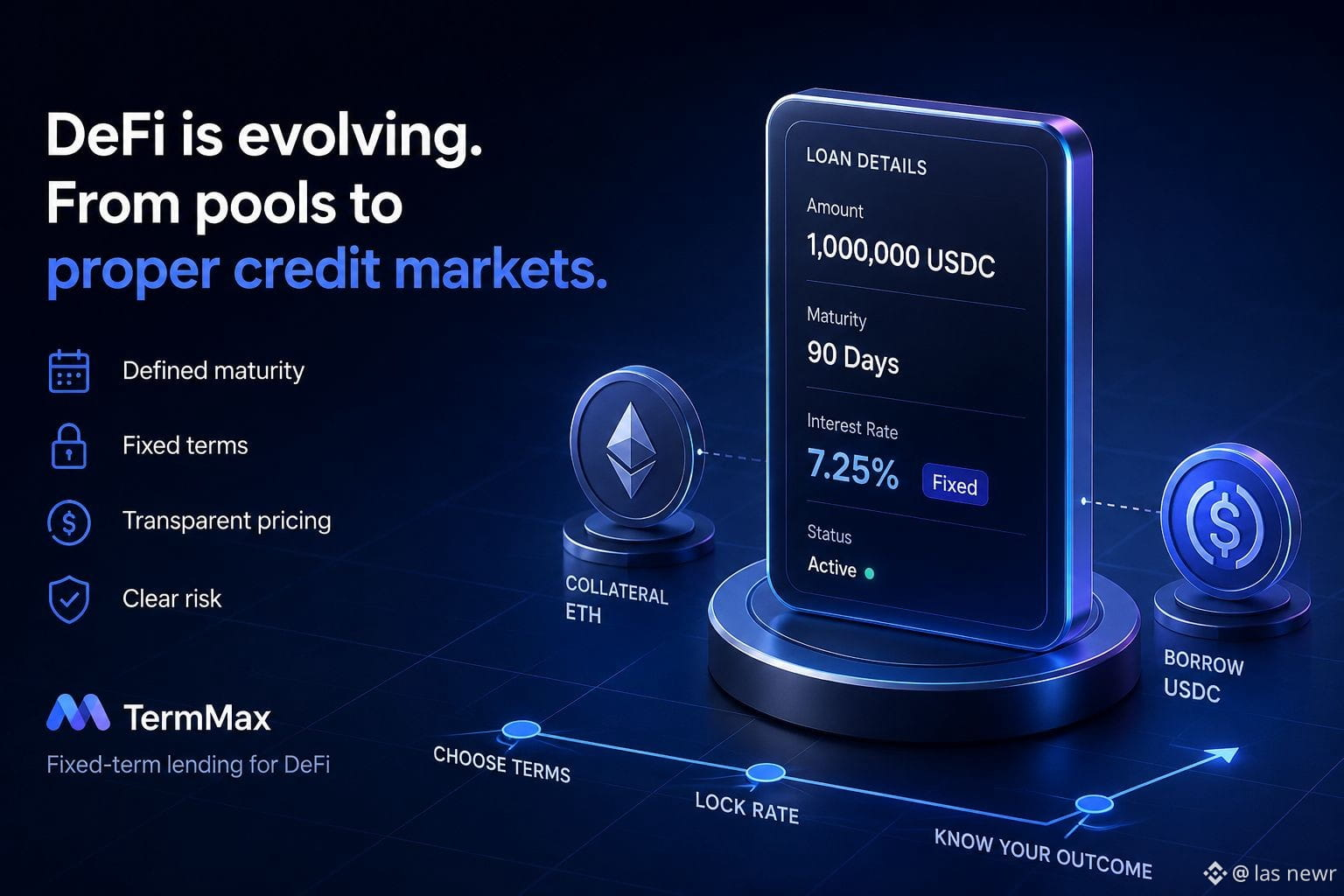
Most DeFi lending starts with one assumption:
your collateral is the interesting part.
I think the more interesting part is actually the loan itself.
A loan has a size. A maturity. A price. A risk profile.
Traditional finance has spent decades building markets around those parameters.
DeFi is still experimenting with them.
That’s why TermMax caught my attention.
Instead of treating lending as an endless position where the rate keeps changing, TermMax structures loans around specific maturities and fixed terms.
That opens up a different way to think about on-chain credit.
You can compare financing costs.
You can build strategies around a known maturity.
And lenders can choose exposure based on a defined term instead of simply depositing into an open-ended pool.
The interesting question isn't:
“Can DeFi lend money?”
We already know the answer.
The bigger question is:
Can DeFi build a proper credit market?
TermMax is one of the projects trying to answer that.
And honestly, I think this part of DeFi deserves much more attention.
#termmax @termmax
Most DeFi lending starts with one assumption:
your collateral is the interesting part.
I think the more interesting part is actually the loan itself.
A loan has a size. A maturity. A price. A risk profile.
Traditional finance has spent decades building markets around those parameters.
DeFi is still experimenting with them.
That’s why TermMax caught my attention.
Instead of treating lending as an endless position where the rate keeps changing, TermMax structures loans around specific maturities and fixed terms.
That opens up a different way to think about on-chain credit.
You can compare financing costs.
You can build strategies around a known maturity.
And lenders can choose exposure based on a defined term instead of simply depositing into an open-ended pool.
The interesting question isn't:
“Can DeFi lend money?”
We already know the answer.
The bigger question is:
Can DeFi build a proper credit market?
TermMax is one of the projects trying to answer that.
And honestly, I think this part of DeFi deserves much more attention.
#termmax @TermMax
your collateral is the interesting part.
I think the more interesting part is actually the loan itself.
A loan has a size. A maturity. A price. A risk profile.
Traditional finance has spent decades building markets around those parameters.
DeFi is still experimenting with them.
That’s why TermMax caught my attention.
Instead of treating lending as an endless position where the rate keeps changing, TermMax structures loans around specific maturities and fixed terms.
That opens up a different way to think about on-chain credit.
You can compare financing costs.
You can build strategies around a known maturity.
And lenders can choose exposure based on a defined term instead of simply depositing into an open-ended pool.
The interesting question isn't:
“Can DeFi lend money?”
We already know the answer.
The bigger question is:
Can DeFi build a proper credit market?
TermMax is one of the projects trying to answer that.
And honestly, I think this part of DeFi deserves much more attention.
#termmax @TermMax
62
·
--
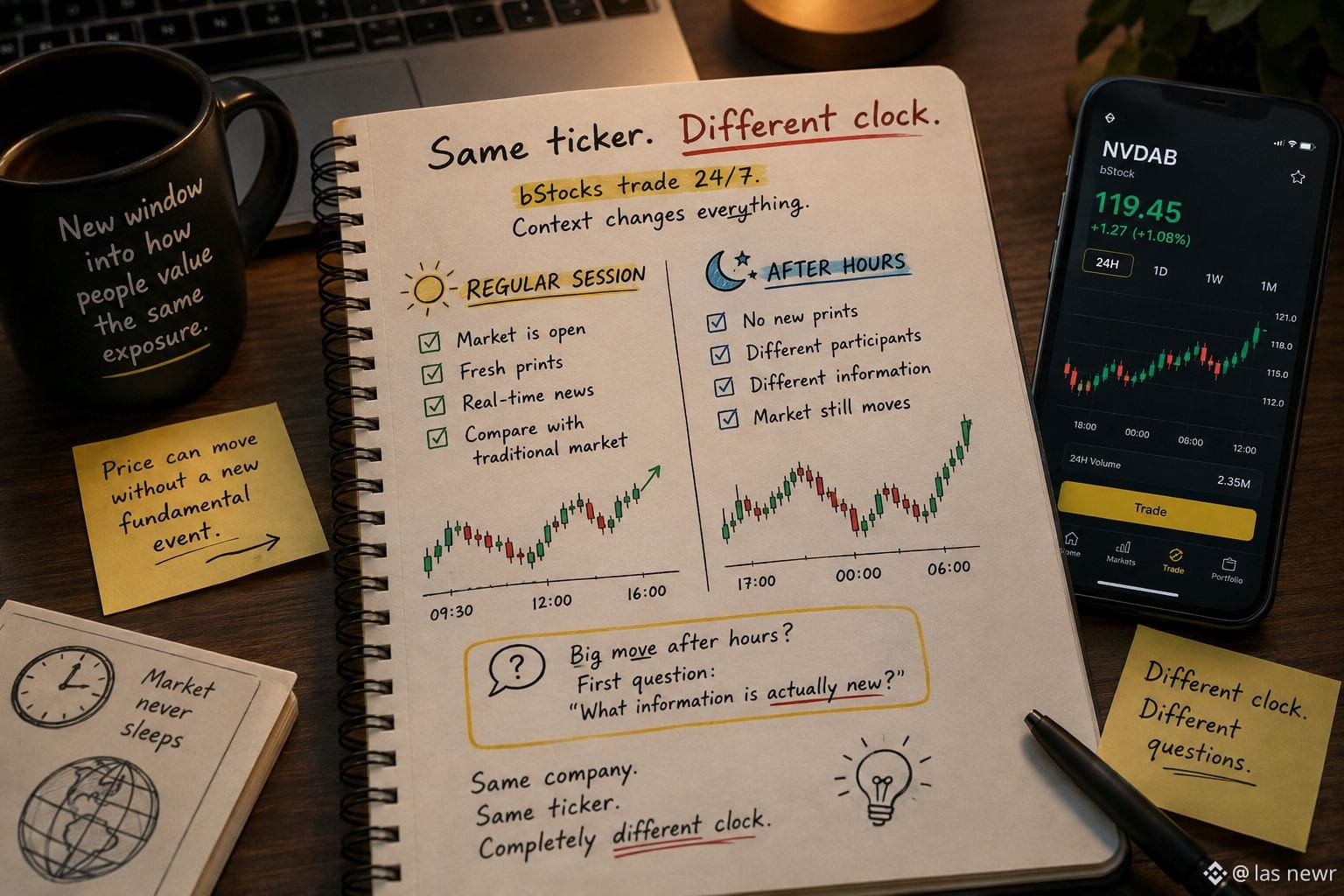
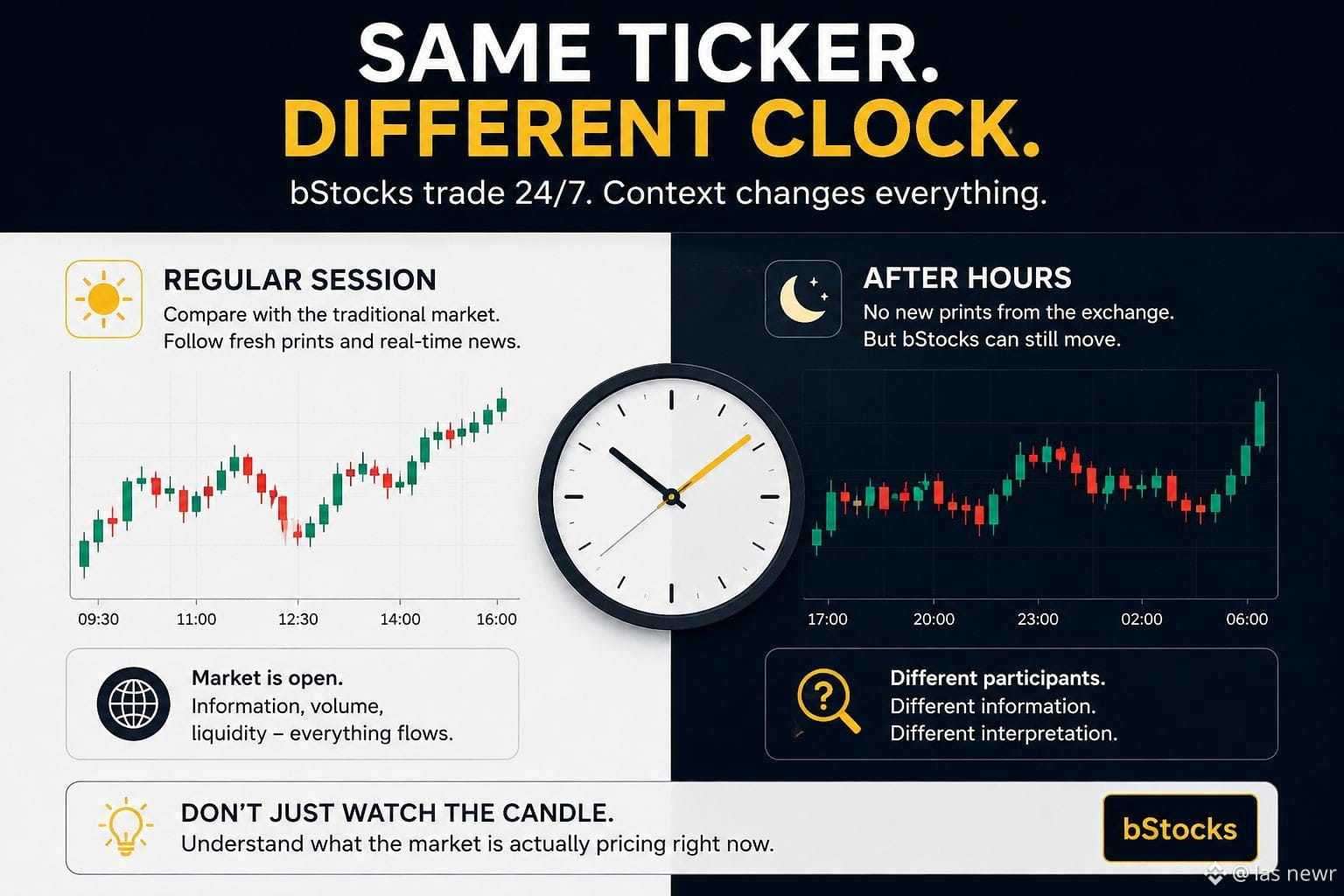
I noticed something funny about bStocks.
The ticker can stay exactly the same, but the way I look at the position changes completely depending on the time of day.
During the regular stock session, I naturally compare the price with what I see on the traditional market.
Later, the question becomes different.
There may be no fresh print from the underlying exchange, but the bStock market is still moving.
So what exactly am I looking at?
Not necessarily “the stock moving again.”
Sometimes I'm looking at a market trying to price the latest available information with a different set of participants.
That made me stop treating the chart like a normal stock chart.
Now, when I see an unusual move outside regular hours, my first reaction isn't:
“Something happened to the company.”
It's:
“What information is actually new?”
If the answer is “nothing,” I become much more careful about attaching a story to the candle.
A price can move without a new fundamental event.
And a quiet chart doesn't mean the market has stopped thinking.
That's probably one of the strangest things about having a traditional asset represented in a market that doesn't sleep.
Same company.
Same ticker.
Completely different clock.
Do you pay attention to the time when you see a big bStock move?$
$NVDAB
#bstockscis @BinanceCIS
{spot}(NVDABUSDT)
I noticed something funny about bStocks.
The ticker can stay exactly the same, but the way I look at the position changes completely depending on the time of day.
During the regular stock session, I naturally compare the price with what I see on the traditional market.
Later, the question becomes different.
There may be no fresh print from the underlying exchange, but the bStock market is still moving.
So what exactly am I looking at?
Not necessarily “the stock moving again.”
Sometimes I'm looking at a market trying to price the latest available information with a different set of participants.
That made me stop treating the chart like a normal stock chart.
Now, when I see an unusual move outside regular hours, my first reaction isn't:
“Something happened to the company.”
It's:
“What information is actually new?”
If the answer is “nothing,” I become much more careful about attaching a story to the candle.
A price can move without a new fundamental event.
And a quiet chart doesn't mean the market has stopped thinking.
That's probably one of the strangest things about having a traditional asset represented in a market that doesn't sleep.
Same company.
Same ticker.
Completely different clock.
Do you pay attention to the time when you see a big bStock move?$
$NVDAB
#bstockscis @BinanceCIS
The ticker can stay exactly the same, but the way I look at the position changes completely depending on the time of day.
During the regular stock session, I naturally compare the price with what I see on the traditional market.
Later, the question becomes different.
There may be no fresh print from the underlying exchange, but the bStock market is still moving.
So what exactly am I looking at?
Not necessarily “the stock moving again.”
Sometimes I'm looking at a market trying to price the latest available information with a different set of participants.
That made me stop treating the chart like a normal stock chart.
Now, when I see an unusual move outside regular hours, my first reaction isn't:
“Something happened to the company.”
It's:
“What information is actually new?”
If the answer is “nothing,” I become much more careful about attaching a story to the candle.
A price can move without a new fundamental event.
And a quiet chart doesn't mean the market has stopped thinking.
That's probably one of the strangest things about having a traditional asset represented in a market that doesn't sleep.
Same company.
Same ticker.
Completely different clock.
Do you pay attention to the time when you see a big bStock move?$
$NVDAB
#bstockscis @BinanceCIS
1
1
88
·
--
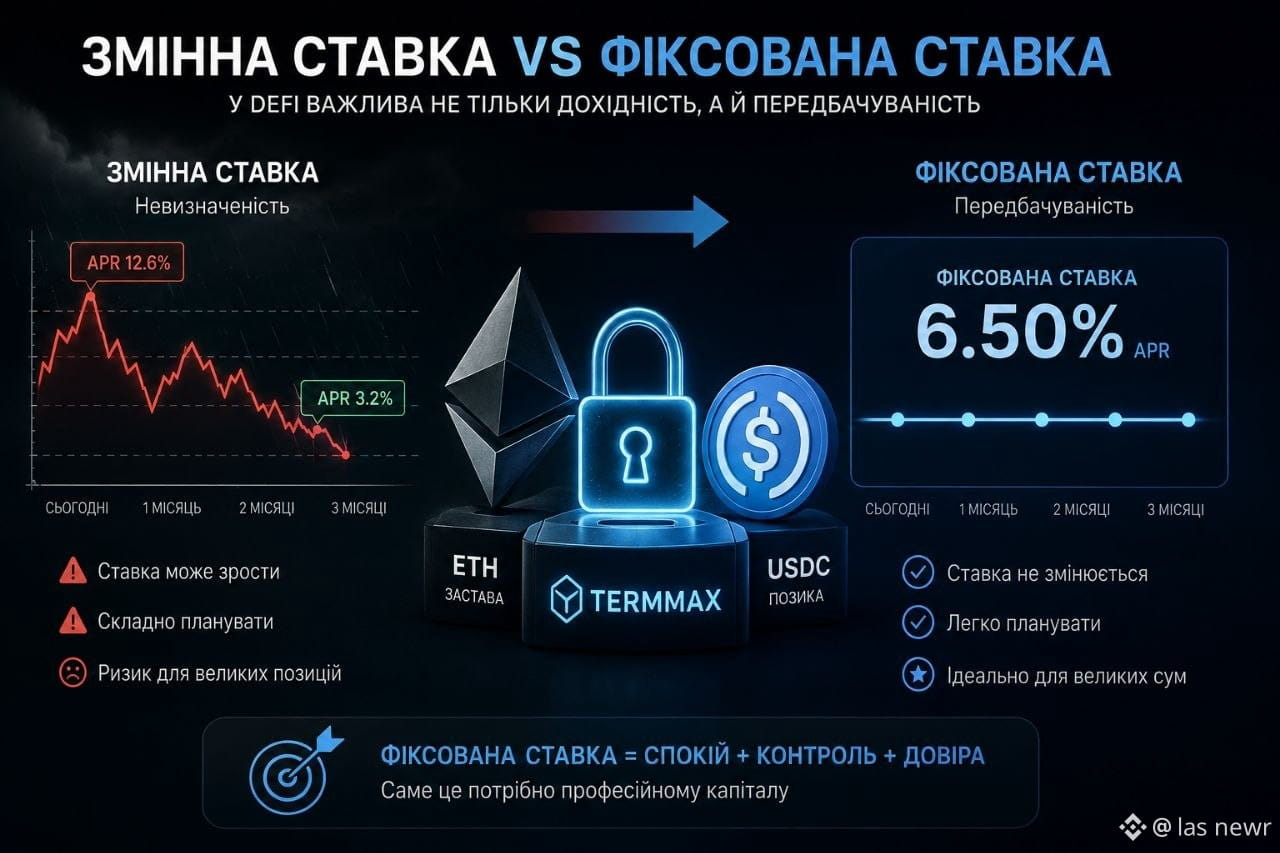
У DeFi є одна дивна проблема.
Ми навчилися знаходити прибутковість, але досі не завжди вміємо нормально планувати ризик.
Наприклад, ти хочеш позичити USDC під заставу ETH на 3 місяці.
Зі змінною ставкою все може виглядати добре сьогодні.
Але що буде через місяць?
Ставка може змінитися разом із попитом на позики та ліквідністю.
Саме тому мені цікавий підхід TermMax.
Тут позика має термін погашення і фіксовану ставку.
Тобто ти не просто дивишся на цифру APY зараз — ти можеш заздалегідь розуміти економіку всієї позиції.
І це особливо цікаво для великих позицій.
Чим більша сума, тим дорожче може коштувати помилка у прогнозі ставки.
Мені здається, що fixed-rate DeFi може стати набагато важливішим, коли в протоколи прийде більше професійного капіталу.
Бо професійним гравцям потрібен не тільки yield.
Їм потрібна передбачуваність.
І саме тут TermMax виглядає цікаво.
А ти користувався б DeFi-позикою з фіксованою ставкою?
#termmax @termmax
У DeFi є одна дивна проблема.
Ми навчилися знаходити прибутковість, але досі не завжди вміємо нормально планувати ризик.
Наприклад, ти хочеш позичити USDC під заставу ETH на 3 місяці.
Зі змінною ставкою все може виглядати добре сьогодні.
Але що буде через місяць?
Ставка може змінитися разом із попитом на позики та ліквідністю.
Саме тому мені цікавий підхід TermMax.
Тут позика має термін погашення і фіксовану ставку.
Тобто ти не просто дивишся на цифру APY зараз — ти можеш заздалегідь розуміти економіку всієї позиції.
І це особливо цікаво для великих позицій.
Чим більша сума, тим дорожче може коштувати помилка у прогнозі ставки.
Мені здається, що fixed-rate DeFi може стати набагато важливішим, коли в протоколи прийде більше професійного капіталу.
Бо професійним гравцям потрібен не тільки yield.
Їм потрібна передбачуваність.
І саме тут TermMax виглядає цікаво.
А ти користувався б DeFi-позикою з фіксованою ставкою?
#termmax @TermMax
Ми навчилися знаходити прибутковість, але досі не завжди вміємо нормально планувати ризик.
Наприклад, ти хочеш позичити USDC під заставу ETH на 3 місяці.
Зі змінною ставкою все може виглядати добре сьогодні.
Але що буде через місяць?
Ставка може змінитися разом із попитом на позики та ліквідністю.
Саме тому мені цікавий підхід TermMax.
Тут позика має термін погашення і фіксовану ставку.
Тобто ти не просто дивишся на цифру APY зараз — ти можеш заздалегідь розуміти економіку всієї позиції.
І це особливо цікаво для великих позицій.
Чим більша сума, тим дорожче може коштувати помилка у прогнозі ставки.
Мені здається, що fixed-rate DeFi може стати набагато важливішим, коли в протоколи прийде більше професійного капіталу.
Бо професійним гравцям потрібен не тільки yield.
Їм потрібна передбачуваність.
І саме тут TermMax виглядає цікаво.
А ти користувався б DeFi-позикою з фіксованою ставкою?
#termmax @TermMax
72
·
--
Рост
I used to think the most important question with a tokenized stock was simply:
“Does the token follow the stock?”
Now I think there’s a better question.
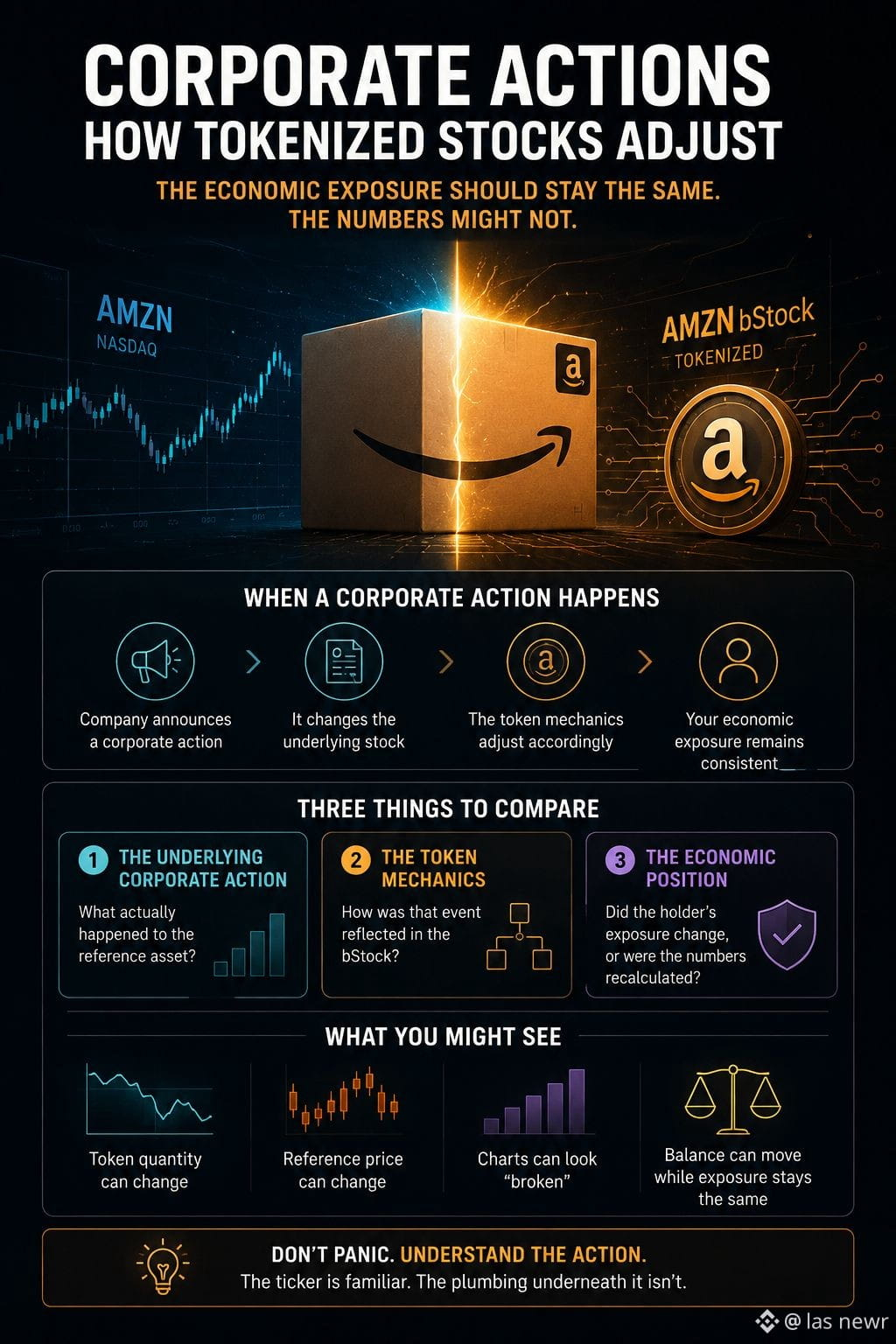
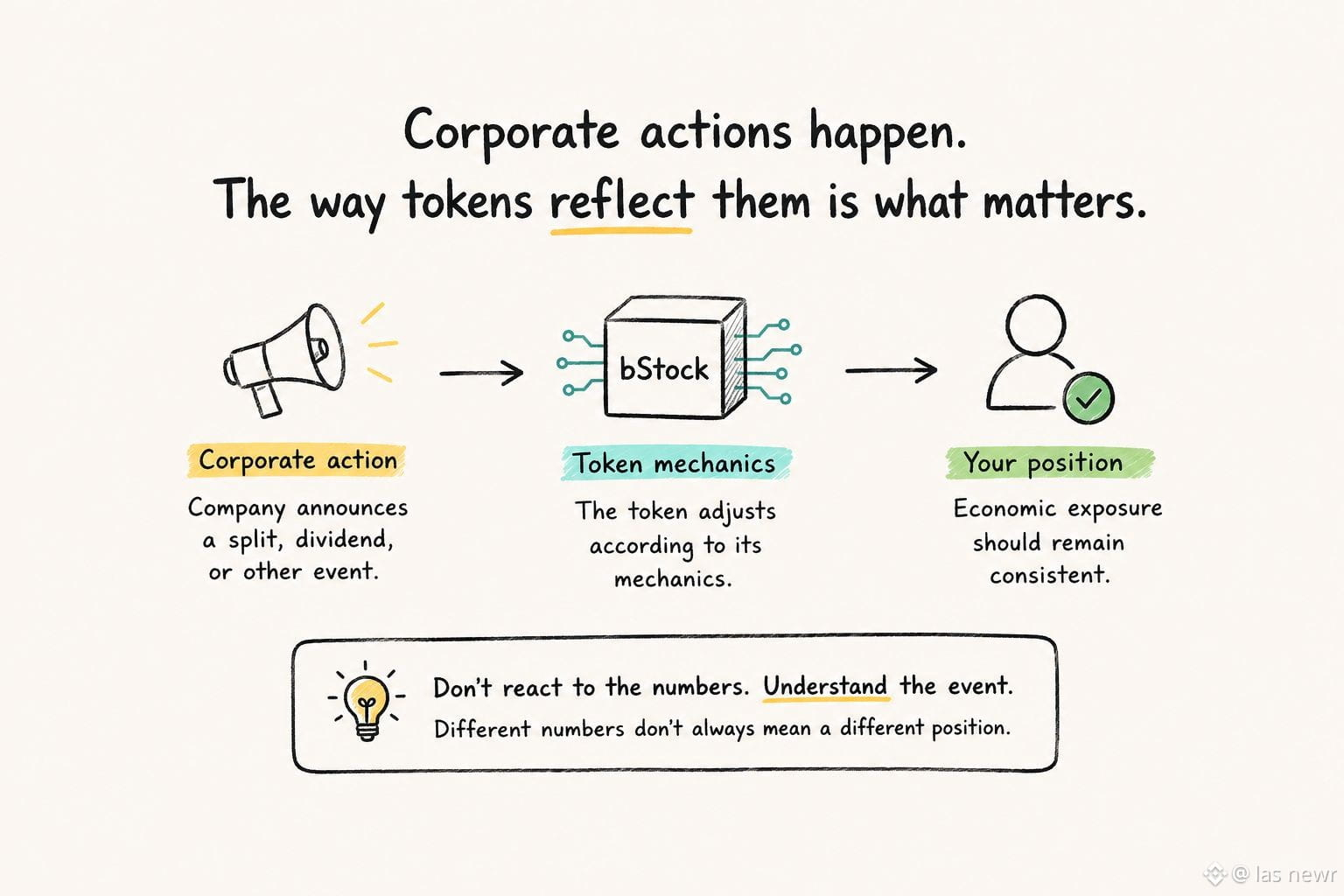
“What exactly happens when the underlying stock changes its structure?”
Take #AMZN as an example.
Imagine Amazon announces a corporate action that changes the number of shares, the economic value per share, or the way the underlying security is represented.
With a normal stock position, the broker handles the adjustment in the background.
With a bStock, I would want to understand how that adjustment appears on the token side.
Not because something is necessarily wrong.
Actually, the opposite.
A clean adjustment can make the token look strange for a short period:
the token quantity can change;
the reference price can change;
historical charts can suddenly look “broken”;
the displayed balance can move even when the economic exposure was intended to remain consistent.
That is why I wouldn’t judge a tokenized stock by looking at one number before and after a corporate action.
I’d compare three things:
1. The underlying corporate action
What actually happened to the reference asset?
2. The token mechanics
How was that event reflected in the bStock?
3. The economic position
Did the holder’s exposure change, or did the numbers simply get recalculated?
This distinction is easy to miss.
A chart can show a dramatic move while the economic position barely changes.
And the reverse can also happen: the displayed price may look normal while the mechanics underneath deserve a closer look.
That’s probably the part of tokenized markets I find most interesting.
The ticker is familiar.
The plumbing underneath it isn't.
So when I see something unusual around #AMZN, my first reaction wouldn't be “the token is broken.”
I'd ask:
“What changed in the underlying asset, and how did the tokenization layer translate it?”$MSFTB
#bstockscis @BinanceCIS
I used to think the most important question with a tokenized stock was simply:
“Does the token follow the stock?”
Now I think there’s a better question.
“What exactly happens when the underlying stock changes its structure?”
Take #AMZN as an example.
Imagine Amazon announces a corporate action that changes the number of shares, the economic value per share, or the way the underlying security is represented.
With a normal stock position, the broker handles the adjustment in the background.
With a bStock, I would want to understand how that adjustment appears on the token side.
Not because something is necessarily wrong.
Actually, the opposite.
A clean adjustment can make the token look strange for a short period:
the token quantity can change;
the reference price can change;
historical charts can suddenly look “broken”;
the displayed balance can move even when the economic exposure was intended to remain consistent.
That is why I wouldn’t judge a tokenized stock by looking at one number before and after a corporate action.
I’d compare three things:
1. The underlying corporate action
What actually happened to the reference asset?
2. The token mechanics
How was that event reflected in the bStock?
3. The economic position
Did the holder’s exposure change, or did the numbers simply get recalculated?
This distinction is easy to miss.
A chart can show a dramatic move while the economic position barely changes.
And the reverse can also happen: the displayed price may look normal while the mechanics underneath deserve a closer look.
That’s probably the part of tokenized markets I find most interesting.
The ticker is familiar.
The plumbing underneath it isn't.
So when I see something unusual around #AMZN, my first reaction wouldn't be “the token is broken.”
I'd ask:
“What changed in the underlying asset, and how did the tokenization layer translate it?”$MSFTB
#bstockscis @BinanceCIS
“Does the token follow the stock?”
Now I think there’s a better question.
“What exactly happens when the underlying stock changes its structure?”
Take #AMZN as an example.
Imagine Amazon announces a corporate action that changes the number of shares, the economic value per share, or the way the underlying security is represented.
With a normal stock position, the broker handles the adjustment in the background.
With a bStock, I would want to understand how that adjustment appears on the token side.
Not because something is necessarily wrong.
Actually, the opposite.
A clean adjustment can make the token look strange for a short period:
the token quantity can change;
the reference price can change;
historical charts can suddenly look “broken”;
the displayed balance can move even when the economic exposure was intended to remain consistent.
That is why I wouldn’t judge a tokenized stock by looking at one number before and after a corporate action.
I’d compare three things:
1. The underlying corporate action
What actually happened to the reference asset?
2. The token mechanics
How was that event reflected in the bStock?
3. The economic position
Did the holder’s exposure change, or did the numbers simply get recalculated?
This distinction is easy to miss.
A chart can show a dramatic move while the economic position barely changes.
And the reverse can also happen: the displayed price may look normal while the mechanics underneath deserve a closer look.
That’s probably the part of tokenized markets I find most interesting.
The ticker is familiar.
The plumbing underneath it isn't.
So when I see something unusual around #AMZN, my first reaction wouldn't be “the token is broken.”
I'd ask:
“What changed in the underlying asset, and how did the tokenization layer translate it?”$MSFTB
#bstockscis @BinanceCIS
1
1
73
·
--
I used to think the interesting part of tokenized stocks was simply being able to trade them outside traditional market hours.
Then I started looking at it from a different angle.
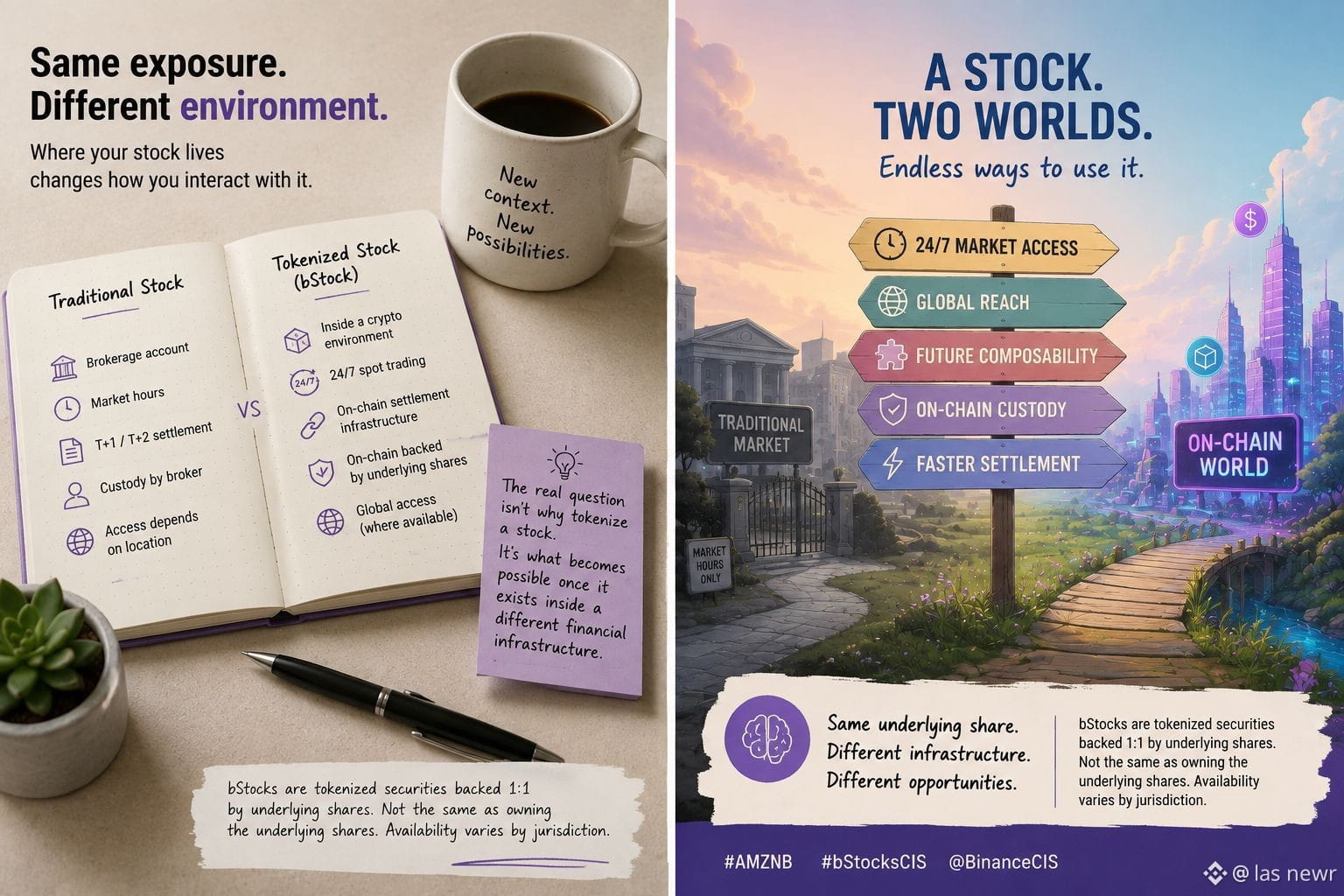
The bigger change may be where the asset lives in the investor’s workflow.
A traditional stock usually sits inside a brokerage account.
A bStock sits inside a crypto environment.
That sounds like a small technical distinction.
It isn't.
With a tokenized security, the same market participant who already manages USDT, BNB or other digital assets can encounter an equity-linked instrument without completely switching financial environments.
That changes the context in which the asset can be used.
And this is where I think tokenization gets more interesting.
Not:
“Stocks, but on a blockchain.”
More like:
“What happens when an equity-linked asset becomes part of an on-chain financial ecosystem?”
That opens a much bigger discussion around settlement, custody, portability and eventually composability.
Of course, a bStock is not the same thing as directly owning the underlying company’s shares. It is a tokenized security backed 1:1 by an underlying share, and availability depends on jurisdiction. �
Binance Academy +1
For me, the important question has changed.
I no longer ask:
“Why would someone tokenize a stock?”
I ask:
“What becomes possible once the stock can exist inside a different financial infrastructure?”
That is a much more interesting question.
#bstockscis @BinanceCIS #AMZNB
{spot}(AMZNBUSDT)
I used to think the interesting part of tokenized stocks was simply being able to trade them outside traditional market hours.
Then I started looking at it from a different angle.
The bigger change may be where the asset lives in the investor’s workflow.
A traditional stock usually sits inside a brokerage account.
A bStock sits inside a crypto environment.
That sounds like a small technical distinction.
It isn't.
With a tokenized security, the same market participant who already manages USDT, BNB or other digital assets can encounter an equity-linked instrument without completely switching financial environments.
That changes the context in which the asset can be used.
And this is where I think tokenization gets more interesting.
Not:
“Stocks, but on a blockchain.”
More like:
“What happens when an equity-linked asset becomes part of an on-chain financial ecosystem?”
That opens a much bigger discussion around settlement, custody, portability and eventually composability.
Of course, a bStock is not the same thing as directly owning the underlying company’s shares. It is a tokenized security backed 1:1 by an underlying share, and availability depends on jurisdiction. �
Binance Academy +1
For me, the important question has changed.
I no longer ask:
“Why would someone tokenize a stock?”
I ask:
“What becomes possible once the stock can exist inside a different financial infrastructure?”
That is a much more interesting question.
#bstockscis @BinanceCIS #AMZNB
Then I started looking at it from a different angle.
The bigger change may be where the asset lives in the investor’s workflow.
A traditional stock usually sits inside a brokerage account.
A bStock sits inside a crypto environment.
That sounds like a small technical distinction.
It isn't.
With a tokenized security, the same market participant who already manages USDT, BNB or other digital assets can encounter an equity-linked instrument without completely switching financial environments.
That changes the context in which the asset can be used.
And this is where I think tokenization gets more interesting.
Not:
“Stocks, but on a blockchain.”
More like:
“What happens when an equity-linked asset becomes part of an on-chain financial ecosystem?”
That opens a much bigger discussion around settlement, custody, portability and eventually composability.
Of course, a bStock is not the same thing as directly owning the underlying company’s shares. It is a tokenized security backed 1:1 by an underlying share, and availability depends on jurisdiction. �
Binance Academy +1
For me, the important question has changed.
I no longer ask:
“Why would someone tokenize a stock?”
I ask:
“What becomes possible once the stock can exist inside a different financial infrastructure?”
That is a much more interesting question.
#bstockscis @BinanceCIS #AMZNB
78
·
--
When you look at a tokenized stock, what would make you trust it more?
For me, the price chart is only the beginning.
A token can follow its underlying asset closely and still leave other questions unanswered.
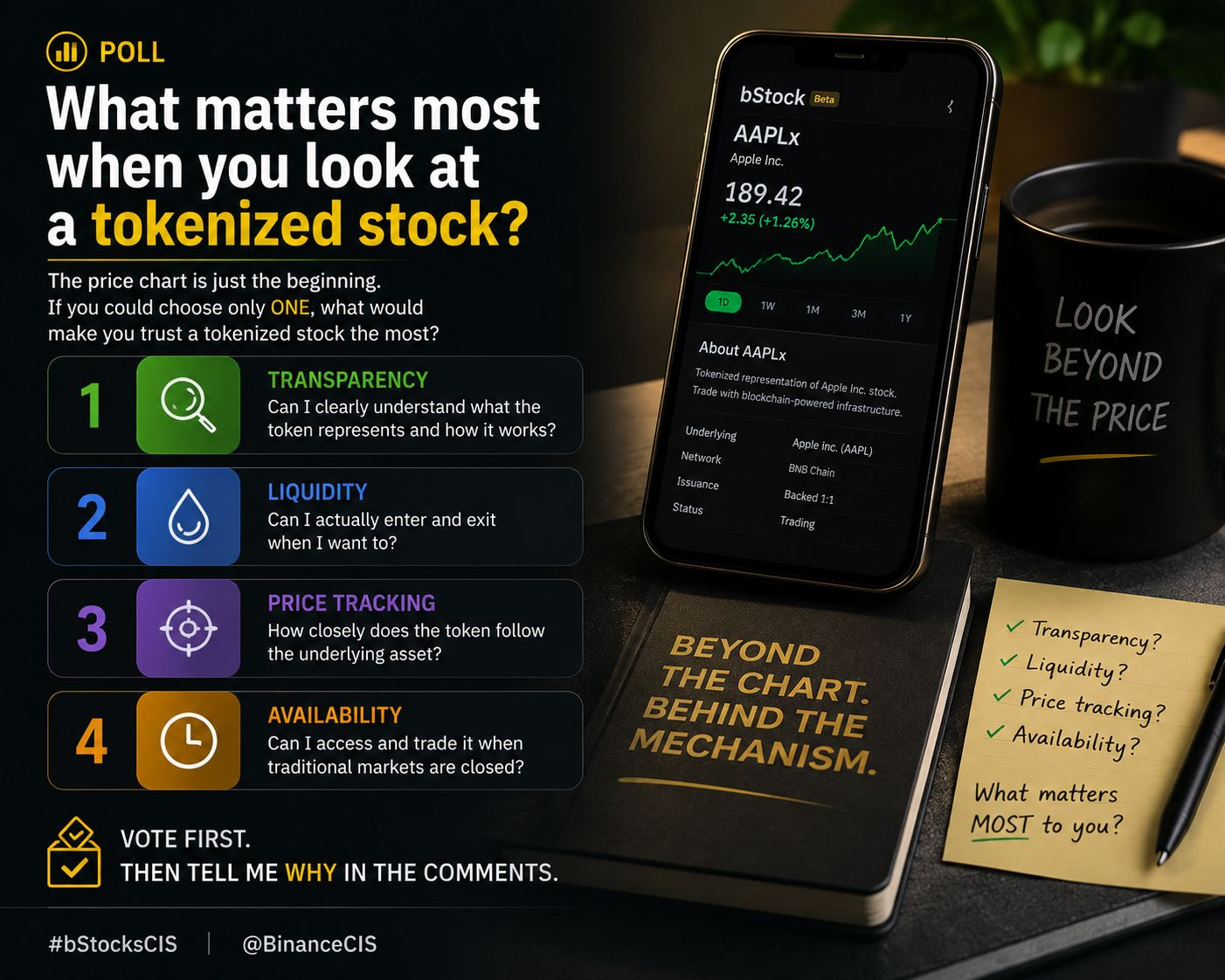
So I would break the decision into four things:
1️⃣ Transparency
Can I clearly understand what the token represents and how the structure works?
2️⃣ Liquidity
Can I actually enter and exit when I want to?
3️⃣ Price tracking
How closely does the token follow the underlying asset?
4️⃣ Availability
Can I access and trade it when traditional markets are closed?
I think people may rank these very differently depending on what they actually use tokenized equities for.
So let's test it.
If you could choose only ONE, what matters most to you?
🟢 Transparency
🔵 Liquidity
🟣 Price tracking
🟠 Availability
Vote first.
Then tell me why in the comments.
#bstockscis @BinanceCIS
When you look at a tokenized stock, what would make you trust it more?
For me, the price chart is only the beginning.
A token can follow its underlying asset closely and still leave other questions unanswered.
So I would break the decision into four things:
1️⃣ Transparency
Can I clearly understand what the token represents and how the structure works?
2️⃣ Liquidity
Can I actually enter and exit when I want to?
3️⃣ Price tracking
How closely does the token follow the underlying asset?
4️⃣ Availability
Can I access and trade it when traditional markets are closed?
I think people may rank these very differently depending on what they actually use tokenized equities for.
So let's test it.
If you could choose only ONE, what matters most to you?
🟢 Transparency
🔵 Liquidity
🟣 Price tracking
🟠 Availability
Vote first.
Then tell me why in the comments.
#bstockscis @BinanceCIS
For me, the price chart is only the beginning.
A token can follow its underlying asset closely and still leave other questions unanswered.
So I would break the decision into four things:
1️⃣ Transparency
Can I clearly understand what the token represents and how the structure works?
2️⃣ Liquidity
Can I actually enter and exit when I want to?
3️⃣ Price tracking
How closely does the token follow the underlying asset?
4️⃣ Availability
Can I access and trade it when traditional markets are closed?
I think people may rank these very differently depending on what they actually use tokenized equities for.
So let's test it.
If you could choose only ONE, what matters most to you?
🟢 Transparency
🔵 Liquidity
🟣 Price tracking
🟠 Availability
Vote first.
Then tell me why in the comments.
#bstockscis @BinanceCIS
107
·
--
Рост
One thing I would watch with tokenized stocks is not the headline price.
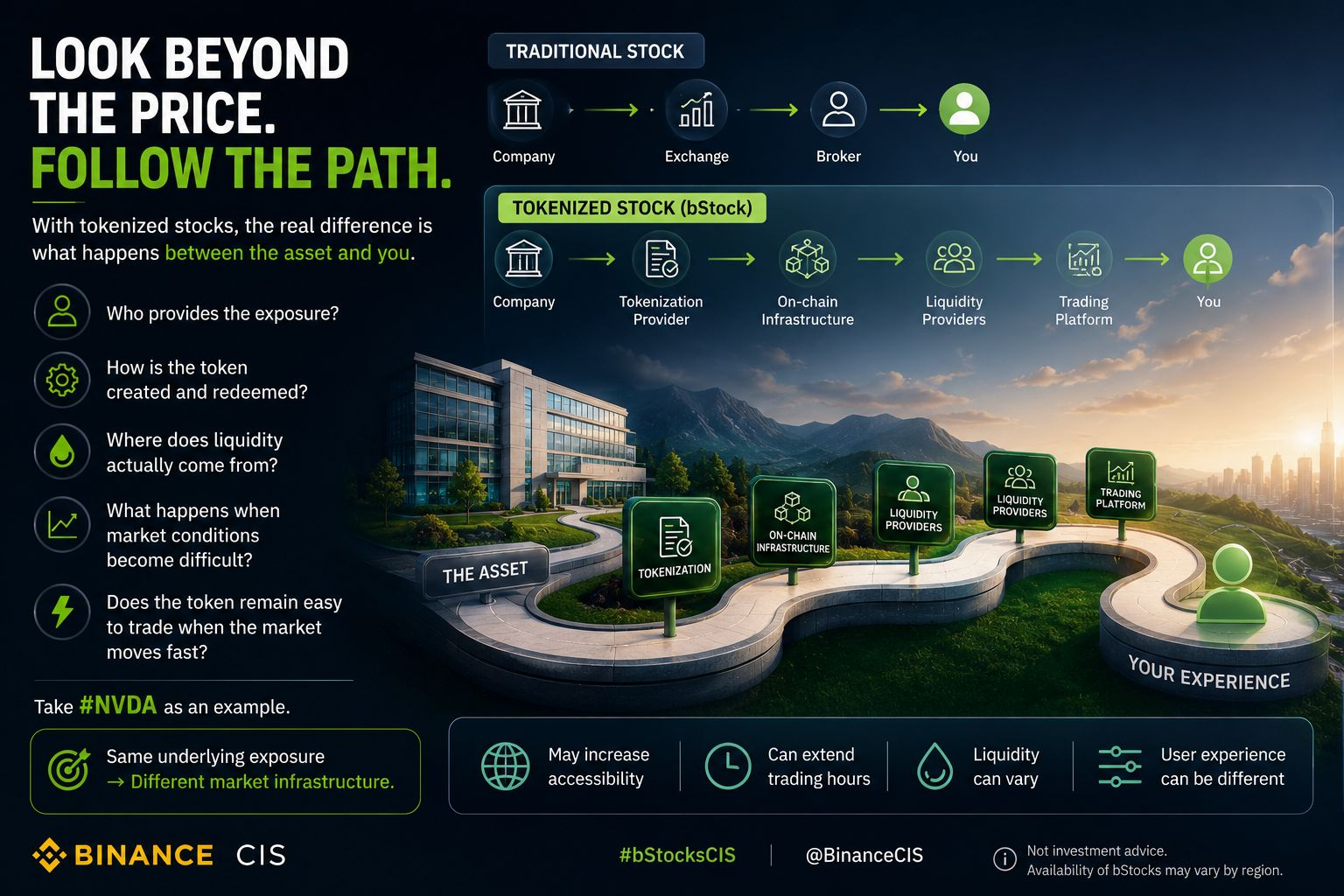
It is the path between the asset and the person trading it.
With a traditional stock, most of the infrastructure is familiar.
With a tokenized version, there can be another layer between the underlying asset and the trading experience.
That makes me ask a different set of questions:
Who provides the exposure?
How is the token created and redeemed?
Where does liquidity actually come from?
What happens when market conditions become difficult?
And perhaps the most important one:
Does the token remain easy to trade when the market moves fast?
Take #NVDA as an example.
The interesting comparison isn't simply:
stock vs token.
It is:
same underlying exposure → different market infrastructure.
That difference can affect accessibility, trading hours, liquidity, and the overall user experience.
So when I look at a bStock, I don't want to stop at the chart.
I want to understand what is happening behind the chart.
#bstockscis @BinanceCIS
One thing I would watch with tokenized stocks is not the headline price.
It is the path between the asset and the person trading it.
With a traditional stock, most of the infrastructure is familiar.
With a tokenized version, there can be another layer between the underlying asset and the trading experience.
That makes me ask a different set of questions:
Who provides the exposure?
How is the token created and redeemed?
Where does liquidity actually come from?
What happens when market conditions become difficult?
And perhaps the most important one:
Does the token remain easy to trade when the market moves fast?
Take #NVDA as an example.
The interesting comparison isn't simply:
stock vs token.
It is:
same underlying exposure → different market infrastructure.
That difference can affect accessibility, trading hours, liquidity, and the overall user experience.
So when I look at a bStock, I don't want to stop at the chart.
I want to understand what is happening behind the chart.
#bstockscis @BinanceCIS
It is the path between the asset and the person trading it.
With a traditional stock, most of the infrastructure is familiar.
With a tokenized version, there can be another layer between the underlying asset and the trading experience.
That makes me ask a different set of questions:
Who provides the exposure?
How is the token created and redeemed?
Where does liquidity actually come from?
What happens when market conditions become difficult?
And perhaps the most important one:
Does the token remain easy to trade when the market moves fast?
Take #NVDA as an example.
The interesting comparison isn't simply:
stock vs token.
It is:
same underlying exposure → different market infrastructure.
That difference can affect accessibility, trading hours, liquidity, and the overall user experience.
So when I look at a bStock, I don't want to stop at the chart.
I want to understand what is happening behind the chart.
#bstockscis @BinanceCIS
1
89
·
--
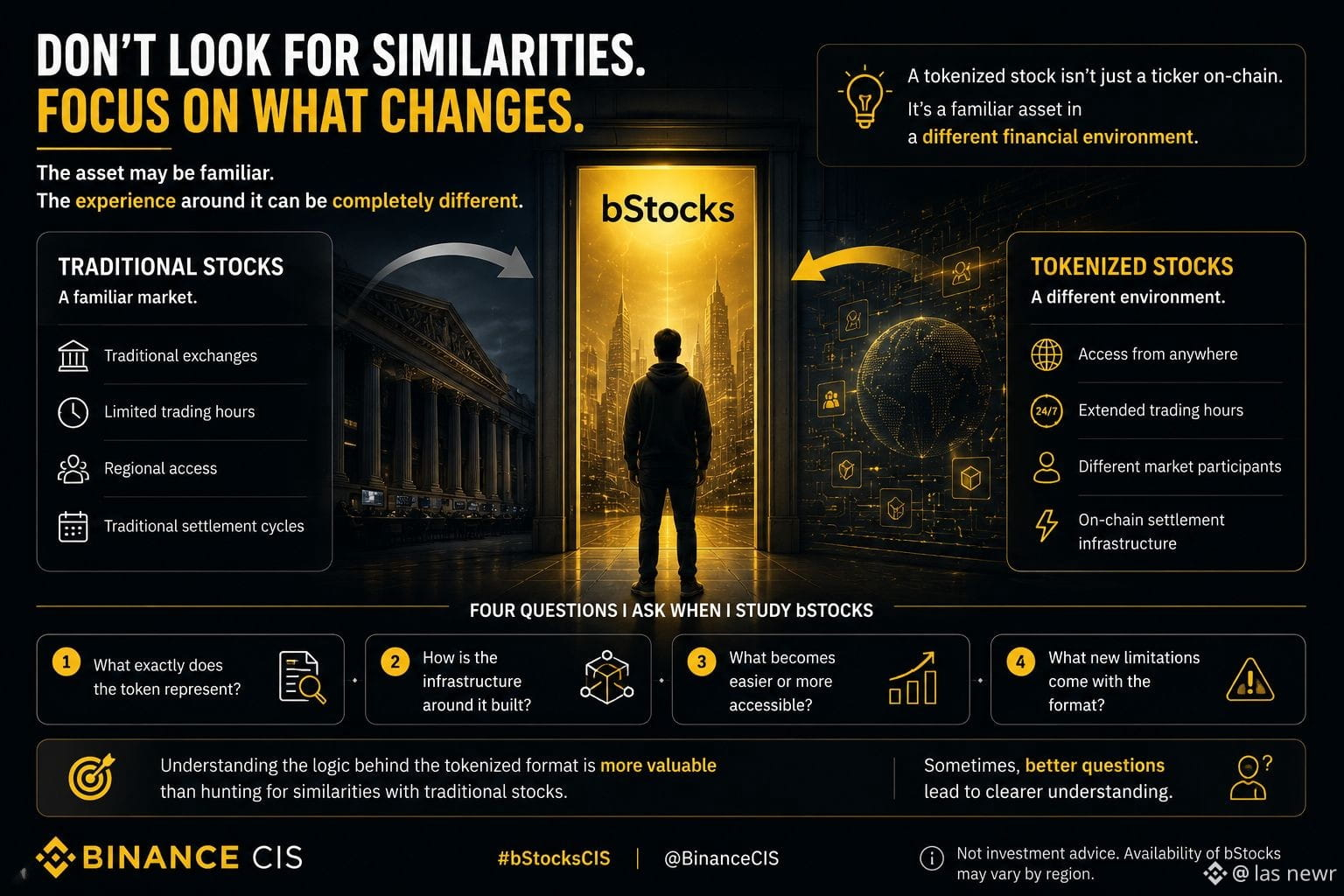
The more I learn about bStocks, the less useful I find one particular question:
“How similar are they to traditional stocks?”
It sounds reasonable, but it can lead you in the wrong direction.
A more interesting question is:
What changes for the user when a familiar market asset appears in a tokenized form?
Because the point isn't simply to take a ticker and add the word “token.”
The asset enters a different infrastructure — with a different interface, different ways of moving capital, and different possibilities for interacting with it.
And I don't think the goal should be to immediately decide which format is “better.”
It's more useful to understand what each format is designed to do.
So when I look at bStocks, I try to ask four things:
— What exactly does the token represent?
— How is the infrastructure around it built?
— What becomes easier or more accessible?
— What new limitations come with the format?
That last question matters just as much.
Every new financial structure adds something, but it also introduces its own rules.
That's why I'm less interested in finding similarities between bStocks and traditional stocks, and more interested in understanding the logic behind the tokenized format.
Sometimes a product becomes easier to understand not when you find more answers.
But when you finally start asking better questions.
@BinanceCIS #bstockscis
The more I learn about bStocks, the less useful I find one particular question:
“How similar are they to traditional stocks?”
It sounds reasonable, but it can lead you in the wrong direction.
A more interesting question is:
What changes for the user when a familiar market asset appears in a tokenized form?
Because the point isn't simply to take a ticker and add the word “token.”
The asset enters a different infrastructure — with a different interface, different ways of moving capital, and different possibilities for interacting with it.
And I don't think the goal should be to immediately decide which format is “better.”
It's more useful to understand what each format is designed to do.
So when I look at bStocks, I try to ask four things:
— What exactly does the token represent?
— How is the infrastructure around it built?
— What becomes easier or more accessible?
— What new limitations come with the format?
That last question matters just as much.
Every new financial structure adds something, but it also introduces its own rules.
That's why I'm less interested in finding similarities between bStocks and traditional stocks, and more interested in understanding the logic behind the tokenized format.
Sometimes a product becomes easier to understand not when you find more answers.
But when you finally start asking better questions.
@BinanceCIS #bstockscis
“How similar are they to traditional stocks?”
It sounds reasonable, but it can lead you in the wrong direction.
A more interesting question is:
What changes for the user when a familiar market asset appears in a tokenized form?
Because the point isn't simply to take a ticker and add the word “token.”
The asset enters a different infrastructure — with a different interface, different ways of moving capital, and different possibilities for interacting with it.
And I don't think the goal should be to immediately decide which format is “better.”
It's more useful to understand what each format is designed to do.
So when I look at bStocks, I try to ask four things:
— What exactly does the token represent?
— How is the infrastructure around it built?
— What becomes easier or more accessible?
— What new limitations come with the format?
That last question matters just as much.
Every new financial structure adds something, but it also introduces its own rules.
That's why I'm less interested in finding similarities between bStocks and traditional stocks, and more interested in understanding the logic behind the tokenized format.
Sometimes a product becomes easier to understand not when you find more answers.
But when you finally start asking better questions.
@BinanceCIS #bstockscis
82
·
--
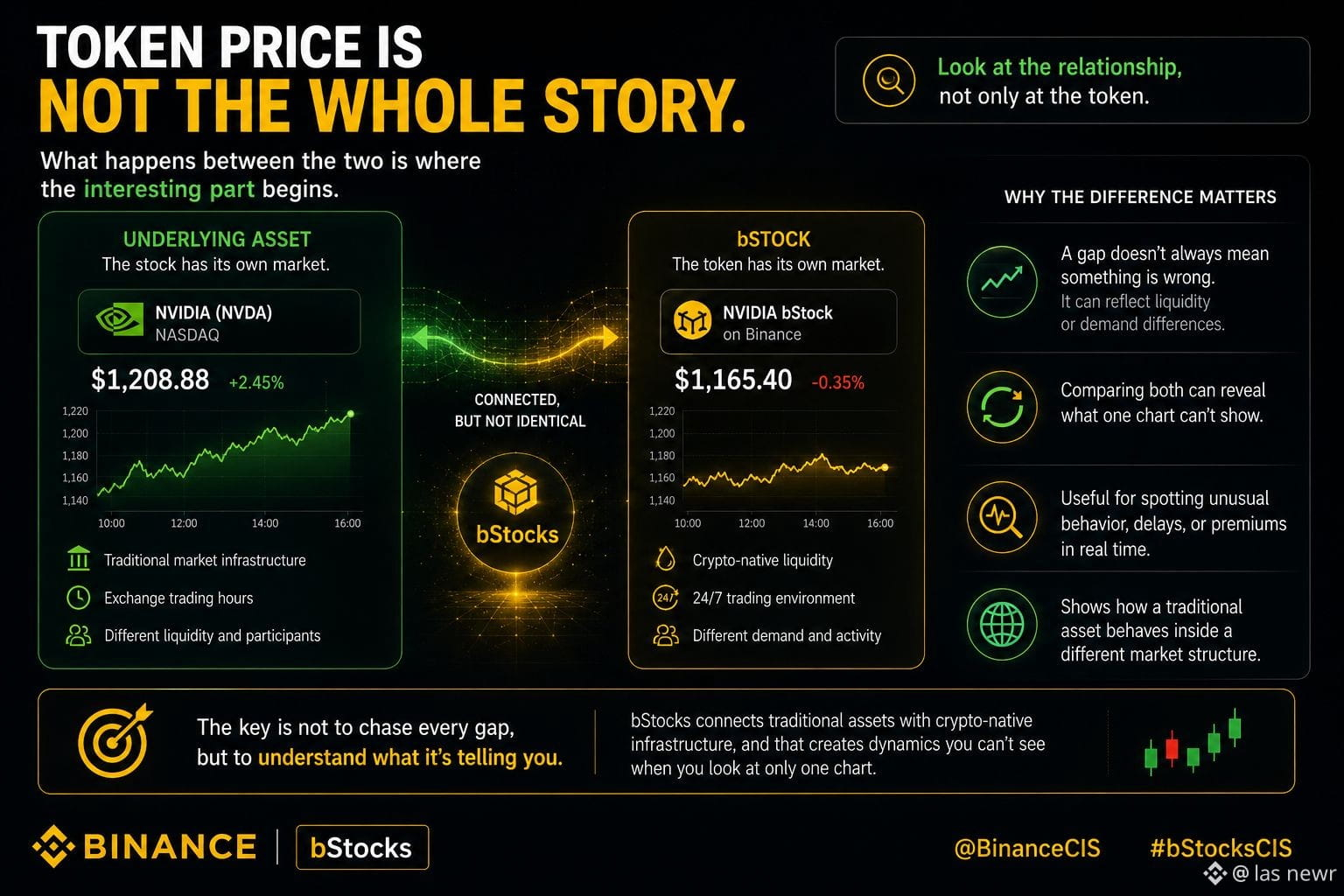
One thing I find interesting about bStocks is that the token price is not the whole story.
At first, I looked at the price and thought:
“Okay, it follows the underlying stock. Simple.”
But then I started thinking about what happens between the two.
The underlying asset has its own market.
The bStock has its own liquidity, trading activity and market participants.
So even when they are connected, the two prices don't have to move in exactly the same way at every moment.
That difference is actually one of the things I'd watch most closely.
Not because every gap means something is wrong.
Sometimes it can simply show where liquidity or demand is different.
For me, this makes bStocks more interesting to analyze than just looking at a price chart.
You have to look at the relationship between the asset and the token, not only at the token itself. 👀
That is probably the part I would pay the most attention to over time. 📊
@BinanceCIS #bstockscis
One thing I find interesting about bStocks is that the token price is not the whole story.
At first, I looked at the price and thought:
“Okay, it follows the underlying stock. Simple.”
But then I started thinking about what happens between the two.
The underlying asset has its own market.
The bStock has its own liquidity, trading activity and market participants.
So even when they are connected, the two prices don't have to move in exactly the same way at every moment.
That difference is actually one of the things I'd watch most closely.
Not because every gap means something is wrong.
Sometimes it can simply show where liquidity or demand is different.
For me, this makes bStocks more interesting to analyze than just looking at a price chart.
You have to look at the relationship between the asset and the token, not only at the token itself. 👀
That is probably the part I would pay the most attention to over time. 📊
@BinanceCIS #bstockscis
At first, I looked at the price and thought:
“Okay, it follows the underlying stock. Simple.”
But then I started thinking about what happens between the two.
The underlying asset has its own market.
The bStock has its own liquidity, trading activity and market participants.
So even when they are connected, the two prices don't have to move in exactly the same way at every moment.
That difference is actually one of the things I'd watch most closely.
Not because every gap means something is wrong.
Sometimes it can simply show where liquidity or demand is different.
For me, this makes bStocks more interesting to analyze than just looking at a price chart.
You have to look at the relationship between the asset and the token, not only at the token itself. 👀
That is probably the part I would pay the most attention to over time. 📊
@BinanceCIS #bstockscis
83
·
--
One thing I started noticing while learning about bStocks:
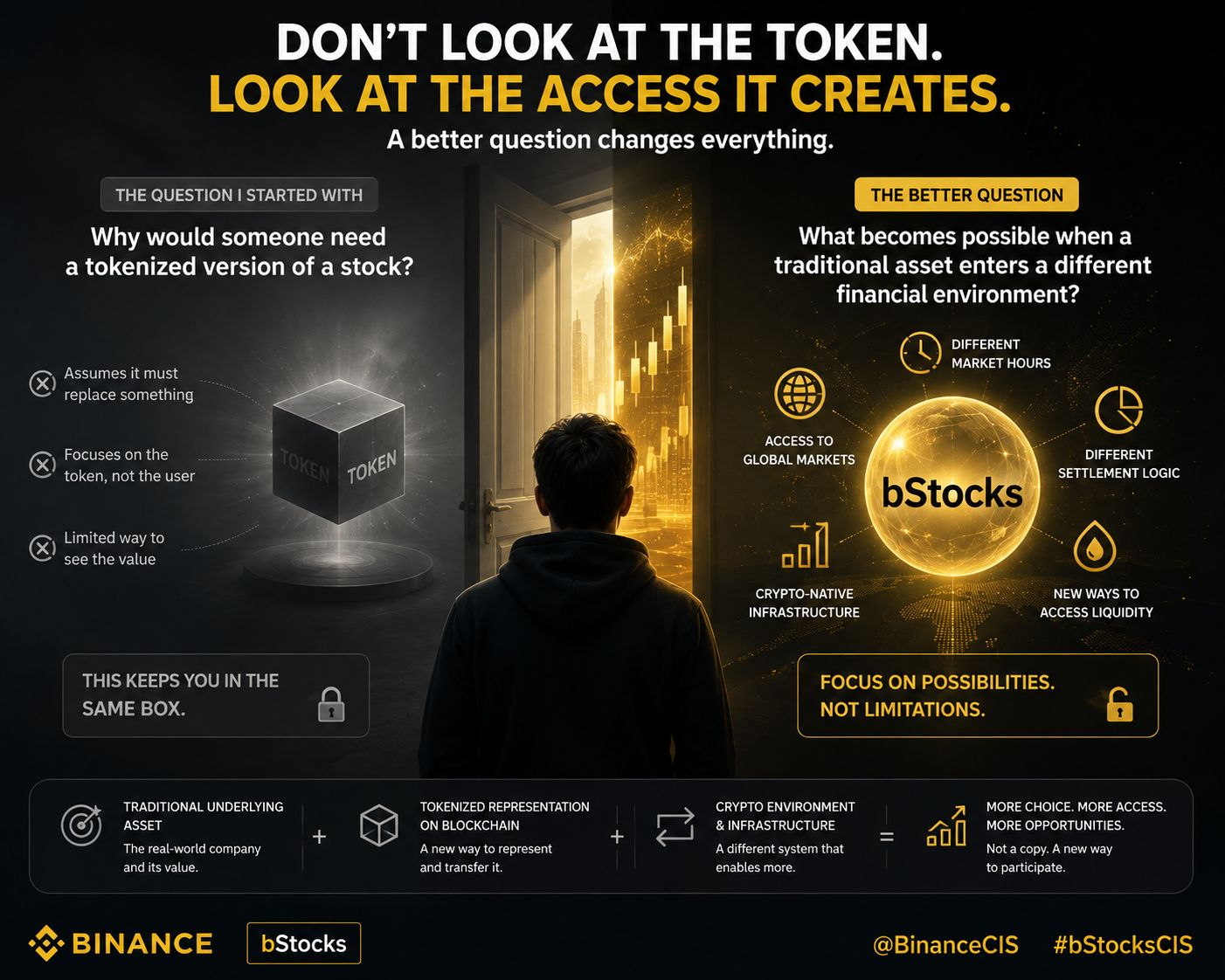
I was looking at the token first, instead of looking at the access it creates.
At first, I kept asking:
“Why would someone need a tokenized version of a stock?”
But that question already assumes the token has to replace something.
A better question is:
“What becomes possible when a traditional asset enters a different financial environment?”
That changed how I look at bStocks.
The interesting part isn't simply putting a familiar name on-chain.
It's the combination of a traditional underlying asset with crypto-native infrastructure.
Different market hours.
Different settlement logic.
Different ways of accessing liquidity.
So now I try not to ask whether tokenized stocks are “better” than traditional stocks.
I ask what they allow users to do that wasn't as simple before.
For me, that's a much more interesting way to understand RWA. 👀
@BinanceCIS #bstockscis
One thing I started noticing while learning about bStocks:
I was looking at the token first, instead of looking at the access it creates.
At first, I kept asking:
“Why would someone need a tokenized version of a stock?”
But that question already assumes the token has to replace something.
A better question is:
“What becomes possible when a traditional asset enters a different financial environment?”
That changed how I look at bStocks.
The interesting part isn't simply putting a familiar name on-chain.
It's the combination of a traditional underlying asset with crypto-native infrastructure.
Different market hours.
Different settlement logic.
Different ways of accessing liquidity.
So now I try not to ask whether tokenized stocks are “better” than traditional stocks.
I ask what they allow users to do that wasn't as simple before.
For me, that's a much more interesting way to understand RWA. 👀
@BinanceCIS #bstockscis
I was looking at the token first, instead of looking at the access it creates.
At first, I kept asking:
“Why would someone need a tokenized version of a stock?”
But that question already assumes the token has to replace something.
A better question is:
“What becomes possible when a traditional asset enters a different financial environment?”
That changed how I look at bStocks.
The interesting part isn't simply putting a familiar name on-chain.
It's the combination of a traditional underlying asset with crypto-native infrastructure.
Different market hours.
Different settlement logic.
Different ways of accessing liquidity.
So now I try not to ask whether tokenized stocks are “better” than traditional stocks.
I ask what they allow users to do that wasn't as simple before.
For me, that's a much more interesting way to understand RWA. 👀
@BinanceCIS #bstockscis
73
·
--
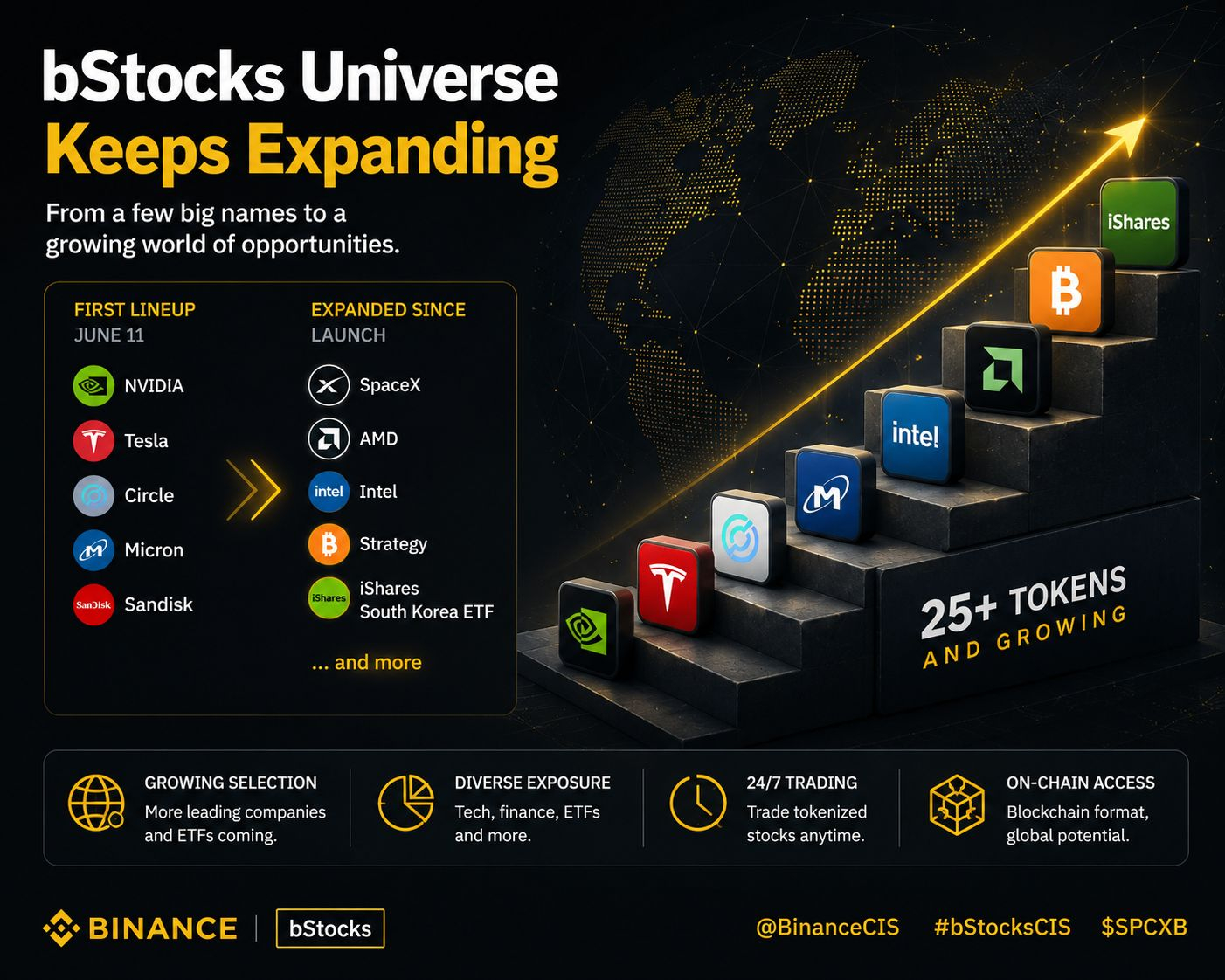
One thing I like about bStocks is that the story isn’t only about the first few tokens.
The interesting part is how quickly the selection can expand. You can start with familiar names and then suddenly see completely different sectors and companies appearing in the same tokenized format.
For me, that makes bStocks more interesting than simply having “stock tokens” on a list.
It feels more like a growing market where the choice of traditional assets is gradually being brought into a blockchain-based trading environment.
I’d rather watch how this ecosystem develops than try to guess which token will move next. 👀
@BinanceCIS $SPCXB #bstockscis
One thing I like about bStocks is that the story isn’t only about the first few tokens.
The interesting part is how quickly the selection can expand. You can start with familiar names and then suddenly see completely different sectors and companies appearing in the same tokenized format.
For me, that makes bStocks more interesting than simply having “stock tokens” on a list.
It feels more like a growing market where the choice of traditional assets is gradually being brought into a blockchain-based trading environment.
I’d rather watch how this ecosystem develops than try to guess which token will move next. 👀
@BinanceCIS $SPCXB #bstockscis
The interesting part is how quickly the selection can expand. You can start with familiar names and then suddenly see completely different sectors and companies appearing in the same tokenized format.
For me, that makes bStocks more interesting than simply having “stock tokens” on a list.
It feels more like a growing market where the choice of traditional assets is gradually being brought into a blockchain-based trading environment.
I’d rather watch how this ecosystem develops than try to guess which token will move next. 👀
@BinanceCIS $SPCXB #bstockscis
107
·
--
I’ve been thinking about one thing with bStocks that is easy to miss.
The interesting part isn’t only that stocks can be represented on-chain. It’s the change in the way you can interact with them.
Traditional markets have their own schedules. bStocks can be traded on Binance Spot 24/7, which makes the whole experience feel much closer to the crypto market.
And the fractional format is another detail I like. You don’t necessarily need a huge amount of capital just to get started and learn how it works.
For me, the combination of traditional assets + blockchain access is the part worth watching. 👀📈
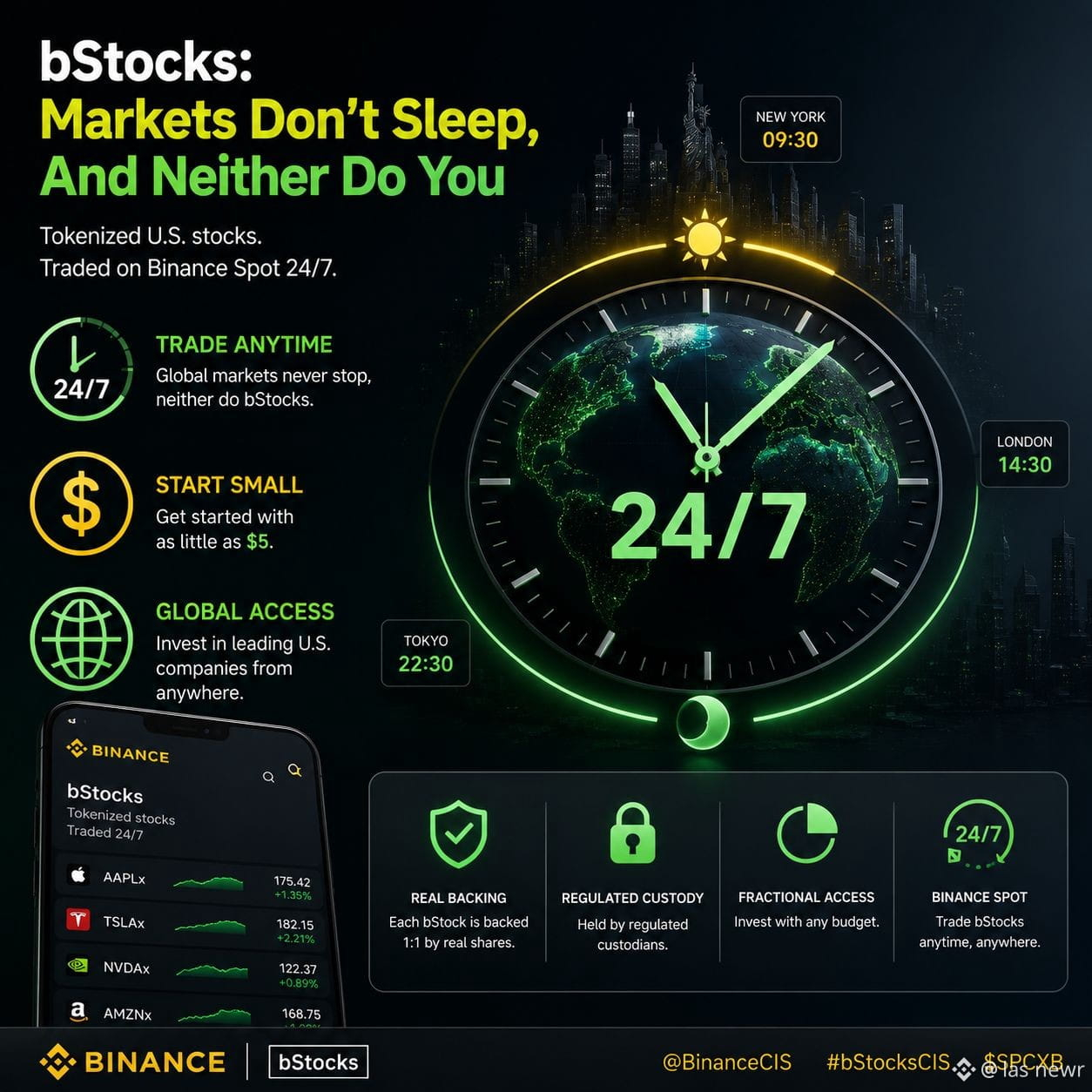
@BinanceCIS $SPCXB #bstockscis
I’ve been thinking about one thing with bStocks that is easy to miss.
The interesting part isn’t only that stocks can be represented on-chain. It’s the change in the way you can interact with them.
Traditional markets have their own schedules. bStocks can be traded on Binance Spot 24/7, which makes the whole experience feel much closer to the crypto market.
And the fractional format is another detail I like. You don’t necessarily need a huge amount of capital just to get started and learn how it works.
For me, the combination of traditional assets + blockchain access is the part worth watching. 👀📈
@BinanceCIS $SPCXB #bstockscis
The interesting part isn’t only that stocks can be represented on-chain. It’s the change in the way you can interact with them.
Traditional markets have their own schedules. bStocks can be traded on Binance Spot 24/7, which makes the whole experience feel much closer to the crypto market.
And the fractional format is another detail I like. You don’t necessarily need a huge amount of capital just to get started and learn how it works.
For me, the combination of traditional assets + blockchain access is the part worth watching. 👀📈
@BinanceCIS $SPCXB #bstockscis
106
·
--
I've been reading more about bStocks lately, and one thing stands out to me.
People often focus on price first, but I think understanding how a product works is much more important. Tokenization isn't about replacing traditional finance — it's about connecting it with blockchain technology.
For me, that's the most interesting part of bStocks.
Do you usually learn about a product before trading it, or do you explore it afterwards? 🤔📚
@BinanceCIS
#bstockscis
I've been reading more about bStocks lately, and one thing stands out to me.
People often focus on price first, but I think understanding how a product works is much more important. Tokenization isn't about replacing traditional finance — it's about connecting it with blockchain technology.
For me, that's the most interesting part of bStocks.
Do you usually learn about a product before trading it, or do you explore it afterwards? 🤔📚
@BinanceCIS
#bstockscis
People often focus on price first, but I think understanding how a product works is much more important. Tokenization isn't about replacing traditional finance — it's about connecting it with blockchain technology.
For me, that's the most interesting part of bStocks.
Do you usually learn about a product before trading it, or do you explore it afterwards? 🤔📚
@BinanceCIS
#bstockscis

1
1
·
--
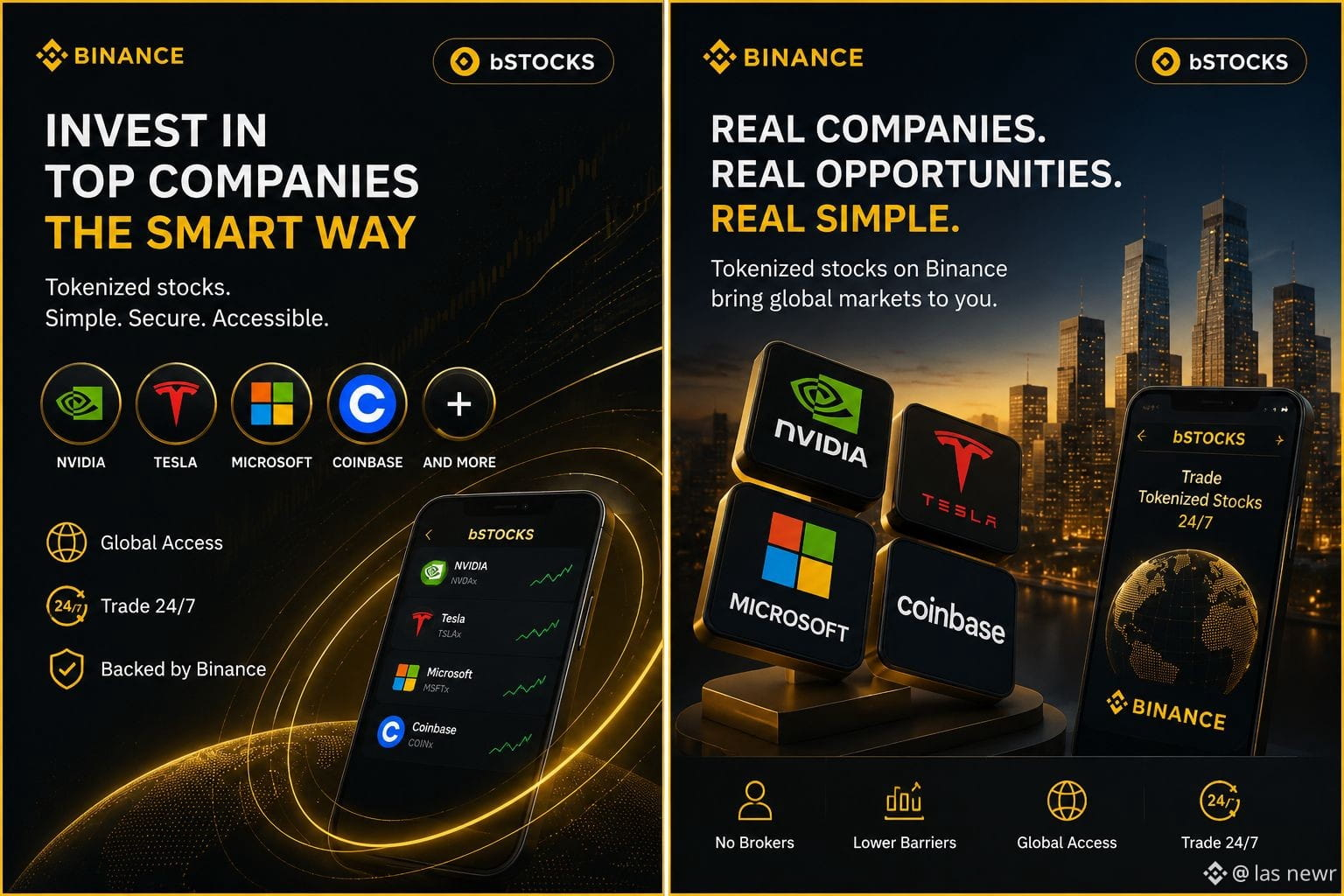
The idea behind bStocks is pretty interesting.
Tokenized stocks make it easier to follow and access some of the world's biggest companies from a single platform. For many users, that's a much smoother experience than using multiple services.
Technology keeps making investing more accessible.
@BinanceCIS #bStocksCIS #Binance
The idea behind bStocks is pretty interesting.
Tokenized stocks make it easier to follow and access some of the world's biggest companies from a single platform. For many users, that's a much smoother experience than using multiple services.
Technology keeps making investing more accessible.
@BinanceCIS #bStocksCIS #Binance
Tokenized stocks make it easier to follow and access some of the world's biggest companies from a single platform. For many users, that's a much smoother experience than using multiple services.
Technology keeps making investing more accessible.
@BinanceCIS #bStocksCIS #Binance
1
85
·
--
Сьогодні замислився над тим, чому тема токенізації стає дедалі популярнішою.
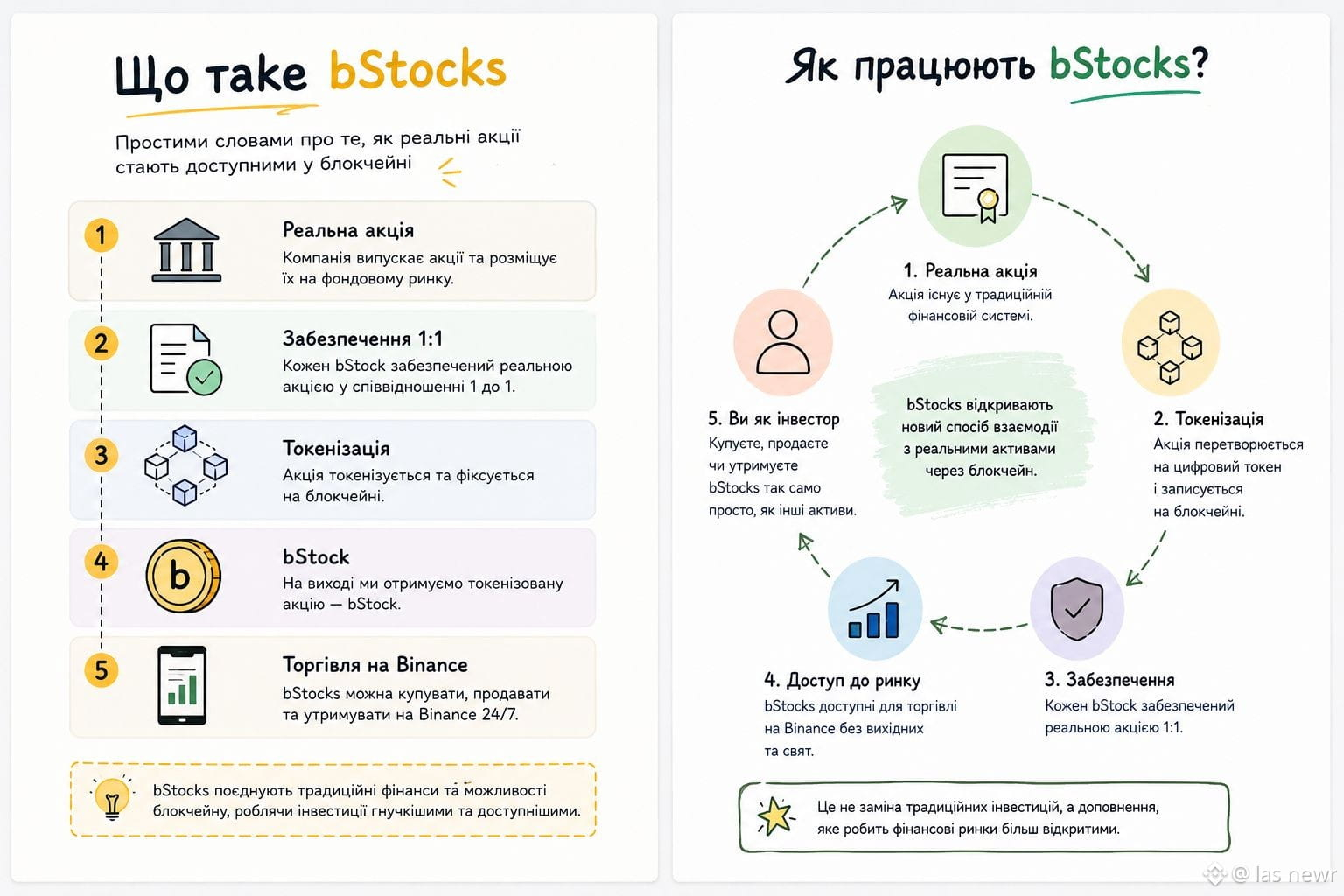
Мені здається, що одна з причин — це спроба поєднати звичні фінансові інструменти з можливостями блокчейну. Саме таку ідею реалізують bStocks: реальні акції представлені у вигляді токенів, що дозволяє взаємодіяти з ними через екосистему Binance.
Для мене це не заміна традиційного фондового ринку, а ще один формат доступу до активів. Цікаво спостерігати, як розвивається цей напрям.
А як ви ставитеся до токенізації реальних активів?
@BinanceCIS $SPCXB #bStocks #bstockscis
Сьогодні замислився над тим, чому тема токенізації стає дедалі популярнішою.
Мені здається, що одна з причин — це спроба поєднати звичні фінансові інструменти з можливостями блокчейну. Саме таку ідею реалізують bStocks: реальні акції представлені у вигляді токенів, що дозволяє взаємодіяти з ними через екосистему Binance.
Для мене це не заміна традиційного фондового ринку, а ще один формат доступу до активів. Цікаво спостерігати, як розвивається цей напрям.
А як ви ставитеся до токенізації реальних активів?
@BinanceCIS $SPCXB #bStocks #bstockscis
Мені здається, що одна з причин — це спроба поєднати звичні фінансові інструменти з можливостями блокчейну. Саме таку ідею реалізують bStocks: реальні акції представлені у вигляді токенів, що дозволяє взаємодіяти з ними через екосистему Binance.
Для мене це не заміна традиційного фондового ринку, а ще один формат доступу до активів. Цікаво спостерігати, як розвивається цей напрям.
А як ви ставитеся до токенізації реальних активів?
@BinanceCIS $SPCXB #bStocks #bstockscis
1
66
·
--
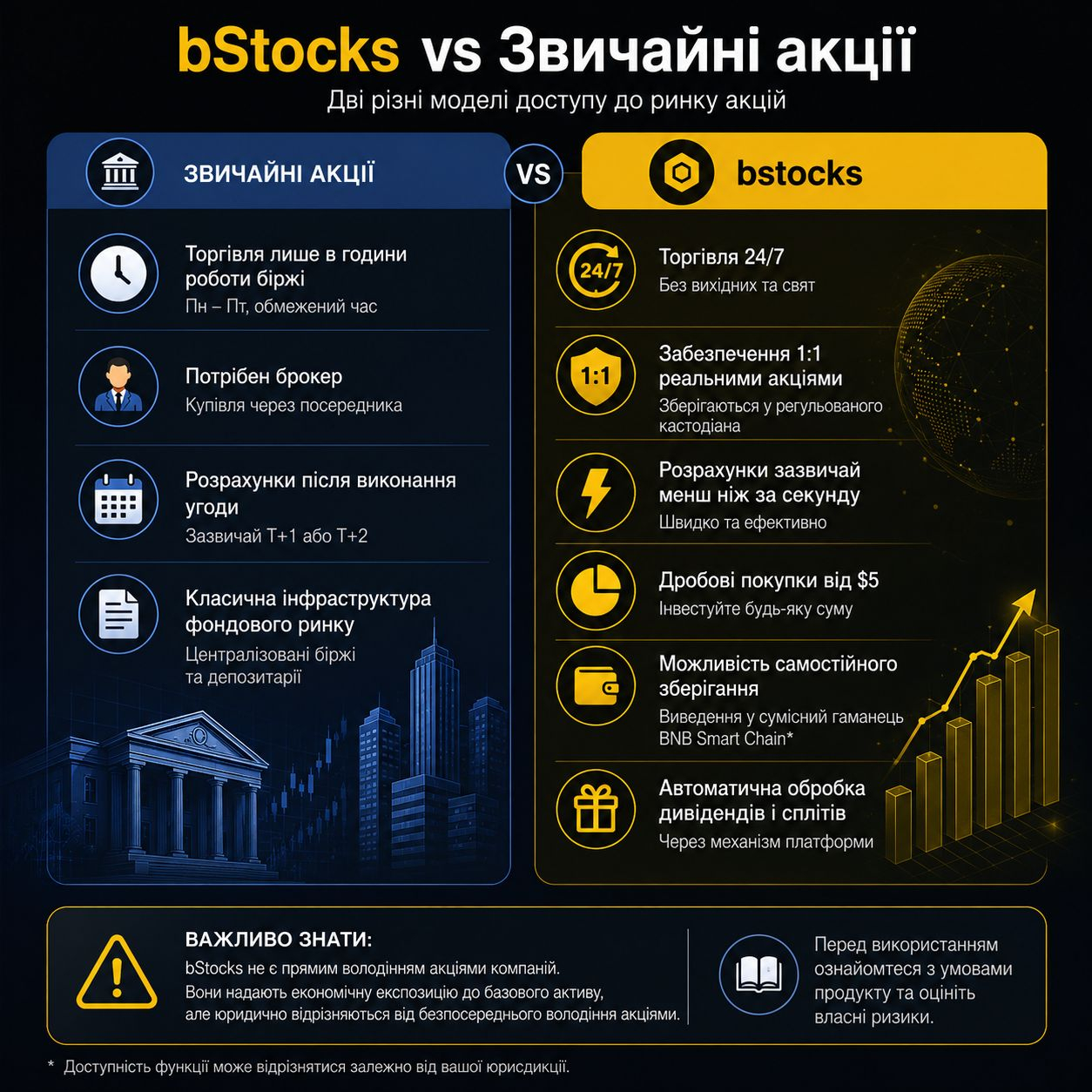
Чим bStocks відрізняються від звичайних акцій? Просте порівняння 👇
Коли я вперше почув про bStocks, подумав, що це просто «акції на блокчейні». Насправді є важливі відмінності.
📊 Звичайні акції • Купуються через брокера. • Торги проходять лише в години роботи фондового ринку. • Розрахунки займають певний час після угоди. • Зберігаються через інфраструктуру брокера або депозитарію.
🟡 bStocks • Це токенізовані цінні папери, забезпечені 1:1 відповідними акціями, які зберігаються у регульованого кастодіана. • Торгівля доступна 24/7 на Binance. • Доступні дробові покупки — від невеликих сум. • Токени можна вивести у сумісний гаманець BNB Smart Chain (для підтримуваних юрисдикцій). • Корпоративні дії, такі як спліти та дивіденди, обробляються автоматично відповідно до механізму платформи.
⚠️ Важливий нюанс: bStocks — це не пряме володіння акціями компанії. Вони надають економічну експозицію до базового активу, але юридично відрізняються від безпосереднього володіння акціями.
@BinanceCIS #bStocksCIS #SPCXB #bnb
Чим bStocks відрізняються від звичайних акцій? Просте порівняння 👇
Коли я вперше почув про bStocks, подумав, що це просто «акції на блокчейні». Насправді є важливі відмінності.
📊 Звичайні акції • Купуються через брокера. • Торги проходять лише в години роботи фондового ринку. • Розрахунки займають певний час після угоди. • Зберігаються через інфраструктуру брокера або депозитарію.
🟡 bStocks • Це токенізовані цінні папери, забезпечені 1:1 відповідними акціями, які зберігаються у регульованого кастодіана. • Торгівля доступна 24/7 на Binance. • Доступні дробові покупки — від невеликих сум. • Токени можна вивести у сумісний гаманець BNB Smart Chain (для підтримуваних юрисдикцій). • Корпоративні дії, такі як спліти та дивіденди, обробляються автоматично відповідно до механізму платформи.
⚠️ Важливий нюанс: bStocks — це не пряме володіння акціями компанії. Вони надають економічну експозицію до базового активу, але юридично відрізняються від безпосереднього володіння акціями.
@BinanceCIS #bStocksCIS #SPCXB #bnb
Коли я вперше почув про bStocks, подумав, що це просто «акції на блокчейні». Насправді є важливі відмінності.
📊 Звичайні акції • Купуються через брокера. • Торги проходять лише в години роботи фондового ринку. • Розрахунки займають певний час після угоди. • Зберігаються через інфраструктуру брокера або депозитарію.
🟡 bStocks • Це токенізовані цінні папери, забезпечені 1:1 відповідними акціями, які зберігаються у регульованого кастодіана. • Торгівля доступна 24/7 на Binance. • Доступні дробові покупки — від невеликих сум. • Токени можна вивести у сумісний гаманець BNB Smart Chain (для підтримуваних юрисдикцій). • Корпоративні дії, такі як спліти та дивіденди, обробляються автоматично відповідно до механізму платформи.
⚠️ Важливий нюанс: bStocks — це не пряме володіння акціями компанії. Вони надають економічну експозицію до базового активу, але юридично відрізняються від безпосереднього володіння акціями.
@BinanceCIS #bStocksCIS #SPCXB #bnb
1
68
Войдите, чтобы посмотреть больше материала
Присоединяйтесь к пользователям криптовалют по всему миру на Binance Square
⚡️ Получайте новейшую и полезную информацию о криптоактивах.
💬 Нам доверяет крупнейшая в мире криптобиржа.
👍 Получите достоверные аналитические данные от верифицированных создателей контента.
Эл. почта/номер телефона
В тренде
FedRateWatch
Просмотров: 1.4M
6,619 обсуждают
Share & Win Traffic Reward in our Trending Hashtag Campaign
✨Topic: FOMC September, What's The Fed's Next Move?
👉How to Join:
Publish a short post or article with hashtag #FedRateWatch
Create content based on the below angles:
- August core CPI rose 0.3% month-over-month, and the odds of a 25bp hike this week are now close to 90%. Do you anticipate a rate hike this week? Is it a one-off, or the start of a longer hiking cycle?
- If the hike lands, how does it play out for BTC, tech stocks, and gold? Bullish or bearish?
- How are you planning to trade next? Share your BTC, stocks or gold trade/holdings with our trade sharing widget.
⏰Campaign Period:
- 2026-09-15 11:00 - 2026-09-17 3:00 UTC
🎁Reward:
- Qualified posts that comply with the above guidelines and contain more than 100 words will be reviewed and may receive a random traffic boost of 500 to 3,000 views. You will receive a notification from your feed secretary if your post is selected.
- Get a chance to have your article featured on Binance Square Official
Need ideas for your post? Visit the topic page #FedRateWatch or the Square Guide on How to Post for Better Reach.
Binance Square Official
·Лайков: 643
·Просмотров: 1.6M
ZcashRises6%
Просмотров: 44,621
601 обсуждают
XRPSinks10%
Просмотров: 30,294
393 обсуждают