

Sir Ismail
174 Публикации

Sir Ismail
Отправить жалобу
Заблокировать пользователя
BP-A6DD7B781409
25 подписок(и/а)
89 подписчиков(а)
110 понравилось
Посты
Все
Цитирования
·
--
Рост
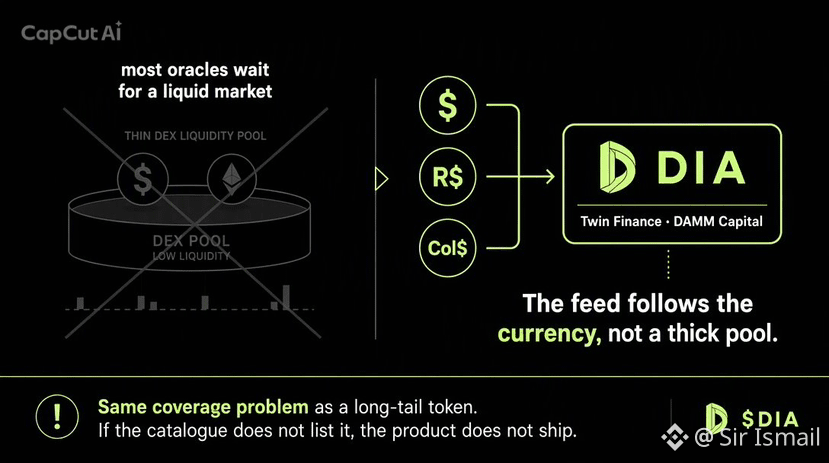
What happens when your DeFi product needs a currency price but that feed doesn’t exist?
No price feed. No product.
Most oracles focus on assets with liquid markets but many Latin American currencies lack deep onchain trading pools.
Twin Finance and DAMM Capital are working with DIA to bring these FX rates onchain so protocols can access the data they need without waiting for large trading pools to emerge.
It’s a simple but important shift: build around the currencies your users need, not just the assets oracles already support.
More price feeds mean more opportunities to build new products and serve new markets.
Don’t let missing data limit what you build.
$DIA 🤝😉
115
·
--
Рост
DIA Weekly Update
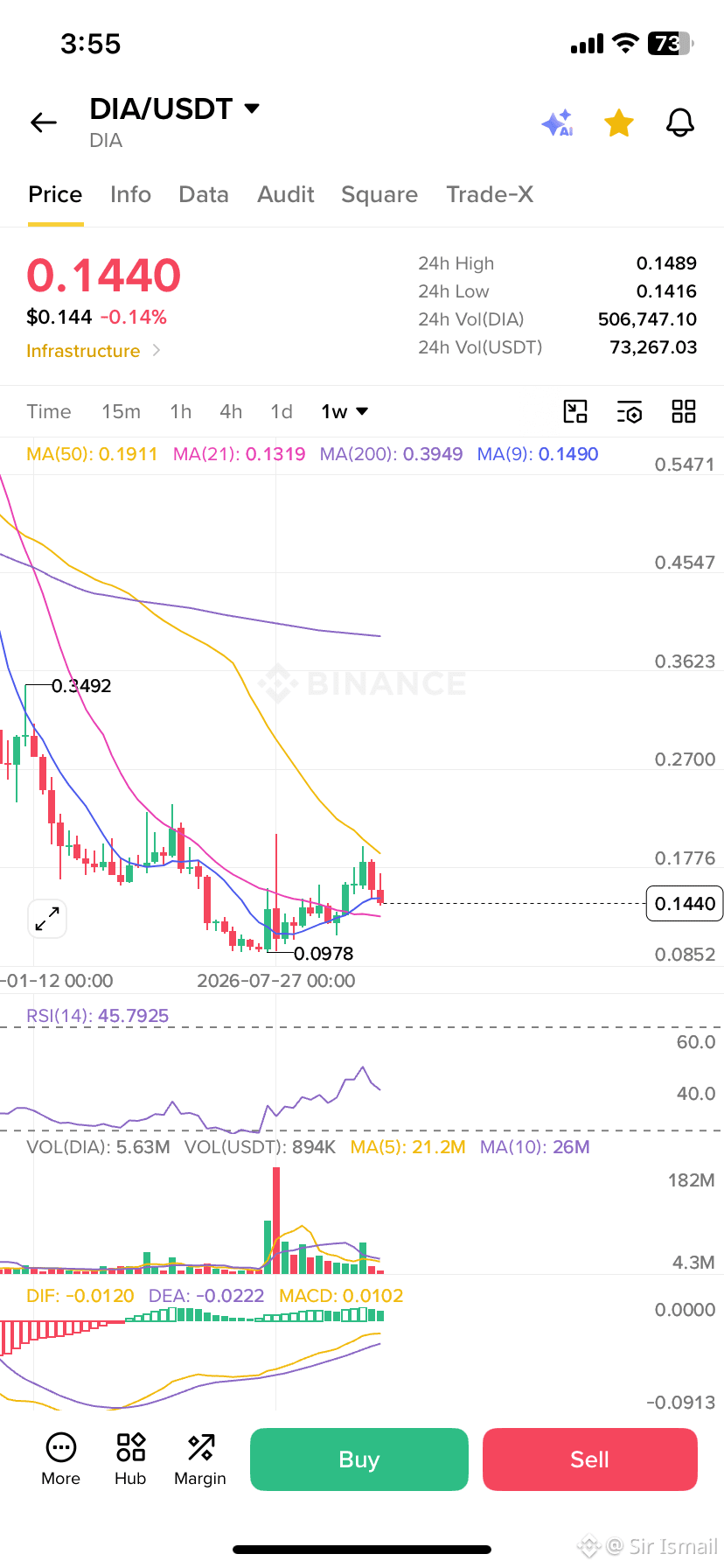
$DIA has lost the level we flagged last week. Now the market needs to prove it can hold support.
Price is around $0.142 down roughly 10% this week and 20% over two weeks.
The rejection from the October high near $0.197 has turned into a deeper pullback. Price lost $0.152, slipped through $0.148, and is now testing the weekly lows.
Key levels to watch:
Bull case: Hold $0.142 and reclaim $0.148–$0.152. That could build a higher-low attempt and bring $0.166 back into play.
Bear case: Lose $0.142, and $0.140 is next. A deeper move could expose $0.120, while the $0.098 base becomes relevant if selling accelerates.
Weekly bias: Bearish until price reclaims resistance.
The bigger base from $0.098 remains intact but $0.142 is the line bulls need to defend.
watching for a bounce legends
133
·
--
Рост
DeFi is down from its peak but one part of the market is still growing.
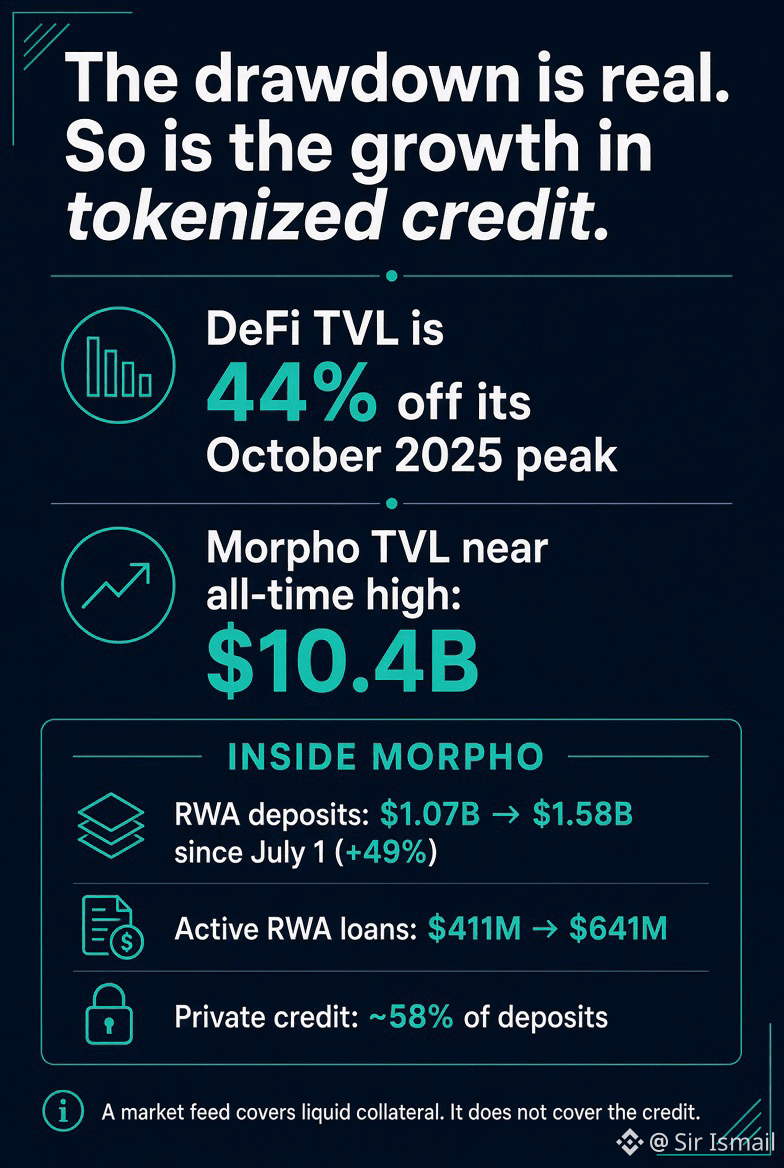
Since October 2025, DeFi’s total value locked has fallen 44% yet Morpho is near an all-time high, with about $10.4B in deposits.
Look closer at what’s happening inside Morpho.
Since July 1:
→ RWA deposits grew from $1.07B to $1.58B
→ Active RWA loans increased from $411M to $641M
→ Around 58% of those RWA deposits are in private credit
The market drawdown is real but tokenized credit is still growing and that creates a problem most people overlook.
Private credit is not like BTC or ETH. You can’t always use the latest trade to know what it’s worth. There may not even be enough trading activity to give you a reliable market price.
Lending protocols need to know the value of the assets backing these loans.
That means checking the reserves, the amount of credit outstanding, or the value recorded by the underlying contract.
This is where the oracle problem begins.
A market oracle can provide prices for liquid assets but tokenized private credit needs data that shows what the asset is actually worth.
DIAdata_org has already secured markets on Morpho.
The next challenge is helping these growing RWA markets get prices that risk teams can verify and trust because as tokenized credit grows lending protocols need more than a price.
They need proof behind the number. That’s where DIA can make a difference. $DIA
2
1.2k
·
--
Рост
Imagine your DeFi protocol makes an important decision based on a price feed.
But do you know where that number came from, or how it was calculated?
Don’t trust the oracle logo. Trace the number.
Here’s how DIA makes that possible.
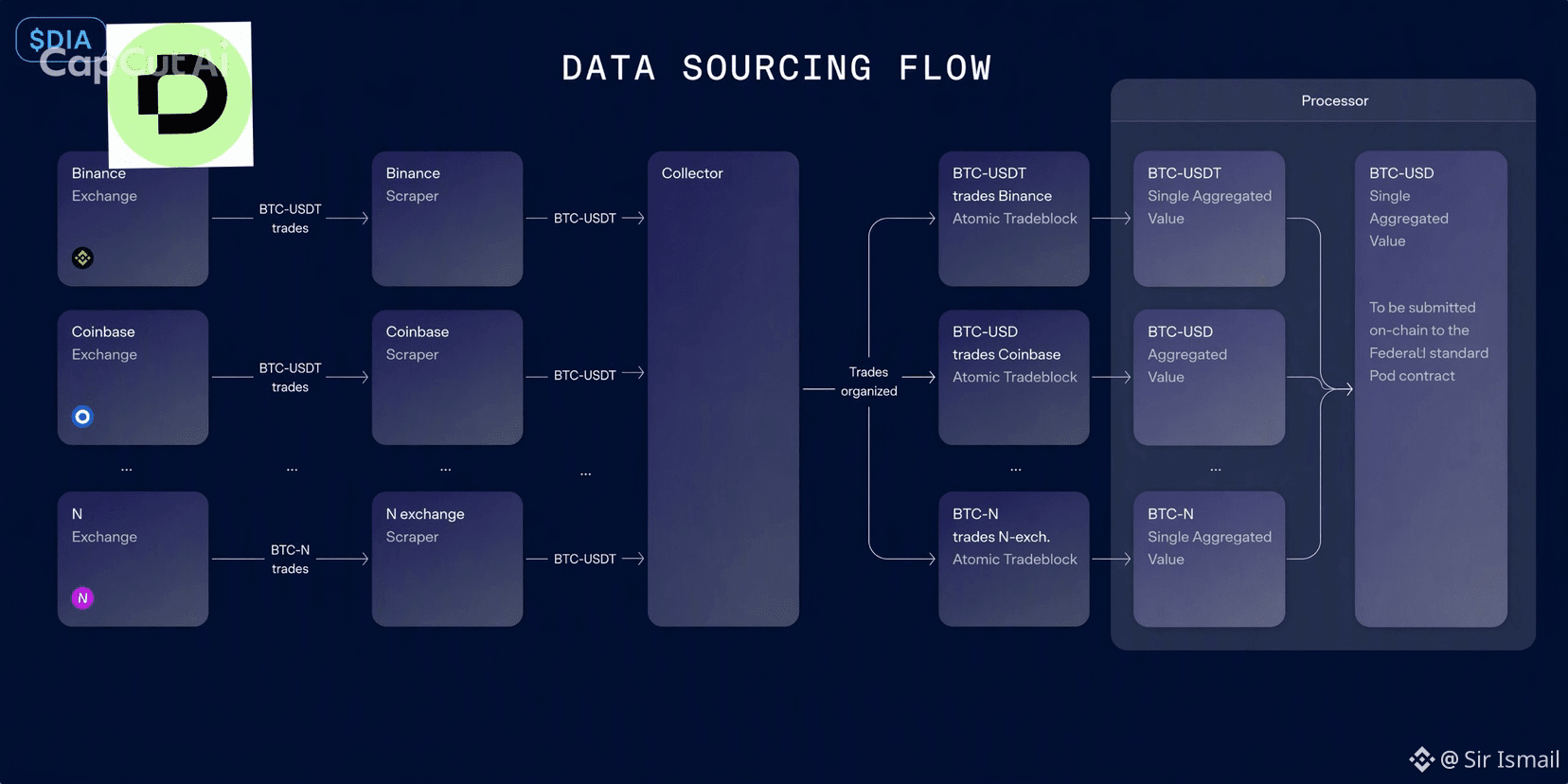
For market prices:
→ Collects individual trades from 100+ crypto exchanges
→ Groups the trades together
→ Processes the data on DIA’s own blockchain
→ Publishes the price onchain, allowing anyone to trace it back to the original trades
For assets backed by real value, the process is different.
Instead of relying only on market prices, DIA can check the data behind an asset.
→ Vetro: VUSD is priced using the value of its treasury backing.
→ River: satUSD+ is priced using the exchange rate of its vault.
Different assets need different ways to calculate their value. But the goal is the same: make the data easy to verify.
In DeFi, knowing who provides a price is not enough. You should also be able to check how that price was calculated.
Before you trust a price feed, ask where the number comes from. Check the data. Trace the source. Verify the price.
That’s the standard DeFi deserves. That’s the transparency DIA brings. $DIA
144
·
--
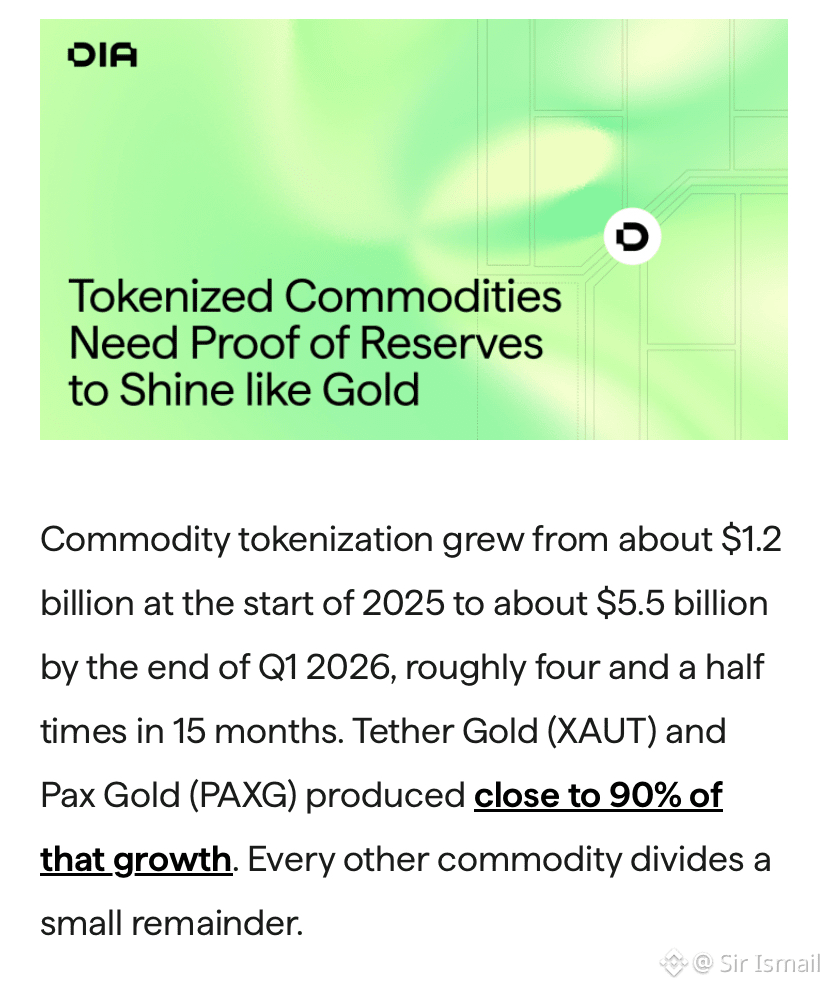
Tokenized commodities are a $5.5B market. Almost 90% of the growth came from gold.
Silver and copper have the demand. They do not have what allocators check first: verifiable reserves and a reference price.
A token with no proof of reserves is a claim. A token with reserves divided by supply is a number a risk team can model.
That is the feed. Not another market print.
Stay bullish on $DIA
293
·
--
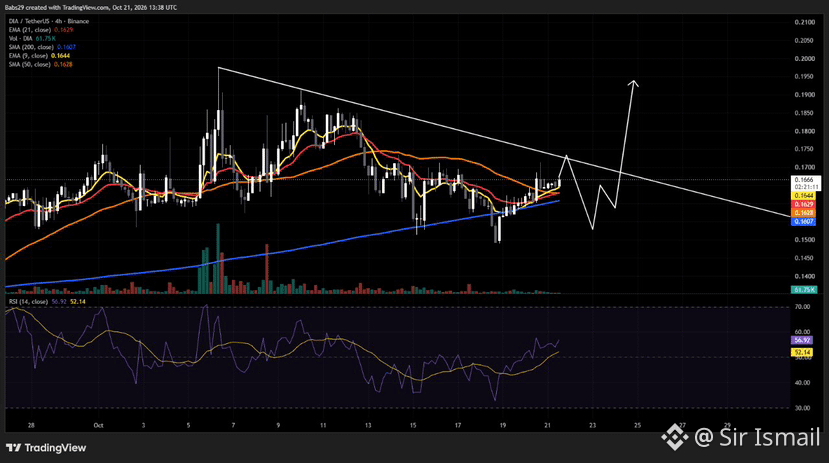
$DIA is approaching a critical moment on the 4H chart.
Price has reclaimed its key moving averages, RSI is back above 50, and buyers are pushing toward the descending trendline.
Here’s what I’m watching:
Break above $0.172–$0.175 → potential continuation toward $0.18–$0.195.
Rejection → a retest of $0.162–$0.164 or $0.159–$0.161 could follow.
The bullish setup is developing, but confirmation matters. I want to see a clean breakout and a successful retest before calling it a trend reversal.
Breakout or rejection? What’s your play on $DIA?
$DIA is approaching a critical moment on the 4H chart.
Price has reclaimed its key moving averages, RSI is back above 50, and buyers are pushing toward the descending trendline.
Here’s what I’m watching:
Break above $0.172–$0.175 → potential continuation toward $0.18–$0.195.
Rejection → a retest of $0.162–$0.164 or $0.159–$0.161 could follow.
The bullish setup is developing, but confirmation matters. I want to see a clean breakout and a successful retest before calling it a trend reversal.
Breakout or rejection? What’s your play on $DIA ?
110
·
--
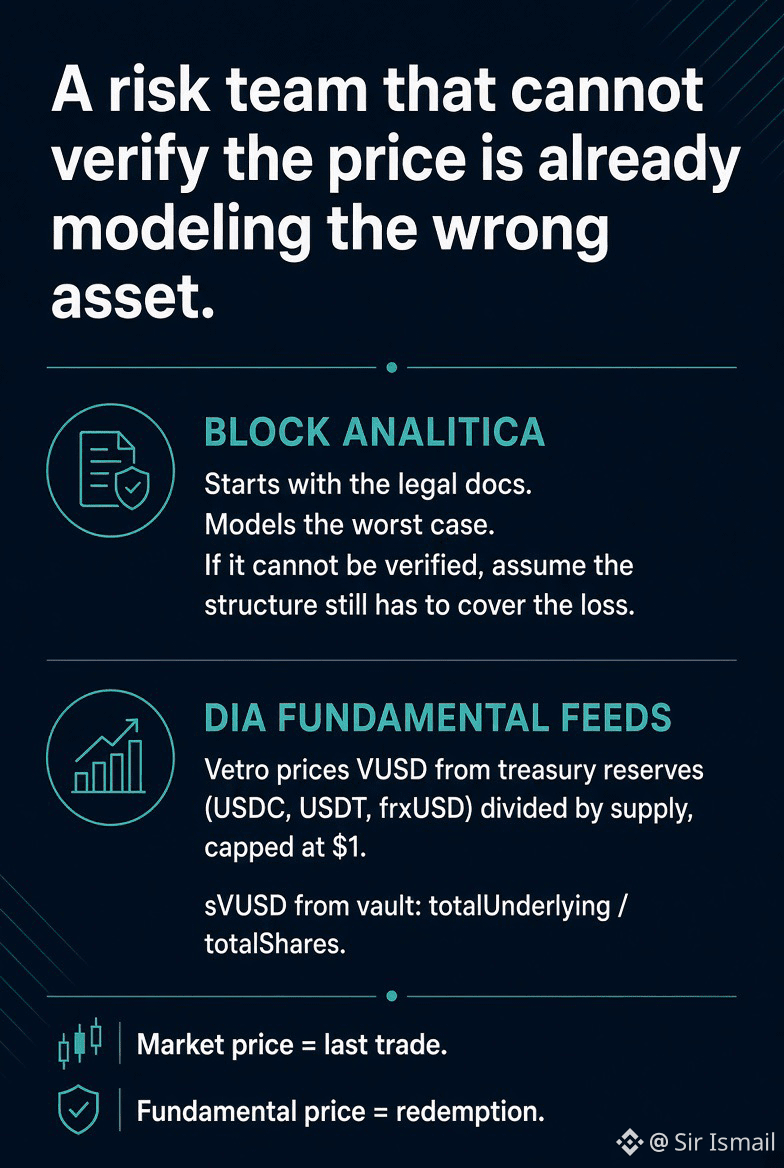
Your risk model is only as good as the price it trusts. And if that price can’t be verified, you’re modeling a guess.
Block Analitica starts with the legal documents, then models the worst case. If an asset’s structure can’t be fully verified, the risk model still has to account for the potential loss.
That’s the standard oracle data should meet.
Market prices and redemption values are not the same thing.
A market feed reports trades. With DIA, first-party market data is aggregated onchain, with timestamps that help users verify when observations were made.
But a vault share needs a different approach.
→ Vetro’s VUSD: priced against treasury backing.
→ River’s satUSD+: valued using the vault’s exchange rate.
For these assets, reserves, supply, and redemption mechanics can matter far more than the last trade in a thin liquidity pool.
Risk teams need data that reflects what an asset is actually worth — and how that value can be verified.
If the feed is a black box, the worst-case model is just a guess. $DIA
71
·
--
Рост
Stay bullish on DIA 🚨
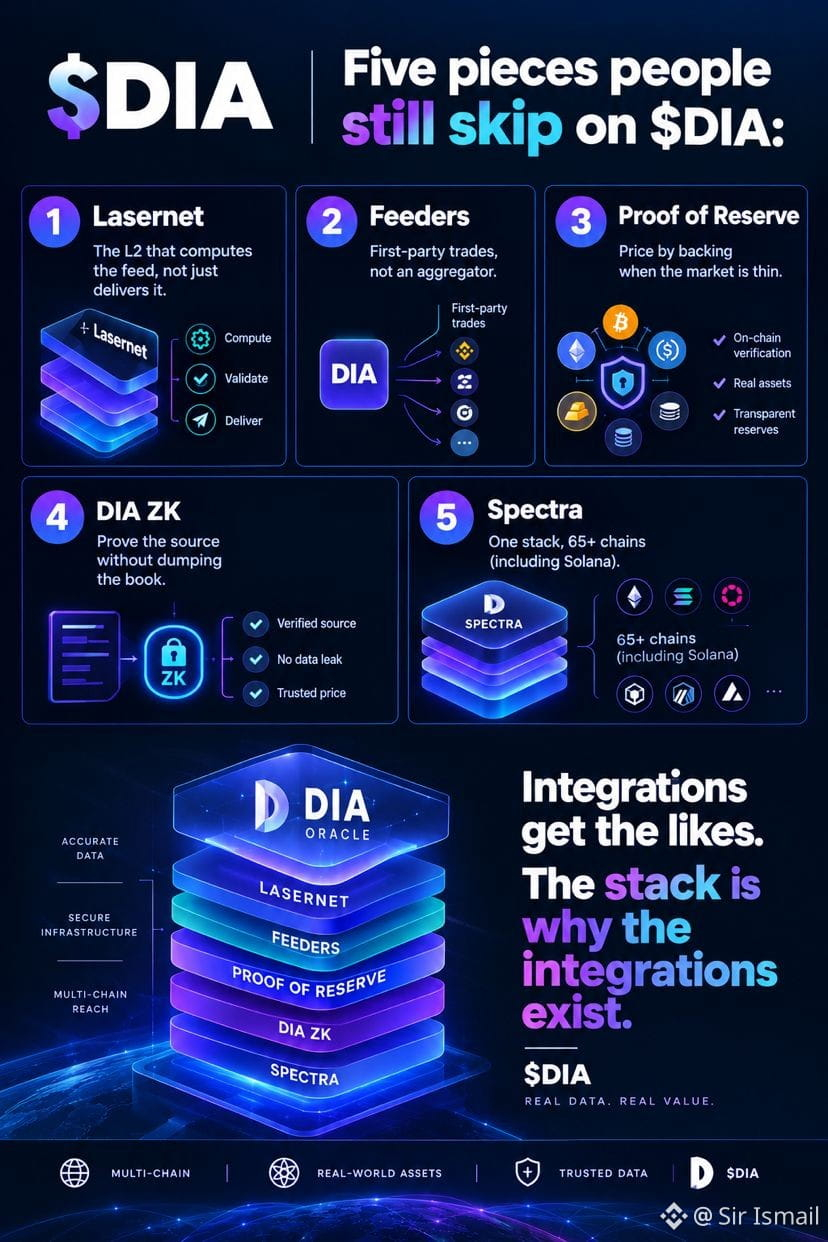
5 parts of $DIA people overlook when they focus only on integrations.
👉🏽Lasernet — the L2 where oracle data is computed not just passed along.
👉🏽First-party feeders — data sourced directly from markets rather than relying solely on third-party aggregators.
👉🏽Proof of Reserve — reserve data that helps verify asset backing especially when market prices alone tell only part of the story.
👉🏽DIA ZK — zero-knowledge proofs that can help verify data while keeping underlying information private.
👉🏽Cross-chain reach (Spectra)— one oracle stack serving 65+ destinations including Solana where Spectra is building.
Integrations are the visible layer but the infrastructure underneath is what makes them possible.
Don’t just count the integrations. Look at the infrastructure connecting them.
That’s where $DIA ‘s real edge is built 🤝
1
156
·
--
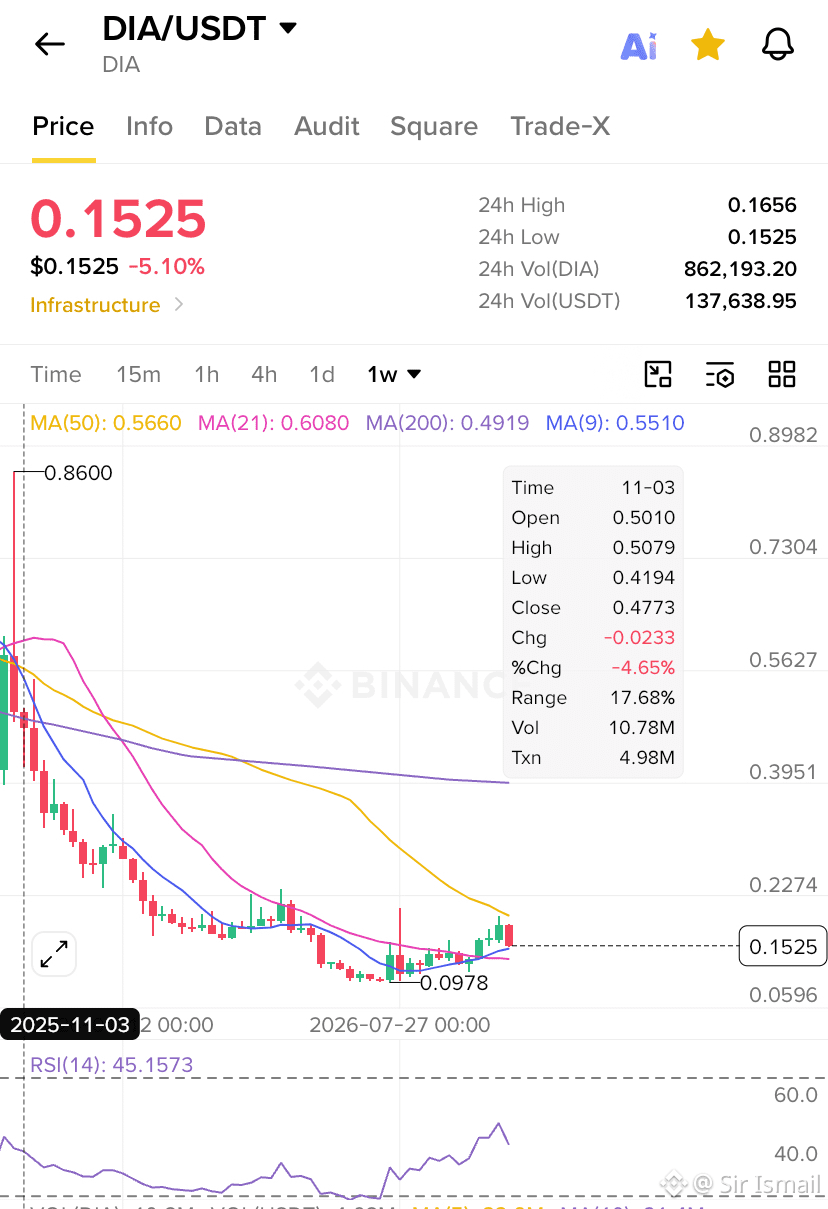
$DIA Weekly Update
Current Structure
Price is $0.1525, down on the week after failing to hold the $0.165–0.180 zone.
This is a deeper pullback from the Oct 6 high near $0.197. Weekly structure is still a higher low off the $0.0978 cycle base, but the bounce is cooling. RSI is 45 — neutral, not washed out. Still well under MA9 ($0.55), MA21, and MA50 on the weekly.
Key Levels
• Resistance: $0.1656, then $0.180–0.197
• Support: $0.1525, then $0.140 / $0.120, then the base at $0.0978
Bull Case
Hold $0.152 and reclaim $0.166. That would turn this into a higher-low and reopen $0.180.
Bear Case
Lose $0.152. Next stop is $0.140, then a deeper retrace toward $0.120. The $0.098 base only comes back if this fails hard.
For now Weekly bias is neutral-to-down short term after the rejection. Bigger base off $0.098 is still intact. $0.152 is the line this week.
142
·
--
Tokenized equities don’t trade like crypto.
Markets close.
Sessions change.
A stale print becomes a bad liquidation.
@DIAdata_org is feeding ST0x with signed timestamps and per-session freshness logic.
That’s the difference between a price and a usable price.
Stay bullish on $DIA
Tokenized equities don’t trade like crypto.
Markets close.
Sessions change.
A stale print becomes a bad liquidation.
@DIAdata_org is feeding ST0x with signed timestamps and per-session freshness logic.
That’s the difference between a price and a usable price.
Stay bullish on $DIA
Markets close.
Sessions change.
A stale print becomes a bad liquidation.
@DIAdata_org is feeding ST0x with signed timestamps and per-session freshness logic.
That’s the difference between a price and a usable price.
Stay bullish on $DIA
82
·
--
Even AI agents on Solana need data they can trust.
A price to execute a swap.
An NAV to value a vault.
A reserve check to verify a stablecoin’s backing.
That’s where @DIAdata_org comes in.
DIA is live on Solana bringing the same oracle infrastructure used across its wider network:
→ First-party trade data
→ Onchain computation through Lasernet
→ Data delivered to the destination chain
No separate oracle stack just for Solana. One data layer built to serve multiple ecosystems with 65+ destinations.
That matters as Solana’s agent economy grows. Agents can only make sound decisions when the data behind those decisions is reliable.
One data layer. Multiple chains. Including the ecosystem Spectra is building on.
That’s the point of $DIA
74
·
--
Gm Legends
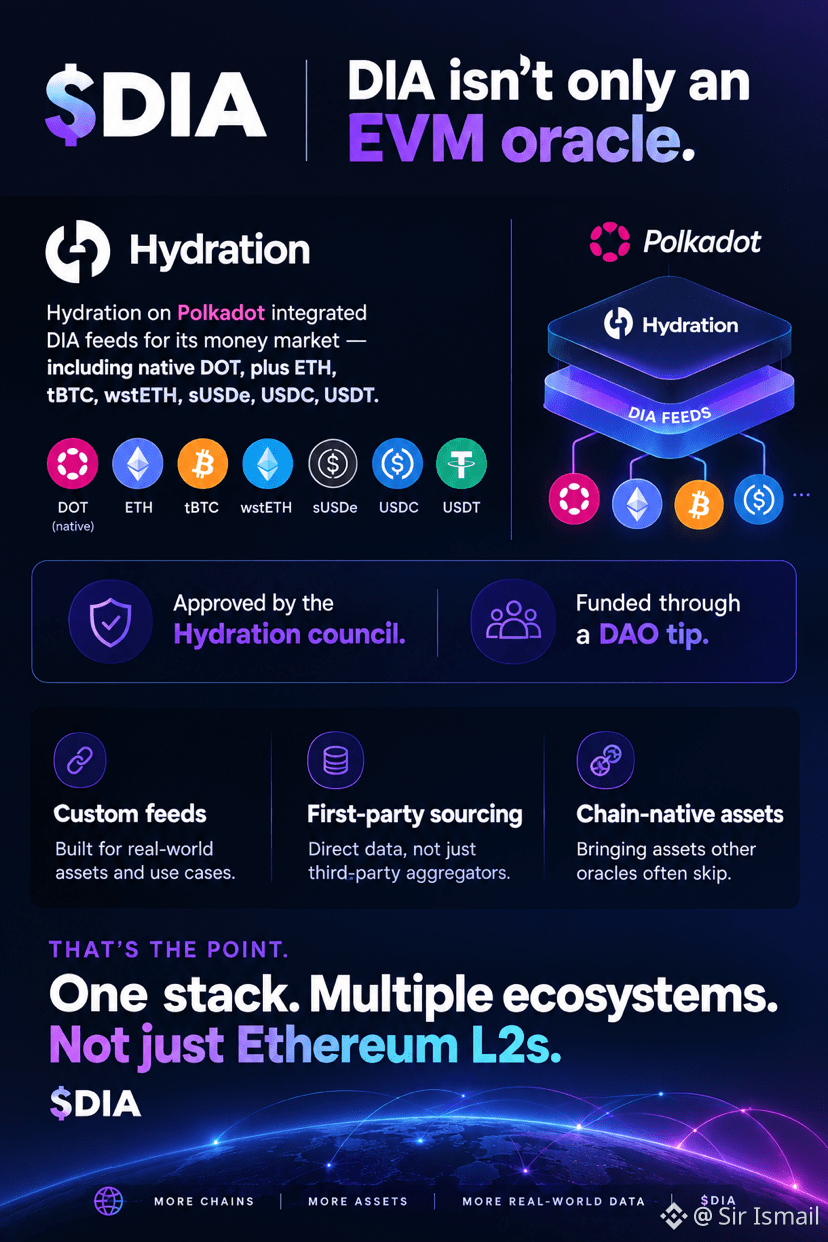
Another reminder that DIA’s oracle coverage goes beyond EVM chains.
@Hydration on Polkadot integrated DIA feeds for its money market covering assets like:
→ Native DOT
→ ETH & tBTC
→ wstETH & sUSDe
→ USDC & USDT
The integration was approved by the Hydration Council and funded through a DAO tip.
What stands out is the approach: custom feeds, first-party data sourcing and support for chain-native assets that standard oracle catalogues may overlook.
That flexibility matters when ecosystems need reliable pricing for the assets their users actually hold and borrow against.
DIA isn’t just building for Ethereum and its L2s.
One oracle stack,multiple ecosystems.
Assets priced where they’re needed.
That’s the kind of coverage DeFi needs to keep expanding.
$DIA
70
·
--
Проверено
A new listing can survive market risk. What it can’t survive is having no oracle willing to price it.
This is why @FolksFinance added DIA feeds for MON, SEI, and SYRUP on Avalanche enabling those markets to open on xChain.
The key detail is that Folks Finance chooses its oracle per asset rather than relying on one provider for its entire market catalogue.
That flexibility matters.
→ One fixed catalogue means listings depend on that provider’s coverage and timeline.
→ Request-based feeds give protocols more flexibility to support assets as their markets evolve.
DIA already covers 3,000+ crypto price feeds across 60+ chains with additional assets available on request.
For lending protocols that means more flexibility to expand supported markets without waiting for a default catalogue to catch up.
Coverage is the product. Accuracy is table stakes.
That’s why custom oracle infrastructure matters as onchain markets grow.
$DIA 4U 😉
632
·
--
$DIA is pulling back, but the bigger uptrend is still intact.
Keeping it simple.
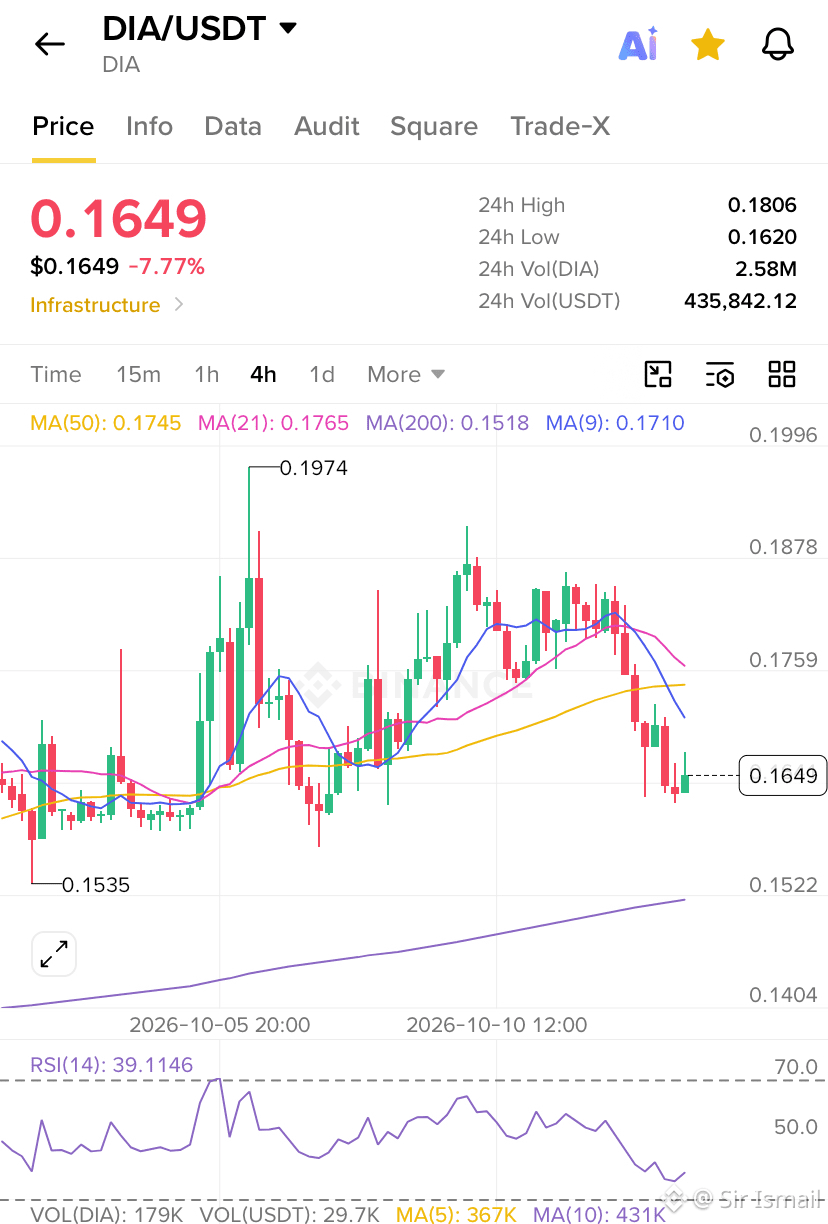
Price is around $0.165–$0.167, down roughly 7% on the day, after rejecting the $0.191–$0.197 resistance zone and sliding back into the EMA cluster we’ve been watching.
Key levels:
→ 24H range: $0.162–$0.180
→ 30D performance: still around +26–31%
→ Trend structure: Higher lows from the $0.098 base remain intact
For now, this looks like digestion beneath the highs, not a confirmed breakdown.
Bull case: Hold $0.162–$0.167 and reclaim $0.175–$0.180. That brings $0.191 back into play.
Bear case: Lose $0.162, and $0.159 becomes the next level to watch, followed by $0.153.
The next move depends on how price reacts at support.
I’m watching the levels, not chasing the candles.
$DIA
198
·
--
DIA is not just about feeding BTC and ETH prices.
It’s about bringing reliable data to the assets most oracles overlook.
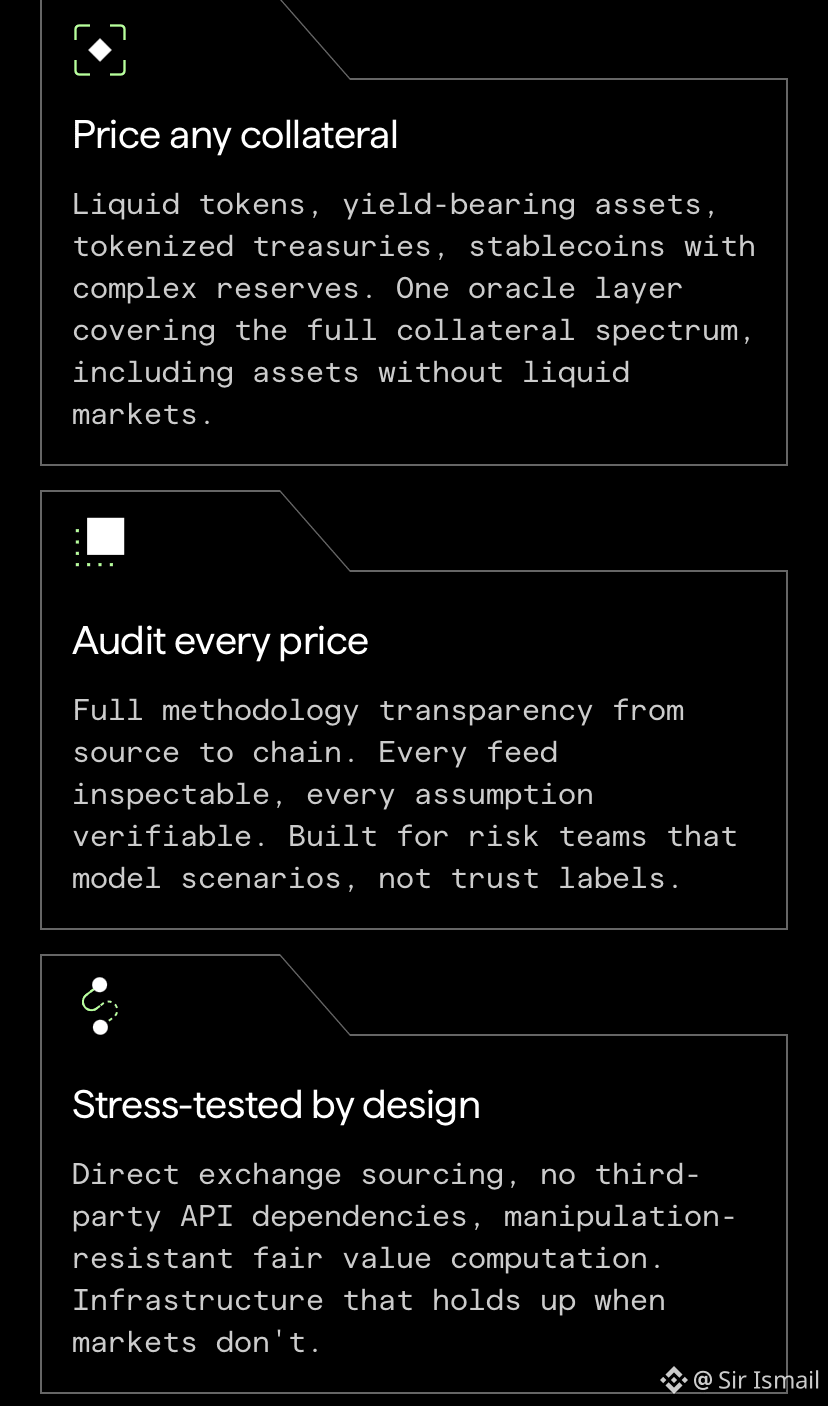
20,000+ assets.
65+ chains.
100+ data sources.
250+ dApps.
From tokens, stocks, FX and commodities to fair-value feeds for assets without active markets, DIA is building the infrastructure to price what others struggle to cover.
Because the RWA market needs more than tokenization. It needs verifiable data behind every asset.
Price any asset. Verify every feed.
That’s the bigger picture behind $DIA
61
·
--
An omnichain stable has two prices, and most oracles only ship one.
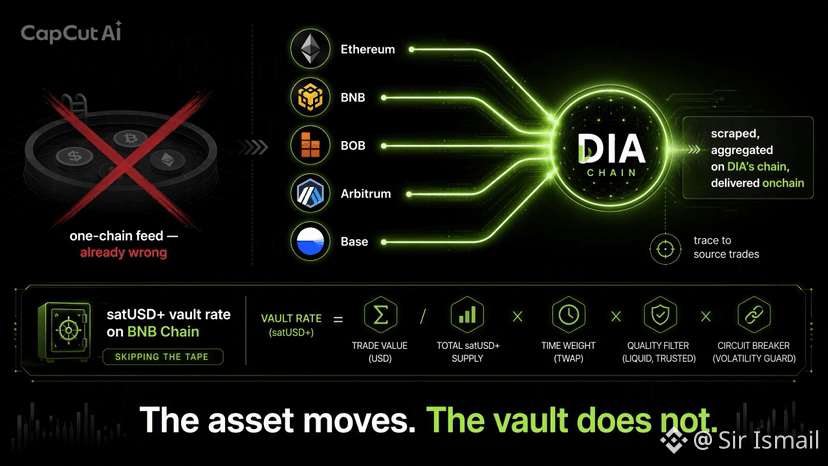
River mints satUSD across Ethereum, BNB Chain, BOB, Arbitrum, and Base. The collateral sits on one chain. The token shows up on another. A feed that only watches one pool is already wrong.
DIA ships the market price on all five chains, scraped from the venues where satUSD actually trades, aggregated on DIA’s own chain, then delivered onchain. You can trace the print back to the source trades.
For satUSD+ they skip the tape. The feed reads the vault exchange rate on BNB Chain. totalUnderlying divided by totalShares. That is the Contract Exchange Rate. Lending can price the share off what the protocol will redeem, not off a thin secondary market.
Market price tells you the last trade. Fundamental price tells you the redemption.
River needs both, because the asset moves and the vault does not.
Stay bullish on $DIA guys!
68
·
--
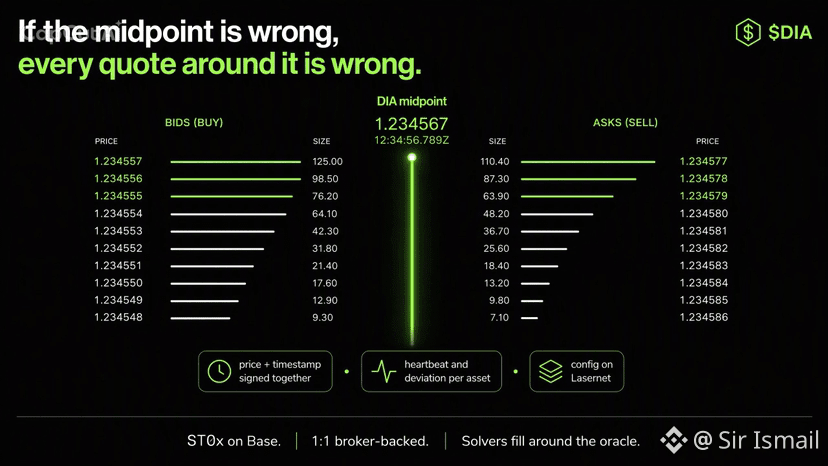
Tokenized stocks don’t just need a price. They need a reliable midpoint the entire trading system can build around.
That’s where @DIAdata_org comes in.
ST0x brings 24/7 tokenized equity and ETF trading to Base, with each token backed 1:1 by shares held at a regulated broker.
Solvers execute intent orders around a live oracle midpoint and $DIA supplies the custom equity and ETF feeds powering that reference price.
What matters under the hood:
→ Price and timestamp signed together
→ Per-asset heartbeat and deviation settings
→ Oracle configuration managed through Lasernet
Why does this matter?
Because a stale or inaccurate midpoint can distort every quote built around it.
Tokenization brings equities onchain. Reliable oracle data helps make 24/7 trading work.
That’s the infrastructure side of the RWA story — and another reason $DIA is worth watching. 👀
60
·
--
Рост
$DIA 4H Update
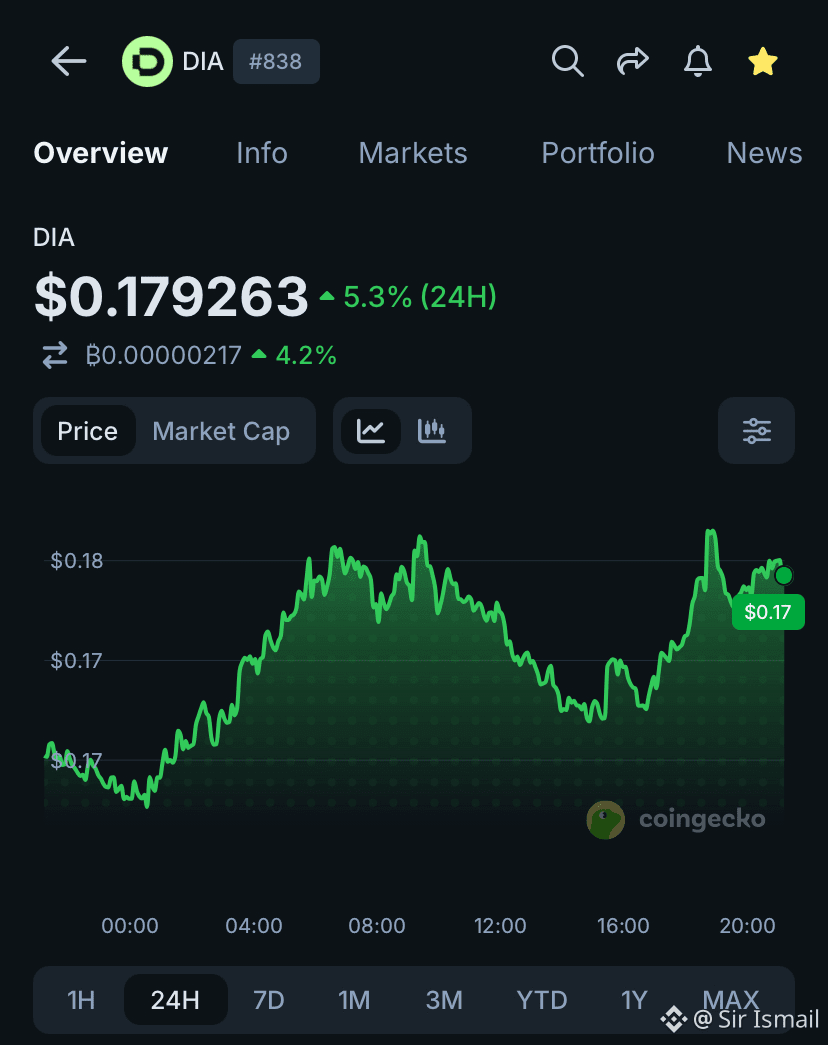
Will keep it simple. Trend is still up.
Price is around $0.178–0.179 (+6% on the day) after holding the $0.167 dip. That low sat right on the EMA cluster from yesterday. 24h range is $0.167–0.182. Last swing high is still $0.197 from Oct 6.
7D is about +7–13%, 30D about +30%. Higher lows from $0.153 → $0.159 → $0.167 are intact.
Bull case: Hold $0.167–0.170 and clear $0.183–0.187. That puts $0.197 back on the table, then $0.21–0.22.
Bear case: Lose $0.167. Next stop $0.159, then $0.153.
72
·
--
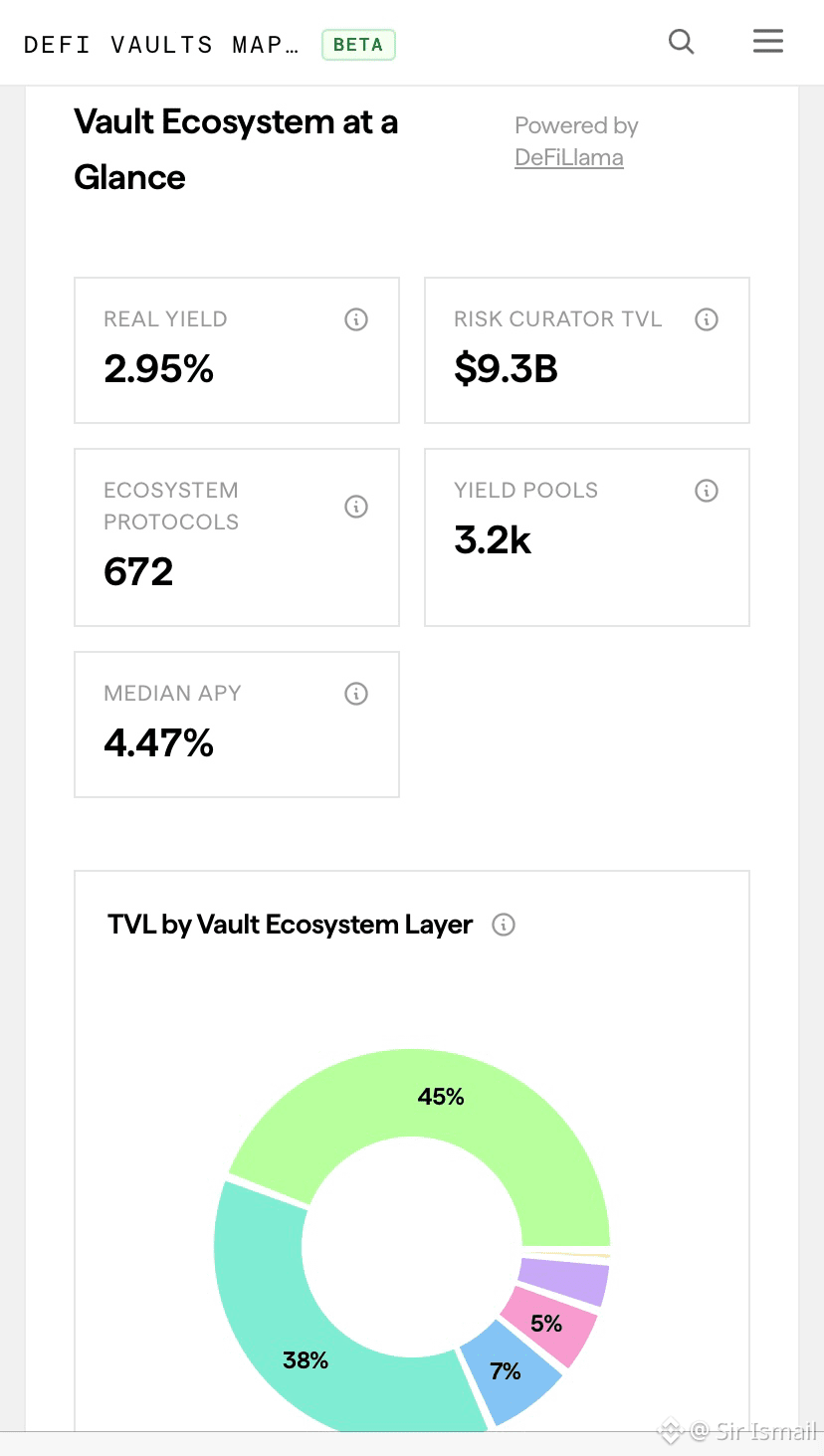
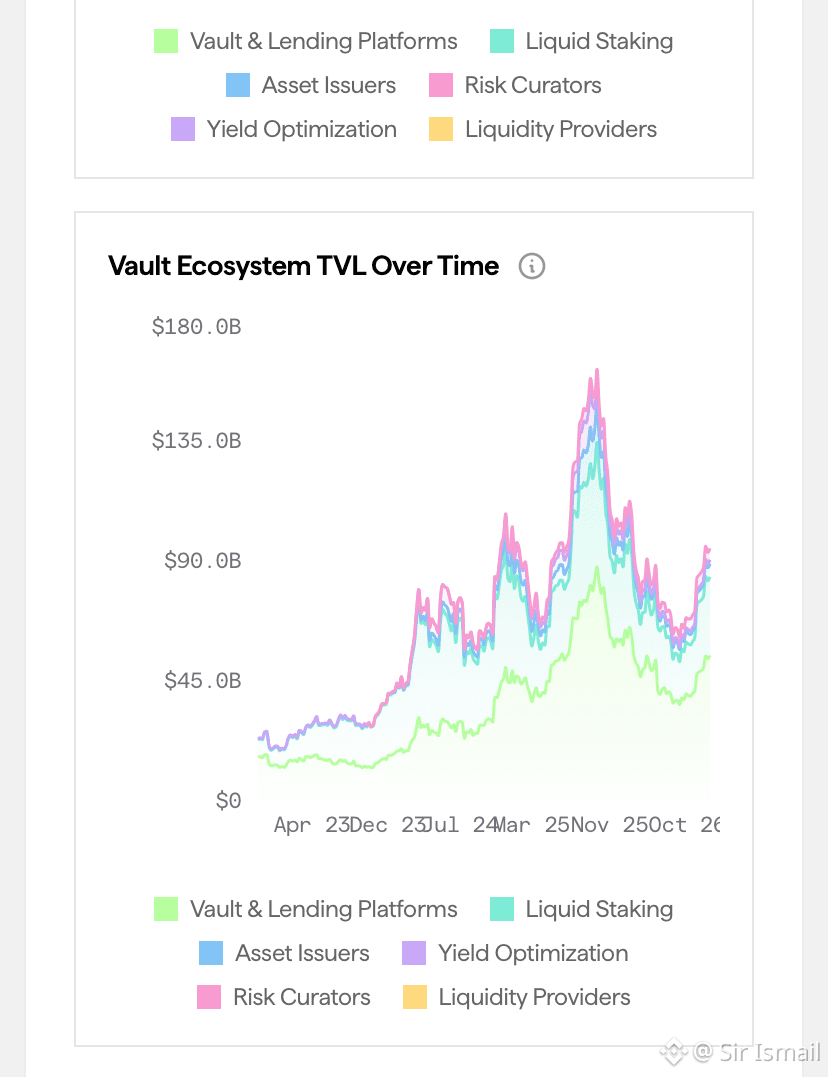
S&P is now rating onchain lending vaults. Deposits in that sector went from $1.5B to $10B in two years.
A rating needs vaults you can compare. Most of those vaults still die at the price.
If the feed is a thin pool, the collateral number is a last trade. If the feed reads reserves or the vault exchange rate, the number is what you can redeem.
DIA’s vault map lines them up across 70+ chains:
Stsy bullish on $DIA
62
·
--
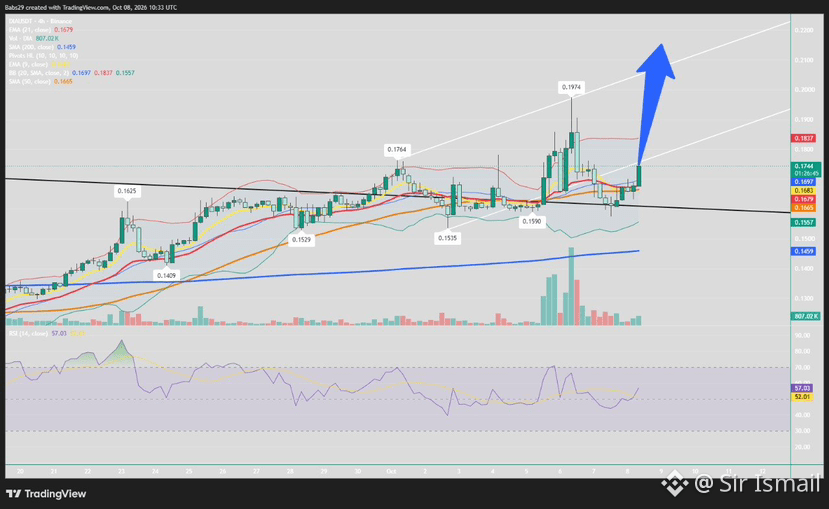
Keeping it simple:
$DIA is still in an uptrend.
Price went back around $0.174 after the dip to $0.159 was bought.
That wick held the rising channel and the EMA cluster around $0.166–$0.168.
The structure is still clean:
→ Higher lows: $0.141 → $0.153 → $0.159
→ SMA50: $0.1665
→ SMA200: $0.1459
→ RSI: 57, reset with room to run
→ Previous high: $0.197
Bull case: Hold $0.166–$0.168 → reclaim $0.183–$0.187 → $0.197 → $0.21–$0.22
Invalidation: Lose $0.159 → $0.153 comes back into play.
The structure is intact.
As long as those higher lows keep holding I’m staying bullish on $DIA
52
Войдите, чтобы посмотреть больше материала
Присоединяйтесь к пользователям криптовалют по всему миру на Binance Square
⚡️ Получайте новейшую и полезную информацию о криптоактивах.
💬 Нам доверяет крупнейшая в мире криптобиржа.
👍 Получите достоверные аналитические данные от верифицированных создателей контента.
Эл. почта/номер телефона