
Anuu_
7.9k Публикации

Anuu_
Отправить жалобу
Заблокировать пользователя
I’m living in charts,chasing every move crypto isn’t luck,it’s my lifestyle
Открытая сделка
Трейдер с регулярными сделками
1 г
824 подписок(и/а)
22.5K+ подписчиков(а)
8.5K+ понравилось
Посты
Портфель
Все
Цитирования
Активно
·
--
CPI could be the spark that moves the entire crypto market.
CPI could be the spark that moves the entire crypto market.


Bullish_Vortex
·
--
One number could flip the mood of the entire market.
That number is CPI.
I’m watching this release because the market is trying to figure out one thing: what happens next with Fed policy?
Think of it like this:
If inflation shows signs of heating up again, traders may become less comfortable expecting easier policy. That can push yields and the dollar higher, which often makes risk assets harder to trade.
Crypto could feel that pressure fast.
On the other hand, if inflation comes in softer than expected, the story changes.
A cooler CPI could reduce concerns about another rate increase and give traders more confidence to step back into risk.
But here’s the part I wouldn’t ignore:
The reaction matters more than the headline.
Imagine CPI beats expectations, BTC initially drops 2%, then quickly recovers and starts pushing higher.
That would tell me the market absorbed the bad news differently than expected.
Now imagine the opposite — CPI looks positive, BTC jumps, but buyers disappear within minutes.
That could be a warning that the move was mostly short-term positioning.
So I’m not picking a direction before the data.
I’m waiting to see where the real money moves after the number hits.
Today could bring a breakout, a fakeout, or simply a huge volatility spike.
Let the data speak first. Then let the chart confirm it.
Not financial advice. Trade with proper risk management.
$牛来
$RAYSOL
$GAIB
#CPIWatch
That number is CPI.
I’m watching this release because the market is trying to figure out one thing: what happens next with Fed policy?
Think of it like this:
If inflation shows signs of heating up again, traders may become less comfortable expecting easier policy. That can push yields and the dollar higher, which often makes risk assets harder to trade.
Crypto could feel that pressure fast.
On the other hand, if inflation comes in softer than expected, the story changes.
A cooler CPI could reduce concerns about another rate increase and give traders more confidence to step back into risk.
But here’s the part I wouldn’t ignore:
The reaction matters more than the headline.
Imagine CPI beats expectations, BTC initially drops 2%, then quickly recovers and starts pushing higher.
That would tell me the market absorbed the bad news differently than expected.
Now imagine the opposite — CPI looks positive, BTC jumps, but buyers disappear within minutes.
That could be a warning that the move was mostly short-term positioning.
So I’m not picking a direction before the data.
I’m waiting to see where the real money moves after the number hits.
Today could bring a breakout, a fakeout, or simply a huge volatility spike.
Let the data speak first. Then let the chart confirm it.
Not financial advice. Trade with proper risk management.
$牛来
$RAYSOL
$GAIB
#CPIWatch

72
·
--
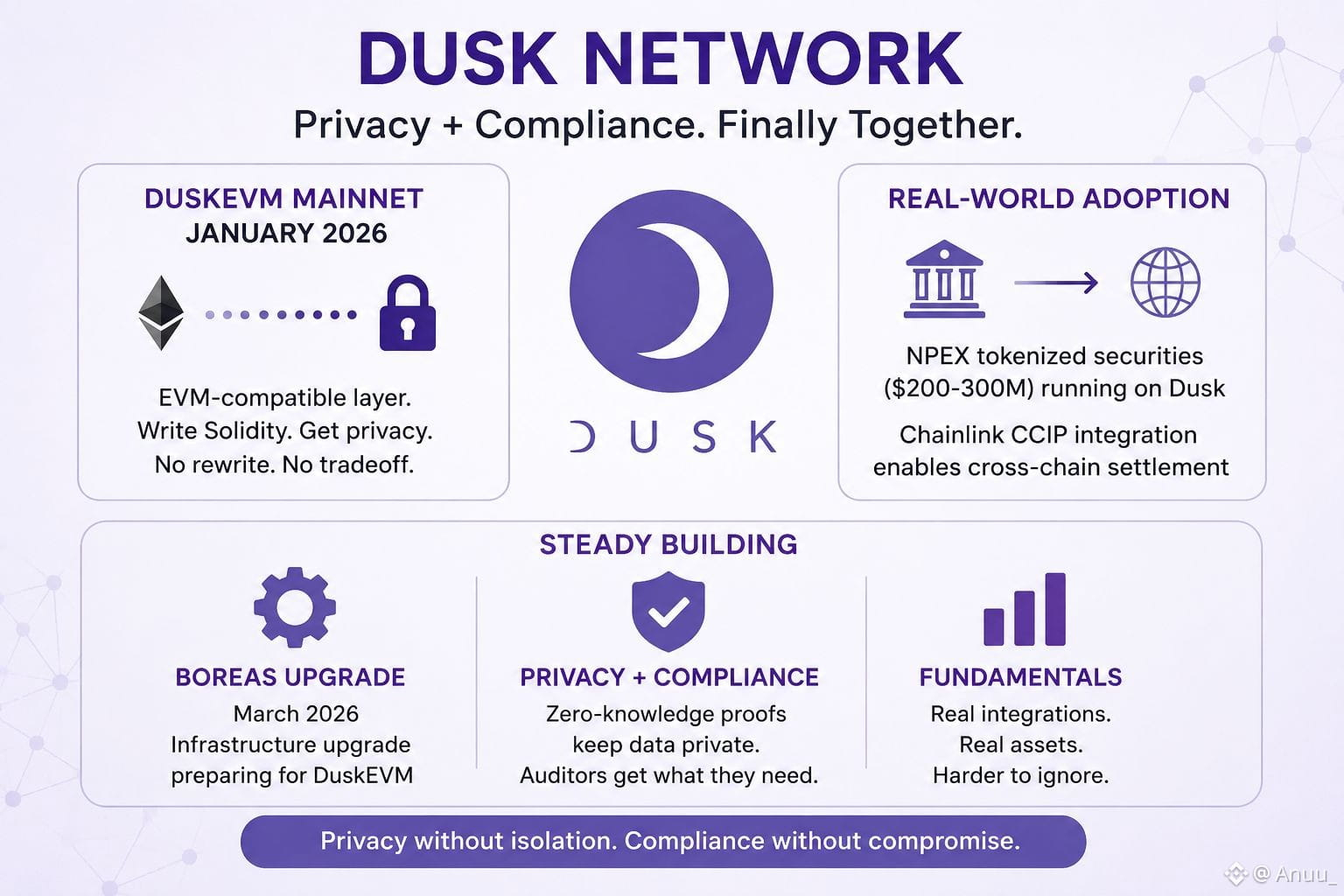
Ok, so I spent the last few days digging into Dusk Network, mainly because I'm a little tired of projects throwing around "privacy" and "compliance" like they're the same thing.
What actually got me paying attention was the DuskEVM mainnet, which went live in January 2026 as a fully EVM-compatible layer sitting on top of Dusk's base chain. In plain terms: developers can write regular Solidity code, the stuff Ethereum devs already know, and it still automatically inherits Dusk's underlying privacy protections. No rewrite, no separate ecosystem to learn from scratch.
The difference here is most privacy chains force you to pick a side — stay private and isolated, or stay compatible and give up confidentiality. This setup tries to sidestep that tradeoff entirely.
Then there's the part that actually involves real money. NPEX's tokenized securities operation, somewhere in the $200-300M range, is running on Dusk now, and a Chainlink integration from January lets those assets settle across chains using CCIP. That's a step further than most RWA pitches ever get.
Add the Boreas network upgrade from March, mostly unglamorous infrastructure work to prep for DuskEVM, and the overall picture is steady building rather than loud announcements.
Not sure how the market prices any of this long term, but the fundamentals are getting harder to wave off.
@Dusk_Foundation #dusk $DUSK
{future}(DUSKUSDT)
Ok, so I spent the last few days digging into Dusk Network, mainly because I'm a little tired of projects throwing around "privacy" and "compliance" like they're the same thing.
What actually got me paying attention was the DuskEVM mainnet, which went live in January 2026 as a fully EVM-compatible layer sitting on top of Dusk's base chain. In plain terms: developers can write regular Solidity code, the stuff Ethereum devs already know, and it still automatically inherits Dusk's underlying privacy protections. No rewrite, no separate ecosystem to learn from scratch.
The difference here is most privacy chains force you to pick a side — stay private and isolated, or stay compatible and give up confidentiality. This setup tries to sidestep that tradeoff entirely.
Then there's the part that actually involves real money. NPEX's tokenized securities operation, somewhere in the $200-300M range, is running on Dusk now, and a Chainlink integration from January lets those assets settle across chains using CCIP. That's a step further than most RWA pitches ever get.
Add the Boreas network upgrade from March, mostly unglamorous infrastructure work to prep for DuskEVM, and the overall picture is steady building rather than loud announcements.
Not sure how the market prices any of this long term, but the fundamentals are getting harder to wave off.
@Dusk #dusk $DUSK
What actually got me paying attention was the DuskEVM mainnet, which went live in January 2026 as a fully EVM-compatible layer sitting on top of Dusk's base chain. In plain terms: developers can write regular Solidity code, the stuff Ethereum devs already know, and it still automatically inherits Dusk's underlying privacy protections. No rewrite, no separate ecosystem to learn from scratch.
The difference here is most privacy chains force you to pick a side — stay private and isolated, or stay compatible and give up confidentiality. This setup tries to sidestep that tradeoff entirely.
Then there's the part that actually involves real money. NPEX's tokenized securities operation, somewhere in the $200-300M range, is running on Dusk now, and a Chainlink integration from January lets those assets settle across chains using CCIP. That's a step further than most RWA pitches ever get.
Add the Boreas network upgrade from March, mostly unglamorous infrastructure work to prep for DuskEVM, and the overall picture is steady building rather than loud announcements.
Not sure how the market prices any of this long term, but the fundamentals are getting harder to wave off.
@Dusk #dusk $DUSK
3
3
188
·
--
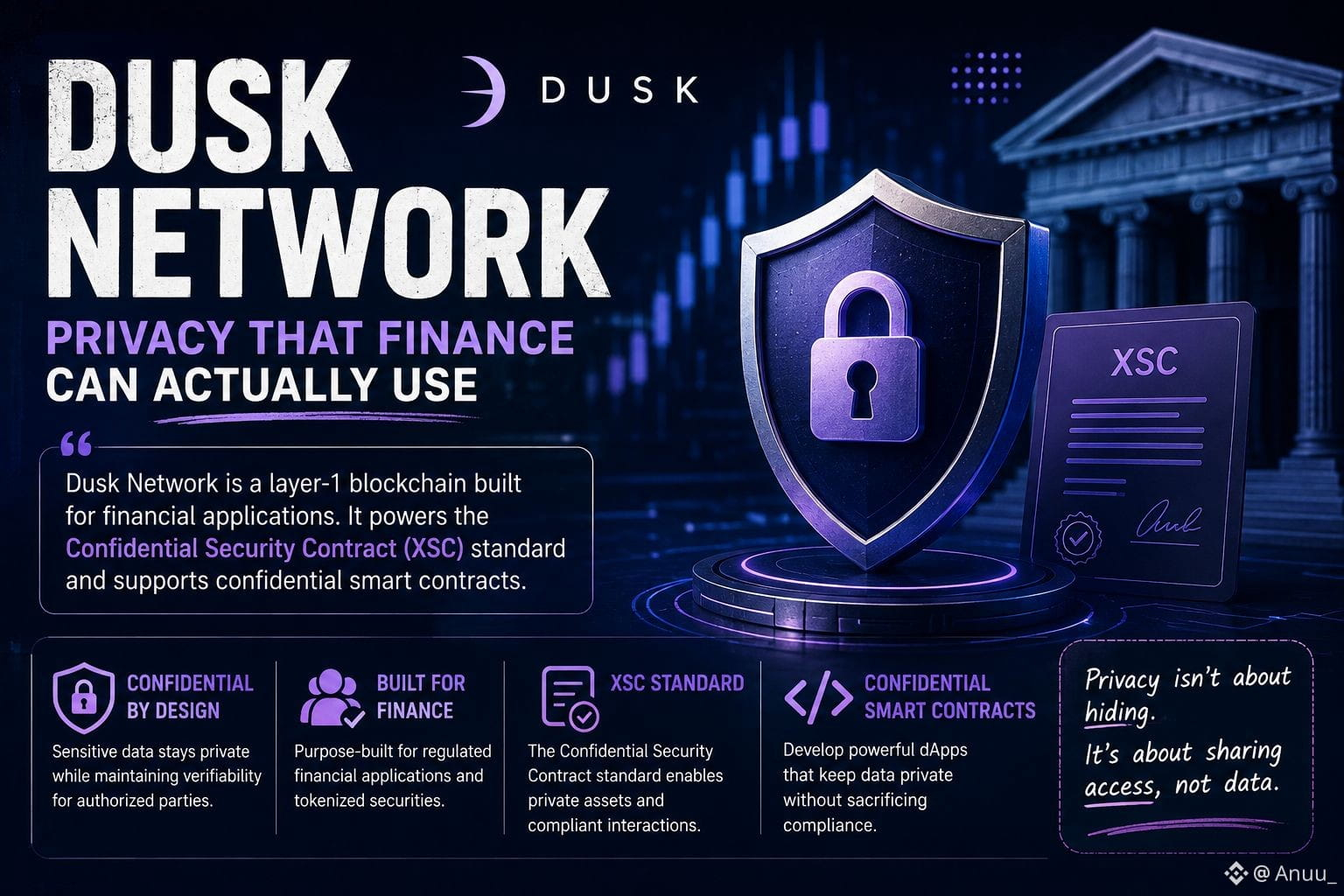
I’ve been looking at Dusk Network lately, and I keep coming back to a simple question: what does “privacy” actually need to look like when the users are financial institutions?
The more I dig into it, the more I think Dusk is taking a different route from the usual privacy narrative.
It’s a Layer-1 built around confidential smart contracts, with its XSC standard designed specifically for financial assets. What interests me isn’t just hiding transaction data. It’s the idea that sensitive information can stay private while authorized parties can still verify that everything is valid.
That feels much closer to how real finance already works.
I don’t want my financial activity broadcast to the entire world, but regulators and authorized institutions still need ways to check that things are legitimate. That balance is where Dusk starts getting interesting for me.
I’ll be honest, I’m still watching the execution more than the narrative. Building privacy technology is one thing; getting actual financial markets to trust and use it is another.
But if Dusk can bridge that gap, I think its value proposition becomes much easier to understand.
That’s the part I’m watching now.
$DUSK
{future}(DUSKUSDT)
#dusk
@Dusk_Foundation
I’ve been looking at Dusk Network lately, and I keep coming back to a simple question: what does “privacy” actually need to look like when the users are financial institutions?
The more I dig into it, the more I think Dusk is taking a different route from the usual privacy narrative.
It’s a Layer-1 built around confidential smart contracts, with its XSC standard designed specifically for financial assets. What interests me isn’t just hiding transaction data. It’s the idea that sensitive information can stay private while authorized parties can still verify that everything is valid.
That feels much closer to how real finance already works.
I don’t want my financial activity broadcast to the entire world, but regulators and authorized institutions still need ways to check that things are legitimate. That balance is where Dusk starts getting interesting for me.
I’ll be honest, I’m still watching the execution more than the narrative. Building privacy technology is one thing; getting actual financial markets to trust and use it is another.
But if Dusk can bridge that gap, I think its value proposition becomes much easier to understand.
That’s the part I’m watching now.
$DUSK
#dusk
@Dusk
The more I dig into it, the more I think Dusk is taking a different route from the usual privacy narrative.
It’s a Layer-1 built around confidential smart contracts, with its XSC standard designed specifically for financial assets. What interests me isn’t just hiding transaction data. It’s the idea that sensitive information can stay private while authorized parties can still verify that everything is valid.
That feels much closer to how real finance already works.
I don’t want my financial activity broadcast to the entire world, but regulators and authorized institutions still need ways to check that things are legitimate. That balance is where Dusk starts getting interesting for me.
I’ll be honest, I’m still watching the execution more than the narrative. Building privacy technology is one thing; getting actual financial markets to trust and use it is another.
But if Dusk can bridge that gap, I think its value proposition becomes much easier to understand.
That’s the part I’m watching now.
$DUSK
#dusk
@Dusk
5
4
157
·
--
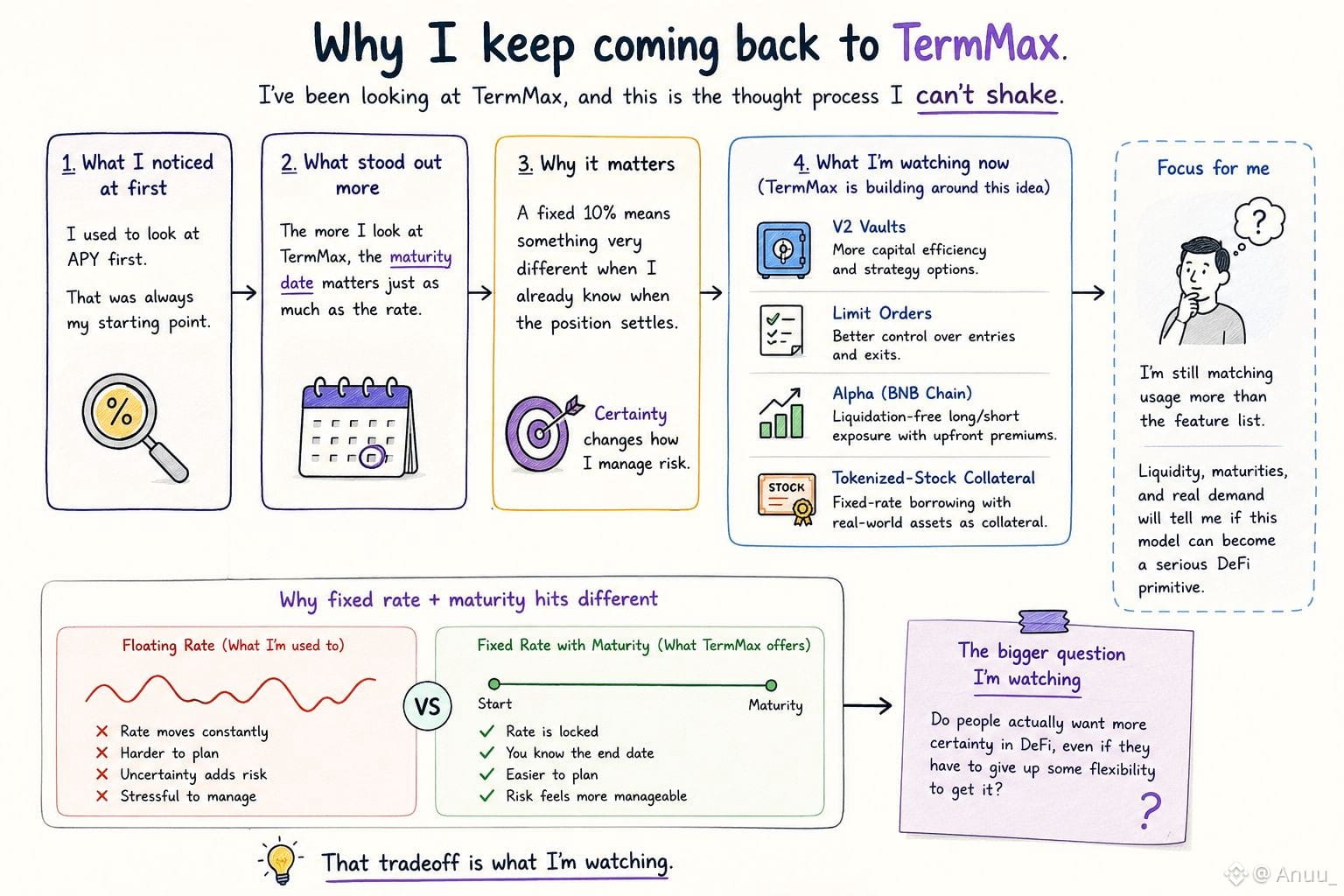
I’ve been looking at @termmax again, and one thing keeps bothering me in a good way: I’m starting to think I’ve been looking at DeFi rates the wrong way.
I usually notice the APY first.But the more I dig into TermMax,the maturity date keeps standing out more. A fixed rate feels very different when I already know when the position ends instead of watching a floating rate move around me.
What I’m watching now is how the protocol is building around that idea.V2 vaults, limit orders, and its newer BNB Chain products add more flexibility, while the options side lets users take leveraged exposure with an upfront premium rather than relying entirely on traditional liquidation mechanics.
I’m not convinced yet that fixed-rate DeFi is going to become mainstream.
But I do think TermMax is testing something interesting: whether people actually want more certainty in DeFi, even if they have to give up some flexibility to get it.
That tradeoff is what I’m watching.
@termmax #TermMax
I’ve been looking at @TermMax again, and one thing keeps bothering me in a good way: I’m starting to think I’ve been looking at DeFi rates the wrong way.
I usually notice the APY first.But the more I dig into TermMax,the maturity date keeps standing out more. A fixed rate feels very different when I already know when the position ends instead of watching a floating rate move around me.
What I’m watching now is how the protocol is building around that idea.V2 vaults, limit orders, and its newer BNB Chain products add more flexibility, while the options side lets users take leveraged exposure with an upfront premium rather than relying entirely on traditional liquidation mechanics.
I’m not convinced yet that fixed-rate DeFi is going to become mainstream.
But I do think TermMax is testing something interesting: whether people actually want more certainty in DeFi, even if they have to give up some flexibility to get it.
That tradeoff is what I’m watching.
@TermMax #TermMax
I usually notice the APY first.But the more I dig into TermMax,the maturity date keeps standing out more. A fixed rate feels very different when I already know when the position ends instead of watching a floating rate move around me.
What I’m watching now is how the protocol is building around that idea.V2 vaults, limit orders, and its newer BNB Chain products add more flexibility, while the options side lets users take leveraged exposure with an upfront premium rather than relying entirely on traditional liquidation mechanics.
I’m not convinced yet that fixed-rate DeFi is going to become mainstream.
But I do think TermMax is testing something interesting: whether people actually want more certainty in DeFi, even if they have to give up some flexibility to get it.
That tradeoff is what I’m watching.
@TermMax #TermMax
4
6
153
·
--
Проверено
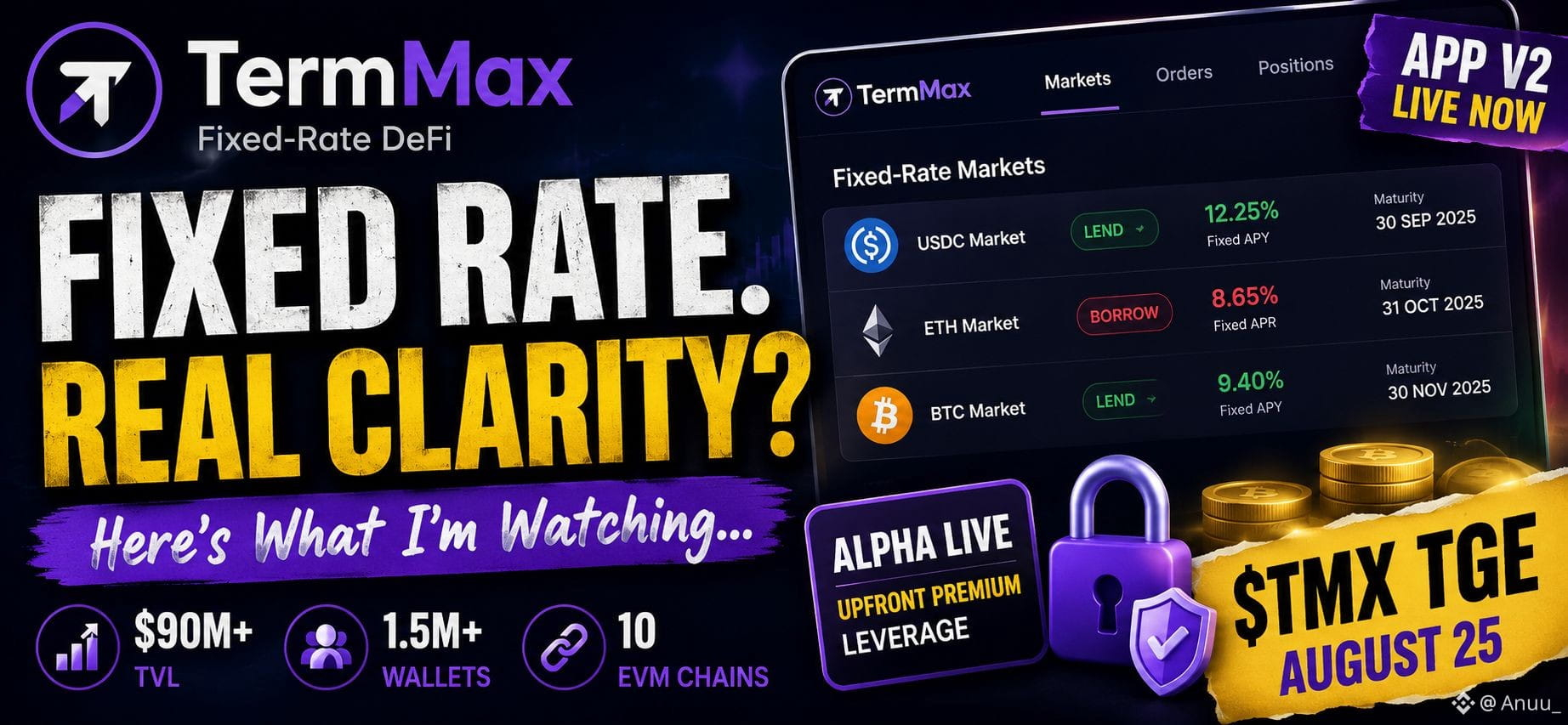
I’ve been looking at @termmax again, and the thing I keep coming back to is how different DeFi feels when I actually know the rate and the date I’m getting into.
I used to look at the APY first. The more I’ve watched fixed-rate markets, the more I think that’s backwards. A 10% rate means something very different when I know exactly when the position matures, instead of wondering where a floating rate will be a few weeks from now.
What caught my attention is how TermMax has been filling out the product around that idea. App V2 puts markets, orders and positions together, limit orders are now available, and Alpha adds leverage with an upfront premium instead of the usual ongoing margin-call pressure.
The numbers are interesting too: over $90M TVL, 1.5M+ registered wallets and support across 10 EVM chains.With the $TMX TGE announced for August 25, I’m curious to see what happens next.
I’m not convinced by numbers alone, though. I want to see whether people actually keep using the product once the initial attention fades.
@termmax #TermMax
$AVAAI
{future}(AVAAIUSDT)
$COLLECT
{alpha}(560x4b3d30992f003c8167699735f5ab2831b2a087d3)
$LAB
{future}(LABUSDT)
I’ve been looking at @TermMax again, and the thing I keep coming back to is how different DeFi feels when I actually know the rate and the date I’m getting into.
I used to look at the APY first. The more I’ve watched fixed-rate markets, the more I think that’s backwards. A 10% rate means something very different when I know exactly when the position matures, instead of wondering where a floating rate will be a few weeks from now.
What caught my attention is how TermMax has been filling out the product around that idea. App V2 puts markets, orders and positions together, limit orders are now available, and Alpha adds leverage with an upfront premium instead of the usual ongoing margin-call pressure.
The numbers are interesting too: over $90M TVL, 1.5M+ registered wallets and support across 10 EVM chains.With the $TMX TGE announced for August 25, I’m curious to see what happens next.
I’m not convinced by numbers alone, though. I want to see whether people actually keep using the product once the initial attention fades.
@TermMax #TermMax
$AVAAI
$COLLECT
$LAB
I used to look at the APY first. The more I’ve watched fixed-rate markets, the more I think that’s backwards. A 10% rate means something very different when I know exactly when the position matures, instead of wondering where a floating rate will be a few weeks from now.
What caught my attention is how TermMax has been filling out the product around that idea. App V2 puts markets, orders and positions together, limit orders are now available, and Alpha adds leverage with an upfront premium instead of the usual ongoing margin-call pressure.
The numbers are interesting too: over $90M TVL, 1.5M+ registered wallets and support across 10 EVM chains.With the $TMX TGE announced for August 25, I’m curious to see what happens next.
I’m not convinced by numbers alone, though. I want to see whether people actually keep using the product once the initial attention fades.
@TermMax #TermMax
$AVAAI
$COLLECT
$LAB
2
5
941
·
--
Okay so I've been circling back to Dusk Network for about a week now, mostly out of curiosity about whether a privacy chain can actually survive contact with regulators instead of just talking a big game about it.
The thing that pulled me back in was DuskEVM. It's not flashy basically a compatibility layer so Solidity apps can run on Dusk without a full rewrite. But here's the part that made me pause: apps that migrate over don't need to bolt privacy on afterward, they just inherit it. Most chains treat privacy as an add-on feature. Dusk treats it as the default state you fall back into.
Then there's the NPEX thing, which honestly is the part I keep coming back to. They've already tokenized north of €300 million in real securities with a licensed Dutch exchange. Not a demo, not some testnet toy actual regulated financial assets sitting on-chain. That's a very different flex than most projects make.
They also brought in Chainlink CCIP to move those tokenized assets across chains, which matters more than it sounds — otherwise you'd have compliant assets stuck on one network, which kind of defeats the point.
What's interesting is their version of "privacy" isn't total opacity. Auditors can still check specific things without the whole transaction being exposed. Feels like a rare middle ground that actually maps to how regulators think.
Not sure how the market ends up pricing any of this. But the shipping cadence is real, even if the attention isn't there yet.
@Dusk_Foundation #dusk $DUSK
$MRNAon
{alpha}(560x01486675da0764ee780ea7cb65c33062e9b2d28c)
$SKYAI
{future}(SKYAIUSDT)
Okay so I've been circling back to Dusk Network for about a week now, mostly out of curiosity about whether a privacy chain can actually survive contact with regulators instead of just talking a big game about it.
The thing that pulled me back in was DuskEVM. It's not flashy basically a compatibility layer so Solidity apps can run on Dusk without a full rewrite. But here's the part that made me pause: apps that migrate over don't need to bolt privacy on afterward, they just inherit it. Most chains treat privacy as an add-on feature. Dusk treats it as the default state you fall back into.
Then there's the NPEX thing, which honestly is the part I keep coming back to. They've already tokenized north of €300 million in real securities with a licensed Dutch exchange. Not a demo, not some testnet toy actual regulated financial assets sitting on-chain. That's a very different flex than most projects make.
They also brought in Chainlink CCIP to move those tokenized assets across chains, which matters more than it sounds — otherwise you'd have compliant assets stuck on one network, which kind of defeats the point.
What's interesting is their version of "privacy" isn't total opacity. Auditors can still check specific things without the whole transaction being exposed. Feels like a rare middle ground that actually maps to how regulators think.
Not sure how the market ends up pricing any of this. But the shipping cadence is real, even if the attention isn't there yet.
@Dusk #dusk $DUSK
$MRNAon
$SKYAI
The thing that pulled me back in was DuskEVM. It's not flashy basically a compatibility layer so Solidity apps can run on Dusk without a full rewrite. But here's the part that made me pause: apps that migrate over don't need to bolt privacy on afterward, they just inherit it. Most chains treat privacy as an add-on feature. Dusk treats it as the default state you fall back into.
Then there's the NPEX thing, which honestly is the part I keep coming back to. They've already tokenized north of €300 million in real securities with a licensed Dutch exchange. Not a demo, not some testnet toy actual regulated financial assets sitting on-chain. That's a very different flex than most projects make.
They also brought in Chainlink CCIP to move those tokenized assets across chains, which matters more than it sounds — otherwise you'd have compliant assets stuck on one network, which kind of defeats the point.
What's interesting is their version of "privacy" isn't total opacity. Auditors can still check specific things without the whole transaction being exposed. Feels like a rare middle ground that actually maps to how regulators think.
Not sure how the market ends up pricing any of this. But the shipping cadence is real, even if the attention isn't there yet.
@Dusk #dusk $DUSK
$MRNAon
$SKYAI
🅰️ Privacy
0%
🅱️ Real-world assets
0%
🅲️ Cross-chain
0%
🅳️ DuskEVM
0%
0 проголосовали • Голосование закрыто
4
3
315
·
--
I've been looking into TermMax lately, and it's carving out an interesting niche in a lending market that's still mostly dominated by floating-rate giants like Aave and Morpho.
The idea itself isn't complicated. Lenders lock in a yield, borrowers lock in a cost, both tied to a maturity date. It's basically a bond, just running on-chain instead of through a bank. There's also a leverage product where you pay a fixed premium upfront instead of dealing with ongoing margin calls, which sidesteps the liquidation cascades that have burned people on variable-rate platforms before.
What actually caught my attention were the numbers. Over 1 million users, 837K+ registered wallets, TVL sitting around $64M spread across seven chains, and daily actives that peaked near 170,000 at one point. That's a real jump from where things were earlier in the year.
The other piece worth noting is where they're expanding. They've started accepting Ondo's tokenized stock tokens as collateral, which is a clear signal they're courting institutional users rather than just retail farmers. And the Morpho integration is a smart fix for a problem most fixed-rate protocols never really solve — capital sitting idle while it waits to get matched. Here, that idle capital still earns something in the meantime.
Most projects talk about solving capital efficiency. Fewer actually ship something that addresses it directly.
Still early, but something seems to be taking shape here.
@termmax #TermMax
I've been looking into TermMax lately, and it's carving out an interesting niche in a lending market that's still mostly dominated by floating-rate giants like Aave and Morpho.
The idea itself isn't complicated. Lenders lock in a yield, borrowers lock in a cost, both tied to a maturity date. It's basically a bond, just running on-chain instead of through a bank. There's also a leverage product where you pay a fixed premium upfront instead of dealing with ongoing margin calls, which sidesteps the liquidation cascades that have burned people on variable-rate platforms before.
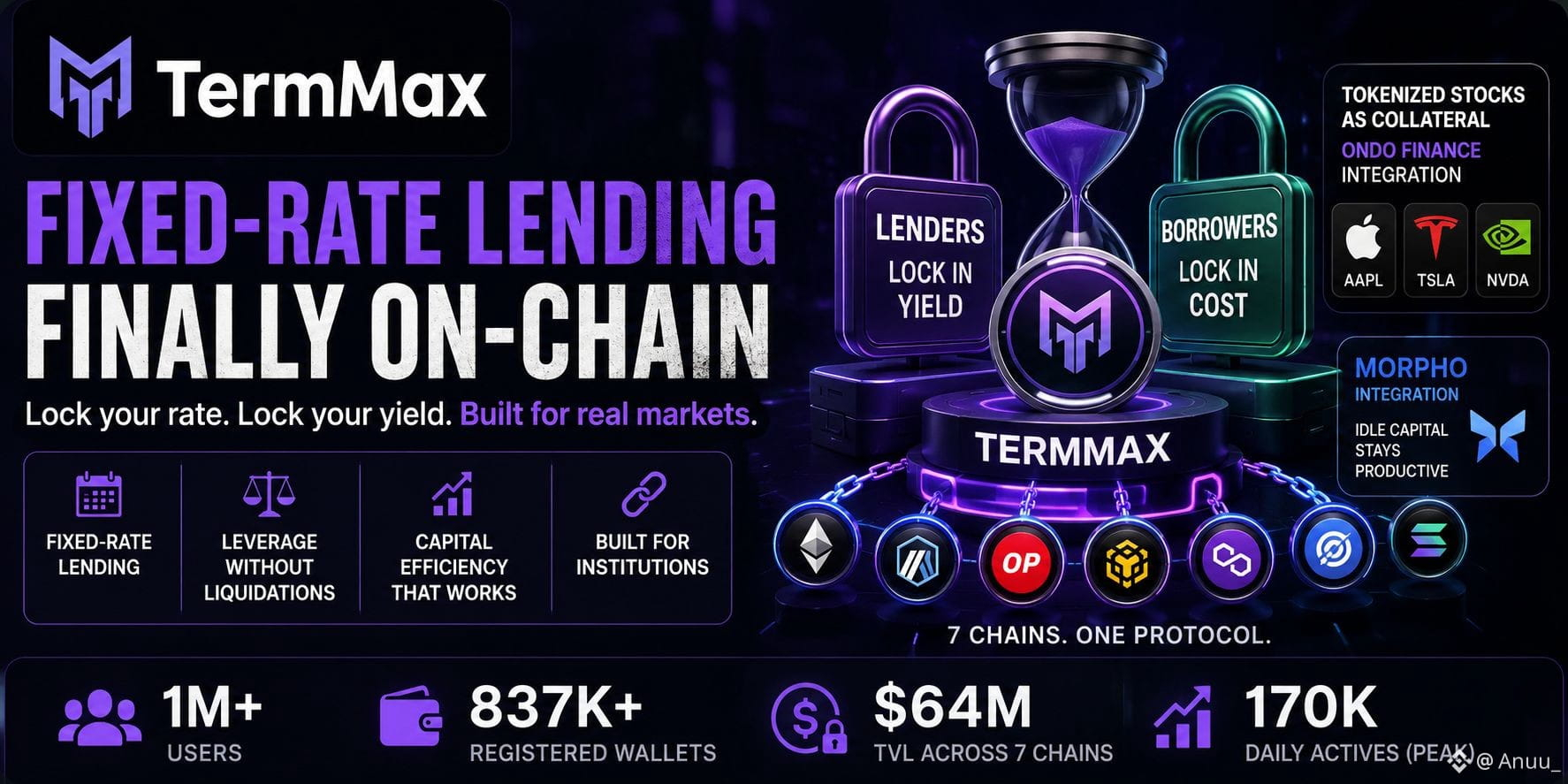
What actually caught my attention were the numbers. Over 1 million users, 837K+ registered wallets, TVL sitting around $64M spread across seven chains, and daily actives that peaked near 170,000 at one point. That's a real jump from where things were earlier in the year.
The other piece worth noting is where they're expanding. They've started accepting Ondo's tokenized stock tokens as collateral, which is a clear signal they're courting institutional users rather than just retail farmers. And the Morpho integration is a smart fix for a problem most fixed-rate protocols never really solve — capital sitting idle while it waits to get matched. Here, that idle capital still earns something in the meantime.
Most projects talk about solving capital efficiency. Fewer actually ship something that addresses it directly.
Still early, but something seems to be taking shape here.
@TermMax #TermMax
The idea itself isn't complicated. Lenders lock in a yield, borrowers lock in a cost, both tied to a maturity date. It's basically a bond, just running on-chain instead of through a bank. There's also a leverage product where you pay a fixed premium upfront instead of dealing with ongoing margin calls, which sidesteps the liquidation cascades that have burned people on variable-rate platforms before.
What actually caught my attention were the numbers. Over 1 million users, 837K+ registered wallets, TVL sitting around $64M spread across seven chains, and daily actives that peaked near 170,000 at one point. That's a real jump from where things were earlier in the year.
The other piece worth noting is where they're expanding. They've started accepting Ondo's tokenized stock tokens as collateral, which is a clear signal they're courting institutional users rather than just retail farmers. And the Morpho integration is a smart fix for a problem most fixed-rate protocols never really solve — capital sitting idle while it waits to get matched. Here, that idle capital still earns something in the meantime.
Most projects talk about solving capital efficiency. Fewer actually ship something that addresses it directly.
Still early, but something seems to be taking shape here.
@TermMax #TermMax
2
3
237
·
--
Been spending my evenings reading through Dusk Network's docs and recent updates, and a few things stood out enough to write down.
First, the mainnet finally shipped in January after six years in development. That's an unusually long runway, and it makes me wonder what took so long — though the answer seems to be that privacy-plus-compliance is genuinely hard engineering.
The technical centerpiece is DuskEVM. Developers write normal Solidity code, nothing exotic, and the privacy layer sits underneath without forcing a rewrite. That's actually pretty interesting because most privacy-focused chains make you pick: keep your familiar tools, or get privacy. Here you don't have to choose.
Hedger is the other component worth understanding. It blends zero-knowledge proofs with homomorphic encryption, so transactions stay confidential by default but can still be audited when a regulator needs to look. The difference here is that "private" doesn't mean "unaccountable."
On the adoption side, the NPEX partnership is targeting roughly €200-300M in tokenized Dutch securities running on Dusk, alongside a Chainlink CCIP integration for cross-chain settlement. That's real institutional weight, not just a partnership announcement.
Price action hasn't reflected any of this yet. Not sure how the market eventually prices it, but the fundamentals are getting harder to ignore.
@Dusk_Foundation #dusk $DUSK
{future}(DUSKUSDT)
Been spending my evenings reading through Dusk Network's docs and recent updates, and a few things stood out enough to write down.
First, the mainnet finally shipped in January after six years in development. That's an unusually long runway, and it makes me wonder what took so long — though the answer seems to be that privacy-plus-compliance is genuinely hard engineering.
The technical centerpiece is DuskEVM. Developers write normal Solidity code, nothing exotic, and the privacy layer sits underneath without forcing a rewrite. That's actually pretty interesting because most privacy-focused chains make you pick: keep your familiar tools, or get privacy. Here you don't have to choose.
Hedger is the other component worth understanding. It blends zero-knowledge proofs with homomorphic encryption, so transactions stay confidential by default but can still be audited when a regulator needs to look. The difference here is that "private" doesn't mean "unaccountable."
On the adoption side, the NPEX partnership is targeting roughly €200-300M in tokenized Dutch securities running on Dusk, alongside a Chainlink CCIP integration for cross-chain settlement. That's real institutional weight, not just a partnership announcement.
Price action hasn't reflected any of this yet. Not sure how the market eventually prices it, but the fundamentals are getting harder to ignore.
@Dusk #dusk $DUSK
First, the mainnet finally shipped in January after six years in development. That's an unusually long runway, and it makes me wonder what took so long — though the answer seems to be that privacy-plus-compliance is genuinely hard engineering.
The technical centerpiece is DuskEVM. Developers write normal Solidity code, nothing exotic, and the privacy layer sits underneath without forcing a rewrite. That's actually pretty interesting because most privacy-focused chains make you pick: keep your familiar tools, or get privacy. Here you don't have to choose.
Hedger is the other component worth understanding. It blends zero-knowledge proofs with homomorphic encryption, so transactions stay confidential by default but can still be audited when a regulator needs to look. The difference here is that "private" doesn't mean "unaccountable."
On the adoption side, the NPEX partnership is targeting roughly €200-300M in tokenized Dutch securities running on Dusk, alongside a Chainlink CCIP integration for cross-chain settlement. That's real institutional weight, not just a partnership announcement.
Price action hasn't reflected any of this yet. Not sure how the market eventually prices it, but the fundamentals are getting harder to ignore.
@Dusk #dusk $DUSK
🔐 Privacy by default
0%
⚖️ Regulatory compliance
0%
🌐 Institutional adoption
0%
0 проголосовали • Голосование закрыто
4
3
157
·
--
I’ve been spending more time watching TermMax, and honestly, I’m less interested in the “fixed-rate DeFi” label than I am in whether people actually have a reason to use it.
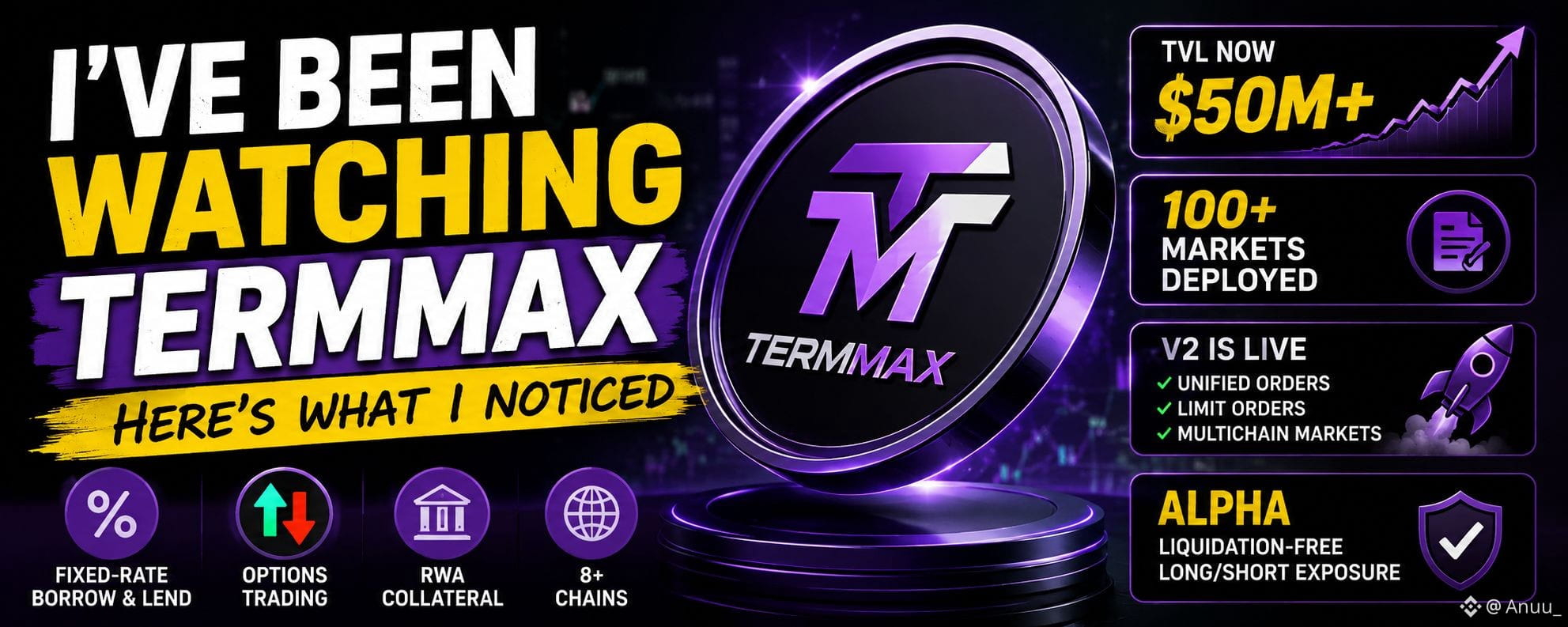
The more I look at it, the interesting part is how the pieces are starting to connect. Fixed-rate borrowing and lending, options-style exposure, RWA collateral, and markets spread across multiple chains.
One thing I noticed is that TermMax isn’t just sitting on the original lending idea either. V2 has brought things like unified orders and limit orders, while Alpha adds a different way to get long or short exposure without the usual liquidation setup.
I’m still watching the numbers too.TVL has moved above $50M, with markets deployed across 8+ chains.
But I’m not convinced yet.
For me, the real test is simple: can TermMax turn all this flexibility into consistent demand and useful liquidity?
That’s the part I’m waiting to see.
@termmax #TermMax
I’ve been spending more time watching TermMax, and honestly, I’m less interested in the “fixed-rate DeFi” label than I am in whether people actually have a reason to use it.
The more I look at it, the interesting part is how the pieces are starting to connect. Fixed-rate borrowing and lending, options-style exposure, RWA collateral, and markets spread across multiple chains.
One thing I noticed is that TermMax isn’t just sitting on the original lending idea either. V2 has brought things like unified orders and limit orders, while Alpha adds a different way to get long or short exposure without the usual liquidation setup.
I’m still watching the numbers too.TVL has moved above $50M, with markets deployed across 8+ chains.
But I’m not convinced yet.
For me, the real test is simple: can TermMax turn all this flexibility into consistent demand and useful liquidity?
That’s the part I’m waiting to see.
@TermMax #TermMax
The more I look at it, the interesting part is how the pieces are starting to connect. Fixed-rate borrowing and lending, options-style exposure, RWA collateral, and markets spread across multiple chains.
One thing I noticed is that TermMax isn’t just sitting on the original lending idea either. V2 has brought things like unified orders and limit orders, while Alpha adds a different way to get long or short exposure without the usual liquidation setup.
I’m still watching the numbers too.TVL has moved above $50M, with markets deployed across 8+ chains.
But I’m not convinced yet.
For me, the real test is simple: can TermMax turn all this flexibility into consistent demand and useful liquidity?
That’s the part I’m waiting to see.
@TermMax #TermMax
4
4
212
·
--
I’ve been looking at @Dusk_Foundation more closely lately, and one thing keeps sitting in the back of my mind: I’m less interested in what the project says it can do and more interested in whether people actually start using it.
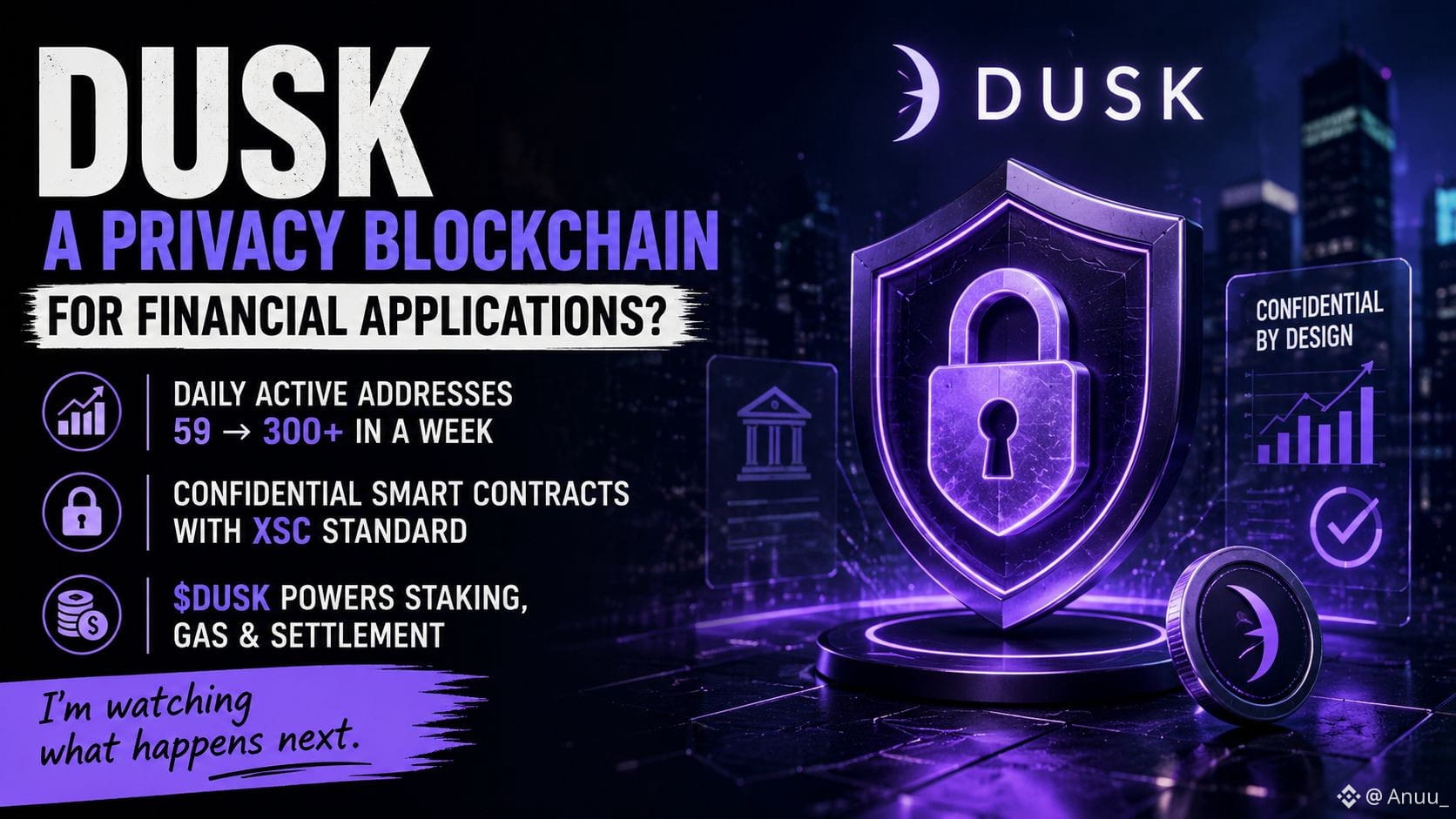
I keep coming back to the activity because the numbers caught me off guard a little. Daily active addresses went from around 59 to more than 300 in roughly a week. It’s not a huge number yet, but that kind of move is hard for me to completely ignore.
I’m also watching the staking side. The 1,000 DUSK minimum, validator setup, and the way $DUSK fits into staking, gas and settlement make me want to see how much of this translates into actual network demand.
I’m not convinced yet, and I think that’s the interesting part.
For me, the bigger question is whether Dusk can turn its privacy and compliance approach into something financial applications genuinely need, rather than just another good-looking blockchain narrative.
#dusk @Dusk_Foundation $DUSK
{future}(DUSKUSDT)
I’ve been looking at @Dusk more closely lately, and one thing keeps sitting in the back of my mind: I’m less interested in what the project says it can do and more interested in whether people actually start using it.
I keep coming back to the activity because the numbers caught me off guard a little. Daily active addresses went from around 59 to more than 300 in roughly a week. It’s not a huge number yet, but that kind of move is hard for me to completely ignore.
I’m also watching the staking side. The 1,000 DUSK minimum, validator setup, and the way $DUSK fits into staking, gas and settlement make me want to see how much of this translates into actual network demand.
I’m not convinced yet, and I think that’s the interesting part.
For me, the bigger question is whether Dusk can turn its privacy and compliance approach into something financial applications genuinely need, rather than just another good-looking blockchain narrative.
#dusk @Dusk $DUSK
I keep coming back to the activity because the numbers caught me off guard a little. Daily active addresses went from around 59 to more than 300 in roughly a week. It’s not a huge number yet, but that kind of move is hard for me to completely ignore.
I’m also watching the staking side. The 1,000 DUSK minimum, validator setup, and the way $DUSK fits into staking, gas and settlement make me want to see how much of this translates into actual network demand.
I’m not convinced yet, and I think that’s the interesting part.
For me, the bigger question is whether Dusk can turn its privacy and compliance approach into something financial applications genuinely need, rather than just another good-looking blockchain narrative.
#dusk @Dusk $DUSK
7
5
174
·
--
Spent some time this week just watching Dusk's on-chain numbers instead of reading another thread about it, and one stat actually made me pause — daily active addresses went from 59 to over 300 in about a week. Small numbers in the grand scheme, sure, but the jump itself was sharp enough to notice.
Everyone talks about Dusk as "the privacy chain," which, fine, it is. But the part I found more interesting was the validator setup. There's no mining here stakers get chosen to propose and validate blocks based on how much they've staked and how reliable they've been. Capital and uptime, not GPUs.
Then there's the messier part nobody really likes bringing up. The bridge linking Dusk to BNB Smart Chain got hit earlier this year, and funds moved out through a compromised signing wallet, not a bug in Dusk's actual protocol. That distinction matters more than people give it credit for — a chain being secure and everything wrapped around that chain being secure are two separate claims, and this incident makes that gap pretty obvious.
The institutional piece is still NPEX, a regulated Dutch exchange working to bring real securities onto Dusk, reportedly in the hundreds of millions. Plenty of chains promise this kind of thing. Fewer actually get a regulated partner to commit.
No idea yet if that address spike means anything long-term or if it fades in a month. Going to keep an eye on it before saying more.
#dusk @Dusk_Foundation $DUSK
$GPS
$STAR
Spent some time this week just watching Dusk's on-chain numbers instead of reading another thread about it, and one stat actually made me pause — daily active addresses went from 59 to over 300 in about a week. Small numbers in the grand scheme, sure, but the jump itself was sharp enough to notice.
Everyone talks about Dusk as "the privacy chain," which, fine, it is. But the part I found more interesting was the validator setup. There's no mining here stakers get chosen to propose and validate blocks based on how much they've staked and how reliable they've been. Capital and uptime, not GPUs.
Then there's the messier part nobody really likes bringing up. The bridge linking Dusk to BNB Smart Chain got hit earlier this year, and funds moved out through a compromised signing wallet, not a bug in Dusk's actual protocol. That distinction matters more than people give it credit for — a chain being secure and everything wrapped around that chain being secure are two separate claims, and this incident makes that gap pretty obvious.
The institutional piece is still NPEX, a regulated Dutch exchange working to bring real securities onto Dusk, reportedly in the hundreds of millions. Plenty of chains promise this kind of thing. Fewer actually get a regulated partner to commit.
No idea yet if that address spike means anything long-term or if it fades in a month. Going to keep an eye on it before saying more.
#dusk @Dusk $DUSK
$GPS
$STAR
Everyone talks about Dusk as "the privacy chain," which, fine, it is. But the part I found more interesting was the validator setup. There's no mining here stakers get chosen to propose and validate blocks based on how much they've staked and how reliable they've been. Capital and uptime, not GPUs.
Then there's the messier part nobody really likes bringing up. The bridge linking Dusk to BNB Smart Chain got hit earlier this year, and funds moved out through a compromised signing wallet, not a bug in Dusk's actual protocol. That distinction matters more than people give it credit for — a chain being secure and everything wrapped around that chain being secure are two separate claims, and this incident makes that gap pretty obvious.
The institutional piece is still NPEX, a regulated Dutch exchange working to bring real securities onto Dusk, reportedly in the hundreds of millions. Plenty of chains promise this kind of thing. Fewer actually get a regulated partner to commit.
No idea yet if that address spike means anything long-term or if it fades in a month. Going to keep an eye on it before saying more.
#dusk @Dusk $DUSK
$GPS
$STAR
🚀 Yes, real growth
100%
🧐 Too early to tell
0%
📉 Likely fades
0%
🤔 Need more data
0%
1 проголосовали • Голосование закрыто
10
9
144
·
--
Проверено
@Dusk_Foundation $DUSK #dusk
{future}(DUSKUSDT)
I've been digging into Dusk Network lately, and honestly, the part I keep coming back to is how focused it is on a problem most blockchains don't handle particularly well: financial privacy.
Dusk is a Layer-1 built around confidential transactions, with its XSC standard designed for regulated assets and securities. Put simply, sensitive information can stay private while authorized parties can still verify that the rules were followed.
What caught my attention was the recent Boreas upgrade work. It isn't the kind of headline that gets everyone excited, but improvements around network resilience, resource accounting, client compatibility and DuskEVM matter if the network is actually going to support real applications.
Dusk has also been expanding the user side with Dusk Connect and its updated Rusk Wallet, making the ecosystem easier to interact with.
Then there's the Chainlink integration with NPEX, bringing external market data and cross-chain infrastructure into the picture.
That's actually pretty interesting because tokenizing securities is the easy part of the story. Making privacy, compliance and settlement work together is much harder.
Most projects talk about institutional adoption. I'm more interested in whether the infrastructure eventually gives institutions a reason to actually use it.
Still early, but something seems to be taking shape here.
$MarsCoin
{alpha}(560xfe189e97832da1573e4e4ff034f4ffc3a15c7777)
$DOLO
{future}(DOLOUSDT)
@Dusk $DUSK #dusk
I've been digging into Dusk Network lately, and honestly, the part I keep coming back to is how focused it is on a problem most blockchains don't handle particularly well: financial privacy.
Dusk is a Layer-1 built around confidential transactions, with its XSC standard designed for regulated assets and securities. Put simply, sensitive information can stay private while authorized parties can still verify that the rules were followed.
What caught my attention was the recent Boreas upgrade work. It isn't the kind of headline that gets everyone excited, but improvements around network resilience, resource accounting, client compatibility and DuskEVM matter if the network is actually going to support real applications.
Dusk has also been expanding the user side with Dusk Connect and its updated Rusk Wallet, making the ecosystem easier to interact with.
Then there's the Chainlink integration with NPEX, bringing external market data and cross-chain infrastructure into the picture.
That's actually pretty interesting because tokenizing securities is the easy part of the story. Making privacy, compliance and settlement work together is much harder.
Most projects talk about institutional adoption. I'm more interested in whether the infrastructure eventually gives institutions a reason to actually use it.
Still early, but something seems to be taking shape here.
$MarsCoin
$DOLO
I've been digging into Dusk Network lately, and honestly, the part I keep coming back to is how focused it is on a problem most blockchains don't handle particularly well: financial privacy.
Dusk is a Layer-1 built around confidential transactions, with its XSC standard designed for regulated assets and securities. Put simply, sensitive information can stay private while authorized parties can still verify that the rules were followed.
What caught my attention was the recent Boreas upgrade work. It isn't the kind of headline that gets everyone excited, but improvements around network resilience, resource accounting, client compatibility and DuskEVM matter if the network is actually going to support real applications.
Dusk has also been expanding the user side with Dusk Connect and its updated Rusk Wallet, making the ecosystem easier to interact with.
Then there's the Chainlink integration with NPEX, bringing external market data and cross-chain infrastructure into the picture.
That's actually pretty interesting because tokenizing securities is the easy part of the story. Making privacy, compliance and settlement work together is much harder.
Most projects talk about institutional adoption. I'm more interested in whether the infrastructure eventually gives institutions a reason to actually use it.
Still early, but something seems to be taking shape here.
$MarsCoin
$DOLO
Bullish 💚
67%
Bearish ❤️
33%
Neutral 👈
0%
12 проголосовали • Голосование закрыто
7
7
4.1k
·
--
@Dusk_Foundation #dusk $DUSK
Spent the last few days digging into Dusk, and honestly, the thing I find most interesting isn't the token price.
It's the gap between what Dusk has actually built and how little usage the network seems to have so far.
The idea itself makes sense to me. Institutions want privacy because they don't want every transaction exposed publicly, but regulators still need a way to verify what's happening.
Dusk is basically trying to solve both problems with zero-knowledge proofs: keep the details private, while still making them auditable when required.
The mainnet finally went live after years of development, DuskEVM made Solidity deployment possible, and the NPEX partnership gives the project a more credible institutional angle than the usual "RWA partnership" headlines.
But then I look at the numbers.
TVL was still under $1M in the data I was looking at, despite all that development.
That's the part I can't ignore.
Maybe it's simply too early. Regulated assets don't move at the speed of meme coins, and getting real securities onto a blockchain involves a completely different set of hurdles.
Still, that's exactly why I'm watching Dusk.
The technology story looks interesting. The adoption story still has a lot to prove.
$ACE
{future}(ACEUSDT)
$KII
{alpha}(560xeec6574eabba52bac3f0277f2cd5ac7e67197886)
@Dusk #dusk $DUSK
Spent the last few days digging into Dusk, and honestly, the thing I find most interesting isn't the token price.
It's the gap between what Dusk has actually built and how little usage the network seems to have so far.
The idea itself makes sense to me. Institutions want privacy because they don't want every transaction exposed publicly, but regulators still need a way to verify what's happening.
Dusk is basically trying to solve both problems with zero-knowledge proofs: keep the details private, while still making them auditable when required.
The mainnet finally went live after years of development, DuskEVM made Solidity deployment possible, and the NPEX partnership gives the project a more credible institutional angle than the usual "RWA partnership" headlines.
But then I look at the numbers.
TVL was still under $1M in the data I was looking at, despite all that development.
That's the part I can't ignore.
Maybe it's simply too early. Regulated assets don't move at the speed of meme coins, and getting real securities onto a blockchain involves a completely different set of hurdles.
Still, that's exactly why I'm watching Dusk.
The technology story looks interesting. The adoption story still has a lot to prove.
$ACE
$KII
Spent the last few days digging into Dusk, and honestly, the thing I find most interesting isn't the token price.
It's the gap between what Dusk has actually built and how little usage the network seems to have so far.
The idea itself makes sense to me. Institutions want privacy because they don't want every transaction exposed publicly, but regulators still need a way to verify what's happening.
Dusk is basically trying to solve both problems with zero-knowledge proofs: keep the details private, while still making them auditable when required.
The mainnet finally went live after years of development, DuskEVM made Solidity deployment possible, and the NPEX partnership gives the project a more credible institutional angle than the usual "RWA partnership" headlines.
But then I look at the numbers.
TVL was still under $1M in the data I was looking at, despite all that development.
That's the part I can't ignore.
Maybe it's simply too early. Regulated assets don't move at the speed of meme coins, and getting real securities onto a blockchain involves a completely different set of hurdles.
Still, that's exactly why I'm watching Dusk.
The technology story looks interesting. The adoption story still has a lot to prove.
$ACE
$KII
🟢 Bullish
0%
🟡 Neutral
0%
🔴 Bearish
0%
⚪ Not sure
100%
1 проголосовали • Голосование закрыто
2
2
138
·
--
Проверено
I've been looking into Dusk Network lately, mostly because it's one of the few "privacy chain" projects that isn't just repeating the word compliance and hoping nobody asks follow-up questions.
The DuskEVM mainnet finally shipped in Q1 this year. It's Solidity-compatible, so developers building on Ethereum don't have to relearn everything to deploy here. What caught my attention wasn't the compatibility part, though — it was the Hedger piece underneath it. It uses zero-knowledge proofs and homomorphic encryption to keep transaction amounts and identities hidden from the public, but still lets an authorized regulator look in when needed. Most privacy projects treat regulators like an obstacle to route around. The difference here is they built the access in on purpose.
Then there's DuskTrade, done with NPEX, a licensed Dutch exchange. Together they've moved over €300 million in traditional securities onto the chain. That's not a testnet number or a projection, that's actual regulated inventory.
There was also a network upgrade in March, Rusk v1.7.0, mostly plumbing work around resilience and resource accounting ahead of the EVM launch. Not exciting, but usually the boring updates are the ones that matter later.
Not sure how the market prices it long term, but the fundamentals are getting harder to ignore.
@Dusk_Foundation #dusk $DUSK
{future}(DUSKUSDT)
$AKE
{future}(AKEUSDT)
$KII
{alpha}(560xeec6574eabba52bac3f0277f2cd5ac7e67197886)
I've been looking into Dusk Network lately, mostly because it's one of the few "privacy chain" projects that isn't just repeating the word compliance and hoping nobody asks follow-up questions.
The DuskEVM mainnet finally shipped in Q1 this year. It's Solidity-compatible, so developers building on Ethereum don't have to relearn everything to deploy here. What caught my attention wasn't the compatibility part, though — it was the Hedger piece underneath it. It uses zero-knowledge proofs and homomorphic encryption to keep transaction amounts and identities hidden from the public, but still lets an authorized regulator look in when needed. Most privacy projects treat regulators like an obstacle to route around. The difference here is they built the access in on purpose.
Then there's DuskTrade, done with NPEX, a licensed Dutch exchange. Together they've moved over €300 million in traditional securities onto the chain. That's not a testnet number or a projection, that's actual regulated inventory.
There was also a network upgrade in March, Rusk v1.7.0, mostly plumbing work around resilience and resource accounting ahead of the EVM launch. Not exciting, but usually the boring updates are the ones that matter later.
Not sure how the market prices it long term, but the fundamentals are getting harder to ignore.
@Dusk #dusk $DUSK
$AKE
$KII
The DuskEVM mainnet finally shipped in Q1 this year. It's Solidity-compatible, so developers building on Ethereum don't have to relearn everything to deploy here. What caught my attention wasn't the compatibility part, though — it was the Hedger piece underneath it. It uses zero-knowledge proofs and homomorphic encryption to keep transaction amounts and identities hidden from the public, but still lets an authorized regulator look in when needed. Most privacy projects treat regulators like an obstacle to route around. The difference here is they built the access in on purpose.
Then there's DuskTrade, done with NPEX, a licensed Dutch exchange. Together they've moved over €300 million in traditional securities onto the chain. That's not a testnet number or a projection, that's actual regulated inventory.
There was also a network upgrade in March, Rusk v1.7.0, mostly plumbing work around resilience and resource accounting ahead of the EVM launch. Not exciting, but usually the boring updates are the ones that matter later.
Not sure how the market prices it long term, but the fundamentals are getting harder to ignore.
@Dusk #dusk $DUSK
$AKE
$KII
Bullish 💚
63%
Bearish ❤️
30%
Neutral 👈
7%
46 проголосовали • Голосование закрыто
18
6
5k
·
--
@Dusk_Foundation $DUSK #dusk
I keep coming back to one detail about Dusk Network: it was built with regulators in the room from the start, not summoned after the fact.
Most privacy chains treat compliance like an afterthought, something you bolt on later if institutions come asking. Dusk built the whole thing around that question instead.
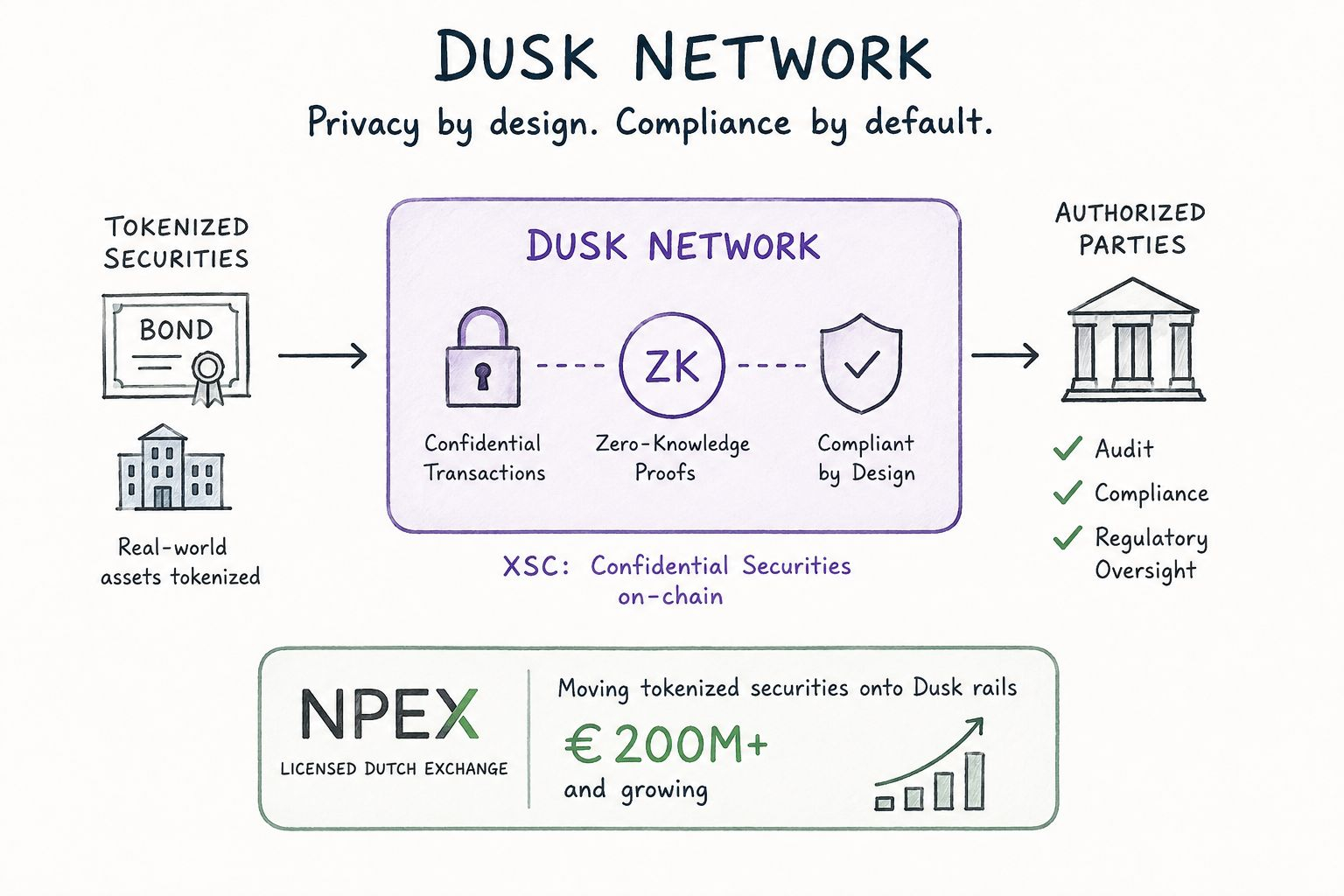
The core piece is XSC, a contract standard for confidential securities. Transaction details stay hidden from the public, but zero-knowledge proofs let an authorized party confirm everything checks out without ever seeing the raw numbers. It's a narrow kind of privacy, honestly, and it's clearly built for someone who needs to satisfy an auditor, not just hide a wallet balance from the world.
What caught my attention wasn't the cryptography. It was NPEX, a licensed Dutch exchange, quietly moving tokenized securities onto Dusk's rails, north of €200 million worth by some accounts.
Most projects chase retail attention first and worry about compliance later, if ever. Dusk went the other way, which probably means slower growth but a more credible shot at institutional use.
I expected another privacy-coin pitch. What I found felt more like plumbing.
Still early, but it's a question worth sitting with.
$AVAAI $APR
@Dusk $DUSK #dusk
I keep coming back to one detail about Dusk Network: it was built with regulators in the room from the start, not summoned after the fact.
Most privacy chains treat compliance like an afterthought, something you bolt on later if institutions come asking. Dusk built the whole thing around that question instead.
The core piece is XSC, a contract standard for confidential securities. Transaction details stay hidden from the public, but zero-knowledge proofs let an authorized party confirm everything checks out without ever seeing the raw numbers. It's a narrow kind of privacy, honestly, and it's clearly built for someone who needs to satisfy an auditor, not just hide a wallet balance from the world.
What caught my attention wasn't the cryptography. It was NPEX, a licensed Dutch exchange, quietly moving tokenized securities onto Dusk's rails, north of €200 million worth by some accounts.
Most projects chase retail attention first and worry about compliance later, if ever. Dusk went the other way, which probably means slower growth but a more credible shot at institutional use.
I expected another privacy-coin pitch. What I found felt more like plumbing.
Still early, but it's a question worth sitting with.
$AVAAI $APR
I keep coming back to one detail about Dusk Network: it was built with regulators in the room from the start, not summoned after the fact.
Most privacy chains treat compliance like an afterthought, something you bolt on later if institutions come asking. Dusk built the whole thing around that question instead.
The core piece is XSC, a contract standard for confidential securities. Transaction details stay hidden from the public, but zero-knowledge proofs let an authorized party confirm everything checks out without ever seeing the raw numbers. It's a narrow kind of privacy, honestly, and it's clearly built for someone who needs to satisfy an auditor, not just hide a wallet balance from the world.
What caught my attention wasn't the cryptography. It was NPEX, a licensed Dutch exchange, quietly moving tokenized securities onto Dusk's rails, north of €200 million worth by some accounts.
Most projects chase retail attention first and worry about compliance later, if ever. Dusk went the other way, which probably means slower growth but a more credible shot at institutional use.
I expected another privacy-coin pitch. What I found felt more like plumbing.
Still early, but it's a question worth sitting with.
$AVAAI $APR
2
2
160
·
--
The deeper I looked into @babylonlabs_io , the more I realized the interesting part wasn't staking itself. It was the fact that Bitcoin never has to leave the Bitcoin network. After seeing years of projects asking people to wrap their BTC or send it across bridges, that immediately made me curious.
What caught my attention wasn't the promise of earning a yield. It was the different way Babylon approaches the problem. Instead of moving Bitcoin somewhere else, it uses Bitcoin's own time-lock mechanism so the coins stay under the owner's control while still helping secure proof-of-stake chains. That feels like a small detail until I started thinking about how many bridge failures we've seen over the years.
Most crypto projects solve this by adding another layer of trust. You hand over your Bitcoin, receive a wrapped version, and hope every piece of infrastructure in between keeps working. Babylon seems to flip that idea around. Rather than changing Bitcoin to fit other networks, it tries to let other networks benefit from Bitcoin's security.
I honestly expected the concept to be more of a research project than a working network. Instead, I found Babylon Genesis already supporting native BTC staking alongside BABY staking and co-staking. That made me stop for a minute because it's one thing to describe an idea on paper and another to actually build it.
The scale surprised me too. Seeing billions of dollars worth of BTC already committed to the protocol made me realize this isn't just a niche experiment anymore. It doesn't prove the model will win, but it does show there's real interest in exploring a different approach.
Maybe I'm reading too much into it, but I don't think the rewards are the most interesting part of Babylon. I keep coming back to the idea that Bitcoin can contribute its security without ever leaving its own chain. Whether that ends up becoming a major shift or just another chapter in Bitcoin's evolution, it's one of the more thoughtful ideas I've come across lately.
@babylonlabs_io #baby $BABY
{future}(BABYUSDT)
$HEI $BANK
The deeper I looked into @BabylonLabs_io , the more I realized the interesting part wasn't staking itself. It was the fact that Bitcoin never has to leave the Bitcoin network. After seeing years of projects asking people to wrap their BTC or send it across bridges, that immediately made me curious.
What caught my attention wasn't the promise of earning a yield. It was the different way Babylon approaches the problem. Instead of moving Bitcoin somewhere else, it uses Bitcoin's own time-lock mechanism so the coins stay under the owner's control while still helping secure proof-of-stake chains. That feels like a small detail until I started thinking about how many bridge failures we've seen over the years.
Most crypto projects solve this by adding another layer of trust. You hand over your Bitcoin, receive a wrapped version, and hope every piece of infrastructure in between keeps working. Babylon seems to flip that idea around. Rather than changing Bitcoin to fit other networks, it tries to let other networks benefit from Bitcoin's security.
I honestly expected the concept to be more of a research project than a working network. Instead, I found Babylon Genesis already supporting native BTC staking alongside BABY staking and co-staking. That made me stop for a minute because it's one thing to describe an idea on paper and another to actually build it.
The scale surprised me too. Seeing billions of dollars worth of BTC already committed to the protocol made me realize this isn't just a niche experiment anymore. It doesn't prove the model will win, but it does show there's real interest in exploring a different approach.
Maybe I'm reading too much into it, but I don't think the rewards are the most interesting part of Babylon. I keep coming back to the idea that Bitcoin can contribute its security without ever leaving its own chain. Whether that ends up becoming a major shift or just another chapter in Bitcoin's evolution, it's one of the more thoughtful ideas I've come across lately.
@BabylonLabs_io #baby $BABY
$HEI $BANK
What caught my attention wasn't the promise of earning a yield. It was the different way Babylon approaches the problem. Instead of moving Bitcoin somewhere else, it uses Bitcoin's own time-lock mechanism so the coins stay under the owner's control while still helping secure proof-of-stake chains. That feels like a small detail until I started thinking about how many bridge failures we've seen over the years.
Most crypto projects solve this by adding another layer of trust. You hand over your Bitcoin, receive a wrapped version, and hope every piece of infrastructure in between keeps working. Babylon seems to flip that idea around. Rather than changing Bitcoin to fit other networks, it tries to let other networks benefit from Bitcoin's security.
I honestly expected the concept to be more of a research project than a working network. Instead, I found Babylon Genesis already supporting native BTC staking alongside BABY staking and co-staking. That made me stop for a minute because it's one thing to describe an idea on paper and another to actually build it.
The scale surprised me too. Seeing billions of dollars worth of BTC already committed to the protocol made me realize this isn't just a niche experiment anymore. It doesn't prove the model will win, but it does show there's real interest in exploring a different approach.
Maybe I'm reading too much into it, but I don't think the rewards are the most interesting part of Babylon. I keep coming back to the idea that Bitcoin can contribute its security without ever leaving its own chain. Whether that ends up becoming a major shift or just another chapter in Bitcoin's evolution, it's one of the more thoughtful ideas I've come across lately.
@BabylonLabs_io #baby $BABY
$HEI $BANK
Bullish 🚀
0%
Neutral 👀
0%
Still Researching 📚
0%
Bearish ⚠️
0%
0 проголосовали • Голосование закрыто
5
4
146
·
--
Sustainable growth always beats temporary volume spikes in my opinion.
Sustainable growth always beats temporary volume spikes in my opinion.

Bullish_Storm
·
--
@BabylonLabs_io #baby $BABY
I've spent a lot of time looking through different crypto projects, and Babylon is one of the few that actually made me pause. It isn't trying to replace Bitcoin or completely change how it works. Instead, it's asking whether Bitcoin can help secure PoS networks while staying in your own wallet. That felt like a simple idea with real value, which is why I started paying attention.
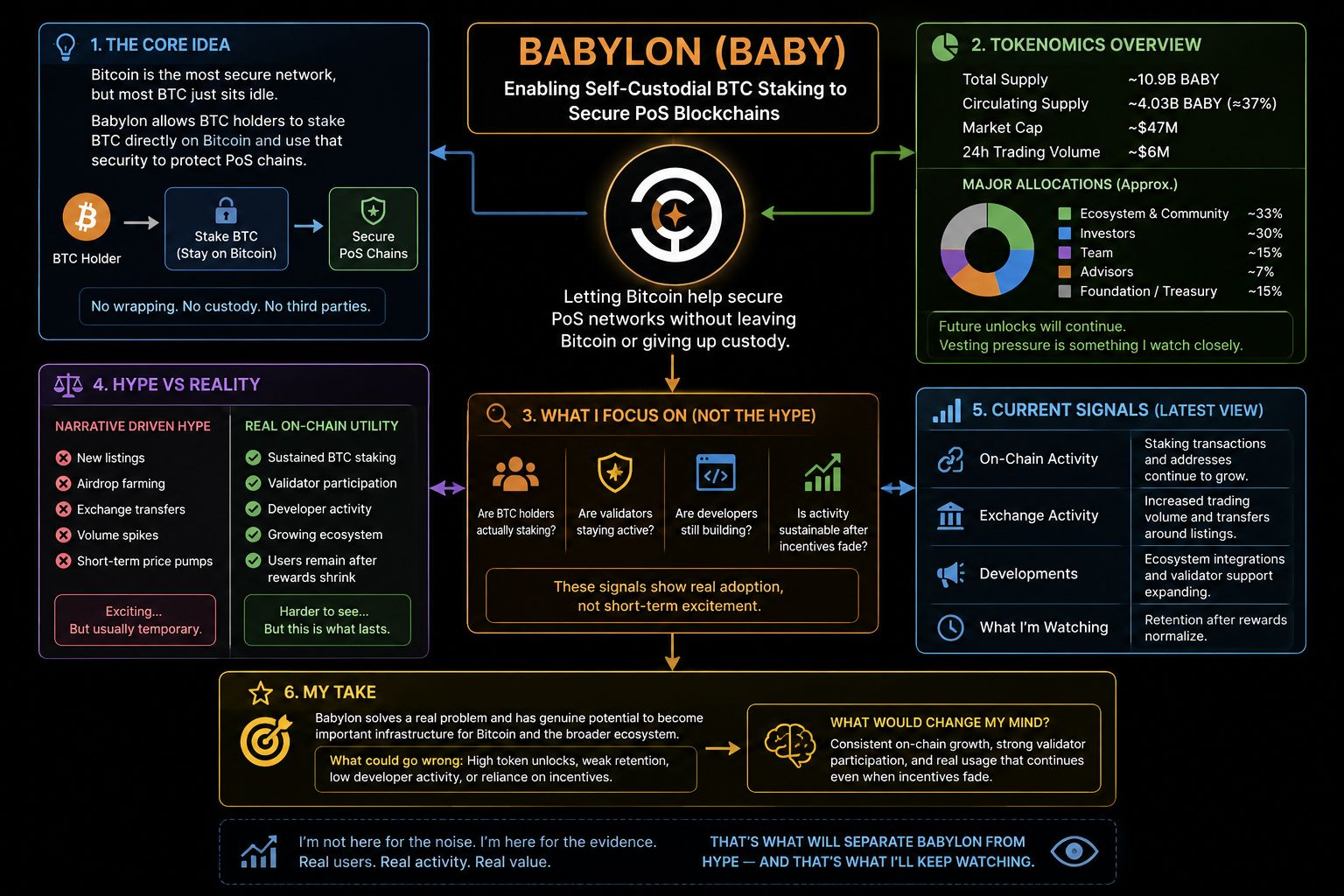
That said, I never look at the technology alone. Tokenomics usually tells the other half of the story. If a big share of the supply is still locked, future unlocks can create pressure even when the project itself is doing well. I've watched enough new listings to know that a surge in volume, airdrop farming, and exchange activity can make almost anything look stronger than it really is.
The things I'm interested in are much less exciting but far more important. Are people still staking after the rewards settle down? Are validators continuing to participate? Are developers building because they see long-term value, not just short-term incentives?
For now, I'm keeping an open mind. I like the direction Babylon is taking, but I'll believe the story when the on-chain activity keeps growing after the hype has faded. That's the kind of signal I trust the most.
$QUID
$CYS
I've spent a lot of time looking through different crypto projects, and Babylon is one of the few that actually made me pause. It isn't trying to replace Bitcoin or completely change how it works. Instead, it's asking whether Bitcoin can help secure PoS networks while staying in your own wallet. That felt like a simple idea with real value, which is why I started paying attention.
That said, I never look at the technology alone. Tokenomics usually tells the other half of the story. If a big share of the supply is still locked, future unlocks can create pressure even when the project itself is doing well. I've watched enough new listings to know that a surge in volume, airdrop farming, and exchange activity can make almost anything look stronger than it really is.
The things I'm interested in are much less exciting but far more important. Are people still staking after the rewards settle down? Are validators continuing to participate? Are developers building because they see long-term value, not just short-term incentives?
For now, I'm keeping an open mind. I like the direction Babylon is taking, but I'll believe the story when the on-chain activity keeps growing after the hype has faded. That's the kind of signal I trust the most.
$QUID
$CYS
103
·
--
@babylonlabs_io $BABY #baby
I've been spending more time looking into Babylon (BABY), and I'm still trying to figure out if there's a catch. The one thing I keep coming back to is surprisingly simple: it never asks Bitcoin to leave Bitcoin. After watching years of wrapped BTC and bridge-related problems, that immediately stood out to me.
What caught my attention was how quietly the project has been progressing. Babylon's Genesis network is live, native Bitcoin staking is expanding, and the protocol has at times secured more than 56,000 BTC, putting billions of dollars' worth of Bitcoin to work without changing who controls it. That's not a small experiment anymore.
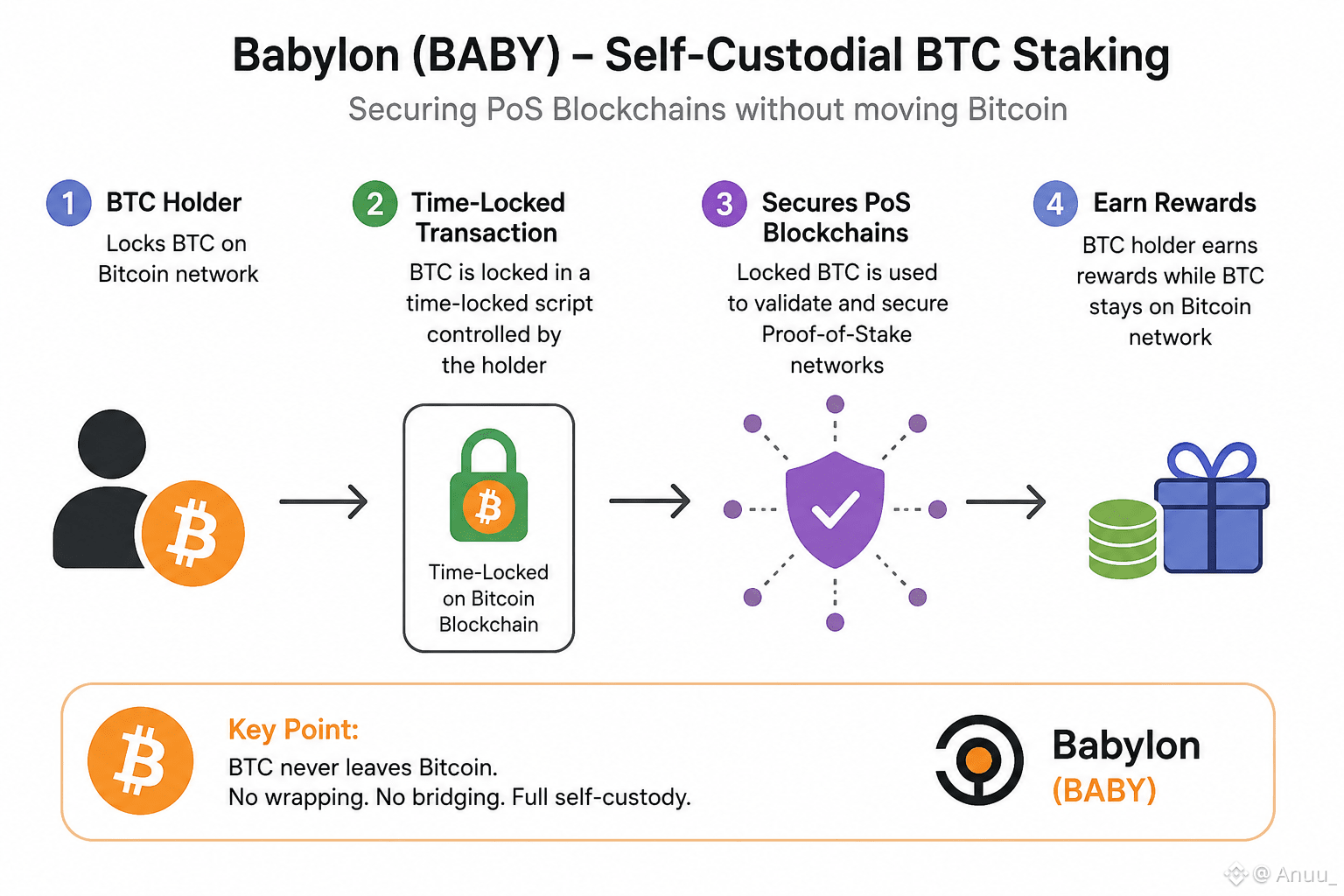
The idea is easier to understand than the documentation makes it sound. Instead of sending your BTC to another chain, you lock it in a Bitcoin transaction that remains under your control. That locked Bitcoin helps strengthen Proof-of-Stake networks while the coins themselves never leave the Bitcoin blockchain.
That's actually pretty interesting because most projects talk about making Bitcoin productive, but they usually start by introducing another layer of trust. The difference here is that Babylon tries to work with Bitcoin's existing security model instead of asking people to bypass it.
Maybe I'm missing something, and I'll keep digging. But the more I read, the more it feels like Babylon is solving a problem in a way that Bitcoin holders might actually be comfortable with. Whether it translates into long-term adoption remains to be seen, but at least they're shipping.
@BabylonLabs_io $BABY #baby
I've been spending more time looking into Babylon (BABY), and I'm still trying to figure out if there's a catch. The one thing I keep coming back to is surprisingly simple: it never asks Bitcoin to leave Bitcoin. After watching years of wrapped BTC and bridge-related problems, that immediately stood out to me.
What caught my attention was how quietly the project has been progressing. Babylon's Genesis network is live, native Bitcoin staking is expanding, and the protocol has at times secured more than 56,000 BTC, putting billions of dollars' worth of Bitcoin to work without changing who controls it. That's not a small experiment anymore.
The idea is easier to understand than the documentation makes it sound. Instead of sending your BTC to another chain, you lock it in a Bitcoin transaction that remains under your control. That locked Bitcoin helps strengthen Proof-of-Stake networks while the coins themselves never leave the Bitcoin blockchain.
That's actually pretty interesting because most projects talk about making Bitcoin productive, but they usually start by introducing another layer of trust. The difference here is that Babylon tries to work with Bitcoin's existing security model instead of asking people to bypass it.
Maybe I'm missing something, and I'll keep digging. But the more I read, the more it feels like Babylon is solving a problem in a way that Bitcoin holders might actually be comfortable with. Whether it translates into long-term adoption remains to be seen, but at least they're shipping.
I've been spending more time looking into Babylon (BABY), and I'm still trying to figure out if there's a catch. The one thing I keep coming back to is surprisingly simple: it never asks Bitcoin to leave Bitcoin. After watching years of wrapped BTC and bridge-related problems, that immediately stood out to me.
What caught my attention was how quietly the project has been progressing. Babylon's Genesis network is live, native Bitcoin staking is expanding, and the protocol has at times secured more than 56,000 BTC, putting billions of dollars' worth of Bitcoin to work without changing who controls it. That's not a small experiment anymore.
The idea is easier to understand than the documentation makes it sound. Instead of sending your BTC to another chain, you lock it in a Bitcoin transaction that remains under your control. That locked Bitcoin helps strengthen Proof-of-Stake networks while the coins themselves never leave the Bitcoin blockchain.
That's actually pretty interesting because most projects talk about making Bitcoin productive, but they usually start by introducing another layer of trust. The difference here is that Babylon tries to work with Bitcoin's existing security model instead of asking people to bypass it.
Maybe I'm missing something, and I'll keep digging. But the more I read, the more it feels like Babylon is solving a problem in a way that Bitcoin holders might actually be comfortable with. Whether it translates into long-term adoption remains to be seen, but at least they're shipping.
6
6
145
·
--
#baby $BABY @babylonlabs_io
I'll be honest, I've been thinking about Babylon again lately. I'm still waiting for someone to point out the catch, because the one thing I keep coming back to is surprisingly simple: it never asks Bitcoin to leave home.
Most BTC yield schemes want you to wrap the coin, bridge it somewhere, or trust a custodian. Babylon skips that entirely.
The core idea is simple once you sit with it. Bitcoin holders stake native BTC directly to secure proof-of-stake chains, with no wrapping or bridging involved. You're not creating a synthetic version of your coin. You're just locking it on Bitcoin and lending its security elsewhere.
Think of it as a marketplace: Bitcoin holders supply staking assets, and proof-of-stake chains and rollups show up looking for security.
What caught my attention wasn't the TVL number, though it's notable. Babylon peaked above $5.6 billion, dropped sharply after a large unstaking event tied to a finality provider transition, then climbed back over $4 billion within months. That resilience says more than the peak did.
The surprising part was watching the foundation quietly move funds into Aave, nudging toward Ethereum DeFi from a Bitcoin-native base. Small gesture, odd signal.
Most BTC-DeFi bets fail on trust assumptions. Babylon's bet is that Bitcoin doesn't need to change to be useful.
So yeah... I'm still watching. Maybe I'm wrong, but this feels like one of the few Bitcoin infrastructure ideas that's trying to work with Bitcoin instead of asking it to become something else.
Still early, but something feels different.
#baby $BABY @BabylonLabs_io
I'll be honest, I've been thinking about Babylon again lately. I'm still waiting for someone to point out the catch, because the one thing I keep coming back to is surprisingly simple: it never asks Bitcoin to leave home.
Most BTC yield schemes want you to wrap the coin, bridge it somewhere, or trust a custodian. Babylon skips that entirely.
The core idea is simple once you sit with it. Bitcoin holders stake native BTC directly to secure proof-of-stake chains, with no wrapping or bridging involved. You're not creating a synthetic version of your coin. You're just locking it on Bitcoin and lending its security elsewhere.
Think of it as a marketplace: Bitcoin holders supply staking assets, and proof-of-stake chains and rollups show up looking for security.
What caught my attention wasn't the TVL number, though it's notable. Babylon peaked above $5.6 billion, dropped sharply after a large unstaking event tied to a finality provider transition, then climbed back over $4 billion within months. That resilience says more than the peak did.
The surprising part was watching the foundation quietly move funds into Aave, nudging toward Ethereum DeFi from a Bitcoin-native base. Small gesture, odd signal.
Most BTC-DeFi bets fail on trust assumptions. Babylon's bet is that Bitcoin doesn't need to change to be useful.
So yeah... I'm still watching. Maybe I'm wrong, but this feels like one of the few Bitcoin infrastructure ideas that's trying to work with Bitcoin instead of asking it to become something else.
Still early, but something feels different.
I'll be honest, I've been thinking about Babylon again lately. I'm still waiting for someone to point out the catch, because the one thing I keep coming back to is surprisingly simple: it never asks Bitcoin to leave home.
Most BTC yield schemes want you to wrap the coin, bridge it somewhere, or trust a custodian. Babylon skips that entirely.
The core idea is simple once you sit with it. Bitcoin holders stake native BTC directly to secure proof-of-stake chains, with no wrapping or bridging involved. You're not creating a synthetic version of your coin. You're just locking it on Bitcoin and lending its security elsewhere.
Think of it as a marketplace: Bitcoin holders supply staking assets, and proof-of-stake chains and rollups show up looking for security.
What caught my attention wasn't the TVL number, though it's notable. Babylon peaked above $5.6 billion, dropped sharply after a large unstaking event tied to a finality provider transition, then climbed back over $4 billion within months. That resilience says more than the peak did.
The surprising part was watching the foundation quietly move funds into Aave, nudging toward Ethereum DeFi from a Bitcoin-native base. Small gesture, odd signal.
Most BTC-DeFi bets fail on trust assumptions. Babylon's bet is that Bitcoin doesn't need to change to be useful.
So yeah... I'm still watching. Maybe I'm wrong, but this feels like one of the few Bitcoin infrastructure ideas that's trying to work with Bitcoin instead of asking it to become something else.
Still early, but something feels different.

4
3
160
·
--
#baby @babylonlabs_io $BABY
I'll be honest, I wasn't expecting Babylon to hold my attention for this long.
I kept coming back to one question: how can you stake Bitcoin without ever handing it over to someone else? So yeah, I waited, kept reading, and assumed there had to be a catch somewhere.
No wrapped token. No bridge. No custodian quietly holding your keys somewhere in the background.
At first I assumed that was just marketing language, the kind every project uses. But Bitcoin doesn't run smart contracts, so staking it natively is a real technical problem, not a slogan. The way Babylon gets around this is through a timelock script paired with Bitcoin's own signature setup, which keeps the BTC sitting on its native chain while it still backs security for other proof-of-stake networks.
What caught my attention wasn't the cleverness of it. It was how unglamorous the whole design feels. Nothing new is minted. The Bitcoin just sits there, doing extra work it wasn't doing before.
The Aave integration is what actually got me digging further. Babylon ran an experiment where native BTC was used as collateral to borrow USDC on Ethereum, without going through a wrapped BTC setup. Most of BTCFi solves this problem with custodians or synthetic stand-ins for Bitcoin. This is a quieter route.
TVL sitting near $5.6 billion is not a small number, though the token hasn't really moved in step with it.
The more I sat with this, the more it read like infrastructure being built patiently, not a story being sold loudly. Whether the market ever catches up to that is a different question. Still early, but something about it feels worth watching.
$DEXE
$LAB
#baby @BabylonLabs_io $BABY
I'll be honest, I wasn't expecting Babylon to hold my attention for this long.
I kept coming back to one question: how can you stake Bitcoin without ever handing it over to someone else? So yeah, I waited, kept reading, and assumed there had to be a catch somewhere.
No wrapped token. No bridge. No custodian quietly holding your keys somewhere in the background.
At first I assumed that was just marketing language, the kind every project uses. But Bitcoin doesn't run smart contracts, so staking it natively is a real technical problem, not a slogan. The way Babylon gets around this is through a timelock script paired with Bitcoin's own signature setup, which keeps the BTC sitting on its native chain while it still backs security for other proof-of-stake networks.
What caught my attention wasn't the cleverness of it. It was how unglamorous the whole design feels. Nothing new is minted. The Bitcoin just sits there, doing extra work it wasn't doing before.
The Aave integration is what actually got me digging further. Babylon ran an experiment where native BTC was used as collateral to borrow USDC on Ethereum, without going through a wrapped BTC setup. Most of BTCFi solves this problem with custodians or synthetic stand-ins for Bitcoin. This is a quieter route.
TVL sitting near $5.6 billion is not a small number, though the token hasn't really moved in step with it.
The more I sat with this, the more it read like infrastructure being built patiently, not a story being sold loudly. Whether the market ever catches up to that is a different question. Still early, but something about it feels worth watching.
$DEXE
$LAB
I'll be honest, I wasn't expecting Babylon to hold my attention for this long.
I kept coming back to one question: how can you stake Bitcoin without ever handing it over to someone else? So yeah, I waited, kept reading, and assumed there had to be a catch somewhere.
No wrapped token. No bridge. No custodian quietly holding your keys somewhere in the background.
At first I assumed that was just marketing language, the kind every project uses. But Bitcoin doesn't run smart contracts, so staking it natively is a real technical problem, not a slogan. The way Babylon gets around this is through a timelock script paired with Bitcoin's own signature setup, which keeps the BTC sitting on its native chain while it still backs security for other proof-of-stake networks.
What caught my attention wasn't the cleverness of it. It was how unglamorous the whole design feels. Nothing new is minted. The Bitcoin just sits there, doing extra work it wasn't doing before.
The Aave integration is what actually got me digging further. Babylon ran an experiment where native BTC was used as collateral to borrow USDC on Ethereum, without going through a wrapped BTC setup. Most of BTCFi solves this problem with custodians or synthetic stand-ins for Bitcoin. This is a quieter route.
TVL sitting near $5.6 billion is not a small number, though the token hasn't really moved in step with it.
The more I sat with this, the more it read like infrastructure being built patiently, not a story being sold loudly. Whether the market ever catches up to that is a different question. Still early, but something about it feels worth watching.
$DEXE
$LAB
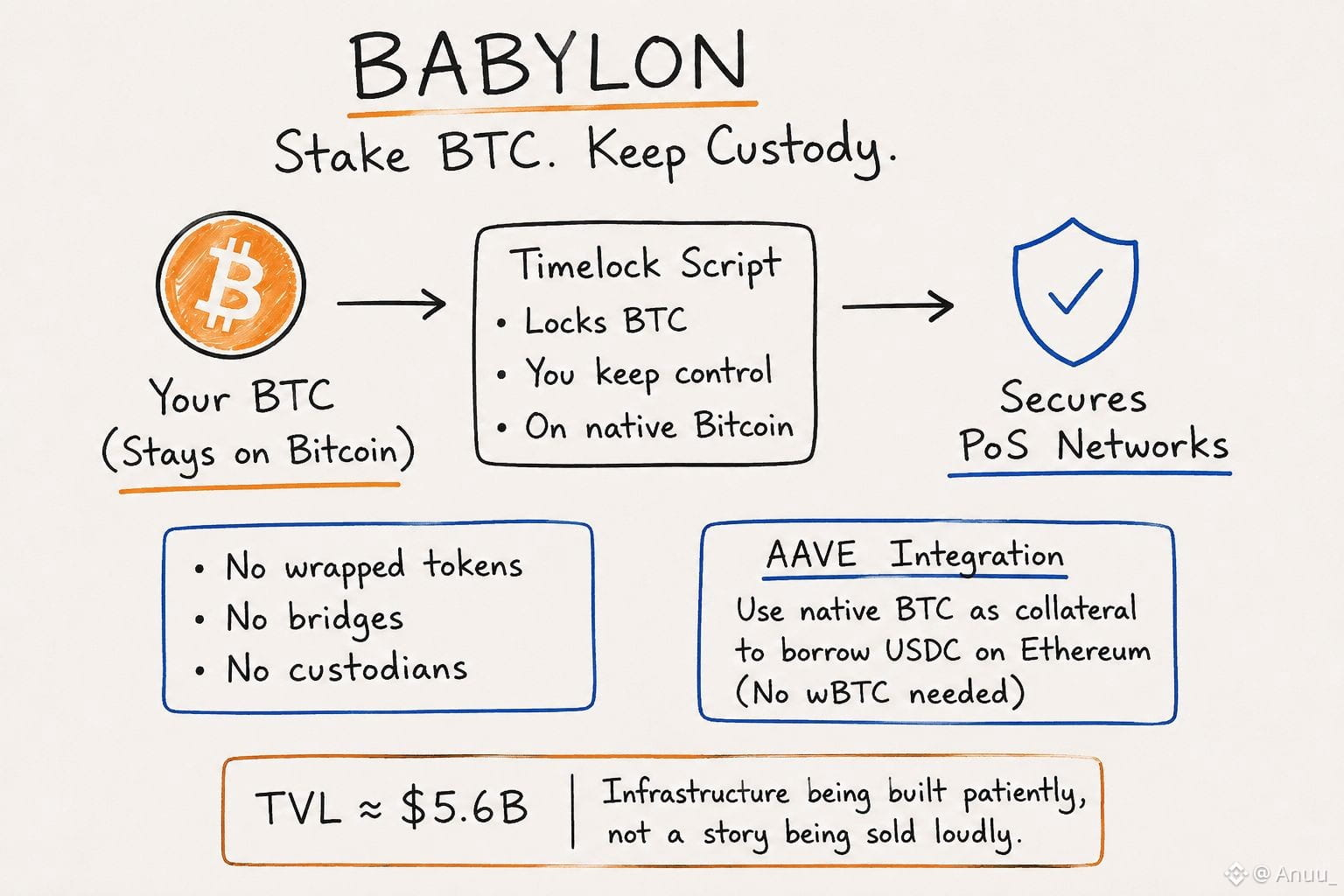
10
8
237
Войдите, чтобы посмотреть больше материала
Присоединяйтесь к пользователям криптовалют по всему миру на Binance Square
⚡️ Получайте новейшую и полезную информацию о криптоактивах.
💬 Нам доверяет крупнейшая в мире криптобиржа.
👍 Получите достоверные аналитические данные от верифицированных создателей контента.
Эл. почта/номер телефона