

顾清妍
1.2k Публикации

顾清妍
Отправить жалобу
Заблокировать пользователя
Curious about Web3, digital trends, and new ideas. Sharing simple thoughts, learning notes, and market observations along the way.
76 подписок(и/а)
165 подписчиков(а)
702 понравилось
Посты
Все
Цитирования
·
--
Рост
#circletetherfreezebitgethackerwallet
🚨 CIRCLE & TETHER FREEZE STABLECOINS LINKED TO BITGET HACK
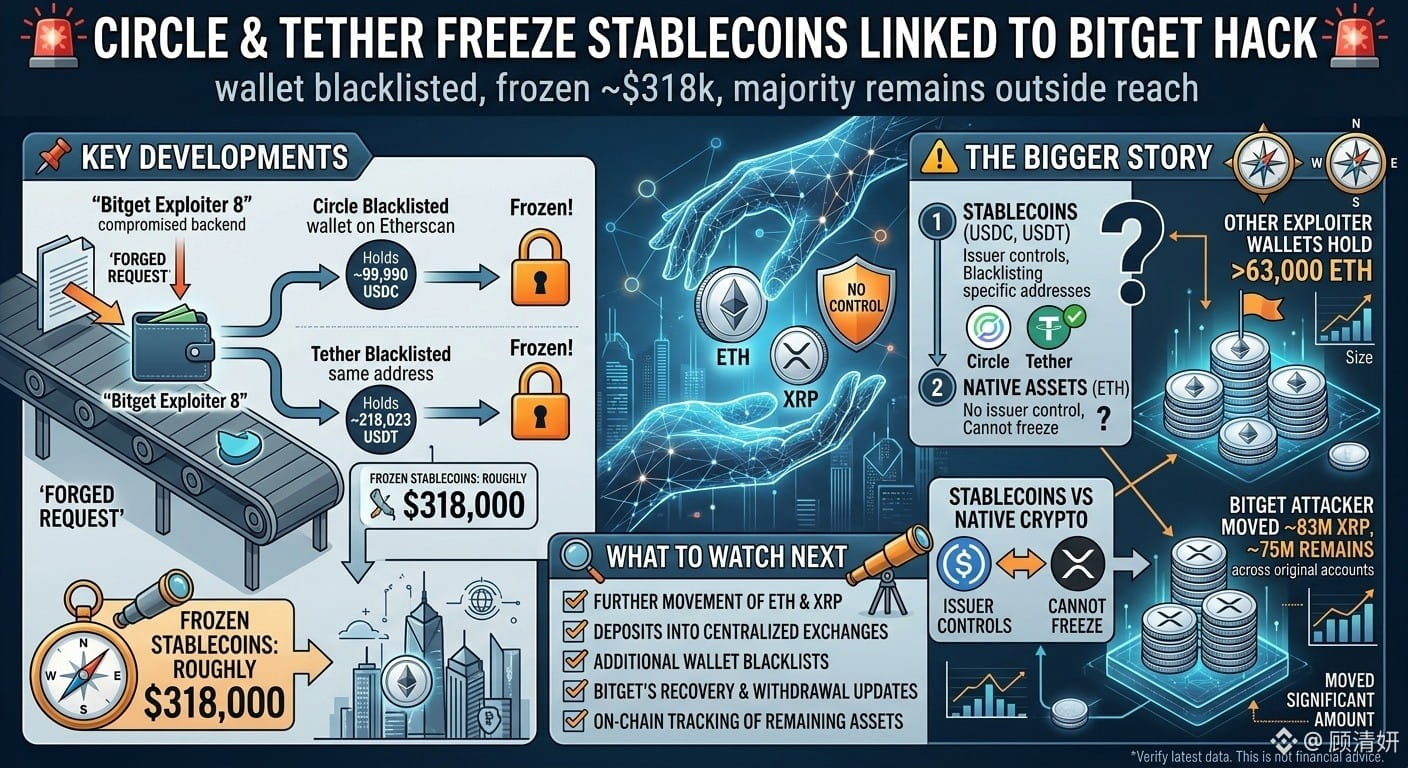
Circle and Tether have blacklisted a wallet linked to the recent Bitget security breach, freezing roughly $318,000 worth of USDC and USDT.
But the majority of the stolen assets remain outside the reach of stablecoin issuers.
📌 KEY DEVELOPMENTS
• Circle blacklisted a wallet identified as “Bitget Exploiter 8” on Etherscan.
• The wallet held approximately 99,990 USDC and 218,023 USDT.
• Tether subsequently blacklisted the same address.
• The frozen stablecoins are worth roughly $318,000.
• Other exploiter-linked wallets reportedly still hold more than 63,000 ETH.
• Stablecoin issuers can freeze their own tokens, but they cannot freeze native ETH held by an attacker.
⚠️ THE BIGGER STORY
The incident highlights an important difference between stablecoins and native crypto assets.
USDC and USDT include issuer-level controls that allow Circle and Tether to blacklist specific addresses.
ETH does not have an issuer with the same type of control.
Meanwhile, the Bitget attacker has also moved a significant amount of stolen XRP. CoinDesk reported that roughly $83 million in XRP had been moved from three original holding wallets, with about $75 million remaining across the original accounts at the time of its report.
🔎 WHAT TO WATCH
• Further movement of the stolen ETH and XRP
• Deposits into centralized exchanges
• Additional wallet blacklists
• Bitget's recovery and withdrawal updates
• On-chain tracking of the remaining assets
This is not just another exchange hack story. It shows how the ability to freeze assets can differ dramatically depending on the underlying blockchain and token design.
$SUPER $GRAM $PYTH
{future}(PYTHUSDT)
{future}(GRAMUSDT)
{future}(SUPERUSDT)
#circletetherfreezebitgethackerwallet
🚨 CIRCLE & TETHER FREEZE STABLECOINS LINKED TO BITGET HACK
Circle and Tether have blacklisted a wallet linked to the recent Bitget security breach, freezing roughly $318,000 worth of USDC and USDT.
But the majority of the stolen assets remain outside the reach of stablecoin issuers.
📌 KEY DEVELOPMENTS
• Circle blacklisted a wallet identified as “Bitget Exploiter 8” on Etherscan.
• The wallet held approximately 99,990 USDC and 218,023 USDT.
• Tether subsequently blacklisted the same address.
• The frozen stablecoins are worth roughly $318,000.
• Other exploiter-linked wallets reportedly still hold more than 63,000 ETH.
• Stablecoin issuers can freeze their own tokens, but they cannot freeze native ETH held by an attacker.
⚠️ THE BIGGER STORY
The incident highlights an important difference between stablecoins and native crypto assets.
USDC and USDT include issuer-level controls that allow Circle and Tether to blacklist specific addresses.
ETH does not have an issuer with the same type of control.
Meanwhile, the Bitget attacker has also moved a significant amount of stolen XRP. CoinDesk reported that roughly $83 million in XRP had been moved from three original holding wallets, with about $75 million remaining across the original accounts at the time of its report.
🔎 WHAT TO WATCH
• Further movement of the stolen ETH and XRP
• Deposits into centralized exchanges
• Additional wallet blacklists
• Bitget's recovery and withdrawal updates
• On-chain tracking of the remaining assets
This is not just another exchange hack story. It shows how the ability to freeze assets can differ dramatically depending on the underlying blockchain and token design.
$SUPER $GRAM $PYTH
🚨 CIRCLE & TETHER FREEZE STABLECOINS LINKED TO BITGET HACK
Circle and Tether have blacklisted a wallet linked to the recent Bitget security breach, freezing roughly $318,000 worth of USDC and USDT.
But the majority of the stolen assets remain outside the reach of stablecoin issuers.
📌 KEY DEVELOPMENTS
• Circle blacklisted a wallet identified as “Bitget Exploiter 8” on Etherscan.
• The wallet held approximately 99,990 USDC and 218,023 USDT.
• Tether subsequently blacklisted the same address.
• The frozen stablecoins are worth roughly $318,000.
• Other exploiter-linked wallets reportedly still hold more than 63,000 ETH.
• Stablecoin issuers can freeze their own tokens, but they cannot freeze native ETH held by an attacker.
⚠️ THE BIGGER STORY
The incident highlights an important difference between stablecoins and native crypto assets.
USDC and USDT include issuer-level controls that allow Circle and Tether to blacklist specific addresses.
ETH does not have an issuer with the same type of control.
Meanwhile, the Bitget attacker has also moved a significant amount of stolen XRP. CoinDesk reported that roughly $83 million in XRP had been moved from three original holding wallets, with about $75 million remaining across the original accounts at the time of its report.
🔎 WHAT TO WATCH
• Further movement of the stolen ETH and XRP
• Deposits into centralized exchanges
• Additional wallet blacklists
• Bitget's recovery and withdrawal updates
• On-chain tracking of the remaining assets
This is not just another exchange hack story. It shows how the ability to freeze assets can differ dramatically depending on the underlying blockchain and token design.
$SUPER $GRAM $PYTH
5
13
14.1k
·
--
Рост
Проверено
#trumprejectsiranhormuzreopening
🚨 TRUMP REJECTS IRAN’S PLAN TO REOPEN STRAIT OF HORMUZ
A major geopolitical development is putting energy markets and global risk sentiment back in focus.
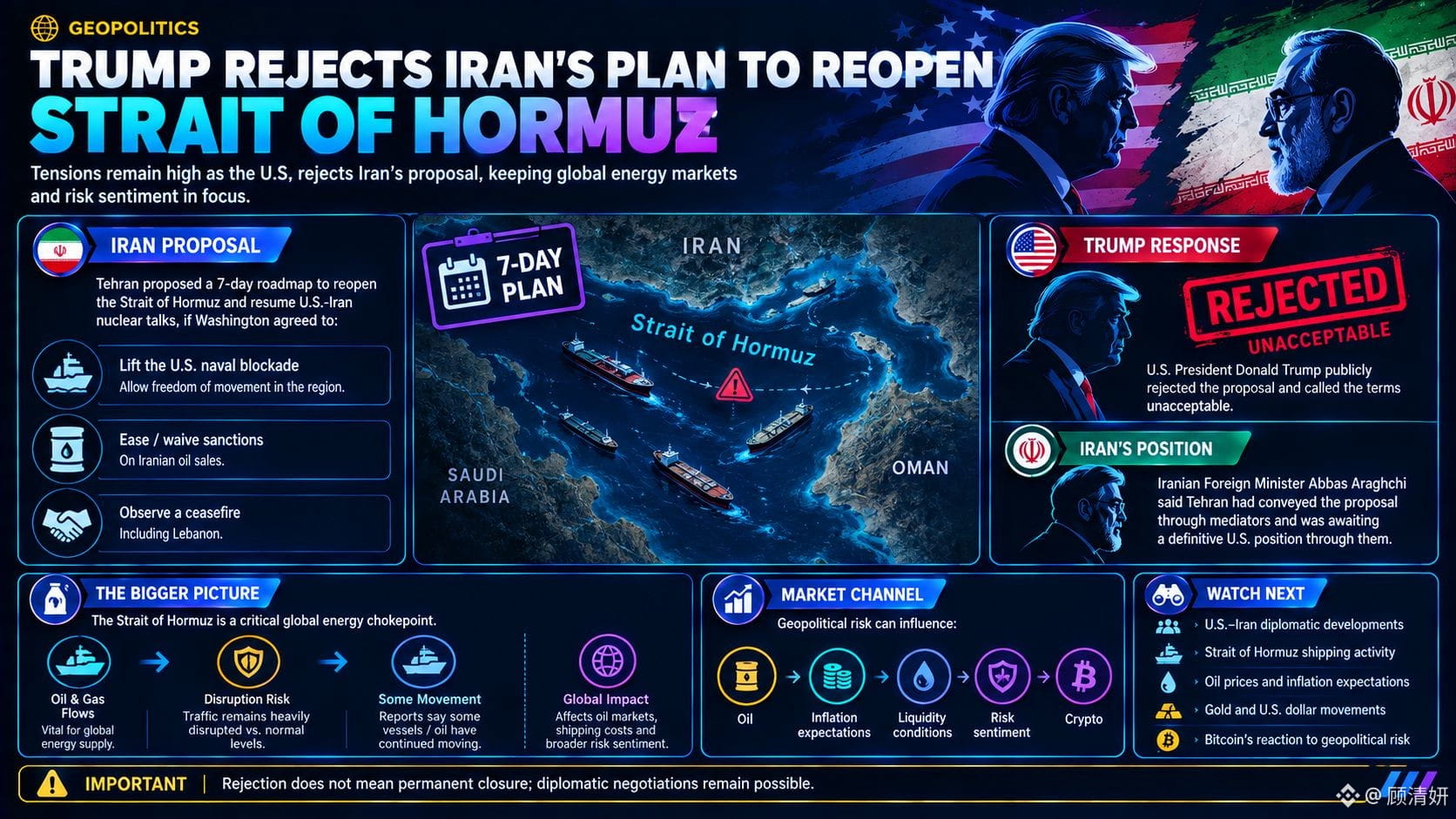
U.S. President Donald Trump has rejected Iran’s proposal to reopen the Strait of Hormuz within seven days and resume negotiations.
📌 KEY DEVELOPMENTS
• 🇮🇷 Iran proposed reopening the Strait within 7 days under specific conditions.
• 🇺🇸 Trump publicly rejected the proposal, calling the terms unacceptable.
• 🤝 Iran says it is still awaiting a definitive U.S. response through mediators.
• 🚢 Shipping through Hormuz remains significantly disrupted compared with normal levels.
• 🛢️ The Strait is a critical global energy route, making any prolonged disruption important for oil and shipping markets.
🌍 WHY IT MATTERS
The Strait of Hormuz is one of the world's most important energy chokepoints. Continued uncertainty around its reopening could keep pressure on oil prices, shipping costs and broader risk sentiment.
For crypto markets, the key transmission channel is macro risk: higher energy costs and geopolitical uncertainty can influence inflation expectations, liquidity conditions and investor appetite for risk assets.
⚠️ IMPORTANT
This does NOT mean Hormuz will remain closed permanently. Diplomatic negotiations are still possible, and Iran says reopening remains linked to conditions being met.
👀 WHAT TO WATCH NEXT
• U.S.–Iran diplomatic developments
• Strait of Hormuz shipping activity
• Oil prices and inflation expectations
• Gold and U.S. dollar movements
• Bitcoin’s reaction to changing geopolitical risk
The next major catalyst may be whether Washington and Tehran can move from public statements back toward negotiations.
$GLMR $QI $WLD
{future}(WLDUSDT)
{spot}(QIUSDT)
{spot}(GLMRUSDT)
#trumprejectsiranhormuzreopening
🚨 TRUMP REJECTS IRAN’S PLAN TO REOPEN STRAIT OF HORMUZ
A major geopolitical development is putting energy markets and global risk sentiment back in focus.
U.S. President Donald Trump has rejected Iran’s proposal to reopen the Strait of Hormuz within seven days and resume negotiations.
📌 KEY DEVELOPMENTS
• 🇮🇷 Iran proposed reopening the Strait within 7 days under specific conditions.
• 🇺🇸 Trump publicly rejected the proposal, calling the terms unacceptable.
• 🤝 Iran says it is still awaiting a definitive U.S. response through mediators.
• 🚢 Shipping through Hormuz remains significantly disrupted compared with normal levels.
• 🛢️ The Strait is a critical global energy route, making any prolonged disruption important for oil and shipping markets.
🌍 WHY IT MATTERS
The Strait of Hormuz is one of the world's most important energy chokepoints. Continued uncertainty around its reopening could keep pressure on oil prices, shipping costs and broader risk sentiment.
For crypto markets, the key transmission channel is macro risk: higher energy costs and geopolitical uncertainty can influence inflation expectations, liquidity conditions and investor appetite for risk assets.
⚠️ IMPORTANT
This does NOT mean Hormuz will remain closed permanently. Diplomatic negotiations are still possible, and Iran says reopening remains linked to conditions being met.
👀 WHAT TO WATCH NEXT
• U.S.–Iran diplomatic developments
• Strait of Hormuz shipping activity
• Oil prices and inflation expectations
• Gold and U.S. dollar movements
• Bitcoin’s reaction to changing geopolitical risk
The next major catalyst may be whether Washington and Tehran can move from public statements back toward negotiations.
$GLMR $QI $WLD
🚨 TRUMP REJECTS IRAN’S PLAN TO REOPEN STRAIT OF HORMUZ
A major geopolitical development is putting energy markets and global risk sentiment back in focus.
U.S. President Donald Trump has rejected Iran’s proposal to reopen the Strait of Hormuz within seven days and resume negotiations.
📌 KEY DEVELOPMENTS
• 🇮🇷 Iran proposed reopening the Strait within 7 days under specific conditions.
• 🇺🇸 Trump publicly rejected the proposal, calling the terms unacceptable.
• 🤝 Iran says it is still awaiting a definitive U.S. response through mediators.
• 🚢 Shipping through Hormuz remains significantly disrupted compared with normal levels.
• 🛢️ The Strait is a critical global energy route, making any prolonged disruption important for oil and shipping markets.
🌍 WHY IT MATTERS
The Strait of Hormuz is one of the world's most important energy chokepoints. Continued uncertainty around its reopening could keep pressure on oil prices, shipping costs and broader risk sentiment.
For crypto markets, the key transmission channel is macro risk: higher energy costs and geopolitical uncertainty can influence inflation expectations, liquidity conditions and investor appetite for risk assets.
⚠️ IMPORTANT
This does NOT mean Hormuz will remain closed permanently. Diplomatic negotiations are still possible, and Iran says reopening remains linked to conditions being met.
👀 WHAT TO WATCH NEXT
• U.S.–Iran diplomatic developments
• Strait of Hormuz shipping activity
• Oil prices and inflation expectations
• Gold and U.S. dollar movements
• Bitcoin’s reaction to changing geopolitical risk
The next major catalyst may be whether Washington and Tehran can move from public statements back toward negotiations.
$GLMR $QI $WLD
7
8.8k
·
--
Рост
Проверено
#strategystriveadd2305bitcointhisweek
🚨 STRATEGY & STRIVE ADD 2,305 BITCOIN IN FRESH CORPORATE BUYING
Corporate Bitcoin accumulation is back in focus.
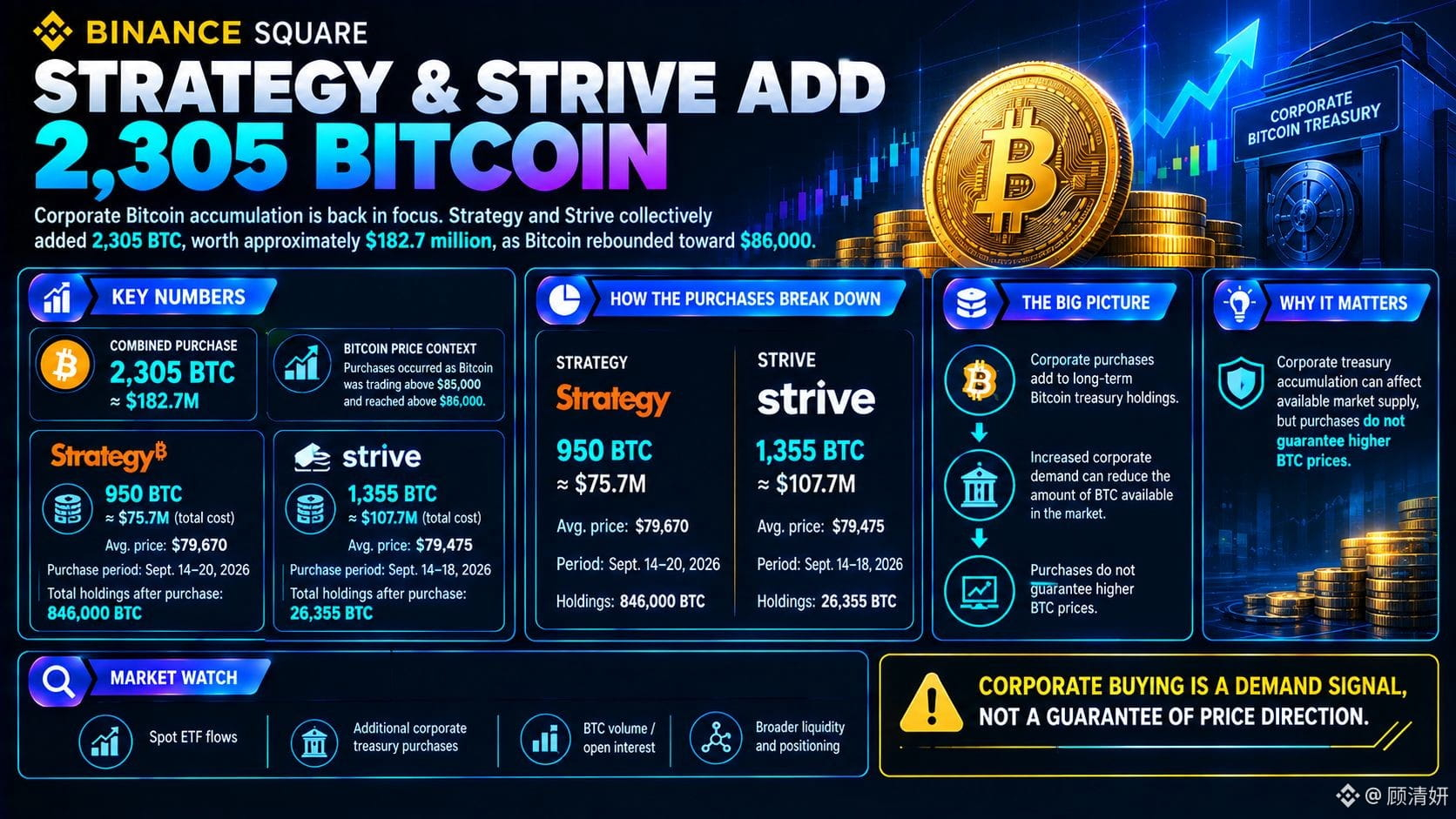
Strategy and Strive collectively added 2,305 BTC, worth approximately $182.7 million based on their reported purchase prices. The buying came as Bitcoin rebounded sharply toward the $86,000 area.
📊 KEY NUMBERS
• 2,305 BTC — combined new purchases
• $182.7M — approximate combined cost
• 950 BTC — purchased by Strategy for ~$75.7M
• 1,355 BTC — purchased by Strive for ~$107.7M
• 846,000 BTC — Strategy's reported holdings after the purchase
• 26,355 BTC — Strive's reported holdings
💡 WHY IT MATTERS
Strategy bought its 950 BTC at an average price of approximately $79,670, while Strive's 1,355 BTC purchase averaged about $79,475.
Both purchases were made below Bitcoin's subsequent market price, highlighting continued corporate demand even after a volatile period for Bitcoin treasury companies.
📈 MARKET IMPACT
Large corporate purchases can reduce the amount of Bitcoin available to the broader market, but they do not guarantee higher prices.
The bigger question for traders is whether other corporate buyers and spot Bitcoin ETFs continue adding exposure.
🔎 WHAT TO WATCH
• Bitcoin holding above recent support zones
• Spot ETF net flows
• Additional corporate treasury purchases
• BTC trading volume and open interest
• Whether corporate accumulation accelerates or remains concentrated among a few buyers
This is a notable development in Bitcoin's corporate-treasury trend—but price direction will still depend on broader market liquidity, flows and positioning.
What do you think: Will corporate Bitcoin accumulation accelerate from here?
$QNT $SUPER $AMP
{spot}(AMPUSDT)
{future}(SUPERUSDT)
{future}(QNTUSDT)
#strategystriveadd2305bitcointhisweek
🚨 STRATEGY & STRIVE ADD 2,305 BITCOIN IN FRESH CORPORATE BUYING
Corporate Bitcoin accumulation is back in focus.
Strategy and Strive collectively added 2,305 BTC, worth approximately $182.7 million based on their reported purchase prices. The buying came as Bitcoin rebounded sharply toward the $86,000 area.
📊 KEY NUMBERS
• 2,305 BTC — combined new purchases
• $182.7M — approximate combined cost
• 950 BTC — purchased by Strategy for ~$75.7M
• 1,355 BTC — purchased by Strive for ~$107.7M
• 846,000 BTC — Strategy's reported holdings after the purchase
• 26,355 BTC — Strive's reported holdings
💡 WHY IT MATTERS
Strategy bought its 950 BTC at an average price of approximately $79,670, while Strive's 1,355 BTC purchase averaged about $79,475.
Both purchases were made below Bitcoin's subsequent market price, highlighting continued corporate demand even after a volatile period for Bitcoin treasury companies.
📈 MARKET IMPACT
Large corporate purchases can reduce the amount of Bitcoin available to the broader market, but they do not guarantee higher prices.
The bigger question for traders is whether other corporate buyers and spot Bitcoin ETFs continue adding exposure.
🔎 WHAT TO WATCH
• Bitcoin holding above recent support zones
• Spot ETF net flows
• Additional corporate treasury purchases
• BTC trading volume and open interest
• Whether corporate accumulation accelerates or remains concentrated among a few buyers
This is a notable development in Bitcoin's corporate-treasury trend—but price direction will still depend on broader market liquidity, flows and positioning.
What do you think: Will corporate Bitcoin accumulation accelerate from here?
$QNT $SUPER $AMP
🚨 STRATEGY & STRIVE ADD 2,305 BITCOIN IN FRESH CORPORATE BUYING
Corporate Bitcoin accumulation is back in focus.
Strategy and Strive collectively added 2,305 BTC, worth approximately $182.7 million based on their reported purchase prices. The buying came as Bitcoin rebounded sharply toward the $86,000 area.
📊 KEY NUMBERS
• 2,305 BTC — combined new purchases
• $182.7M — approximate combined cost
• 950 BTC — purchased by Strategy for ~$75.7M
• 1,355 BTC — purchased by Strive for ~$107.7M
• 846,000 BTC — Strategy's reported holdings after the purchase
• 26,355 BTC — Strive's reported holdings
💡 WHY IT MATTERS
Strategy bought its 950 BTC at an average price of approximately $79,670, while Strive's 1,355 BTC purchase averaged about $79,475.
Both purchases were made below Bitcoin's subsequent market price, highlighting continued corporate demand even after a volatile period for Bitcoin treasury companies.
📈 MARKET IMPACT
Large corporate purchases can reduce the amount of Bitcoin available to the broader market, but they do not guarantee higher prices.
The bigger question for traders is whether other corporate buyers and spot Bitcoin ETFs continue adding exposure.
🔎 WHAT TO WATCH
• Bitcoin holding above recent support zones
• Spot ETF net flows
• Additional corporate treasury purchases
• BTC trading volume and open interest
• Whether corporate accumulation accelerates or remains concentrated among a few buyers
This is a notable development in Bitcoin's corporate-treasury trend—but price direction will still depend on broader market liquidity, flows and positioning.
What do you think: Will corporate Bitcoin accumulation accelerate from here?
$QNT $SUPER $AMP
1
3
3.9k
·
--
#SOLSpotETFWeeklyInflow$188M
🚨 SOLANA SPOT ETFs ATTRACT $188M IN ONE WEEK
Institutional demand for Solana is showing a notable pickup.
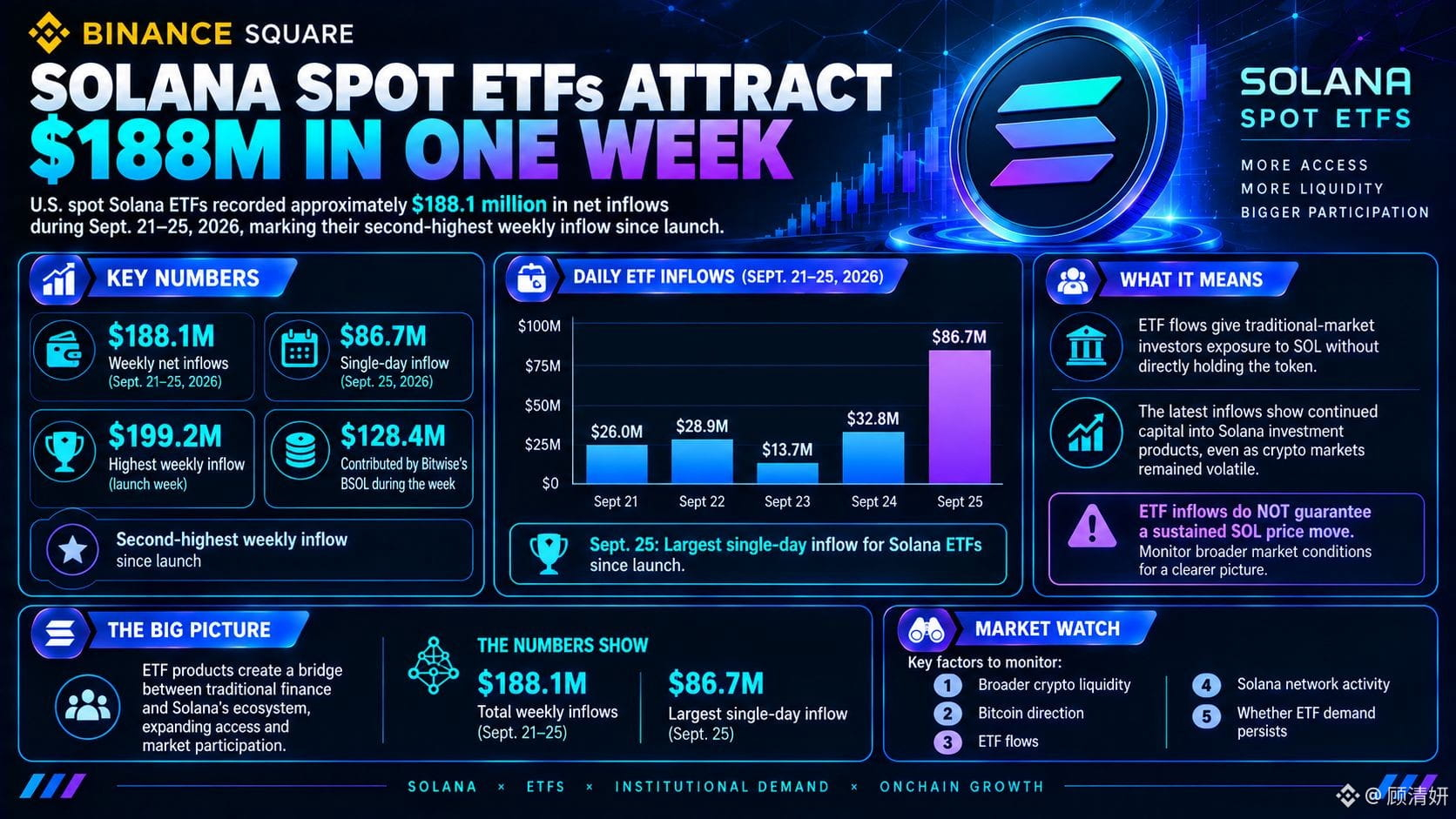
U.S. spot Solana ETFs recorded approximately $188.1 million in net inflows during Sept. 21–25, marking their second-highest weekly inflow since launch.
📊 KEY NUMBERS
• $188.1M — weekly net inflows
• $86.7M — single-day inflow on Sept. 25
• $199.2M — highest weekly inflow, recorded during launch week
• $128.4M — contributed by Bitwise's BSOL during the week
Friday's $86.7M inflow was also the largest single-day inflow for Solana ETFs since launch, according to reported SoSoValue/Farside data.
WHY IT MATTERS
ETF flows provide a way for traditional-market investors to gain exposure to SOL without directly holding the token.
The latest numbers show that capital continued flowing into Solana investment products even as crypto markets remained volatile.
However, ETF inflows alone do not guarantee a sustained SOL price move. Traders should also monitor broader crypto liquidity, Bitcoin's direction, ETF flows and Solana network activity.
MARKET WATCH
The key question now:
Can Solana maintain this level of ETF demand in the coming weeks?
$IQ $WLD $SUPER
{future}(SUPERUSDT)
{future}(WLDUSDT)
{spot}(IQUSDT)
#SOLSpotETFWeeklyInflow$188M
🚨 SOLANA SPOT ETFs ATTRACT $188M IN ONE WEEK
Institutional demand for Solana is showing a notable pickup.
U.S. spot Solana ETFs recorded approximately $188.1 million in net inflows during Sept. 21–25, marking their second-highest weekly inflow since launch.
📊 KEY NUMBERS
• $188.1M — weekly net inflows
• $86.7M — single-day inflow on Sept. 25
• $199.2M — highest weekly inflow, recorded during launch week
• $128.4M — contributed by Bitwise's BSOL during the week
Friday's $86.7M inflow was also the largest single-day inflow for Solana ETFs since launch, according to reported SoSoValue/Farside data.
WHY IT MATTERS
ETF flows provide a way for traditional-market investors to gain exposure to SOL without directly holding the token.
The latest numbers show that capital continued flowing into Solana investment products even as crypto markets remained volatile.
However, ETF inflows alone do not guarantee a sustained SOL price move. Traders should also monitor broader crypto liquidity, Bitcoin's direction, ETF flows and Solana network activity.
MARKET WATCH
The key question now:
Can Solana maintain this level of ETF demand in the coming weeks?
$IQ $WLD $SUPER
🚨 SOLANA SPOT ETFs ATTRACT $188M IN ONE WEEK
Institutional demand for Solana is showing a notable pickup.
U.S. spot Solana ETFs recorded approximately $188.1 million in net inflows during Sept. 21–25, marking their second-highest weekly inflow since launch.
📊 KEY NUMBERS
• $188.1M — weekly net inflows
• $86.7M — single-day inflow on Sept. 25
• $199.2M — highest weekly inflow, recorded during launch week
• $128.4M — contributed by Bitwise's BSOL during the week
Friday's $86.7M inflow was also the largest single-day inflow for Solana ETFs since launch, according to reported SoSoValue/Farside data.
WHY IT MATTERS
ETF flows provide a way for traditional-market investors to gain exposure to SOL without directly holding the token.
The latest numbers show that capital continued flowing into Solana investment products even as crypto markets remained volatile.
However, ETF inflows alone do not guarantee a sustained SOL price move. Traders should also monitor broader crypto liquidity, Bitcoin's direction, ETF flows and Solana network activity.
MARKET WATCH
The key question now:
Can Solana maintain this level of ETF demand in the coming weeks?
$IQ $WLD $SUPER
1
122
·
--
Рост
#BitgetHackerMoves$83MStolenXRP
🚨 $83M IN STOLEN XRP MOVED — BITGET HACKER ON THE MOVE
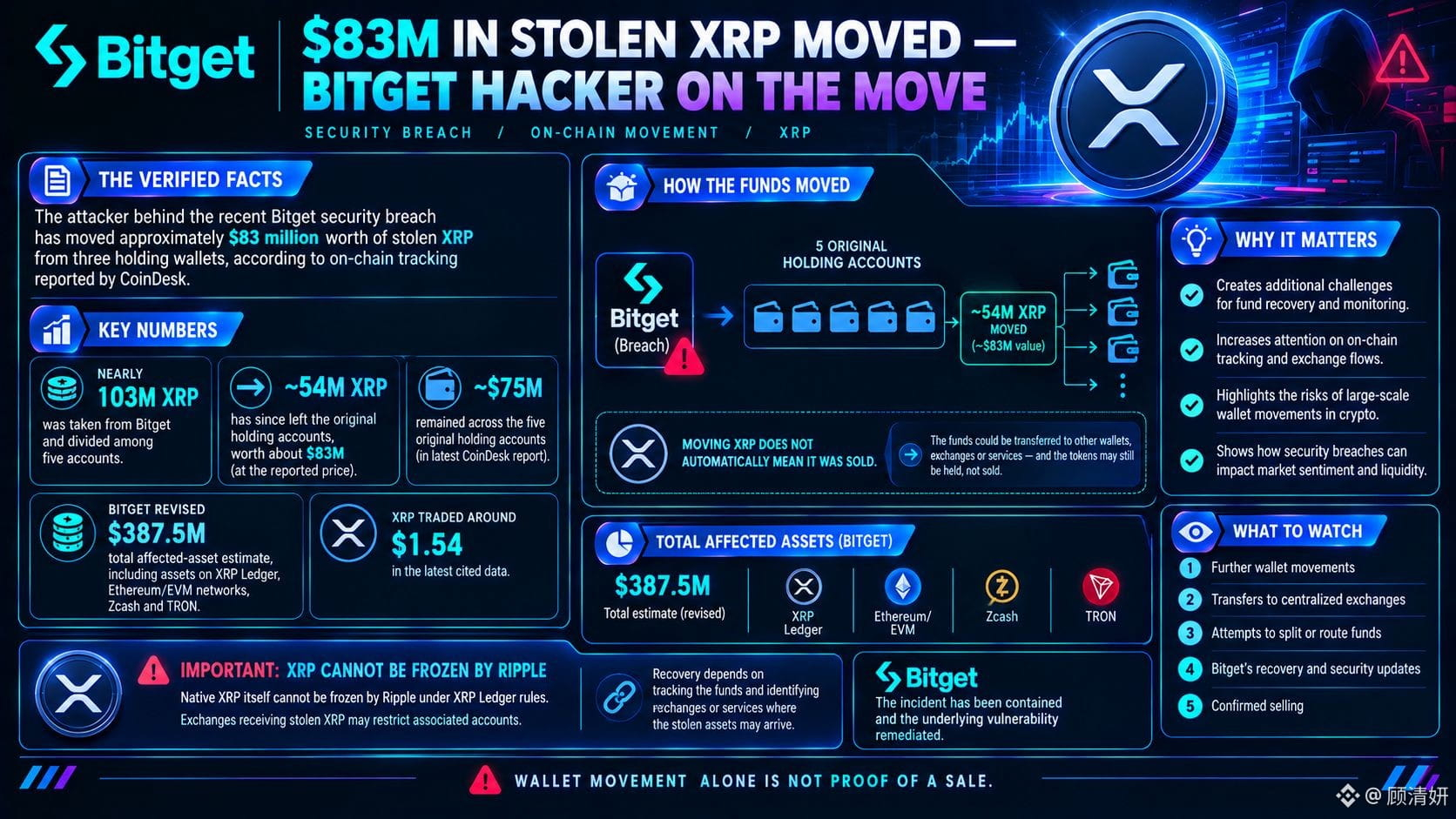
The attacker behind the recent Bitget security breach has moved approximately $83 million worth of stolen XRP from three holding wallets, according to on-chain tracking reported by CoinDesk.
🔎 WHAT HAPPENED?
• Nearly 103M XRP was reportedly stolen during the Sept. 24 Bitget breach
• Around 54M XRP, worth roughly $83M, has since moved from the original wallets
• Approximately $75M in XRP reportedly remains across the original holding accounts
• The transfers indicate the funds are being distributed across additional wallets
• Moving the XRP does not automatically mean the tokens have been sold
Bitget has revised its total affected-asset estimate to approximately $387.5M, including assets on XRP Ledger, Ethereum/EVM networks, Zcash and TRON. The exchange says the incident has been contained and the underlying vulnerability remediated.
⚠️ WHY IT MATTERS
The movement of a large stolen XRP balance creates additional challenges for fund recovery and monitoring.
Unlike some issued tokens on the XRP Ledger, native XRP itself cannot simply be frozen by Ripple. Recovery therefore depends heavily on tracking the funds and identifying exchanges or other services where the stolen assets may eventually arrive.
XRP was trading around $1.54 in the latest reported data, with the token still showing a weekly gain despite the security-related pressure.
👀 WHAT TO WATCH
• Further movement from the remaining attacker wallets
• Whether any stolen XRP reaches centralized exchanges
• On-chain attempts to split or route the funds
• Bitget's recovery and security updates
• XRP price reaction if significant selling is confirmed
Important: Wallet movement alone is not proof that the attacker has sold the XRP.
The next major signal may come from where these funds move next.
$QNT $GLMR $AMP
{spot}(AMPUSDT)
{spot}(GLMRUSDT)
{future}(QNTUSDT)
#BitgetHackerMoves$83MStolenXRP
🚨 $83M IN STOLEN XRP MOVED — BITGET HACKER ON THE MOVE
The attacker behind the recent Bitget security breach has moved approximately $83 million worth of stolen XRP from three holding wallets, according to on-chain tracking reported by CoinDesk.
🔎 WHAT HAPPENED?
• Nearly 103M XRP was reportedly stolen during the Sept. 24 Bitget breach
• Around 54M XRP, worth roughly $83M, has since moved from the original wallets
• Approximately $75M in XRP reportedly remains across the original holding accounts
• The transfers indicate the funds are being distributed across additional wallets
• Moving the XRP does not automatically mean the tokens have been sold
Bitget has revised its total affected-asset estimate to approximately $387.5M, including assets on XRP Ledger, Ethereum/EVM networks, Zcash and TRON. The exchange says the incident has been contained and the underlying vulnerability remediated.
⚠️ WHY IT MATTERS
The movement of a large stolen XRP balance creates additional challenges for fund recovery and monitoring.
Unlike some issued tokens on the XRP Ledger, native XRP itself cannot simply be frozen by Ripple. Recovery therefore depends heavily on tracking the funds and identifying exchanges or other services where the stolen assets may eventually arrive.
XRP was trading around $1.54 in the latest reported data, with the token still showing a weekly gain despite the security-related pressure.
👀 WHAT TO WATCH
• Further movement from the remaining attacker wallets
• Whether any stolen XRP reaches centralized exchanges
• On-chain attempts to split or route the funds
• Bitget's recovery and security updates
• XRP price reaction if significant selling is confirmed
Important: Wallet movement alone is not proof that the attacker has sold the XRP.
The next major signal may come from where these funds move next.
$QNT $GLMR $AMP
🚨 $83M IN STOLEN XRP MOVED — BITGET HACKER ON THE MOVE
The attacker behind the recent Bitget security breach has moved approximately $83 million worth of stolen XRP from three holding wallets, according to on-chain tracking reported by CoinDesk.
🔎 WHAT HAPPENED?
• Nearly 103M XRP was reportedly stolen during the Sept. 24 Bitget breach
• Around 54M XRP, worth roughly $83M, has since moved from the original wallets
• Approximately $75M in XRP reportedly remains across the original holding accounts
• The transfers indicate the funds are being distributed across additional wallets
• Moving the XRP does not automatically mean the tokens have been sold
Bitget has revised its total affected-asset estimate to approximately $387.5M, including assets on XRP Ledger, Ethereum/EVM networks, Zcash and TRON. The exchange says the incident has been contained and the underlying vulnerability remediated.
⚠️ WHY IT MATTERS
The movement of a large stolen XRP balance creates additional challenges for fund recovery and monitoring.
Unlike some issued tokens on the XRP Ledger, native XRP itself cannot simply be frozen by Ripple. Recovery therefore depends heavily on tracking the funds and identifying exchanges or other services where the stolen assets may eventually arrive.
XRP was trading around $1.54 in the latest reported data, with the token still showing a weekly gain despite the security-related pressure.
👀 WHAT TO WATCH
• Further movement from the remaining attacker wallets
• Whether any stolen XRP reaches centralized exchanges
• On-chain attempts to split or route the funds
• Bitget's recovery and security updates
• XRP price reaction if significant selling is confirmed
Important: Wallet movement alone is not proof that the attacker has sold the XRP.
The next major signal may come from where these funds move next.
$QNT $GLMR $AMP
81
·
--
#seccommissionerpeircetoleaveoct2
🚨 SEC’S HESTER PEIRCE TO LEAVE ON OCTOBER 2
A notable change is coming to U.S. crypto regulation.
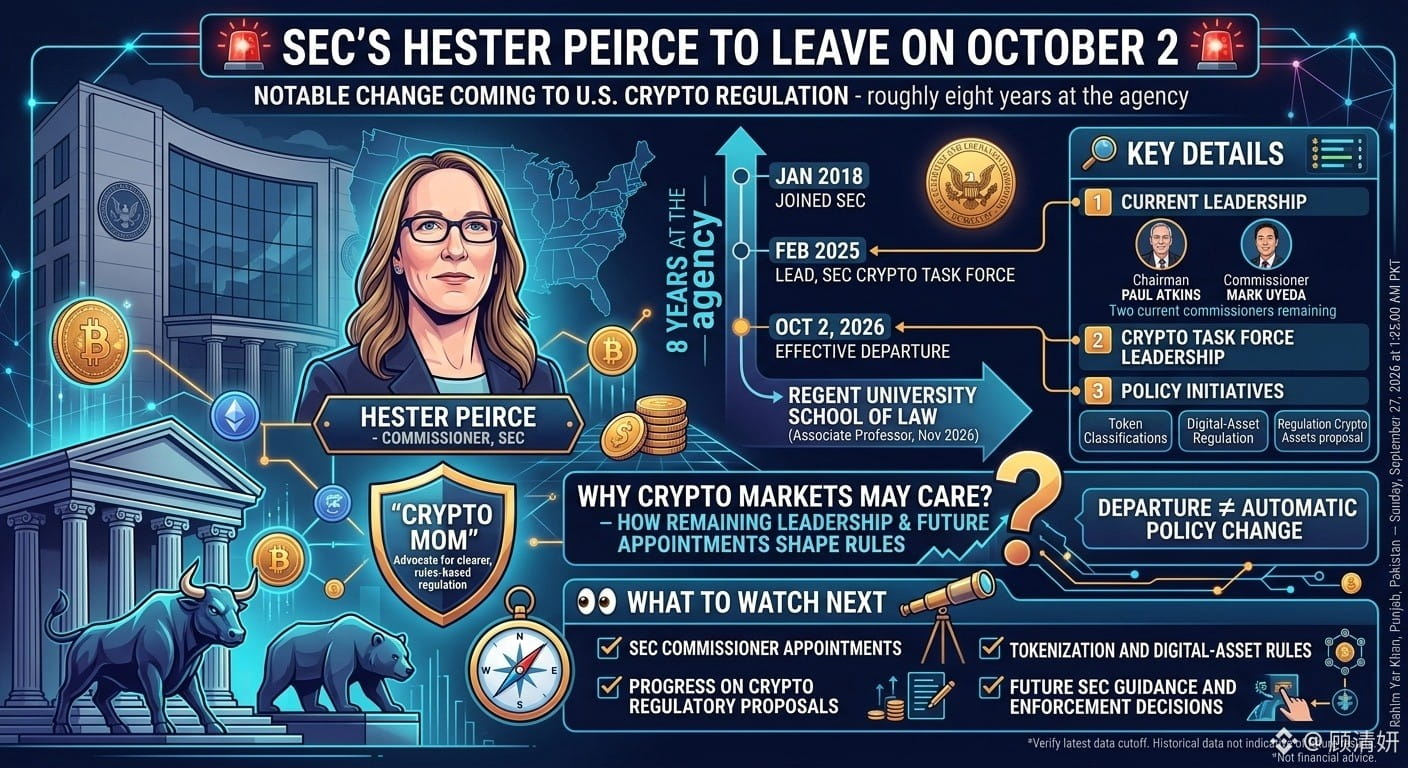
SEC Commissioner Hester Peirce has announced that she will leave the U.S. Securities and Exchange Commission effective October 2, 2026, ending roughly eight years at the agency.
🔎 KEY DETAILS
• Peirce joined the SEC in January 2018.
• She became widely known in the crypto industry as “Crypto Mom” for advocating clearer, rules-based digital-asset regulation.
• Since February 2025, she has led the SEC’s Crypto Task Force, which has worked on questions around digital assets and securities laws.
• Her departure will leave Chairman Paul Atkins and Commissioner Mark Uyeda as the SEC’s two current commissioners, according to current SEC information and reporting.
• Peirce is expected to join Regent University School of Law as an associate professor in November 2026.
📊 WHY CRYPTO MARKETS MAY CARE
Peirce has been involved in several major SEC crypto-policy initiatives, including work related to token classifications, digital-asset regulation and the agency’s recent Regulation Crypto Assets proposal.
Her departure does not automatically mean a change in SEC policy.
The bigger question for the crypto market is how the agency’s remaining leadership and any future appointments shape the direction and implementation of U.S. digital-asset rules.
👀 WHAT TO WATCH
→ SEC commissioner appointments
→ Progress on crypto regulatory proposals
→ Tokenization and digital-asset rules
→ Future SEC guidance and enforcement decisions
For traders and investors, the key takeaway is simple:
October 2 marks a personnel change — the market impact will depend on what comes next.
Not financial advice.
$SPELL $RUNE $DASH
{future}(DASHUSDT)
{future}(RUNEUSDT)
{future}(SPELLUSDT)
#seccommissionerpeircetoleaveoct2
🚨 SEC’S HESTER PEIRCE TO LEAVE ON OCTOBER 2
A notable change is coming to U.S. crypto regulation.
SEC Commissioner Hester Peirce has announced that she will leave the U.S. Securities and Exchange Commission effective October 2, 2026, ending roughly eight years at the agency.
🔎 KEY DETAILS
• Peirce joined the SEC in January 2018.
• She became widely known in the crypto industry as “Crypto Mom” for advocating clearer, rules-based digital-asset regulation.
• Since February 2025, she has led the SEC’s Crypto Task Force, which has worked on questions around digital assets and securities laws.
• Her departure will leave Chairman Paul Atkins and Commissioner Mark Uyeda as the SEC’s two current commissioners, according to current SEC information and reporting.
• Peirce is expected to join Regent University School of Law as an associate professor in November 2026.
📊 WHY CRYPTO MARKETS MAY CARE
Peirce has been involved in several major SEC crypto-policy initiatives, including work related to token classifications, digital-asset regulation and the agency’s recent Regulation Crypto Assets proposal.
Her departure does not automatically mean a change in SEC policy.
The bigger question for the crypto market is how the agency’s remaining leadership and any future appointments shape the direction and implementation of U.S. digital-asset rules.
👀 WHAT TO WATCH
→ SEC commissioner appointments
→ Progress on crypto regulatory proposals
→ Tokenization and digital-asset rules
→ Future SEC guidance and enforcement decisions
For traders and investors, the key takeaway is simple:
October 2 marks a personnel change — the market impact will depend on what comes next.
Not financial advice.
$SPELL $RUNE $DASH
🚨 SEC’S HESTER PEIRCE TO LEAVE ON OCTOBER 2
A notable change is coming to U.S. crypto regulation.
SEC Commissioner Hester Peirce has announced that she will leave the U.S. Securities and Exchange Commission effective October 2, 2026, ending roughly eight years at the agency.
🔎 KEY DETAILS
• Peirce joined the SEC in January 2018.
• She became widely known in the crypto industry as “Crypto Mom” for advocating clearer, rules-based digital-asset regulation.
• Since February 2025, she has led the SEC’s Crypto Task Force, which has worked on questions around digital assets and securities laws.
• Her departure will leave Chairman Paul Atkins and Commissioner Mark Uyeda as the SEC’s two current commissioners, according to current SEC information and reporting.
• Peirce is expected to join Regent University School of Law as an associate professor in November 2026.
📊 WHY CRYPTO MARKETS MAY CARE
Peirce has been involved in several major SEC crypto-policy initiatives, including work related to token classifications, digital-asset regulation and the agency’s recent Regulation Crypto Assets proposal.
Her departure does not automatically mean a change in SEC policy.
The bigger question for the crypto market is how the agency’s remaining leadership and any future appointments shape the direction and implementation of U.S. digital-asset rules.
👀 WHAT TO WATCH
→ SEC commissioner appointments
→ Progress on crypto regulatory proposals
→ Tokenization and digital-asset rules
→ Future SEC guidance and enforcement decisions
For traders and investors, the key takeaway is simple:
October 2 marks a personnel change — the market impact will depend on what comes next.
Not financial advice.
$SPELL $RUNE $DASH
1
61
·
--
Рост
Проверено
#bitwisefilestolistnearetfonnysearca
🚨 BITWISE’S NEAR ETF CLEARS A MAJOR NYSE ARCA MILESTONE
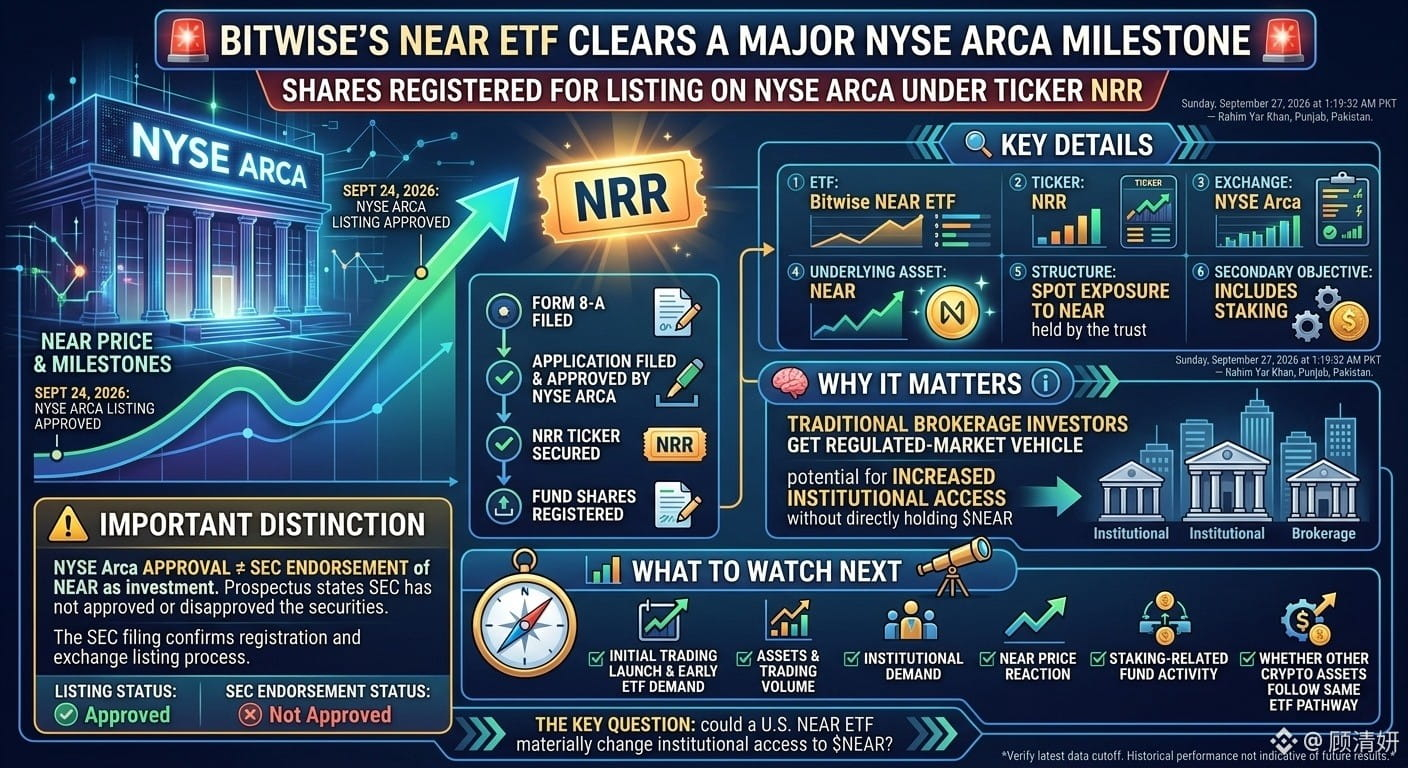
Bitwise has moved another step forward with its NEAR ETF, registering the fund’s shares for listing on NYSE Arca under the ticker NRR.
According to the SEC filing dated September 24, 2026, the Bitwise NEAR ETF filed Form 8-A and states that its application to list the shares was filed with and approved by NYSE Arca.
🔎 KEY DETAILS
• ETF: Bitwise NEAR ETF
• Ticker: NRR
• Exchange: NYSE Arca
• Underlying asset: NEAR
• Structure: Spot exposure to NEAR held by the trust
• Additional strategy: The fund’s prospectus includes staking as a secondary investment objective.
🧠 WHY IT MATTERS
A U.S.-listed NEAR ETF would give traditional brokerage investors a regulated-market vehicle for gaining exposure to NEAR without directly holding the token.
The development also comes as NEAR has attracted renewed market attention, with recent reports linking the token’s price strength to the ETF milestone and broader network activity.
⚠️ IMPORTANT DISTINCTION
NYSE Arca’s listing approval should not be confused with an SEC endorsement of NEAR as an investment.
The SEC filing confirms the registration of the securities and the exchange listing process, while the fund’s prospectus states that the SEC has not approved or disapproved the securities themselves.
📊 WHAT TO WATCH NEXT
The key focus now is the actual trading launch and early ETF demand.
If NRR begins trading successfully, investors will be watching:
• Initial assets and trading volume
• Institutional demand
• NEAR price reaction
• Staking-related fund activity
• Whether other crypto assets follow the same ETF pathway
This is another notable development in the expansion of U.S. crypto investment products.
ETF infrastructure is becoming an increasingly important bridge between traditional markets and crypto.
What do you think: could a U.S. NEAR ETF materially change institutional access to $NEAR?
$AMP $RARE $KMNO
{future}(KMNOUSDT)
{future}(RAREUSDT)
{spot}(AMPUSDT)
#bitwisefilestolistnearetfonnysearca
🚨 BITWISE’S NEAR ETF CLEARS A MAJOR NYSE ARCA MILESTONE
Bitwise has moved another step forward with its NEAR ETF, registering the fund’s shares for listing on NYSE Arca under the ticker NRR.
According to the SEC filing dated September 24, 2026, the Bitwise NEAR ETF filed Form 8-A and states that its application to list the shares was filed with and approved by NYSE Arca.
🔎 KEY DETAILS
• ETF: Bitwise NEAR ETF
• Ticker: NRR
• Exchange: NYSE Arca
• Underlying asset: NEAR
• Structure: Spot exposure to NEAR held by the trust
• Additional strategy: The fund’s prospectus includes staking as a secondary investment objective.
🧠 WHY IT MATTERS
A U.S.-listed NEAR ETF would give traditional brokerage investors a regulated-market vehicle for gaining exposure to NEAR without directly holding the token.
The development also comes as NEAR has attracted renewed market attention, with recent reports linking the token’s price strength to the ETF milestone and broader network activity.
⚠️ IMPORTANT DISTINCTION
NYSE Arca’s listing approval should not be confused with an SEC endorsement of NEAR as an investment.
The SEC filing confirms the registration of the securities and the exchange listing process, while the fund’s prospectus states that the SEC has not approved or disapproved the securities themselves.
📊 WHAT TO WATCH NEXT
The key focus now is the actual trading launch and early ETF demand.
If NRR begins trading successfully, investors will be watching:
• Initial assets and trading volume
• Institutional demand
• NEAR price reaction
• Staking-related fund activity
• Whether other crypto assets follow the same ETF pathway
This is another notable development in the expansion of U.S. crypto investment products.
ETF infrastructure is becoming an increasingly important bridge between traditional markets and crypto.
What do you think: could a U.S. NEAR ETF materially change institutional access to $NEAR?
$AMP $RARE $KMNO
🚨 BITWISE’S NEAR ETF CLEARS A MAJOR NYSE ARCA MILESTONE
Bitwise has moved another step forward with its NEAR ETF, registering the fund’s shares for listing on NYSE Arca under the ticker NRR.
According to the SEC filing dated September 24, 2026, the Bitwise NEAR ETF filed Form 8-A and states that its application to list the shares was filed with and approved by NYSE Arca.
🔎 KEY DETAILS
• ETF: Bitwise NEAR ETF
• Ticker: NRR
• Exchange: NYSE Arca
• Underlying asset: NEAR
• Structure: Spot exposure to NEAR held by the trust
• Additional strategy: The fund’s prospectus includes staking as a secondary investment objective.
🧠 WHY IT MATTERS
A U.S.-listed NEAR ETF would give traditional brokerage investors a regulated-market vehicle for gaining exposure to NEAR without directly holding the token.
The development also comes as NEAR has attracted renewed market attention, with recent reports linking the token’s price strength to the ETF milestone and broader network activity.
⚠️ IMPORTANT DISTINCTION
NYSE Arca’s listing approval should not be confused with an SEC endorsement of NEAR as an investment.
The SEC filing confirms the registration of the securities and the exchange listing process, while the fund’s prospectus states that the SEC has not approved or disapproved the securities themselves.
📊 WHAT TO WATCH NEXT
The key focus now is the actual trading launch and early ETF demand.
If NRR begins trading successfully, investors will be watching:
• Initial assets and trading volume
• Institutional demand
• NEAR price reaction
• Staking-related fund activity
• Whether other crypto assets follow the same ETF pathway
This is another notable development in the expansion of U.S. crypto investment products.
ETF infrastructure is becoming an increasingly important bridge between traditional markets and crypto.
What do you think: could a U.S. NEAR ETF materially change institutional access to $NEAR?
$AMP $RARE $KMNO
1
7
8.6k
·
--
Рост
Проверено
#blackrockbuildstokenizedportfoliosforondo
🚨 BLACKROCK’S PORTFOLIO STRATEGIES ARE GOING ONCHAIN
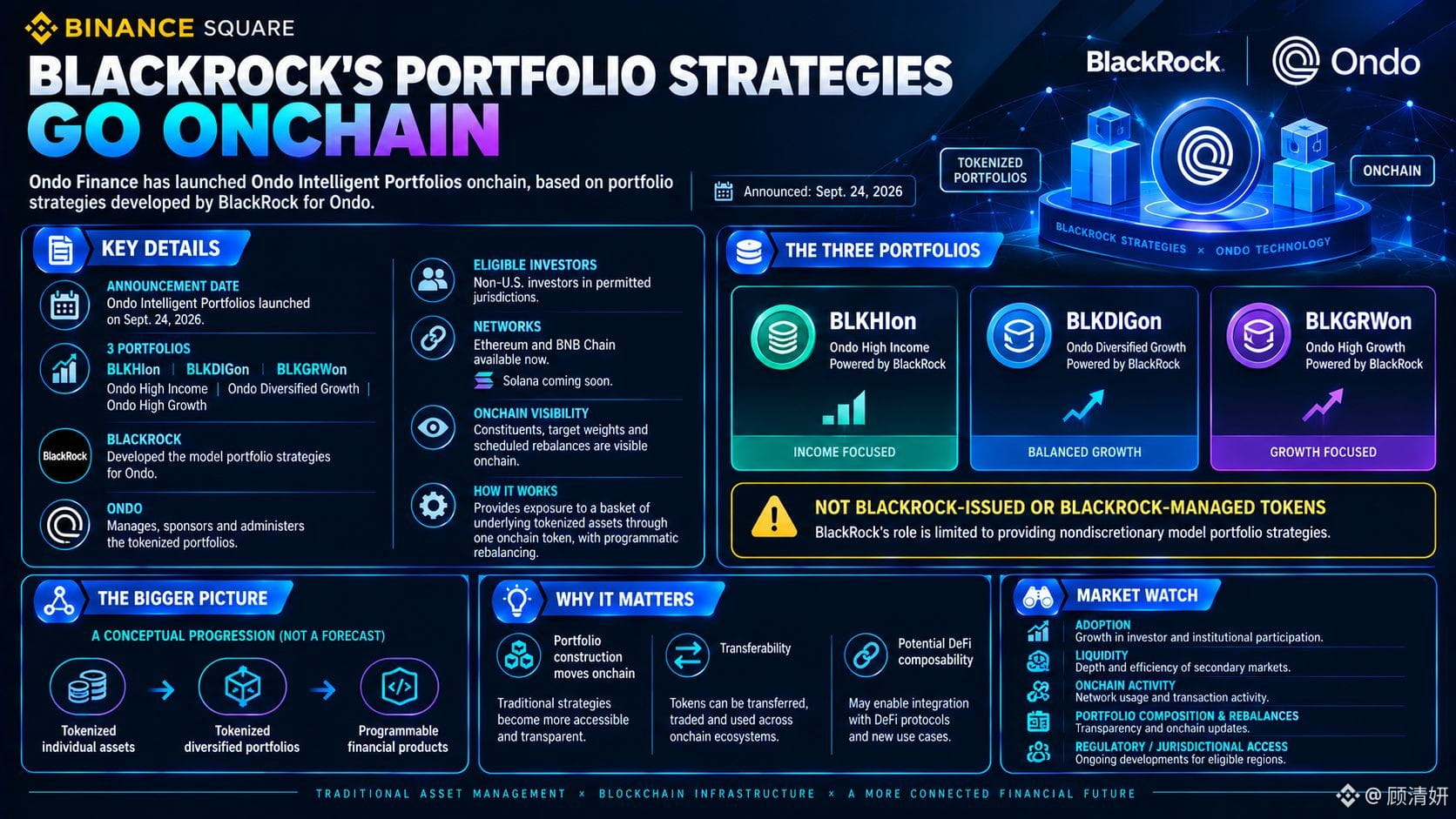
A major development for tokenized finance: Ondo Finance has launched three onchain investment portfolios based on portfolio strategies developed by BlackRock for Ondo.
Instead of buying and rebalancing multiple assets individually, eligible investors can gain exposure to a diversified portfolio through a single blockchain-based token.
🔎 KEY DETAILS
• 3 portfolios launched: High Income, Diversified Growth and High Growth
• BlackRock’s role: Developed the portfolio strategies for Ondo
• Ondo’s role: Manages, sponsors and administers the tokenized portfolios
• Onchain structure: Portfolio constituents, weights and rebalances are visible onchain
• Networks: Ethereum and BNB Chain are available; Solana is listed as coming soon
• Access: Currently designed for eligible investors outside the U.S.
🏦 WHY THIS MATTERS
This move connects traditional portfolio construction with blockchain infrastructure.
The concept is simple: institutional-style portfolio strategies → tokenized assets → one transferable onchain token.
It could represent another step toward bringing traditional investment products into 24/7 blockchain-based markets.
⚠️ IMPORTANT DISTINCTION
This is not a BlackRock-issued crypto product.
BlackRock provides the model portfolio strategies, while Ondo is responsible for the tokenized portfolios. BlackRock itself states that it does not manage, issue, distribute or operate these tokens.
👀 WHAT TO WATCH
The bigger question is whether tokenized portfolios can attract meaningful adoption and become a practical bridge between traditional finance and DeFi.
For the RWA sector, this is another important test of how far institutional investment strategies can move onchain.
TradFi is moving further onchain — and portfolio products may be the next major frontier.
$RUNE $AMP $WLD
{future}(WLDUSDT)
{spot}(AMPUSDT)
{future}(RUNEUSDT)
#blackrockbuildstokenizedportfoliosforondo
🚨 BLACKROCK’S PORTFOLIO STRATEGIES ARE GOING ONCHAIN
A major development for tokenized finance: Ondo Finance has launched three onchain investment portfolios based on portfolio strategies developed by BlackRock for Ondo.
Instead of buying and rebalancing multiple assets individually, eligible investors can gain exposure to a diversified portfolio through a single blockchain-based token.
🔎 KEY DETAILS
• 3 portfolios launched: High Income, Diversified Growth and High Growth
• BlackRock’s role: Developed the portfolio strategies for Ondo
• Ondo’s role: Manages, sponsors and administers the tokenized portfolios
• Onchain structure: Portfolio constituents, weights and rebalances are visible onchain
• Networks: Ethereum and BNB Chain are available; Solana is listed as coming soon
• Access: Currently designed for eligible investors outside the U.S.
🏦 WHY THIS MATTERS
This move connects traditional portfolio construction with blockchain infrastructure.
The concept is simple: institutional-style portfolio strategies → tokenized assets → one transferable onchain token.
It could represent another step toward bringing traditional investment products into 24/7 blockchain-based markets.
⚠️ IMPORTANT DISTINCTION
This is not a BlackRock-issued crypto product.
BlackRock provides the model portfolio strategies, while Ondo is responsible for the tokenized portfolios. BlackRock itself states that it does not manage, issue, distribute or operate these tokens.
👀 WHAT TO WATCH
The bigger question is whether tokenized portfolios can attract meaningful adoption and become a practical bridge between traditional finance and DeFi.
For the RWA sector, this is another important test of how far institutional investment strategies can move onchain.
TradFi is moving further onchain — and portfolio products may be the next major frontier.
$RUNE $AMP $WLD
🚨 BLACKROCK’S PORTFOLIO STRATEGIES ARE GOING ONCHAIN
A major development for tokenized finance: Ondo Finance has launched three onchain investment portfolios based on portfolio strategies developed by BlackRock for Ondo.
Instead of buying and rebalancing multiple assets individually, eligible investors can gain exposure to a diversified portfolio through a single blockchain-based token.
🔎 KEY DETAILS
• 3 portfolios launched: High Income, Diversified Growth and High Growth
• BlackRock’s role: Developed the portfolio strategies for Ondo
• Ondo’s role: Manages, sponsors and administers the tokenized portfolios
• Onchain structure: Portfolio constituents, weights and rebalances are visible onchain
• Networks: Ethereum and BNB Chain are available; Solana is listed as coming soon
• Access: Currently designed for eligible investors outside the U.S.
🏦 WHY THIS MATTERS
This move connects traditional portfolio construction with blockchain infrastructure.
The concept is simple: institutional-style portfolio strategies → tokenized assets → one transferable onchain token.
It could represent another step toward bringing traditional investment products into 24/7 blockchain-based markets.
⚠️ IMPORTANT DISTINCTION
This is not a BlackRock-issued crypto product.
BlackRock provides the model portfolio strategies, while Ondo is responsible for the tokenized portfolios. BlackRock itself states that it does not manage, issue, distribute or operate these tokens.
👀 WHAT TO WATCH
The bigger question is whether tokenized portfolios can attract meaningful adoption and become a practical bridge between traditional finance and DeFi.
For the RWA sector, this is another important test of how far institutional investment strategies can move onchain.
TradFi is moving further onchain — and portfolio products may be the next major frontier.
$RUNE $AMP $WLD
2
8
6.7k
·
--
Рост
#polymarketbankfailurebetsdrawfdicconcern
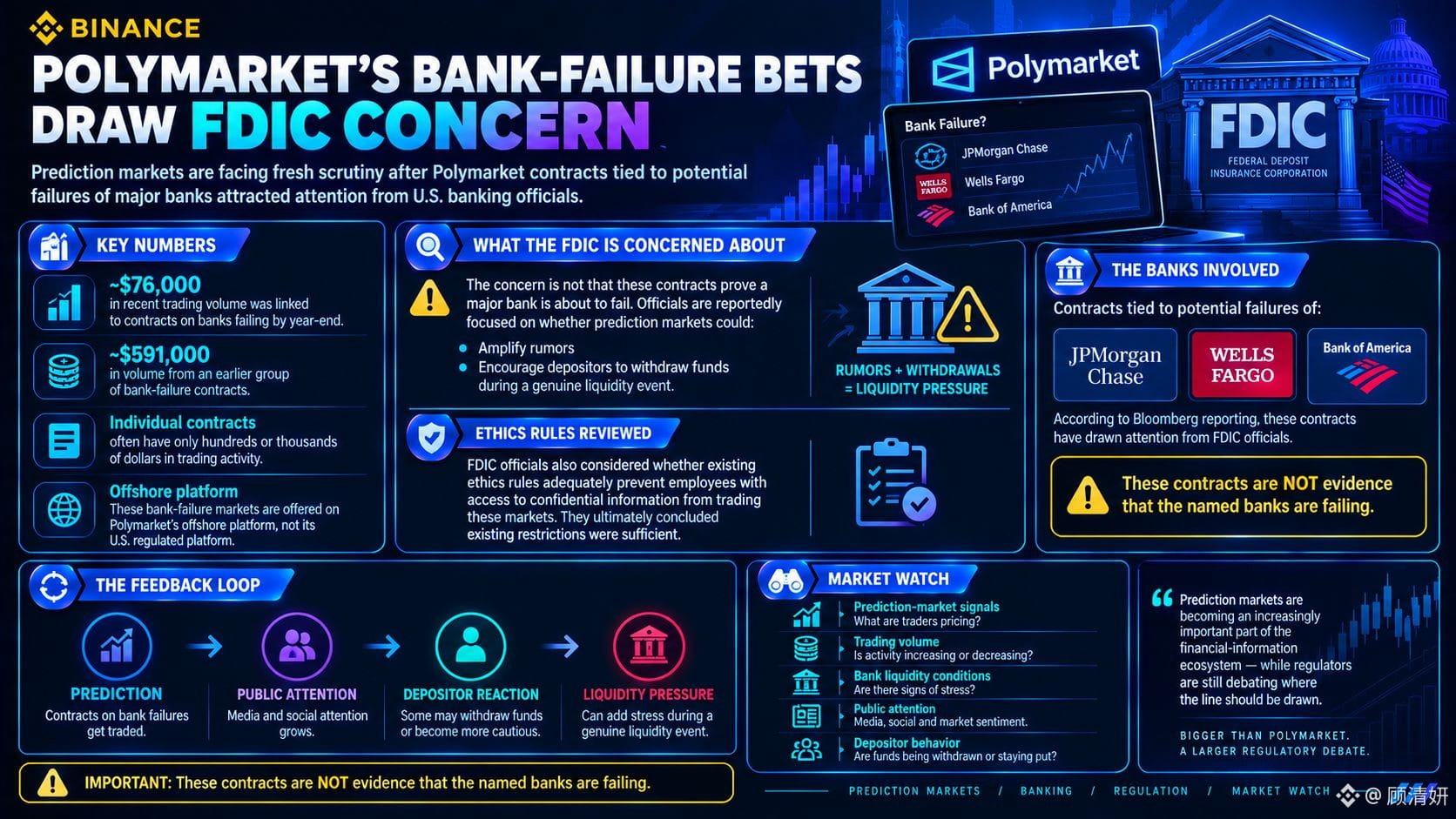
🚨 POLYMARKET’S BANK-FAILURE BETS DRAW FDIC CONCERN
Prediction markets are facing fresh scrutiny after Polymarket contracts tied to potential failures of major banks attracted attention from U.S. banking officials.
According to Bloomberg reporting, contracts involving banks such as JPMorgan Chase, Wells Fargo and Bank of America have raised concerns at the Federal Deposit Insurance Corporation (FDIC).
🔎 KEY NUMBERS
• Around $76,000 in recent trading volume was linked to contracts on banks failing by year-end
• An earlier group of bank-failure contracts reportedly generated about $591,000 in volume
WHY THE FDIC IS WATCHING
Officials are reportedly focused on the possibility that larger prediction markets could amplify rumors or encourage depositors to withdraw funds, potentially creating additional pressure on a bank during a genuine liquidity event.
FDIC officials also considered whether existing ethics rules adequately prevent employees with access to confidential information from trading these markets. They ultimately concluded that existing restrictions were sufficient.
🌐 WHY IT MATTERS FOR MARKETS
Prediction markets are increasingly being used to price probabilities around real-world events.
But bank-failure contracts create a unique feedback loop:
Prediction → Public attention → Depositor reaction → Liquidity pressure
That makes the regulatory debate bigger than Polymarket itself.
For crypto traders, the broader takeaway is that prediction markets are becoming an increasingly important part of the financial-information ecosystem — while regulators are still debating where the line should be drawn.
⚠️ Important: These contracts are not evidence that the named banks are failing. Trading volume remains relatively small compared with traditional financial markets.
Could prediction markets become useful early-warning indicators — or create the very panic they are trying to measure?
$KMNO $2Z $MARSCOIN
{future}(MARSCOINUSDT)
{future}(2ZUSDT)
{future}(KMNOUSDT)
#polymarketbankfailurebetsdrawfdicconcern
🚨 POLYMARKET’S BANK-FAILURE BETS DRAW FDIC CONCERN
Prediction markets are facing fresh scrutiny after Polymarket contracts tied to potential failures of major banks attracted attention from U.S. banking officials.
According to Bloomberg reporting, contracts involving banks such as JPMorgan Chase, Wells Fargo and Bank of America have raised concerns at the Federal Deposit Insurance Corporation (FDIC).
🔎 KEY NUMBERS
• Around $76,000 in recent trading volume was linked to contracts on banks failing by year-end
• An earlier group of bank-failure contracts reportedly generated about $591,000 in volume
WHY THE FDIC IS WATCHING
Officials are reportedly focused on the possibility that larger prediction markets could amplify rumors or encourage depositors to withdraw funds, potentially creating additional pressure on a bank during a genuine liquidity event.
FDIC officials also considered whether existing ethics rules adequately prevent employees with access to confidential information from trading these markets. They ultimately concluded that existing restrictions were sufficient.
🌐 WHY IT MATTERS FOR MARKETS
Prediction markets are increasingly being used to price probabilities around real-world events.
But bank-failure contracts create a unique feedback loop:
Prediction → Public attention → Depositor reaction → Liquidity pressure
That makes the regulatory debate bigger than Polymarket itself.
For crypto traders, the broader takeaway is that prediction markets are becoming an increasingly important part of the financial-information ecosystem — while regulators are still debating where the line should be drawn.
⚠️ Important: These contracts are not evidence that the named banks are failing. Trading volume remains relatively small compared with traditional financial markets.
Could prediction markets become useful early-warning indicators — or create the very panic they are trying to measure?
$KMNO $2Z $MARSCOIN
🚨 POLYMARKET’S BANK-FAILURE BETS DRAW FDIC CONCERN
Prediction markets are facing fresh scrutiny after Polymarket contracts tied to potential failures of major banks attracted attention from U.S. banking officials.
According to Bloomberg reporting, contracts involving banks such as JPMorgan Chase, Wells Fargo and Bank of America have raised concerns at the Federal Deposit Insurance Corporation (FDIC).
🔎 KEY NUMBERS
• Around $76,000 in recent trading volume was linked to contracts on banks failing by year-end
• An earlier group of bank-failure contracts reportedly generated about $591,000 in volume
WHY THE FDIC IS WATCHING
Officials are reportedly focused on the possibility that larger prediction markets could amplify rumors or encourage depositors to withdraw funds, potentially creating additional pressure on a bank during a genuine liquidity event.
FDIC officials also considered whether existing ethics rules adequately prevent employees with access to confidential information from trading these markets. They ultimately concluded that existing restrictions were sufficient.
🌐 WHY IT MATTERS FOR MARKETS
Prediction markets are increasingly being used to price probabilities around real-world events.
But bank-failure contracts create a unique feedback loop:
Prediction → Public attention → Depositor reaction → Liquidity pressure
That makes the regulatory debate bigger than Polymarket itself.
For crypto traders, the broader takeaway is that prediction markets are becoming an increasingly important part of the financial-information ecosystem — while regulators are still debating where the line should be drawn.
⚠️ Important: These contracts are not evidence that the named banks are failing. Trading volume remains relatively small compared with traditional financial markets.
Could prediction markets become useful early-warning indicators — or create the very panic they are trying to measure?
$KMNO $2Z $MARSCOIN
6
9.1k
·
--
Рост
Проверено
#circlemints500musdconsolana
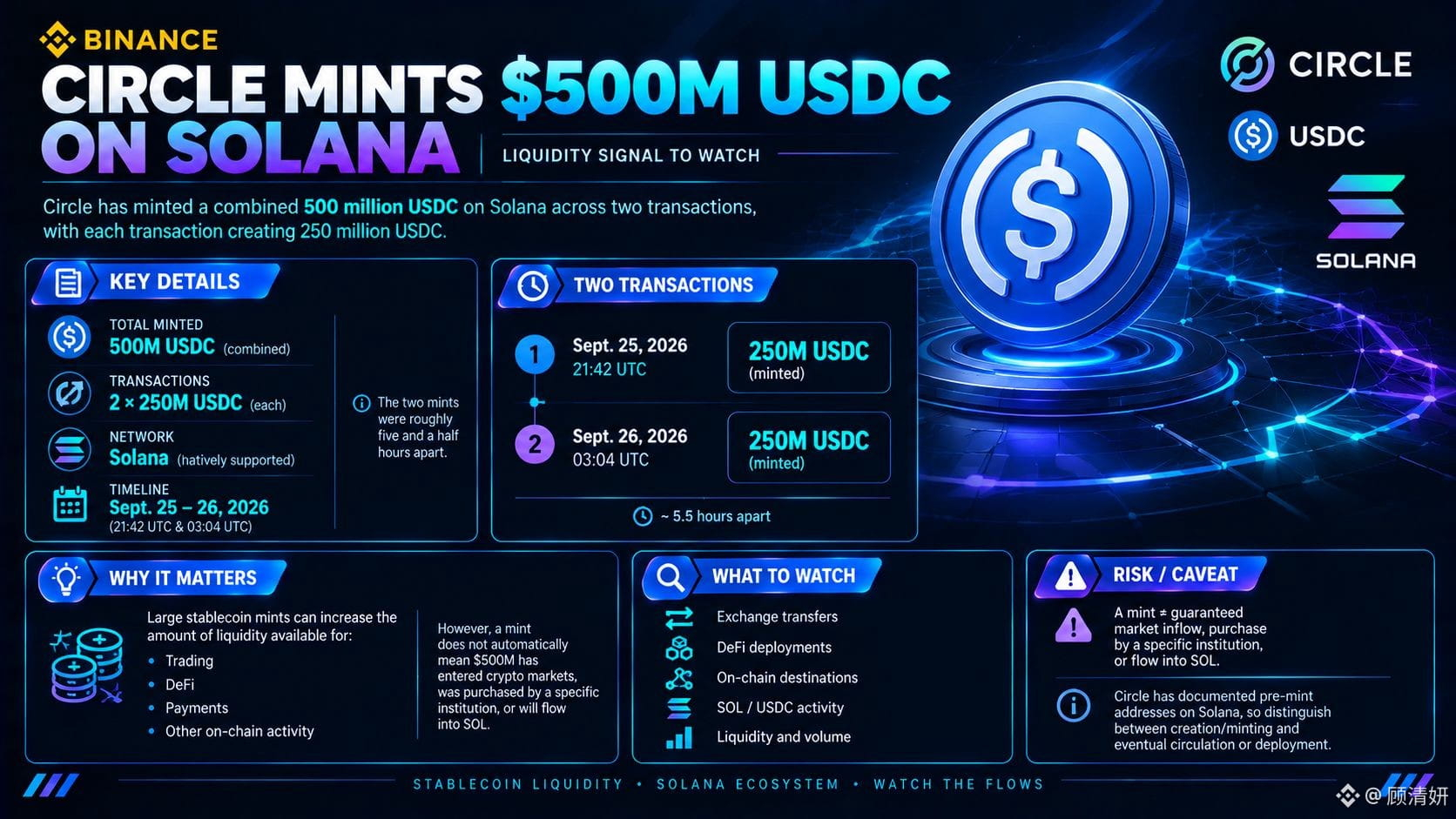
🚨 CIRCLE MINTS $500M USDC ON SOLANA — LIQUIDITY SIGNAL TO WATCH
Circle has minted a combined 500 million USDC on Solana across two transactions, with each transaction creating 250 million USDC.
The activity highlights continued demand for dollar-denominated liquidity on Solana, where USDC is natively supported by Circle.
KEY DETAILS
• $500M USDC minted
• Split into 2 × $250M transactions
• Network: Solana
• USDC is Circle’s dollar-backed stablecoin
• Latest activity occurred around Sept. 25–26, 2026
WHY IT MATTERS
Large stablecoin mints can increase the amount of liquidity available for trading, DeFi, payments and other on-chain activity.
However, a mint does not automatically mean $500M has entered crypto markets or will immediately flow into SOL. Circle explains that on Solana, pre-minted USDC can be held before being authorized into circulation.
So the key question for traders is what happens next:
Will this newly created USDC move toward exchanges, DeFi protocols or other Solana-based applications?
For now, the mint itself is confirmed — the eventual destination of the liquidity remains the part to watch.
$AMP $RARE $QNT
{future}(QNTUSDT)
{future}(RAREUSDT)
{spot}(AMPUSDT)
#circlemints500musdconsolana
🚨 CIRCLE MINTS $500M USDC ON SOLANA — LIQUIDITY SIGNAL TO WATCH
Circle has minted a combined 500 million USDC on Solana across two transactions, with each transaction creating 250 million USDC.
The activity highlights continued demand for dollar-denominated liquidity on Solana, where USDC is natively supported by Circle.
KEY DETAILS
• $500M USDC minted
• Split into 2 × $250M transactions
• Network: Solana
• USDC is Circle’s dollar-backed stablecoin
• Latest activity occurred around Sept. 25–26, 2026
WHY IT MATTERS
Large stablecoin mints can increase the amount of liquidity available for trading, DeFi, payments and other on-chain activity.
However, a mint does not automatically mean $500M has entered crypto markets or will immediately flow into SOL. Circle explains that on Solana, pre-minted USDC can be held before being authorized into circulation.
So the key question for traders is what happens next:
Will this newly created USDC move toward exchanges, DeFi protocols or other Solana-based applications?
For now, the mint itself is confirmed — the eventual destination of the liquidity remains the part to watch.
$AMP $RARE $QNT
🚨 CIRCLE MINTS $500M USDC ON SOLANA — LIQUIDITY SIGNAL TO WATCH
Circle has minted a combined 500 million USDC on Solana across two transactions, with each transaction creating 250 million USDC.
The activity highlights continued demand for dollar-denominated liquidity on Solana, where USDC is natively supported by Circle.
KEY DETAILS
• $500M USDC minted
• Split into 2 × $250M transactions
• Network: Solana
• USDC is Circle’s dollar-backed stablecoin
• Latest activity occurred around Sept. 25–26, 2026
WHY IT MATTERS
Large stablecoin mints can increase the amount of liquidity available for trading, DeFi, payments and other on-chain activity.
However, a mint does not automatically mean $500M has entered crypto markets or will immediately flow into SOL. Circle explains that on Solana, pre-minted USDC can be held before being authorized into circulation.
So the key question for traders is what happens next:
Will this newly created USDC move toward exchanges, DeFi protocols or other Solana-based applications?
For now, the mint itself is confirmed — the eventual destination of the liquidity remains the part to watch.
$AMP $RARE $QNT
3
2
4k
·
--
Рост
#bitcoinspotetfsturnnetpositiveytd
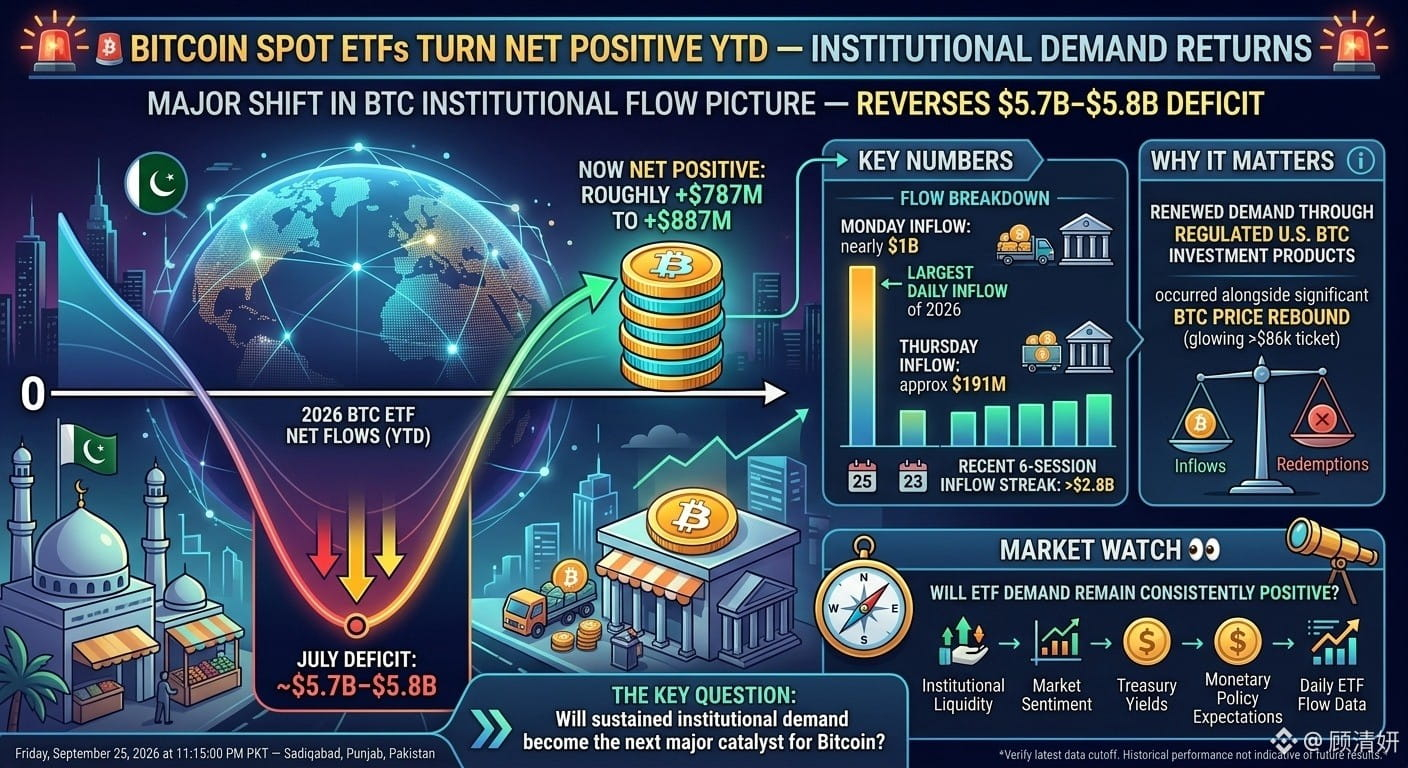
BITCOIN SPOT ETFs TURN NET POSITIVE YTD — INSTITUTIONAL DEMAND RETURNS
A major shift in Bitcoin’s institutional flow picture:
U.S. spot Bitcoin ETFs have officially moved back into positive territory for 2026, reversing a deficit of roughly $5.7–$5.8B recorded earlier this year.
KEY NUMBERS
• 2026 YTD net flows: roughly +$787M to +$887M, depending on the latest data cutoff
• Recent 6-session inflow streak: more than $2.8B
• Thursday inflow: approximately $191M
• Monday inflow: nearly $1B, the largest daily inflow of 2026
• The ETF complex had been about $5.7B–$5.8B negative in July
WHY IT MATTERS
The reversal suggests renewed demand through regulated U.S. Bitcoin investment products after months of heavy redemptions.
Bitcoin also rallied above $86,000 earlier this week, meaning the ETF-flow recovery has occurred alongside a significant rebound in BTC price. However, strong recent inflows do not guarantee that the trend will continue.
MARKET WATCH
The key question now is whether ETF demand can remain consistently positive into the final months of 2026.
If inflows continue, institutional demand could remain an important factor for Bitcoin liquidity and market sentiment.
But traders should also watch Treasury yields, monetary-policy expectations and daily ETF flow data for signs that the momentum is changing.
ETF flows are turning positive.
Will sustained institutional demand become the next major catalyst for Bitcoin?
$RARE $AERO $ENA
{future}(ENAUSDT)
{future}(AEROUSDT)
{future}(RAREUSDT)
#bitcoinspotetfsturnnetpositiveytd
BITCOIN SPOT ETFs TURN NET POSITIVE YTD — INSTITUTIONAL DEMAND RETURNS
A major shift in Bitcoin’s institutional flow picture:
U.S. spot Bitcoin ETFs have officially moved back into positive territory for 2026, reversing a deficit of roughly $5.7–$5.8B recorded earlier this year.
KEY NUMBERS
• 2026 YTD net flows: roughly +$787M to +$887M, depending on the latest data cutoff
• Recent 6-session inflow streak: more than $2.8B
• Thursday inflow: approximately $191M
• Monday inflow: nearly $1B, the largest daily inflow of 2026
• The ETF complex had been about $5.7B–$5.8B negative in July
WHY IT MATTERS
The reversal suggests renewed demand through regulated U.S. Bitcoin investment products after months of heavy redemptions.
Bitcoin also rallied above $86,000 earlier this week, meaning the ETF-flow recovery has occurred alongside a significant rebound in BTC price. However, strong recent inflows do not guarantee that the trend will continue.
MARKET WATCH
The key question now is whether ETF demand can remain consistently positive into the final months of 2026.
If inflows continue, institutional demand could remain an important factor for Bitcoin liquidity and market sentiment.
But traders should also watch Treasury yields, monetary-policy expectations and daily ETF flow data for signs that the momentum is changing.
ETF flows are turning positive.
Will sustained institutional demand become the next major catalyst for Bitcoin?
$RARE $AERO $ENA
BITCOIN SPOT ETFs TURN NET POSITIVE YTD — INSTITUTIONAL DEMAND RETURNS
A major shift in Bitcoin’s institutional flow picture:
U.S. spot Bitcoin ETFs have officially moved back into positive territory for 2026, reversing a deficit of roughly $5.7–$5.8B recorded earlier this year.
KEY NUMBERS
• 2026 YTD net flows: roughly +$787M to +$887M, depending on the latest data cutoff
• Recent 6-session inflow streak: more than $2.8B
• Thursday inflow: approximately $191M
• Monday inflow: nearly $1B, the largest daily inflow of 2026
• The ETF complex had been about $5.7B–$5.8B negative in July
WHY IT MATTERS
The reversal suggests renewed demand through regulated U.S. Bitcoin investment products after months of heavy redemptions.
Bitcoin also rallied above $86,000 earlier this week, meaning the ETF-flow recovery has occurred alongside a significant rebound in BTC price. However, strong recent inflows do not guarantee that the trend will continue.
MARKET WATCH
The key question now is whether ETF demand can remain consistently positive into the final months of 2026.
If inflows continue, institutional demand could remain an important factor for Bitcoin liquidity and market sentiment.
But traders should also watch Treasury yields, monetary-policy expectations and daily ETF flow data for signs that the momentum is changing.
ETF flows are turning positive.
Will sustained institutional demand become the next major catalyst for Bitcoin?
$RARE $AERO $ENA
2
5
6.4k
·
--
Рост
#bitgetbreachforgedrequestsnotstolenkeys
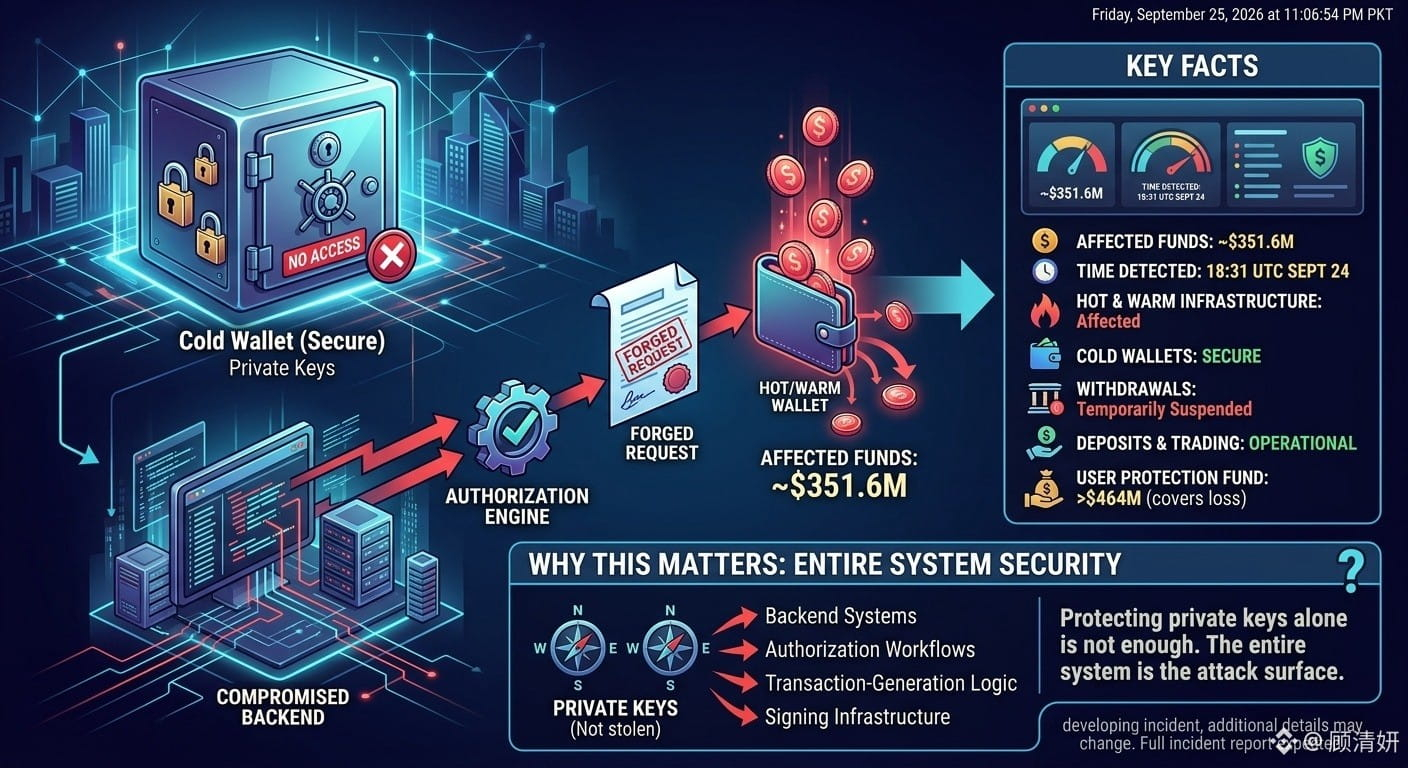
BITGET BREACH: FORGED TRANSFER REQUESTS, NOT STOLEN PRIVATE KEYS
Bitget has confirmed a major security incident involving approximately $351.6M in affected funds.
But there’s a critical detail:
The attackers reportedly did NOT steal Bitget’s private keys.
Instead, Bitget CEO Gracy Chen said attackers breached a backend wallet-service system and used that access to forge transfer information and invoke the authorization/signing process.
KEY FACTS
• Approximately $351.6M in funds were affected
• The incident was detected at 18:31 UTC on September 24
• Portions of Bitget’s hot and warm wallet infrastructure were affected
• Bitget says cold wallets remained secure
• Withdrawals were temporarily suspended during the security review
• Deposits and trading remained operational
• Bitget says its User Protection Fund holds more than $464M and covers the reported loss
WHY THIS MATTERS
This incident highlights an important exchange-security risk: protecting private keys alone is not enough.
Backend systems, transaction-generation logic, authorization workflows and signing infrastructure can also become critical attack surfaces.
Bitget says investigators are still determining exactly how the backend system was compromised, with a full incident report expected.
For traders, the key takeaway is simple:
Exchange security is an entire system — not just a private-key problem.
This remains a developing incident, so additional details may change as the investigation progresses.
$QI $PHA $ARK
{future}(ARKUSDT)
{future}(PHAUSDT)
{spot}(QIUSDT)
#bitgetbreachforgedrequestsnotstolenkeys
BITGET BREACH: FORGED TRANSFER REQUESTS, NOT STOLEN PRIVATE KEYS
Bitget has confirmed a major security incident involving approximately $351.6M in affected funds.
But there’s a critical detail:
The attackers reportedly did NOT steal Bitget’s private keys.
Instead, Bitget CEO Gracy Chen said attackers breached a backend wallet-service system and used that access to forge transfer information and invoke the authorization/signing process.
KEY FACTS
• Approximately $351.6M in funds were affected
• The incident was detected at 18:31 UTC on September 24
• Portions of Bitget’s hot and warm wallet infrastructure were affected
• Bitget says cold wallets remained secure
• Withdrawals were temporarily suspended during the security review
• Deposits and trading remained operational
• Bitget says its User Protection Fund holds more than $464M and covers the reported loss
WHY THIS MATTERS
This incident highlights an important exchange-security risk: protecting private keys alone is not enough.
Backend systems, transaction-generation logic, authorization workflows and signing infrastructure can also become critical attack surfaces.
Bitget says investigators are still determining exactly how the backend system was compromised, with a full incident report expected.
For traders, the key takeaway is simple:
Exchange security is an entire system — not just a private-key problem.
This remains a developing incident, so additional details may change as the investigation progresses.
$QI $PHA $ARK
BITGET BREACH: FORGED TRANSFER REQUESTS, NOT STOLEN PRIVATE KEYS
Bitget has confirmed a major security incident involving approximately $351.6M in affected funds.
But there’s a critical detail:
The attackers reportedly did NOT steal Bitget’s private keys.
Instead, Bitget CEO Gracy Chen said attackers breached a backend wallet-service system and used that access to forge transfer information and invoke the authorization/signing process.
KEY FACTS
• Approximately $351.6M in funds were affected
• The incident was detected at 18:31 UTC on September 24
• Portions of Bitget’s hot and warm wallet infrastructure were affected
• Bitget says cold wallets remained secure
• Withdrawals were temporarily suspended during the security review
• Deposits and trading remained operational
• Bitget says its User Protection Fund holds more than $464M and covers the reported loss
WHY THIS MATTERS
This incident highlights an important exchange-security risk: protecting private keys alone is not enough.
Backend systems, transaction-generation logic, authorization workflows and signing infrastructure can also become critical attack surfaces.
Bitget says investigators are still determining exactly how the backend system was compromised, with a full incident report expected.
For traders, the key takeaway is simple:
Exchange security is an entire system — not just a private-key problem.
This remains a developing incident, so additional details may change as the investigation progresses.
$QI $PHA $ARK
4
3
7.8k
·
--
Рост
#EthereumBreaksAbove$2700
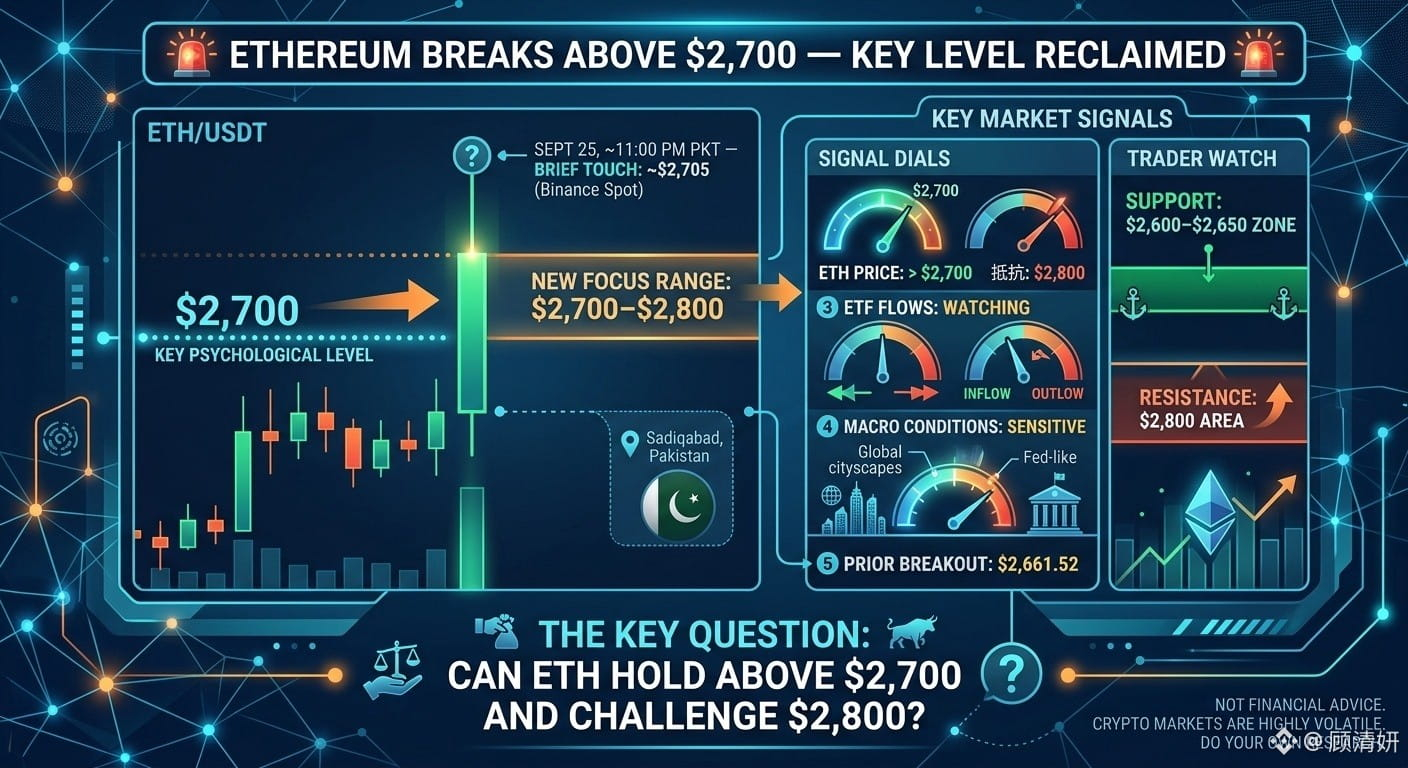
🚨 ETHEREUM BREAKS ABOVE $2,700 — KEY LEVEL RECLAIMED
Ethereum (ETH) has moved back above the $2,700 psychological level, briefly reaching around $2,705 on Binance spot on September 25. The move puts ETH back in focus as traders watch whether the breakout can hold.
KEY MARKET SIGNALS
• ETH traded above $2,700 on Binance spot
• $2,700 is now a key psychological level to monitor
• $2,800 remains an important nearby resistance zone
• Recent technical analysis identified $2,661.52 as a prior breakout level
• ETH remains sensitive to broader market liquidity, ETF flows and macro conditions
WHY IT MATTERS
A sustained move above $2,700 could keep attention focused on the next resistance area around $2,800. However, simply touching or briefly crossing $2,700 does not confirm a durable breakout.
TRADER WATCH
Support: $2,600–$2,650 zone
Resistance: $2,800 area
The key question now: Can ETH hold above $2,700 and challenge the $2,800 zone?
Not financial advice. Crypto markets are highly volatile. Do your own research.
$ENA $RARE $QUICK
{spot}(QUICKUSDT)
{future}(RAREUSDT)
{future}(ENAUSDT)
#EthereumBreaksAbove$2700
🚨 ETHEREUM BREAKS ABOVE $2,700 — KEY LEVEL RECLAIMED
Ethereum (ETH) has moved back above the $2,700 psychological level, briefly reaching around $2,705 on Binance spot on September 25. The move puts ETH back in focus as traders watch whether the breakout can hold.
KEY MARKET SIGNALS
• ETH traded above $2,700 on Binance spot
• $2,700 is now a key psychological level to monitor
• $2,800 remains an important nearby resistance zone
• Recent technical analysis identified $2,661.52 as a prior breakout level
• ETH remains sensitive to broader market liquidity, ETF flows and macro conditions
WHY IT MATTERS
A sustained move above $2,700 could keep attention focused on the next resistance area around $2,800. However, simply touching or briefly crossing $2,700 does not confirm a durable breakout.
TRADER WATCH
Support: $2,600–$2,650 zone
Resistance: $2,800 area
The key question now: Can ETH hold above $2,700 and challenge the $2,800 zone?
Not financial advice. Crypto markets are highly volatile. Do your own research.
$ENA $RARE $QUICK
🚨 ETHEREUM BREAKS ABOVE $2,700 — KEY LEVEL RECLAIMED
Ethereum (ETH) has moved back above the $2,700 psychological level, briefly reaching around $2,705 on Binance spot on September 25. The move puts ETH back in focus as traders watch whether the breakout can hold.
KEY MARKET SIGNALS
• ETH traded above $2,700 on Binance spot
• $2,700 is now a key psychological level to monitor
• $2,800 remains an important nearby resistance zone
• Recent technical analysis identified $2,661.52 as a prior breakout level
• ETH remains sensitive to broader market liquidity, ETF flows and macro conditions
WHY IT MATTERS
A sustained move above $2,700 could keep attention focused on the next resistance area around $2,800. However, simply touching or briefly crossing $2,700 does not confirm a durable breakout.
TRADER WATCH
Support: $2,600–$2,650 zone
Resistance: $2,800 area
The key question now: Can ETH hold above $2,700 and challenge the $2,800 zone?
Not financial advice. Crypto markets are highly volatile. Do your own research.
$ENA $RARE $QUICK
1
199
·
--
Рост
#qntrises39%
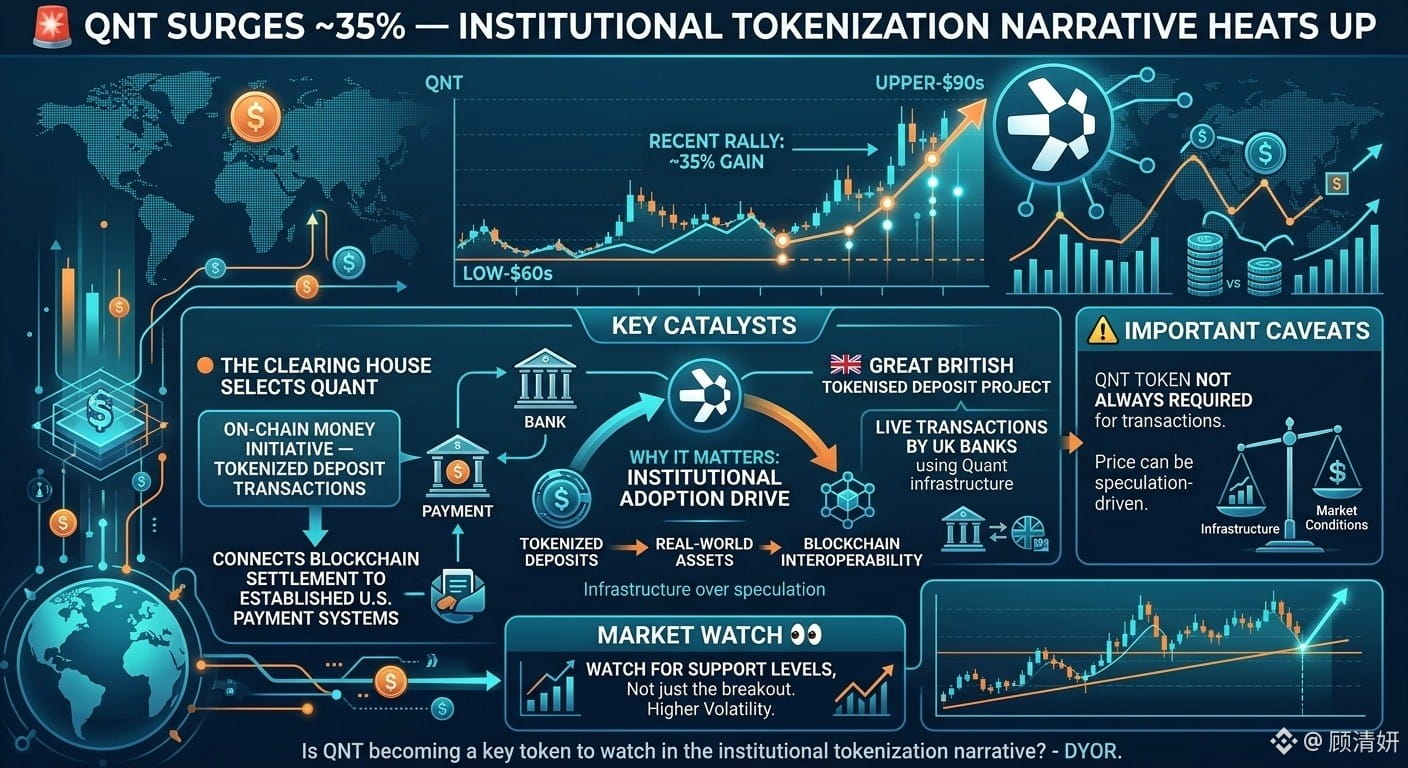
QNT SURGES 35% — INSTITUTIONAL TOKENIZATION NARRATIVE HEATS UP
Quant (QNT) is making a major move, gaining roughly 35% over the past 24 hours and becoming one of the strongest performers among large-cap crypto assets.
The rally comes as attention shifts toward Quant’s role in institutional blockchain infrastructure and tokenized deposits.
KEY CATALYSTS
• QNT gained around 35% in the latest 24-hour period.
• The Clearing House selected Quant to support its On-Chain Money Initiative for tokenized deposit transactions.
• The initiative is designed to connect blockchain-based settlement infrastructure with established U.S. payment systems.
• Quant has also been involved in the Great British Tokenised Deposit project, where UK banks conducted live tokenized-deposit and interbank transactions using Quant-related infrastructure.
WHY IT MATTERS
The bigger story is not simply QNT’s price move.
Institutional adoption of tokenized deposits and real-world financial assets could increase attention toward blockchain interoperability infrastructure.
However, the latest announcements do not mean that QNT itself is required for every transaction, and the token’s price can still be driven by broader market conditions and speculation.
MARKET WATCH
QNT has moved sharply from the low-$60s earlier this month toward the upper-$90s, showing strong momentum but also significantly higher short-term volatility.
After a move of this size, traders may want to watch whether QNT can hold newly established support levels rather than chasing the move after the breakout.
No guaranteed upside. DYOR.
Is QNT becoming one of the key tokens to watch in the institutional tokenization narrative?
$QI $PHA $ARK
{future}(ARKUSDT)
{future}(PHAUSDT)
{spot}(QIUSDT)
#qntrises39%
QNT SURGES 35% — INSTITUTIONAL TOKENIZATION NARRATIVE HEATS UP
Quant (QNT) is making a major move, gaining roughly 35% over the past 24 hours and becoming one of the strongest performers among large-cap crypto assets.
The rally comes as attention shifts toward Quant’s role in institutional blockchain infrastructure and tokenized deposits.
KEY CATALYSTS
• QNT gained around 35% in the latest 24-hour period.
• The Clearing House selected Quant to support its On-Chain Money Initiative for tokenized deposit transactions.
• The initiative is designed to connect blockchain-based settlement infrastructure with established U.S. payment systems.
• Quant has also been involved in the Great British Tokenised Deposit project, where UK banks conducted live tokenized-deposit and interbank transactions using Quant-related infrastructure.
WHY IT MATTERS
The bigger story is not simply QNT’s price move.
Institutional adoption of tokenized deposits and real-world financial assets could increase attention toward blockchain interoperability infrastructure.
However, the latest announcements do not mean that QNT itself is required for every transaction, and the token’s price can still be driven by broader market conditions and speculation.
MARKET WATCH
QNT has moved sharply from the low-$60s earlier this month toward the upper-$90s, showing strong momentum but also significantly higher short-term volatility.
After a move of this size, traders may want to watch whether QNT can hold newly established support levels rather than chasing the move after the breakout.
No guaranteed upside. DYOR.
Is QNT becoming one of the key tokens to watch in the institutional tokenization narrative?
$QI $PHA $ARK
QNT SURGES 35% — INSTITUTIONAL TOKENIZATION NARRATIVE HEATS UP
Quant (QNT) is making a major move, gaining roughly 35% over the past 24 hours and becoming one of the strongest performers among large-cap crypto assets.
The rally comes as attention shifts toward Quant’s role in institutional blockchain infrastructure and tokenized deposits.
KEY CATALYSTS
• QNT gained around 35% in the latest 24-hour period.
• The Clearing House selected Quant to support its On-Chain Money Initiative for tokenized deposit transactions.
• The initiative is designed to connect blockchain-based settlement infrastructure with established U.S. payment systems.
• Quant has also been involved in the Great British Tokenised Deposit project, where UK banks conducted live tokenized-deposit and interbank transactions using Quant-related infrastructure.
WHY IT MATTERS
The bigger story is not simply QNT’s price move.
Institutional adoption of tokenized deposits and real-world financial assets could increase attention toward blockchain interoperability infrastructure.
However, the latest announcements do not mean that QNT itself is required for every transaction, and the token’s price can still be driven by broader market conditions and speculation.
MARKET WATCH
QNT has moved sharply from the low-$60s earlier this month toward the upper-$90s, showing strong momentum but also significantly higher short-term volatility.
After a move of this size, traders may want to watch whether QNT can hold newly established support levels rather than chasing the move after the breakout.
No guaranteed upside. DYOR.
Is QNT becoming one of the key tokens to watch in the institutional tokenization narrative?
$QI $PHA $ARK
1
424
·
--
Рост
Проверено
#binancewilllisthyperliquid(hype)
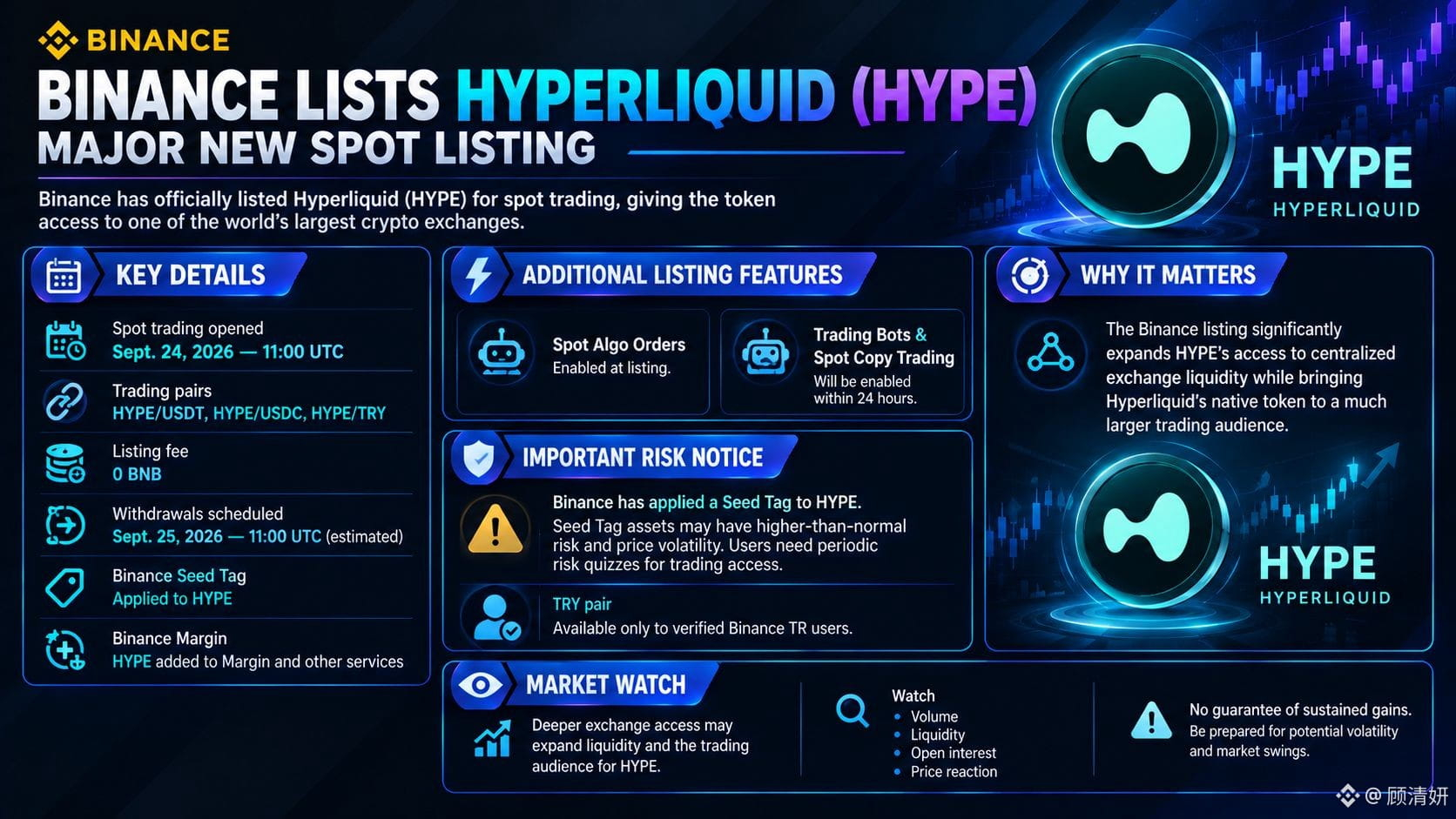
BINANCE LISTS HYPERLIQUID (HYPE) — A MAJOR NEW SPOT LISTING
Binance has officially listed Hyperliquid (HYPE) for spot trading, giving the token access to one of the world’s largest crypto exchanges.
📊 KEY DETAILS
• Spot trading opened: Sept. 24, 2026 — 11:00 UTC
• Trading pairs: HYPE/USDT, HYPE/USDC, HYPE/TRY
• Listing fee: 0 BNB
• Withdrawals: scheduled for Sept. 25, 2026 — 11:00 UTC
• Binance applied a Seed Tag to HYPE
• HYPE was also added to Binance Margin and other Binance services
⚡ WHY IT MATTERS
The Binance listing significantly expands HYPE’s access to centralized exchange liquidity while bringing Hyperliquid’s native token to a much larger trading audience.
However, Binance specifically warns that HYPE is a relatively new asset with potentially higher volatility and risk. The Seed Tag also requires eligible traders to complete periodic risk quizzes.
📈 MARKET WATCH
The key question now is whether deeper exchange access translates into sustained liquidity and demand — or whether the increased visibility leads to short-term volatility and profit-taking.
No guarantees. Watch volume, liquidity, open interest and price reaction rather than chasing the first move.
What do you think — will Binance’s HYPE listing strengthen Hyperliquid’s market position?
$XAI $NOM $LSK
{future}(LSKUSDT)
{future}(NOMUSDT)
{future}(XAIUSDT)
#binancewilllisthyperliquid(hype)
BINANCE LISTS HYPERLIQUID (HYPE) — A MAJOR NEW SPOT LISTING
Binance has officially listed Hyperliquid (HYPE) for spot trading, giving the token access to one of the world’s largest crypto exchanges.
📊 KEY DETAILS
• Spot trading opened: Sept. 24, 2026 — 11:00 UTC
• Trading pairs: HYPE/USDT, HYPE/USDC, HYPE/TRY
• Listing fee: 0 BNB
• Withdrawals: scheduled for Sept. 25, 2026 — 11:00 UTC
• Binance applied a Seed Tag to HYPE
• HYPE was also added to Binance Margin and other Binance services
⚡ WHY IT MATTERS
The Binance listing significantly expands HYPE’s access to centralized exchange liquidity while bringing Hyperliquid’s native token to a much larger trading audience.
However, Binance specifically warns that HYPE is a relatively new asset with potentially higher volatility and risk. The Seed Tag also requires eligible traders to complete periodic risk quizzes.
📈 MARKET WATCH
The key question now is whether deeper exchange access translates into sustained liquidity and demand — or whether the increased visibility leads to short-term volatility and profit-taking.
No guarantees. Watch volume, liquidity, open interest and price reaction rather than chasing the first move.
What do you think — will Binance’s HYPE listing strengthen Hyperliquid’s market position?
$XAI $NOM $LSK
BINANCE LISTS HYPERLIQUID (HYPE) — A MAJOR NEW SPOT LISTING
Binance has officially listed Hyperliquid (HYPE) for spot trading, giving the token access to one of the world’s largest crypto exchanges.
📊 KEY DETAILS
• Spot trading opened: Sept. 24, 2026 — 11:00 UTC
• Trading pairs: HYPE/USDT, HYPE/USDC, HYPE/TRY
• Listing fee: 0 BNB
• Withdrawals: scheduled for Sept. 25, 2026 — 11:00 UTC
• Binance applied a Seed Tag to HYPE
• HYPE was also added to Binance Margin and other Binance services
⚡ WHY IT MATTERS
The Binance listing significantly expands HYPE’s access to centralized exchange liquidity while bringing Hyperliquid’s native token to a much larger trading audience.
However, Binance specifically warns that HYPE is a relatively new asset with potentially higher volatility and risk. The Seed Tag also requires eligible traders to complete periodic risk quizzes.
📈 MARKET WATCH
The key question now is whether deeper exchange access translates into sustained liquidity and demand — or whether the increased visibility leads to short-term volatility and profit-taking.
No guarantees. Watch volume, liquidity, open interest and price reaction rather than chasing the first move.
What do you think — will Binance’s HYPE listing strengthen Hyperliquid’s market position?
$XAI $NOM $LSK
5
26
32.6k
·
--
Рост
#SpotBitcoinETFsInflow$2.31BInFourDays
🚨 $2.31 BILLION FLOWS INTO SPOT BITCOIN ETFs IN JUST 4 SESSIONS
Institutional demand for Bitcoin accelerated sharply this week.
U.S. spot Bitcoin ETFs recorded approximately $2.31B in net inflows across four trading sessions from Sept. 17–22, marking four consecutive positive sessions.
📊 KEY NUMBERS
• Sept. 17: +$159.5M
• Sept. 18: +$433.0M
• Sept. 21: +$998.95M
• Sept. 22: +$714.75M
• 4-session total: ≈$2.31B
BlackRock’s IBIT led the Sept. 22 inflows with about $350.3M, followed by Fidelity’s FBTC with $257.4M and Morgan Stanley’s MSBT with about $99M. No U.S. spot Bitcoin ETF recorded a net outflow that day.
WHY IT MATTERS
The flow data shows renewed demand through regulated Bitcoin investment products after significant ETF outflows earlier in September.
Bitcoin also pushed above $87,000 during this period, although price later pulled back. ETF inflows can support spot-market demand, but they do not guarantee that BTC will continue higher.
⚠️ UPDATE: The positive streak continued after the four-day figure. Wednesday, Sept. 23 added another $346.98M, taking the five-session total to roughly $2.65B.
For traders, the key question now is whether ETF demand remains strong while Bitcoin consolidates after the move toward $87K.
Do you think sustained ETF inflows can keep supporting BTC demand?
$NOM $NIL $XPL
{future}(XPLUSDT)
{future}(NILUSDT)
{future}(NOMUSDT)
#SpotBitcoinETFsInflow$2.31BInFourDays
🚨 $2.31 BILLION FLOWS INTO SPOT BITCOIN ETFs IN JUST 4 SESSIONS
Institutional demand for Bitcoin accelerated sharply this week.
U.S. spot Bitcoin ETFs recorded approximately $2.31B in net inflows across four trading sessions from Sept. 17–22, marking four consecutive positive sessions.
📊 KEY NUMBERS
• Sept. 17: +$159.5M
• Sept. 18: +$433.0M
• Sept. 21: +$998.95M
• Sept. 22: +$714.75M
• 4-session total: ≈$2.31B
BlackRock’s IBIT led the Sept. 22 inflows with about $350.3M, followed by Fidelity’s FBTC with $257.4M and Morgan Stanley’s MSBT with about $99M. No U.S. spot Bitcoin ETF recorded a net outflow that day.
WHY IT MATTERS
The flow data shows renewed demand through regulated Bitcoin investment products after significant ETF outflows earlier in September.
Bitcoin also pushed above $87,000 during this period, although price later pulled back. ETF inflows can support spot-market demand, but they do not guarantee that BTC will continue higher.
⚠️ UPDATE: The positive streak continued after the four-day figure. Wednesday, Sept. 23 added another $346.98M, taking the five-session total to roughly $2.65B.
For traders, the key question now is whether ETF demand remains strong while Bitcoin consolidates after the move toward $87K.
Do you think sustained ETF inflows can keep supporting BTC demand?
$NOM $NIL $XPL
🚨 $2.31 BILLION FLOWS INTO SPOT BITCOIN ETFs IN JUST 4 SESSIONS
Institutional demand for Bitcoin accelerated sharply this week.
U.S. spot Bitcoin ETFs recorded approximately $2.31B in net inflows across four trading sessions from Sept. 17–22, marking four consecutive positive sessions.
📊 KEY NUMBERS
• Sept. 17: +$159.5M
• Sept. 18: +$433.0M
• Sept. 21: +$998.95M
• Sept. 22: +$714.75M
• 4-session total: ≈$2.31B
BlackRock’s IBIT led the Sept. 22 inflows with about $350.3M, followed by Fidelity’s FBTC with $257.4M and Morgan Stanley’s MSBT with about $99M. No U.S. spot Bitcoin ETF recorded a net outflow that day.
WHY IT MATTERS
The flow data shows renewed demand through regulated Bitcoin investment products after significant ETF outflows earlier in September.
Bitcoin also pushed above $87,000 during this period, although price later pulled back. ETF inflows can support spot-market demand, but they do not guarantee that BTC will continue higher.
⚠️ UPDATE: The positive streak continued after the four-day figure. Wednesday, Sept. 23 added another $346.98M, taking the five-session total to roughly $2.65B.
For traders, the key question now is whether ETF demand remains strong while Bitcoin consolidates after the move toward $87K.
Do you think sustained ETF inflows can keep supporting BTC demand?
$NOM $NIL $XPL
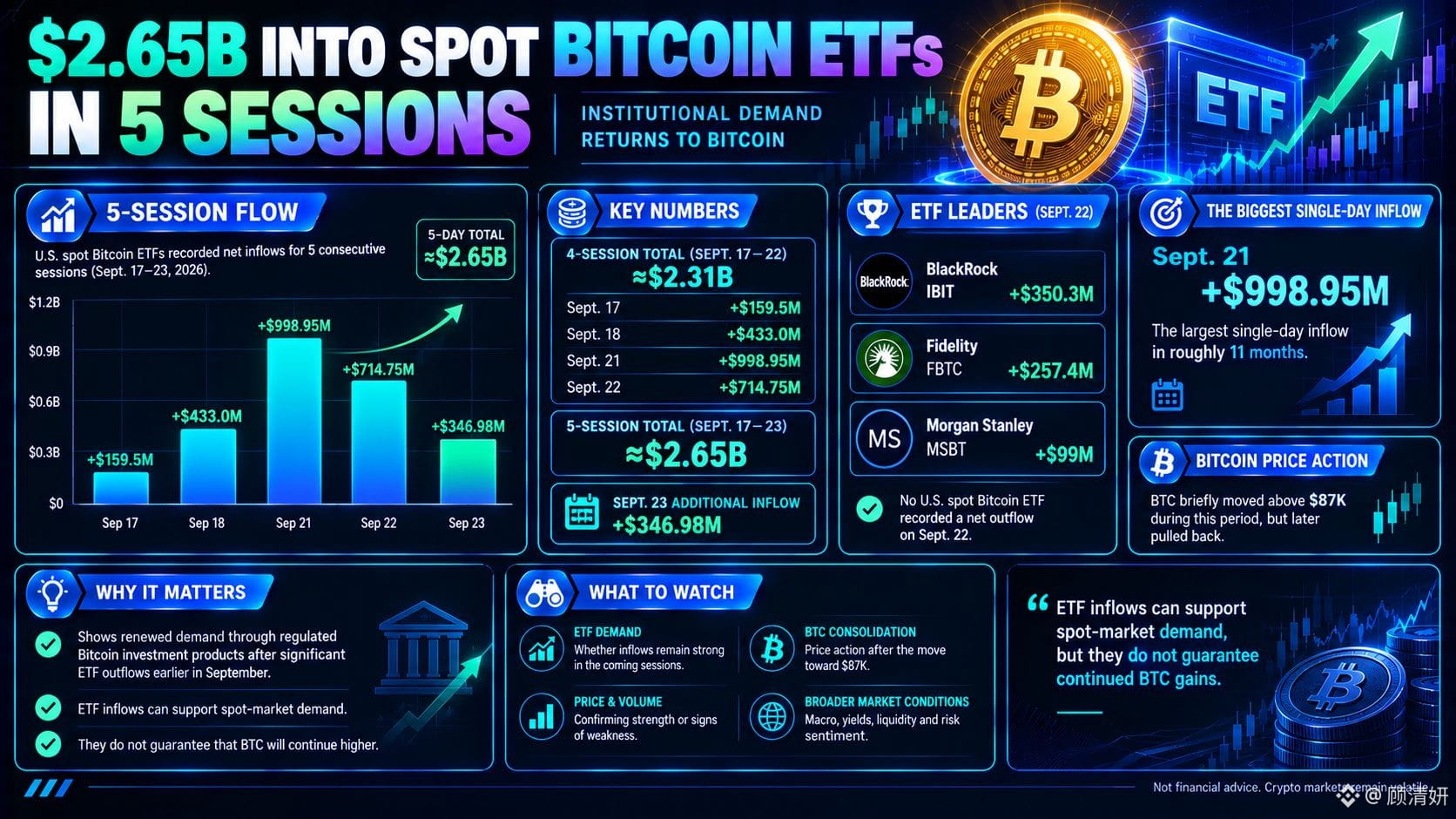
92
·
--
Рост
#BitcoinFallsToAround$84,600ThisWeek
🚨 BITCOIN PULLS BACK TOWARD $84,600 THIS WEEK
Bitcoin is cooling off after a strong rally that pushed BTC to its highest level since January.
BTC climbed as high as roughly $87,360 on September 21 before retreating toward the $84K–$85K area. On September 24, Bitcoin traded as low as about $82,957 on daily data, while prices later recovered into the mid-$84K range.
📊 WHY THIS MATTERS
• BTC recently broke above $85K for the first time since January.
• The weekly move remains positive despite the pullback.
• $85K–$87K is now an important area for traders to watch.
• A sustained move back above the recent high could signal renewed momentum, while weakness below the current range could increase short-term volatility.
🔎 MARKET WATCH
The key question now is whether Bitcoin can stabilize around the $84K–$85K region or continue searching for lower support.
No breakout is confirmed yet — price action around these levels will be important.
What do you think: consolidation before another move higher, or deeper correction?
$NOM $PLUME $ONDO
{future}(ONDOUSDT)
{future}(PLUMEUSDT)
{future}(NOMUSDT)
#BitcoinFallsToAround$84,600ThisWeek
🚨 BITCOIN PULLS BACK TOWARD $84,600 THIS WEEK
Bitcoin is cooling off after a strong rally that pushed BTC to its highest level since January.
BTC climbed as high as roughly $87,360 on September 21 before retreating toward the $84K–$85K area. On September 24, Bitcoin traded as low as about $82,957 on daily data, while prices later recovered into the mid-$84K range.
📊 WHY THIS MATTERS
• BTC recently broke above $85K for the first time since January.
• The weekly move remains positive despite the pullback.
• $85K–$87K is now an important area for traders to watch.
• A sustained move back above the recent high could signal renewed momentum, while weakness below the current range could increase short-term volatility.
🔎 MARKET WATCH
The key question now is whether Bitcoin can stabilize around the $84K–$85K region or continue searching for lower support.
No breakout is confirmed yet — price action around these levels will be important.
What do you think: consolidation before another move higher, or deeper correction?
$NOM $PLUME $ONDO
🚨 BITCOIN PULLS BACK TOWARD $84,600 THIS WEEK
Bitcoin is cooling off after a strong rally that pushed BTC to its highest level since January.
BTC climbed as high as roughly $87,360 on September 21 before retreating toward the $84K–$85K area. On September 24, Bitcoin traded as low as about $82,957 on daily data, while prices later recovered into the mid-$84K range.
📊 WHY THIS MATTERS
• BTC recently broke above $85K for the first time since January.
• The weekly move remains positive despite the pullback.
• $85K–$87K is now an important area for traders to watch.
• A sustained move back above the recent high could signal renewed momentum, while weakness below the current range could increase short-term volatility.
🔎 MARKET WATCH
The key question now is whether Bitcoin can stabilize around the $84K–$85K region or continue searching for lower support.
No breakout is confirmed yet — price action around these levels will be important.
What do you think: consolidation before another move higher, or deeper correction?
$NOM $PLUME $ONDO
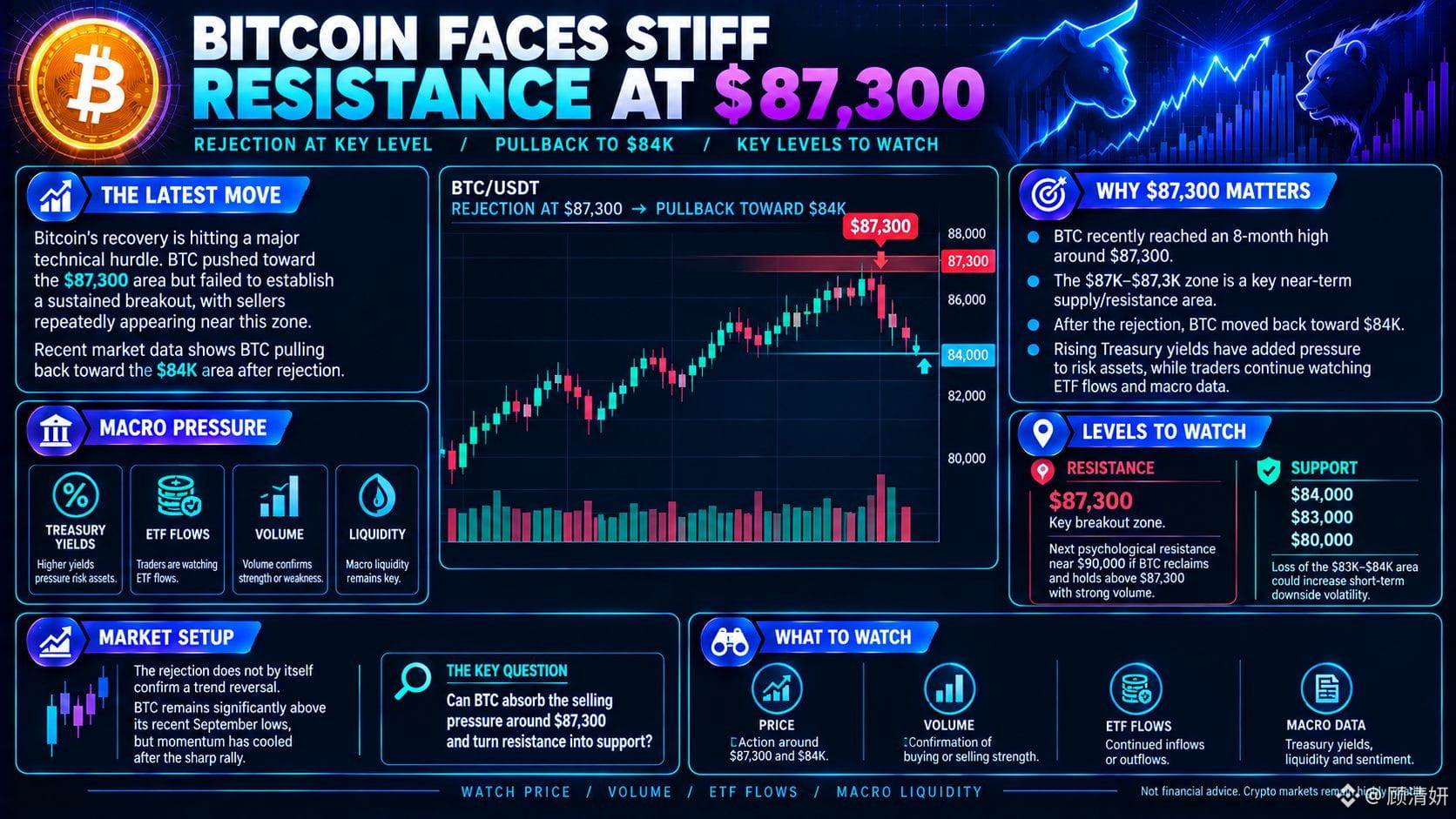
66
·
--
Рост
#BitcoinRejectedAt$87,300Twice
🚨 BITCOIN FACES STIFF RESISTANCE AT $87,300
Bitcoin’s recovery is hitting a major technical hurdle.
BTC pushed toward the $87,300 area but failed to establish a sustained breakout, with sellers repeatedly appearing near this zone. Recent market data shows BTC pulling back toward the $84K area after the rejection.
📊 WHY $87,300 MATTERS
• BTC recently reached an 8-month high around $87,300.
• The $87K–$87.3K zone has become a clear near-term supply area.
• After the rejection, Bitcoin moved back toward $84K.
• Rising Treasury yields have added pressure to risk assets, while traders continue watching ETF flows and macro data.
🔑 LEVELS TO WATCH
Resistance:
$87,300 — key breakout zone
If BTC can reclaim and hold above this area with strong volume, traders may look toward the next psychological resistance near $90K.
Support:
$84,000
$83,000
$80,000
A loss of the $83K–$84K area could increase short-term downside volatility.
📈 MARKET SETUP
The rejection does not by itself confirm a trend reversal. Bitcoin is still trading significantly above its recent September lows, but momentum has cooled after the sharp rally.
For traders, the key question is simple:
Can BTC absorb the selling pressure around $87,300 and turn resistance into support?
Watch price, volume, ETF flows and macro liquidity before assuming the next major move.
Not financial advice. Crypto markets remain highly volatile.
$XAI $BROCCOLI714 $LSK
{future}(LSKUSDT)
{future}(BROCCOLI714USDT)
{future}(XAIUSDT)
#BitcoinRejectedAt$87,300Twice
🚨 BITCOIN FACES STIFF RESISTANCE AT $87,300
Bitcoin’s recovery is hitting a major technical hurdle.
BTC pushed toward the $87,300 area but failed to establish a sustained breakout, with sellers repeatedly appearing near this zone. Recent market data shows BTC pulling back toward the $84K area after the rejection.
📊 WHY $87,300 MATTERS
• BTC recently reached an 8-month high around $87,300.
• The $87K–$87.3K zone has become a clear near-term supply area.
• After the rejection, Bitcoin moved back toward $84K.
• Rising Treasury yields have added pressure to risk assets, while traders continue watching ETF flows and macro data.
🔑 LEVELS TO WATCH
Resistance:
$87,300 — key breakout zone
If BTC can reclaim and hold above this area with strong volume, traders may look toward the next psychological resistance near $90K.
Support:
$84,000
$83,000
$80,000
A loss of the $83K–$84K area could increase short-term downside volatility.
📈 MARKET SETUP
The rejection does not by itself confirm a trend reversal. Bitcoin is still trading significantly above its recent September lows, but momentum has cooled after the sharp rally.
For traders, the key question is simple:
Can BTC absorb the selling pressure around $87,300 and turn resistance into support?
Watch price, volume, ETF flows and macro liquidity before assuming the next major move.
Not financial advice. Crypto markets remain highly volatile.
$XAI $BROCCOLI714 $LSK
🚨 BITCOIN FACES STIFF RESISTANCE AT $87,300
Bitcoin’s recovery is hitting a major technical hurdle.
BTC pushed toward the $87,300 area but failed to establish a sustained breakout, with sellers repeatedly appearing near this zone. Recent market data shows BTC pulling back toward the $84K area after the rejection.
📊 WHY $87,300 MATTERS
• BTC recently reached an 8-month high around $87,300.
• The $87K–$87.3K zone has become a clear near-term supply area.
• After the rejection, Bitcoin moved back toward $84K.
• Rising Treasury yields have added pressure to risk assets, while traders continue watching ETF flows and macro data.
🔑 LEVELS TO WATCH
Resistance:
$87,300 — key breakout zone
If BTC can reclaim and hold above this area with strong volume, traders may look toward the next psychological resistance near $90K.
Support:
$84,000
$83,000
$80,000
A loss of the $83K–$84K area could increase short-term downside volatility.
📈 MARKET SETUP
The rejection does not by itself confirm a trend reversal. Bitcoin is still trading significantly above its recent September lows, but momentum has cooled after the sharp rally.
For traders, the key question is simple:
Can BTC absorb the selling pressure around $87,300 and turn resistance into support?
Watch price, volume, ETF flows and macro liquidity before assuming the next major move.
Not financial advice. Crypto markets remain highly volatile.
$XAI $BROCCOLI714 $LSK
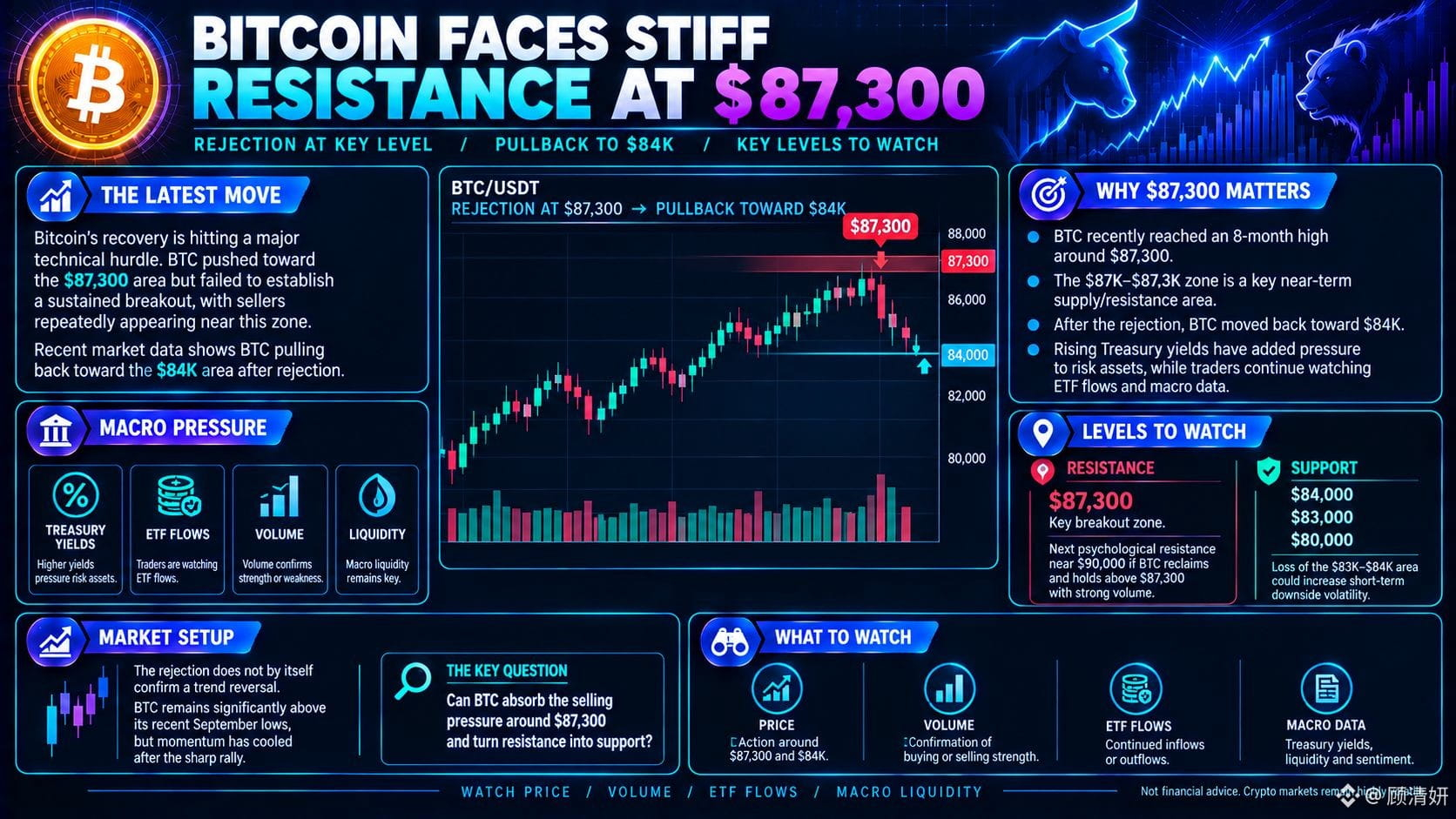
127
·
--
Рост
#dollarindexreclaims101
🚨 DOLLAR INDEX RECLAIMS 101 — WHY CRYPTO TRADERS SHOULD CARE
The U.S. Dollar Index (DXY) has moved back above the 101 level, reaching its strongest area in nearly two months.
📊 WHAT’S DRIVING THE MOVE?
• DXY climbed roughly 0.4% on September 23, reaching around 101.04 in market data.
• Reuters reported the dollar strengthening as markets priced in the possibility of further Federal Reserve rate hikes.
• Several Fed officials have indicated that additional tightening could be needed if inflation remains elevated.
• Higher U.S. rates can increase the relative appeal of dollar-denominated assets and tighten financial conditions.
🌐 WHY IT MATTERS FOR CRYPTO
A stronger dollar can create a tougher macro backdrop for Bitcoin and other risk assets because tighter liquidity and higher yields may reduce demand for speculative investments.
That doesn’t automatically mean BTC or crypto must fall.
The key question is whether DXY can HOLD above 101 and continue higher, or whether this move turns into another failed breakout.
👀 KEY LEVEL TO WATCH
DXY: 101
A sustained move above this area could keep pressure on broader risk sentiment, while a rejection back below 101 would weaken the breakout signal.
For crypto traders, watch the relationship between:
DXY ↔ Treasury yields ↔ Fed expectations ↔ BTC
Macro is moving the market again.
$SAGA $NIL $RAY
{spot}(RAYUSDT)
{future}(NILUSDT)
{future}(SAGAUSDT)
#dollarindexreclaims101
🚨 DOLLAR INDEX RECLAIMS 101 — WHY CRYPTO TRADERS SHOULD CARE
The U.S. Dollar Index (DXY) has moved back above the 101 level, reaching its strongest area in nearly two months.
📊 WHAT’S DRIVING THE MOVE?
• DXY climbed roughly 0.4% on September 23, reaching around 101.04 in market data.
• Reuters reported the dollar strengthening as markets priced in the possibility of further Federal Reserve rate hikes.
• Several Fed officials have indicated that additional tightening could be needed if inflation remains elevated.
• Higher U.S. rates can increase the relative appeal of dollar-denominated assets and tighten financial conditions.
🌐 WHY IT MATTERS FOR CRYPTO
A stronger dollar can create a tougher macro backdrop for Bitcoin and other risk assets because tighter liquidity and higher yields may reduce demand for speculative investments.
That doesn’t automatically mean BTC or crypto must fall.
The key question is whether DXY can HOLD above 101 and continue higher, or whether this move turns into another failed breakout.
👀 KEY LEVEL TO WATCH
DXY: 101
A sustained move above this area could keep pressure on broader risk sentiment, while a rejection back below 101 would weaken the breakout signal.
For crypto traders, watch the relationship between:
DXY ↔ Treasury yields ↔ Fed expectations ↔ BTC
Macro is moving the market again.
$SAGA $NIL $RAY
🚨 DOLLAR INDEX RECLAIMS 101 — WHY CRYPTO TRADERS SHOULD CARE
The U.S. Dollar Index (DXY) has moved back above the 101 level, reaching its strongest area in nearly two months.
📊 WHAT’S DRIVING THE MOVE?
• DXY climbed roughly 0.4% on September 23, reaching around 101.04 in market data.
• Reuters reported the dollar strengthening as markets priced in the possibility of further Federal Reserve rate hikes.
• Several Fed officials have indicated that additional tightening could be needed if inflation remains elevated.
• Higher U.S. rates can increase the relative appeal of dollar-denominated assets and tighten financial conditions.
🌐 WHY IT MATTERS FOR CRYPTO
A stronger dollar can create a tougher macro backdrop for Bitcoin and other risk assets because tighter liquidity and higher yields may reduce demand for speculative investments.
That doesn’t automatically mean BTC or crypto must fall.
The key question is whether DXY can HOLD above 101 and continue higher, or whether this move turns into another failed breakout.
👀 KEY LEVEL TO WATCH
DXY: 101
A sustained move above this area could keep pressure on broader risk sentiment, while a rejection back below 101 would weaken the breakout signal.
For crypto traders, watch the relationship between:
DXY ↔ Treasury yields ↔ Fed expectations ↔ BTC
Macro is moving the market again.
$SAGA $NIL $RAY
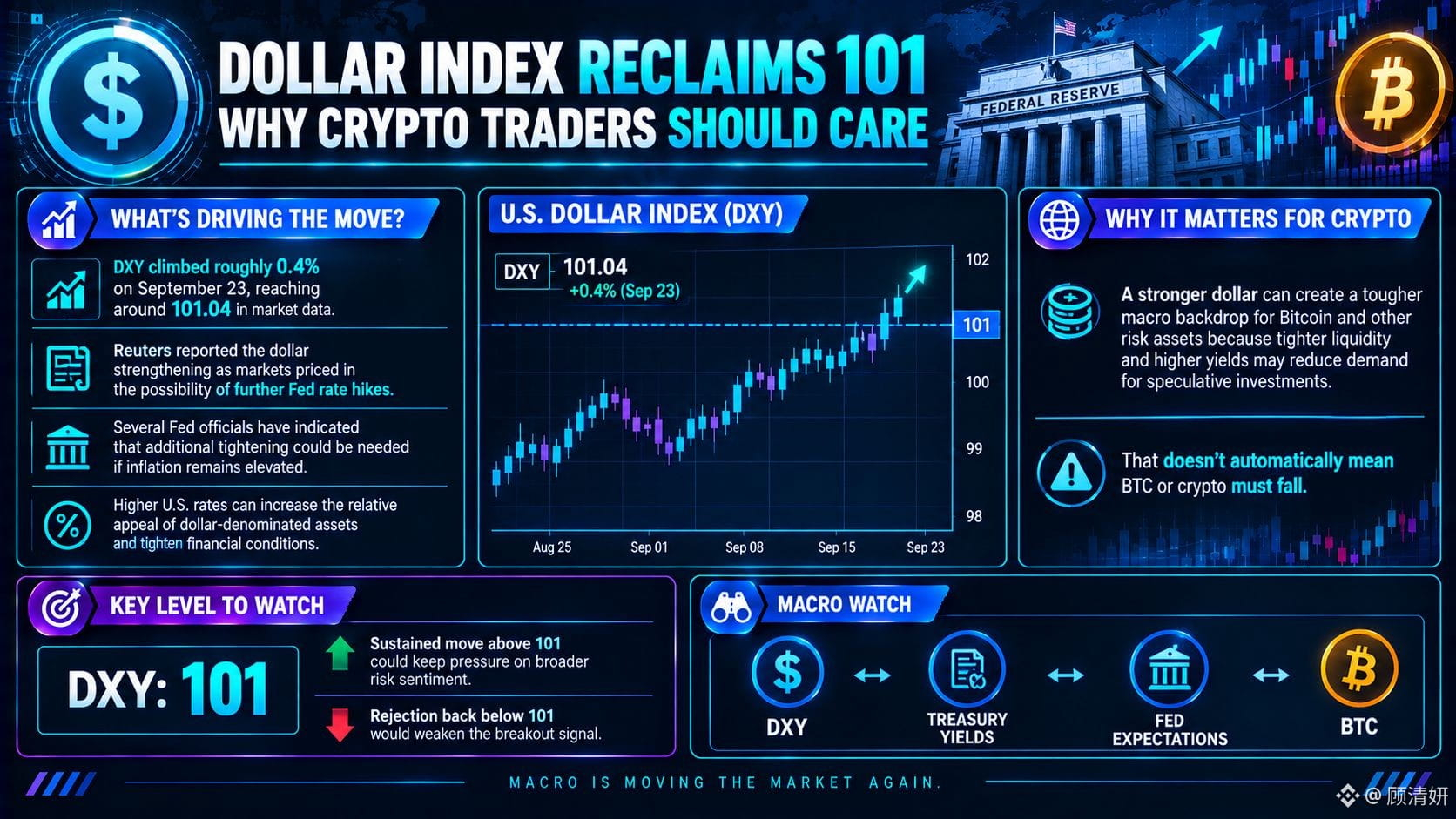
158
·
--
Рост
#wallstreetearningsrevisionsturnbearish
📉 WALL STREET EARNINGS REVISIONS JUST TURNED NEGATIVE
A key shift is showing up beneath the U.S. stock-market rally.
For the first time in 23 weeks, Wall Street analysts are cutting more U.S. corporate earnings estimates than they are raising.
According to Bloomberg, the reversal marks the end of the longest streak of positive earnings revisions since September 2021.
🔎 WHAT CHANGED?
• 📊 Citi’s earnings-revision index has turned negative.
• 🏦 Analysts are becoming more cautious about corporate profit expectations.
• 💰 Higher inflation and interest rates are increasing pressure on companies.
• 🛒 Consumer staples, consumer discretionary, materials and financials are among the areas seeing weakness in revisions.
• ⚠️ This comes after months of unusually strong earnings upgrades.
WHY DOES IT MATTER?
Markets ultimately depend on expectations for future profits.
When earnings estimates keep rising, elevated valuations can receive fundamental support.
But if revisions continue moving lower, investors may start questioning whether current profit expectations are too optimistic.
And that matters beyond stocks.
🌐 CRYPTO MARKET IMPACT
A more cautious earnings outlook could influence broader risk sentiment.
If investors reduce exposure to equities because of weaker profit expectations, high-beta assets such as crypto could also experience changes in liquidity and risk appetite.
However, this does NOT automatically mean Bitcoin or crypto must fall.
Rates, the U.S. dollar, liquidity, ETF flows, regulation and crypto-specific demand remain important variables.
📌 THE KEY SIGNAL
The important development isn't simply that analysts became bearish.
It's that the direction of earnings revisions has changed after a prolonged period of upgrades.
Traders will be watching whether this is a short-term reset — or the beginning of a broader deterioration in corporate earnings expectations.
$MET $SUPER $SENT
{future}(SENTUSDT)
{future}(SUPERUSDT)
{future}(METUSDT)
#wallstreetearningsrevisionsturnbearish
📉 WALL STREET EARNINGS REVISIONS JUST TURNED NEGATIVE
A key shift is showing up beneath the U.S. stock-market rally.
For the first time in 23 weeks, Wall Street analysts are cutting more U.S. corporate earnings estimates than they are raising.
According to Bloomberg, the reversal marks the end of the longest streak of positive earnings revisions since September 2021.
🔎 WHAT CHANGED?
• 📊 Citi’s earnings-revision index has turned negative.
• 🏦 Analysts are becoming more cautious about corporate profit expectations.
• 💰 Higher inflation and interest rates are increasing pressure on companies.
• 🛒 Consumer staples, consumer discretionary, materials and financials are among the areas seeing weakness in revisions.
• ⚠️ This comes after months of unusually strong earnings upgrades.
WHY DOES IT MATTER?
Markets ultimately depend on expectations for future profits.
When earnings estimates keep rising, elevated valuations can receive fundamental support.
But if revisions continue moving lower, investors may start questioning whether current profit expectations are too optimistic.
And that matters beyond stocks.
🌐 CRYPTO MARKET IMPACT
A more cautious earnings outlook could influence broader risk sentiment.
If investors reduce exposure to equities because of weaker profit expectations, high-beta assets such as crypto could also experience changes in liquidity and risk appetite.
However, this does NOT automatically mean Bitcoin or crypto must fall.
Rates, the U.S. dollar, liquidity, ETF flows, regulation and crypto-specific demand remain important variables.
📌 THE KEY SIGNAL
The important development isn't simply that analysts became bearish.
It's that the direction of earnings revisions has changed after a prolonged period of upgrades.
Traders will be watching whether this is a short-term reset — or the beginning of a broader deterioration in corporate earnings expectations.
$MET $SUPER $SENT
📉 WALL STREET EARNINGS REVISIONS JUST TURNED NEGATIVE
A key shift is showing up beneath the U.S. stock-market rally.
For the first time in 23 weeks, Wall Street analysts are cutting more U.S. corporate earnings estimates than they are raising.
According to Bloomberg, the reversal marks the end of the longest streak of positive earnings revisions since September 2021.
🔎 WHAT CHANGED?
• 📊 Citi’s earnings-revision index has turned negative.
• 🏦 Analysts are becoming more cautious about corporate profit expectations.
• 💰 Higher inflation and interest rates are increasing pressure on companies.
• 🛒 Consumer staples, consumer discretionary, materials and financials are among the areas seeing weakness in revisions.
• ⚠️ This comes after months of unusually strong earnings upgrades.
WHY DOES IT MATTER?
Markets ultimately depend on expectations for future profits.
When earnings estimates keep rising, elevated valuations can receive fundamental support.
But if revisions continue moving lower, investors may start questioning whether current profit expectations are too optimistic.
And that matters beyond stocks.
🌐 CRYPTO MARKET IMPACT
A more cautious earnings outlook could influence broader risk sentiment.
If investors reduce exposure to equities because of weaker profit expectations, high-beta assets such as crypto could also experience changes in liquidity and risk appetite.
However, this does NOT automatically mean Bitcoin or crypto must fall.
Rates, the U.S. dollar, liquidity, ETF flows, regulation and crypto-specific demand remain important variables.
📌 THE KEY SIGNAL
The important development isn't simply that analysts became bearish.
It's that the direction of earnings revisions has changed after a prolonged period of upgrades.
Traders will be watching whether this is a short-term reset — or the beginning of a broader deterioration in corporate earnings expectations.
$MET $SUPER $SENT
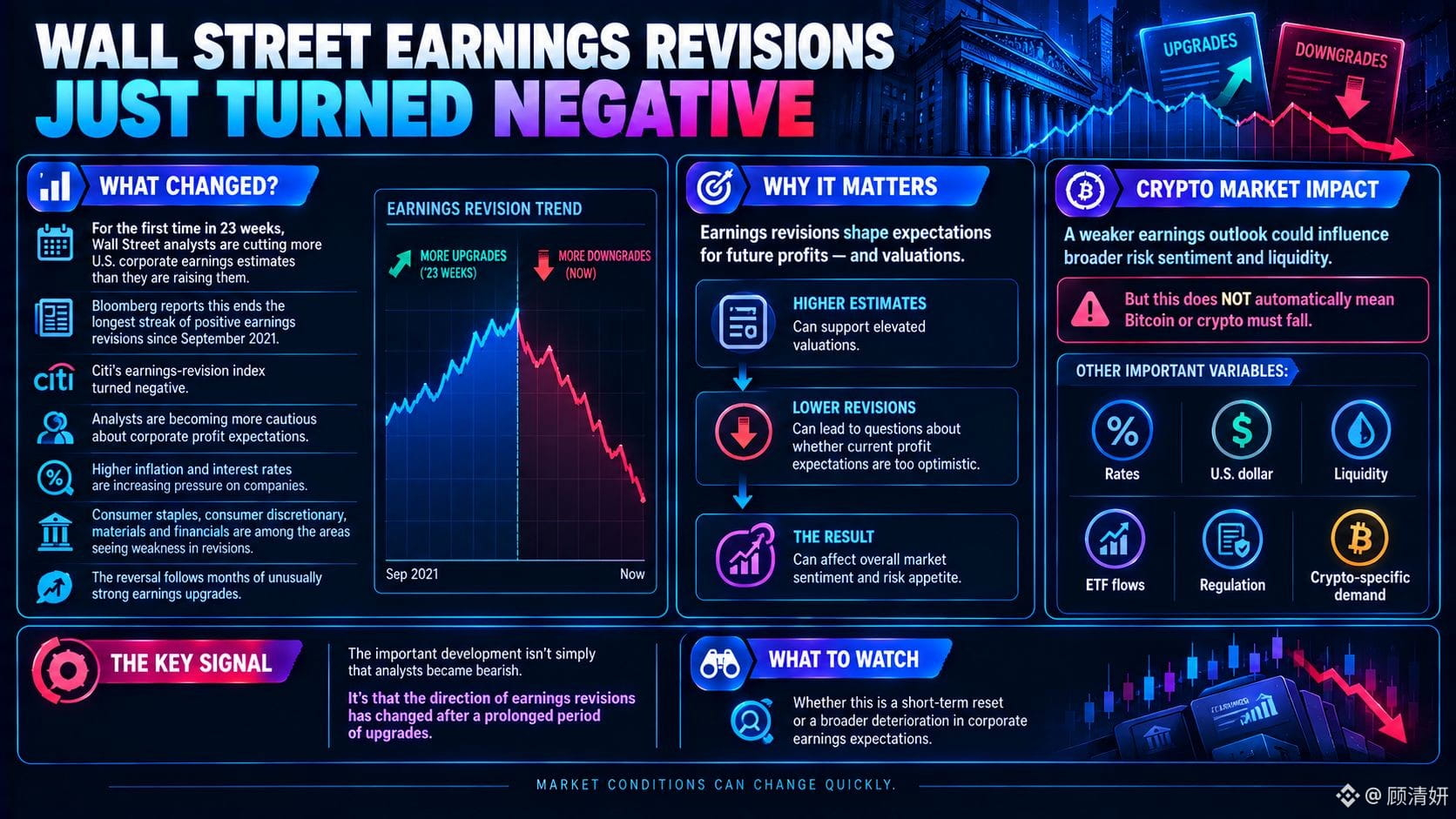
311
Войдите, чтобы посмотреть больше материала
Присоединяйтесь к пользователям криптовалют по всему миру на Binance Square
⚡️ Получайте новейшую и полезную информацию о криптоактивах.
💬 Нам доверяет крупнейшая в мире криптобиржа.
👍 Получите достоверные аналитические данные от верифицированных создателей контента.
Эл. почта/номер телефона
В тренде
BinanceKZ
Просмотров: 9,048
50 обсуждают
Как я потерял 180 000 тенге на «менеджере Binance» из WhatsApp — и почему всё равно остался в крипте
phpdead
·Лайков: 6
·Просмотров: 2.2k
UKFCAWinsCourtOrderToRecover851400Pounds
Просмотров: 37,747
807 обсуждают
ChainlinkLaunchesCCIP2WithEnterpriseVerification
Просмотров: 50,041
975 обсуждают