

CryptonewsCom
12k Публикации

CryptonewsCom
 Square Verified+
Отправить жалобу
Заблокировать пользователя
Latest cryptocurrency news from cryptonews.com
0 подписок(и/а)
3.8K+ подписчиков(а)
7.6K+ понравилось
Посты
Статья
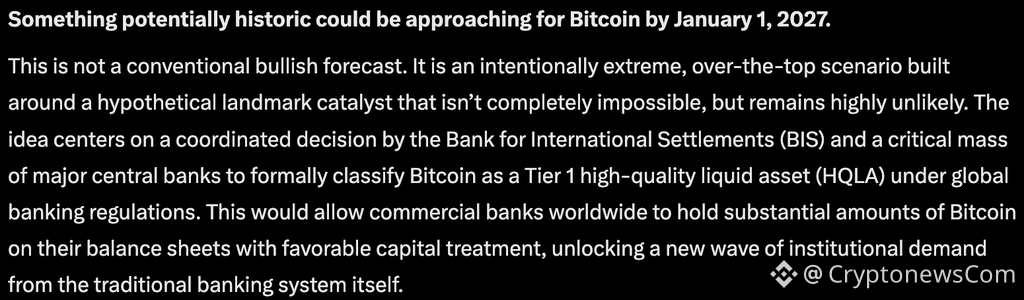
Elon Musk’s Grok AI Predicts When Bitcoin Will Finally Hit its Ultimate Price TargetX and SpaceX CEO Elon Musk’s Grok AI predicts something potentially historic could be brewing for Bitcoin by January 1, 2027. This is not a conventional bullish forecast. In this prediction, Grok assumes a landmark catalyst will hit BTC in Q4 2026, sparking the hypothesized rally.
The concept centers on a coordinated decision by the Bank for International Settlements (BIS) and many major central banks to officially classify Bitcoin as a Tier 1 high-quality liquid asset (HQLA) under global banking regulations.
This classification would allow commercial banks worldwide to hold substantial amounts of Bitcoin on their balance sheets with favorable capital treatment. As a result, it could stimulate a new wave of institutional demand from the traditional banking sector.
SOURCE: Grok AI Predicts the Bitcoin Price
Elon Musk’s Grok AI Predicts the Bitcoin Price: Is the Technical Analysis Bullish or Bearish?
On higher timeframes, Bitcoin has been consolidating in the $79,000–$81,000 region after pulling back from higher levels earlier in the month. Price continues to defend key intermediate supports while facing resistance around the $85,000–$90,000 zone.
In a standard bull market, a sustained breakout above $95,000–$100,000 would confirm intermediate strength and open the path toward a retest of the prior all-time high near $126,000.
Bitcoin (BTC)
24h7d30d1yAll time
Under the extreme global banking HQLA classification scenario outlined above, clearing that previous high would likely trigger powerful measured-move extensions and multi-cycle Fibonacci projections from the multi-year base.
Momentum indicators currently sit in neutral-to-corrective territory with substantial room to run into the extreme overbought readings characteristic of parabolic advances.
Key nearer-term supports sit near $78,000–$79,000 and $74,000–$76,000; holding those levels would keep the broader recovery structure intact while the market digests any major narrative developments.
EXPLORE: The Crypto Presales This Q4 2026
Bitcoin Hyper Targets Early-Mover Interest as Bitcoin Tests Key Levels
Too fast. Too strong. Too Hyper. https://t.co/VNG0P4GuDo pic.twitter.com/oLavMFuU7w
— Bitcoin Hyper (@BTC_Hyper2) October 26, 2026
Current uncertainty across crypto may push traders to look at infrastructure plays alongside BTC exposure. Bitcoin Hyper ($HYPER) is a Bitcoin Layer 2 project built on the Solana Virtual Machine (SVM), aiming for faster smart contracts and lower-cost execution in the Bitcoin ecosystem.
HYPER is one of the most anticipated presale plays in recent memory, combining meme branding with legitimate blue-chip technology built on the market’s largest digital asset. The project’s feature set includes a Decentralized Canonical Bridge for BTC transfers and low-latency Layer 2 processing.
Only 31 days remain until the Bitcoin Hyper presale closes, meaning the current price of $0.0136877 will be gone for good as the token hits the open market and bullish demand takes control of the chart.
To underscore demand for HYPER, the project has raised over $33.2M to date, making it one of the highest-grossing early-stage projects over the past twelve months.
Staking is also live, offering a juicy 30% APY, but only for presale buyers.
Research Bitcoin Hyper before the presale window closes in less than 30 days.
Gain Access to New Bitcoin Layer 2 Early HereThe Final Bitcoin Prediction by Grok AI
Under this highly speculative scenario, and assuming a full-blown crypto bull market returns, Bitcoin could reach between $650,000 and $1,200,000, with a stretch target of $1,800,000+ by January 1, 2027.
This remains pure speculation and entertainment, not a realistic base-case outlook. The catalyst would require extraordinary coordination among global regulators and central banks that is currently highly unlikely.
DISCOVER: The Best Token Presales
The post Elon Musk’s Grok AI Predicts When Bitcoin Will Finally Hit its Ultimate Price Target appeared first on Cryptonews.
Elon Musk’s Grok AI Predicts When Bitcoin Will Finally Hit its Ultimate Price Target
X and SpaceX CEO Elon Musk’s Grok AI predicts something potentially historic could be brewing for Bitcoin by January 1, 2027. This is not a conventional bullish forecast. In this prediction, Grok assumes a landmark catalyst will hit BTC in Q4 2026, sparking the hypothesized rally.
The concept centers on a coordinated decision by the Bank for International Settlements (BIS) and many major central banks to officially classify Bitcoin as a Tier 1 high-quality liquid asset (HQLA) under global banking regulations.
This classification would allow commercial banks worldwide to hold substantial amounts of Bitcoin on their balance sheets with favorable capital treatment. As a result, it could stimulate a new wave of institutional demand from the traditional banking sector.
SOURCE: Grok AI Predicts the Bitcoin Price
Elon Musk’s Grok AI Predicts the Bitcoin Price: Is the Technical Analysis Bullish or Bearish?
On higher timeframes, Bitcoin has been consolidating in the $79,000–$81,000 region after pulling back from higher levels earlier in the month. Price continues to defend key intermediate supports while facing resistance around the $85,000–$90,000 zone.
In a standard bull market, a sustained breakout above $95,000–$100,000 would confirm intermediate strength and open the path toward a retest of the prior all-time high near $126,000.
Bitcoin (BTC)
24h7d30d1yAll time
Under the extreme global banking HQLA classification scenario outlined above, clearing that previous high would likely trigger powerful measured-move extensions and multi-cycle Fibonacci projections from the multi-year base.
Momentum indicators currently sit in neutral-to-corrective territory with substantial room to run into the extreme overbought readings characteristic of parabolic advances.
Key nearer-term supports sit near $78,000–$79,000 and $74,000–$76,000; holding those levels would keep the broader recovery structure intact while the market digests any major narrative developments.
EXPLORE: The Crypto Presales This Q4 2026
Bitcoin Hyper Targets Early-Mover Interest as Bitcoin Tests Key Levels
Too fast. Too strong. Too Hyper. https://t.co/VNG0P4GuDo pic.twitter.com/oLavMFuU7w
— Bitcoin Hyper (@BTC_Hyper2) October 26, 2026
Current uncertainty across crypto may push traders to look at infrastructure plays alongside BTC exposure. Bitcoin Hyper ($HYPER) is a Bitcoin Layer 2 project built on the Solana Virtual Machine (SVM), aiming for faster smart contracts and lower-cost execution in the Bitcoin ecosystem.
HYPER is one of the most anticipated presale plays in recent memory, combining meme branding with legitimate blue-chip technology built on the market’s largest digital asset. The project’s feature set includes a Decentralized Canonical Bridge for BTC transfers and low-latency Layer 2 processing.
Only 31 days remain until the Bitcoin Hyper presale closes, meaning the current price of $0.0136877 will be gone for good as the token hits the open market and bullish demand takes control of the chart.
To underscore demand for HYPER, the project has raised over $33.2M to date, making it one of the highest-grossing early-stage projects over the past twelve months.
Staking is also live, offering a juicy 30% APY, but only for presale buyers.
Research Bitcoin Hyper before the presale window closes in less than 30 days.
Gain Access to New Bitcoin Layer 2 Early HereThe Final Bitcoin Prediction by Grok AI
Under this highly speculative scenario, and assuming a full-blown crypto bull market returns, Bitcoin could reach between $650,000 and $1,200,000, with a stretch target of $1,800,000+ by January 1, 2027.
This remains pure speculation and entertainment, not a realistic base-case outlook. The catalyst would require extraordinary coordination among global regulators and central banks that is currently highly unlikely.
DISCOVER: The Best Token Presales
The post Elon Musk’s Grok AI Predicts When Bitcoin Will Finally Hit its Ultimate Price Target appeared first on Cryptonews.
The concept centers on a coordinated decision by the Bank for International Settlements (BIS) and many major central banks to officially classify Bitcoin as a Tier 1 high-quality liquid asset (HQLA) under global banking regulations.
This classification would allow commercial banks worldwide to hold substantial amounts of Bitcoin on their balance sheets with favorable capital treatment. As a result, it could stimulate a new wave of institutional demand from the traditional banking sector.
SOURCE: Grok AI Predicts the Bitcoin Price
Elon Musk’s Grok AI Predicts the Bitcoin Price: Is the Technical Analysis Bullish or Bearish?
On higher timeframes, Bitcoin has been consolidating in the $79,000–$81,000 region after pulling back from higher levels earlier in the month. Price continues to defend key intermediate supports while facing resistance around the $85,000–$90,000 zone.
In a standard bull market, a sustained breakout above $95,000–$100,000 would confirm intermediate strength and open the path toward a retest of the prior all-time high near $126,000.
Bitcoin (BTC)
24h7d30d1yAll time
Under the extreme global banking HQLA classification scenario outlined above, clearing that previous high would likely trigger powerful measured-move extensions and multi-cycle Fibonacci projections from the multi-year base.
Momentum indicators currently sit in neutral-to-corrective territory with substantial room to run into the extreme overbought readings characteristic of parabolic advances.
Key nearer-term supports sit near $78,000–$79,000 and $74,000–$76,000; holding those levels would keep the broader recovery structure intact while the market digests any major narrative developments.
EXPLORE: The Crypto Presales This Q4 2026
Bitcoin Hyper Targets Early-Mover Interest as Bitcoin Tests Key Levels
Too fast. Too strong. Too Hyper. https://t.co/VNG0P4GuDo pic.twitter.com/oLavMFuU7w
— Bitcoin Hyper (@BTC_Hyper2) October 26, 2026
Current uncertainty across crypto may push traders to look at infrastructure plays alongside BTC exposure. Bitcoin Hyper ($HYPER) is a Bitcoin Layer 2 project built on the Solana Virtual Machine (SVM), aiming for faster smart contracts and lower-cost execution in the Bitcoin ecosystem.
HYPER is one of the most anticipated presale plays in recent memory, combining meme branding with legitimate blue-chip technology built on the market’s largest digital asset. The project’s feature set includes a Decentralized Canonical Bridge for BTC transfers and low-latency Layer 2 processing.
Only 31 days remain until the Bitcoin Hyper presale closes, meaning the current price of $0.0136877 will be gone for good as the token hits the open market and bullish demand takes control of the chart.
To underscore demand for HYPER, the project has raised over $33.2M to date, making it one of the highest-grossing early-stage projects over the past twelve months.
Staking is also live, offering a juicy 30% APY, but only for presale buyers.
Research Bitcoin Hyper before the presale window closes in less than 30 days.
Gain Access to New Bitcoin Layer 2 Early HereThe Final Bitcoin Prediction by Grok AI
Under this highly speculative scenario, and assuming a full-blown crypto bull market returns, Bitcoin could reach between $650,000 and $1,200,000, with a stretch target of $1,800,000+ by January 1, 2027.
This remains pure speculation and entertainment, not a realistic base-case outlook. The catalyst would require extraordinary coordination among global regulators and central banks that is currently highly unlikely.
DISCOVER: The Best Token Presales
The post Elon Musk’s Grok AI Predicts When Bitcoin Will Finally Hit its Ultimate Price Target appeared first on Cryptonews.
181

Статья
Perplexity AI Predicts a Wild Finish to 2026 for XRPSomething potentially significant could happen for Ripple (XRP) by January 1, 2027. This is not a traditional bullish forecast; instead, it presents an intentionally extreme, speculative scenario based on a hypothetical landmark event that isn’t impossible but remains highly unlikely.
The scenario revolves around a major strategic partnership in which SWIFT announces a hybrid integration that designates the XRP Ledger as a preferred high-speed settlement option for a substantial portion of its global cross-border payment traffic.
Several major regional real-time gross settlement systems would further support this move by adopting XRP Ledger technology as an interoperability layer. This could create unprecedented institutional demand for XRP as a bridge asset at a massive scale.
SOURCE: Perplexity AI Predicts a Historic Q4 for XRP
Ripple Technical Analysis: Can XRP Reclaim $1.35 Ahead of an Explosive Q4?
On the higher timeframes, XRP has been consolidating in the $1.27–$1.30 region after a broader pullback from higher levels near $1.50 earlier in the cycle.
Price continues to hold above key intermediate supports while facing resistance around the $1.35–$1.45 zone. In a standard bull market, a sustained breakout above $1.60–$1.80 would confirm intermediate strength and open the path toward the prior all-time high near $3.66.
Xrp (XRP)
24h7d30d1yAll time
Under the extreme SWIFT hybrid integration and RTGS interoperability scenario outlined above, clearing that previous high would likely trigger powerful measured-move extensions and multi-cycle Fibonacci projections from the long-term base.
Momentum indicators currently sit in neutral-to-oversold territory with significant room to run into the extreme overbought levels typical of parabolic advances.
Key near-term support sits in the $1.25–$1.27 and $1.15–$1.20 zones; holding those levels would keep the broader recovery structure intact while the market prices in any major narrative shifts.
EXPLORE: The Crypto Presales This Q4 2026
Bitcoin Hyper Targets Early-Mover Interest as XRP Tests Key Levels
The Bitcoin Hyper Testnet Explorer is LIVE!
Explore transactions and on-chain activity as the ecosystem expands.
https://t.co/urF87uMlzS
Wallet, Faucet, Bridge & Staking coming up!
November 26. Bitcoin Hyper is moving forward.
Full article https://t.co/OjgfUifd52 pic.twitter.com/0RwTgOcwle
— Bitcoin Hyper (@BTC_Hyper2) October 17, 2026
Current uncertainty across crypto may push traders to look at infrastructure plays alongside BTC exposure. Bitcoin Hyper ($HYPER) is a Bitcoin Layer 2 project built on the Solana Virtual Machine (SVM), aiming for faster smart contracts and lower-cost execution in the Bitcoin ecosystem.
HYPER is one of the most anticipated presale plays in recent memory, combining meme branding with legitimate blue-chip technology built on the market’s largest digital asset. The project’s feature set includes a Decentralized Canonical Bridge for BTC transfers and low-latency Layer 2 processing.
Bitcoin Hyper has taken another step in its development by launching its native wallet. We are excited to announce the Bitcoin Hyper Wallet for community testing, following the launch of the Bitcoin Hyper Testnet and Explorer. Users can now download the latest wallet version, install it in their browser, and get hands-on experience with the Bitcoin Hyper ecosystem.
This marks another significant step toward a complete, connected testnet experience for Bitcoin Hyper. The network is live for testing, the explorer is available, and you can now explore the wallet that puts the network at your fingertips.
Only 31 days remain until the Bitcoin Hyper presale closes, meaning the current price of $0.0136877 will be gone for good as the token hits the open market and bullish demand takes control of the chart.
To underscore demand for HYPER, the project has raised over $33.2M to date, making it one of the highest-grossing early-stage projects over the past twelve months.
Staking is also live, offering a juicy 30% APY, but only for presale buyers. Research Bitcoin Hyper before the presale window closes in less than 30 days.
Gain Access to New Bitcoin Layer 2 Early HerePerplexity AI Predicts a Wild Price Target for XRP: The Big Prediction
Under this highly speculative scenario, and assuming a full-blown crypto bull market returns, XRP could reach anywhere between $28 and $50, with a stretch target toward $75+ by January 1, 2027.
This remains pure speculation and entertainment, not a realistic base-case outlook. The catalyst would require extraordinary coordination among SWIFT, major financial institutions, and the XRP Ledger ecosystem, which is currently highly unlikely.
DISCOVER: The Best Token Presales
The post Perplexity AI Predicts a Wild Finish to 2026 for XRP appeared first on Cryptonews.
Perplexity AI Predicts a Wild Finish to 2026 for XRP
Something potentially significant could happen for Ripple (XRP) by January 1, 2027. This is not a traditional bullish forecast; instead, it presents an intentionally extreme, speculative scenario based on a hypothetical landmark event that isn’t impossible but remains highly unlikely.
The scenario revolves around a major strategic partnership in which SWIFT announces a hybrid integration that designates the XRP Ledger as a preferred high-speed settlement option for a substantial portion of its global cross-border payment traffic.
Several major regional real-time gross settlement systems would further support this move by adopting XRP Ledger technology as an interoperability layer. This could create unprecedented institutional demand for XRP as a bridge asset at a massive scale.
SOURCE: Perplexity AI Predicts a Historic Q4 for XRP
Ripple Technical Analysis: Can XRP Reclaim $1.35 Ahead of an Explosive Q4?
On the higher timeframes, XRP has been consolidating in the $1.27–$1.30 region after a broader pullback from higher levels near $1.50 earlier in the cycle.
Price continues to hold above key intermediate supports while facing resistance around the $1.35–$1.45 zone. In a standard bull market, a sustained breakout above $1.60–$1.80 would confirm intermediate strength and open the path toward the prior all-time high near $3.66.
Xrp (XRP)
24h7d30d1yAll time
Under the extreme SWIFT hybrid integration and RTGS interoperability scenario outlined above, clearing that previous high would likely trigger powerful measured-move extensions and multi-cycle Fibonacci projections from the long-term base.
Momentum indicators currently sit in neutral-to-oversold territory with significant room to run into the extreme overbought levels typical of parabolic advances.
Key near-term support sits in the $1.25–$1.27 and $1.15–$1.20 zones; holding those levels would keep the broader recovery structure intact while the market prices in any major narrative shifts.
EXPLORE: The Crypto Presales This Q4 2026
Bitcoin Hyper Targets Early-Mover Interest as XRP Tests Key Levels
The Bitcoin Hyper Testnet Explorer is LIVE!
Explore transactions and on-chain activity as the ecosystem expands.
https://t.co/urF87uMlzS
Wallet, Faucet, Bridge & Staking coming up!
November 26. Bitcoin Hyper is moving forward.
Full article https://t.co/OjgfUifd52 pic.twitter.com/0RwTgOcwle
— Bitcoin Hyper (@BTC_Hyper2) October 17, 2026
Current uncertainty across crypto may push traders to look at infrastructure plays alongside BTC exposure. Bitcoin Hyper ($HYPER) is a Bitcoin Layer 2 project built on the Solana Virtual Machine (SVM), aiming for faster smart contracts and lower-cost execution in the Bitcoin ecosystem.
HYPER is one of the most anticipated presale plays in recent memory, combining meme branding with legitimate blue-chip technology built on the market’s largest digital asset. The project’s feature set includes a Decentralized Canonical Bridge for BTC transfers and low-latency Layer 2 processing.
Bitcoin Hyper has taken another step in its development by launching its native wallet. We are excited to announce the Bitcoin Hyper Wallet for community testing, following the launch of the Bitcoin Hyper Testnet and Explorer. Users can now download the latest wallet version, install it in their browser, and get hands-on experience with the Bitcoin Hyper ecosystem.
This marks another significant step toward a complete, connected testnet experience for Bitcoin Hyper. The network is live for testing, the explorer is available, and you can now explore the wallet that puts the network at your fingertips.
Only 31 days remain until the Bitcoin Hyper presale closes, meaning the current price of $0.0136877 will be gone for good as the token hits the open market and bullish demand takes control of the chart.
To underscore demand for HYPER, the project has raised over $33.2M to date, making it one of the highest-grossing early-stage projects over the past twelve months.
Staking is also live, offering a juicy 30% APY, but only for presale buyers. Research Bitcoin Hyper before the presale window closes in less than 30 days.
Gain Access to New Bitcoin Layer 2 Early HerePerplexity AI Predicts a Wild Price Target for XRP: The Big Prediction
Under this highly speculative scenario, and assuming a full-blown crypto bull market returns, XRP could reach anywhere between $28 and $50, with a stretch target toward $75+ by January 1, 2027.
This remains pure speculation and entertainment, not a realistic base-case outlook. The catalyst would require extraordinary coordination among SWIFT, major financial institutions, and the XRP Ledger ecosystem, which is currently highly unlikely.
DISCOVER: The Best Token Presales
The post Perplexity AI Predicts a Wild Finish to 2026 for XRP appeared first on Cryptonews.
The scenario revolves around a major strategic partnership in which SWIFT announces a hybrid integration that designates the XRP Ledger as a preferred high-speed settlement option for a substantial portion of its global cross-border payment traffic.
Several major regional real-time gross settlement systems would further support this move by adopting XRP Ledger technology as an interoperability layer. This could create unprecedented institutional demand for XRP as a bridge asset at a massive scale.
SOURCE: Perplexity AI Predicts a Historic Q4 for XRP
Ripple Technical Analysis: Can XRP Reclaim $1.35 Ahead of an Explosive Q4?
On the higher timeframes, XRP has been consolidating in the $1.27–$1.30 region after a broader pullback from higher levels near $1.50 earlier in the cycle.
Price continues to hold above key intermediate supports while facing resistance around the $1.35–$1.45 zone. In a standard bull market, a sustained breakout above $1.60–$1.80 would confirm intermediate strength and open the path toward the prior all-time high near $3.66.
Xrp (XRP)
24h7d30d1yAll time
Under the extreme SWIFT hybrid integration and RTGS interoperability scenario outlined above, clearing that previous high would likely trigger powerful measured-move extensions and multi-cycle Fibonacci projections from the long-term base.
Momentum indicators currently sit in neutral-to-oversold territory with significant room to run into the extreme overbought levels typical of parabolic advances.
Key near-term support sits in the $1.25–$1.27 and $1.15–$1.20 zones; holding those levels would keep the broader recovery structure intact while the market prices in any major narrative shifts.
EXPLORE: The Crypto Presales This Q4 2026
Bitcoin Hyper Targets Early-Mover Interest as XRP Tests Key Levels
The Bitcoin Hyper Testnet Explorer is LIVE!
Explore transactions and on-chain activity as the ecosystem expands.
https://t.co/urF87uMlzS
Wallet, Faucet, Bridge & Staking coming up!
November 26. Bitcoin Hyper is moving forward.
Full article https://t.co/OjgfUifd52 pic.twitter.com/0RwTgOcwle
— Bitcoin Hyper (@BTC_Hyper2) October 17, 2026
Current uncertainty across crypto may push traders to look at infrastructure plays alongside BTC exposure. Bitcoin Hyper ($HYPER) is a Bitcoin Layer 2 project built on the Solana Virtual Machine (SVM), aiming for faster smart contracts and lower-cost execution in the Bitcoin ecosystem.
HYPER is one of the most anticipated presale plays in recent memory, combining meme branding with legitimate blue-chip technology built on the market’s largest digital asset. The project’s feature set includes a Decentralized Canonical Bridge for BTC transfers and low-latency Layer 2 processing.
Bitcoin Hyper has taken another step in its development by launching its native wallet. We are excited to announce the Bitcoin Hyper Wallet for community testing, following the launch of the Bitcoin Hyper Testnet and Explorer. Users can now download the latest wallet version, install it in their browser, and get hands-on experience with the Bitcoin Hyper ecosystem.
This marks another significant step toward a complete, connected testnet experience for Bitcoin Hyper. The network is live for testing, the explorer is available, and you can now explore the wallet that puts the network at your fingertips.
Only 31 days remain until the Bitcoin Hyper presale closes, meaning the current price of $0.0136877 will be gone for good as the token hits the open market and bullish demand takes control of the chart.
To underscore demand for HYPER, the project has raised over $33.2M to date, making it one of the highest-grossing early-stage projects over the past twelve months.
Staking is also live, offering a juicy 30% APY, but only for presale buyers. Research Bitcoin Hyper before the presale window closes in less than 30 days.
Gain Access to New Bitcoin Layer 2 Early HerePerplexity AI Predicts a Wild Price Target for XRP: The Big Prediction
Under this highly speculative scenario, and assuming a full-blown crypto bull market returns, XRP could reach anywhere between $28 and $50, with a stretch target toward $75+ by January 1, 2027.
This remains pure speculation and entertainment, not a realistic base-case outlook. The catalyst would require extraordinary coordination among SWIFT, major financial institutions, and the XRP Ledger ecosystem, which is currently highly unlikely.
DISCOVER: The Best Token Presales
The post Perplexity AI Predicts a Wild Finish to 2026 for XRP appeared first on Cryptonews.
300

Статья
Anthropic’s Claude AI Predicts a Huge Move for Solana by 2027Something potentially significant could happen for Solana by January 1, 2027, as Anthropic’s Claude AI predicts that SOL could be among the top performers in Q4 and into the new year, contingent on a hypothetical landmark event.
The concept revolves around a consortium of major global banks and payment companies formally selecting Solana as the primary high-throughput settlement layer for a large-scale tokenized deposit and stablecoin network.
In this scenario, substantial volumes of institutional and consumer payments, along with the on-chain settlement of tokenized bank liabilities, would primarily operate on Solana. This would surge transaction demand, positioning SOL as critical infrastructure for the next generation of digital money.
SOURCE: Claude AI Predicts a Four-Figure Surge for SOL
Solana Technical Analysis: Can SOL Hold Above $100 Ahead of Potentially Explosive Q4?
On the higher timeframes, SOL has been consolidating in the $99–$103 range following a broader pullback from higher levels earlier in the cycle. Price continues to hold above key intermediate support levels but faces resistance in the $105–$110 zone.
In a typical bull market, a sustained breakout above $120–$140 would confirm intermediate strength and pave the way for higher cycle targets, possibly leading to a longer-term recovery toward the previous all-time high near $295.
Solana (SOL)
24h7d30d1yAll time
In the extreme-adoption scenario of tokenized deposits and stablecoin settlements outlined earlier, clearing key resistance levels could trigger strong measured-move extensions and multi-cycle Fibonacci projections from the longer-term base.
Momentum indicators are currently in neutral to corrective territory, leaving substantial room to move toward the extreme overbought readings often seen during parabolic advances.
Key near-term supports are situated around $95–$98 and $88–$92. If these levels hold, they would help keep the broader recovery structure intact.
EXPLORE: The Crypto Presales This Q4 2026
LiquidChain Targets Cross-Chain Liquidity as SOL Tests Key Levels
Ethereum is one piece of a much bigger puzzle. ⟁https://t.co/vqvBcdSQYC pic.twitter.com/I6Gvxl9SNq
— LiquidChain (@getliquidchain) October 26, 2026
ETH’s modest daily decline does not erase its institutional-access story, but neither does a JPMorgan development resolve the chart’s resistance. For traders looking beyond a mature asset’s near-term range, early-stage infrastructure can offer a different risk profile, along with materially higher execution and adoption risk. That is the trade-off, not a shortcut.
LiquidChain ($LIQUID) is a Layer 3 project built around a single execution environment for Bitcoin, Ethereum, and Solana liquidity. Its features include a Unified Liquidity Layer, Single-Step Execution, Verifiable Settlement, and a Deploy-Once Architecture.
With Liquid, developers deploy once and aim to access all three ecosystems. The presale price is also low at $0.014969, and the project has raised more than $987,000. Staking is live, offering an incredibly juicy 1,162% APY, but only for presale buyers.
Research LiquidChain before the presale window ends.
Gain Special Access to Layer 3 Trading HereThe Big Solana Prediction By Claude AI: Could It Truly Go This High?
Under this highly speculative scenario, and assuming a full-blown crypto bull market returns alongside supportive external conditions, Solana (SOL) could reach $1,100 to $2,200, with a stretch target toward $3,500+ by January 1, 2027.
This remains pure speculation and entertainment, not a realistic base-case outlook. The core catalyst would require extraordinary coordination among major banks, payment companies, and the Solana ecosystem that is currently highly unlikely.
DISCOVER: The Best Token Presales
The post Anthropic’s Claude AI Predicts a Huge Move for Solana by 2027 appeared first on Cryptonews.
Anthropic’s Claude AI Predicts a Huge Move for Solana by 2027
Something potentially significant could happen for Solana by January 1, 2027, as Anthropic’s Claude AI predicts that SOL could be among the top performers in Q4 and into the new year, contingent on a hypothetical landmark event.
The concept revolves around a consortium of major global banks and payment companies formally selecting Solana as the primary high-throughput settlement layer for a large-scale tokenized deposit and stablecoin network.
In this scenario, substantial volumes of institutional and consumer payments, along with the on-chain settlement of tokenized bank liabilities, would primarily operate on Solana. This would surge transaction demand, positioning SOL as critical infrastructure for the next generation of digital money.
SOURCE: Claude AI Predicts a Four-Figure Surge for SOL
Solana Technical Analysis: Can SOL Hold Above $100 Ahead of Potentially Explosive Q4?
On the higher timeframes, SOL has been consolidating in the $99–$103 range following a broader pullback from higher levels earlier in the cycle. Price continues to hold above key intermediate support levels but faces resistance in the $105–$110 zone.
In a typical bull market, a sustained breakout above $120–$140 would confirm intermediate strength and pave the way for higher cycle targets, possibly leading to a longer-term recovery toward the previous all-time high near $295.
Solana (SOL)
24h7d30d1yAll time
In the extreme-adoption scenario of tokenized deposits and stablecoin settlements outlined earlier, clearing key resistance levels could trigger strong measured-move extensions and multi-cycle Fibonacci projections from the longer-term base.
Momentum indicators are currently in neutral to corrective territory, leaving substantial room to move toward the extreme overbought readings often seen during parabolic advances.
Key near-term supports are situated around $95–$98 and $88–$92. If these levels hold, they would help keep the broader recovery structure intact.
EXPLORE: The Crypto Presales This Q4 2026
LiquidChain Targets Cross-Chain Liquidity as SOL Tests Key Levels
Ethereum is one piece of a much bigger puzzle. ⟁https://t.co/vqvBcdSQYC pic.twitter.com/I6Gvxl9SNq
— LiquidChain (@getliquidchain) October 26, 2026
ETH’s modest daily decline does not erase its institutional-access story, but neither does a JPMorgan development resolve the chart’s resistance. For traders looking beyond a mature asset’s near-term range, early-stage infrastructure can offer a different risk profile, along with materially higher execution and adoption risk. That is the trade-off, not a shortcut.
LiquidChain ($LIQUID) is a Layer 3 project built around a single execution environment for Bitcoin, Ethereum, and Solana liquidity. Its features include a Unified Liquidity Layer, Single-Step Execution, Verifiable Settlement, and a Deploy-Once Architecture.
With Liquid, developers deploy once and aim to access all three ecosystems. The presale price is also low at $0.014969, and the project has raised more than $987,000. Staking is live, offering an incredibly juicy 1,162% APY, but only for presale buyers.
Research LiquidChain before the presale window ends.
Gain Special Access to Layer 3 Trading HereThe Big Solana Prediction By Claude AI: Could It Truly Go This High?
Under this highly speculative scenario, and assuming a full-blown crypto bull market returns alongside supportive external conditions, Solana (SOL) could reach $1,100 to $2,200, with a stretch target toward $3,500+ by January 1, 2027.
This remains pure speculation and entertainment, not a realistic base-case outlook. The core catalyst would require extraordinary coordination among major banks, payment companies, and the Solana ecosystem that is currently highly unlikely.
DISCOVER: The Best Token Presales
The post Anthropic’s Claude AI Predicts a Huge Move for Solana by 2027 appeared first on Cryptonews.
The concept revolves around a consortium of major global banks and payment companies formally selecting Solana as the primary high-throughput settlement layer for a large-scale tokenized deposit and stablecoin network.
In this scenario, substantial volumes of institutional and consumer payments, along with the on-chain settlement of tokenized bank liabilities, would primarily operate on Solana. This would surge transaction demand, positioning SOL as critical infrastructure for the next generation of digital money.
SOURCE: Claude AI Predicts a Four-Figure Surge for SOL
Solana Technical Analysis: Can SOL Hold Above $100 Ahead of Potentially Explosive Q4?
On the higher timeframes, SOL has been consolidating in the $99–$103 range following a broader pullback from higher levels earlier in the cycle. Price continues to hold above key intermediate support levels but faces resistance in the $105–$110 zone.
In a typical bull market, a sustained breakout above $120–$140 would confirm intermediate strength and pave the way for higher cycle targets, possibly leading to a longer-term recovery toward the previous all-time high near $295.
Solana (SOL)
24h7d30d1yAll time
In the extreme-adoption scenario of tokenized deposits and stablecoin settlements outlined earlier, clearing key resistance levels could trigger strong measured-move extensions and multi-cycle Fibonacci projections from the longer-term base.
Momentum indicators are currently in neutral to corrective territory, leaving substantial room to move toward the extreme overbought readings often seen during parabolic advances.
Key near-term supports are situated around $95–$98 and $88–$92. If these levels hold, they would help keep the broader recovery structure intact.
EXPLORE: The Crypto Presales This Q4 2026
LiquidChain Targets Cross-Chain Liquidity as SOL Tests Key Levels
Ethereum is one piece of a much bigger puzzle. ⟁https://t.co/vqvBcdSQYC pic.twitter.com/I6Gvxl9SNq
— LiquidChain (@getliquidchain) October 26, 2026
ETH’s modest daily decline does not erase its institutional-access story, but neither does a JPMorgan development resolve the chart’s resistance. For traders looking beyond a mature asset’s near-term range, early-stage infrastructure can offer a different risk profile, along with materially higher execution and adoption risk. That is the trade-off, not a shortcut.
LiquidChain ($LIQUID) is a Layer 3 project built around a single execution environment for Bitcoin, Ethereum, and Solana liquidity. Its features include a Unified Liquidity Layer, Single-Step Execution, Verifiable Settlement, and a Deploy-Once Architecture.
With Liquid, developers deploy once and aim to access all three ecosystems. The presale price is also low at $0.014969, and the project has raised more than $987,000. Staking is live, offering an incredibly juicy 1,162% APY, but only for presale buyers.
Research LiquidChain before the presale window ends.
Gain Special Access to Layer 3 Trading HereThe Big Solana Prediction By Claude AI: Could It Truly Go This High?
Under this highly speculative scenario, and assuming a full-blown crypto bull market returns alongside supportive external conditions, Solana (SOL) could reach $1,100 to $2,200, with a stretch target toward $3,500+ by January 1, 2027.
This remains pure speculation and entertainment, not a realistic base-case outlook. The core catalyst would require extraordinary coordination among major banks, payment companies, and the Solana ecosystem that is currently highly unlikely.
DISCOVER: The Best Token Presales
The post Anthropic’s Claude AI Predicts a Huge Move for Solana by 2027 appeared first on Cryptonews.
174

Статья
ChatGPT AI Predicts an Insane Pi Crypto Price for 2027Sam Altman’s ChatGPT AI predicts a potentially significant development for Pi Network (PI) by January 1, 2027. For this insane prediction to play out, ChatGPT has outlined a key event that would need to land for the project.
The OpenAI chatbot’s idea centers on a consortium of major global payment processors and large fintech platforms adopting Pi as their preferred mobile-first standard for micropayments and consumer settlements.
If this happens, combined with full mainnet utility, widespread merchant integration, and seamless on-ramps for everyday users, it could transform Pi from a community-driven project into a high-velocity global payments network serving hundreds of millions of users.
SOURCE: ChatGPT AI Predicts a Huge Move for PI Crypto
PI Network Technical Analysis: Is a Generational Run on the Cards?
On the higher timeframes, PI has been consolidating in the $0.074–$0.078 region after a prolonged downtrend from its earlier peaks. Price continues to hold above recent lows while facing overhead resistance around the $0.08–$0.09 zone.
In a standard bull market, a sustained breakout above $0.10–$0.15 would confirm intermediate strength and open the path toward higher recovery targets.
Pi Network (PI)
24h7d30d1yAll time
Under the extreme mass-adoption payments-rail scenario outlined above, clearing significant resistance levels would likely trigger powerful measured-move extensions and multi-cycle Fibonacci projections from the long-term base.
Momentum indicators currently sit in neutral-to-oversold territory with substantial room to run into the extreme overbought readings typical of parabolic advances.
Key near-term support sits near $0.072–$0.074 and $0.065–$0.070; holding those levels would keep the broader structure intact while the market prices in any major narrative developments.
EXPLORE: The Crypto Presales This Q4 2026
Maxi Doge Targets Early-Mover Interest as PI Tests Key Support Levels
With Pi below key averages and the ChatGPT AI catalyst still more of a fantasy than reality, near-term upside depends on follow-through. Even a positive announcement may not erase overhead resistance; that is the awkward part of buying a rumor before the chart confirms it.
Some traders look beyond large-cap setups to early-stage projects, accepting much higher execution and liquidity risk, and Maxi Doge (MAXI) is getting a lot of attention.
It is an Ethereum ERC-20 meme token built around a 240-lb canine character and a 1000x-leverage trading-community identity, giving early DOGE and PEPE vibes to a market starved of a hero or zero play.
Its stated price is $0.0002860, and it has raised over $4.8M. It also offers staking at a high 60% APY, but only to presale buyers.
The project also has holder-only trading competitions with leaderboard rewards and a Maxi Fund treasury for liquidity and partnerships.
Get Ahead of Next Meme Coin Launch HereThe Big Pi Crypto Prediction from Sam Altman’s ChatGPT AI
Under this highly speculative scenario, and assuming a full-blown crypto bull market returns, Pi Network (PI) could reach $8–$15, with a stretch target of $25+ by January 1, 2027.
This remains pure speculation and entertainment, not a realistic base-case outlook. The catalyst would require extraordinary coordination among major payment companies and the Pi ecosystem that is currently highly unlikely.
DISCOVER: The Best Token Presales
The post ChatGPT AI Predicts an Insane Pi Crypto Price for 2027 appeared first on Cryptonews.
ChatGPT AI Predicts an Insane Pi Crypto Price for 2027
Sam Altman’s ChatGPT AI predicts a potentially significant development for Pi Network (PI) by January 1, 2027. For this insane prediction to play out, ChatGPT has outlined a key event that would need to land for the project.
The OpenAI chatbot’s idea centers on a consortium of major global payment processors and large fintech platforms adopting Pi as their preferred mobile-first standard for micropayments and consumer settlements.
If this happens, combined with full mainnet utility, widespread merchant integration, and seamless on-ramps for everyday users, it could transform Pi from a community-driven project into a high-velocity global payments network serving hundreds of millions of users.
SOURCE: ChatGPT AI Predicts a Huge Move for PI Crypto
PI Network Technical Analysis: Is a Generational Run on the Cards?
On the higher timeframes, PI has been consolidating in the $0.074–$0.078 region after a prolonged downtrend from its earlier peaks. Price continues to hold above recent lows while facing overhead resistance around the $0.08–$0.09 zone.
In a standard bull market, a sustained breakout above $0.10–$0.15 would confirm intermediate strength and open the path toward higher recovery targets.
Pi Network (PI)
24h7d30d1yAll time
Under the extreme mass-adoption payments-rail scenario outlined above, clearing significant resistance levels would likely trigger powerful measured-move extensions and multi-cycle Fibonacci projections from the long-term base.
Momentum indicators currently sit in neutral-to-oversold territory with substantial room to run into the extreme overbought readings typical of parabolic advances.
Key near-term support sits near $0.072–$0.074 and $0.065–$0.070; holding those levels would keep the broader structure intact while the market prices in any major narrative developments.
EXPLORE: The Crypto Presales This Q4 2026
Maxi Doge Targets Early-Mover Interest as PI Tests Key Support Levels
With Pi below key averages and the ChatGPT AI catalyst still more of a fantasy than reality, near-term upside depends on follow-through. Even a positive announcement may not erase overhead resistance; that is the awkward part of buying a rumor before the chart confirms it.
Some traders look beyond large-cap setups to early-stage projects, accepting much higher execution and liquidity risk, and Maxi Doge (MAXI) is getting a lot of attention.
It is an Ethereum ERC-20 meme token built around a 240-lb canine character and a 1000x-leverage trading-community identity, giving early DOGE and PEPE vibes to a market starved of a hero or zero play.
Its stated price is $0.0002860, and it has raised over $4.8M. It also offers staking at a high 60% APY, but only to presale buyers.
The project also has holder-only trading competitions with leaderboard rewards and a Maxi Fund treasury for liquidity and partnerships.
Get Ahead of Next Meme Coin Launch HereThe Big Pi Crypto Prediction from Sam Altman’s ChatGPT AI
Under this highly speculative scenario, and assuming a full-blown crypto bull market returns, Pi Network (PI) could reach $8–$15, with a stretch target of $25+ by January 1, 2027.
This remains pure speculation and entertainment, not a realistic base-case outlook. The catalyst would require extraordinary coordination among major payment companies and the Pi ecosystem that is currently highly unlikely.
DISCOVER: The Best Token Presales
The post ChatGPT AI Predicts an Insane Pi Crypto Price for 2027 appeared first on Cryptonews.
The OpenAI chatbot’s idea centers on a consortium of major global payment processors and large fintech platforms adopting Pi as their preferred mobile-first standard for micropayments and consumer settlements.
If this happens, combined with full mainnet utility, widespread merchant integration, and seamless on-ramps for everyday users, it could transform Pi from a community-driven project into a high-velocity global payments network serving hundreds of millions of users.
SOURCE: ChatGPT AI Predicts a Huge Move for PI Crypto
PI Network Technical Analysis: Is a Generational Run on the Cards?
On the higher timeframes, PI has been consolidating in the $0.074–$0.078 region after a prolonged downtrend from its earlier peaks. Price continues to hold above recent lows while facing overhead resistance around the $0.08–$0.09 zone.
In a standard bull market, a sustained breakout above $0.10–$0.15 would confirm intermediate strength and open the path toward higher recovery targets.
Pi Network (PI)
24h7d30d1yAll time
Under the extreme mass-adoption payments-rail scenario outlined above, clearing significant resistance levels would likely trigger powerful measured-move extensions and multi-cycle Fibonacci projections from the long-term base.
Momentum indicators currently sit in neutral-to-oversold territory with substantial room to run into the extreme overbought readings typical of parabolic advances.
Key near-term support sits near $0.072–$0.074 and $0.065–$0.070; holding those levels would keep the broader structure intact while the market prices in any major narrative developments.
EXPLORE: The Crypto Presales This Q4 2026
Maxi Doge Targets Early-Mover Interest as PI Tests Key Support Levels
With Pi below key averages and the ChatGPT AI catalyst still more of a fantasy than reality, near-term upside depends on follow-through. Even a positive announcement may not erase overhead resistance; that is the awkward part of buying a rumor before the chart confirms it.
Some traders look beyond large-cap setups to early-stage projects, accepting much higher execution and liquidity risk, and Maxi Doge (MAXI) is getting a lot of attention.
It is an Ethereum ERC-20 meme token built around a 240-lb canine character and a 1000x-leverage trading-community identity, giving early DOGE and PEPE vibes to a market starved of a hero or zero play.
Its stated price is $0.0002860, and it has raised over $4.8M. It also offers staking at a high 60% APY, but only to presale buyers.
The project also has holder-only trading competitions with leaderboard rewards and a Maxi Fund treasury for liquidity and partnerships.
Get Ahead of Next Meme Coin Launch HereThe Big Pi Crypto Prediction from Sam Altman’s ChatGPT AI
Under this highly speculative scenario, and assuming a full-blown crypto bull market returns, Pi Network (PI) could reach $8–$15, with a stretch target of $25+ by January 1, 2027.
This remains pure speculation and entertainment, not a realistic base-case outlook. The catalyst would require extraordinary coordination among major payment companies and the Pi ecosystem that is currently highly unlikely.
DISCOVER: The Best Token Presales
The post ChatGPT AI Predicts an Insane Pi Crypto Price for 2027 appeared first on Cryptonews.
1

Статья
Bitcoin Hyper Launches Wallet: Could Its Testnet Make Early Investors Rich?Pioneering layer-2, Bitcoin Hyper (HYPER) has opened its new wallet for community testing, marking another step in the project’s effort to bring more functionality to the Bitcoin ecosystem.
The Bitcoin Hyper Wallet is available as a browser extension for its testnet, giving users an interface to begin exploring the network as development progresses. The release follows the project’s rollout of its public testnet infrastructure and blockchain explorer, with a faucet, bridge, and staking dashboard outlined as subsequent additions.
The wallet announcement puts a practical component at the center of Bitcoin Hyper’s development. While Layer 2 projects often emphasize transaction speeds and scalability, users also need accessible tools to interact with the networks being built.
Bitcoin Hyper Wallet Opens for Testnet Testing
As of today, Bitcoin Hyper Wallet is ready for community testing and can be installed as a browser extension. The team has also published installation instructions to help users get started.
The wallet adds another piece to that process by providing an interface for interacting with the test environment. Its availability gives the community an opportunity to engage with the developing ecosystem while the project continues working on additional components.
Bitcoin Hyper has also indicated that a testnet faucet is planned for the week following the wallet announcement. The faucet is intended to provide test assets for experimentation, although its availability should be confirmed separately before users attempt to access it.
Bitcoin’s established role as a crypto asset has encouraged developers to explore ways to expand what users can do with BTC. Layer 2 networks seek to support additional activity without requiring every transaction or application operation to take place directly on Bitcoin’s base layer.
However, infrastructure alone does not create an accessible product. Wallets are an important part of the user experience because they provide the interface through which people manage accounts and interact with supported network functions.
Bitcoin Hyper is building around this utility proposition. Its proposed architecture combines a Bitcoin-focused Layer 2 with the Solana Virtual Machine (SVM), an execution environment designed to support smart contracts and decentralized applications.
Discover: The Crypto Presales This Q4 2026
Can Hyper Turn Its Utility Into Wider Adoption?
Bitcoin Hyper’s new wallet gives users an entry point into its developing Layer 2 ecosystem, but the bigger question is whether that early access can translate into lasting adoption. With $33.2 million raised in its presale, a token price of around $0.0137, and 35% APY staking rewards, Bitcoin Hyper is attracting attention from people looking for early exposure to Bitcoin-focused infrastructure.
Too fast. Too strong. Too Hyper. https://t.co/VNG0P4GuDo pic.twitter.com/oLavMFuU7w
— Bitcoin Hyper (@BTC_Hyper2) October 26, 2026
Quant (QNT) offers an example of how an infrastructure-focused crypto project can develop beyond its initial fundraising phase. Its April 2018 public token sale raised $11 million, with QNT sold at an effective price of $1.10 per token. The project went on to develop Overledger, technology designed to connect different blockchains and existing financial systems through APIs.
Bitcoin Hyper has now raised roughly three times that amount, surpassing $33 million in its presale. The comparison highlights the scale of early funding behind its attempt to build Bitcoin Layer 2 infrastructure. With its wallet now available for testnet testing and its planned launch approaching, Bitcoin Hyper is at an early stage where successful execution could shape its longer-term potential.
With Bitcoin Hyper’s launch scheduled for November 26, just one month away, investors have a narrowing window to consider the presale before the project moves into its next phase.
Gain Access to New Bitcoin Hyper Wallet Testnet Early Before the Presale Window Ends
The post Bitcoin Hyper Launches Wallet: Could Its Testnet Make Early Investors Rich? appeared first on Cryptonews.
Bitcoin Hyper Launches Wallet: Could Its Testnet Make Early Investors Rich?
Pioneering layer-2, Bitcoin Hyper (HYPER) has opened its new wallet for community testing, marking another step in the project’s effort to bring more functionality to the Bitcoin ecosystem.
The Bitcoin Hyper Wallet is available as a browser extension for its testnet, giving users an interface to begin exploring the network as development progresses. The release follows the project’s rollout of its public testnet infrastructure and blockchain explorer, with a faucet, bridge, and staking dashboard outlined as subsequent additions.
The wallet announcement puts a practical component at the center of Bitcoin Hyper’s development. While Layer 2 projects often emphasize transaction speeds and scalability, users also need accessible tools to interact with the networks being built.
Bitcoin Hyper Wallet Opens for Testnet Testing
As of today, Bitcoin Hyper Wallet is ready for community testing and can be installed as a browser extension. The team has also published installation instructions to help users get started.
The wallet adds another piece to that process by providing an interface for interacting with the test environment. Its availability gives the community an opportunity to engage with the developing ecosystem while the project continues working on additional components.
Bitcoin Hyper has also indicated that a testnet faucet is planned for the week following the wallet announcement. The faucet is intended to provide test assets for experimentation, although its availability should be confirmed separately before users attempt to access it.
Bitcoin’s established role as a crypto asset has encouraged developers to explore ways to expand what users can do with BTC. Layer 2 networks seek to support additional activity without requiring every transaction or application operation to take place directly on Bitcoin’s base layer.
However, infrastructure alone does not create an accessible product. Wallets are an important part of the user experience because they provide the interface through which people manage accounts and interact with supported network functions.
Bitcoin Hyper is building around this utility proposition. Its proposed architecture combines a Bitcoin-focused Layer 2 with the Solana Virtual Machine (SVM), an execution environment designed to support smart contracts and decentralized applications.
Discover: The Crypto Presales This Q4 2026
Can Hyper Turn Its Utility Into Wider Adoption?
Bitcoin Hyper’s new wallet gives users an entry point into its developing Layer 2 ecosystem, but the bigger question is whether that early access can translate into lasting adoption. With $33.2 million raised in its presale, a token price of around $0.0137, and 35% APY staking rewards, Bitcoin Hyper is attracting attention from people looking for early exposure to Bitcoin-focused infrastructure.
Too fast. Too strong. Too Hyper. https://t.co/VNG0P4GuDo pic.twitter.com/oLavMFuU7w
— Bitcoin Hyper (@BTC_Hyper2) October 26, 2026
Quant (QNT) offers an example of how an infrastructure-focused crypto project can develop beyond its initial fundraising phase. Its April 2018 public token sale raised $11 million, with QNT sold at an effective price of $1.10 per token. The project went on to develop Overledger, technology designed to connect different blockchains and existing financial systems through APIs.
Bitcoin Hyper has now raised roughly three times that amount, surpassing $33 million in its presale. The comparison highlights the scale of early funding behind its attempt to build Bitcoin Layer 2 infrastructure. With its wallet now available for testnet testing and its planned launch approaching, Bitcoin Hyper is at an early stage where successful execution could shape its longer-term potential.
With Bitcoin Hyper’s launch scheduled for November 26, just one month away, investors have a narrowing window to consider the presale before the project moves into its next phase.
Gain Access to New Bitcoin Hyper Wallet Testnet Early Before the Presale Window Ends
The post Bitcoin Hyper Launches Wallet: Could Its Testnet Make Early Investors Rich? appeared first on Cryptonews.
The Bitcoin Hyper Wallet is available as a browser extension for its testnet, giving users an interface to begin exploring the network as development progresses. The release follows the project’s rollout of its public testnet infrastructure and blockchain explorer, with a faucet, bridge, and staking dashboard outlined as subsequent additions.
The wallet announcement puts a practical component at the center of Bitcoin Hyper’s development. While Layer 2 projects often emphasize transaction speeds and scalability, users also need accessible tools to interact with the networks being built.
Bitcoin Hyper Wallet Opens for Testnet Testing
As of today, Bitcoin Hyper Wallet is ready for community testing and can be installed as a browser extension. The team has also published installation instructions to help users get started.
The wallet adds another piece to that process by providing an interface for interacting with the test environment. Its availability gives the community an opportunity to engage with the developing ecosystem while the project continues working on additional components.
Bitcoin Hyper has also indicated that a testnet faucet is planned for the week following the wallet announcement. The faucet is intended to provide test assets for experimentation, although its availability should be confirmed separately before users attempt to access it.
Bitcoin’s established role as a crypto asset has encouraged developers to explore ways to expand what users can do with BTC. Layer 2 networks seek to support additional activity without requiring every transaction or application operation to take place directly on Bitcoin’s base layer.
However, infrastructure alone does not create an accessible product. Wallets are an important part of the user experience because they provide the interface through which people manage accounts and interact with supported network functions.
Bitcoin Hyper is building around this utility proposition. Its proposed architecture combines a Bitcoin-focused Layer 2 with the Solana Virtual Machine (SVM), an execution environment designed to support smart contracts and decentralized applications.
Discover: The Crypto Presales This Q4 2026
Can Hyper Turn Its Utility Into Wider Adoption?
Bitcoin Hyper’s new wallet gives users an entry point into its developing Layer 2 ecosystem, but the bigger question is whether that early access can translate into lasting adoption. With $33.2 million raised in its presale, a token price of around $0.0137, and 35% APY staking rewards, Bitcoin Hyper is attracting attention from people looking for early exposure to Bitcoin-focused infrastructure.
Too fast. Too strong. Too Hyper. https://t.co/VNG0P4GuDo pic.twitter.com/oLavMFuU7w
— Bitcoin Hyper (@BTC_Hyper2) October 26, 2026
Quant (QNT) offers an example of how an infrastructure-focused crypto project can develop beyond its initial fundraising phase. Its April 2018 public token sale raised $11 million, with QNT sold at an effective price of $1.10 per token. The project went on to develop Overledger, technology designed to connect different blockchains and existing financial systems through APIs.
Bitcoin Hyper has now raised roughly three times that amount, surpassing $33 million in its presale. The comparison highlights the scale of early funding behind its attempt to build Bitcoin Layer 2 infrastructure. With its wallet now available for testnet testing and its planned launch approaching, Bitcoin Hyper is at an early stage where successful execution could shape its longer-term potential.
With Bitcoin Hyper’s launch scheduled for November 26, just one month away, investors have a narrowing window to consider the presale before the project moves into its next phase.
Gain Access to New Bitcoin Hyper Wallet Testnet Early Before the Presale Window Ends
The post Bitcoin Hyper Launches Wallet: Could Its Testnet Make Early Investors Rich? appeared first on Cryptonews.
190
Статья
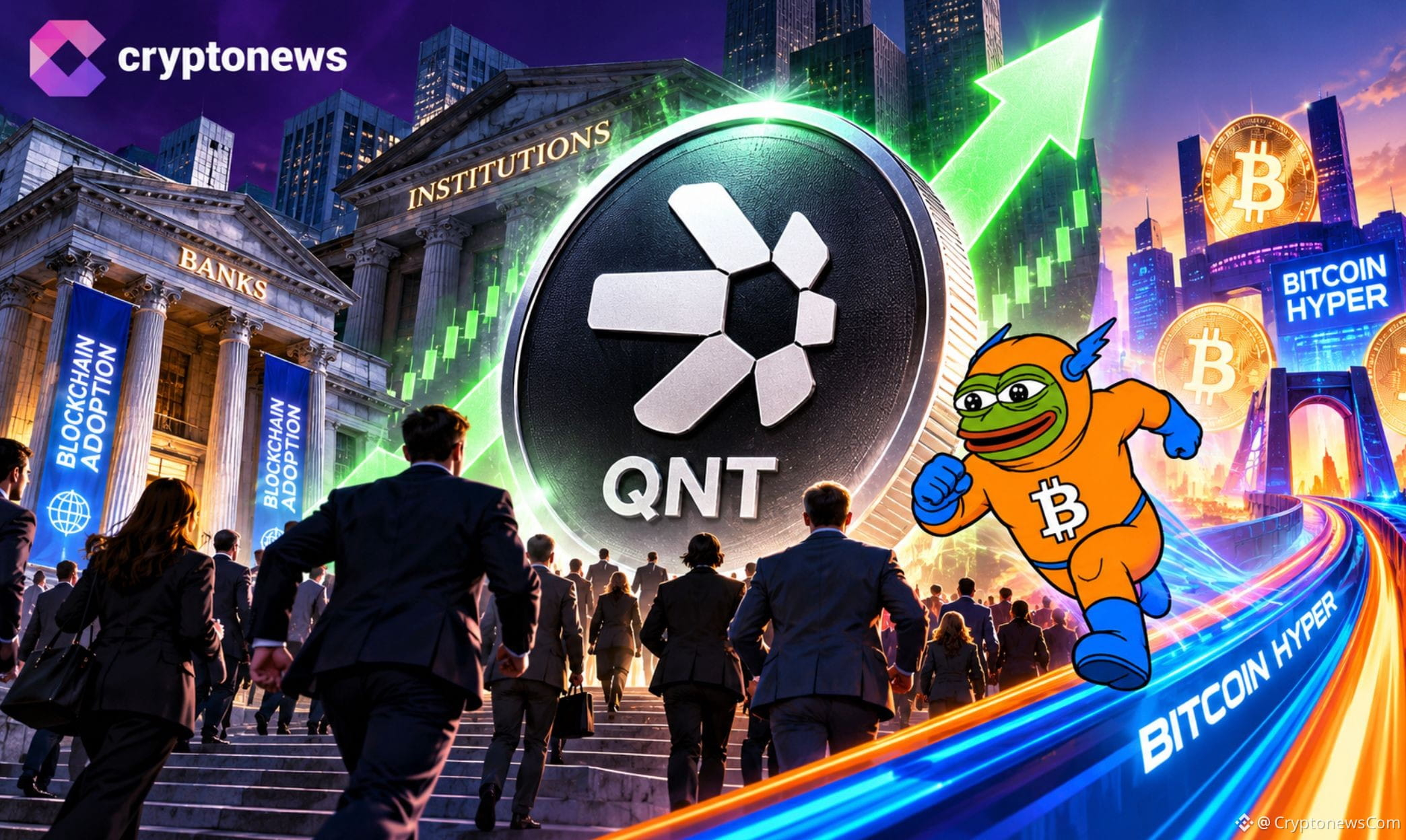
Quant Crypto Soars 18% as QNT Charges Toward $250Quant crypto is back in the spotlight after QNT climbed to $216, gaining 18.7% in 24 hours. The move puts the blockchain interoperability project back on traders’ radar as investors look for crypto with potential links to real-world financial infrastructure.
Quant’s institutional ambitions offer a compelling narrative for the rally, particularly as financial institutions explore tokenized deposits and blockchain-based settlement.
Quant (QNT)
24h7d30d1yAll time
QNT climbed from around $181 to an intraday high of $221 before settling near $216. The move lifted its market cap to $3.16 billion, while daily trading volume reached $146.5 million. QNT gained 93.8% over 30 days and 150.7% over one year despite a more modest 2.9% increase over seven days.
That combination shows the latest surge follows a much larger recovery over the preceding month. The rapid move toward $220 also puts short-term momentum in focus, with traders watching whether buyers can sustain the advance or whether profit-taking follows the sharp rise.
Price action alone cannot establish what triggered the latest buying. However, Quant’s institutional positioning gives investors a fundamental narrative to consider alongside market momentum.
Discover: The Crypto Presales This Q4 2026
Quant Crypto Banking Ambitions Put Blockchain Interoperability in Focus
Quant core crypto technology, Overledger, is designed to connect different blockchain networks and existing financial infrastructure. Rather than requiring institutions to replace their systems, the technology aims to help separate networks communicate.
The opportunity has gained relevance as banks explore tokenized money and faster settlement systems. Just recently, the Clearing House selected Quant to provide technology for its On-Chain Money Initiative, which is designed to support clearing and settlement involving tokenized bank deposits.
BREAKING: Quant selected by The Clearing House for the interoperability layer of its US tokenized deposit network. Trillions of dollars will be on chain though #Quant pic.twitter.com/mPxO1i22Ae
— CRYPTO CAPTAIN (@UniverseTwenty) October 26, 2026
The initiative could give Quant a more substantial role in the emerging market for tokenized banking. If the project progresses toward deployment, it would provide a concrete institutional application for the company’s interoperability technology.
For QNT, the gap between business adoption and token demand remains important. Institutional use of Quant’s technology could strengthen its commercial position, but the impact on QNT’s valuation will depend on how that activity translates into demand for the token.
The takeaway is that blockchain infrastructure is attracting attention for its potential utility, not simply for the speculative appeal of individual assets.
Bitcoin Layer 2 Projects Target a Different Side of Crypto Adoption
While Quant is focused on connecting financial systems, another infrastructure trend is developing around making Bitcoin more useful in decentralized finance.
Bitcoin Hyper is one project pursuing that opportunity. It is developing a Bitcoin Layer 2 based on the Solana Virtual Machine (SVM), with the stated goal of supporting faster transactions and applications such as decentralized exchanges and staking.
Too fast. Too strong. Too Hyper. https://t.co/VNG0P4GuDo pic.twitter.com/oLavMFuU7w
— Bitcoin Hyper (@BTC_Hyper2) October 26, 2026
The idea is to combine Bitcoin’s established asset ecosystem with a programmable environment that can appeal to both Bitcoin holders and traders accustomed to Solana’s fast-moving decentralized application ecosystem.
The project has raised more than $33 million through its presale and is targeting a November 26 launch. Its 35% APY staking rewards also give prospective participants another feature to evaluate.
Bitcoin Hyper has also announced that its browser-based wallet is available for community testing, following the release of its testnet and explorer. These components give users an opportunity to explore the developing ecosystem ahead of the planned launch. Much like Quant, Hyper is focusing on utility while still at a fraction of QNT’s price.
Quant and newer blockchain infrastructure projects are pursuing different opportunities. Quant is targeting institutional interoperability and tokenized financial systems, while Bitcoin Hyper is focused on expanding Bitcoin’s potential in programmable applications and DeFi.
Gain Access to New Bitcoin Layer 2 Early Before the Presale Window Ends
Discover: The Best Token Presales
The post Quant Crypto Soars 18% as QNT Charges Toward $250 appeared first on Cryptonews.
Quant Crypto Soars 18% as QNT Charges Toward $250
Quant crypto is back in the spotlight after QNT climbed to $216, gaining 18.7% in 24 hours. The move puts the blockchain interoperability project back on traders’ radar as investors look for crypto with potential links to real-world financial infrastructure.
Quant’s institutional ambitions offer a compelling narrative for the rally, particularly as financial institutions explore tokenized deposits and blockchain-based settlement.
Quant (QNT)
24h7d30d1yAll time
QNT climbed from around $181 to an intraday high of $221 before settling near $216. The move lifted its market cap to $3.16 billion, while daily trading volume reached $146.5 million. QNT gained 93.8% over 30 days and 150.7% over one year despite a more modest 2.9% increase over seven days.
That combination shows the latest surge follows a much larger recovery over the preceding month. The rapid move toward $220 also puts short-term momentum in focus, with traders watching whether buyers can sustain the advance or whether profit-taking follows the sharp rise.
Price action alone cannot establish what triggered the latest buying. However, Quant’s institutional positioning gives investors a fundamental narrative to consider alongside market momentum.
Discover: The Crypto Presales This Q4 2026
Quant Crypto Banking Ambitions Put Blockchain Interoperability in Focus
Quant core crypto technology, Overledger, is designed to connect different blockchain networks and existing financial infrastructure. Rather than requiring institutions to replace their systems, the technology aims to help separate networks communicate.
The opportunity has gained relevance as banks explore tokenized money and faster settlement systems. Just recently, the Clearing House selected Quant to provide technology for its On-Chain Money Initiative, which is designed to support clearing and settlement involving tokenized bank deposits.
BREAKING: Quant selected by The Clearing House for the interoperability layer of its US tokenized deposit network. Trillions of dollars will be on chain though #Quant pic.twitter.com/mPxO1i22Ae
— CRYPTO CAPTAIN (@UniverseTwenty) October 26, 2026
The initiative could give Quant a more substantial role in the emerging market for tokenized banking. If the project progresses toward deployment, it would provide a concrete institutional application for the company’s interoperability technology.
For QNT, the gap between business adoption and token demand remains important. Institutional use of Quant’s technology could strengthen its commercial position, but the impact on QNT’s valuation will depend on how that activity translates into demand for the token.
The takeaway is that blockchain infrastructure is attracting attention for its potential utility, not simply for the speculative appeal of individual assets.
Bitcoin Layer 2 Projects Target a Different Side of Crypto Adoption
While Quant is focused on connecting financial systems, another infrastructure trend is developing around making Bitcoin more useful in decentralized finance.
Bitcoin Hyper is one project pursuing that opportunity. It is developing a Bitcoin Layer 2 based on the Solana Virtual Machine (SVM), with the stated goal of supporting faster transactions and applications such as decentralized exchanges and staking.
Too fast. Too strong. Too Hyper. https://t.co/VNG0P4GuDo pic.twitter.com/oLavMFuU7w
— Bitcoin Hyper (@BTC_Hyper2) October 26, 2026
The idea is to combine Bitcoin’s established asset ecosystem with a programmable environment that can appeal to both Bitcoin holders and traders accustomed to Solana’s fast-moving decentralized application ecosystem.
The project has raised more than $33 million through its presale and is targeting a November 26 launch. Its 35% APY staking rewards also give prospective participants another feature to evaluate.
Bitcoin Hyper has also announced that its browser-based wallet is available for community testing, following the release of its testnet and explorer. These components give users an opportunity to explore the developing ecosystem ahead of the planned launch. Much like Quant, Hyper is focusing on utility while still at a fraction of QNT’s price.
Quant and newer blockchain infrastructure projects are pursuing different opportunities. Quant is targeting institutional interoperability and tokenized financial systems, while Bitcoin Hyper is focused on expanding Bitcoin’s potential in programmable applications and DeFi.
Gain Access to New Bitcoin Layer 2 Early Before the Presale Window Ends
Discover: The Best Token Presales
The post Quant Crypto Soars 18% as QNT Charges Toward $250 appeared first on Cryptonews.
Quant’s institutional ambitions offer a compelling narrative for the rally, particularly as financial institutions explore tokenized deposits and blockchain-based settlement.
Quant (QNT)
24h7d30d1yAll time
QNT climbed from around $181 to an intraday high of $221 before settling near $216. The move lifted its market cap to $3.16 billion, while daily trading volume reached $146.5 million. QNT gained 93.8% over 30 days and 150.7% over one year despite a more modest 2.9% increase over seven days.
That combination shows the latest surge follows a much larger recovery over the preceding month. The rapid move toward $220 also puts short-term momentum in focus, with traders watching whether buyers can sustain the advance or whether profit-taking follows the sharp rise.
Price action alone cannot establish what triggered the latest buying. However, Quant’s institutional positioning gives investors a fundamental narrative to consider alongside market momentum.
Discover: The Crypto Presales This Q4 2026
Quant Crypto Banking Ambitions Put Blockchain Interoperability in Focus
Quant core crypto technology, Overledger, is designed to connect different blockchain networks and existing financial infrastructure. Rather than requiring institutions to replace their systems, the technology aims to help separate networks communicate.
The opportunity has gained relevance as banks explore tokenized money and faster settlement systems. Just recently, the Clearing House selected Quant to provide technology for its On-Chain Money Initiative, which is designed to support clearing and settlement involving tokenized bank deposits.
BREAKING: Quant selected by The Clearing House for the interoperability layer of its US tokenized deposit network. Trillions of dollars will be on chain though #Quant pic.twitter.com/mPxO1i22Ae
— CRYPTO CAPTAIN (@UniverseTwenty) October 26, 2026
The initiative could give Quant a more substantial role in the emerging market for tokenized banking. If the project progresses toward deployment, it would provide a concrete institutional application for the company’s interoperability technology.
For QNT, the gap between business adoption and token demand remains important. Institutional use of Quant’s technology could strengthen its commercial position, but the impact on QNT’s valuation will depend on how that activity translates into demand for the token.
The takeaway is that blockchain infrastructure is attracting attention for its potential utility, not simply for the speculative appeal of individual assets.
Bitcoin Layer 2 Projects Target a Different Side of Crypto Adoption
While Quant is focused on connecting financial systems, another infrastructure trend is developing around making Bitcoin more useful in decentralized finance.
Bitcoin Hyper is one project pursuing that opportunity. It is developing a Bitcoin Layer 2 based on the Solana Virtual Machine (SVM), with the stated goal of supporting faster transactions and applications such as decentralized exchanges and staking.
Too fast. Too strong. Too Hyper. https://t.co/VNG0P4GuDo pic.twitter.com/oLavMFuU7w
— Bitcoin Hyper (@BTC_Hyper2) October 26, 2026
The idea is to combine Bitcoin’s established asset ecosystem with a programmable environment that can appeal to both Bitcoin holders and traders accustomed to Solana’s fast-moving decentralized application ecosystem.
The project has raised more than $33 million through its presale and is targeting a November 26 launch. Its 35% APY staking rewards also give prospective participants another feature to evaluate.
Bitcoin Hyper has also announced that its browser-based wallet is available for community testing, following the release of its testnet and explorer. These components give users an opportunity to explore the developing ecosystem ahead of the planned launch. Much like Quant, Hyper is focusing on utility while still at a fraction of QNT’s price.
Quant and newer blockchain infrastructure projects are pursuing different opportunities. Quant is targeting institutional interoperability and tokenized financial systems, while Bitcoin Hyper is focused on expanding Bitcoin’s potential in programmable applications and DeFi.
Gain Access to New Bitcoin Layer 2 Early Before the Presale Window Ends
Discover: The Best Token Presales
The post Quant Crypto Soars 18% as QNT Charges Toward $250 appeared first on Cryptonews.
288

Статья
Bitcoin Price Rebounds Again, Peter Schiff Repeats His Crash WarningsBitcoin price has once again challenged Peter Schiff’s latest crash warning, after the longtime crypto critic predicted BTC would fall to $75,000 following a weekend selloff. Bitcoin briefly recovered above $80,000 after dropping to around $79,100 2 days ago, leaving Schiff’s immediate downside target untested.
The rebound offered another awkward moment for Schiff, who has repeatedly questioned Bitcoin’s staying power despite its continued presence in financial markets. However, Bitcoin slipped below $80,000 again on October 26, showing that the market remains under pressure and that the latest recovery has not settled the debate.
Schiff issued his latest warning on X on October 24, after Bitcoin fell below the closely watched $80,000 level.
Bitcoin is finally breaking down. It's hard to believe it's held up this long. Now that it's below $80K, the next stop is likely $75K. If that level fails to hold today, it's going to be a very long weekend for Bitcoiners, especially for ETF investors who can't sell until Monday.
— Peter Schiff (@PeterSchiff) October 24, 2026
He also warned that failure to hold $75,000 would make for a difficult weekend for Bitcoin investors, particularly those using exchange-traded funds (ETFs), which cannot generally be traded on US stock exchanges during weekends.
Bitcoin subsequently recovered above $80,000 and briefly reached $81,000, challenging the immediate timing of Schiff’s prediction. However, the recovery did not last uninterrupted. Bitcoin price is trading just above $80,000 after reaching an intraday low around $79,300.
Peter Schiff Keeps Expecting Bitcoin to Collapse
The latest warning follows years of Schiff questioning Bitcoin’s value and predicting further declines. His argument is that Bitcoin lacks the monetary history and intrinsic value he associates with gold, while its market price remains vulnerable to speculation and investor sentiment.
Yet Bitcoin has continued to attract attention from investors and financial institutions, including through US spot Bitcoin ETFs. Their existence does not guarantee higher prices, but it gives investors another route into the market beyond directly purchasing and holding BTC.
Schiff has also acknowledged that Bitcoin’s resilience has surprised him. In an October interview with Scott Melker, he discussed Bitcoin holding onto gains while gold surrendered much of its advance. “I don’t really know what’s holding it up,” Schiff said, while maintaining that Bitcoin could eventually make new lows.
That admission is worth examining. Schiff can reasonably argue that Bitcoin remains volatile and that its price could fall substantially. But repeatedly anticipating a collapse also leaves his analysis open to scrutiny whenever Bitcoin recovers and buyers return.
Discover: The Crypto Presales This Q4 2026
Bitcoin Price Faces More Than One Bearish Signal
The latest selloff was not happening in isolation. US spot Bitcoin ETFs experienced substantial withdrawals during the week, with $635.5 million leaving the products on October 22, and $137 million on October 23.
Those outflows give bears a concrete reason to remain cautious. ETF demand can weaken, leveraged positions can amplify price swings, and market uncertainty can push investors away from riskier assets.
Bitcoin (BTC)
24h7d30d1yAll time
For the Bitcoin price, the immediate levels to watch are $80,000 and Schiff’s $75,000 target. A sustained recovery above $80,000 would weaken the case for an immediate breakdown, while a decisive move toward $75,000 would bring his latest warning closer to reality.
For now, the Bitcoin price remains under pressure, and Schiff’s $75,000 target is still in play. The next move will determine whether his warning gains traction or becomes another bearish call that Bitcoin investors can revisit after the market turns.
Discover: The Best Token Presales
The post Bitcoin Price Rebounds Again, Peter Schiff Repeats His Crash Warnings appeared first on Cryptonews.
Bitcoin Price Rebounds Again, Peter Schiff Repeats His Crash Warnings
Bitcoin price has once again challenged Peter Schiff’s latest crash warning, after the longtime crypto critic predicted BTC would fall to $75,000 following a weekend selloff. Bitcoin briefly recovered above $80,000 after dropping to around $79,100 2 days ago, leaving Schiff’s immediate downside target untested.
The rebound offered another awkward moment for Schiff, who has repeatedly questioned Bitcoin’s staying power despite its continued presence in financial markets. However, Bitcoin slipped below $80,000 again on October 26, showing that the market remains under pressure and that the latest recovery has not settled the debate.
Schiff issued his latest warning on X on October 24, after Bitcoin fell below the closely watched $80,000 level.
Bitcoin is finally breaking down. It's hard to believe it's held up this long. Now that it's below $80K, the next stop is likely $75K. If that level fails to hold today, it's going to be a very long weekend for Bitcoiners, especially for ETF investors who can't sell until Monday.
— Peter Schiff (@PeterSchiff) October 24, 2026
He also warned that failure to hold $75,000 would make for a difficult weekend for Bitcoin investors, particularly those using exchange-traded funds (ETFs), which cannot generally be traded on US stock exchanges during weekends.
Bitcoin subsequently recovered above $80,000 and briefly reached $81,000, challenging the immediate timing of Schiff’s prediction. However, the recovery did not last uninterrupted. Bitcoin price is trading just above $80,000 after reaching an intraday low around $79,300.
Peter Schiff Keeps Expecting Bitcoin to Collapse
The latest warning follows years of Schiff questioning Bitcoin’s value and predicting further declines. His argument is that Bitcoin lacks the monetary history and intrinsic value he associates with gold, while its market price remains vulnerable to speculation and investor sentiment.
Yet Bitcoin has continued to attract attention from investors and financial institutions, including through US spot Bitcoin ETFs. Their existence does not guarantee higher prices, but it gives investors another route into the market beyond directly purchasing and holding BTC.
Schiff has also acknowledged that Bitcoin’s resilience has surprised him. In an October interview with Scott Melker, he discussed Bitcoin holding onto gains while gold surrendered much of its advance. “I don’t really know what’s holding it up,” Schiff said, while maintaining that Bitcoin could eventually make new lows.
That admission is worth examining. Schiff can reasonably argue that Bitcoin remains volatile and that its price could fall substantially. But repeatedly anticipating a collapse also leaves his analysis open to scrutiny whenever Bitcoin recovers and buyers return.
Discover: The Crypto Presales This Q4 2026
Bitcoin Price Faces More Than One Bearish Signal
The latest selloff was not happening in isolation. US spot Bitcoin ETFs experienced substantial withdrawals during the week, with $635.5 million leaving the products on October 22, and $137 million on October 23.
Those outflows give bears a concrete reason to remain cautious. ETF demand can weaken, leveraged positions can amplify price swings, and market uncertainty can push investors away from riskier assets.
Bitcoin (BTC)
24h7d30d1yAll time
For the Bitcoin price, the immediate levels to watch are $80,000 and Schiff’s $75,000 target. A sustained recovery above $80,000 would weaken the case for an immediate breakdown, while a decisive move toward $75,000 would bring his latest warning closer to reality.
For now, the Bitcoin price remains under pressure, and Schiff’s $75,000 target is still in play. The next move will determine whether his warning gains traction or becomes another bearish call that Bitcoin investors can revisit after the market turns.
Discover: The Best Token Presales
The post Bitcoin Price Rebounds Again, Peter Schiff Repeats His Crash Warnings appeared first on Cryptonews.
The rebound offered another awkward moment for Schiff, who has repeatedly questioned Bitcoin’s staying power despite its continued presence in financial markets. However, Bitcoin slipped below $80,000 again on October 26, showing that the market remains under pressure and that the latest recovery has not settled the debate.
Schiff issued his latest warning on X on October 24, after Bitcoin fell below the closely watched $80,000 level.
Bitcoin is finally breaking down. It's hard to believe it's held up this long. Now that it's below $80K, the next stop is likely $75K. If that level fails to hold today, it's going to be a very long weekend for Bitcoiners, especially for ETF investors who can't sell until Monday.
— Peter Schiff (@PeterSchiff) October 24, 2026
He also warned that failure to hold $75,000 would make for a difficult weekend for Bitcoin investors, particularly those using exchange-traded funds (ETFs), which cannot generally be traded on US stock exchanges during weekends.
Bitcoin subsequently recovered above $80,000 and briefly reached $81,000, challenging the immediate timing of Schiff’s prediction. However, the recovery did not last uninterrupted. Bitcoin price is trading just above $80,000 after reaching an intraday low around $79,300.
Peter Schiff Keeps Expecting Bitcoin to Collapse
The latest warning follows years of Schiff questioning Bitcoin’s value and predicting further declines. His argument is that Bitcoin lacks the monetary history and intrinsic value he associates with gold, while its market price remains vulnerable to speculation and investor sentiment.
Yet Bitcoin has continued to attract attention from investors and financial institutions, including through US spot Bitcoin ETFs. Their existence does not guarantee higher prices, but it gives investors another route into the market beyond directly purchasing and holding BTC.
Schiff has also acknowledged that Bitcoin’s resilience has surprised him. In an October interview with Scott Melker, he discussed Bitcoin holding onto gains while gold surrendered much of its advance. “I don’t really know what’s holding it up,” Schiff said, while maintaining that Bitcoin could eventually make new lows.
That admission is worth examining. Schiff can reasonably argue that Bitcoin remains volatile and that its price could fall substantially. But repeatedly anticipating a collapse also leaves his analysis open to scrutiny whenever Bitcoin recovers and buyers return.
Discover: The Crypto Presales This Q4 2026
Bitcoin Price Faces More Than One Bearish Signal
The latest selloff was not happening in isolation. US spot Bitcoin ETFs experienced substantial withdrawals during the week, with $635.5 million leaving the products on October 22, and $137 million on October 23.
Those outflows give bears a concrete reason to remain cautious. ETF demand can weaken, leveraged positions can amplify price swings, and market uncertainty can push investors away from riskier assets.
Bitcoin (BTC)
24h7d30d1yAll time
For the Bitcoin price, the immediate levels to watch are $80,000 and Schiff’s $75,000 target. A sustained recovery above $80,000 would weaken the case for an immediate breakdown, while a decisive move toward $75,000 would bring his latest warning closer to reality.
For now, the Bitcoin price remains under pressure, and Schiff’s $75,000 target is still in play. The next move will determine whether his warning gains traction or becomes another bearish call that Bitcoin investors can revisit after the market turns.
Discover: The Best Token Presales
The post Bitcoin Price Rebounds Again, Peter Schiff Repeats His Crash Warnings appeared first on Cryptonews.
2
752

Статья
Sony Soneium Coin: PlayStation and GTA 6 Crypto Twist?Soneium, the blockchain ecosystem associated with Sony Group’s Web3 strategy, announced plans to introduce its native ecosystem coin, SONEIUM, on October 26. The initiative aims to connect entertainment intellectual property (IP), creators, developers, fans, and investors through an on-chain economy.
As of today, Soneium itself already supports more than 250 applications across gaming, music, anime, film, collectibles, and fan creations. Its next phase centers on tokenized IP, which could allow creators and rights holders to develop new funding models while giving fans opportunities to support entertainment properties.
1/ Soneium: The Onchain Entertainment Economy.
Today we introduce Tokenized IP and our plan to issue $SONEIUM, an ecosystem-native token that connects our global community. pic.twitter.com/jMwv9qoit3
— Soneium (@soneium) October 26, 2026
The first project under the initiative is Moriusa, a character IP from Tokyo-based entertainment group Super State Holdings. Soneium also plans to work with K-pop IP company DayOneDream to tokenize concert-business royalties.
These projects reveal the ambition behind the Sony Soneium Coin: connecting entertainment businesses with communities that want to participate in their growth.
Rather than focusing exclusively on cryptocurrency trading, Soneium wants to build an economy around the commercial value of creative works. Its planned products include IP Vault, which would provide indirect access to entertainment investment opportunities, and IP Bond, a bond product backed by entertainment businesses.
But this move raises a tantalizing question for gamers: could blockchain become part of the future of PlayStation and blockbuster franchises such as Grand Theft Auto VI?
Discover: The Crypto Presales This Q4 2026
PlayStation, GTA 6: Is Sony Preparing for Gaming’s Next Crypto Era?
PlayStation is the obvious name that comes to mind when considering Sony’s potential reach in gaming. Meanwhile, GTA 6 is shaping up to be one of the biggest entertainment releases of its generation, making it a compelling example of the commercial power of major gaming IP.
Could blockchain eventually allow fans to participate in gaming economies beyond simply purchasing a game?
Soneium’s proposed infrastructure is designed to make IP licensing, attribution, and royalty distribution programmable on-chain. In principle, similar technology could support authorized digital collectibles, licensed fan projects, or new ways of funding entertainment ventures.
That creates an intriguing possibility for the gaming industry. Imagine a future in which fans could support independent game creators or participate in the commercial success of licensed entertainment projects through tokenized assets.
For now, PlayStation and GTA 6 are the bigger questions surrounding the announcement.
Sony Soneium Executive Says Creators Come First for The Coin
“Entertainment starts with creators. Today, Soneium enters a new stage built to stand behind them,” – Yuji Kumagai
Soneium’s strategy is not simply about launching another crypto. The company wants to change how creators finance projects and participate in the value their work generates.
Yuji Kumagai, Head of Soneium Protocol, outlined that ambition in the announcement. “Entertainment starts with creators. Today, Soneium enters a new stage built to stand behind them,” Kumagai said.
Yuji Kumagai
He added that the platform would help creators “fund their next work at a new scale” while exploring new forms of expression and connections with fans.
The comments highlight the economic model Soneium wants to establish. Tokenized IP could allow creators to seek funding from their communities, while programmable revenue mechanisms could distribute proceeds according to predefined arrangements.
The company is also developing an Onchain IP Architecture that includes an IP Registry, IP Graph, and IP Execution Layer. Together, these components are intended to connect creative works, licensing terms and revenue mechanisms, including in an era when artificial intelligence makes content creation and remixing easier.
The combination of entertainment financing, digital ownership, and programmable licensing gives Soneium an ambition beyond a conventional gaming token.
Discover: The Best Token Presales
The post Sony Soneium Coin: PlayStation and GTA 6 Crypto Twist? appeared first on Cryptonews.
Sony Soneium Coin: PlayStation and GTA 6 Crypto Twist?
Soneium, the blockchain ecosystem associated with Sony Group’s Web3 strategy, announced plans to introduce its native ecosystem coin, SONEIUM, on October 26. The initiative aims to connect entertainment intellectual property (IP), creators, developers, fans, and investors through an on-chain economy.
As of today, Soneium itself already supports more than 250 applications across gaming, music, anime, film, collectibles, and fan creations. Its next phase centers on tokenized IP, which could allow creators and rights holders to develop new funding models while giving fans opportunities to support entertainment properties.
1/ Soneium: The Onchain Entertainment Economy.
Today we introduce Tokenized IP and our plan to issue $SONEIUM, an ecosystem-native token that connects our global community. pic.twitter.com/jMwv9qoit3
— Soneium (@soneium) October 26, 2026
The first project under the initiative is Moriusa, a character IP from Tokyo-based entertainment group Super State Holdings. Soneium also plans to work with K-pop IP company DayOneDream to tokenize concert-business royalties.
These projects reveal the ambition behind the Sony Soneium Coin: connecting entertainment businesses with communities that want to participate in their growth.
Rather than focusing exclusively on cryptocurrency trading, Soneium wants to build an economy around the commercial value of creative works. Its planned products include IP Vault, which would provide indirect access to entertainment investment opportunities, and IP Bond, a bond product backed by entertainment businesses.
But this move raises a tantalizing question for gamers: could blockchain become part of the future of PlayStation and blockbuster franchises such as Grand Theft Auto VI?
Discover: The Crypto Presales This Q4 2026
PlayStation, GTA 6: Is Sony Preparing for Gaming’s Next Crypto Era?
PlayStation is the obvious name that comes to mind when considering Sony’s potential reach in gaming. Meanwhile, GTA 6 is shaping up to be one of the biggest entertainment releases of its generation, making it a compelling example of the commercial power of major gaming IP.
Could blockchain eventually allow fans to participate in gaming economies beyond simply purchasing a game?
Soneium’s proposed infrastructure is designed to make IP licensing, attribution, and royalty distribution programmable on-chain. In principle, similar technology could support authorized digital collectibles, licensed fan projects, or new ways of funding entertainment ventures.
That creates an intriguing possibility for the gaming industry. Imagine a future in which fans could support independent game creators or participate in the commercial success of licensed entertainment projects through tokenized assets.
For now, PlayStation and GTA 6 are the bigger questions surrounding the announcement.
Sony Soneium Executive Says Creators Come First for The Coin
“Entertainment starts with creators. Today, Soneium enters a new stage built to stand behind them,” – Yuji Kumagai
Soneium’s strategy is not simply about launching another crypto. The company wants to change how creators finance projects and participate in the value their work generates.
Yuji Kumagai, Head of Soneium Protocol, outlined that ambition in the announcement. “Entertainment starts with creators. Today, Soneium enters a new stage built to stand behind them,” Kumagai said.
Yuji Kumagai
He added that the platform would help creators “fund their next work at a new scale” while exploring new forms of expression and connections with fans.
The comments highlight the economic model Soneium wants to establish. Tokenized IP could allow creators to seek funding from their communities, while programmable revenue mechanisms could distribute proceeds according to predefined arrangements.
The company is also developing an Onchain IP Architecture that includes an IP Registry, IP Graph, and IP Execution Layer. Together, these components are intended to connect creative works, licensing terms and revenue mechanisms, including in an era when artificial intelligence makes content creation and remixing easier.
The combination of entertainment financing, digital ownership, and programmable licensing gives Soneium an ambition beyond a conventional gaming token.
Discover: The Best Token Presales
The post Sony Soneium Coin: PlayStation and GTA 6 Crypto Twist? appeared first on Cryptonews.
As of today, Soneium itself already supports more than 250 applications across gaming, music, anime, film, collectibles, and fan creations. Its next phase centers on tokenized IP, which could allow creators and rights holders to develop new funding models while giving fans opportunities to support entertainment properties.
1/ Soneium: The Onchain Entertainment Economy.
Today we introduce Tokenized IP and our plan to issue $SONEIUM, an ecosystem-native token that connects our global community. pic.twitter.com/jMwv9qoit3
— Soneium (@soneium) October 26, 2026
The first project under the initiative is Moriusa, a character IP from Tokyo-based entertainment group Super State Holdings. Soneium also plans to work with K-pop IP company DayOneDream to tokenize concert-business royalties.
These projects reveal the ambition behind the Sony Soneium Coin: connecting entertainment businesses with communities that want to participate in their growth.
Rather than focusing exclusively on cryptocurrency trading, Soneium wants to build an economy around the commercial value of creative works. Its planned products include IP Vault, which would provide indirect access to entertainment investment opportunities, and IP Bond, a bond product backed by entertainment businesses.
But this move raises a tantalizing question for gamers: could blockchain become part of the future of PlayStation and blockbuster franchises such as Grand Theft Auto VI?
Discover: The Crypto Presales This Q4 2026
PlayStation, GTA 6: Is Sony Preparing for Gaming’s Next Crypto Era?
PlayStation is the obvious name that comes to mind when considering Sony’s potential reach in gaming. Meanwhile, GTA 6 is shaping up to be one of the biggest entertainment releases of its generation, making it a compelling example of the commercial power of major gaming IP.
Could blockchain eventually allow fans to participate in gaming economies beyond simply purchasing a game?
Soneium’s proposed infrastructure is designed to make IP licensing, attribution, and royalty distribution programmable on-chain. In principle, similar technology could support authorized digital collectibles, licensed fan projects, or new ways of funding entertainment ventures.
That creates an intriguing possibility for the gaming industry. Imagine a future in which fans could support independent game creators or participate in the commercial success of licensed entertainment projects through tokenized assets.
For now, PlayStation and GTA 6 are the bigger questions surrounding the announcement.
Sony Soneium Executive Says Creators Come First for The Coin
“Entertainment starts with creators. Today, Soneium enters a new stage built to stand behind them,” – Yuji Kumagai
Soneium’s strategy is not simply about launching another crypto. The company wants to change how creators finance projects and participate in the value their work generates.
Yuji Kumagai, Head of Soneium Protocol, outlined that ambition in the announcement. “Entertainment starts with creators. Today, Soneium enters a new stage built to stand behind them,” Kumagai said.
Yuji Kumagai
He added that the platform would help creators “fund their next work at a new scale” while exploring new forms of expression and connections with fans.
The comments highlight the economic model Soneium wants to establish. Tokenized IP could allow creators to seek funding from their communities, while programmable revenue mechanisms could distribute proceeds according to predefined arrangements.
The company is also developing an Onchain IP Architecture that includes an IP Registry, IP Graph, and IP Execution Layer. Together, these components are intended to connect creative works, licensing terms and revenue mechanisms, including in an era when artificial intelligence makes content creation and remixing easier.
The combination of entertainment financing, digital ownership, and programmable licensing gives Soneium an ambition beyond a conventional gaming token.
Discover: The Best Token Presales
The post Sony Soneium Coin: PlayStation and GTA 6 Crypto Twist? appeared first on Cryptonews.
56

Статья
BNB New Layer 1 Puts CZ’s Ecosystem Strategy in Focus as ASTER Builds Its Own ChainChangpeng Zhao’s vision for a multi-chain crypto ecosystem is coming into sharper focus as BNB Chain develops a new Layer 1 blockchain while ASTER, a project backed by CZ’s investment firm YZi Labs, operates its own trading-focused network.
CZ highlighted the approach in an X post, writing, “Multiple chains, one coins,” in response to the BNB Chain proposal. The message points to a strategy built around expanding blockchain infrastructure without necessarily introducing a separate native token for every network.
Multiple chains, one coins. https://t.co/uwjbQ72v5D
— CZ BNB (@cz_binance) October 25, 2026
The development raises a question about the CZ ecosystem strategy: can specialized blockchains serve different markets while strengthening the wider network of projects, applications, and assets connected to it?
Discover: The Crypto Presales This Q4 2026
BNB New Layer 1 Shows a Multi-Chain Strategy
Bnb (BNB)
24h7d30d1yAll time
BNB Chain’s proposed new L1 is designed to operate alongside BNB Smart Chain (BSC), rather than replace it. According to the official technical documentation, the new network is being developed for latency-sensitive applications, including high-frequency trading, on-chain order books, and real-time payments.
Its design targets 200-millisecond blocks, transaction pre-confirmations of 20 milliseconds, and sub-second finality. These remain development targets, with a public testnet planned for late 2026 and mainnet targeted for early 2027.
The more significant detail is the proposed token model. BNB will serve as the native asset for transaction fees and staking, extending its utility across multiple networks instead of introducing another crypto asset.
CZ’s “Multiple chains, one coins” comment captures this direction. Rather than treating every blockchain as an independent ecosystem, the model could connect specialized networks through a shared asset and interoperability infrastructure.
This is central to the CZ ecosystem strategy. BNB Smart Chain is expanding the range of applications that can operate across the BNB ecosystem while keeping BNB relevant to their activity.
ASTER Offers Another View of CZ’s Ecosystem Strategy
ASTER provides an interesting comparison because its own Layer 1 is already live. Aster Chain officially launched its mainnet on March 17, 2026, positioning itself as a privacy-focused blockchain built for on-chain trading. The network emphasizes encrypted order flow, privacy features, and execution performance designed to appeal to derivatives traders.
According to Aster’s launch announcement, the network targets throughput above 100,000 transactions per second, with median block times of 50 milliseconds.
As the lotus lives in water, where no trace will remain.
Leave nothing behind. Trade on Aster Chain. pic.twitter.com/GWe4iA7Uhx
— Aster (@Aster_DEX) March 17, 2026
Aster is backed by YZi Labs, the investment firm formerly known as Binance Labs. CZ remains involved in YZi Labs’ investment activities, although this does not mean he directly controls every project the firm backs.
The gap between the two networks is important. BNB New L1 is being developed as a high-performance network for several use cases, including trading, payments and privacy-related applications. Aster Chain is more narrowly focused on trading infrastructure, particularly protecting traders’ positions and order information from public visibility.
Both approaches reflect a push toward specialized blockchain infrastructure, but they do not necessarily serve identical markets.
Could Multiple New Chains Strengthen the BNB Layer 1 Ecosystem?
The relationship between BNB new Layer 1 and ASTER raises a strategic question: does the future of the BNB ecosystem depend on one dominant blockchain, or can multiple specialized networks coexist?
A shared BNB token could help preserve continuity across BNB Chain’s proposed network expansion. If applications migrate or expand onto additional chains, users would not necessarily need to adopt a new native asset for every network.
Meanwhile, projects such as ASTER can develop differentiated products around specific trading needs. Their growth could broaden the range of services available to traders operating across connected crypto ecosystems.
There is also a potential challenge. Multiple networks can divide liquidity, developer attention and user activity, particularly when their applications overlap. A shared token alone does not guarantee that activity on a new chain will translate into additional BNB demand.
Discover: The Best Token Presales
The post BNB New Layer 1 Puts CZ’s Ecosystem Strategy in Focus as ASTER Builds Its Own Chain appeared first on Cryptonews.
BNB New Layer 1 Puts CZ’s Ecosystem Strategy in Focus as ASTER Builds Its Own Chain
Changpeng Zhao’s vision for a multi-chain crypto ecosystem is coming into sharper focus as BNB Chain develops a new Layer 1 blockchain while ASTER, a project backed by CZ’s investment firm YZi Labs, operates its own trading-focused network.
CZ highlighted the approach in an X post, writing, “Multiple chains, one coins,” in response to the BNB Chain proposal. The message points to a strategy built around expanding blockchain infrastructure without necessarily introducing a separate native token for every network.
Multiple chains, one coins. https://t.co/uwjbQ72v5D
— CZ BNB (@cz_binance) October 25, 2026
The development raises a question about the CZ ecosystem strategy: can specialized blockchains serve different markets while strengthening the wider network of projects, applications, and assets connected to it?
Discover: The Crypto Presales This Q4 2026
BNB New Layer 1 Shows a Multi-Chain Strategy
Bnb (BNB)
24h7d30d1yAll time
BNB Chain’s proposed new L1 is designed to operate alongside BNB Smart Chain (BSC), rather than replace it. According to the official technical documentation, the new network is being developed for latency-sensitive applications, including high-frequency trading, on-chain order books, and real-time payments.
Its design targets 200-millisecond blocks, transaction pre-confirmations of 20 milliseconds, and sub-second finality. These remain development targets, with a public testnet planned for late 2026 and mainnet targeted for early 2027.
The more significant detail is the proposed token model. BNB will serve as the native asset for transaction fees and staking, extending its utility across multiple networks instead of introducing another crypto asset.
CZ’s “Multiple chains, one coins” comment captures this direction. Rather than treating every blockchain as an independent ecosystem, the model could connect specialized networks through a shared asset and interoperability infrastructure.
This is central to the CZ ecosystem strategy. BNB Smart Chain is expanding the range of applications that can operate across the BNB ecosystem while keeping BNB relevant to their activity.
ASTER Offers Another View of CZ’s Ecosystem Strategy
ASTER provides an interesting comparison because its own Layer 1 is already live. Aster Chain officially launched its mainnet on March 17, 2026, positioning itself as a privacy-focused blockchain built for on-chain trading. The network emphasizes encrypted order flow, privacy features, and execution performance designed to appeal to derivatives traders.
According to Aster’s launch announcement, the network targets throughput above 100,000 transactions per second, with median block times of 50 milliseconds.
As the lotus lives in water, where no trace will remain.
Leave nothing behind. Trade on Aster Chain. pic.twitter.com/GWe4iA7Uhx
— Aster (@Aster_DEX) March 17, 2026
Aster is backed by YZi Labs, the investment firm formerly known as Binance Labs. CZ remains involved in YZi Labs’ investment activities, although this does not mean he directly controls every project the firm backs.
The gap between the two networks is important. BNB New L1 is being developed as a high-performance network for several use cases, including trading, payments and privacy-related applications. Aster Chain is more narrowly focused on trading infrastructure, particularly protecting traders’ positions and order information from public visibility.
Both approaches reflect a push toward specialized blockchain infrastructure, but they do not necessarily serve identical markets.
Could Multiple New Chains Strengthen the BNB Layer 1 Ecosystem?
The relationship between BNB new Layer 1 and ASTER raises a strategic question: does the future of the BNB ecosystem depend on one dominant blockchain, or can multiple specialized networks coexist?
A shared BNB token could help preserve continuity across BNB Chain’s proposed network expansion. If applications migrate or expand onto additional chains, users would not necessarily need to adopt a new native asset for every network.
Meanwhile, projects such as ASTER can develop differentiated products around specific trading needs. Their growth could broaden the range of services available to traders operating across connected crypto ecosystems.
There is also a potential challenge. Multiple networks can divide liquidity, developer attention and user activity, particularly when their applications overlap. A shared token alone does not guarantee that activity on a new chain will translate into additional BNB demand.
Discover: The Best Token Presales
The post BNB New Layer 1 Puts CZ’s Ecosystem Strategy in Focus as ASTER Builds Its Own Chain appeared first on Cryptonews.
CZ highlighted the approach in an X post, writing, “Multiple chains, one coins,” in response to the BNB Chain proposal. The message points to a strategy built around expanding blockchain infrastructure without necessarily introducing a separate native token for every network.
Multiple chains, one coins. https://t.co/uwjbQ72v5D
— CZ BNB (@cz_binance) October 25, 2026
The development raises a question about the CZ ecosystem strategy: can specialized blockchains serve different markets while strengthening the wider network of projects, applications, and assets connected to it?
Discover: The Crypto Presales This Q4 2026
BNB New Layer 1 Shows a Multi-Chain Strategy
Bnb (BNB)
24h7d30d1yAll time
BNB Chain’s proposed new L1 is designed to operate alongside BNB Smart Chain (BSC), rather than replace it. According to the official technical documentation, the new network is being developed for latency-sensitive applications, including high-frequency trading, on-chain order books, and real-time payments.
Its design targets 200-millisecond blocks, transaction pre-confirmations of 20 milliseconds, and sub-second finality. These remain development targets, with a public testnet planned for late 2026 and mainnet targeted for early 2027.
The more significant detail is the proposed token model. BNB will serve as the native asset for transaction fees and staking, extending its utility across multiple networks instead of introducing another crypto asset.
CZ’s “Multiple chains, one coins” comment captures this direction. Rather than treating every blockchain as an independent ecosystem, the model could connect specialized networks through a shared asset and interoperability infrastructure.
This is central to the CZ ecosystem strategy. BNB Smart Chain is expanding the range of applications that can operate across the BNB ecosystem while keeping BNB relevant to their activity.
ASTER Offers Another View of CZ’s Ecosystem Strategy
ASTER provides an interesting comparison because its own Layer 1 is already live. Aster Chain officially launched its mainnet on March 17, 2026, positioning itself as a privacy-focused blockchain built for on-chain trading. The network emphasizes encrypted order flow, privacy features, and execution performance designed to appeal to derivatives traders.
According to Aster’s launch announcement, the network targets throughput above 100,000 transactions per second, with median block times of 50 milliseconds.
As the lotus lives in water, where no trace will remain.
Leave nothing behind. Trade on Aster Chain. pic.twitter.com/GWe4iA7Uhx
— Aster (@Aster_DEX) March 17, 2026
Aster is backed by YZi Labs, the investment firm formerly known as Binance Labs. CZ remains involved in YZi Labs’ investment activities, although this does not mean he directly controls every project the firm backs.
The gap between the two networks is important. BNB New L1 is being developed as a high-performance network for several use cases, including trading, payments and privacy-related applications. Aster Chain is more narrowly focused on trading infrastructure, particularly protecting traders’ positions and order information from public visibility.
Both approaches reflect a push toward specialized blockchain infrastructure, but they do not necessarily serve identical markets.
Could Multiple New Chains Strengthen the BNB Layer 1 Ecosystem?
The relationship between BNB new Layer 1 and ASTER raises a strategic question: does the future of the BNB ecosystem depend on one dominant blockchain, or can multiple specialized networks coexist?
A shared BNB token could help preserve continuity across BNB Chain’s proposed network expansion. If applications migrate or expand onto additional chains, users would not necessarily need to adopt a new native asset for every network.
Meanwhile, projects such as ASTER can develop differentiated products around specific trading needs. Their growth could broaden the range of services available to traders operating across connected crypto ecosystems.
There is also a potential challenge. Multiple networks can divide liquidity, developer attention and user activity, particularly when their applications overlap. A shared token alone does not guarantee that activity on a new chain will translate into additional BNB demand.
Discover: The Best Token Presales
The post BNB New Layer 1 Puts CZ’s Ecosystem Strategy in Focus as ASTER Builds Its Own Chain appeared first on Cryptonews.
1
639

Статья
CoinDepo Publishes Full CertiK Web Application Audit Results and Remediation StatusesCoinDepo has made the complete results of an independent security audit of its web application available for public review on its CertiK Skynet profile. The published entry covers the areas that were examined, the testing methods that were applied, every finding that was recorded, and the status of the remediation work that followed, giving users and other readers a single place to inspect both the scope of the engagement and its outcomes.
CertiK’s review looked at the application’s functionality, the business logic that shapes how it operates, and the security controls that protect the system. CertiK combined dynamic testing and a manual review, so it could identify potential vulnerabilities and also observe how the application behaved when it was placed under active test conditions. After those findings were raised, the same process included a review of the fixes that CoinDepo implemented in response, confirming that the reported issues had been addressed.
The Skynet listing records 18 findings from the web application audit. Sixteen of them have been resolved, while the two remaining items are informational findings that have been acknowledged. All of the findings that were classified as critical, high, medium, or low appear as resolved. Because the statuses are published, readers can see both the issues that were identified during the review and the results of the remediation steps that were taken.
The report itself can be reached by opening CoinDepo’s CertiK Skynet profile and selecting “CoinDepo Web Application” in the Code Audit History section. That same profile also contains the results of an earlier CertiK audit of CoinDepo’s smart contracts. The smart-contract review examined a separate part of the project’s technology, so the profile now holds independent assessments of two distinct layers of the platform.
CoinDepo is also participating in CertiK Hunt, the firm’s bug bounty program. Under the conditions of that program, invited security researchers have a channel to responsibly report eligible vulnerabilities, and each report is evaluated according to the program’s defined scope and disclosure rules. This arrangement creates a continuing route for external testing as the platform develops, operating alongside the independent security audits that have already been completed.
About CoinDepo
CoinDepo is a centralized digital asset platform offering crypto savings and asset-backed borrowing services. Its products allow users to earn interest on supported digital assets and access liquidity through credit facilities.
The post CoinDepo Publishes Full CertiK Web Application Audit Results and Remediation Statuses appeared first on Cryptonews.
CoinDepo Publishes Full CertiK Web Application Audit Results and Remediation Statuses
CoinDepo has made the complete results of an independent security audit of its web application available for public review on its CertiK Skynet profile. The published entry covers the areas that were examined, the testing methods that were applied, every finding that was recorded, and the status of the remediation work that followed, giving users and other readers a single place to inspect both the scope of the engagement and its outcomes.
CertiK’s review looked at the application’s functionality, the business logic that shapes how it operates, and the security controls that protect the system. CertiK combined dynamic testing and a manual review, so it could identify potential vulnerabilities and also observe how the application behaved when it was placed under active test conditions. After those findings were raised, the same process included a review of the fixes that CoinDepo implemented in response, confirming that the reported issues had been addressed.
The Skynet listing records 18 findings from the web application audit. Sixteen of them have been resolved, while the two remaining items are informational findings that have been acknowledged. All of the findings that were classified as critical, high, medium, or low appear as resolved. Because the statuses are published, readers can see both the issues that were identified during the review and the results of the remediation steps that were taken.
The report itself can be reached by opening CoinDepo’s CertiK Skynet profile and selecting “CoinDepo Web Application” in the Code Audit History section. That same profile also contains the results of an earlier CertiK audit of CoinDepo’s smart contracts. The smart-contract review examined a separate part of the project’s technology, so the profile now holds independent assessments of two distinct layers of the platform.
CoinDepo is also participating in CertiK Hunt, the firm’s bug bounty program. Under the conditions of that program, invited security researchers have a channel to responsibly report eligible vulnerabilities, and each report is evaluated according to the program’s defined scope and disclosure rules. This arrangement creates a continuing route for external testing as the platform develops, operating alongside the independent security audits that have already been completed.
About CoinDepo
CoinDepo is a centralized digital asset platform offering crypto savings and asset-backed borrowing services. Its products allow users to earn interest on supported digital assets and access liquidity through credit facilities.
The post CoinDepo Publishes Full CertiK Web Application Audit Results and Remediation Statuses appeared first on Cryptonews.
CertiK’s review looked at the application’s functionality, the business logic that shapes how it operates, and the security controls that protect the system. CertiK combined dynamic testing and a manual review, so it could identify potential vulnerabilities and also observe how the application behaved when it was placed under active test conditions. After those findings were raised, the same process included a review of the fixes that CoinDepo implemented in response, confirming that the reported issues had been addressed.
The Skynet listing records 18 findings from the web application audit. Sixteen of them have been resolved, while the two remaining items are informational findings that have been acknowledged. All of the findings that were classified as critical, high, medium, or low appear as resolved. Because the statuses are published, readers can see both the issues that were identified during the review and the results of the remediation steps that were taken.
The report itself can be reached by opening CoinDepo’s CertiK Skynet profile and selecting “CoinDepo Web Application” in the Code Audit History section. That same profile also contains the results of an earlier CertiK audit of CoinDepo’s smart contracts. The smart-contract review examined a separate part of the project’s technology, so the profile now holds independent assessments of two distinct layers of the platform.
CoinDepo is also participating in CertiK Hunt, the firm’s bug bounty program. Under the conditions of that program, invited security researchers have a channel to responsibly report eligible vulnerabilities, and each report is evaluated according to the program’s defined scope and disclosure rules. This arrangement creates a continuing route for external testing as the platform develops, operating alongside the independent security audits that have already been completed.
About CoinDepo
CoinDepo is a centralized digital asset platform offering crypto savings and asset-backed borrowing services. Its products allow users to earn interest on supported digital assets and access liquidity through credit facilities.
The post CoinDepo Publishes Full CertiK Web Application Audit Results and Remediation Statuses appeared first on Cryptonews.
14
Статья
Ethereum Glamsterdam Upgrade Delayed Over Smart Contract Security RisksEthereum developers have postponed the Glamsterdam upgrade on the Hoodi testnet after researchers identified potential security risks involving existing smart contracts, leaving the network’s next major development milestone without a confirmed activation date. The decision comes as ETH trades under $2,400, with the token losing around 0.5%.
The Ethereum Foundation announced the delay last night, canceling the Hoodi activation scheduled for October 26. Developers want more time to investigate how proposed gas-accounting changes could interact with contracts already deployed on Ethereum mainnet. No replacement date has been announced for the testnet upgrade, and the mainnet schedule remains undecided.
Ethereum postpones the Glamsterdam upgrade and cancels Monday's Hoodi testnet activation after security developers flagged risks to existing contracts.
Just another reminder that protocol upgrades can be fragile.
— lenny (@blockchainlenny) October 23, 2026
Ethereum Holds Near $2,400 as Glamsterdam Delayed
Ethereum (ETH)
24h7d30d1yAll time
ETH price is fluctuating between $2,370 and $2,415. The token is approaching the upper end of its daily range, putting the $2,400 level in focus as traders assess whether the latest gains can hold.
A sustained move above $2,415 could open the door to further upside, while a drop below $2,370 would signal renewed selling pressure and put lower price levels in focus. For now, ETH’s short-term direction will depend on whether buyers can maintain momentum and how the broader crypto market performs.
The Ethereum Glamsterdam delay adds another factor for traders to watch, particularly if uncertainty around the upgrade timeline persists. However, the postponement alone does not establish a bearish outlook for ETH. Attention will remain on price momentum, market demand, and further updates from Ethereum developers as the next testing milestone approaches.
Discover: The Best Token Presales
Delay Leaves December Timeline Uncertain
The postponement also raises questions about the broader Ethereum Glamsterdam rollout timeline. Developers had discussed potential December activation dates for mainnet, but the schedule had not been finalized. With the Hoodi test now delayed, those possible dates should not be treated as confirmed launch targets.
Hoodi testing is an important step in checking how the upgrade behaves before developers decide when to deploy it on mainnet. The canceled activation also removes a planned increase in Hoodi’s gas limit to 200 million, which had been scheduled alongside the upgrade.
The Ethereum Foundation has not announced a replacement Hoodi date. Developers must first investigate the reported compatibility issues and determine what changes, if any, are needed before the next activation can proceed.
For ETH traders, the uncertainty creates a new development milestone to follow rather than a confirmed change to the network’s mainnet operations. A prolonged delay could keep attention on the upgrade’s readiness, while a revised testing schedule would provide a clearer timeline for the next phase.
Smart Contract Security Concerns Trigger Ethereum Glamsterdam Delay
The immediate issue involves EIP-8037, a proposal that changes how Ethereum accounts for gas costs associated with creating blockchain state. Researchers have raised concerns about how the proposed changes could interact with existing smart contracts, particularly those that rely on specific gas limits when handling failed operations.
Security firm ChainSecurity identified scenarios in which the proposed gas changes could leave contracts with different amounts of gas than expected. That could affect how certain applications handle errors, potentially causing operations to fail or behave differently from their original design.
The findings matter because deployed smart contracts may continue operating under assumptions established before the upgrade. Changes to gas accounting can therefore create compatibility problems even when developers are not deliberately changing an application’s underlying logic.
Ethereum’s decision to postpone the Hoodi activation gives developers additional time to investigate those interactions before proceeding. The delay is specific to the Hoodi testnet and does not mean the Glamsterdam upgrade has been canceled.
Glamsterdam remains part of Ethereum’s development roadmap, with proposed improvements including enshrined proposer-builder separation and block-level access lists. For now, the immediate focus is on resolving the security concerns, rescheduling Hoodi testing, and establishing a clearer path toward mainnet activation.
Discover: Best Crypto IPOs This Q4
The post Ethereum Glamsterdam Upgrade Delayed Over Smart Contract Security Risks appeared first on Cryptonews.
Ethereum Glamsterdam Upgrade Delayed Over Smart Contract Security Risks
Ethereum developers have postponed the Glamsterdam upgrade on the Hoodi testnet after researchers identified potential security risks involving existing smart contracts, leaving the network’s next major development milestone without a confirmed activation date. The decision comes as ETH trades under $2,400, with the token losing around 0.5%.
The Ethereum Foundation announced the delay last night, canceling the Hoodi activation scheduled for October 26. Developers want more time to investigate how proposed gas-accounting changes could interact with contracts already deployed on Ethereum mainnet. No replacement date has been announced for the testnet upgrade, and the mainnet schedule remains undecided.
Ethereum postpones the Glamsterdam upgrade and cancels Monday's Hoodi testnet activation after security developers flagged risks to existing contracts.
Just another reminder that protocol upgrades can be fragile.
— lenny (@blockchainlenny) October 23, 2026
Ethereum Holds Near $2,400 as Glamsterdam Delayed
Ethereum (ETH)
24h7d30d1yAll time
ETH price is fluctuating between $2,370 and $2,415. The token is approaching the upper end of its daily range, putting the $2,400 level in focus as traders assess whether the latest gains can hold.
A sustained move above $2,415 could open the door to further upside, while a drop below $2,370 would signal renewed selling pressure and put lower price levels in focus. For now, ETH’s short-term direction will depend on whether buyers can maintain momentum and how the broader crypto market performs.
The Ethereum Glamsterdam delay adds another factor for traders to watch, particularly if uncertainty around the upgrade timeline persists. However, the postponement alone does not establish a bearish outlook for ETH. Attention will remain on price momentum, market demand, and further updates from Ethereum developers as the next testing milestone approaches.
Discover: The Best Token Presales
Delay Leaves December Timeline Uncertain
The postponement also raises questions about the broader Ethereum Glamsterdam rollout timeline. Developers had discussed potential December activation dates for mainnet, but the schedule had not been finalized. With the Hoodi test now delayed, those possible dates should not be treated as confirmed launch targets.
Hoodi testing is an important step in checking how the upgrade behaves before developers decide when to deploy it on mainnet. The canceled activation also removes a planned increase in Hoodi’s gas limit to 200 million, which had been scheduled alongside the upgrade.
The Ethereum Foundation has not announced a replacement Hoodi date. Developers must first investigate the reported compatibility issues and determine what changes, if any, are needed before the next activation can proceed.
For ETH traders, the uncertainty creates a new development milestone to follow rather than a confirmed change to the network’s mainnet operations. A prolonged delay could keep attention on the upgrade’s readiness, while a revised testing schedule would provide a clearer timeline for the next phase.
Smart Contract Security Concerns Trigger Ethereum Glamsterdam Delay
The immediate issue involves EIP-8037, a proposal that changes how Ethereum accounts for gas costs associated with creating blockchain state. Researchers have raised concerns about how the proposed changes could interact with existing smart contracts, particularly those that rely on specific gas limits when handling failed operations.
Security firm ChainSecurity identified scenarios in which the proposed gas changes could leave contracts with different amounts of gas than expected. That could affect how certain applications handle errors, potentially causing operations to fail or behave differently from their original design.
The findings matter because deployed smart contracts may continue operating under assumptions established before the upgrade. Changes to gas accounting can therefore create compatibility problems even when developers are not deliberately changing an application’s underlying logic.
Ethereum’s decision to postpone the Hoodi activation gives developers additional time to investigate those interactions before proceeding. The delay is specific to the Hoodi testnet and does not mean the Glamsterdam upgrade has been canceled.
Glamsterdam remains part of Ethereum’s development roadmap, with proposed improvements including enshrined proposer-builder separation and block-level access lists. For now, the immediate focus is on resolving the security concerns, rescheduling Hoodi testing, and establishing a clearer path toward mainnet activation.
Discover: Best Crypto IPOs This Q4
The post Ethereum Glamsterdam Upgrade Delayed Over Smart Contract Security Risks appeared first on Cryptonews.
The Ethereum Foundation announced the delay last night, canceling the Hoodi activation scheduled for October 26. Developers want more time to investigate how proposed gas-accounting changes could interact with contracts already deployed on Ethereum mainnet. No replacement date has been announced for the testnet upgrade, and the mainnet schedule remains undecided.
Ethereum postpones the Glamsterdam upgrade and cancels Monday's Hoodi testnet activation after security developers flagged risks to existing contracts.
Just another reminder that protocol upgrades can be fragile.
— lenny (@blockchainlenny) October 23, 2026
Ethereum Holds Near $2,400 as Glamsterdam Delayed
Ethereum (ETH)
24h7d30d1yAll time
ETH price is fluctuating between $2,370 and $2,415. The token is approaching the upper end of its daily range, putting the $2,400 level in focus as traders assess whether the latest gains can hold.
A sustained move above $2,415 could open the door to further upside, while a drop below $2,370 would signal renewed selling pressure and put lower price levels in focus. For now, ETH’s short-term direction will depend on whether buyers can maintain momentum and how the broader crypto market performs.
The Ethereum Glamsterdam delay adds another factor for traders to watch, particularly if uncertainty around the upgrade timeline persists. However, the postponement alone does not establish a bearish outlook for ETH. Attention will remain on price momentum, market demand, and further updates from Ethereum developers as the next testing milestone approaches.
Discover: The Best Token Presales
Delay Leaves December Timeline Uncertain
The postponement also raises questions about the broader Ethereum Glamsterdam rollout timeline. Developers had discussed potential December activation dates for mainnet, but the schedule had not been finalized. With the Hoodi test now delayed, those possible dates should not be treated as confirmed launch targets.
Hoodi testing is an important step in checking how the upgrade behaves before developers decide when to deploy it on mainnet. The canceled activation also removes a planned increase in Hoodi’s gas limit to 200 million, which had been scheduled alongside the upgrade.
The Ethereum Foundation has not announced a replacement Hoodi date. Developers must first investigate the reported compatibility issues and determine what changes, if any, are needed before the next activation can proceed.
For ETH traders, the uncertainty creates a new development milestone to follow rather than a confirmed change to the network’s mainnet operations. A prolonged delay could keep attention on the upgrade’s readiness, while a revised testing schedule would provide a clearer timeline for the next phase.
Smart Contract Security Concerns Trigger Ethereum Glamsterdam Delay
The immediate issue involves EIP-8037, a proposal that changes how Ethereum accounts for gas costs associated with creating blockchain state. Researchers have raised concerns about how the proposed changes could interact with existing smart contracts, particularly those that rely on specific gas limits when handling failed operations.
Security firm ChainSecurity identified scenarios in which the proposed gas changes could leave contracts with different amounts of gas than expected. That could affect how certain applications handle errors, potentially causing operations to fail or behave differently from their original design.
The findings matter because deployed smart contracts may continue operating under assumptions established before the upgrade. Changes to gas accounting can therefore create compatibility problems even when developers are not deliberately changing an application’s underlying logic.
Ethereum’s decision to postpone the Hoodi activation gives developers additional time to investigate those interactions before proceeding. The delay is specific to the Hoodi testnet and does not mean the Glamsterdam upgrade has been canceled.
Glamsterdam remains part of Ethereum’s development roadmap, with proposed improvements including enshrined proposer-builder separation and block-level access lists. For now, the immediate focus is on resolving the security concerns, rescheduling Hoodi testing, and establishing a clearer path toward mainnet activation.
Discover: Best Crypto IPOs This Q4
The post Ethereum Glamsterdam Upgrade Delayed Over Smart Contract Security Risks appeared first on Cryptonews.
413

Статья
JPMorgan Solana Push Brings MONY and JLTXX Into Tokenized FinanceJPMorgan Asset Management brings two Solana tokenized money market funds, MONY and JLTXX, to the blockchain, opening another route for institutional investors to access onchain cash management products. Announced last night, the expansion makes both funds available to qualified U.S. investors through Morgan Money, the firm’s liquidity management and trading platform.
The move adds Solana to the funds’ existing blockchain availability as traditional financial institutions explore tokenization. This JPMorgan announcement strengthens Solana’s position in institutional finance.
BREAKING: @JPMorganAM's tokenized money market funds are live on Solana.
MONY and JLTXX are both available to qualified U.S. investors through Morgan Money, with subscriptions, redemptions and token balances handled on one platform. pic.twitter.com/hZBR6Q8wHS
— Solana (@solana) October 22, 2026
JPMorgan Solana Expansion Adds Two Tokenized Funds
The JPMorgan Solana move covers two products with different investment structures. My OnChain Net Yield Fund (MONY) is a tokenized money market fund launched in December 2025. Structured as a Rule 506(c) private placement, it provides eligible investors with exposure to U.S. dollar yields.
JPMorgan OnChain Liquidity–Token Money Market Fund (JLTXX) is a U.S.-registered government money market fund designed to support stablecoin issuers under the GENIUS Act, the U.S. stablecoin legislation.
Investors can subscribe to and redeem shares through Morgan Money, receiving token balances at their blockchain addresses. Both products remain subject to their respective eligibility requirements, meaning the expansion does not make them freely available to all retail investors.
The funds initially launched on Ethereum, making Solana an additional network for accessing the products. J.P. Morgan Asset Management reported $4.8 trillion in assets under management as of September 30, 2026.
Discover: JP Morgan Calls Bitcoin to Outperform US Stocks
Why Solana?
The JPMorgan Solana expansion reflects a growing effort to connect traditional financial products with blockchain infrastructure. Tokenization represents financial assets as digital tokens on a blockchain. For money market funds, this can provide another way to manage and transfer ownership records while connecting investment products with digital asset infrastructure.
JPMorgan Asset Management says the multi-chain approach responds to clients operating across different blockchain networks. Paul Przybylski, the firm’s global head of product for digital and tokenized assets, said the expansion gives stablecoin issuers and institutional investors access to the same funds across the networks they use.
The development could strengthen Solana’s role in institutional financial applications, particularly if more asset managers and liquidity providers deploy tokenized products on the network.
However, bringing funds to Solana does not automatically translate into substantial demand for SOL. The price impact will depend partly on how much activity the products generate and how that activity affects demand for the network’s native token.
Can Solana Benefit From JPMorgan?
Solana (SOL)
24h7d30d1yAll time
Solana is trading around $103, putting our three-month base-case target at $122.58. We see SOL potentially climbing toward $147.09 by the end of 2026, with our forecast suggesting a gradual recovery as market conditions improve.
A more bullish scenario could put SOL on track for $250 by year-end, in line with Standard Chartered’s forecast. From $103, that would represent an upside of approximately 142%.
JPMorgan expansion onto Solana adds to the network’s institutional adoption story, particularly as traditional financial firms bring tokenized financial products onchain. If more institutions follow suit, increased activity across Solana’s ecosystem could strengthen the case for a higher SOL valuation.
The key question is whether institutional adoption translates into sustained network demand. JPMorgan’s move is an encouraging development, but SOL’s ability to reach these targets will also depend on broader crypto market momentum and investor appetite for risk.
Discover: The Best Token Presales
The post JPMorgan Solana Push Brings MONY and JLTXX Into Tokenized Finance appeared first on Cryptonews.
JPMorgan Solana Push Brings MONY and JLTXX Into Tokenized Finance
JPMorgan Asset Management brings two Solana tokenized money market funds, MONY and JLTXX, to the blockchain, opening another route for institutional investors to access onchain cash management products. Announced last night, the expansion makes both funds available to qualified U.S. investors through Morgan Money, the firm’s liquidity management and trading platform.
The move adds Solana to the funds’ existing blockchain availability as traditional financial institutions explore tokenization. This JPMorgan announcement strengthens Solana’s position in institutional finance.
BREAKING: @JPMorganAM's tokenized money market funds are live on Solana.
MONY and JLTXX are both available to qualified U.S. investors through Morgan Money, with subscriptions, redemptions and token balances handled on one platform. pic.twitter.com/hZBR6Q8wHS
— Solana (@solana) October 22, 2026
JPMorgan Solana Expansion Adds Two Tokenized Funds
The JPMorgan Solana move covers two products with different investment structures. My OnChain Net Yield Fund (MONY) is a tokenized money market fund launched in December 2025. Structured as a Rule 506(c) private placement, it provides eligible investors with exposure to U.S. dollar yields.
JPMorgan OnChain Liquidity–Token Money Market Fund (JLTXX) is a U.S.-registered government money market fund designed to support stablecoin issuers under the GENIUS Act, the U.S. stablecoin legislation.
Investors can subscribe to and redeem shares through Morgan Money, receiving token balances at their blockchain addresses. Both products remain subject to their respective eligibility requirements, meaning the expansion does not make them freely available to all retail investors.
The funds initially launched on Ethereum, making Solana an additional network for accessing the products. J.P. Morgan Asset Management reported $4.8 trillion in assets under management as of September 30, 2026.
Discover: JP Morgan Calls Bitcoin to Outperform US Stocks
Why Solana?
The JPMorgan Solana expansion reflects a growing effort to connect traditional financial products with blockchain infrastructure. Tokenization represents financial assets as digital tokens on a blockchain. For money market funds, this can provide another way to manage and transfer ownership records while connecting investment products with digital asset infrastructure.
JPMorgan Asset Management says the multi-chain approach responds to clients operating across different blockchain networks. Paul Przybylski, the firm’s global head of product for digital and tokenized assets, said the expansion gives stablecoin issuers and institutional investors access to the same funds across the networks they use.
The development could strengthen Solana’s role in institutional financial applications, particularly if more asset managers and liquidity providers deploy tokenized products on the network.
However, bringing funds to Solana does not automatically translate into substantial demand for SOL. The price impact will depend partly on how much activity the products generate and how that activity affects demand for the network’s native token.
Can Solana Benefit From JPMorgan?
Solana (SOL)
24h7d30d1yAll time
Solana is trading around $103, putting our three-month base-case target at $122.58. We see SOL potentially climbing toward $147.09 by the end of 2026, with our forecast suggesting a gradual recovery as market conditions improve.
A more bullish scenario could put SOL on track for $250 by year-end, in line with Standard Chartered’s forecast. From $103, that would represent an upside of approximately 142%.
JPMorgan expansion onto Solana adds to the network’s institutional adoption story, particularly as traditional financial firms bring tokenized financial products onchain. If more institutions follow suit, increased activity across Solana’s ecosystem could strengthen the case for a higher SOL valuation.
The key question is whether institutional adoption translates into sustained network demand. JPMorgan’s move is an encouraging development, but SOL’s ability to reach these targets will also depend on broader crypto market momentum and investor appetite for risk.
Discover: The Best Token Presales
The post JPMorgan Solana Push Brings MONY and JLTXX Into Tokenized Finance appeared first on Cryptonews.
The move adds Solana to the funds’ existing blockchain availability as traditional financial institutions explore tokenization. This JPMorgan announcement strengthens Solana’s position in institutional finance.
BREAKING: @JPMorganAM's tokenized money market funds are live on Solana.
MONY and JLTXX are both available to qualified U.S. investors through Morgan Money, with subscriptions, redemptions and token balances handled on one platform. pic.twitter.com/hZBR6Q8wHS
— Solana (@solana) October 22, 2026
JPMorgan Solana Expansion Adds Two Tokenized Funds
The JPMorgan Solana move covers two products with different investment structures. My OnChain Net Yield Fund (MONY) is a tokenized money market fund launched in December 2025. Structured as a Rule 506(c) private placement, it provides eligible investors with exposure to U.S. dollar yields.
JPMorgan OnChain Liquidity–Token Money Market Fund (JLTXX) is a U.S.-registered government money market fund designed to support stablecoin issuers under the GENIUS Act, the U.S. stablecoin legislation.
Investors can subscribe to and redeem shares through Morgan Money, receiving token balances at their blockchain addresses. Both products remain subject to their respective eligibility requirements, meaning the expansion does not make them freely available to all retail investors.
The funds initially launched on Ethereum, making Solana an additional network for accessing the products. J.P. Morgan Asset Management reported $4.8 trillion in assets under management as of September 30, 2026.
Discover: JP Morgan Calls Bitcoin to Outperform US Stocks
Why Solana?
The JPMorgan Solana expansion reflects a growing effort to connect traditional financial products with blockchain infrastructure. Tokenization represents financial assets as digital tokens on a blockchain. For money market funds, this can provide another way to manage and transfer ownership records while connecting investment products with digital asset infrastructure.
JPMorgan Asset Management says the multi-chain approach responds to clients operating across different blockchain networks. Paul Przybylski, the firm’s global head of product for digital and tokenized assets, said the expansion gives stablecoin issuers and institutional investors access to the same funds across the networks they use.
The development could strengthen Solana’s role in institutional financial applications, particularly if more asset managers and liquidity providers deploy tokenized products on the network.
However, bringing funds to Solana does not automatically translate into substantial demand for SOL. The price impact will depend partly on how much activity the products generate and how that activity affects demand for the network’s native token.
Can Solana Benefit From JPMorgan?
Solana (SOL)
24h7d30d1yAll time
Solana is trading around $103, putting our three-month base-case target at $122.58. We see SOL potentially climbing toward $147.09 by the end of 2026, with our forecast suggesting a gradual recovery as market conditions improve.
A more bullish scenario could put SOL on track for $250 by year-end, in line with Standard Chartered’s forecast. From $103, that would represent an upside of approximately 142%.
JPMorgan expansion onto Solana adds to the network’s institutional adoption story, particularly as traditional financial firms bring tokenized financial products onchain. If more institutions follow suit, increased activity across Solana’s ecosystem could strengthen the case for a higher SOL valuation.
The key question is whether institutional adoption translates into sustained network demand. JPMorgan’s move is an encouraging development, but SOL’s ability to reach these targets will also depend on broader crypto market momentum and investor appetite for risk.
Discover: The Best Token Presales
The post JPMorgan Solana Push Brings MONY and JLTXX Into Tokenized Finance appeared first on Cryptonews.
104

Статья
Is Monero Traceable? What the FCMP++ Upgrade Changes, and WhenMonero (XMR) is built so that an outside observer cannot see who paid whom, or how much. Every transaction hides its sender, its receiver, and its amount by default, and there is no way to send a transparent Monero payment by mistake. That is why the question “Is Monero traceable?” usually gets a short answer: not from the chain alone.
The longer answer is changing. Monero’s developers are preparing a major privacy upgrade, known as FCMP++, which would replace the ring signatures that hide every spend today. It is not live yet, and it has no official fork date. Here is what it would change, what research says about Monero’s privacy now, and what users can do in the meantime.
HiddenSwap (hiddenswap.com) is a no-KYC, anonymous crypto exchange for crypto-to-crypto swaps: no account, no email, and no ID needed to swap. It follows the upgrade on a public FCMP++ status tracker, with sources for every entry.
How Monero Hides a Payment Today
Monero uses three tools, each covering one part of a payment.
Ring signatures hide the sender. When you spend, your wallet signs with a ring: the output you are really spending plus decoys taken from the chain. Since the network upgrade of August 2022, every ring has 16 members, so each input points to 16 possible sources and only one is real.
Stealth addresses hide the receiver. The sender’s wallet creates a new one-time address for each payment, so two payments to the same published address look unrelated to everyone else.
RingCT hides the amount. Ring Confidential Transactions went live in January 2017, and every transaction has had to use them since September 2017.
Open a recent Monero transaction on a block explorer and you will see the 16 ring members of each input, one-time output addresses, and amounts shown as unknown. None of it names a sender or a receiver.
Is Monero Traceable? What Research Has Found
Monero’s privacy has been tested in public, and early studies found real weaknesses. A 2017 study by Kumar and colleagues could identify the real output being spent in 87% of the cases it looked at. A 2018 paper by Möser and colleagues found that many early inputs had no decoys at all, which let researchers rule out spent coins in other rings, and that the newest ring member was usually the real one.
Most of those problems were fixed by the protocol’s own changes. A minimum ring size ended spends without decoys, RingCT inputs turned out to be largely immune to the “chain reaction” the 2018 paper described, and wallets now pick decoys using the same spending-time curve that paper measured. The 2018 study’s warning was mainly about transactions made before February 2017.
Research on today’s rings of 16 continues. One known weak point is a pattern where you send to and receive from the same party again and again; if that party wants to follow your funds, it may be able to make a statistical guess. The fix on your side is simple: do not move coins back and forth through the same counterparty.
What FCMP++ Changes
FCMP++ stands for Full-Chain Membership Proofs, combined with spend authorisation and linkability. Instead of hiding a spend among 16 ring members, a transaction would prove that it spends one of all the spendable outputs on the chain, which the developers put at more than 150 million.
For users, the planned changes are:
The same addresses as today, with existing standard addresses and subaddresses still working.
A much larger anonymity set for every transaction.
Larger transactions.
Wallets that re-scan the chain once after updating.
No more custom unlock times on new transactions.
A new addressing protocol called Carrot ships with FCMP++. Addresses from new Carrot wallets look the same as old ones, and Carrot adds protection against the Janus address-linking attack and the so-called burning bug.
Where FCMP++ Stands
The only public timeline is a draft plan by a Monero developer, who calls it “a non-binding working draft.” It pencilled in a first fork-enabled release for October 14 to 21, 2026, a fully featured release with hardware wallet and multisig support in early December, and activation around the first week of March 2027. However, at the time of writing on October 23, getmonero.org has not announced a fork-enabled release. Dates in that plan have moved before and can move again; Monero’s own blog said in May 2026 that a fork date was not set.
How to Stay Private Until Then
Keep XMR in a wallet you control. A service where you have an account knows which address it paid.
Use a new subaddress for each payer. If each payer gets a different subaddress, two payers who compare notes cannot tell they paid the same person.
Run your own node, or reach one over Tor or I2P. A remote node’s operator can see which IP address a transaction came from.
Avoid mirror-image payments. Let incoming and outgoing amounts and timing differ.
Get XMR through a route with no account. Swapping BTC, USDT or another coin you hold keeps your name out of the record. On HiddenSwap you can swap Bitcoin to Monero with no account, and the XMR arrives at a one-time address in your own wallet. Swap records keep no name and no IP address.
HiddenSwap’s full guide, Is Monero traceable?, lists the research and the sources behind each of these steps.
FAQ
Is Monero traceable?
Not from the chain alone. Every Monero transaction hides the sender, the receiver, and the amount by default. Traces usually come from what surrounds the chain: exchange accounts, remote nodes, and repeated payments with the same party.
When will FCMP++ go live?
There is no official date. A developer’s draft plan points to around March 2027, but the developer calls it non-binding.
Will my Monero address change after FCMP++?
No. Existing addresses and subaddresses keep working. Wallets will need an update and a one-time re-scan.
Is Monero more private than Bitcoin?
Yes. Bitcoin addresses and amounts are public, and anyone can see the balance and history of an address. Monero hides all three parts of every payment by default.
The post Is Monero Traceable? What the FCMP++ Upgrade Changes, and When appeared first on Cryptonews.
Is Monero Traceable? What the FCMP++ Upgrade Changes, and When
Monero (XMR) is built so that an outside observer cannot see who paid whom, or how much. Every transaction hides its sender, its receiver, and its amount by default, and there is no way to send a transparent Monero payment by mistake. That is why the question “Is Monero traceable?” usually gets a short answer: not from the chain alone.
The longer answer is changing. Monero’s developers are preparing a major privacy upgrade, known as FCMP++, which would replace the ring signatures that hide every spend today. It is not live yet, and it has no official fork date. Here is what it would change, what research says about Monero’s privacy now, and what users can do in the meantime.
HiddenSwap (hiddenswap.com) is a no-KYC, anonymous crypto exchange for crypto-to-crypto swaps: no account, no email, and no ID needed to swap. It follows the upgrade on a public FCMP++ status tracker, with sources for every entry.
How Monero Hides a Payment Today
Monero uses three tools, each covering one part of a payment.
Ring signatures hide the sender. When you spend, your wallet signs with a ring: the output you are really spending plus decoys taken from the chain. Since the network upgrade of August 2022, every ring has 16 members, so each input points to 16 possible sources and only one is real.
Stealth addresses hide the receiver. The sender’s wallet creates a new one-time address for each payment, so two payments to the same published address look unrelated to everyone else.
RingCT hides the amount. Ring Confidential Transactions went live in January 2017, and every transaction has had to use them since September 2017.
Open a recent Monero transaction on a block explorer and you will see the 16 ring members of each input, one-time output addresses, and amounts shown as unknown. None of it names a sender or a receiver.
Is Monero Traceable? What Research Has Found
Monero’s privacy has been tested in public, and early studies found real weaknesses. A 2017 study by Kumar and colleagues could identify the real output being spent in 87% of the cases it looked at. A 2018 paper by Möser and colleagues found that many early inputs had no decoys at all, which let researchers rule out spent coins in other rings, and that the newest ring member was usually the real one.
Most of those problems were fixed by the protocol’s own changes. A minimum ring size ended spends without decoys, RingCT inputs turned out to be largely immune to the “chain reaction” the 2018 paper described, and wallets now pick decoys using the same spending-time curve that paper measured. The 2018 study’s warning was mainly about transactions made before February 2017.
Research on today’s rings of 16 continues. One known weak point is a pattern where you send to and receive from the same party again and again; if that party wants to follow your funds, it may be able to make a statistical guess. The fix on your side is simple: do not move coins back and forth through the same counterparty.
What FCMP++ Changes
FCMP++ stands for Full-Chain Membership Proofs, combined with spend authorisation and linkability. Instead of hiding a spend among 16 ring members, a transaction would prove that it spends one of all the spendable outputs on the chain, which the developers put at more than 150 million.
For users, the planned changes are:
The same addresses as today, with existing standard addresses and subaddresses still working.
A much larger anonymity set for every transaction.
Larger transactions.
Wallets that re-scan the chain once after updating.
No more custom unlock times on new transactions.
A new addressing protocol called Carrot ships with FCMP++. Addresses from new Carrot wallets look the same as old ones, and Carrot adds protection against the Janus address-linking attack and the so-called burning bug.
Where FCMP++ Stands
The only public timeline is a draft plan by a Monero developer, who calls it “a non-binding working draft.” It pencilled in a first fork-enabled release for October 14 to 21, 2026, a fully featured release with hardware wallet and multisig support in early December, and activation around the first week of March 2027. However, at the time of writing on October 23, getmonero.org has not announced a fork-enabled release. Dates in that plan have moved before and can move again; Monero’s own blog said in May 2026 that a fork date was not set.
How to Stay Private Until Then
Keep XMR in a wallet you control. A service where you have an account knows which address it paid.
Use a new subaddress for each payer. If each payer gets a different subaddress, two payers who compare notes cannot tell they paid the same person.
Run your own node, or reach one over Tor or I2P. A remote node’s operator can see which IP address a transaction came from.
Avoid mirror-image payments. Let incoming and outgoing amounts and timing differ.
Get XMR through a route with no account. Swapping BTC, USDT or another coin you hold keeps your name out of the record. On HiddenSwap you can swap Bitcoin to Monero with no account, and the XMR arrives at a one-time address in your own wallet. Swap records keep no name and no IP address.
HiddenSwap’s full guide, Is Monero traceable?, lists the research and the sources behind each of these steps.
FAQ
Is Monero traceable?
Not from the chain alone. Every Monero transaction hides the sender, the receiver, and the amount by default. Traces usually come from what surrounds the chain: exchange accounts, remote nodes, and repeated payments with the same party.
When will FCMP++ go live?
There is no official date. A developer’s draft plan points to around March 2027, but the developer calls it non-binding.
Will my Monero address change after FCMP++?
No. Existing addresses and subaddresses keep working. Wallets will need an update and a one-time re-scan.
Is Monero more private than Bitcoin?
Yes. Bitcoin addresses and amounts are public, and anyone can see the balance and history of an address. Monero hides all three parts of every payment by default.
The post Is Monero Traceable? What the FCMP++ Upgrade Changes, and When appeared first on Cryptonews.
The longer answer is changing. Monero’s developers are preparing a major privacy upgrade, known as FCMP++, which would replace the ring signatures that hide every spend today. It is not live yet, and it has no official fork date. Here is what it would change, what research says about Monero’s privacy now, and what users can do in the meantime.
HiddenSwap (hiddenswap.com) is a no-KYC, anonymous crypto exchange for crypto-to-crypto swaps: no account, no email, and no ID needed to swap. It follows the upgrade on a public FCMP++ status tracker, with sources for every entry.
How Monero Hides a Payment Today
Monero uses three tools, each covering one part of a payment.
Ring signatures hide the sender. When you spend, your wallet signs with a ring: the output you are really spending plus decoys taken from the chain. Since the network upgrade of August 2022, every ring has 16 members, so each input points to 16 possible sources and only one is real.
Stealth addresses hide the receiver. The sender’s wallet creates a new one-time address for each payment, so two payments to the same published address look unrelated to everyone else.
RingCT hides the amount. Ring Confidential Transactions went live in January 2017, and every transaction has had to use them since September 2017.
Open a recent Monero transaction on a block explorer and you will see the 16 ring members of each input, one-time output addresses, and amounts shown as unknown. None of it names a sender or a receiver.
Is Monero Traceable? What Research Has Found
Monero’s privacy has been tested in public, and early studies found real weaknesses. A 2017 study by Kumar and colleagues could identify the real output being spent in 87% of the cases it looked at. A 2018 paper by Möser and colleagues found that many early inputs had no decoys at all, which let researchers rule out spent coins in other rings, and that the newest ring member was usually the real one.
Most of those problems were fixed by the protocol’s own changes. A minimum ring size ended spends without decoys, RingCT inputs turned out to be largely immune to the “chain reaction” the 2018 paper described, and wallets now pick decoys using the same spending-time curve that paper measured. The 2018 study’s warning was mainly about transactions made before February 2017.
Research on today’s rings of 16 continues. One known weak point is a pattern where you send to and receive from the same party again and again; if that party wants to follow your funds, it may be able to make a statistical guess. The fix on your side is simple: do not move coins back and forth through the same counterparty.
What FCMP++ Changes
FCMP++ stands for Full-Chain Membership Proofs, combined with spend authorisation and linkability. Instead of hiding a spend among 16 ring members, a transaction would prove that it spends one of all the spendable outputs on the chain, which the developers put at more than 150 million.
For users, the planned changes are:
The same addresses as today, with existing standard addresses and subaddresses still working.
A much larger anonymity set for every transaction.
Larger transactions.
Wallets that re-scan the chain once after updating.
No more custom unlock times on new transactions.
A new addressing protocol called Carrot ships with FCMP++. Addresses from new Carrot wallets look the same as old ones, and Carrot adds protection against the Janus address-linking attack and the so-called burning bug.
Where FCMP++ Stands
The only public timeline is a draft plan by a Monero developer, who calls it “a non-binding working draft.” It pencilled in a first fork-enabled release for October 14 to 21, 2026, a fully featured release with hardware wallet and multisig support in early December, and activation around the first week of March 2027. However, at the time of writing on October 23, getmonero.org has not announced a fork-enabled release. Dates in that plan have moved before and can move again; Monero’s own blog said in May 2026 that a fork date was not set.
How to Stay Private Until Then
Keep XMR in a wallet you control. A service where you have an account knows which address it paid.
Use a new subaddress for each payer. If each payer gets a different subaddress, two payers who compare notes cannot tell they paid the same person.
Run your own node, or reach one over Tor or I2P. A remote node’s operator can see which IP address a transaction came from.
Avoid mirror-image payments. Let incoming and outgoing amounts and timing differ.
Get XMR through a route with no account. Swapping BTC, USDT or another coin you hold keeps your name out of the record. On HiddenSwap you can swap Bitcoin to Monero with no account, and the XMR arrives at a one-time address in your own wallet. Swap records keep no name and no IP address.
HiddenSwap’s full guide, Is Monero traceable?, lists the research and the sources behind each of these steps.
FAQ
Is Monero traceable?
Not from the chain alone. Every Monero transaction hides the sender, the receiver, and the amount by default. Traces usually come from what surrounds the chain: exchange accounts, remote nodes, and repeated payments with the same party.
When will FCMP++ go live?
There is no official date. A developer’s draft plan points to around March 2027, but the developer calls it non-binding.
Will my Monero address change after FCMP++?
No. Existing addresses and subaddresses keep working. Wallets will need an update and a one-time re-scan.
Is Monero more private than Bitcoin?
Yes. Bitcoin addresses and amounts are public, and anyone can see the balance and history of an address. Monero hides all three parts of every payment by default.
The post Is Monero Traceable? What the FCMP++ Upgrade Changes, and When appeared first on Cryptonews.
146
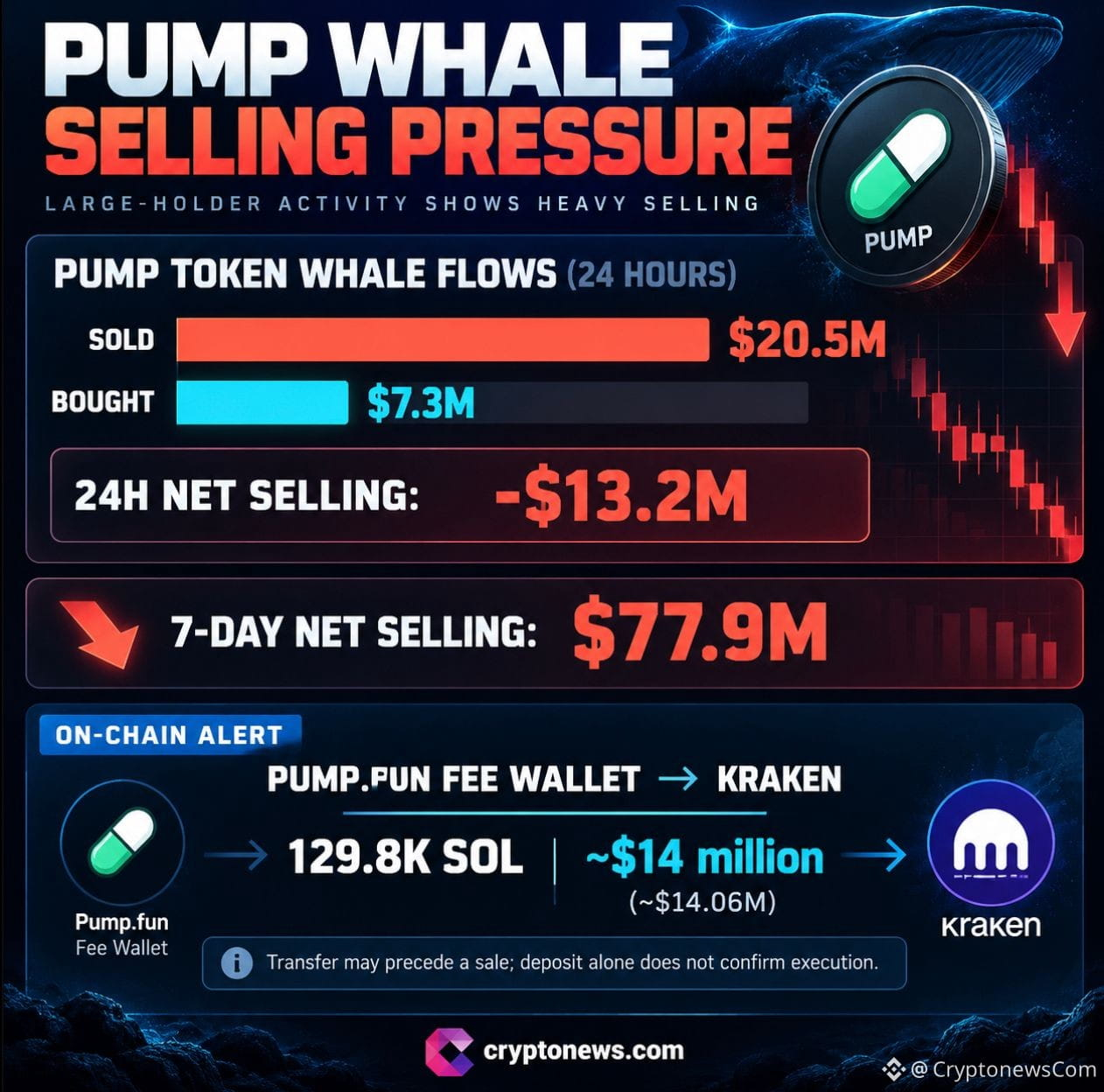
Статья
Crypto Whale Activity: $7.2M Flows Into 9 Altcoins as PUMP and ENA Face Selling PressureCrypto whale activity is sending unusual signals across the altcoin market. One whale deployed $7.22 million across nine coins, including Ethena (ENA), while Pump.fun (PUMP) faces significant whale selling. Meanwhile, historical AAVE accumulation offers contrasting angles for us watching the market.
The reported buying spree, highlighted by blockchain analytics platform Lookonchain, shows some large investors are still finding opportunities in altcoins despite selling pressure elsewhere.
A whale bought ~$7.22M worth of tokens over the past 24 hours, including:
378,129 $LIT ($1.4M)
6.61M $ENA ($1.34M)
3M $ONDO ($1.34M)
1.154M $AERO ($948K)
241.8 $ETH ($591K)
2,944 $QNT ($589K)
61,252 $UNI ($443K)
1,387 $TAO ($368K)
43.3B $PEPE ($195K)https://t.co/9IgfeLT9A8 pic.twitter.com/ZeCPztInZV
— Lookonchain (@lookonchain) October 22, 2026
Lookonchain reported that the investor acquired 378,129 LIT worth $1.4 million, 6.61 million ENA valued at $1.34 million, and 3 million ONDO worth another $1.34 million.
The remaining purchases included $948,000 in Aerodrome (AERO), $591,000 in Ethereum (ETH), $589,000 in Quant (QNT), $443,000 in Uniswap (UNI), $368,000 in Bittensor (TAO), and $195,000 in Pepe (PEPE). The portfolio spans decentralized finance (DeFi), tokenized real-world assets, and meme coins.
Crypto Whale Activity Signaling PUMP and ENA Movements
While one investor accumulated ENA, separate whale trackers flagged selling pressure in both ENA and PUMP.
PUMP saw $13.2 million in net whale selling over 24 hours, with $20.5 million sold against $7.3 million bought. Its seven-day net selling figure reached approximately $77.9 million, suggesting that large-holder distribution remains a concern.
ENA presents a more complicated picture. We tracked wallets recorded $27.5 million in distribution-side flows against $22.7 million in accumulation-side flows over 30 days, leaving approximately $4.8 million in net distribution. The $1.34 million ENA purchase stands out against the distribution trend.
For those monitoring crypto whale activity, the gap is to be questioned. Continued PUMP selling could weigh on sentiment, while ENA’s competing accumulation and distribution signals leave its next move less certain.
AAVE Whales Buy Millions as Bitcoin Hyper Presale Nears Its End
Historical crypto whale activity provides another angle for traders looking beyond immediate selling pressure. On October 1, Lookonchain reported that a wallet bought 39,018 AAVE worth approximately $6.3 million from Kraken. The transaction demonstrates substantial historical demand for the DeFi token, which then saw ENA run by more than 5%.
Whale 0xe271 bought 39,018 $AAVE ($6.3M) from #Kraken 4 hours ago.https://t.co/gobQ81Bizi pic.twitter.com/tmu69mt7BL
— Lookonchain (@lookonchain) October 1, 2026
Bitcoin Hyper offers a different proposition. It records $33.22 million in presale fundraising milestones, a token price of $0.0136, and around 35 days remaining on its countdown. The project boasts a Bitcoin Layer 2 network designed to support faster transactions and additional functionality.
In November last year, a whale spent 155 ETH, or $374,000, on HYPER during its presale.
Bitcoin Hyper Whale Activity, Etherscan
With the deadline approaching, buyers have a limited window under the current schedule to assess the offering.
Gain Access to New Bitcoin Layer 2 Early Before the Presale Window EndsWhat to Monitor From Crypto Whale Activity?
The latest crypto whale activity reveals contrasting signs: a $7.22 million altcoin buying spree, substantial net selling in PUMP, and mixed flows in ENA. Historical AAVE accumulation and Bitcoin Hyper’s presale countdown add further angles for traders assessing large-investor behavior.
For now, watch whether PUMP selling persists, whether ENA accumulation deepens, and whether Bitcoin Hyper attracts new presale purchases before its deadline. The evidence points to selective positioning.
Discover: The Best Token Presales
The post Crypto Whale Activity: $7.2M Flows Into 9 Altcoins as PUMP and ENA Face Selling Pressure appeared first on Cryptonews.
Crypto Whale Activity: $7.2M Flows Into 9 Altcoins as PUMP and ENA Face Selling Pressure
Crypto whale activity is sending unusual signals across the altcoin market. One whale deployed $7.22 million across nine coins, including Ethena (ENA), while Pump.fun (PUMP) faces significant whale selling. Meanwhile, historical AAVE accumulation offers contrasting angles for us watching the market.
The reported buying spree, highlighted by blockchain analytics platform Lookonchain, shows some large investors are still finding opportunities in altcoins despite selling pressure elsewhere.
A whale bought ~$7.22M worth of tokens over the past 24 hours, including:
378,129 $LIT ($1.4M)
6.61M $ENA ($1.34M)
3M $ONDO ($1.34M)
1.154M $AERO ($948K)
241.8 $ETH ($591K)
2,944 $QNT ($589K)
61,252 $UNI ($443K)
1,387 $TAO ($368K)
43.3B $PEPE ($195K)https://t.co/9IgfeLT9A8 pic.twitter.com/ZeCPztInZV
— Lookonchain (@lookonchain) October 22, 2026
Lookonchain reported that the investor acquired 378,129 LIT worth $1.4 million, 6.61 million ENA valued at $1.34 million, and 3 million ONDO worth another $1.34 million.
The remaining purchases included $948,000 in Aerodrome (AERO), $591,000 in Ethereum (ETH), $589,000 in Quant (QNT), $443,000 in Uniswap (UNI), $368,000 in Bittensor (TAO), and $195,000 in Pepe (PEPE). The portfolio spans decentralized finance (DeFi), tokenized real-world assets, and meme coins.
Crypto Whale Activity Signaling PUMP and ENA Movements
While one investor accumulated ENA, separate whale trackers flagged selling pressure in both ENA and PUMP.
PUMP saw $13.2 million in net whale selling over 24 hours, with $20.5 million sold against $7.3 million bought. Its seven-day net selling figure reached approximately $77.9 million, suggesting that large-holder distribution remains a concern.
ENA presents a more complicated picture. We tracked wallets recorded $27.5 million in distribution-side flows against $22.7 million in accumulation-side flows over 30 days, leaving approximately $4.8 million in net distribution. The $1.34 million ENA purchase stands out against the distribution trend.
For those monitoring crypto whale activity, the gap is to be questioned. Continued PUMP selling could weigh on sentiment, while ENA’s competing accumulation and distribution signals leave its next move less certain.
AAVE Whales Buy Millions as Bitcoin Hyper Presale Nears Its End
Historical crypto whale activity provides another angle for traders looking beyond immediate selling pressure. On October 1, Lookonchain reported that a wallet bought 39,018 AAVE worth approximately $6.3 million from Kraken. The transaction demonstrates substantial historical demand for the DeFi token, which then saw ENA run by more than 5%.
Whale 0xe271 bought 39,018 $AAVE ($6.3M) from #Kraken 4 hours ago.https://t.co/gobQ81Bizi pic.twitter.com/tmu69mt7BL
— Lookonchain (@lookonchain) October 1, 2026
Bitcoin Hyper offers a different proposition. It records $33.22 million in presale fundraising milestones, a token price of $0.0136, and around 35 days remaining on its countdown. The project boasts a Bitcoin Layer 2 network designed to support faster transactions and additional functionality.
In November last year, a whale spent 155 ETH, or $374,000, on HYPER during its presale.
Bitcoin Hyper Whale Activity, Etherscan
With the deadline approaching, buyers have a limited window under the current schedule to assess the offering.
Gain Access to New Bitcoin Layer 2 Early Before the Presale Window EndsWhat to Monitor From Crypto Whale Activity?
The latest crypto whale activity reveals contrasting signs: a $7.22 million altcoin buying spree, substantial net selling in PUMP, and mixed flows in ENA. Historical AAVE accumulation and Bitcoin Hyper’s presale countdown add further angles for traders assessing large-investor behavior.
For now, watch whether PUMP selling persists, whether ENA accumulation deepens, and whether Bitcoin Hyper attracts new presale purchases before its deadline. The evidence points to selective positioning.
Discover: The Best Token Presales
The post Crypto Whale Activity: $7.2M Flows Into 9 Altcoins as PUMP and ENA Face Selling Pressure appeared first on Cryptonews.
The reported buying spree, highlighted by blockchain analytics platform Lookonchain, shows some large investors are still finding opportunities in altcoins despite selling pressure elsewhere.
A whale bought ~$7.22M worth of tokens over the past 24 hours, including:
378,129 $LIT ($1.4M)
6.61M $ENA ($1.34M)
3M $ONDO ($1.34M)
1.154M $AERO ($948K)
241.8 $ETH ($591K)
2,944 $QNT ($589K)
61,252 $UNI ($443K)
1,387 $TAO ($368K)
43.3B $PEPE ($195K)https://t.co/9IgfeLT9A8 pic.twitter.com/ZeCPztInZV
— Lookonchain (@lookonchain) October 22, 2026
Lookonchain reported that the investor acquired 378,129 LIT worth $1.4 million, 6.61 million ENA valued at $1.34 million, and 3 million ONDO worth another $1.34 million.
The remaining purchases included $948,000 in Aerodrome (AERO), $591,000 in Ethereum (ETH), $589,000 in Quant (QNT), $443,000 in Uniswap (UNI), $368,000 in Bittensor (TAO), and $195,000 in Pepe (PEPE). The portfolio spans decentralized finance (DeFi), tokenized real-world assets, and meme coins.
Crypto Whale Activity Signaling PUMP and ENA Movements
While one investor accumulated ENA, separate whale trackers flagged selling pressure in both ENA and PUMP.
PUMP saw $13.2 million in net whale selling over 24 hours, with $20.5 million sold against $7.3 million bought. Its seven-day net selling figure reached approximately $77.9 million, suggesting that large-holder distribution remains a concern.
ENA presents a more complicated picture. We tracked wallets recorded $27.5 million in distribution-side flows against $22.7 million in accumulation-side flows over 30 days, leaving approximately $4.8 million in net distribution. The $1.34 million ENA purchase stands out against the distribution trend.
For those monitoring crypto whale activity, the gap is to be questioned. Continued PUMP selling could weigh on sentiment, while ENA’s competing accumulation and distribution signals leave its next move less certain.
AAVE Whales Buy Millions as Bitcoin Hyper Presale Nears Its End
Historical crypto whale activity provides another angle for traders looking beyond immediate selling pressure. On October 1, Lookonchain reported that a wallet bought 39,018 AAVE worth approximately $6.3 million from Kraken. The transaction demonstrates substantial historical demand for the DeFi token, which then saw ENA run by more than 5%.
Whale 0xe271 bought 39,018 $AAVE ($6.3M) from #Kraken 4 hours ago.https://t.co/gobQ81Bizi pic.twitter.com/tmu69mt7BL
— Lookonchain (@lookonchain) October 1, 2026
Bitcoin Hyper offers a different proposition. It records $33.22 million in presale fundraising milestones, a token price of $0.0136, and around 35 days remaining on its countdown. The project boasts a Bitcoin Layer 2 network designed to support faster transactions and additional functionality.
In November last year, a whale spent 155 ETH, or $374,000, on HYPER during its presale.
Bitcoin Hyper Whale Activity, Etherscan
With the deadline approaching, buyers have a limited window under the current schedule to assess the offering.
Gain Access to New Bitcoin Layer 2 Early Before the Presale Window EndsWhat to Monitor From Crypto Whale Activity?
The latest crypto whale activity reveals contrasting signs: a $7.22 million altcoin buying spree, substantial net selling in PUMP, and mixed flows in ENA. Historical AAVE accumulation and Bitcoin Hyper’s presale countdown add further angles for traders assessing large-investor behavior.
For now, watch whether PUMP selling persists, whether ENA accumulation deepens, and whether Bitcoin Hyper attracts new presale purchases before its deadline. The evidence points to selective positioning.
Discover: The Best Token Presales
The post Crypto Whale Activity: $7.2M Flows Into 9 Altcoins as PUMP and ENA Face Selling Pressure appeared first on Cryptonews.
1
1.7k
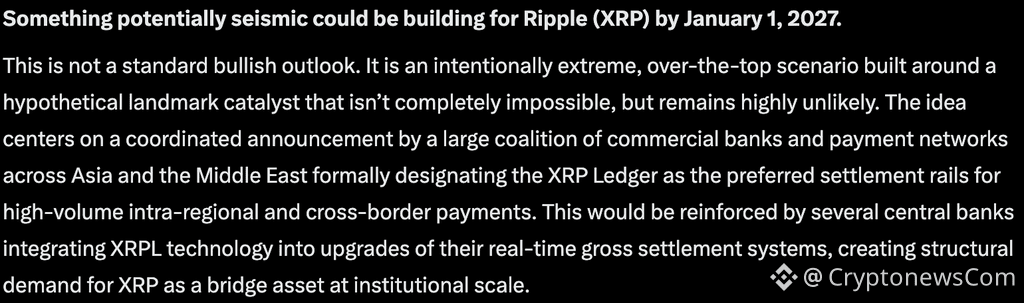
Статья
Mark Zuckerberg’s Meta AI Makes Outlandish XRP Price ClaimIf you are a staunch member of the Ripple Army, you may want to read on. Mark Zuckerberg’s Meta AI predicts that something potentially seismic is building for XRP, suggesting it could be set for a historic move by January 1, 2027.
The catalyst in question centers on a coordinated announcement by a large coalition of commercial banks and payment networks across Asia and the Middle East formally designating the XRP Ledger as the preferred settlement rail for high-volume intra-regional and cross-border payments.
SOURCE: Meta AI Predicts a Huge Upcoming Move for XRP
Several central banks would reinforce this by integrating XRPL technology into upgrades to their real-time gross settlement systems, creating structural demand for XRP as a bridge asset at institutional scale.
XRP is currently up a modest +0.5% on the day, holding steady above key support at $1.30 after a +2.5% weekly climb. Ripple’s market cap sits at around $83.7Bn, making it the 5th largest digital asset, per CoinGecko data.
Meta AI Predicts a Huge Move Brewing for XRP: What Does the Technical Analysis Say?
Xrp (XRP)
24h7d30d1yAll time
On the higher timeframes, XRP has been consolidating in the $1.30–$1.40 region after testing higher levels near $1.50 earlier in the month. Price continues to hold above key intermediate supports while facing resistance around the $1.40–$1.50 zone.
In a standard bull market, a sustained breakout above $1.60–$1.80 would confirm intermediate strength and open the path toward the prior all-time high near $3.66.
Under the extreme multi-region banking and central-bank settlement adoption scenario outlined above, clearing that previous high would likely trigger powerful measured-move extensions and multi-cycle Fibonacci projections from the long-term base.
Momentum indicators are currently neutral, with significant room to run into the extreme overbought levels typical of parabolic advances. Key near-term support sits in the $1.28–$1.32 and $1.20–$1.25 zones.
Holding those levels would keep the broader recovery structure intact while the market prices in any major narrative shifts, making them key data points to watch over the next few weeks.
Bitcoin Hyper Targets Early-Mover Interest as XRP Tests Key Levels
Bitcoin on the screen. $HYPER on the mind.https://t.co/VNG0P4GuDo pic.twitter.com/BD02AGLl5U
— Bitcoin Hyper (@BTC_Hyper2) October 19, 2026
XRP is holding support at $1.30 and is still -66% from its all-time high; Meta AI’s insanely bullish prediction seems uncertain. That uncertainty is pushing traders to look at infrastructure plays offering BTC exposure.
Bitcoin Hyper ($HYPER) is a Bitcoin Layer 2 project that incorporates the Solana Virtual Machine (SVM), positioning itself to deliver faster smart contracts and lower-cost execution in the Bitcoin ecosystem. The project’s feature set includes a Decentralized Canonical Bridge for BTC transfers and low-latency Layer 2 processing.
HYPER is priced at just $0.0136877, with more than $33.2M raised, making it one of 2026’s biggest and most in-demand presales. Staking is live at a lucrative 30% APY, but it’s only available to presale buyers.
Research Bitcoin Hyper before the presale window closes in around 30 days.
Gain Access to New Bitcoin Layer 2 Early HereThe Prediction
Under this highly speculative scenario, and assuming a full-blown crypto bull market returns, XRP could reach anywhere between $30 and $55, with a stretch target toward $80+ by January 1, 2027.
This remains pure speculation and entertainment, not a realistic base-case outlook. The catalyst would require extraordinary coordination among major banks and central banks across multiple regions that is currently highly unlikely.
Discover: The Best Token Presales
The post Mark Zuckerberg’s Meta AI Makes Outlandish XRP Price Claim appeared first on Cryptonews.
Mark Zuckerberg’s Meta AI Makes Outlandish XRP Price Claim
If you are a staunch member of the Ripple Army, you may want to read on. Mark Zuckerberg’s Meta AI predicts that something potentially seismic is building for XRP, suggesting it could be set for a historic move by January 1, 2027.
The catalyst in question centers on a coordinated announcement by a large coalition of commercial banks and payment networks across Asia and the Middle East formally designating the XRP Ledger as the preferred settlement rail for high-volume intra-regional and cross-border payments.
SOURCE: Meta AI Predicts a Huge Upcoming Move for XRP
Several central banks would reinforce this by integrating XRPL technology into upgrades to their real-time gross settlement systems, creating structural demand for XRP as a bridge asset at institutional scale.
XRP is currently up a modest +0.5% on the day, holding steady above key support at $1.30 after a +2.5% weekly climb. Ripple’s market cap sits at around $83.7Bn, making it the 5th largest digital asset, per CoinGecko data.
Meta AI Predicts a Huge Move Brewing for XRP: What Does the Technical Analysis Say?
Xrp (XRP)
24h7d30d1yAll time
On the higher timeframes, XRP has been consolidating in the $1.30–$1.40 region after testing higher levels near $1.50 earlier in the month. Price continues to hold above key intermediate supports while facing resistance around the $1.40–$1.50 zone.
In a standard bull market, a sustained breakout above $1.60–$1.80 would confirm intermediate strength and open the path toward the prior all-time high near $3.66.
Under the extreme multi-region banking and central-bank settlement adoption scenario outlined above, clearing that previous high would likely trigger powerful measured-move extensions and multi-cycle Fibonacci projections from the long-term base.
Momentum indicators are currently neutral, with significant room to run into the extreme overbought levels typical of parabolic advances. Key near-term support sits in the $1.28–$1.32 and $1.20–$1.25 zones.
Holding those levels would keep the broader recovery structure intact while the market prices in any major narrative shifts, making them key data points to watch over the next few weeks.
Bitcoin Hyper Targets Early-Mover Interest as XRP Tests Key Levels
Bitcoin on the screen. $HYPER on the mind.https://t.co/VNG0P4GuDo pic.twitter.com/BD02AGLl5U
— Bitcoin Hyper (@BTC_Hyper2) October 19, 2026
XRP is holding support at $1.30 and is still -66% from its all-time high; Meta AI’s insanely bullish prediction seems uncertain. That uncertainty is pushing traders to look at infrastructure plays offering BTC exposure.
Bitcoin Hyper ($HYPER) is a Bitcoin Layer 2 project that incorporates the Solana Virtual Machine (SVM), positioning itself to deliver faster smart contracts and lower-cost execution in the Bitcoin ecosystem. The project’s feature set includes a Decentralized Canonical Bridge for BTC transfers and low-latency Layer 2 processing.
HYPER is priced at just $0.0136877, with more than $33.2M raised, making it one of 2026’s biggest and most in-demand presales. Staking is live at a lucrative 30% APY, but it’s only available to presale buyers.
Research Bitcoin Hyper before the presale window closes in around 30 days.
Gain Access to New Bitcoin Layer 2 Early HereThe Prediction
Under this highly speculative scenario, and assuming a full-blown crypto bull market returns, XRP could reach anywhere between $30 and $55, with a stretch target toward $80+ by January 1, 2027.
This remains pure speculation and entertainment, not a realistic base-case outlook. The catalyst would require extraordinary coordination among major banks and central banks across multiple regions that is currently highly unlikely.
Discover: The Best Token Presales
The post Mark Zuckerberg’s Meta AI Makes Outlandish XRP Price Claim appeared first on Cryptonews.
The catalyst in question centers on a coordinated announcement by a large coalition of commercial banks and payment networks across Asia and the Middle East formally designating the XRP Ledger as the preferred settlement rail for high-volume intra-regional and cross-border payments.
SOURCE: Meta AI Predicts a Huge Upcoming Move for XRP
Several central banks would reinforce this by integrating XRPL technology into upgrades to their real-time gross settlement systems, creating structural demand for XRP as a bridge asset at institutional scale.
XRP is currently up a modest +0.5% on the day, holding steady above key support at $1.30 after a +2.5% weekly climb. Ripple’s market cap sits at around $83.7Bn, making it the 5th largest digital asset, per CoinGecko data.
Meta AI Predicts a Huge Move Brewing for XRP: What Does the Technical Analysis Say?
Xrp (XRP)
24h7d30d1yAll time
On the higher timeframes, XRP has been consolidating in the $1.30–$1.40 region after testing higher levels near $1.50 earlier in the month. Price continues to hold above key intermediate supports while facing resistance around the $1.40–$1.50 zone.
In a standard bull market, a sustained breakout above $1.60–$1.80 would confirm intermediate strength and open the path toward the prior all-time high near $3.66.
Under the extreme multi-region banking and central-bank settlement adoption scenario outlined above, clearing that previous high would likely trigger powerful measured-move extensions and multi-cycle Fibonacci projections from the long-term base.
Momentum indicators are currently neutral, with significant room to run into the extreme overbought levels typical of parabolic advances. Key near-term support sits in the $1.28–$1.32 and $1.20–$1.25 zones.
Holding those levels would keep the broader recovery structure intact while the market prices in any major narrative shifts, making them key data points to watch over the next few weeks.
Bitcoin Hyper Targets Early-Mover Interest as XRP Tests Key Levels
Bitcoin on the screen. $HYPER on the mind.https://t.co/VNG0P4GuDo pic.twitter.com/BD02AGLl5U
— Bitcoin Hyper (@BTC_Hyper2) October 19, 2026
XRP is holding support at $1.30 and is still -66% from its all-time high; Meta AI’s insanely bullish prediction seems uncertain. That uncertainty is pushing traders to look at infrastructure plays offering BTC exposure.
Bitcoin Hyper ($HYPER) is a Bitcoin Layer 2 project that incorporates the Solana Virtual Machine (SVM), positioning itself to deliver faster smart contracts and lower-cost execution in the Bitcoin ecosystem. The project’s feature set includes a Decentralized Canonical Bridge for BTC transfers and low-latency Layer 2 processing.
HYPER is priced at just $0.0136877, with more than $33.2M raised, making it one of 2026’s biggest and most in-demand presales. Staking is live at a lucrative 30% APY, but it’s only available to presale buyers.
Research Bitcoin Hyper before the presale window closes in around 30 days.
Gain Access to New Bitcoin Layer 2 Early HereThe Prediction
Under this highly speculative scenario, and assuming a full-blown crypto bull market returns, XRP could reach anywhere between $30 and $55, with a stretch target toward $80+ by January 1, 2027.
This remains pure speculation and entertainment, not a realistic base-case outlook. The catalyst would require extraordinary coordination among major banks and central banks across multiple regions that is currently highly unlikely.
Discover: The Best Token Presales
The post Mark Zuckerberg’s Meta AI Makes Outlandish XRP Price Claim appeared first on Cryptonews.
2
2
717
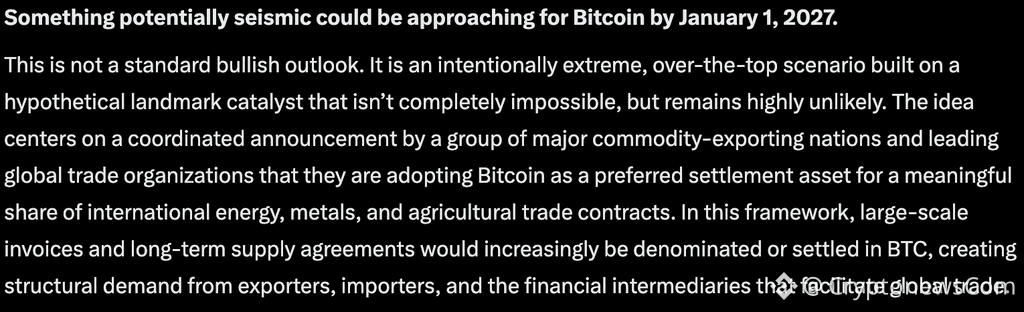
Статья
Mark Zuckerberg Meta AI Predicts an Insane Run for BTC in Q4Something potentially seismic could be approaching for Bitcoin by January 1, 2027. Mark Zuckerberg’s Meta AI predicts that if a full-blown bull market returns in Q4 and a major catalyst lands, BTC could hit insane new highs.
Meta AI highlighted a significant development: a coordinated announcement from major commodity-exporting nations and leading global trade organizations. This announcement indicates that they are adopting Bitcoin as a preferred asset for settling a substantial portion of international contracts in energy, metals, and agriculture.
SOURCE: Meta AI Predicts Huge Move for BTC
As a result, more large-scale invoices and long-term supply agreements will be denominated or settled in Bitcoin. This shift is expected to create structural demand from exporters, importers, and financial intermediaries that facilitate global trade.
This bullish prediction from Mark Zuckerberg’s AI bot comes as Bitcoin continues to range between $81,000 and $84,000, with multiple failed attempts to breach $85,000 resistance. Daily trading volume sits at $36.7Bn, up from $28Bn the day prior. Stick around until the end to see what BTC price Meta AI is calling for.
Meta AI Predicts a Huge Run for Bitcoin: How Does BTC Get Back to Six Figures?
Bitcoin (BTC)
24h7d30d1yAll time
On the higher timeframes, Bitcoin has been consolidating and attempting to build momentum in the low-to-mid $80,000s, recently testing the mid-$84,000 area after holding key support near $80,000–$82,000.
Price continues to form higher lows relative to earlier cycle troughs while facing resistance around recent local highs. In a standard bull market, a decisive weekly close above $90,000–$95,000 would confirm intermediate strength and open the path toward the prior all-time high near $126,000.
Under the extreme commodity-trade settlement adoption scenario outlined above, clearing that previous high would likely unleash powerful measured-move extensions and multi-cycle Fibonacci projections from the multi-year base.
Momentum indicators currently sit in neutral-to-improving territory, with substantial room to reach the extreme overbought readings characteristic of parabolic advances.
Key near-term support sits in the $80,000–$82,000 and $76,000–$78,000 zones; holding those levels would preserve the broader recovery structure while the market digests any major narrative developments.
Discover: The Top Crypto Presales for Q4 2026
$33M Presale Play Bitcoin Hyper Enters its Final Leg Before Full November Launch
One day closer to $HYPER Speed. pic.twitter.com/DNmawhVhRw
— Bitcoin Hyper (@BTC_Hyper2) October 22, 2026
While Bitcoin continues to struggle to breach the $85K resistance level, Meta AI’s prediction that it could hit $1M+ by 2027 seems increasingly unlikely. For higher upside potential, investors are seeking out blue-chip early-stage plays as an alternative.
That BTC uncertainty is pushing traders to look at infrastructure plays alongside BTC exposure. Bitcoin Hyper (HYPER) is a Bitcoin Layer 2 project that incorporates the Solana Virtual Machine (SVM), positioning itself to deliver faster smart contracts and lower-cost execution in the Bitcoin ecosystem. The project’s feature set includes a Decentralized Canonical Bridge for BTC transfers and low-latency Layer 2 processing.
HYPER is currently priced at just $0.0136877, with more than $33.2M raised, making it one of the most in-demand presale plays in recent memory. Staking is live, offering a high 30% APY, but only for presale buyers.
Research Bitcoin Hyper before the presale window closes in less than 30 days and HYPER hits the open market.
Gain Access to New Bitcoin Layer 2 Early HereMeta AI Predicts the Bitcoin Price: What is the Number?
CZ JUST DROPPED A MASSIVE BITCOIN SCARCITY TAKE
Binance founder CZ believes a time will come when even millionaires struggle to afford 1 full $BTC.
With a hard cap of just 21 million Bitcoin, the race to accumulate is getting more interesting.
Will owning 1 full Bitcoin… pic.twitter.com/dhYVhqbsLf
— BTC News Global (@BTCNewsGlobal) October 16, 2026
Under this highly speculative scenario, and assuming a full-blown crypto bull market returns, Bitcoin could reach anywhere between $700,000 and $1,300,000, with a stretch target toward $1,800,000+ by January 1, 2027.
While this remains pure speculation and entertainment, not a realistic base-case outlook, the $1M price target for Bitcoin is real, with many high-profile figures believing it will come sooner rather than later, including Binance founder CZ.
However, the catalyst would require extraordinary coordination among major commodity producers and trade bodies, which is currently highly unlikely in the short term.
Discover: The Best Token Presales
The post Mark Zuckerberg Meta AI Predicts an Insane Run for BTC in Q4 appeared first on Cryptonews.
Mark Zuckerberg Meta AI Predicts an Insane Run for BTC in Q4
Something potentially seismic could be approaching for Bitcoin by January 1, 2027. Mark Zuckerberg’s Meta AI predicts that if a full-blown bull market returns in Q4 and a major catalyst lands, BTC could hit insane new highs.
Meta AI highlighted a significant development: a coordinated announcement from major commodity-exporting nations and leading global trade organizations. This announcement indicates that they are adopting Bitcoin as a preferred asset for settling a substantial portion of international contracts in energy, metals, and agriculture.
SOURCE: Meta AI Predicts Huge Move for BTC
As a result, more large-scale invoices and long-term supply agreements will be denominated or settled in Bitcoin. This shift is expected to create structural demand from exporters, importers, and financial intermediaries that facilitate global trade.
This bullish prediction from Mark Zuckerberg’s AI bot comes as Bitcoin continues to range between $81,000 and $84,000, with multiple failed attempts to breach $85,000 resistance. Daily trading volume sits at $36.7Bn, up from $28Bn the day prior. Stick around until the end to see what BTC price Meta AI is calling for.
Meta AI Predicts a Huge Run for Bitcoin: How Does BTC Get Back to Six Figures?
Bitcoin (BTC)
24h7d30d1yAll time
On the higher timeframes, Bitcoin has been consolidating and attempting to build momentum in the low-to-mid $80,000s, recently testing the mid-$84,000 area after holding key support near $80,000–$82,000.
Price continues to form higher lows relative to earlier cycle troughs while facing resistance around recent local highs. In a standard bull market, a decisive weekly close above $90,000–$95,000 would confirm intermediate strength and open the path toward the prior all-time high near $126,000.
Under the extreme commodity-trade settlement adoption scenario outlined above, clearing that previous high would likely unleash powerful measured-move extensions and multi-cycle Fibonacci projections from the multi-year base.
Momentum indicators currently sit in neutral-to-improving territory, with substantial room to reach the extreme overbought readings characteristic of parabolic advances.
Key near-term support sits in the $80,000–$82,000 and $76,000–$78,000 zones; holding those levels would preserve the broader recovery structure while the market digests any major narrative developments.
Discover: The Top Crypto Presales for Q4 2026
$33M Presale Play Bitcoin Hyper Enters its Final Leg Before Full November Launch
One day closer to $HYPER Speed. pic.twitter.com/DNmawhVhRw
— Bitcoin Hyper (@BTC_Hyper2) October 22, 2026
While Bitcoin continues to struggle to breach the $85K resistance level, Meta AI’s prediction that it could hit $1M+ by 2027 seems increasingly unlikely. For higher upside potential, investors are seeking out blue-chip early-stage plays as an alternative.
That BTC uncertainty is pushing traders to look at infrastructure plays alongside BTC exposure. Bitcoin Hyper (HYPER) is a Bitcoin Layer 2 project that incorporates the Solana Virtual Machine (SVM), positioning itself to deliver faster smart contracts and lower-cost execution in the Bitcoin ecosystem. The project’s feature set includes a Decentralized Canonical Bridge for BTC transfers and low-latency Layer 2 processing.
HYPER is currently priced at just $0.0136877, with more than $33.2M raised, making it one of the most in-demand presale plays in recent memory. Staking is live, offering a high 30% APY, but only for presale buyers.
Research Bitcoin Hyper before the presale window closes in less than 30 days and HYPER hits the open market.
Gain Access to New Bitcoin Layer 2 Early HereMeta AI Predicts the Bitcoin Price: What is the Number?
CZ JUST DROPPED A MASSIVE BITCOIN SCARCITY TAKE
Binance founder CZ believes a time will come when even millionaires struggle to afford 1 full $BTC.
With a hard cap of just 21 million Bitcoin, the race to accumulate is getting more interesting.
Will owning 1 full Bitcoin… pic.twitter.com/dhYVhqbsLf
— BTC News Global (@BTCNewsGlobal) October 16, 2026
Under this highly speculative scenario, and assuming a full-blown crypto bull market returns, Bitcoin could reach anywhere between $700,000 and $1,300,000, with a stretch target toward $1,800,000+ by January 1, 2027.
While this remains pure speculation and entertainment, not a realistic base-case outlook, the $1M price target for Bitcoin is real, with many high-profile figures believing it will come sooner rather than later, including Binance founder CZ.
However, the catalyst would require extraordinary coordination among major commodity producers and trade bodies, which is currently highly unlikely in the short term.
Discover: The Best Token Presales
The post Mark Zuckerberg Meta AI Predicts an Insane Run for BTC in Q4 appeared first on Cryptonews.
Meta AI highlighted a significant development: a coordinated announcement from major commodity-exporting nations and leading global trade organizations. This announcement indicates that they are adopting Bitcoin as a preferred asset for settling a substantial portion of international contracts in energy, metals, and agriculture.
SOURCE: Meta AI Predicts Huge Move for BTC
As a result, more large-scale invoices and long-term supply agreements will be denominated or settled in Bitcoin. This shift is expected to create structural demand from exporters, importers, and financial intermediaries that facilitate global trade.
This bullish prediction from Mark Zuckerberg’s AI bot comes as Bitcoin continues to range between $81,000 and $84,000, with multiple failed attempts to breach $85,000 resistance. Daily trading volume sits at $36.7Bn, up from $28Bn the day prior. Stick around until the end to see what BTC price Meta AI is calling for.
Meta AI Predicts a Huge Run for Bitcoin: How Does BTC Get Back to Six Figures?
Bitcoin (BTC)
24h7d30d1yAll time
On the higher timeframes, Bitcoin has been consolidating and attempting to build momentum in the low-to-mid $80,000s, recently testing the mid-$84,000 area after holding key support near $80,000–$82,000.
Price continues to form higher lows relative to earlier cycle troughs while facing resistance around recent local highs. In a standard bull market, a decisive weekly close above $90,000–$95,000 would confirm intermediate strength and open the path toward the prior all-time high near $126,000.
Under the extreme commodity-trade settlement adoption scenario outlined above, clearing that previous high would likely unleash powerful measured-move extensions and multi-cycle Fibonacci projections from the multi-year base.
Momentum indicators currently sit in neutral-to-improving territory, with substantial room to reach the extreme overbought readings characteristic of parabolic advances.
Key near-term support sits in the $80,000–$82,000 and $76,000–$78,000 zones; holding those levels would preserve the broader recovery structure while the market digests any major narrative developments.
Discover: The Top Crypto Presales for Q4 2026
$33M Presale Play Bitcoin Hyper Enters its Final Leg Before Full November Launch
One day closer to $HYPER Speed. pic.twitter.com/DNmawhVhRw
— Bitcoin Hyper (@BTC_Hyper2) October 22, 2026
While Bitcoin continues to struggle to breach the $85K resistance level, Meta AI’s prediction that it could hit $1M+ by 2027 seems increasingly unlikely. For higher upside potential, investors are seeking out blue-chip early-stage plays as an alternative.
That BTC uncertainty is pushing traders to look at infrastructure plays alongside BTC exposure. Bitcoin Hyper (HYPER) is a Bitcoin Layer 2 project that incorporates the Solana Virtual Machine (SVM), positioning itself to deliver faster smart contracts and lower-cost execution in the Bitcoin ecosystem. The project’s feature set includes a Decentralized Canonical Bridge for BTC transfers and low-latency Layer 2 processing.
HYPER is currently priced at just $0.0136877, with more than $33.2M raised, making it one of the most in-demand presale plays in recent memory. Staking is live, offering a high 30% APY, but only for presale buyers.
Research Bitcoin Hyper before the presale window closes in less than 30 days and HYPER hits the open market.
Gain Access to New Bitcoin Layer 2 Early HereMeta AI Predicts the Bitcoin Price: What is the Number?
CZ JUST DROPPED A MASSIVE BITCOIN SCARCITY TAKE
Binance founder CZ believes a time will come when even millionaires struggle to afford 1 full $BTC.
With a hard cap of just 21 million Bitcoin, the race to accumulate is getting more interesting.
Will owning 1 full Bitcoin… pic.twitter.com/dhYVhqbsLf
— BTC News Global (@BTCNewsGlobal) October 16, 2026
Under this highly speculative scenario, and assuming a full-blown crypto bull market returns, Bitcoin could reach anywhere between $700,000 and $1,300,000, with a stretch target toward $1,800,000+ by January 1, 2027.
While this remains pure speculation and entertainment, not a realistic base-case outlook, the $1M price target for Bitcoin is real, with many high-profile figures believing it will come sooner rather than later, including Binance founder CZ.
However, the catalyst would require extraordinary coordination among major commodity producers and trade bodies, which is currently highly unlikely in the short term.
Discover: The Best Token Presales
The post Mark Zuckerberg Meta AI Predicts an Insane Run for BTC in Q4 appeared first on Cryptonews.
267
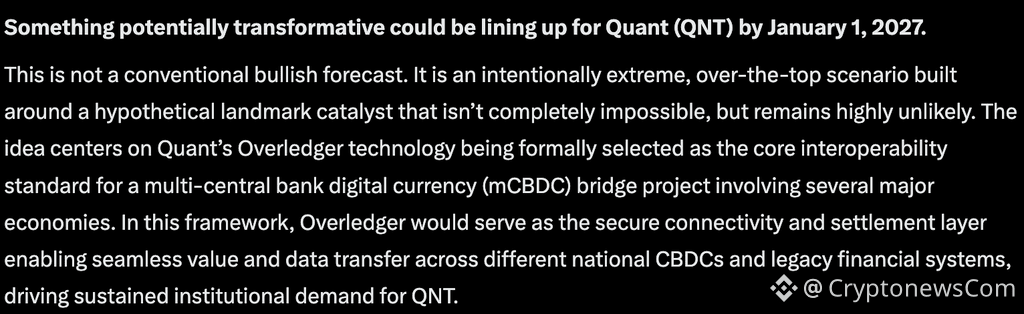
Статья
Sam Altman ChatGPT AI Predicts Something Huge on the Way for Quant (QNT)Sam Altman’s ChatGPT AI predicts that a potentially transformative catalyst could line up for Quant (QNT) by January 1, 2027. If that happens, OpenAI’s chat model believes Quant could significantly outperform the entire market in Q4.
The concept centers on Quant’s Overledger technology being officially designated as the core interoperability standard for a multi-central bank digital currency (mCBDC) bridge project involving several major economies.
In this framework, Overledger would serve as the secure connectivity and settlement layer, enabling seamless transfers of value and data between national CBDCs and traditional financial systems. This would, in turn, foster sustained institutional demand for QNT.
SOURCE: ChatGPT AI Predicts a Huge Move Incoming for Quant (QNT)
Quant (QNT) Technical Analysis: $200 Needs Reclaiming Before Any Explosive Move
Quant (QNT)
24h7d30d1yAll time
On higher timeframes, QNT has been consolidating in the $190–$210 region after a strong multi-month advance that saw prices reach significantly higher levels earlier in the cycle.
Price continues to hold above key intermediate supports while facing resistance around the $220–$250 zone. In a standard bull market, a sustained breakout above $280–$320 would confirm intermediate strength and open the path toward a retest of the prior all-time high near $427.
Under the extreme multi-CBDC interoperability adoption scenario outlined above, clearing that previous high would likely trigger powerful measured-move extensions and multi-cycle Fibonacci projections from the longer-term base.
Momentum indicators currently sit in neutral territory with substantial room to run into the extreme overbought levels typical of parabolic advances.
Key near-term support sits near $180–$190 and $160–$170; holding those levels would keep the broader recovery structure intact while the market prices in any major narrative developments.
Explore: Top Presale Plays for Q4
Maxi Doge Targets Early-Mover Interest as Quant Tests Support
With QNT below key near-term upside, it depends on follow-through. Even a positive announcement may not erase overhead resistance; that is the awkward part of buying a rumor before the chart confirms it.
Some traders may look beyond large-cap setups to early-stage projects, accepting substantially higher execution and liquidity risk.
Maxi Doge (MAXI) is an Ethereum ERC-20 meme token built around a 240-lb canine character and a 1000x-leverage trading-community identity. Its stated price is $0.0002845, and it has raised over $4.8M, nearing its $5M target. Staking is also live at a high 60% APY, but only for presale buyers.
The project also has holder-only trading competitions with leaderboard rewards and a Maxi Fund treasury for liquidity and partnerships.
Get Ahead of Next Meme Coin Launch HereChatGPT AI Predicts: The Big Quant (QNT) Price Reveal
Under this highly speculative scenario, and assuming a full-blown crypto bull market returns, Quant (QNT) could reach $2,500-$4,500, with a stretch target toward $7,000+ by January 1, 2027.
This remains pure speculation and entertainment, not a realistic base-case outlook. The catalyst would require extraordinary coordination among multiple central banks and the Quant ecosystem that is currently highly unlikely.
Discover: The Best Token Presales
The post Sam Altman ChatGPT AI Predicts Something Huge on the Way for Quant (QNT) appeared first on Cryptonews.
Sam Altman ChatGPT AI Predicts Something Huge on the Way for Quant (QNT)
Sam Altman’s ChatGPT AI predicts that a potentially transformative catalyst could line up for Quant (QNT) by January 1, 2027. If that happens, OpenAI’s chat model believes Quant could significantly outperform the entire market in Q4.
The concept centers on Quant’s Overledger technology being officially designated as the core interoperability standard for a multi-central bank digital currency (mCBDC) bridge project involving several major economies.
In this framework, Overledger would serve as the secure connectivity and settlement layer, enabling seamless transfers of value and data between national CBDCs and traditional financial systems. This would, in turn, foster sustained institutional demand for QNT.
SOURCE: ChatGPT AI Predicts a Huge Move Incoming for Quant (QNT)
Quant (QNT) Technical Analysis: $200 Needs Reclaiming Before Any Explosive Move
Quant (QNT)
24h7d30d1yAll time
On higher timeframes, QNT has been consolidating in the $190–$210 region after a strong multi-month advance that saw prices reach significantly higher levels earlier in the cycle.
Price continues to hold above key intermediate supports while facing resistance around the $220–$250 zone. In a standard bull market, a sustained breakout above $280–$320 would confirm intermediate strength and open the path toward a retest of the prior all-time high near $427.
Under the extreme multi-CBDC interoperability adoption scenario outlined above, clearing that previous high would likely trigger powerful measured-move extensions and multi-cycle Fibonacci projections from the longer-term base.
Momentum indicators currently sit in neutral territory with substantial room to run into the extreme overbought levels typical of parabolic advances.
Key near-term support sits near $180–$190 and $160–$170; holding those levels would keep the broader recovery structure intact while the market prices in any major narrative developments.
Explore: Top Presale Plays for Q4
Maxi Doge Targets Early-Mover Interest as Quant Tests Support
With QNT below key near-term upside, it depends on follow-through. Even a positive announcement may not erase overhead resistance; that is the awkward part of buying a rumor before the chart confirms it.
Some traders may look beyond large-cap setups to early-stage projects, accepting substantially higher execution and liquidity risk.
Maxi Doge (MAXI) is an Ethereum ERC-20 meme token built around a 240-lb canine character and a 1000x-leverage trading-community identity. Its stated price is $0.0002845, and it has raised over $4.8M, nearing its $5M target. Staking is also live at a high 60% APY, but only for presale buyers.
The project also has holder-only trading competitions with leaderboard rewards and a Maxi Fund treasury for liquidity and partnerships.
Get Ahead of Next Meme Coin Launch HereChatGPT AI Predicts: The Big Quant (QNT) Price Reveal
Under this highly speculative scenario, and assuming a full-blown crypto bull market returns, Quant (QNT) could reach $2,500-$4,500, with a stretch target toward $7,000+ by January 1, 2027.
This remains pure speculation and entertainment, not a realistic base-case outlook. The catalyst would require extraordinary coordination among multiple central banks and the Quant ecosystem that is currently highly unlikely.
Discover: The Best Token Presales
The post Sam Altman ChatGPT AI Predicts Something Huge on the Way for Quant (QNT) appeared first on Cryptonews.
The concept centers on Quant’s Overledger technology being officially designated as the core interoperability standard for a multi-central bank digital currency (mCBDC) bridge project involving several major economies.
In this framework, Overledger would serve as the secure connectivity and settlement layer, enabling seamless transfers of value and data between national CBDCs and traditional financial systems. This would, in turn, foster sustained institutional demand for QNT.
SOURCE: ChatGPT AI Predicts a Huge Move Incoming for Quant (QNT)
Quant (QNT) Technical Analysis: $200 Needs Reclaiming Before Any Explosive Move
Quant (QNT)
24h7d30d1yAll time
On higher timeframes, QNT has been consolidating in the $190–$210 region after a strong multi-month advance that saw prices reach significantly higher levels earlier in the cycle.
Price continues to hold above key intermediate supports while facing resistance around the $220–$250 zone. In a standard bull market, a sustained breakout above $280–$320 would confirm intermediate strength and open the path toward a retest of the prior all-time high near $427.
Under the extreme multi-CBDC interoperability adoption scenario outlined above, clearing that previous high would likely trigger powerful measured-move extensions and multi-cycle Fibonacci projections from the longer-term base.
Momentum indicators currently sit in neutral territory with substantial room to run into the extreme overbought levels typical of parabolic advances.
Key near-term support sits near $180–$190 and $160–$170; holding those levels would keep the broader recovery structure intact while the market prices in any major narrative developments.
Explore: Top Presale Plays for Q4
Maxi Doge Targets Early-Mover Interest as Quant Tests Support
With QNT below key near-term upside, it depends on follow-through. Even a positive announcement may not erase overhead resistance; that is the awkward part of buying a rumor before the chart confirms it.
Some traders may look beyond large-cap setups to early-stage projects, accepting substantially higher execution and liquidity risk.
Maxi Doge (MAXI) is an Ethereum ERC-20 meme token built around a 240-lb canine character and a 1000x-leverage trading-community identity. Its stated price is $0.0002845, and it has raised over $4.8M, nearing its $5M target. Staking is also live at a high 60% APY, but only for presale buyers.
The project also has holder-only trading competitions with leaderboard rewards and a Maxi Fund treasury for liquidity and partnerships.
Get Ahead of Next Meme Coin Launch HereChatGPT AI Predicts: The Big Quant (QNT) Price Reveal
Under this highly speculative scenario, and assuming a full-blown crypto bull market returns, Quant (QNT) could reach $2,500-$4,500, with a stretch target toward $7,000+ by January 1, 2027.
This remains pure speculation and entertainment, not a realistic base-case outlook. The catalyst would require extraordinary coordination among multiple central banks and the Quant ecosystem that is currently highly unlikely.
Discover: The Best Token Presales
The post Sam Altman ChatGPT AI Predicts Something Huge on the Way for Quant (QNT) appeared first on Cryptonews.
931

Статья
Microsoft Copilot AI Predicts Hyperliquid to Soar to New Highs in Q4Microsoft Copilot AI predicts that something potentially massive is on the horizon for Hyperliquid (HYPE). It believes that by early 2027, HYPE price could make a move that leaves all other digital assets in the dust.
The idea centers on major traditional finance institutions and regulated derivatives exchanges formally integrating Hyperliquid’s technology and liquidity as the primary on-chain venue for high-performance perpetual futures and institutional-grade derivatives trading.
In this framework, significant professional and institutional flow would migrate to Hyperliquid, making HYPE critical infrastructure for the next generation of decentralized and hybrid derivatives markets.
SOURCE: Microsoft Copilot AI Predicts Hyperliquid to Explode
Microsoft Copilot AI Predicts a Storm is Brewing for HYPE: What Does the Technical Analysis Say?
24h7d30d1yAll time
On higher timeframes, HYPE has been consolidating in the $78–$82 region after pulling back from its recent all-time high near $98. Price continues to hold above key intermediate support while facing resistance around $85–$90.
In a standard bull market, a sustained breakout above $100–$120 would confirm intermediate strength and open the path toward significant new price discovery.
Under the extreme institutional derivatives adoption scenario outlined above, clearing prior highs would likely trigger powerful measured-move extensions and multi-cycle Fibonacci projections from the longer-term base.
Momentum indicators currently sit in neutral territory with substantial room to run into the extreme overbought levels typical of parabolic advances.
Key near-term support sits near $75–$78 and $68–$72; holding those levels would keep the broader recovery structure intact while the market prices in any major narrative developments.
Discover: The Crypto Presales This Q4 2026
LiquidChain Targets Cross-Chain Liquidity as Hyperliquid Tests Key Levels
The Order moves together. Always. https://t.co/vqvBcdSQYC pic.twitter.com/Q2nqQSpcdw
— LiquidChain (@getliquidchain) October 22, 2026
HYPE’s daily drop of -3.3% highlights ongoing crypto volatility and makes Microsoft Copilot AI’s bullish prediction seem more hopeful than realistic. For traders looking beyond a mature asset’s near-term range, early-stage infrastructure can offer a different risk profile, along with materially higher execution and adoption risk.
LiquidChain ($LIQUID) is a Layer 3 project built around a single execution environment for Bitcoin, Ethereum, and Solana liquidity. Its features include a Unified Liquidity Layer, Single-Step Execution, Verifiable Settlement, and a Deploy-Once Architecture.
With Liquid, developers deploy once and aim to access all three ecosystems. The presale price is also low at $0.014967, and the project has raised over $985K, quickly approaching its $1M target. Staking APY is live at an incredibly lucrative 1,164% APY rate, only for presale buyers.
Research LiquidChain before the presale window closes and the price increases as it moves on to the next stage.
Gain Special Access to Layer 3 Trading HereThe Final HYPE Prediction
Under this highly speculative scenario, and assuming a full-blown crypto bull market returns, Hyperliquid (HYPE) could reach $450–$800, with a stretch target of $1,200+ by January 1, 2027.
This remains pure speculation and entertainment, not a realistic base-case outlook. The catalyst would require extraordinary coordination between traditional finance institutions and the Hyperliquid ecosystem that is currently highly unlikely.
Discover: The Best Token Presales
The post Microsoft Copilot AI Predicts Hyperliquid to Soar to New Highs in Q4 appeared first on Cryptonews.
Microsoft Copilot AI Predicts Hyperliquid to Soar to New Highs in Q4
Microsoft Copilot AI predicts that something potentially massive is on the horizon for Hyperliquid (HYPE). It believes that by early 2027, HYPE price could make a move that leaves all other digital assets in the dust.
The idea centers on major traditional finance institutions and regulated derivatives exchanges formally integrating Hyperliquid’s technology and liquidity as the primary on-chain venue for high-performance perpetual futures and institutional-grade derivatives trading.
In this framework, significant professional and institutional flow would migrate to Hyperliquid, making HYPE critical infrastructure for the next generation of decentralized and hybrid derivatives markets.
SOURCE: Microsoft Copilot AI Predicts Hyperliquid to Explode
Microsoft Copilot AI Predicts a Storm is Brewing for HYPE: What Does the Technical Analysis Say?
24h7d30d1yAll time
On higher timeframes, HYPE has been consolidating in the $78–$82 region after pulling back from its recent all-time high near $98. Price continues to hold above key intermediate support while facing resistance around $85–$90.
In a standard bull market, a sustained breakout above $100–$120 would confirm intermediate strength and open the path toward significant new price discovery.
Under the extreme institutional derivatives adoption scenario outlined above, clearing prior highs would likely trigger powerful measured-move extensions and multi-cycle Fibonacci projections from the longer-term base.
Momentum indicators currently sit in neutral territory with substantial room to run into the extreme overbought levels typical of parabolic advances.
Key near-term support sits near $75–$78 and $68–$72; holding those levels would keep the broader recovery structure intact while the market prices in any major narrative developments.
Discover: The Crypto Presales This Q4 2026
LiquidChain Targets Cross-Chain Liquidity as Hyperliquid Tests Key Levels
The Order moves together. Always. https://t.co/vqvBcdSQYC pic.twitter.com/Q2nqQSpcdw
— LiquidChain (@getliquidchain) October 22, 2026
HYPE’s daily drop of -3.3% highlights ongoing crypto volatility and makes Microsoft Copilot AI’s bullish prediction seem more hopeful than realistic. For traders looking beyond a mature asset’s near-term range, early-stage infrastructure can offer a different risk profile, along with materially higher execution and adoption risk.
LiquidChain ($LIQUID) is a Layer 3 project built around a single execution environment for Bitcoin, Ethereum, and Solana liquidity. Its features include a Unified Liquidity Layer, Single-Step Execution, Verifiable Settlement, and a Deploy-Once Architecture.
With Liquid, developers deploy once and aim to access all three ecosystems. The presale price is also low at $0.014967, and the project has raised over $985K, quickly approaching its $1M target. Staking APY is live at an incredibly lucrative 1,164% APY rate, only for presale buyers.
Research LiquidChain before the presale window closes and the price increases as it moves on to the next stage.
Gain Special Access to Layer 3 Trading HereThe Final HYPE Prediction
Under this highly speculative scenario, and assuming a full-blown crypto bull market returns, Hyperliquid (HYPE) could reach $450–$800, with a stretch target of $1,200+ by January 1, 2027.
This remains pure speculation and entertainment, not a realistic base-case outlook. The catalyst would require extraordinary coordination between traditional finance institutions and the Hyperliquid ecosystem that is currently highly unlikely.
Discover: The Best Token Presales
The post Microsoft Copilot AI Predicts Hyperliquid to Soar to New Highs in Q4 appeared first on Cryptonews.
The idea centers on major traditional finance institutions and regulated derivatives exchanges formally integrating Hyperliquid’s technology and liquidity as the primary on-chain venue for high-performance perpetual futures and institutional-grade derivatives trading.
In this framework, significant professional and institutional flow would migrate to Hyperliquid, making HYPE critical infrastructure for the next generation of decentralized and hybrid derivatives markets.
SOURCE: Microsoft Copilot AI Predicts Hyperliquid to Explode
Microsoft Copilot AI Predicts a Storm is Brewing for HYPE: What Does the Technical Analysis Say?
24h7d30d1yAll time
On higher timeframes, HYPE has been consolidating in the $78–$82 region after pulling back from its recent all-time high near $98. Price continues to hold above key intermediate support while facing resistance around $85–$90.
In a standard bull market, a sustained breakout above $100–$120 would confirm intermediate strength and open the path toward significant new price discovery.
Under the extreme institutional derivatives adoption scenario outlined above, clearing prior highs would likely trigger powerful measured-move extensions and multi-cycle Fibonacci projections from the longer-term base.
Momentum indicators currently sit in neutral territory with substantial room to run into the extreme overbought levels typical of parabolic advances.
Key near-term support sits near $75–$78 and $68–$72; holding those levels would keep the broader recovery structure intact while the market prices in any major narrative developments.
Discover: The Crypto Presales This Q4 2026
LiquidChain Targets Cross-Chain Liquidity as Hyperliquid Tests Key Levels
The Order moves together. Always. https://t.co/vqvBcdSQYC pic.twitter.com/Q2nqQSpcdw
— LiquidChain (@getliquidchain) October 22, 2026
HYPE’s daily drop of -3.3% highlights ongoing crypto volatility and makes Microsoft Copilot AI’s bullish prediction seem more hopeful than realistic. For traders looking beyond a mature asset’s near-term range, early-stage infrastructure can offer a different risk profile, along with materially higher execution and adoption risk.
LiquidChain ($LIQUID) is a Layer 3 project built around a single execution environment for Bitcoin, Ethereum, and Solana liquidity. Its features include a Unified Liquidity Layer, Single-Step Execution, Verifiable Settlement, and a Deploy-Once Architecture.
With Liquid, developers deploy once and aim to access all three ecosystems. The presale price is also low at $0.014967, and the project has raised over $985K, quickly approaching its $1M target. Staking APY is live at an incredibly lucrative 1,164% APY rate, only for presale buyers.
Research LiquidChain before the presale window closes and the price increases as it moves on to the next stage.
Gain Special Access to Layer 3 Trading HereThe Final HYPE Prediction
Under this highly speculative scenario, and assuming a full-blown crypto bull market returns, Hyperliquid (HYPE) could reach $450–$800, with a stretch target of $1,200+ by January 1, 2027.
This remains pure speculation and entertainment, not a realistic base-case outlook. The catalyst would require extraordinary coordination between traditional finance institutions and the Hyperliquid ecosystem that is currently highly unlikely.
Discover: The Best Token Presales
The post Microsoft Copilot AI Predicts Hyperliquid to Soar to New Highs in Q4 appeared first on Cryptonews.
143
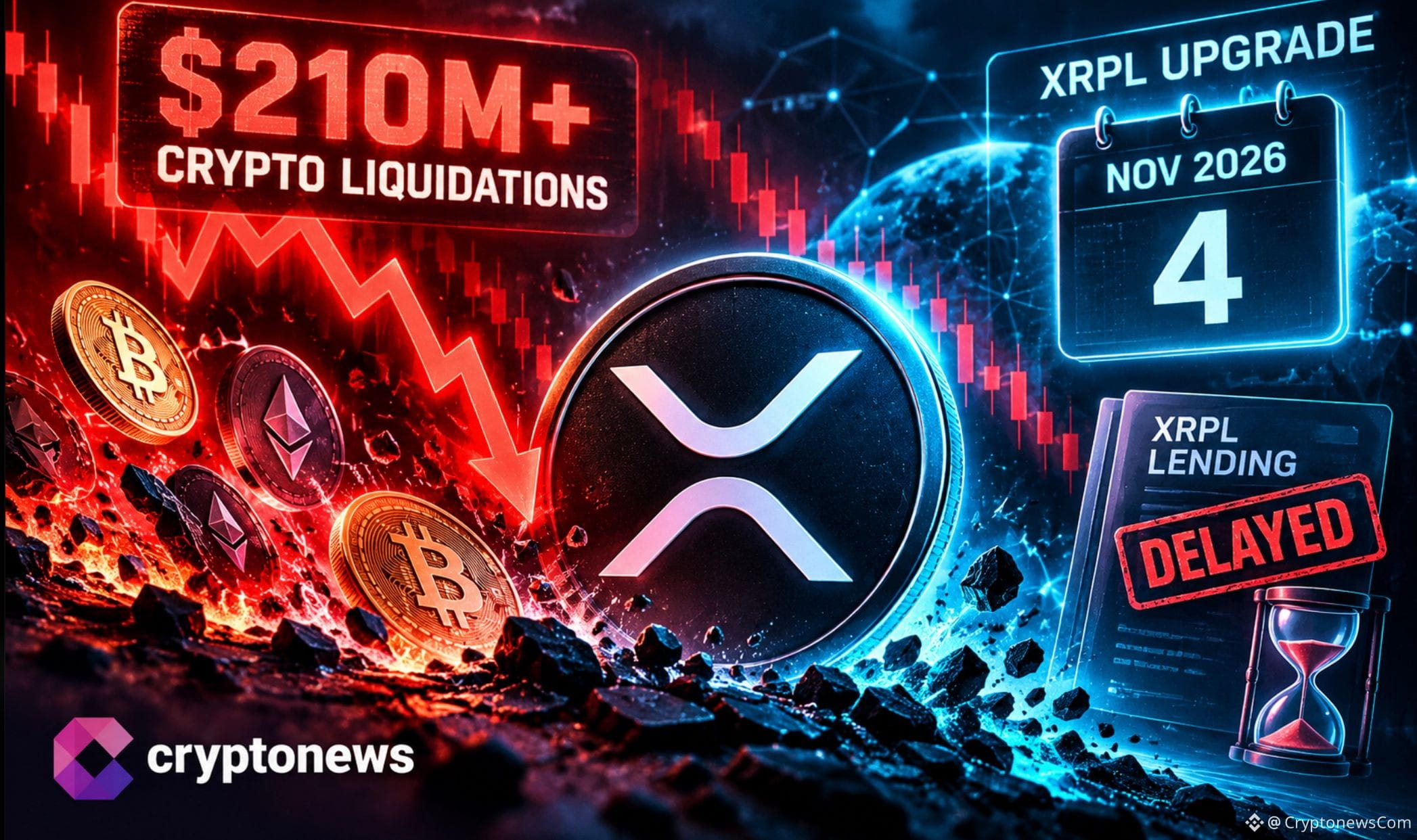
Статья
XRP Price Falls as Crypto Longs Get Wiped Out and XRPL Upgrade DelayedThe XRP price fell below $1.35 just now after an attempted recovery toward $1.40 lost momentum. Not just XRP, renewed selling pressure also hit the crypto market. More than $220 million in crypto long positions were reportedly liquidated over 12 hours as Bitcoin and Ethereum dropped toward $81,000 and $2,300, respectively.
Crypto Liquidation, Coinglass
The downturn comes as the XRP Ledger prepares a significant network maintenance update, although a setback in validator support has pushed its expected activation into November. The combination of weakening price action, leveraged liquidations, and uncertainty surrounding the upgrade leaves XRP wobbling, waiting to see if buyers can defend the $1.30 area.
XRP Price Reversal Deepens, Liquidations Mount
Xrp (XRP)
24h7d30d1yAll time
The XRP price climbed toward $1.40 just a few hours ago before reversing lower. The token subsequently fell through the $1.38 and $1.36 areas before approaching $1.33, leaving the attempted recovery looking increasingly fragile.
As of now, XRP price is down 2% over 24 hours, despite remaining up 1.1% over seven days. The $220 million liquidation wave adds another source of pressure. When leveraged traders open long positions, they are betting that prices will rise. A sharp decline can trigger forced closures when collateral becomes insufficient, potentially adding selling pressure and accelerating losses.
For the XRP price, the immediate technical question is whether buyers can hold the $1.30–$1.32 region. A recovery above $1.35 would help ease some short-term pressure, while another breakdown could leave the token exposed to further losses.
Discover: The Crypto Presales This Q4 2026
XRPL Upgrade Delayed After Validator Support Falls
The XRP Ledger’s fixCleanup3_4_0 amendment was initially expected to activate on October 23, but that timeline has changed. Validator support briefly fell to 26 of 35 trusted validators, below the 29 votes required to maintain the necessary majority. The countdown consequently restarted, moving the projected activation to November 4 at 14:46 UTC.
XRP Ledger Bug Fix Hits a Last Minute Roadblock
The XRP Ledger’s (@XRP) $XRP fixCleanup3_4_0 amendment has been delayed until November after validator support briefly fell below the required threshold.
The network requires at least 29 validators to maintain approval throughout… pic.twitter.com/9aunWT0Kbj
— BSCN (@BSCNews) October 22, 2026
The amendment bundles technical corrections affecting several XRPL components, including single-asset vaults, lending, automated market makers, the permissioned decentralized exchange, trust lines, NFTs, escrow, and transaction signing. These changes are intended to correct issues in the network’s implementation.
XRP Price Depends on Buyers and Network Progress
The revised upgrade timeline gives traders another date to monitor, but the XRP price must first contend with the current market downturn. If buyers defend $1.30–$1.32 and reclaim $1.35, the token could attempt another move toward $1.38 and the $1.40 area.
A sustained break below $1.30 would weaken that recovery scenario and could encourage further selling, particularly if Bitcoin and Ethereum continue to fall. Traders will also be watching whether liquidation pressure eases and whether spot-market demand returns.
The November 4 activation projection provides a potential network catalyst, provided validator support remains above the required threshold. Meanwhile, XRPL’s separate lending amendments have not received the necessary approval, meaning the maintenance update should not be confused with the launch of a fully enabled lending protocol.
For now, the XRP price faces a near-term test of market demand while the ledger’s next technical milestone moves further out. A sustained recovery will likely require stronger buying interest and improved conditions across the broader crypto market, rather than the upgrade date alone.
Discover: The Best Token Presales
The post XRP Price Falls as Crypto Longs Get Wiped Out and XRPL Upgrade Delayed appeared first on Cryptonews.
XRP Price Falls as Crypto Longs Get Wiped Out and XRPL Upgrade Delayed
The XRP price fell below $1.35 just now after an attempted recovery toward $1.40 lost momentum. Not just XRP, renewed selling pressure also hit the crypto market. More than $220 million in crypto long positions were reportedly liquidated over 12 hours as Bitcoin and Ethereum dropped toward $81,000 and $2,300, respectively.
Crypto Liquidation, Coinglass
The downturn comes as the XRP Ledger prepares a significant network maintenance update, although a setback in validator support has pushed its expected activation into November. The combination of weakening price action, leveraged liquidations, and uncertainty surrounding the upgrade leaves XRP wobbling, waiting to see if buyers can defend the $1.30 area.
XRP Price Reversal Deepens, Liquidations Mount
Xrp (XRP)
24h7d30d1yAll time
The XRP price climbed toward $1.40 just a few hours ago before reversing lower. The token subsequently fell through the $1.38 and $1.36 areas before approaching $1.33, leaving the attempted recovery looking increasingly fragile.
As of now, XRP price is down 2% over 24 hours, despite remaining up 1.1% over seven days. The $220 million liquidation wave adds another source of pressure. When leveraged traders open long positions, they are betting that prices will rise. A sharp decline can trigger forced closures when collateral becomes insufficient, potentially adding selling pressure and accelerating losses.
For the XRP price, the immediate technical question is whether buyers can hold the $1.30–$1.32 region. A recovery above $1.35 would help ease some short-term pressure, while another breakdown could leave the token exposed to further losses.
Discover: The Crypto Presales This Q4 2026
XRPL Upgrade Delayed After Validator Support Falls
The XRP Ledger’s fixCleanup3_4_0 amendment was initially expected to activate on October 23, but that timeline has changed. Validator support briefly fell to 26 of 35 trusted validators, below the 29 votes required to maintain the necessary majority. The countdown consequently restarted, moving the projected activation to November 4 at 14:46 UTC.
XRP Ledger Bug Fix Hits a Last Minute Roadblock
The XRP Ledger’s (@XRP) $XRP fixCleanup3_4_0 amendment has been delayed until November after validator support briefly fell below the required threshold.
The network requires at least 29 validators to maintain approval throughout… pic.twitter.com/9aunWT0Kbj
— BSCN (@BSCNews) October 22, 2026
The amendment bundles technical corrections affecting several XRPL components, including single-asset vaults, lending, automated market makers, the permissioned decentralized exchange, trust lines, NFTs, escrow, and transaction signing. These changes are intended to correct issues in the network’s implementation.
XRP Price Depends on Buyers and Network Progress
The revised upgrade timeline gives traders another date to monitor, but the XRP price must first contend with the current market downturn. If buyers defend $1.30–$1.32 and reclaim $1.35, the token could attempt another move toward $1.38 and the $1.40 area.
A sustained break below $1.30 would weaken that recovery scenario and could encourage further selling, particularly if Bitcoin and Ethereum continue to fall. Traders will also be watching whether liquidation pressure eases and whether spot-market demand returns.
The November 4 activation projection provides a potential network catalyst, provided validator support remains above the required threshold. Meanwhile, XRPL’s separate lending amendments have not received the necessary approval, meaning the maintenance update should not be confused with the launch of a fully enabled lending protocol.
For now, the XRP price faces a near-term test of market demand while the ledger’s next technical milestone moves further out. A sustained recovery will likely require stronger buying interest and improved conditions across the broader crypto market, rather than the upgrade date alone.
Discover: The Best Token Presales
The post XRP Price Falls as Crypto Longs Get Wiped Out and XRPL Upgrade Delayed appeared first on Cryptonews.
Crypto Liquidation, Coinglass
The downturn comes as the XRP Ledger prepares a significant network maintenance update, although a setback in validator support has pushed its expected activation into November. The combination of weakening price action, leveraged liquidations, and uncertainty surrounding the upgrade leaves XRP wobbling, waiting to see if buyers can defend the $1.30 area.
XRP Price Reversal Deepens, Liquidations Mount
Xrp (XRP)
24h7d30d1yAll time
The XRP price climbed toward $1.40 just a few hours ago before reversing lower. The token subsequently fell through the $1.38 and $1.36 areas before approaching $1.33, leaving the attempted recovery looking increasingly fragile.
As of now, XRP price is down 2% over 24 hours, despite remaining up 1.1% over seven days. The $220 million liquidation wave adds another source of pressure. When leveraged traders open long positions, they are betting that prices will rise. A sharp decline can trigger forced closures when collateral becomes insufficient, potentially adding selling pressure and accelerating losses.
For the XRP price, the immediate technical question is whether buyers can hold the $1.30–$1.32 region. A recovery above $1.35 would help ease some short-term pressure, while another breakdown could leave the token exposed to further losses.
Discover: The Crypto Presales This Q4 2026
XRPL Upgrade Delayed After Validator Support Falls
The XRP Ledger’s fixCleanup3_4_0 amendment was initially expected to activate on October 23, but that timeline has changed. Validator support briefly fell to 26 of 35 trusted validators, below the 29 votes required to maintain the necessary majority. The countdown consequently restarted, moving the projected activation to November 4 at 14:46 UTC.
XRP Ledger Bug Fix Hits a Last Minute Roadblock
The XRP Ledger’s (@XRP) $XRP fixCleanup3_4_0 amendment has been delayed until November after validator support briefly fell below the required threshold.
The network requires at least 29 validators to maintain approval throughout… pic.twitter.com/9aunWT0Kbj
— BSCN (@BSCNews) October 22, 2026
The amendment bundles technical corrections affecting several XRPL components, including single-asset vaults, lending, automated market makers, the permissioned decentralized exchange, trust lines, NFTs, escrow, and transaction signing. These changes are intended to correct issues in the network’s implementation.
XRP Price Depends on Buyers and Network Progress
The revised upgrade timeline gives traders another date to monitor, but the XRP price must first contend with the current market downturn. If buyers defend $1.30–$1.32 and reclaim $1.35, the token could attempt another move toward $1.38 and the $1.40 area.
A sustained break below $1.30 would weaken that recovery scenario and could encourage further selling, particularly if Bitcoin and Ethereum continue to fall. Traders will also be watching whether liquidation pressure eases and whether spot-market demand returns.
The November 4 activation projection provides a potential network catalyst, provided validator support remains above the required threshold. Meanwhile, XRPL’s separate lending amendments have not received the necessary approval, meaning the maintenance update should not be confused with the launch of a fully enabled lending protocol.
For now, the XRP price faces a near-term test of market demand while the ledger’s next technical milestone moves further out. A sustained recovery will likely require stronger buying interest and improved conditions across the broader crypto market, rather than the upgrade date alone.
Discover: The Best Token Presales
The post XRP Price Falls as Crypto Longs Get Wiped Out and XRPL Upgrade Delayed appeared first on Cryptonews.
125
Статья
ETH to XMR: How to Swap Ethereum to Monero Without an Account as XMR Outpaces EtherOne Ether (ETH) now swaps for about 3.7 Monero (XMR), down from almost 13 a year ago. On October 22, 2025, ETH traded near $3,866 and XMR near $305, according to CoinGecko. On October 22, 2026, ETH is worth around $2,400 and XMR around $645: Monero has more than doubled over the year, while Ether has lost more than a third of its value.
Monero now ranks 13th by market cap, at about $12.2 billion, and set its all-time high of about $798 in January 2026. It has also become harder to get on large exchanges since Binance ended XMR trading in 2024 and Kraken stopped it for clients in the European Economic Area the same year. For people who hold ETH, the shortest route is a direct swap from their own wallet, with no exchange account in between.
GhostSwap (ghostswap.io) is a no-KYC crypto exchange for instant, non-custodial swaps between more than 1,600 cryptocurrencies, Ethereum and Monero included: no account, no email, and no ID upload. You paste the Monero address that should receive the coins, send ETH from your own wallet, and the XMR is paid straight to that address.
ETH to XMR at a Glance
Swap time: Usually 10 to 25 minutes until the XMR is sent.
Deposit: Native ETH on the Ethereum mainnet, which confirms in about 2 to 5 minutes.
Minimum: About 0.012 ETH. The swap box shows the current minimum before you send anything.
Network fee: Gas, paid in ETH by your wallet. Keep a little ETH aside to cover it.
Rate: Floating. The exact amount of XMR is set when your deposit confirms, and the GhostSwap fee is already inside the quote. At the time of writing on October 22, 2026, 1 ETH quoted at about 3.67 XMR after all fees.
Receiving: A Monero wallet needs 10 confirmations, about 20 minutes, before the XMR can be spent.
Tracking: A live status page for every swap, and the ETH deposit on Etherscan.
Step by Step: Ethereum to Monero
Get a Monero wallet. MetaMask, Rabby, and other Ethereum wallets cannot hold XMR. Feather is a light, open-source desktop wallet with Tor built in, Cake Wallet works on phones, and the official Monero GUI suits people who run their own node. GhostSwap compares more options in its Monero wallet guide.
Copy your XMR address. A Monero address is 95 characters long and starts with 4 (standard) or 8 (subaddress). Use a fresh subaddress for each swap, and paste it rather than typing it.
Enter the swap. Pick ETH in “You send” and XMR in “You get”, enter the amount, paste the Monero address, and add the Ethereum address you are sending from. If a refund is ever needed, it goes back to that address.
Send the deposit. From that same address, send the exact ETH amount to the one-time deposit address shown, as native ETH on the Ethereum mainnet. MetaMask, Rabby, and Ledger all work.
Follow the status page. Your swap ID opens a page that shows each step until the XMR is sent.
What Stays Public and What Becomes Private
Ethereum is fully transparent. Every address, balance, and transfer can be read on Etherscan by anyone, and addresses linked to an exchange account or an ENS name are often tied to a real name. The ETH deposit to a swap is visible in the same way.
Monero is private by default. Ring signatures hide which coins are being spent, stealth addresses give each payment a one-time destination, and RingCT hides the amount. Once the XMR lands in your wallet, outsiders cannot see who sent it, who received it, or how much.
A swap with no account removes one more link. There is no customer profile tying the ETH you sent to the XMR you received, because no profile exists.
It is also a cross-chain swap in the plain sense. There is no bridge and no wrapped token: the ETH is taken on Ethereum, and native XMR is paid on the Monero network.
Common Mistakes to Avoid
Sending from an exchange account. A withdrawal from an exchange comes from the exchange’s address, not the sender address you entered. Send from a wallet you control.
Wrong network. This pair takes native ETH on the Ethereum mainnet. ETH on a Layer 2 such as Arbitrum or Base, or wrapped ETH (WETH), is a different deposit.
No ETH left for gas. The gas comes on top of the swap amount. Leave enough ETH in the wallet, or the transfer will not go through.
A different amount. Send exactly the amount shown, in one transaction.
Typed addresses. Copy and paste both addresses, then check the first and last characters. Monero transfers cannot be reversed.
If a swap cannot be completed, the ETH is refunded to the sender address you entered. For every other route into and out of Monero, with current minimums, GhostSwap keeps a Monero (XMR) hub page.
FAQ
How do I swap ETH to XMR without KYC?
Use a swap service that needs no account. On GhostSwap you pick ETH and XMR, paste your Monero address, add the Ethereum address you send from, and send the ETH. Standard swaps need no sign-up, email, or ID upload.
How long does an ETH to XMR swap take?
Usually 10 to 25 minutes until the XMR is sent. The ETH deposit confirms in about 2 to 5 minutes, and the Monero wallet then needs about 20 minutes (10 confirmations) before the coins can be spent.
Can I swap ETH to XMR from MetaMask?
Yes. You can send the ETH deposit from MetaMask, Rabby, or a Ledger. MetaMask cannot receive Monero, so the XMR must go to a Monero wallet such as Feather, Cake Wallet, or Monero GUI.
What is the minimum for ETH to XMR?
About 0.012 ETH on October 22 2026. The swap box shows the current minimum before you send anything.
Can an ETH to XMR swap be traced?
The ETH deposit is visible on Ethereum like any other transfer. The Monero payout is private by default, and with no account there is no record linking you to both sides.
The post ETH to XMR: How to Swap Ethereum to Monero Without an Account as XMR Outpaces Ether appeared first on Cryptonews.
ETH to XMR: How to Swap Ethereum to Monero Without an Account as XMR Outpaces Ether
One Ether (ETH) now swaps for about 3.7 Monero (XMR), down from almost 13 a year ago. On October 22, 2025, ETH traded near $3,866 and XMR near $305, according to CoinGecko. On October 22, 2026, ETH is worth around $2,400 and XMR around $645: Monero has more than doubled over the year, while Ether has lost more than a third of its value.
Monero now ranks 13th by market cap, at about $12.2 billion, and set its all-time high of about $798 in January 2026. It has also become harder to get on large exchanges since Binance ended XMR trading in 2024 and Kraken stopped it for clients in the European Economic Area the same year. For people who hold ETH, the shortest route is a direct swap from their own wallet, with no exchange account in between.
GhostSwap (ghostswap.io) is a no-KYC crypto exchange for instant, non-custodial swaps between more than 1,600 cryptocurrencies, Ethereum and Monero included: no account, no email, and no ID upload. You paste the Monero address that should receive the coins, send ETH from your own wallet, and the XMR is paid straight to that address.
ETH to XMR at a Glance
Swap time: Usually 10 to 25 minutes until the XMR is sent.
Deposit: Native ETH on the Ethereum mainnet, which confirms in about 2 to 5 minutes.
Minimum: About 0.012 ETH. The swap box shows the current minimum before you send anything.
Network fee: Gas, paid in ETH by your wallet. Keep a little ETH aside to cover it.
Rate: Floating. The exact amount of XMR is set when your deposit confirms, and the GhostSwap fee is already inside the quote. At the time of writing on October 22, 2026, 1 ETH quoted at about 3.67 XMR after all fees.
Receiving: A Monero wallet needs 10 confirmations, about 20 minutes, before the XMR can be spent.
Tracking: A live status page for every swap, and the ETH deposit on Etherscan.
Step by Step: Ethereum to Monero
Get a Monero wallet. MetaMask, Rabby, and other Ethereum wallets cannot hold XMR. Feather is a light, open-source desktop wallet with Tor built in, Cake Wallet works on phones, and the official Monero GUI suits people who run their own node. GhostSwap compares more options in its Monero wallet guide.
Copy your XMR address. A Monero address is 95 characters long and starts with 4 (standard) or 8 (subaddress). Use a fresh subaddress for each swap, and paste it rather than typing it.
Enter the swap. Pick ETH in “You send” and XMR in “You get”, enter the amount, paste the Monero address, and add the Ethereum address you are sending from. If a refund is ever needed, it goes back to that address.
Send the deposit. From that same address, send the exact ETH amount to the one-time deposit address shown, as native ETH on the Ethereum mainnet. MetaMask, Rabby, and Ledger all work.
Follow the status page. Your swap ID opens a page that shows each step until the XMR is sent.
What Stays Public and What Becomes Private
Ethereum is fully transparent. Every address, balance, and transfer can be read on Etherscan by anyone, and addresses linked to an exchange account or an ENS name are often tied to a real name. The ETH deposit to a swap is visible in the same way.
Monero is private by default. Ring signatures hide which coins are being spent, stealth addresses give each payment a one-time destination, and RingCT hides the amount. Once the XMR lands in your wallet, outsiders cannot see who sent it, who received it, or how much.
A swap with no account removes one more link. There is no customer profile tying the ETH you sent to the XMR you received, because no profile exists.
It is also a cross-chain swap in the plain sense. There is no bridge and no wrapped token: the ETH is taken on Ethereum, and native XMR is paid on the Monero network.
Common Mistakes to Avoid
Sending from an exchange account. A withdrawal from an exchange comes from the exchange’s address, not the sender address you entered. Send from a wallet you control.
Wrong network. This pair takes native ETH on the Ethereum mainnet. ETH on a Layer 2 such as Arbitrum or Base, or wrapped ETH (WETH), is a different deposit.
No ETH left for gas. The gas comes on top of the swap amount. Leave enough ETH in the wallet, or the transfer will not go through.
A different amount. Send exactly the amount shown, in one transaction.
Typed addresses. Copy and paste both addresses, then check the first and last characters. Monero transfers cannot be reversed.
If a swap cannot be completed, the ETH is refunded to the sender address you entered. For every other route into and out of Monero, with current minimums, GhostSwap keeps a Monero (XMR) hub page.
FAQ
How do I swap ETH to XMR without KYC?
Use a swap service that needs no account. On GhostSwap you pick ETH and XMR, paste your Monero address, add the Ethereum address you send from, and send the ETH. Standard swaps need no sign-up, email, or ID upload.
How long does an ETH to XMR swap take?
Usually 10 to 25 minutes until the XMR is sent. The ETH deposit confirms in about 2 to 5 minutes, and the Monero wallet then needs about 20 minutes (10 confirmations) before the coins can be spent.
Can I swap ETH to XMR from MetaMask?
Yes. You can send the ETH deposit from MetaMask, Rabby, or a Ledger. MetaMask cannot receive Monero, so the XMR must go to a Monero wallet such as Feather, Cake Wallet, or Monero GUI.
What is the minimum for ETH to XMR?
About 0.012 ETH on October 22 2026. The swap box shows the current minimum before you send anything.
Can an ETH to XMR swap be traced?
The ETH deposit is visible on Ethereum like any other transfer. The Monero payout is private by default, and with no account there is no record linking you to both sides.
The post ETH to XMR: How to Swap Ethereum to Monero Without an Account as XMR Outpaces Ether appeared first on Cryptonews.
Monero now ranks 13th by market cap, at about $12.2 billion, and set its all-time high of about $798 in January 2026. It has also become harder to get on large exchanges since Binance ended XMR trading in 2024 and Kraken stopped it for clients in the European Economic Area the same year. For people who hold ETH, the shortest route is a direct swap from their own wallet, with no exchange account in between.
GhostSwap (ghostswap.io) is a no-KYC crypto exchange for instant, non-custodial swaps between more than 1,600 cryptocurrencies, Ethereum and Monero included: no account, no email, and no ID upload. You paste the Monero address that should receive the coins, send ETH from your own wallet, and the XMR is paid straight to that address.
ETH to XMR at a Glance
Swap time: Usually 10 to 25 minutes until the XMR is sent.
Deposit: Native ETH on the Ethereum mainnet, which confirms in about 2 to 5 minutes.
Minimum: About 0.012 ETH. The swap box shows the current minimum before you send anything.
Network fee: Gas, paid in ETH by your wallet. Keep a little ETH aside to cover it.
Rate: Floating. The exact amount of XMR is set when your deposit confirms, and the GhostSwap fee is already inside the quote. At the time of writing on October 22, 2026, 1 ETH quoted at about 3.67 XMR after all fees.
Receiving: A Monero wallet needs 10 confirmations, about 20 minutes, before the XMR can be spent.
Tracking: A live status page for every swap, and the ETH deposit on Etherscan.
Step by Step: Ethereum to Monero
Get a Monero wallet. MetaMask, Rabby, and other Ethereum wallets cannot hold XMR. Feather is a light, open-source desktop wallet with Tor built in, Cake Wallet works on phones, and the official Monero GUI suits people who run their own node. GhostSwap compares more options in its Monero wallet guide.
Copy your XMR address. A Monero address is 95 characters long and starts with 4 (standard) or 8 (subaddress). Use a fresh subaddress for each swap, and paste it rather than typing it.
Enter the swap. Pick ETH in “You send” and XMR in “You get”, enter the amount, paste the Monero address, and add the Ethereum address you are sending from. If a refund is ever needed, it goes back to that address.
Send the deposit. From that same address, send the exact ETH amount to the one-time deposit address shown, as native ETH on the Ethereum mainnet. MetaMask, Rabby, and Ledger all work.
Follow the status page. Your swap ID opens a page that shows each step until the XMR is sent.
What Stays Public and What Becomes Private
Ethereum is fully transparent. Every address, balance, and transfer can be read on Etherscan by anyone, and addresses linked to an exchange account or an ENS name are often tied to a real name. The ETH deposit to a swap is visible in the same way.
Monero is private by default. Ring signatures hide which coins are being spent, stealth addresses give each payment a one-time destination, and RingCT hides the amount. Once the XMR lands in your wallet, outsiders cannot see who sent it, who received it, or how much.
A swap with no account removes one more link. There is no customer profile tying the ETH you sent to the XMR you received, because no profile exists.
It is also a cross-chain swap in the plain sense. There is no bridge and no wrapped token: the ETH is taken on Ethereum, and native XMR is paid on the Monero network.
Common Mistakes to Avoid
Sending from an exchange account. A withdrawal from an exchange comes from the exchange’s address, not the sender address you entered. Send from a wallet you control.
Wrong network. This pair takes native ETH on the Ethereum mainnet. ETH on a Layer 2 such as Arbitrum or Base, or wrapped ETH (WETH), is a different deposit.
No ETH left for gas. The gas comes on top of the swap amount. Leave enough ETH in the wallet, or the transfer will not go through.
A different amount. Send exactly the amount shown, in one transaction.
Typed addresses. Copy and paste both addresses, then check the first and last characters. Monero transfers cannot be reversed.
If a swap cannot be completed, the ETH is refunded to the sender address you entered. For every other route into and out of Monero, with current minimums, GhostSwap keeps a Monero (XMR) hub page.
FAQ
How do I swap ETH to XMR without KYC?
Use a swap service that needs no account. On GhostSwap you pick ETH and XMR, paste your Monero address, add the Ethereum address you send from, and send the ETH. Standard swaps need no sign-up, email, or ID upload.
How long does an ETH to XMR swap take?
Usually 10 to 25 minutes until the XMR is sent. The ETH deposit confirms in about 2 to 5 minutes, and the Monero wallet then needs about 20 minutes (10 confirmations) before the coins can be spent.
Can I swap ETH to XMR from MetaMask?
Yes. You can send the ETH deposit from MetaMask, Rabby, or a Ledger. MetaMask cannot receive Monero, so the XMR must go to a Monero wallet such as Feather, Cake Wallet, or Monero GUI.
What is the minimum for ETH to XMR?
About 0.012 ETH on October 22 2026. The swap box shows the current minimum before you send anything.
Can an ETH to XMR swap be traced?
The ETH deposit is visible on Ethereum like any other transfer. The Monero payout is private by default, and with no account there is no record linking you to both sides.
The post ETH to XMR: How to Swap Ethereum to Monero Without an Account as XMR Outpaces Ether appeared first on Cryptonews.
1
317
Войдите, чтобы посмотреть больше материала
Присоединяйтесь к пользователям криптовалют по всему миру на Binance Square
⚡️ Получайте новейшую и полезную информацию о криптоактивах.
💬 Нам доверяет крупнейшая в мире криптобиржа.
👍 Получите достоверные аналитические данные от верифицированных создателей контента.
Эл. почта/номер телефона