

Mr Dream X
7.1k Публикации

Mr Dream X
Отправить жалобу
Заблокировать пользователя
431 подписок(и/а)
20.5K+ подписчиков(а)
10.8K+ понравилось
Посты
Портфель
Все
Цитирования
·
--
🔥 The Fed's Coin Flip: Will Friday's CPI Seal a Hike?
August payrolls just printed +162K with unemployment holding at 4.1% — a labor market that refuses to crack. Add in a hot PPI print (+0.4% monthly, +5.4% annual) and you've got the ingredients for a genuinely nervous FOMC walking into their September 15-16 meeting.
The market's still pricing in a hold — funds rate steady at 3.50%-3.75% — but hawkish signals from new Fed Chair Kevin Warsh and a visibly divided committee mean this isn't the slam-dunk "pause" story it was a few months back. If core CPI comes in anywhere near 0.3%+ tomorrow, don't be shocked if hike odds start climbing fast.
My take: I'm leaning cautious-bearish on risk assets into the print, and watching gold as the hedge play if the number runs hot — inflation surprises tend to send safe-haven flows before anyone waits for the Fed to confirm anything.
What's your read — hike, hold, or surprise cut talk? Drop your position below and tag it Not financial advice — just my two cents ahead of a big data day.
#CPIWatch
$TFUEL
{spot}(TFUELUSDT)
$MET
{spot}(METUSDT)
$RAY
{spot}(RAYUSDT)
🔥 The Fed's Coin Flip: Will Friday's CPI Seal a Hike?
August payrolls just printed +162K with unemployment holding at 4.1% — a labor market that refuses to crack. Add in a hot PPI print (+0.4% monthly, +5.4% annual) and you've got the ingredients for a genuinely nervous FOMC walking into their September 15-16 meeting.
The market's still pricing in a hold — funds rate steady at 3.50%-3.75% — but hawkish signals from new Fed Chair Kevin Warsh and a visibly divided committee mean this isn't the slam-dunk "pause" story it was a few months back. If core CPI comes in anywhere near 0.3%+ tomorrow, don't be shocked if hike odds start climbing fast.
My take: I'm leaning cautious-bearish on risk assets into the print, and watching gold as the hedge play if the number runs hot — inflation surprises tend to send safe-haven flows before anyone waits for the Fed to confirm anything.
What's your read — hike, hold, or surprise cut talk? Drop your position below and tag it Not financial advice — just my two cents ahead of a big data day.
#CPIWatch
$TFUEL
$MET
$RAY
August payrolls just printed +162K with unemployment holding at 4.1% — a labor market that refuses to crack. Add in a hot PPI print (+0.4% monthly, +5.4% annual) and you've got the ingredients for a genuinely nervous FOMC walking into their September 15-16 meeting.
The market's still pricing in a hold — funds rate steady at 3.50%-3.75% — but hawkish signals from new Fed Chair Kevin Warsh and a visibly divided committee mean this isn't the slam-dunk "pause" story it was a few months back. If core CPI comes in anywhere near 0.3%+ tomorrow, don't be shocked if hike odds start climbing fast.
My take: I'm leaning cautious-bearish on risk assets into the print, and watching gold as the hedge play if the number runs hot — inflation surprises tend to send safe-haven flows before anyone waits for the Fed to confirm anything.
What's your read — hike, hold, or surprise cut talk? Drop your position below and tag it Not financial advice — just my two cents ahead of a big data day.
#CPIWatch
$TFUEL
$MET
$RAY

4
3
360
·
--
Частичная правда
I'm watching TermMax get filed under "another fixed-rate lending protocol" — a category that's already crowded with Notional, Pendle, and Yield-style tokenized maturities — when the actual thing worth pricing is the collateral engine underneath it.
Most fixed-rate lending markets treat the loan and the position management as separate problems. You lock a rate, and then you're on your own for managing liquidation risk, rolling debt, or unwinding when volatility hits. TermMax bundles borrowing, lending, leverage, and options-like payoffs into a single AMM-based order book where the collateral, the debt token, and the maturity are all priced together in one venue. That's not a UX feature — it's a change to where price discovery actually happens.
The layer this hits is execution, not liquidity depth. In most lending protocols, your borrow rate and your exit risk are discovered in two different places at two different times — the money market sets the rate, and a DEX or liquidation bot sets your exit price under stress. TermMax collapses that into one market, so the cost of entering, holding, and exiting a leveraged fixed-rate position is discovered simultaneously, in the same curve. That matters most exactly when it's least visible: during calm periods, bundled execution looks like a minor convenience; during a volatility spike, it's the difference between a clean unwind and a cascading liquidation, because the exit isn't waiting on a second, disconnected market to have depth.
The market is pricing TermMax as a rates product. It's better understood as a risk-execution primitive — and those get repriced hard the first time a stress event shows the bundled market held while comparable two-layer systems didn't.@termmax #termmax
$ONG
{spot}(ONGUSDT)
$ENA
{spot}(ENAUSDT)
I'm watching TermMax get filed under "another fixed-rate lending protocol" — a category that's already crowded with Notional, Pendle, and Yield-style tokenized maturities — when the actual thing worth pricing is the collateral engine underneath it.
Most fixed-rate lending markets treat the loan and the position management as separate problems. You lock a rate, and then you're on your own for managing liquidation risk, rolling debt, or unwinding when volatility hits. TermMax bundles borrowing, lending, leverage, and options-like payoffs into a single AMM-based order book where the collateral, the debt token, and the maturity are all priced together in one venue. That's not a UX feature — it's a change to where price discovery actually happens.
The layer this hits is execution, not liquidity depth. In most lending protocols, your borrow rate and your exit risk are discovered in two different places at two different times — the money market sets the rate, and a DEX or liquidation bot sets your exit price under stress. TermMax collapses that into one market, so the cost of entering, holding, and exiting a leveraged fixed-rate position is discovered simultaneously, in the same curve. That matters most exactly when it's least visible: during calm periods, bundled execution looks like a minor convenience; during a volatility spike, it's the difference between a clean unwind and a cascading liquidation, because the exit isn't waiting on a second, disconnected market to have depth.
The market is pricing TermMax as a rates product. It's better understood as a risk-execution primitive — and those get repriced hard the first time a stress event shows the bundled market held while comparable two-layer systems didn't.@TermMax #termmax
$ONG
$ENA
Most fixed-rate lending markets treat the loan and the position management as separate problems. You lock a rate, and then you're on your own for managing liquidation risk, rolling debt, or unwinding when volatility hits. TermMax bundles borrowing, lending, leverage, and options-like payoffs into a single AMM-based order book where the collateral, the debt token, and the maturity are all priced together in one venue. That's not a UX feature — it's a change to where price discovery actually happens.
The layer this hits is execution, not liquidity depth. In most lending protocols, your borrow rate and your exit risk are discovered in two different places at two different times — the money market sets the rate, and a DEX or liquidation bot sets your exit price under stress. TermMax collapses that into one market, so the cost of entering, holding, and exiting a leveraged fixed-rate position is discovered simultaneously, in the same curve. That matters most exactly when it's least visible: during calm periods, bundled execution looks like a minor convenience; during a volatility spike, it's the difference between a clean unwind and a cascading liquidation, because the exit isn't waiting on a second, disconnected market to have depth.
The market is pricing TermMax as a rates product. It's better understood as a risk-execution primitive — and those get repriced hard the first time a stress event shows the bundled market held while comparable two-layer systems didn't.@TermMax #termmax
$ONG
$ENA
Rates product
0%
Risk-execution layer
0%
Both
0%
Not sure
0%
0 проголосовали • Голосование закрыто
2
2
683
·
--
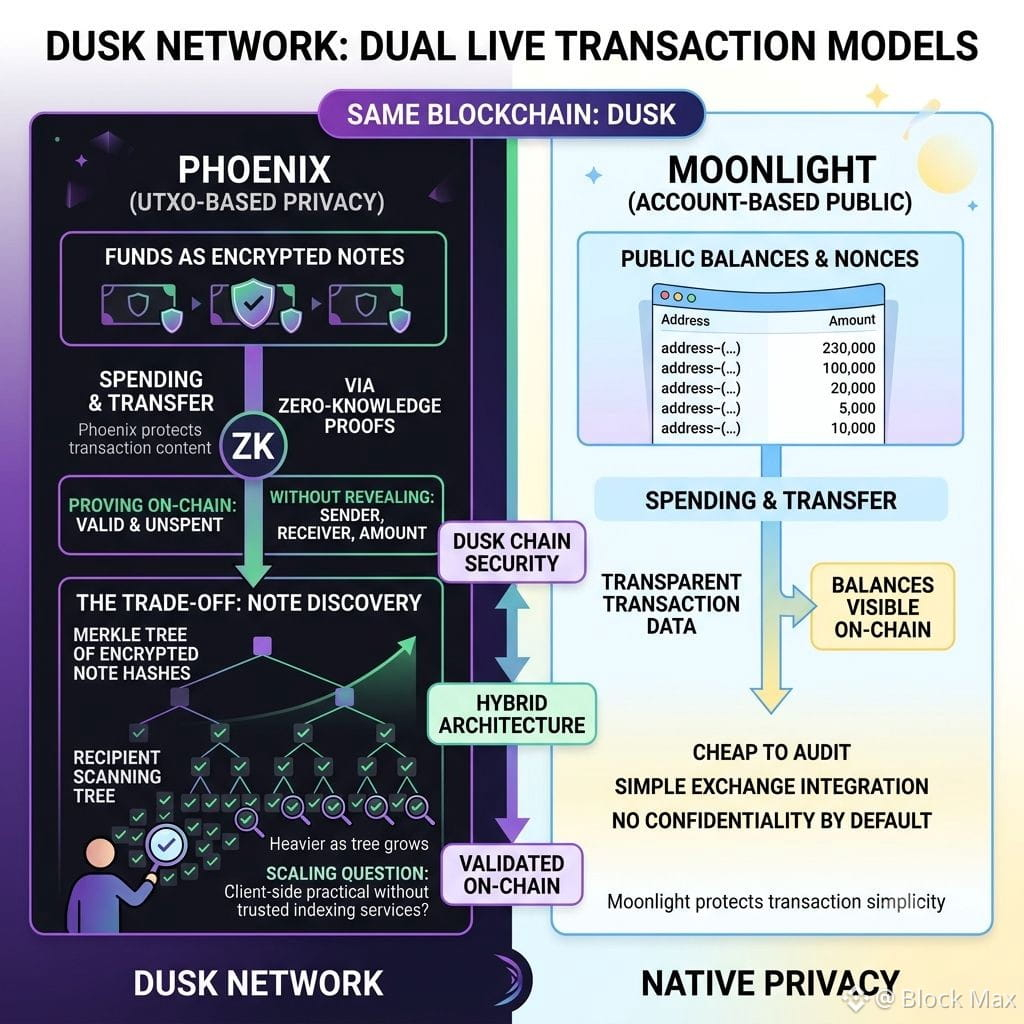
One detail I kept coming back to while studying @Dusk_Foundation is that it runs two live transaction models on the same chain rather than picking one and bolting privacy on later.
Phoenix is UTXO-based: funds exist as encrypted notes, and spending means proving — via zero-knowledge proofs — that a note is valid and unspent, without revealing sender, receiver, or amount on-chain. The trade-off is note discovery: a recipient has to scan the growing Merkle tree of note hashes to find what's theirs, which gets heavier as the tree grows.
Moonlight is account-based and public, closer to Ethereum: balances and nonces sit in the open. It's cheap to audit and simple for exchanges to integrate, but offers no confidentiality by default.
Phoenix protects transaction content, while Moonlight protects transaction simplicity.
Open question: as the note set scales, does client-side scanning stay practical without trusted indexing services quietly becoming a soft dependency for "self-custodial" privacy?
#dusk $DUSK #Dusk #DUSK
{future}(DUSKUSDT)
One detail I kept coming back to while studying @Dusk is that it runs two live transaction models on the same chain rather than picking one and bolting privacy on later.
Phoenix is UTXO-based: funds exist as encrypted notes, and spending means proving — via zero-knowledge proofs — that a note is valid and unspent, without revealing sender, receiver, or amount on-chain. The trade-off is note discovery: a recipient has to scan the growing Merkle tree of note hashes to find what's theirs, which gets heavier as the tree grows.
Moonlight is account-based and public, closer to Ethereum: balances and nonces sit in the open. It's cheap to audit and simple for exchanges to integrate, but offers no confidentiality by default.
Phoenix protects transaction content, while Moonlight protects transaction simplicity.
Open question: as the note set scales, does client-side scanning stay practical without trusted indexing services quietly becoming a soft dependency for "self-custodial" privacy?
#dusk $DUSK #Dusk #DUSK
Phoenix is UTXO-based: funds exist as encrypted notes, and spending means proving — via zero-knowledge proofs — that a note is valid and unspent, without revealing sender, receiver, or amount on-chain. The trade-off is note discovery: a recipient has to scan the growing Merkle tree of note hashes to find what's theirs, which gets heavier as the tree grows.
Moonlight is account-based and public, closer to Ethereum: balances and nonces sit in the open. It's cheap to audit and simple for exchanges to integrate, but offers no confidentiality by default.
Phoenix protects transaction content, while Moonlight protects transaction simplicity.
Open question: as the note set scales, does client-side scanning stay practical without trusted indexing services quietly becoming a soft dependency for "self-custodial" privacy?
#dusk $DUSK #Dusk #DUSK
5
6
138
·
--
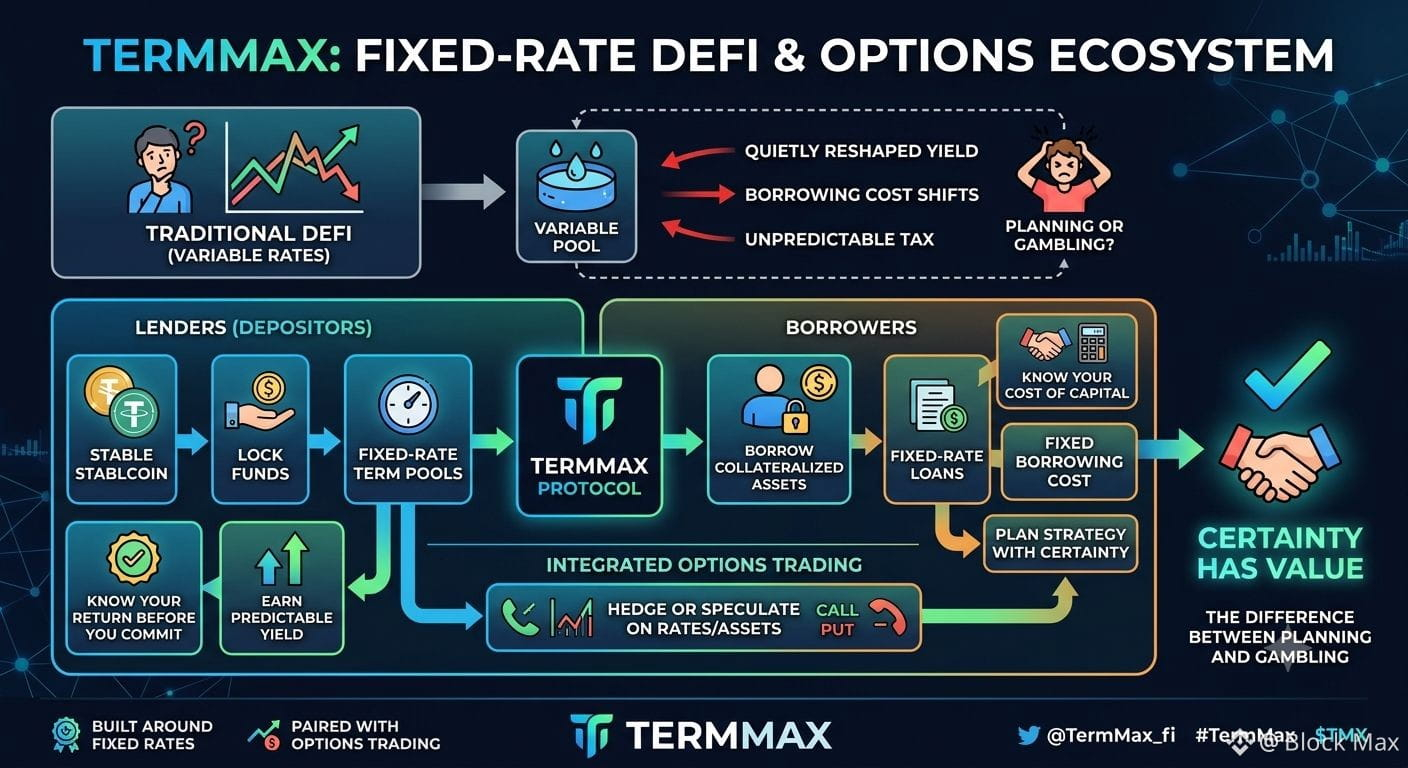
Most DeFi lending still asks you to trust a number that moves while you're not looking. You lock funds into a "variable rate" pool, walk away, and come back to find your yield — or your borrowing cost — quietly reshaped by demand you had no part of. That unpredictability is the real tax nobody talks about.
TermMax approaches this differently. Instead of floating rates that shift under you, it's built around fixed-rate borrowing and lending, paired with options trading in one system. You know your cost of capital or your return before you commit, not after. For anyone who's ever tried to plan around DeFi yield and gotten burned by a rate flip mid-strategy, that's not a small detail — it's the difference between planning and gambling.
Here's the deeper thing worth sitting with: crypto lending grew up mimicking bank-style variable models because that's what was easy to code first, not because it's what borrowers actually wanted. Fixed-rate infrastructure is really DeFi catching up to what traditional finance figured out decades ago — certainty has value, sometimes more than raw yield does.
Combining that with options trading in one protocol is an interesting bet on where on-chain credit markets are heading next.
Would you rather lock in a known rate, or take your chances with the market's mood swings?
@termmax #termmax
$BOME
{future}(BOMEUSDT)
$RE
{future}(REUSDT)
$BIO
{future}(BIOUSDT)
Most DeFi lending still asks you to trust a number that moves while you're not looking. You lock funds into a "variable rate" pool, walk away, and come back to find your yield — or your borrowing cost — quietly reshaped by demand you had no part of. That unpredictability is the real tax nobody talks about.
TermMax approaches this differently. Instead of floating rates that shift under you, it's built around fixed-rate borrowing and lending, paired with options trading in one system. You know your cost of capital or your return before you commit, not after. For anyone who's ever tried to plan around DeFi yield and gotten burned by a rate flip mid-strategy, that's not a small detail — it's the difference between planning and gambling.
Here's the deeper thing worth sitting with: crypto lending grew up mimicking bank-style variable models because that's what was easy to code first, not because it's what borrowers actually wanted. Fixed-rate infrastructure is really DeFi catching up to what traditional finance figured out decades ago — certainty has value, sometimes more than raw yield does.
Combining that with options trading in one protocol is an interesting bet on where on-chain credit markets are heading next.
Would you rather lock in a known rate, or take your chances with the market's mood swings?
@TermMax #termmax
$BOME
$RE
$BIO
TermMax approaches this differently. Instead of floating rates that shift under you, it's built around fixed-rate borrowing and lending, paired with options trading in one system. You know your cost of capital or your return before you commit, not after. For anyone who's ever tried to plan around DeFi yield and gotten burned by a rate flip mid-strategy, that's not a small detail — it's the difference between planning and gambling.
Here's the deeper thing worth sitting with: crypto lending grew up mimicking bank-style variable models because that's what was easy to code first, not because it's what borrowers actually wanted. Fixed-rate infrastructure is really DeFi catching up to what traditional finance figured out decades ago — certainty has value, sometimes more than raw yield does.
Combining that with options trading in one protocol is an interesting bet on where on-chain credit markets are heading next.
Would you rather lock in a known rate, or take your chances with the market's mood swings?
@TermMax #termmax
$BOME
$RE
$BIO
1
1
309
·
--
Every transaction you've ever made on a public blockchain is sitting there, forever, for anyone to read. Your salary, your trades, your rent payments — all of it, permanently public. Most people never think about this until someone actually looks.
That's the quiet problem crypto doesn't like to talk about. We call it "decentralized finance," but true finance has always required discretion. Banks don't publish your balance sheet. Businesses don't want competitors reading their treasury moves in real time. Yet most chains force that exact exposure just to get the benefits of decentralization.
This is where Dusk Network ($DUSK) is trying something different. Instead of bolting privacy on as an afterthought, it built the base layer around it — the XSC standard lets smart contracts stay confidential while still being verifiable, which is really the hard part. Anyone can build financial logic without leaking every internal detail to the entire internet.
The deeper thought here: privacy and compliance are usually framed as opposites in crypto. Dusk's whole bet is that they don't have to be — that regulated financial products actually need confidentiality to function on-chain at all, not despite regulation, but because of it.
If real-world finance ever fully moves on-chain, do you think privacy-first chains like this become the standard, or stay a niche?
@Dusk_Foundation #dusk $DUSK
Every transaction you've ever made on a public blockchain is sitting there, forever, for anyone to read. Your salary, your trades, your rent payments — all of it, permanently public. Most people never think about this until someone actually looks.
That's the quiet problem crypto doesn't like to talk about. We call it "decentralized finance," but true finance has always required discretion. Banks don't publish your balance sheet. Businesses don't want competitors reading their treasury moves in real time. Yet most chains force that exact exposure just to get the benefits of decentralization.
This is where Dusk Network ($DUSK ) is trying something different. Instead of bolting privacy on as an afterthought, it built the base layer around it — the XSC standard lets smart contracts stay confidential while still being verifiable, which is really the hard part. Anyone can build financial logic without leaking every internal detail to the entire internet.
The deeper thought here: privacy and compliance are usually framed as opposites in crypto. Dusk's whole bet is that they don't have to be — that regulated financial products actually need confidentiality to function on-chain at all, not despite regulation, but because of it.
If real-world finance ever fully moves on-chain, do you think privacy-first chains like this become the standard, or stay a niche?
@Dusk #dusk $DUSK
That's the quiet problem crypto doesn't like to talk about. We call it "decentralized finance," but true finance has always required discretion. Banks don't publish your balance sheet. Businesses don't want competitors reading their treasury moves in real time. Yet most chains force that exact exposure just to get the benefits of decentralization.
This is where Dusk Network ($DUSK ) is trying something different. Instead of bolting privacy on as an afterthought, it built the base layer around it — the XSC standard lets smart contracts stay confidential while still being verifiable, which is really the hard part. Anyone can build financial logic without leaking every internal detail to the entire internet.
The deeper thought here: privacy and compliance are usually framed as opposites in crypto. Dusk's whole bet is that they don't have to be — that regulated financial products actually need confidentiality to function on-chain at all, not despite regulation, but because of it.
If real-world finance ever fully moves on-chain, do you think privacy-first chains like this become the standard, or stay a niche?
@Dusk #dusk $DUSK
Becomes the standard
0%
Stays a niche
0%
Only for institutions
0%
Too early to tell
0%
0 проголосовали • Голосование закрыто
2
5
113
·
--
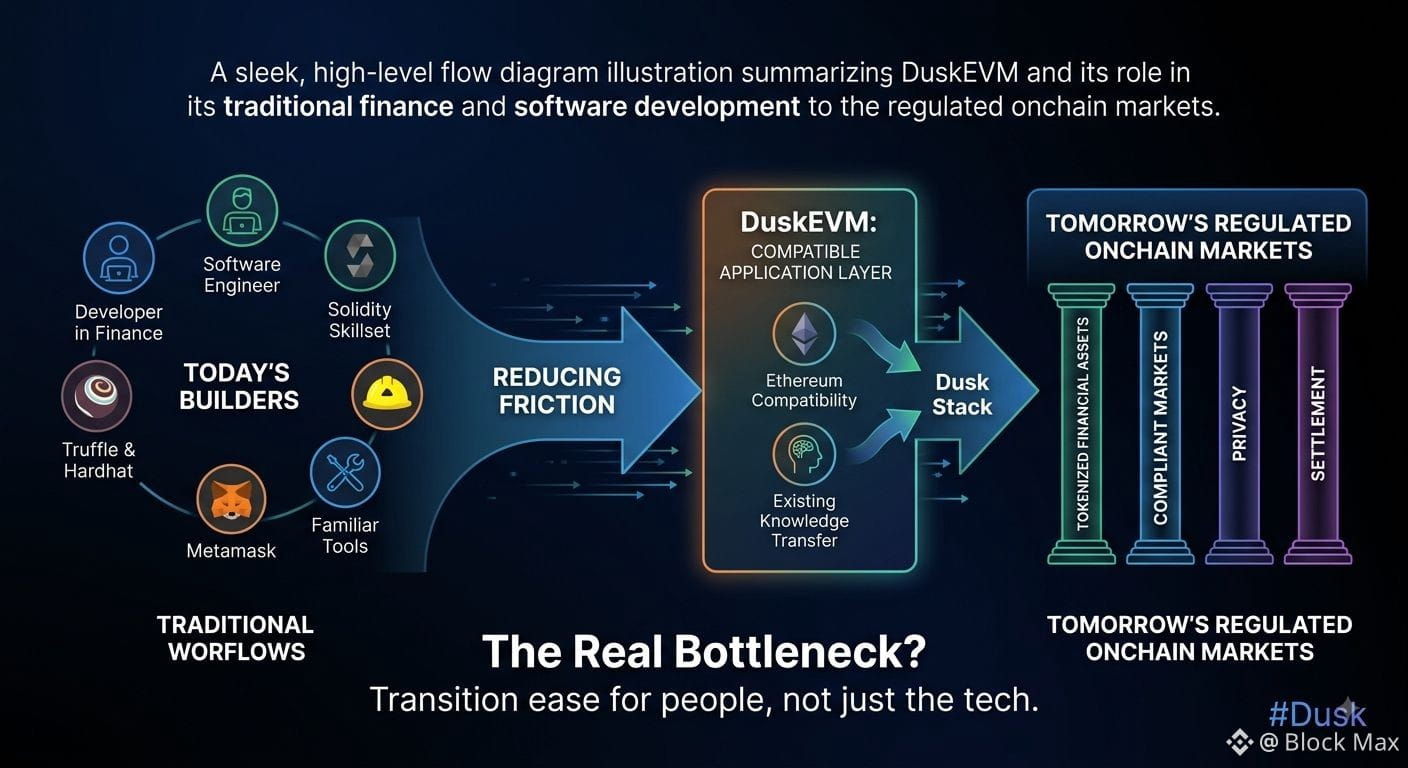
EVM compatibility sounds like a small technical detail until you look at who actually has to build on a financial blockchain.
A good idea can still struggle if developers need to throw away familiar tools just to get started.
That’s why Dusk.is interesting to me. It brings an application layer into the Dusk stack, giving Solidity and builders a more familiar environment to work with.
The bigger point isn’t simply “Dusk supports EVM.”
It’s about reducing friction.
For institutions, infrastructure partners, and developers exploring regulated financial applications, familiarity can matter almost as much as raw blockchain performance. Existing knowledge, tooling and development habits can make the jump into a new ecosystem much easier.
And Dusk is aiming at a part of crypto where the requirements are different: tokenized financial assets, compliant markets, privacy and settlement.
That creates an interesting tension. Financial infrastructure needs to evolve, but the people building it don’t necessarily want to reinvent every development workflow from scratch.
Maybe the real adoption bottleneck isn’t whether blockchain can handle finance.
Maybe it’s how easy we make the transition for the people already working in finance and software.
Could EVM compatibility become one of the quiet bridges between today’s developers and tomorrow’s regulated onchain markets?
@Dusk_Foundation #dusk $DUSK
EVM compatibility sounds like a small technical detail until you look at who actually has to build on a financial blockchain.
A good idea can still struggle if developers need to throw away familiar tools just to get started.
That’s why Dusk.is interesting to me. It brings an application layer into the Dusk stack, giving Solidity and builders a more familiar environment to work with.
The bigger point isn’t simply “Dusk supports EVM.”
It’s about reducing friction.
For institutions, infrastructure partners, and developers exploring regulated financial applications, familiarity can matter almost as much as raw blockchain performance. Existing knowledge, tooling and development habits can make the jump into a new ecosystem much easier.
And Dusk is aiming at a part of crypto where the requirements are different: tokenized financial assets, compliant markets, privacy and settlement.
That creates an interesting tension. Financial infrastructure needs to evolve, but the people building it don’t necessarily want to reinvent every development workflow from scratch.
Maybe the real adoption bottleneck isn’t whether blockchain can handle finance.
Maybe it’s how easy we make the transition for the people already working in finance and software.
Could EVM compatibility become one of the quiet bridges between today’s developers and tomorrow’s regulated onchain markets?
@Dusk #dusk $DUSK
A good idea can still struggle if developers need to throw away familiar tools just to get started.
That’s why Dusk.is interesting to me. It brings an application layer into the Dusk stack, giving Solidity and builders a more familiar environment to work with.
The bigger point isn’t simply “Dusk supports EVM.”
It’s about reducing friction.
For institutions, infrastructure partners, and developers exploring regulated financial applications, familiarity can matter almost as much as raw blockchain performance. Existing knowledge, tooling and development habits can make the jump into a new ecosystem much easier.
And Dusk is aiming at a part of crypto where the requirements are different: tokenized financial assets, compliant markets, privacy and settlement.
That creates an interesting tension. Financial infrastructure needs to evolve, but the people building it don’t necessarily want to reinvent every development workflow from scratch.
Maybe the real adoption bottleneck isn’t whether blockchain can handle finance.
Maybe it’s how easy we make the transition for the people already working in finance and software.
Could EVM compatibility become one of the quiet bridges between today’s developers and tomorrow’s regulated onchain markets?
@Dusk #dusk $DUSK
4
4
100
·
--
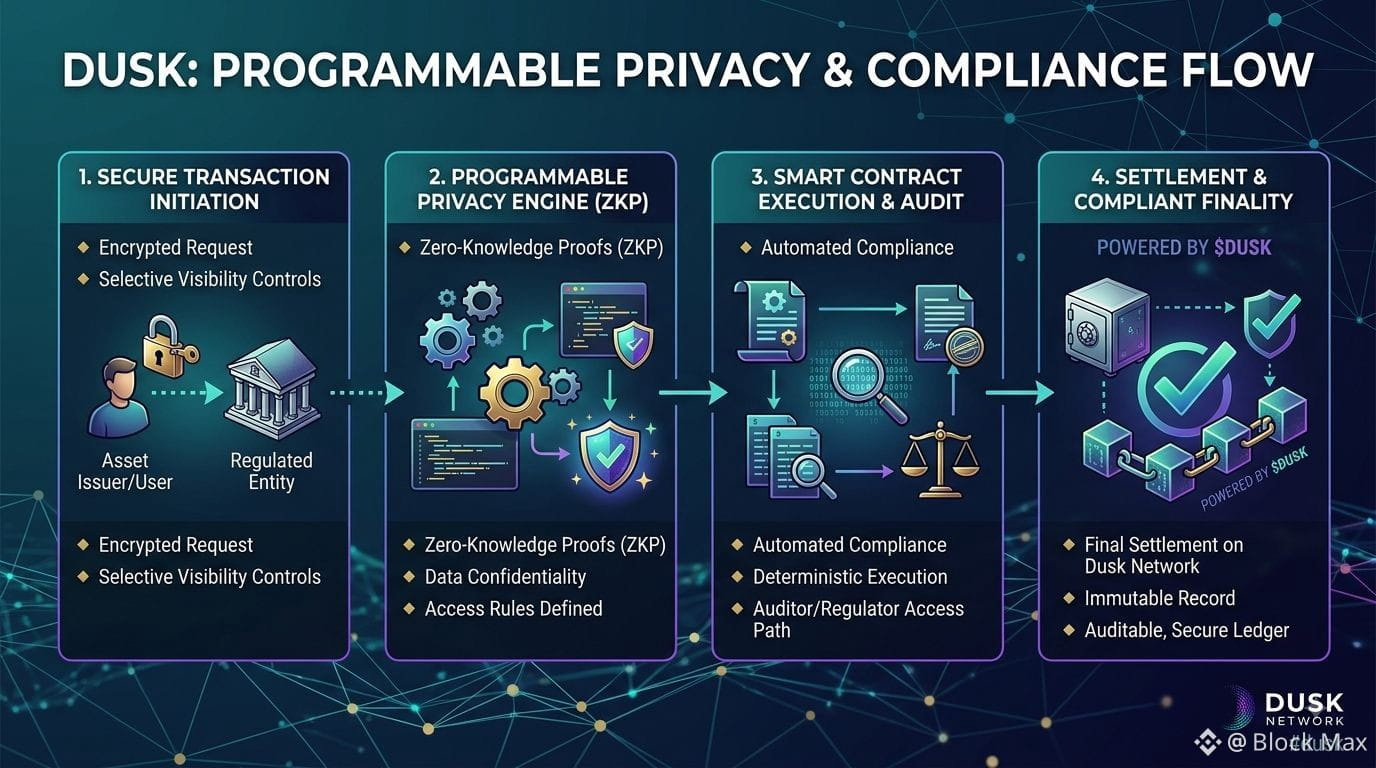
Ever notice how every "private" blockchain either hides too much or reveals too much? There's rarely a middle ground. And for regulated finance, that middle ground isn't optional — it's the whole requirement.
Banks can't run on public ledgers where anyone sees your position size. Regulators can't accept a black box where nothing is auditable. Somewhere between those two extremes is where real financial infrastructure has to live, and most chains just weren't built for that tension.
This is where @Dusk_Foundation takes a different approach. Instead of treating privacy as all-or-nothing, Dusk treats it as something programmable — privacy where it's actually needed, transparency where it's useful, and selective disclosure for the parties who are authorized to review a transaction. Settlement still happens deterministically underneath all of it, so finality isn't sacrificed for confidentiality.
Think about a bond issuance. The public doesn't need to see every holder's position. But an auditor or regulator might need to, on request, without the issuer redesigning the entire system just to grant that access.
That's the quiet difference between "encrypted" and "compliant." Most projects chase the first word. Regulated markets actually need the second.
$DUSK sits underneath this design as the network's native asset, tied to how the chain itself operates.
Where do you think onchain finance breaks down first — privacy or compliance?
#dusk $DUSK
{spot}(DUSKUSDT)
$PORTAL
{spot}(PORTALUSDT)
Ever notice how every "private" blockchain either hides too much or reveals too much? There's rarely a middle ground. And for regulated finance, that middle ground isn't optional — it's the whole requirement.
Banks can't run on public ledgers where anyone sees your position size. Regulators can't accept a black box where nothing is auditable. Somewhere between those two extremes is where real financial infrastructure has to live, and most chains just weren't built for that tension.
This is where @Dusk takes a different approach. Instead of treating privacy as all-or-nothing, Dusk treats it as something programmable — privacy where it's actually needed, transparency where it's useful, and selective disclosure for the parties who are authorized to review a transaction. Settlement still happens deterministically underneath all of it, so finality isn't sacrificed for confidentiality.
Think about a bond issuance. The public doesn't need to see every holder's position. But an auditor or regulator might need to, on request, without the issuer redesigning the entire system just to grant that access.
That's the quiet difference between "encrypted" and "compliant." Most projects chase the first word. Regulated markets actually need the second.
$DUSK sits underneath this design as the network's native asset, tied to how the chain itself operates.
Where do you think onchain finance breaks down first — privacy or compliance?
#dusk $DUSK
$PORTAL
Banks can't run on public ledgers where anyone sees your position size. Regulators can't accept a black box where nothing is auditable. Somewhere between those two extremes is where real financial infrastructure has to live, and most chains just weren't built for that tension.
This is where @Dusk takes a different approach. Instead of treating privacy as all-or-nothing, Dusk treats it as something programmable — privacy where it's actually needed, transparency where it's useful, and selective disclosure for the parties who are authorized to review a transaction. Settlement still happens deterministically underneath all of it, so finality isn't sacrificed for confidentiality.
Think about a bond issuance. The public doesn't need to see every holder's position. But an auditor or regulator might need to, on request, without the issuer redesigning the entire system just to grant that access.
That's the quiet difference between "encrypted" and "compliant." Most projects chase the first word. Regulated markets actually need the second.
$DUSK sits underneath this design as the network's native asset, tied to how the chain itself operates.
Where do you think onchain finance breaks down first — privacy or compliance?
#dusk $DUSK
$PORTAL
13
4
313
·
--
Частичная правда
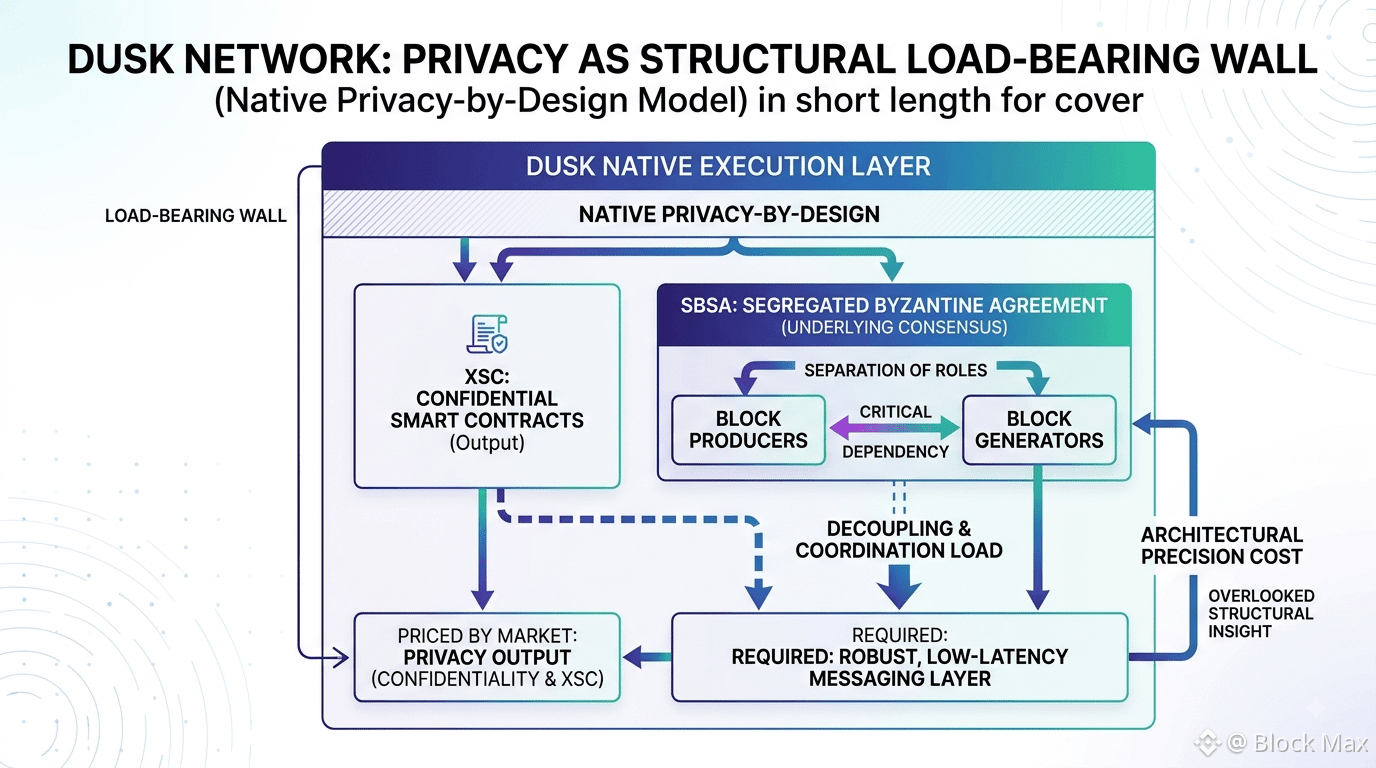
I'm watching how Dusk Network’s architectural commitment to a native privacy-by-design model is being misinterpreted as merely a feature set rather than a fundamental shift in execution layer dynamics. The market focuses on the XSC standard for confidential smart contracts, but it overlooks the critical implication of its underlying consensus mechanism. Dusk utilizes a Proof-of-Stake variant called Segregated Byzantine Agreement (SBSA), which segregates the roles of block producers and block generators to minimize attack vectors while maintaining confidentiality. The non-obvious structural insight is that this separation, designed for security, creates a hidden dependency on coordination. It forces a decoupling of transaction validation from block finalization that requires a more robust, low-latency messaging layer than standard monolithic consensus. While competitors bolt privacy onto existing execution environments, introducing latency and complexity, Dusk’s native integration means its coordination layer must be fundamentally more efficient. The market prices the privacy output; it misses the cost of the architectural precision required to sustain it. Privacy isn't an added feature here—it's the structural load-bearing wall.
@Dusk_Foundation #dusk $DUSK
{spot}(DUSKUSDT)
I'm watching how Dusk Network’s architectural commitment to a native privacy-by-design model is being misinterpreted as merely a feature set rather than a fundamental shift in execution layer dynamics. The market focuses on the XSC standard for confidential smart contracts, but it overlooks the critical implication of its underlying consensus mechanism. Dusk utilizes a Proof-of-Stake variant called Segregated Byzantine Agreement (SBSA), which segregates the roles of block producers and block generators to minimize attack vectors while maintaining confidentiality. The non-obvious structural insight is that this separation, designed for security, creates a hidden dependency on coordination. It forces a decoupling of transaction validation from block finalization that requires a more robust, low-latency messaging layer than standard monolithic consensus. While competitors bolt privacy onto existing execution environments, introducing latency and complexity, Dusk’s native integration means its coordination layer must be fundamentally more efficient. The market prices the privacy output; it misses the cost of the architectural precision required to sustain it. Privacy isn't an added feature here—it's the structural load-bearing wall.
@Dusk #dusk $DUSK
@Dusk #dusk $DUSK
99
41
10.2k
·
--
Проверено
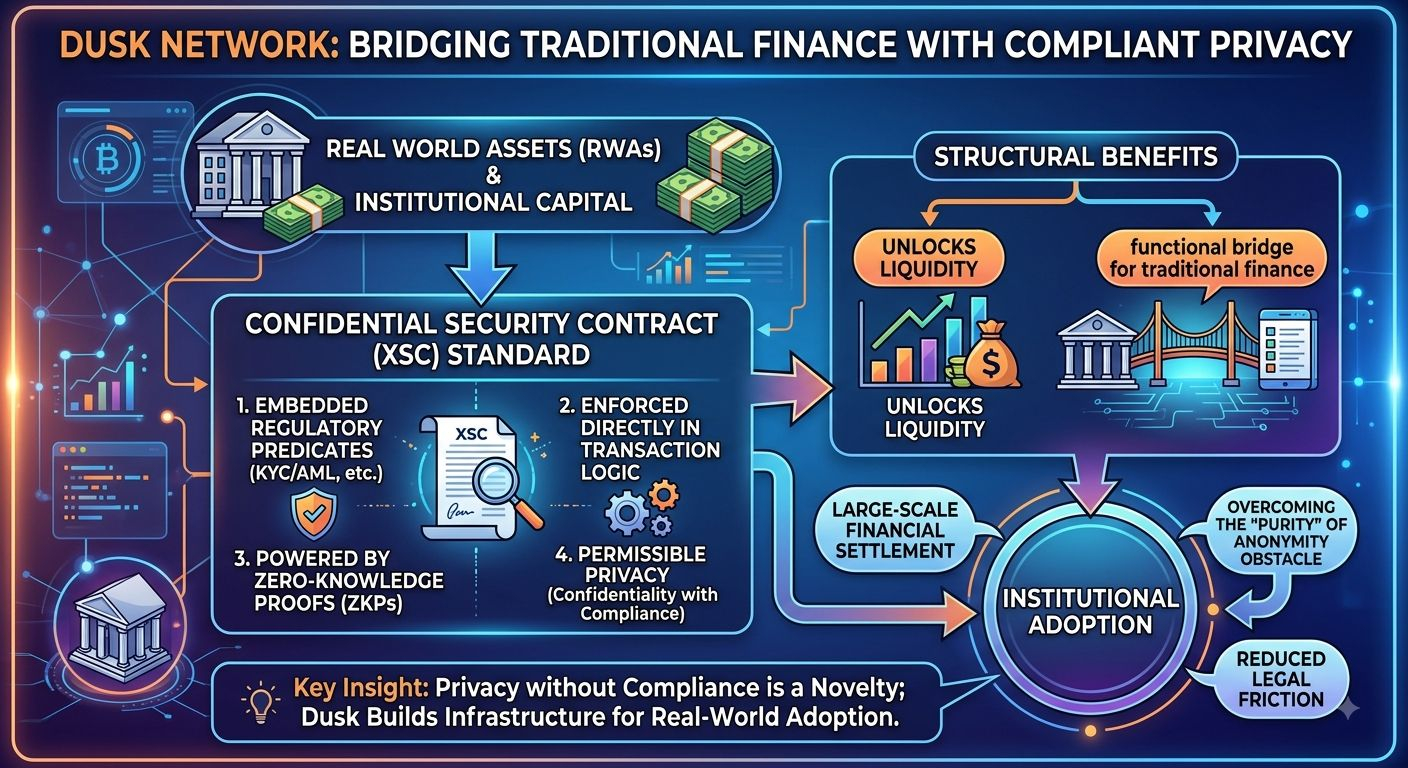
I'm looking at Dusk Network and the market is misreading the value of its compliance constraints. The specific mechanism being overlooked is the Confidential Security Contract (XSC) standard, which enforces regulatory predicates directly within the transaction logic. Unlike competitors who treat regulation as an external adversary, Dusk bakes it into the protocol via zero-knowledge proofs. This structural choice fundamentally alters liquidity. It addresses the legal friction that currently barricades institutional capital from deploying on anonymous chains, creating a functional bridge for Real World Assets. While the market obsesses over 'pure' anonymity, it fails to price in that large-scale financial settlement requires permissible privacy, not just cryptographic obscurity. This isn't merely a feature set; it is a necessary dependency for onboarding traditional finance. Privacy without compliance is a novelty; Dusk is building the infrastructure for institutional adoption.
@Dusk_Foundation #dusk $DUSK
{spot}(DUSKUSDT)
#DUSK
$COW
{spot}(COWUSDT)
I'm looking at Dusk Network and the market is misreading the value of its compliance constraints. The specific mechanism being overlooked is the Confidential Security Contract (XSC) standard, which enforces regulatory predicates directly within the transaction logic. Unlike competitors who treat regulation as an external adversary, Dusk bakes it into the protocol via zero-knowledge proofs. This structural choice fundamentally alters liquidity. It addresses the legal friction that currently barricades institutional capital from deploying on anonymous chains, creating a functional bridge for Real World Assets. While the market obsesses over 'pure' anonymity, it fails to price in that large-scale financial settlement requires permissible privacy, not just cryptographic obscurity. This isn't merely a feature set; it is a necessary dependency for onboarding traditional finance. Privacy without compliance is a novelty; Dusk is building the infrastructure for institutional adoption.
@Dusk #dusk $DUSK
#DUSK
$COW
@Dusk #dusk $DUSK
#DUSK
$COW
48
26
6.3k
·
--
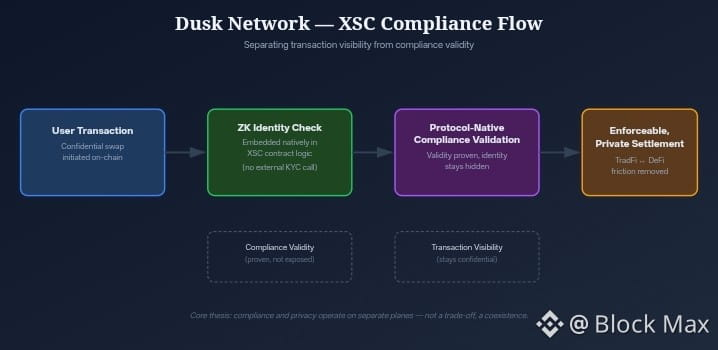
I'm watching Dusk Network closely. While most privacy projects focus on total anonymity, the market is mispricing the structural implications of the XSC (Confidential Security Contract) standard. Dusk forces a separation between transaction visibility and compliance validity by embedding zero-knowledge identity checks directly into the contract architecture. This design choice radically alters the infrastructure layer for capital markets. By moving compliance verification from external KYC providers to the protocol’s native execution environment, the chain enables legally enforceable swaps without compromising user privacy. This removes the coordination friction that currently prevents traditional finance from interacting with DeFi. The market assumes privacy and regulation are mutually exclusive, but Dusk’s architecture forces them to coexist.I'm watching Dusk Network closely. While most privacy projects focus on total anonymity, the market is mispricing the structural implications of the XSC (Confidential Security Contract) standard. Dusk forces a separation between transaction visibility and compliance validity by embedding zero-knowledge identity checks directly into the contract architecture. This design choice radically alters the infrastructure layer for capital markets. By moving compliance verification from external KYC providers to the protocol’s native execution environment, the chain enables legally enforceable swaps without compromising user privacy. This removes the coordination friction that currently prevents traditional finance from interacting with DeFi. The market assumes privacy and regulation are mutually exclusive, but Dusk’s architecture forces them to coexist.
@Dusk_Foundation #dusk $DUSK
I'm watching Dusk Network closely. While most privacy projects focus on total anonymity, the market is mispricing the structural implications of the XSC (Confidential Security Contract) standard. Dusk forces a separation between transaction visibility and compliance validity by embedding zero-knowledge identity checks directly into the contract architecture. This design choice radically alters the infrastructure layer for capital markets. By moving compliance verification from external KYC providers to the protocol’s native execution environment, the chain enables legally enforceable swaps without compromising user privacy. This removes the coordination friction that currently prevents traditional finance from interacting with DeFi. The market assumes privacy and regulation are mutually exclusive, but Dusk’s architecture forces them to coexist.I'm watching Dusk Network closely. While most privacy projects focus on total anonymity, the market is mispricing the structural implications of the XSC (Confidential Security Contract) standard. Dusk forces a separation between transaction visibility and compliance validity by embedding zero-knowledge identity checks directly into the contract architecture. This design choice radically alters the infrastructure layer for capital markets. By moving compliance verification from external KYC providers to the protocol’s native execution environment, the chain enables legally enforceable swaps without compromising user privacy. This removes the coordination friction that currently prevents traditional finance from interacting with DeFi. The market assumes privacy and regulation are mutually exclusive, but Dusk’s architecture forces them to coexist.
@Dusk #dusk $DUSK
@Dusk #dusk $DUSK
2
2
93
·
--
Проверено
I'm looking at how Dusk Network positions its XSC standard not merely as a privacy tool, but as a specific compliance engine for tokenised securities. Most Layer-1s treat confidentiality and regulation as opposing forces, forcing institutions to choose between anonymity and legal adherence. Dusk’s architecture embeds compliance checks directly into the protocol, allowing KYC and AML verification to occur without revealing underlying trading data. This structural design creates a counter-intuitive downstream effect: it deliberately filters out speculative retail volume to prioritise high-value, institutional liquidity that demands legal certainty. The market currently prices Dusk as a generic privacy alternative, missing that it is positioning itself as mandatory infrastructure for regulated security markets. As tokenised equities move on-chain, the demand for a settlement rail that satisfies regulators while protecting trade data will shift from optional to essential. The market is pricing a privacy coin, but it is actually buying the plumbing for compliant digital assets.
@Dusk_Foundation #dusk $DUSK #DUSK
I'm looking at how Dusk Network positions its XSC standard not merely as a privacy tool, but as a specific compliance engine for tokenised securities. Most Layer-1s treat confidentiality and regulation as opposing forces, forcing institutions to choose between anonymity and legal adherence. Dusk’s architecture embeds compliance checks directly into the protocol, allowing KYC and AML verification to occur without revealing underlying trading data. This structural design creates a counter-intuitive downstream effect: it deliberately filters out speculative retail volume to prioritise high-value, institutional liquidity that demands legal certainty. The market currently prices Dusk as a generic privacy alternative, missing that it is positioning itself as mandatory infrastructure for regulated security markets. As tokenised equities move on-chain, the demand for a settlement rail that satisfies regulators while protecting trade data will shift from optional to essential. The market is pricing a privacy coin, but it is actually buying the plumbing for compliant digital assets.
@Dusk #dusk $DUSK #DUSK
@Dusk #dusk $DUSK #DUSK
Compliant infrastructure 🏦
0%
Generic privacy coin 🔒
0%
Institutional liquidity play📈
0%
Overhyped, no real demand 📉
0%
0 проголосовали • Голосование закрыто
12
8
730
·
--
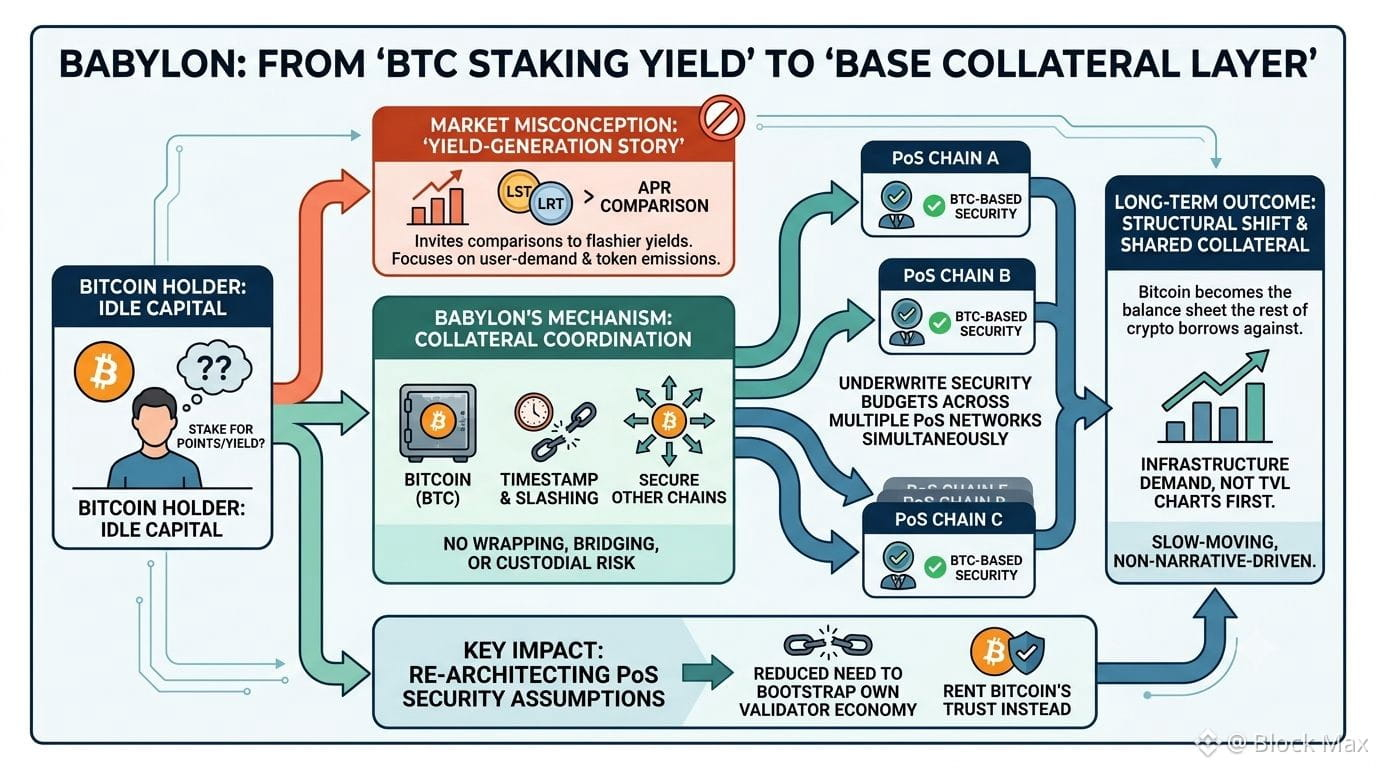
I'm watching Babylon get priced like a "Bitcoin staking yield" play when the actual bet is on something less visible: whether Bitcoin's idle capital can become the base collateral layer for the entire PoS world.
The market's mistake is treating BABY as a yield-generation story — stake BTC, earn points, wait for token emissions. That framing invites comparison to liquid staking tokens and their circulating APRs, which makes Babylon look unremarkable next to anything offering flashier numbers.
But the real mechanism isn't yield. It's collateral coordination. Babylon lets Bitcoin — the largest, most trusted, most liquid crypter asset — timestamp and slash itself to secure other chains, without wrapping, bridging, or custodial risk. That's not a yield product. That's an attempt to make BTC the reserve asset underwriting security budgets across dozens of independent PoS networks simultaneously.
The layer this actually affects is infrastructure demand, not user demand. Success here doesn't show up in TVL charts first — it shows up in how many chains quietly redesign their security assumptions around "what if we don't need our own token for security anymore." That's a slow-moving, structural shift, not a narrative that trends on a timeline. Bitcoin becoming shared collateral changes the discovery layer for every PoS chain evaluating whether to bootstrap its own validator economy or rent Bitcoin's trust instead.
If that thesis plays out, the value isn't in what BABY yields today. It's in whether Bitcoin quietly becomes the balance sheet the rest of crypto borrows against.
#baby $BABY @babylonlabs_io
I'm watching Babylon get priced like a "Bitcoin staking yield" play when the actual bet is on something less visible: whether Bitcoin's idle capital can become the base collateral layer for the entire PoS world.
The market's mistake is treating BABY as a yield-generation story — stake BTC, earn points, wait for token emissions. That framing invites comparison to liquid staking tokens and their circulating APRs, which makes Babylon look unremarkable next to anything offering flashier numbers.
But the real mechanism isn't yield. It's collateral coordination. Babylon lets Bitcoin — the largest, most trusted, most liquid crypter asset — timestamp and slash itself to secure other chains, without wrapping, bridging, or custodial risk. That's not a yield product. That's an attempt to make BTC the reserve asset underwriting security budgets across dozens of independent PoS networks simultaneously.
The layer this actually affects is infrastructure demand, not user demand. Success here doesn't show up in TVL charts first — it shows up in how many chains quietly redesign their security assumptions around "what if we don't need our own token for security anymore." That's a slow-moving, structural shift, not a narrative that trends on a timeline. Bitcoin becoming shared collateral changes the discovery layer for every PoS chain evaluating whether to bootstrap its own validator economy or rent Bitcoin's trust instead.
If that thesis plays out, the value isn't in what BABY yields today. It's in whether Bitcoin quietly becomes the balance sheet the rest of crypto borrows against.
#baby $BABY @BabylonLabs_io
The market's mistake is treating BABY as a yield-generation story — stake BTC, earn points, wait for token emissions. That framing invites comparison to liquid staking tokens and their circulating APRs, which makes Babylon look unremarkable next to anything offering flashier numbers.
But the real mechanism isn't yield. It's collateral coordination. Babylon lets Bitcoin — the largest, most trusted, most liquid crypter asset — timestamp and slash itself to secure other chains, without wrapping, bridging, or custodial risk. That's not a yield product. That's an attempt to make BTC the reserve asset underwriting security budgets across dozens of independent PoS networks simultaneously.
The layer this actually affects is infrastructure demand, not user demand. Success here doesn't show up in TVL charts first — it shows up in how many chains quietly redesign their security assumptions around "what if we don't need our own token for security anymore." That's a slow-moving, structural shift, not a narrative that trends on a timeline. Bitcoin becoming shared collateral changes the discovery layer for every PoS chain evaluating whether to bootstrap its own validator economy or rent Bitcoin's trust instead.
If that thesis plays out, the value isn't in what BABY yields today. It's in whether Bitcoin quietly becomes the balance sheet the rest of crypto borrows against.
#baby $BABY @BabylonLabs_io
22
6
225
·
--
I’m watching Babylon less as a "BTC staking" play and more as a quiet re-architecture of how trust gets sourced in crypto.
Most people frame BABY around yield — "now BTC earns." That's the surface read, and it's why the market keeps pricing it like another restaking token chasing APY narratives. The deeper thing it changes is where security comes from. Every PoS chain today has to bootstrap its own validator set and its own credibility from zero. Babylon lets them borrow Bitcoin's economic weight directly, without wrapping BTC, without custodians, without a bridge that can be drained. That's not a yield feature — it's a trust-supply mechanism.
The hidden layer this hits is coordination. Right now, security is siloed: every chain competes for validators and liquidity independently. If Bitcoin becomes a shared, self-custodial security backstop, you get pooled trust instead of fragmented trust — chains stop competing for capital and start competing for integration priority.
That reframes future demand. It's not "how much BTC gets staked," it's "how many chains need Bitcoin-grade finality to be taken seriously." That number is still unpriced.
The market is valuing a yield product. The protocol is building a trust layer. Those are different assets.
#baby $BABY @babylonlabs_io
I’m watching Babylon less as a "BTC staking" play and more as a quiet re-architecture of how trust gets sourced in crypto.
Most people frame BABY around yield — "now BTC earns." That's the surface read, and it's why the market keeps pricing it like another restaking token chasing APY narratives. The deeper thing it changes is where security comes from. Every PoS chain today has to bootstrap its own validator set and its own credibility from zero. Babylon lets them borrow Bitcoin's economic weight directly, without wrapping BTC, without custodians, without a bridge that can be drained. That's not a yield feature — it's a trust-supply mechanism.
The hidden layer this hits is coordination. Right now, security is siloed: every chain competes for validators and liquidity independently. If Bitcoin becomes a shared, self-custodial security backstop, you get pooled trust instead of fragmented trust — chains stop competing for capital and start competing for integration priority.
That reframes future demand. It's not "how much BTC gets staked," it's "how many chains need Bitcoin-grade finality to be taken seriously." That number is still unpriced.
The market is valuing a yield product. The protocol is building a trust layer. Those are different assets.
#baby $BABY @BabylonLabs_io
Most people frame BABY around yield — "now BTC earns." That's the surface read, and it's why the market keeps pricing it like another restaking token chasing APY narratives. The deeper thing it changes is where security comes from. Every PoS chain today has to bootstrap its own validator set and its own credibility from zero. Babylon lets them borrow Bitcoin's economic weight directly, without wrapping BTC, without custodians, without a bridge that can be drained. That's not a yield feature — it's a trust-supply mechanism.
The hidden layer this hits is coordination. Right now, security is siloed: every chain competes for validators and liquidity independently. If Bitcoin becomes a shared, self-custodial security backstop, you get pooled trust instead of fragmented trust — chains stop competing for capital and start competing for integration priority.
That reframes future demand. It's not "how much BTC gets staked," it's "how many chains need Bitcoin-grade finality to be taken seriously." That number is still unpriced.
The market is valuing a yield product. The protocol is building a trust layer. Those are different assets.
#baby $BABY @BabylonLabs_io
Vision 🚀
0%
People 🤝
0%
Profit 💰
0%
Patience ⌛
0%
0 проголосовали • Голосование закрыто
5
3
169
·
--
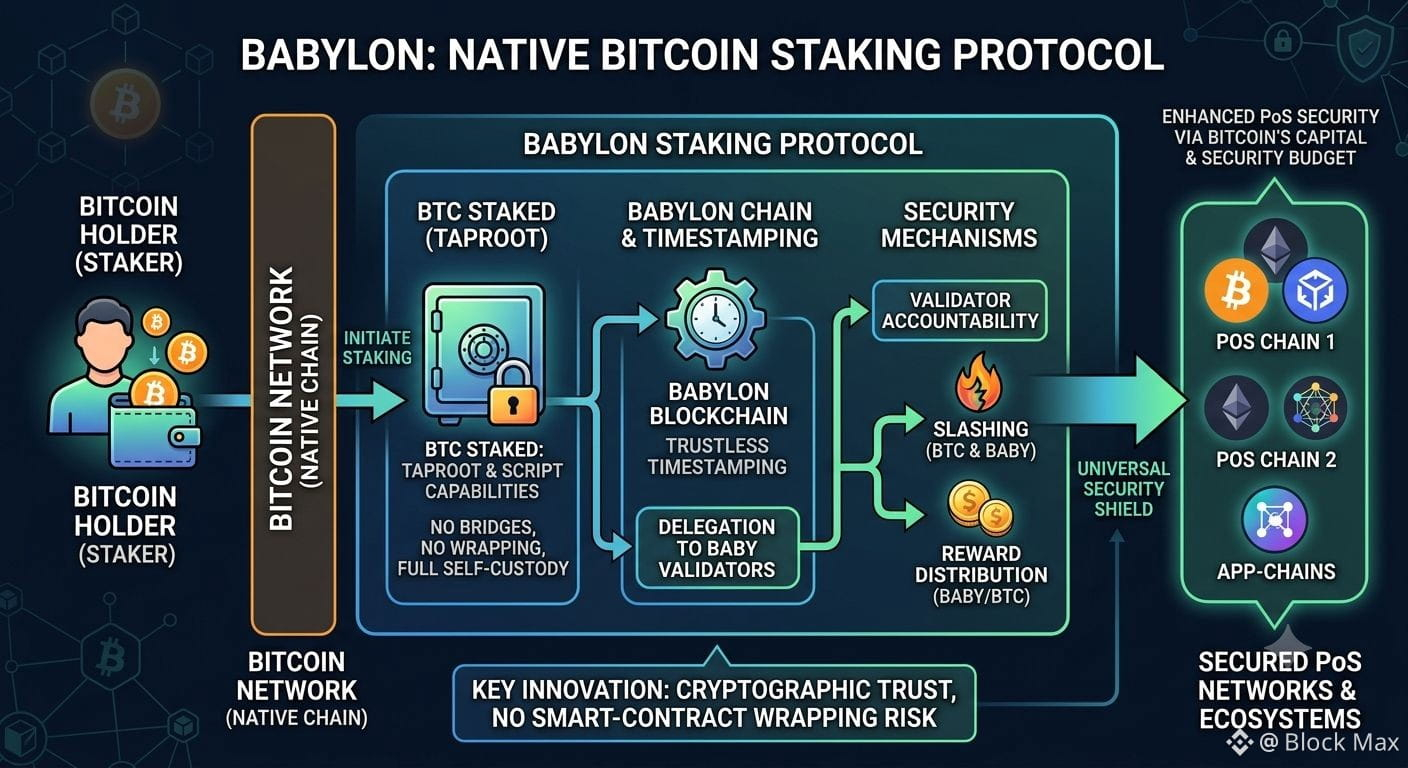
Babylon is a Bitcoin staking protocol that lets BTC holders stake Bitcoin directly to secure PoS chains with no wrapping or bridging , keeping full self-custody the entire time.
Babylon's core breakthrough is trustless, native BTC staking built on Bitcoin script capabilities (Taproot-based mechanisms and timestamping) rather than a bridge or synthetic asset. It's the first L1 network secured by Bitcoin staking through BABY token delegation, using Bitcoin's timestamping and slashing mechanisms to enhance validator accountability while securing the network (Atomic) . Because BTC never leaves the Bitcoin chain, there's no smart-contract wrapping risk and no bridge exploit surface — the staking is purely cryptographic.
Bitcoin holds the deepest liquidity and security budget in crypto, but historically that capital has sat idle or only entered DeFi through custodial/wrapped routes (WBTC, bridges) that reintroduce counterparty and smart-contract risk. Babylon solves this by letting BTC act as a trust-minimized security layer for PoS ecosystems — allowing Bitcoin to act as a universal security shield, redefining the utility of the world's largest cryptocurrency (BTCC) . For context on scale, for comparison, the entire wrapped Bitcoin supply sits around 150,000 BTC, so Babylon holding more than a third of that in native staking vaults signals real demand for non-custodial BTC staking .@babylonlabs_io #baby $BABY
Babylon is a Bitcoin staking protocol that lets BTC holders stake Bitcoin directly to secure PoS chains with no wrapping or bridging , keeping full self-custody the entire time.
Babylon's core breakthrough is trustless, native BTC staking built on Bitcoin script capabilities (Taproot-based mechanisms and timestamping) rather than a bridge or synthetic asset. It's the first L1 network secured by Bitcoin staking through BABY token delegation, using Bitcoin's timestamping and slashing mechanisms to enhance validator accountability while securing the network (Atomic) . Because BTC never leaves the Bitcoin chain, there's no smart-contract wrapping risk and no bridge exploit surface — the staking is purely cryptographic.
Bitcoin holds the deepest liquidity and security budget in crypto, but historically that capital has sat idle or only entered DeFi through custodial/wrapped routes (WBTC, bridges) that reintroduce counterparty and smart-contract risk. Babylon solves this by letting BTC act as a trust-minimized security layer for PoS ecosystems — allowing Bitcoin to act as a universal security shield, redefining the utility of the world's largest cryptocurrency (BTCC) . For context on scale, for comparison, the entire wrapped Bitcoin supply sits around 150,000 BTC, so Babylon holding more than a third of that in native staking vaults signals real demand for non-custodial BTC staking .@BabylonLabs_io #baby $BABY
Babylon's core breakthrough is trustless, native BTC staking built on Bitcoin script capabilities (Taproot-based mechanisms and timestamping) rather than a bridge or synthetic asset. It's the first L1 network secured by Bitcoin staking through BABY token delegation, using Bitcoin's timestamping and slashing mechanisms to enhance validator accountability while securing the network (Atomic) . Because BTC never leaves the Bitcoin chain, there's no smart-contract wrapping risk and no bridge exploit surface — the staking is purely cryptographic.
Bitcoin holds the deepest liquidity and security budget in crypto, but historically that capital has sat idle or only entered DeFi through custodial/wrapped routes (WBTC, bridges) that reintroduce counterparty and smart-contract risk. Babylon solves this by letting BTC act as a trust-minimized security layer for PoS ecosystems — allowing Bitcoin to act as a universal security shield, redefining the utility of the world's largest cryptocurrency (BTCC) . For context on scale, for comparison, the entire wrapped Bitcoin supply sits around 150,000 BTC, so Babylon holding more than a third of that in native staking vaults signals real demand for non-custodial BTC staking .@BabylonLabs_io #baby $BABY
9
8
271
·
--
Статья
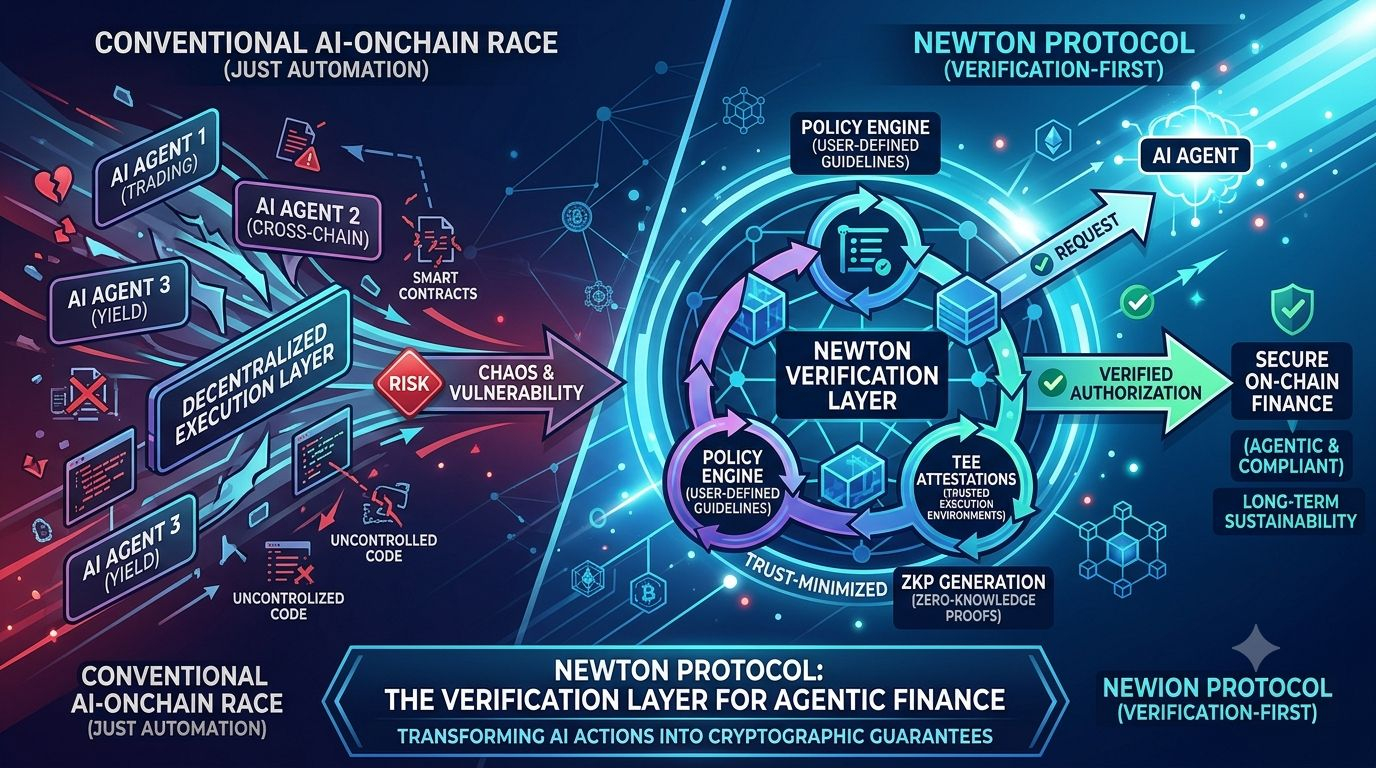
Newton Protocol: Betting On Verification, Not Just Automation, In The AI-Onchain RaceI've been spending a lot of time lately scrolling through newer L2 and rollup projects, and one thing keeps popping up in my feed that I can't quite ignore — Newton Protocol. If you haven't come across it yet, it's basically trying to build the plumbing for a world where AI agents actually manage money onchain, not just chat about it. And the more I dug into it, the more I realized this isn't some vague "AI plus crypto" buzzword combo. There's a real architecture behind it.
Let me back up a bit. We've all seen a hundred projects slap "AI" onto their whitepaper this cycle. Most of them amount to a chatbot wrapper or a trading signal generator that nobody can verify. What caught my attention with Newton is that it's not selling AI as the product. It's selling verification as the product, with AI agents as one of the use cases riding on top of it.
The core idea, from what I've read, is a dedicated rollup — they call it the Newton Keystore rollup — that handles permissions and cross chain state transitions for automated actions. So instead of trusting some offchain bot to execute your trade or rebalance your portfolio "correctly," the protocol uses trusted execution environments alongside zero knowledge proofs to actually prove the rules were followed. That's the part that stood out to me. You're not just hoping the agent behaved. You can check it.
What stands out to me is the framing around "compliance as code." I know that phrase sounds dry, almost boring next to the usual AI hype language, but it's actually the more interesting angle here. Newton lets builders define policies, things like only approve a transaction if it meets certain onchain or offchain conditions, and then a decentralized network of operators evaluates those policies inside TEEs and generates proofs anyone can check through their explorer. It's less "AI will trade for you and trust us" and more "here's a programmable rulebook that gets enforced automatically, and you can audit it."
From what I've seen, this matters more for institutional players than for the average retail trader chasing a quick flip. Stablecoin issuers, RWA platforms, anyone dealing with regulatory obligations, they need something that behaves consistently and can be verified after the fact. Manual compliance reviews don't scale well onchain. If Newton can genuinely replace that with real time enforceable logic, that's a real problem being solved, not just a narrative.
I've noticed the team behind this isn't some anonymous group that popped up out of nowhere either. It's built by Magic Labs, the same team behind the early embedded wallet infrastructure that a lot of people don't realize powered onboarding for platforms like Polymarket and WalletConnect. That gives me a bit more confidence than usual, because they've already shipped infrastructure that real users touched, even if they never knew the name behind it.
On the token side, NEWT has a fixed supply of one billion, no inflation baked in, which I personally like. Too many projects still lean on endless emissions to prop up staking yields, and it just dilutes everyone slowly over time. NEWT's utility is split across paying for compliance compute, rewarding network operators and delegated stakers, and governance votes down the line. Simple enough on paper.
Here's where things get interesting though. A huge chunk of the supply is still locked. Something like seventy plus percent depending on when you're checking, with vesting stretching out toward 2029. That's a long runway, which is good for long term alignment, but it also means unlock events are going to keep showing up on the calendar and testing the market's ability to absorb new supply. I've watched a few of these unlocks already put pressure on price, and I don't expect that pattern to just stop.
This is where things get interesting for me as someone who actually trades this stuff rather than just reads about it. NEWT has been fairly volatile since its token generation event. Big price swings, both directions, which honestly isn't shocking for a young infra token still building out its actual network. The technology story is ahead of the usage story right now. That's common, but it's worth being honest about instead of pretending otherwise.
What I appreciate is that the roadmap isn't just vague promises. They've laid out specific phases, things like the verifiable automation marketplace where developers can publish and monetize their own agents, and the multichain rollup expansion for programmable permissions across different networks. If those actually ship on schedule and get real adoption, that's when NEWT's utility starts tying more directly to actual usage instead of speculation.
From what I've seen with similar infrastructure plays, the real test isn't the tech demo. It's whether developers actually build on it and whether enough volume flows through the system to justify the token's value beyond just trading it on exchanges. A lot of promising rollups have stalled right at that step, not because the tech failed, but because the ecosystem around it never caught up.
I also think about the timing here. AI agents managing wallets and executing strategies autonomously is going from a sci-fi concept to something people are actually experimenting with. But most of it right now happens off the chain entirely, or on centralized platforms where you just have to trust the operator. Newton's bet is that as this trend grows, people and institutions will want a verifiable layer underneath it rather than blind trust. That's a reasonable bet, but it's still a bet on adoption timing, which is always the hardest thing to predict in crypto.
I'm not writing this to tell anyone to ape into NEWT. Volatility is real, unlocks are coming, and the actual usage numbers still need to catch up to the vision. What I do think is worth watching is whether the marketplace and multichain rollup pieces actually launch and get picked up by real builders, not just announced. That's usually the difference between a narrative token and an infrastructure token that survives multiple cycles.
Honestly, projects like this make me a little more optimistic about where this space is heading, even with all the noise around AI right now. Not because the hype is convincing, but because the underlying problem, verifying that automated onchain actions actually followed the rules they claimed to, is a real one that isn't going away. Whether Newton ends up being the one that solves it at scale, I genuinely don't know yet. But I'll be keeping half an eye on it as the roadmap unfolds, the way I do with most infrastructure bets that feel early rather than obvious.
@NewtonProtocol #Newt #newt $NEWT
Newton Protocol: Betting On Verification, Not Just Automation, In The AI-Onchain Race
I've been spending a lot of time lately scrolling through newer L2 and rollup projects, and one thing keeps popping up in my feed that I can't quite ignore — Newton Protocol. If you haven't come across it yet, it's basically trying to build the plumbing for a world where AI agents actually manage money onchain, not just chat about it. And the more I dug into it, the more I realized this isn't some vague "AI plus crypto" buzzword combo. There's a real architecture behind it.
Let me back up a bit. We've all seen a hundred projects slap "AI" onto their whitepaper this cycle. Most of them amount to a chatbot wrapper or a trading signal generator that nobody can verify. What caught my attention with Newton is that it's not selling AI as the product. It's selling verification as the product, with AI agents as one of the use cases riding on top of it.
The core idea, from what I've read, is a dedicated rollup — they call it the Newton Keystore rollup — that handles permissions and cross chain state transitions for automated actions. So instead of trusting some offchain bot to execute your trade or rebalance your portfolio "correctly," the protocol uses trusted execution environments alongside zero knowledge proofs to actually prove the rules were followed. That's the part that stood out to me. You're not just hoping the agent behaved. You can check it.
What stands out to me is the framing around "compliance as code." I know that phrase sounds dry, almost boring next to the usual AI hype language, but it's actually the more interesting angle here. Newton lets builders define policies, things like only approve a transaction if it meets certain onchain or offchain conditions, and then a decentralized network of operators evaluates those policies inside TEEs and generates proofs anyone can check through their explorer. It's less "AI will trade for you and trust us" and more "here's a programmable rulebook that gets enforced automatically, and you can audit it."
From what I've seen, this matters more for institutional players than for the average retail trader chasing a quick flip. Stablecoin issuers, RWA platforms, anyone dealing with regulatory obligations, they need something that behaves consistently and can be verified after the fact. Manual compliance reviews don't scale well onchain. If Newton can genuinely replace that with real time enforceable logic, that's a real problem being solved, not just a narrative.
I've noticed the team behind this isn't some anonymous group that popped up out of nowhere either. It's built by Magic Labs, the same team behind the early embedded wallet infrastructure that a lot of people don't realize powered onboarding for platforms like Polymarket and WalletConnect. That gives me a bit more confidence than usual, because they've already shipped infrastructure that real users touched, even if they never knew the name behind it.
On the token side, NEWT has a fixed supply of one billion, no inflation baked in, which I personally like. Too many projects still lean on endless emissions to prop up staking yields, and it just dilutes everyone slowly over time. NEWT's utility is split across paying for compliance compute, rewarding network operators and delegated stakers, and governance votes down the line. Simple enough on paper.
Here's where things get interesting though. A huge chunk of the supply is still locked. Something like seventy plus percent depending on when you're checking, with vesting stretching out toward 2029. That's a long runway, which is good for long term alignment, but it also means unlock events are going to keep showing up on the calendar and testing the market's ability to absorb new supply. I've watched a few of these unlocks already put pressure on price, and I don't expect that pattern to just stop.
This is where things get interesting for me as someone who actually trades this stuff rather than just reads about it. NEWT has been fairly volatile since its token generation event. Big price swings, both directions, which honestly isn't shocking for a young infra token still building out its actual network. The technology story is ahead of the usage story right now. That's common, but it's worth being honest about instead of pretending otherwise.
What I appreciate is that the roadmap isn't just vague promises. They've laid out specific phases, things like the verifiable automation marketplace where developers can publish and monetize their own agents, and the multichain rollup expansion for programmable permissions across different networks. If those actually ship on schedule and get real adoption, that's when NEWT's utility starts tying more directly to actual usage instead of speculation.
From what I've seen with similar infrastructure plays, the real test isn't the tech demo. It's whether developers actually build on it and whether enough volume flows through the system to justify the token's value beyond just trading it on exchanges. A lot of promising rollups have stalled right at that step, not because the tech failed, but because the ecosystem around it never caught up.
I also think about the timing here. AI agents managing wallets and executing strategies autonomously is going from a sci-fi concept to something people are actually experimenting with. But most of it right now happens off the chain entirely, or on centralized platforms where you just have to trust the operator. Newton's bet is that as this trend grows, people and institutions will want a verifiable layer underneath it rather than blind trust. That's a reasonable bet, but it's still a bet on adoption timing, which is always the hardest thing to predict in crypto.
I'm not writing this to tell anyone to ape into NEWT. Volatility is real, unlocks are coming, and the actual usage numbers still need to catch up to the vision. What I do think is worth watching is whether the marketplace and multichain rollup pieces actually launch and get picked up by real builders, not just announced. That's usually the difference between a narrative token and an infrastructure token that survives multiple cycles.
Honestly, projects like this make me a little more optimistic about where this space is heading, even with all the noise around AI right now. Not because the hype is convincing, but because the underlying problem, verifying that automated onchain actions actually followed the rules they claimed to, is a real one that isn't going away. Whether Newton ends up being the one that solves it at scale, I genuinely don't know yet. But I'll be keeping half an eye on it as the roadmap unfolds, the way I do with most infrastructure bets that feel early rather than obvious.
@NewtonProtocol #Newt #newt $NEWT
Let me back up a bit. We've all seen a hundred projects slap "AI" onto their whitepaper this cycle. Most of them amount to a chatbot wrapper or a trading signal generator that nobody can verify. What caught my attention with Newton is that it's not selling AI as the product. It's selling verification as the product, with AI agents as one of the use cases riding on top of it.
The core idea, from what I've read, is a dedicated rollup — they call it the Newton Keystore rollup — that handles permissions and cross chain state transitions for automated actions. So instead of trusting some offchain bot to execute your trade or rebalance your portfolio "correctly," the protocol uses trusted execution environments alongside zero knowledge proofs to actually prove the rules were followed. That's the part that stood out to me. You're not just hoping the agent behaved. You can check it.
What stands out to me is the framing around "compliance as code." I know that phrase sounds dry, almost boring next to the usual AI hype language, but it's actually the more interesting angle here. Newton lets builders define policies, things like only approve a transaction if it meets certain onchain or offchain conditions, and then a decentralized network of operators evaluates those policies inside TEEs and generates proofs anyone can check through their explorer. It's less "AI will trade for you and trust us" and more "here's a programmable rulebook that gets enforced automatically, and you can audit it."
From what I've seen, this matters more for institutional players than for the average retail trader chasing a quick flip. Stablecoin issuers, RWA platforms, anyone dealing with regulatory obligations, they need something that behaves consistently and can be verified after the fact. Manual compliance reviews don't scale well onchain. If Newton can genuinely replace that with real time enforceable logic, that's a real problem being solved, not just a narrative.
I've noticed the team behind this isn't some anonymous group that popped up out of nowhere either. It's built by Magic Labs, the same team behind the early embedded wallet infrastructure that a lot of people don't realize powered onboarding for platforms like Polymarket and WalletConnect. That gives me a bit more confidence than usual, because they've already shipped infrastructure that real users touched, even if they never knew the name behind it.
On the token side, NEWT has a fixed supply of one billion, no inflation baked in, which I personally like. Too many projects still lean on endless emissions to prop up staking yields, and it just dilutes everyone slowly over time. NEWT's utility is split across paying for compliance compute, rewarding network operators and delegated stakers, and governance votes down the line. Simple enough on paper.
Here's where things get interesting though. A huge chunk of the supply is still locked. Something like seventy plus percent depending on when you're checking, with vesting stretching out toward 2029. That's a long runway, which is good for long term alignment, but it also means unlock events are going to keep showing up on the calendar and testing the market's ability to absorb new supply. I've watched a few of these unlocks already put pressure on price, and I don't expect that pattern to just stop.
This is where things get interesting for me as someone who actually trades this stuff rather than just reads about it. NEWT has been fairly volatile since its token generation event. Big price swings, both directions, which honestly isn't shocking for a young infra token still building out its actual network. The technology story is ahead of the usage story right now. That's common, but it's worth being honest about instead of pretending otherwise.
What I appreciate is that the roadmap isn't just vague promises. They've laid out specific phases, things like the verifiable automation marketplace where developers can publish and monetize their own agents, and the multichain rollup expansion for programmable permissions across different networks. If those actually ship on schedule and get real adoption, that's when NEWT's utility starts tying more directly to actual usage instead of speculation.
From what I've seen with similar infrastructure plays, the real test isn't the tech demo. It's whether developers actually build on it and whether enough volume flows through the system to justify the token's value beyond just trading it on exchanges. A lot of promising rollups have stalled right at that step, not because the tech failed, but because the ecosystem around it never caught up.
I also think about the timing here. AI agents managing wallets and executing strategies autonomously is going from a sci-fi concept to something people are actually experimenting with. But most of it right now happens off the chain entirely, or on centralized platforms where you just have to trust the operator. Newton's bet is that as this trend grows, people and institutions will want a verifiable layer underneath it rather than blind trust. That's a reasonable bet, but it's still a bet on adoption timing, which is always the hardest thing to predict in crypto.
I'm not writing this to tell anyone to ape into NEWT. Volatility is real, unlocks are coming, and the actual usage numbers still need to catch up to the vision. What I do think is worth watching is whether the marketplace and multichain rollup pieces actually launch and get picked up by real builders, not just announced. That's usually the difference between a narrative token and an infrastructure token that survives multiple cycles.
Honestly, projects like this make me a little more optimistic about where this space is heading, even with all the noise around AI right now. Not because the hype is convincing, but because the underlying problem, verifying that automated onchain actions actually followed the rules they claimed to, is a real one that isn't going away. Whether Newton ends up being the one that solves it at scale, I genuinely don't know yet. But I'll be keeping half an eye on it as the roadmap unfolds, the way I do with most infrastructure bets that feel early rather than obvious.
@NewtonProtocol #Newt #newt $NEWT
5
7
127
·
--
Can You Actually Trust an AI Agent With Your Wallet?
I keep asking myself this every time I look at Newton Protocol. Most "AI plus crypto" projects sell you a bot and ask you to trust it blindly. Newton flips that. Instead of just automating trades, it builds a rollup that proves your AI agent actually followed the rules you set — using TEEs and zero knowledge proofs, verifiable by anyone.
What stands out? It's built by Magic Labs, the team behind early embedded wallet infra used by Polymarket and WalletConnect. NEWT has a fixed 1B supply, no inflation, but over 70% is still locked, so unlocks will keep testing price.
The real question isn't the tech. It's adoption. Will developers actually build on the marketplace? Will usage catch up to the vision?
I'm watching, not chasing. Are you?
@NewtonProtocol #Newt #newt $NEWT
Can You Actually Trust an AI Agent With Your Wallet?
I keep asking myself this every time I look at Newton Protocol. Most "AI plus crypto" projects sell you a bot and ask you to trust it blindly. Newton flips that. Instead of just automating trades, it builds a rollup that proves your AI agent actually followed the rules you set — using TEEs and zero knowledge proofs, verifiable by anyone.
What stands out? It's built by Magic Labs, the team behind early embedded wallet infra used by Polymarket and WalletConnect. NEWT has a fixed 1B supply, no inflation, but over 70% is still locked, so unlocks will keep testing price.
The real question isn't the tech. It's adoption. Will developers actually build on the marketplace? Will usage catch up to the vision?
I'm watching, not chasing. Are you?
@NewtonProtocol #Newt #newt $NEWT
I keep asking myself this every time I look at Newton Protocol. Most "AI plus crypto" projects sell you a bot and ask you to trust it blindly. Newton flips that. Instead of just automating trades, it builds a rollup that proves your AI agent actually followed the rules you set — using TEEs and zero knowledge proofs, verifiable by anyone.
What stands out? It's built by Magic Labs, the team behind early embedded wallet infra used by Polymarket and WalletConnect. NEWT has a fixed 1B supply, no inflation, but over 70% is still locked, so unlocks will keep testing price.
The real question isn't the tech. It's adoption. Will developers actually build on the marketplace? Will usage catch up to the vision?
I'm watching, not chasing. Are you?
@NewtonProtocol #Newt #newt $NEWT
🔍 Watching, not chasing
0%
🚀 Adoption before hype
0%
⚠️ Unlocks worry me
0%
🤖 Trust the tech, not agents
0%
0 проголосовали • Голосование закрыто
8
5
275
·
--
Статья
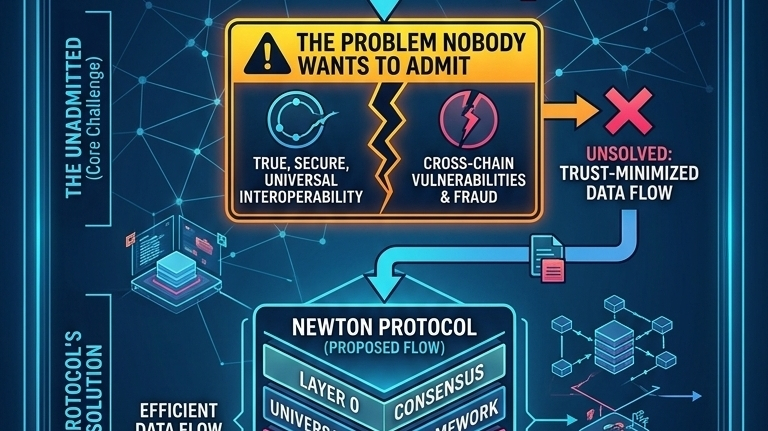
NEWTON PROTOCOL AND THE PROBLEM NOBODY WANTS TO ADMIT IS STILL UNSOLVEDCrypto solved the easy problem first. That's the thing I keep coming back to. We made execution trustless. Anyone can send anyone else money without a bank standing in the middle, without some institution deciding your transaction doesn't fit their risk model today. Fine. Good. That got solved years ago. But the part that comes after — who, or what, gets to act on your behalf, and how do you actually know it's doing what you told it, not what it decided to do on its own — nobody really cracked that one. That's the gap Newton Protocol is trying to climb into. And look, the branding around it doesn't do it any favors. AI agents, rollups, verifiable this, verifiable that. It reads like buzzword soup. But underneath the soup, there's a real problem here, and I think it's more underrated than people give it credit for.
Here's what actually got my attention. Newton isn't a trading bot platform. People keep calling it one, and sure, a lot of the use cases are trading-adjacent — recurring buys, rebalancing, yield chasing, copy trading, orders that fire when a price crosses some line. But that's not the core of it. The core is a permissions layer. A way to tell an AI agent "do this, but only under these conditions, and don't you dare touch anything outside this box" — and then actually prove that promise held, instead of just hoping it did. Trusted execution environments handle the offchain computation. Zero-knowledge proofs verify it followed the rules. That's the skeleton. I won't pretend TEEs make for thrilling reading. They don't. But the instinct behind it is solid: if you're handing software access to your money, a nice dashboard and a promise shouldn't be enough anymore.
The team behind this is Magic Labs, a company that's been building wallet infrastructure for a while now. Alongside it sits a separate nonprofit, the Magic Newton Foundation, meant to carry the community and decentralization side of things. That's a familiar split in this industry — company keeps building, foundation handles the "we're decentralizing, promise" narrative. Whether that split actually plays out the way it's pitched, I don't know. Nobody does. Roadmaps are wish lists with dates attached, and crypto has a long, ugly history of "progressively decentralized" quietly becoming "still centralized, three years later, with a governance forum nobody bothers posting in." That's not a shot at Newton specifically. It's just what the word "progressively" tends to mean once the marketing wears off.
So what's actually under the hood? Three main pieces, more or less, though the exact framing shifts depending on which writeup you're reading and when it was published — which is its own small tell about how fast this thing is still moving. First, the Model Registry. An onchain catalog where developers publish "agent models" — smart contracts that encode trigger-action logic. Price drops ten percent, execute a trade. Volatility spikes, rebalance. RSI dips below some level, buy. Simple enough on paper. The real complexity shows up once developers start stacking these models on top of each other in ways nobody planned for. That's always where the real test happens. Not the demo. The moment some user chains four agents together and something behaves in a way none of the original builders saw coming.
Second, the Keystore — a dedicated rollup that handles permissions. Who's allowed to do what, under what conditions, how those rules get issued or pulled back. Some material calls this zkPermissions specifically, letting users set granular limits — spending caps, timing windows, conditional triggers — enforced by math instead of a terms-of-service page nobody reads. Third, the account layer, built on ERC-4337 smart accounts, which lets you delegate a narrow slice of control instead of handing over your whole wallet and crossing your fingers. This last piece doesn't get talked about enough, honestly. The difference between "here's my private key, good luck" and "here's a scoped, revocable permission that can't touch anything outside its lane" isn't small. It's the entire difference between something you'd trust with real money and something you'd only ever test with money you can afford to lose.
There's also a newer angle showing up more in their messaging lately: compliance as code. Builders write policies — apparently in something like Rego, the same language a lot of cloud infrastructure already leans on — and a decentralized network of operators checks every transaction against those policies inside secure enclaves, spitting out a cryptographic proof that the check actually happened, verifiable by anyone through their explorer. My first reaction to seeing "compliance" as a headline feature of a crypto protocol was a wince. Compliance is usually the word that shows up right before decentralization quietly slips out the back door. But sitting with it longer, I'm not sure that reaction holds up here. If the real goal is getting actual financial institutions, stablecoin issuers, real-world-asset platforms comfortable enough to let AI agents touch real money — and that does seem to be who they're courting now — then some kind of programmable, verifiable compliance layer isn't optional. It's closer to a prerequisite. Whether it stays neutral the way they're describing it, or slowly turns into a chokepoint controlled by whoever writes the dominant policies — that's the real question. Nobody can answer it honestly yet. Ask again in two years.
The token, NEWT, does what you'd expect. It's gas for the rollup — issuing, updating, revoking permissions and session keys all cost NEWT. It's collateral for operators running agents, with slashing built in if an agent misbehaves, which at least makes running a sloppy or malicious agent cost something real instead of nothing. It secures the Keystore rollup through delegated proof-of-stake, with a fourteen-day unstaking window that's pretty standard for this kind of design. And eventually it carries governance weight, once that side actually turns on. There's a fee market modeled loosely on Ethereum's EIP-1559, meant to keep ordering fair and stop the network from clogging during busy stretches.
Total supply is capped at one billion tokens. No inflationary minting, which removes one long-term worry even if it does nothing for the short-term ones. The split leans community-heavy on paper — around sixty percent earmarked over time for rewards, staking incentives, and grants, rather than sitting entirely with the founding team. At launch, only a modest slice — somewhere in the low twenty percent range — actually entered circulation. The rest sits behind a fairly standard vesting structure. Team and early backers both behind roughly a twelve-month cliff, then unlocking linearly over another three years or so. And here's the make-or-break moment nobody likes talking about out loud: a big locked supply plus a public unlock calendar is basically a countdown clock the whole market watches. That's not a knock on Newton specifically. It's just what happens to any token built this way. There was already a sizable unlock flagged for late January 2026, and events like that tend to bring sell pressure whether or not real usage has grown enough to absorb it.
On the trading side, things moved faster than the actual protocol did — and that's a pattern I notice constantly in this industry, and it never stops bugging me a little. NEWT landed derivatives listings on major exchanges pretty quickly after launch, including a leveraged perpetual contract on Binance, funding settled every few hours, all the usual mechanics of a modern perp market. That brings liquidity, sure, and attention. But it also means a huge chunk of the price action early on has basically nothing to do with whether the Model Registry is actually composable or whether the Keystore is decentralizing on schedule. It's leveraged traders reacting to leveraged traders. A separate ecosystem that just happens to share a ticker with the infrastructure underneath it. Worth remembering next time the price does something wild and someone tries to read deep meaning into a candle.
Regulatory positioning is one of the more interesting threads here, mostly because most projects at this stage haven't bothered thinking about it publicly at all. Newton's apparently already secured some form of classification under the EU's MiCA framework — filed under something like "other crypto-asset." Whether that ages well as enforcement matures, or as U.S. regulators finally land somewhere solid on autonomous financial tools, which has been a painfully slow and genuinely unresolved conversation — that's anyone's guess. But engaging with it early instead of waiting for a subpoena to force the issue says something. It reads like a project aiming at institutional plumbing more than retail speculation, even while retail speculation is clearly what's driving the token's day-to-day price right now.
Here's where I land, honestly uncertain, and I don't think that's a bad place to be. It's not the cryptography or the architecture that worries me — that's been through independent audits, reports are public, and on paper it holds up, or at least holds up as well as any young, still-shifting codebase can. What I'm actually unsure about is adoption. The boring kind. Does a developer really choose to build an agent inside this Model Registry, instead of just writing their own bot and running it off a rented server somewhere, quiet, off to the side, answerable to nobody — the way basically every trading bot has ever been built? The pitch is that verifiability and composability make this categorically better, not just marginally better. Maybe that's true. But "categorically better" claims about crypto infrastructure have a rough track record of turning into developers actually showing up. Plenty of technically superior systems shipped into total silence because switching cost too much friction, or there was no existing user base to plug into, or the old centralized way was just good enough for most people's purposes. That kills momentum before it ever really starts.
Then there's the marketplace — still "upcoming," not live, as of the latest updates I can find. The public place where you'd go discover an agent someone else built, activate it, maybe pay for it, maybe stack it with agents you're already running. This is the piece that, if it actually works, turns Newton from "interesting infrastructure a handful of protocols quietly plug into" into something with real network effects — the kind where every new agent published makes the whole thing marginally more useful for the next person walking in. But marketplaces are brutal. Genuinely, categorically harder than pure infrastructure. Getting supply and demand to show up at the same time, in the right proportions, with enough quality on the supply side that early users don't bounce after one bad experience and never come back — that's a cold-start problem that's quietly killed way more ambitious platforms than this one. In crypto and well beyond it.
So no, I'm not handing you a clean verdict here. And honestly, I'd be a little suspicious of anyone who does hand you one this early, about a protocol whose most consequential pieces — the fully multichain rollup, the open marketplace, the shift to a permissionless validator set — are still sitting in the "upcoming" column of their own roadmap. But here's what I do believe, with more confidence than the rest of this: the problem Newton keeps circling is real. Maybe more real than most of what gets funded and hyped in this corner of the industry. Automation without verification is just trust wearing a costume made of code. And trust wearing a costume is exactly the thing that's burned people over and over — every time some offchain bot got quietly compromised, every time some centralized automation service rugged its users while the landing page still said "secure." If Newton, or something built roughly like it, actually manages to make "the agent did exactly what it was permitted to do, and here's the proof" a normal, boring, expected feature of onchain finance instead of a headline on a pitch deck — that would matter. Not because it's flashy. It wouldn't be flashy at all if it worked the way it's supposed to. It'd be the kind of thing nobody notices when it's working and everybody notices the second it isn't. That's usually the real tell, in my experience, in any corner of technology you look at closely enough. Whether this particular team, this particular token, on this particular timeline actually gets there — or gets there first — is a whole separate question. And honestly, I'd rather watch that play out than pretend I can call it right now.
@NewtonProtocol #Newt #newt $NEWT
NEWTON PROTOCOL AND THE PROBLEM NOBODY WANTS TO ADMIT IS STILL UNSOLVED
Crypto solved the easy problem first. That's the thing I keep coming back to. We made execution trustless. Anyone can send anyone else money without a bank standing in the middle, without some institution deciding your transaction doesn't fit their risk model today. Fine. Good. That got solved years ago. But the part that comes after — who, or what, gets to act on your behalf, and how do you actually know it's doing what you told it, not what it decided to do on its own — nobody really cracked that one. That's the gap Newton Protocol is trying to climb into. And look, the branding around it doesn't do it any favors. AI agents, rollups, verifiable this, verifiable that. It reads like buzzword soup. But underneath the soup, there's a real problem here, and I think it's more underrated than people give it credit for.
Here's what actually got my attention. Newton isn't a trading bot platform. People keep calling it one, and sure, a lot of the use cases are trading-adjacent — recurring buys, rebalancing, yield chasing, copy trading, orders that fire when a price crosses some line. But that's not the core of it. The core is a permissions layer. A way to tell an AI agent "do this, but only under these conditions, and don't you dare touch anything outside this box" — and then actually prove that promise held, instead of just hoping it did. Trusted execution environments handle the offchain computation. Zero-knowledge proofs verify it followed the rules. That's the skeleton. I won't pretend TEEs make for thrilling reading. They don't. But the instinct behind it is solid: if you're handing software access to your money, a nice dashboard and a promise shouldn't be enough anymore.
The team behind this is Magic Labs, a company that's been building wallet infrastructure for a while now. Alongside it sits a separate nonprofit, the Magic Newton Foundation, meant to carry the community and decentralization side of things. That's a familiar split in this industry — company keeps building, foundation handles the "we're decentralizing, promise" narrative. Whether that split actually plays out the way it's pitched, I don't know. Nobody does. Roadmaps are wish lists with dates attached, and crypto has a long, ugly history of "progressively decentralized" quietly becoming "still centralized, three years later, with a governance forum nobody bothers posting in." That's not a shot at Newton specifically. It's just what the word "progressively" tends to mean once the marketing wears off.
So what's actually under the hood? Three main pieces, more or less, though the exact framing shifts depending on which writeup you're reading and when it was published — which is its own small tell about how fast this thing is still moving. First, the Model Registry. An onchain catalog where developers publish "agent models" — smart contracts that encode trigger-action logic. Price drops ten percent, execute a trade. Volatility spikes, rebalance. RSI dips below some level, buy. Simple enough on paper. The real complexity shows up once developers start stacking these models on top of each other in ways nobody planned for. That's always where the real test happens. Not the demo. The moment some user chains four agents together and something behaves in a way none of the original builders saw coming.
Second, the Keystore — a dedicated rollup that handles permissions. Who's allowed to do what, under what conditions, how those rules get issued or pulled back. Some material calls this zkPermissions specifically, letting users set granular limits — spending caps, timing windows, conditional triggers — enforced by math instead of a terms-of-service page nobody reads. Third, the account layer, built on ERC-4337 smart accounts, which lets you delegate a narrow slice of control instead of handing over your whole wallet and crossing your fingers. This last piece doesn't get talked about enough, honestly. The difference between "here's my private key, good luck" and "here's a scoped, revocable permission that can't touch anything outside its lane" isn't small. It's the entire difference between something you'd trust with real money and something you'd only ever test with money you can afford to lose.
There's also a newer angle showing up more in their messaging lately: compliance as code. Builders write policies — apparently in something like Rego, the same language a lot of cloud infrastructure already leans on — and a decentralized network of operators checks every transaction against those policies inside secure enclaves, spitting out a cryptographic proof that the check actually happened, verifiable by anyone through their explorer. My first reaction to seeing "compliance" as a headline feature of a crypto protocol was a wince. Compliance is usually the word that shows up right before decentralization quietly slips out the back door. But sitting with it longer, I'm not sure that reaction holds up here. If the real goal is getting actual financial institutions, stablecoin issuers, real-world-asset platforms comfortable enough to let AI agents touch real money — and that does seem to be who they're courting now — then some kind of programmable, verifiable compliance layer isn't optional. It's closer to a prerequisite. Whether it stays neutral the way they're describing it, or slowly turns into a chokepoint controlled by whoever writes the dominant policies — that's the real question. Nobody can answer it honestly yet. Ask again in two years.
The token, NEWT, does what you'd expect. It's gas for the rollup — issuing, updating, revoking permissions and session keys all cost NEWT. It's collateral for operators running agents, with slashing built in if an agent misbehaves, which at least makes running a sloppy or malicious agent cost something real instead of nothing. It secures the Keystore rollup through delegated proof-of-stake, with a fourteen-day unstaking window that's pretty standard for this kind of design. And eventually it carries governance weight, once that side actually turns on. There's a fee market modeled loosely on Ethereum's EIP-1559, meant to keep ordering fair and stop the network from clogging during busy stretches.
Total supply is capped at one billion tokens. No inflationary minting, which removes one long-term worry even if it does nothing for the short-term ones. The split leans community-heavy on paper — around sixty percent earmarked over time for rewards, staking incentives, and grants, rather than sitting entirely with the founding team. At launch, only a modest slice — somewhere in the low twenty percent range — actually entered circulation. The rest sits behind a fairly standard vesting structure. Team and early backers both behind roughly a twelve-month cliff, then unlocking linearly over another three years or so. And here's the make-or-break moment nobody likes talking about out loud: a big locked supply plus a public unlock calendar is basically a countdown clock the whole market watches. That's not a knock on Newton specifically. It's just what happens to any token built this way. There was already a sizable unlock flagged for late January 2026, and events like that tend to bring sell pressure whether or not real usage has grown enough to absorb it.
On the trading side, things moved faster than the actual protocol did — and that's a pattern I notice constantly in this industry, and it never stops bugging me a little. NEWT landed derivatives listings on major exchanges pretty quickly after launch, including a leveraged perpetual contract on Binance, funding settled every few hours, all the usual mechanics of a modern perp market. That brings liquidity, sure, and attention. But it also means a huge chunk of the price action early on has basically nothing to do with whether the Model Registry is actually composable or whether the Keystore is decentralizing on schedule. It's leveraged traders reacting to leveraged traders. A separate ecosystem that just happens to share a ticker with the infrastructure underneath it. Worth remembering next time the price does something wild and someone tries to read deep meaning into a candle.
Regulatory positioning is one of the more interesting threads here, mostly because most projects at this stage haven't bothered thinking about it publicly at all. Newton's apparently already secured some form of classification under the EU's MiCA framework — filed under something like "other crypto-asset." Whether that ages well as enforcement matures, or as U.S. regulators finally land somewhere solid on autonomous financial tools, which has been a painfully slow and genuinely unresolved conversation — that's anyone's guess. But engaging with it early instead of waiting for a subpoena to force the issue says something. It reads like a project aiming at institutional plumbing more than retail speculation, even while retail speculation is clearly what's driving the token's day-to-day price right now.
Here's where I land, honestly uncertain, and I don't think that's a bad place to be. It's not the cryptography or the architecture that worries me — that's been through independent audits, reports are public, and on paper it holds up, or at least holds up as well as any young, still-shifting codebase can. What I'm actually unsure about is adoption. The boring kind. Does a developer really choose to build an agent inside this Model Registry, instead of just writing their own bot and running it off a rented server somewhere, quiet, off to the side, answerable to nobody — the way basically every trading bot has ever been built? The pitch is that verifiability and composability make this categorically better, not just marginally better. Maybe that's true. But "categorically better" claims about crypto infrastructure have a rough track record of turning into developers actually showing up. Plenty of technically superior systems shipped into total silence because switching cost too much friction, or there was no existing user base to plug into, or the old centralized way was just good enough for most people's purposes. That kills momentum before it ever really starts.
Then there's the marketplace — still "upcoming," not live, as of the latest updates I can find. The public place where you'd go discover an agent someone else built, activate it, maybe pay for it, maybe stack it with agents you're already running. This is the piece that, if it actually works, turns Newton from "interesting infrastructure a handful of protocols quietly plug into" into something with real network effects — the kind where every new agent published makes the whole thing marginally more useful for the next person walking in. But marketplaces are brutal. Genuinely, categorically harder than pure infrastructure. Getting supply and demand to show up at the same time, in the right proportions, with enough quality on the supply side that early users don't bounce after one bad experience and never come back — that's a cold-start problem that's quietly killed way more ambitious platforms than this one. In crypto and well beyond it.
So no, I'm not handing you a clean verdict here. And honestly, I'd be a little suspicious of anyone who does hand you one this early, about a protocol whose most consequential pieces — the fully multichain rollup, the open marketplace, the shift to a permissionless validator set — are still sitting in the "upcoming" column of their own roadmap. But here's what I do believe, with more confidence than the rest of this: the problem Newton keeps circling is real. Maybe more real than most of what gets funded and hyped in this corner of the industry. Automation without verification is just trust wearing a costume made of code. And trust wearing a costume is exactly the thing that's burned people over and over — every time some offchain bot got quietly compromised, every time some centralized automation service rugged its users while the landing page still said "secure." If Newton, or something built roughly like it, actually manages to make "the agent did exactly what it was permitted to do, and here's the proof" a normal, boring, expected feature of onchain finance instead of a headline on a pitch deck — that would matter. Not because it's flashy. It wouldn't be flashy at all if it worked the way it's supposed to. It'd be the kind of thing nobody notices when it's working and everybody notices the second it isn't. That's usually the real tell, in my experience, in any corner of technology you look at closely enough. Whether this particular team, this particular token, on this particular timeline actually gets there — or gets there first — is a whole separate question. And honestly, I'd rather watch that play out than pretend I can call it right now.
@NewtonProtocol #Newt #newt $NEWT
Here's what actually got my attention. Newton isn't a trading bot platform. People keep calling it one, and sure, a lot of the use cases are trading-adjacent — recurring buys, rebalancing, yield chasing, copy trading, orders that fire when a price crosses some line. But that's not the core of it. The core is a permissions layer. A way to tell an AI agent "do this, but only under these conditions, and don't you dare touch anything outside this box" — and then actually prove that promise held, instead of just hoping it did. Trusted execution environments handle the offchain computation. Zero-knowledge proofs verify it followed the rules. That's the skeleton. I won't pretend TEEs make for thrilling reading. They don't. But the instinct behind it is solid: if you're handing software access to your money, a nice dashboard and a promise shouldn't be enough anymore.
The team behind this is Magic Labs, a company that's been building wallet infrastructure for a while now. Alongside it sits a separate nonprofit, the Magic Newton Foundation, meant to carry the community and decentralization side of things. That's a familiar split in this industry — company keeps building, foundation handles the "we're decentralizing, promise" narrative. Whether that split actually plays out the way it's pitched, I don't know. Nobody does. Roadmaps are wish lists with dates attached, and crypto has a long, ugly history of "progressively decentralized" quietly becoming "still centralized, three years later, with a governance forum nobody bothers posting in." That's not a shot at Newton specifically. It's just what the word "progressively" tends to mean once the marketing wears off.
So what's actually under the hood? Three main pieces, more or less, though the exact framing shifts depending on which writeup you're reading and when it was published — which is its own small tell about how fast this thing is still moving. First, the Model Registry. An onchain catalog where developers publish "agent models" — smart contracts that encode trigger-action logic. Price drops ten percent, execute a trade. Volatility spikes, rebalance. RSI dips below some level, buy. Simple enough on paper. The real complexity shows up once developers start stacking these models on top of each other in ways nobody planned for. That's always where the real test happens. Not the demo. The moment some user chains four agents together and something behaves in a way none of the original builders saw coming.
Second, the Keystore — a dedicated rollup that handles permissions. Who's allowed to do what, under what conditions, how those rules get issued or pulled back. Some material calls this zkPermissions specifically, letting users set granular limits — spending caps, timing windows, conditional triggers — enforced by math instead of a terms-of-service page nobody reads. Third, the account layer, built on ERC-4337 smart accounts, which lets you delegate a narrow slice of control instead of handing over your whole wallet and crossing your fingers. This last piece doesn't get talked about enough, honestly. The difference between "here's my private key, good luck" and "here's a scoped, revocable permission that can't touch anything outside its lane" isn't small. It's the entire difference between something you'd trust with real money and something you'd only ever test with money you can afford to lose.
There's also a newer angle showing up more in their messaging lately: compliance as code. Builders write policies — apparently in something like Rego, the same language a lot of cloud infrastructure already leans on — and a decentralized network of operators checks every transaction against those policies inside secure enclaves, spitting out a cryptographic proof that the check actually happened, verifiable by anyone through their explorer. My first reaction to seeing "compliance" as a headline feature of a crypto protocol was a wince. Compliance is usually the word that shows up right before decentralization quietly slips out the back door. But sitting with it longer, I'm not sure that reaction holds up here. If the real goal is getting actual financial institutions, stablecoin issuers, real-world-asset platforms comfortable enough to let AI agents touch real money — and that does seem to be who they're courting now — then some kind of programmable, verifiable compliance layer isn't optional. It's closer to a prerequisite. Whether it stays neutral the way they're describing it, or slowly turns into a chokepoint controlled by whoever writes the dominant policies — that's the real question. Nobody can answer it honestly yet. Ask again in two years.
The token, NEWT, does what you'd expect. It's gas for the rollup — issuing, updating, revoking permissions and session keys all cost NEWT. It's collateral for operators running agents, with slashing built in if an agent misbehaves, which at least makes running a sloppy or malicious agent cost something real instead of nothing. It secures the Keystore rollup through delegated proof-of-stake, with a fourteen-day unstaking window that's pretty standard for this kind of design. And eventually it carries governance weight, once that side actually turns on. There's a fee market modeled loosely on Ethereum's EIP-1559, meant to keep ordering fair and stop the network from clogging during busy stretches.
Total supply is capped at one billion tokens. No inflationary minting, which removes one long-term worry even if it does nothing for the short-term ones. The split leans community-heavy on paper — around sixty percent earmarked over time for rewards, staking incentives, and grants, rather than sitting entirely with the founding team. At launch, only a modest slice — somewhere in the low twenty percent range — actually entered circulation. The rest sits behind a fairly standard vesting structure. Team and early backers both behind roughly a twelve-month cliff, then unlocking linearly over another three years or so. And here's the make-or-break moment nobody likes talking about out loud: a big locked supply plus a public unlock calendar is basically a countdown clock the whole market watches. That's not a knock on Newton specifically. It's just what happens to any token built this way. There was already a sizable unlock flagged for late January 2026, and events like that tend to bring sell pressure whether or not real usage has grown enough to absorb it.
On the trading side, things moved faster than the actual protocol did — and that's a pattern I notice constantly in this industry, and it never stops bugging me a little. NEWT landed derivatives listings on major exchanges pretty quickly after launch, including a leveraged perpetual contract on Binance, funding settled every few hours, all the usual mechanics of a modern perp market. That brings liquidity, sure, and attention. But it also means a huge chunk of the price action early on has basically nothing to do with whether the Model Registry is actually composable or whether the Keystore is decentralizing on schedule. It's leveraged traders reacting to leveraged traders. A separate ecosystem that just happens to share a ticker with the infrastructure underneath it. Worth remembering next time the price does something wild and someone tries to read deep meaning into a candle.
Regulatory positioning is one of the more interesting threads here, mostly because most projects at this stage haven't bothered thinking about it publicly at all. Newton's apparently already secured some form of classification under the EU's MiCA framework — filed under something like "other crypto-asset." Whether that ages well as enforcement matures, or as U.S. regulators finally land somewhere solid on autonomous financial tools, which has been a painfully slow and genuinely unresolved conversation — that's anyone's guess. But engaging with it early instead of waiting for a subpoena to force the issue says something. It reads like a project aiming at institutional plumbing more than retail speculation, even while retail speculation is clearly what's driving the token's day-to-day price right now.
Here's where I land, honestly uncertain, and I don't think that's a bad place to be. It's not the cryptography or the architecture that worries me — that's been through independent audits, reports are public, and on paper it holds up, or at least holds up as well as any young, still-shifting codebase can. What I'm actually unsure about is adoption. The boring kind. Does a developer really choose to build an agent inside this Model Registry, instead of just writing their own bot and running it off a rented server somewhere, quiet, off to the side, answerable to nobody — the way basically every trading bot has ever been built? The pitch is that verifiability and composability make this categorically better, not just marginally better. Maybe that's true. But "categorically better" claims about crypto infrastructure have a rough track record of turning into developers actually showing up. Plenty of technically superior systems shipped into total silence because switching cost too much friction, or there was no existing user base to plug into, or the old centralized way was just good enough for most people's purposes. That kills momentum before it ever really starts.
Then there's the marketplace — still "upcoming," not live, as of the latest updates I can find. The public place where you'd go discover an agent someone else built, activate it, maybe pay for it, maybe stack it with agents you're already running. This is the piece that, if it actually works, turns Newton from "interesting infrastructure a handful of protocols quietly plug into" into something with real network effects — the kind where every new agent published makes the whole thing marginally more useful for the next person walking in. But marketplaces are brutal. Genuinely, categorically harder than pure infrastructure. Getting supply and demand to show up at the same time, in the right proportions, with enough quality on the supply side that early users don't bounce after one bad experience and never come back — that's a cold-start problem that's quietly killed way more ambitious platforms than this one. In crypto and well beyond it.
So no, I'm not handing you a clean verdict here. And honestly, I'd be a little suspicious of anyone who does hand you one this early, about a protocol whose most consequential pieces — the fully multichain rollup, the open marketplace, the shift to a permissionless validator set — are still sitting in the "upcoming" column of their own roadmap. But here's what I do believe, with more confidence than the rest of this: the problem Newton keeps circling is real. Maybe more real than most of what gets funded and hyped in this corner of the industry. Automation without verification is just trust wearing a costume made of code. And trust wearing a costume is exactly the thing that's burned people over and over — every time some offchain bot got quietly compromised, every time some centralized automation service rugged its users while the landing page still said "secure." If Newton, or something built roughly like it, actually manages to make "the agent did exactly what it was permitted to do, and here's the proof" a normal, boring, expected feature of onchain finance instead of a headline on a pitch deck — that would matter. Not because it's flashy. It wouldn't be flashy at all if it worked the way it's supposed to. It'd be the kind of thing nobody notices when it's working and everybody notices the second it isn't. That's usually the real tell, in my experience, in any corner of technology you look at closely enough. Whether this particular team, this particular token, on this particular timeline actually gets there — or gets there first — is a whole separate question. And honestly, I'd rather watch that play out than pretend I can call it right now.
@NewtonProtocol #Newt #newt $NEWT
7
5
119
·
--
I’m watching Newton Protocol (NEWT), and the market is pricing it as an "AI agent trading" token when its real function sits one layer beneath that.
Most of the attention goes to the trading-bot narrative — agents rebalancing portfolios, executing strategies. But Newton's actual architecture is a compliance-as-code layer, where builder-defined policies use onchain and offchain data to approve or block transactions, verified by a decentralized operator network running inside trusted execution environments (CoinMarketCap) .
That's not a trading feature. That's a permissioning primitive — the same category oracles occupy for data. And permissioning layers don't get valued by trading volume; they get valued by who's forced to integrate them.
The stated targets are financial institutions, stablecoin issuers, and RWA platforms needing real-time enforcement without giving up transparency (CoinMarketCap) . That's a coordination bet: if regulated capital needs verifiable rule-checking to touch onchain automation at all, NEWT becomes infrastructure demand, not narrative demand — sticky, not reflexive.
The market is still pricing it off unlock-driven volatility, with a 139.6 million token unlock on January 24, 2026 threatening to outpace absorption (CoinMarketCap) — a supply story. The real question is a demand story: does compliance-as-code become the default rail before that supply lands.
I'm not watching the agents. I'm watching who has to ask permission to move.
#newt $NEWT @NewtonProtocol
I’m watching Newton Protocol (NEWT), and the market is pricing it as an "AI agent trading" token when its real function sits one layer beneath that.
Most of the attention goes to the trading-bot narrative — agents rebalancing portfolios, executing strategies. But Newton's actual architecture is a compliance-as-code layer, where builder-defined policies use onchain and offchain data to approve or block transactions, verified by a decentralized operator network running inside trusted execution environments (CoinMarketCap) .
That's not a trading feature. That's a permissioning primitive — the same category oracles occupy for data. And permissioning layers don't get valued by trading volume; they get valued by who's forced to integrate them.
The stated targets are financial institutions, stablecoin issuers, and RWA platforms needing real-time enforcement without giving up transparency (CoinMarketCap) . That's a coordination bet: if regulated capital needs verifiable rule-checking to touch onchain automation at all, NEWT becomes infrastructure demand, not narrative demand — sticky, not reflexive.
The market is still pricing it off unlock-driven volatility, with a 139.6 million token unlock on January 24, 2026 threatening to outpace absorption (CoinMarketCap) — a supply story. The real question is a demand story: does compliance-as-code become the default rail before that supply lands.
I'm not watching the agents. I'm watching who has to ask permission to move.
#newt $NEWT @NewtonProtocol
Most of the attention goes to the trading-bot narrative — agents rebalancing portfolios, executing strategies. But Newton's actual architecture is a compliance-as-code layer, where builder-defined policies use onchain and offchain data to approve or block transactions, verified by a decentralized operator network running inside trusted execution environments (CoinMarketCap) .
That's not a trading feature. That's a permissioning primitive — the same category oracles occupy for data. And permissioning layers don't get valued by trading volume; they get valued by who's forced to integrate them.
The stated targets are financial institutions, stablecoin issuers, and RWA platforms needing real-time enforcement without giving up transparency (CoinMarketCap) . That's a coordination bet: if regulated capital needs verifiable rule-checking to touch onchain automation at all, NEWT becomes infrastructure demand, not narrative demand — sticky, not reflexive.
The market is still pricing it off unlock-driven volatility, with a 139.6 million token unlock on January 24, 2026 threatening to outpace absorption (CoinMarketCap) — a supply story. The real question is a demand story: does compliance-as-code become the default rail before that supply lands.
I'm not watching the agents. I'm watching who has to ask permission to move.
#newt $NEWT @NewtonProtocol
Infrastructure play
100%
Hype-driven AI coin
0%
Unlocks outweigh demand
0%
Too early to call
0%
1 проголосовали • Голосование закрыто
5
4
151
·
--
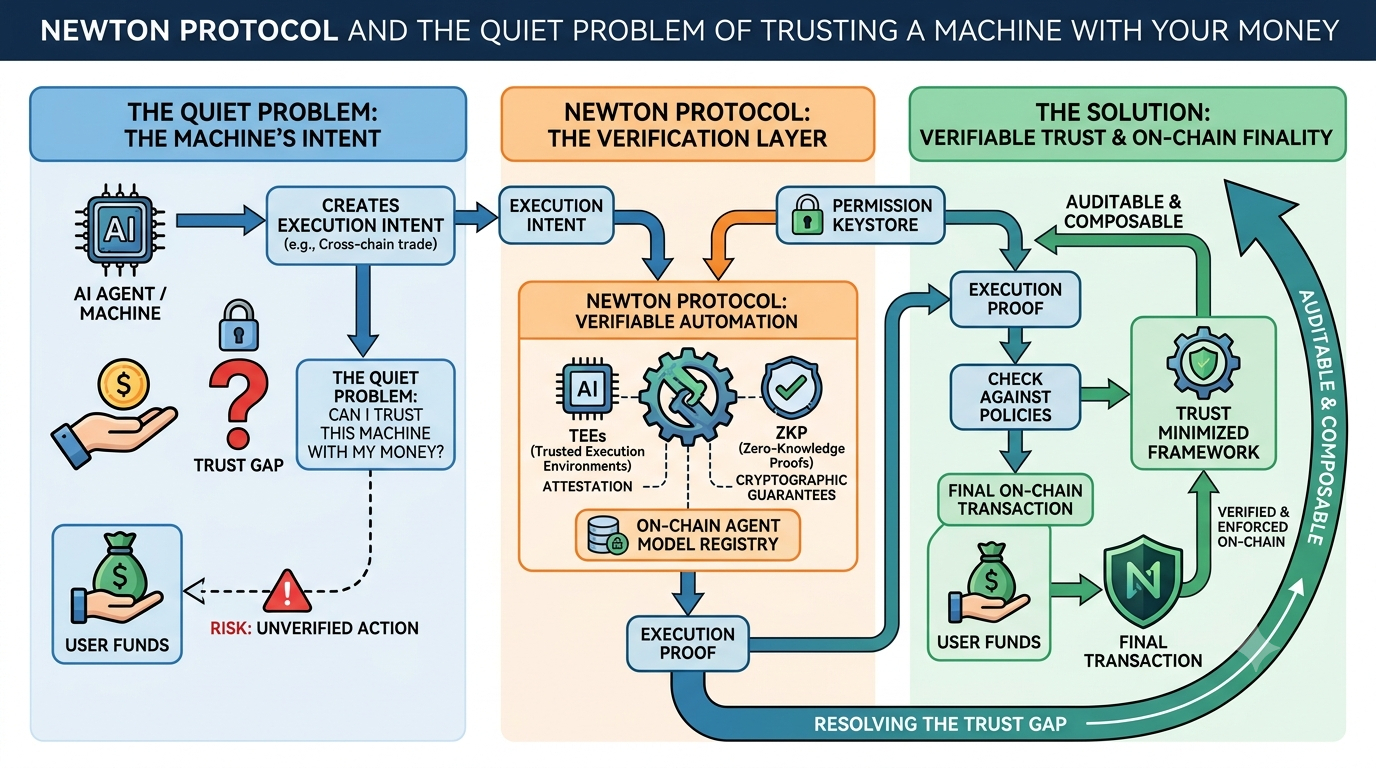
Статья
NEWTON PROTOCOL AND THE QUIET PROBLEM OF TRUSTING A MACHINE WITH YOUR MONEY"Trustless automation." I've read that phrase so many times it barely registers anymore. But sit with it for a second and it actually means something. Newton Protocol is one of those projects that forces you to slow down and ask: what problem are you actually solving here? Because on paper it reads like every other AI-meets-crypto pitch from the last two years. Agents. Rollups. Marketplaces. The words blur together. I say that as someone who's read a lot of these decks, and I'll admit some fatigue creeps in around the fifth "AI-powered onchain" tagline of the week.
But dig past the pitch deck language and there's a specific thing going on. Newton wants you to hand off financial decisions to software without handing over custody of your money. And without trusting that the software is doing what it claims to be doing. That's the real hurdle. Anyone can build a bot that trades for you. The hard part is proving, to a total stranger, that the bot only did what you told it to do. Nothing more.
Newton's answer is a mix of trusted execution environments and zero-knowledge proofs. Sounds like jargon soup, I know. Break it down, though, and it's not that complicated. A TEE is basically a locked room. Computation happens inside it that nobody — not even the operator running the hardware — can peek into or mess with. The zk-proof is the receipt that comes out of that room. A mathematical guarantee that whatever happened inside followed the rules, without ever revealing the private details of how. Builders write policies using onchain and offchain data to decide if a transaction gets approved or blocked. A decentralized network of operators, backed by Ethereum restaking and NEWT itself, runs those checks inside the enclave and spits out a proof. Anyone can verify it later through what they call the Newton Explorer. Nobody has to take their word for it.
Here's the thing I keep coming back to, though. This isn't just an AI trading platform. It's closer to a compliance engine that happens to run AI agents on top. Once you see it that way, the rest of the design starts to click.
And honestly? That might be the more interesting story here. Not the trading angle everyone leads with. The pitch is that Newton bakes compliance directly into the transaction itself. Same way smart contracts made execution programmable. Same way oracles made outside data usable onchain. Compliance-as-code. Sounds dry until you think about who actually needs it. Stablecoin issuers. Real-world-asset platforms. Institutions that want AI touching their money but are terrified of what regulators will say about it. That's a real gap. It's been sitting there this whole time while everyone else chased faster DEXs and flashier speculative tokens. Is Newton the team that fills it? I don't know. Nobody does yet. But the shape of the problem is dead right. And builders can write these policies in a language like Rego instead of some made-up syntax nobody wants to learn — small detail, but the kind of small detail that decides whether developers actually show up.
Under the hood, three pieces matter. The Model Registry — an onchain catalog where developers publish agent strategies, the "if this drops ten percent, do this" kind of logic. The Keystore — a dedicated rollup managing permissions, letting you set spending limits and timing windows instead of handing a bot blanket access to everything you own. And smart accounts, built on the ERC-4337 standard, which let you delegate narrow slices of wallet control without ever giving up your private keys. Put it together and the idea is simple: you never hand an agent the keys to the whole house. You give it a fenced-in permission. And that fence is enforced by math, not by some company's promise buried in a terms-of-service page nobody reads.
The roadmap still has two big pieces ahead of it, not behind it. There's the Verifiable Automation Marketplace — an onchain spot where developers publish agents and users discover, mix, and activate them for things like staking or treasury management or trading. That's the piece that turns Newton from plumbing into something people actually browse and use, like an app store. And there's the expansion of the Keystore into a full multichain zkPermissions rollup, so these permissions aren't stuck on one chain. Both are still "coming soon," not shipped. And that distinction matters a lot. A rollup on a roadmap slide is a very different animal than a rollup processing real transactions at real volume.
I want to be careful not to get swept up in the architecture, because good architecture doesn't guarantee anyone shows up to use it. And adoption is the whole ballgame here. A rollup can be elegant and still sit empty. A permissions system can be airtight and still go nowhere because the SDK is annoying to integrate, or the incentives aren't there yet, or some competitor ships a scrappier version first. The way I see it, adoption speed is the real risk with this project — and that comes down to developer interest and how painless the tooling actually is. That's not a knock on Newton specifically. That's true of basically every piece of infrastructure ever built, long before crypto existed. The tech can be right and still lose. To timing. To a rival with better onboarding. Or just to the fact that most builders will go wherever the friction is lowest, every single time.
Now, the token. NEWT does the usual multi-job that these layer-two tokens tend to do. It's the gas paid to issue, update, or revoke permissions and session keys. It's the staking collateral securing the Keystore rollup, running on a delegated proof-of-stake model with a fourteen-day unstaking window. It carries governance weight once that layer goes fully live. And it's the collateral operators post when running agents — so if a strategy misbehaves, there's something real on the line to slash. Total supply is capped at one billion tokens. Sixty percent goes toward community allocations — staking rewards, grants, that kind of thing. The rest is split between core contributors and early backers, vesting out over three to four years depending on the bucket. Nothing radical there. But the unlock calendar is worth watching closely if you're the type who tracks this stuff, because there's a meaningful unlock event analysts have flagged, and if demand doesn't keep pace with the fresh supply hitting the market, that's real sell pressure. I'm not giving investment advice here — I can't, and this isn't the place for it — but that detail matters more than most of the roadmap talk, because unlock schedules are usually what actually moves price in the short term, regardless of how the tech is progressing underneath.
What really sticks with me, though, is the line the team's been using lately. Crypto built a glass house — everything transparent, everything sitting on a public ledger for anyone to see — but nobody built the locks to go with all that glass. Newton's positioning itself as the team building those locks. Long-term narrative, security and compliance as the missing layer for AI and real-world assets onchain. It's a good line. The kind that sticks with you after you close the tab. But look — a good narrative and a good product are two completely different animals. And this industry's graveyard is full of projects with great narratives that never closed the gap to something people actually used at scale.
Then there's price, which I almost don't want to touch because it swallows every other conversation the second it comes up. But ignoring it would be dishonest. The mood around NEWT right now is a weird mix — quiet confidence in the tech, paired with a wary eye on some genuinely violent post-airdrop price swings. People in the community are flagging real risk after past parabolic runs and overbought conditions. That tension — belief in the roadmap next to distrust of the chart — is basically the emotional weather pattern of every serious infrastructure token in year one. People believe the story and don't trust the candles, sometimes in the same breath. And honestly, I don't think that's irrational. It's just an accurate read of where things stand. The roadmap's unproven. The chart's unforgiving. Both can be true at once.
There's a regulatory thread here too, one that gets way less attention than the technical side but might matter just as much down the line. Newton's agents currently sit under the EU's MiCA framework, classified as an "other crypto-asset." That gives it solid footing in at least one major jurisdiction. Meanwhile, proposed U.S. rules around autonomous financial tools are still up in the air, and however that shakes out could seriously shape — or restrict — how something like this operates across borders. Sounds boring next to talk of zero-knowledge proofs and AI agents, I know. But it might be one of the more consequential variables in play. A compliance-focused protocol with shaky regulatory footing of its own would be a pretty ironic outcome. Worth watching closely over the next year, not assuming it's settled.
So where does that leave things? I keep landing in the same place. Newton's tackling a real problem that's genuinely under-addressed — verifiable delegation, agents acting on your behalf without you blindly trusting either the agent or the company behind it. And the compliance angle might end up being the more durable value here, even though the trading-bot pitch is what gets the headlines and the exchange listings and the leveraged perpetual contracts. Does the execution catch up to the ambition? Genuinely don't know. I'd be lying if I said otherwise. Infrastructure plays like this live or die on adoption curves measured in years, not months, and the loudest voices in a market like this are rarely the most patient ones. Maybe that's fine. Maybe patience isn't even the right lens for any of this. But if you're trying to figure out what actually matters here, watch the developer activity on the Model Registry. Watch how fast validators actually decentralize. That'll tell you more than the token chart ever will — because one of those things tells you whether this is actually getting built, and the other just tells you how people feel about it this particular week. Those aren't the same question. Even if this industry loves pretending they are.
@NewtonProtocol #Newt $NEWT #newt
{future}(NEWTUSDT)
NEWTON PROTOCOL AND THE QUIET PROBLEM OF TRUSTING A MACHINE WITH YOUR MONEY
"Trustless automation." I've read that phrase so many times it barely registers anymore. But sit with it for a second and it actually means something. Newton Protocol is one of those projects that forces you to slow down and ask: what problem are you actually solving here? Because on paper it reads like every other AI-meets-crypto pitch from the last two years. Agents. Rollups. Marketplaces. The words blur together. I say that as someone who's read a lot of these decks, and I'll admit some fatigue creeps in around the fifth "AI-powered onchain" tagline of the week.
But dig past the pitch deck language and there's a specific thing going on. Newton wants you to hand off financial decisions to software without handing over custody of your money. And without trusting that the software is doing what it claims to be doing. That's the real hurdle. Anyone can build a bot that trades for you. The hard part is proving, to a total stranger, that the bot only did what you told it to do. Nothing more.
Newton's answer is a mix of trusted execution environments and zero-knowledge proofs. Sounds like jargon soup, I know. Break it down, though, and it's not that complicated. A TEE is basically a locked room. Computation happens inside it that nobody — not even the operator running the hardware — can peek into or mess with. The zk-proof is the receipt that comes out of that room. A mathematical guarantee that whatever happened inside followed the rules, without ever revealing the private details of how. Builders write policies using onchain and offchain data to decide if a transaction gets approved or blocked. A decentralized network of operators, backed by Ethereum restaking and NEWT itself, runs those checks inside the enclave and spits out a proof. Anyone can verify it later through what they call the Newton Explorer. Nobody has to take their word for it.
Here's the thing I keep coming back to, though. This isn't just an AI trading platform. It's closer to a compliance engine that happens to run AI agents on top. Once you see it that way, the rest of the design starts to click.
And honestly? That might be the more interesting story here. Not the trading angle everyone leads with. The pitch is that Newton bakes compliance directly into the transaction itself. Same way smart contracts made execution programmable. Same way oracles made outside data usable onchain. Compliance-as-code. Sounds dry until you think about who actually needs it. Stablecoin issuers. Real-world-asset platforms. Institutions that want AI touching their money but are terrified of what regulators will say about it. That's a real gap. It's been sitting there this whole time while everyone else chased faster DEXs and flashier speculative tokens. Is Newton the team that fills it? I don't know. Nobody does yet. But the shape of the problem is dead right. And builders can write these policies in a language like Rego instead of some made-up syntax nobody wants to learn — small detail, but the kind of small detail that decides whether developers actually show up.
Under the hood, three pieces matter. The Model Registry — an onchain catalog where developers publish agent strategies, the "if this drops ten percent, do this" kind of logic. The Keystore — a dedicated rollup managing permissions, letting you set spending limits and timing windows instead of handing a bot blanket access to everything you own. And smart accounts, built on the ERC-4337 standard, which let you delegate narrow slices of wallet control without ever giving up your private keys. Put it together and the idea is simple: you never hand an agent the keys to the whole house. You give it a fenced-in permission. And that fence is enforced by math, not by some company's promise buried in a terms-of-service page nobody reads.
The roadmap still has two big pieces ahead of it, not behind it. There's the Verifiable Automation Marketplace — an onchain spot where developers publish agents and users discover, mix, and activate them for things like staking or treasury management or trading. That's the piece that turns Newton from plumbing into something people actually browse and use, like an app store. And there's the expansion of the Keystore into a full multichain zkPermissions rollup, so these permissions aren't stuck on one chain. Both are still "coming soon," not shipped. And that distinction matters a lot. A rollup on a roadmap slide is a very different animal than a rollup processing real transactions at real volume.
I want to be careful not to get swept up in the architecture, because good architecture doesn't guarantee anyone shows up to use it. And adoption is the whole ballgame here. A rollup can be elegant and still sit empty. A permissions system can be airtight and still go nowhere because the SDK is annoying to integrate, or the incentives aren't there yet, or some competitor ships a scrappier version first. The way I see it, adoption speed is the real risk with this project — and that comes down to developer interest and how painless the tooling actually is. That's not a knock on Newton specifically. That's true of basically every piece of infrastructure ever built, long before crypto existed. The tech can be right and still lose. To timing. To a rival with better onboarding. Or just to the fact that most builders will go wherever the friction is lowest, every single time.
Now, the token. NEWT does the usual multi-job that these layer-two tokens tend to do. It's the gas paid to issue, update, or revoke permissions and session keys. It's the staking collateral securing the Keystore rollup, running on a delegated proof-of-stake model with a fourteen-day unstaking window. It carries governance weight once that layer goes fully live. And it's the collateral operators post when running agents — so if a strategy misbehaves, there's something real on the line to slash. Total supply is capped at one billion tokens. Sixty percent goes toward community allocations — staking rewards, grants, that kind of thing. The rest is split between core contributors and early backers, vesting out over three to four years depending on the bucket. Nothing radical there. But the unlock calendar is worth watching closely if you're the type who tracks this stuff, because there's a meaningful unlock event analysts have flagged, and if demand doesn't keep pace with the fresh supply hitting the market, that's real sell pressure. I'm not giving investment advice here — I can't, and this isn't the place for it — but that detail matters more than most of the roadmap talk, because unlock schedules are usually what actually moves price in the short term, regardless of how the tech is progressing underneath.
What really sticks with me, though, is the line the team's been using lately. Crypto built a glass house — everything transparent, everything sitting on a public ledger for anyone to see — but nobody built the locks to go with all that glass. Newton's positioning itself as the team building those locks. Long-term narrative, security and compliance as the missing layer for AI and real-world assets onchain. It's a good line. The kind that sticks with you after you close the tab. But look — a good narrative and a good product are two completely different animals. And this industry's graveyard is full of projects with great narratives that never closed the gap to something people actually used at scale.
Then there's price, which I almost don't want to touch because it swallows every other conversation the second it comes up. But ignoring it would be dishonest. The mood around NEWT right now is a weird mix — quiet confidence in the tech, paired with a wary eye on some genuinely violent post-airdrop price swings. People in the community are flagging real risk after past parabolic runs and overbought conditions. That tension — belief in the roadmap next to distrust of the chart — is basically the emotional weather pattern of every serious infrastructure token in year one. People believe the story and don't trust the candles, sometimes in the same breath. And honestly, I don't think that's irrational. It's just an accurate read of where things stand. The roadmap's unproven. The chart's unforgiving. Both can be true at once.
There's a regulatory thread here too, one that gets way less attention than the technical side but might matter just as much down the line. Newton's agents currently sit under the EU's MiCA framework, classified as an "other crypto-asset." That gives it solid footing in at least one major jurisdiction. Meanwhile, proposed U.S. rules around autonomous financial tools are still up in the air, and however that shakes out could seriously shape — or restrict — how something like this operates across borders. Sounds boring next to talk of zero-knowledge proofs and AI agents, I know. But it might be one of the more consequential variables in play. A compliance-focused protocol with shaky regulatory footing of its own would be a pretty ironic outcome. Worth watching closely over the next year, not assuming it's settled.
So where does that leave things? I keep landing in the same place. Newton's tackling a real problem that's genuinely under-addressed — verifiable delegation, agents acting on your behalf without you blindly trusting either the agent or the company behind it. And the compliance angle might end up being the more durable value here, even though the trading-bot pitch is what gets the headlines and the exchange listings and the leveraged perpetual contracts. Does the execution catch up to the ambition? Genuinely don't know. I'd be lying if I said otherwise. Infrastructure plays like this live or die on adoption curves measured in years, not months, and the loudest voices in a market like this are rarely the most patient ones. Maybe that's fine. Maybe patience isn't even the right lens for any of this. But if you're trying to figure out what actually matters here, watch the developer activity on the Model Registry. Watch how fast validators actually decentralize. That'll tell you more than the token chart ever will — because one of those things tells you whether this is actually getting built, and the other just tells you how people feel about it this particular week. Those aren't the same question. Even if this industry loves pretending they are.
@NewtonProtocol #Newt $NEWT #newt
But dig past the pitch deck language and there's a specific thing going on. Newton wants you to hand off financial decisions to software without handing over custody of your money. And without trusting that the software is doing what it claims to be doing. That's the real hurdle. Anyone can build a bot that trades for you. The hard part is proving, to a total stranger, that the bot only did what you told it to do. Nothing more.
Newton's answer is a mix of trusted execution environments and zero-knowledge proofs. Sounds like jargon soup, I know. Break it down, though, and it's not that complicated. A TEE is basically a locked room. Computation happens inside it that nobody — not even the operator running the hardware — can peek into or mess with. The zk-proof is the receipt that comes out of that room. A mathematical guarantee that whatever happened inside followed the rules, without ever revealing the private details of how. Builders write policies using onchain and offchain data to decide if a transaction gets approved or blocked. A decentralized network of operators, backed by Ethereum restaking and NEWT itself, runs those checks inside the enclave and spits out a proof. Anyone can verify it later through what they call the Newton Explorer. Nobody has to take their word for it.
Here's the thing I keep coming back to, though. This isn't just an AI trading platform. It's closer to a compliance engine that happens to run AI agents on top. Once you see it that way, the rest of the design starts to click.
And honestly? That might be the more interesting story here. Not the trading angle everyone leads with. The pitch is that Newton bakes compliance directly into the transaction itself. Same way smart contracts made execution programmable. Same way oracles made outside data usable onchain. Compliance-as-code. Sounds dry until you think about who actually needs it. Stablecoin issuers. Real-world-asset platforms. Institutions that want AI touching their money but are terrified of what regulators will say about it. That's a real gap. It's been sitting there this whole time while everyone else chased faster DEXs and flashier speculative tokens. Is Newton the team that fills it? I don't know. Nobody does yet. But the shape of the problem is dead right. And builders can write these policies in a language like Rego instead of some made-up syntax nobody wants to learn — small detail, but the kind of small detail that decides whether developers actually show up.
Under the hood, three pieces matter. The Model Registry — an onchain catalog where developers publish agent strategies, the "if this drops ten percent, do this" kind of logic. The Keystore — a dedicated rollup managing permissions, letting you set spending limits and timing windows instead of handing a bot blanket access to everything you own. And smart accounts, built on the ERC-4337 standard, which let you delegate narrow slices of wallet control without ever giving up your private keys. Put it together and the idea is simple: you never hand an agent the keys to the whole house. You give it a fenced-in permission. And that fence is enforced by math, not by some company's promise buried in a terms-of-service page nobody reads.
The roadmap still has two big pieces ahead of it, not behind it. There's the Verifiable Automation Marketplace — an onchain spot where developers publish agents and users discover, mix, and activate them for things like staking or treasury management or trading. That's the piece that turns Newton from plumbing into something people actually browse and use, like an app store. And there's the expansion of the Keystore into a full multichain zkPermissions rollup, so these permissions aren't stuck on one chain. Both are still "coming soon," not shipped. And that distinction matters a lot. A rollup on a roadmap slide is a very different animal than a rollup processing real transactions at real volume.
I want to be careful not to get swept up in the architecture, because good architecture doesn't guarantee anyone shows up to use it. And adoption is the whole ballgame here. A rollup can be elegant and still sit empty. A permissions system can be airtight and still go nowhere because the SDK is annoying to integrate, or the incentives aren't there yet, or some competitor ships a scrappier version first. The way I see it, adoption speed is the real risk with this project — and that comes down to developer interest and how painless the tooling actually is. That's not a knock on Newton specifically. That's true of basically every piece of infrastructure ever built, long before crypto existed. The tech can be right and still lose. To timing. To a rival with better onboarding. Or just to the fact that most builders will go wherever the friction is lowest, every single time.
Now, the token. NEWT does the usual multi-job that these layer-two tokens tend to do. It's the gas paid to issue, update, or revoke permissions and session keys. It's the staking collateral securing the Keystore rollup, running on a delegated proof-of-stake model with a fourteen-day unstaking window. It carries governance weight once that layer goes fully live. And it's the collateral operators post when running agents — so if a strategy misbehaves, there's something real on the line to slash. Total supply is capped at one billion tokens. Sixty percent goes toward community allocations — staking rewards, grants, that kind of thing. The rest is split between core contributors and early backers, vesting out over three to four years depending on the bucket. Nothing radical there. But the unlock calendar is worth watching closely if you're the type who tracks this stuff, because there's a meaningful unlock event analysts have flagged, and if demand doesn't keep pace with the fresh supply hitting the market, that's real sell pressure. I'm not giving investment advice here — I can't, and this isn't the place for it — but that detail matters more than most of the roadmap talk, because unlock schedules are usually what actually moves price in the short term, regardless of how the tech is progressing underneath.
What really sticks with me, though, is the line the team's been using lately. Crypto built a glass house — everything transparent, everything sitting on a public ledger for anyone to see — but nobody built the locks to go with all that glass. Newton's positioning itself as the team building those locks. Long-term narrative, security and compliance as the missing layer for AI and real-world assets onchain. It's a good line. The kind that sticks with you after you close the tab. But look — a good narrative and a good product are two completely different animals. And this industry's graveyard is full of projects with great narratives that never closed the gap to something people actually used at scale.
Then there's price, which I almost don't want to touch because it swallows every other conversation the second it comes up. But ignoring it would be dishonest. The mood around NEWT right now is a weird mix — quiet confidence in the tech, paired with a wary eye on some genuinely violent post-airdrop price swings. People in the community are flagging real risk after past parabolic runs and overbought conditions. That tension — belief in the roadmap next to distrust of the chart — is basically the emotional weather pattern of every serious infrastructure token in year one. People believe the story and don't trust the candles, sometimes in the same breath. And honestly, I don't think that's irrational. It's just an accurate read of where things stand. The roadmap's unproven. The chart's unforgiving. Both can be true at once.
There's a regulatory thread here too, one that gets way less attention than the technical side but might matter just as much down the line. Newton's agents currently sit under the EU's MiCA framework, classified as an "other crypto-asset." That gives it solid footing in at least one major jurisdiction. Meanwhile, proposed U.S. rules around autonomous financial tools are still up in the air, and however that shakes out could seriously shape — or restrict — how something like this operates across borders. Sounds boring next to talk of zero-knowledge proofs and AI agents, I know. But it might be one of the more consequential variables in play. A compliance-focused protocol with shaky regulatory footing of its own would be a pretty ironic outcome. Worth watching closely over the next year, not assuming it's settled.
So where does that leave things? I keep landing in the same place. Newton's tackling a real problem that's genuinely under-addressed — verifiable delegation, agents acting on your behalf without you blindly trusting either the agent or the company behind it. And the compliance angle might end up being the more durable value here, even though the trading-bot pitch is what gets the headlines and the exchange listings and the leveraged perpetual contracts. Does the execution catch up to the ambition? Genuinely don't know. I'd be lying if I said otherwise. Infrastructure plays like this live or die on adoption curves measured in years, not months, and the loudest voices in a market like this are rarely the most patient ones. Maybe that's fine. Maybe patience isn't even the right lens for any of this. But if you're trying to figure out what actually matters here, watch the developer activity on the Model Registry. Watch how fast validators actually decentralize. That'll tell you more than the token chart ever will — because one of those things tells you whether this is actually getting built, and the other just tells you how people feel about it this particular week. Those aren't the same question. Even if this industry loves pretending they are.
@NewtonProtocol #Newt $NEWT #newt
16
6
320
·
--
I’m watching Newton Protocol, and the market seems to be pricing it as “another AI-agent trading token” — riding the automation narrative, judged on unlock schedules and volume. That framing misses what NEWT is actually building underneath.
The real product isn’t the agents. It’s the verification layer that has to exist before anyone lets an autonomous agent touch real capital. Newton's policy layer, operator network, and oracle adapters check every transaction against defined rules, producing cryptographic proofs that confirm those checks were done correctly (CoinMarketCap) , and TEE attestations prove that off-chain decisions align with user directives while zero-knowledge proofs ensure each automated step is verifiably correct without exposing private data (CryptoSlate) .
That's not a trading feature. It's coordination infrastructure — the layer that lets institutions, stablecoin issuers, and RWA platforms delegate execution to code without giving up auditability. Financial institutions, stablecoin issuers, RWA platforms, and AI agents can meet evolving regulatory requirements directly at the point of transaction without giving up transparency, privacy, or decentralization. (CoinMarketCap)
Most retail traders can't price that. There's no dashboard for "verifiable trust." So the market defaults to the metric it can see — unlocks, volume, listings — and misses that Newton is competing for a slower, stickier form of demand: institutional automation flows that don't show up until the permissioning layer is proven in production.
The token unlock overhang is real. But the deeper question isn't supply — it's whether compliance-as-code becomes the default rail agents run on before anyone else builds it first.
I'm not watching the chart. I'm watching whether the trust layer ships before the narrative does.
#newt $NEWT @NewtonProtocol
I’m watching Newton Protocol, and the market seems to be pricing it as “another AI-agent trading token” — riding the automation narrative, judged on unlock schedules and volume. That framing misses what NEWT is actually building underneath.
The real product isn’t the agents. It’s the verification layer that has to exist before anyone lets an autonomous agent touch real capital. Newton's policy layer, operator network, and oracle adapters check every transaction against defined rules, producing cryptographic proofs that confirm those checks were done correctly (CoinMarketCap) , and TEE attestations prove that off-chain decisions align with user directives while zero-knowledge proofs ensure each automated step is verifiably correct without exposing private data (CryptoSlate) .
That's not a trading feature. It's coordination infrastructure — the layer that lets institutions, stablecoin issuers, and RWA platforms delegate execution to code without giving up auditability. Financial institutions, stablecoin issuers, RWA platforms, and AI agents can meet evolving regulatory requirements directly at the point of transaction without giving up transparency, privacy, or decentralization. (CoinMarketCap)
Most retail traders can't price that. There's no dashboard for "verifiable trust." So the market defaults to the metric it can see — unlocks, volume, listings — and misses that Newton is competing for a slower, stickier form of demand: institutional automation flows that don't show up until the permissioning layer is proven in production.
The token unlock overhang is real. But the deeper question isn't supply — it's whether compliance-as-code becomes the default rail agents run on before anyone else builds it first.
I'm not watching the chart. I'm watching whether the trust layer ships before the narrative does.
#newt $NEWT @NewtonProtocol
The real product isn’t the agents. It’s the verification layer that has to exist before anyone lets an autonomous agent touch real capital. Newton's policy layer, operator network, and oracle adapters check every transaction against defined rules, producing cryptographic proofs that confirm those checks were done correctly (CoinMarketCap) , and TEE attestations prove that off-chain decisions align with user directives while zero-knowledge proofs ensure each automated step is verifiably correct without exposing private data (CryptoSlate) .
That's not a trading feature. It's coordination infrastructure — the layer that lets institutions, stablecoin issuers, and RWA platforms delegate execution to code without giving up auditability. Financial institutions, stablecoin issuers, RWA platforms, and AI agents can meet evolving regulatory requirements directly at the point of transaction without giving up transparency, privacy, or decentralization. (CoinMarketCap)
Most retail traders can't price that. There's no dashboard for "verifiable trust." So the market defaults to the metric it can see — unlocks, volume, listings — and misses that Newton is competing for a slower, stickier form of demand: institutional automation flows that don't show up until the permissioning layer is proven in production.
The token unlock overhang is real. But the deeper question isn't supply — it's whether compliance-as-code becomes the default rail agents run on before anyone else builds it first.
I'm not watching the chart. I'm watching whether the trust layer ships before the narrative does.
#newt $NEWT @NewtonProtocol
Trust layer ships first
0%
Narrative wins first
0%
Unlocks overshadow tech
0%
Institutions adopt it
0%
0 проголосовали • Голосование закрыто
7
1
87
Войдите, чтобы посмотреть больше материала
Присоединяйтесь к пользователям криптовалют по всему миру на Binance Square
⚡️ Получайте новейшую и полезную информацию о криптоактивах.
💬 Нам доверяет крупнейшая в мире криптобиржа.
👍 Получите достоверные аналитические данные от верифицированных создателей контента.
Эл. почта/номер телефона
В тренде
BitcoinSlipsBelow$80KAgain
Просмотров: 27
3 обсуждают
🚨 $BULLA SHORT SETUP — IS ANOTHER DUMP COMING? 📉🔥
Bears could be getting ready for another move lower. 👀
🔴 SHORT $BULLA/USDT
🎯 Entry: Market Price
✅ Take Profit: $0.0800
🛑 Stop Loss: $0.01400
#BitcoinSlipsBelow$80KAgain #StrategySkipsBitcoinPurchasesSpends$205MOnSTRCBuybacks #BitmineAdds10452ETH #SouthKoreaConsidersEducationTaxOnCryptoExchanges #OCCUrgesCommunityBanksToEnterStablecoinPayments
KimHotbae
·Лайков: 0
·Просмотров: 66
StrategySkipsBitcoinPurchasesSpends$205MOnSTRCBuybacks
Просмотров: 2,411
61 обсуждают
BitmineAdds10452ETH
Просмотров: 21,876
424 обсуждают