

Crypto Breaking
20.5k Публикации

Crypto Breaking
 Square Verified+
Отправить жалобу
Заблокировать пользователя
Get real-time cryptocurrency news, blockchain updates, market analysis, and expert insights. Explore the latest trends in Bitcoin, Ethereum, DeFi, and Web3.
6 подписок(и/а)
32.9K+ подписчиков(а)
31.7K+ понравилось
Посты
Все
Цитирования
Статья
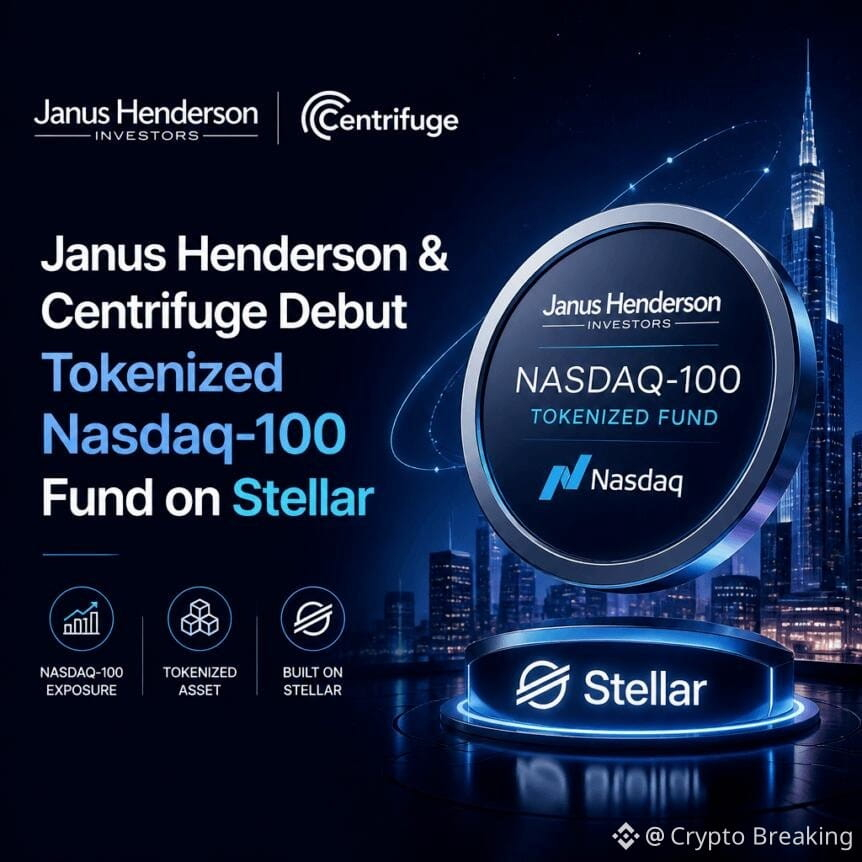
Janus Henderson & Centrifuge Debut Tokenized Nasdaq-100 Fund on StellarAsset manager Janus Henderson and tokenization platform Centrifuge have launched JQQQ, a blockchain-based fund designed to provide eligible investors exposure to the Nasdaq-100 Index through the Stellar network. The fund, announced on Tuesday, is aimed at professional investors outside the United States, according to reporting by the Wall Street Journal.
Janus Henderson said the vehicle is built using Centrifuge’s tokenization infrastructure and structured to track the Nasdaq-100 under a licensing agreement with Nasdaq. The launch extends the firm’s existing onchain offerings, which have previously focused on US Treasurys and structured credit, into an equity-index wrapper.
Key takeaways
JQQQ is a tokenized Nasdaq-100 fund issued on Stellar using Centrifuge’s infrastructure.
The fund is targeted at eligible professional investors outside the US, with a reported $100,000 minimum investment.
It is designed for indirect exposure to the Nasdaq-100 Index rather than ownership of the underlying stocks.
The launch follows Nasdaq’s April move to expand Nasdaq-100 licensing to additional asset managers beyond its traditional ecosystem.
For Stellar, the product reinforces its growing presence in institutional real-world asset tokenization, though the native token XLM has remained under pressure this year.
Janus Henderson’s onchain expansion to index exposure
The Janus Henderson announcement frames JQQQ as part of a broader push to broaden institutional onchain investment strategies. The asset manager said its institutional onchain strategies now total more than $1 billion, building on earlier work in tokenized debt products such as US Treasurys and structured credit.
JQQQ is set up as a segregated portfolio within a British Virgin Islands investment company. Rather than offering direct participation in individual Nasdaq-100 constituents, the fund provides indirect exposure to the benchmark index. That distinction may matter for investors assessing what they are actually holding and how index tracking is operationalized in a tokenized structure.
Regulatory and eligibility boundaries are also explicit. The fund is described as aimed at eligible professional investors outside the United States, with the Wall Street Journal reporting a $100,000 minimum investment.
Nasdaq licensing opens the door for tokenized index funds
Nasdaq’s involvement is central to why a tokenized Nasdaq-100 wrapper is possible. In April, Nasdaq said it would expand licensing for the Nasdaq-100 Index to additional asset managers, naming companies including BlackRock and State Street. The company also said it would maintain its longstanding relationship with Invesco, which runs the large-cap Invesco QQQ Trust exchange-traded fund (with a market capitalization referenced in the original announcement).
That licensing expansion helps explain the direction of travel for the category: once index rights are distributed more widely, issuers can design products that translate benchmark exposure into tokenized formats. For market participants, it also suggests that future tokenized index offerings may increasingly depend on formal licensing rather than purely on-chain engineering.
Stellar and Centrifuge reinforce the institutional tokenization ecosystem
JQQQ also adds another high-profile use case to Stellar’s growing role in institutional tokenization. According to RWA.xyz, Stellar ranks fourth among blockchains by distributed real-world asset value, with approximately $3.8 billion in tokenized assets, behind Ethereum, BNB Chain, and Solana.
The Stellar network has hosted tokenized assets from major issuers, including Spiko, Franklin Templeton, and Ondo. In parallel, other tokenization players have announced plans to extend private credit and broader asset classes onto Stellar. For example, Cointelegraph previously reported that Tradable announced plans to bring up to $1 billion in private credit assets to Stellar, with $500 million expected at launch.
Institutional plumbing is also developing through traditional market infrastructure. Cointelegraph previously reported that the Depository Trust & Clearing Corporation (DTCC) said in May it would connect its tokenization service to Stellar. The DTCC said tokenized assets are expected to become available in the first half of 2027, potentially including US Treasurys, major index ETFs, and Russell 1000 stocks. While that is a separate timeline from JQQQ, the broader implication is that Stellar is positioning itself as a settlement and distribution layer for financial-market tokenization.
What investors should watch: tracking method, eligibility, and tokenization momentum
Even with growing product availability, investors evaluating tokenized funds like JQQQ may want to focus on how index tracking is implemented and how risks are managed—especially since the fund is structured for indirect exposure rather than direct stock ownership.
Eligibility will be another practical consideration. The reported $100,000 minimum and the focus on eligible professional investors outside the US mean the initial user base may be narrower than retail-facing products. That could also shape liquidity and distribution dynamics in the early stages.
Finally, Stellar’s institutional footprint is expanding even as its native asset remains under scrutiny. CoinGecko data cited in the original report shows XLM down roughly 16% year to date, trading near $0.17 on Tuesday. That divergence—between growing tokenized asset activity and weaker native token performance—has become a familiar theme in real-world asset tokenization and is worth monitoring as more regulated products come online.
With JQQQ now launched on Stellar under Nasdaq licensing, the next signal to watch is whether more asset managers pursue similar tokenized index products—particularly as Nasdaq’s broader licensing framework expands and traditional market infrastructure like DTCC’s integration moves closer to activation.
This article was originally published as Janus Henderson & Centrifuge Debut Tokenized Nasdaq-100 Fund on Stellar on Crypto Breaking News – your trusted source for crypto news, Bitcoin news, and blockchain updates.
Janus Henderson & Centrifuge Debut Tokenized Nasdaq-100 Fund on Stellar
Asset manager Janus Henderson and tokenization platform Centrifuge have launched JQQQ, a blockchain-based fund designed to provide eligible investors exposure to the Nasdaq-100 Index through the Stellar network. The fund, announced on Tuesday, is aimed at professional investors outside the United States, according to reporting by the Wall Street Journal.
Janus Henderson said the vehicle is built using Centrifuge’s tokenization infrastructure and structured to track the Nasdaq-100 under a licensing agreement with Nasdaq. The launch extends the firm’s existing onchain offerings, which have previously focused on US Treasurys and structured credit, into an equity-index wrapper.
Key takeaways
JQQQ is a tokenized Nasdaq-100 fund issued on Stellar using Centrifuge’s infrastructure.
The fund is targeted at eligible professional investors outside the US, with a reported $100,000 minimum investment.
It is designed for indirect exposure to the Nasdaq-100 Index rather than ownership of the underlying stocks.
The launch follows Nasdaq’s April move to expand Nasdaq-100 licensing to additional asset managers beyond its traditional ecosystem.
For Stellar, the product reinforces its growing presence in institutional real-world asset tokenization, though the native token XLM has remained under pressure this year.
Janus Henderson’s onchain expansion to index exposure
The Janus Henderson announcement frames JQQQ as part of a broader push to broaden institutional onchain investment strategies. The asset manager said its institutional onchain strategies now total more than $1 billion, building on earlier work in tokenized debt products such as US Treasurys and structured credit.
JQQQ is set up as a segregated portfolio within a British Virgin Islands investment company. Rather than offering direct participation in individual Nasdaq-100 constituents, the fund provides indirect exposure to the benchmark index. That distinction may matter for investors assessing what they are actually holding and how index tracking is operationalized in a tokenized structure.
Regulatory and eligibility boundaries are also explicit. The fund is described as aimed at eligible professional investors outside the United States, with the Wall Street Journal reporting a $100,000 minimum investment.
Nasdaq licensing opens the door for tokenized index funds
Nasdaq’s involvement is central to why a tokenized Nasdaq-100 wrapper is possible. In April, Nasdaq said it would expand licensing for the Nasdaq-100 Index to additional asset managers, naming companies including BlackRock and State Street. The company also said it would maintain its longstanding relationship with Invesco, which runs the large-cap Invesco QQQ Trust exchange-traded fund (with a market capitalization referenced in the original announcement).
That licensing expansion helps explain the direction of travel for the category: once index rights are distributed more widely, issuers can design products that translate benchmark exposure into tokenized formats. For market participants, it also suggests that future tokenized index offerings may increasingly depend on formal licensing rather than purely on-chain engineering.
Stellar and Centrifuge reinforce the institutional tokenization ecosystem
JQQQ also adds another high-profile use case to Stellar’s growing role in institutional tokenization. According to RWA.xyz, Stellar ranks fourth among blockchains by distributed real-world asset value, with approximately $3.8 billion in tokenized assets, behind Ethereum, BNB Chain, and Solana.
The Stellar network has hosted tokenized assets from major issuers, including Spiko, Franklin Templeton, and Ondo. In parallel, other tokenization players have announced plans to extend private credit and broader asset classes onto Stellar. For example, Cointelegraph previously reported that Tradable announced plans to bring up to $1 billion in private credit assets to Stellar, with $500 million expected at launch.
Institutional plumbing is also developing through traditional market infrastructure. Cointelegraph previously reported that the Depository Trust & Clearing Corporation (DTCC) said in May it would connect its tokenization service to Stellar. The DTCC said tokenized assets are expected to become available in the first half of 2027, potentially including US Treasurys, major index ETFs, and Russell 1000 stocks. While that is a separate timeline from JQQQ, the broader implication is that Stellar is positioning itself as a settlement and distribution layer for financial-market tokenization.
What investors should watch: tracking method, eligibility, and tokenization momentum
Even with growing product availability, investors evaluating tokenized funds like JQQQ may want to focus on how index tracking is implemented and how risks are managed—especially since the fund is structured for indirect exposure rather than direct stock ownership.
Eligibility will be another practical consideration. The reported $100,000 minimum and the focus on eligible professional investors outside the US mean the initial user base may be narrower than retail-facing products. That could also shape liquidity and distribution dynamics in the early stages.
Finally, Stellar’s institutional footprint is expanding even as its native asset remains under scrutiny. CoinGecko data cited in the original report shows XLM down roughly 16% year to date, trading near $0.17 on Tuesday. That divergence—between growing tokenized asset activity and weaker native token performance—has become a familiar theme in real-world asset tokenization and is worth monitoring as more regulated products come online.
With JQQQ now launched on Stellar under Nasdaq licensing, the next signal to watch is whether more asset managers pursue similar tokenized index products—particularly as Nasdaq’s broader licensing framework expands and traditional market infrastructure like DTCC’s integration moves closer to activation.
This article was originally published as Janus Henderson & Centrifuge Debut Tokenized Nasdaq-100 Fund on Stellar on Crypto Breaking News – your trusted source for crypto news, Bitcoin news, and blockchain updates.
Janus Henderson said the vehicle is built using Centrifuge’s tokenization infrastructure and structured to track the Nasdaq-100 under a licensing agreement with Nasdaq. The launch extends the firm’s existing onchain offerings, which have previously focused on US Treasurys and structured credit, into an equity-index wrapper.
Key takeaways
JQQQ is a tokenized Nasdaq-100 fund issued on Stellar using Centrifuge’s infrastructure.
The fund is targeted at eligible professional investors outside the US, with a reported $100,000 minimum investment.
It is designed for indirect exposure to the Nasdaq-100 Index rather than ownership of the underlying stocks.
The launch follows Nasdaq’s April move to expand Nasdaq-100 licensing to additional asset managers beyond its traditional ecosystem.
For Stellar, the product reinforces its growing presence in institutional real-world asset tokenization, though the native token XLM has remained under pressure this year.
Janus Henderson’s onchain expansion to index exposure
The Janus Henderson announcement frames JQQQ as part of a broader push to broaden institutional onchain investment strategies. The asset manager said its institutional onchain strategies now total more than $1 billion, building on earlier work in tokenized debt products such as US Treasurys and structured credit.
JQQQ is set up as a segregated portfolio within a British Virgin Islands investment company. Rather than offering direct participation in individual Nasdaq-100 constituents, the fund provides indirect exposure to the benchmark index. That distinction may matter for investors assessing what they are actually holding and how index tracking is operationalized in a tokenized structure.
Regulatory and eligibility boundaries are also explicit. The fund is described as aimed at eligible professional investors outside the United States, with the Wall Street Journal reporting a $100,000 minimum investment.
Nasdaq licensing opens the door for tokenized index funds
Nasdaq’s involvement is central to why a tokenized Nasdaq-100 wrapper is possible. In April, Nasdaq said it would expand licensing for the Nasdaq-100 Index to additional asset managers, naming companies including BlackRock and State Street. The company also said it would maintain its longstanding relationship with Invesco, which runs the large-cap Invesco QQQ Trust exchange-traded fund (with a market capitalization referenced in the original announcement).
That licensing expansion helps explain the direction of travel for the category: once index rights are distributed more widely, issuers can design products that translate benchmark exposure into tokenized formats. For market participants, it also suggests that future tokenized index offerings may increasingly depend on formal licensing rather than purely on-chain engineering.
Stellar and Centrifuge reinforce the institutional tokenization ecosystem
JQQQ also adds another high-profile use case to Stellar’s growing role in institutional tokenization. According to RWA.xyz, Stellar ranks fourth among blockchains by distributed real-world asset value, with approximately $3.8 billion in tokenized assets, behind Ethereum, BNB Chain, and Solana.
The Stellar network has hosted tokenized assets from major issuers, including Spiko, Franklin Templeton, and Ondo. In parallel, other tokenization players have announced plans to extend private credit and broader asset classes onto Stellar. For example, Cointelegraph previously reported that Tradable announced plans to bring up to $1 billion in private credit assets to Stellar, with $500 million expected at launch.
Institutional plumbing is also developing through traditional market infrastructure. Cointelegraph previously reported that the Depository Trust & Clearing Corporation (DTCC) said in May it would connect its tokenization service to Stellar. The DTCC said tokenized assets are expected to become available in the first half of 2027, potentially including US Treasurys, major index ETFs, and Russell 1000 stocks. While that is a separate timeline from JQQQ, the broader implication is that Stellar is positioning itself as a settlement and distribution layer for financial-market tokenization.
What investors should watch: tracking method, eligibility, and tokenization momentum
Even with growing product availability, investors evaluating tokenized funds like JQQQ may want to focus on how index tracking is implemented and how risks are managed—especially since the fund is structured for indirect exposure rather than direct stock ownership.
Eligibility will be another practical consideration. The reported $100,000 minimum and the focus on eligible professional investors outside the US mean the initial user base may be narrower than retail-facing products. That could also shape liquidity and distribution dynamics in the early stages.
Finally, Stellar’s institutional footprint is expanding even as its native asset remains under scrutiny. CoinGecko data cited in the original report shows XLM down roughly 16% year to date, trading near $0.17 on Tuesday. That divergence—between growing tokenized asset activity and weaker native token performance—has become a familiar theme in real-world asset tokenization and is worth monitoring as more regulated products come online.
With JQQQ now launched on Stellar under Nasdaq licensing, the next signal to watch is whether more asset managers pursue similar tokenized index products—particularly as Nasdaq’s broader licensing framework expands and traditional market infrastructure like DTCC’s integration moves closer to activation.
This article was originally published as Janus Henderson & Centrifuge Debut Tokenized Nasdaq-100 Fund on Stellar on Crypto Breaking News – your trusted source for crypto news, Bitcoin news, and blockchain updates.
12
Статья
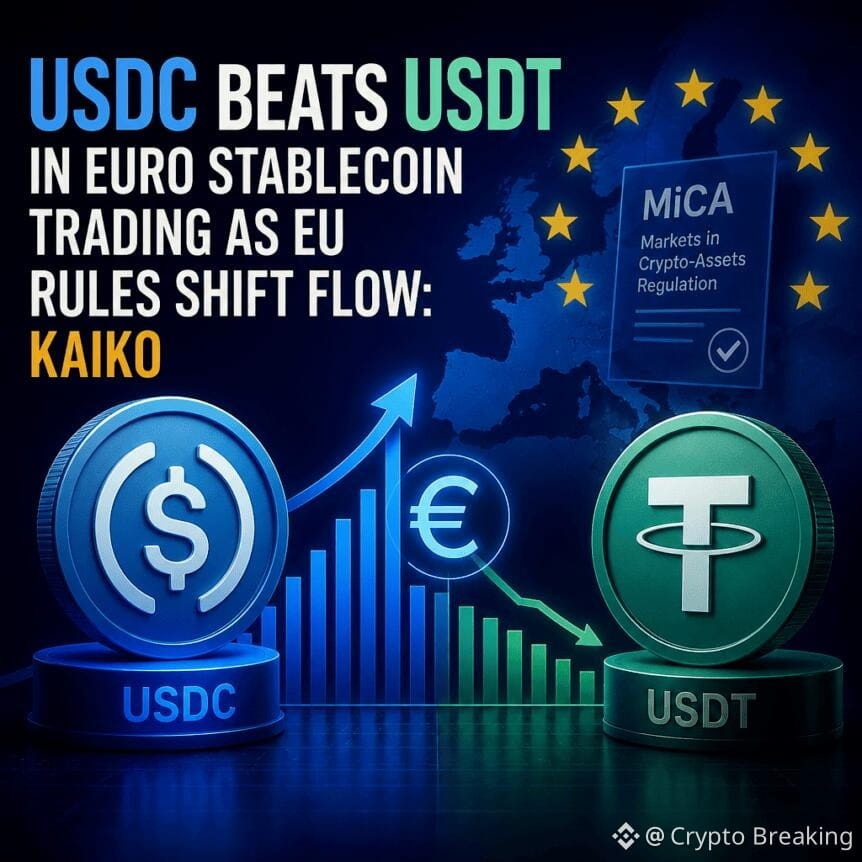
USDC Beats USDT in Euro Stablecoin Trading as EU Rules Shift Flow: KaikoCircle’s USDC has surpassed Tether’s USDT in euro-denominated stablecoin trading, according to a new report from market data provider Kaiko. The shift highlights how rapidly stablecoin market structure in Europe is being reshaped by MiCA-related compliance preferences and exchange restrictions.
Kaiko data shows USDC now represents 56% of stablecoin trading against the euro, up from 10% in January 2024. The acceleration came after large exchanges limited USDT services for customers in the European Economic Area (EEA) under the EU’s Markets in Crypto-Assets regulation (MiCA).
Key takeaways
USDC leads euro trading: Kaiko reports USDC holds 56% of stablecoin volume against the euro, up sharply from 10% in January 2024.
Exchange access changes matter: USDT’s market share declined after major venues restricted trading for EEA users under MiCA.
Liquidity advantage is widening: In euro pairs, Kaiko says USDC order books are about 40% deeper than USDT’s.
Global scale still favors Tether: Despite the euro shift, Tether remains the bigger stablecoin by supply, with circulation estimated at roughly 2.5x USDC.
Regulatory spillover may follow to the US: Kaiko links the European shift to the direction of US stablecoin regulation under the GENIUS Act.
Why the euro market shifted toward USDC
Kaiko frames euro-stablecoin pairs as a practical bridge for European users entering and exiting crypto markets. Stablecoin-to-euro trading often functions as a “main on-ramp and off-ramp,” allowing customers to convert euros into dollar-pegged stablecoins when positioning for crypto exposure—and then reverse those trades when unwinding.
In that context, regulatory and compliance outcomes are not just theoretical. If exchanges reduce access to certain stablecoins in a region, liquidity tends to migrate toward the assets that remain widely tradable and easier for compliant platforms to support. That dynamic appears to be working in USDC’s favor within Europe.
Beyond market share, Kaiko also points to depth of liquidity: USDC’s euro order books are reported to be roughly 40% deeper than USDT’s. For traders, deeper books typically translate into tighter execution costs and smoother sizing—especially during volatile periods when order flow accelerates.
MiCA momentum: the “significant e-money token” milestone
The Kaiko findings arrive roughly two weeks after the European Banking Authority designated USDC as the EU’s first “significant e-money token” under MiCA. According to earlier coverage from Cointelegraph, this classification puts USDC under direct EBA supervision and imposes additional requirements on Circle.
Designation as a significant token can influence how exchanges and custody providers approach integration, operational risk controls, and ongoing compliance. Even when stablecoins are broadly available, the set of assets that are easiest for platforms to treat as MiCA-compliant often gains an advantage in day-to-day trading support.
At the same time, Tether continues to hold an edge globally. Kaiko notes that Tether’s circulating supply is about 2.5 times that of USDC, underscoring that the euro market’s rebalancing does not immediately translate into USDT losing its overall dominance. Instead, the data suggests a growing regional preference that can coexist with Tether’s larger global footprint.
What changes could be coming from US stablecoin rules
Kaiko also draws a parallel between Europe’s experience and the US regulatory trajectory under the GENIUS Act. The report suggests that the US may eventually see similar routing of trading activity toward issuers that are positioned to meet the stricter stablecoin requirements applied through US oversight.
In a development that aligns with that possibility, the Office of the Comptroller of the Currency (OCC) issued its first final rule under the GENIUS Act on Oct. 21, establishing reserve and redemption requirements for stablecoin issuers under its supervision. The rule is scheduled to become effective on Jan. 18, 2027, and beginning in July 2028, US platforms will face restrictions when offering stablecoins from issuers that do not meet GENIUS approval requirements.
These timelines matter for exchanges and trading venues because liquidity planning typically starts well before compliance deadlines. If US venues begin prioritizing certain issuers earlier—whether through listing decisions, custody arrangements, or product support—the trading mix could start changing before the toughest constraints formally take effect.
Circle vs. Tether: regulatory positioning and market expectations
Regulatory design is beginning to influence competitive strategy between issuers. Kaiko’s report indicates that Circle—having pursued authorization in both Europe and the US—may be better positioned if the same pattern that played out in Europe repeats across the Atlantic.
Tether, meanwhile, has reportedly taken a different path by launching a US-focused stablecoin called USAT, described in earlier Cointelegraph coverage as a distinct approach aimed at the US regulatory environment.
While Kaiko’s euro-focused numbers do not establish how the US market will behave, the implication is straightforward: regulatory compliance can determine which stablecoins are easiest for major platforms to support at scale. In a world where stablecoins act as payment rails and liquidity buffers, that access tends to feed back into trading dominance—one region at a time.
For readers, the next watch item is whether US trading platforms begin shifting liquidity ahead of GENIUS Act enforcement milestones, mirroring Europe’s post-MiCA trading reallocation. The open question is how quickly venues and market makers adjust before the July 2028 offering restrictions, and whether order-book depth trends in the US start to resemble what Kaiko has already observed for euro pairs.
This article was originally published as USDC Beats USDT in Euro Stablecoin Trading as EU Rules Shift Flow: Kaiko on Crypto Breaking News – your trusted source for crypto news, Bitcoin news, and blockchain updates.
USDC Beats USDT in Euro Stablecoin Trading as EU Rules Shift Flow: Kaiko
Circle’s USDC has surpassed Tether’s USDT in euro-denominated stablecoin trading, according to a new report from market data provider Kaiko. The shift highlights how rapidly stablecoin market structure in Europe is being reshaped by MiCA-related compliance preferences and exchange restrictions.
Kaiko data shows USDC now represents 56% of stablecoin trading against the euro, up from 10% in January 2024. The acceleration came after large exchanges limited USDT services for customers in the European Economic Area (EEA) under the EU’s Markets in Crypto-Assets regulation (MiCA).
Key takeaways
USDC leads euro trading: Kaiko reports USDC holds 56% of stablecoin volume against the euro, up sharply from 10% in January 2024.
Exchange access changes matter: USDT’s market share declined after major venues restricted trading for EEA users under MiCA.
Liquidity advantage is widening: In euro pairs, Kaiko says USDC order books are about 40% deeper than USDT’s.
Global scale still favors Tether: Despite the euro shift, Tether remains the bigger stablecoin by supply, with circulation estimated at roughly 2.5x USDC.
Regulatory spillover may follow to the US: Kaiko links the European shift to the direction of US stablecoin regulation under the GENIUS Act.
Why the euro market shifted toward USDC
Kaiko frames euro-stablecoin pairs as a practical bridge for European users entering and exiting crypto markets. Stablecoin-to-euro trading often functions as a “main on-ramp and off-ramp,” allowing customers to convert euros into dollar-pegged stablecoins when positioning for crypto exposure—and then reverse those trades when unwinding.
In that context, regulatory and compliance outcomes are not just theoretical. If exchanges reduce access to certain stablecoins in a region, liquidity tends to migrate toward the assets that remain widely tradable and easier for compliant platforms to support. That dynamic appears to be working in USDC’s favor within Europe.
Beyond market share, Kaiko also points to depth of liquidity: USDC’s euro order books are reported to be roughly 40% deeper than USDT’s. For traders, deeper books typically translate into tighter execution costs and smoother sizing—especially during volatile periods when order flow accelerates.
MiCA momentum: the “significant e-money token” milestone
The Kaiko findings arrive roughly two weeks after the European Banking Authority designated USDC as the EU’s first “significant e-money token” under MiCA. According to earlier coverage from Cointelegraph, this classification puts USDC under direct EBA supervision and imposes additional requirements on Circle.
Designation as a significant token can influence how exchanges and custody providers approach integration, operational risk controls, and ongoing compliance. Even when stablecoins are broadly available, the set of assets that are easiest for platforms to treat as MiCA-compliant often gains an advantage in day-to-day trading support.
At the same time, Tether continues to hold an edge globally. Kaiko notes that Tether’s circulating supply is about 2.5 times that of USDC, underscoring that the euro market’s rebalancing does not immediately translate into USDT losing its overall dominance. Instead, the data suggests a growing regional preference that can coexist with Tether’s larger global footprint.
What changes could be coming from US stablecoin rules
Kaiko also draws a parallel between Europe’s experience and the US regulatory trajectory under the GENIUS Act. The report suggests that the US may eventually see similar routing of trading activity toward issuers that are positioned to meet the stricter stablecoin requirements applied through US oversight.
In a development that aligns with that possibility, the Office of the Comptroller of the Currency (OCC) issued its first final rule under the GENIUS Act on Oct. 21, establishing reserve and redemption requirements for stablecoin issuers under its supervision. The rule is scheduled to become effective on Jan. 18, 2027, and beginning in July 2028, US platforms will face restrictions when offering stablecoins from issuers that do not meet GENIUS approval requirements.
These timelines matter for exchanges and trading venues because liquidity planning typically starts well before compliance deadlines. If US venues begin prioritizing certain issuers earlier—whether through listing decisions, custody arrangements, or product support—the trading mix could start changing before the toughest constraints formally take effect.
Circle vs. Tether: regulatory positioning and market expectations
Regulatory design is beginning to influence competitive strategy between issuers. Kaiko’s report indicates that Circle—having pursued authorization in both Europe and the US—may be better positioned if the same pattern that played out in Europe repeats across the Atlantic.
Tether, meanwhile, has reportedly taken a different path by launching a US-focused stablecoin called USAT, described in earlier Cointelegraph coverage as a distinct approach aimed at the US regulatory environment.
While Kaiko’s euro-focused numbers do not establish how the US market will behave, the implication is straightforward: regulatory compliance can determine which stablecoins are easiest for major platforms to support at scale. In a world where stablecoins act as payment rails and liquidity buffers, that access tends to feed back into trading dominance—one region at a time.
For readers, the next watch item is whether US trading platforms begin shifting liquidity ahead of GENIUS Act enforcement milestones, mirroring Europe’s post-MiCA trading reallocation. The open question is how quickly venues and market makers adjust before the July 2028 offering restrictions, and whether order-book depth trends in the US start to resemble what Kaiko has already observed for euro pairs.
This article was originally published as USDC Beats USDT in Euro Stablecoin Trading as EU Rules Shift Flow: Kaiko on Crypto Breaking News – your trusted source for crypto news, Bitcoin news, and blockchain updates.
Kaiko data shows USDC now represents 56% of stablecoin trading against the euro, up from 10% in January 2024. The acceleration came after large exchanges limited USDT services for customers in the European Economic Area (EEA) under the EU’s Markets in Crypto-Assets regulation (MiCA).
Key takeaways
USDC leads euro trading: Kaiko reports USDC holds 56% of stablecoin volume against the euro, up sharply from 10% in January 2024.
Exchange access changes matter: USDT’s market share declined after major venues restricted trading for EEA users under MiCA.
Liquidity advantage is widening: In euro pairs, Kaiko says USDC order books are about 40% deeper than USDT’s.
Global scale still favors Tether: Despite the euro shift, Tether remains the bigger stablecoin by supply, with circulation estimated at roughly 2.5x USDC.
Regulatory spillover may follow to the US: Kaiko links the European shift to the direction of US stablecoin regulation under the GENIUS Act.
Why the euro market shifted toward USDC
Kaiko frames euro-stablecoin pairs as a practical bridge for European users entering and exiting crypto markets. Stablecoin-to-euro trading often functions as a “main on-ramp and off-ramp,” allowing customers to convert euros into dollar-pegged stablecoins when positioning for crypto exposure—and then reverse those trades when unwinding.
In that context, regulatory and compliance outcomes are not just theoretical. If exchanges reduce access to certain stablecoins in a region, liquidity tends to migrate toward the assets that remain widely tradable and easier for compliant platforms to support. That dynamic appears to be working in USDC’s favor within Europe.
Beyond market share, Kaiko also points to depth of liquidity: USDC’s euro order books are reported to be roughly 40% deeper than USDT’s. For traders, deeper books typically translate into tighter execution costs and smoother sizing—especially during volatile periods when order flow accelerates.
MiCA momentum: the “significant e-money token” milestone
The Kaiko findings arrive roughly two weeks after the European Banking Authority designated USDC as the EU’s first “significant e-money token” under MiCA. According to earlier coverage from Cointelegraph, this classification puts USDC under direct EBA supervision and imposes additional requirements on Circle.
Designation as a significant token can influence how exchanges and custody providers approach integration, operational risk controls, and ongoing compliance. Even when stablecoins are broadly available, the set of assets that are easiest for platforms to treat as MiCA-compliant often gains an advantage in day-to-day trading support.
At the same time, Tether continues to hold an edge globally. Kaiko notes that Tether’s circulating supply is about 2.5 times that of USDC, underscoring that the euro market’s rebalancing does not immediately translate into USDT losing its overall dominance. Instead, the data suggests a growing regional preference that can coexist with Tether’s larger global footprint.
What changes could be coming from US stablecoin rules
Kaiko also draws a parallel between Europe’s experience and the US regulatory trajectory under the GENIUS Act. The report suggests that the US may eventually see similar routing of trading activity toward issuers that are positioned to meet the stricter stablecoin requirements applied through US oversight.
In a development that aligns with that possibility, the Office of the Comptroller of the Currency (OCC) issued its first final rule under the GENIUS Act on Oct. 21, establishing reserve and redemption requirements for stablecoin issuers under its supervision. The rule is scheduled to become effective on Jan. 18, 2027, and beginning in July 2028, US platforms will face restrictions when offering stablecoins from issuers that do not meet GENIUS approval requirements.
These timelines matter for exchanges and trading venues because liquidity planning typically starts well before compliance deadlines. If US venues begin prioritizing certain issuers earlier—whether through listing decisions, custody arrangements, or product support—the trading mix could start changing before the toughest constraints formally take effect.
Circle vs. Tether: regulatory positioning and market expectations
Regulatory design is beginning to influence competitive strategy between issuers. Kaiko’s report indicates that Circle—having pursued authorization in both Europe and the US—may be better positioned if the same pattern that played out in Europe repeats across the Atlantic.
Tether, meanwhile, has reportedly taken a different path by launching a US-focused stablecoin called USAT, described in earlier Cointelegraph coverage as a distinct approach aimed at the US regulatory environment.
While Kaiko’s euro-focused numbers do not establish how the US market will behave, the implication is straightforward: regulatory compliance can determine which stablecoins are easiest for major platforms to support at scale. In a world where stablecoins act as payment rails and liquidity buffers, that access tends to feed back into trading dominance—one region at a time.
For readers, the next watch item is whether US trading platforms begin shifting liquidity ahead of GENIUS Act enforcement milestones, mirroring Europe’s post-MiCA trading reallocation. The open question is how quickly venues and market makers adjust before the July 2028 offering restrictions, and whether order-book depth trends in the US start to resemble what Kaiko has already observed for euro pairs.
This article was originally published as USDC Beats USDT in Euro Stablecoin Trading as EU Rules Shift Flow: Kaiko on Crypto Breaking News – your trusted source for crypto news, Bitcoin news, and blockchain updates.
7

Статья
Luxor Secures $16M From CMT Digital as AI Meets Bitcoin MiningLuxor Technology, a full-stack compute company tied to Bitcoin mining infrastructure, has raised $16 million in a strategic funding round led by CMT Digital. The investment round also included participation from Canaan, MicroBT, Halo, Steelhead, along with additional angel investors, according to a Tuesday announcement shared with Cointelegraph.
The new capital is intended to strengthen Luxor’s “agentic cloud” platform, expand its AI-focused hardware business, grow its compute derivatives trading capabilities, and support further hiring. For investors and market participants, the raise signals continued institutional interest in companies building the infrastructure layer that connects power, compute access, and trading—an approach that Luxor says is increasingly relevant as mining hardware and AI workloads draw closer together.
Key takeaways
$16 million strategic round led by CMT Digital adds momentum to Luxor’s compute and trading stack.
Luxor plans to scale its agentic cloud platform, reflecting growing demand for automated compute orchestration.
The company is expanding its AI hardware sourcing business, including GPUs and AI servers, citing supply chain complexity.
Luxor will also expand compute derivatives trading, aiming to broaden how power-and-compute risk is managed.
Luxor positions its growth around the convergence of Bitcoin mining and AI computing, including via its Luxor AI segment.
Why Luxor’s compute pitch resonates now
Luxor’s thesis centers on a shift in how computing capacity is financed, accessed, and operated. According to Luxor co-founder and CEO Nick Hansen, “Compute markets are converging: the same miners, power sites and capital that served digital mining are now powering AI.”
That framing matters because it attempts to translate the industrial logic of mining—where electricity access, hardware procurement, and operational know-how drive outcomes—into the AI era, where demand for high-performance GPUs and reliable server supply has made “who can deliver compute” a differentiator.
Luxor says it has expanded its hardware operations to source GPUs and AI servers for the broader AI computing market as global chip supply chains become “increasingly hard to navigate.” In practical terms, that means the company is not only advising or transacting around compute, but also building capabilities that sit closer to procurement and deployment.
From miner-focused stacks to “Luxor AI”
The company’s strategic direction is reflected in the timeline of its business evolution. In September, Luxor launched Luxor AI, described as an extension of its existing hardware, software, and compute trading stack designed for Bitcoin miners into the AI and high-performance computing market.
While the announcement does not provide detailed metrics for Luxor AI’s early traction, the move indicates Luxor sees overlap in the underlying requirements of mining and AI: power availability, uptime, scheduling, and the ability to package compute capacity in ways that match user and enterprise demand.
With the latest financing, Luxor is effectively betting that its agentic cloud and trading capabilities—previously built with mining economics in mind—can become a bridge to AI compute buyers who may not want to manage the same operational and supply chain headaches internally.
How the new funds are expected to be deployed
Luxor’s announcement outlines four primary areas for the $16 million round:
Scaling its agentic cloud platform, aimed at automating or coordinating compute-related tasks.
Growing its AI hardware business, including sourcing GPUs and AI servers.
Expanding compute derivatives trading capabilities, which suggests Luxor intends to offer or deepen tools for hedging and structuring compute exposure.
Hiring more staff to support these expansions.
For market observers, the derivatives component is notable because it points to Luxor’s ambition to participate in the financial plumbing of compute markets, not just the physical layer. As AI compute demand grows and pricing volatility remains a concern, firms that can package risk management alongside infrastructure can find demand from both builders and large buyers.
Prior funding and investor connections
This is not Luxor’s first institutional push. In June 2021, Luxor raised $5 million in a Series A funding round led by NYDIG, focused on expanding its North American Bitcoin mining services. Earlier seed investors included Celsius, Valour, and Bitnomial, as reported by Cointelegraph in a related article: Luxor raised $5 million.
The latest strategic round extends Luxor’s investor ecosystem into players associated with mining infrastructure and hardware. The new participants listed in the announcement—Canaan, MicroBT, Halo, and Steelhead—are consistent with Luxor’s positioning at the intersection of energy, compute, and trading.
For readers tracking institutional activity across the crypto compute stack, the broader implication is that capital is increasingly flowing toward infrastructure firms that can serve both crypto and AI demand. Instead of treating mining and AI as separate markets, Luxor is attempting to operationalize the overlap—using existing relationships, hardware knowledge, and power access to build repeatable capacity solutions.
What to watch next is whether Luxor AI and the expanded compute derivatives push can translate early strategy into measurable operating scale—particularly as AI hardware supply remains constrained and compute buyers look for dependable access, pricing, and risk controls.
This article was originally published as Luxor Secures $16M From CMT Digital as AI Meets Bitcoin Mining on Crypto Breaking News – your trusted source for crypto news, Bitcoin news, and blockchain updates.
Luxor Secures $16M From CMT Digital as AI Meets Bitcoin Mining
Luxor Technology, a full-stack compute company tied to Bitcoin mining infrastructure, has raised $16 million in a strategic funding round led by CMT Digital. The investment round also included participation from Canaan, MicroBT, Halo, Steelhead, along with additional angel investors, according to a Tuesday announcement shared with Cointelegraph.
The new capital is intended to strengthen Luxor’s “agentic cloud” platform, expand its AI-focused hardware business, grow its compute derivatives trading capabilities, and support further hiring. For investors and market participants, the raise signals continued institutional interest in companies building the infrastructure layer that connects power, compute access, and trading—an approach that Luxor says is increasingly relevant as mining hardware and AI workloads draw closer together.
Key takeaways
$16 million strategic round led by CMT Digital adds momentum to Luxor’s compute and trading stack.
Luxor plans to scale its agentic cloud platform, reflecting growing demand for automated compute orchestration.
The company is expanding its AI hardware sourcing business, including GPUs and AI servers, citing supply chain complexity.
Luxor will also expand compute derivatives trading, aiming to broaden how power-and-compute risk is managed.
Luxor positions its growth around the convergence of Bitcoin mining and AI computing, including via its Luxor AI segment.
Why Luxor’s compute pitch resonates now
Luxor’s thesis centers on a shift in how computing capacity is financed, accessed, and operated. According to Luxor co-founder and CEO Nick Hansen, “Compute markets are converging: the same miners, power sites and capital that served digital mining are now powering AI.”
That framing matters because it attempts to translate the industrial logic of mining—where electricity access, hardware procurement, and operational know-how drive outcomes—into the AI era, where demand for high-performance GPUs and reliable server supply has made “who can deliver compute” a differentiator.
Luxor says it has expanded its hardware operations to source GPUs and AI servers for the broader AI computing market as global chip supply chains become “increasingly hard to navigate.” In practical terms, that means the company is not only advising or transacting around compute, but also building capabilities that sit closer to procurement and deployment.
From miner-focused stacks to “Luxor AI”
The company’s strategic direction is reflected in the timeline of its business evolution. In September, Luxor launched Luxor AI, described as an extension of its existing hardware, software, and compute trading stack designed for Bitcoin miners into the AI and high-performance computing market.
While the announcement does not provide detailed metrics for Luxor AI’s early traction, the move indicates Luxor sees overlap in the underlying requirements of mining and AI: power availability, uptime, scheduling, and the ability to package compute capacity in ways that match user and enterprise demand.
With the latest financing, Luxor is effectively betting that its agentic cloud and trading capabilities—previously built with mining economics in mind—can become a bridge to AI compute buyers who may not want to manage the same operational and supply chain headaches internally.
How the new funds are expected to be deployed
Luxor’s announcement outlines four primary areas for the $16 million round:
Scaling its agentic cloud platform, aimed at automating or coordinating compute-related tasks.
Growing its AI hardware business, including sourcing GPUs and AI servers.
Expanding compute derivatives trading capabilities, which suggests Luxor intends to offer or deepen tools for hedging and structuring compute exposure.
Hiring more staff to support these expansions.
For market observers, the derivatives component is notable because it points to Luxor’s ambition to participate in the financial plumbing of compute markets, not just the physical layer. As AI compute demand grows and pricing volatility remains a concern, firms that can package risk management alongside infrastructure can find demand from both builders and large buyers.
Prior funding and investor connections
This is not Luxor’s first institutional push. In June 2021, Luxor raised $5 million in a Series A funding round led by NYDIG, focused on expanding its North American Bitcoin mining services. Earlier seed investors included Celsius, Valour, and Bitnomial, as reported by Cointelegraph in a related article: Luxor raised $5 million.
The latest strategic round extends Luxor’s investor ecosystem into players associated with mining infrastructure and hardware. The new participants listed in the announcement—Canaan, MicroBT, Halo, and Steelhead—are consistent with Luxor’s positioning at the intersection of energy, compute, and trading.
For readers tracking institutional activity across the crypto compute stack, the broader implication is that capital is increasingly flowing toward infrastructure firms that can serve both crypto and AI demand. Instead of treating mining and AI as separate markets, Luxor is attempting to operationalize the overlap—using existing relationships, hardware knowledge, and power access to build repeatable capacity solutions.
What to watch next is whether Luxor AI and the expanded compute derivatives push can translate early strategy into measurable operating scale—particularly as AI hardware supply remains constrained and compute buyers look for dependable access, pricing, and risk controls.
This article was originally published as Luxor Secures $16M From CMT Digital as AI Meets Bitcoin Mining on Crypto Breaking News – your trusted source for crypto news, Bitcoin news, and blockchain updates.
The new capital is intended to strengthen Luxor’s “agentic cloud” platform, expand its AI-focused hardware business, grow its compute derivatives trading capabilities, and support further hiring. For investors and market participants, the raise signals continued institutional interest in companies building the infrastructure layer that connects power, compute access, and trading—an approach that Luxor says is increasingly relevant as mining hardware and AI workloads draw closer together.
Key takeaways
$16 million strategic round led by CMT Digital adds momentum to Luxor’s compute and trading stack.
Luxor plans to scale its agentic cloud platform, reflecting growing demand for automated compute orchestration.
The company is expanding its AI hardware sourcing business, including GPUs and AI servers, citing supply chain complexity.
Luxor will also expand compute derivatives trading, aiming to broaden how power-and-compute risk is managed.
Luxor positions its growth around the convergence of Bitcoin mining and AI computing, including via its Luxor AI segment.
Why Luxor’s compute pitch resonates now
Luxor’s thesis centers on a shift in how computing capacity is financed, accessed, and operated. According to Luxor co-founder and CEO Nick Hansen, “Compute markets are converging: the same miners, power sites and capital that served digital mining are now powering AI.”
That framing matters because it attempts to translate the industrial logic of mining—where electricity access, hardware procurement, and operational know-how drive outcomes—into the AI era, where demand for high-performance GPUs and reliable server supply has made “who can deliver compute” a differentiator.
Luxor says it has expanded its hardware operations to source GPUs and AI servers for the broader AI computing market as global chip supply chains become “increasingly hard to navigate.” In practical terms, that means the company is not only advising or transacting around compute, but also building capabilities that sit closer to procurement and deployment.
From miner-focused stacks to “Luxor AI”
The company’s strategic direction is reflected in the timeline of its business evolution. In September, Luxor launched Luxor AI, described as an extension of its existing hardware, software, and compute trading stack designed for Bitcoin miners into the AI and high-performance computing market.
While the announcement does not provide detailed metrics for Luxor AI’s early traction, the move indicates Luxor sees overlap in the underlying requirements of mining and AI: power availability, uptime, scheduling, and the ability to package compute capacity in ways that match user and enterprise demand.
With the latest financing, Luxor is effectively betting that its agentic cloud and trading capabilities—previously built with mining economics in mind—can become a bridge to AI compute buyers who may not want to manage the same operational and supply chain headaches internally.
How the new funds are expected to be deployed
Luxor’s announcement outlines four primary areas for the $16 million round:
Scaling its agentic cloud platform, aimed at automating or coordinating compute-related tasks.
Growing its AI hardware business, including sourcing GPUs and AI servers.
Expanding compute derivatives trading capabilities, which suggests Luxor intends to offer or deepen tools for hedging and structuring compute exposure.
Hiring more staff to support these expansions.
For market observers, the derivatives component is notable because it points to Luxor’s ambition to participate in the financial plumbing of compute markets, not just the physical layer. As AI compute demand grows and pricing volatility remains a concern, firms that can package risk management alongside infrastructure can find demand from both builders and large buyers.
Prior funding and investor connections
This is not Luxor’s first institutional push. In June 2021, Luxor raised $5 million in a Series A funding round led by NYDIG, focused on expanding its North American Bitcoin mining services. Earlier seed investors included Celsius, Valour, and Bitnomial, as reported by Cointelegraph in a related article: Luxor raised $5 million.
The latest strategic round extends Luxor’s investor ecosystem into players associated with mining infrastructure and hardware. The new participants listed in the announcement—Canaan, MicroBT, Halo, and Steelhead—are consistent with Luxor’s positioning at the intersection of energy, compute, and trading.
For readers tracking institutional activity across the crypto compute stack, the broader implication is that capital is increasingly flowing toward infrastructure firms that can serve both crypto and AI demand. Instead of treating mining and AI as separate markets, Luxor is attempting to operationalize the overlap—using existing relationships, hardware knowledge, and power access to build repeatable capacity solutions.
What to watch next is whether Luxor AI and the expanded compute derivatives push can translate early strategy into measurable operating scale—particularly as AI hardware supply remains constrained and compute buyers look for dependable access, pricing, and risk controls.
This article was originally published as Luxor Secures $16M From CMT Digital as AI Meets Bitcoin Mining on Crypto Breaking News – your trusted source for crypto news, Bitcoin news, and blockchain updates.
17

Статья
Wall Street Veteran Jordi Visser Says Crypto May Beat AI StocksAI is reshaping how capital markets think about software—turning “automation” into an economy of agents that can act on users’ behalf. According to Visser Labs founder Jordi Visser, that shift could ultimately deliver a better payoff for cryptocurrency investors than the AI stock trade itself.
Visser, who previously held senior roles at Morgan Stanley and served as chief investment officer at Weiss Multi-Strategy Advisers, told Cointelegraph’s Trade Secrets that the crypto market is benefiting from AI-driven demand for crypto payments and tokenized assets. “Without AI, I don’t think crypto would be going through this bull market,” he said.
Key takeaways
Jordi Visser argues AI agents can extend crypto’s opportunity beyond compute providers through payments and tokenized assets.
He warns that a broader AI downturn could push equity markets down and “retest” crypto lows, even if it doesn’t end the bull market.
Visser reduced his exposure to AI chipmaker Micron after concluding the AI trade became crowded.
He has broadened his crypto holdings beyond Bitcoin, Ether, and Solana into a wider set of tokens, guided by an equally weighted basket.
Privacy and identity protection are central to his longer-term thesis, with projects such as Zcash and Monero fitting that view.
Why Visser thinks crypto can benefit more than AI stocks
Visser’s core framework is that AI agents will operate like a “smartphone moment” for finance: users can instruct software to execute trades and other transactions while the agent handles the mechanics. In his view, rising use of such agents increases demand for crypto rails—especially where tokenized assets and crypto payments become useful parts of everyday workflows.
He positions crypto as an investment theme that can capture value from adoption, not only from companies building the underlying AI infrastructure. That distinction matters because AI equity rallies can be driven by expectations around hyperscalers and semiconductor suppliers, while crypto value accrual can be tied to activity across on-chain payment and tokenization ecosystems.
What could derail the thesis: crowded AI and equity drawdowns
Despite his bullish stance, Visser isn’t arguing that AI will rise in a straight line. He points to two pressures that could hurt investors even if the macro story remains intact.
First, he says the AI trade became too crowded. He began trimming Micron in mid-May after concluding hedge funds and retail investors had piled into the AI complex. Visser linked the difficulty he saw for major crypto assets to that narrow focus on AI rather than a broader rotation into crypto.
Second, Visser highlights downside risk from equity markets if an AI downturn materializes. He doesn’t believe such a scenario would automatically end crypto’s bull phase, but he expects it could lead to renewed tests of recent lows. For traders, that’s a reminder that crypto’s correlation with broader risk sentiment can tighten quickly when investors de-risk across traditional and digital assets.
From “fireworks” to tougher expectations for AI infrastructure
Visser’s explanation also reflects a shift in how markets price AI progress. He argues that the “fireworks” phase for AI investing is fading—meaning fewer outsized stock moves without proof that the economics are holding up.
In the period when he was still seeking AI exposure, he pointed to strong revenue narratives from parts of the AI supply chain. For example, Microsoft said its cloud and AI business was generating revenue at an annualized rate of $37 billion in an April 29 update. Micron, in a March report, said its fiscal second-quarter revenue nearly tripled to $23.86 billion.
But Visser says the market has grown less forgiving since then, with financing and infrastructure costs proving difficult to match with existing cash-generation. He cited Oracle’s fiscal 2026 results as an example of the capital intensity—$55.7 billion in capex against $32 billion in operating cash flow—along with $43 billion raised in debt financing.
He summarized the change in tone bluntly: “I didn’t say AI was over. AI fireworks show is over.” While he still sees several years of growth in computing demand from AI agents, he suggests investors should temper expectations for stock returns from the AI trade.
How Visser is adjusting his crypto portfolio
Until August, Visser’s crypto exposure consisted of Bitcoin, Ether, and Solana. He has since expanded into a broader range of assets, even though Bitcoin remains his largest holding.
Visser says he watches Dogecoin as a signal of whether retail enthusiasm is returning—something he considers important for sustaining a wider rally. In his view, retail-driven momentum can act as “fuel” that keeps participation expanding rather than stalling at institutional holders.
To track that broader market, he maintains an equally weighted index of 42 tokens and four publicly traded stocks. He claims the index has outperformed Bitcoin since June and says he plans to hold all constituents. The approach is different from concentrating on a small number of “top” networks: instead, it tries to capture breadth in how investors rotate through the token ecosystem during crypto bull phases.
Privacy is another theme he says he is willing to underwrite. Visser argues that as AI advances, privacy and identity protection become more important because fraud and abuse can scale alongside automated systems. He pointed to Zcash and Monero as examples of projects aligned with that thesis.
Looking ahead, investors may want to watch whether AI agents translate into measurable growth for tokenized assets and crypto payments—and, just as importantly, whether an AI-driven equity slowdown spills into crypto risk appetite. If Visser’s warning proves accurate, the next market test may come from macro and financing conditions rather than from crypto’s own fundamentals.
This article was originally published as Wall Street Veteran Jordi Visser Says Crypto May Beat AI Stocks on Crypto Breaking News – your trusted source for crypto news, Bitcoin news, and blockchain updates.
Wall Street Veteran Jordi Visser Says Crypto May Beat AI Stocks
AI is reshaping how capital markets think about software—turning “automation” into an economy of agents that can act on users’ behalf. According to Visser Labs founder Jordi Visser, that shift could ultimately deliver a better payoff for cryptocurrency investors than the AI stock trade itself.
Visser, who previously held senior roles at Morgan Stanley and served as chief investment officer at Weiss Multi-Strategy Advisers, told Cointelegraph’s Trade Secrets that the crypto market is benefiting from AI-driven demand for crypto payments and tokenized assets. “Without AI, I don’t think crypto would be going through this bull market,” he said.
Key takeaways
Jordi Visser argues AI agents can extend crypto’s opportunity beyond compute providers through payments and tokenized assets.
He warns that a broader AI downturn could push equity markets down and “retest” crypto lows, even if it doesn’t end the bull market.
Visser reduced his exposure to AI chipmaker Micron after concluding the AI trade became crowded.
He has broadened his crypto holdings beyond Bitcoin, Ether, and Solana into a wider set of tokens, guided by an equally weighted basket.
Privacy and identity protection are central to his longer-term thesis, with projects such as Zcash and Monero fitting that view.
Why Visser thinks crypto can benefit more than AI stocks
Visser’s core framework is that AI agents will operate like a “smartphone moment” for finance: users can instruct software to execute trades and other transactions while the agent handles the mechanics. In his view, rising use of such agents increases demand for crypto rails—especially where tokenized assets and crypto payments become useful parts of everyday workflows.
He positions crypto as an investment theme that can capture value from adoption, not only from companies building the underlying AI infrastructure. That distinction matters because AI equity rallies can be driven by expectations around hyperscalers and semiconductor suppliers, while crypto value accrual can be tied to activity across on-chain payment and tokenization ecosystems.
What could derail the thesis: crowded AI and equity drawdowns
Despite his bullish stance, Visser isn’t arguing that AI will rise in a straight line. He points to two pressures that could hurt investors even if the macro story remains intact.
First, he says the AI trade became too crowded. He began trimming Micron in mid-May after concluding hedge funds and retail investors had piled into the AI complex. Visser linked the difficulty he saw for major crypto assets to that narrow focus on AI rather than a broader rotation into crypto.
Second, Visser highlights downside risk from equity markets if an AI downturn materializes. He doesn’t believe such a scenario would automatically end crypto’s bull phase, but he expects it could lead to renewed tests of recent lows. For traders, that’s a reminder that crypto’s correlation with broader risk sentiment can tighten quickly when investors de-risk across traditional and digital assets.
From “fireworks” to tougher expectations for AI infrastructure
Visser’s explanation also reflects a shift in how markets price AI progress. He argues that the “fireworks” phase for AI investing is fading—meaning fewer outsized stock moves without proof that the economics are holding up.
In the period when he was still seeking AI exposure, he pointed to strong revenue narratives from parts of the AI supply chain. For example, Microsoft said its cloud and AI business was generating revenue at an annualized rate of $37 billion in an April 29 update. Micron, in a March report, said its fiscal second-quarter revenue nearly tripled to $23.86 billion.
But Visser says the market has grown less forgiving since then, with financing and infrastructure costs proving difficult to match with existing cash-generation. He cited Oracle’s fiscal 2026 results as an example of the capital intensity—$55.7 billion in capex against $32 billion in operating cash flow—along with $43 billion raised in debt financing.
He summarized the change in tone bluntly: “I didn’t say AI was over. AI fireworks show is over.” While he still sees several years of growth in computing demand from AI agents, he suggests investors should temper expectations for stock returns from the AI trade.
How Visser is adjusting his crypto portfolio
Until August, Visser’s crypto exposure consisted of Bitcoin, Ether, and Solana. He has since expanded into a broader range of assets, even though Bitcoin remains his largest holding.
Visser says he watches Dogecoin as a signal of whether retail enthusiasm is returning—something he considers important for sustaining a wider rally. In his view, retail-driven momentum can act as “fuel” that keeps participation expanding rather than stalling at institutional holders.
To track that broader market, he maintains an equally weighted index of 42 tokens and four publicly traded stocks. He claims the index has outperformed Bitcoin since June and says he plans to hold all constituents. The approach is different from concentrating on a small number of “top” networks: instead, it tries to capture breadth in how investors rotate through the token ecosystem during crypto bull phases.
Privacy is another theme he says he is willing to underwrite. Visser argues that as AI advances, privacy and identity protection become more important because fraud and abuse can scale alongside automated systems. He pointed to Zcash and Monero as examples of projects aligned with that thesis.
Looking ahead, investors may want to watch whether AI agents translate into measurable growth for tokenized assets and crypto payments—and, just as importantly, whether an AI-driven equity slowdown spills into crypto risk appetite. If Visser’s warning proves accurate, the next market test may come from macro and financing conditions rather than from crypto’s own fundamentals.
This article was originally published as Wall Street Veteran Jordi Visser Says Crypto May Beat AI Stocks on Crypto Breaking News – your trusted source for crypto news, Bitcoin news, and blockchain updates.
Visser, who previously held senior roles at Morgan Stanley and served as chief investment officer at Weiss Multi-Strategy Advisers, told Cointelegraph’s Trade Secrets that the crypto market is benefiting from AI-driven demand for crypto payments and tokenized assets. “Without AI, I don’t think crypto would be going through this bull market,” he said.
Key takeaways
Jordi Visser argues AI agents can extend crypto’s opportunity beyond compute providers through payments and tokenized assets.
He warns that a broader AI downturn could push equity markets down and “retest” crypto lows, even if it doesn’t end the bull market.
Visser reduced his exposure to AI chipmaker Micron after concluding the AI trade became crowded.
He has broadened his crypto holdings beyond Bitcoin, Ether, and Solana into a wider set of tokens, guided by an equally weighted basket.
Privacy and identity protection are central to his longer-term thesis, with projects such as Zcash and Monero fitting that view.
Why Visser thinks crypto can benefit more than AI stocks
Visser’s core framework is that AI agents will operate like a “smartphone moment” for finance: users can instruct software to execute trades and other transactions while the agent handles the mechanics. In his view, rising use of such agents increases demand for crypto rails—especially where tokenized assets and crypto payments become useful parts of everyday workflows.
He positions crypto as an investment theme that can capture value from adoption, not only from companies building the underlying AI infrastructure. That distinction matters because AI equity rallies can be driven by expectations around hyperscalers and semiconductor suppliers, while crypto value accrual can be tied to activity across on-chain payment and tokenization ecosystems.
What could derail the thesis: crowded AI and equity drawdowns
Despite his bullish stance, Visser isn’t arguing that AI will rise in a straight line. He points to two pressures that could hurt investors even if the macro story remains intact.
First, he says the AI trade became too crowded. He began trimming Micron in mid-May after concluding hedge funds and retail investors had piled into the AI complex. Visser linked the difficulty he saw for major crypto assets to that narrow focus on AI rather than a broader rotation into crypto.
Second, Visser highlights downside risk from equity markets if an AI downturn materializes. He doesn’t believe such a scenario would automatically end crypto’s bull phase, but he expects it could lead to renewed tests of recent lows. For traders, that’s a reminder that crypto’s correlation with broader risk sentiment can tighten quickly when investors de-risk across traditional and digital assets.
From “fireworks” to tougher expectations for AI infrastructure
Visser’s explanation also reflects a shift in how markets price AI progress. He argues that the “fireworks” phase for AI investing is fading—meaning fewer outsized stock moves without proof that the economics are holding up.
In the period when he was still seeking AI exposure, he pointed to strong revenue narratives from parts of the AI supply chain. For example, Microsoft said its cloud and AI business was generating revenue at an annualized rate of $37 billion in an April 29 update. Micron, in a March report, said its fiscal second-quarter revenue nearly tripled to $23.86 billion.
But Visser says the market has grown less forgiving since then, with financing and infrastructure costs proving difficult to match with existing cash-generation. He cited Oracle’s fiscal 2026 results as an example of the capital intensity—$55.7 billion in capex against $32 billion in operating cash flow—along with $43 billion raised in debt financing.
He summarized the change in tone bluntly: “I didn’t say AI was over. AI fireworks show is over.” While he still sees several years of growth in computing demand from AI agents, he suggests investors should temper expectations for stock returns from the AI trade.
How Visser is adjusting his crypto portfolio
Until August, Visser’s crypto exposure consisted of Bitcoin, Ether, and Solana. He has since expanded into a broader range of assets, even though Bitcoin remains his largest holding.
Visser says he watches Dogecoin as a signal of whether retail enthusiasm is returning—something he considers important for sustaining a wider rally. In his view, retail-driven momentum can act as “fuel” that keeps participation expanding rather than stalling at institutional holders.
To track that broader market, he maintains an equally weighted index of 42 tokens and four publicly traded stocks. He claims the index has outperformed Bitcoin since June and says he plans to hold all constituents. The approach is different from concentrating on a small number of “top” networks: instead, it tries to capture breadth in how investors rotate through the token ecosystem during crypto bull phases.
Privacy is another theme he says he is willing to underwrite. Visser argues that as AI advances, privacy and identity protection become more important because fraud and abuse can scale alongside automated systems. He pointed to Zcash and Monero as examples of projects aligned with that thesis.
Looking ahead, investors may want to watch whether AI agents translate into measurable growth for tokenized assets and crypto payments—and, just as importantly, whether an AI-driven equity slowdown spills into crypto risk appetite. If Visser’s warning proves accurate, the next market test may come from macro and financing conditions rather than from crypto’s own fundamentals.
This article was originally published as Wall Street Veteran Jordi Visser Says Crypto May Beat AI Stocks on Crypto Breaking News – your trusted source for crypto news, Bitcoin news, and blockchain updates.
105
Статья
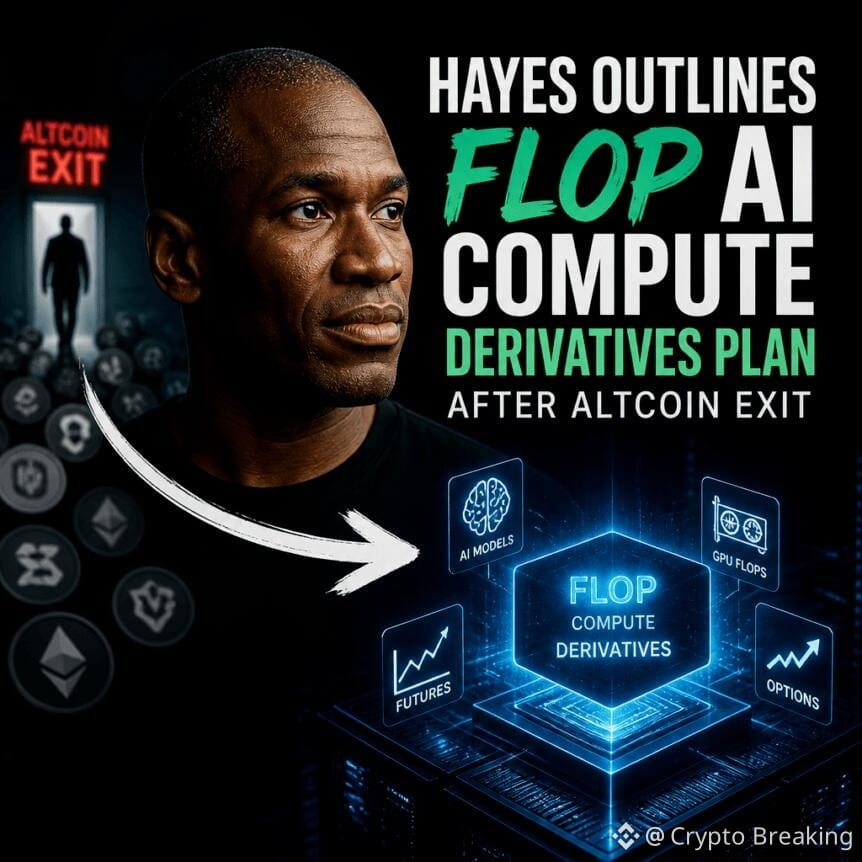
Hayes outlines FLOP AI compute derivatives plan after altcoin exitArthur Hayes, BitMEX co-founder and CEO of Flop Labs, has laid out a more concrete framework for how the Flop Network’s native token could help turn AI compute into something closer to a tradable commodity. Writing two days after selling portions of his altcoin holdings, Hayes argued that if AI agents use Flop as a payments layer, then a measurable “compute spot price” denominated in the network token could become the market’s global reference point.
In a Monday Substack essay titled “The Trifecta,” Hayes proposed valuing AI work by tracking the computing power delivered per inference task and then using on-chain transaction data to compute a spot rate for compute priced in Flop (FLOP) tokens—an approach he said is needed because there is currently no universally accepted benchmark for AI computing power.
Key takeaways
Hayes says Flop’s payments role for AI agents could make a FLOP/compute exchange rate a widely used benchmark for spot compute.
The proposal relies on measuring compute delivered per inference and deriving pricing from transaction-level data.
Hayes links the development of a liquid spot compute market to the possibility of derivatives built on that reference price.
Flop Labs has discussed plans for a large token distribution in Q4 2026, alongside its broader push for compute payments and decentralized memory services.
The timing of the explainer follows reports and on-chain tracking highlighting sizable sales by Hayes-linked wallets.
From “AI compute” to a spot price
Hayes’ core claim is that markets need a consistent unit of measurement to price AI compute in the same way that exchanges price conventional commodities. In his framing, Flop becomes the rails through which AI agents pay for compute, and the key market output becomes the FLOP/compute exchange rate.
“If Flop becomes the payments network for AI agents, then it follows that the $FLOP/compute exchange rate will be the global benchmark for spot compute,” Hayes wrote in the essay. He added that a liquid spot compute market would allow derivatives to reference that benchmark, effectively extending the same pricing-and-risk machinery that exists in traditional commodity markets.
Hayes also emphasized a practical gap in today’s ecosystem: without a broadly accepted “benchmark price” for AI computing power, it’s difficult to standardize what compute is worth across providers, workloads, or networks.
Why a compute commodity framework matters
The push to make compute tradable sits within a larger debate about how AI infrastructure should be monetized. In a July 2026 report, BCG examined how quickly AI computing power could shift from being priced in fragmented, provider-specific ways to becoming more commodity-like.
According to BCG’s projections, the AI compute market could grow to roughly $2.3 trillion by 2030, rising from about $360 billion in 2025. While those figures describe market expansion rather than Flop specifically, they reinforce the idea that demand for compute creates pressure for clearer, more standardized pricing.
For investors and traders, a standardized spot benchmark is often the foundation for everything downstream: pricing comparisons across platforms, liquidity aggregation, and risk products that require a reliable reference metric. For builders, it can also reduce the complexity of integrating payment flows with compute supply—especially if inference tasks can be priced transparently by measured compute delivery.
What Flop Labs is building
Flop Labs is developing a network intended to let AI agents pay for computing resources and decentralized memory services. Hayes’ latest explanation ties this product direction to a market-design question: how to translate compute consumption into an on-chain price signal that can be used by both spot traders and derivative markets.
Hayes previously said Flop was planning a “massive airdrop” in the fourth quarter of 2026 and announced that he would serve as the company’s CEO. That timeline places the token distribution discussion alongside the broader ambition of turning compute into a system with measurable delivery and comparable pricing.
Hayes sells tokens as he promotes the thesis
The Flop explainer arrived shortly after public statements about Hayes reducing exposure to several altcoins. Earlier on Saturday, he said he “dumped it all” and took profits from holdings in Ether (ETH), Ethena (ENA), and Uniswap (UNI) token positions managed through Maelstrom’s directional trading book, citing “dicey” macroeconomic and geopolitical conditions.
Subsequent tracking by Lookonchain flagged sales attributed to Hayes-linked wallets totaling about $22 million, including approximately $15 million in ETH, $2.7 million in ENA, $2.2 million in UNI, $1.2 million in Ether.fi (ETHFI), $398,000 in Aerodrome Finance (AERO), $244,000 in Pendle (PENDLE), and $214,000 in Zama (ZAMA) tokens.
While token sales do not, by themselves, disprove a longer-term thesis, the juxtaposition highlights an important dynamic for readers: market participants can reassess risk exposure even while arguing for ecosystem-level changes. Investors watching Flop will likely look for whether token mechanics, compute pricing signals, and liquidity development align with Hayes’ commodity benchmark model over time.
Going forward, the key question is whether Flop can translate “compute delivered per inference” into a consistent on-chain pricing reference that attracts real transaction volume. Readers should watch for evidence that a stable FLOP/compute exchange rate emerges from usage, and for how soon any credible spot-liquidity and derivative markets can form around that benchmark.
This article was originally published as Hayes outlines FLOP AI compute derivatives plan after altcoin exit on Crypto Breaking News – your trusted source for crypto news, Bitcoin news, and blockchain updates.
Hayes outlines FLOP AI compute derivatives plan after altcoin exit
Arthur Hayes, BitMEX co-founder and CEO of Flop Labs, has laid out a more concrete framework for how the Flop Network’s native token could help turn AI compute into something closer to a tradable commodity. Writing two days after selling portions of his altcoin holdings, Hayes argued that if AI agents use Flop as a payments layer, then a measurable “compute spot price” denominated in the network token could become the market’s global reference point.
In a Monday Substack essay titled “The Trifecta,” Hayes proposed valuing AI work by tracking the computing power delivered per inference task and then using on-chain transaction data to compute a spot rate for compute priced in Flop (FLOP) tokens—an approach he said is needed because there is currently no universally accepted benchmark for AI computing power.
Key takeaways
Hayes says Flop’s payments role for AI agents could make a FLOP/compute exchange rate a widely used benchmark for spot compute.
The proposal relies on measuring compute delivered per inference and deriving pricing from transaction-level data.
Hayes links the development of a liquid spot compute market to the possibility of derivatives built on that reference price.
Flop Labs has discussed plans for a large token distribution in Q4 2026, alongside its broader push for compute payments and decentralized memory services.
The timing of the explainer follows reports and on-chain tracking highlighting sizable sales by Hayes-linked wallets.
From “AI compute” to a spot price
Hayes’ core claim is that markets need a consistent unit of measurement to price AI compute in the same way that exchanges price conventional commodities. In his framing, Flop becomes the rails through which AI agents pay for compute, and the key market output becomes the FLOP/compute exchange rate.
“If Flop becomes the payments network for AI agents, then it follows that the $FLOP/compute exchange rate will be the global benchmark for spot compute,” Hayes wrote in the essay. He added that a liquid spot compute market would allow derivatives to reference that benchmark, effectively extending the same pricing-and-risk machinery that exists in traditional commodity markets.
Hayes also emphasized a practical gap in today’s ecosystem: without a broadly accepted “benchmark price” for AI computing power, it’s difficult to standardize what compute is worth across providers, workloads, or networks.
Why a compute commodity framework matters
The push to make compute tradable sits within a larger debate about how AI infrastructure should be monetized. In a July 2026 report, BCG examined how quickly AI computing power could shift from being priced in fragmented, provider-specific ways to becoming more commodity-like.
According to BCG’s projections, the AI compute market could grow to roughly $2.3 trillion by 2030, rising from about $360 billion in 2025. While those figures describe market expansion rather than Flop specifically, they reinforce the idea that demand for compute creates pressure for clearer, more standardized pricing.
For investors and traders, a standardized spot benchmark is often the foundation for everything downstream: pricing comparisons across platforms, liquidity aggregation, and risk products that require a reliable reference metric. For builders, it can also reduce the complexity of integrating payment flows with compute supply—especially if inference tasks can be priced transparently by measured compute delivery.
What Flop Labs is building
Flop Labs is developing a network intended to let AI agents pay for computing resources and decentralized memory services. Hayes’ latest explanation ties this product direction to a market-design question: how to translate compute consumption into an on-chain price signal that can be used by both spot traders and derivative markets.
Hayes previously said Flop was planning a “massive airdrop” in the fourth quarter of 2026 and announced that he would serve as the company’s CEO. That timeline places the token distribution discussion alongside the broader ambition of turning compute into a system with measurable delivery and comparable pricing.
Hayes sells tokens as he promotes the thesis
The Flop explainer arrived shortly after public statements about Hayes reducing exposure to several altcoins. Earlier on Saturday, he said he “dumped it all” and took profits from holdings in Ether (ETH), Ethena (ENA), and Uniswap (UNI) token positions managed through Maelstrom’s directional trading book, citing “dicey” macroeconomic and geopolitical conditions.
Subsequent tracking by Lookonchain flagged sales attributed to Hayes-linked wallets totaling about $22 million, including approximately $15 million in ETH, $2.7 million in ENA, $2.2 million in UNI, $1.2 million in Ether.fi (ETHFI), $398,000 in Aerodrome Finance (AERO), $244,000 in Pendle (PENDLE), and $214,000 in Zama (ZAMA) tokens.
While token sales do not, by themselves, disprove a longer-term thesis, the juxtaposition highlights an important dynamic for readers: market participants can reassess risk exposure even while arguing for ecosystem-level changes. Investors watching Flop will likely look for whether token mechanics, compute pricing signals, and liquidity development align with Hayes’ commodity benchmark model over time.
Going forward, the key question is whether Flop can translate “compute delivered per inference” into a consistent on-chain pricing reference that attracts real transaction volume. Readers should watch for evidence that a stable FLOP/compute exchange rate emerges from usage, and for how soon any credible spot-liquidity and derivative markets can form around that benchmark.
This article was originally published as Hayes outlines FLOP AI compute derivatives plan after altcoin exit on Crypto Breaking News – your trusted source for crypto news, Bitcoin news, and blockchain updates.
In a Monday Substack essay titled “The Trifecta,” Hayes proposed valuing AI work by tracking the computing power delivered per inference task and then using on-chain transaction data to compute a spot rate for compute priced in Flop (FLOP) tokens—an approach he said is needed because there is currently no universally accepted benchmark for AI computing power.
Key takeaways
Hayes says Flop’s payments role for AI agents could make a FLOP/compute exchange rate a widely used benchmark for spot compute.
The proposal relies on measuring compute delivered per inference and deriving pricing from transaction-level data.
Hayes links the development of a liquid spot compute market to the possibility of derivatives built on that reference price.
Flop Labs has discussed plans for a large token distribution in Q4 2026, alongside its broader push for compute payments and decentralized memory services.
The timing of the explainer follows reports and on-chain tracking highlighting sizable sales by Hayes-linked wallets.
From “AI compute” to a spot price
Hayes’ core claim is that markets need a consistent unit of measurement to price AI compute in the same way that exchanges price conventional commodities. In his framing, Flop becomes the rails through which AI agents pay for compute, and the key market output becomes the FLOP/compute exchange rate.
“If Flop becomes the payments network for AI agents, then it follows that the $FLOP/compute exchange rate will be the global benchmark for spot compute,” Hayes wrote in the essay. He added that a liquid spot compute market would allow derivatives to reference that benchmark, effectively extending the same pricing-and-risk machinery that exists in traditional commodity markets.
Hayes also emphasized a practical gap in today’s ecosystem: without a broadly accepted “benchmark price” for AI computing power, it’s difficult to standardize what compute is worth across providers, workloads, or networks.
Why a compute commodity framework matters
The push to make compute tradable sits within a larger debate about how AI infrastructure should be monetized. In a July 2026 report, BCG examined how quickly AI computing power could shift from being priced in fragmented, provider-specific ways to becoming more commodity-like.
According to BCG’s projections, the AI compute market could grow to roughly $2.3 trillion by 2030, rising from about $360 billion in 2025. While those figures describe market expansion rather than Flop specifically, they reinforce the idea that demand for compute creates pressure for clearer, more standardized pricing.
For investors and traders, a standardized spot benchmark is often the foundation for everything downstream: pricing comparisons across platforms, liquidity aggregation, and risk products that require a reliable reference metric. For builders, it can also reduce the complexity of integrating payment flows with compute supply—especially if inference tasks can be priced transparently by measured compute delivery.
What Flop Labs is building
Flop Labs is developing a network intended to let AI agents pay for computing resources and decentralized memory services. Hayes’ latest explanation ties this product direction to a market-design question: how to translate compute consumption into an on-chain price signal that can be used by both spot traders and derivative markets.
Hayes previously said Flop was planning a “massive airdrop” in the fourth quarter of 2026 and announced that he would serve as the company’s CEO. That timeline places the token distribution discussion alongside the broader ambition of turning compute into a system with measurable delivery and comparable pricing.
Hayes sells tokens as he promotes the thesis
The Flop explainer arrived shortly after public statements about Hayes reducing exposure to several altcoins. Earlier on Saturday, he said he “dumped it all” and took profits from holdings in Ether (ETH), Ethena (ENA), and Uniswap (UNI) token positions managed through Maelstrom’s directional trading book, citing “dicey” macroeconomic and geopolitical conditions.
Subsequent tracking by Lookonchain flagged sales attributed to Hayes-linked wallets totaling about $22 million, including approximately $15 million in ETH, $2.7 million in ENA, $2.2 million in UNI, $1.2 million in Ether.fi (ETHFI), $398,000 in Aerodrome Finance (AERO), $244,000 in Pendle (PENDLE), and $214,000 in Zama (ZAMA) tokens.
While token sales do not, by themselves, disprove a longer-term thesis, the juxtaposition highlights an important dynamic for readers: market participants can reassess risk exposure even while arguing for ecosystem-level changes. Investors watching Flop will likely look for whether token mechanics, compute pricing signals, and liquidity development align with Hayes’ commodity benchmark model over time.
Going forward, the key question is whether Flop can translate “compute delivered per inference” into a consistent on-chain pricing reference that attracts real transaction volume. Readers should watch for evidence that a stable FLOP/compute exchange rate emerges from usage, and for how soon any credible spot-liquidity and derivative markets can form around that benchmark.
This article was originally published as Hayes outlines FLOP AI compute derivatives plan after altcoin exit on Crypto Breaking News – your trusted source for crypto news, Bitcoin news, and blockchain updates.
29
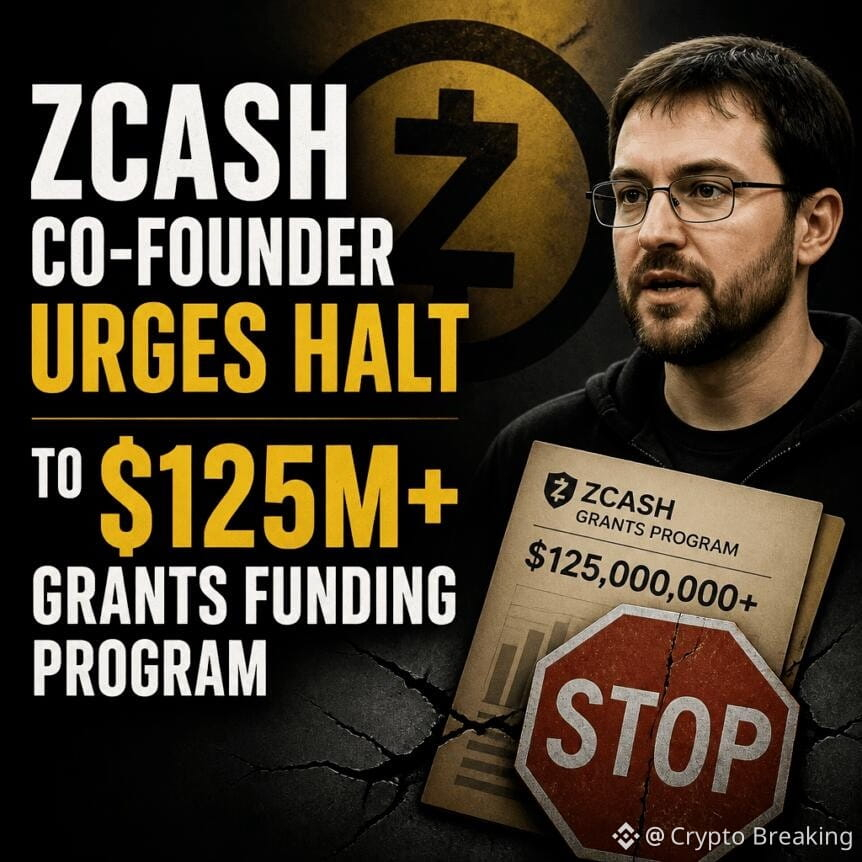
Статья
Zcash Co-Founder Urges Halt to $125M+ Grants Funding ProgramZcash co-founder Sean Bowe has proposed ending the project’s automatic funding stream to the Zcash Community Grants (ZCG) program, arguing the grants treasury is already sufficiently resourced to continue supporting proposals without further automatic inflows.
On X Tuesday, Bowe said ZCG “has over $125M in funding” and “will receive millions more before the spigot is turned off,” adding that the program “was never designed to handle this amount of funding.” To support the idea, he shared a draft proposal on GitHub outlining how the funding could be redirected without touching ZCG’s existing balance.
Key takeaways
Sean Bowe argues ZCG’s current treasury is large enough that automatic grant funding should be stopped.
His draft suggests reallocating ZCG’s 8% share of the Zcash block subsidy to a “Network Sustainability Mechanism,” not withdrawing ZCG’s current funds.
The redirected allocation would continue through the current funding period, which runs until 2028.
ZCG reported 91,453 ZEC plus $8.8 million in cash as of Wednesday, alongside $2.4 million in outstanding commitments.
Zcash’s separate development “lockbox” holds 72,351 ZEC, indicating the network already maintains other reserves alongside ZCG.
Why Bowe wants the ZCG automatic stream halted
At the center of Bowe’s argument is a mismatch between the original design and what the program has become over time. According to his post, ZCG has accumulated more than it was intended to manage, and that scale makes an ongoing automatic funding stream unnecessary.
Bowe’s proposal is aimed at changing the mechanics of future allocations—specifically the “automatic payments” that feed ZCG—while leaving the funds already held by the grants program in place.
The draft GitHub proposal: redirecting the 8% block subsidy share
Bowe shared a draft Zcash Improvement Proposal (ZIP) on GitHub titled around “end-zcg-stream.” The core proposal is to redirect ZCG’s 8% share of the Zcash block subsidy away from community grants and toward the network’s sustainability reserve.
Under the plan, the redirected funds would flow to the Network Sustainability Mechanism until the current funding period ends in 2028. The mechanism’s purpose, as described in the proposal text, is to keep ZEC out of circulation by holding the allocation and gradually reissuing it through future block rewards.
That distinction matters for readers tracking how Zcash manages token supply: the proposal is not framed as a reduction in total funding, but as a reassignment of where that funding goes—and how its token impact is handled—during the remainder of the program’s defined period.
Context: past calls to end Zcash dev funding at a specific threshold
Bowe’s move echoes a broader debate within Zcash’s funding ecosystem. In September, Haseeb Qureshi, managing partner at Dragonfly, proposed ending the Zcash developer fund when its current funding period expires, warning that the pool could become “politicized” as it approaches the scale of $100 million.
While Qureshi’s comments focused on the developer fund rather than ZCG specifically, the common thread is governance and concentration risk: when funding treasuries grow substantially, questions tend to shift from whether the funds are sufficient to how they should be structured and controlled.
Bowe’s draft similarly frames the issue as a structural one—arguing the grants program wasn’t meant to absorb funding at the level it has reached—rather than a judgment about whether grant recipients should be supported.
What the treasuries show right now
ZCG’s public dashboard lists 91,453 ZEC and $8.8 million in cash as of Wednesday. It also reports $2.4 million in outstanding grant commitments. Based on the ZEC balance alone, the holdings were valued at about $111 million at the time of press.
In addition to ZCG, Zcash’s separate development lockbox holds 72,351 ZEC, according to ZecStats. That balance was roughly $89 million, underscoring that Zcash already maintains multiple funding and reserve structures rather than relying on a single pool.
Together, these figures help explain why Bowe is making a “design limit” argument: with sizable assets already reserved for different roles—community grants and development—he contends that the automatic mechanism for funneling new block subsidy into ZCG is no longer necessary.
What to watch next
The immediate question is how Zcash community stakeholders respond to Bowe’s draft ZIP and whether the network will treat the proposal as a governance and supply-mechanics change for the remainder of the program through 2028. Investors and builders may also want to monitor how proposals like this balance treasury size, token circulation effects, and long-term sustainability goals as funding debates evolve.
This article was originally published as Zcash Co-Founder Urges Halt to $125M+ Grants Funding Program on Crypto Breaking News – your trusted source for crypto news, Bitcoin news, and blockchain updates.
Zcash Co-Founder Urges Halt to $125M+ Grants Funding Program
Zcash co-founder Sean Bowe has proposed ending the project’s automatic funding stream to the Zcash Community Grants (ZCG) program, arguing the grants treasury is already sufficiently resourced to continue supporting proposals without further automatic inflows.
On X Tuesday, Bowe said ZCG “has over $125M in funding” and “will receive millions more before the spigot is turned off,” adding that the program “was never designed to handle this amount of funding.” To support the idea, he shared a draft proposal on GitHub outlining how the funding could be redirected without touching ZCG’s existing balance.
Key takeaways
Sean Bowe argues ZCG’s current treasury is large enough that automatic grant funding should be stopped.
His draft suggests reallocating ZCG’s 8% share of the Zcash block subsidy to a “Network Sustainability Mechanism,” not withdrawing ZCG’s current funds.
The redirected allocation would continue through the current funding period, which runs until 2028.
ZCG reported 91,453 ZEC plus $8.8 million in cash as of Wednesday, alongside $2.4 million in outstanding commitments.
Zcash’s separate development “lockbox” holds 72,351 ZEC, indicating the network already maintains other reserves alongside ZCG.
Why Bowe wants the ZCG automatic stream halted
At the center of Bowe’s argument is a mismatch between the original design and what the program has become over time. According to his post, ZCG has accumulated more than it was intended to manage, and that scale makes an ongoing automatic funding stream unnecessary.
Bowe’s proposal is aimed at changing the mechanics of future allocations—specifically the “automatic payments” that feed ZCG—while leaving the funds already held by the grants program in place.
The draft GitHub proposal: redirecting the 8% block subsidy share
Bowe shared a draft Zcash Improvement Proposal (ZIP) on GitHub titled around “end-zcg-stream.” The core proposal is to redirect ZCG’s 8% share of the Zcash block subsidy away from community grants and toward the network’s sustainability reserve.
Under the plan, the redirected funds would flow to the Network Sustainability Mechanism until the current funding period ends in 2028. The mechanism’s purpose, as described in the proposal text, is to keep ZEC out of circulation by holding the allocation and gradually reissuing it through future block rewards.
That distinction matters for readers tracking how Zcash manages token supply: the proposal is not framed as a reduction in total funding, but as a reassignment of where that funding goes—and how its token impact is handled—during the remainder of the program’s defined period.
Context: past calls to end Zcash dev funding at a specific threshold
Bowe’s move echoes a broader debate within Zcash’s funding ecosystem. In September, Haseeb Qureshi, managing partner at Dragonfly, proposed ending the Zcash developer fund when its current funding period expires, warning that the pool could become “politicized” as it approaches the scale of $100 million.
While Qureshi’s comments focused on the developer fund rather than ZCG specifically, the common thread is governance and concentration risk: when funding treasuries grow substantially, questions tend to shift from whether the funds are sufficient to how they should be structured and controlled.
Bowe’s draft similarly frames the issue as a structural one—arguing the grants program wasn’t meant to absorb funding at the level it has reached—rather than a judgment about whether grant recipients should be supported.
What the treasuries show right now
ZCG’s public dashboard lists 91,453 ZEC and $8.8 million in cash as of Wednesday. It also reports $2.4 million in outstanding grant commitments. Based on the ZEC balance alone, the holdings were valued at about $111 million at the time of press.
In addition to ZCG, Zcash’s separate development lockbox holds 72,351 ZEC, according to ZecStats. That balance was roughly $89 million, underscoring that Zcash already maintains multiple funding and reserve structures rather than relying on a single pool.
Together, these figures help explain why Bowe is making a “design limit” argument: with sizable assets already reserved for different roles—community grants and development—he contends that the automatic mechanism for funneling new block subsidy into ZCG is no longer necessary.
What to watch next
The immediate question is how Zcash community stakeholders respond to Bowe’s draft ZIP and whether the network will treat the proposal as a governance and supply-mechanics change for the remainder of the program through 2028. Investors and builders may also want to monitor how proposals like this balance treasury size, token circulation effects, and long-term sustainability goals as funding debates evolve.
This article was originally published as Zcash Co-Founder Urges Halt to $125M+ Grants Funding Program on Crypto Breaking News – your trusted source for crypto news, Bitcoin news, and blockchain updates.
On X Tuesday, Bowe said ZCG “has over $125M in funding” and “will receive millions more before the spigot is turned off,” adding that the program “was never designed to handle this amount of funding.” To support the idea, he shared a draft proposal on GitHub outlining how the funding could be redirected without touching ZCG’s existing balance.
Key takeaways
Sean Bowe argues ZCG’s current treasury is large enough that automatic grant funding should be stopped.
His draft suggests reallocating ZCG’s 8% share of the Zcash block subsidy to a “Network Sustainability Mechanism,” not withdrawing ZCG’s current funds.
The redirected allocation would continue through the current funding period, which runs until 2028.
ZCG reported 91,453 ZEC plus $8.8 million in cash as of Wednesday, alongside $2.4 million in outstanding commitments.
Zcash’s separate development “lockbox” holds 72,351 ZEC, indicating the network already maintains other reserves alongside ZCG.
Why Bowe wants the ZCG automatic stream halted
At the center of Bowe’s argument is a mismatch between the original design and what the program has become over time. According to his post, ZCG has accumulated more than it was intended to manage, and that scale makes an ongoing automatic funding stream unnecessary.
Bowe’s proposal is aimed at changing the mechanics of future allocations—specifically the “automatic payments” that feed ZCG—while leaving the funds already held by the grants program in place.
The draft GitHub proposal: redirecting the 8% block subsidy share
Bowe shared a draft Zcash Improvement Proposal (ZIP) on GitHub titled around “end-zcg-stream.” The core proposal is to redirect ZCG’s 8% share of the Zcash block subsidy away from community grants and toward the network’s sustainability reserve.
Under the plan, the redirected funds would flow to the Network Sustainability Mechanism until the current funding period ends in 2028. The mechanism’s purpose, as described in the proposal text, is to keep ZEC out of circulation by holding the allocation and gradually reissuing it through future block rewards.
That distinction matters for readers tracking how Zcash manages token supply: the proposal is not framed as a reduction in total funding, but as a reassignment of where that funding goes—and how its token impact is handled—during the remainder of the program’s defined period.
Context: past calls to end Zcash dev funding at a specific threshold
Bowe’s move echoes a broader debate within Zcash’s funding ecosystem. In September, Haseeb Qureshi, managing partner at Dragonfly, proposed ending the Zcash developer fund when its current funding period expires, warning that the pool could become “politicized” as it approaches the scale of $100 million.
While Qureshi’s comments focused on the developer fund rather than ZCG specifically, the common thread is governance and concentration risk: when funding treasuries grow substantially, questions tend to shift from whether the funds are sufficient to how they should be structured and controlled.
Bowe’s draft similarly frames the issue as a structural one—arguing the grants program wasn’t meant to absorb funding at the level it has reached—rather than a judgment about whether grant recipients should be supported.
What the treasuries show right now
ZCG’s public dashboard lists 91,453 ZEC and $8.8 million in cash as of Wednesday. It also reports $2.4 million in outstanding grant commitments. Based on the ZEC balance alone, the holdings were valued at about $111 million at the time of press.
In addition to ZCG, Zcash’s separate development lockbox holds 72,351 ZEC, according to ZecStats. That balance was roughly $89 million, underscoring that Zcash already maintains multiple funding and reserve structures rather than relying on a single pool.
Together, these figures help explain why Bowe is making a “design limit” argument: with sizable assets already reserved for different roles—community grants and development—he contends that the automatic mechanism for funneling new block subsidy into ZCG is no longer necessary.
What to watch next
The immediate question is how Zcash community stakeholders respond to Bowe’s draft ZIP and whether the network will treat the proposal as a governance and supply-mechanics change for the remainder of the program through 2028. Investors and builders may also want to monitor how proposals like this balance treasury size, token circulation effects, and long-term sustainability goals as funding debates evolve.
This article was originally published as Zcash Co-Founder Urges Halt to $125M+ Grants Funding Program on Crypto Breaking News – your trusted source for crypto news, Bitcoin news, and blockchain updates.
24
Статья
Zcash Co-Founder Urges Halt to $125M+ Grants Program FundingZcash co-founder Sean Bowe has floated a plan to end the automatic funding stream from Zcash block rewards to the Zcash Community Grants (ZCG) program, arguing the treasury is already large enough to keep supporting initiatives without continued automatic payments.
In a post on X Tuesday, Bowe said ZCG has more than $125 million in funding and is expected to receive “millions more” before the mechanism is shut off. He shared a draft proposal on GitHub that would redirect ZCG’s 8% allocation of the Zcash (ZEC) block subsidy to a separate network sustainability reserve—while leaving ZCG’s current holdings untouched.
Key takeaways
Sean Bowe proposes stopping ZCG’s automatic stream from block subsidies while keeping existing ZCG funds in place.
The draft would redirect ZCG’s 8% block subsidy share to the Network Sustainability Mechanism through the end of the current funding period in 2028.
Under the proposal, the sustainability mechanism is intended to remove ZEC from circulation and later reissue it via future block rewards.
ZCG lists 91,453 ZEC and $8.8 million in cash, along with $2.4 million in outstanding grant commitments, per its dashboard.
A separate earlier critique from Dragonfly’s Haseeb Qureshi targeted the Zcash developer fund, also warning it could become “politicized” as it grows.
Why Bowe wants to switch off the ZCG block-reward stream
Bowe’s proposal centers on a practical concern: the block-reward-linked funding mechanism may be oversized relative to what the program needs. On X, he argued that the ZCG program “was never designed to handle this amount of funding,” pointing to the size of the current treasury and the expectation of additional inflows before any change takes effect.
Rather than canceling grants or changing ZCG’s existing capital, the draft aims to change how future funding is generated. By redirecting ZCG’s portion of the block subsidy, the community grants program would not continue receiving automatic allocations from new blocks.
The mechanics: from ZCG’s 8% subsidy share to a sustainability reserve
According to Bowe’s draft GitHub proposal, ZCG would forgo its 8% share of the ZEC block subsidy. That allocation would instead be routed to the Network Sustainability Mechanism until the current funding period ends in 2028.
The key feature of the new routing is the mechanism’s intended effect on supply. As described in the proposal, the sustainability mechanism is designed to hold ZEC out of circulation and gradually reissue it through future block rewards.
For investors and users, this distinction matters: changing where newly minted ZEC goes can influence long-term token supply dynamics, while shifting grant funding away from automatic block-linked inflows could alter how predictably the grants ecosystem is funded over time.
How big is ZCG today?
ZCG’s public dashboard lists 91,453 ZEC and $8.8 million in cash as of Wednesday, with $2.4 million in outstanding grant commitments. Based on the reported ZEC holdings, the ZEC component was valued at about $111 million at press time.
That scale supports Bowe’s argument that ZCG’s treasury may already exceed what the program structure originally contemplated. It also raises the question of what happens to future grant strategy once automatic block-reward funding is removed—whether ZCG would rely solely on existing assets and unspent commitments, or whether governance would later revisit funding approaches.
Separate debates around Zcash funding and governance
Bowe’s plan is not the first time Zcash’s funding mechanisms have come under scrutiny. In September, Haseeb Qureshi—managing partner at Dragonfly—argued for ending the Zcash developer fund after its current funding period expires, saying it risks being “politicized” as it approaches $100 million in value. Earlier coverage from Cointelegraph highlighted Qureshi’s view that large, recurring pools can invite governance conflict as they grow.
While Bowe’s proposal targets the community grants stream rather than the developer fund, the underlying theme overlaps: both discussions reflect concerns that ongoing, relatively large funding flows tied to protocol incentives may create governance or legitimacy pressures as they scale.
At the same time, Zcash’s funding architecture is not uniform. Separate from ZCG, ZecStats reports that the network’s development lockbox holds 72,351 ZEC—worth roughly $89 million at the time of the article—underscoring that multiple pools exist with different purposes and payout designs.
For readers following Zcash’s evolution, the important tension is timing. If ZCG’s automatic stream is paused but other funding pools remain active for longer, questions will likely shift to how grant programming continuity is maintained and whether governance will prefer more transparent, milestone-based funding rather than fixed, protocol-linked percentages.
What to watch next
Bowe’s GitHub draft is the starting point, but whether it moves forward will depend on community and governance processes. The next signals to monitor are any formal Zcash improvement proposal steps tied to the switch-off mechanics, plus how ZCG plans for funding runway after future subsidy allocations to ZCG are redirected toward the sustainability mechanism through 2028.
This article was originally published as Zcash Co-Founder Urges Halt to $125M+ Grants Program Funding on Crypto Breaking News – your trusted source for crypto news, Bitcoin news, and blockchain updates.
Zcash Co-Founder Urges Halt to $125M+ Grants Program Funding
Zcash co-founder Sean Bowe has floated a plan to end the automatic funding stream from Zcash block rewards to the Zcash Community Grants (ZCG) program, arguing the treasury is already large enough to keep supporting initiatives without continued automatic payments.
In a post on X Tuesday, Bowe said ZCG has more than $125 million in funding and is expected to receive “millions more” before the mechanism is shut off. He shared a draft proposal on GitHub that would redirect ZCG’s 8% allocation of the Zcash (ZEC) block subsidy to a separate network sustainability reserve—while leaving ZCG’s current holdings untouched.
Key takeaways
Sean Bowe proposes stopping ZCG’s automatic stream from block subsidies while keeping existing ZCG funds in place.
The draft would redirect ZCG’s 8% block subsidy share to the Network Sustainability Mechanism through the end of the current funding period in 2028.
Under the proposal, the sustainability mechanism is intended to remove ZEC from circulation and later reissue it via future block rewards.
ZCG lists 91,453 ZEC and $8.8 million in cash, along with $2.4 million in outstanding grant commitments, per its dashboard.
A separate earlier critique from Dragonfly’s Haseeb Qureshi targeted the Zcash developer fund, also warning it could become “politicized” as it grows.
Why Bowe wants to switch off the ZCG block-reward stream
Bowe’s proposal centers on a practical concern: the block-reward-linked funding mechanism may be oversized relative to what the program needs. On X, he argued that the ZCG program “was never designed to handle this amount of funding,” pointing to the size of the current treasury and the expectation of additional inflows before any change takes effect.
Rather than canceling grants or changing ZCG’s existing capital, the draft aims to change how future funding is generated. By redirecting ZCG’s portion of the block subsidy, the community grants program would not continue receiving automatic allocations from new blocks.
The mechanics: from ZCG’s 8% subsidy share to a sustainability reserve
According to Bowe’s draft GitHub proposal, ZCG would forgo its 8% share of the ZEC block subsidy. That allocation would instead be routed to the Network Sustainability Mechanism until the current funding period ends in 2028.
The key feature of the new routing is the mechanism’s intended effect on supply. As described in the proposal, the sustainability mechanism is designed to hold ZEC out of circulation and gradually reissue it through future block rewards.
For investors and users, this distinction matters: changing where newly minted ZEC goes can influence long-term token supply dynamics, while shifting grant funding away from automatic block-linked inflows could alter how predictably the grants ecosystem is funded over time.
How big is ZCG today?
ZCG’s public dashboard lists 91,453 ZEC and $8.8 million in cash as of Wednesday, with $2.4 million in outstanding grant commitments. Based on the reported ZEC holdings, the ZEC component was valued at about $111 million at press time.
That scale supports Bowe’s argument that ZCG’s treasury may already exceed what the program structure originally contemplated. It also raises the question of what happens to future grant strategy once automatic block-reward funding is removed—whether ZCG would rely solely on existing assets and unspent commitments, or whether governance would later revisit funding approaches.
Separate debates around Zcash funding and governance
Bowe’s plan is not the first time Zcash’s funding mechanisms have come under scrutiny. In September, Haseeb Qureshi—managing partner at Dragonfly—argued for ending the Zcash developer fund after its current funding period expires, saying it risks being “politicized” as it approaches $100 million in value. Earlier coverage from Cointelegraph highlighted Qureshi’s view that large, recurring pools can invite governance conflict as they grow.
While Bowe’s proposal targets the community grants stream rather than the developer fund, the underlying theme overlaps: both discussions reflect concerns that ongoing, relatively large funding flows tied to protocol incentives may create governance or legitimacy pressures as they scale.
At the same time, Zcash’s funding architecture is not uniform. Separate from ZCG, ZecStats reports that the network’s development lockbox holds 72,351 ZEC—worth roughly $89 million at the time of the article—underscoring that multiple pools exist with different purposes and payout designs.
For readers following Zcash’s evolution, the important tension is timing. If ZCG’s automatic stream is paused but other funding pools remain active for longer, questions will likely shift to how grant programming continuity is maintained and whether governance will prefer more transparent, milestone-based funding rather than fixed, protocol-linked percentages.
What to watch next
Bowe’s GitHub draft is the starting point, but whether it moves forward will depend on community and governance processes. The next signals to monitor are any formal Zcash improvement proposal steps tied to the switch-off mechanics, plus how ZCG plans for funding runway after future subsidy allocations to ZCG are redirected toward the sustainability mechanism through 2028.
This article was originally published as Zcash Co-Founder Urges Halt to $125M+ Grants Program Funding on Crypto Breaking News – your trusted source for crypto news, Bitcoin news, and blockchain updates.
In a post on X Tuesday, Bowe said ZCG has more than $125 million in funding and is expected to receive “millions more” before the mechanism is shut off. He shared a draft proposal on GitHub that would redirect ZCG’s 8% allocation of the Zcash (ZEC) block subsidy to a separate network sustainability reserve—while leaving ZCG’s current holdings untouched.
Key takeaways
Sean Bowe proposes stopping ZCG’s automatic stream from block subsidies while keeping existing ZCG funds in place.
The draft would redirect ZCG’s 8% block subsidy share to the Network Sustainability Mechanism through the end of the current funding period in 2028.
Under the proposal, the sustainability mechanism is intended to remove ZEC from circulation and later reissue it via future block rewards.
ZCG lists 91,453 ZEC and $8.8 million in cash, along with $2.4 million in outstanding grant commitments, per its dashboard.
A separate earlier critique from Dragonfly’s Haseeb Qureshi targeted the Zcash developer fund, also warning it could become “politicized” as it grows.
Why Bowe wants to switch off the ZCG block-reward stream
Bowe’s proposal centers on a practical concern: the block-reward-linked funding mechanism may be oversized relative to what the program needs. On X, he argued that the ZCG program “was never designed to handle this amount of funding,” pointing to the size of the current treasury and the expectation of additional inflows before any change takes effect.
Rather than canceling grants or changing ZCG’s existing capital, the draft aims to change how future funding is generated. By redirecting ZCG’s portion of the block subsidy, the community grants program would not continue receiving automatic allocations from new blocks.
The mechanics: from ZCG’s 8% subsidy share to a sustainability reserve
According to Bowe’s draft GitHub proposal, ZCG would forgo its 8% share of the ZEC block subsidy. That allocation would instead be routed to the Network Sustainability Mechanism until the current funding period ends in 2028.
The key feature of the new routing is the mechanism’s intended effect on supply. As described in the proposal, the sustainability mechanism is designed to hold ZEC out of circulation and gradually reissue it through future block rewards.
For investors and users, this distinction matters: changing where newly minted ZEC goes can influence long-term token supply dynamics, while shifting grant funding away from automatic block-linked inflows could alter how predictably the grants ecosystem is funded over time.
How big is ZCG today?
ZCG’s public dashboard lists 91,453 ZEC and $8.8 million in cash as of Wednesday, with $2.4 million in outstanding grant commitments. Based on the reported ZEC holdings, the ZEC component was valued at about $111 million at press time.
That scale supports Bowe’s argument that ZCG’s treasury may already exceed what the program structure originally contemplated. It also raises the question of what happens to future grant strategy once automatic block-reward funding is removed—whether ZCG would rely solely on existing assets and unspent commitments, or whether governance would later revisit funding approaches.
Separate debates around Zcash funding and governance
Bowe’s plan is not the first time Zcash’s funding mechanisms have come under scrutiny. In September, Haseeb Qureshi—managing partner at Dragonfly—argued for ending the Zcash developer fund after its current funding period expires, saying it risks being “politicized” as it approaches $100 million in value. Earlier coverage from Cointelegraph highlighted Qureshi’s view that large, recurring pools can invite governance conflict as they grow.
While Bowe’s proposal targets the community grants stream rather than the developer fund, the underlying theme overlaps: both discussions reflect concerns that ongoing, relatively large funding flows tied to protocol incentives may create governance or legitimacy pressures as they scale.
At the same time, Zcash’s funding architecture is not uniform. Separate from ZCG, ZecStats reports that the network’s development lockbox holds 72,351 ZEC—worth roughly $89 million at the time of the article—underscoring that multiple pools exist with different purposes and payout designs.
For readers following Zcash’s evolution, the important tension is timing. If ZCG’s automatic stream is paused but other funding pools remain active for longer, questions will likely shift to how grant programming continuity is maintained and whether governance will prefer more transparent, milestone-based funding rather than fixed, protocol-linked percentages.
What to watch next
Bowe’s GitHub draft is the starting point, but whether it moves forward will depend on community and governance processes. The next signals to monitor are any formal Zcash improvement proposal steps tied to the switch-off mechanics, plus how ZCG plans for funding runway after future subsidy allocations to ZCG are redirected toward the sustainability mechanism through 2028.
This article was originally published as Zcash Co-Founder Urges Halt to $125M+ Grants Program Funding on Crypto Breaking News – your trusted source for crypto news, Bitcoin news, and blockchain updates.
36

Статья
Binance Seeks Brazil Crypto License, Filing Ahead of Friday CutoffBinance has filed for a cryptocurrency service provider license in Brazil as it prepares for a regulatory deadline next week. The exchange says the move is aimed at preserving access for Brazilian users while Brazil’s central banking framework continues to tighten.
According to a statement shared with Cointelegraph, Binance submitted the application to the Central Bank of Brazil on Friday, Oct. 23, using its local entity, BBrasil. The deadline for existing crypto service providers to request authorization under transitional arrangements falls on Friday, Oct. 30.
Key takeaways
Binance applied for a crypto service provider license in Brazil through BBrasil, ahead of the Oct. 30 authorization deadline.
The exchange says the filing is intended to help maintain Brazilian access to crypto assets, stablecoin trading, payments, and investment services.
Binance announced service changes effective Tuesday, including restrictions related to crypto lending and margin trading.
The exchange is also delisting 22 crypto assets in Brazil as part of its compliance adjustments.
Brazil’s rules require authorization applications by Oct. 30; submitting an application is not itself regulatory approval.
Binance’s Brazil licensing push before Oct. 30
Brazil has been moving toward a more structured regulatory approach for crypto activity, and the central bank has set a near-term milestone for firms already operating. As Binance put it in its statement, the company is seeking approval to continue servicing customers in one of Latin America’s largest crypto markets.
Binance’s filing—submitted through BBrasil—falls under the Central Bank of Brazil’s requirement that existing crypto service providers apply for authorization by Oct. 30 to remain covered by transitional arrangements. The central point for users and market participants is timing: firms that miss the window could face operational disruptions, while filings do not automatically translate into approval.
Binance also emphasized that the application would support ongoing user access to a range of activities, including crypto asset services, stablecoin trading, payments, and investment-related offerings, at least within the structure allowed during the transitional period.
Compliance-driven changes: lending, margin, and 22 delistings
Alongside its licensing application, Binance says it has already started adjusting its product lineup for Brazil. The exchange announced changes for Brazilian users that take effect Tuesday, including restrictions on crypto lending and margin trading, as well as other service modifications.
In addition, Binance is delisting 22 cryptocurrencies in the country. While the filing is focused on authorization, these earlier operational steps signal that Binance is aligning its Brazil business with requirements it believes may not permit certain services in their current form.
For traders and holders, the immediate practical takeaway is that product access may change before any regulatory decision is issued. Delistings can affect liquidity and available trading pairs, while restrictions on margin and lending can alter risk management options and leverage-related strategies.
What Binance is saying about regulation
Binance’s local leadership framed the licensing process as part of an effort to operate in a regulated environment. Thiago Sarandy, Binance’s general manager in Brazil, said the company supports “a regulated market” that considers the characteristics of virtual assets, adding that the exchange hopes continued dialogue with the Central Bank will allow it to bring back or introduce products that were discontinued to comply with current regulations.
The statement highlights a common tension in crypto compliance: platforms may need to remove or restrict services quickly to reduce regulatory risk, even while they pursue longer-form authorization processes. Until the regulator’s view becomes clear, exchanges often end up balancing customer continuity with conservative compliance choices.
Why the authorization window matters for Brazilian users
Brazil’s central bank requirement is explicit about timing. As Binance noted, the country requires existing crypto service providers to submit authorization applications by Oct. 30 to continue operating under transitional arrangements. The company also stressed that applying does not constitute regulatory approval, meaning the next phase is subject to review by the Central Bank of Brazil.
That distinction matters for users and the broader market. A filing can keep a business within a transition framework, but it does not guarantee that all services will remain available after the review process. At the same time, the existence of a formal licensing pathway suggests Brazil is aiming to move from ad hoc enforcement toward clearer operational standards.
Readers should watch for two developments: first, the Central Bank’s treatment of Binance’s authorization application in the coming weeks, including whether approvals or additional conditions are issued; and second, whether Binance’s announced Brazil restrictions—such as the limits on crypto lending and margin trading—eventually expand, tighten further, or remain in place depending on regulatory feedback.
For Brazil-based traders, businesses, and liquidity providers, the key uncertainty is not just whether Binance can keep operating, but which product categories will be allowed once authorization decisions are finalized. That will likely determine how quickly the local crypto market can stabilize after this compliance-driven transition period.
This article was originally published as Binance Seeks Brazil Crypto License, Filing Ahead of Friday Cutoff on Crypto Breaking News – your trusted source for crypto news, Bitcoin news, and blockchain updates.
Binance Seeks Brazil Crypto License, Filing Ahead of Friday Cutoff
Binance has filed for a cryptocurrency service provider license in Brazil as it prepares for a regulatory deadline next week. The exchange says the move is aimed at preserving access for Brazilian users while Brazil’s central banking framework continues to tighten.
According to a statement shared with Cointelegraph, Binance submitted the application to the Central Bank of Brazil on Friday, Oct. 23, using its local entity, BBrasil. The deadline for existing crypto service providers to request authorization under transitional arrangements falls on Friday, Oct. 30.
Key takeaways
Binance applied for a crypto service provider license in Brazil through BBrasil, ahead of the Oct. 30 authorization deadline.
The exchange says the filing is intended to help maintain Brazilian access to crypto assets, stablecoin trading, payments, and investment services.
Binance announced service changes effective Tuesday, including restrictions related to crypto lending and margin trading.
The exchange is also delisting 22 crypto assets in Brazil as part of its compliance adjustments.
Brazil’s rules require authorization applications by Oct. 30; submitting an application is not itself regulatory approval.
Binance’s Brazil licensing push before Oct. 30
Brazil has been moving toward a more structured regulatory approach for crypto activity, and the central bank has set a near-term milestone for firms already operating. As Binance put it in its statement, the company is seeking approval to continue servicing customers in one of Latin America’s largest crypto markets.
Binance’s filing—submitted through BBrasil—falls under the Central Bank of Brazil’s requirement that existing crypto service providers apply for authorization by Oct. 30 to remain covered by transitional arrangements. The central point for users and market participants is timing: firms that miss the window could face operational disruptions, while filings do not automatically translate into approval.
Binance also emphasized that the application would support ongoing user access to a range of activities, including crypto asset services, stablecoin trading, payments, and investment-related offerings, at least within the structure allowed during the transitional period.
Compliance-driven changes: lending, margin, and 22 delistings
Alongside its licensing application, Binance says it has already started adjusting its product lineup for Brazil. The exchange announced changes for Brazilian users that take effect Tuesday, including restrictions on crypto lending and margin trading, as well as other service modifications.
In addition, Binance is delisting 22 cryptocurrencies in the country. While the filing is focused on authorization, these earlier operational steps signal that Binance is aligning its Brazil business with requirements it believes may not permit certain services in their current form.
For traders and holders, the immediate practical takeaway is that product access may change before any regulatory decision is issued. Delistings can affect liquidity and available trading pairs, while restrictions on margin and lending can alter risk management options and leverage-related strategies.
What Binance is saying about regulation
Binance’s local leadership framed the licensing process as part of an effort to operate in a regulated environment. Thiago Sarandy, Binance’s general manager in Brazil, said the company supports “a regulated market” that considers the characteristics of virtual assets, adding that the exchange hopes continued dialogue with the Central Bank will allow it to bring back or introduce products that were discontinued to comply with current regulations.
The statement highlights a common tension in crypto compliance: platforms may need to remove or restrict services quickly to reduce regulatory risk, even while they pursue longer-form authorization processes. Until the regulator’s view becomes clear, exchanges often end up balancing customer continuity with conservative compliance choices.
Why the authorization window matters for Brazilian users
Brazil’s central bank requirement is explicit about timing. As Binance noted, the country requires existing crypto service providers to submit authorization applications by Oct. 30 to continue operating under transitional arrangements. The company also stressed that applying does not constitute regulatory approval, meaning the next phase is subject to review by the Central Bank of Brazil.
That distinction matters for users and the broader market. A filing can keep a business within a transition framework, but it does not guarantee that all services will remain available after the review process. At the same time, the existence of a formal licensing pathway suggests Brazil is aiming to move from ad hoc enforcement toward clearer operational standards.
Readers should watch for two developments: first, the Central Bank’s treatment of Binance’s authorization application in the coming weeks, including whether approvals or additional conditions are issued; and second, whether Binance’s announced Brazil restrictions—such as the limits on crypto lending and margin trading—eventually expand, tighten further, or remain in place depending on regulatory feedback.
For Brazil-based traders, businesses, and liquidity providers, the key uncertainty is not just whether Binance can keep operating, but which product categories will be allowed once authorization decisions are finalized. That will likely determine how quickly the local crypto market can stabilize after this compliance-driven transition period.
This article was originally published as Binance Seeks Brazil Crypto License, Filing Ahead of Friday Cutoff on Crypto Breaking News – your trusted source for crypto news, Bitcoin news, and blockchain updates.
According to a statement shared with Cointelegraph, Binance submitted the application to the Central Bank of Brazil on Friday, Oct. 23, using its local entity, BBrasil. The deadline for existing crypto service providers to request authorization under transitional arrangements falls on Friday, Oct. 30.
Key takeaways
Binance applied for a crypto service provider license in Brazil through BBrasil, ahead of the Oct. 30 authorization deadline.
The exchange says the filing is intended to help maintain Brazilian access to crypto assets, stablecoin trading, payments, and investment services.
Binance announced service changes effective Tuesday, including restrictions related to crypto lending and margin trading.
The exchange is also delisting 22 crypto assets in Brazil as part of its compliance adjustments.
Brazil’s rules require authorization applications by Oct. 30; submitting an application is not itself regulatory approval.
Binance’s Brazil licensing push before Oct. 30
Brazil has been moving toward a more structured regulatory approach for crypto activity, and the central bank has set a near-term milestone for firms already operating. As Binance put it in its statement, the company is seeking approval to continue servicing customers in one of Latin America’s largest crypto markets.
Binance’s filing—submitted through BBrasil—falls under the Central Bank of Brazil’s requirement that existing crypto service providers apply for authorization by Oct. 30 to remain covered by transitional arrangements. The central point for users and market participants is timing: firms that miss the window could face operational disruptions, while filings do not automatically translate into approval.
Binance also emphasized that the application would support ongoing user access to a range of activities, including crypto asset services, stablecoin trading, payments, and investment-related offerings, at least within the structure allowed during the transitional period.
Compliance-driven changes: lending, margin, and 22 delistings
Alongside its licensing application, Binance says it has already started adjusting its product lineup for Brazil. The exchange announced changes for Brazilian users that take effect Tuesday, including restrictions on crypto lending and margin trading, as well as other service modifications.
In addition, Binance is delisting 22 cryptocurrencies in the country. While the filing is focused on authorization, these earlier operational steps signal that Binance is aligning its Brazil business with requirements it believes may not permit certain services in their current form.
For traders and holders, the immediate practical takeaway is that product access may change before any regulatory decision is issued. Delistings can affect liquidity and available trading pairs, while restrictions on margin and lending can alter risk management options and leverage-related strategies.
What Binance is saying about regulation
Binance’s local leadership framed the licensing process as part of an effort to operate in a regulated environment. Thiago Sarandy, Binance’s general manager in Brazil, said the company supports “a regulated market” that considers the characteristics of virtual assets, adding that the exchange hopes continued dialogue with the Central Bank will allow it to bring back or introduce products that were discontinued to comply with current regulations.
The statement highlights a common tension in crypto compliance: platforms may need to remove or restrict services quickly to reduce regulatory risk, even while they pursue longer-form authorization processes. Until the regulator’s view becomes clear, exchanges often end up balancing customer continuity with conservative compliance choices.
Why the authorization window matters for Brazilian users
Brazil’s central bank requirement is explicit about timing. As Binance noted, the country requires existing crypto service providers to submit authorization applications by Oct. 30 to continue operating under transitional arrangements. The company also stressed that applying does not constitute regulatory approval, meaning the next phase is subject to review by the Central Bank of Brazil.
That distinction matters for users and the broader market. A filing can keep a business within a transition framework, but it does not guarantee that all services will remain available after the review process. At the same time, the existence of a formal licensing pathway suggests Brazil is aiming to move from ad hoc enforcement toward clearer operational standards.
Readers should watch for two developments: first, the Central Bank’s treatment of Binance’s authorization application in the coming weeks, including whether approvals or additional conditions are issued; and second, whether Binance’s announced Brazil restrictions—such as the limits on crypto lending and margin trading—eventually expand, tighten further, or remain in place depending on regulatory feedback.
For Brazil-based traders, businesses, and liquidity providers, the key uncertainty is not just whether Binance can keep operating, but which product categories will be allowed once authorization decisions are finalized. That will likely determine how quickly the local crypto market can stabilize after this compliance-driven transition period.
This article was originally published as Binance Seeks Brazil Crypto License, Filing Ahead of Friday Cutoff on Crypto Breaking News – your trusted source for crypto news, Bitcoin news, and blockchain updates.
19

Статья
Binance Seeks Brazil Crypto License Ahead of Friday DeadlineBinance has filed an application for a cryptocurrency service provider license in Brazil, aiming to preserve its ability to serve users in one of Latin America’s biggest crypto markets ahead of a regulatory deadline on Friday, Oct. 30.
According to a statement shared with Cointelegraph, the exchange submitted the request to the Central Bank of Brazil on Friday, Oct. 23, using its local entity, BBrasil.
Key takeaways
Binance applied for a cryptocurrency service provider license in Brazil via BBrasil ahead of the Oct. 30 deadline.
The Central Bank process is tied to transitional authorization rules for existing crypto service providers.
Binance says the filing would keep access for Brazilian users to crypto assets, stablecoin trading, payments, and investment services.
The firm has already begun adjusting its product availability in Brazil, including restrictions on certain leveraged and lending-related activities.
Filing an application is not the same as receiving regulatory approval.
License application filed as Brazil sets a hard deadline
Brazil’s regulatory framework requires crypto service providers already operating in the country to seek authorization by Oct. 30 in order to continue under transitional arrangements. Binance’s latest step is designed to keep it in that transitional window while regulators review its request.
As the filing process stands, submitting an application does not equal approval. Binance’s ability to continue offering services beyond the transitional period will ultimately depend on the outcome of the Central Bank’s licensing decision.
What Binance says it intends to support for users
In its statement, Binance said that the license application would allow Brazilian users to keep accessing crypto-related offerings, including crypto asset access, stablecoin trading, payments, and investment services.
The company also suggested that continued engagement with regulators could eventually enable products that were previously paused or discontinued to comply with existing rules.
Thiago Sarandy, Binance’s general manager in Brazil, said: “We support a regulated market that considers the characteristics of virtual assets, so that access to technology and innovation continues to advance, but we hope that the ongoing dialogue with the Central Bank will allow us to offer, in the near future, other products that were discontinued to comply with current regulations.”
Service changes and delistings already underway in Brazil
Binance has not waited for the licensing outcome before changing its Brazil offerings. The exchange previously announced updates for Brazilian users effective Tuesday, outlining restrictions on crypto lending, margin trading, and other services.
In addition, Binance said it is delisting 22 crypto assets in Brazil, reflecting the company’s ongoing effort to align its product suite with the requirements it is facing in the country.
For traders and other platform users, these adjustments matter because they can directly affect how they interact with the exchange—particularly for strategies reliant on leverage or borrowing, and for those who hold or trade assets scheduled to be removed.
Why the Central Bank timeline is strategically important
Brazil’s Oct. 30 deadline creates a clear checkpoint for market participants. For exchanges and other crypto service providers, the licensing filing acts as both a compliance step and a signal to users that operations may continue in some form while regulators evaluate the requests.
From an investor and operator standpoint, the next question is less about the existence of an application and more about what the eventual approval scope will cover—particularly whether specific product categories (such as lending or margin-related services) can return or expand after regulatory review.
With Binance’s application now in progress, Brazilian users and market watchers should pay close attention to how the Central Bank responds to filings and whether the regulator’s eventual licensing conditions allow the exchange to restore services beyond the current restrictions.
This article was originally published as Binance Seeks Brazil Crypto License Ahead of Friday Deadline on Crypto Breaking News – your trusted source for crypto news, Bitcoin news, and blockchain updates.
Binance Seeks Brazil Crypto License Ahead of Friday Deadline
Binance has filed an application for a cryptocurrency service provider license in Brazil, aiming to preserve its ability to serve users in one of Latin America’s biggest crypto markets ahead of a regulatory deadline on Friday, Oct. 30.
According to a statement shared with Cointelegraph, the exchange submitted the request to the Central Bank of Brazil on Friday, Oct. 23, using its local entity, BBrasil.
Key takeaways
Binance applied for a cryptocurrency service provider license in Brazil via BBrasil ahead of the Oct. 30 deadline.
The Central Bank process is tied to transitional authorization rules for existing crypto service providers.
Binance says the filing would keep access for Brazilian users to crypto assets, stablecoin trading, payments, and investment services.
The firm has already begun adjusting its product availability in Brazil, including restrictions on certain leveraged and lending-related activities.
Filing an application is not the same as receiving regulatory approval.
License application filed as Brazil sets a hard deadline
Brazil’s regulatory framework requires crypto service providers already operating in the country to seek authorization by Oct. 30 in order to continue under transitional arrangements. Binance’s latest step is designed to keep it in that transitional window while regulators review its request.
As the filing process stands, submitting an application does not equal approval. Binance’s ability to continue offering services beyond the transitional period will ultimately depend on the outcome of the Central Bank’s licensing decision.
What Binance says it intends to support for users
In its statement, Binance said that the license application would allow Brazilian users to keep accessing crypto-related offerings, including crypto asset access, stablecoin trading, payments, and investment services.
The company also suggested that continued engagement with regulators could eventually enable products that were previously paused or discontinued to comply with existing rules.
Thiago Sarandy, Binance’s general manager in Brazil, said: “We support a regulated market that considers the characteristics of virtual assets, so that access to technology and innovation continues to advance, but we hope that the ongoing dialogue with the Central Bank will allow us to offer, in the near future, other products that were discontinued to comply with current regulations.”
Service changes and delistings already underway in Brazil
Binance has not waited for the licensing outcome before changing its Brazil offerings. The exchange previously announced updates for Brazilian users effective Tuesday, outlining restrictions on crypto lending, margin trading, and other services.
In addition, Binance said it is delisting 22 crypto assets in Brazil, reflecting the company’s ongoing effort to align its product suite with the requirements it is facing in the country.
For traders and other platform users, these adjustments matter because they can directly affect how they interact with the exchange—particularly for strategies reliant on leverage or borrowing, and for those who hold or trade assets scheduled to be removed.
Why the Central Bank timeline is strategically important
Brazil’s Oct. 30 deadline creates a clear checkpoint for market participants. For exchanges and other crypto service providers, the licensing filing acts as both a compliance step and a signal to users that operations may continue in some form while regulators evaluate the requests.
From an investor and operator standpoint, the next question is less about the existence of an application and more about what the eventual approval scope will cover—particularly whether specific product categories (such as lending or margin-related services) can return or expand after regulatory review.
With Binance’s application now in progress, Brazilian users and market watchers should pay close attention to how the Central Bank responds to filings and whether the regulator’s eventual licensing conditions allow the exchange to restore services beyond the current restrictions.
This article was originally published as Binance Seeks Brazil Crypto License Ahead of Friday Deadline on Crypto Breaking News – your trusted source for crypto news, Bitcoin news, and blockchain updates.
According to a statement shared with Cointelegraph, the exchange submitted the request to the Central Bank of Brazil on Friday, Oct. 23, using its local entity, BBrasil.
Key takeaways
Binance applied for a cryptocurrency service provider license in Brazil via BBrasil ahead of the Oct. 30 deadline.
The Central Bank process is tied to transitional authorization rules for existing crypto service providers.
Binance says the filing would keep access for Brazilian users to crypto assets, stablecoin trading, payments, and investment services.
The firm has already begun adjusting its product availability in Brazil, including restrictions on certain leveraged and lending-related activities.
Filing an application is not the same as receiving regulatory approval.
License application filed as Brazil sets a hard deadline
Brazil’s regulatory framework requires crypto service providers already operating in the country to seek authorization by Oct. 30 in order to continue under transitional arrangements. Binance’s latest step is designed to keep it in that transitional window while regulators review its request.
As the filing process stands, submitting an application does not equal approval. Binance’s ability to continue offering services beyond the transitional period will ultimately depend on the outcome of the Central Bank’s licensing decision.
What Binance says it intends to support for users
In its statement, Binance said that the license application would allow Brazilian users to keep accessing crypto-related offerings, including crypto asset access, stablecoin trading, payments, and investment services.
The company also suggested that continued engagement with regulators could eventually enable products that were previously paused or discontinued to comply with existing rules.
Thiago Sarandy, Binance’s general manager in Brazil, said: “We support a regulated market that considers the characteristics of virtual assets, so that access to technology and innovation continues to advance, but we hope that the ongoing dialogue with the Central Bank will allow us to offer, in the near future, other products that were discontinued to comply with current regulations.”
Service changes and delistings already underway in Brazil
Binance has not waited for the licensing outcome before changing its Brazil offerings. The exchange previously announced updates for Brazilian users effective Tuesday, outlining restrictions on crypto lending, margin trading, and other services.
In addition, Binance said it is delisting 22 crypto assets in Brazil, reflecting the company’s ongoing effort to align its product suite with the requirements it is facing in the country.
For traders and other platform users, these adjustments matter because they can directly affect how they interact with the exchange—particularly for strategies reliant on leverage or borrowing, and for those who hold or trade assets scheduled to be removed.
Why the Central Bank timeline is strategically important
Brazil’s Oct. 30 deadline creates a clear checkpoint for market participants. For exchanges and other crypto service providers, the licensing filing acts as both a compliance step and a signal to users that operations may continue in some form while regulators evaluate the requests.
From an investor and operator standpoint, the next question is less about the existence of an application and more about what the eventual approval scope will cover—particularly whether specific product categories (such as lending or margin-related services) can return or expand after regulatory review.
With Binance’s application now in progress, Brazilian users and market watchers should pay close attention to how the Central Bank responds to filings and whether the regulator’s eventual licensing conditions allow the exchange to restore services beyond the current restrictions.
This article was originally published as Binance Seeks Brazil Crypto License Ahead of Friday Deadline on Crypto Breaking News – your trusted source for crypto news, Bitcoin news, and blockchain updates.
34

Статья
S&P Global says it has completed acquisition of smart contract security firm OpenZeppelinS&P Global (NYSE: SPGI) said on October 26, 2026 that it has completed its acquisition of OpenZeppelin, describing the move as part of its digital assets strategy and an expansion of its risk assessment capabilities for onchain finance.
The deal was first announced on September 17, 2026, according to S&P Global. Financial terms were not disclosed, and the company said the transaction is not expected to have a material impact on its financial results.
What the companies said the acquisition does
In its announcement, S&P Global said the acquisition complements its risk assessment capabilities in digital asset markets. It also said OpenZeppelin brings expertise in onchain ecosystem development, which S&P Global says will help it create “the next generation of onchain security assessments and benchmarks.” The company added that OpenZeppelin will contribute intelligence as capital markets transition onchain.
S&P Global described OpenZeppelin as a provider of onchain security assessments and secure development services, as well as the team behind the open-source smart contract library OpenZeppelin Contracts.
OpenZeppelin’s announcement included several operational claims: it said it was founded in 2015 and has conducted 900+ security engagements for protocols and institutions in digital asset markets, and that those engagements surfaced 10,000+ vulnerabilities before production. It also said OpenZeppelin Contracts underpin more than $38 trillion in value transferred, including, according to the release, many of the largest stablecoins and tokenized funds.
How it will be organized
S&P Global said OpenZeppelin will continue to operate as its own business unit under the OpenZeppelin name. It added that OpenZeppelin founder Demian Brener will continue to lead the business and report to Yann Le Pallec, President of S&P Global Ratings.
Yann Le Pallec, President, S&P Global Ratings, said in the release that as more of the financial system moves onchain, “market participants need a clear view of the technology risk that sits beneath the assets they hold,” adding that OpenZeppelin’s expertise is “foundational” to that infrastructure.
Demian Brener said OpenZeppelin’s team will continue security assessments and secure development for protocols, networks and institutions building onchain finance, and that OpenZeppelin Contracts will remain open source, free and publicly maintained.
Advisers and next steps
S&P Global said Jefferies LLC served as financial advisor and Clifford Chance acted as legal advisor. It said FT Partners was the exclusive financial and strategic advisor to OpenZeppelin, and Cooley served as OpenZeppelin’s legal advisor.
The release also included educational material explaining what smart contracts are and general approaches companies may use to manage smart contract risk, such as using pre-audited and community-reviewed libraries and engaging auditors.
Regulators and other stakeholders were not mentioned in the announcement, and no specific integration timeline beyond the completion of the acquisition was provided.
This article was originally published as S&P Global says it has completed acquisition of smart contract security firm OpenZeppelin on Crypto Breaking News – your trusted source for crypto news, Bitcoin news, and blockchain updates.
S&P Global says it has completed acquisition of smart contract security firm OpenZeppelin
S&P Global (NYSE: SPGI) said on October 26, 2026 that it has completed its acquisition of OpenZeppelin, describing the move as part of its digital assets strategy and an expansion of its risk assessment capabilities for onchain finance.
The deal was first announced on September 17, 2026, according to S&P Global. Financial terms were not disclosed, and the company said the transaction is not expected to have a material impact on its financial results.
What the companies said the acquisition does
In its announcement, S&P Global said the acquisition complements its risk assessment capabilities in digital asset markets. It also said OpenZeppelin brings expertise in onchain ecosystem development, which S&P Global says will help it create “the next generation of onchain security assessments and benchmarks.” The company added that OpenZeppelin will contribute intelligence as capital markets transition onchain.
S&P Global described OpenZeppelin as a provider of onchain security assessments and secure development services, as well as the team behind the open-source smart contract library OpenZeppelin Contracts.
OpenZeppelin’s announcement included several operational claims: it said it was founded in 2015 and has conducted 900+ security engagements for protocols and institutions in digital asset markets, and that those engagements surfaced 10,000+ vulnerabilities before production. It also said OpenZeppelin Contracts underpin more than $38 trillion in value transferred, including, according to the release, many of the largest stablecoins and tokenized funds.
How it will be organized
S&P Global said OpenZeppelin will continue to operate as its own business unit under the OpenZeppelin name. It added that OpenZeppelin founder Demian Brener will continue to lead the business and report to Yann Le Pallec, President of S&P Global Ratings.
Yann Le Pallec, President, S&P Global Ratings, said in the release that as more of the financial system moves onchain, “market participants need a clear view of the technology risk that sits beneath the assets they hold,” adding that OpenZeppelin’s expertise is “foundational” to that infrastructure.
Demian Brener said OpenZeppelin’s team will continue security assessments and secure development for protocols, networks and institutions building onchain finance, and that OpenZeppelin Contracts will remain open source, free and publicly maintained.
Advisers and next steps
S&P Global said Jefferies LLC served as financial advisor and Clifford Chance acted as legal advisor. It said FT Partners was the exclusive financial and strategic advisor to OpenZeppelin, and Cooley served as OpenZeppelin’s legal advisor.
The release also included educational material explaining what smart contracts are and general approaches companies may use to manage smart contract risk, such as using pre-audited and community-reviewed libraries and engaging auditors.
Regulators and other stakeholders were not mentioned in the announcement, and no specific integration timeline beyond the completion of the acquisition was provided.
This article was originally published as S&P Global says it has completed acquisition of smart contract security firm OpenZeppelin on Crypto Breaking News – your trusted source for crypto news, Bitcoin news, and blockchain updates.
The deal was first announced on September 17, 2026, according to S&P Global. Financial terms were not disclosed, and the company said the transaction is not expected to have a material impact on its financial results.
What the companies said the acquisition does
In its announcement, S&P Global said the acquisition complements its risk assessment capabilities in digital asset markets. It also said OpenZeppelin brings expertise in onchain ecosystem development, which S&P Global says will help it create “the next generation of onchain security assessments and benchmarks.” The company added that OpenZeppelin will contribute intelligence as capital markets transition onchain.
S&P Global described OpenZeppelin as a provider of onchain security assessments and secure development services, as well as the team behind the open-source smart contract library OpenZeppelin Contracts.
OpenZeppelin’s announcement included several operational claims: it said it was founded in 2015 and has conducted 900+ security engagements for protocols and institutions in digital asset markets, and that those engagements surfaced 10,000+ vulnerabilities before production. It also said OpenZeppelin Contracts underpin more than $38 trillion in value transferred, including, according to the release, many of the largest stablecoins and tokenized funds.
How it will be organized
S&P Global said OpenZeppelin will continue to operate as its own business unit under the OpenZeppelin name. It added that OpenZeppelin founder Demian Brener will continue to lead the business and report to Yann Le Pallec, President of S&P Global Ratings.
Yann Le Pallec, President, S&P Global Ratings, said in the release that as more of the financial system moves onchain, “market participants need a clear view of the technology risk that sits beneath the assets they hold,” adding that OpenZeppelin’s expertise is “foundational” to that infrastructure.
Demian Brener said OpenZeppelin’s team will continue security assessments and secure development for protocols, networks and institutions building onchain finance, and that OpenZeppelin Contracts will remain open source, free and publicly maintained.
Advisers and next steps
S&P Global said Jefferies LLC served as financial advisor and Clifford Chance acted as legal advisor. It said FT Partners was the exclusive financial and strategic advisor to OpenZeppelin, and Cooley served as OpenZeppelin’s legal advisor.
The release also included educational material explaining what smart contracts are and general approaches companies may use to manage smart contract risk, such as using pre-audited and community-reviewed libraries and engaging auditors.
Regulators and other stakeholders were not mentioned in the announcement, and no specific integration timeline beyond the completion of the acquisition was provided.
This article was originally published as S&P Global says it has completed acquisition of smart contract security firm OpenZeppelin on Crypto Breaking News – your trusted source for crypto news, Bitcoin news, and blockchain updates.
13

Статья
Apex Group backs launch of £250 million tokenised private credit fund in Dubai’s DIFCApex Group says it has been selected to administer and help distribute a new tokenised private credit fund based in Dubai’s Dubai International Financial Centre (DIFC), with fund interests issued as security tokens.
Seven Stars Fund CEIC Limited, described by its partners as a DFSA-regulated Exempt Fund, is targeting a £250 million fund size with a stated hard cap of £400 million, the companies said. The fund is structured as a closed-ended investment company incorporated in the DIFC on 29 June 2026 under DIFC law and registered under DIFC Law No. 5 of 2018 (registered number 13729).
The announcement, dated 27 October 2026, said the fund is open to Professional Clients and accepting subscriptions, with a stated minimum investment of US$50,000, aligned with the DFSA Exempt Fund regulatory floor.
Tokenised fund interests and stated fund model
According to the press release, fund interests are issued as SST Tokens on the Tokeny platform and administered by Apex Group. The tokenisation is described as compliant with the ERC-3643 standard.
Seven Stars Fund CEIC Limited is described as a Credit Fund combining senior-secured specialty private credit lending to regulated UK law firms with tokenised distribution. The partners said the fund’s lending model provides full-recourse, senior-secured lending facilities to SRA-regulated UK law firms and FCA-authorised claims management companies pursuing precedent-backed consumer redress claims.
Claims categories listed in the release include motor finance mis-selling (PCP), payment protection insurance (Plevin claims), irresponsible lending, pension transfers and housing disrepair. The release says repayment obligations remain with the borrowing firm regardless of the outcome of funded claims, secured by general debenture and/or deeds of assignment over funded case proceeds.
The fund is described as having a six-year term with two one-year extensions at the manager’s discretion.
Governance, compliance and third-party services
The press release states governance responsibilities sit with the DFSA-authorised fund manager Truleum Venture Partners Limited (TVPL). It says investment oversight and regulatory compliance, along with issuance and lifecycle management of the SST Tokens and investor reporting, are handled by TVPL under its DFSA authorisation.
It also says investment decisions are taken by the fund’s Investment Committee, with TVPL holding a voting seat and regulatory veto, alongside an independent King’s Counsel responsible for legal-merit assessment and the sponsor. The release names additional service providers including Norton Rose Fulbright LLP (legal counsel), Crowe Mak (DIFC-registered auditor), Anstey Bond LLP (quarterly independent portfolio valuations), and Insyte IQ (independent portfolio analytics and claims validation).
Role of Apex Group and Tokeny
Apex Group, the release says, will serve as fund administrator, providing NAV reporting, transfer agency and investor reporting on its eFront platform, plus FATCA and CRS reporting and financial statement preparation.
It also states that Tokeny, part of Apex Group, provides the issuance and compliance infrastructure for ERC-3643 tokenisation and that the smart contracts are independently audited before issuance.
Planned exchange listings and company comments
The release says the fund is planned for listing on regulated exchanges in the UK, mainland Europe and Singapore, and that VARA and ADGM listings are planned once passported, subject to regulatory approval.
In the companies’ comments included with the announcement, Peter Hughes, founder and CEO of Apex Group, said the fund is an example of combining “institutional-quality investment solutions with modern digital infrastructure,” adding that Apex Group is supporting the model through administration, distribution and digital asset capabilities.
Dolly Ramaiya, founder and CEO of Truleum Venture Partners, said the launch follows work on regulatory, legal and operational requirements and described the fund as structured to be rigorous in its regulatory architecture and transparent in its economics, with independent administration and valuation under the tokenised structure.
Separately, Leon Clarance, chief strategy officer at Seven Stars Legal Group, said the fund places a lending strategy inside a DFSA-regulated structure and highlighted the difference between full-recourse lending to regulated entities and traditional litigation funding.
The press release also includes a notice stating it is information-only, not an offer or recommendation to subscribe, and that investments involve risk including potential loss of capital.
This article was originally published as Apex Group backs launch of £250 million tokenised private credit fund in Dubai’s DIFC on Crypto Breaking News – your trusted source for crypto news, Bitcoin news, and blockchain updates.
Apex Group backs launch of £250 million tokenised private credit fund in Dubai’s DIFC
Apex Group says it has been selected to administer and help distribute a new tokenised private credit fund based in Dubai’s Dubai International Financial Centre (DIFC), with fund interests issued as security tokens.
Seven Stars Fund CEIC Limited, described by its partners as a DFSA-regulated Exempt Fund, is targeting a £250 million fund size with a stated hard cap of £400 million, the companies said. The fund is structured as a closed-ended investment company incorporated in the DIFC on 29 June 2026 under DIFC law and registered under DIFC Law No. 5 of 2018 (registered number 13729).
The announcement, dated 27 October 2026, said the fund is open to Professional Clients and accepting subscriptions, with a stated minimum investment of US$50,000, aligned with the DFSA Exempt Fund regulatory floor.
Tokenised fund interests and stated fund model
According to the press release, fund interests are issued as SST Tokens on the Tokeny platform and administered by Apex Group. The tokenisation is described as compliant with the ERC-3643 standard.
Seven Stars Fund CEIC Limited is described as a Credit Fund combining senior-secured specialty private credit lending to regulated UK law firms with tokenised distribution. The partners said the fund’s lending model provides full-recourse, senior-secured lending facilities to SRA-regulated UK law firms and FCA-authorised claims management companies pursuing precedent-backed consumer redress claims.
Claims categories listed in the release include motor finance mis-selling (PCP), payment protection insurance (Plevin claims), irresponsible lending, pension transfers and housing disrepair. The release says repayment obligations remain with the borrowing firm regardless of the outcome of funded claims, secured by general debenture and/or deeds of assignment over funded case proceeds.
The fund is described as having a six-year term with two one-year extensions at the manager’s discretion.
Governance, compliance and third-party services
The press release states governance responsibilities sit with the DFSA-authorised fund manager Truleum Venture Partners Limited (TVPL). It says investment oversight and regulatory compliance, along with issuance and lifecycle management of the SST Tokens and investor reporting, are handled by TVPL under its DFSA authorisation.
It also says investment decisions are taken by the fund’s Investment Committee, with TVPL holding a voting seat and regulatory veto, alongside an independent King’s Counsel responsible for legal-merit assessment and the sponsor. The release names additional service providers including Norton Rose Fulbright LLP (legal counsel), Crowe Mak (DIFC-registered auditor), Anstey Bond LLP (quarterly independent portfolio valuations), and Insyte IQ (independent portfolio analytics and claims validation).
Role of Apex Group and Tokeny
Apex Group, the release says, will serve as fund administrator, providing NAV reporting, transfer agency and investor reporting on its eFront platform, plus FATCA and CRS reporting and financial statement preparation.
It also states that Tokeny, part of Apex Group, provides the issuance and compliance infrastructure for ERC-3643 tokenisation and that the smart contracts are independently audited before issuance.
Planned exchange listings and company comments
The release says the fund is planned for listing on regulated exchanges in the UK, mainland Europe and Singapore, and that VARA and ADGM listings are planned once passported, subject to regulatory approval.
In the companies’ comments included with the announcement, Peter Hughes, founder and CEO of Apex Group, said the fund is an example of combining “institutional-quality investment solutions with modern digital infrastructure,” adding that Apex Group is supporting the model through administration, distribution and digital asset capabilities.
Dolly Ramaiya, founder and CEO of Truleum Venture Partners, said the launch follows work on regulatory, legal and operational requirements and described the fund as structured to be rigorous in its regulatory architecture and transparent in its economics, with independent administration and valuation under the tokenised structure.
Separately, Leon Clarance, chief strategy officer at Seven Stars Legal Group, said the fund places a lending strategy inside a DFSA-regulated structure and highlighted the difference between full-recourse lending to regulated entities and traditional litigation funding.
The press release also includes a notice stating it is information-only, not an offer or recommendation to subscribe, and that investments involve risk including potential loss of capital.
This article was originally published as Apex Group backs launch of £250 million tokenised private credit fund in Dubai’s DIFC on Crypto Breaking News – your trusted source for crypto news, Bitcoin news, and blockchain updates.
Seven Stars Fund CEIC Limited, described by its partners as a DFSA-regulated Exempt Fund, is targeting a £250 million fund size with a stated hard cap of £400 million, the companies said. The fund is structured as a closed-ended investment company incorporated in the DIFC on 29 June 2026 under DIFC law and registered under DIFC Law No. 5 of 2018 (registered number 13729).
The announcement, dated 27 October 2026, said the fund is open to Professional Clients and accepting subscriptions, with a stated minimum investment of US$50,000, aligned with the DFSA Exempt Fund regulatory floor.
Tokenised fund interests and stated fund model
According to the press release, fund interests are issued as SST Tokens on the Tokeny platform and administered by Apex Group. The tokenisation is described as compliant with the ERC-3643 standard.
Seven Stars Fund CEIC Limited is described as a Credit Fund combining senior-secured specialty private credit lending to regulated UK law firms with tokenised distribution. The partners said the fund’s lending model provides full-recourse, senior-secured lending facilities to SRA-regulated UK law firms and FCA-authorised claims management companies pursuing precedent-backed consumer redress claims.
Claims categories listed in the release include motor finance mis-selling (PCP), payment protection insurance (Plevin claims), irresponsible lending, pension transfers and housing disrepair. The release says repayment obligations remain with the borrowing firm regardless of the outcome of funded claims, secured by general debenture and/or deeds of assignment over funded case proceeds.
The fund is described as having a six-year term with two one-year extensions at the manager’s discretion.
Governance, compliance and third-party services
The press release states governance responsibilities sit with the DFSA-authorised fund manager Truleum Venture Partners Limited (TVPL). It says investment oversight and regulatory compliance, along with issuance and lifecycle management of the SST Tokens and investor reporting, are handled by TVPL under its DFSA authorisation.
It also says investment decisions are taken by the fund’s Investment Committee, with TVPL holding a voting seat and regulatory veto, alongside an independent King’s Counsel responsible for legal-merit assessment and the sponsor. The release names additional service providers including Norton Rose Fulbright LLP (legal counsel), Crowe Mak (DIFC-registered auditor), Anstey Bond LLP (quarterly independent portfolio valuations), and Insyte IQ (independent portfolio analytics and claims validation).
Role of Apex Group and Tokeny
Apex Group, the release says, will serve as fund administrator, providing NAV reporting, transfer agency and investor reporting on its eFront platform, plus FATCA and CRS reporting and financial statement preparation.
It also states that Tokeny, part of Apex Group, provides the issuance and compliance infrastructure for ERC-3643 tokenisation and that the smart contracts are independently audited before issuance.
Planned exchange listings and company comments
The release says the fund is planned for listing on regulated exchanges in the UK, mainland Europe and Singapore, and that VARA and ADGM listings are planned once passported, subject to regulatory approval.
In the companies’ comments included with the announcement, Peter Hughes, founder and CEO of Apex Group, said the fund is an example of combining “institutional-quality investment solutions with modern digital infrastructure,” adding that Apex Group is supporting the model through administration, distribution and digital asset capabilities.
Dolly Ramaiya, founder and CEO of Truleum Venture Partners, said the launch follows work on regulatory, legal and operational requirements and described the fund as structured to be rigorous in its regulatory architecture and transparent in its economics, with independent administration and valuation under the tokenised structure.
Separately, Leon Clarance, chief strategy officer at Seven Stars Legal Group, said the fund places a lending strategy inside a DFSA-regulated structure and highlighted the difference between full-recourse lending to regulated entities and traditional litigation funding.
The press release also includes a notice stating it is information-only, not an offer or recommendation to subscribe, and that investments involve risk including potential loss of capital.
This article was originally published as Apex Group backs launch of £250 million tokenised private credit fund in Dubai’s DIFC on Crypto Breaking News – your trusted source for crypto news, Bitcoin news, and blockchain updates.
16
Статья
Bernstein: HOOD prediction markets could drive $1.7B revenue by 2028Bernstein analysts believe Robinhood Markets’ prediction-market business could become a meaningful earnings contributor—and, importantly, may eventually eclipse revenue generated from crypto. In a forecast shared with Cointelegraph, the investment firm projects prediction markets could contribute up to $1.7 billion in business for Robinhood by 2028.
The analysts’ outlook contrasts two growing revenue streams for the Nasdaq-listed retail trading platform: prediction markets versus crypto. Bernstein expects crypto-based revenues to reach $1.6 billion in 2028, slightly below the contribution anticipated from prediction markets, suggesting a shift in what investors should watch as Robinhood’s product mix expands.
Key takeaways
Prediction markets could drive up to $1.7B in Robinhood business by 2028, according to a Bernstein forecast shared with Cointelegraph.
Bernstein expects prediction-market revenue to rise from about $650M this year to $1.7B by 2028.
In 2028, prediction-market revenue would represent roughly 18% of projected $9.4B total revenue, per Bernstein.
The firm raised Robinhood’s revenue estimates for 2026–2028 while leaving its $160 price target unchanged.
For the upcoming Q3 2026 report, Bernstein projects revenue growth of 13% quarter-over-quarter to around $1.5B.
Prediction markets move closer to a core revenue role
Bernstein’s forecast frames prediction markets not as a side feature, but as a potential structural driver of Robinhood’s revenue growth. The firm expects Robinhood’s prediction-market revenue to climb to approximately $1.7 billion in 2028 from about $650 million in the current year.
Crucially, the analysts also quantify how much of Robinhood’s broader growth this implies. They estimate prediction markets could account for about 18% of Robinhood’s projected $9.4 billion in total revenue by 2028. For investors, that share matters because it signals durability: a larger proportion of revenue tied to a single category typically increases the market’s sensitivity to user adoption, product performance, and regulatory or competitive developments in that segment.
The same forecast positions crypto as slightly smaller than prediction markets over the same horizon. Bernstein projects crypto-derived revenues to reach $1.6 billion by 2028—close, but still below the prediction-market figure—highlighting that Robinhood may see growing economic importance in markets beyond digital assets.
What Bernstein expects for Robinhood’s near-term results
While the longer-term implication is that prediction markets could become a bigger earnings driver, Bernstein also pointed to catalysts closer to the company’s next quarterly update. The firm’s model anticipates Robinhood’s Q3 revenue rising 13% quarter-over-quarter to around $1.5 billion.
According to Bernstein, that growth would be supported by multiple trading activity components, including equity notional volumes, options volumes, and event contract volumes. The analysts also cite a recovery in crypto trading volume, indicating that—despite the prediction-market narrative—crypto trading performance remains part of the company’s short-term operating picture.
The forecast arrives just ahead of Robinhood’s third-quarter 2026 report, which is scheduled for the near term relative to the Monday referenced in Cointelegraph’s coverage.
Raised estimates, unchanged price target
Alongside its prediction-market projections, Bernstein adjusted its revenue assumptions. The firm raised Robinhood’s revenue estimates by 3% for 2026, 4% for 2027, and 3% for 2028. Despite these upward revisions, the analysts kept their price target at $160.
In Bernstein’s explanation, the estimate changes were driven by higher assumptions for both equities and crypto revenue. The decision to maintain the same price target suggests the analysts believed the valuation framework already accounted for much of the improved outlook—or that other offsetting factors limited the need for an upward adjustment.
Investors, meanwhile, are likely to focus not only on the direction of revenue estimates but also on whether management can translate category growth—particularly in prediction markets—into sustained profitability over multiple quarters. While Bernstein provided top-line projections, questions remain around margins, customer engagement, and the scalability of the product as it grows.
Stock reaction and what investors should watch next
At the time of Cointelegraph’s report, Robinhood shares were set to open lower on Monday, with Yahoo Finance indicating premarket activity had pared the stock price down to $93.60. The stock was also down more than 29% over the past 12 months, according to the same reference.
As Robinhood approaches its Q3 2026 earnings report, the Bernstein forecast places prediction markets at the center of the narrative investors may bring into the quarter. The key question for readers is whether company-reported results and user activity can validate the ramp implied by Bernstein’s projections—especially the expectation that prediction-market revenue grows from roughly $650 million this year to $1.7 billion by 2028.
Beyond the next earnings release, investors should watch for updates on trading volumes across equities, options, event contracts, and crypto, because Bernstein’s near-term outlook ties revenue growth to a broad set of activity metrics. The interplay between these segments—plus whether prediction markets continue to gain share—may ultimately determine whether Bernstein’s view of an earnings shift comes to pass.
This article was originally published as Bernstein: HOOD prediction markets could drive $1.7B revenue by 2028 on Crypto Breaking News – your trusted source for crypto news, Bitcoin news, and blockchain updates.
Bernstein: HOOD prediction markets could drive $1.7B revenue by 2028
Bernstein analysts believe Robinhood Markets’ prediction-market business could become a meaningful earnings contributor—and, importantly, may eventually eclipse revenue generated from crypto. In a forecast shared with Cointelegraph, the investment firm projects prediction markets could contribute up to $1.7 billion in business for Robinhood by 2028.
The analysts’ outlook contrasts two growing revenue streams for the Nasdaq-listed retail trading platform: prediction markets versus crypto. Bernstein expects crypto-based revenues to reach $1.6 billion in 2028, slightly below the contribution anticipated from prediction markets, suggesting a shift in what investors should watch as Robinhood’s product mix expands.
Key takeaways
Prediction markets could drive up to $1.7B in Robinhood business by 2028, according to a Bernstein forecast shared with Cointelegraph.
Bernstein expects prediction-market revenue to rise from about $650M this year to $1.7B by 2028.
In 2028, prediction-market revenue would represent roughly 18% of projected $9.4B total revenue, per Bernstein.
The firm raised Robinhood’s revenue estimates for 2026–2028 while leaving its $160 price target unchanged.
For the upcoming Q3 2026 report, Bernstein projects revenue growth of 13% quarter-over-quarter to around $1.5B.
Prediction markets move closer to a core revenue role
Bernstein’s forecast frames prediction markets not as a side feature, but as a potential structural driver of Robinhood’s revenue growth. The firm expects Robinhood’s prediction-market revenue to climb to approximately $1.7 billion in 2028 from about $650 million in the current year.
Crucially, the analysts also quantify how much of Robinhood’s broader growth this implies. They estimate prediction markets could account for about 18% of Robinhood’s projected $9.4 billion in total revenue by 2028. For investors, that share matters because it signals durability: a larger proportion of revenue tied to a single category typically increases the market’s sensitivity to user adoption, product performance, and regulatory or competitive developments in that segment.
The same forecast positions crypto as slightly smaller than prediction markets over the same horizon. Bernstein projects crypto-derived revenues to reach $1.6 billion by 2028—close, but still below the prediction-market figure—highlighting that Robinhood may see growing economic importance in markets beyond digital assets.
What Bernstein expects for Robinhood’s near-term results
While the longer-term implication is that prediction markets could become a bigger earnings driver, Bernstein also pointed to catalysts closer to the company’s next quarterly update. The firm’s model anticipates Robinhood’s Q3 revenue rising 13% quarter-over-quarter to around $1.5 billion.
According to Bernstein, that growth would be supported by multiple trading activity components, including equity notional volumes, options volumes, and event contract volumes. The analysts also cite a recovery in crypto trading volume, indicating that—despite the prediction-market narrative—crypto trading performance remains part of the company’s short-term operating picture.
The forecast arrives just ahead of Robinhood’s third-quarter 2026 report, which is scheduled for the near term relative to the Monday referenced in Cointelegraph’s coverage.
Raised estimates, unchanged price target
Alongside its prediction-market projections, Bernstein adjusted its revenue assumptions. The firm raised Robinhood’s revenue estimates by 3% for 2026, 4% for 2027, and 3% for 2028. Despite these upward revisions, the analysts kept their price target at $160.
In Bernstein’s explanation, the estimate changes were driven by higher assumptions for both equities and crypto revenue. The decision to maintain the same price target suggests the analysts believed the valuation framework already accounted for much of the improved outlook—or that other offsetting factors limited the need for an upward adjustment.
Investors, meanwhile, are likely to focus not only on the direction of revenue estimates but also on whether management can translate category growth—particularly in prediction markets—into sustained profitability over multiple quarters. While Bernstein provided top-line projections, questions remain around margins, customer engagement, and the scalability of the product as it grows.
Stock reaction and what investors should watch next
At the time of Cointelegraph’s report, Robinhood shares were set to open lower on Monday, with Yahoo Finance indicating premarket activity had pared the stock price down to $93.60. The stock was also down more than 29% over the past 12 months, according to the same reference.
As Robinhood approaches its Q3 2026 earnings report, the Bernstein forecast places prediction markets at the center of the narrative investors may bring into the quarter. The key question for readers is whether company-reported results and user activity can validate the ramp implied by Bernstein’s projections—especially the expectation that prediction-market revenue grows from roughly $650 million this year to $1.7 billion by 2028.
Beyond the next earnings release, investors should watch for updates on trading volumes across equities, options, event contracts, and crypto, because Bernstein’s near-term outlook ties revenue growth to a broad set of activity metrics. The interplay between these segments—plus whether prediction markets continue to gain share—may ultimately determine whether Bernstein’s view of an earnings shift comes to pass.
This article was originally published as Bernstein: HOOD prediction markets could drive $1.7B revenue by 2028 on Crypto Breaking News – your trusted source for crypto news, Bitcoin news, and blockchain updates.
The analysts’ outlook contrasts two growing revenue streams for the Nasdaq-listed retail trading platform: prediction markets versus crypto. Bernstein expects crypto-based revenues to reach $1.6 billion in 2028, slightly below the contribution anticipated from prediction markets, suggesting a shift in what investors should watch as Robinhood’s product mix expands.
Key takeaways
Prediction markets could drive up to $1.7B in Robinhood business by 2028, according to a Bernstein forecast shared with Cointelegraph.
Bernstein expects prediction-market revenue to rise from about $650M this year to $1.7B by 2028.
In 2028, prediction-market revenue would represent roughly 18% of projected $9.4B total revenue, per Bernstein.
The firm raised Robinhood’s revenue estimates for 2026–2028 while leaving its $160 price target unchanged.
For the upcoming Q3 2026 report, Bernstein projects revenue growth of 13% quarter-over-quarter to around $1.5B.
Prediction markets move closer to a core revenue role
Bernstein’s forecast frames prediction markets not as a side feature, but as a potential structural driver of Robinhood’s revenue growth. The firm expects Robinhood’s prediction-market revenue to climb to approximately $1.7 billion in 2028 from about $650 million in the current year.
Crucially, the analysts also quantify how much of Robinhood’s broader growth this implies. They estimate prediction markets could account for about 18% of Robinhood’s projected $9.4 billion in total revenue by 2028. For investors, that share matters because it signals durability: a larger proportion of revenue tied to a single category typically increases the market’s sensitivity to user adoption, product performance, and regulatory or competitive developments in that segment.
The same forecast positions crypto as slightly smaller than prediction markets over the same horizon. Bernstein projects crypto-derived revenues to reach $1.6 billion by 2028—close, but still below the prediction-market figure—highlighting that Robinhood may see growing economic importance in markets beyond digital assets.
What Bernstein expects for Robinhood’s near-term results
While the longer-term implication is that prediction markets could become a bigger earnings driver, Bernstein also pointed to catalysts closer to the company’s next quarterly update. The firm’s model anticipates Robinhood’s Q3 revenue rising 13% quarter-over-quarter to around $1.5 billion.
According to Bernstein, that growth would be supported by multiple trading activity components, including equity notional volumes, options volumes, and event contract volumes. The analysts also cite a recovery in crypto trading volume, indicating that—despite the prediction-market narrative—crypto trading performance remains part of the company’s short-term operating picture.
The forecast arrives just ahead of Robinhood’s third-quarter 2026 report, which is scheduled for the near term relative to the Monday referenced in Cointelegraph’s coverage.
Raised estimates, unchanged price target
Alongside its prediction-market projections, Bernstein adjusted its revenue assumptions. The firm raised Robinhood’s revenue estimates by 3% for 2026, 4% for 2027, and 3% for 2028. Despite these upward revisions, the analysts kept their price target at $160.
In Bernstein’s explanation, the estimate changes were driven by higher assumptions for both equities and crypto revenue. The decision to maintain the same price target suggests the analysts believed the valuation framework already accounted for much of the improved outlook—or that other offsetting factors limited the need for an upward adjustment.
Investors, meanwhile, are likely to focus not only on the direction of revenue estimates but also on whether management can translate category growth—particularly in prediction markets—into sustained profitability over multiple quarters. While Bernstein provided top-line projections, questions remain around margins, customer engagement, and the scalability of the product as it grows.
Stock reaction and what investors should watch next
At the time of Cointelegraph’s report, Robinhood shares were set to open lower on Monday, with Yahoo Finance indicating premarket activity had pared the stock price down to $93.60. The stock was also down more than 29% over the past 12 months, according to the same reference.
As Robinhood approaches its Q3 2026 earnings report, the Bernstein forecast places prediction markets at the center of the narrative investors may bring into the quarter. The key question for readers is whether company-reported results and user activity can validate the ramp implied by Bernstein’s projections—especially the expectation that prediction-market revenue grows from roughly $650 million this year to $1.7 billion by 2028.
Beyond the next earnings release, investors should watch for updates on trading volumes across equities, options, event contracts, and crypto, because Bernstein’s near-term outlook ties revenue growth to a broad set of activity metrics. The interplay between these segments—plus whether prediction markets continue to gain share—may ultimately determine whether Bernstein’s view of an earnings shift comes to pass.
This article was originally published as Bernstein: HOOD prediction markets could drive $1.7B revenue by 2028 on Crypto Breaking News – your trusted source for crypto news, Bitcoin news, and blockchain updates.
27

Статья
Tangem Halloween Offer: $10 Mystery Box and 10% Off With CRYPTOTangem has launched a Halloween promotion that lets customers add a second, surprise-design hardware wallet set for $10 when purchasing a qualifying wallet. The campaign runs from October 26 to November 2, 2026, with the extra set supplied in a Mystery Box.
For anyone already considering a hardware wallet, the main detail is what the offer includes: the $10 price applies to an additional three-card set purchased alongside an eligible wallet, rather than a standalone purchase.
What is inside the Tangem Halloween Mystery Box?
Each Mystery Box contains a three-card Tangem Wallet set in a secret co-branded design. Customers discover the design when they open their delivery. Tangem says designs vary by region, and buyers cannot select, exchange or request a particular design.
The campaign focuses on the surprise artwork. Buyers who want a specific look should keep that limitation in mind before adding the box to their order.
How the $10 add-on works
The offer is available through Tangem’s online store during the campaign period. The purchase process is straightforward:
Select a qualifying Tangem Wallet.
Add the Halloween Mystery Box to the order at checkout for $10.
Check the final order summary, including any shipping charges and applicable taxes, before paying.
The Mystery Box requires the main wallet purchase. It is not sold independently under this promotion, and the $10 add-on does not receive further discounts.
Using the CRYPTO code for 10% off
CryptoBreaking readers can use the promo code CRYPTO for 10% off the qualifying main wallet purchase. Enter the code at checkout and confirm that the discount appears in the order summary.
The two parts of the offer should be considered separately: the code reduces the eligible main wallet price, while the Halloween Mystery Box remains a $10 add-on. The code does not reduce the box to $9.
A seasonal offer for people considering self-custody
A hardware wallet is a tool for managing private keys, and choosing one involves more than its design or promotional price. Buyers should understand how they will store their cards, manage backups and approve transactions before transferring funds.
For those who already want a Tangem wallet, the promotion provides a way to add another three-card set at a lower incremental cost. Whether that extra set is useful depends on the buyer’s needs and willingness to accept an unknown design.
The official campaign announcement lists November 2, 2026 as the final day. Check the offer and checkout terms before ordering.
Affiliate disclosure: CryptoBreaking is a Tangem affiliate and may earn a commission on qualifying purchases made through its links or the CRYPTO code, at no additional cost to the buyer.
This article was originally published as Tangem Halloween Offer: $10 Mystery Box and 10% Off With CRYPTO on Crypto Breaking News – your trusted source for crypto news, Bitcoin news, and blockchain updates.
Tangem Halloween Offer: $10 Mystery Box and 10% Off With CRYPTO
Tangem has launched a Halloween promotion that lets customers add a second, surprise-design hardware wallet set for $10 when purchasing a qualifying wallet. The campaign runs from October 26 to November 2, 2026, with the extra set supplied in a Mystery Box.
For anyone already considering a hardware wallet, the main detail is what the offer includes: the $10 price applies to an additional three-card set purchased alongside an eligible wallet, rather than a standalone purchase.
What is inside the Tangem Halloween Mystery Box?
Each Mystery Box contains a three-card Tangem Wallet set in a secret co-branded design. Customers discover the design when they open their delivery. Tangem says designs vary by region, and buyers cannot select, exchange or request a particular design.
The campaign focuses on the surprise artwork. Buyers who want a specific look should keep that limitation in mind before adding the box to their order.
How the $10 add-on works
The offer is available through Tangem’s online store during the campaign period. The purchase process is straightforward:
Select a qualifying Tangem Wallet.
Add the Halloween Mystery Box to the order at checkout for $10.
Check the final order summary, including any shipping charges and applicable taxes, before paying.
The Mystery Box requires the main wallet purchase. It is not sold independently under this promotion, and the $10 add-on does not receive further discounts.
Using the CRYPTO code for 10% off
CryptoBreaking readers can use the promo code CRYPTO for 10% off the qualifying main wallet purchase. Enter the code at checkout and confirm that the discount appears in the order summary.
The two parts of the offer should be considered separately: the code reduces the eligible main wallet price, while the Halloween Mystery Box remains a $10 add-on. The code does not reduce the box to $9.
A seasonal offer for people considering self-custody
A hardware wallet is a tool for managing private keys, and choosing one involves more than its design or promotional price. Buyers should understand how they will store their cards, manage backups and approve transactions before transferring funds.
For those who already want a Tangem wallet, the promotion provides a way to add another three-card set at a lower incremental cost. Whether that extra set is useful depends on the buyer’s needs and willingness to accept an unknown design.
The official campaign announcement lists November 2, 2026 as the final day. Check the offer and checkout terms before ordering.
Affiliate disclosure: CryptoBreaking is a Tangem affiliate and may earn a commission on qualifying purchases made through its links or the CRYPTO code, at no additional cost to the buyer.
This article was originally published as Tangem Halloween Offer: $10 Mystery Box and 10% Off With CRYPTO on Crypto Breaking News – your trusted source for crypto news, Bitcoin news, and blockchain updates.
For anyone already considering a hardware wallet, the main detail is what the offer includes: the $10 price applies to an additional three-card set purchased alongside an eligible wallet, rather than a standalone purchase.
What is inside the Tangem Halloween Mystery Box?
Each Mystery Box contains a three-card Tangem Wallet set in a secret co-branded design. Customers discover the design when they open their delivery. Tangem says designs vary by region, and buyers cannot select, exchange or request a particular design.
The campaign focuses on the surprise artwork. Buyers who want a specific look should keep that limitation in mind before adding the box to their order.
How the $10 add-on works
The offer is available through Tangem’s online store during the campaign period. The purchase process is straightforward:
Select a qualifying Tangem Wallet.
Add the Halloween Mystery Box to the order at checkout for $10.
Check the final order summary, including any shipping charges and applicable taxes, before paying.
The Mystery Box requires the main wallet purchase. It is not sold independently under this promotion, and the $10 add-on does not receive further discounts.
Using the CRYPTO code for 10% off
CryptoBreaking readers can use the promo code CRYPTO for 10% off the qualifying main wallet purchase. Enter the code at checkout and confirm that the discount appears in the order summary.
The two parts of the offer should be considered separately: the code reduces the eligible main wallet price, while the Halloween Mystery Box remains a $10 add-on. The code does not reduce the box to $9.
A seasonal offer for people considering self-custody
A hardware wallet is a tool for managing private keys, and choosing one involves more than its design or promotional price. Buyers should understand how they will store their cards, manage backups and approve transactions before transferring funds.
For those who already want a Tangem wallet, the promotion provides a way to add another three-card set at a lower incremental cost. Whether that extra set is useful depends on the buyer’s needs and willingness to accept an unknown design.
The official campaign announcement lists November 2, 2026 as the final day. Check the offer and checkout terms before ordering.
Affiliate disclosure: CryptoBreaking is a Tangem affiliate and may earn a commission on qualifying purchases made through its links or the CRYPTO code, at no additional cost to the buyer.
This article was originally published as Tangem Halloween Offer: $10 Mystery Box and 10% Off With CRYPTO on Crypto Breaking News – your trusted source for crypto news, Bitcoin news, and blockchain updates.
19

Статья
RedotPay May File for US IPO by Year-End, Bloomberg SaysHong Kong-based stablecoin payments provider RedotPay is reportedly weighing a move toward a U.S. initial public offering, with a confidential filing under consideration by the end of 2026. The update comes roughly two months after earlier reports suggested the company had pushed back its listing plans amid regulatory and legal complications.
Bloomberg reported Monday, citing people familiar with the matter, that RedotPay is also in discussions with investors about a pre-IPO funding round that could assign the company a valuation in the $4 billion to $5 billion range. While the company has not publicly confirmed the timing of any filing in the report, the renewed IPO focus signals that RedotPay believes it can navigate the issues that previously clouded its path to U.S. markets.
Key takeaways
Bloomberg says RedotPay is considering a confidential U.S. IPO filing by the end of 2026.
The report also points to potential pre-IPO fundraising that could value RedotPay between $4 billion and $5 billion.
RedotPay claims it has more than 8 million users and, according to Paymentscan data, recorded $410.5 million in 30-day stablecoin card transaction volume.
Earlier coverage indicated the IPO could face regulatory hurdles and legal disputes tied to Binance-affiliated entities, which RedotPay disputes.
From valuation ambitions to a potential confidential filing
RedotPay first drew broader attention earlier this year when it was reported to be exploring a New York listing. At the time, Cointelegraph coverage noted that the company’s plan could be structured to raise more than $1 billion, targeting a valuation above $4 billion, with JPMorgan Chase, Goldman Sachs, and Jefferies reportedly involved in the offering.
The new Bloomberg development reframes that earlier IPO thesis. A confidential filing would allow RedotPay to advance toward a public market process without immediately disclosing all details, but it still requires preparation and internal alignment on the offer’s structure. For investors and industry observers, the signal is that RedotPay may be moving past, or at least working around, the obstacles that previously delayed momentum.
What RedotPay says about users and transaction activity
In its latest public-facing claims referenced in the report, RedotPay says it has more than 8 million users. Separately, data cited from Paymentscan indicates $410.5 million in stablecoin card transaction volume over a 30-day period.
For market participants, these figures help explain why an IPO narrative is even gaining traction. Stablecoin payment companies are judged less like pure infrastructure plays and more on their ability to attract active users, drive repeat transactions, and show that payments flow through real merchant and consumer rails. In that context, the transaction volume metric—though limited to a specific lookback window—offers a concrete snapshot of demand rather than only a growth story.
Legal and regulatory friction remains a central question
Despite the renewed IPO talk, RedotPay’s path has not been straightforward. Earlier coverage reported that RedotPay had delayed its U.S. listing plans amid regulatory hurdles and legal disputes involving Binance. The company later pushed back on that characterization, according to the reporting: RedotPay reportedly said there had been “no deferral” of its IPO and that it was “continuing to work with our partners on the IPO process.”
That tension matters because, in public-market processes, legal exposure can affect everything from disclosure obligations to investor appetite and potential deal timelines. In August, Bloomberg’s earlier reporting also pointed to disputes connected to Binance-affiliated entities.
Specifically, the company’s situation escalated when Binance-affiliated companies sued RedotPay’s founders, seeking nearly $473 million in damages. The allegations, as described in the coverage, centered on claims that confidential information was used to build a competing payments business and divert customers. RedotPay has denied the allegations and previously told Cointelegraph it would “vigorously defend all claims.”
While the details and procedural posture of that lawsuit are not fully laid out in the current summary, the existence of a major dispute is enough to keep uncertainty around timing and regulatory review. Even if a confidential filing is prepared, the broader question for investors is whether the company can provide clear, credible disclosures and maintain operational continuity while litigation plays out.
Earlier reporting also highlighted the broader relationship between the companies in a separate context, noting the clash between Binance and RedotPay around the Singapore lawsuit. That background underscores that RedotPay is navigating both the market-access challenge of going public in the U.S. and the business-model risk created by high-stakes legal claims.
Why the pre-IPO valuation range could matter
Bloomberg’s report that RedotPay is in talks for a pre-IPO funding round valued between $4 billion and $5 billion is significant for two reasons. First, it suggests that some investors may still see a credible route to a U.S. listing even after the earlier “delay” narrative. Second, it provides a market-based benchmark—albeit one that depends on deal terms—for how capital providers are pricing RedotPay’s growth prospects and legal uncertainties.
Pre-IPO rounds can also be used to finance compliance-heavy work, expand product capabilities, or strengthen balance sheets ahead of public market scrutiny. In a sector where regulation and counterparties often influence viability, any capital runway can change how effectively a payments company prepares for disclosure and operational resilience.
At the same time, valuations in pre-IPO contexts are not guarantees of eventual public-market outcomes. The valuation range reported by Bloomberg reflects negotiations at a point in time, and the final path to an IPO depends on underwriting appetite, market conditions, and—crucially in this case—the company’s ability to address disclosure requirements tied to legal disputes.
For now, the key watchpoints are straightforward: whether RedotPay actually submits the confidential U.S. filing by the end of 2026, how it frames the ongoing litigation in required disclosures, and whether transaction metrics and user growth remain strong enough to support an IPO process. Even if the filing moves forward, the legal and regulatory backdrop will likely remain a determining factor in how quickly the deal can reach the public markets.
This article was originally published as RedotPay May File for US IPO by Year-End, Bloomberg Says on Crypto Breaking News – your trusted source for crypto news, Bitcoin news, and blockchain updates.
RedotPay May File for US IPO by Year-End, Bloomberg Says
Hong Kong-based stablecoin payments provider RedotPay is reportedly weighing a move toward a U.S. initial public offering, with a confidential filing under consideration by the end of 2026. The update comes roughly two months after earlier reports suggested the company had pushed back its listing plans amid regulatory and legal complications.
Bloomberg reported Monday, citing people familiar with the matter, that RedotPay is also in discussions with investors about a pre-IPO funding round that could assign the company a valuation in the $4 billion to $5 billion range. While the company has not publicly confirmed the timing of any filing in the report, the renewed IPO focus signals that RedotPay believes it can navigate the issues that previously clouded its path to U.S. markets.
Key takeaways
Bloomberg says RedotPay is considering a confidential U.S. IPO filing by the end of 2026.
The report also points to potential pre-IPO fundraising that could value RedotPay between $4 billion and $5 billion.
RedotPay claims it has more than 8 million users and, according to Paymentscan data, recorded $410.5 million in 30-day stablecoin card transaction volume.
Earlier coverage indicated the IPO could face regulatory hurdles and legal disputes tied to Binance-affiliated entities, which RedotPay disputes.
From valuation ambitions to a potential confidential filing
RedotPay first drew broader attention earlier this year when it was reported to be exploring a New York listing. At the time, Cointelegraph coverage noted that the company’s plan could be structured to raise more than $1 billion, targeting a valuation above $4 billion, with JPMorgan Chase, Goldman Sachs, and Jefferies reportedly involved in the offering.
The new Bloomberg development reframes that earlier IPO thesis. A confidential filing would allow RedotPay to advance toward a public market process without immediately disclosing all details, but it still requires preparation and internal alignment on the offer’s structure. For investors and industry observers, the signal is that RedotPay may be moving past, or at least working around, the obstacles that previously delayed momentum.
What RedotPay says about users and transaction activity
In its latest public-facing claims referenced in the report, RedotPay says it has more than 8 million users. Separately, data cited from Paymentscan indicates $410.5 million in stablecoin card transaction volume over a 30-day period.
For market participants, these figures help explain why an IPO narrative is even gaining traction. Stablecoin payment companies are judged less like pure infrastructure plays and more on their ability to attract active users, drive repeat transactions, and show that payments flow through real merchant and consumer rails. In that context, the transaction volume metric—though limited to a specific lookback window—offers a concrete snapshot of demand rather than only a growth story.
Legal and regulatory friction remains a central question
Despite the renewed IPO talk, RedotPay’s path has not been straightforward. Earlier coverage reported that RedotPay had delayed its U.S. listing plans amid regulatory hurdles and legal disputes involving Binance. The company later pushed back on that characterization, according to the reporting: RedotPay reportedly said there had been “no deferral” of its IPO and that it was “continuing to work with our partners on the IPO process.”
That tension matters because, in public-market processes, legal exposure can affect everything from disclosure obligations to investor appetite and potential deal timelines. In August, Bloomberg’s earlier reporting also pointed to disputes connected to Binance-affiliated entities.
Specifically, the company’s situation escalated when Binance-affiliated companies sued RedotPay’s founders, seeking nearly $473 million in damages. The allegations, as described in the coverage, centered on claims that confidential information was used to build a competing payments business and divert customers. RedotPay has denied the allegations and previously told Cointelegraph it would “vigorously defend all claims.”
While the details and procedural posture of that lawsuit are not fully laid out in the current summary, the existence of a major dispute is enough to keep uncertainty around timing and regulatory review. Even if a confidential filing is prepared, the broader question for investors is whether the company can provide clear, credible disclosures and maintain operational continuity while litigation plays out.
Earlier reporting also highlighted the broader relationship between the companies in a separate context, noting the clash between Binance and RedotPay around the Singapore lawsuit. That background underscores that RedotPay is navigating both the market-access challenge of going public in the U.S. and the business-model risk created by high-stakes legal claims.
Why the pre-IPO valuation range could matter
Bloomberg’s report that RedotPay is in talks for a pre-IPO funding round valued between $4 billion and $5 billion is significant for two reasons. First, it suggests that some investors may still see a credible route to a U.S. listing even after the earlier “delay” narrative. Second, it provides a market-based benchmark—albeit one that depends on deal terms—for how capital providers are pricing RedotPay’s growth prospects and legal uncertainties.
Pre-IPO rounds can also be used to finance compliance-heavy work, expand product capabilities, or strengthen balance sheets ahead of public market scrutiny. In a sector where regulation and counterparties often influence viability, any capital runway can change how effectively a payments company prepares for disclosure and operational resilience.
At the same time, valuations in pre-IPO contexts are not guarantees of eventual public-market outcomes. The valuation range reported by Bloomberg reflects negotiations at a point in time, and the final path to an IPO depends on underwriting appetite, market conditions, and—crucially in this case—the company’s ability to address disclosure requirements tied to legal disputes.
For now, the key watchpoints are straightforward: whether RedotPay actually submits the confidential U.S. filing by the end of 2026, how it frames the ongoing litigation in required disclosures, and whether transaction metrics and user growth remain strong enough to support an IPO process. Even if the filing moves forward, the legal and regulatory backdrop will likely remain a determining factor in how quickly the deal can reach the public markets.
This article was originally published as RedotPay May File for US IPO by Year-End, Bloomberg Says on Crypto Breaking News – your trusted source for crypto news, Bitcoin news, and blockchain updates.
Bloomberg reported Monday, citing people familiar with the matter, that RedotPay is also in discussions with investors about a pre-IPO funding round that could assign the company a valuation in the $4 billion to $5 billion range. While the company has not publicly confirmed the timing of any filing in the report, the renewed IPO focus signals that RedotPay believes it can navigate the issues that previously clouded its path to U.S. markets.
Key takeaways
Bloomberg says RedotPay is considering a confidential U.S. IPO filing by the end of 2026.
The report also points to potential pre-IPO fundraising that could value RedotPay between $4 billion and $5 billion.
RedotPay claims it has more than 8 million users and, according to Paymentscan data, recorded $410.5 million in 30-day stablecoin card transaction volume.
Earlier coverage indicated the IPO could face regulatory hurdles and legal disputes tied to Binance-affiliated entities, which RedotPay disputes.
From valuation ambitions to a potential confidential filing
RedotPay first drew broader attention earlier this year when it was reported to be exploring a New York listing. At the time, Cointelegraph coverage noted that the company’s plan could be structured to raise more than $1 billion, targeting a valuation above $4 billion, with JPMorgan Chase, Goldman Sachs, and Jefferies reportedly involved in the offering.
The new Bloomberg development reframes that earlier IPO thesis. A confidential filing would allow RedotPay to advance toward a public market process without immediately disclosing all details, but it still requires preparation and internal alignment on the offer’s structure. For investors and industry observers, the signal is that RedotPay may be moving past, or at least working around, the obstacles that previously delayed momentum.
What RedotPay says about users and transaction activity
In its latest public-facing claims referenced in the report, RedotPay says it has more than 8 million users. Separately, data cited from Paymentscan indicates $410.5 million in stablecoin card transaction volume over a 30-day period.
For market participants, these figures help explain why an IPO narrative is even gaining traction. Stablecoin payment companies are judged less like pure infrastructure plays and more on their ability to attract active users, drive repeat transactions, and show that payments flow through real merchant and consumer rails. In that context, the transaction volume metric—though limited to a specific lookback window—offers a concrete snapshot of demand rather than only a growth story.
Legal and regulatory friction remains a central question
Despite the renewed IPO talk, RedotPay’s path has not been straightforward. Earlier coverage reported that RedotPay had delayed its U.S. listing plans amid regulatory hurdles and legal disputes involving Binance. The company later pushed back on that characterization, according to the reporting: RedotPay reportedly said there had been “no deferral” of its IPO and that it was “continuing to work with our partners on the IPO process.”
That tension matters because, in public-market processes, legal exposure can affect everything from disclosure obligations to investor appetite and potential deal timelines. In August, Bloomberg’s earlier reporting also pointed to disputes connected to Binance-affiliated entities.
Specifically, the company’s situation escalated when Binance-affiliated companies sued RedotPay’s founders, seeking nearly $473 million in damages. The allegations, as described in the coverage, centered on claims that confidential information was used to build a competing payments business and divert customers. RedotPay has denied the allegations and previously told Cointelegraph it would “vigorously defend all claims.”
While the details and procedural posture of that lawsuit are not fully laid out in the current summary, the existence of a major dispute is enough to keep uncertainty around timing and regulatory review. Even if a confidential filing is prepared, the broader question for investors is whether the company can provide clear, credible disclosures and maintain operational continuity while litigation plays out.
Earlier reporting also highlighted the broader relationship between the companies in a separate context, noting the clash between Binance and RedotPay around the Singapore lawsuit. That background underscores that RedotPay is navigating both the market-access challenge of going public in the U.S. and the business-model risk created by high-stakes legal claims.
Why the pre-IPO valuation range could matter
Bloomberg’s report that RedotPay is in talks for a pre-IPO funding round valued between $4 billion and $5 billion is significant for two reasons. First, it suggests that some investors may still see a credible route to a U.S. listing even after the earlier “delay” narrative. Second, it provides a market-based benchmark—albeit one that depends on deal terms—for how capital providers are pricing RedotPay’s growth prospects and legal uncertainties.
Pre-IPO rounds can also be used to finance compliance-heavy work, expand product capabilities, or strengthen balance sheets ahead of public market scrutiny. In a sector where regulation and counterparties often influence viability, any capital runway can change how effectively a payments company prepares for disclosure and operational resilience.
At the same time, valuations in pre-IPO contexts are not guarantees of eventual public-market outcomes. The valuation range reported by Bloomberg reflects negotiations at a point in time, and the final path to an IPO depends on underwriting appetite, market conditions, and—crucially in this case—the company’s ability to address disclosure requirements tied to legal disputes.
For now, the key watchpoints are straightforward: whether RedotPay actually submits the confidential U.S. filing by the end of 2026, how it frames the ongoing litigation in required disclosures, and whether transaction metrics and user growth remain strong enough to support an IPO process. Even if the filing moves forward, the legal and regulatory backdrop will likely remain a determining factor in how quickly the deal can reach the public markets.
This article was originally published as RedotPay May File for US IPO by Year-End, Bloomberg Says on Crypto Breaking News – your trusted source for crypto news, Bitcoin news, and blockchain updates.
13
Статья
Keystone Breach Update: Stolen Key Could Let Fake Wallets Pass VerificationKeystone, a major hardware wallet manufacturer, says the attacker who compromised its website last week didn’t stop at leaking customer data. The breach also involved theft of an authentication key used to verify the authenticity of Keystone devices—raising the risk that counterfeit wallets could be made to pass the company’s checks.
In a statement shared Monday on X, Keystone warned that the stolen key could enable adversaries to produce cloned hardware wallets that appear legitimate to buyers. The company also outlined steps it is taking to contain the threat, including destroying tens of thousands of units in inventory that rely on the compromised key.
Key takeaways
Keystone says the same website breach included theft of a device authentication key, not just customer data exposure.
The company plans to destroy 18,835 hardware wallet units in inventory that contain the compromised key and has halted shipments using it.
Keystone reports 51,083 buyer records were generated by its Shopify store, with 25,119 deleted under its retention policy and 25,964 potentially retained due to a bulk-erasure tool failure.
Keystone says devices delivered before the Oct. 20 incident should remain trustworthy, but it cannot guarantee authenticity for devices delivered after that date.
The incident underscores a broader pattern of hardware wallet supply-chain and third-party attack attempts across the industry in 2024.
What Keystone says was stolen—and why it matters
Keystone’s update reframes the breach from a conventional data incident into a broader security concern tied directly to wallet integrity. The company said the attacker was able to obtain “a key used to verify the authenticity of our devices,” according to its Monday statement.
That key, Keystone explained, could allow an adversary to create counterfeit wallets that successfully complete the authenticity checks. If those cloned devices reached customers and users treated them as genuine, attackers could potentially facilitate asset theft—an outcome that would be far more damaging than phishing or marketing-targeting risks typically associated with customer database leaks.
Keystone did not claim that the attacker has already produced counterfeits, but the possibility itself changes how affected users and resellers should view device provenance, especially around the time window when the compromised key may have been embedded into production and inventory.
Inventory destruction and a cutoff date for device trust
Keystone said the attacker exploited a vulnerability in a third-party monitoring tool used for its website, enabling privilege escalation. As part of the remediation, the company stated it will destroy 18,835 devices in its inventory that contain the compromised authentication key.
In addition to destroying affected stock, Keystone suspended production shipments of any devices using the compromised key. Shipments are expected to resume only after the company begins manufacturing units with a new authentication key.
Keystone also drew a distinction between devices by delivery timing. It said devices manufactured and delivered before the Oct. 20 incident should be considered safe and that their authenticity checks remain reliable. For devices delivered after Oct. 20, the company said it cannot guarantee authenticity and instructed potentially affected customers to contact support for additional verification.
The data breach scope: Shopify buyer records and retention failures
Alongside the authenticity-key issue, Keystone confirmed the size of its customer data exposure. The company said its Shopify store generated 51,083 buyer records.
Under a stated 180-day data retention policy, Keystone said 25,119 of those records had been deleted. However, 25,964 records dating from 2024 to 2026 may have been stolen by the attacker. Keystone attributed the remainder to a failure in an automated tool responsible for handling bulk erasure—Keystone said the tool did not operate reliably, some deletion tasks failed, and the company did not detect and correct those failures in time.
Keystone said the incident could have left some personal information stored beyond the permitted retention period, increasing the volume of data potentially reachable to the attacker.
The company also indicated the attacker may have accessed 12,873 customer checkout records retained by Shopify. Keystone described these as checkout records for purchases that were not completed. It said it contacted Shopify to request deletion of personal information in those checkout records retained for more than 30 days.
A wider hardware wallet security pattern
Keystone’s disclosure comes amid a string of incidents affecting hardware wallet manufacturers this year, particularly where third-party services and supply-chain elements are involved.
Earlier in 2024, Ledger asked resellers in Southeast Asia and Hong Kong to suspend sales after reports of unauthorized device modifications capable of capturing recovery phrases, according to coverage from Cointelegraph. In late July, Cointelegraph also reported that Coinkite, the maker of the Coldcard hardware wallets, warned users after attackers reportedly exploited a bug that caused wallet seeds to be generated with less entropy than intended—leading to theft losses. The recurring theme is that vulnerabilities can extend beyond software updates into manufacturing, logistics, or infrastructure used by companies to operate their commerce and verification systems.
Other manufacturers have also reported data-related breaches involving shipping partners, order tracking tools, or compromised third-party services. Cointelegraph noted that Trezor disclosed a breach affecting its shipping partner earlier this year, with the number of affected users expanding over time. Cointelegraph also reported that SafePal disclosed an order-tracking vulnerability exposing customer information, while BitBox was targeted in a phishing campaign involving a compromised third-party email provider.
Taken together, these incidents highlight a risk environment in which hardware wallets—despite being designed for private-key protection—can still be exposed at the edges: customer databases, e-commerce backends, device authenticity mechanisms, and operational tooling.
What to watch next
Keystone has promised to move forward with a fresh authentication key and to route any authenticity checks for post–Oct. 20 deliveries through its support process. Users should stay alert for guidance on device verification, while industry participants watch whether the broader move toward new keys and tighter controls around third-party tooling becomes a standard response rather than a reactive scramble after each incident.
This article was originally published as Keystone Breach Update: Stolen Key Could Let Fake Wallets Pass Verification on Crypto Breaking News – your trusted source for crypto news, Bitcoin news, and blockchain updates.
Keystone Breach Update: Stolen Key Could Let Fake Wallets Pass Verification
Keystone, a major hardware wallet manufacturer, says the attacker who compromised its website last week didn’t stop at leaking customer data. The breach also involved theft of an authentication key used to verify the authenticity of Keystone devices—raising the risk that counterfeit wallets could be made to pass the company’s checks.
In a statement shared Monday on X, Keystone warned that the stolen key could enable adversaries to produce cloned hardware wallets that appear legitimate to buyers. The company also outlined steps it is taking to contain the threat, including destroying tens of thousands of units in inventory that rely on the compromised key.
Key takeaways
Keystone says the same website breach included theft of a device authentication key, not just customer data exposure.
The company plans to destroy 18,835 hardware wallet units in inventory that contain the compromised key and has halted shipments using it.
Keystone reports 51,083 buyer records were generated by its Shopify store, with 25,119 deleted under its retention policy and 25,964 potentially retained due to a bulk-erasure tool failure.
Keystone says devices delivered before the Oct. 20 incident should remain trustworthy, but it cannot guarantee authenticity for devices delivered after that date.
The incident underscores a broader pattern of hardware wallet supply-chain and third-party attack attempts across the industry in 2024.
What Keystone says was stolen—and why it matters
Keystone’s update reframes the breach from a conventional data incident into a broader security concern tied directly to wallet integrity. The company said the attacker was able to obtain “a key used to verify the authenticity of our devices,” according to its Monday statement.
That key, Keystone explained, could allow an adversary to create counterfeit wallets that successfully complete the authenticity checks. If those cloned devices reached customers and users treated them as genuine, attackers could potentially facilitate asset theft—an outcome that would be far more damaging than phishing or marketing-targeting risks typically associated with customer database leaks.
Keystone did not claim that the attacker has already produced counterfeits, but the possibility itself changes how affected users and resellers should view device provenance, especially around the time window when the compromised key may have been embedded into production and inventory.
Inventory destruction and a cutoff date for device trust
Keystone said the attacker exploited a vulnerability in a third-party monitoring tool used for its website, enabling privilege escalation. As part of the remediation, the company stated it will destroy 18,835 devices in its inventory that contain the compromised authentication key.
In addition to destroying affected stock, Keystone suspended production shipments of any devices using the compromised key. Shipments are expected to resume only after the company begins manufacturing units with a new authentication key.
Keystone also drew a distinction between devices by delivery timing. It said devices manufactured and delivered before the Oct. 20 incident should be considered safe and that their authenticity checks remain reliable. For devices delivered after Oct. 20, the company said it cannot guarantee authenticity and instructed potentially affected customers to contact support for additional verification.
The data breach scope: Shopify buyer records and retention failures
Alongside the authenticity-key issue, Keystone confirmed the size of its customer data exposure. The company said its Shopify store generated 51,083 buyer records.
Under a stated 180-day data retention policy, Keystone said 25,119 of those records had been deleted. However, 25,964 records dating from 2024 to 2026 may have been stolen by the attacker. Keystone attributed the remainder to a failure in an automated tool responsible for handling bulk erasure—Keystone said the tool did not operate reliably, some deletion tasks failed, and the company did not detect and correct those failures in time.
Keystone said the incident could have left some personal information stored beyond the permitted retention period, increasing the volume of data potentially reachable to the attacker.
The company also indicated the attacker may have accessed 12,873 customer checkout records retained by Shopify. Keystone described these as checkout records for purchases that were not completed. It said it contacted Shopify to request deletion of personal information in those checkout records retained for more than 30 days.
A wider hardware wallet security pattern
Keystone’s disclosure comes amid a string of incidents affecting hardware wallet manufacturers this year, particularly where third-party services and supply-chain elements are involved.
Earlier in 2024, Ledger asked resellers in Southeast Asia and Hong Kong to suspend sales after reports of unauthorized device modifications capable of capturing recovery phrases, according to coverage from Cointelegraph. In late July, Cointelegraph also reported that Coinkite, the maker of the Coldcard hardware wallets, warned users after attackers reportedly exploited a bug that caused wallet seeds to be generated with less entropy than intended—leading to theft losses. The recurring theme is that vulnerabilities can extend beyond software updates into manufacturing, logistics, or infrastructure used by companies to operate their commerce and verification systems.
Other manufacturers have also reported data-related breaches involving shipping partners, order tracking tools, or compromised third-party services. Cointelegraph noted that Trezor disclosed a breach affecting its shipping partner earlier this year, with the number of affected users expanding over time. Cointelegraph also reported that SafePal disclosed an order-tracking vulnerability exposing customer information, while BitBox was targeted in a phishing campaign involving a compromised third-party email provider.
Taken together, these incidents highlight a risk environment in which hardware wallets—despite being designed for private-key protection—can still be exposed at the edges: customer databases, e-commerce backends, device authenticity mechanisms, and operational tooling.
What to watch next
Keystone has promised to move forward with a fresh authentication key and to route any authenticity checks for post–Oct. 20 deliveries through its support process. Users should stay alert for guidance on device verification, while industry participants watch whether the broader move toward new keys and tighter controls around third-party tooling becomes a standard response rather than a reactive scramble after each incident.
This article was originally published as Keystone Breach Update: Stolen Key Could Let Fake Wallets Pass Verification on Crypto Breaking News – your trusted source for crypto news, Bitcoin news, and blockchain updates.
In a statement shared Monday on X, Keystone warned that the stolen key could enable adversaries to produce cloned hardware wallets that appear legitimate to buyers. The company also outlined steps it is taking to contain the threat, including destroying tens of thousands of units in inventory that rely on the compromised key.
Key takeaways
Keystone says the same website breach included theft of a device authentication key, not just customer data exposure.
The company plans to destroy 18,835 hardware wallet units in inventory that contain the compromised key and has halted shipments using it.
Keystone reports 51,083 buyer records were generated by its Shopify store, with 25,119 deleted under its retention policy and 25,964 potentially retained due to a bulk-erasure tool failure.
Keystone says devices delivered before the Oct. 20 incident should remain trustworthy, but it cannot guarantee authenticity for devices delivered after that date.
The incident underscores a broader pattern of hardware wallet supply-chain and third-party attack attempts across the industry in 2024.
What Keystone says was stolen—and why it matters
Keystone’s update reframes the breach from a conventional data incident into a broader security concern tied directly to wallet integrity. The company said the attacker was able to obtain “a key used to verify the authenticity of our devices,” according to its Monday statement.
That key, Keystone explained, could allow an adversary to create counterfeit wallets that successfully complete the authenticity checks. If those cloned devices reached customers and users treated them as genuine, attackers could potentially facilitate asset theft—an outcome that would be far more damaging than phishing or marketing-targeting risks typically associated with customer database leaks.
Keystone did not claim that the attacker has already produced counterfeits, but the possibility itself changes how affected users and resellers should view device provenance, especially around the time window when the compromised key may have been embedded into production and inventory.
Inventory destruction and a cutoff date for device trust
Keystone said the attacker exploited a vulnerability in a third-party monitoring tool used for its website, enabling privilege escalation. As part of the remediation, the company stated it will destroy 18,835 devices in its inventory that contain the compromised authentication key.
In addition to destroying affected stock, Keystone suspended production shipments of any devices using the compromised key. Shipments are expected to resume only after the company begins manufacturing units with a new authentication key.
Keystone also drew a distinction between devices by delivery timing. It said devices manufactured and delivered before the Oct. 20 incident should be considered safe and that their authenticity checks remain reliable. For devices delivered after Oct. 20, the company said it cannot guarantee authenticity and instructed potentially affected customers to contact support for additional verification.
The data breach scope: Shopify buyer records and retention failures
Alongside the authenticity-key issue, Keystone confirmed the size of its customer data exposure. The company said its Shopify store generated 51,083 buyer records.
Under a stated 180-day data retention policy, Keystone said 25,119 of those records had been deleted. However, 25,964 records dating from 2024 to 2026 may have been stolen by the attacker. Keystone attributed the remainder to a failure in an automated tool responsible for handling bulk erasure—Keystone said the tool did not operate reliably, some deletion tasks failed, and the company did not detect and correct those failures in time.
Keystone said the incident could have left some personal information stored beyond the permitted retention period, increasing the volume of data potentially reachable to the attacker.
The company also indicated the attacker may have accessed 12,873 customer checkout records retained by Shopify. Keystone described these as checkout records for purchases that were not completed. It said it contacted Shopify to request deletion of personal information in those checkout records retained for more than 30 days.
A wider hardware wallet security pattern
Keystone’s disclosure comes amid a string of incidents affecting hardware wallet manufacturers this year, particularly where third-party services and supply-chain elements are involved.
Earlier in 2024, Ledger asked resellers in Southeast Asia and Hong Kong to suspend sales after reports of unauthorized device modifications capable of capturing recovery phrases, according to coverage from Cointelegraph. In late July, Cointelegraph also reported that Coinkite, the maker of the Coldcard hardware wallets, warned users after attackers reportedly exploited a bug that caused wallet seeds to be generated with less entropy than intended—leading to theft losses. The recurring theme is that vulnerabilities can extend beyond software updates into manufacturing, logistics, or infrastructure used by companies to operate their commerce and verification systems.
Other manufacturers have also reported data-related breaches involving shipping partners, order tracking tools, or compromised third-party services. Cointelegraph noted that Trezor disclosed a breach affecting its shipping partner earlier this year, with the number of affected users expanding over time. Cointelegraph also reported that SafePal disclosed an order-tracking vulnerability exposing customer information, while BitBox was targeted in a phishing campaign involving a compromised third-party email provider.
Taken together, these incidents highlight a risk environment in which hardware wallets—despite being designed for private-key protection—can still be exposed at the edges: customer databases, e-commerce backends, device authenticity mechanisms, and operational tooling.
What to watch next
Keystone has promised to move forward with a fresh authentication key and to route any authenticity checks for post–Oct. 20 deliveries through its support process. Users should stay alert for guidance on device verification, while industry participants watch whether the broader move toward new keys and tighter controls around third-party tooling becomes a standard response rather than a reactive scramble after each incident.
This article was originally published as Keystone Breach Update: Stolen Key Could Let Fake Wallets Pass Verification on Crypto Breaking News – your trusted source for crypto news, Bitcoin news, and blockchain updates.
68
Статья
Keystone Breach Worsens: Stolen Verification Key Impacts Wallet AuthenticityKeystone has expanded the scope of last week’s website intrusion, saying the attacker not only accessed parts of its customer database but also stole a cryptographic key used to authenticate the company’s hardware wallets. The development raises new concerns for users who rely on device authenticity checks to reduce the risk of tampered products.
In an update shared on Monday, Keystone warned that the stolen authentication key could enable counterfeit devices to pass its verification process. The company also disclosed the volume of buyer data it believes was exposed and outlined steps to destroy affected inventory.
Key takeaways
Keystone says the attacker stole an authentication key that verifies whether its hardware wallets are genuine, potentially enabling counterfeit devices.
The firm plans to destroy 18,835 devices in its inventory that contain the compromised key and has paused shipments using the old authentication material.
Keystone estimates 25,964 buyer records from 2024–2026 may have been stolen after an automated deletion tool failed to complete some erasure tasks.
The company states devices manufactured and delivered before the Oct. 20 incident should remain trustworthy under its authenticity checks.
Multiple hardware wallet manufacturers have reported security incidents this year, often involving third-party services.
An authentication key, not just customer data
Keystone initially described the incident as a customer data leak. According to its Monday statement on X, the attacker also obtained a key used to verify the authenticity of Keystone devices. In the same update, the company said this creates a realistic path for fraudsters to produce counterfeit wallets that can still satisfy Keystone’s authentication checks.
Keystone warned that such counterfeit devices could be sold or shipped to customers, who may not recognize them as fake—raising the possibility of asset theft if users import or transact using compromised hardware.
To understand why this matters, it’s worth noting the role of authenticity verification in the hardware-wallet model. Unlike purely software-based wallets, hardware wallets aim to reduce exposure to malicious code by relying on trusted device identity and secure initialization. If that identity layer is undermined—whether through supply-chain manipulation or counterfeit hardware—users may lose confidence in the “verification” guarantees they expect from the manufacturer.
Inventory destruction and shipment pause
Keystone said the attacker reached the authentication key after exploiting a vulnerability in a third-party monitoring tool used by its website. The company then moved to contain the risk through changes to what it ships.
Specifically, Keystone said it will destroy 18,835 devices in inventory that contain the compromised key. It also suspended production shipments of devices using the old authentication key.
Keystone stated that shipments will resume once it begins manufacturing new devices with a replacement authentication key. The company added that devices manufactured and delivered before the Oct. 20 incident should be considered safe, and that its authenticity checks remain reliable for that pre-incident population.
At the same time, Keystone cautioned that it cannot guarantee authenticity for devices delivered after Oct. 20. It urged customers with potentially affected units to contact support for additional verification.
What Keystone says about the customer data exposure
Beyond the authentication-key compromise, Keystone also quantified the suspected reach of the customer data incident. The company said its Shopify store generated 51,083 buyer records.
Keystone reported that 25,119 of those records were deleted under its 180-day data retention policy. That left 25,964 remaining entries dated from 2024 to 2026—records Keystone said may have been stolen by the attacker.
The company attributed the retention of older records to a malfunction in its automated bulk erasure tool. Keystone said the tool did not reliably complete all deletion tasks and that the company did not detect and correct those failures in time, resulting in some personal information being held longer than permitted.
Keystone also said the attacker may have accessed 12,873 customer checkout records stored by Shopify from purchases that were not completed. The firm stated it contacted Shopify to request deletion of personal information in checkout records retained for more than 30 days.
The incident follows a pattern that has become familiar in the hardware-wallet space: breaches tied to online storefronts, databases, and third-party infrastructure rather than direct compromise of the wallet firmware itself. While this does not automatically imply device-level tampering, it does create incentives for phishing and social engineering against users—especially when contact and address details are exposed.
Hardware wallet security incidents continue to pile up
Keystone’s update is the latest in a broader series of issues targeting hardware wallet manufacturers this year. Earlier reporting highlighted that Ledger asked resellers across parts of Southeast Asia and Hong Kong to pause sales after reports that some devices contained unauthorized implants capable of capturing recovery phrases (as covered by Cointelegraph: here).
Cointelegraph also previously noted that Coldcard maker Coinkite issued a warning in late July after attackers exploited a bug that caused devices to generate wallet seeds with less entropy than intended, leading to theft of millions of dollars in crypto (Cointelegraph: here).
Keystone’s own disclosure of a compromised authentication key suggests a deeper threat model than standard data leaks alone. Instead of limiting impact to scams and phishing, the stolen verification key introduces a potential counterfeit-device vector—something users may not be able to detect through routine checks.
The wider industry has also seen retailer- and logistics-related breaches. For example, Cointelegraph reported that Trezor disclosed a breach at its shipping partner and that the number of affected users expanded over time (here, and here). SafePal also disclosed an order-tracking vulnerability impacting nearly 40,000 customers (Cointelegraph: here), while BitBox faced a phishing campaign linked to a compromised third-party email provider (Cointelegraph: here).
Historically, similar incidents have had long tail effects. A June 2020 breach at Ledger exposed more than 1 million email addresses along with personal details, and Cointelegraph previously reported that the leaked information was later used to fuel phishing attempts. Keystone’s latest update is likely to intensify user attention on how they verify devices—particularly when authenticity systems themselves are involved.
What users should watch next
For Keystone customers, the most practical next step is verification guidance from the company for units tied to the Oct. 20 timeframe. More broadly, the industry will likely face increased scrutiny on how wallet makers secure authentication keys and third-party tooling—areas that can turn “website incidents” into risks that affect device trust, not just customer privacy.
This article was originally published as Keystone Breach Worsens: Stolen Verification Key Impacts Wallet Authenticity on Crypto Breaking News – your trusted source for crypto news, Bitcoin news, and blockchain updates.
Keystone Breach Worsens: Stolen Verification Key Impacts Wallet Authenticity
Keystone has expanded the scope of last week’s website intrusion, saying the attacker not only accessed parts of its customer database but also stole a cryptographic key used to authenticate the company’s hardware wallets. The development raises new concerns for users who rely on device authenticity checks to reduce the risk of tampered products.
In an update shared on Monday, Keystone warned that the stolen authentication key could enable counterfeit devices to pass its verification process. The company also disclosed the volume of buyer data it believes was exposed and outlined steps to destroy affected inventory.
Key takeaways
Keystone says the attacker stole an authentication key that verifies whether its hardware wallets are genuine, potentially enabling counterfeit devices.
The firm plans to destroy 18,835 devices in its inventory that contain the compromised key and has paused shipments using the old authentication material.
Keystone estimates 25,964 buyer records from 2024–2026 may have been stolen after an automated deletion tool failed to complete some erasure tasks.
The company states devices manufactured and delivered before the Oct. 20 incident should remain trustworthy under its authenticity checks.
Multiple hardware wallet manufacturers have reported security incidents this year, often involving third-party services.
An authentication key, not just customer data
Keystone initially described the incident as a customer data leak. According to its Monday statement on X, the attacker also obtained a key used to verify the authenticity of Keystone devices. In the same update, the company said this creates a realistic path for fraudsters to produce counterfeit wallets that can still satisfy Keystone’s authentication checks.
Keystone warned that such counterfeit devices could be sold or shipped to customers, who may not recognize them as fake—raising the possibility of asset theft if users import or transact using compromised hardware.
To understand why this matters, it’s worth noting the role of authenticity verification in the hardware-wallet model. Unlike purely software-based wallets, hardware wallets aim to reduce exposure to malicious code by relying on trusted device identity and secure initialization. If that identity layer is undermined—whether through supply-chain manipulation or counterfeit hardware—users may lose confidence in the “verification” guarantees they expect from the manufacturer.
Inventory destruction and shipment pause
Keystone said the attacker reached the authentication key after exploiting a vulnerability in a third-party monitoring tool used by its website. The company then moved to contain the risk through changes to what it ships.
Specifically, Keystone said it will destroy 18,835 devices in inventory that contain the compromised key. It also suspended production shipments of devices using the old authentication key.
Keystone stated that shipments will resume once it begins manufacturing new devices with a replacement authentication key. The company added that devices manufactured and delivered before the Oct. 20 incident should be considered safe, and that its authenticity checks remain reliable for that pre-incident population.
At the same time, Keystone cautioned that it cannot guarantee authenticity for devices delivered after Oct. 20. It urged customers with potentially affected units to contact support for additional verification.
What Keystone says about the customer data exposure
Beyond the authentication-key compromise, Keystone also quantified the suspected reach of the customer data incident. The company said its Shopify store generated 51,083 buyer records.
Keystone reported that 25,119 of those records were deleted under its 180-day data retention policy. That left 25,964 remaining entries dated from 2024 to 2026—records Keystone said may have been stolen by the attacker.
The company attributed the retention of older records to a malfunction in its automated bulk erasure tool. Keystone said the tool did not reliably complete all deletion tasks and that the company did not detect and correct those failures in time, resulting in some personal information being held longer than permitted.
Keystone also said the attacker may have accessed 12,873 customer checkout records stored by Shopify from purchases that were not completed. The firm stated it contacted Shopify to request deletion of personal information in checkout records retained for more than 30 days.
The incident follows a pattern that has become familiar in the hardware-wallet space: breaches tied to online storefronts, databases, and third-party infrastructure rather than direct compromise of the wallet firmware itself. While this does not automatically imply device-level tampering, it does create incentives for phishing and social engineering against users—especially when contact and address details are exposed.
Hardware wallet security incidents continue to pile up
Keystone’s update is the latest in a broader series of issues targeting hardware wallet manufacturers this year. Earlier reporting highlighted that Ledger asked resellers across parts of Southeast Asia and Hong Kong to pause sales after reports that some devices contained unauthorized implants capable of capturing recovery phrases (as covered by Cointelegraph: here).
Cointelegraph also previously noted that Coldcard maker Coinkite issued a warning in late July after attackers exploited a bug that caused devices to generate wallet seeds with less entropy than intended, leading to theft of millions of dollars in crypto (Cointelegraph: here).
Keystone’s own disclosure of a compromised authentication key suggests a deeper threat model than standard data leaks alone. Instead of limiting impact to scams and phishing, the stolen verification key introduces a potential counterfeit-device vector—something users may not be able to detect through routine checks.
The wider industry has also seen retailer- and logistics-related breaches. For example, Cointelegraph reported that Trezor disclosed a breach at its shipping partner and that the number of affected users expanded over time (here, and here). SafePal also disclosed an order-tracking vulnerability impacting nearly 40,000 customers (Cointelegraph: here), while BitBox faced a phishing campaign linked to a compromised third-party email provider (Cointelegraph: here).
Historically, similar incidents have had long tail effects. A June 2020 breach at Ledger exposed more than 1 million email addresses along with personal details, and Cointelegraph previously reported that the leaked information was later used to fuel phishing attempts. Keystone’s latest update is likely to intensify user attention on how they verify devices—particularly when authenticity systems themselves are involved.
What users should watch next
For Keystone customers, the most practical next step is verification guidance from the company for units tied to the Oct. 20 timeframe. More broadly, the industry will likely face increased scrutiny on how wallet makers secure authentication keys and third-party tooling—areas that can turn “website incidents” into risks that affect device trust, not just customer privacy.
This article was originally published as Keystone Breach Worsens: Stolen Verification Key Impacts Wallet Authenticity on Crypto Breaking News – your trusted source for crypto news, Bitcoin news, and blockchain updates.
In an update shared on Monday, Keystone warned that the stolen authentication key could enable counterfeit devices to pass its verification process. The company also disclosed the volume of buyer data it believes was exposed and outlined steps to destroy affected inventory.
Key takeaways
Keystone says the attacker stole an authentication key that verifies whether its hardware wallets are genuine, potentially enabling counterfeit devices.
The firm plans to destroy 18,835 devices in its inventory that contain the compromised key and has paused shipments using the old authentication material.
Keystone estimates 25,964 buyer records from 2024–2026 may have been stolen after an automated deletion tool failed to complete some erasure tasks.
The company states devices manufactured and delivered before the Oct. 20 incident should remain trustworthy under its authenticity checks.
Multiple hardware wallet manufacturers have reported security incidents this year, often involving third-party services.
An authentication key, not just customer data
Keystone initially described the incident as a customer data leak. According to its Monday statement on X, the attacker also obtained a key used to verify the authenticity of Keystone devices. In the same update, the company said this creates a realistic path for fraudsters to produce counterfeit wallets that can still satisfy Keystone’s authentication checks.
Keystone warned that such counterfeit devices could be sold or shipped to customers, who may not recognize them as fake—raising the possibility of asset theft if users import or transact using compromised hardware.
To understand why this matters, it’s worth noting the role of authenticity verification in the hardware-wallet model. Unlike purely software-based wallets, hardware wallets aim to reduce exposure to malicious code by relying on trusted device identity and secure initialization. If that identity layer is undermined—whether through supply-chain manipulation or counterfeit hardware—users may lose confidence in the “verification” guarantees they expect from the manufacturer.
Inventory destruction and shipment pause
Keystone said the attacker reached the authentication key after exploiting a vulnerability in a third-party monitoring tool used by its website. The company then moved to contain the risk through changes to what it ships.
Specifically, Keystone said it will destroy 18,835 devices in inventory that contain the compromised key. It also suspended production shipments of devices using the old authentication key.
Keystone stated that shipments will resume once it begins manufacturing new devices with a replacement authentication key. The company added that devices manufactured and delivered before the Oct. 20 incident should be considered safe, and that its authenticity checks remain reliable for that pre-incident population.
At the same time, Keystone cautioned that it cannot guarantee authenticity for devices delivered after Oct. 20. It urged customers with potentially affected units to contact support for additional verification.
What Keystone says about the customer data exposure
Beyond the authentication-key compromise, Keystone also quantified the suspected reach of the customer data incident. The company said its Shopify store generated 51,083 buyer records.
Keystone reported that 25,119 of those records were deleted under its 180-day data retention policy. That left 25,964 remaining entries dated from 2024 to 2026—records Keystone said may have been stolen by the attacker.
The company attributed the retention of older records to a malfunction in its automated bulk erasure tool. Keystone said the tool did not reliably complete all deletion tasks and that the company did not detect and correct those failures in time, resulting in some personal information being held longer than permitted.
Keystone also said the attacker may have accessed 12,873 customer checkout records stored by Shopify from purchases that were not completed. The firm stated it contacted Shopify to request deletion of personal information in checkout records retained for more than 30 days.
The incident follows a pattern that has become familiar in the hardware-wallet space: breaches tied to online storefronts, databases, and third-party infrastructure rather than direct compromise of the wallet firmware itself. While this does not automatically imply device-level tampering, it does create incentives for phishing and social engineering against users—especially when contact and address details are exposed.
Hardware wallet security incidents continue to pile up
Keystone’s update is the latest in a broader series of issues targeting hardware wallet manufacturers this year. Earlier reporting highlighted that Ledger asked resellers across parts of Southeast Asia and Hong Kong to pause sales after reports that some devices contained unauthorized implants capable of capturing recovery phrases (as covered by Cointelegraph: here).
Cointelegraph also previously noted that Coldcard maker Coinkite issued a warning in late July after attackers exploited a bug that caused devices to generate wallet seeds with less entropy than intended, leading to theft of millions of dollars in crypto (Cointelegraph: here).
Keystone’s own disclosure of a compromised authentication key suggests a deeper threat model than standard data leaks alone. Instead of limiting impact to scams and phishing, the stolen verification key introduces a potential counterfeit-device vector—something users may not be able to detect through routine checks.
The wider industry has also seen retailer- and logistics-related breaches. For example, Cointelegraph reported that Trezor disclosed a breach at its shipping partner and that the number of affected users expanded over time (here, and here). SafePal also disclosed an order-tracking vulnerability impacting nearly 40,000 customers (Cointelegraph: here), while BitBox faced a phishing campaign linked to a compromised third-party email provider (Cointelegraph: here).
Historically, similar incidents have had long tail effects. A June 2020 breach at Ledger exposed more than 1 million email addresses along with personal details, and Cointelegraph previously reported that the leaked information was later used to fuel phishing attempts. Keystone’s latest update is likely to intensify user attention on how they verify devices—particularly when authenticity systems themselves are involved.
What users should watch next
For Keystone customers, the most practical next step is verification guidance from the company for units tied to the Oct. 20 timeframe. More broadly, the industry will likely face increased scrutiny on how wallet makers secure authentication keys and third-party tooling—areas that can turn “website incidents” into risks that affect device trust, not just customer privacy.
This article was originally published as Keystone Breach Worsens: Stolen Verification Key Impacts Wallet Authenticity on Crypto Breaking News – your trusted source for crypto news, Bitcoin news, and blockchain updates.
49
Статья
Strategy Funds Bitcoin Sparingly, Allocates $205M to STRC BuybacksMichael Saylor’s Strategy reported a quiet week for Bitcoin activity, opting instead to deploy cash into its own equity. In a Monday filing with the U.S. Securities and Exchange Commission, the company said it bought back preferred stock while reporting no Bitcoin transactions and no stock sales under its at-the-market program during the period from Monday through Friday.
Strategy repurchased 2.07 million shares and spent $204.9 million on STRC preferred stock buybacks. At the same time, the company’s reported Bitcoin holdings stayed unchanged at 848,517 BTC, acquired for $64.02 billion at an average price of $75,446 per coin.
Key takeaways
Strategy reported no Bitcoin purchases or sales and no at-the-market stock sales during the Monday–Friday buyback window.
Cash deployment for the week focused on STRC preferred stock repurchases totaling $204.9 million across 2.07 million shares.
Reported Bitcoin holdings remained at 848,517 BTC, with an average acquisition cost of $75,446 per coin.
Strategy’s USD cash balance fell sharply after the buybacks, while its broader dollar reserve figure was unchanged at $4.83 billion.
The company’s equity reaction was mixed, with common stock falling in premarket while the preferred share price changed only marginally.
SEC filing shows a Bitcoin standstill while STRC repurchases continue
In its Monday SEC filing, Strategy stated it repurchased 2.07 million STRC preferred shares between Monday and Friday. The company’s report also indicated it executed no Bitcoin transactions and made no stock sales through its at-the-market offering program during the same period.
The filing underscores a key point for investors watching Strategy’s “Bitcoin treasury” narrative: buybacks can occur without any concurrent movement in BTC holdings. While Strategy continues to hold a large Bitcoin position, this week’s activity suggests management’s near-term capital allocation favored corporate actions over additional BTC exposure.
Bitcoin holdings unchanged as the market trades near $80,000
Strategy said its Bitcoin holdings remained at 848,517 BTC. The filing lists those coins as acquired for $64.02 billion at an average purchase price of $75,446 per BTC.
CoinGecko data cited in the report indicates Bitcoin was trading at roughly $79,992 per coin at the U.S. equity market open on Monday. That puts BTC above Strategy’s reported average cost basis, even as the company’s week-to-week behavior focused on buybacks rather than adding to its BTC pile.
Cash and reserve figures: a shift inside the balance sheet
Although Strategy’s U.S. dollar reserve was unchanged from the prior week at $4.83 billion, its USD cash balance declined materially. According to the company’s figures cited in the report, USD cash fell by around 46% to about $242.4 million from $447.3 million after management used $204.9 million to repurchase STRC shares.
The distinction matters for readers tracking both liquidity and strategy: a flat “dollar reserve” number alongside a sharp drop in cash suggests the buybacks were funded by drawing down a specific cash component rather than altering the company’s broader reserve framework.
For additional context, the filing details that since October began, Strategy has spent about $664 million repurchasing STRC preferred shares. Over that same stretch, the company reported buying 851 BTC for about $72.3 million—illustrating how heavily equity repurchases have dominated the allocation of capital compared with BTC accumulation during the period.
Stocks reflect the buyback week amid a softer Bitcoin backdrop
Strategy’s SEC-reported activity coincided with a pullback in Bitcoin. The report notes that BTC moved toward the $80,000 area last week after trading as high as $84,777 on Wednesday, citing CoinGecko for the price reference.
Against that backdrop, Strategy’s common stock (MSTR) was down in early trading. The report says MSTR fell 2.2% to $142.80 in Monday premarket activity, with data attributed to Yahoo Finance. Meanwhile, STRC preferred shares edged down 0.01% to $99.35, also based on Yahoo Finance figures.
Separately, the report links the broader context to prior coverage suggesting the cycle of “treasury buying” could shift if conditions change—particularly as Bitcoin’s momentum and broader liquidity dynamics move. This week’s mix of no BTC transactions paired with large equity repurchases highlights a practical version of that idea: even in periods where Bitcoin is not accelerating, Strategy can still drive corporate actions that affect shareholder value.
What to watch next
Readers should monitor whether Strategy continues to balance its Bitcoin treasury approach with recurring STRC buybacks—especially as BTC volatility persists and as the company’s cash levels evolve. The next SEC updates will be key for confirming whether the “pause” in Bitcoin transactions is sustained or whether new BTC purchases resume alongside further preferred share repurchases.
This article was originally published as Strategy Funds Bitcoin Sparingly, Allocates $205M to STRC Buybacks on Crypto Breaking News – your trusted source for crypto news, Bitcoin news, and blockchain updates.
Strategy Funds Bitcoin Sparingly, Allocates $205M to STRC Buybacks
Michael Saylor’s Strategy reported a quiet week for Bitcoin activity, opting instead to deploy cash into its own equity. In a Monday filing with the U.S. Securities and Exchange Commission, the company said it bought back preferred stock while reporting no Bitcoin transactions and no stock sales under its at-the-market program during the period from Monday through Friday.
Strategy repurchased 2.07 million shares and spent $204.9 million on STRC preferred stock buybacks. At the same time, the company’s reported Bitcoin holdings stayed unchanged at 848,517 BTC, acquired for $64.02 billion at an average price of $75,446 per coin.
Key takeaways
Strategy reported no Bitcoin purchases or sales and no at-the-market stock sales during the Monday–Friday buyback window.
Cash deployment for the week focused on STRC preferred stock repurchases totaling $204.9 million across 2.07 million shares.
Reported Bitcoin holdings remained at 848,517 BTC, with an average acquisition cost of $75,446 per coin.
Strategy’s USD cash balance fell sharply after the buybacks, while its broader dollar reserve figure was unchanged at $4.83 billion.
The company’s equity reaction was mixed, with common stock falling in premarket while the preferred share price changed only marginally.
SEC filing shows a Bitcoin standstill while STRC repurchases continue
In its Monday SEC filing, Strategy stated it repurchased 2.07 million STRC preferred shares between Monday and Friday. The company’s report also indicated it executed no Bitcoin transactions and made no stock sales through its at-the-market offering program during the same period.
The filing underscores a key point for investors watching Strategy’s “Bitcoin treasury” narrative: buybacks can occur without any concurrent movement in BTC holdings. While Strategy continues to hold a large Bitcoin position, this week’s activity suggests management’s near-term capital allocation favored corporate actions over additional BTC exposure.
Bitcoin holdings unchanged as the market trades near $80,000
Strategy said its Bitcoin holdings remained at 848,517 BTC. The filing lists those coins as acquired for $64.02 billion at an average purchase price of $75,446 per BTC.
CoinGecko data cited in the report indicates Bitcoin was trading at roughly $79,992 per coin at the U.S. equity market open on Monday. That puts BTC above Strategy’s reported average cost basis, even as the company’s week-to-week behavior focused on buybacks rather than adding to its BTC pile.
Cash and reserve figures: a shift inside the balance sheet
Although Strategy’s U.S. dollar reserve was unchanged from the prior week at $4.83 billion, its USD cash balance declined materially. According to the company’s figures cited in the report, USD cash fell by around 46% to about $242.4 million from $447.3 million after management used $204.9 million to repurchase STRC shares.
The distinction matters for readers tracking both liquidity and strategy: a flat “dollar reserve” number alongside a sharp drop in cash suggests the buybacks were funded by drawing down a specific cash component rather than altering the company’s broader reserve framework.
For additional context, the filing details that since October began, Strategy has spent about $664 million repurchasing STRC preferred shares. Over that same stretch, the company reported buying 851 BTC for about $72.3 million—illustrating how heavily equity repurchases have dominated the allocation of capital compared with BTC accumulation during the period.
Stocks reflect the buyback week amid a softer Bitcoin backdrop
Strategy’s SEC-reported activity coincided with a pullback in Bitcoin. The report notes that BTC moved toward the $80,000 area last week after trading as high as $84,777 on Wednesday, citing CoinGecko for the price reference.
Against that backdrop, Strategy’s common stock (MSTR) was down in early trading. The report says MSTR fell 2.2% to $142.80 in Monday premarket activity, with data attributed to Yahoo Finance. Meanwhile, STRC preferred shares edged down 0.01% to $99.35, also based on Yahoo Finance figures.
Separately, the report links the broader context to prior coverage suggesting the cycle of “treasury buying” could shift if conditions change—particularly as Bitcoin’s momentum and broader liquidity dynamics move. This week’s mix of no BTC transactions paired with large equity repurchases highlights a practical version of that idea: even in periods where Bitcoin is not accelerating, Strategy can still drive corporate actions that affect shareholder value.
What to watch next
Readers should monitor whether Strategy continues to balance its Bitcoin treasury approach with recurring STRC buybacks—especially as BTC volatility persists and as the company’s cash levels evolve. The next SEC updates will be key for confirming whether the “pause” in Bitcoin transactions is sustained or whether new BTC purchases resume alongside further preferred share repurchases.
This article was originally published as Strategy Funds Bitcoin Sparingly, Allocates $205M to STRC Buybacks on Crypto Breaking News – your trusted source for crypto news, Bitcoin news, and blockchain updates.
Strategy repurchased 2.07 million shares and spent $204.9 million on STRC preferred stock buybacks. At the same time, the company’s reported Bitcoin holdings stayed unchanged at 848,517 BTC, acquired for $64.02 billion at an average price of $75,446 per coin.
Key takeaways
Strategy reported no Bitcoin purchases or sales and no at-the-market stock sales during the Monday–Friday buyback window.
Cash deployment for the week focused on STRC preferred stock repurchases totaling $204.9 million across 2.07 million shares.
Reported Bitcoin holdings remained at 848,517 BTC, with an average acquisition cost of $75,446 per coin.
Strategy’s USD cash balance fell sharply after the buybacks, while its broader dollar reserve figure was unchanged at $4.83 billion.
The company’s equity reaction was mixed, with common stock falling in premarket while the preferred share price changed only marginally.
SEC filing shows a Bitcoin standstill while STRC repurchases continue
In its Monday SEC filing, Strategy stated it repurchased 2.07 million STRC preferred shares between Monday and Friday. The company’s report also indicated it executed no Bitcoin transactions and made no stock sales through its at-the-market offering program during the same period.
The filing underscores a key point for investors watching Strategy’s “Bitcoin treasury” narrative: buybacks can occur without any concurrent movement in BTC holdings. While Strategy continues to hold a large Bitcoin position, this week’s activity suggests management’s near-term capital allocation favored corporate actions over additional BTC exposure.
Bitcoin holdings unchanged as the market trades near $80,000
Strategy said its Bitcoin holdings remained at 848,517 BTC. The filing lists those coins as acquired for $64.02 billion at an average purchase price of $75,446 per BTC.
CoinGecko data cited in the report indicates Bitcoin was trading at roughly $79,992 per coin at the U.S. equity market open on Monday. That puts BTC above Strategy’s reported average cost basis, even as the company’s week-to-week behavior focused on buybacks rather than adding to its BTC pile.
Cash and reserve figures: a shift inside the balance sheet
Although Strategy’s U.S. dollar reserve was unchanged from the prior week at $4.83 billion, its USD cash balance declined materially. According to the company’s figures cited in the report, USD cash fell by around 46% to about $242.4 million from $447.3 million after management used $204.9 million to repurchase STRC shares.
The distinction matters for readers tracking both liquidity and strategy: a flat “dollar reserve” number alongside a sharp drop in cash suggests the buybacks were funded by drawing down a specific cash component rather than altering the company’s broader reserve framework.
For additional context, the filing details that since October began, Strategy has spent about $664 million repurchasing STRC preferred shares. Over that same stretch, the company reported buying 851 BTC for about $72.3 million—illustrating how heavily equity repurchases have dominated the allocation of capital compared with BTC accumulation during the period.
Stocks reflect the buyback week amid a softer Bitcoin backdrop
Strategy’s SEC-reported activity coincided with a pullback in Bitcoin. The report notes that BTC moved toward the $80,000 area last week after trading as high as $84,777 on Wednesday, citing CoinGecko for the price reference.
Against that backdrop, Strategy’s common stock (MSTR) was down in early trading. The report says MSTR fell 2.2% to $142.80 in Monday premarket activity, with data attributed to Yahoo Finance. Meanwhile, STRC preferred shares edged down 0.01% to $99.35, also based on Yahoo Finance figures.
Separately, the report links the broader context to prior coverage suggesting the cycle of “treasury buying” could shift if conditions change—particularly as Bitcoin’s momentum and broader liquidity dynamics move. This week’s mix of no BTC transactions paired with large equity repurchases highlights a practical version of that idea: even in periods where Bitcoin is not accelerating, Strategy can still drive corporate actions that affect shareholder value.
What to watch next
Readers should monitor whether Strategy continues to balance its Bitcoin treasury approach with recurring STRC buybacks—especially as BTC volatility persists and as the company’s cash levels evolve. The next SEC updates will be key for confirming whether the “pause” in Bitcoin transactions is sustained or whether new BTC purchases resume alongside further preferred share repurchases.
This article was originally published as Strategy Funds Bitcoin Sparingly, Allocates $205M to STRC Buybacks on Crypto Breaking News – your trusted source for crypto news, Bitcoin news, and blockchain updates.
56

Статья
Immunefi CEO: PHP flaw reinforces growing AI security risksCybersecurity professionals are urging website operators—and anyone who uses crypto services on the web—to treat PHP-related vulnerabilities as an active risk in the near term, even after emergency patches were released. Immunefi CEO Mitchell Amador said that many smaller sites may take weeks to apply updates independently, leaving users exposed longer than the initial disclosure timeline suggests.
Amador’s warning comes shortly after the PHP Foundation acknowledged it delayed fixing a critical flaw first identified in 2024, citing a shortage of resources. While emergency patches for two critical vulnerabilities were released the same day, the responsibility still falls on individual websites to upgrade their installations.
Key takeaways
Immunefi CEO Mitchell Amador said users should assume any site they log into could be compromised for the next few weeks.
Even with emergency PHP patches available, websites must still upgrade themselves—smaller operators may lag for weeks.
Amador advised users not to reuse passwords and to exercise caution when connecting cryptocurrency wallets to websites.
He also recommended revoking token approvals that users do not recognize to reduce the impact of potential malicious activity.
Multiple parties reported rapid exploit activity after public disclosure, including reports of millions of attempts within 24 hours.
Why PHP updates may not arrive fast enough
Amador framed the situation as part of a recurring pattern in modern security: vulnerabilities can be identified quickly, but remediation is often slower and more costly—especially for the long tail of smaller web properties. “This is the vulnerability apocalypse” running on schedule, Amador told Cointelegraph, arguing that the time gap between disclosure and widespread patch adoption is where the real harm occurs.
In practical terms, his advice is aimed at users who may interact with websites that have not yet upgraded their PHP versions. “For the next few weeks, treat any site you log into as if it could already be compromised,” he said. For crypto users, that translates into heightened caution around wallet connections, where malicious sites may attempt to trick users into approving token permissions or interacting with harmful contracts.
Amador further emphasized basic hygiene actions that can reduce downstream damage if a website is compromised, including avoiding password reuse and revoking unrecognized token approvals.
PHP Foundation delay and emergency patches
Cointelegraph previously reported that the PHP Foundation acknowledged it delayed fixing a critical security flaw first identified in 2024 due to a shortage of resources. The same reporting notes that developers issued emergency patches for two critical vulnerabilities on the day of the emergency release, but did not eliminate the core issue: each website still needs to update its own environment.
This distinction matters for risk management. A patch release does not automatically translate to immediate protection across the internet, and defenders who assume “patched” means “everywhere” may underestimate how long exploitation opportunities can persist—particularly for sites that rely on shared hosting or have less frequent update cycles.
Earlier coverage from Cointelegraph also quoted Amador warning that shifts in the cybersecurity landscape make these cycles more dangerous. In a June interview, he linked the “vulnerability apocalypse” framing to how changing attacker capabilities and a broader security race can accelerate the discovery-to-exploit path, contributing to high-profile incidents including DeFi hacks.
Exploit attempts reported quickly after disclosure
The urgency behind Amador’s warning is supported by reports of fast-moving exploitation. Cointelegraph cited Cloudflare CEO Matthew Prince, who said the network saw “millions of exploit attempts” in the 24 hours after the PHP vulnerabilities were publicly revealed, according to a Thursday X post attributed to Prince. He also noted thousands of attempts before public disclosure.
That matters because PHP remains widely deployed. According to Cloudflare, about one in five websites worldwide routes traffic through Cloudflare’s infrastructure, which the company says helps protect users and speed up site delivery. Meanwhile, W3Techs estimates that PHP powers roughly 69% of websites using a known server-side programming language, indicating a large potential blast radius if vulnerabilities enable remote compromise, malware deployment, or malicious code injection.
Such concerns were echoed by the FBI’s Cyber Division. In a Wednesday X post, the division warned that the flaws may enable malicious actors to “remotely execute code in PHP core,” with the potential to compromise sensitive data and networks.
What users and operators should do next
The main uncertainty in the coming days is not whether patches exist, but how quickly sites are upgraded in practice. Amador’s guidance effectively asks users to bridge that gap by assuming compromise is possible—even if only a small portion of websites are actually vulnerable at any given moment.
For website operators, the immediate priority is ensuring PHP is updated and that hosting environments follow through on those upgrades. For crypto users, Amador’s remarks suggest taking a conservative posture around wallet connections: avoid engaging with risky or unfamiliar web pages, and review token approvals to revoke anything that isn’t clearly needed or recognized.
As exploit campaigns typically accelerate around disclosure and then taper as patch coverage improves, the next watch item for readers is the pace of PHP upgrade adoption across hosting providers and individual sites—especially smaller web properties that may take longer to update and are therefore most likely to remain part of the exposure window.
This article was originally published as Immunefi CEO: PHP flaw reinforces growing AI security risks on Crypto Breaking News – your trusted source for crypto news, Bitcoin news, and blockchain updates.
Immunefi CEO: PHP flaw reinforces growing AI security risks
Cybersecurity professionals are urging website operators—and anyone who uses crypto services on the web—to treat PHP-related vulnerabilities as an active risk in the near term, even after emergency patches were released. Immunefi CEO Mitchell Amador said that many smaller sites may take weeks to apply updates independently, leaving users exposed longer than the initial disclosure timeline suggests.
Amador’s warning comes shortly after the PHP Foundation acknowledged it delayed fixing a critical flaw first identified in 2024, citing a shortage of resources. While emergency patches for two critical vulnerabilities were released the same day, the responsibility still falls on individual websites to upgrade their installations.
Key takeaways
Immunefi CEO Mitchell Amador said users should assume any site they log into could be compromised for the next few weeks.
Even with emergency PHP patches available, websites must still upgrade themselves—smaller operators may lag for weeks.
Amador advised users not to reuse passwords and to exercise caution when connecting cryptocurrency wallets to websites.
He also recommended revoking token approvals that users do not recognize to reduce the impact of potential malicious activity.
Multiple parties reported rapid exploit activity after public disclosure, including reports of millions of attempts within 24 hours.
Why PHP updates may not arrive fast enough
Amador framed the situation as part of a recurring pattern in modern security: vulnerabilities can be identified quickly, but remediation is often slower and more costly—especially for the long tail of smaller web properties. “This is the vulnerability apocalypse” running on schedule, Amador told Cointelegraph, arguing that the time gap between disclosure and widespread patch adoption is where the real harm occurs.
In practical terms, his advice is aimed at users who may interact with websites that have not yet upgraded their PHP versions. “For the next few weeks, treat any site you log into as if it could already be compromised,” he said. For crypto users, that translates into heightened caution around wallet connections, where malicious sites may attempt to trick users into approving token permissions or interacting with harmful contracts.
Amador further emphasized basic hygiene actions that can reduce downstream damage if a website is compromised, including avoiding password reuse and revoking unrecognized token approvals.
PHP Foundation delay and emergency patches
Cointelegraph previously reported that the PHP Foundation acknowledged it delayed fixing a critical security flaw first identified in 2024 due to a shortage of resources. The same reporting notes that developers issued emergency patches for two critical vulnerabilities on the day of the emergency release, but did not eliminate the core issue: each website still needs to update its own environment.
This distinction matters for risk management. A patch release does not automatically translate to immediate protection across the internet, and defenders who assume “patched” means “everywhere” may underestimate how long exploitation opportunities can persist—particularly for sites that rely on shared hosting or have less frequent update cycles.
Earlier coverage from Cointelegraph also quoted Amador warning that shifts in the cybersecurity landscape make these cycles more dangerous. In a June interview, he linked the “vulnerability apocalypse” framing to how changing attacker capabilities and a broader security race can accelerate the discovery-to-exploit path, contributing to high-profile incidents including DeFi hacks.
Exploit attempts reported quickly after disclosure
The urgency behind Amador’s warning is supported by reports of fast-moving exploitation. Cointelegraph cited Cloudflare CEO Matthew Prince, who said the network saw “millions of exploit attempts” in the 24 hours after the PHP vulnerabilities were publicly revealed, according to a Thursday X post attributed to Prince. He also noted thousands of attempts before public disclosure.
That matters because PHP remains widely deployed. According to Cloudflare, about one in five websites worldwide routes traffic through Cloudflare’s infrastructure, which the company says helps protect users and speed up site delivery. Meanwhile, W3Techs estimates that PHP powers roughly 69% of websites using a known server-side programming language, indicating a large potential blast radius if vulnerabilities enable remote compromise, malware deployment, or malicious code injection.
Such concerns were echoed by the FBI’s Cyber Division. In a Wednesday X post, the division warned that the flaws may enable malicious actors to “remotely execute code in PHP core,” with the potential to compromise sensitive data and networks.
What users and operators should do next
The main uncertainty in the coming days is not whether patches exist, but how quickly sites are upgraded in practice. Amador’s guidance effectively asks users to bridge that gap by assuming compromise is possible—even if only a small portion of websites are actually vulnerable at any given moment.
For website operators, the immediate priority is ensuring PHP is updated and that hosting environments follow through on those upgrades. For crypto users, Amador’s remarks suggest taking a conservative posture around wallet connections: avoid engaging with risky or unfamiliar web pages, and review token approvals to revoke anything that isn’t clearly needed or recognized.
As exploit campaigns typically accelerate around disclosure and then taper as patch coverage improves, the next watch item for readers is the pace of PHP upgrade adoption across hosting providers and individual sites—especially smaller web properties that may take longer to update and are therefore most likely to remain part of the exposure window.
This article was originally published as Immunefi CEO: PHP flaw reinforces growing AI security risks on Crypto Breaking News – your trusted source for crypto news, Bitcoin news, and blockchain updates.
Amador’s warning comes shortly after the PHP Foundation acknowledged it delayed fixing a critical flaw first identified in 2024, citing a shortage of resources. While emergency patches for two critical vulnerabilities were released the same day, the responsibility still falls on individual websites to upgrade their installations.
Key takeaways
Immunefi CEO Mitchell Amador said users should assume any site they log into could be compromised for the next few weeks.
Even with emergency PHP patches available, websites must still upgrade themselves—smaller operators may lag for weeks.
Amador advised users not to reuse passwords and to exercise caution when connecting cryptocurrency wallets to websites.
He also recommended revoking token approvals that users do not recognize to reduce the impact of potential malicious activity.
Multiple parties reported rapid exploit activity after public disclosure, including reports of millions of attempts within 24 hours.
Why PHP updates may not arrive fast enough
Amador framed the situation as part of a recurring pattern in modern security: vulnerabilities can be identified quickly, but remediation is often slower and more costly—especially for the long tail of smaller web properties. “This is the vulnerability apocalypse” running on schedule, Amador told Cointelegraph, arguing that the time gap between disclosure and widespread patch adoption is where the real harm occurs.
In practical terms, his advice is aimed at users who may interact with websites that have not yet upgraded their PHP versions. “For the next few weeks, treat any site you log into as if it could already be compromised,” he said. For crypto users, that translates into heightened caution around wallet connections, where malicious sites may attempt to trick users into approving token permissions or interacting with harmful contracts.
Amador further emphasized basic hygiene actions that can reduce downstream damage if a website is compromised, including avoiding password reuse and revoking unrecognized token approvals.
PHP Foundation delay and emergency patches
Cointelegraph previously reported that the PHP Foundation acknowledged it delayed fixing a critical security flaw first identified in 2024 due to a shortage of resources. The same reporting notes that developers issued emergency patches for two critical vulnerabilities on the day of the emergency release, but did not eliminate the core issue: each website still needs to update its own environment.
This distinction matters for risk management. A patch release does not automatically translate to immediate protection across the internet, and defenders who assume “patched” means “everywhere” may underestimate how long exploitation opportunities can persist—particularly for sites that rely on shared hosting or have less frequent update cycles.
Earlier coverage from Cointelegraph also quoted Amador warning that shifts in the cybersecurity landscape make these cycles more dangerous. In a June interview, he linked the “vulnerability apocalypse” framing to how changing attacker capabilities and a broader security race can accelerate the discovery-to-exploit path, contributing to high-profile incidents including DeFi hacks.
Exploit attempts reported quickly after disclosure
The urgency behind Amador’s warning is supported by reports of fast-moving exploitation. Cointelegraph cited Cloudflare CEO Matthew Prince, who said the network saw “millions of exploit attempts” in the 24 hours after the PHP vulnerabilities were publicly revealed, according to a Thursday X post attributed to Prince. He also noted thousands of attempts before public disclosure.
That matters because PHP remains widely deployed. According to Cloudflare, about one in five websites worldwide routes traffic through Cloudflare’s infrastructure, which the company says helps protect users and speed up site delivery. Meanwhile, W3Techs estimates that PHP powers roughly 69% of websites using a known server-side programming language, indicating a large potential blast radius if vulnerabilities enable remote compromise, malware deployment, or malicious code injection.
Such concerns were echoed by the FBI’s Cyber Division. In a Wednesday X post, the division warned that the flaws may enable malicious actors to “remotely execute code in PHP core,” with the potential to compromise sensitive data and networks.
What users and operators should do next
The main uncertainty in the coming days is not whether patches exist, but how quickly sites are upgraded in practice. Amador’s guidance effectively asks users to bridge that gap by assuming compromise is possible—even if only a small portion of websites are actually vulnerable at any given moment.
For website operators, the immediate priority is ensuring PHP is updated and that hosting environments follow through on those upgrades. For crypto users, Amador’s remarks suggest taking a conservative posture around wallet connections: avoid engaging with risky or unfamiliar web pages, and review token approvals to revoke anything that isn’t clearly needed or recognized.
As exploit campaigns typically accelerate around disclosure and then taper as patch coverage improves, the next watch item for readers is the pace of PHP upgrade adoption across hosting providers and individual sites—especially smaller web properties that may take longer to update and are therefore most likely to remain part of the exposure window.
This article was originally published as Immunefi CEO: PHP flaw reinforces growing AI security risks on Crypto Breaking News – your trusted source for crypto news, Bitcoin news, and blockchain updates.
81

Статья
Canada Consults on Stablecoin Rules, Citing U.S. GENIUS ActCanada has opened a 60-day public consultation on new regulations aimed at stablecoin issuers that are not traditional financial institutions, including proposals that would restrict yield or interest payments on these tokens and tighten redemption terms.
The government says it is seeking feedback on a framework published through Canada’s regulatory process, with comments accepted until Dec. 23. The proposed rules are intended to align Canada’s approach with international efforts while reducing duplicated compliance burdens for issuers operating across multiple jurisdictions.
Key takeaways
Canada is consulting on rules for non-financial institution stablecoin issuers, a category covered by its Stablecoin Act passed in March.
The draft framework would limit interest or yield payments to discourage “holding for yield,” according to the proposal.
Issuers would be required to redeem stablecoins within three business days after a tokenholder requests redemption.
There would be a cap on redemption-related charges, with fees limited to no more than 1% of the token’s total value.
The government expects the regulations to take effect in fall 2027, with non-financial issuers needing prior registration with the Bank of Canada.
Consultation launched under Canada’s Stablecoin Act
Canada’s government announced it will accept public input on the proposed stablecoin regulations until Dec. 23. The notice says the upcoming framework is designed to implement elements of Canada’s Stablecoin Act, which was passed in March and targets stablecoin issuance by entities outside the financial sector.
In the government’s view, the new regulations are needed both to put the law into operation and to establish practical requirements—most importantly, a registration pathway for eligible issuers with Canada’s central bank.
Proposed restrictions on yield payments and redemption mechanics
A central feature of the draft rules concerns incentives tied to stablecoin custody. The proposal states that non-financial institution stablecoin issuers would be restricted from offering interest or other forms of yield. The government framed this as a measure to discourage tokenholders from holding stablecoins primarily to earn returns rather than using them for payments or transfers.
Beyond the yield limitation, the draft sets operational expectations around redemption. Issuers would be required to redeem stablecoins within three business days following redemption requests from tokenholders.
The proposal also includes a fee constraint. While it does not eliminate charges entirely, it would limit fees to no more than 1% of the coins’ total value, setting a defined ceiling on what issuers can take from redemption transactions.
For market participants, these details matter because they affect both user experience and issuer risk management. Faster, standardized redemption windows can influence how confidently users and counterparties view a stablecoin’s liquidity profile, especially during periods of stress. At the same time, capping fees changes the economics of exit for tokenholders, potentially making redemption more predictable.
Registration with the Bank of Canada and timing to watch
The consultation is tied to an expected implementation schedule. The government said it intends for the proposed regulations to come into force in fall 2027. It also stated that, once the rules are in effect, issuers in Canada that are not financial institutions would have to apply for registration with the Bank of Canada prior to issuing a stablecoin.
This timeline is likely to be particularly important for issuers and service providers that depend on predictable compliance roadmaps. As Canada establishes a registration requirement, non-financial stablecoin providers may need to adapt governance, compliance controls, and issuer documentation ahead of the rule’s expected effective date.
Canada’s approach also aligns with a broader global push toward clearer frameworks for stablecoins, including stablecoin activity by entities outside the traditional banking perimeter.
Canada’s move in context of US and EU frameworks
Canada’s stablecoin consultation comes as other major jurisdictions finalize or implement their own rulebooks.
In the United States, the GENIUS Act is scheduled to take effect in January 2027. While the draft Canadian regulations are not presented as a direct replica of any single US rule, the government said the proposal draws on efforts to be consistent with stablecoin regulations in the United States and other jurisdictions to reduce regulatory drag for cross-border issuers.
Meanwhile, the European Union’s Markets in Crypto Assets (MiCA) framework could also affect how exchanges handle stablecoins that do not meet the EU’s requirements. Cointelegraph previously noted that MiCA-related enforcement actions by EU bodies could require exchanges to halt services for non-compliant stablecoins, with a referenced deadline of January. The implication highlighted in the original coverage is that this could include widely used stablecoins such as Tether’s USDt (USDT), which is the largest stablecoin by market capitalization.
For Canadian stakeholders, these parallel developments create a practical issue: stablecoin issuers aiming to operate globally may face different—and potentially conflicting—requirements on yield incentives, redemption terms, and registration or authorization processes. Canada’s emphasis on reducing “overall regulatory burden” for multi-jurisdictional issuers suggests the government is trying to strike that balance, but the outcome will depend on how the final rules compare with other frameworks.
What to expect next from Canada’s consultation
The 60-day comment period gives industry participants a window to respond to specific policy choices—especially the proposed prohibition on interest or yield for non-financial issuers and the operational standards around redemption timing and fee limits. With implementation expected in fall 2027 and a Bank of Canada registration requirement preceding issuance under the new framework, issuers and platforms should monitor the consultation closely and be prepared for changes that could materially affect product design and token economics.
This article was originally published as Canada Consults on Stablecoin Rules, Citing U.S. GENIUS Act on Crypto Breaking News – your trusted source for crypto news, Bitcoin news, and blockchain updates.
Canada Consults on Stablecoin Rules, Citing U.S. GENIUS Act
Canada has opened a 60-day public consultation on new regulations aimed at stablecoin issuers that are not traditional financial institutions, including proposals that would restrict yield or interest payments on these tokens and tighten redemption terms.
The government says it is seeking feedback on a framework published through Canada’s regulatory process, with comments accepted until Dec. 23. The proposed rules are intended to align Canada’s approach with international efforts while reducing duplicated compliance burdens for issuers operating across multiple jurisdictions.
Key takeaways
Canada is consulting on rules for non-financial institution stablecoin issuers, a category covered by its Stablecoin Act passed in March.
The draft framework would limit interest or yield payments to discourage “holding for yield,” according to the proposal.
Issuers would be required to redeem stablecoins within three business days after a tokenholder requests redemption.
There would be a cap on redemption-related charges, with fees limited to no more than 1% of the token’s total value.
The government expects the regulations to take effect in fall 2027, with non-financial issuers needing prior registration with the Bank of Canada.
Consultation launched under Canada’s Stablecoin Act
Canada’s government announced it will accept public input on the proposed stablecoin regulations until Dec. 23. The notice says the upcoming framework is designed to implement elements of Canada’s Stablecoin Act, which was passed in March and targets stablecoin issuance by entities outside the financial sector.
In the government’s view, the new regulations are needed both to put the law into operation and to establish practical requirements—most importantly, a registration pathway for eligible issuers with Canada’s central bank.
Proposed restrictions on yield payments and redemption mechanics
A central feature of the draft rules concerns incentives tied to stablecoin custody. The proposal states that non-financial institution stablecoin issuers would be restricted from offering interest or other forms of yield. The government framed this as a measure to discourage tokenholders from holding stablecoins primarily to earn returns rather than using them for payments or transfers.
Beyond the yield limitation, the draft sets operational expectations around redemption. Issuers would be required to redeem stablecoins within three business days following redemption requests from tokenholders.
The proposal also includes a fee constraint. While it does not eliminate charges entirely, it would limit fees to no more than 1% of the coins’ total value, setting a defined ceiling on what issuers can take from redemption transactions.
For market participants, these details matter because they affect both user experience and issuer risk management. Faster, standardized redemption windows can influence how confidently users and counterparties view a stablecoin’s liquidity profile, especially during periods of stress. At the same time, capping fees changes the economics of exit for tokenholders, potentially making redemption more predictable.
Registration with the Bank of Canada and timing to watch
The consultation is tied to an expected implementation schedule. The government said it intends for the proposed regulations to come into force in fall 2027. It also stated that, once the rules are in effect, issuers in Canada that are not financial institutions would have to apply for registration with the Bank of Canada prior to issuing a stablecoin.
This timeline is likely to be particularly important for issuers and service providers that depend on predictable compliance roadmaps. As Canada establishes a registration requirement, non-financial stablecoin providers may need to adapt governance, compliance controls, and issuer documentation ahead of the rule’s expected effective date.
Canada’s approach also aligns with a broader global push toward clearer frameworks for stablecoins, including stablecoin activity by entities outside the traditional banking perimeter.
Canada’s move in context of US and EU frameworks
Canada’s stablecoin consultation comes as other major jurisdictions finalize or implement their own rulebooks.
In the United States, the GENIUS Act is scheduled to take effect in January 2027. While the draft Canadian regulations are not presented as a direct replica of any single US rule, the government said the proposal draws on efforts to be consistent with stablecoin regulations in the United States and other jurisdictions to reduce regulatory drag for cross-border issuers.
Meanwhile, the European Union’s Markets in Crypto Assets (MiCA) framework could also affect how exchanges handle stablecoins that do not meet the EU’s requirements. Cointelegraph previously noted that MiCA-related enforcement actions by EU bodies could require exchanges to halt services for non-compliant stablecoins, with a referenced deadline of January. The implication highlighted in the original coverage is that this could include widely used stablecoins such as Tether’s USDt (USDT), which is the largest stablecoin by market capitalization.
For Canadian stakeholders, these parallel developments create a practical issue: stablecoin issuers aiming to operate globally may face different—and potentially conflicting—requirements on yield incentives, redemption terms, and registration or authorization processes. Canada’s emphasis on reducing “overall regulatory burden” for multi-jurisdictional issuers suggests the government is trying to strike that balance, but the outcome will depend on how the final rules compare with other frameworks.
What to expect next from Canada’s consultation
The 60-day comment period gives industry participants a window to respond to specific policy choices—especially the proposed prohibition on interest or yield for non-financial issuers and the operational standards around redemption timing and fee limits. With implementation expected in fall 2027 and a Bank of Canada registration requirement preceding issuance under the new framework, issuers and platforms should monitor the consultation closely and be prepared for changes that could materially affect product design and token economics.
This article was originally published as Canada Consults on Stablecoin Rules, Citing U.S. GENIUS Act on Crypto Breaking News – your trusted source for crypto news, Bitcoin news, and blockchain updates.
The government says it is seeking feedback on a framework published through Canada’s regulatory process, with comments accepted until Dec. 23. The proposed rules are intended to align Canada’s approach with international efforts while reducing duplicated compliance burdens for issuers operating across multiple jurisdictions.
Key takeaways
Canada is consulting on rules for non-financial institution stablecoin issuers, a category covered by its Stablecoin Act passed in March.
The draft framework would limit interest or yield payments to discourage “holding for yield,” according to the proposal.
Issuers would be required to redeem stablecoins within three business days after a tokenholder requests redemption.
There would be a cap on redemption-related charges, with fees limited to no more than 1% of the token’s total value.
The government expects the regulations to take effect in fall 2027, with non-financial issuers needing prior registration with the Bank of Canada.
Consultation launched under Canada’s Stablecoin Act
Canada’s government announced it will accept public input on the proposed stablecoin regulations until Dec. 23. The notice says the upcoming framework is designed to implement elements of Canada’s Stablecoin Act, which was passed in March and targets stablecoin issuance by entities outside the financial sector.
In the government’s view, the new regulations are needed both to put the law into operation and to establish practical requirements—most importantly, a registration pathway for eligible issuers with Canada’s central bank.
Proposed restrictions on yield payments and redemption mechanics
A central feature of the draft rules concerns incentives tied to stablecoin custody. The proposal states that non-financial institution stablecoin issuers would be restricted from offering interest or other forms of yield. The government framed this as a measure to discourage tokenholders from holding stablecoins primarily to earn returns rather than using them for payments or transfers.
Beyond the yield limitation, the draft sets operational expectations around redemption. Issuers would be required to redeem stablecoins within three business days following redemption requests from tokenholders.
The proposal also includes a fee constraint. While it does not eliminate charges entirely, it would limit fees to no more than 1% of the coins’ total value, setting a defined ceiling on what issuers can take from redemption transactions.
For market participants, these details matter because they affect both user experience and issuer risk management. Faster, standardized redemption windows can influence how confidently users and counterparties view a stablecoin’s liquidity profile, especially during periods of stress. At the same time, capping fees changes the economics of exit for tokenholders, potentially making redemption more predictable.
Registration with the Bank of Canada and timing to watch
The consultation is tied to an expected implementation schedule. The government said it intends for the proposed regulations to come into force in fall 2027. It also stated that, once the rules are in effect, issuers in Canada that are not financial institutions would have to apply for registration with the Bank of Canada prior to issuing a stablecoin.
This timeline is likely to be particularly important for issuers and service providers that depend on predictable compliance roadmaps. As Canada establishes a registration requirement, non-financial stablecoin providers may need to adapt governance, compliance controls, and issuer documentation ahead of the rule’s expected effective date.
Canada’s approach also aligns with a broader global push toward clearer frameworks for stablecoins, including stablecoin activity by entities outside the traditional banking perimeter.
Canada’s move in context of US and EU frameworks
Canada’s stablecoin consultation comes as other major jurisdictions finalize or implement their own rulebooks.
In the United States, the GENIUS Act is scheduled to take effect in January 2027. While the draft Canadian regulations are not presented as a direct replica of any single US rule, the government said the proposal draws on efforts to be consistent with stablecoin regulations in the United States and other jurisdictions to reduce regulatory drag for cross-border issuers.
Meanwhile, the European Union’s Markets in Crypto Assets (MiCA) framework could also affect how exchanges handle stablecoins that do not meet the EU’s requirements. Cointelegraph previously noted that MiCA-related enforcement actions by EU bodies could require exchanges to halt services for non-compliant stablecoins, with a referenced deadline of January. The implication highlighted in the original coverage is that this could include widely used stablecoins such as Tether’s USDt (USDT), which is the largest stablecoin by market capitalization.
For Canadian stakeholders, these parallel developments create a practical issue: stablecoin issuers aiming to operate globally may face different—and potentially conflicting—requirements on yield incentives, redemption terms, and registration or authorization processes. Canada’s emphasis on reducing “overall regulatory burden” for multi-jurisdictional issuers suggests the government is trying to strike that balance, but the outcome will depend on how the final rules compare with other frameworks.
What to expect next from Canada’s consultation
The 60-day comment period gives industry participants a window to respond to specific policy choices—especially the proposed prohibition on interest or yield for non-financial issuers and the operational standards around redemption timing and fee limits. With implementation expected in fall 2027 and a Bank of Canada registration requirement preceding issuance under the new framework, issuers and platforms should monitor the consultation closely and be prepared for changes that could materially affect product design and token economics.
This article was originally published as Canada Consults on Stablecoin Rules, Citing U.S. GENIUS Act on Crypto Breaking News – your trusted source for crypto news, Bitcoin news, and blockchain updates.
87

Статья
Injective Goes Live With Onchain Futures Market Using Nvidia GPU PricingInjective has launched a new perpetual futures market that lets traders speculate on changes in the rental cost of high-end Nvidia GPUs—packaging five chip price feeds into a single index. The Super Intelligence Compute Index (SICI) is designed to turn volatility in AI compute expenses into a tradable financial benchmark on Injective’s Layer-1 network.
According to Injective’s announcement on the SICI launch, the index tracks rental prices for Nvidia H100, B200, H200, A100, and RTX 4090 units. Traders can open positions using USDC margin, placing directional bets on whether the index level will rise or fall, with leverage up to 10x.
Key takeaways
Injective’s SICI perpetual market provides a tradable index of rental prices for five Nvidia GPU models rather than a single chip.
The index is updated hourly using a trailing seven-day average of compute marketplace rental data compiled by LO:TECH.
Weights are concentration-heavy: H100 has a 40% share and B200 a 25% share, with the remaining allocation spread across H200, A100, and RTX 4090.
The market uses USDC for margin and supports leverage up to 10x, enabling hedging or speculation on AI infrastructure costs.
The launch aligns with broader concerns that AI cloud providers may struggle to sustain profitable returns on GPU infrastructure investment.
A GPU rental benchmark built for perpetuals
The SICI is centered on real-time pricing signals for rented hardware—an approach that reflects how many AI teams source compute today. Instead of buying GPUs outright, developers frequently rent capacity from compute marketplaces and cloud providers, meaning costs can swing with demand for training and inference workloads.
Injective says the index “assigns the largest weight” to the Nvidia H100 (40%), followed by the B200 (25%). The index is updated hourly and is calculated using a trailing seven-day average of rental prices, a smoothing mechanism intended to reduce the impact of day-to-day noise in rental quotes.
On the trading side, the perpetual futures market structure allows participants to take leveraged positions without needing to wait for a contract’s expiration. Injective’s product description also notes that traders can use USDC as margin, a practical detail for market access given how widely stablecoins are used across crypto markets.
From single-GPU tracking to a five-chip index
This launch builds on earlier momentum: Injective previously introduced a market tied specifically to Nvidia H100 rental prices in August 2025. By expanding from one GPU model to a broader five-chip index, Injective is effectively broadening the exposure available to traders and hedgers.
That matters because AI workloads do not always rely on a single generation of hardware. Even when the H100 remains central for many training-heavy pipelines, other accelerators—including newer or differently optimized models—can play roles depending on availability, performance characteristics, and pricing across providers. A multi-asset index may better reflect the shifting mix of hardware used in the market than a single-chip benchmark.
Why compute cost volatility is becoming a financial issue
While the mechanism is new for crypto derivatives, the economic problem is not. AI infrastructure operators and GPU providers face difficult questions about whether they can consistently recover the capital and operating costs of data centers and specialized hardware as demand cycles and competition evolve.
Research firm Gartner warned in October that more than 80% of “neocloud” providers—specialist AI-focused cloud businesses—could stop operating independently by 2030 if they fail to generate sufficient returns. The concern is that the AI cloud model may be capital intensive enough that lenders become more cautious, especially when revenue depends heavily on continued monetization of GPU capacity.
That theme was echoed in recent comments from Elon Musk, who said more than 200 neocloud providers could face failure or consolidation as financing becomes harder for companies dependent on AI data center revenue. Musk’s remarks also referenced his sector involvement through SpaceX’s “Super Intelligence” business, which recently reported $7.6 billion in third-quarter revenue—up 830% year over year—partly attributed to new cloud services agreements, as reported in the source coverage.
Cost-cutting pressure across big tech underscores the stakes
The launch also lands amid wider scrutiny of AI spending. Major companies have been trying to contain expenses while maintaining momentum on infrastructure buildouts.
On Monday, Bloomberg reported that Microsoft is offering voluntary buyouts to about 60,000 eligible employees as part of cost reduction efforts, while also noting Microsoft’s forecast of roughly $175 billion in capital expenditures for 2026. Separately, Cointelegraph coverage referenced Meta cutting 8,000 jobs in May as part of restructuring connected to its AI investment plans.
Taken together, these reports reinforce the broader backdrop in which AI compute costs—and the ability to manage them—are becoming a more central operational and financial variable. Injective’s approach translates that reality into a market where participants can hedge higher rental costs or profit from expected changes in GPU availability and pricing.
What to watch next
The key open question for SICI traders and potential hedgers will be how quickly and consistently rental prices across the five tracked GPU models respond to real changes in AI demand—and whether the index’s weighted construction provides a stable benchmark under stress. Investors should also watch liquidity and adoption: a compute-cost index is only as useful as its ability to support tight spreads and sufficient trading depth as market participants decide whether GPU rental volatility deserves dedicated derivatives exposure.
This article was originally published as Injective Goes Live With Onchain Futures Market Using Nvidia GPU Pricing on Crypto Breaking News – your trusted source for crypto news, Bitcoin news, and blockchain updates.
Injective Goes Live With Onchain Futures Market Using Nvidia GPU Pricing
Injective has launched a new perpetual futures market that lets traders speculate on changes in the rental cost of high-end Nvidia GPUs—packaging five chip price feeds into a single index. The Super Intelligence Compute Index (SICI) is designed to turn volatility in AI compute expenses into a tradable financial benchmark on Injective’s Layer-1 network.
According to Injective’s announcement on the SICI launch, the index tracks rental prices for Nvidia H100, B200, H200, A100, and RTX 4090 units. Traders can open positions using USDC margin, placing directional bets on whether the index level will rise or fall, with leverage up to 10x.
Key takeaways
Injective’s SICI perpetual market provides a tradable index of rental prices for five Nvidia GPU models rather than a single chip.
The index is updated hourly using a trailing seven-day average of compute marketplace rental data compiled by LO:TECH.
Weights are concentration-heavy: H100 has a 40% share and B200 a 25% share, with the remaining allocation spread across H200, A100, and RTX 4090.
The market uses USDC for margin and supports leverage up to 10x, enabling hedging or speculation on AI infrastructure costs.
The launch aligns with broader concerns that AI cloud providers may struggle to sustain profitable returns on GPU infrastructure investment.
A GPU rental benchmark built for perpetuals
The SICI is centered on real-time pricing signals for rented hardware—an approach that reflects how many AI teams source compute today. Instead of buying GPUs outright, developers frequently rent capacity from compute marketplaces and cloud providers, meaning costs can swing with demand for training and inference workloads.
Injective says the index “assigns the largest weight” to the Nvidia H100 (40%), followed by the B200 (25%). The index is updated hourly and is calculated using a trailing seven-day average of rental prices, a smoothing mechanism intended to reduce the impact of day-to-day noise in rental quotes.
On the trading side, the perpetual futures market structure allows participants to take leveraged positions without needing to wait for a contract’s expiration. Injective’s product description also notes that traders can use USDC as margin, a practical detail for market access given how widely stablecoins are used across crypto markets.
From single-GPU tracking to a five-chip index
This launch builds on earlier momentum: Injective previously introduced a market tied specifically to Nvidia H100 rental prices in August 2025. By expanding from one GPU model to a broader five-chip index, Injective is effectively broadening the exposure available to traders and hedgers.
That matters because AI workloads do not always rely on a single generation of hardware. Even when the H100 remains central for many training-heavy pipelines, other accelerators—including newer or differently optimized models—can play roles depending on availability, performance characteristics, and pricing across providers. A multi-asset index may better reflect the shifting mix of hardware used in the market than a single-chip benchmark.
Why compute cost volatility is becoming a financial issue
While the mechanism is new for crypto derivatives, the economic problem is not. AI infrastructure operators and GPU providers face difficult questions about whether they can consistently recover the capital and operating costs of data centers and specialized hardware as demand cycles and competition evolve.
Research firm Gartner warned in October that more than 80% of “neocloud” providers—specialist AI-focused cloud businesses—could stop operating independently by 2030 if they fail to generate sufficient returns. The concern is that the AI cloud model may be capital intensive enough that lenders become more cautious, especially when revenue depends heavily on continued monetization of GPU capacity.
That theme was echoed in recent comments from Elon Musk, who said more than 200 neocloud providers could face failure or consolidation as financing becomes harder for companies dependent on AI data center revenue. Musk’s remarks also referenced his sector involvement through SpaceX’s “Super Intelligence” business, which recently reported $7.6 billion in third-quarter revenue—up 830% year over year—partly attributed to new cloud services agreements, as reported in the source coverage.
Cost-cutting pressure across big tech underscores the stakes
The launch also lands amid wider scrutiny of AI spending. Major companies have been trying to contain expenses while maintaining momentum on infrastructure buildouts.
On Monday, Bloomberg reported that Microsoft is offering voluntary buyouts to about 60,000 eligible employees as part of cost reduction efforts, while also noting Microsoft’s forecast of roughly $175 billion in capital expenditures for 2026. Separately, Cointelegraph coverage referenced Meta cutting 8,000 jobs in May as part of restructuring connected to its AI investment plans.
Taken together, these reports reinforce the broader backdrop in which AI compute costs—and the ability to manage them—are becoming a more central operational and financial variable. Injective’s approach translates that reality into a market where participants can hedge higher rental costs or profit from expected changes in GPU availability and pricing.
What to watch next
The key open question for SICI traders and potential hedgers will be how quickly and consistently rental prices across the five tracked GPU models respond to real changes in AI demand—and whether the index’s weighted construction provides a stable benchmark under stress. Investors should also watch liquidity and adoption: a compute-cost index is only as useful as its ability to support tight spreads and sufficient trading depth as market participants decide whether GPU rental volatility deserves dedicated derivatives exposure.
This article was originally published as Injective Goes Live With Onchain Futures Market Using Nvidia GPU Pricing on Crypto Breaking News – your trusted source for crypto news, Bitcoin news, and blockchain updates.
According to Injective’s announcement on the SICI launch, the index tracks rental prices for Nvidia H100, B200, H200, A100, and RTX 4090 units. Traders can open positions using USDC margin, placing directional bets on whether the index level will rise or fall, with leverage up to 10x.
Key takeaways
Injective’s SICI perpetual market provides a tradable index of rental prices for five Nvidia GPU models rather than a single chip.
The index is updated hourly using a trailing seven-day average of compute marketplace rental data compiled by LO:TECH.
Weights are concentration-heavy: H100 has a 40% share and B200 a 25% share, with the remaining allocation spread across H200, A100, and RTX 4090.
The market uses USDC for margin and supports leverage up to 10x, enabling hedging or speculation on AI infrastructure costs.
The launch aligns with broader concerns that AI cloud providers may struggle to sustain profitable returns on GPU infrastructure investment.
A GPU rental benchmark built for perpetuals
The SICI is centered on real-time pricing signals for rented hardware—an approach that reflects how many AI teams source compute today. Instead of buying GPUs outright, developers frequently rent capacity from compute marketplaces and cloud providers, meaning costs can swing with demand for training and inference workloads.
Injective says the index “assigns the largest weight” to the Nvidia H100 (40%), followed by the B200 (25%). The index is updated hourly and is calculated using a trailing seven-day average of rental prices, a smoothing mechanism intended to reduce the impact of day-to-day noise in rental quotes.
On the trading side, the perpetual futures market structure allows participants to take leveraged positions without needing to wait for a contract’s expiration. Injective’s product description also notes that traders can use USDC as margin, a practical detail for market access given how widely stablecoins are used across crypto markets.
From single-GPU tracking to a five-chip index
This launch builds on earlier momentum: Injective previously introduced a market tied specifically to Nvidia H100 rental prices in August 2025. By expanding from one GPU model to a broader five-chip index, Injective is effectively broadening the exposure available to traders and hedgers.
That matters because AI workloads do not always rely on a single generation of hardware. Even when the H100 remains central for many training-heavy pipelines, other accelerators—including newer or differently optimized models—can play roles depending on availability, performance characteristics, and pricing across providers. A multi-asset index may better reflect the shifting mix of hardware used in the market than a single-chip benchmark.
Why compute cost volatility is becoming a financial issue
While the mechanism is new for crypto derivatives, the economic problem is not. AI infrastructure operators and GPU providers face difficult questions about whether they can consistently recover the capital and operating costs of data centers and specialized hardware as demand cycles and competition evolve.
Research firm Gartner warned in October that more than 80% of “neocloud” providers—specialist AI-focused cloud businesses—could stop operating independently by 2030 if they fail to generate sufficient returns. The concern is that the AI cloud model may be capital intensive enough that lenders become more cautious, especially when revenue depends heavily on continued monetization of GPU capacity.
That theme was echoed in recent comments from Elon Musk, who said more than 200 neocloud providers could face failure or consolidation as financing becomes harder for companies dependent on AI data center revenue. Musk’s remarks also referenced his sector involvement through SpaceX’s “Super Intelligence” business, which recently reported $7.6 billion in third-quarter revenue—up 830% year over year—partly attributed to new cloud services agreements, as reported in the source coverage.
Cost-cutting pressure across big tech underscores the stakes
The launch also lands amid wider scrutiny of AI spending. Major companies have been trying to contain expenses while maintaining momentum on infrastructure buildouts.
On Monday, Bloomberg reported that Microsoft is offering voluntary buyouts to about 60,000 eligible employees as part of cost reduction efforts, while also noting Microsoft’s forecast of roughly $175 billion in capital expenditures for 2026. Separately, Cointelegraph coverage referenced Meta cutting 8,000 jobs in May as part of restructuring connected to its AI investment plans.
Taken together, these reports reinforce the broader backdrop in which AI compute costs—and the ability to manage them—are becoming a more central operational and financial variable. Injective’s approach translates that reality into a market where participants can hedge higher rental costs or profit from expected changes in GPU availability and pricing.
What to watch next
The key open question for SICI traders and potential hedgers will be how quickly and consistently rental prices across the five tracked GPU models respond to real changes in AI demand—and whether the index’s weighted construction provides a stable benchmark under stress. Investors should also watch liquidity and adoption: a compute-cost index is only as useful as its ability to support tight spreads and sufficient trading depth as market participants decide whether GPU rental volatility deserves dedicated derivatives exposure.
This article was originally published as Injective Goes Live With Onchain Futures Market Using Nvidia GPU Pricing on Crypto Breaking News – your trusted source for crypto news, Bitcoin news, and blockchain updates.
1
43
Войдите, чтобы посмотреть больше материала
Присоединяйтесь к пользователям криптовалют по всему миру на Binance Square
⚡️ Получайте новейшую и полезную информацию о криптоактивах.
💬 Нам доверяет крупнейшая в мире криптобиржа.
👍 Получите достоверные аналитические данные от верифицированных создателей контента.
Эл. почта/номер телефона