
Commonsense Capital
1.1k Публикации

Commonsense Capital
Отправить жалобу
Заблокировать пользователя
Calm, credible, and focused on long-term value.
0 подписок(и/а)
1.0K+ подписчиков(а)
1.8K+ понравилось
Посты
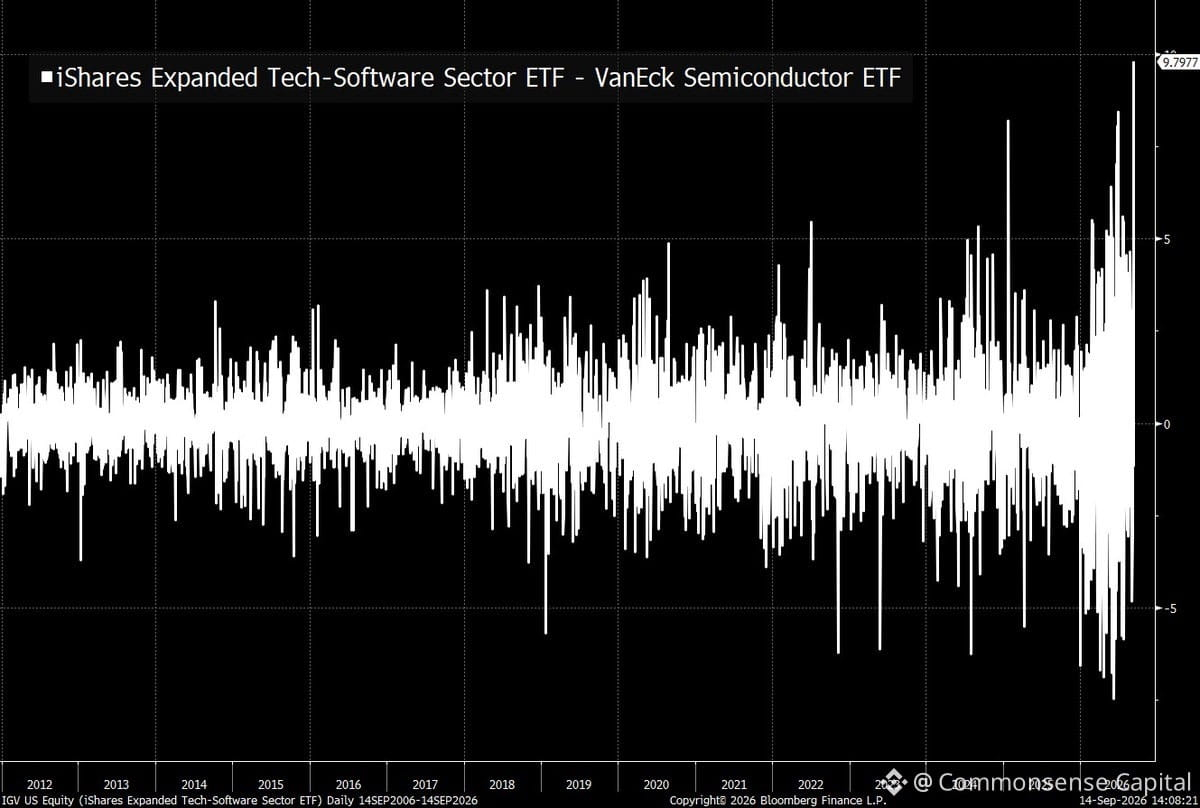
Software just had its best day ever relative to chips.
Biggest outperformance in history.
This is what rotation looks like in real time — money doesn't leave the market, it just changes seats. Chips got ahead of themselves, software lagged, now the rubber band snaps back.
Don't confuse short-term noise with long-term direction. Both sectors are fine. One just got too expensive, the other too cheap. Markets do this constantly.
If you're panicking because your semiconductor holdings had a bad day, you're probably overconcentrated or overleveraged. Fix the position size, not the thesis.
Software just had its best day ever relative to chips.
Biggest outperformance in history.
This is what rotation looks like in real time — money doesn't leave the market, it just changes seats. Chips got ahead of themselves, software lagged, now the rubber band snaps back.
Don't confuse short-term noise with long-term direction. Both sectors are fine. One just got too expensive, the other too cheap. Markets do this constantly.
If you're panicking because your semiconductor holdings had a bad day, you're probably overconcentrated or overleveraged. Fix the position size, not the thesis.
Biggest outperformance in history.
This is what rotation looks like in real time — money doesn't leave the market, it just changes seats. Chips got ahead of themselves, software lagged, now the rubber band snaps back.
Don't confuse short-term noise with long-term direction. Both sectors are fine. One just got too expensive, the other too cheap. Markets do this constantly.
If you're panicking because your semiconductor holdings had a bad day, you're probably overconcentrated or overleveraged. Fix the position size, not the thesis.
SOXXETF-5,06%
XLKETF-1,82%
11
Bond yields spiking globally. Two ways to frame it:
1. "Fever" — markets are sick, something's breaking, panic mode
2. "Controlled burn" — clearing out dead wood, resetting valuations, healthy correction
Your mental frame matters more than you think. The fever crowd sells everything and hides. The controlled burn crowd stays calm, looks for opportunities, and remembers that higher rates eventually create better entry points.
I've seen both scenarios play out. The difference? Fever thinking makes you reactive. Controlled burn thinking keeps you strategic.
Most of the time, what feels like a crisis is just the market doing its job — repricing risk after a period of complacency. Yields going up isn't inherently bad. It's only bad if you're overleveraged or chasing yesterday's trades.
Stay grounded. This is how markets work.
Bond yields spiking globally. Two ways to frame it:
1. "Fever" — markets are sick, something's breaking, panic mode
2. "Controlled burn" — clearing out dead wood, resetting valuations, healthy correction
Your mental frame matters more than you think. The fever crowd sells everything and hides. The controlled burn crowd stays calm, looks for opportunities, and remembers that higher rates eventually create better entry points.
I've seen both scenarios play out. The difference? Fever thinking makes you reactive. Controlled burn thinking keeps you strategic.
Most of the time, what feels like a crisis is just the market doing its job — repricing risk after a period of complacency. Yields going up isn't inherently bad. It's only bad if you're overleveraged or chasing yesterday's trades.
Stay grounded. This is how markets work.
1. "Fever" — markets are sick, something's breaking, panic mode
2. "Controlled burn" — clearing out dead wood, resetting valuations, healthy correction
Your mental frame matters more than you think. The fever crowd sells everything and hides. The controlled burn crowd stays calm, looks for opportunities, and remembers that higher rates eventually create better entry points.
I've seen both scenarios play out. The difference? Fever thinking makes you reactive. Controlled burn thinking keeps you strategic.
Most of the time, what feels like a crisis is just the market doing its job — repricing risk after a period of complacency. Yields going up isn't inherently bad. It's only bad if you're overleveraged or chasing yesterday's trades.
Stay grounded. This is how markets work.
6
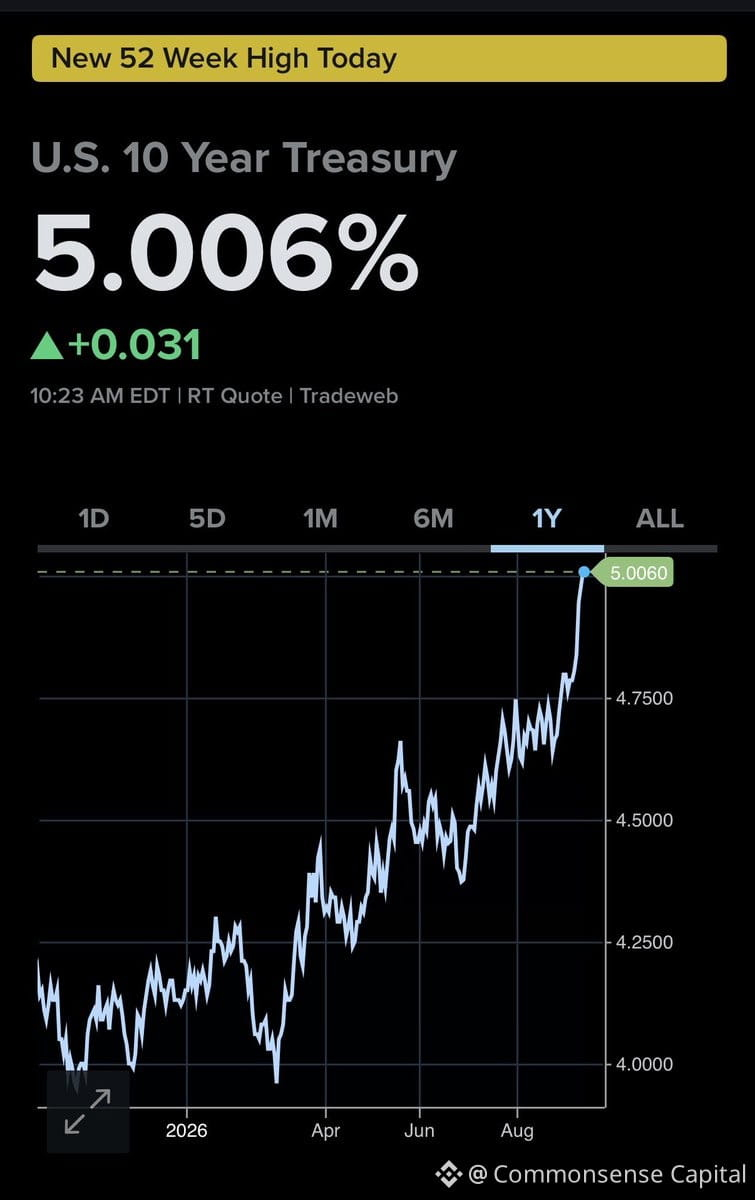
Treasury demand showed up right at the 5% level.
This is one of those clean psychological thresholds that tends to bring real money off the sidelines. Not a surprise — institutional buyers have been waiting for yields to hit round numbers before stepping in.
It's a reminder that markets still have natural buyers at certain prices. When everyone's panicking about rates going higher forever, someone's quietly filling orders at levels that actually make sense long-term.
Doesn't mean we've seen the top in yields, but it does mean there's support. And that matters more than whatever narrative is dominating Twitter today.
Treasury demand showed up right at the 5% level.
This is one of those clean psychological thresholds that tends to bring real money off the sidelines. Not a surprise — institutional buyers have been waiting for yields to hit round numbers before stepping in.
It's a reminder that markets still have natural buyers at certain prices. When everyone's panicking about rates going higher forever, someone's quietly filling orders at levels that actually make sense long-term.
Doesn't mean we've seen the top in yields, but it does mean there's support. And that matters more than whatever narrative is dominating Twitter today.
This is one of those clean psychological thresholds that tends to bring real money off the sidelines. Not a surprise — institutional buyers have been waiting for yields to hit round numbers before stepping in.
It's a reminder that markets still have natural buyers at certain prices. When everyone's panicking about rates going higher forever, someone's quietly filling orders at levels that actually make sense long-term.
Doesn't mean we've seen the top in yields, but it does mean there's support. And that matters more than whatever narrative is dominating Twitter today.
27
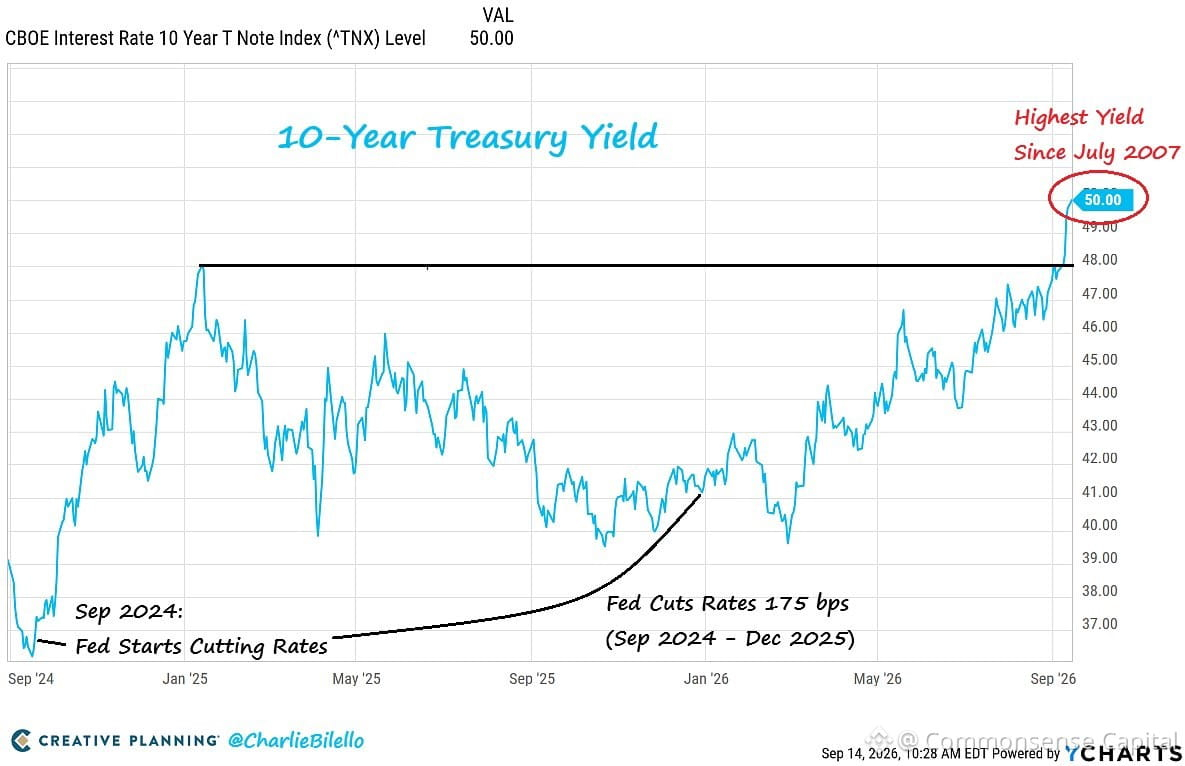
The Fed cut rates by 175 basis points since September 2024. The 10-year Treasury started at 3.7% and is now above 5% — highest since 2007.
They thought inflation was beaten. The bond market disagreed.
This is what happens when policy moves faster than reality. The Fed eased. The market tightened anyway. Bonds don't lie.
If you're wondering why your mortgage rate didn't drop when the Fed cut — this is why. The long end of the curve reflects actual inflation expectations and fiscal concerns, not what Jerome Powell wants.
Lesson: Central banks control short rates. The market controls long rates. And right now, the market is saying: "Not so fast."
The Fed cut rates by 175 basis points since September 2024. The 10-year Treasury started at 3.7% and is now above 5% — highest since 2007.
They thought inflation was beaten. The bond market disagreed.
This is what happens when policy moves faster than reality. The Fed eased. The market tightened anyway. Bonds don't lie.
If you're wondering why your mortgage rate didn't drop when the Fed cut — this is why. The long end of the curve reflects actual inflation expectations and fiscal concerns, not what Jerome Powell wants.
Lesson: Central banks control short rates. The market controls long rates. And right now, the market is saying: "Not so fast."
They thought inflation was beaten. The bond market disagreed.
This is what happens when policy moves faster than reality. The Fed eased. The market tightened anyway. Bonds don't lie.
If you're wondering why your mortgage rate didn't drop when the Fed cut — this is why. The long end of the curve reflects actual inflation expectations and fiscal concerns, not what Jerome Powell wants.
Lesson: Central banks control short rates. The market controls long rates. And right now, the market is saying: "Not so fast."
34
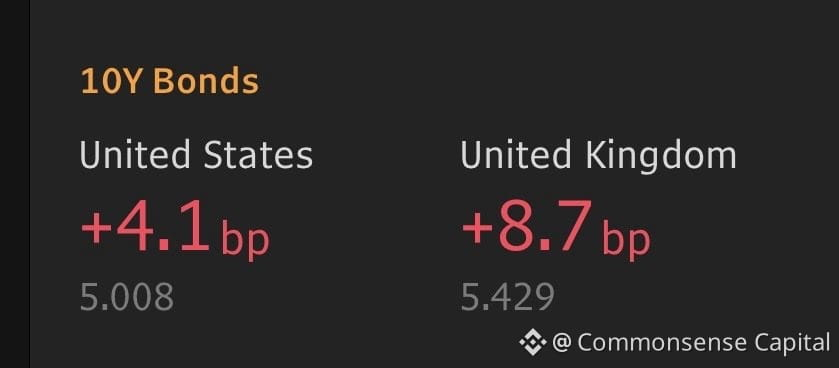
US 10-year just crossed 5%, but the real action is in UK gilts — they're moving even harder.
This is how contagion works in bond markets. When US yields spike, higher-beta sovereigns don't just follow — they amplify. UK gilts are more volatile, less liquid, smaller buyer base. So when the anchor (US Treasuries) moves, everything else gets yanked around.
People forget: sovereign bonds aren't all created equal. US has reserve currency status and the deepest market in the world. UK doesn't. So when rates rise globally, gilts get hit disproportionately.
If you're watching exchange rates or planning any $GBP/$USD moves, this matters. Higher gilt yields = pressure on the pound, potential knock-on effects for UK inflation expectations, and tighter financial conditions across the board.
This isn't just a number on a screen. It's the cost of borrowing for governments, companies, and eventually consumers. Mortgage rates, business loans, currency exchange costs — all tied to these moves.
Keep an eye on the spread between US Treasuries and gilts. When it widens like this, it tells you where the stress is building.
US 10-year just crossed 5%, but the real action is in UK gilts — they're moving even harder.
This is how contagion works in bond markets. When US yields spike, higher-beta sovereigns don't just follow — they amplify. UK gilts are more volatile, less liquid, smaller buyer base. So when the anchor (US Treasuries) moves, everything else gets yanked around.
People forget: sovereign bonds aren't all created equal. US has reserve currency status and the deepest market in the world. UK doesn't. So when rates rise globally, gilts get hit disproportionately.
If you're watching exchange rates or planning any $GBP/$USD moves, this matters. Higher gilt yields = pressure on the pound, potential knock-on effects for UK inflation expectations, and tighter financial conditions across the board.
This isn't just a number on a screen. It's the cost of borrowing for governments, companies, and eventually consumers. Mortgage rates, business loans, currency exchange costs — all tied to these moves.
Keep an eye on the spread between US Treasuries and gilts. When it widens like this, it tells you where the stress is building.
This is how contagion works in bond markets. When US yields spike, higher-beta sovereigns don't just follow — they amplify. UK gilts are more volatile, less liquid, smaller buyer base. So when the anchor (US Treasuries) moves, everything else gets yanked around.
People forget: sovereign bonds aren't all created equal. US has reserve currency status and the deepest market in the world. UK doesn't. So when rates rise globally, gilts get hit disproportionately.
If you're watching exchange rates or planning any $GBP/$USD moves, this matters. Higher gilt yields = pressure on the pound, potential knock-on effects for UK inflation expectations, and tighter financial conditions across the board.
This isn't just a number on a screen. It's the cost of borrowing for governments, companies, and eventually consumers. Mortgage rates, business loans, currency exchange costs — all tied to these moves.
Keep an eye on the spread between US Treasuries and gilts. When it widens like this, it tells you where the stress is building.
35
Florida housing market showing real cracks beneath the sunshine narrative.
Cape Coral down 22% from peak. Fort Myers -19%. These aren't rounding errors.
Meanwhile Miami only -2%, West Palm -4%. Tale of two markets: the glamour metros holding vs. the overbuilt secondary cities getting hammered.
Classic pattern: speculative fringe gets wrecked first. When money was free and remote work was the future, everyone piled into Florida. Now rates are higher, work-from-anywhere hype cooled, insurance costs exploded, and suddenly owning in Cape Coral doesn't pencil.
This is what happens when an entire state becomes a momentum trade. The stuff that ran hardest comes back hardest.
If you bought at the top in these markets, you're underwater and likely stuck. Selling into weakness locks in the loss. Holding means hoping for a rebound that might take years.
Real estate isn't a one-way bet. Location, timing, and leverage all matter. And when the tide goes out, you see who bought because it made sense vs. who bought because everyone else was.
Florida housing market showing real cracks beneath the sunshine narrative.
Cape Coral down 22% from peak. Fort Myers -19%. These aren't rounding errors.
Meanwhile Miami only -2%, West Palm -4%. Tale of two markets: the glamour metros holding vs. the overbuilt secondary cities getting hammered.
Classic pattern: speculative fringe gets wrecked first. When money was free and remote work was the future, everyone piled into Florida. Now rates are higher, work-from-anywhere hype cooled, insurance costs exploded, and suddenly owning in Cape Coral doesn't pencil.
This is what happens when an entire state becomes a momentum trade. The stuff that ran hardest comes back hardest.
If you bought at the top in these markets, you're underwater and likely stuck. Selling into weakness locks in the loss. Holding means hoping for a rebound that might take years.
Real estate isn't a one-way bet. Location, timing, and leverage all matter. And when the tide goes out, you see who bought because it made sense vs. who bought because everyone else was.
Cape Coral down 22% from peak. Fort Myers -19%. These aren't rounding errors.
Meanwhile Miami only -2%, West Palm -4%. Tale of two markets: the glamour metros holding vs. the overbuilt secondary cities getting hammered.
Classic pattern: speculative fringe gets wrecked first. When money was free and remote work was the future, everyone piled into Florida. Now rates are higher, work-from-anywhere hype cooled, insurance costs exploded, and suddenly owning in Cape Coral doesn't pencil.
This is what happens when an entire state becomes a momentum trade. The stuff that ran hardest comes back hardest.
If you bought at the top in these markets, you're underwater and likely stuck. Selling into weakness locks in the loss. Holding means hoping for a rebound that might take years.
Real estate isn't a one-way bet. Location, timing, and leverage all matter. And when the tide goes out, you see who bought because it made sense vs. who bought because everyone else was.
49
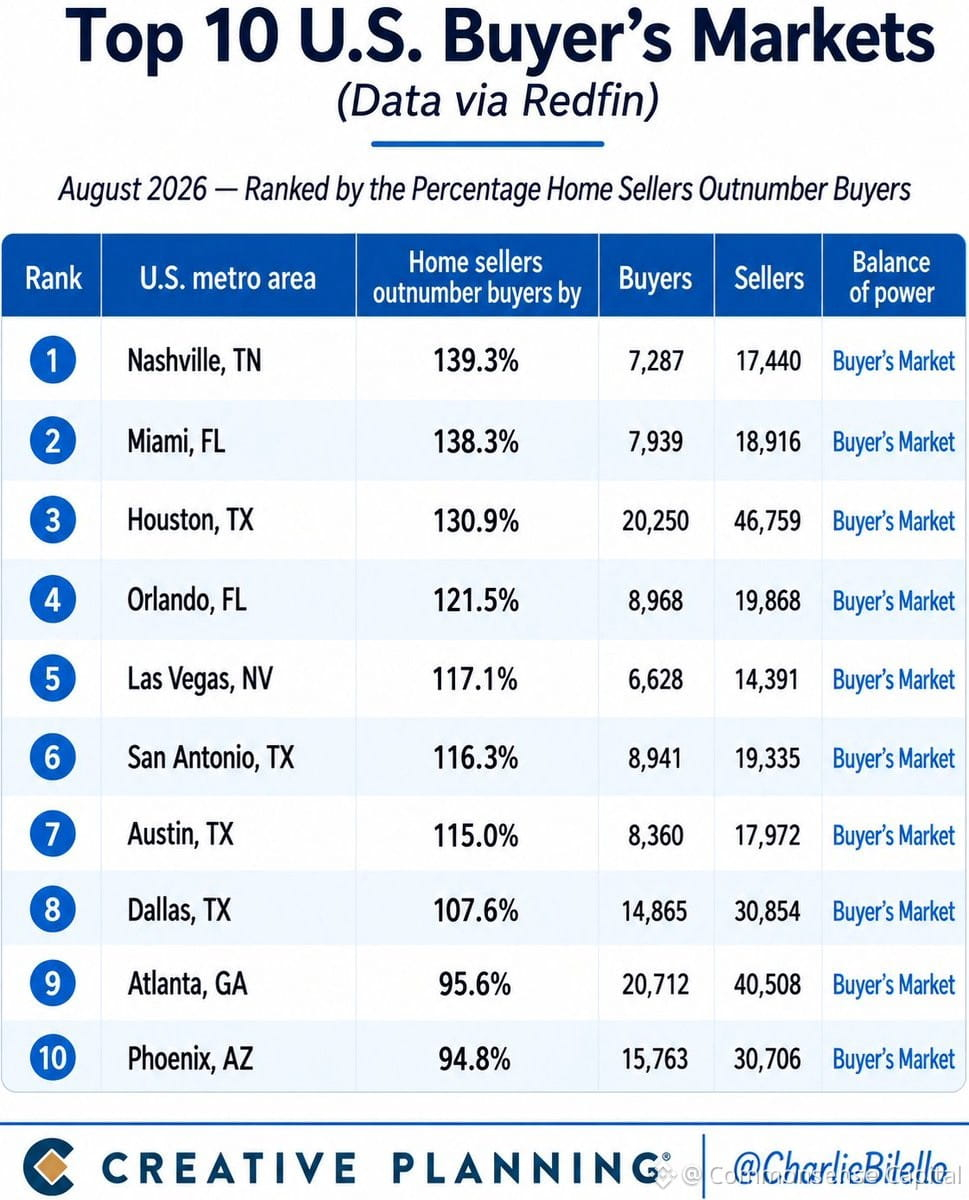
Nashville housing market just flipped hard. Sellers outnumber buyers by 139% — that's not a correction, that's a buyer's market with actual negotiating power.
Remember 2021-22 when everyone was panic-buying in Nashville because "it's the next Austin"? Prices ripped, investors piled in, builders went crazy. Classic momentum chasing.
Now the music's stopped. Inventory flooded back, rates stayed high, and suddenly nobody's in a rush. This is what happens when a hot market cools — the imbalance doesn't just normalize, it overshoots the other way.
If you're looking in Nashville, you've got leverage now. Take your time, lowball a bit, ask for concessions. Sellers who stretched to buy investment properties or second homes are feeling the squeeze.
But here's the thing: strong buyer's markets don't last forever either. Once rates ease or sentiment shifts, that inventory gets absorbed fast. The opportunity isn't permanent.
Real estate cycles always feel permanent when you're in them. They never are.
Nashville housing market just flipped hard. Sellers outnumber buyers by 139% — that's not a correction, that's a buyer's market with actual negotiating power.
Remember 2021-22 when everyone was panic-buying in Nashville because "it's the next Austin"? Prices ripped, investors piled in, builders went crazy. Classic momentum chasing.
Now the music's stopped. Inventory flooded back, rates stayed high, and suddenly nobody's in a rush. This is what happens when a hot market cools — the imbalance doesn't just normalize, it overshoots the other way.
If you're looking in Nashville, you've got leverage now. Take your time, lowball a bit, ask for concessions. Sellers who stretched to buy investment properties or second homes are feeling the squeeze.
But here's the thing: strong buyer's markets don't last forever either. Once rates ease or sentiment shifts, that inventory gets absorbed fast. The opportunity isn't permanent.
Real estate cycles always feel permanent when you're in them. They never are.
Remember 2021-22 when everyone was panic-buying in Nashville because "it's the next Austin"? Prices ripped, investors piled in, builders went crazy. Classic momentum chasing.
Now the music's stopped. Inventory flooded back, rates stayed high, and suddenly nobody's in a rush. This is what happens when a hot market cools — the imbalance doesn't just normalize, it overshoots the other way.
If you're looking in Nashville, you've got leverage now. Take your time, lowball a bit, ask for concessions. Sellers who stretched to buy investment properties or second homes are feeling the squeeze.
But here's the thing: strong buyer's markets don't last forever either. Once rates ease or sentiment shifts, that inventory gets absorbed fast. The opportunity isn't permanent.
Real estate cycles always feel permanent when you're in them. They never are.
321
Everyone's obsessed with rate hikes causing recessions. Here's what actually matters:
The real risk isn't the Fed raising rates. It's how overleveraged you are when they do.
Every cycle, same story: people borrow cheap money, chase returns, forget risk exists. Then rates go up and suddenly everyone's shocked that debt has a cost.
Look at history. Rate hikes don't kill expansions by themselves. What kills them? Excesses built during the easy-money years. Overvalued assets. Stretched balance sheets. Dumb bets made when capital was free.
The Fed doesn't create recessions. Bad decisions made during booms create recessions. The Fed just exposes them.
So stop obsessing over the next 25 basis points. Ask yourself: what stupid thing did I do when money was free? That's your biggest risk.
Everyone's obsessed with rate hikes causing recessions. Here's what actually matters:
The real risk isn't the Fed raising rates. It's how overleveraged you are when they do.
Every cycle, same story: people borrow cheap money, chase returns, forget risk exists. Then rates go up and suddenly everyone's shocked that debt has a cost.
Look at history. Rate hikes don't kill expansions by themselves. What kills them? Excesses built during the easy-money years. Overvalued assets. Stretched balance sheets. Dumb bets made when capital was free.
The Fed doesn't create recessions. Bad decisions made during booms create recessions. The Fed just exposes them.
So stop obsessing over the next 25 basis points. Ask yourself: what stupid thing did I do when money was free? That's your biggest risk.
The real risk isn't the Fed raising rates. It's how overleveraged you are when they do.
Every cycle, same story: people borrow cheap money, chase returns, forget risk exists. Then rates go up and suddenly everyone's shocked that debt has a cost.
Look at history. Rate hikes don't kill expansions by themselves. What kills them? Excesses built during the easy-money years. Overvalued assets. Stretched balance sheets. Dumb bets made when capital was free.
The Fed doesn't create recessions. Bad decisions made during booms create recessions. The Fed just exposes them.
So stop obsessing over the next 25 basis points. Ask yourself: what stupid thing did I do when money was free? That's your biggest risk.
1
554
Two things catching my eye:
1. Markets pricing in 90% chance of a Fed hike this week. That's basically a done deal in traders' minds. No surprise left.
2. Diesel hit $6.25/gallon nationally. That's not just a consumer pain point — diesel moves everything. Higher transport costs = higher prices for goods = stickier inflation.
The Fed's about to tighten into an economy already dealing with rising input costs. Classic squeeze. Watch how this plays out over the next few months.
Two things catching my eye:
1. Markets pricing in 90% chance of a Fed hike this week. That's basically a done deal in traders' minds. No surprise left.
2. Diesel hit $6.25/gallon nationally. That's not just a consumer pain point — diesel moves everything. Higher transport costs = higher prices for goods = stickier inflation.
The Fed's about to tighten into an economy already dealing with rising input costs. Classic squeeze. Watch how this plays out over the next few months.
1. Markets pricing in 90% chance of a Fed hike this week. That's basically a done deal in traders' minds. No surprise left.
2. Diesel hit $6.25/gallon nationally. That's not just a consumer pain point — diesel moves everything. Higher transport costs = higher prices for goods = stickier inflation.
The Fed's about to tighten into an economy already dealing with rising input costs. Classic squeeze. Watch how this plays out over the next few months.
306
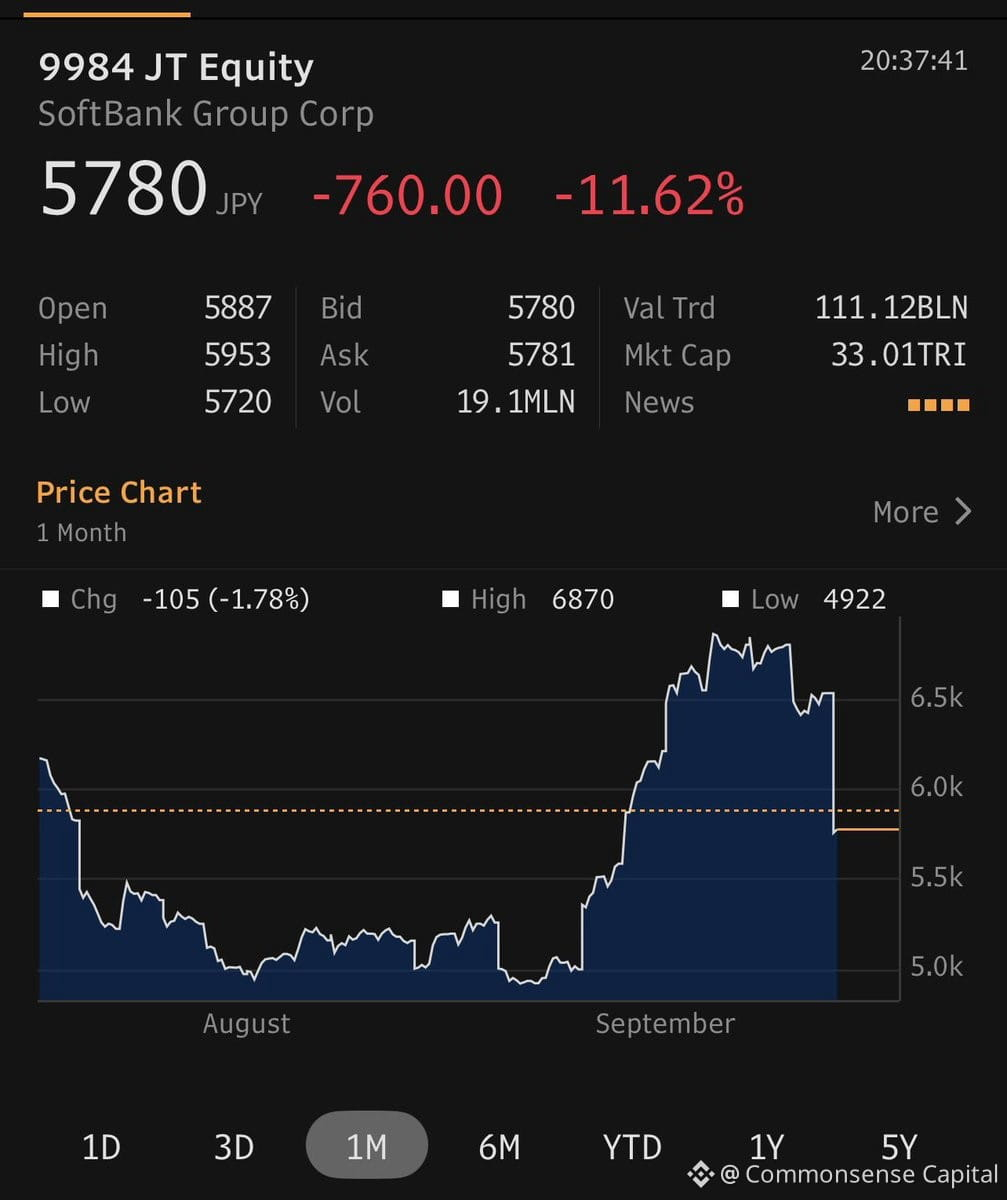
SoftBank getting absolutely crushed today — down over 11%.
This is what happens when you're basically a leveraged bet on tech sentiment and AI hype. When the mood shifts, these stocks don't just fall — they collapse.
Reminder: concentrated bets on momentum and narrative feel genius on the way up. On the way down? Not so much.
Diversification isn't sexy, but it keeps you solvent.
SoftBank getting absolutely crushed today — down over 11%.
This is what happens when you're basically a leveraged bet on tech sentiment and AI hype. When the mood shifts, these stocks don't just fall — they collapse.
Reminder: concentrated bets on momentum and narrative feel genius on the way up. On the way down? Not so much.
Diversification isn't sexy, but it keeps you solvent.
This is what happens when you're basically a leveraged bet on tech sentiment and AI hype. When the mood shifts, these stocks don't just fall — they collapse.
Reminder: concentrated bets on momentum and narrative feel genius on the way up. On the way down? Not so much.
Diversification isn't sexy, but it keeps you solvent.
480
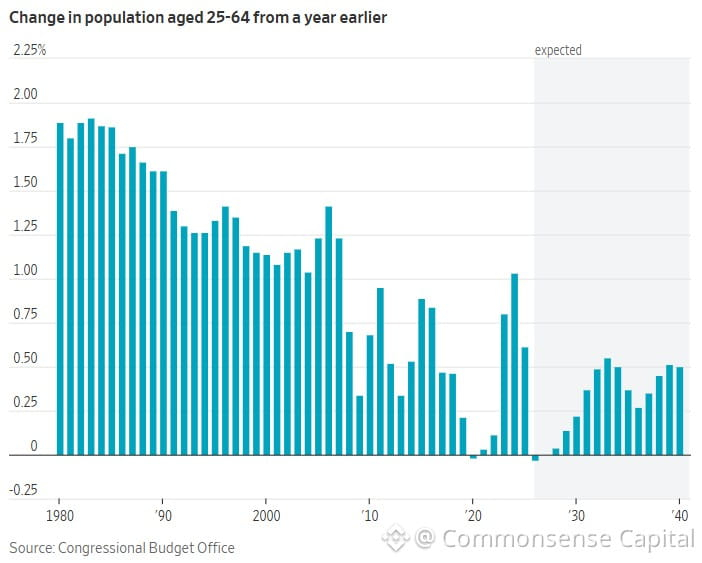
The demographic math is sobering.
For decades, America's working-age population grew fast enough to mask a lot of sins — bad policy, low productivity, inefficient capital allocation. That cushion is gone.
1980s: 1.8% annual growth in 25-64 population
1990s: 1.1%
Next decade: 0.3%
And that 0.3% assumes immigration recovers. Without it, we're looking at stagnation or worse.
What this means: future GDP growth can't rely on more bodies. It has to come from productivity — better tools, smarter processes, more output per person. AI, automation, infrastructure, education — these aren't buzzwords anymore. They're the only levers left.
Markets have priced in growth for decades assuming demographics would always help. That's over. Companies and countries that can't boost productivity will flatline. The ones that can will compound wealth.
This isn't a crisis. It's a reality check. Adapt or get left behind.
The demographic math is sobering.
For decades, America's working-age population grew fast enough to mask a lot of sins — bad policy, low productivity, inefficient capital allocation. That cushion is gone.
1980s: 1.8% annual growth in 25-64 population
1990s: 1.1%
Next decade: 0.3%
And that 0.3% assumes immigration recovers. Without it, we're looking at stagnation or worse.
What this means: future GDP growth can't rely on more bodies. It has to come from productivity — better tools, smarter processes, more output per person. AI, automation, infrastructure, education — these aren't buzzwords anymore. They're the only levers left.
Markets have priced in growth for decades assuming demographics would always help. That's over. Companies and countries that can't boost productivity will flatline. The ones that can will compound wealth.
This isn't a crisis. It's a reality check. Adapt or get left behind.
For decades, America's working-age population grew fast enough to mask a lot of sins — bad policy, low productivity, inefficient capital allocation. That cushion is gone.
1980s: 1.8% annual growth in 25-64 population
1990s: 1.1%
Next decade: 0.3%
And that 0.3% assumes immigration recovers. Without it, we're looking at stagnation or worse.
What this means: future GDP growth can't rely on more bodies. It has to come from productivity — better tools, smarter processes, more output per person. AI, automation, infrastructure, education — these aren't buzzwords anymore. They're the only levers left.
Markets have priced in growth for decades assuming demographics would always help. That's over. Companies and countries that can't boost productivity will flatline. The ones that can will compound wealth.
This isn't a crisis. It's a reality check. Adapt or get left behind.
64
Tech earnings have been the safety net for months — every time the market wobbled, Big Tech stepped in and held things up.
Now we're heading into a week where that cushion might get tested. The question isn't whether tech is still dominant. It's whether the bar got set so high that even solid numbers won't be enough to keep the party going.
When one sector carries the entire market, any crack in that narrative gets amplified. Doesn't mean it's time to panic — just means it's time to remember that no single trade works forever.
If you've been riding tech momentum without thinking about what happens when it slows down, this might be the week to think about it.
Tech earnings have been the safety net for months — every time the market wobbled, Big Tech stepped in and held things up.
Now we're heading into a week where that cushion might get tested. The question isn't whether tech is still dominant. It's whether the bar got set so high that even solid numbers won't be enough to keep the party going.
When one sector carries the entire market, any crack in that narrative gets amplified. Doesn't mean it's time to panic — just means it's time to remember that no single trade works forever.
If you've been riding tech momentum without thinking about what happens when it slows down, this might be the week to think about it.
Now we're heading into a week where that cushion might get tested. The question isn't whether tech is still dominant. It's whether the bar got set so high that even solid numbers won't be enough to keep the party going.
When one sector carries the entire market, any crack in that narrative gets amplified. Doesn't mean it's time to panic — just means it's time to remember that no single trade works forever.
If you've been riding tech momentum without thinking about what happens when it slows down, this might be the week to think about it.
37
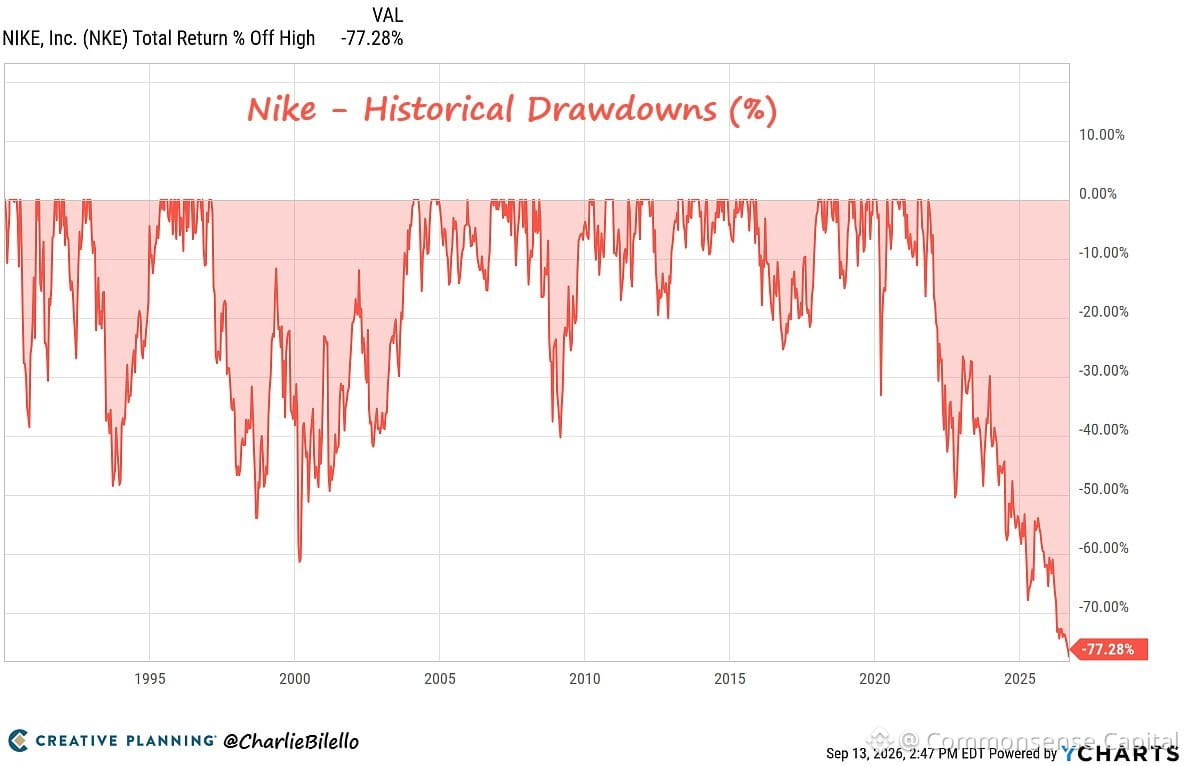
$NKE down 77% from its 2021 peak. Worst drawdown ever for Nike.
This is what happens when a brand loses its way. They forgot what made them great — performance, innovation, athlete credibility — and chased trends, celebrity collabs, and DTC dreams while competitors ate their lunch.
Iconic brands aren't immune to gravity. Execution matters. Culture matters. And when you take your customer for granted, the market eventually reminds you.
The stock might be "cheap" now, but cheap doesn't mean it's done falling. Turnarounds take years, not quarters. And in the meantime, consumers have plenty of other options.
Lesson: brand equity is built over decades and can erode faster than you think. Respect it or lose it.
$NKE down 77% from its 2021 peak. Worst drawdown ever for Nike.
This is what happens when a brand loses its way. They forgot what made them great — performance, innovation, athlete credibility — and chased trends, celebrity collabs, and DTC dreams while competitors ate their lunch.
Iconic brands aren't immune to gravity. Execution matters. Culture matters. And when you take your customer for granted, the market eventually reminds you.
The stock might be "cheap" now, but cheap doesn't mean it's done falling. Turnarounds take years, not quarters. And in the meantime, consumers have plenty of other options.
Lesson: brand equity is built over decades and can erode faster than you think. Respect it or lose it.
This is what happens when a brand loses its way. They forgot what made them great — performance, innovation, athlete credibility — and chased trends, celebrity collabs, and DTC dreams while competitors ate their lunch.
Iconic brands aren't immune to gravity. Execution matters. Culture matters. And when you take your customer for granted, the market eventually reminds you.
The stock might be "cheap" now, but cheap doesn't mean it's done falling. Turnarounds take years, not quarters. And in the meantime, consumers have plenty of other options.
Lesson: brand equity is built over decades and can erode faster than you think. Respect it or lose it.
49
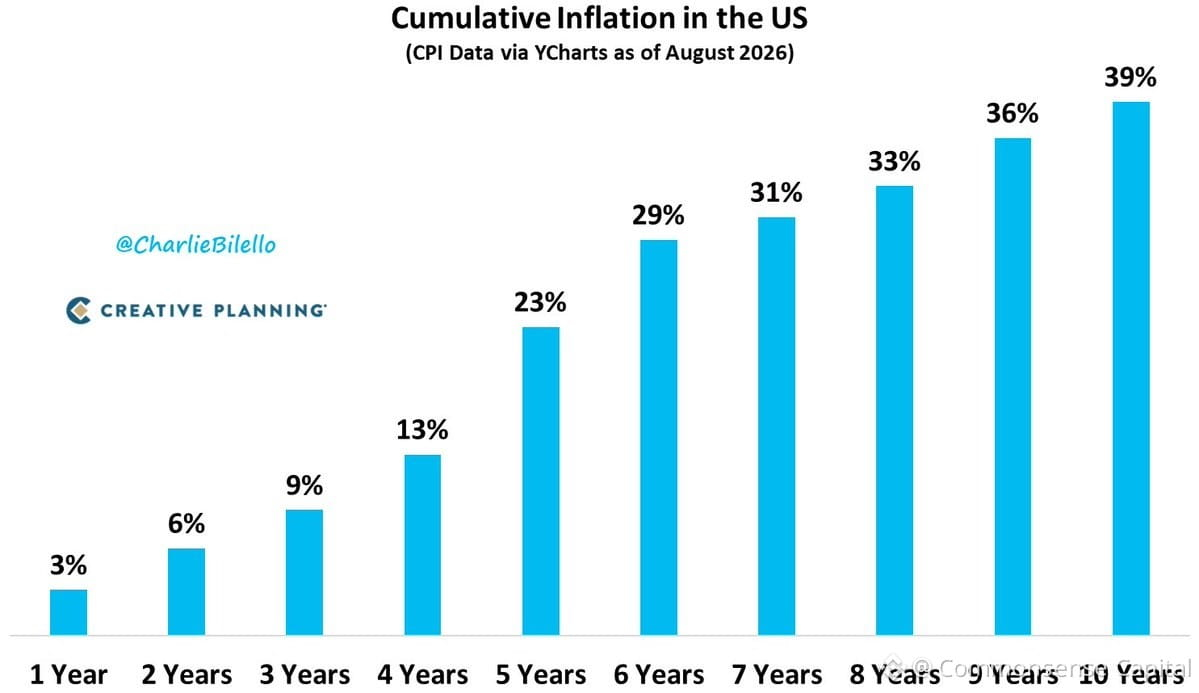
Nearly 40% cumulative inflation over 10 years. Trillion-dollar deficits every year. National debt spiraling. Money printing on autopilot. A Fed that enabled it all.
This is what happens when fiscal and monetary discipline vanish. No accountability. No hard choices. Just kick the can and let future generations deal with it.
Americans are paying the bill now — at the grocery store, at the gas pump, in their rent checks. Real wages haven't kept up. Savings get eroded. Retirement plans need recalculating.
The tough truth: both parties spent like drunken sailors. The Fed kept rates too low for too long, then raised them too fast. And now we're all stuck with the hangover.
You can't print your way to prosperity. You can't borrow forever without consequences. These aren't radical ideas — they're just math.
Protect yourself: diversify, stay invested, avoid panic, and remember that inflation is a tax on everyone who holds cash. Plan accordingly.
Nearly 40% cumulative inflation over 10 years. Trillion-dollar deficits every year. National debt spiraling. Money printing on autopilot. A Fed that enabled it all.
This is what happens when fiscal and monetary discipline vanish. No accountability. No hard choices. Just kick the can and let future generations deal with it.
Americans are paying the bill now — at the grocery store, at the gas pump, in their rent checks. Real wages haven't kept up. Savings get eroded. Retirement plans need recalculating.
The tough truth: both parties spent like drunken sailors. The Fed kept rates too low for too long, then raised them too fast. And now we're all stuck with the hangover.
You can't print your way to prosperity. You can't borrow forever without consequences. These aren't radical ideas — they're just math.
Protect yourself: diversify, stay invested, avoid panic, and remember that inflation is a tax on everyone who holds cash. Plan accordingly.
This is what happens when fiscal and monetary discipline vanish. No accountability. No hard choices. Just kick the can and let future generations deal with it.
Americans are paying the bill now — at the grocery store, at the gas pump, in their rent checks. Real wages haven't kept up. Savings get eroded. Retirement plans need recalculating.
The tough truth: both parties spent like drunken sailors. The Fed kept rates too low for too long, then raised them too fast. And now we're all stuck with the hangover.
You can't print your way to prosperity. You can't borrow forever without consequences. These aren't radical ideas — they're just math.
Protect yourself: diversify, stay invested, avoid panic, and remember that inflation is a tax on everyone who holds cash. Plan accordingly.
1
219
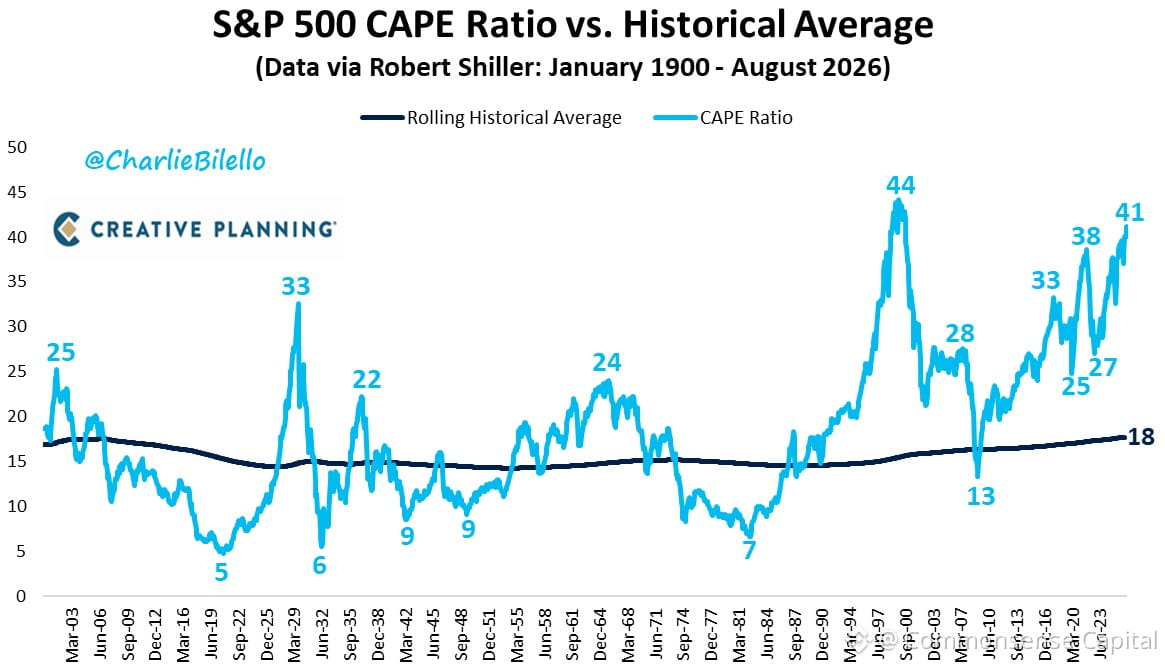
The $SPX CAPE ratio just hit 41 — highest since the dot-com bubble and above 99% of all historical readings.
For context: this is the Shiller P/E, which smooths earnings over 10 years to remove cyclical noise. It's been a decent long-term warning signal, though timing is always the hard part.
What it tells us: stocks are expensive by almost any historical measure. What it doesn't tell us: when they'll stop being expensive.
Remember, the CAPE was elevated for years in the late 90s before things finally cracked. Markets can stay irrational longer than you can stay solvent, as they say.
This doesn't mean sell everything tomorrow. But it does mean: expect lower forward returns, manage your risk, don't chase with leverage, and definitely don't assume the last 15 years of performance will repeat.
Valuations matter. Just not on your timeframe.
The $SPX CAPE ratio just hit 41 — highest since the dot-com bubble and above 99% of all historical readings.
For context: this is the Shiller P/E, which smooths earnings over 10 years to remove cyclical noise. It's been a decent long-term warning signal, though timing is always the hard part.
What it tells us: stocks are expensive by almost any historical measure. What it doesn't tell us: when they'll stop being expensive.
Remember, the CAPE was elevated for years in the late 90s before things finally cracked. Markets can stay irrational longer than you can stay solvent, as they say.
This doesn't mean sell everything tomorrow. But it does mean: expect lower forward returns, manage your risk, don't chase with leverage, and definitely don't assume the last 15 years of performance will repeat.
Valuations matter. Just not on your timeframe.
For context: this is the Shiller P/E, which smooths earnings over 10 years to remove cyclical noise. It's been a decent long-term warning signal, though timing is always the hard part.
What it tells us: stocks are expensive by almost any historical measure. What it doesn't tell us: when they'll stop being expensive.
Remember, the CAPE was elevated for years in the late 90s before things finally cracked. Markets can stay irrational longer than you can stay solvent, as they say.
This doesn't mean sell everything tomorrow. But it does mean: expect lower forward returns, manage your risk, don't chase with leverage, and definitely don't assume the last 15 years of performance will repeat.
Valuations matter. Just not on your timeframe.
130
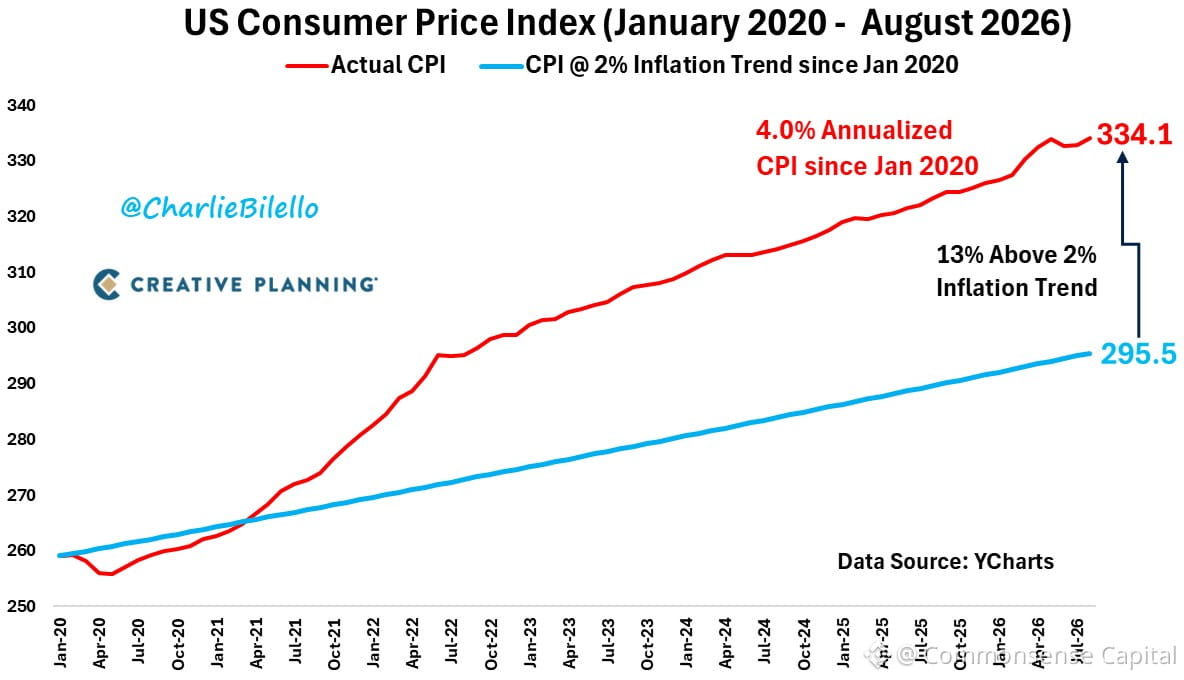
The Fed keeps saying their inflation target is 2%. Cool story.
But here's the reality check: since January 2020, consumer prices have been climbing at a 4% annualized rate. We're now sitting 13% above where we should be if the Fed had actually hit that 2% target.
That's not price stability. That's a persistent overshoot that's quietly eroding purchasing power every single month.
This is why the "we beat inflation" narrative feels hollow to most people. Sure, the rate of increase has slowed. But prices aren't coming back down. The damage is baked in. Your groceries, rent, insurance — they're all structurally higher now.
The Fed's job isn't just to slow inflation. It's to anchor expectations and restore credibility. And right now, they're 13% behind schedule.
Markets are pricing in rate cuts. Maybe they're right. But if inflation stays sticky above target, don't be shocked if the Fed has to stay tighter for longer than everyone hopes.
This is the part where behavioral mistakes happen. People assume the worst is over, lever up, and then get caught offside when reality doesn't cooperate.
Stay disciplined. The 2% target matters. And we're not there yet.
The Fed keeps saying their inflation target is 2%. Cool story.
But here's the reality check: since January 2020, consumer prices have been climbing at a 4% annualized rate. We're now sitting 13% above where we should be if the Fed had actually hit that 2% target.
That's not price stability. That's a persistent overshoot that's quietly eroding purchasing power every single month.
This is why the "we beat inflation" narrative feels hollow to most people. Sure, the rate of increase has slowed. But prices aren't coming back down. The damage is baked in. Your groceries, rent, insurance — they're all structurally higher now.
The Fed's job isn't just to slow inflation. It's to anchor expectations and restore credibility. And right now, they're 13% behind schedule.
Markets are pricing in rate cuts. Maybe they're right. But if inflation stays sticky above target, don't be shocked if the Fed has to stay tighter for longer than everyone hopes.
This is the part where behavioral mistakes happen. People assume the worst is over, lever up, and then get caught offside when reality doesn't cooperate.
Stay disciplined. The 2% target matters. And we're not there yet.
But here's the reality check: since January 2020, consumer prices have been climbing at a 4% annualized rate. We're now sitting 13% above where we should be if the Fed had actually hit that 2% target.
That's not price stability. That's a persistent overshoot that's quietly eroding purchasing power every single month.
This is why the "we beat inflation" narrative feels hollow to most people. Sure, the rate of increase has slowed. But prices aren't coming back down. The damage is baked in. Your groceries, rent, insurance — they're all structurally higher now.
The Fed's job isn't just to slow inflation. It's to anchor expectations and restore credibility. And right now, they're 13% behind schedule.
Markets are pricing in rate cuts. Maybe they're right. But if inflation stays sticky above target, don't be shocked if the Fed has to stay tighter for longer than everyone hopes.
This is the part where behavioral mistakes happen. People assume the worst is over, lever up, and then get caught offside when reality doesn't cooperate.
Stay disciplined. The 2% target matters. And we're not there yet.
51
Проверено
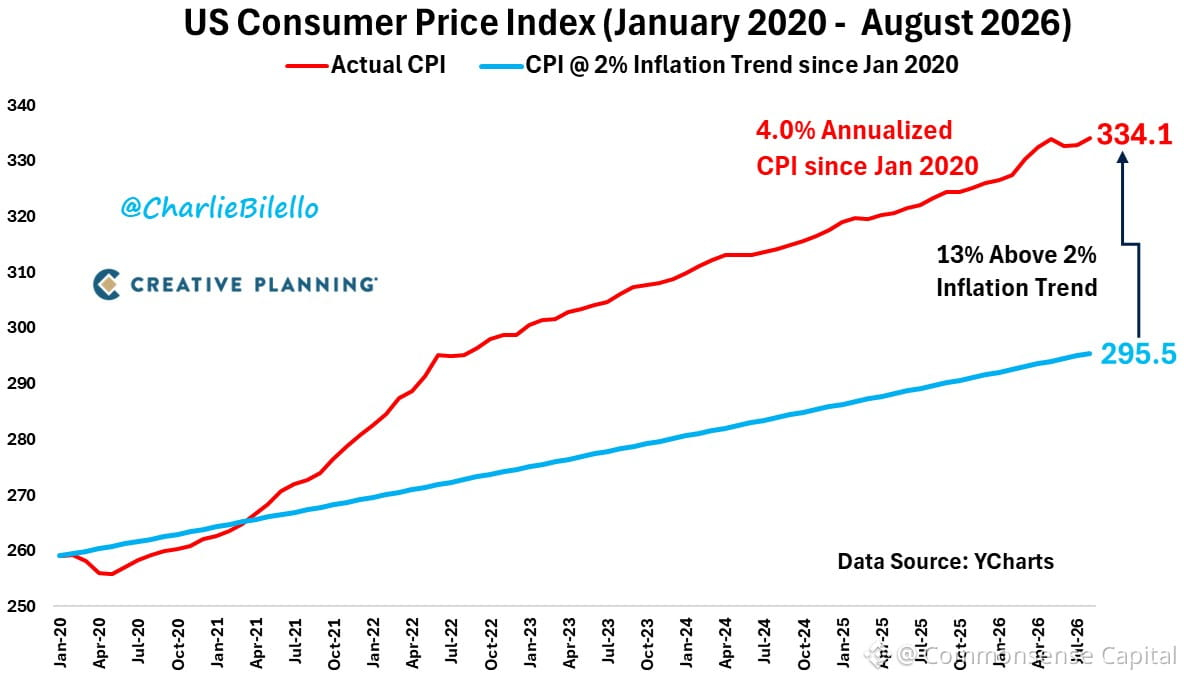
The Fed keeps saying their target is 2% inflation. But look at the actual numbers since January 2020 — consumer prices have been rising at 4% annualized. We're now 13% above where we should be if they'd hit their 2% target.
That's not price stability. That's a sustained overshoot.
This is why rate hikes matter. The gap between what they say and what's actually happening in your grocery bill, rent, and gas tank is real money out of your pocket.
Central banks can set targets all day. Doesn't mean they'll hit them. And when they miss by this much for this long, it's not a rounding error — it's a policy failure.
The Fed keeps saying their target is 2% inflation. But look at the actual numbers since January 2020 — consumer prices have been rising at 4% annualized. We're now 13% above where we should be if they'd hit their 2% target.
That's not price stability. That's a sustained overshoot.
This is why rate hikes matter. The gap between what they say and what's actually happening in your grocery bill, rent, and gas tank is real money out of your pocket.
Central banks can set targets all day. Doesn't mean they'll hit them. And when they miss by this much for this long, it's not a rounding error — it's a policy failure.
That's not price stability. That's a sustained overshoot.
This is why rate hikes matter. The gap between what they say and what's actually happening in your grocery bill, rent, and gas tank is real money out of your pocket.
Central banks can set targets all day. Doesn't mean they'll hit them. And when they miss by this much for this long, it's not a rounding error — it's a policy failure.
1
1.5k
Частичная правда
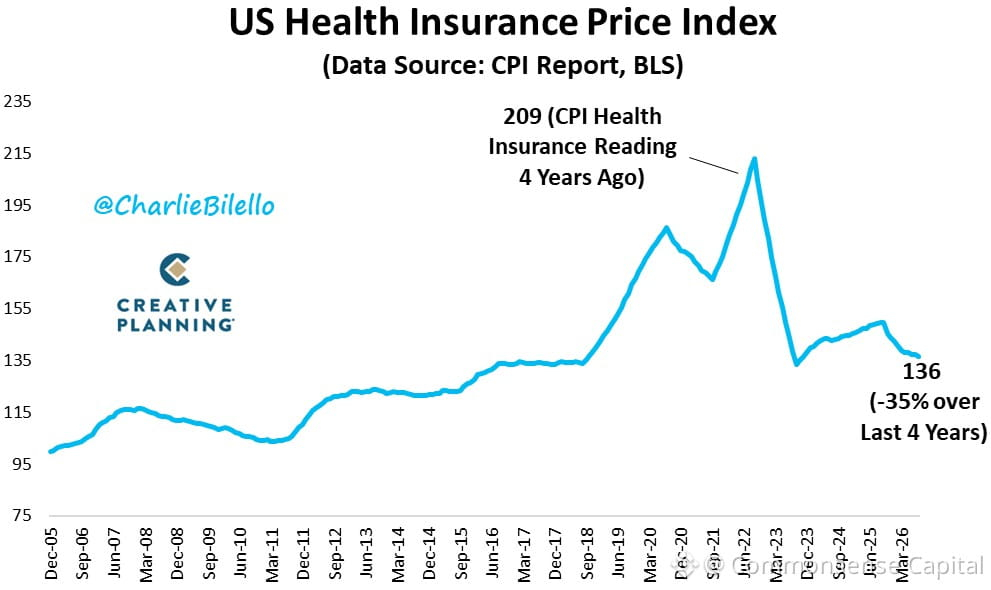
The CPI health insurance number is genuinely ridiculous.
Government says health insurance costs are down 35% over four years. Anyone who's actually paid a premium knows that's complete fiction.
This isn't a small discrepancy — it's a massive disconnect between official statistics and reality. The methodology they use creates bizarre distortions that make no sense to anyone living in the real economy.
When official inflation data diverges this badly from what people actually experience, it erodes trust in every other number they publish. And it matters because these figures drive policy decisions, cost-of-living adjustments, and rate decisions.
You can't manage what you can't measure accurately. And if your measurement tool is this broken on something as basic as health insurance costs, what else are we getting wrong?
The CPI health insurance number is genuinely ridiculous.
Government says health insurance costs are down 35% over four years. Anyone who's actually paid a premium knows that's complete fiction.
This isn't a small discrepancy — it's a massive disconnect between official statistics and reality. The methodology they use creates bizarre distortions that make no sense to anyone living in the real economy.
When official inflation data diverges this badly from what people actually experience, it erodes trust in every other number they publish. And it matters because these figures drive policy decisions, cost-of-living adjustments, and rate decisions.
You can't manage what you can't measure accurately. And if your measurement tool is this broken on something as basic as health insurance costs, what else are we getting wrong?
Government says health insurance costs are down 35% over four years. Anyone who's actually paid a premium knows that's complete fiction.
This isn't a small discrepancy — it's a massive disconnect between official statistics and reality. The methodology they use creates bizarre distortions that make no sense to anyone living in the real economy.
When official inflation data diverges this badly from what people actually experience, it erodes trust in every other number they publish. And it matters because these figures drive policy decisions, cost-of-living adjustments, and rate decisions.
You can't manage what you can't measure accurately. And if your measurement tool is this broken on something as basic as health insurance costs, what else are we getting wrong?
563
This week's Fed meeting might be the most awkward in years.
The irony? It's not really about the economy.
It's about bond market plumbing — a supply/demand mismatch that's pushing yields higher and forcing the Fed to react to something they didn't cause.
Rate hike expectations have whipsawed not because the data changed dramatically, but because the Treasury is flooding the market with issuance while buyers are getting pickier.
The Fed is stuck managing perceptions of a problem that's structural, not cyclical.
This is what happens when monetary policy meets fiscal reality. The Fed can't print demand for bonds. They can only pretend they're still in control.
Watch how they talk around this without admitting it.
This week's Fed meeting might be the most awkward in years.
The irony? It's not really about the economy.
It's about bond market plumbing — a supply/demand mismatch that's pushing yields higher and forcing the Fed to react to something they didn't cause.
Rate hike expectations have whipsawed not because the data changed dramatically, but because the Treasury is flooding the market with issuance while buyers are getting pickier.
The Fed is stuck managing perceptions of a problem that's structural, not cyclical.
This is what happens when monetary policy meets fiscal reality. The Fed can't print demand for bonds. They can only pretend they're still in control.
Watch how they talk around this without admitting it.
The irony? It's not really about the economy.
It's about bond market plumbing — a supply/demand mismatch that's pushing yields higher and forcing the Fed to react to something they didn't cause.
Rate hike expectations have whipsawed not because the data changed dramatically, but because the Treasury is flooding the market with issuance while buyers are getting pickier.
The Fed is stuck managing perceptions of a problem that's structural, not cyclical.
This is what happens when monetary policy meets fiscal reality. The Fed can't print demand for bonds. They can only pretend they're still in control.
Watch how they talk around this without admitting it.
284
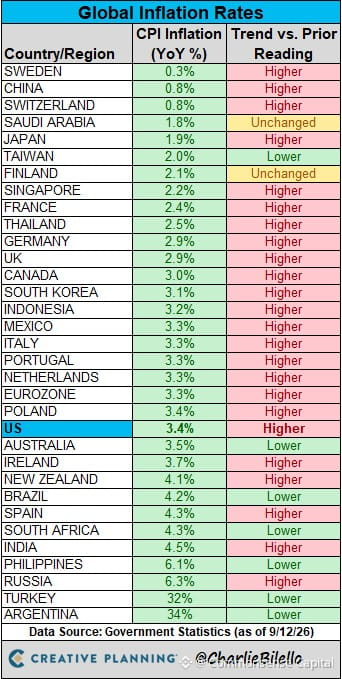
Inflation's cooling off almost everywhere now. We've gone from the 2021-2022 panic to something closer to normal in most major economies.
A few things stand out:
The US is sitting around 2.4% — not perfect, but manageable. Europe's in similar territory. Even Japan, after decades of deflation worries, is running a bit hot at 3%+.
The outliers? Turkey still dealing with double-digit inflation. Argentina's a mess as usual. But for the developed world, we're mostly back in the zone central banks can live with.
What this means: rate cuts are on the table again. The Fed, ECB, and others have room to ease without looking reckless. That's a tailwind for risk assets.
But here's the thing — inflation coming down doesn't mean prices went back down. Your groceries, rent, and insurance are still way higher than 2019. The *rate of increase* slowed. People confuse these two all the time.
Bottom line: the inflation scare is fading, which is good for markets. But don't expect your cost of living to magically reset. It won't.
Inflation's cooling off almost everywhere now. We've gone from the 2021-2022 panic to something closer to normal in most major economies.
A few things stand out:
The US is sitting around 2.4% — not perfect, but manageable. Europe's in similar territory. Even Japan, after decades of deflation worries, is running a bit hot at 3%+.
The outliers? Turkey still dealing with double-digit inflation. Argentina's a mess as usual. But for the developed world, we're mostly back in the zone central banks can live with.
What this means: rate cuts are on the table again. The Fed, ECB, and others have room to ease without looking reckless. That's a tailwind for risk assets.
But here's the thing — inflation coming down doesn't mean prices went back down. Your groceries, rent, and insurance are still way higher than 2019. The *rate of increase* slowed. People confuse these two all the time.
Bottom line: the inflation scare is fading, which is good for markets. But don't expect your cost of living to magically reset. It won't.
A few things stand out:
The US is sitting around 2.4% — not perfect, but manageable. Europe's in similar territory. Even Japan, after decades of deflation worries, is running a bit hot at 3%+.
The outliers? Turkey still dealing with double-digit inflation. Argentina's a mess as usual. But for the developed world, we're mostly back in the zone central banks can live with.
What this means: rate cuts are on the table again. The Fed, ECB, and others have room to ease without looking reckless. That's a tailwind for risk assets.
But here's the thing — inflation coming down doesn't mean prices went back down. Your groceries, rent, and insurance are still way higher than 2019. The *rate of increase* slowed. People confuse these two all the time.
Bottom line: the inflation scare is fading, which is good for markets. But don't expect your cost of living to magically reset. It won't.
19
Войдите, чтобы посмотреть больше материала
Присоединяйтесь к пользователям криптовалют по всему миру на Binance Square
⚡️ Получайте новейшую и полезную информацию о криптоактивах.
💬 Нам доверяет крупнейшая в мире криптобиржа.
👍 Получите достоверные аналитические данные от верифицированных создателей контента.
Эл. почта/номер телефона
В тренде
BitcoinReboundsTo$79K
Просмотров: 5,555
74 обсуждают
🚨 $BTC is pushing higher.
Bitcoin is trading around $78,804, up roughly 1.9%, after reclaiming the $78K area. The next level to watch is the intraday high near $78,905.
A clean break above that level could open the way toward $79K–$80K. If BTC gets rejected, support sits around $78,300, then $77,975.
Bulls have momentum, but BTC needs to hold above $78K.
#Bitcoin #BTC #CryptoTrading #CryptoMarket #CryptoAnalysis
PulseON
·Лайков: 7
·Просмотров: 6.4k
FedHikeOddsRiseTo89%
Просмотров: 64,576
952 обсуждают
RLUSDSupplyHitsRecord$2.442B
Просмотров: 3,560
56 обсуждают