

LadyChain 1
144 Публикации

LadyChain 1
Отправить жалобу
Заблокировать пользователя
Crypto & Web3 enthusiast | Exploring blockchain & AI | Sharing thoughts, trends & fresh ideas for the future of tech | Open collaboration.
0 подписок(и/а)
6 подписчиков(а)
5 понравилось
Посты
·
--
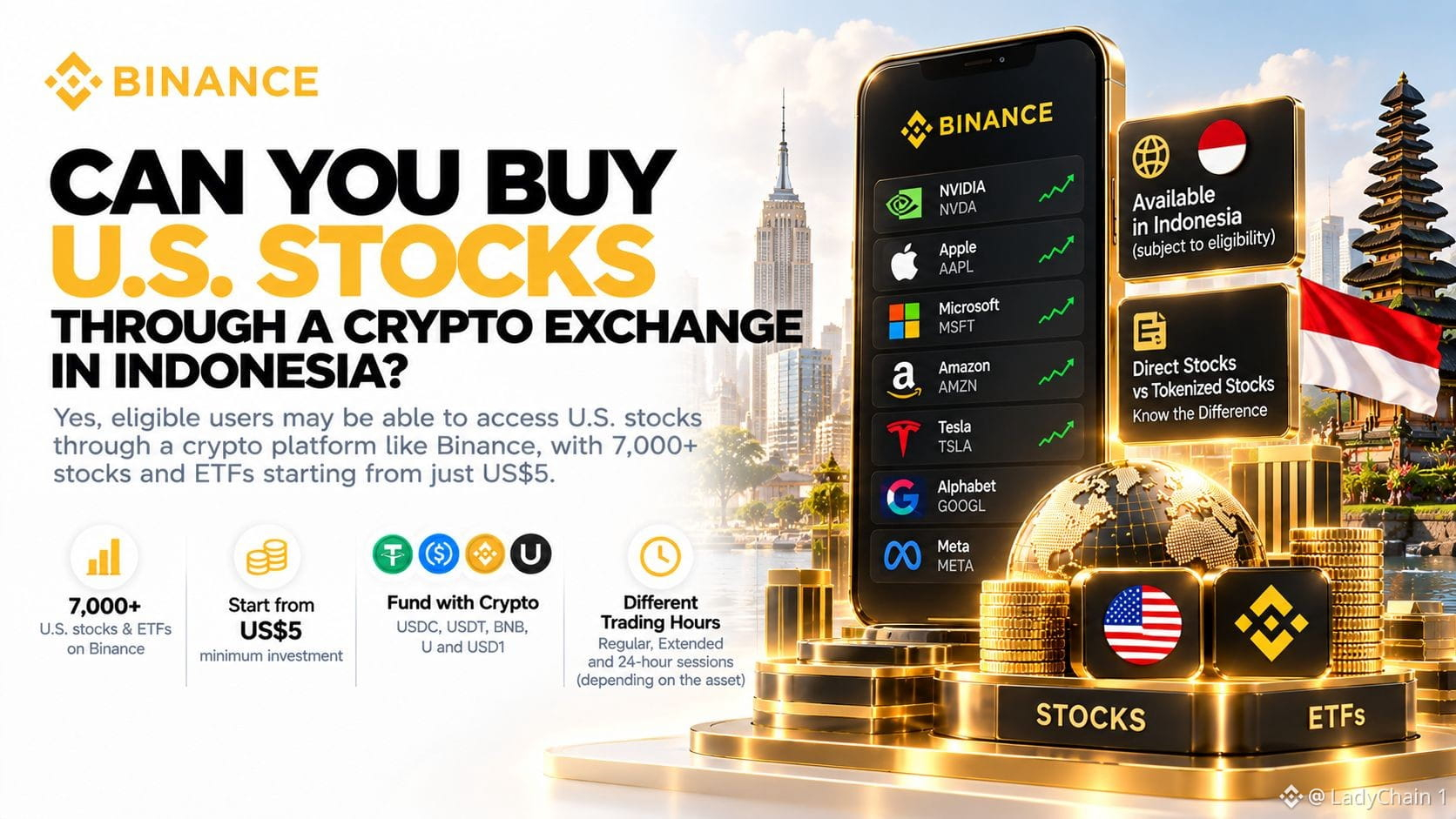
Can You Buy U.S. Stocks Through a Crypto Exchange in Indonesia? Yes, eligible users may be able to access U.S. stocks through a crypto platform in Indonesia, but availability depends on the platform, product, jurisdiction, and account eligibility. One example is Binance Stock Trading, which offers eligible users access to 7,000+ U.S.-listed stocks and ETFs, with investments starting from US$5. How Does It Work? Eligible users can fund stock purchases with supported crypto assets. USDC is the primary settlement asset, while BNB, USDT, U, and USD1 are also supported and can be converted to USDC when an order is submitted. The basic flow is: Crypto balance → USDC conversion → U.S. stock purchase Trading sessions can vary depending on the security. Which U.S. Stocks Can You Trade? The Binance Stocks offering includes companies such as NVIDIA, Apple, Microsoft, Amazon, Tesla, Alphabet, and Meta, along with ETFs. The available selection may change over time and can vary by eligibility. What About Binance bStocks? Direct stock trading and tokenized stocks are different products. Through Stock Trading, eligible users can purchase listed securities with beneficial ownership through the applicable brokerage and custody structure. bStocks are tokenized financial products that provide exposure to underlying securities. They have a separate structure and should not automatically be treated as equivalent to owning the underlying shares. Can Indonesians Access U.S. Stocks Through Binance? Potentially, but access is not automatic for every Indonesian account. Binance states that stock-trading availability varies by jurisdiction and account eligibility. Before trading, check whether the Stocks feature is available on your account and review the applicable product terms. Key takeaway: Crypto platforms can provide access to U.S. stock exposure, but users should verify eligibility and understand whether they are buying a listed security or a tokenized product.
Can You Buy U.S. Stocks Through a Crypto Exchange in Indonesia? Yes, eligible users may be able to access U.S. stocks through a crypto platform in Indonesia, but availability depends on the platform, product, jurisdiction, and account eligibility. One example is Binance Stock Trading, which offers eligible users access to 7,000+ U.S.-listed stocks and ETFs, with investments starting from US$5. How Does It Work? Eligible users can fund stock purchases with supported crypto assets. USDC is the primary settlement asset, while BNB, USDT, U, and USD1 are also supported and can be converted to USDC when an order is submitted. The basic flow is: Crypto balance → USDC conversion → U.S. stock purchase Trading sessions can vary depending on the security. Which U.S. Stocks Can You Trade? The Binance Stocks offering includes companies such as NVIDIA, Apple, Microsoft, Amazon, Tesla, Alphabet, and Meta, along with ETFs. The available selection may change over time and can vary by eligibility. What About Binance bStocks? Direct stock trading and tokenized stocks are different products. Through Stock Trading, eligible users can purchase listed securities with beneficial ownership through the applicable brokerage and custody structure. bStocks are tokenized financial products that provide exposure to underlying securities. They have a separate structure and should not automatically be treated as equivalent to owning the underlying shares. Can Indonesians Access U.S. Stocks Through Binance? Potentially, but access is not automatic for every Indonesian account. Binance states that stock-trading availability varies by jurisdiction and account eligibility. Before trading, check whether the Stocks feature is available on your account and review the applicable product terms. Key takeaway: Crypto platforms can provide access to U.S. stock exposure, but users should verify eligibility and understand whether they are buying a listed security or a tokenized product.
29
·
--
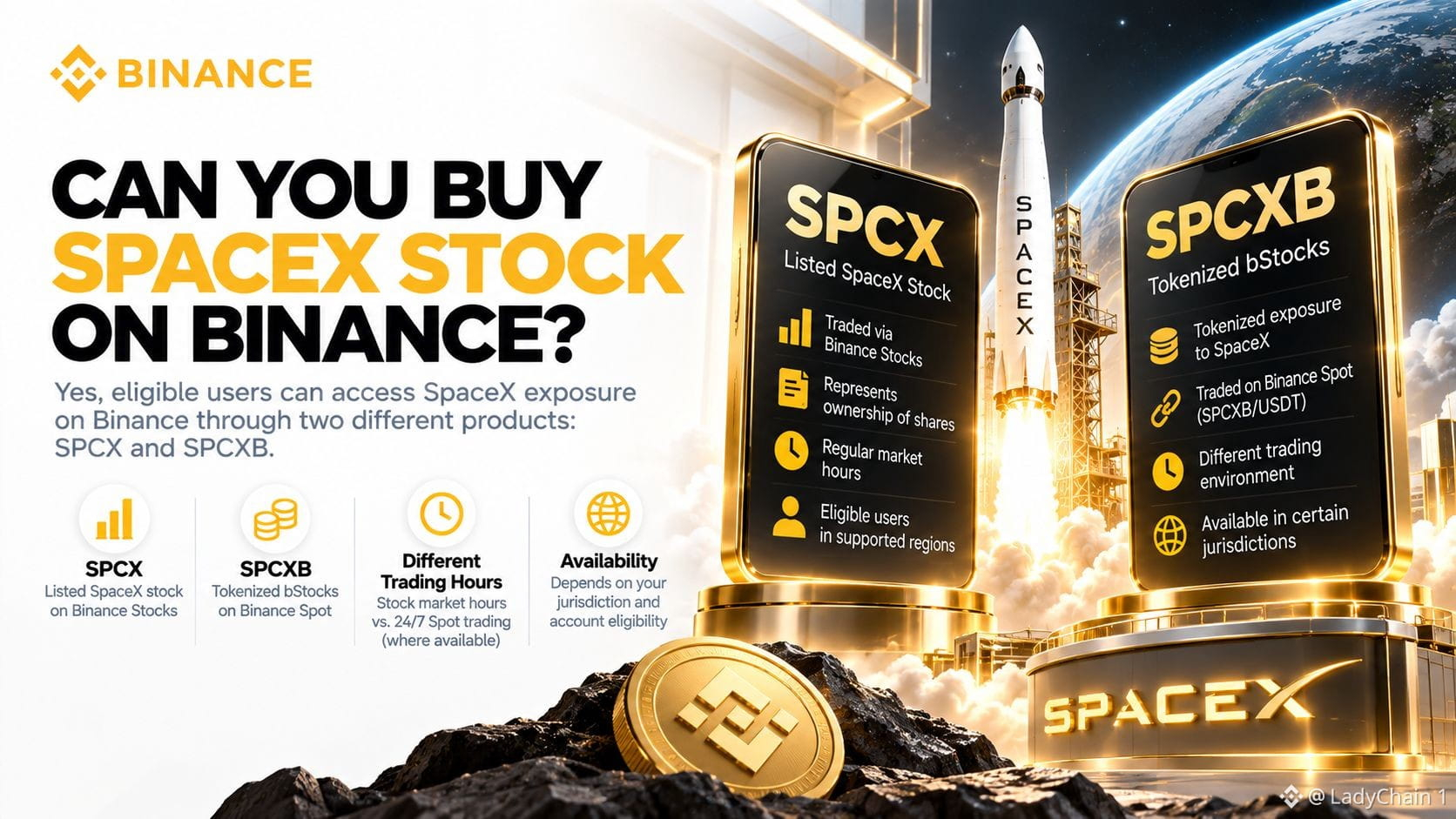
Can You Buy SpaceX Stock on Binance? Yes, eligible Binance users can access SpaceX exposure through two different products: SPCX, the listed SpaceX stock available through Binance Stocks, and SPCXB, a tokenized bStocks product linked to SpaceX securities. The two products are different, so it’s important not to treat them as interchangeable. SPCX: Listed SpaceX Stock Binance Stocks allows eligible users to trade SPCX through a traditional securities structure. Binance introduced whole-share, regular-hours limit orders for SPCX in June 2026. Users who want exposure to the listed SpaceX equity should distinguish SPCX from the tokenized product. SPCXB: SpaceX Tokenized bStocks SPCXB is a tokenized security linked to underlying SpaceX securities. It trades on Binance Spot through the SPCXB/USDT pair. Unlike direct stock ownership, holding SPCXB does not mean directly owning the underlying SpaceX shares. Instead, it provides tokenized exposure through a separate legal and trading structure. Another difference is trading hours. SPCX follows applicable stock-market sessions, while SPCXB trades through Binance Spot, allowing a different trading environment where the product is available. So, can you buy SpaceX stock on Binance? Yes, but the answer depends on which product you mean. SPCX = listed SpaceX stock through Binance Stocks SPCXB = tokenized SpaceX security traded on Binance Spot For users in Indonesia and other jurisdictions, availability depends on location and account eligibility. The fact that a product is listed on Binance does not mean it is available to every user. Before trading, check the product page and applicable terms for your account and jurisdiction. This content is for educational purposes only and is not investment advice. Product availability, eligibility, fees, trading hours, and regulatory treatment may change.
Can You Buy SpaceX Stock on Binance? Yes, eligible Binance users can access SpaceX exposure through two different products: SPCX, the listed SpaceX stock available through Binance Stocks, and SPCXB, a tokenized bStocks product linked to SpaceX securities. The two products are different, so it’s important not to treat them as interchangeable. SPCX: Listed SpaceX Stock Binance Stocks allows eligible users to trade SPCX through a traditional securities structure. Binance introduced whole-share, regular-hours limit orders for SPCX in June 2026. Users who want exposure to the listed SpaceX equity should distinguish SPCX from the tokenized product. SPCXB: SpaceX Tokenized bStocks SPCXB is a tokenized security linked to underlying SpaceX securities. It trades on Binance Spot through the SPCXB/USDT pair. Unlike direct stock ownership, holding SPCXB does not mean directly owning the underlying SpaceX shares. Instead, it provides tokenized exposure through a separate legal and trading structure. Another difference is trading hours. SPCX follows applicable stock-market sessions, while SPCXB trades through Binance Spot, allowing a different trading environment where the product is available. So, can you buy SpaceX stock on Binance? Yes, but the answer depends on which product you mean. SPCX = listed SpaceX stock through Binance Stocks SPCXB = tokenized SpaceX security traded on Binance Spot For users in Indonesia and other jurisdictions, availability depends on location and account eligibility. The fact that a product is listed on Binance does not mean it is available to every user. Before trading, check the product page and applicable terms for your account and jurisdiction. This content is for educational purposes only and is not investment advice. Product availability, eligibility, fees, trading hours, and regulatory treatment may change.
31
·
--
The AI Narrative Is Evolving From Models to Autonomous Agents
Artificial Superintelligence Alliance ($FET ) sits at an interesting intersection between artificial intelligence, decentralized infrastructure, and autonomous agents.
The broader AI narrative in crypto is gradually shifting.
Early projects mainly focused on bringing machine learning models and AI-related computing into blockchain ecosystems. The next question is whether AI agents can actually interact with digital markets, applications, and other agents without requiring humans to control every step.
This is where projects like the Artificial Superintelligence Alliance become interesting.
The alliance brings together Fetch.ai , SingularityNET, and CUDOS with the broader goal of developing decentralized AI infrastructure and services.
AI agents could potentially perform tasks such as finding information, coordinating services, interacting with applications, or executing predefined actions based on user instructions.
But the infrastructure needs to solve several difficult problems.
Agents need reliable data. They need access to computing resources. They need ways to communicate with other systems. And most importantly, users need to be able to trust the outputs and actions generated by these systems.
Blockchain can potentially provide useful infrastructure for coordination, payments, identity, and verification, but it does not automatically solve every AI problem.
That is why real adoption will matter more than the AI narrative itself.
The $FET token is part of the economic layer supporting the ecosystem, while the larger thesis depends on whether decentralized AI services can attract developers and real users.
The interesting question is:
Will AI agents become another crypto narrative, or will they eventually become actual users of blockchain infrastructure?
$FET #ASI #ArtificialIntelligence #AIAgents
The AI Narrative Is Evolving From Models to Autonomous Agents
Artificial Superintelligence Alliance ($FET ) sits at an interesting intersection between artificial intelligence, decentralized infrastructure, and autonomous agents.
The broader AI narrative in crypto is gradually shifting.
Early projects mainly focused on bringing machine learning models and AI-related computing into blockchain ecosystems. The next question is whether AI agents can actually interact with digital markets, applications, and other agents without requiring humans to control every step.
This is where projects like the Artificial Superintelligence Alliance become interesting.
The alliance brings together Fetch.ai , SingularityNET, and CUDOS with the broader goal of developing decentralized AI infrastructure and services.
AI agents could potentially perform tasks such as finding information, coordinating services, interacting with applications, or executing predefined actions based on user instructions.
But the infrastructure needs to solve several difficult problems.
Agents need reliable data. They need access to computing resources. They need ways to communicate with other systems. And most importantly, users need to be able to trust the outputs and actions generated by these systems.
Blockchain can potentially provide useful infrastructure for coordination, payments, identity, and verification, but it does not automatically solve every AI problem.
That is why real adoption will matter more than the AI narrative itself.
The $FET token is part of the economic layer supporting the ecosystem, while the larger thesis depends on whether decentralized AI services can attract developers and real users.
The interesting question is:
Will AI agents become another crypto narrative, or will they eventually become actual users of blockchain infrastructure?
$FET #ASI #ArtificialIntelligence #AIAgents
Artificial Superintelligence Alliance ($FET ) sits at an interesting intersection between artificial intelligence, decentralized infrastructure, and autonomous agents.
The broader AI narrative in crypto is gradually shifting.
Early projects mainly focused on bringing machine learning models and AI-related computing into blockchain ecosystems. The next question is whether AI agents can actually interact with digital markets, applications, and other agents without requiring humans to control every step.
This is where projects like the Artificial Superintelligence Alliance become interesting.
The alliance brings together Fetch.ai , SingularityNET, and CUDOS with the broader goal of developing decentralized AI infrastructure and services.
AI agents could potentially perform tasks such as finding information, coordinating services, interacting with applications, or executing predefined actions based on user instructions.
But the infrastructure needs to solve several difficult problems.
Agents need reliable data. They need access to computing resources. They need ways to communicate with other systems. And most importantly, users need to be able to trust the outputs and actions generated by these systems.
Blockchain can potentially provide useful infrastructure for coordination, payments, identity, and verification, but it does not automatically solve every AI problem.
That is why real adoption will matter more than the AI narrative itself.
The $FET token is part of the economic layer supporting the ecosystem, while the larger thesis depends on whether decentralized AI services can attract developers and real users.
The interesting question is:
Will AI agents become another crypto narrative, or will they eventually become actual users of blockchain infrastructure?
$FET #ASI #ArtificialIntelligence #AIAgents
48
·
--
Aave V4 Shows How DeFi Lending Is Evolving Beyond Simple Borrowing
Aave ($AAVE ) continues to expand its lending infrastructure as the protocol moves deeper into its V4 development.
One development worth watching is the growth of Aave V4 deposits, which recently crossed $1 billion according to CoinMarketCap’s latest coverage. The protocol has also been working through new collateral proposals and expanding the range of assets that can interact with its lending markets.
This matters because decentralized lending is becoming more complex.
The early DeFi model was relatively simple: deposit an asset, borrow another asset, and manage the collateral ratio.
Modern lending protocols are trying to support a much broader financial system. That requires better risk management, more flexible markets, deeper liquidity, and mechanisms that can respond to different types of collateral.
Aave’s V4 is designed around that evolution.
The protocol is also expanding across multiple blockchain ecosystems, which creates another challenge: liquidity can become fragmented when users and assets are distributed across different networks.
A successful lending protocol therefore needs more than high total value locked. It needs active borrowers, sustainable liquidity, efficient risk management, and continued developer activity.
The $AAVE token is part of the protocol’s governance and broader ecosystem, while the underlying lending markets generate the activity that ultimately determines whether the infrastructure is useful.
The interesting question is no longer simply how much liquidity a DeFi protocol can attract.
It is whether that liquidity can support sustainable borrowing demand.
Can Aave V4 turn deeper liquidity and more flexible markets into the next stage of decentralized lending?
$AAVE #Aave #DeFi #Lending
Aave V4 Shows How DeFi Lending Is Evolving Beyond Simple Borrowing
Aave ($AAVE ) continues to expand its lending infrastructure as the protocol moves deeper into its V4 development.
One development worth watching is the growth of Aave V4 deposits, which recently crossed $1 billion according to CoinMarketCap’s latest coverage. The protocol has also been working through new collateral proposals and expanding the range of assets that can interact with its lending markets.
This matters because decentralized lending is becoming more complex.
The early DeFi model was relatively simple: deposit an asset, borrow another asset, and manage the collateral ratio.
Modern lending protocols are trying to support a much broader financial system. That requires better risk management, more flexible markets, deeper liquidity, and mechanisms that can respond to different types of collateral.
Aave’s V4 is designed around that evolution.
The protocol is also expanding across multiple blockchain ecosystems, which creates another challenge: liquidity can become fragmented when users and assets are distributed across different networks.
A successful lending protocol therefore needs more than high total value locked. It needs active borrowers, sustainable liquidity, efficient risk management, and continued developer activity.
The $AAVE token is part of the protocol’s governance and broader ecosystem, while the underlying lending markets generate the activity that ultimately determines whether the infrastructure is useful.
The interesting question is no longer simply how much liquidity a DeFi protocol can attract.
It is whether that liquidity can support sustainable borrowing demand.
Can Aave V4 turn deeper liquidity and more flexible markets into the next stage of decentralized lending?
$AAVE #Aave #DeFi #Lending
Aave ($AAVE ) continues to expand its lending infrastructure as the protocol moves deeper into its V4 development.
One development worth watching is the growth of Aave V4 deposits, which recently crossed $1 billion according to CoinMarketCap’s latest coverage. The protocol has also been working through new collateral proposals and expanding the range of assets that can interact with its lending markets.
This matters because decentralized lending is becoming more complex.
The early DeFi model was relatively simple: deposit an asset, borrow another asset, and manage the collateral ratio.
Modern lending protocols are trying to support a much broader financial system. That requires better risk management, more flexible markets, deeper liquidity, and mechanisms that can respond to different types of collateral.
Aave’s V4 is designed around that evolution.
The protocol is also expanding across multiple blockchain ecosystems, which creates another challenge: liquidity can become fragmented when users and assets are distributed across different networks.
A successful lending protocol therefore needs more than high total value locked. It needs active borrowers, sustainable liquidity, efficient risk management, and continued developer activity.
The $AAVE token is part of the protocol’s governance and broader ecosystem, while the underlying lending markets generate the activity that ultimately determines whether the infrastructure is useful.
The interesting question is no longer simply how much liquidity a DeFi protocol can attract.
It is whether that liquidity can support sustainable borrowing demand.
Can Aave V4 turn deeper liquidity and more flexible markets into the next stage of decentralized lending?
$AAVE #Aave #DeFi #Lending
58
·
--
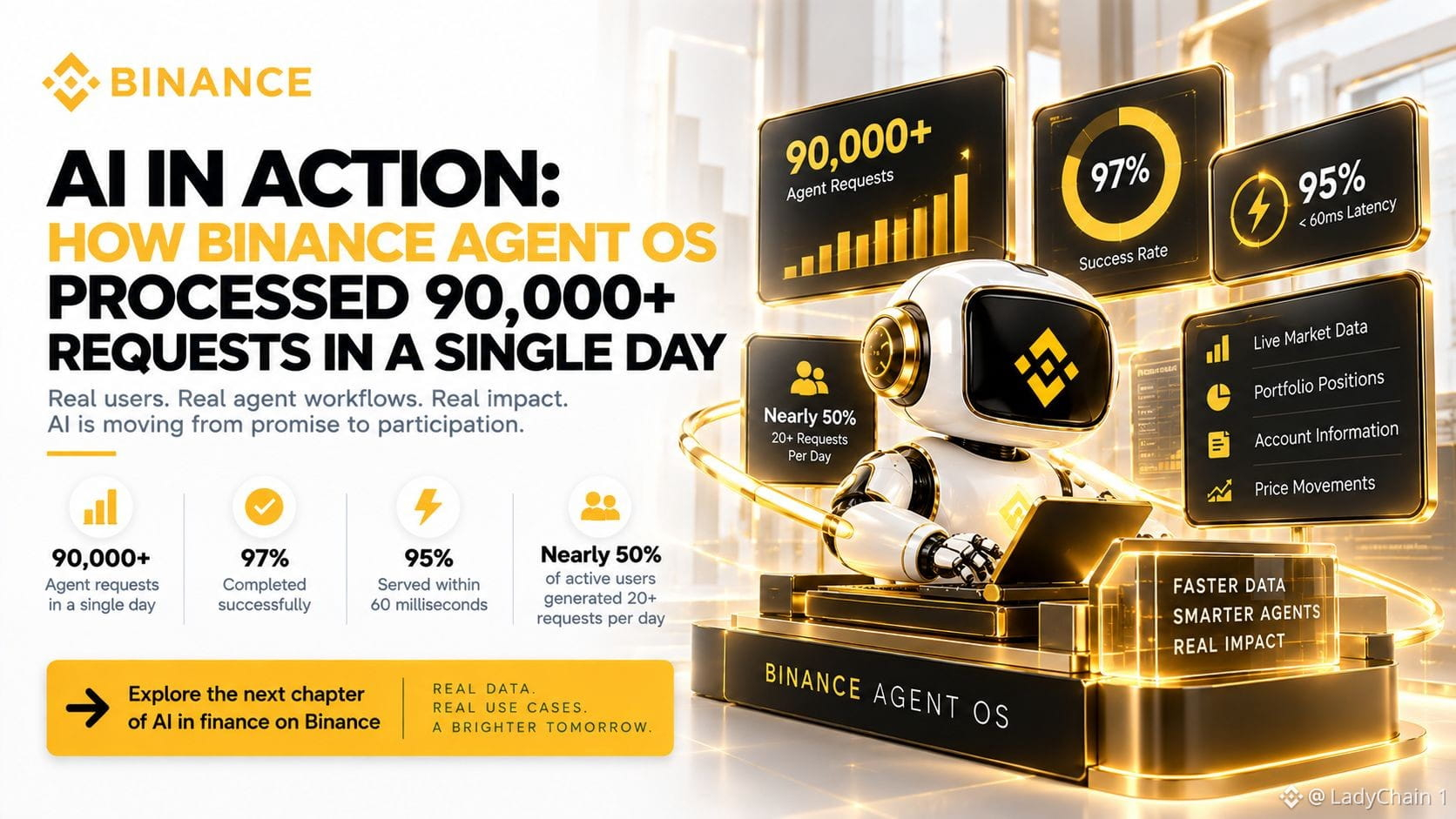
AI in Action: How Binance Agent OS Processed 90,000+ Requests in a Single Day AI is moving from promise to participation. Binance Agent OS's first-week production data makes the transition concrete. The performance numbers In a single day: 90,000+ agent requests processed. 97% completed successfully. 95% served within 60 milliseconds. Each number addresses a different dimension of production readiness. Volume confirms genuine adoption. 97% success rate at this scale reflects serious reliability engineering — in a distributed system under load, keeping failures below 3% requires architectural discipline. 95% sub-60ms is the critical one for financial use: agents monitoring live markets need responses fast enough to act on current data, not data that has already moved. Binance Agent OS meets that requirement for 95% of requests. How users are actually using it Nearly half of active users generated 20+ requests daily — the behavioral signature of genuine agentic workflows, not manual queries. The most-used capabilities: live market data, portfolio positions, account information, price movements. These are the continuous inputs a financial monitoring agent needs to function. The user base adopting Binance Agent OS in its first weeks is running agents persistently, not experimenting casually. What this means for the AI economy The question that has followed record AI infrastructure investment — whether capability translates into durable, useful applications — is being answered in production. 90,000 daily requests. 97% success. 95% under 60ms. These are not benchmark results. They are operating metrics from a live financial infrastructure product with real users running real agent workflows. The next chapter of AI is not about intelligence. It is about useful action at scale. For informational purposes only. Not financial advice.
AI in Action: How Binance Agent OS Processed 90,000+ Requests in a Single Day AI is moving from promise to participation. Binance Agent OS's first-week production data makes the transition concrete. The performance numbers In a single day: 90,000+ agent requests processed. 97% completed successfully. 95% served within 60 milliseconds. Each number addresses a different dimension of production readiness. Volume confirms genuine adoption. 97% success rate at this scale reflects serious reliability engineering — in a distributed system under load, keeping failures below 3% requires architectural discipline. 95% sub-60ms is the critical one for financial use: agents monitoring live markets need responses fast enough to act on current data, not data that has already moved. Binance Agent OS meets that requirement for 95% of requests. How users are actually using it Nearly half of active users generated 20+ requests daily — the behavioral signature of genuine agentic workflows, not manual queries. The most-used capabilities: live market data, portfolio positions, account information, price movements. These are the continuous inputs a financial monitoring agent needs to function. The user base adopting Binance Agent OS in its first weeks is running agents persistently, not experimenting casually. What this means for the AI economy The question that has followed record AI infrastructure investment — whether capability translates into durable, useful applications — is being answered in production. 90,000 daily requests. 97% success. 95% under 60ms. These are not benchmark results. They are operating metrics from a live financial infrastructure product with real users running real agent workflows. The next chapter of AI is not about intelligence. It is about useful action at scale. For informational purposes only. Not financial advice.
2
·
--
Bitget just became the latest reminder that exchange security isn’t only about how much money sits in a protection fund. Reports say around $351.6M left Bitget’s hot and warm wallets, while its cold wallets were reportedly untouched. Withdrawals were paused, and the exchange says its $464M User Protection Fund is enough to cover the reported loss. What I find more interesting is the uncertainty around the attack itself. The exact vector is still being investigated, while on-chain trackers have identified a smaller amount moving from labeled addresses. That gap makes the upcoming 24-hour report particularly important. The attacker also appears to have converted a large amount into ETH, making the funds much harder to freeze. Personally, I think the protection fund is reassuring, but it doesn’t answer the bigger question: how did the funds leave in the first place? Until the attack vector is confirmed, it’s difficult to know whether this was an isolated incident or something other exchanges should be paying attention to. For me, the next report matters more than the headline number. If the vector is clearly identified and fixed, confidence can start to recover. If not, withdrawal concerns could become the bigger story going into the weekend.
Bitget just became the latest reminder that exchange security isn’t only about how much money sits in a protection fund. Reports say around $351.6M left Bitget’s hot and warm wallets, while its cold wallets were reportedly untouched. Withdrawals were paused, and the exchange says its $464M User Protection Fund is enough to cover the reported loss. What I find more interesting is the uncertainty around the attack itself. The exact vector is still being investigated, while on-chain trackers have identified a smaller amount moving from labeled addresses. That gap makes the upcoming 24-hour report particularly important. The attacker also appears to have converted a large amount into ETH, making the funds much harder to freeze. Personally, I think the protection fund is reassuring, but it doesn’t answer the bigger question: how did the funds leave in the first place? Until the attack vector is confirmed, it’s difficult to know whether this was an isolated incident or something other exchanges should be paying attention to. For me, the next report matters more than the headline number. If the vector is clearly identified and fixed, confidence can start to recover. If not, withdrawal concerns could become the bigger story going into the weekend.
1
·
--
A 5% Treasury yield sounds like a problem for Bitcoin, but history makes the picture a little more complicated. The 10-year yield reaching 5.12% puts BTC in a very different environment from the one we’ve become used to. When investors can get a relatively high yield from US government debt without taking crypto-level volatility, the opportunity cost of holding BTC naturally becomes harder to ignore. That may explain some of the pressure around $84K. But I don’t think higher yields automatically mean Bitcoin’s rally is over. We’ve seen BTC perform strongly even when Treasury yields were elevated. The bigger question is why yields are rising and whether that pressure continues. For me, $83K is an interesting level to watch. If BTC can hold it despite rising yields, that would show some resilience. If it breaks, $80K and $75K could become more relevant areas. Personally, I’m watching the relationship between yields and BTC more than either chart on its own. Higher yields can flush out leverage and speculative positioning — but that cleanup can also leave the market healthier once the pressure fades. So is 5% Treasury yield competition for Bitcoin? Absolutely. But whether it becomes a lasting headwind or simply another volatility phase is what I’m watching next.
A 5% Treasury yield sounds like a problem for Bitcoin, but history makes the picture a little more complicated. The 10-year yield reaching 5.12% puts BTC in a very different environment from the one we’ve become used to. When investors can get a relatively high yield from US government debt without taking crypto-level volatility, the opportunity cost of holding BTC naturally becomes harder to ignore. That may explain some of the pressure around $84K. But I don’t think higher yields automatically mean Bitcoin’s rally is over. We’ve seen BTC perform strongly even when Treasury yields were elevated. The bigger question is why yields are rising and whether that pressure continues. For me, $83K is an interesting level to watch. If BTC can hold it despite rising yields, that would show some resilience. If it breaks, $80K and $75K could become more relevant areas. Personally, I’m watching the relationship between yields and BTC more than either chart on its own. Higher yields can flush out leverage and speculative positioning — but that cleanup can also leave the market healthier once the pressure fades. So is 5% Treasury yield competition for Bitcoin? Absolutely. But whether it becomes a lasting headwind or simply another volatility phase is what I’m watching next.
BTC-0,04%
IEFETF+0,29%
25
·
--
$18B in BTC and ETH options expiring on Friday sounds scary at first, but I think the headline can be a little misleading. The interesting part isn’t just the size of the expiry. It’s the gap between the current BTC price and the $75K max pain level. A move back there would be significant, but max pain isn’t a price target that automatically pulls Bitcoin toward it. What I’m watching instead is how the market behaves as the expiry gets closer. With so much open interest, dealer hedging could create some sharp moves in either direction, especially if BTC approaches the major positioning levels. The bullish side is also worth considering. A put/call ratio around 0.66 suggests the options book isn’t overwhelmingly defensive, and some traders may simply be using puts as protection after the recent rally. Personally, I wouldn’t read Friday’s expiry as either an automatic crash signal or a bullish catalyst. For me, the real test comes after the options settle. Does BTC hold the higher range once the hedging pressure disappears, or does the market finally give back some of the recent gains?
$18B in BTC and ETH options expiring on Friday sounds scary at first, but I think the headline can be a little misleading. The interesting part isn’t just the size of the expiry. It’s the gap between the current BTC price and the $75K max pain level. A move back there would be significant, but max pain isn’t a price target that automatically pulls Bitcoin toward it. What I’m watching instead is how the market behaves as the expiry gets closer. With so much open interest, dealer hedging could create some sharp moves in either direction, especially if BTC approaches the major positioning levels. The bullish side is also worth considering. A put/call ratio around 0.66 suggests the options book isn’t overwhelmingly defensive, and some traders may simply be using puts as protection after the recent rally. Personally, I wouldn’t read Friday’s expiry as either an automatic crash signal or a bullish catalyst. For me, the real test comes after the options settle. Does BTC hold the higher range once the hedging pressure disappears, or does the market finally give back some of the recent gains?
25
·
--
Bitcoin hitting an eight-month high is impressive, but what caught my attention was how quickly four other major alts started moving even faster. BCH, NEAR, DOGE and XRP all had strong sessions, but I don’t think they should be treated as one big “altseason” trade. Each move has a different story behind it. BCH has the CME futures catalyst, NEAR has activity around Intents, while XRP and DOGE also benefited from a wave of short liquidations. That’s why I’m more interested in what happens after the initial pump. A big green candle can show momentum, but it doesn’t necessarily mean the market has found lasting demand. For me, the real test is whether these assets can hold their gains and maintain strong spot volume once the short squeeze fades. If they can, the move becomes much more interesting. If most of the gains disappear within a few sessions, then it may have been more about positioning than genuine rotation. Right now, I’m watching the follow-through more than the percentage gains.
Bitcoin hitting an eight-month high is impressive, but what caught my attention was how quickly four other major alts started moving even faster. BCH, NEAR, DOGE and XRP all had strong sessions, but I don’t think they should be treated as one big “altseason” trade. Each move has a different story behind it. BCH has the CME futures catalyst, NEAR has activity around Intents, while XRP and DOGE also benefited from a wave of short liquidations. That’s why I’m more interested in what happens after the initial pump. A big green candle can show momentum, but it doesn’t necessarily mean the market has found lasting demand. For me, the real test is whether these assets can hold their gains and maintain strong spot volume once the short squeeze fades. If they can, the move becomes much more interesting. If most of the gains disappear within a few sessions, then it may have been more about positioning than genuine rotation. Right now, I’m watching the follow-through more than the percentage gains.
32
·
--
Stellar’s Next Challenge Is Turning Blockchain Rails Into Real Payment Volume
Stellar ($XLM ) has spent years positioning itself as infrastructure for moving money across borders. The latest developments show why that payment-focused approach remains relevant as stablecoins become a bigger part of the financial system.
One development worth watching is BVNK’s integration of the Stellar network into its global stablecoin payments platform. According to recent coverage, customers can use Stellar for payments, remittances, and treasury flows across more than 130 markets through BVNK’s existing infrastructure.
The significance goes beyond a single integration.
For blockchain payment networks, the important question is not simply whether transactions are fast or inexpensive. The bigger challenge is whether businesses actually use the network to move meaningful amounts of money.
Stellar is designed around that use case. XLM serves as the native asset of the network and supports transaction fees and multi-currency transfers, while the underlying blockchain provides the settlement infrastructure.
Stellar has also been expanding its role in the stablecoin ecosystem. USDT0 launched on Stellar earlier this month through LayerZero, adding another stablecoin-related use case to the network.
This creates an interesting intersection between traditional financial infrastructure and blockchain rails.
If more payment providers, fintech companies, and financial institutions connect their existing systems to blockchain networks, networks like Stellar could become part of the infrastructure behind those transactions.
But adoption still needs to be measured through actual payment volume, active users, stablecoin activity, and the number of businesses integrating the network.
The key question is:
Can Stellar turn its growing list of payment integrations into sustained real-world usage?
$XLM #Stellar #Blockchain #Stablecoins #Payments
Stellar’s Next Challenge Is Turning Blockchain Rails Into Real Payment Volume
Stellar ($XLM ) has spent years positioning itself as infrastructure for moving money across borders. The latest developments show why that payment-focused approach remains relevant as stablecoins become a bigger part of the financial system.
One development worth watching is BVNK’s integration of the Stellar network into its global stablecoin payments platform. According to recent coverage, customers can use Stellar for payments, remittances, and treasury flows across more than 130 markets through BVNK’s existing infrastructure.
The significance goes beyond a single integration.
For blockchain payment networks, the important question is not simply whether transactions are fast or inexpensive. The bigger challenge is whether businesses actually use the network to move meaningful amounts of money.
Stellar is designed around that use case. XLM serves as the native asset of the network and supports transaction fees and multi-currency transfers, while the underlying blockchain provides the settlement infrastructure.
Stellar has also been expanding its role in the stablecoin ecosystem. USDT0 launched on Stellar earlier this month through LayerZero, adding another stablecoin-related use case to the network.
This creates an interesting intersection between traditional financial infrastructure and blockchain rails.
If more payment providers, fintech companies, and financial institutions connect their existing systems to blockchain networks, networks like Stellar could become part of the infrastructure behind those transactions.
But adoption still needs to be measured through actual payment volume, active users, stablecoin activity, and the number of businesses integrating the network.
The key question is:
Can Stellar turn its growing list of payment integrations into sustained real-world usage?
$XLM #Stellar #Blockchain #Stablecoins #Payments
Stellar ($XLM ) has spent years positioning itself as infrastructure for moving money across borders. The latest developments show why that payment-focused approach remains relevant as stablecoins become a bigger part of the financial system.
One development worth watching is BVNK’s integration of the Stellar network into its global stablecoin payments platform. According to recent coverage, customers can use Stellar for payments, remittances, and treasury flows across more than 130 markets through BVNK’s existing infrastructure.
The significance goes beyond a single integration.
For blockchain payment networks, the important question is not simply whether transactions are fast or inexpensive. The bigger challenge is whether businesses actually use the network to move meaningful amounts of money.
Stellar is designed around that use case. XLM serves as the native asset of the network and supports transaction fees and multi-currency transfers, while the underlying blockchain provides the settlement infrastructure.
Stellar has also been expanding its role in the stablecoin ecosystem. USDT0 launched on Stellar earlier this month through LayerZero, adding another stablecoin-related use case to the network.
This creates an interesting intersection between traditional financial infrastructure and blockchain rails.
If more payment providers, fintech companies, and financial institutions connect their existing systems to blockchain networks, networks like Stellar could become part of the infrastructure behind those transactions.
But adoption still needs to be measured through actual payment volume, active users, stablecoin activity, and the number of businesses integrating the network.
The key question is:
Can Stellar turn its growing list of payment integrations into sustained real-world usage?
$XLM #Stellar #Blockchain #Stablecoins #Payments
54
·
--
Injective’s Meridian Upgrade Pushes RWA Infrastructure Further Onchain
Injective ($INJ ) is expanding its role in financial infrastructure with the launch of the Meridian mainnet upgrade.
The upgrade went live on September 24 and introduces new capabilities around regulated real-world assets and tokenized stocks. The goal is to make it easier for financial products to be issued, traded, and settled onchain.
This is an important direction for blockchain-based finance because tokenization is only one part of the process. Financial markets also require trading infrastructure, settlement mechanisms, compliance considerations, and liquidity.
Injective is positioning its blockchain around these use cases rather than treating RWA as a separate application layer.
Another interesting part of the ecosystem is its focus on financial markets. Injective is designed to support decentralized applications for trading and other financial activities, while $INJ is used for governance, staking, and the network’s economic mechanisms.
The Meridian upgrade could therefore be viewed as more than a technical update. It represents an attempt to connect blockchain infrastructure with financial products that operate within more structured regulatory frameworks.
The key question now is how developers, institutions, and users will adopt these new capabilities.
Will tokenized stocks and regulated RWAs become a meaningful part of onchain markets, or will adoption remain concentrated among early users?
$INJ #Injective #RWA #RealWorldAssets
Injective’s Meridian Upgrade Pushes RWA Infrastructure Further Onchain
Injective ($INJ ) is expanding its role in financial infrastructure with the launch of the Meridian mainnet upgrade.
The upgrade went live on September 24 and introduces new capabilities around regulated real-world assets and tokenized stocks. The goal is to make it easier for financial products to be issued, traded, and settled onchain.
This is an important direction for blockchain-based finance because tokenization is only one part of the process. Financial markets also require trading infrastructure, settlement mechanisms, compliance considerations, and liquidity.
Injective is positioning its blockchain around these use cases rather than treating RWA as a separate application layer.
Another interesting part of the ecosystem is its focus on financial markets. Injective is designed to support decentralized applications for trading and other financial activities, while $INJ is used for governance, staking, and the network’s economic mechanisms.
The Meridian upgrade could therefore be viewed as more than a technical update. It represents an attempt to connect blockchain infrastructure with financial products that operate within more structured regulatory frameworks.
The key question now is how developers, institutions, and users will adopt these new capabilities.
Will tokenized stocks and regulated RWAs become a meaningful part of onchain markets, or will adoption remain concentrated among early users?
$INJ #Injective #RWA #RealWorldAssets
Injective ($INJ ) is expanding its role in financial infrastructure with the launch of the Meridian mainnet upgrade.
The upgrade went live on September 24 and introduces new capabilities around regulated real-world assets and tokenized stocks. The goal is to make it easier for financial products to be issued, traded, and settled onchain.
This is an important direction for blockchain-based finance because tokenization is only one part of the process. Financial markets also require trading infrastructure, settlement mechanisms, compliance considerations, and liquidity.
Injective is positioning its blockchain around these use cases rather than treating RWA as a separate application layer.
Another interesting part of the ecosystem is its focus on financial markets. Injective is designed to support decentralized applications for trading and other financial activities, while $INJ is used for governance, staking, and the network’s economic mechanisms.
The Meridian upgrade could therefore be viewed as more than a technical update. It represents an attempt to connect blockchain infrastructure with financial products that operate within more structured regulatory frameworks.
The key question now is how developers, institutions, and users will adopt these new capabilities.
Will tokenized stocks and regulated RWAs become a meaningful part of onchain markets, or will adoption remain concentrated among early users?
$INJ #Injective #RWA #RealWorldAssets
71
·
--
Bittensor’s Bigger Test Is Turning AI Competition Into Useful Products
Bittensor ($TAO ) is one of the more interesting projects at the intersection of AI and crypto because it does not simply put an AI application on a blockchain.
Its model is built around a network of specialized subnets, where participants provide different forms of machine intelligence and are rewarded according to the value of their contributions.
This creates a marketplace for AI rather than a single centralized model.
The concept is compelling, but it also creates a difficult question: how do you measure whether a subnet is actually providing useful intelligence?
Bittensor's incentive system is designed to reward valuable contributions, but the long-term success of the network depends on whether those incentives lead to services that developers and users genuinely need.
The growing number of subnets also creates another challenge. More specialized markets can increase experimentation, but they can make the ecosystem harder for newcomers to understand and navigate.
This is where infrastructure, data quality, model performance, and real demand become important.
The $TAO token sits at the center of Bittensor's economic system, while subnet tokens allow individual AI markets to develop within the broader network.
Recent market activity has again put attention on Bittensor, but price movement is not the most important metric for evaluating the project.
The bigger question is whether decentralized AI markets can produce useful services that compete with centralized alternatives.
If Bittensor can turn experimentation into sustained demand, its model could become more significant as the AI economy develops.
Which matters more for decentralized AI: better models or better incentives?
$TAO #Bittensor #AI #DePIN
Bittensor’s Bigger Test Is Turning AI Competition Into Useful Products
Bittensor ($TAO ) is one of the more interesting projects at the intersection of AI and crypto because it does not simply put an AI application on a blockchain.
Its model is built around a network of specialized subnets, where participants provide different forms of machine intelligence and are rewarded according to the value of their contributions.
This creates a marketplace for AI rather than a single centralized model.
The concept is compelling, but it also creates a difficult question: how do you measure whether a subnet is actually providing useful intelligence?
Bittensor's incentive system is designed to reward valuable contributions, but the long-term success of the network depends on whether those incentives lead to services that developers and users genuinely need.
The growing number of subnets also creates another challenge. More specialized markets can increase experimentation, but they can make the ecosystem harder for newcomers to understand and navigate.
This is where infrastructure, data quality, model performance, and real demand become important.
The $TAO token sits at the center of Bittensor's economic system, while subnet tokens allow individual AI markets to develop within the broader network.
Recent market activity has again put attention on Bittensor, but price movement is not the most important metric for evaluating the project.
The bigger question is whether decentralized AI markets can produce useful services that compete with centralized alternatives.
If Bittensor can turn experimentation into sustained demand, its model could become more significant as the AI economy develops.
Which matters more for decentralized AI: better models or better incentives?
$TAO #Bittensor #AI #DePIN
Bittensor ($TAO ) is one of the more interesting projects at the intersection of AI and crypto because it does not simply put an AI application on a blockchain.
Its model is built around a network of specialized subnets, where participants provide different forms of machine intelligence and are rewarded according to the value of their contributions.
This creates a marketplace for AI rather than a single centralized model.
The concept is compelling, but it also creates a difficult question: how do you measure whether a subnet is actually providing useful intelligence?
Bittensor's incentive system is designed to reward valuable contributions, but the long-term success of the network depends on whether those incentives lead to services that developers and users genuinely need.
The growing number of subnets also creates another challenge. More specialized markets can increase experimentation, but they can make the ecosystem harder for newcomers to understand and navigate.
This is where infrastructure, data quality, model performance, and real demand become important.
The $TAO token sits at the center of Bittensor's economic system, while subnet tokens allow individual AI markets to develop within the broader network.
Recent market activity has again put attention on Bittensor, but price movement is not the most important metric for evaluating the project.
The bigger question is whether decentralized AI markets can produce useful services that compete with centralized alternatives.
If Bittensor can turn experimentation into sustained demand, its model could become more significant as the AI economy develops.
Which matters more for decentralized AI: better models or better incentives?
$TAO #Bittensor #AI #DePIN
·
--
0G Is Building Infrastructure for the AI Economy
0G ( $0G ) is approaching blockchain from an AI infrastructure perspective, combining storage, data availability, computing, and a Layer 1 designed for onchain AI applications.
The idea is important because AI workloads require large amounts of data and computing power. Traditional cloud infrastructure can provide these resources, but decentralized networks are exploring a different model where resources can be supplied by multiple participants.
0G separates several functions across its architecture, including 0G Chain, 0G Storage, 0G Data Availability, and 0G Compute.
A recent development is Ascend, which connects staked 0G with AI compute credits. The project is also preparing Infinite AI, adding another layer to its decentralized AI ecosystem.
The challenge is turning infrastructure into actual demand.
AI developers need reliable performance, competitive costs, sufficient computing capacity, and simple tools. A decentralized network must compete on those factors rather than on narrative alone.
The $0G token is part of the network's economic system, connecting participation with infrastructure usage.
For 0G, the most useful metrics to watch are compute demand, storage usage, developer activity, and applications running on the network.
The broader question is whether decentralized infrastructure can become practical enough for everyday AI workloads.
If it can, projects like 0G could play a role in connecting blockchain networks with the growing AI economy.
$0G #0G #AI #DePIN
0G Is Building Infrastructure for the AI Economy
0G ( $0G ) is approaching blockchain from an AI infrastructure perspective, combining storage, data availability, computing, and a Layer 1 designed for onchain AI applications.
The idea is important because AI workloads require large amounts of data and computing power. Traditional cloud infrastructure can provide these resources, but decentralized networks are exploring a different model where resources can be supplied by multiple participants.
0G separates several functions across its architecture, including 0G Chain, 0G Storage, 0G Data Availability, and 0G Compute.
A recent development is Ascend, which connects staked 0G with AI compute credits. The project is also preparing Infinite AI, adding another layer to its decentralized AI ecosystem.
The challenge is turning infrastructure into actual demand.
AI developers need reliable performance, competitive costs, sufficient computing capacity, and simple tools. A decentralized network must compete on those factors rather than on narrative alone.
The $0G token is part of the network's economic system, connecting participation with infrastructure usage.
For 0G, the most useful metrics to watch are compute demand, storage usage, developer activity, and applications running on the network.
The broader question is whether decentralized infrastructure can become practical enough for everyday AI workloads.
If it can, projects like 0G could play a role in connecting blockchain networks with the growing AI economy.
$0G #0G #AI #DePIN
0G ( $0G ) is approaching blockchain from an AI infrastructure perspective, combining storage, data availability, computing, and a Layer 1 designed for onchain AI applications.
The idea is important because AI workloads require large amounts of data and computing power. Traditional cloud infrastructure can provide these resources, but decentralized networks are exploring a different model where resources can be supplied by multiple participants.
0G separates several functions across its architecture, including 0G Chain, 0G Storage, 0G Data Availability, and 0G Compute.
A recent development is Ascend, which connects staked 0G with AI compute credits. The project is also preparing Infinite AI, adding another layer to its decentralized AI ecosystem.
The challenge is turning infrastructure into actual demand.
AI developers need reliable performance, competitive costs, sufficient computing capacity, and simple tools. A decentralized network must compete on those factors rather than on narrative alone.
The $0G token is part of the network's economic system, connecting participation with infrastructure usage.
For 0G, the most useful metrics to watch are compute demand, storage usage, developer activity, and applications running on the network.
The broader question is whether decentralized infrastructure can become practical enough for everyday AI workloads.
If it can, projects like 0G could play a role in connecting blockchain networks with the growing AI economy.
$0G #0G #AI #DePIN
32
·
--
BTC just closed above its 50-week moving average for the first time in 45 weeks, and that’s a pretty important technical shift. What I find interesting is that this level has rejected Bitcoin several times before, so reclaiming it is only part of the story. The bigger question is whether $78K–$79K can now turn into support. The next levels are fairly clear: $86K is the next resistance, followed by $90K and potentially $93K if momentum continues. But I wouldn’t ignore how this move happened. Part of the push toward $85K appears to have been driven by short liquidations, which can make a rally look stronger than the underlying spot demand actually is. For me, the weekly close matters more than the initial breakout. If BTC can hold above the 50W MA and buyers keep showing up, this could be a meaningful shift in structure. If it falls back below, we may learn that the reclaim was another failed attempt. Now the real test is whether the former resistance can become support.
BTC just closed above its 50-week moving average for the first time in 45 weeks, and that’s a pretty important technical shift. What I find interesting is that this level has rejected Bitcoin several times before, so reclaiming it is only part of the story. The bigger question is whether $78K–$79K can now turn into support. The next levels are fairly clear: $86K is the next resistance, followed by $90K and potentially $93K if momentum continues. But I wouldn’t ignore how this move happened. Part of the push toward $85K appears to have been driven by short liquidations, which can make a rally look stronger than the underlying spot demand actually is. For me, the weekly close matters more than the initial breakout. If BTC can hold above the 50W MA and buyers keep showing up, this could be a meaningful shift in structure. If it falls back below, we may learn that the reclaim was another failed attempt. Now the real test is whether the former resistance can become support.
26
·
--
The Fed hiked rates, but Bitcoin didn’t exactly follow the script. BTC briefly dropped below $75K around the decision, then bounced back toward $80K within 48 hours. What caught my attention is that the market seems to be focusing less on the rate hike itself and more on what’s happening with liquidity underneath. The Fed is still tightening the price of money, but its balance sheet and reserve levels tell a more complicated story. Treasury purchases and reserve management can provide support without necessarily meaning we’re back to full-blown QE. That distinction matters. Personally, I’m not ready to call this a new liquidity wave just because BTC bounced. ETF flows still need to show more consistency, especially after recent outflows. For me, $81K is the level to watch next. If BTC can hold above it with real spot demand, the recovery starts to look more convincing. The big question isn’t whether the Fed is easing or tightening. It’s whether liquidity is actually finding its way back into Bitcoin.
The Fed hiked rates, but Bitcoin didn’t exactly follow the script. BTC briefly dropped below $75K around the decision, then bounced back toward $80K within 48 hours. What caught my attention is that the market seems to be focusing less on the rate hike itself and more on what’s happening with liquidity underneath. The Fed is still tightening the price of money, but its balance sheet and reserve levels tell a more complicated story. Treasury purchases and reserve management can provide support without necessarily meaning we’re back to full-blown QE. That distinction matters. Personally, I’m not ready to call this a new liquidity wave just because BTC bounced. ETF flows still need to show more consistency, especially after recent outflows. For me, $81K is the level to watch next. If BTC can hold above it with real spot demand, the recovery starts to look more convincing. The big question isn’t whether the Fed is easing or tightening. It’s whether liquidity is actually finding its way back into Bitcoin.
36
·
--
Creditcoin Is Taking RWA Beyond Tokenized Assets
Creditcoin ($CTC ) approaches the real-world asset sector from the perspective of credit infrastructure.
Instead of focusing only on tokenizing physical or financial assets, Creditcoin is designed to record credit transactions and connect lenders and borrowers across blockchain networks.
The idea addresses a real problem in emerging markets. People and businesses may have borrowing histories with non-bank lenders, but those records are not always recognized by traditional financial institutions.
Creditcoin aims to create an objective record of credit activity on a public blockchain. This could make credit histories easier to verify and potentially connect them with a broader digital financial system.
That makes the project interesting within the RWA narrative.
Real-world financial activity is not limited to assets such as real estate or bonds. Credit records, lending relationships, and repayment history can also become part of onchain financial infrastructure.
But the technology alone is not enough.
A credit network needs reliable data, lenders, borrowers, risk assessment, liquidity, and sustainable repayment activity.
The $CTC token is the native asset of the Creditcoin network and supports its broader ecosystem.
The key metric to watch is therefore real credit activity rather than simply token transactions.
Can blockchain-based credit records improve access to financing while making lending data more transparent?
$CTC #Creditcoin #RWA #RealWorldAssets
Creditcoin Is Taking RWA Beyond Tokenized Assets
Creditcoin ($CTC ) approaches the real-world asset sector from the perspective of credit infrastructure.
Instead of focusing only on tokenizing physical or financial assets, Creditcoin is designed to record credit transactions and connect lenders and borrowers across blockchain networks.
The idea addresses a real problem in emerging markets. People and businesses may have borrowing histories with non-bank lenders, but those records are not always recognized by traditional financial institutions.
Creditcoin aims to create an objective record of credit activity on a public blockchain. This could make credit histories easier to verify and potentially connect them with a broader digital financial system.
That makes the project interesting within the RWA narrative.
Real-world financial activity is not limited to assets such as real estate or bonds. Credit records, lending relationships, and repayment history can also become part of onchain financial infrastructure.
But the technology alone is not enough.
A credit network needs reliable data, lenders, borrowers, risk assessment, liquidity, and sustainable repayment activity.
The $CTC token is the native asset of the Creditcoin network and supports its broader ecosystem.
The key metric to watch is therefore real credit activity rather than simply token transactions.
Can blockchain-based credit records improve access to financing while making lending data more transparent?
$CTC #Creditcoin #RWA #RealWorldAssets
Creditcoin ($CTC ) approaches the real-world asset sector from the perspective of credit infrastructure.
Instead of focusing only on tokenizing physical or financial assets, Creditcoin is designed to record credit transactions and connect lenders and borrowers across blockchain networks.
The idea addresses a real problem in emerging markets. People and businesses may have borrowing histories with non-bank lenders, but those records are not always recognized by traditional financial institutions.
Creditcoin aims to create an objective record of credit activity on a public blockchain. This could make credit histories easier to verify and potentially connect them with a broader digital financial system.
That makes the project interesting within the RWA narrative.
Real-world financial activity is not limited to assets such as real estate or bonds. Credit records, lending relationships, and repayment history can also become part of onchain financial infrastructure.
But the technology alone is not enough.
A credit network needs reliable data, lenders, borrowers, risk assessment, liquidity, and sustainable repayment activity.
The $CTC token is the native asset of the Creditcoin network and supports its broader ecosystem.
The key metric to watch is therefore real credit activity rather than simply token transactions.
Can blockchain-based credit records improve access to financing while making lending data more transparent?
$CTC #Creditcoin #RWA #RealWorldAssets
43
·
--
Dusk Is Building Infrastructure for Regulated Onchain Finance
Dusk ($DUSK ) is taking a different approach to real-world assets by focusing on the infrastructure required for regulated financial markets.
Dusk is a Layer 1 designed for the issuance, trading, and settlement of RWAs. Its architecture combines privacy-preserving technology, zero-knowledge proofs, and compliance tools to support digital securities and other regulated assets.
That focus matters because tokenization is only the beginning.
Financial institutions also need reliable settlement, ownership records, compliance processes, and infrastructure for secondary markets. Dusk is designed to address these requirements within one blockchain environment.
A major development to watch is DuskEVM. Its testnet allows developers to deploy Solidity applications using familiar Ethereum tools, potentially lowering the barrier to building financial applications on Dusk.
The project is also working toward regulated RWA applications, including its planned NPEX-related ecosystem.
The $DUSK token is used within the network, including for gas and staking. It should be distinguished from the real-world assets issued through the infrastructure.
The interesting question is whether Dusk can turn its regulatory and technical infrastructure into real network activity.
RWA adoption will require more than token issuance. It will need issuers, developers, liquidity, and users.
Can a compliance-focused blockchain become a practical foundation for regulated onchain markets?
$DUSK #Dusk #RWA #RealWorldAssets
Dusk Is Building Infrastructure for Regulated Onchain Finance
Dusk ($DUSK ) is taking a different approach to real-world assets by focusing on the infrastructure required for regulated financial markets.
Dusk is a Layer 1 designed for the issuance, trading, and settlement of RWAs. Its architecture combines privacy-preserving technology, zero-knowledge proofs, and compliance tools to support digital securities and other regulated assets.
That focus matters because tokenization is only the beginning.
Financial institutions also need reliable settlement, ownership records, compliance processes, and infrastructure for secondary markets. Dusk is designed to address these requirements within one blockchain environment.
A major development to watch is DuskEVM. Its testnet allows developers to deploy Solidity applications using familiar Ethereum tools, potentially lowering the barrier to building financial applications on Dusk.
The project is also working toward regulated RWA applications, including its planned NPEX-related ecosystem.
The $DUSK token is used within the network, including for gas and staking. It should be distinguished from the real-world assets issued through the infrastructure.
The interesting question is whether Dusk can turn its regulatory and technical infrastructure into real network activity.
RWA adoption will require more than token issuance. It will need issuers, developers, liquidity, and users.
Can a compliance-focused blockchain become a practical foundation for regulated onchain markets?
$DUSK #Dusk #RWA #RealWorldAssets
Dusk ($DUSK ) is taking a different approach to real-world assets by focusing on the infrastructure required for regulated financial markets.
Dusk is a Layer 1 designed for the issuance, trading, and settlement of RWAs. Its architecture combines privacy-preserving technology, zero-knowledge proofs, and compliance tools to support digital securities and other regulated assets.
That focus matters because tokenization is only the beginning.
Financial institutions also need reliable settlement, ownership records, compliance processes, and infrastructure for secondary markets. Dusk is designed to address these requirements within one blockchain environment.
A major development to watch is DuskEVM. Its testnet allows developers to deploy Solidity applications using familiar Ethereum tools, potentially lowering the barrier to building financial applications on Dusk.
The project is also working toward regulated RWA applications, including its planned NPEX-related ecosystem.
The $DUSK token is used within the network, including for gas and staking. It should be distinguished from the real-world assets issued through the infrastructure.
The interesting question is whether Dusk can turn its regulatory and technical infrastructure into real network activity.
RWA adoption will require more than token issuance. It will need issuers, developers, liquidity, and users.
Can a compliance-focused blockchain become a practical foundation for regulated onchain markets?
$DUSK #Dusk #RWA #RealWorldAssets
54
·
--
Privacy coins are getting attention again, but the interesting part isn’t just the price action.
ZEC pushed above $1,400 while XMR moved into the top 10, yet the debate around these two projects is very different. Monero focuses on privacy by default, while Zcash gives users the option of shielded transactions.
Personally, I find the adoption question more interesting than the narrative around which one is “better.”
Recent events show that privacy still has real-world use cases, but speculation can also push these assets far beyond their fundamentals. The harder question is whether this momentum can turn into sustainable demand.
For ZEC, institutional interest and recent price strength are worth watching. For XMR, its long-standing privacy model remains the core of its identity.
Maybe the real test isn’t which privacy coin wins the narrative.
It’s whether people actually keep using them when the hype fades.
Privacy coins are getting attention again, but the interesting part isn’t just the price action.
ZEC pushed above $1,400 while XMR moved into the top 10, yet the debate around these two projects is very different. Monero focuses on privacy by default, while Zcash gives users the option of shielded transactions.
Personally, I find the adoption question more interesting than the narrative around which one is “better.”
Recent events show that privacy still has real-world use cases, but speculation can also push these assets far beyond their fundamentals. The harder question is whether this momentum can turn into sustainable demand.
For ZEC, institutional interest and recent price strength are worth watching. For XMR, its long-standing privacy model remains the core of its identity.
Maybe the real test isn’t which privacy coin wins the narrative.
It’s whether people actually keep using them when the hype fades.
ZEC pushed above $1,400 while XMR moved into the top 10, yet the debate around these two projects is very different. Monero focuses on privacy by default, while Zcash gives users the option of shielded transactions.
Personally, I find the adoption question more interesting than the narrative around which one is “better.”
Recent events show that privacy still has real-world use cases, but speculation can also push these assets far beyond their fundamentals. The harder question is whether this momentum can turn into sustainable demand.
For ZEC, institutional interest and recent price strength are worth watching. For XMR, its long-standing privacy model remains the core of its identity.
Maybe the real test isn’t which privacy coin wins the narrative.
It’s whether people actually keep using them when the hype fades.
230
·
--
AIOZ Is Building Decentralized Infrastructure for AI and Content
AIOZ Network ( $AIOZ ) is combining decentralized physical infrastructure with AI, storage, and digital content distribution.
The core idea behind DePIN is to connect unused computing, storage, and bandwidth resources through a decentralized network instead of relying entirely on centralized data centers.
AIOZ applies this model across several areas. Its infrastructure supports decentralized storage, AI computation, and content delivery, giving the network use cases beyond simple blockchain transactions.
The AI side is particularly interesting. AI applications require increasing amounts of computing power and storage, while decentralized infrastructure offers another way to distribute those resources across a network.
However, connecting hardware is only the beginning.
A decentralized infrastructure network still needs reliable nodes, competitive costs, consistent performance, and applications that create real demand. Without sustained usage, a large network of resources does not automatically create meaningful utility.
AIOZ also supports interoperability with Ethereum and Cosmos, giving developers additional ways to interact with its ecosystem.
The $AIOZ token is used within the network for transactions and ecosystem participation, connecting the token economy with network activity.
For AIOZ, the metrics worth watching are practical ones: network usage, storage demand, AI workloads, content delivery, and developer adoption.
The broader DePIN sector is still developing. Its long-term potential will depend on whether decentralized infrastructure can provide useful services at competitive costs.
AIOZ is one project testing that model across multiple areas of digital infrastructure.
$AIOZ #AIOZ #DePIN #AI
AIOZ Is Building Decentralized Infrastructure for AI and Content
AIOZ Network ( $AIOZ ) is combining decentralized physical infrastructure with AI, storage, and digital content distribution.
The core idea behind DePIN is to connect unused computing, storage, and bandwidth resources through a decentralized network instead of relying entirely on centralized data centers.
AIOZ applies this model across several areas. Its infrastructure supports decentralized storage, AI computation, and content delivery, giving the network use cases beyond simple blockchain transactions.
The AI side is particularly interesting. AI applications require increasing amounts of computing power and storage, while decentralized infrastructure offers another way to distribute those resources across a network.
However, connecting hardware is only the beginning.
A decentralized infrastructure network still needs reliable nodes, competitive costs, consistent performance, and applications that create real demand. Without sustained usage, a large network of resources does not automatically create meaningful utility.
AIOZ also supports interoperability with Ethereum and Cosmos, giving developers additional ways to interact with its ecosystem.
The $AIOZ token is used within the network for transactions and ecosystem participation, connecting the token economy with network activity.
For AIOZ, the metrics worth watching are practical ones: network usage, storage demand, AI workloads, content delivery, and developer adoption.
The broader DePIN sector is still developing. Its long-term potential will depend on whether decentralized infrastructure can provide useful services at competitive costs.
AIOZ is one project testing that model across multiple areas of digital infrastructure.
$AIOZ #AIOZ #DePIN #AI
AIOZ Network ( $AIOZ ) is combining decentralized physical infrastructure with AI, storage, and digital content distribution.
The core idea behind DePIN is to connect unused computing, storage, and bandwidth resources through a decentralized network instead of relying entirely on centralized data centers.
AIOZ applies this model across several areas. Its infrastructure supports decentralized storage, AI computation, and content delivery, giving the network use cases beyond simple blockchain transactions.
The AI side is particularly interesting. AI applications require increasing amounts of computing power and storage, while decentralized infrastructure offers another way to distribute those resources across a network.
However, connecting hardware is only the beginning.
A decentralized infrastructure network still needs reliable nodes, competitive costs, consistent performance, and applications that create real demand. Without sustained usage, a large network of resources does not automatically create meaningful utility.
AIOZ also supports interoperability with Ethereum and Cosmos, giving developers additional ways to interact with its ecosystem.
The $AIOZ token is used within the network for transactions and ecosystem participation, connecting the token economy with network activity.
For AIOZ, the metrics worth watching are practical ones: network usage, storage demand, AI workloads, content delivery, and developer adoption.
The broader DePIN sector is still developing. Its long-term potential will depend on whether decentralized infrastructure can provide useful services at competitive costs.
AIOZ is one project testing that model across multiple areas of digital infrastructure.
$AIOZ #AIOZ #DePIN #AI
82
·
--
Chintai Is Building Infrastructure for Institutional Tokenization
Chintai ( $CHEX ) is focused on one of the more practical areas of the RWA sector: creating infrastructure for tokenized assets and regulated digital markets.
The project aims to provide a blockchain-based environment where real-world assets can be issued, managed, and traded onchain. This includes assets that traditionally exist within financial markets but can benefit from blockchain-based settlement and ownership records.
What makes Chintai interesting is its focus on the infrastructure behind tokenization.
Creating a token is only one part of the process. Institutional assets also require compliance, controlled access, reliable settlement, and a market where those assets can actually be used or transferred.
Chintai is designed around these requirements, with its network supporting asset issuance and liquidity while targeting institutional use cases.
The CHEX token is the utility token of the Chintai Network. It is used for resource handling and various mechanisms designed to support liquidity within the ecosystem.
This distinction is important when evaluating RWA projects. CHEX itself is not a direct claim on every real-world asset issued through Chintai. Instead, it supports the network infrastructure surrounding those assets.
The bigger question is adoption.
For tokenization to become meaningful, projects need real assets, credible issuers, sufficient liquidity, and users willing to interact with the resulting markets.
Chintai is interesting because it is trying to address several of these infrastructure requirements at the network level.
The RWA sector may ultimately be judged less by how many assets are tokenized and more by whether those assets can become useful and transferable financial instruments onchain.
$CHEX #Chintai #RWA #RealWorldAssets
Chintai Is Building Infrastructure for Institutional Tokenization
Chintai ( $CHEX ) is focused on one of the more practical areas of the RWA sector: creating infrastructure for tokenized assets and regulated digital markets.
The project aims to provide a blockchain-based environment where real-world assets can be issued, managed, and traded onchain. This includes assets that traditionally exist within financial markets but can benefit from blockchain-based settlement and ownership records.
What makes Chintai interesting is its focus on the infrastructure behind tokenization.
Creating a token is only one part of the process. Institutional assets also require compliance, controlled access, reliable settlement, and a market where those assets can actually be used or transferred.
Chintai is designed around these requirements, with its network supporting asset issuance and liquidity while targeting institutional use cases.
The CHEX token is the utility token of the Chintai Network. It is used for resource handling and various mechanisms designed to support liquidity within the ecosystem.
This distinction is important when evaluating RWA projects. CHEX itself is not a direct claim on every real-world asset issued through Chintai. Instead, it supports the network infrastructure surrounding those assets.
The bigger question is adoption.
For tokenization to become meaningful, projects need real assets, credible issuers, sufficient liquidity, and users willing to interact with the resulting markets.
Chintai is interesting because it is trying to address several of these infrastructure requirements at the network level.
The RWA sector may ultimately be judged less by how many assets are tokenized and more by whether those assets can become useful and transferable financial instruments onchain.
$CHEX #Chintai #RWA #RealWorldAssets
Chintai ( $CHEX ) is focused on one of the more practical areas of the RWA sector: creating infrastructure for tokenized assets and regulated digital markets.
The project aims to provide a blockchain-based environment where real-world assets can be issued, managed, and traded onchain. This includes assets that traditionally exist within financial markets but can benefit from blockchain-based settlement and ownership records.
What makes Chintai interesting is its focus on the infrastructure behind tokenization.
Creating a token is only one part of the process. Institutional assets also require compliance, controlled access, reliable settlement, and a market where those assets can actually be used or transferred.
Chintai is designed around these requirements, with its network supporting asset issuance and liquidity while targeting institutional use cases.
The CHEX token is the utility token of the Chintai Network. It is used for resource handling and various mechanisms designed to support liquidity within the ecosystem.
This distinction is important when evaluating RWA projects. CHEX itself is not a direct claim on every real-world asset issued through Chintai. Instead, it supports the network infrastructure surrounding those assets.
The bigger question is adoption.
For tokenization to become meaningful, projects need real assets, credible issuers, sufficient liquidity, and users willing to interact with the resulting markets.
Chintai is interesting because it is trying to address several of these infrastructure requirements at the network level.
The RWA sector may ultimately be judged less by how many assets are tokenized and more by whether those assets can become useful and transferable financial instruments onchain.
$CHEX #Chintai #RWA #RealWorldAssets
97
Войдите, чтобы посмотреть больше материала
Присоединяйтесь к пользователям криптовалют по всему миру на Binance Square
⚡️ Получайте новейшую и полезную информацию о криптоактивах.
💬 Нам доверяет крупнейшая в мире криптобиржа.
👍 Получите достоверные аналитические данные от верифицированных создателей контента.
Эл. почта/номер телефона
В тренде
BinanceKZ
Просмотров: 7,665
45 обсуждают
Как я потерял 180 000 тенге на «менеджере Binance» из WhatsApp — и почему всё равно остался в крипте
phpdead
·Лайков: 5
·Просмотров: 1.1k
CircleMints500MUSDCOnSolana
Просмотров: 96,037
2,082 обсуждают
PolymarketBankFailureBetsDrawFDICConcern
Просмотров: 96,130
1,853 обсуждают