
YohannaOlva 1
115 Публикации

YohannaOlva 1
Отправить жалобу
Заблокировать пользователя
Verified BS creator || KOL || TG~ @YohannaOlva56 24/7 Dm me
0 подписок(и/а)
6 подписчиков(а)
30 понравилось
Посты
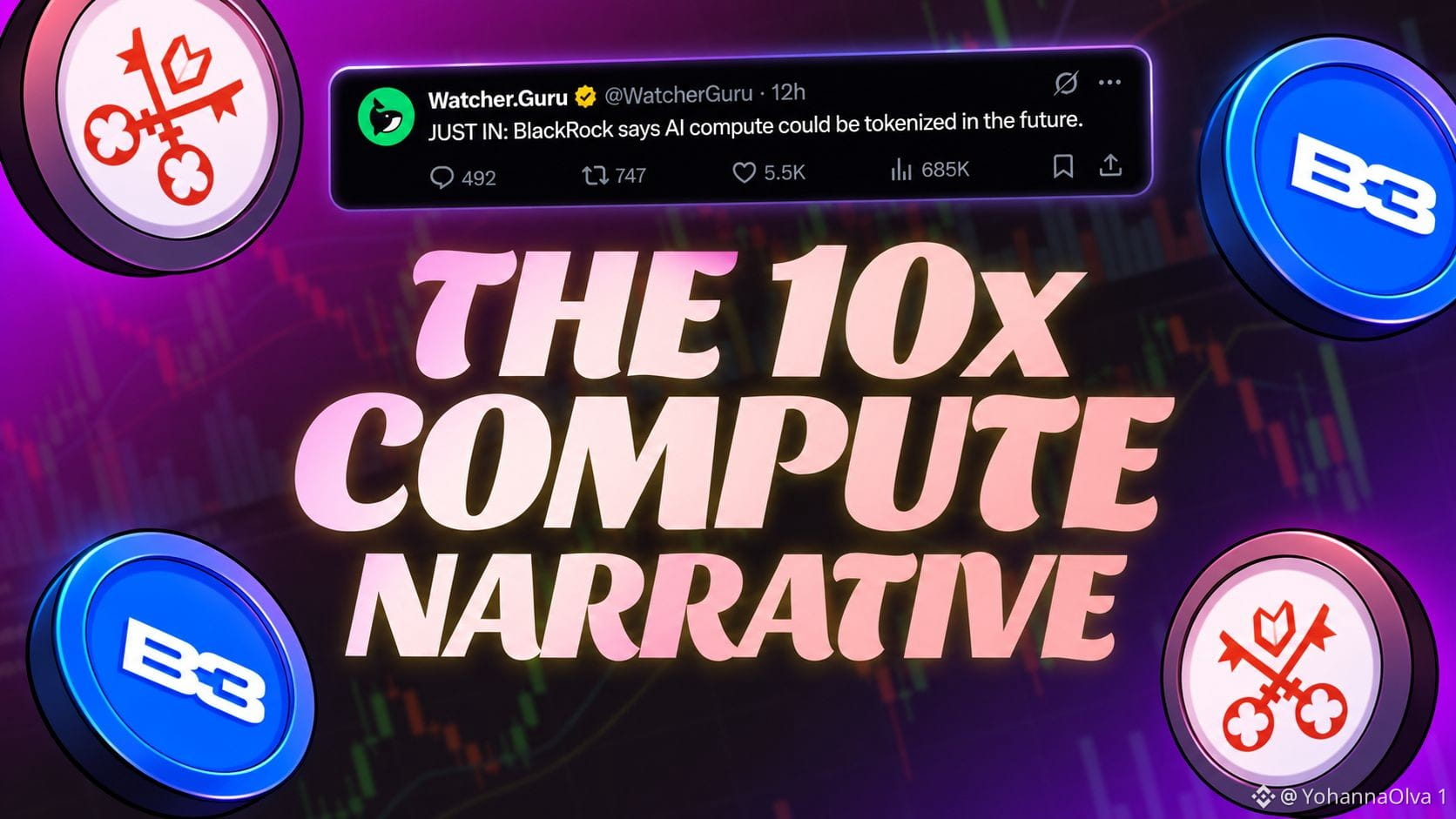
$B3 might be early to a 10x compute narrative 👀
BlackRock just pushed AI infrastructure into a much bigger conversation.
Its latest research says claims on compute capacity could eventually be tokenized, traded and used for programmable settlement, while $VVV already gives the market a crypto-native way to access AI inference through Venice.
I think $B3 sits where those ideas begin to overlap.
Not simply trading access to compute, but turning the physical GPU itself into productive infrastructure.
B3IQ already lets buyers own NVIDIA systems while B3 handles the build, hosting and commercial demand.
On select machines:
• Buyers can start with roughly 30% down.
• The machine can earn while the remaining balance is paid down.
• Owners keep 85% of realized gross revenue after B3’s network share.
That model looks more interesting if compute itself starts becoming a financial asset.
VVV gives exposure to the usage of AI compute.
B3 is building around ownership of the machines producing it.
If BlackRock is right that compute becomes tokenizable infrastructure, B3IQ is already building around the physical asset underneath that market.
For me, that is where the B3 thesis starts getting much bigger 🔥
#Altcoin Season# #DePIN
$B3 might be early to a 10x compute narrative 👀
BlackRock just pushed AI infrastructure into a much bigger conversation.
Its latest research says claims on compute capacity could eventually be tokenized, traded and used for programmable settlement, while $VVV already gives the market a crypto-native way to access AI inference through Venice.
I think $B3 sits where those ideas begin to overlap.
Not simply trading access to compute, but turning the physical GPU itself into productive infrastructure.
B3IQ already lets buyers own NVIDIA systems while B3 handles the build, hosting and commercial demand.
On select machines:
• Buyers can start with roughly 30% down.
• The machine can earn while the remaining balance is paid down.
• Owners keep 85% of realized gross revenue after B3’s network share.
That model looks more interesting if compute itself starts becoming a financial asset.
VVV gives exposure to the usage of AI compute.
B3 is building around ownership of the machines producing it.
If BlackRock is right that compute becomes tokenizable infrastructure, B3IQ is already building around the physical asset underneath that market.
For me, that is where the B3 thesis starts getting much bigger 🔥
#Altcoin Season# #DePIN
BlackRock just pushed AI infrastructure into a much bigger conversation.
Its latest research says claims on compute capacity could eventually be tokenized, traded and used for programmable settlement, while $VVV already gives the market a crypto-native way to access AI inference through Venice.
I think $B3 sits where those ideas begin to overlap.
Not simply trading access to compute, but turning the physical GPU itself into productive infrastructure.
B3IQ already lets buyers own NVIDIA systems while B3 handles the build, hosting and commercial demand.
On select machines:
• Buyers can start with roughly 30% down.
• The machine can earn while the remaining balance is paid down.
• Owners keep 85% of realized gross revenue after B3’s network share.
That model looks more interesting if compute itself starts becoming a financial asset.
VVV gives exposure to the usage of AI compute.
B3 is building around ownership of the machines producing it.
If BlackRock is right that compute becomes tokenizable infrastructure, B3IQ is already building around the physical asset underneath that market.
For me, that is where the B3 thesis starts getting much bigger 🔥
#Altcoin Season# #DePIN
55
You Can Now Vest Tokens To The Holders 💎
$JUP and Ethena taught this market that distribution design decides who stays. $BNKR is testing a version where holding is the thing that earns.
New on Arbitrum and Arc: a launch can vest tokens directly to holders rather than to the team, with a second option to route fees to holders in the quote token, the base token, or both. Both are written into the contract rather than administered by the platform.
What interests me is what it rewards.
Most token distribution pays for arrival. Airdrops reward being early, points reward activity, and neither pays anyone for still being there a year later. A vest that accrues to holders inverts that entirely.
The counterpoint deserves saying, because it is the obvious one.
Paying people to hold does not give them a reason to hold. Emissions aimed at loyalty still dilute somebody, and a token whose main attraction is receiving more of itself has a circular problem this industry has already lived through twice.
The version that survives contact with reality is the one where the payout comes from fee income rather than from supply, which is why the fees-to-holders option is the more interesting of the two.
Status matters here. These are experimental, live on two chains, with Base and Robinhood Chain described only as possible.
Before judging it I want to see one launch using it with real volume behind it, and then whether the holders it paid actually stayed.
#Arbitrum #Altcoin Season#
You Can Now Vest Tokens To The Holders 💎
$JUP and Ethena taught this market that distribution design decides who stays. $BNKR is testing a version where holding is the thing that earns.
New on Arbitrum and Arc: a launch can vest tokens directly to holders rather than to the team, with a second option to route fees to holders in the quote token, the base token, or both. Both are written into the contract rather than administered by the platform.
What interests me is what it rewards.
Most token distribution pays for arrival. Airdrops reward being early, points reward activity, and neither pays anyone for still being there a year later. A vest that accrues to holders inverts that entirely.
The counterpoint deserves saying, because it is the obvious one.
Paying people to hold does not give them a reason to hold. Emissions aimed at loyalty still dilute somebody, and a token whose main attraction is receiving more of itself has a circular problem this industry has already lived through twice.
The version that survives contact with reality is the one where the payout comes from fee income rather than from supply, which is why the fees-to-holders option is the more interesting of the two.
Status matters here. These are experimental, live on two chains, with Base and Robinhood Chain described only as possible.
Before judging it I want to see one launch using it with real volume behind it, and then whether the holders it paid actually stayed.
#Arbitrum #Altcoin Season#
$JUP and Ethena taught this market that distribution design decides who stays. $BNKR is testing a version where holding is the thing that earns.
New on Arbitrum and Arc: a launch can vest tokens directly to holders rather than to the team, with a second option to route fees to holders in the quote token, the base token, or both. Both are written into the contract rather than administered by the platform.
What interests me is what it rewards.
Most token distribution pays for arrival. Airdrops reward being early, points reward activity, and neither pays anyone for still being there a year later. A vest that accrues to holders inverts that entirely.
The counterpoint deserves saying, because it is the obvious one.
Paying people to hold does not give them a reason to hold. Emissions aimed at loyalty still dilute somebody, and a token whose main attraction is receiving more of itself has a circular problem this industry has already lived through twice.
The version that survives contact with reality is the one where the payout comes from fee income rather than from supply, which is why the fees-to-holders option is the more interesting of the two.
Status matters here. These are experimental, live on two chains, with Base and Robinhood Chain described only as possible.
Before judging it I want to see one launch using it with real volume behind it, and then whether the holders it paid actually stayed.
#Arbitrum #Altcoin Season#
90
Injective might surprise everyone with an 8x 👀
The market is already rewarding two of the clearest narratives across onchain finance with $HYPE becoming a major trading infrastructure bet, while $ONDO made institutional tokenization one of the strongest RWA themes.
I think Injective sits where those narratives begin to overlap, with equities and RWAs trading onchain alongside infrastructure designed for American financial markets.
An 8x sounds aggressive, I know but still, the version of Injective trading today is materially different from the one that reached its previous ATH.
Its position in the U.S. has developed across several fronts:
• Injective is the first L1 to have an SEC-registered transfer agent.
• INJ futures are live on Bitnomial’s CFTC-regulated U.S. exchange.
• Canary Capital has filed for a staked INJ ETF.
Those developments do not guarantee institutional adoption or price appreciation, but they give Injective an actual pathway across tokenization, onchain markets, and regulated access.
For me, the American angle is becoming a major part of the Injective thesis 🔥
#Macro Insights#
Injective might surprise everyone with an 8x 👀
The market is already rewarding two of the clearest narratives across onchain finance with $HYPE becoming a major trading infrastructure bet, while $ONDO made institutional tokenization one of the strongest RWA themes.
I think Injective sits where those narratives begin to overlap, with equities and RWAs trading onchain alongside infrastructure designed for American financial markets.
An 8x sounds aggressive, I know but still, the version of Injective trading today is materially different from the one that reached its previous ATH.
Its position in the U.S. has developed across several fronts:
• Injective is the first L1 to have an SEC-registered transfer agent.
• INJ futures are live on Bitnomial’s CFTC-regulated U.S. exchange.
• Canary Capital has filed for a staked INJ ETF.
Those developments do not guarantee institutional adoption or price appreciation, but they give Injective an actual pathway across tokenization, onchain markets, and regulated access.
For me, the American angle is becoming a major part of the Injective thesis 🔥
#Macro Insights#
The market is already rewarding two of the clearest narratives across onchain finance with $HYPE becoming a major trading infrastructure bet, while $ONDO made institutional tokenization one of the strongest RWA themes.
I think Injective sits where those narratives begin to overlap, with equities and RWAs trading onchain alongside infrastructure designed for American financial markets.
An 8x sounds aggressive, I know but still, the version of Injective trading today is materially different from the one that reached its previous ATH.
Its position in the U.S. has developed across several fronts:
• Injective is the first L1 to have an SEC-registered transfer agent.
• INJ futures are live on Bitnomial’s CFTC-regulated U.S. exchange.
• Canary Capital has filed for a staked INJ ETF.
Those developments do not guarantee institutional adoption or price appreciation, but they give Injective an actual pathway across tokenization, onchain markets, and regulated access.
For me, the American angle is becoming a major part of the Injective thesis 🔥
#Macro Insights#
46
$516M market cap for this story? 🟢
$ONDO owns a lot of the tokenized asset conversation on CMC. $RENDER brings the AI compute and infrastructure crowd that cares about what machines can actually use. Pyth connects both through the part nobody can skip: market data.
The Nasdaq Basic update makes that clearer.
Pyth has been approved as an external distributor to offer Nasdaq Basic, Nasdaq’s real-time quote and trade product for U.S. equities, through its Data Marketplace.
This gives Pyth stronger positioning inside the institutional market-data conversation.
The token chart already started reacting, with PYTH up over 8% in 24H and volume up more than 23%.
But the larger setup is still the product-to-market-cap gap.
3,500+ market feeds.
138+ first-party publishers.
1,901 equity feeds.
45 live Pyth Indices.
$10.4M ARR in August.
$2.9M gross new ARR.
$723.77B in August RWA perp volume priced by Pyth.
Now Nasdaq Basic enters the marketplace narrative.
At around $516M market cap, PYTH still looks like the market is pricing an oracle ticker while the product is moving toward a market-data business.
That is exactly the kind of gap I want to watch 📈
#Altcoin Season# #Trading
$516M market cap for this story? 🟢
$ONDO owns a lot of the tokenized asset conversation on CMC. $RENDER brings the AI compute and infrastructure crowd that cares about what machines can actually use. Pyth connects both through the part nobody can skip: market data.
The Nasdaq Basic update makes that clearer.
Pyth has been approved as an external distributor to offer Nasdaq Basic, Nasdaq’s real-time quote and trade product for U.S. equities, through its Data Marketplace.
This gives Pyth stronger positioning inside the institutional market-data conversation.
The token chart already started reacting, with PYTH up over 8% in 24H and volume up more than 23%.
But the larger setup is still the product-to-market-cap gap.
3,500+ market feeds.
138+ first-party publishers.
1,901 equity feeds.
45 live Pyth Indices.
$10.4M ARR in August.
$2.9M gross new ARR.
$723.77B in August RWA perp volume priced by Pyth.
Now Nasdaq Basic enters the marketplace narrative.
At around $516M market cap, PYTH still looks like the market is pricing an oracle ticker while the product is moving toward a market-data business.
That is exactly the kind of gap I want to watch 📈
#Altcoin Season# #Trading
$ONDO owns a lot of the tokenized asset conversation on CMC. $RENDER brings the AI compute and infrastructure crowd that cares about what machines can actually use. Pyth connects both through the part nobody can skip: market data.
The Nasdaq Basic update makes that clearer.
Pyth has been approved as an external distributor to offer Nasdaq Basic, Nasdaq’s real-time quote and trade product for U.S. equities, through its Data Marketplace.
This gives Pyth stronger positioning inside the institutional market-data conversation.
The token chart already started reacting, with PYTH up over 8% in 24H and volume up more than 23%.
But the larger setup is still the product-to-market-cap gap.
3,500+ market feeds.
138+ first-party publishers.
1,901 equity feeds.
45 live Pyth Indices.
$10.4M ARR in August.
$2.9M gross new ARR.
$723.77B in August RWA perp volume priced by Pyth.
Now Nasdaq Basic enters the marketplace narrative.
At around $516M market cap, PYTH still looks like the market is pricing an oracle ticker while the product is moving toward a market-data business.
That is exactly the kind of gap I want to watch 📈
#Altcoin Season# #Trading
48
Basecamp Could Reprice Sui’s Finance Thesis 🔥
$SUI has spent many years now building the foundations. Even its co-founder says the next reveal will unleash the full power of Sui’s financial composability.
That is a massive claim.
The ambition is to make Sui the best place in the world to put capital to work.
The foundations are already visible across DeepBook’s native liquidity, gasless stablecoin transfers and Hashi becoming the Bitcoin collateral layer.
Basecamp is where those separate pieces could finally become one connected financial system.
If capital can trade, borrow, settle and move across Sui without fragmented infrastructure, the network becomes much harder to value as just another Layer 1.
I’m watching this super closely, because composability is where good technology becomes an actual financial economy.
Sui has set the expectations extremely high.
Now Basecamp needs to show the market why.
#Altcoin Season# #DeFi
Basecamp Could Reprice Sui’s Finance Thesis 🔥
$SUI has spent many years now building the foundations. Even its co-founder says the next reveal will unleash the full power of Sui’s financial composability.
That is a massive claim.
The ambition is to make Sui the best place in the world to put capital to work.
The foundations are already visible across DeepBook’s native liquidity, gasless stablecoin transfers and Hashi becoming the Bitcoin collateral layer.
Basecamp is where those separate pieces could finally become one connected financial system.
If capital can trade, borrow, settle and move across Sui without fragmented infrastructure, the network becomes much harder to value as just another Layer 1.
I’m watching this super closely, because composability is where good technology becomes an actual financial economy.
Sui has set the expectations extremely high.
Now Basecamp needs to show the market why.
#Altcoin Season# #DeFi
$SUI has spent many years now building the foundations. Even its co-founder says the next reveal will unleash the full power of Sui’s financial composability.
That is a massive claim.
The ambition is to make Sui the best place in the world to put capital to work.
The foundations are already visible across DeepBook’s native liquidity, gasless stablecoin transfers and Hashi becoming the Bitcoin collateral layer.
Basecamp is where those separate pieces could finally become one connected financial system.
If capital can trade, borrow, settle and move across Sui without fragmented infrastructure, the network becomes much harder to value as just another Layer 1.
I’m watching this super closely, because composability is where good technology becomes an actual financial economy.
Sui has set the expectations extremely high.
Now Basecamp needs to show the market why.
#Altcoin Season# #DeFi
72
Get Smarter Position Sizing With AI 📊
Figuring out how much of your money actually deserves to go behind certain trades is an underrated skill.
Most people mismanage this part, but luckily there's a new vault from Pear Protocol that handles that automatically.
Every opportunity gets scored from 1–10 using factors like the strength of the statistical signal, liquidity, open interest and pair volatility. Position sizing then follows the quality of that signal.
So a potential $ZEC pair trade with stronger data behind it doesn't have to get treated the same as a weaker $SUI setup.
Your capital can be allocated based on conviction instead of giving every opportunity the same weight.
I think that's one of the more underrated parts of automated trading. The question isn't always just "WHAT is worth trading?”, but also “how much is this trade worth risking?”
Agent Pear Vault makes both decisions part of the strategy.
Trade with Agent Pear at pear.garden
#Altcoin Season#
Get Smarter Position Sizing With AI 📊
Figuring out how much of your money actually deserves to go behind certain trades is an underrated skill.
Most people mismanage this part, but luckily there's a new vault from Pear Protocol that handles that automatically.
Every opportunity gets scored from 1–10 using factors like the strength of the statistical signal, liquidity, open interest and pair volatility. Position sizing then follows the quality of that signal.
So a potential $ZEC pair trade with stronger data behind it doesn't have to get treated the same as a weaker $SUI setup.
Your capital can be allocated based on conviction instead of giving every opportunity the same weight.
I think that's one of the more underrated parts of automated trading. The question isn't always just "WHAT is worth trading?”, but also “how much is this trade worth risking?”
Agent Pear Vault makes both decisions part of the strategy.
Trade with Agent Pear at pear.garden
#Altcoin Season#
Figuring out how much of your money actually deserves to go behind certain trades is an underrated skill.
Most people mismanage this part, but luckily there's a new vault from Pear Protocol that handles that automatically.
Every opportunity gets scored from 1–10 using factors like the strength of the statistical signal, liquidity, open interest and pair volatility. Position sizing then follows the quality of that signal.
So a potential $ZEC pair trade with stronger data behind it doesn't have to get treated the same as a weaker $SUI setup.
Your capital can be allocated based on conviction instead of giving every opportunity the same weight.
I think that's one of the more underrated parts of automated trading. The question isn't always just "WHAT is worth trading?”, but also “how much is this trade worth risking?”
Agent Pear Vault makes both decisions part of the strategy.
Trade with Agent Pear at pear.garden
#Altcoin Season#
58
Every Token Treasury Is An Allocation Decision 💼
Anyone holding $TAO or $ONDO chose the kind of exposure they wanted. Projects have rarely had that choice, and most end up holding whatever their launch left them with.
Bankr changed one input this week. TAO is now selectable as the pairing asset for token launches on Base.
The pairing asset is what a pool's swap fees accrue in, so the choice quietly sets what the project's reserves are denominated in before a single trade happens.
That makes it an allocation decision, taken at launch, with no revenue yet to judge it by.
The case for choosing TAO is alignment. An AI or agent project ends up holding a position in the network its thesis depends on, built out of its own trading rather than out of a purchase or a treasury vote.
The counterpoint deserves equal airtime, and it is one I would want a team to answer.
That exposure is correlated. If the AI sector has a bad quarter, the token and the reserves behind it move down together, exactly when the reserves matter most. A less correlated denomination does the opposite, holding steadier through the periods when your own market is quiet.
Neither answer is wrong. They solve different problems, and a team should be able to say which one they were solving.
The usual conditions apply underneath all of it. Fees only accumulate where there is volume, so a market nobody trades allocates nothing. And TAO's volatility runs in both directions.
What I take from this is not about TAO specifically. It is that the denomination of a project's reserves has become a deliberate choice, made in public, at launch.
That is one more thing investors can actually read a team on.
#AI #Base
Every Token Treasury Is An Allocation Decision 💼
Anyone holding $TAO or $ONDO chose the kind of exposure they wanted. Projects have rarely had that choice, and most end up holding whatever their launch left them with.
Bankr changed one input this week. TAO is now selectable as the pairing asset for token launches on Base.
The pairing asset is what a pool's swap fees accrue in, so the choice quietly sets what the project's reserves are denominated in before a single trade happens.
That makes it an allocation decision, taken at launch, with no revenue yet to judge it by.
The case for choosing TAO is alignment. An AI or agent project ends up holding a position in the network its thesis depends on, built out of its own trading rather than out of a purchase or a treasury vote.
The counterpoint deserves equal airtime, and it is one I would want a team to answer.
That exposure is correlated. If the AI sector has a bad quarter, the token and the reserves behind it move down together, exactly when the reserves matter most. A less correlated denomination does the opposite, holding steadier through the periods when your own market is quiet.
Neither answer is wrong. They solve different problems, and a team should be able to say which one they were solving.
The usual conditions apply underneath all of it. Fees only accumulate where there is volume, so a market nobody trades allocates nothing. And TAO's volatility runs in both directions.
What I take from this is not about TAO specifically. It is that the denomination of a project's reserves has become a deliberate choice, made in public, at launch.
That is one more thing investors can actually read a team on.
#AI #Base
Anyone holding $TAO or $ONDO chose the kind of exposure they wanted. Projects have rarely had that choice, and most end up holding whatever their launch left them with.
Bankr changed one input this week. TAO is now selectable as the pairing asset for token launches on Base.
The pairing asset is what a pool's swap fees accrue in, so the choice quietly sets what the project's reserves are denominated in before a single trade happens.
That makes it an allocation decision, taken at launch, with no revenue yet to judge it by.
The case for choosing TAO is alignment. An AI or agent project ends up holding a position in the network its thesis depends on, built out of its own trading rather than out of a purchase or a treasury vote.
The counterpoint deserves equal airtime, and it is one I would want a team to answer.
That exposure is correlated. If the AI sector has a bad quarter, the token and the reserves behind it move down together, exactly when the reserves matter most. A less correlated denomination does the opposite, holding steadier through the periods when your own market is quiet.
Neither answer is wrong. They solve different problems, and a team should be able to say which one they were solving.
The usual conditions apply underneath all of it. Fees only accumulate where there is volume, so a market nobody trades allocates nothing. And TAO's volatility runs in both directions.
What I take from this is not about TAO specifically. It is that the denomination of a project's reserves has become a deliberate choice, made in public, at launch.
That is one more thing investors can actually read a team on.
#AI #Base
69
Noble can clear this line 🚀
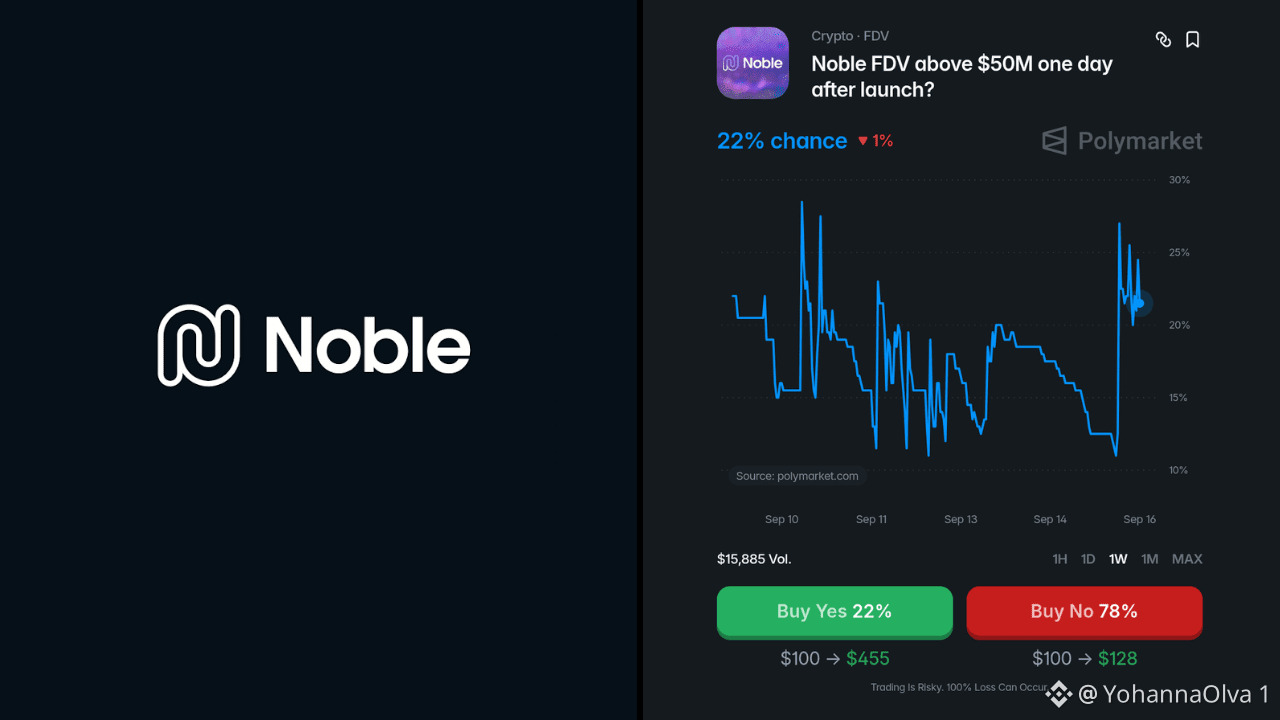
22% on Yes with only around $16K traded.
This feels early.
Polymarket is asking whether Noble can be above a $50M FDV one day after launch, and I think the market is being too conservative.
I'm taking Yes.
What matters to me is the size of the hurdle. We're not talking about Noble instantly becoming a multi-billion-dollar token. $50M during the first wave of launch speculation, liquidity and price discovery is a much more achievable target.
Noble itself remains an actively developed network, with mainnet software upgrades continuing through 2026.
At 22%, the payout is still attractive too.
A $10 position bought around 22% would represent roughly $45 at resolution if Yes wins, before fees and execution differences. That's why I like looking at probabilities before simply deciding whether something is "likely" or "unlikely."
The price matters.
I'd rather take a calculated prediction here than leave the same capital sitting in another $HYPE swing and hope the market gives me direction.
And if Noble expectations improve before launch, I can sell the Polymarket position early.
I don't need to wait for the final answer.
That's where prediction markets become trading markets.
#Altcoin Season#
Noble can clear this line 🚀
22% on Yes with only around $16K traded.
This feels early.
Polymarket is asking whether Noble can be above a $50M FDV one day after launch, and I think the market is being too conservative.
I'm taking Yes.
What matters to me is the size of the hurdle. We're not talking about Noble instantly becoming a multi-billion-dollar token. $50M during the first wave of launch speculation, liquidity and price discovery is a much more achievable target.
Noble itself remains an actively developed network, with mainnet software upgrades continuing through 2026.
At 22%, the payout is still attractive too.
A $10 position bought around 22% would represent roughly $45 at resolution if Yes wins, before fees and execution differences. That's why I like looking at probabilities before simply deciding whether something is "likely" or "unlikely."
The price matters.
I'd rather take a calculated prediction here than leave the same capital sitting in another $HYPE swing and hope the market gives me direction.
And if Noble expectations improve before launch, I can sell the Polymarket position early.
I don't need to wait for the final answer.
That's where prediction markets become trading markets.
#Altcoin Season#
22% on Yes with only around $16K traded.
This feels early.
Polymarket is asking whether Noble can be above a $50M FDV one day after launch, and I think the market is being too conservative.
I'm taking Yes.
What matters to me is the size of the hurdle. We're not talking about Noble instantly becoming a multi-billion-dollar token. $50M during the first wave of launch speculation, liquidity and price discovery is a much more achievable target.
Noble itself remains an actively developed network, with mainnet software upgrades continuing through 2026.
At 22%, the payout is still attractive too.
A $10 position bought around 22% would represent roughly $45 at resolution if Yes wins, before fees and execution differences. That's why I like looking at probabilities before simply deciding whether something is "likely" or "unlikely."
The price matters.
I'd rather take a calculated prediction here than leave the same capital sitting in another $HYPE swing and hope the market gives me direction.
And if Noble expectations improve before launch, I can sell the Polymarket position early.
I don't need to wait for the final answer.
That's where prediction markets become trading markets.
#Altcoin Season#
58
The Bar Gets Higher 📜
Did you know Space and Time has been thinking about compliance at the infrastructure level?
That's much more important to me than adding compliance after a product reaches scale.
The CLARITY framework raises a simple question for crypto projects:
Who controls what, and can the system prove how it operates?
Space and Time's answer is built around cryptographic verification.
Data computation can be proven.
Validator infrastructure distributes responsibility.
And applications don't need to treat every offchain result as trusted truth.
$NEAR has pushed the idea that blockchain infrastructure should become easier for users and applications to consume.
I think the next requirement is equally important.
That infrastructure also needs to become easier to verify.
Projects preparing for that standard before they're forced to are the ones I'm watching.
#Altcoin Season#
The Bar Gets Higher 📜
Did you know Space and Time has been thinking about compliance at the infrastructure level?
That's much more important to me than adding compliance after a product reaches scale.
The CLARITY framework raises a simple question for crypto projects:
Who controls what, and can the system prove how it operates?
Space and Time's answer is built around cryptographic verification.
Data computation can be proven.
Validator infrastructure distributes responsibility.
And applications don't need to treat every offchain result as trusted truth.
$NEAR has pushed the idea that blockchain infrastructure should become easier for users and applications to consume.
I think the next requirement is equally important.
That infrastructure also needs to become easier to verify.
Projects preparing for that standard before they're forced to are the ones I'm watching.
#Altcoin Season#
Did you know Space and Time has been thinking about compliance at the infrastructure level?
That's much more important to me than adding compliance after a product reaches scale.
The CLARITY framework raises a simple question for crypto projects:
Who controls what, and can the system prove how it operates?
Space and Time's answer is built around cryptographic verification.
Data computation can be proven.
Validator infrastructure distributes responsibility.
And applications don't need to treat every offchain result as trusted truth.
$NEAR has pushed the idea that blockchain infrastructure should become easier for users and applications to consume.
I think the next requirement is equally important.
That infrastructure also needs to become easier to verify.
Projects preparing for that standard before they're forced to are the ones I'm watching.
#Altcoin Season#
60
A Memecoin That Pays Holders In Nvidia 📈
Fee revenue actually reaching holders is why people track $HYPE and $SKY so closely. Until now it took a large protocol and a lot of governance to arrange.
Pools.fun , built by the Bankr team with SushiSwap on Robinhood Chain, just turned it into a toggle at launch.
A creator can send all of a token's fees to holders, and choose what those holders are paid in.
• Launch against NVDA and pay from the quote side, and holders receive NVDA
• Launch against WETH and pay in the token, and the fees are converted into the token and streamed to holders
• Launch against USDG and pay both sides, and holders receive each asset exactly as the fees arrive, with no conversion in between
The choice of payout asset is the part I keep thinking about.
A community token can distribute something the project does not issue itself. Holding it becomes a claim on trading activity, settled in an asset with its own market outside crypto entirely.
Distribution is also open. On tokens that convert one side, anyone can trigger the payout and keeps 0.5% of the amount converted, so the mechanism does not depend on the team or a keeper bot showing up.
Now the parts to be clear-eyed about.
Payouts come from trading fees, so a token nobody trades pays nothing. A payout in a tokenized stock carries that stock's drawdowns. Converting fees into the token is a mechanic, not a promise about anything else. And availability of tokenized assets depends on your jurisdiction.
Every cycle promises holders a share of revenue and mostly delivers emissions. This is a smaller, more honest version of that idea, and the payout asset is finally a real decision. $sky
#DeFi #Robinhood
A Memecoin That Pays Holders In Nvidia 📈
Fee revenue actually reaching holders is why people track $HYPE and $SKY so closely. Until now it took a large protocol and a lot of governance to arrange.
Pools.fun , built by the Bankr team with SushiSwap on Robinhood Chain, just turned it into a toggle at launch.
A creator can send all of a token's fees to holders, and choose what those holders are paid in.
• Launch against NVDA and pay from the quote side, and holders receive NVDA
• Launch against WETH and pay in the token, and the fees are converted into the token and streamed to holders
• Launch against USDG and pay both sides, and holders receive each asset exactly as the fees arrive, with no conversion in between
The choice of payout asset is the part I keep thinking about.
A community token can distribute something the project does not issue itself. Holding it becomes a claim on trading activity, settled in an asset with its own market outside crypto entirely.
Distribution is also open. On tokens that convert one side, anyone can trigger the payout and keeps 0.5% of the amount converted, so the mechanism does not depend on the team or a keeper bot showing up.
Now the parts to be clear-eyed about.
Payouts come from trading fees, so a token nobody trades pays nothing. A payout in a tokenized stock carries that stock's drawdowns. Converting fees into the token is a mechanic, not a promise about anything else. And availability of tokenized assets depends on your jurisdiction.
Every cycle promises holders a share of revenue and mostly delivers emissions. This is a smaller, more honest version of that idea, and the payout asset is finally a real decision. $sky
#DeFi #Robinhood
Fee revenue actually reaching holders is why people track $HYPE and $SKY so closely. Until now it took a large protocol and a lot of governance to arrange.
Pools.fun , built by the Bankr team with SushiSwap on Robinhood Chain, just turned it into a toggle at launch.
A creator can send all of a token's fees to holders, and choose what those holders are paid in.
• Launch against NVDA and pay from the quote side, and holders receive NVDA
• Launch against WETH and pay in the token, and the fees are converted into the token and streamed to holders
• Launch against USDG and pay both sides, and holders receive each asset exactly as the fees arrive, with no conversion in between
The choice of payout asset is the part I keep thinking about.
A community token can distribute something the project does not issue itself. Holding it becomes a claim on trading activity, settled in an asset with its own market outside crypto entirely.
Distribution is also open. On tokens that convert one side, anyone can trigger the payout and keeps 0.5% of the amount converted, so the mechanism does not depend on the team or a keeper bot showing up.
Now the parts to be clear-eyed about.
Payouts come from trading fees, so a token nobody trades pays nothing. A payout in a tokenized stock carries that stock's drawdowns. Converting fees into the token is a mechanic, not a promise about anything else. And availability of tokenized assets depends on your jurisdiction.
Every cycle promises holders a share of revenue and mostly delivers emissions. This is a smaller, more honest version of that idea, and the payout asset is finally a real decision. $sky
#DeFi #Robinhood
45
A Cultural Icon On Solana 🚀
$SOL just became home to one of the most iconic automotive brands in history.
$DMC is now live on Solana, backed by the Solana Foundation and powered by Wormhole. What that means for the ecosystem deserves serious attention.
Think about what Solana actually is. The highest retail density chain in crypto, the fastest settlement layer, and the place where real everyday participation happens at scale.
Mastercard and Google are already building here. DeLorean, the legendary Back to the Future car, just joined that list.
With 45years of in-demand IP and sustainable positive revenue, DeLorean is a brand people outside of crypto have loved since before the internet existed. All of it now accessible to Solana users for the first time.
Solana users can now buy, hold, stake, and use DMC across top platforms, access early tokenized vehicle drops, and participate in governance for a globally recognized brand.
The gullwing doors are open. I'm not waiting to see who walks through 🏎️💨
#Altcoin Season#
A Cultural Icon On Solana 🚀
$SOL just became home to one of the most iconic automotive brands in history.
$DMC is now live on Solana, backed by the Solana Foundation and powered by Wormhole. What that means for the ecosystem deserves serious attention.
Think about what Solana actually is. The highest retail density chain in crypto, the fastest settlement layer, and the place where real everyday participation happens at scale.
Mastercard and Google are already building here. DeLorean, the legendary Back to the Future car, just joined that list.
With 45years of in-demand IP and sustainable positive revenue, DeLorean is a brand people outside of crypto have loved since before the internet existed. All of it now accessible to Solana users for the first time.
Solana users can now buy, hold, stake, and use DMC across top platforms, access early tokenized vehicle drops, and participate in governance for a globally recognized brand.
The gullwing doors are open. I'm not waiting to see who walks through 🏎️💨
#Altcoin Season#
$SOL just became home to one of the most iconic automotive brands in history.
$DMC is now live on Solana, backed by the Solana Foundation and powered by Wormhole. What that means for the ecosystem deserves serious attention.
Think about what Solana actually is. The highest retail density chain in crypto, the fastest settlement layer, and the place where real everyday participation happens at scale.
Mastercard and Google are already building here. DeLorean, the legendary Back to the Future car, just joined that list.
With 45years of in-demand IP and sustainable positive revenue, DeLorean is a brand people outside of crypto have loved since before the internet existed. All of it now accessible to Solana users for the first time.
Solana users can now buy, hold, stake, and use DMC across top platforms, access early tokenized vehicle drops, and participate in governance for a globally recognized brand.
The gullwing doors are open. I'm not waiting to see who walks through 🏎️💨
#Altcoin Season#
53
You Hold Your Keys, Not Your Questions 🔑
Not your keys, not your coins is the first thing Bitcoin taught most of us, and yet I still type my most personal questions into apps that keep every word on somebody else's server.
$RENDER added 60,000 GPUs in April and rolled out Dispersed for AI inference, and the token behind all of it lives on $SOL where the compute under AI is already running on crypto rails.
The ownership model on top of it has not caught up.
In February an AI chat app with more than 50 million users left a database open and exposed around 300 million messages from roughly 25 million people, full chat histories included.
Nobody had to break a model to get that, somebody just found the pile.
That is what the current setup does by default, because every question has to be readable somewhere before it can be answered, so the questions collect in one place until someone finds them.
Arcium works the other way, splitting each input into fragments across a cluster of nodes so no single node ever holds a readable copy, and the cluster still returns the correct answer.
The computation leaves no readable archive behind, so there is nothing sitting there for anyone to stumble into.
Results settle on Solana as ordinary public transactions, and that layer has been live on Mainnet Alpha since February 2 with more than 2.5 million computations run so far.
Blackthorn is the protocol that brings the same setup to AI models, and it has not shipped yet, so that is the release I am watching.
Holding your keys was step one, and I think step two is using AI in a way that leaves nothing behind for anyone to find.
#AI #Solana
You Hold Your Keys, Not Your Questions 🔑
Not your keys, not your coins is the first thing Bitcoin taught most of us, and yet I still type my most personal questions into apps that keep every word on somebody else's server.
$RENDER added 60,000 GPUs in April and rolled out Dispersed for AI inference, and the token behind all of it lives on $SOL where the compute under AI is already running on crypto rails.
The ownership model on top of it has not caught up.
In February an AI chat app with more than 50 million users left a database open and exposed around 300 million messages from roughly 25 million people, full chat histories included.
Nobody had to break a model to get that, somebody just found the pile.
That is what the current setup does by default, because every question has to be readable somewhere before it can be answered, so the questions collect in one place until someone finds them.
Arcium works the other way, splitting each input into fragments across a cluster of nodes so no single node ever holds a readable copy, and the cluster still returns the correct answer.
The computation leaves no readable archive behind, so there is nothing sitting there for anyone to stumble into.
Results settle on Solana as ordinary public transactions, and that layer has been live on Mainnet Alpha since February 2 with more than 2.5 million computations run so far.
Blackthorn is the protocol that brings the same setup to AI models, and it has not shipped yet, so that is the release I am watching.
Holding your keys was step one, and I think step two is using AI in a way that leaves nothing behind for anyone to find.
#AI #Solana
Not your keys, not your coins is the first thing Bitcoin taught most of us, and yet I still type my most personal questions into apps that keep every word on somebody else's server.
$RENDER added 60,000 GPUs in April and rolled out Dispersed for AI inference, and the token behind all of it lives on $SOL where the compute under AI is already running on crypto rails.
The ownership model on top of it has not caught up.
In February an AI chat app with more than 50 million users left a database open and exposed around 300 million messages from roughly 25 million people, full chat histories included.
Nobody had to break a model to get that, somebody just found the pile.
That is what the current setup does by default, because every question has to be readable somewhere before it can be answered, so the questions collect in one place until someone finds them.
Arcium works the other way, splitting each input into fragments across a cluster of nodes so no single node ever holds a readable copy, and the cluster still returns the correct answer.
The computation leaves no readable archive behind, so there is nothing sitting there for anyone to stumble into.
Results settle on Solana as ordinary public transactions, and that layer has been live on Mainnet Alpha since February 2 with more than 2.5 million computations run so far.
Blackthorn is the protocol that brings the same setup to AI models, and it has not shipped yet, so that is the release I am watching.
Holding your keys was step one, and I think step two is using AI in a way that leaves nothing behind for anyone to find.
#AI #Solana
64
Privacy is becoming financial infra 🔒
I see financial privacy as a fundamental right, which is why $XMR and $ZEC remain enduring parts of the crypto conversation, but I think the next privacy cycle will extend beyond private transfers.
As equities, funds, and RWAs move onchain, public-by-default records can expose sensitive transaction details and commercial activity.
That creates a practical constraint for institutions operating in competitive or regulated markets.
Injective has revealed that it is developing native onchain privacy designed to integrate directly into the network, and the disclosed direction focuses on privacy for institutional transactions and tokenized assets, including RWAs.
If Injective delivers network-level privacy, institutions could gain stronger confidentiality within the same onchain infra used for issuance and markets.
For me, this is one of the more important Injective developments to watch 👀
Privacy is becoming financial infra 🔒
I see financial privacy as a fundamental right, which is why $XMR and $ZEC remain enduring parts of the crypto conversation, but I think the next privacy cycle will extend beyond private transfers.
As equities, funds, and RWAs move onchain, public-by-default records can expose sensitive transaction details and commercial activity.
That creates a practical constraint for institutions operating in competitive or regulated markets.
Injective has revealed that it is developing native onchain privacy designed to integrate directly into the network, and the disclosed direction focuses on privacy for institutional transactions and tokenized assets, including RWAs.
If Injective delivers network-level privacy, institutions could gain stronger confidentiality within the same onchain infra used for issuance and markets.
For me, this is one of the more important Injective developments to watch 👀
I see financial privacy as a fundamental right, which is why $XMR and $ZEC remain enduring parts of the crypto conversation, but I think the next privacy cycle will extend beyond private transfers.
As equities, funds, and RWAs move onchain, public-by-default records can expose sensitive transaction details and commercial activity.
That creates a practical constraint for institutions operating in competitive or regulated markets.
Injective has revealed that it is developing native onchain privacy designed to integrate directly into the network, and the disclosed direction focuses on privacy for institutional transactions and tokenized assets, including RWAs.
If Injective delivers network-level privacy, institutions could gain stronger confidentiality within the same onchain infra used for issuance and markets.
For me, this is one of the more important Injective developments to watch 👀
62
Your Bid Should Not Reveal Your Budget 🎨
A public auction gives the seller more information than the buyer ever intended to share.
$BLUR made NFT trading faster and more professional, but a wallet placing a bid still brings a readable history that can reveal what else the bidder owns.
That means the seller can start pricing the buyer instead of pricing the asset.
$ZEC can hide the payment after a sale, but shielding a transfer does not give a marketplace a private way to prove the bidder can actually settle before the auction closes.
Midnight separates those two problems, keeping the bid logic and wallet state unreadable while proving the buyer satisfies the rules of the sale.
Webisoft is already building a private trading venue on Midnight, which makes sealed execution a product direction rather than a theoretical privacy feature.
The seller gets settlement certainty without receiving a free look at the buyer's balance sheet.
High-value markets will eventually treat private bidding the same way traditional auctions treat sealed envelopes.
#Privacy #NFT
Your Bid Should Not Reveal Your Budget 🎨
A public auction gives the seller more information than the buyer ever intended to share.
$BLUR made NFT trading faster and more professional, but a wallet placing a bid still brings a readable history that can reveal what else the bidder owns.
That means the seller can start pricing the buyer instead of pricing the asset.
$ZEC can hide the payment after a sale, but shielding a transfer does not give a marketplace a private way to prove the bidder can actually settle before the auction closes.
Midnight separates those two problems, keeping the bid logic and wallet state unreadable while proving the buyer satisfies the rules of the sale.
Webisoft is already building a private trading venue on Midnight, which makes sealed execution a product direction rather than a theoretical privacy feature.
The seller gets settlement certainty without receiving a free look at the buyer's balance sheet.
High-value markets will eventually treat private bidding the same way traditional auctions treat sealed envelopes.
#Privacy #NFT
A public auction gives the seller more information than the buyer ever intended to share.
$BLUR made NFT trading faster and more professional, but a wallet placing a bid still brings a readable history that can reveal what else the bidder owns.
That means the seller can start pricing the buyer instead of pricing the asset.
$ZEC can hide the payment after a sale, but shielding a transfer does not give a marketplace a private way to prove the bidder can actually settle before the auction closes.
Midnight separates those two problems, keeping the bid logic and wallet state unreadable while proving the buyer satisfies the rules of the sale.
Webisoft is already building a private trading venue on Midnight, which makes sealed execution a product direction rather than a theoretical privacy feature.
The seller gets settlement certainty without receiving a free look at the buyer's balance sheet.
High-value markets will eventually treat private bidding the same way traditional auctions treat sealed envelopes.
#Privacy #NFT

58
The Top Perp DEXs Got An AI Upgrade 🤖
Trading on $HYPE and $LIT is one thing. Trading on both with a free AI agent that watches your portfolio and the market 24/7 to surface the best trading opportunities is a much different experience.
Pear Protocol's Agent Pear gives you non-custodial execution across both Hyperliquid and Lighter, but the real advantage is basically having a quant in your pocket the entire time.
Pitch it a trade and it'll tell you when the data says your setup probably sucks instead of blindly agreeing with you. It can research the latest quant data, news and sentiment, then optimize the sizing, hedge and risk protections before you execute.
And Agent Pear monitors markets around the clock. One of the coolest features is that it automatically rebalances your portfolio when positions drift so you can feel secure even when you're offline.
This is how you get your trading experience to work harder for you than even you do 🫡
#Altcoin Season#
The Top Perp DEXs Got An AI Upgrade 🤖
Trading on $HYPE and $LIT is one thing. Trading on both with a free AI agent that watches your portfolio and the market 24/7 to surface the best trading opportunities is a much different experience.
Pear Protocol's Agent Pear gives you non-custodial execution across both Hyperliquid and Lighter, but the real advantage is basically having a quant in your pocket the entire time.
Pitch it a trade and it'll tell you when the data says your setup probably sucks instead of blindly agreeing with you. It can research the latest quant data, news and sentiment, then optimize the sizing, hedge and risk protections before you execute.
And Agent Pear monitors markets around the clock. One of the coolest features is that it automatically rebalances your portfolio when positions drift so you can feel secure even when you're offline.
This is how you get your trading experience to work harder for you than even you do 🫡
#Altcoin Season#
Trading on $HYPE and $LIT is one thing. Trading on both with a free AI agent that watches your portfolio and the market 24/7 to surface the best trading opportunities is a much different experience.
Pear Protocol's Agent Pear gives you non-custodial execution across both Hyperliquid and Lighter, but the real advantage is basically having a quant in your pocket the entire time.
Pitch it a trade and it'll tell you when the data says your setup probably sucks instead of blindly agreeing with you. It can research the latest quant data, news and sentiment, then optimize the sizing, hedge and risk protections before you execute.
And Agent Pear monitors markets around the clock. One of the coolest features is that it automatically rebalances your portfolio when positions drift so you can feel secure even when you're offline.
This is how you get your trading experience to work harder for you than even you do 🫡
#Altcoin Season#

50
Your Validator Is Paying For Distance 🌍
A validator can run identical software to every other machine on the network and still perform worse simply because it sits in the wrong part of the world.
$SOL has pushed validator performance far enough that networking quality increasingly matters alongside compute, because block data still needs to travel between physical machines before consensus can move forward.
That means an operator in a weaker-connected region can lose time even when its hardware and software are perfectly competitive.
And $ADA has spent years emphasizing geographically distributed infrastructure, but that distribution only survives if operators outside the major data-center hubs can remain economically competitive.
So decentralization can look healthy on a dashboard while the incentives underneath quietly push machines toward the same locations.
DoubleZero attacks that incentive at the networking layer by combining dedicated links from independent contributors into routes designed specifically for distributed systems.
That gives validators another way to reach each other without depending entirely on whatever path the public internet chooses between them.
Its networking model can improve connectivity between geographically separated infrastructure without pretending that Tokyo suddenly becomes physically closer to Frankfurt.
The most decentralized validator set still becomes concentrated if only a handful of cities can compete.
#Validators #Altcoin Season#
Your Validator Is Paying For Distance 🌍
A validator can run identical software to every other machine on the network and still perform worse simply because it sits in the wrong part of the world.
$SOL has pushed validator performance far enough that networking quality increasingly matters alongside compute, because block data still needs to travel between physical machines before consensus can move forward.
That means an operator in a weaker-connected region can lose time even when its hardware and software are perfectly competitive.
And $ADA has spent years emphasizing geographically distributed infrastructure, but that distribution only survives if operators outside the major data-center hubs can remain economically competitive.
So decentralization can look healthy on a dashboard while the incentives underneath quietly push machines toward the same locations.
DoubleZero attacks that incentive at the networking layer by combining dedicated links from independent contributors into routes designed specifically for distributed systems.
That gives validators another way to reach each other without depending entirely on whatever path the public internet chooses between them.
Its networking model can improve connectivity between geographically separated infrastructure without pretending that Tokyo suddenly becomes physically closer to Frankfurt.
The most decentralized validator set still becomes concentrated if only a handful of cities can compete.
#Validators #Altcoin Season#
A validator can run identical software to every other machine on the network and still perform worse simply because it sits in the wrong part of the world.
$SOL has pushed validator performance far enough that networking quality increasingly matters alongside compute, because block data still needs to travel between physical machines before consensus can move forward.
That means an operator in a weaker-connected region can lose time even when its hardware and software are perfectly competitive.
And $ADA has spent years emphasizing geographically distributed infrastructure, but that distribution only survives if operators outside the major data-center hubs can remain economically competitive.
So decentralization can look healthy on a dashboard while the incentives underneath quietly push machines toward the same locations.
DoubleZero attacks that incentive at the networking layer by combining dedicated links from independent contributors into routes designed specifically for distributed systems.
That gives validators another way to reach each other without depending entirely on whatever path the public internet chooses between them.
Its networking model can improve connectivity between geographically separated infrastructure without pretending that Tokyo suddenly becomes physically closer to Frankfurt.
The most decentralized validator set still becomes concentrated if only a handful of cities can compete.
#Validators #Altcoin Season#

52
The most important crypto bill, simplified. 📋
Space and Time published something I have not seen any other infrastructure project attempt: a full compliance framework mapped to every obligation the Digital Asset Market Clarity Act introduces.
Here is what CLARITY actually does in plain terms.
It draws a hard line between CFTC and SEC jurisdiction for the first time in US crypto history.
Tokens that prove sufficient decentralization go to the CFTC, everything else stays with the SEC.
Every token issuer, exchange, broker, dealer, and stablecoin issuer faces new continuous disclosure requirements.
Not periodic snapshots, continuous verifiable evidence.
$ZK has been making the case that verifiable computation is the baseline any compliant system needs and Space and Time is where that argument meets institutional finance in production.
The projects that try to meet these requirements through legacy reporting will spend months building what Space and Time already has running.
Insider vesting schedules proven onchain.
DAO votes queryable by any regulator on demand.
Real-time NAV for tokenized funds.
Reserve attestations that never go stale.
All of it live, all of it verifiable, all of it Space and Time.
The bar for compliance just moved permanently upward and Space and Time is already above it.
#Altcoin Season# #RWA
The most important crypto bill, simplified. 📋
Space and Time published something I have not seen any other infrastructure project attempt: a full compliance framework mapped to every obligation the Digital Asset Market Clarity Act introduces.
Here is what CLARITY actually does in plain terms.
It draws a hard line between CFTC and SEC jurisdiction for the first time in US crypto history.
Tokens that prove sufficient decentralization go to the CFTC, everything else stays with the SEC.
Every token issuer, exchange, broker, dealer, and stablecoin issuer faces new continuous disclosure requirements.
Not periodic snapshots, continuous verifiable evidence.
$ZK has been making the case that verifiable computation is the baseline any compliant system needs and Space and Time is where that argument meets institutional finance in production.
The projects that try to meet these requirements through legacy reporting will spend months building what Space and Time already has running.
Insider vesting schedules proven onchain.
DAO votes queryable by any regulator on demand.
Real-time NAV for tokenized funds.
Reserve attestations that never go stale.
All of it live, all of it verifiable, all of it Space and Time.
The bar for compliance just moved permanently upward and Space and Time is already above it.
#Altcoin Season# #RWA
Space and Time published something I have not seen any other infrastructure project attempt: a full compliance framework mapped to every obligation the Digital Asset Market Clarity Act introduces.
Here is what CLARITY actually does in plain terms.
It draws a hard line between CFTC and SEC jurisdiction for the first time in US crypto history.
Tokens that prove sufficient decentralization go to the CFTC, everything else stays with the SEC.
Every token issuer, exchange, broker, dealer, and stablecoin issuer faces new continuous disclosure requirements.
Not periodic snapshots, continuous verifiable evidence.
$ZK has been making the case that verifiable computation is the baseline any compliant system needs and Space and Time is where that argument meets institutional finance in production.
The projects that try to meet these requirements through legacy reporting will spend months building what Space and Time already has running.
Insider vesting schedules proven onchain.
DAO votes queryable by any regulator on demand.
Real-time NAV for tokenized funds.
Reserve attestations that never go stale.
All of it live, all of it verifiable, all of it Space and Time.
The bar for compliance just moved permanently upward and Space and Time is already above it.
#Altcoin Season# #RWA
54
Kaito Pulse Is the FOMO Trading Layer for X
Crypto has always been social - traders discover new assets through posts, follow influential accounts and watch narratives spread across the timeline. The problem is that social trading has mostly relied on trust.
You may have seen Poorgoat_ on X hold a 7 figure bag of the memecoin $CATE , but this was purely relied on with screenshots rather than anyone doing due diligence and checking his wallet.
Anyone can post a winning screenshot or claim they entered before a move.
$KAITO Pulse introduces something more useful: verifiable context to these claims.
With Pulse, users can connect and verify their Hyperliquid or Polymarket activity, bringing public positions and trading history directly into the X experience. Instead of judging a trader only by what they say, you can examine whether their activity supports their commentary.
That changes how FOMO works. When an asset begins taking over the timeline, Pulse can help you identify who has genuine exposure, who has a credible history and who may simply be chasing engagement.
For Hyperliquid traders, prediction market participants and crypto researchers, this creates a more transparent form of social trading, one where reputation is increasingly supported by receipts.
Kaito Pulse turns the X timeline from a feed of opinions into a layer of verifiable market context.
With Kaito Pulse, the timeline is becoming part of the trading interface.
#Altcoin Season# #Meme Alpha#
Kaito Pulse Is the FOMO Trading Layer for X
Crypto has always been social - traders discover new assets through posts, follow influential accounts and watch narratives spread across the timeline. The problem is that social trading has mostly relied on trust.
You may have seen Poorgoat_ on X hold a 7 figure bag of the memecoin $CATE , but this was purely relied on with screenshots rather than anyone doing due diligence and checking his wallet.
Anyone can post a winning screenshot or claim they entered before a move.
$KAITO Pulse introduces something more useful: verifiable context to these claims.
With Pulse, users can connect and verify their Hyperliquid or Polymarket activity, bringing public positions and trading history directly into the X experience. Instead of judging a trader only by what they say, you can examine whether their activity supports their commentary.
That changes how FOMO works. When an asset begins taking over the timeline, Pulse can help you identify who has genuine exposure, who has a credible history and who may simply be chasing engagement.
For Hyperliquid traders, prediction market participants and crypto researchers, this creates a more transparent form of social trading, one where reputation is increasingly supported by receipts.
Kaito Pulse turns the X timeline from a feed of opinions into a layer of verifiable market context.
With Kaito Pulse, the timeline is becoming part of the trading interface.
#Altcoin Season# #Meme Alpha#
Crypto has always been social - traders discover new assets through posts, follow influential accounts and watch narratives spread across the timeline. The problem is that social trading has mostly relied on trust.
You may have seen Poorgoat_ on X hold a 7 figure bag of the memecoin $CATE , but this was purely relied on with screenshots rather than anyone doing due diligence and checking his wallet.
Anyone can post a winning screenshot or claim they entered before a move.
$KAITO Pulse introduces something more useful: verifiable context to these claims.
With Pulse, users can connect and verify their Hyperliquid or Polymarket activity, bringing public positions and trading history directly into the X experience. Instead of judging a trader only by what they say, you can examine whether their activity supports their commentary.
That changes how FOMO works. When an asset begins taking over the timeline, Pulse can help you identify who has genuine exposure, who has a credible history and who may simply be chasing engagement.
For Hyperliquid traders, prediction market participants and crypto researchers, this creates a more transparent form of social trading, one where reputation is increasingly supported by receipts.
Kaito Pulse turns the X timeline from a feed of opinions into a layer of verifiable market context.
With Kaito Pulse, the timeline is becoming part of the trading interface.
#Altcoin Season# #Meme Alpha#
67
Tokenized Stock Volume Just Jumped 415% 📈
The distance between a culture trade like $ANSEM and the RWA infrastructure around $XDC is collapsing as both become programmable assets in the same market.
Over the 30 days ending August 29, tokenized equity transfer volume reached $29.5B, an increase of more than 415%.
Traders are using these assets for more than passive exposure.
The memestock trend turns stocks into liquidity, identity, and raw material for entirely new markets.
A tokenized stock can now sit underneath a meme as its paired asset.
The missing layer was somewhere anyone could create those combinations.
That is where Zora enters the picture.
Custom Pairs let creators build markets around supported assets across Base, Robinhood Chain, and Solana.
More than 4,000 pairs have already been created.
Most will fade, which is the natural cost of open experimentation.
The important part is that thousands of new markets can now test what earns attention, liquidity, and staying power.
Zora is becoming the bridge between meme culture and the expanding RWA economy.
It deserves far more visibility for how early it is to this convergence.
Anyone following the memestock narrative should be watching what gets paired on Zora next.
#RWA #Altcoin Season#
Tokenized Stock Volume Just Jumped 415% 📈
The distance between a culture trade like $ANSEM and the RWA infrastructure around $XDC is collapsing as both become programmable assets in the same market.
Over the 30 days ending August 29, tokenized equity transfer volume reached $29.5B, an increase of more than 415%.
Traders are using these assets for more than passive exposure.
The memestock trend turns stocks into liquidity, identity, and raw material for entirely new markets.
A tokenized stock can now sit underneath a meme as its paired asset.
The missing layer was somewhere anyone could create those combinations.
That is where Zora enters the picture.
Custom Pairs let creators build markets around supported assets across Base, Robinhood Chain, and Solana.
More than 4,000 pairs have already been created.
Most will fade, which is the natural cost of open experimentation.
The important part is that thousands of new markets can now test what earns attention, liquidity, and staying power.
Zora is becoming the bridge between meme culture and the expanding RWA economy.
It deserves far more visibility for how early it is to this convergence.
Anyone following the memestock narrative should be watching what gets paired on Zora next.
#RWA #Altcoin Season#
The distance between a culture trade like $ANSEM and the RWA infrastructure around $XDC is collapsing as both become programmable assets in the same market.
Over the 30 days ending August 29, tokenized equity transfer volume reached $29.5B, an increase of more than 415%.
Traders are using these assets for more than passive exposure.
The memestock trend turns stocks into liquidity, identity, and raw material for entirely new markets.
A tokenized stock can now sit underneath a meme as its paired asset.
The missing layer was somewhere anyone could create those combinations.
That is where Zora enters the picture.
Custom Pairs let creators build markets around supported assets across Base, Robinhood Chain, and Solana.
More than 4,000 pairs have already been created.
Most will fade, which is the natural cost of open experimentation.
The important part is that thousands of new markets can now test what earns attention, liquidity, and staying power.
Zora is becoming the bridge between meme culture and the expanding RWA economy.
It deserves far more visibility for how early it is to this convergence.
Anyone following the memestock narrative should be watching what gets paired on Zora next.
#RWA #Altcoin Season#
62
The Fee You Never Agreed To 👀
Gas is the number you approve before you sign, and it is not the one that decides your fill.
That gets decided in the gap between broadcasting an order and having it settle, where anyone reading the mempool can price against you.
And none of it shows up as a fee anywhere.
Most of the aggregator volume on Solana routes through $JUP , so most of the order flow worth reading crosses a single surface.
That surface is valuable enough that Jupiter spent real engineering on MEV protection and Jito bundles to narrow the window, while the institutional side went the other way entirely and $CC now settles size on domains where a counterparty only receives its own slice of a deal.
Two completely different markets, both paying to close the same exposure.
That is the part I keep coming back to.
Not a rounding error, when a retail router and a network run by Goldman Sachs, BNP Paribas and Nasdaq are both spending money on the same problem.
Arcium works one level below both of them.
A computation splits across a cluster of nodes and each node only holds a fragment of the input, so no operator assembles the whole thing at any point.
So an order book can match on that basis without the venue reading the orders it is matching.
The trade that comes out still settles on Solana as an ordinary public transaction anyone can verify.
But I want to be precise about what is live.
Sealing a computation has run on Mainnet Alpha since February 2, with more than 4,000 nodes and over 30 apps in production.
Sealing a transfer amount is C-SPL, and that has not shipped.
Which means the confidential order book everyone talks about is half built, and the half that exists is the harder half.
My read is, whoever ships confidential matching on Solana first takes the size that has never come onchain, because an order nobody can read is an order nobody can trade ahead of.
#DeFi #Solana
The Fee You Never Agreed To 👀
Gas is the number you approve before you sign, and it is not the one that decides your fill.
That gets decided in the gap between broadcasting an order and having it settle, where anyone reading the mempool can price against you.
And none of it shows up as a fee anywhere.
Most of the aggregator volume on Solana routes through $JUP , so most of the order flow worth reading crosses a single surface.
That surface is valuable enough that Jupiter spent real engineering on MEV protection and Jito bundles to narrow the window, while the institutional side went the other way entirely and $CC now settles size on domains where a counterparty only receives its own slice of a deal.
Two completely different markets, both paying to close the same exposure.
That is the part I keep coming back to.
Not a rounding error, when a retail router and a network run by Goldman Sachs, BNP Paribas and Nasdaq are both spending money on the same problem.
Arcium works one level below both of them.
A computation splits across a cluster of nodes and each node only holds a fragment of the input, so no operator assembles the whole thing at any point.
So an order book can match on that basis without the venue reading the orders it is matching.
The trade that comes out still settles on Solana as an ordinary public transaction anyone can verify.
But I want to be precise about what is live.
Sealing a computation has run on Mainnet Alpha since February 2, with more than 4,000 nodes and over 30 apps in production.
Sealing a transfer amount is C-SPL, and that has not shipped.
Which means the confidential order book everyone talks about is half built, and the half that exists is the harder half.
My read is, whoever ships confidential matching on Solana first takes the size that has never come onchain, because an order nobody can read is an order nobody can trade ahead of.
#DeFi #Solana
Gas is the number you approve before you sign, and it is not the one that decides your fill.
That gets decided in the gap between broadcasting an order and having it settle, where anyone reading the mempool can price against you.
And none of it shows up as a fee anywhere.
Most of the aggregator volume on Solana routes through $JUP , so most of the order flow worth reading crosses a single surface.
That surface is valuable enough that Jupiter spent real engineering on MEV protection and Jito bundles to narrow the window, while the institutional side went the other way entirely and $CC now settles size on domains where a counterparty only receives its own slice of a deal.
Two completely different markets, both paying to close the same exposure.
That is the part I keep coming back to.
Not a rounding error, when a retail router and a network run by Goldman Sachs, BNP Paribas and Nasdaq are both spending money on the same problem.
Arcium works one level below both of them.
A computation splits across a cluster of nodes and each node only holds a fragment of the input, so no operator assembles the whole thing at any point.
So an order book can match on that basis without the venue reading the orders it is matching.
The trade that comes out still settles on Solana as an ordinary public transaction anyone can verify.
But I want to be precise about what is live.
Sealing a computation has run on Mainnet Alpha since February 2, with more than 4,000 nodes and over 30 apps in production.
Sealing a transfer amount is C-SPL, and that has not shipped.
Which means the confidential order book everyone talks about is half built, and the half that exists is the harder half.
My read is, whoever ships confidential matching on Solana first takes the size that has never come onchain, because an order nobody can read is an order nobody can trade ahead of.
#DeFi #Solana
70
Войдите, чтобы посмотреть больше материала
Присоединяйтесь к пользователям криптовалют по всему миру на Binance Square
⚡️ Получайте новейшую и полезную информацию о криптоактивах.
💬 Нам доверяет крупнейшая в мире криптобиржа.
👍 Получите достоверные аналитические данные от верифицированных создателей контента.
Эл. почта/номер телефона