
Jens 1
81 Публикации

Jens 1
Отправить жалобу
Заблокировать пользователя
Gas fees don't scare me
0 подписок(и/а)
0 подписчиков(а)
3 понравилось
Посты
·
--
Your Wallet Should Not Be Your Credit Score 💳
A lending app can read every asset you hold before it decides what terms to offer you, which turns an open ledger into a permanent financial profile.
$AAVE made onchain lending useful at scale, but the collateral behind a position is still visible to anyone who knows the address.
That means the protocol can price the loan correctly while every competitor, bot and counterparty learns how much liquidity sits behind the borrower.
Going completely opaque does not solve lending either, because $XMR can hide a balance but cannot prove that hidden collateral actually clears a required threshold.
So the market keeps choosing between visible solvency and invisible money nobody can verify.
Midnight lets a borrower prove the collateral condition without publishing the rest of the wallet that settled it.
The lender gets the answer it needs while the borrower keeps unrelated positions out of the underwriting process.
That is the part private credit eventually needs onchain, because nobody applying for a mortgage hands the bank a live feed of every account they will ever use.
#Privacy #DeFi
Your Wallet Should Not Be Your Credit Score 💳
A lending app can read every asset you hold before it decides what terms to offer you, which turns an open ledger into a permanent financial profile.
$AAVE made onchain lending useful at scale, but the collateral behind a position is still visible to anyone who knows the address.
That means the protocol can price the loan correctly while every competitor, bot and counterparty learns how much liquidity sits behind the borrower.
Going completely opaque does not solve lending either, because $XMR can hide a balance but cannot prove that hidden collateral actually clears a required threshold.
So the market keeps choosing between visible solvency and invisible money nobody can verify.
Midnight lets a borrower prove the collateral condition without publishing the rest of the wallet that settled it.
The lender gets the answer it needs while the borrower keeps unrelated positions out of the underwriting process.
That is the part private credit eventually needs onchain, because nobody applying for a mortgage hands the bank a live feed of every account they will ever use.
#Privacy #DeFi
A lending app can read every asset you hold before it decides what terms to offer you, which turns an open ledger into a permanent financial profile.
$AAVE made onchain lending useful at scale, but the collateral behind a position is still visible to anyone who knows the address.
That means the protocol can price the loan correctly while every competitor, bot and counterparty learns how much liquidity sits behind the borrower.
Going completely opaque does not solve lending either, because $XMR can hide a balance but cannot prove that hidden collateral actually clears a required threshold.
So the market keeps choosing between visible solvency and invisible money nobody can verify.
Midnight lets a borrower prove the collateral condition without publishing the rest of the wallet that settled it.
The lender gets the answer it needs while the borrower keeps unrelated positions out of the underwriting process.
That is the part private credit eventually needs onchain, because nobody applying for a mortgage hands the bank a live feed of every account they will ever use.
#Privacy #DeFi
50
·
--
Raoul Pal Got Smoked Yet Won’t Flip 🔥
$SOL has already shown how violently high-beta L1s can recover once liquidity returns.
$SUI is still roughly 80% below its highs, and people want Raoul Pal to abandon the thesis.
He refuses.
Raoul sees the drawdown as normal behaviour for an asset sitting at the sharp end of the risk curve.
He also still rates Sui among crypto’s fastest and cheapest networks.
I think the background grind supports his conviction.
Sui’s latest network snapshot shows:
• 22.76 million transactions in 24 hours
• 144,502 active addresses
• Nearly $447 million in stablecoins
• More than $58 million in daily DEX volume
Sui also cut its reference gas price roughly 5X and made supported stablecoin transfers free.
The price got crushed while the network kept getting cheaper, faster and more active.
Raoul’s thesis accepts the volatility and focuses on whether adoption keeps compounding underneath it.
When market liquidity returns, I think Sui has the fundamentals to move far more aggressively than the crowd expects.
#Altcoin Season#
Raoul Pal Got Smoked Yet Won’t Flip 🔥
$SOL has already shown how violently high-beta L1s can recover once liquidity returns.
$SUI is still roughly 80% below its highs, and people want Raoul Pal to abandon the thesis.
He refuses.
Raoul sees the drawdown as normal behaviour for an asset sitting at the sharp end of the risk curve.
He also still rates Sui among crypto’s fastest and cheapest networks.
I think the background grind supports his conviction.
Sui’s latest network snapshot shows:
• 22.76 million transactions in 24 hours
• 144,502 active addresses
• Nearly $447 million in stablecoins
• More than $58 million in daily DEX volume
Sui also cut its reference gas price roughly 5X and made supported stablecoin transfers free.
The price got crushed while the network kept getting cheaper, faster and more active.
Raoul’s thesis accepts the volatility and focuses on whether adoption keeps compounding underneath it.
When market liquidity returns, I think Sui has the fundamentals to move far more aggressively than the crowd expects.
#Altcoin Season#
$SOL has already shown how violently high-beta L1s can recover once liquidity returns.
$SUI is still roughly 80% below its highs, and people want Raoul Pal to abandon the thesis.
He refuses.
Raoul sees the drawdown as normal behaviour for an asset sitting at the sharp end of the risk curve.
He also still rates Sui among crypto’s fastest and cheapest networks.
I think the background grind supports his conviction.
Sui’s latest network snapshot shows:
• 22.76 million transactions in 24 hours
• 144,502 active addresses
• Nearly $447 million in stablecoins
• More than $58 million in daily DEX volume
Sui also cut its reference gas price roughly 5X and made supported stablecoin transfers free.
The price got crushed while the network kept getting cheaper, faster and more active.
Raoul’s thesis accepts the volatility and focuses on whether adoption keeps compounding underneath it.
When market liquidity returns, I think Sui has the fundamentals to move far more aggressively than the crowd expects.
#Altcoin Season#
51
·
--
AI Startups Still Need Too Much Code 🤖
$ICP represents the programmable compute side of the AI economy, where software can operate onchain. $AAVE represents the DeFi infrastructure an autonomous agent can use once it holds a wallet and takes actions.
The market has built infrastructure for agents, but creating one still assumes the founder can code or manage engineers.
That excludes creators who understand the product, audience and business model but cannot build the software.
Launchpads solve distribution and liquidity after a token exists.
Traditional accelerators add capital and advice, while the technical build remains with the founder. So the missing layer is a place where someone can build the agent, connect its capabilities and fund development through the same system.
Bankr’s terminal is trying to put those pieces together without requiring code.
A creator can design an agent with its own wallet then install skills and connect actions into automated workflows.
Four parts of that model matter.
• Custom agents built around the creator’s idea
• Installable DeFi skills that add onchain actions
• Automated workflows connecting those actions
• Token launches where swap fees can help cover costs such as LLM inference
Bankr Fund then adds support after launch, and its latest investment was ClawBank.
The fund purchased ClawBank tokens and locked them for one year, making this the second project it has supported.
ClawBank is building the financial and corporate infrastructure agents need to operate independently.
The part I find interesting is that creation, token funding and post-launch support now sit inside the same ecosystem.
Two investments are still a small portfolio, so I am watching whether these projects keep shipping once the first wave of token attention passes.
If they become durable businesses, Bankr could start looking less like a launchpad and more like an onchain accelerator for agent founders.
#AI #DeFi
AI Startups Still Need Too Much Code 🤖
$ICP represents the programmable compute side of the AI economy, where software can operate onchain. $AAVE represents the DeFi infrastructure an autonomous agent can use once it holds a wallet and takes actions.
The market has built infrastructure for agents, but creating one still assumes the founder can code or manage engineers.
That excludes creators who understand the product, audience and business model but cannot build the software.
Launchpads solve distribution and liquidity after a token exists.
Traditional accelerators add capital and advice, while the technical build remains with the founder. So the missing layer is a place where someone can build the agent, connect its capabilities and fund development through the same system.
Bankr’s terminal is trying to put those pieces together without requiring code.
A creator can design an agent with its own wallet then install skills and connect actions into automated workflows.
Four parts of that model matter.
• Custom agents built around the creator’s idea
• Installable DeFi skills that add onchain actions
• Automated workflows connecting those actions
• Token launches where swap fees can help cover costs such as LLM inference
Bankr Fund then adds support after launch, and its latest investment was ClawBank.
The fund purchased ClawBank tokens and locked them for one year, making this the second project it has supported.
ClawBank is building the financial and corporate infrastructure agents need to operate independently.
The part I find interesting is that creation, token funding and post-launch support now sit inside the same ecosystem.
Two investments are still a small portfolio, so I am watching whether these projects keep shipping once the first wave of token attention passes.
If they become durable businesses, Bankr could start looking less like a launchpad and more like an onchain accelerator for agent founders.
#AI #DeFi
$ICP represents the programmable compute side of the AI economy, where software can operate onchain. $AAVE represents the DeFi infrastructure an autonomous agent can use once it holds a wallet and takes actions.
The market has built infrastructure for agents, but creating one still assumes the founder can code or manage engineers.
That excludes creators who understand the product, audience and business model but cannot build the software.
Launchpads solve distribution and liquidity after a token exists.
Traditional accelerators add capital and advice, while the technical build remains with the founder. So the missing layer is a place where someone can build the agent, connect its capabilities and fund development through the same system.
Bankr’s terminal is trying to put those pieces together without requiring code.
A creator can design an agent with its own wallet then install skills and connect actions into automated workflows.
Four parts of that model matter.
• Custom agents built around the creator’s idea
• Installable DeFi skills that add onchain actions
• Automated workflows connecting those actions
• Token launches where swap fees can help cover costs such as LLM inference
Bankr Fund then adds support after launch, and its latest investment was ClawBank.
The fund purchased ClawBank tokens and locked them for one year, making this the second project it has supported.
ClawBank is building the financial and corporate infrastructure agents need to operate independently.
The part I find interesting is that creation, token funding and post-launch support now sit inside the same ecosystem.
Two investments are still a small portfolio, so I am watching whether these projects keep shipping once the first wave of token attention passes.
If they become durable businesses, Bankr could start looking less like a launchpad and more like an onchain accelerator for agent founders.
#AI #DeFi
33
·
--
Banks Cannot Paste Their Book Anywhere 🔒
A bank cannot put its positions into a chatbot, a hospital cannot put patient records in, and a law firm cannot put discovery in.
So the work that would be worth the most simply never runs.
More than $130M has gone into $ZAMA to build confidential computation for exactly those institutions, which is a lot of capital chasing a problem nobody outside the category talks about.
$CC is the other half of that picture, settling more than $4 trillion of tokenized RWA volume a year with Goldman Sachs, BNP Paribas, Visa and Nasdaq running the network themselves.
Those are the same institutions that cannot let a model near their books.
Sealed chips looked like the answer for a while, and the problem is that almost nobody has them.
Most of the world's compute sits on ordinary GPUs, which is where this work is going to run whether the guarantee is ready or not.
That gap is the thing I find most interesting in the whole AI trade right now.
Everybody is pricing compute capacity and almost nobody is pricing whether the operator can read the job.
Arcium replaces the sealed chip with cryptography, splitting a computation across a cluster of nodes so each one holds a fragment and none can read the input.
So it runs on ordinary hardware, which is the entire point of doing it this way.
The network underneath has been live on Solana since February 2, with more than 4,000 nodes and over 30 apps, and teams building there have raised more than $7.5M.
But Blackthorn is the AI protocol meant to bring this to models, and it is still to come.
Banks and hospitals have had the data the whole time, and the first network that computes on it without ever receiving it will take the enterprise side of this market.
#AI #RWA
Banks Cannot Paste Their Book Anywhere 🔒
A bank cannot put its positions into a chatbot, a hospital cannot put patient records in, and a law firm cannot put discovery in.
So the work that would be worth the most simply never runs.
More than $130M has gone into $ZAMA to build confidential computation for exactly those institutions, which is a lot of capital chasing a problem nobody outside the category talks about.
$CC is the other half of that picture, settling more than $4 trillion of tokenized RWA volume a year with Goldman Sachs, BNP Paribas, Visa and Nasdaq running the network themselves.
Those are the same institutions that cannot let a model near their books.
Sealed chips looked like the answer for a while, and the problem is that almost nobody has them.
Most of the world's compute sits on ordinary GPUs, which is where this work is going to run whether the guarantee is ready or not.
That gap is the thing I find most interesting in the whole AI trade right now.
Everybody is pricing compute capacity and almost nobody is pricing whether the operator can read the job.
Arcium replaces the sealed chip with cryptography, splitting a computation across a cluster of nodes so each one holds a fragment and none can read the input.
So it runs on ordinary hardware, which is the entire point of doing it this way.
The network underneath has been live on Solana since February 2, with more than 4,000 nodes and over 30 apps, and teams building there have raised more than $7.5M.
But Blackthorn is the AI protocol meant to bring this to models, and it is still to come.
Banks and hospitals have had the data the whole time, and the first network that computes on it without ever receiving it will take the enterprise side of this market.
#AI #RWA
A bank cannot put its positions into a chatbot, a hospital cannot put patient records in, and a law firm cannot put discovery in.
So the work that would be worth the most simply never runs.
More than $130M has gone into $ZAMA to build confidential computation for exactly those institutions, which is a lot of capital chasing a problem nobody outside the category talks about.
$CC is the other half of that picture, settling more than $4 trillion of tokenized RWA volume a year with Goldman Sachs, BNP Paribas, Visa and Nasdaq running the network themselves.
Those are the same institutions that cannot let a model near their books.
Sealed chips looked like the answer for a while, and the problem is that almost nobody has them.
Most of the world's compute sits on ordinary GPUs, which is where this work is going to run whether the guarantee is ready or not.
That gap is the thing I find most interesting in the whole AI trade right now.
Everybody is pricing compute capacity and almost nobody is pricing whether the operator can read the job.
Arcium replaces the sealed chip with cryptography, splitting a computation across a cluster of nodes so each one holds a fragment and none can read the input.
So it runs on ordinary hardware, which is the entire point of doing it this way.
The network underneath has been live on Solana since February 2, with more than 4,000 nodes and over 30 apps, and teams building there have raised more than $7.5M.
But Blackthorn is the AI protocol meant to bring this to models, and it is still to come.
Banks and hospitals have had the data the whole time, and the first network that computes on it without ever receiving it will take the enterprise side of this market.
#AI #RWA
71
·
--
Locked Until Nobody Can Peek 🔐
A stand out project like Theoriq freezes every claim before an experiment even runs. What counts as success. What has to be beaten. All locked in place well in advance.
A final evaluation window gets sealed on top of that, unreadable even by accident until the method and scoring are already completely fixed.
It opens exactly once. Whatever it says becomes the answer. No do-overs, no quiet second attempt.
Years of trust got built around interoperability rules that don't bend once they're set either, which is exactly the discipline $QNT has become known for across its own ecosystem.
Shuffled data a real signal has to survive. Planted leaks a system has to actually catch. Placebo signals that must score at pure chance. The whole battery exists purely to catch a team quietly fooling itself.
Backing a process engineered to stay skeptical of its own success, not just its failures, is what holding $THQ actually means underneath the branding.
Most teams design tests built to prove they're right.
This one is designed to make it genuinely hard to be wrong without noticing it happened.
#Altcoin Season#
Locked Until Nobody Can Peek 🔐
A stand out project like Theoriq freezes every claim before an experiment even runs. What counts as success. What has to be beaten. All locked in place well in advance.
A final evaluation window gets sealed on top of that, unreadable even by accident until the method and scoring are already completely fixed.
It opens exactly once. Whatever it says becomes the answer. No do-overs, no quiet second attempt.
Years of trust got built around interoperability rules that don't bend once they're set either, which is exactly the discipline $QNT has become known for across its own ecosystem.
Shuffled data a real signal has to survive. Planted leaks a system has to actually catch. Placebo signals that must score at pure chance. The whole battery exists purely to catch a team quietly fooling itself.
Backing a process engineered to stay skeptical of its own success, not just its failures, is what holding $THQ actually means underneath the branding.
Most teams design tests built to prove they're right.
This one is designed to make it genuinely hard to be wrong without noticing it happened.
#Altcoin Season#
A stand out project like Theoriq freezes every claim before an experiment even runs. What counts as success. What has to be beaten. All locked in place well in advance.
A final evaluation window gets sealed on top of that, unreadable even by accident until the method and scoring are already completely fixed.
It opens exactly once. Whatever it says becomes the answer. No do-overs, no quiet second attempt.
Years of trust got built around interoperability rules that don't bend once they're set either, which is exactly the discipline $QNT has become known for across its own ecosystem.
Shuffled data a real signal has to survive. Planted leaks a system has to actually catch. Placebo signals that must score at pure chance. The whole battery exists purely to catch a team quietly fooling itself.
Backing a process engineered to stay skeptical of its own success, not just its failures, is what holding $THQ actually means underneath the branding.
Most teams design tests built to prove they're right.
This one is designed to make it genuinely hard to be wrong without noticing it happened.
#Altcoin Season#
54
·
--
Launchpads Make You Show Your Whole Bag 🎯
Qualifying for an allocation tier means proving what you hold, and every launchpad does that by making you show all of it.
Serious money is going into fixing this, and $ZAMA raised over $118M at its token auction this year to run computations on data that stays encrypted the whole way through.
Their route unlocks the data for an approved party at the end, which works and still leaves a readable copy somewhere.
Going fully dark does not work either, and $XMR holds about $7.46B at rank sixteen because people want unreadable balances, but an unreadable balance cannot qualify you for anything.
So you either publish your bag to get an allocation or you hold something no launchpad can check.
Midnight answers only the question being asked, so a contract confirms you clear the tier without listing what else you own.
The same proof covers a whitelist, a gated mint or a rewards tier, because all three are the same question from different projects.
Every allocation you ever qualified for told that project how big you are, and none of them will keep needing to once a proof can answer instead.
#Privacy #Altcoin Season#
Launchpads Make You Show Your Whole Bag 🎯
Qualifying for an allocation tier means proving what you hold, and every launchpad does that by making you show all of it.
Serious money is going into fixing this, and $ZAMA raised over $118M at its token auction this year to run computations on data that stays encrypted the whole way through.
Their route unlocks the data for an approved party at the end, which works and still leaves a readable copy somewhere.
Going fully dark does not work either, and $XMR holds about $7.46B at rank sixteen because people want unreadable balances, but an unreadable balance cannot qualify you for anything.
So you either publish your bag to get an allocation or you hold something no launchpad can check.
Midnight answers only the question being asked, so a contract confirms you clear the tier without listing what else you own.
The same proof covers a whitelist, a gated mint or a rewards tier, because all three are the same question from different projects.
Every allocation you ever qualified for told that project how big you are, and none of them will keep needing to once a proof can answer instead.
#Privacy #Altcoin Season#
Qualifying for an allocation tier means proving what you hold, and every launchpad does that by making you show all of it.
Serious money is going into fixing this, and $ZAMA raised over $118M at its token auction this year to run computations on data that stays encrypted the whole way through.
Their route unlocks the data for an approved party at the end, which works and still leaves a readable copy somewhere.
Going fully dark does not work either, and $XMR holds about $7.46B at rank sixteen because people want unreadable balances, but an unreadable balance cannot qualify you for anything.
So you either publish your bag to get an allocation or you hold something no launchpad can check.
Midnight answers only the question being asked, so a contract confirms you clear the tier without listing what else you own.
The same proof covers a whitelist, a gated mint or a rewards tier, because all three are the same question from different projects.
Every allocation you ever qualified for told that project how big you are, and none of them will keep needing to once a proof can answer instead.
#Privacy #Altcoin Season#

66
·
--
AI Is Moving Into The Trading Screen 🧠
When I research AI markets like $TAO and $RENDER I still move between the chart, social feeds, and a separate research tool, and every switch means rebuilding the context behind the position.
That workflow is manageable when the market is quiet, but volatility turns each extra step into a delay.
But now Aevo answered that issue.
Elfa now sits inside the Aevo trading interface, keeping the selected market visible while the trader asks AI questions, so every trader can use it for free to research markets and request trade setups without leaving Aevo.
That keeps the research attached to the position from the first question to the final decision.
For me, this is a more useful direction for AI inside trading products 🌟
#Macro Insights#
AI Is Moving Into The Trading Screen 🧠
When I research AI markets like $TAO and $RENDER I still move between the chart, social feeds, and a separate research tool, and every switch means rebuilding the context behind the position.
That workflow is manageable when the market is quiet, but volatility turns each extra step into a delay.
But now Aevo answered that issue.
Elfa now sits inside the Aevo trading interface, keeping the selected market visible while the trader asks AI questions, so every trader can use it for free to research markets and request trade setups without leaving Aevo.
That keeps the research attached to the position from the first question to the final decision.
For me, this is a more useful direction for AI inside trading products 🌟
#Macro Insights#
When I research AI markets like $TAO and $RENDER I still move between the chart, social feeds, and a separate research tool, and every switch means rebuilding the context behind the position.
That workflow is manageable when the market is quiet, but volatility turns each extra step into a delay.
But now Aevo answered that issue.
Elfa now sits inside the Aevo trading interface, keeping the selected market visible while the trader asks AI questions, so every trader can use it for free to research markets and request trade setups without leaving Aevo.
That keeps the research attached to the position from the first question to the final decision.
For me, this is a more useful direction for AI inside trading products 🌟
#Macro Insights#
83
·
--
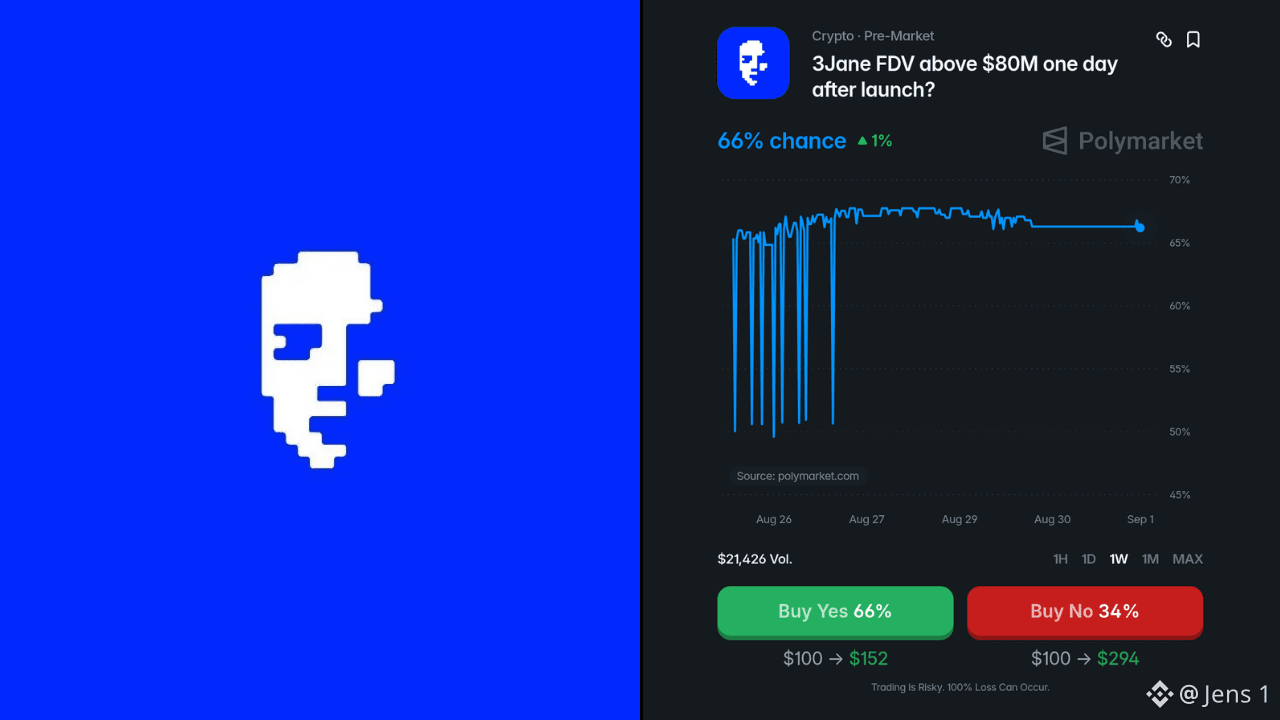
Will 3Jane's FDV clear $80M? 📈
Rough start, calm finish. That's the whole arc of this chart in one line.
66% chance right now, up slightly. Early on this thing kept diving hard and recovering just as fast, but it's been steady near the highs for a while now.
$21,426 in volume shows a real crowd has already settled on this side.
I'm taking Yes. Volatility calming down into a steady high usually means the market found its actual number.
$HYPE has funded a decent share of this position, a far better use of the coin than just holding and hoping for a pump.
$POL rides along on plenty of these FDV questions too, its presence on the platform keeps growing right along with it.
You can walk away from this trade anytime, you're not locked in until launch day.
Polymarket remains the clearest way to cash in on a read this steady.
#Altcoin Season#
Will 3Jane's FDV clear $80M? 📈
Rough start, calm finish. That's the whole arc of this chart in one line.
66% chance right now, up slightly. Early on this thing kept diving hard and recovering just as fast, but it's been steady near the highs for a while now.
$21,426 in volume shows a real crowd has already settled on this side.
I'm taking Yes. Volatility calming down into a steady high usually means the market found its actual number.
$HYPE has funded a decent share of this position, a far better use of the coin than just holding and hoping for a pump.
$POL rides along on plenty of these FDV questions too, its presence on the platform keeps growing right along with it.
You can walk away from this trade anytime, you're not locked in until launch day.
Polymarket remains the clearest way to cash in on a read this steady.
#Altcoin Season#
Rough start, calm finish. That's the whole arc of this chart in one line.
66% chance right now, up slightly. Early on this thing kept diving hard and recovering just as fast, but it's been steady near the highs for a while now.
$21,426 in volume shows a real crowd has already settled on this side.
I'm taking Yes. Volatility calming down into a steady high usually means the market found its actual number.
$HYPE has funded a decent share of this position, a far better use of the coin than just holding and hoping for a pump.
$POL rides along on plenty of these FDV questions too, its presence on the platform keeps growing right along with it.
You can walk away from this trade anytime, you're not locked in until launch day.
Polymarket remains the clearest way to cash in on a read this steady.
#Altcoin Season#
74
·
--
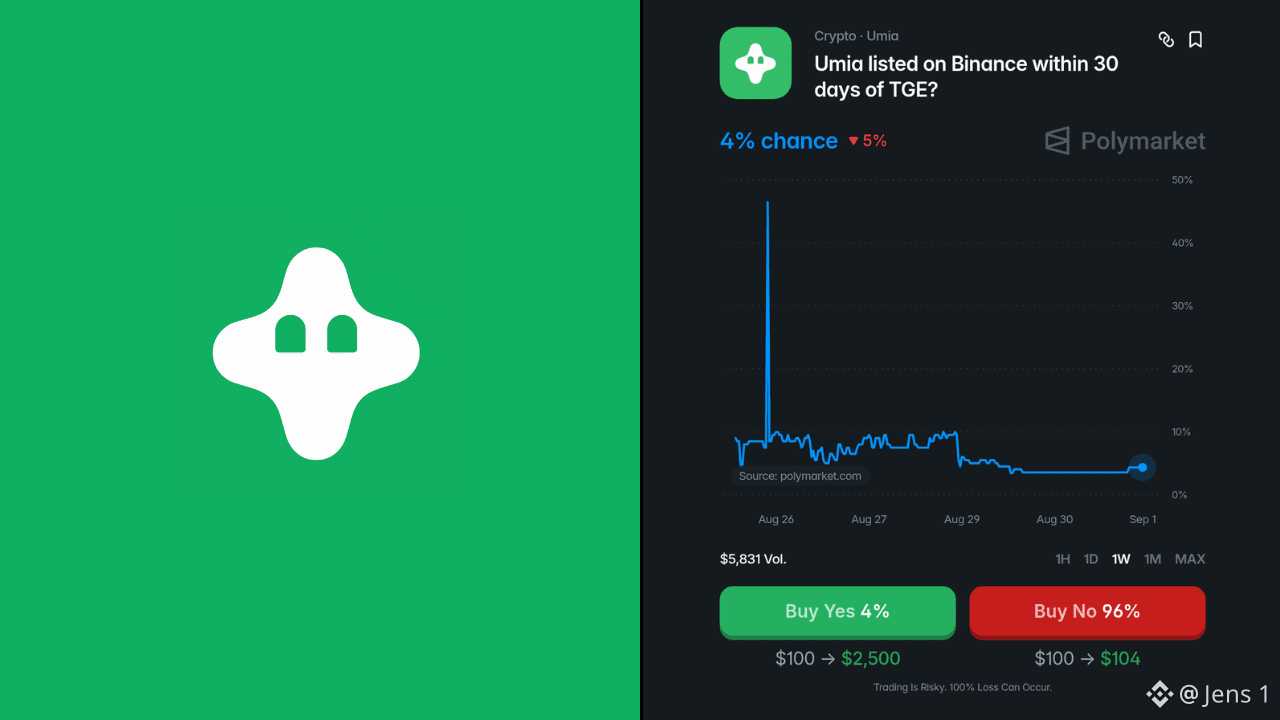
Will Umia list on Binance in time? 👀
This chart already had its moment and blew right through it. One massive spike shot this all the way up near 48%, then it came crashing back down just as fast.
4% chance right now, down 5%, and it's been grinding along near the bottom ever since that crash.
Still a fairly quiet market too, only $5,831 in volume so far, which makes it a genuinely fresh opportunity if you've got a read nobody else has caught yet.
I'm taking No here. A spike that fades that completely usually means the excitement wasn't backed by anything real.
Funding this read through $TRUMP is honestly a sharper move than just holding the coin and hoping price does something on its own.
$SOL keeps showing up in these fast moving listing questions too, and its footprint on Polymarket only keeps growing.
You're never locked in either, you can walk away from this position whenever you want, long before the 30 day window even closes.
Polymarket remains the place to trade a read like this instead of just talking about it.
#Altcoin Season#
Will Umia list on Binance in time? 👀
This chart already had its moment and blew right through it. One massive spike shot this all the way up near 48%, then it came crashing back down just as fast.
4% chance right now, down 5%, and it's been grinding along near the bottom ever since that crash.
Still a fairly quiet market too, only $5,831 in volume so far, which makes it a genuinely fresh opportunity if you've got a read nobody else has caught yet.
I'm taking No here. A spike that fades that completely usually means the excitement wasn't backed by anything real.
Funding this read through $TRUMP is honestly a sharper move than just holding the coin and hoping price does something on its own.
$SOL keeps showing up in these fast moving listing questions too, and its footprint on Polymarket only keeps growing.
You're never locked in either, you can walk away from this position whenever you want, long before the 30 day window even closes.
Polymarket remains the place to trade a read like this instead of just talking about it.
#Altcoin Season#
This chart already had its moment and blew right through it. One massive spike shot this all the way up near 48%, then it came crashing back down just as fast.
4% chance right now, down 5%, and it's been grinding along near the bottom ever since that crash.
Still a fairly quiet market too, only $5,831 in volume so far, which makes it a genuinely fresh opportunity if you've got a read nobody else has caught yet.
I'm taking No here. A spike that fades that completely usually means the excitement wasn't backed by anything real.
Funding this read through $TRUMP is honestly a sharper move than just holding the coin and hoping price does something on its own.
$SOL keeps showing up in these fast moving listing questions too, and its footprint on Polymarket only keeps growing.
You're never locked in either, you can walk away from this position whenever you want, long before the 30 day window even closes.
Polymarket remains the place to trade a read like this instead of just talking about it.
#Altcoin Season#
69
·
--
Volatility Is Back And I'm Entering 🔥
The huge $HYPE spike and also the $ETH move… every volatility window used to mean the same two choices. Size down so a liquidation doesn't wipe you, or size normal and accept that a wick might end the trade before the move plays out.
I've been doing this long enough to know both options feel bad. Size down and you're in the trade but not really in it. Size normal and you're watching your stop like it's the only thing that matters.
The tools changed what that decision looks like for me.
When volatility spikes now I can open a PERPS+ position on Aevo with the max loss fixed before I confirm, not a stop that gets hunted, a hard floor baked into the structure. Size the position from what I'm willing to lose, not from what I'm trying to capture. Or I go through Options Easy Mode, pick direction, define the downside, and the position can't cost me more than I agreed to when I opened it.
Same volatility. Same market. The entry just doesn't carry the same binary anymore 👀
#Altcoin Season#
Volatility Is Back And I'm Entering 🔥
The huge $HYPE spike and also the $ETH move… every volatility window used to mean the same two choices. Size down so a liquidation doesn't wipe you, or size normal and accept that a wick might end the trade before the move plays out.
I've been doing this long enough to know both options feel bad. Size down and you're in the trade but not really in it. Size normal and you're watching your stop like it's the only thing that matters.
The tools changed what that decision looks like for me.
When volatility spikes now I can open a PERPS+ position on Aevo with the max loss fixed before I confirm, not a stop that gets hunted, a hard floor baked into the structure. Size the position from what I'm willing to lose, not from what I'm trying to capture. Or I go through Options Easy Mode, pick direction, define the downside, and the position can't cost me more than I agreed to when I opened it.
Same volatility. Same market. The entry just doesn't carry the same binary anymore 👀
#Altcoin Season#
The huge $HYPE spike and also the $ETH move… every volatility window used to mean the same two choices. Size down so a liquidation doesn't wipe you, or size normal and accept that a wick might end the trade before the move plays out.
I've been doing this long enough to know both options feel bad. Size down and you're in the trade but not really in it. Size normal and you're watching your stop like it's the only thing that matters.
The tools changed what that decision looks like for me.
When volatility spikes now I can open a PERPS+ position on Aevo with the max loss fixed before I confirm, not a stop that gets hunted, a hard floor baked into the structure. Size the position from what I'm willing to lose, not from what I'm trying to capture. Or I go through Options Easy Mode, pick direction, define the downside, and the position can't cost me more than I agreed to when I opened it.
Same volatility. Same market. The entry just doesn't carry the same binary anymore 👀
#Altcoin Season#
69
·
--
Most ZK Coins Do Not Hide Anything 🧮 People see zero-knowledge on a project page and assume their balance is hidden, and most of the time it only means verified. $SXT proves a database query ran correctly over more than a million rows in under a second, which is genuinely hard engineering. That proof does not hide the data it ran on, because proving something is correct and keeping it secret are two separate jobs. You can see what happens when only the first one is solved on $TAO, where every score and payout across 128 active subnets is written out for anyone to read. So you end up with a system nobody can cheat and everybody can read. Midnight does both at once, proving a statement is true while the data underneath stays unreadable to whoever is checking it. That is worth knowing before you judge any project that puts ZK on its front page. Ask which half they solved, because plenty of teams shipped the proof and left your balance sitting in the open. #Privacy #ZK
Most ZK Coins Do Not Hide Anything 🧮 People see zero-knowledge on a project page and assume their balance is hidden, and most of the time it only means verified. $SXT proves a database query ran correctly over more than a million rows in under a second, which is genuinely hard engineering. That proof does not hide the data it ran on, because proving something is correct and keeping it secret are two separate jobs. You can see what happens when only the first one is solved on $TAO, where every score and payout across 128 active subnets is written out for anyone to read. So you end up with a system nobody can cheat and everybody can read. Midnight does both at once, proving a statement is true while the data underneath stays unreadable to whoever is checking it. That is worth knowing before you judge any project that puts ZK on its front page. Ask which half they solved, because plenty of teams shipped the proof and left your balance sitting in the open. #Privacy #ZK
58
·
--
The assets that choose a chain define it. $SUI holders talk about speed. Architecture. Developer tooling. All of it matters. But the projects that make an ecosystem real aren't the technical ones. They're the cultural ones. $DMC is that for Sui right now. The DeLorean IP. One of the most recognized automotive brands in the world. 40 years of global cultural presence. Now finding a home in this ecosystem. When IP at this level picks a chain, it tells you where serious builders are looking. This is worth paying attention to. #Altcoin Season#
The assets that choose a chain define it. $SUI holders talk about speed. Architecture. Developer tooling. All of it matters. But the projects that make an ecosystem real aren't the technical ones. They're the cultural ones. $DMC is that for Sui right now. The DeLorean IP. One of the most recognized automotive brands in the world. 40 years of global cultural presence. Now finding a home in this ecosystem. When IP at this level picks a chain, it tells you where serious builders are looking. This is worth paying attention to. #Altcoin Season#
74
·
--
Sui Is Quiet. Its Volume Isn’t ⚡ Everyone loves calling their blockchain fast. Serious traders care about what happens after the slogan. $HYPE made onchain order books impossible to ignore. $UNI proved that liquidity infrastructure can become an ecosystem’s strongest moat. Execution speed, available liquidity and predictable costs decide where trading activity stays. That is the standard I’m using to judge DeFi networks now. Sui is assembling a much stronger trading stack, and it is obvious when you look at the evidence. DeepBook provides the onchain spot order book. Aftermath adds perpetual markets. Gasless stablecoin transfers reduce friction when capital needs to move. At my latest check, Sui recorded approximately: • $36.64 million in 24-hour DEX volume • $26.19 million in 24-hour perpetuals volume • 150,000 active addresses over the same period Those numbers do not make Sui the finished product but they certainly suggest traders are already testing the rails. My unpopular opinion is that the next DeFi winners will be decided by execution quality, not whichever chain has the loudest community. Sui is starting to look built for that contest. #DeFi #Altcoin Season#
Sui Is Quiet. Its Volume Isn’t ⚡ Everyone loves calling their blockchain fast. Serious traders care about what happens after the slogan. $HYPE made onchain order books impossible to ignore. $UNI proved that liquidity infrastructure can become an ecosystem’s strongest moat. Execution speed, available liquidity and predictable costs decide where trading activity stays. That is the standard I’m using to judge DeFi networks now. Sui is assembling a much stronger trading stack, and it is obvious when you look at the evidence. DeepBook provides the onchain spot order book. Aftermath adds perpetual markets. Gasless stablecoin transfers reduce friction when capital needs to move. At my latest check, Sui recorded approximately: • $36.64 million in 24-hour DEX volume • $26.19 million in 24-hour perpetuals volume • 150,000 active addresses over the same period Those numbers do not make Sui the finished product but they certainly suggest traders are already testing the rails. My unpopular opinion is that the next DeFi winners will be decided by execution quality, not whichever chain has the loudest community. Sui is starting to look built for that contest. #DeFi #Altcoin Season#
82
·
--
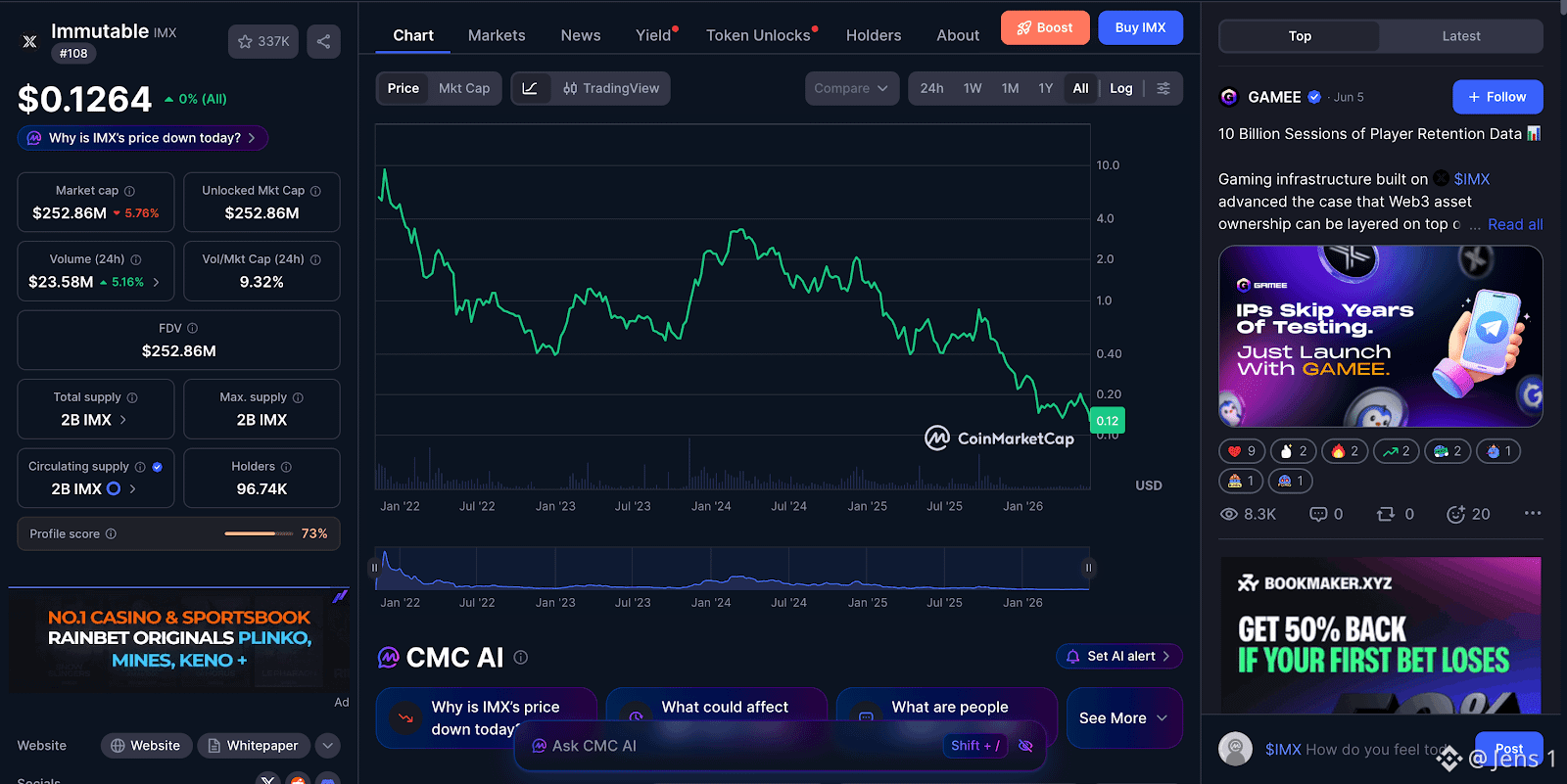
Bots Read Your Swap Before It Fills 🤖 Every swap you send sits in the open long enough for somebody faster to trade in front of it. $JUP handles roughly 95% of Solana's aggregator volume and over $20B a year, and every route it builds is fully readable while it is still working. That is an enormous amount of order flow sitting visible before the person who sent it gets filled. And hiding everything is not the answer either, since $XMR conceals a payment so completely that no venue can prove the trade followed any rules at all. So retail either trades in public and pays for it, or trades somewhere no regulated platform will go. So Midnight lets the order stay unreadable while it runs and still produces proof it cleared the rules afterwards. Webisoft is building a trading venue on that design right now. That chain has made over 1.5 million blocks since March, one every 6 seconds, with no downtime reported. Front-running is the tax nobody agreed to pay, and the venues that remove it will not have to advertise very hard. #Privacy #DeFi
Bots Read Your Swap Before It Fills 🤖 Every swap you send sits in the open long enough for somebody faster to trade in front of it. $JUP handles roughly 95% of Solana's aggregator volume and over $20B a year, and every route it builds is fully readable while it is still working. That is an enormous amount of order flow sitting visible before the person who sent it gets filled. And hiding everything is not the answer either, since $XMR conceals a payment so completely that no venue can prove the trade followed any rules at all. So retail either trades in public and pays for it, or trades somewhere no regulated platform will go. So Midnight lets the order stay unreadable while it runs and still produces proof it cleared the rules afterwards. Webisoft is building a trading venue on that design right now. That chain has made over 1.5 million blocks since March, one every 6 seconds, with no downtime reported. Front-running is the tax nobody agreed to pay, and the venues that remove it will not have to advertise very hard. #Privacy #DeFi
69
·
--
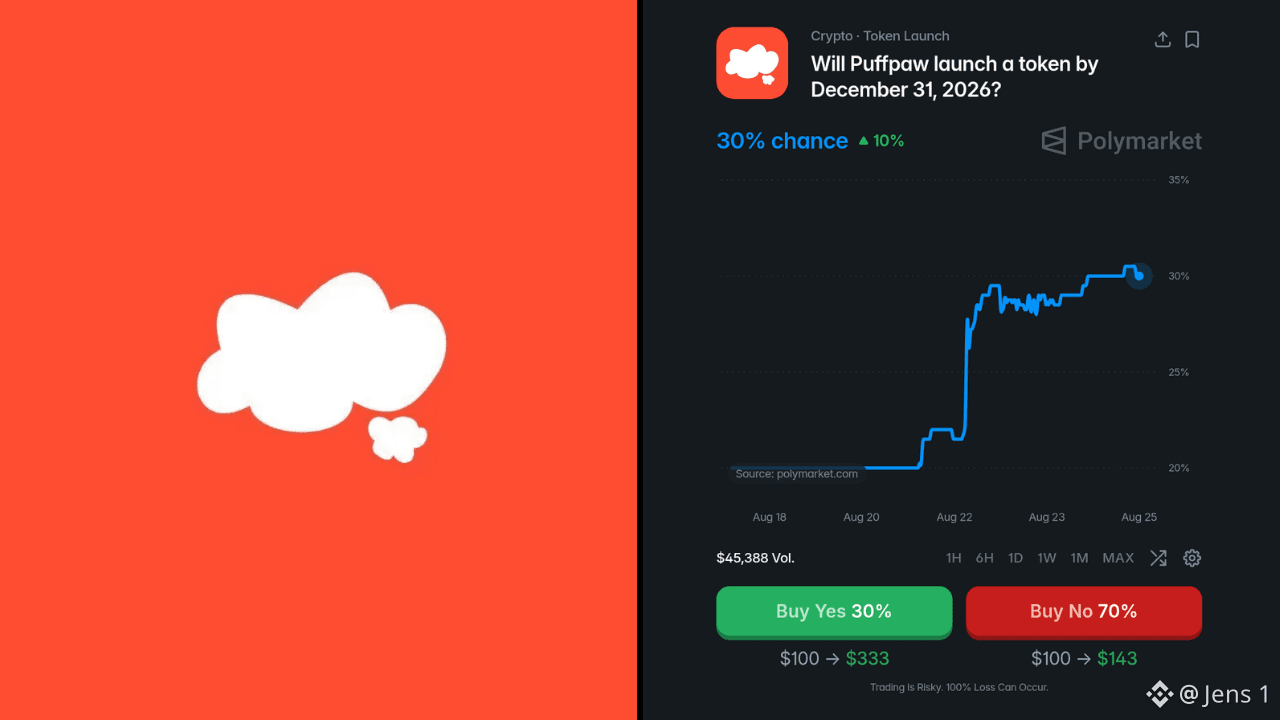
Is Puffpaw closer to a token? 📈 Puffpaw's still a smaller name in the token launch conversation, but this chart just woke up in a big way. Step one, it sat flat near 20% for a long stretch with barely any movement at all. Step two, it broke out hard and climbed all the way up to 30%, and it's still climbing right at the very end. 30% chance right now, up 10%. $45,388 in volume shows this market's still fairly fresh but picking up real attention fast. I'm leaning Yes here, even as the technical underdog. A breakout this clean, still climbing at the tail end, usually has more room to run. $HYPE has been funding a good share of that breakout, with $TRUMP not far behind on the same side of the move. You can simple use any for this particular trade. Honestly, breakouts like this are why I think Polymarket's lead in this space isn't even close right now, nobody else covers this many corners of the market this well. And if you've heard the same perp launch rumors I have, this platform pulling that off would take things to a whole different level entirely. Polymarket is still the cleanest way I've found to actually cash in on a read like this instead of just watching it happen. The pick is yours at the end of the day though. #Altcoin Season#
Is Puffpaw closer to a token? 📈 Puffpaw's still a smaller name in the token launch conversation, but this chart just woke up in a big way. Step one, it sat flat near 20% for a long stretch with barely any movement at all. Step two, it broke out hard and climbed all the way up to 30%, and it's still climbing right at the very end. 30% chance right now, up 10%. $45,388 in volume shows this market's still fairly fresh but picking up real attention fast. I'm leaning Yes here, even as the technical underdog. A breakout this clean, still climbing at the tail end, usually has more room to run. $HYPE has been funding a good share of that breakout, with $TRUMP not far behind on the same side of the move. You can simple use any for this particular trade. Honestly, breakouts like this are why I think Polymarket's lead in this space isn't even close right now, nobody else covers this many corners of the market this well. And if you've heard the same perp launch rumors I have, this platform pulling that off would take things to a whole different level entirely. Polymarket is still the cleanest way I've found to actually cash in on a read like this instead of just watching it happen. The pick is yours at the end of the day though. #Altcoin Season#
74
·
--
140% APR From One Simple Prompt 🤖 AI agents are quietly moving from answering questions to actually managing capital, and liquidity provision is one of the first real tests of that shift in DeFi. $VIRTUAL has been building the rails for autonomous agents that can hold wallets and execute onchain actions without a human clicking every button. $JUP has shown how much liquidity is willing to move once the interface gets simple enough, routing billions through Solana without users needing to understand the mechanics underneath. The next test is whether an agent can actually manage a liquidity position well enough that you would trust it with real money, not just execute a swap. Bankr just answered that with its new Aerodrome Stock LP skill on Base. You tell your Bankr agent in plain English that you want to LP into tokenized stocks, and it opens and manages the position on Aerodrome directly. There is no manual range setting or rebalancing involved, and nobody needs to be watching charts at 2am for it to work. It also keeps earning fees on trades that happen while Wall Street is closed, nights, weekends, all of it. 0xdeployer, the builder behind Bankr, put the skill to the test himself. • $110 in rewards earned in under 24 hours • Token position value increased on top of that • Current pool APR sitting at 140% What stands out to me is that the agent is making the same range and rebalancing decisions a competent LP would make manually, just executing them faster and without anyone staring at a screen. It is one skill and one pool for now, but it is a real test of whether liquidity provision can run on autopilot without losing quality. I am watching how many people start treating LPing as something they configure once instead of something they actively manage. #AI Agents 🤖# #AI
140% APR From One Simple Prompt 🤖 AI agents are quietly moving from answering questions to actually managing capital, and liquidity provision is one of the first real tests of that shift in DeFi. $VIRTUAL has been building the rails for autonomous agents that can hold wallets and execute onchain actions without a human clicking every button. $JUP has shown how much liquidity is willing to move once the interface gets simple enough, routing billions through Solana without users needing to understand the mechanics underneath. The next test is whether an agent can actually manage a liquidity position well enough that you would trust it with real money, not just execute a swap. Bankr just answered that with its new Aerodrome Stock LP skill on Base. You tell your Bankr agent in plain English that you want to LP into tokenized stocks, and it opens and manages the position on Aerodrome directly. There is no manual range setting or rebalancing involved, and nobody needs to be watching charts at 2am for it to work. It also keeps earning fees on trades that happen while Wall Street is closed, nights, weekends, all of it. 0xdeployer, the builder behind Bankr, put the skill to the test himself. • $110 in rewards earned in under 24 hours • Token position value increased on top of that • Current pool APR sitting at 140% What stands out to me is that the agent is making the same range and rebalancing decisions a competent LP would make manually, just executing them faster and without anyone staring at a screen. It is one skill and one pool for now, but it is a real test of whether liquidity provision can run on autopilot without losing quality. I am watching how many people start treating LPing as something they configure once instead of something they actively manage. #AI Agents 🤖# #AI
73
·
--
Base TVL Jumped 23% In One Week 🌊 I've been watching Base closely during this pump and the observations have been interesting. $MORPHO and $AERO have been two of the clearest signals of that, both sitting near the center of the activity driving Base's TVL back up. Base already captured the majority of Ethereum L2 revenue last year, and after last year's upgrades brought sub-cent fees and near-instant confirmations, it's leading in TVL and L1 data fees again this cycle. What's really driving the recent jump is a mix that many people are not watching closely enough, real DeFi activity through protocols like Morpho and Aerodrome, plus a memecoin scene on Base now doing something like $300M in activity. 👉 Zora's custom pairs feature sits right on top of that exact combination. It lets anyone create a token and pair it against an RWA token, a tokenized stock, or a memecoin - across Base, Robinhood, and Solana. Being live on Base specifically means it's sitting on the same chain already pulling in both the serious capital and the degen attention driving this rotation. That's a meaningfully different starting position than launching the same idea on a chain that only has one of those audiences. That combination is rare enough that it's worth paying attention to which projects build there first. A lot of new chains have one side or the other. Base right now genuinely has both. I don't think Base's momentum right now is fully priced in yet. Custom Pairs gives that momentum somewhere direct to go instead of just sitting in a handful of blue chip DeFi tokens. #Meme Alpha# #Altcoin Season#
Base TVL Jumped 23% In One Week 🌊 I've been watching Base closely during this pump and the observations have been interesting. $MORPHO and $AERO have been two of the clearest signals of that, both sitting near the center of the activity driving Base's TVL back up. Base already captured the majority of Ethereum L2 revenue last year, and after last year's upgrades brought sub-cent fees and near-instant confirmations, it's leading in TVL and L1 data fees again this cycle. What's really driving the recent jump is a mix that many people are not watching closely enough, real DeFi activity through protocols like Morpho and Aerodrome, plus a memecoin scene on Base now doing something like $300M in activity. 👉 Zora's custom pairs feature sits right on top of that exact combination. It lets anyone create a token and pair it against an RWA token, a tokenized stock, or a memecoin - across Base, Robinhood, and Solana. Being live on Base specifically means it's sitting on the same chain already pulling in both the serious capital and the degen attention driving this rotation. That's a meaningfully different starting position than launching the same idea on a chain that only has one of those audiences. That combination is rare enough that it's worth paying attention to which projects build there first. A lot of new chains have one side or the other. Base right now genuinely has both. I don't think Base's momentum right now is fully priced in yet. Custom Pairs gives that momentum somewhere direct to go instead of just sitting in a handful of blue chip DeFi tokens. #Meme Alpha# #Altcoin Season#
75
·
--
Stock-Paired Token Volume Hits $112M In 30 Days 🔥 RWA tokenization stopped being a thesis and started being a volume story. $CC is already routing billions in traditional assets through permissioned infrastructure built for real institutions. $XLM has spent years proving that same volume story on the payments side, settling cross border transfers at a fraction of legacy cost and speed. That's not a small use case either. Anyone who’s checked their DAU knows that real people are already routing real value through the blockchain every single day. Stocks are the next asset class moving through that same shift. In most markets, traditional equities still sit idle on nights, weekends, and holidays while crypto markets never stop running. That gap is exactly what stock paired tokens are built to close, and closing it at scale turns a chain from a testing ground into a real settlement layer. Robinhood Chain just showed what that looks like in practice. In the last 30 days, 9,210 stock paired tokens launched there, generating $112.4M in stock paired volume and $3M in fees for Bankr alone. Bankr has been Robinhood Chain's day one partner since launch, which is why every new token deployment there already defaults through it. What stands out to me is Bankr isn't new to earning like this on Base either. • $32.4M in fees generated on Base this year, making it a top 5 earner on the chain • $1.25M of that is in the last 30 days alone Now the same stock pairing mechanism that did $112.4M in a month on Robinhood Chain is live on Base too. What I'm watching is exactly how fast stock pairs on Base catch up to that $112.4M Robinhood Chain number. It's the same agent, running the same playbook, now live on both books at once. #RWA #DeFi
Stock-Paired Token Volume Hits $112M In 30 Days 🔥 RWA tokenization stopped being a thesis and started being a volume story. $CC is already routing billions in traditional assets through permissioned infrastructure built for real institutions. $XLM has spent years proving that same volume story on the payments side, settling cross border transfers at a fraction of legacy cost and speed. That's not a small use case either. Anyone who’s checked their DAU knows that real people are already routing real value through the blockchain every single day. Stocks are the next asset class moving through that same shift. In most markets, traditional equities still sit idle on nights, weekends, and holidays while crypto markets never stop running. That gap is exactly what stock paired tokens are built to close, and closing it at scale turns a chain from a testing ground into a real settlement layer. Robinhood Chain just showed what that looks like in practice. In the last 30 days, 9,210 stock paired tokens launched there, generating $112.4M in stock paired volume and $3M in fees for Bankr alone. Bankr has been Robinhood Chain's day one partner since launch, which is why every new token deployment there already defaults through it. What stands out to me is Bankr isn't new to earning like this on Base either. • $32.4M in fees generated on Base this year, making it a top 5 earner on the chain • $1.25M of that is in the last 30 days alone Now the same stock pairing mechanism that did $112.4M in a month on Robinhood Chain is live on Base too. What I'm watching is exactly how fast stock pairs on Base catch up to that $112.4M Robinhood Chain number. It's the same agent, running the same playbook, now live on both books at once. #RWA #DeFi
71
·
--
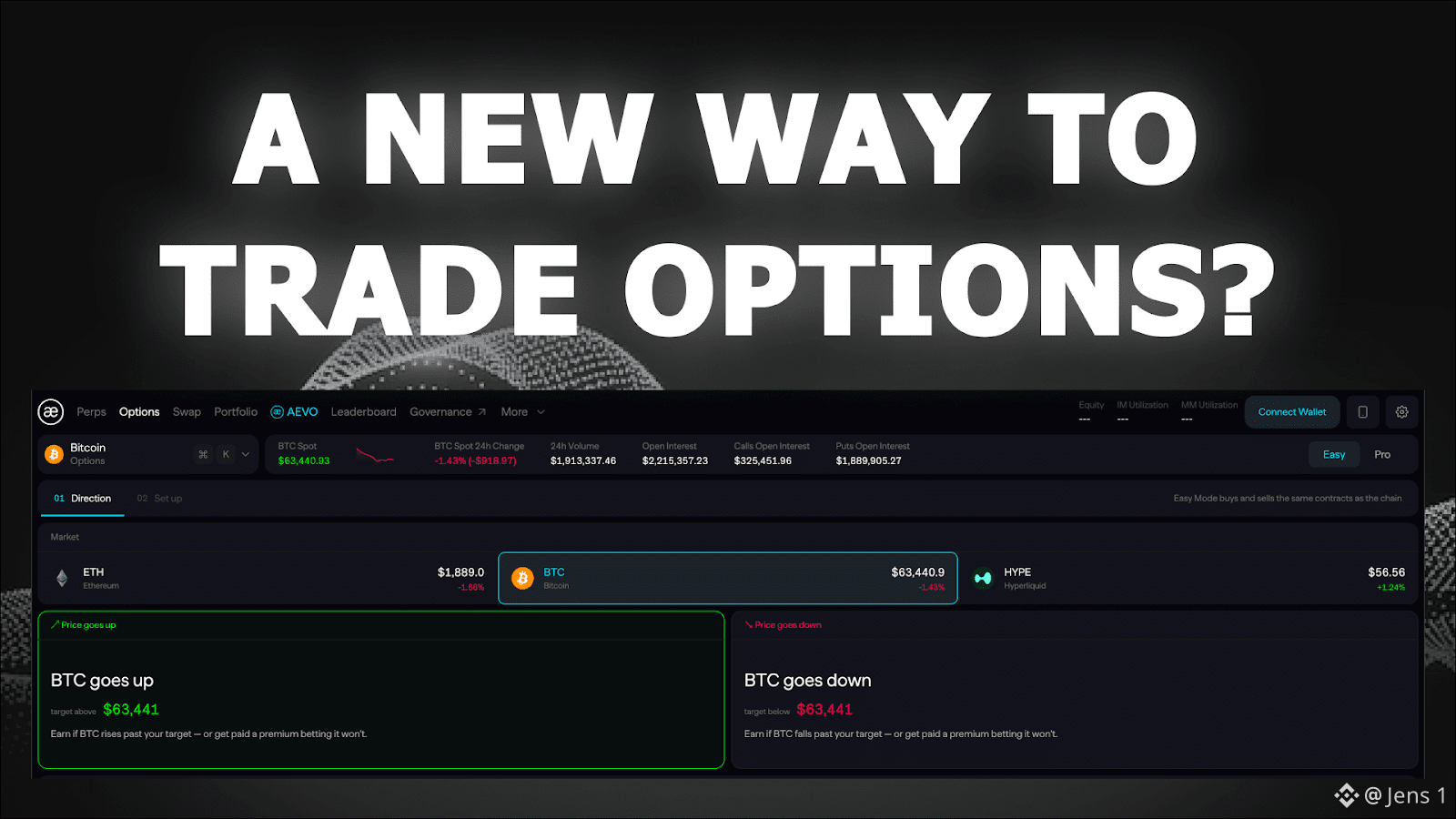
Options Just Got A Lot Harder To Ignore 🔥 $ETH options have been the most talked-about instrument in crypto derivatives for three years. $HYPE perp traders have been the target audience the whole time, traders who kept closing the options tab the moment the interface appeared. That's over. Aevo just launched Options Easy Mode. A perp trader can now open an options position without touching a strike, an expiry, or a Greek. You pick direction, you see your max loss before you confirm, you open the position. That's the whole interface. The interface was the only thing standing between perp traders and options. That excuse is gone. Try it here: https://app.aevo.xyz/r/CMC #Macro Insights#
Options Just Got A Lot Harder To Ignore 🔥 $ETH options have been the most talked-about instrument in crypto derivatives for three years. $HYPE perp traders have been the target audience the whole time, traders who kept closing the options tab the moment the interface appeared. That's over. Aevo just launched Options Easy Mode. A perp trader can now open an options position without touching a strike, an expiry, or a Greek. You pick direction, you see your max loss before you confirm, you open the position. That's the whole interface. The interface was the only thing standing between perp traders and options. That excuse is gone. Try it here: https://app.aevo.xyz/r/CMC #Macro Insights#
71
·
--
Why These Buybacks Need More Attention 👀 While the market watches unlock schedules, Sui Foundation has been running a perpetual buyback program funded by real yield, similar in spirit to what $ENA proved can be done with stablecoin mechanics. There is approximately $460M in stablecoins on Sui, with the Foundation routing the yield directly into buying SUI on the open market. 451,200 SUI bought back so far this year, in a bear market. Token unlocks get attention because they are visible. They appear on a schedule and everyone adjusts their narrative when they hit. Buybacks are behind the scene. They do not announce themselves, they just show up as consistent demand on the order book. The 0% transfer fees built into the protocol are what attracted that DeFi liquidity in the first place, and private payments coming online expand it further. The yield from $460M in stablecoins at any reasonable rate is not a small number. More stablecoin liquidity means more yield. More yield means more buybacks. The people watching the unlock schedule are watching one side of the equation. I am watching how much stablecoin liquidity Sui can attract over the next 12 months. The price targets at $2, $4.40, $5.30, and $8 have been circulating. At $0.67, everyone treats them as cope. If the buyback engine keeps running and stablecoin adoption expands the yield base, those levels have a structural mechanism behind them. I would rather watch the mechanism. #DeFi #Altcoin Season#
Why These Buybacks Need More Attention 👀 While the market watches unlock schedules, Sui Foundation has been running a perpetual buyback program funded by real yield, similar in spirit to what $ENA proved can be done with stablecoin mechanics. There is approximately $460M in stablecoins on Sui, with the Foundation routing the yield directly into buying SUI on the open market. 451,200 SUI bought back so far this year, in a bear market. Token unlocks get attention because they are visible. They appear on a schedule and everyone adjusts their narrative when they hit. Buybacks are behind the scene. They do not announce themselves, they just show up as consistent demand on the order book. The 0% transfer fees built into the protocol are what attracted that DeFi liquidity in the first place, and private payments coming online expand it further. The yield from $460M in stablecoins at any reasonable rate is not a small number. More stablecoin liquidity means more yield. More yield means more buybacks. The people watching the unlock schedule are watching one side of the equation. I am watching how much stablecoin liquidity Sui can attract over the next 12 months. The price targets at $2, $4.40, $5.30, and $8 have been circulating. At $0.67, everyone treats them as cope. If the buyback engine keeps running and stablecoin adoption expands the yield base, those levels have a structural mechanism behind them. I would rather watch the mechanism. #DeFi #Altcoin Season#
62
Войдите, чтобы посмотреть больше материала
Присоединяйтесь к пользователям криптовалют по всему миру на Binance Square
⚡️ Получайте новейшую и полезную информацию о криптоактивах.
💬 Нам доверяет крупнейшая в мире криптобиржа.
👍 Получите достоверные аналитические данные от верифицированных создателей контента.
Эл. почта/номер телефона
В тренде
AppleDebutsFoldablePhone
Просмотров: 47,115
941 обсуждают
Apple just dropped the foldable iPhone — and the market is paying attention. This isn't just another product cycle; it's a new product category, a new CEO on stage, and a $1,999 price tag that pushes $AAPL further into ultra-premium territory. Foldables are the narrative, and Apple is now the headline.
#appledebutsfoldablephone #EUExtendsCentralContactPointToCASPs #US10YTreasuryYieldHitsHighestSinceNov2023 #BrentCrudeTops$100 #USTreasuryToBuyBackUpTo$6BLongDatedDebt
KimHotbae
·Лайков: 2
·Просмотров: 2.9k
TSMCAugustRevenueUp53.3%YoY
Просмотров: 10,827
308 обсуждают
IranSaysReadyToEscalateWarWithUS
Просмотров: 13,625
327 обсуждают