
BLANK _
21.9k Публикации

BLANK _
 Square Verified+
Отправить жалобу
Заблокировать пользователя
Binance Enthusiast 💠 Crypto Trader 💠Deciphering the Charts,One trade at a time 💠Passionate about Blockchain as Web3 💠 Hustle. Trade. Repeat 💠 👉X::@BLANK53
Открытая сделка
Трейдер с регулярными сделками
2 г
292 подписок(и/а)
46.3K+ подписчиков(а)
35.4K+ понравилось
Посты
Портфель
Все
Цитирования
Видео
Активно
·
--
Рост
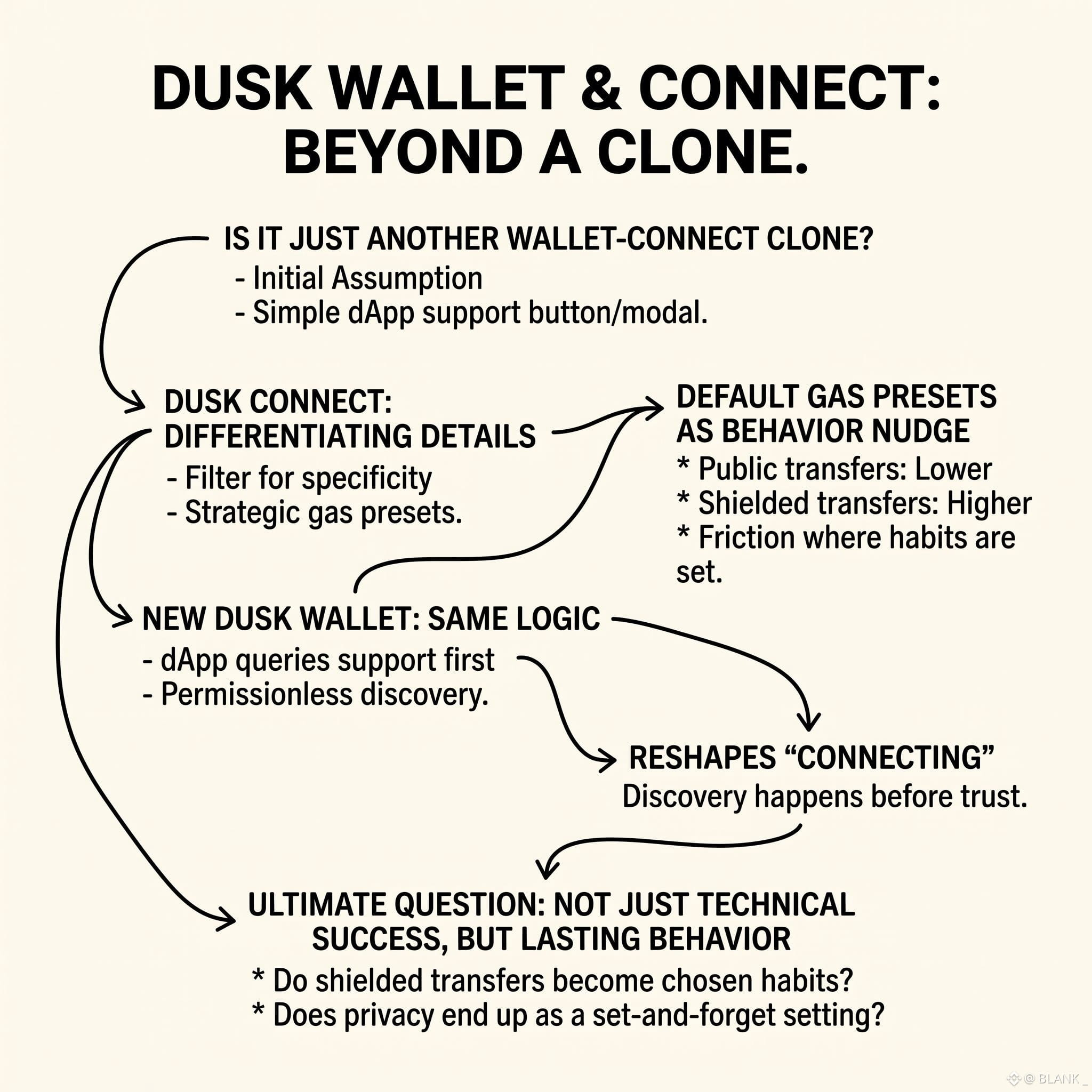
At first I assumed Dusk Connect was just another wallet-connect clone, a button that opens a modal and calls it dApp support. But the details filter for something more specific. Default gas presets sit lower for public transfers and higher for shielded ones, so the wallet nudges behavior before a user consciously chooses. That's not neutral plumbing. It's friction placed exactly where habits get set.
The new Dusk Wallet follows the same logic. A dApp can query what's supported before any connection permission exists, so discovery happens ahead of trust rather than alongside it. Convenient, yes, but it also reshapes what "connecting" actually means for the user on the other end. None of this proves adoption. Reducing friction can just as easily reduce memorability. The real question isn't whether shielded transfers work. It's whether anyone keeps choosing them once the default wears off, or whether privacy ends up as a setting people enable once and never touch again.
@Dusk_Foundation $DUSK #dusk
At first I assumed Dusk Connect was just another wallet-connect clone, a button that opens a modal and calls it dApp support. But the details filter for something more specific. Default gas presets sit lower for public transfers and higher for shielded ones, so the wallet nudges behavior before a user consciously chooses. That's not neutral plumbing. It's friction placed exactly where habits get set.
The new Dusk Wallet follows the same logic. A dApp can query what's supported before any connection permission exists, so discovery happens ahead of trust rather than alongside it. Convenient, yes, but it also reshapes what "connecting" actually means for the user on the other end. None of this proves adoption. Reducing friction can just as easily reduce memorability. The real question isn't whether shielded transfers work. It's whether anyone keeps choosing them once the default wears off, or whether privacy ends up as a setting people enable once and never touch again.
@Dusk $DUSK #dusk
The new Dusk Wallet follows the same logic. A dApp can query what's supported before any connection permission exists, so discovery happens ahead of trust rather than alongside it. Convenient, yes, but it also reshapes what "connecting" actually means for the user on the other end. None of this proves adoption. Reducing friction can just as easily reduce memorability. The real question isn't whether shielded transfers work. It's whether anyone keeps choosing them once the default wears off, or whether privacy ends up as a setting people enable once and never touch again.
@Dusk $DUSK #dusk
11
1
20
2k
·
--
Рост
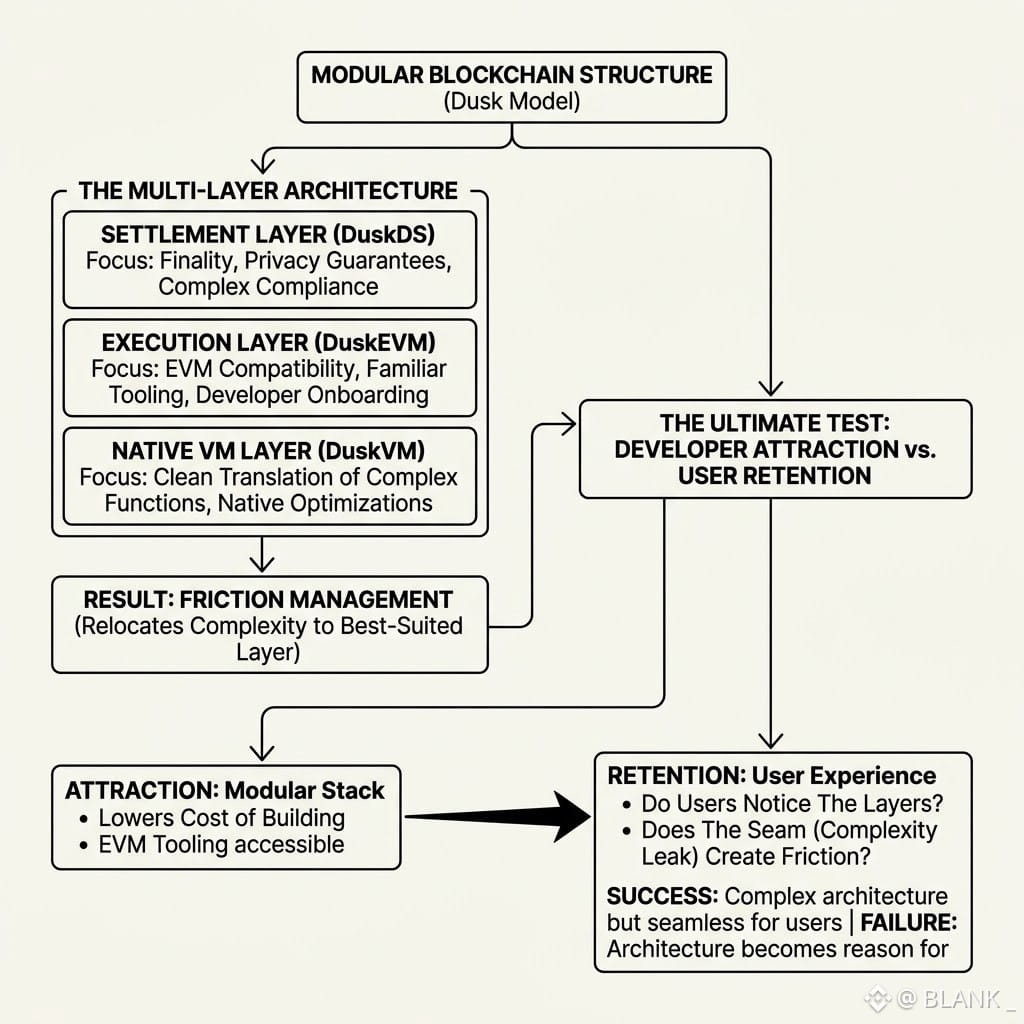
At first I assumed splitting a chain into three layers was just architecture for architecture's sake, another diagram promising flexibility nobody asked for. But watching how DuskDS, DuskEVM, and DuskVM sit next to each other, the layering starts to look less decorative and more like friction management. Settlement stays where it needs finality and privacy guarantees, execution moves to where developers already know the tooling, and the native VM absorbs the parts that don't translate cleanly to EVM assumptions. Nothing here removes complexity, it just relocates it to the layer best suited to hold it without leaking into the others. What's harder to see is the retention question underneath. A modular stack lowers the cost of building, but building isn't the same as staying. The real test isn't whether developers can deploy across three layers, it's whether users ever notice which layer they're on, or whether that seam becomes the reason they leave.
@Dusk_Foundation $DUSK #dusk
At first I assumed splitting a chain into three layers was just architecture for architecture's sake, another diagram promising flexibility nobody asked for. But watching how DuskDS, DuskEVM, and DuskVM sit next to each other, the layering starts to look less decorative and more like friction management. Settlement stays where it needs finality and privacy guarantees, execution moves to where developers already know the tooling, and the native VM absorbs the parts that don't translate cleanly to EVM assumptions. Nothing here removes complexity, it just relocates it to the layer best suited to hold it without leaking into the others. What's harder to see is the retention question underneath. A modular stack lowers the cost of building, but building isn't the same as staying. The real test isn't whether developers can deploy across three layers, it's whether users ever notice which layer they're on, or whether that seam becomes the reason they leave.
@Dusk $DUSK #dusk
@Dusk $DUSK #dusk
13
17
1.7k
·
--
Рост
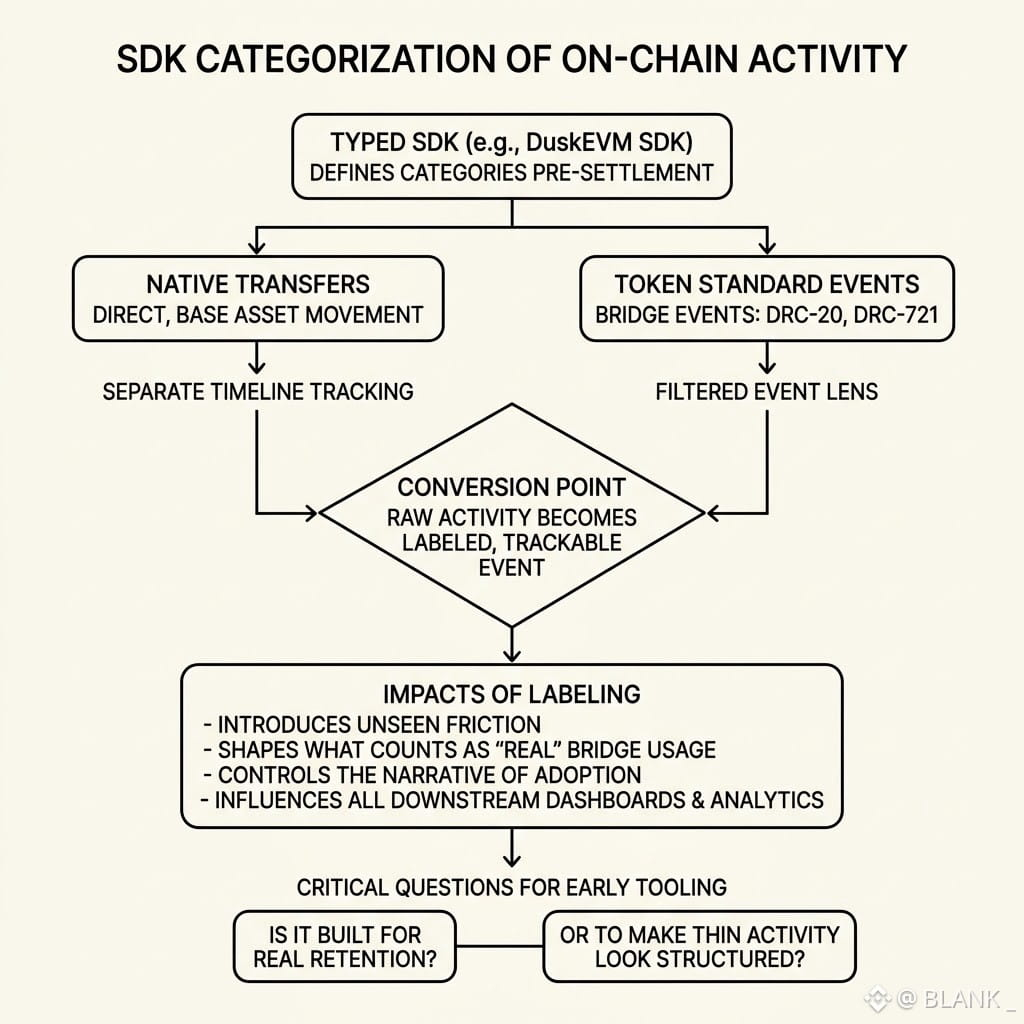
At first I assumed a typed SDK was mostly about developer convenience, cleaner calls, fewer bugs. But watching how the DuskEVM SDK separates native transfers from DRC-20 and DRC-721 bridge events, something else stood out. The typing isn't neutral. It decides how activity gets categorized before a transaction even settles, which quietly shapes what counts as "real" bridge usage downstream. Native movement gets tracked on its own timeline. Token standard events get filtered through a different lens entirely. That split introduces friction most users never see, but it persists into every dashboard, every analytics layer built on top of it.
What interests me is the conversion point, the moment raw chain activity becomes a labeled, trackable event. Whoever controls that labeling controls the narrative of adoption. So I keep wondering: when tooling this granular exists this early, is it built for real retention, or is it built to make thin activity look structured before the demand actually arrives?
@Dusk_Foundation $DUSK #dusk
At first I assumed a typed SDK was mostly about developer convenience, cleaner calls, fewer bugs. But watching how the DuskEVM SDK separates native transfers from DRC-20 and DRC-721 bridge events, something else stood out. The typing isn't neutral. It decides how activity gets categorized before a transaction even settles, which quietly shapes what counts as "real" bridge usage downstream. Native movement gets tracked on its own timeline. Token standard events get filtered through a different lens entirely. That split introduces friction most users never see, but it persists into every dashboard, every analytics layer built on top of it.
What interests me is the conversion point, the moment raw chain activity becomes a labeled, trackable event. Whoever controls that labeling controls the narrative of adoption. So I keep wondering: when tooling this granular exists this early, is it built for real retention, or is it built to make thin activity look structured before the demand actually arrives?
@Dusk $DUSK #dusk
What interests me is the conversion point, the moment raw chain activity becomes a labeled, trackable event. Whoever controls that labeling controls the narrative of adoption. So I keep wondering: when tooling this granular exists this early, is it built for real retention, or is it built to make thin activity look structured before the demand actually arrives?
@Dusk $DUSK #dusk
10
15
2.7k
·
--
Рост
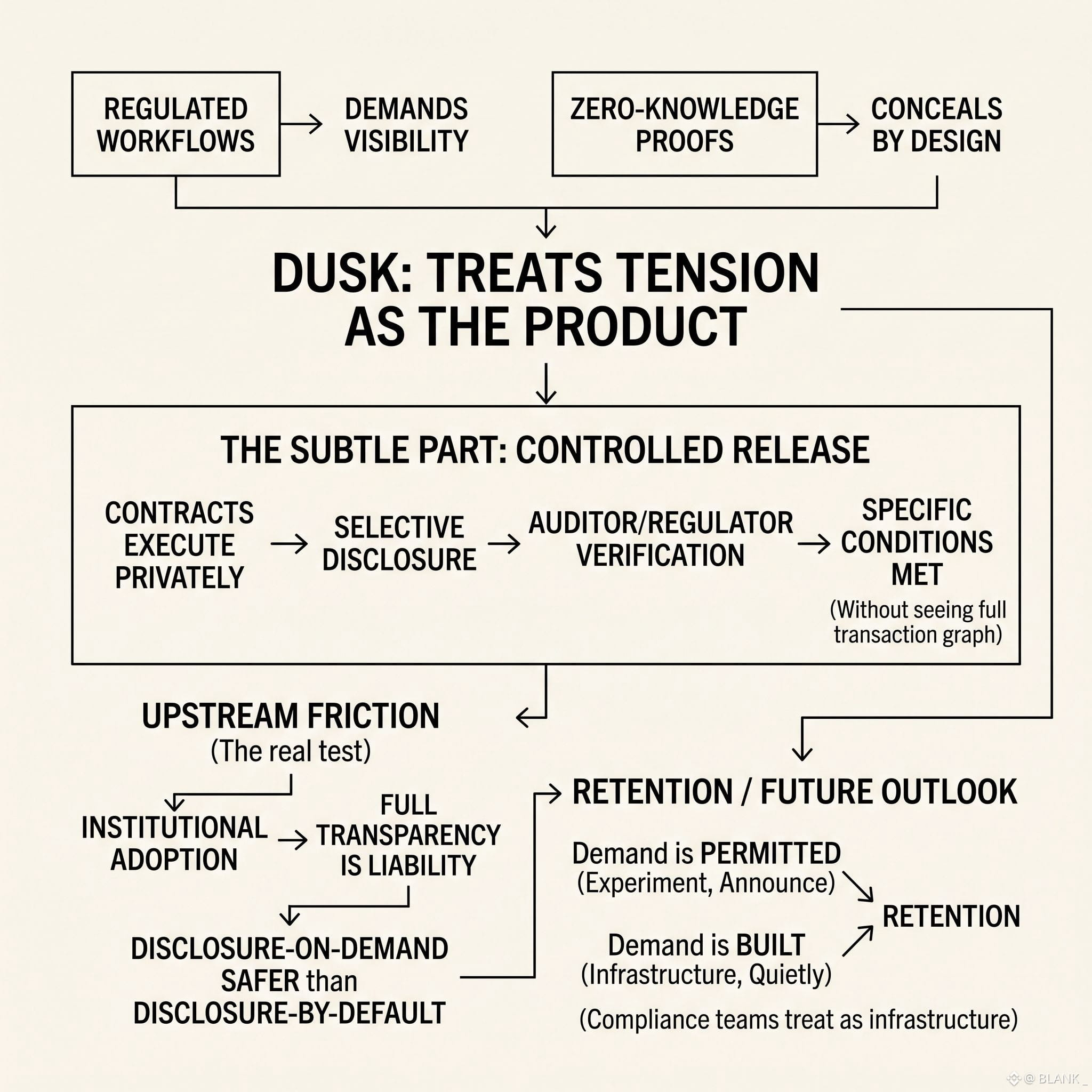
At first I assumed regulated workflows and zero-knowledge proofs were natural opposites, one demands visibility, the other conceals by design. Dusk treats that tension as the actual product instead of a bug to route around. Contracts execute privately, but selective disclosure lets an auditor or regulator verify specific conditions without seeing the full transaction graph. That's the subtle part, not privacy as absence of data, but privacy as controlled release of it, timed to whoever holds the right key. What interests me more is the friction this creates upstream. Institutions rarely adopt privacy tooling for its own sake, they adopt it when full transparency becomes the actual liability. So the real test isn't whether the cryptography holds, it's whether enough regulated entities decide disclosure-on-demand is safer than disclosure-by-default. Retention won't come from speculation here. It'll come from whether compliance teams start treating this as infrastructure rather than experiment, quietly, without announcing it. Which raises the real question: is demand being built, or just being permitted?
@Dusk_Foundation $DUSK #dusk
At first I assumed regulated workflows and zero-knowledge proofs were natural opposites, one demands visibility, the other conceals by design. Dusk treats that tension as the actual product instead of a bug to route around. Contracts execute privately, but selective disclosure lets an auditor or regulator verify specific conditions without seeing the full transaction graph. That's the subtle part, not privacy as absence of data, but privacy as controlled release of it, timed to whoever holds the right key. What interests me more is the friction this creates upstream. Institutions rarely adopt privacy tooling for its own sake, they adopt it when full transparency becomes the actual liability. So the real test isn't whether the cryptography holds, it's whether enough regulated entities decide disclosure-on-demand is safer than disclosure-by-default. Retention won't come from speculation here. It'll come from whether compliance teams start treating this as infrastructure rather than experiment, quietly, without announcing it. Which raises the real question: is demand being built, or just being permitted?
@Dusk $DUSK #dusk
@Dusk $DUSK #dusk
9
10
2.3k
·
--
Рост
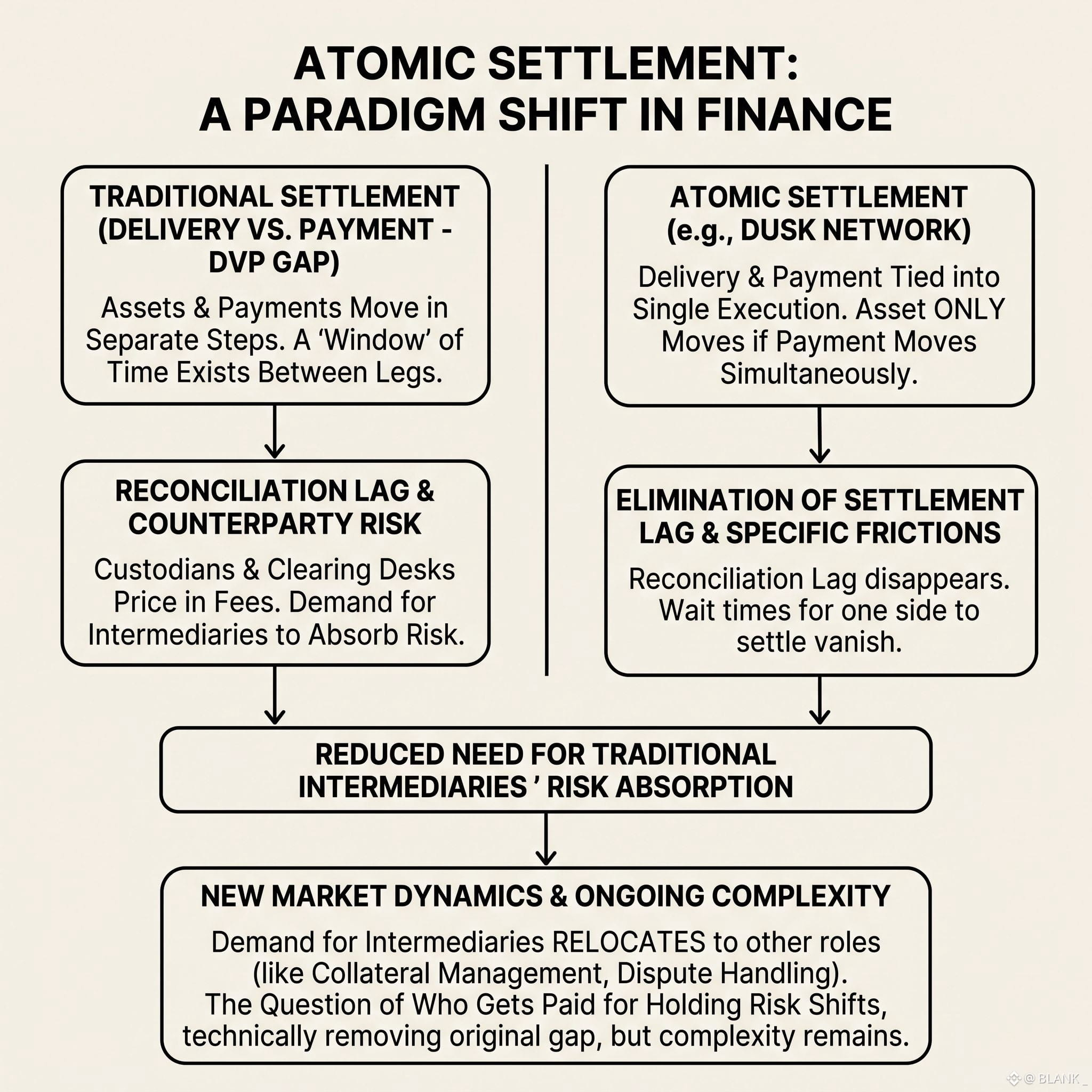
At first I assumed atomic settlement was mostly a technical footnote, the kind of detail that matters to engineers but rarely to markets. Dusk ties delivery and payment into a single execution step, so an asset only moves if the payment moves with it. There's no window where one side settles and the other waits. That removes a specific kind of friction: the reconciliation lag that custodians and clearing desks have quietly priced into their fees for decades. What's interesting is what disappears along with the lag. Trust intermediaries exist partly to absorb the risk of that gap. So if the gap closes, does the demand for those intermediaries close with it, or does it just relocate somewhere less visible, like collateral management or dispute handling. Simplifying settlement doesn't remove complexity. It just moves the question of who still gets paid for holding risk that, technically, no longer exists.
@Dusk_Foundation $DUSK #dusk
At first I assumed atomic settlement was mostly a technical footnote, the kind of detail that matters to engineers but rarely to markets. Dusk ties delivery and payment into a single execution step, so an asset only moves if the payment moves with it. There's no window where one side settles and the other waits. That removes a specific kind of friction: the reconciliation lag that custodians and clearing desks have quietly priced into their fees for decades. What's interesting is what disappears along with the lag. Trust intermediaries exist partly to absorb the risk of that gap. So if the gap closes, does the demand for those intermediaries close with it, or does it just relocate somewhere less visible, like collateral management or dispute handling. Simplifying settlement doesn't remove complexity. It just moves the question of who still gets paid for holding risk that, technically, no longer exists.
@Dusk $DUSK #dusk
@Dusk $DUSK #dusk
19
20
2.2k
·
--
Рост
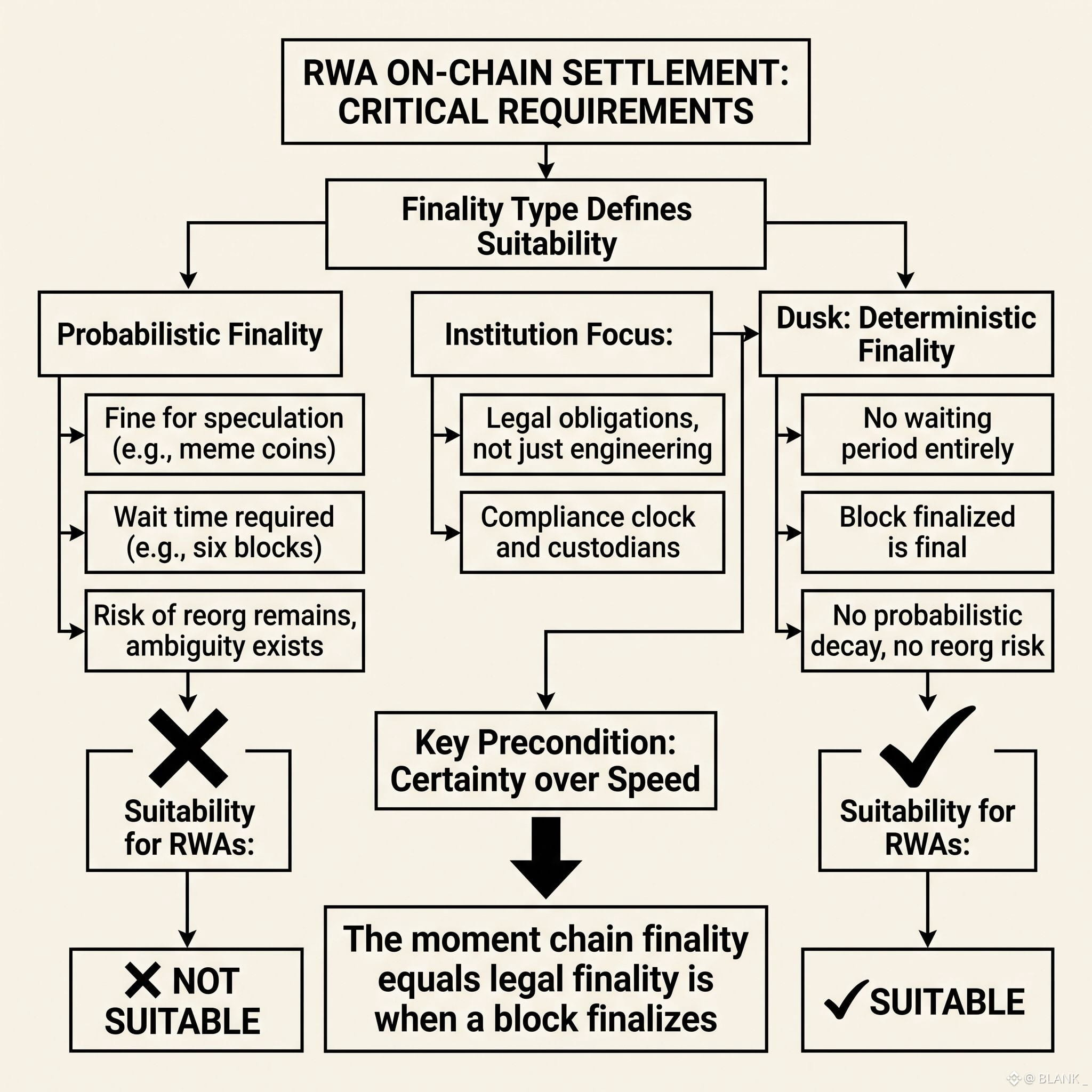
At first I assumed finality was a technical footnote, something settlement engineers cared about more than users ever would. But watching how RWA desks actually behave changes that read. Probabilistic finality is fine for speculation. Nobody minds a six block wait when the asset is a meme coin. Real estate titles, bond coupons, and settlement windows tied to legal obligations don't tolerate that kind of ambiguity though. A trade that might reorg isn't settled, it's pending, and pending doesn't satisfy a custodian's compliance clock. Dusk's deterministic finality removes that waiting period entirely. The moment a block finalizes, it's final, no probabilistic decay, no reorg risk creeping in later. That's less a feature than a precondition. Institutions aren't pricing in speed. They're pricing in certainty, because certainty is what lets legal finality and chain finality collapse into the same moment.
The real question isn't whether RWAs come on chain. It's whether they stay once the settlement guarantees get tested.
@Dusk_Foundation $DUSK #dusk
At first I assumed finality was a technical footnote, something settlement engineers cared about more than users ever would. But watching how RWA desks actually behave changes that read. Probabilistic finality is fine for speculation. Nobody minds a six block wait when the asset is a meme coin. Real estate titles, bond coupons, and settlement windows tied to legal obligations don't tolerate that kind of ambiguity though. A trade that might reorg isn't settled, it's pending, and pending doesn't satisfy a custodian's compliance clock. Dusk's deterministic finality removes that waiting period entirely. The moment a block finalizes, it's final, no probabilistic decay, no reorg risk creeping in later. That's less a feature than a precondition. Institutions aren't pricing in speed. They're pricing in certainty, because certainty is what lets legal finality and chain finality collapse into the same moment.
The real question isn't whether RWAs come on chain. It's whether they stay once the settlement guarantees get tested.
@Dusk $DUSK #dusk
The real question isn't whether RWAs come on chain. It's whether they stay once the settlement guarantees get tested.
@Dusk $DUSK #dusk
25
1
27
2.2k
·
--
Рост
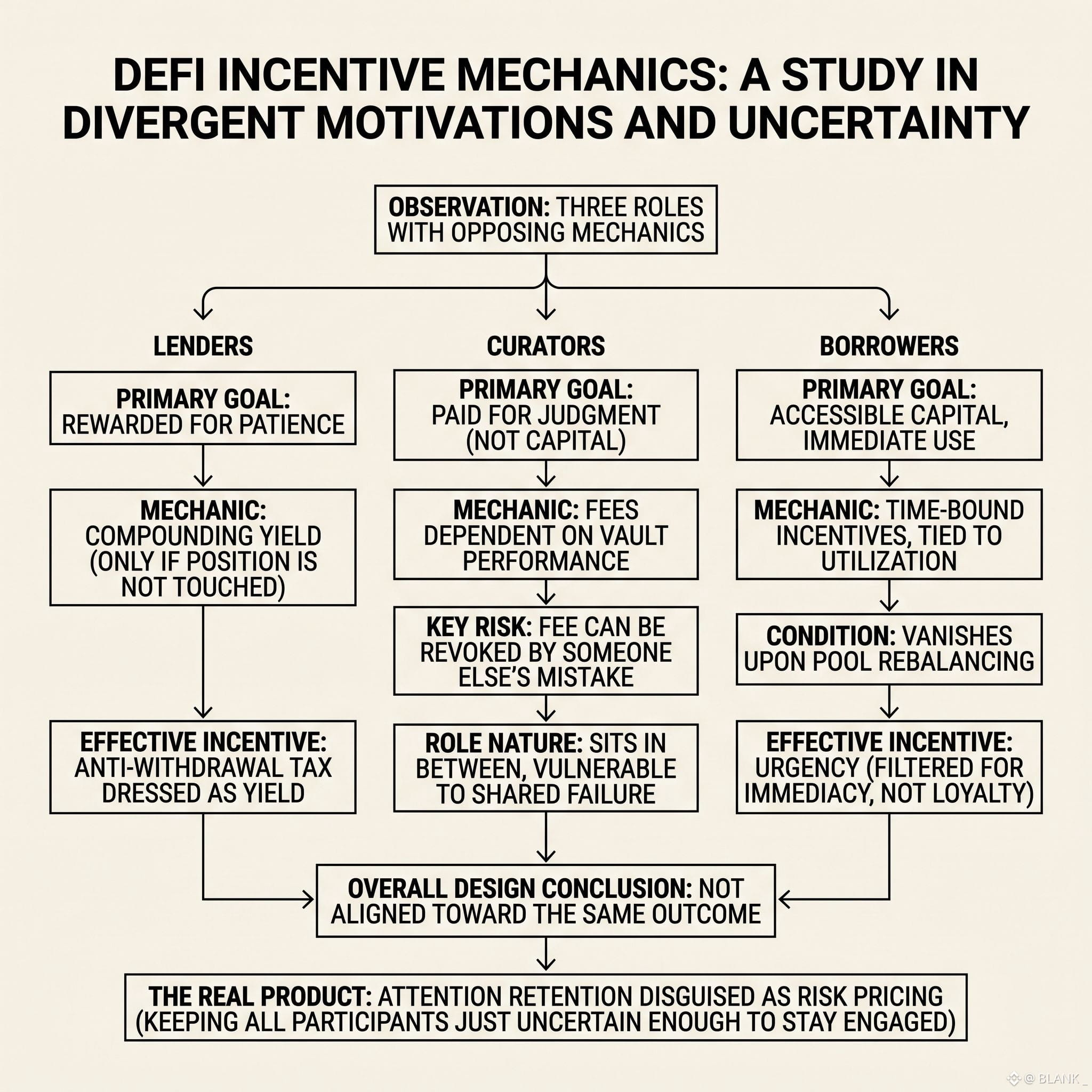
At first I assumed the three roles were just different entry points into the same incentive pool, but the mechanics pull in different directions. Lenders get paid for patience. Their reward compounds quietly as long as they don't touch the position, so the incentive is really an anti withdrawal tax dressed up as yield. Borrowers face the opposite pressure: every incentive is time bound, tied to utilization, and vanishes the moment the pool rebalances. Their behavior is filtered for urgency, not loyalty. Curators sit in between, paid not for capital but for judgment, and that fee only persists if the vaults they route into keep performing. It's the one role where the incentive can be revoked by someone else's mistake. None of these are aligned toward the same outcome. They're aligned toward keeping each participant just uncertain enough to stay engaged. Maybe that's the real product: not yield, but attention retention disguised as risk pricing.
@termmax #TermMax
At first I assumed the three roles were just different entry points into the same incentive pool, but the mechanics pull in different directions. Lenders get paid for patience. Their reward compounds quietly as long as they don't touch the position, so the incentive is really an anti withdrawal tax dressed up as yield. Borrowers face the opposite pressure: every incentive is time bound, tied to utilization, and vanishes the moment the pool rebalances. Their behavior is filtered for urgency, not loyalty. Curators sit in between, paid not for capital but for judgment, and that fee only persists if the vaults they route into keep performing. It's the one role where the incentive can be revoked by someone else's mistake. None of these are aligned toward the same outcome. They're aligned toward keeping each participant just uncertain enough to stay engaged. Maybe that's the real product: not yield, but attention retention disguised as risk pricing.
@TermMax #TermMax
@TermMax #TermMax
19
22
2k
·
--
Рост
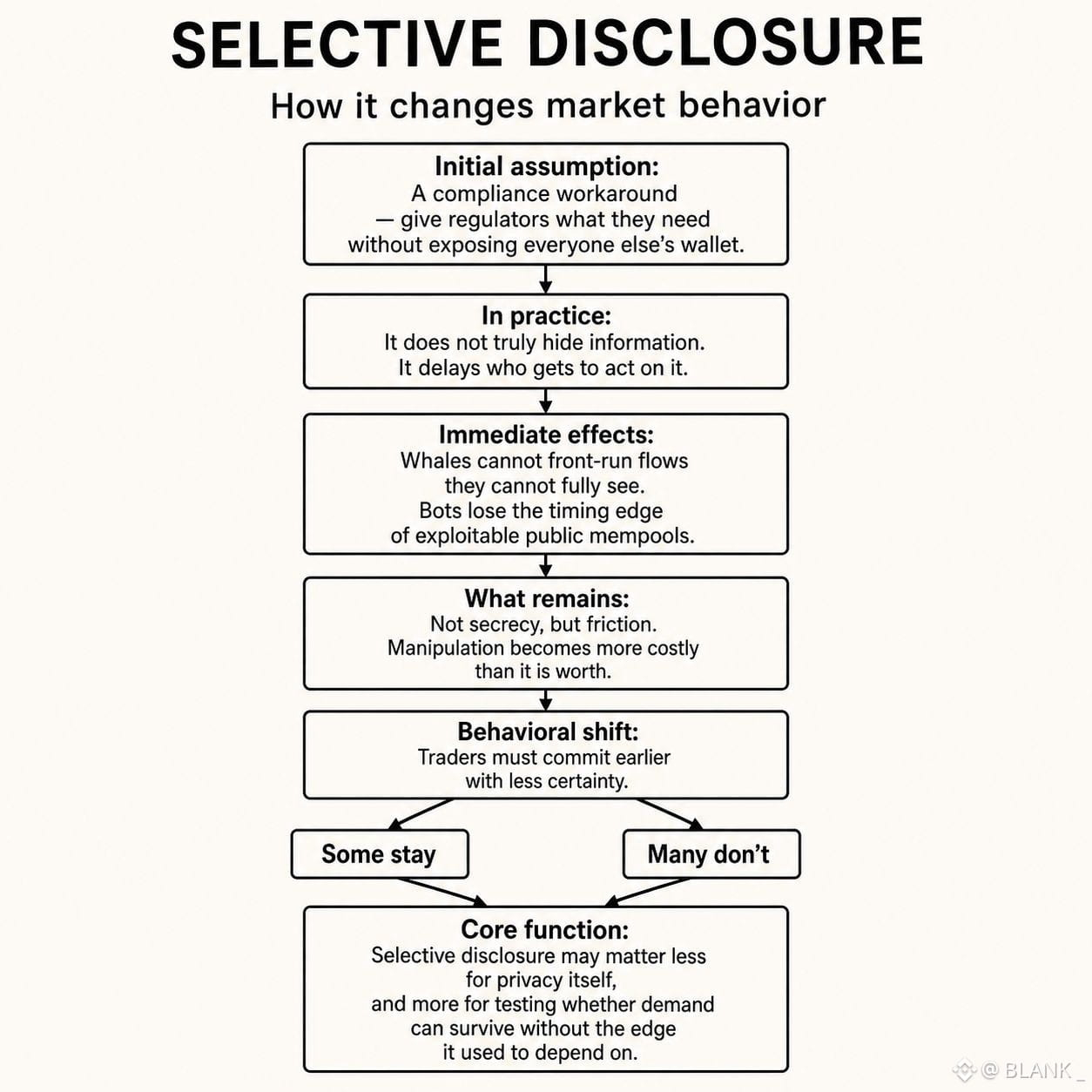
At first I assumed selective disclosure was just a compliance workaround, a way to hand regulators what they needed without exposing everyone else's wallet. But watching it in practice, the effect is quieter than that. It doesn't hide information so much as delay who gets to act on it. Whales can't front-run flows they can't see in full. Bots lose the timing edge that made public mempools so exploitable. What's left isn't secrecy, it's friction, the kind that makes manipulation cost more than it pays. The strange part is how this reshapes behavior. Traders who once positioned around leaked data now have to commit earlier, with less certainty. Some stay. Many don't. Maybe that's the real function of selective disclosure: not protecting privacy for its own sake, but asking whether demand can survive without the edge it used to lean on.
@Dusk_Foundation $DUSK #dusk
At first I assumed selective disclosure was just a compliance workaround, a way to hand regulators what they needed without exposing everyone else's wallet. But watching it in practice, the effect is quieter than that. It doesn't hide information so much as delay who gets to act on it. Whales can't front-run flows they can't see in full. Bots lose the timing edge that made public mempools so exploitable. What's left isn't secrecy, it's friction, the kind that makes manipulation cost more than it pays. The strange part is how this reshapes behavior. Traders who once positioned around leaked data now have to commit earlier, with less certainty. Some stay. Many don't. Maybe that's the real function of selective disclosure: not protecting privacy for its own sake, but asking whether demand can survive without the edge it used to lean on.
@Dusk $DUSK #dusk
@Dusk $DUSK #dusk
46
41
2.3k
·
--
Рост
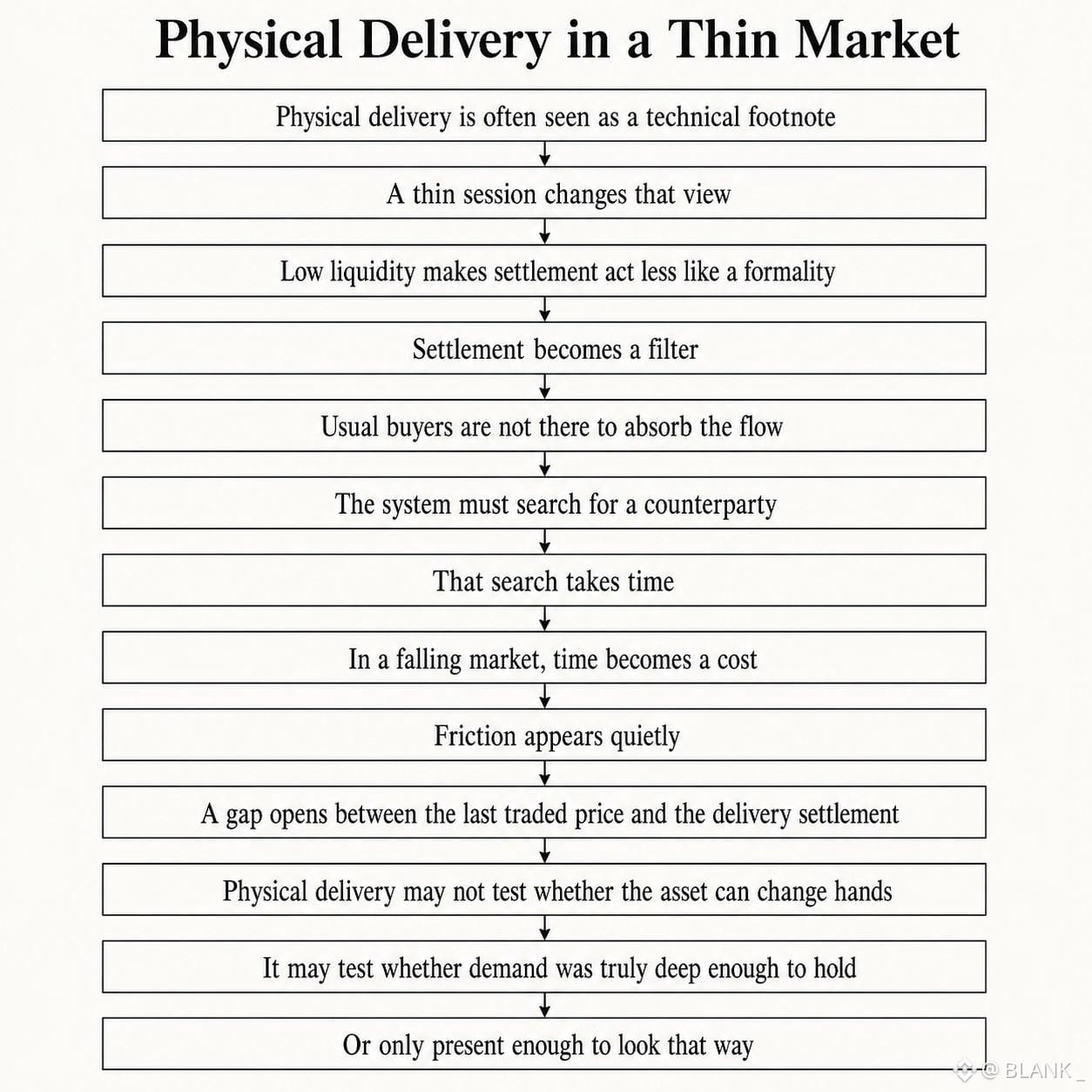
At first I assumed physical delivery was just a technical footnote, something reserved for traders who forgot to close before expiry. Watching one unwind during a thin session changed that. When liquidity is low, the settlement layer stops acting like a formality and starts acting like a filter. The buyers who would normally absorb the flow simply aren't there. Instead of clearing at a price, the system has to search for a counterparty, and that search takes time. In a falling market, time is its own kind of cost. What struck me most was how quietly the friction showed up. No alert, no warning, just a widening gap between the last traded price and whatever the delivery mechanism eventually settles on. Maybe physical delivery isn't really testing whether the asset can change hands. Maybe it's testing whether demand was ever deep enough to hold, or just present enough to look that way.
@termmax #TermMax
At first I assumed physical delivery was just a technical footnote, something reserved for traders who forgot to close before expiry. Watching one unwind during a thin session changed that. When liquidity is low, the settlement layer stops acting like a formality and starts acting like a filter. The buyers who would normally absorb the flow simply aren't there. Instead of clearing at a price, the system has to search for a counterparty, and that search takes time. In a falling market, time is its own kind of cost. What struck me most was how quietly the friction showed up. No alert, no warning, just a widening gap between the last traded price and whatever the delivery mechanism eventually settles on. Maybe physical delivery isn't really testing whether the asset can change hands. Maybe it's testing whether demand was ever deep enough to hold, or just present enough to look that way.
@TermMax #TermMax
@TermMax #TermMax
43
48
10.9k
·
--
Рост
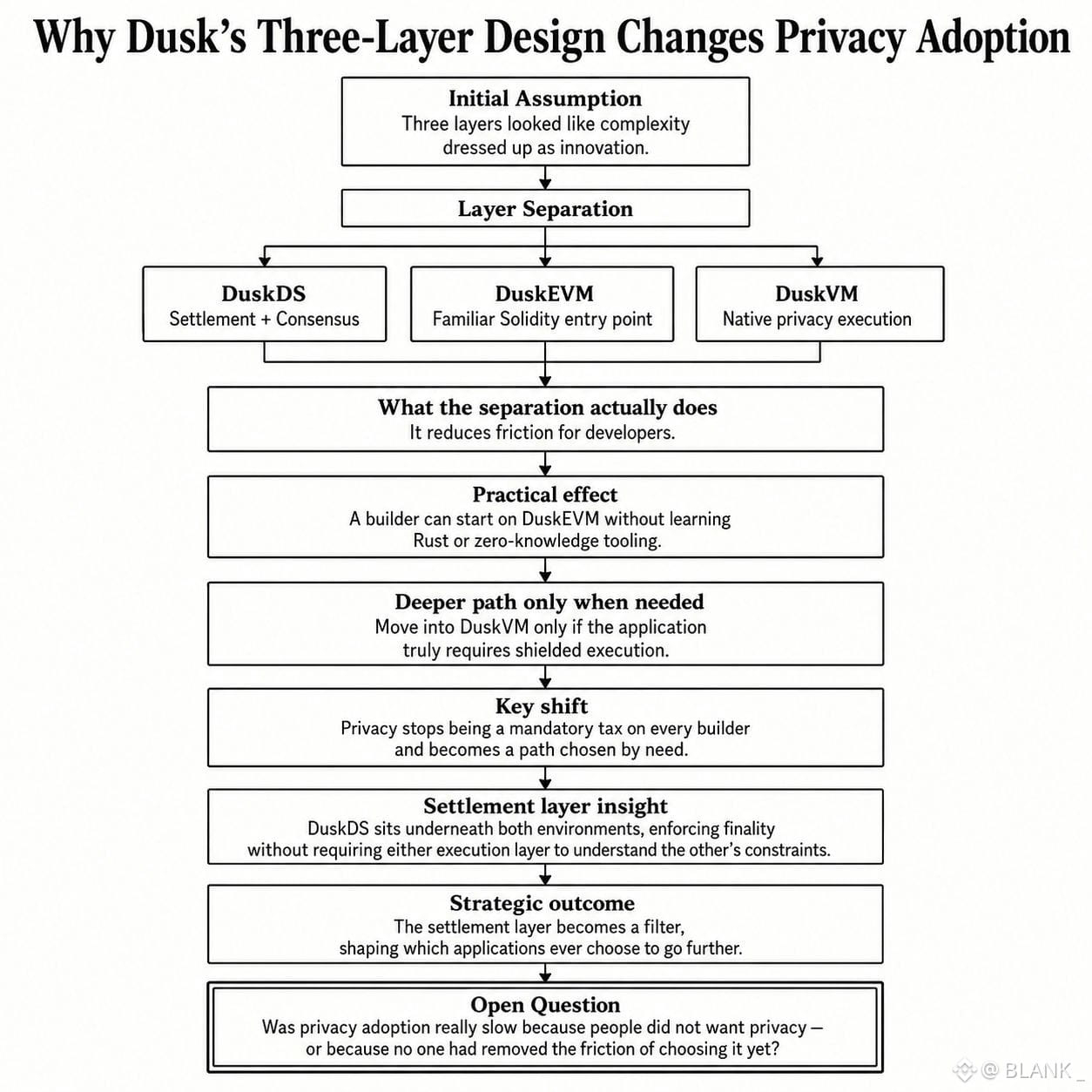
At first I assumed splitting a chain into three layers was just complexity dressed up as innovation. DuskDS handles settlement and consensus, DuskEVM gives Solidity developers a familiar entry point, DuskVM stays reserved for native privacy work. That separation looked like overhead until I noticed what it does to friction. A developer doesn't need to learn Rust and zero knowledge tooling just to deploy something simple; they can start on DuskEVM and only move deeper if the application actually needs shielded execution. Privacy stops being a mandatory tax on every builder and becomes a path chosen by need. What interests me more is the settlement layer sitting underneath both, quietly enforcing finality without asking either execution environment to know about the other's constraints. It's less a feature than a filter, deciding which applications ever bother going further. I keep wondering whether privacy adoption was ever actually slow because people didn't want it, or because no one had removed the friction of choosing it yet.
@Dusk_Foundation $DUSK #dusk
At first I assumed splitting a chain into three layers was just complexity dressed up as innovation. DuskDS handles settlement and consensus, DuskEVM gives Solidity developers a familiar entry point, DuskVM stays reserved for native privacy work. That separation looked like overhead until I noticed what it does to friction. A developer doesn't need to learn Rust and zero knowledge tooling just to deploy something simple; they can start on DuskEVM and only move deeper if the application actually needs shielded execution. Privacy stops being a mandatory tax on every builder and becomes a path chosen by need. What interests me more is the settlement layer sitting underneath both, quietly enforcing finality without asking either execution environment to know about the other's constraints. It's less a feature than a filter, deciding which applications ever bother going further. I keep wondering whether privacy adoption was ever actually slow because people didn't want it, or because no one had removed the friction of choosing it yet.
@Dusk $DUSK #dusk
@Dusk $DUSK #dusk
37
31
1.4k
·
--
Рост
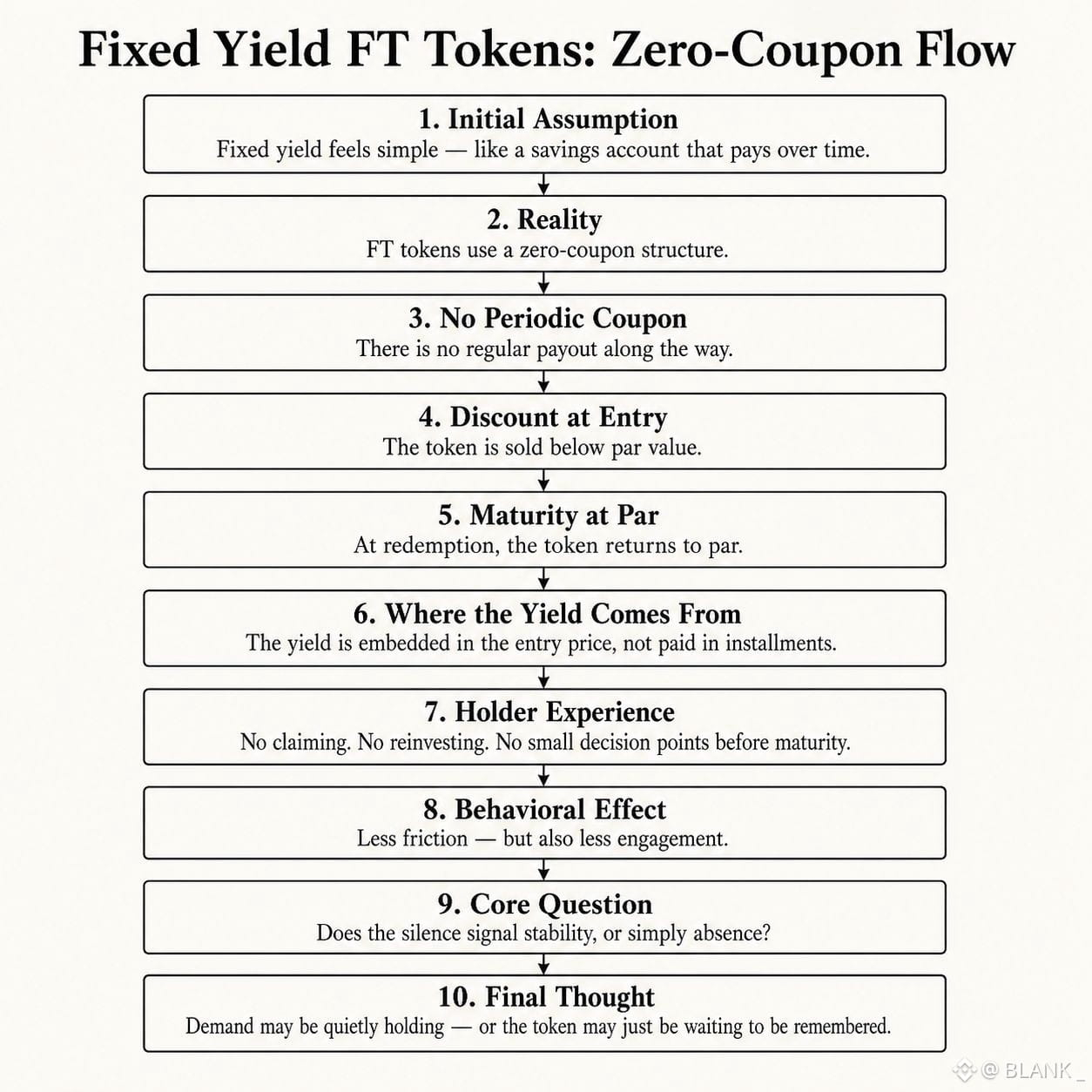
At first I assumed fixed yield meant simplicity, that FT tokens just paid investors over time like a savings account would. But the zero-coupon structure works differently. There's no coupon at all, no periodic payout to anchor expectations along the way. Instead the token is sold at a discount and matures at par, so the yield sits inside the entry price itself rather than being distributed in installments. That changes behavior more than I expected. Holders aren't checking for payments, they're just waiting. No claiming, no reinvesting, no small decision points to keep attention engaged until maturity arrives. It strips out a layer of friction, but it also strips out a layer of engagement. Nothing to do often means nothing to notice. The real question is whether that silence signals stability or absence. A token that asks nothing of you until redemption might be holding demand quietly, or it might just be waiting to be remembered.
@termmax #TermMax
At first I assumed fixed yield meant simplicity, that FT tokens just paid investors over time like a savings account would. But the zero-coupon structure works differently. There's no coupon at all, no periodic payout to anchor expectations along the way. Instead the token is sold at a discount and matures at par, so the yield sits inside the entry price itself rather than being distributed in installments. That changes behavior more than I expected. Holders aren't checking for payments, they're just waiting. No claiming, no reinvesting, no small decision points to keep attention engaged until maturity arrives. It strips out a layer of friction, but it also strips out a layer of engagement. Nothing to do often means nothing to notice. The real question is whether that silence signals stability or absence. A token that asks nothing of you until redemption might be holding demand quietly, or it might just be waiting to be remembered.
@TermMax #TermMax
@TermMax #TermMax
31
28
3.1k
·
--
Рост
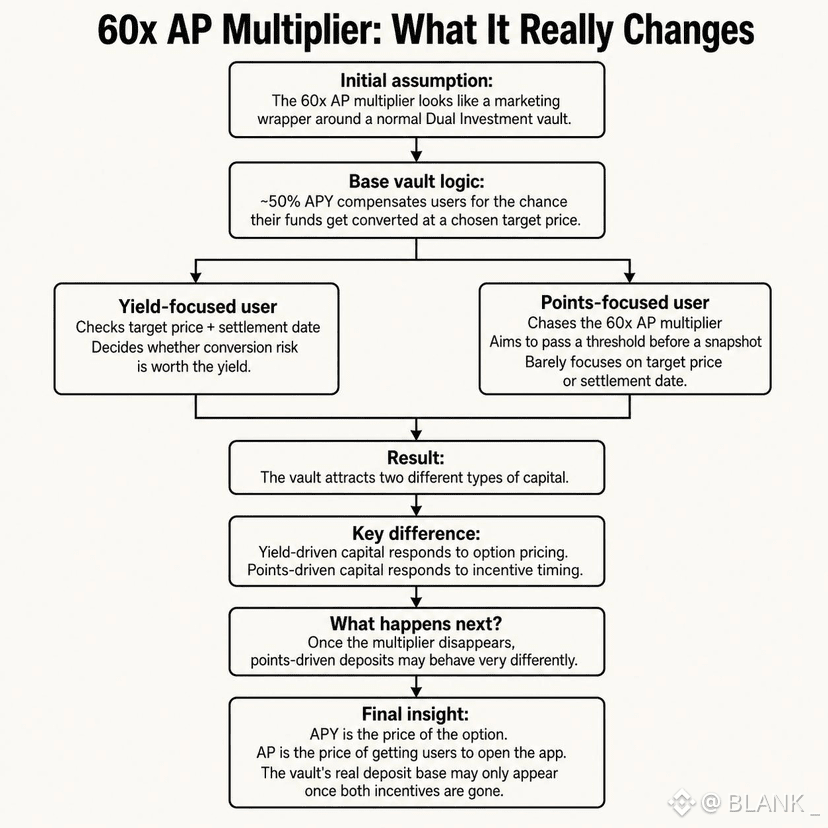
At first I assumed the 60x AP multiplier was just a marketing wrapper around a normal Dual Investment vault, a way to make a familiar structured product sound new again. The APY told a clean story on its own: roughly 50%, priced for the chance your funds get converted at a target you picked yourself. But the points layer changes who shows up. A user optimizing for yield reads the target price and the settlement date and decides if the trade is worth the conversion risk. A user optimizing for points barely looks at either. They're depositing because sixty times the multiplier moves them past a threshold before a snapshot, not because they have a view on price. That's a different kind of capital, and it behaves differently once the multiplier disappears. The APY is the price of the option. The AP is the price of getting people to open the app at all. I'm not sure the vault's real deposit base shows up until both incentives are gone at once.
@termmax #TermMax
At first I assumed the 60x AP multiplier was just a marketing wrapper around a normal Dual Investment vault, a way to make a familiar structured product sound new again. The APY told a clean story on its own: roughly 50%, priced for the chance your funds get converted at a target you picked yourself. But the points layer changes who shows up. A user optimizing for yield reads the target price and the settlement date and decides if the trade is worth the conversion risk. A user optimizing for points barely looks at either. They're depositing because sixty times the multiplier moves them past a threshold before a snapshot, not because they have a view on price. That's a different kind of capital, and it behaves differently once the multiplier disappears. The APY is the price of the option. The AP is the price of getting people to open the app at all. I'm not sure the vault's real deposit base shows up until both incentives are gone at once.
@TermMax #TermMax
@TermMax #TermMax
62
45
5.5k
·
--
Рост
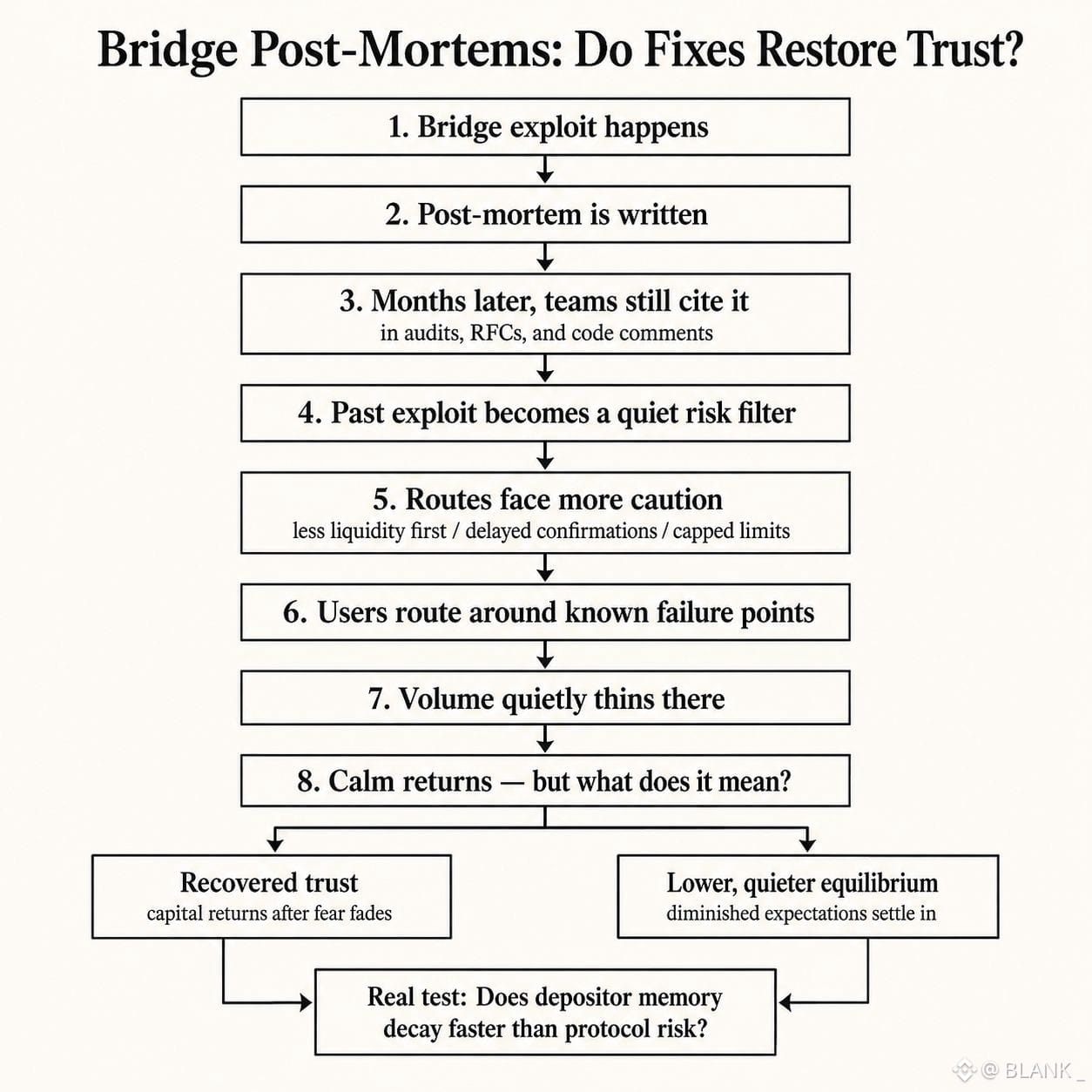
At first I assumed bridge post-mortems mostly get read once and forgotten, filed away after the incident thread fades. But watching how teams cite them months later, in audits, in RFC discussions, in silent code comments, it looks more like slow-release friction. Every past exploit becomes a quiet filter: which routes get liquidity first, which get delayed confirmations, which get capped limits before anyone trusts them again. The mechanics rarely change fast. What changes is patience, users route around known failure points without announcing why, and volume just thins there. Reliability isn't proven by uptime charts, it's proven by whether capital returns after being scared once. That's the real test post-mortem lessons face, not whether the fix holds technically, but whether depositors' memory decays faster than the protocol's. So when a bridge looks calm again, is that recovered trust, or just diminished expectations settling into a lower, quieter equilibrium?
@Dusk_Foundation $DUSK #dusk
At first I assumed bridge post-mortems mostly get read once and forgotten, filed away after the incident thread fades. But watching how teams cite them months later, in audits, in RFC discussions, in silent code comments, it looks more like slow-release friction. Every past exploit becomes a quiet filter: which routes get liquidity first, which get delayed confirmations, which get capped limits before anyone trusts them again. The mechanics rarely change fast. What changes is patience, users route around known failure points without announcing why, and volume just thins there. Reliability isn't proven by uptime charts, it's proven by whether capital returns after being scared once. That's the real test post-mortem lessons face, not whether the fix holds technically, but whether depositors' memory decays faster than the protocol's. So when a bridge looks calm again, is that recovered trust, or just diminished expectations settling into a lower, quieter equilibrium?
@Dusk $DUSK #dusk
@Dusk $DUSK #dusk
63
51
3.1k
·
--
Рост
Проверено
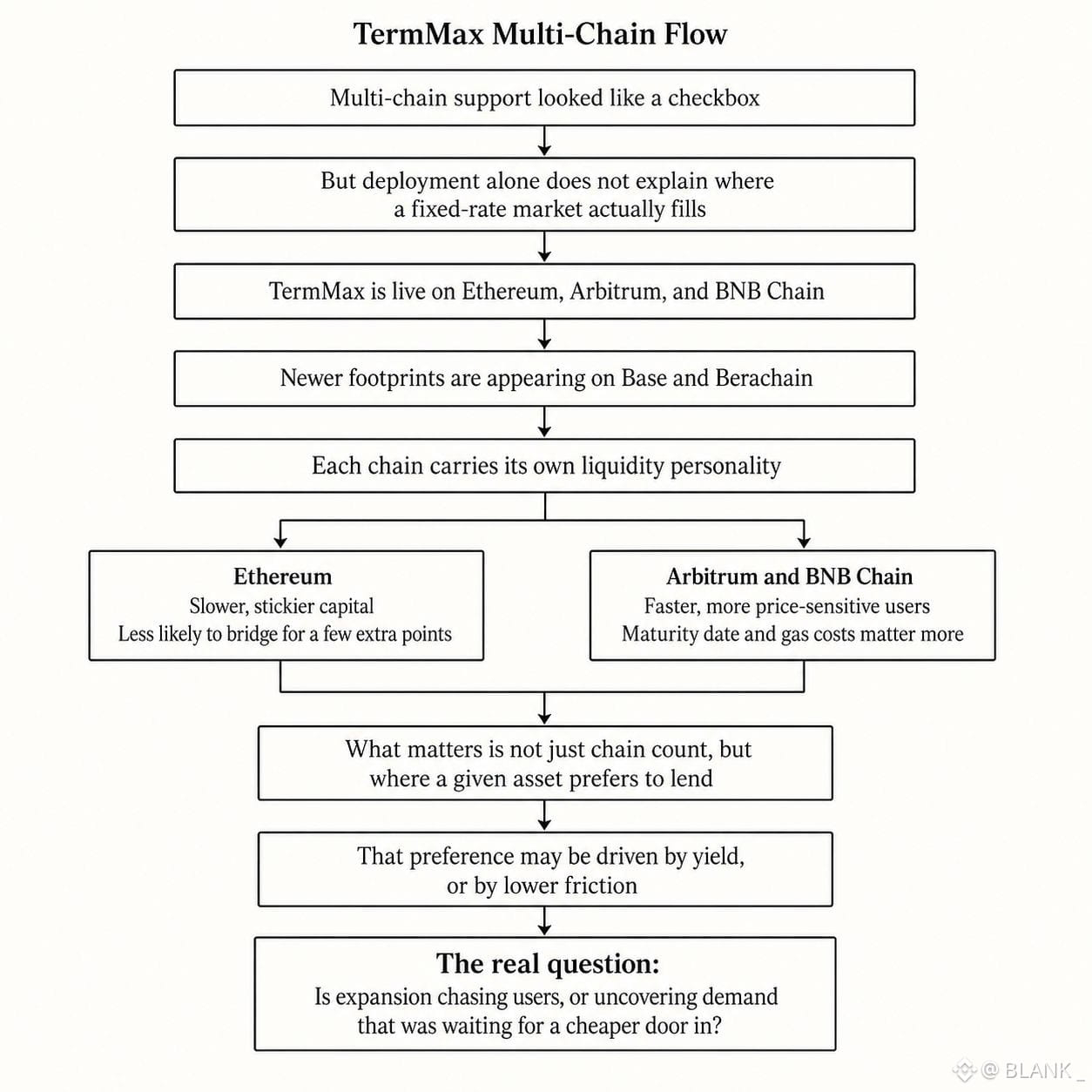
At first I assumed multi-chain support was mostly a checkbox, something protocols list to look complete. TermMax sits live on Ethereum, Arbitrum, and BNB Chain, with newer footprints on chains like Berachain and Base. But watching where a fixed-rate market actually fills, not just where it's deployed, changes the read.
Each chain carries its own liquidity personality. Ethereum tends to hold slower, stickier capital, the kind that doesn't chase yield across a bridge for a few extra points. Arbitrum and BNB Chain pull faster, more price-sensitive users, the ones weighing a maturity date against gas costs before committing at all. What's interesting isn't the chain count. It's which chain a given asset quietly prefers to lend on, and whether that preference is really about yield, or about friction. So the deeper question isn't how many chains a protocol reaches. It's whether expansion is chasing users, or just uncovering demand that was already waiting for a cheaper door in.
@termmax #TermMax
At first I assumed multi-chain support was mostly a checkbox, something protocols list to look complete. TermMax sits live on Ethereum, Arbitrum, and BNB Chain, with newer footprints on chains like Berachain and Base. But watching where a fixed-rate market actually fills, not just where it's deployed, changes the read.
Each chain carries its own liquidity personality. Ethereum tends to hold slower, stickier capital, the kind that doesn't chase yield across a bridge for a few extra points. Arbitrum and BNB Chain pull faster, more price-sensitive users, the ones weighing a maturity date against gas costs before committing at all. What's interesting isn't the chain count. It's which chain a given asset quietly prefers to lend on, and whether that preference is really about yield, or about friction. So the deeper question isn't how many chains a protocol reaches. It's whether expansion is chasing users, or just uncovering demand that was already waiting for a cheaper door in.
@TermMax #TermMax
Each chain carries its own liquidity personality. Ethereum tends to hold slower, stickier capital, the kind that doesn't chase yield across a bridge for a few extra points. Arbitrum and BNB Chain pull faster, more price-sensitive users, the ones weighing a maturity date against gas costs before committing at all. What's interesting isn't the chain count. It's which chain a given asset quietly prefers to lend on, and whether that preference is really about yield, or about friction. So the deeper question isn't how many chains a protocol reaches. It's whether expansion is chasing users, or just uncovering demand that was already waiting for a cheaper door in.
@TermMax #TermMax
88
71
1.6k
·
--
Рост
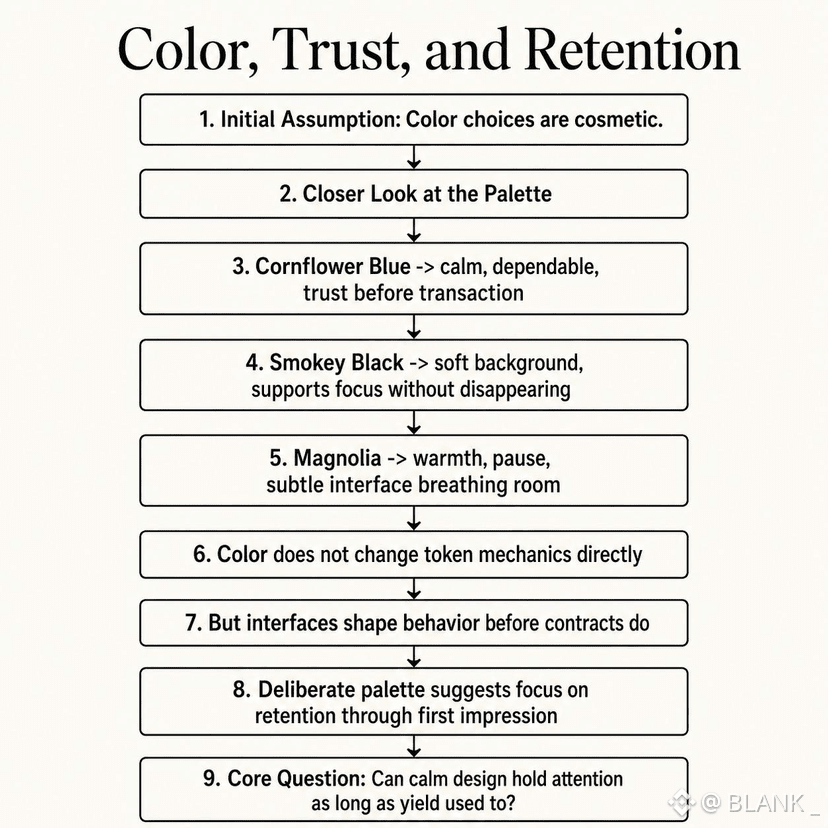
At first I assumed the color choices were cosmetic, something a design team picks last, after the logic of the protocol is already locked in. Then I looked at the palette again. Cornflower Blue reads as calm and dependable, the color you'd want people to associate with trust before a transaction, not after. Smokey Black doesn't behave like a pure black. It's softer, less absolute, more like a background that lets other elements hold attention without disappearing itself. Magnolia sits somewhere between white and warmth, an accent that doesn't announce itself but shows up wherever the interface wants a pause. None of this changes token mechanics directly. But interfaces shape behavior before contracts do. A palette this deliberate suggests a team thinking about retention at the level of first impression, not just incentive design. The real question isn't whether the colors are appealing. It's whether calm design can hold attention as long as yield used to.
@Dusk_Foundation $DUSK #dusk
At first I assumed the color choices were cosmetic, something a design team picks last, after the logic of the protocol is already locked in. Then I looked at the palette again. Cornflower Blue reads as calm and dependable, the color you'd want people to associate with trust before a transaction, not after. Smokey Black doesn't behave like a pure black. It's softer, less absolute, more like a background that lets other elements hold attention without disappearing itself. Magnolia sits somewhere between white and warmth, an accent that doesn't announce itself but shows up wherever the interface wants a pause. None of this changes token mechanics directly. But interfaces shape behavior before contracts do. A palette this deliberate suggests a team thinking about retention at the level of first impression, not just incentive design. The real question isn't whether the colors are appealing. It's whether calm design can hold attention as long as yield used to.
@Dusk $DUSK #dusk
@Dusk $DUSK #dusk
50
46
672
·
--
Рост
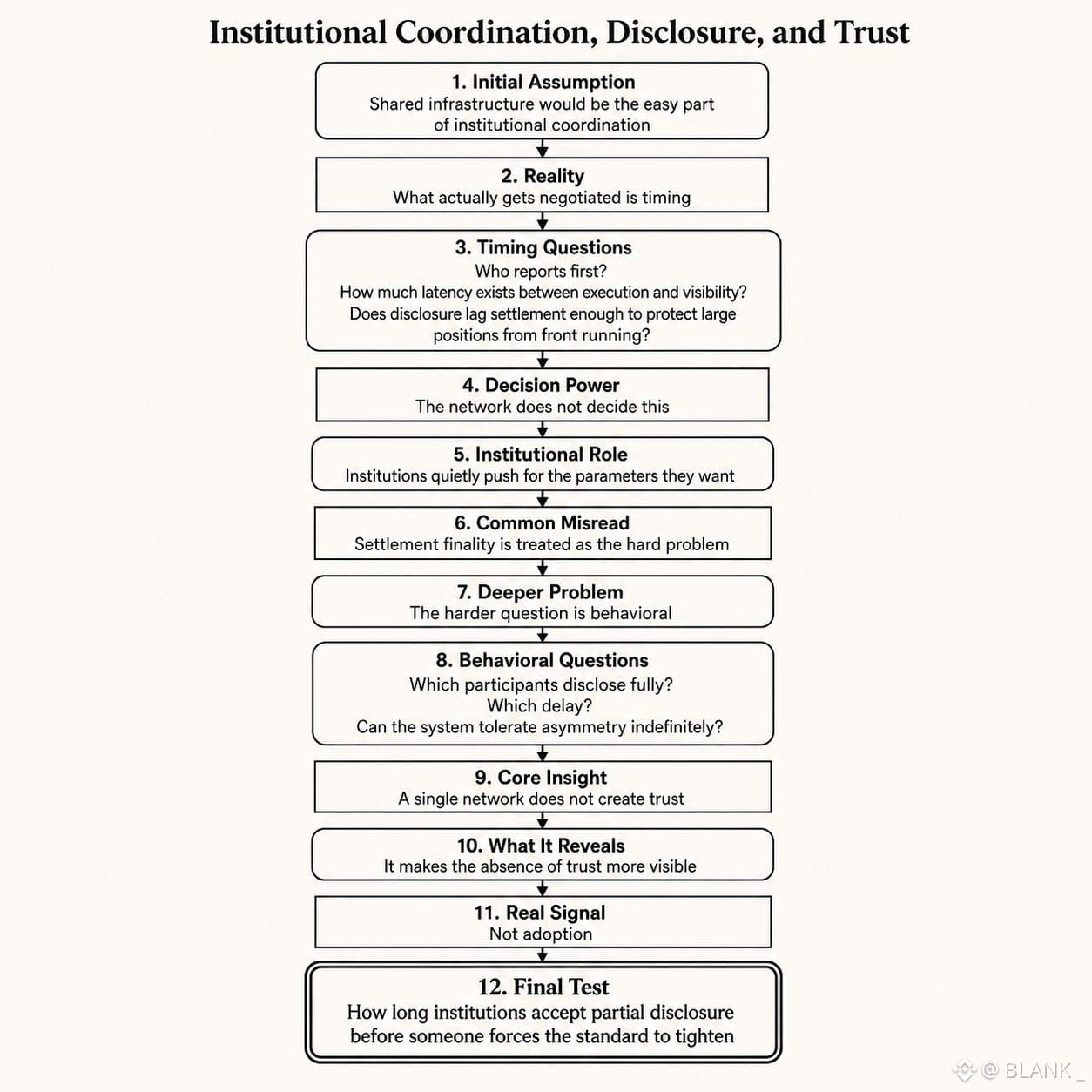
At first I assumed shared infrastructure would be the easy part of institutional coordination, that once everyone settled on one network, disclosure rules would follow naturally. That is not what happens. What actually gets negotiated is timing. Who reports first, how much latency exists between execution and visibility, and whether disclosure lags settlement enough to protect large positions from front running. The network does not decide this. Institutions do, quietly, through the parameters they push for. Settlement finality gets treated as the hard problem, but it is usually solved early. The harder question is behavioral: which participants disclose fully, which delay, and whether the system tolerates asymmetry indefinitely. A single network does not create trust. It just makes the absence of it more visible. The real signal is not adoption. It is how long institutions accept partial disclosure before someone forces the standard to tighten.
@Dusk_Foundation $DUSK #dusk
At first I assumed shared infrastructure would be the easy part of institutional coordination, that once everyone settled on one network, disclosure rules would follow naturally. That is not what happens. What actually gets negotiated is timing. Who reports first, how much latency exists between execution and visibility, and whether disclosure lags settlement enough to protect large positions from front running. The network does not decide this. Institutions do, quietly, through the parameters they push for. Settlement finality gets treated as the hard problem, but it is usually solved early. The harder question is behavioral: which participants disclose fully, which delay, and whether the system tolerates asymmetry indefinitely. A single network does not create trust. It just makes the absence of it more visible. The real signal is not adoption. It is how long institutions accept partial disclosure before someone forces the standard to tighten.
@Dusk $DUSK #dusk
@Dusk $DUSK #dusk
66
52
561
·
--
Рост
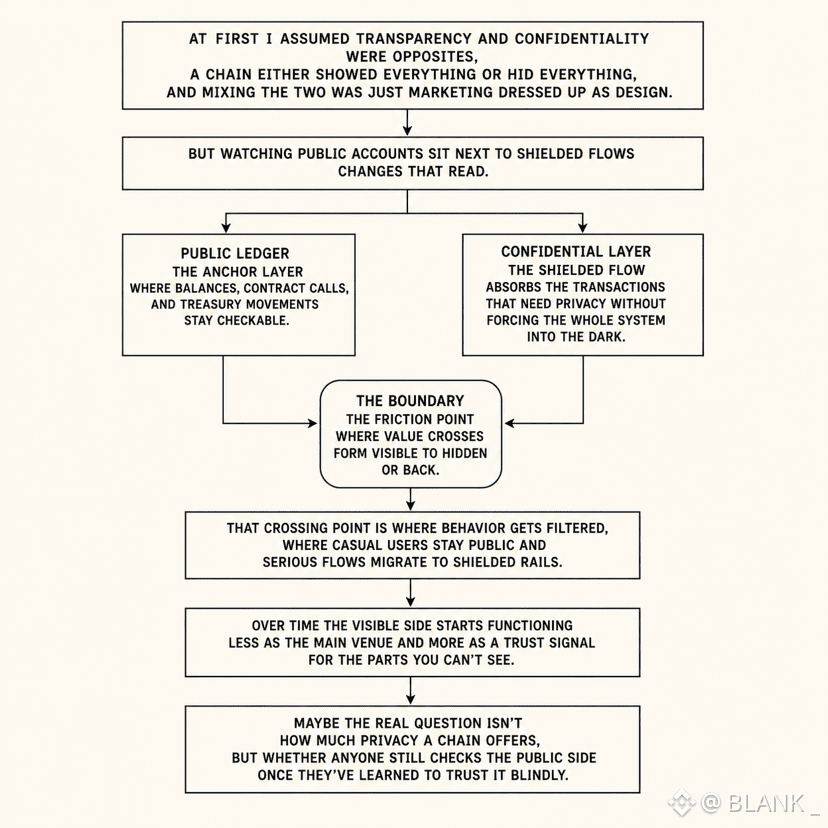
At first I assumed transparency and confidentiality were opposites, that a chain either showed everything or hid everything, and mixing the two was just marketing dressed up as design. But watching public accounts sit next to shielded flows changes that read. The public ledger becomes a kind of anchor, a place where balances, contract calls, and treasury movements stay checkable, while the confidential layer absorbs the transactions that need privacy without forcing the whole system into the dark. What's interesting is the friction at the boundary, the moment value crosses from visible to hidden or back. That crossing point is where behavior gets filtered, where casual users stay public and serious flows migrate to shielded rails. Over time the visible side starts functioning less as the main venue and more as a trust signal for the parts you can't see. Maybe the real question isn't how much privacy a chain offers, but whether anyone still checks the public side once they've learned to trust it blindly.
@Dusk_Foundation $DUSK #dusk
At first I assumed transparency and confidentiality were opposites, that a chain either showed everything or hid everything, and mixing the two was just marketing dressed up as design. But watching public accounts sit next to shielded flows changes that read. The public ledger becomes a kind of anchor, a place where balances, contract calls, and treasury movements stay checkable, while the confidential layer absorbs the transactions that need privacy without forcing the whole system into the dark. What's interesting is the friction at the boundary, the moment value crosses from visible to hidden or back. That crossing point is where behavior gets filtered, where casual users stay public and serious flows migrate to shielded rails. Over time the visible side starts functioning less as the main venue and more as a trust signal for the parts you can't see. Maybe the real question isn't how much privacy a chain offers, but whether anyone still checks the public side once they've learned to trust it blindly.
@Dusk $DUSK #dusk
@Dusk $DUSK #dusk
89
69
1.5k
·
--
Рост
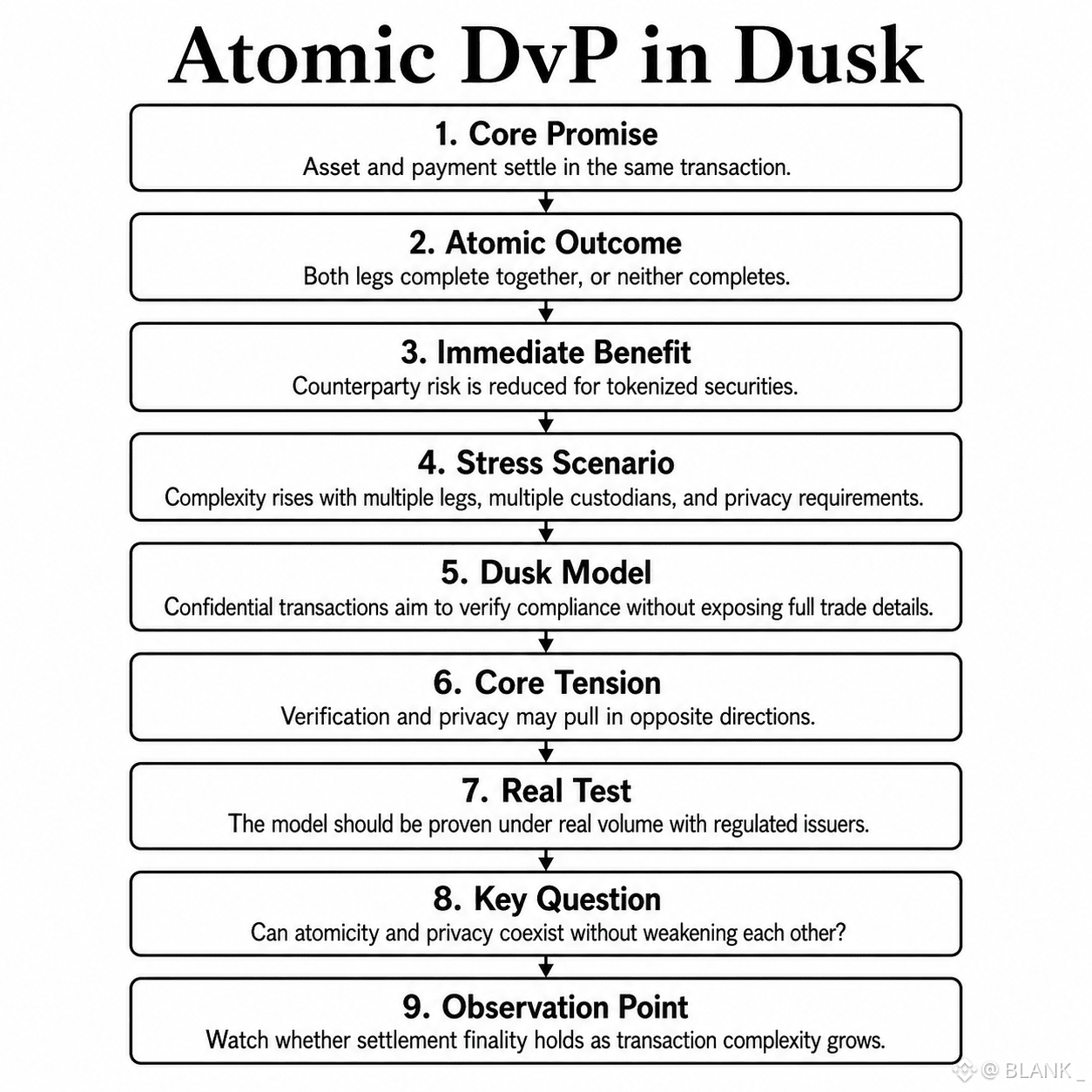
At first I assumed Citadel was just another identity layer bolted onto a chain, another box to check for compliance theater. But the more I watched how credentials moved through it, the more it felt like something else: a filter, not a vault. The system doesn't ask you to hand over your data. It asks you to prove a claim, then forgets the specifics almost immediately. That's a subtle kind of friction, the burden shifts from disclosure to attestation. Timing matters here too. A credential verified once doesn't linger as an asset; it expires into irrelevance unless the underlying claim still holds. What's interesting isn't the privacy, it's the retention pressure this creates. Users aren't kept by convenience, they're kept by the cost of re-proving elsewhere. Which raises the real question: is demand for verification systems like this driven by trust, or by how expensive it becomes to leave?
@Dusk_Foundation $DUSK #dusk
At first I assumed Citadel was just another identity layer bolted onto a chain, another box to check for compliance theater. But the more I watched how credentials moved through it, the more it felt like something else: a filter, not a vault. The system doesn't ask you to hand over your data. It asks you to prove a claim, then forgets the specifics almost immediately. That's a subtle kind of friction, the burden shifts from disclosure to attestation. Timing matters here too. A credential verified once doesn't linger as an asset; it expires into irrelevance unless the underlying claim still holds. What's interesting isn't the privacy, it's the retention pressure this creates. Users aren't kept by convenience, they're kept by the cost of re-proving elsewhere. Which raises the real question: is demand for verification systems like this driven by trust, or by how expensive it becomes to leave?
@Dusk $DUSK #dusk
@Dusk $DUSK #dusk
211
98
2.7k
·
--
Рост
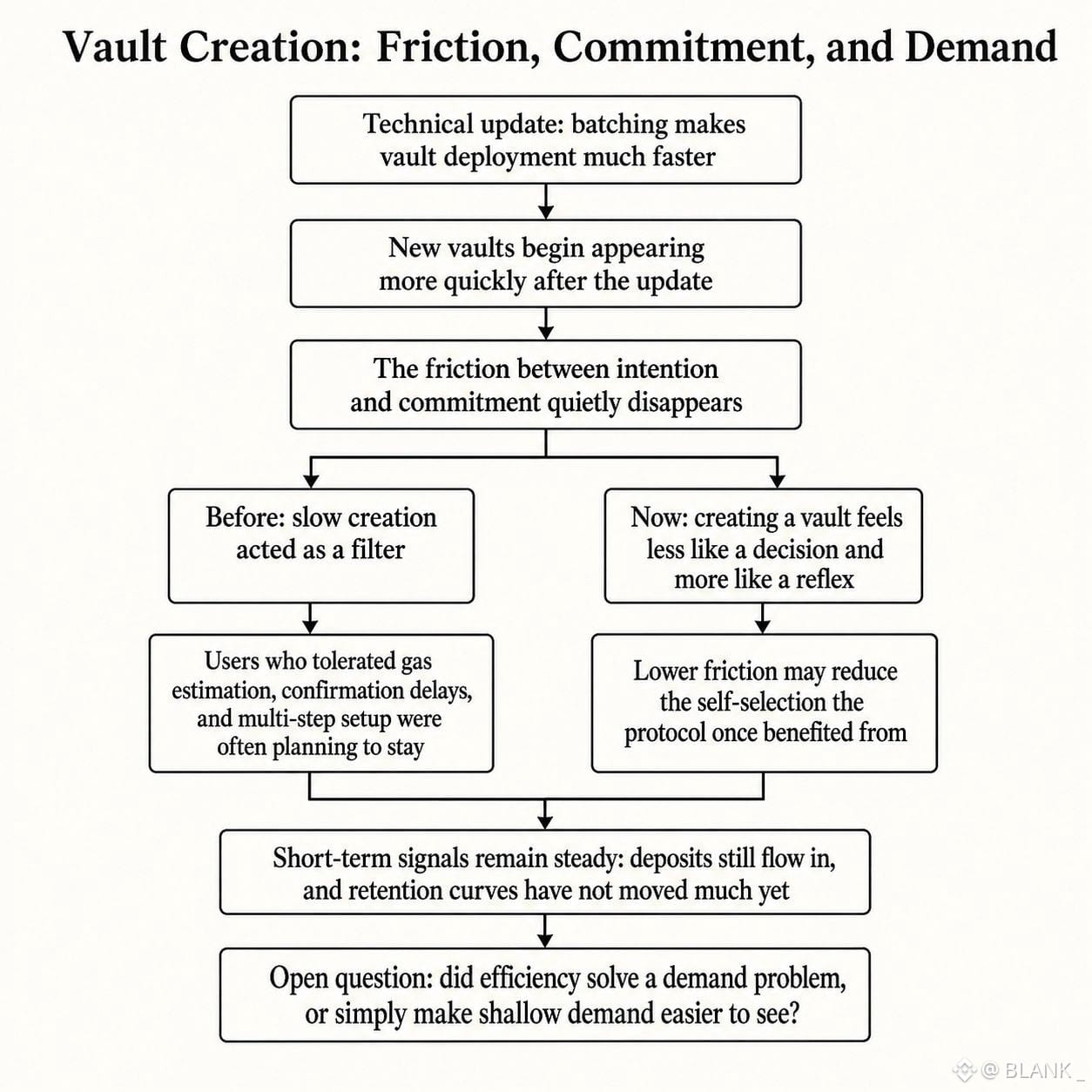
At first I assumed the breakthrough was purely technical, a clever bit of batching that shaved seconds off vault deployment. But watching how fast new vaults started appearing after the update, I noticed something else: the friction that used to sit between intention and commitment had quietly disappeared. Slow creation used to act as a filter. People who waited through gas estimation, confirmation delays, and multi-step setup were usually the ones planning to stay. Now that the process takes moments, the vault feels less like a decision and more like a reflex. Deposits still flow in, retention curves haven't moved much yet, but I keep wondering whether removing that friction also removed a kind of self-selection the protocol relied on without realizing it. Efficiency solved a UX problem. Whether it solved a demand problem, or just made shallow demand easier to see, still feels unresolved.
@babylonlabs_io $BABY #baby
At first I assumed the breakthrough was purely technical, a clever bit of batching that shaved seconds off vault deployment. But watching how fast new vaults started appearing after the update, I noticed something else: the friction that used to sit between intention and commitment had quietly disappeared. Slow creation used to act as a filter. People who waited through gas estimation, confirmation delays, and multi-step setup were usually the ones planning to stay. Now that the process takes moments, the vault feels less like a decision and more like a reflex. Deposits still flow in, retention curves haven't moved much yet, but I keep wondering whether removing that friction also removed a kind of self-selection the protocol relied on without realizing it. Efficiency solved a UX problem. Whether it solved a demand problem, or just made shallow demand easier to see, still feels unresolved.
@BabylonLabs_io $BABY #baby
@BabylonLabs_io $BABY #baby
176
90
15.5k
·
--
Рост
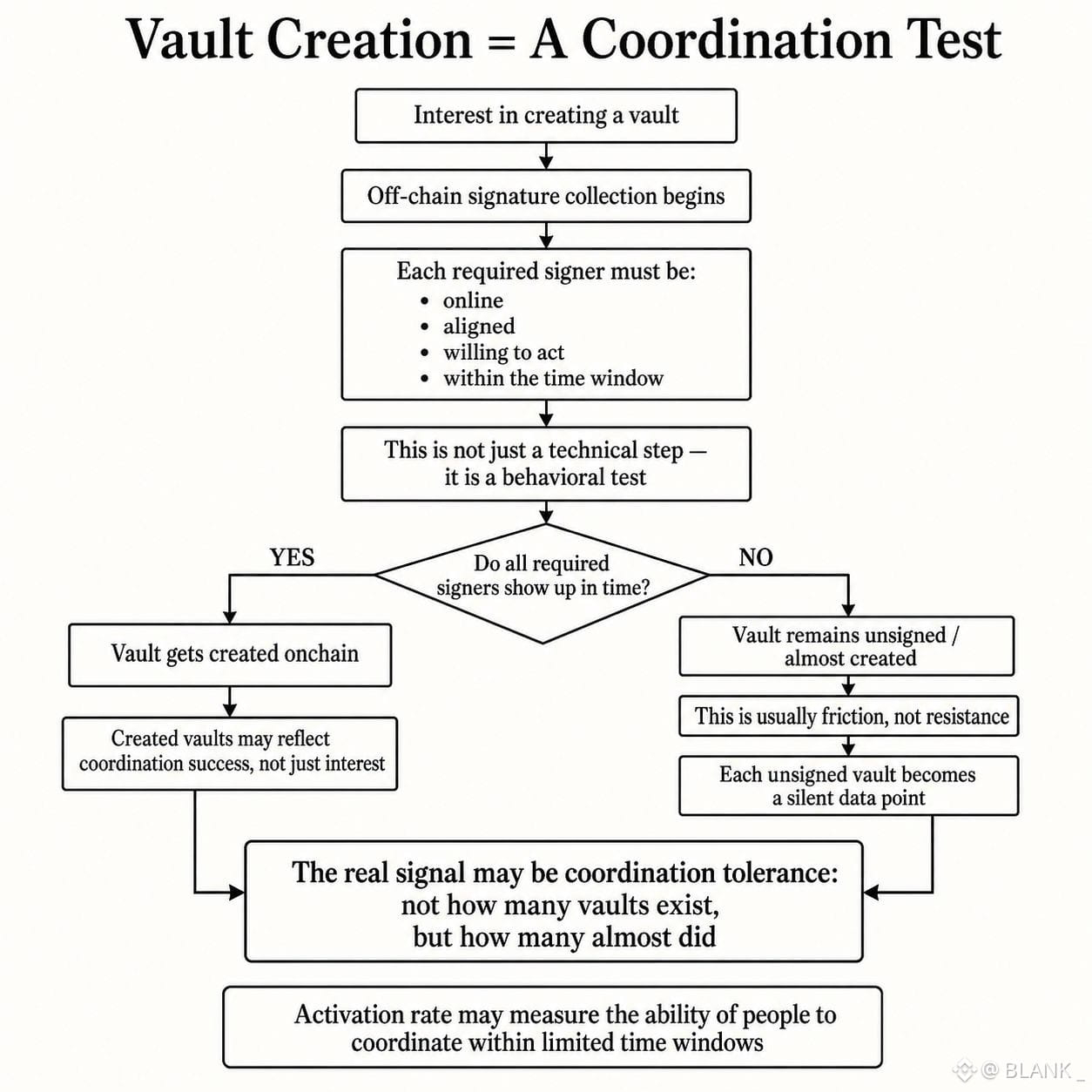
At first I assumed vault creation was just a formality, a wallet click and a confirmation. But watching the signature collection process, off-chain, before anything settles onchain, there's a filtering effect happening that's easy to miss. Each signer has to be online, aligned, and willing to act within a window that isn't always generous. That's not a technical detail. It's a behavioral test. The vaults that actually get created aren't the ones with the most interest, they're the ones where every required party shows up at the same time, with the same intent, before the moment passes. I keep wondering how much of a protocol's "activation rate" is really just measuring coordination tolerance. Every unsigned vault is a small, silent data point: not resistance, just friction that never quite got answered. Maybe that's the real signal worth tracking, not how many vaults exist, but how many almost did.
@babylonlabs_io $BABY #baby
At first I assumed vault creation was just a formality, a wallet click and a confirmation. But watching the signature collection process, off-chain, before anything settles onchain, there's a filtering effect happening that's easy to miss. Each signer has to be online, aligned, and willing to act within a window that isn't always generous. That's not a technical detail. It's a behavioral test. The vaults that actually get created aren't the ones with the most interest, they're the ones where every required party shows up at the same time, with the same intent, before the moment passes. I keep wondering how much of a protocol's "activation rate" is really just measuring coordination tolerance. Every unsigned vault is a small, silent data point: not resistance, just friction that never quite got answered. Maybe that's the real signal worth tracking, not how many vaults exist, but how many almost did.
@BabylonLabs_io $BABY #baby
@BabylonLabs_io $BABY #baby
145
66
2.3k
Войдите, чтобы посмотреть больше материала
Присоединяйтесь к пользователям криптовалют по всему миру на Binance Square
⚡️ Получайте новейшую и полезную информацию о криптоактивах.
💬 Нам доверяет крупнейшая в мире криптобиржа.
👍 Получите достоверные аналитические данные от верифицированных создателей контента.
Эл. почта/номер телефона