
indian akshat
44 Публикации

indian akshat
Отправить жалобу
Заблокировать пользователя
Трейдер с частыми сделками
2.1 мес.
14 подписок(и/а)
1.9K+ подписчиков(а)
107 понравилось
Посты
Все
Активно
·
--
Падение
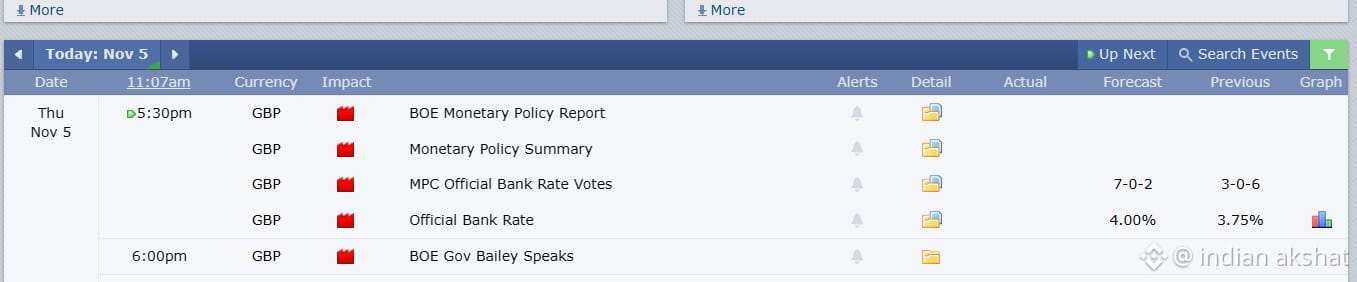
everyone ready for 5 : 30 time because coming many of news and careful that time. that time how to $BTC how to perform and creating suspense . be carefully that time make good trade .
#news
⭕‼️⭕
everyone ready for 5 : 30 time because coming many of news and careful that time. that time how to $BTC how to perform and creating suspense . be carefully that time make good trade .
#news
⭕‼️⭕
#news
⭕‼️⭕
1
126
·
--
Рост
Частичная правда
dark reality of $KORUB stocks fully depend on the Samsung stocks . that day crash Samsung and another hand $KORUB stocks being start for crash . $SAMSUNG and Koru charts are similar and this stocks belong to Korea. please carefully trade in this stocks beacause of too much coming in this stocks. #KORU
i am lossing our all capital 😭😭😭. i am really sad
⭕‼️⭕
i am lossing our all capital 😭😭😭. i am really sad
⭕‼️⭕
1
1.1k
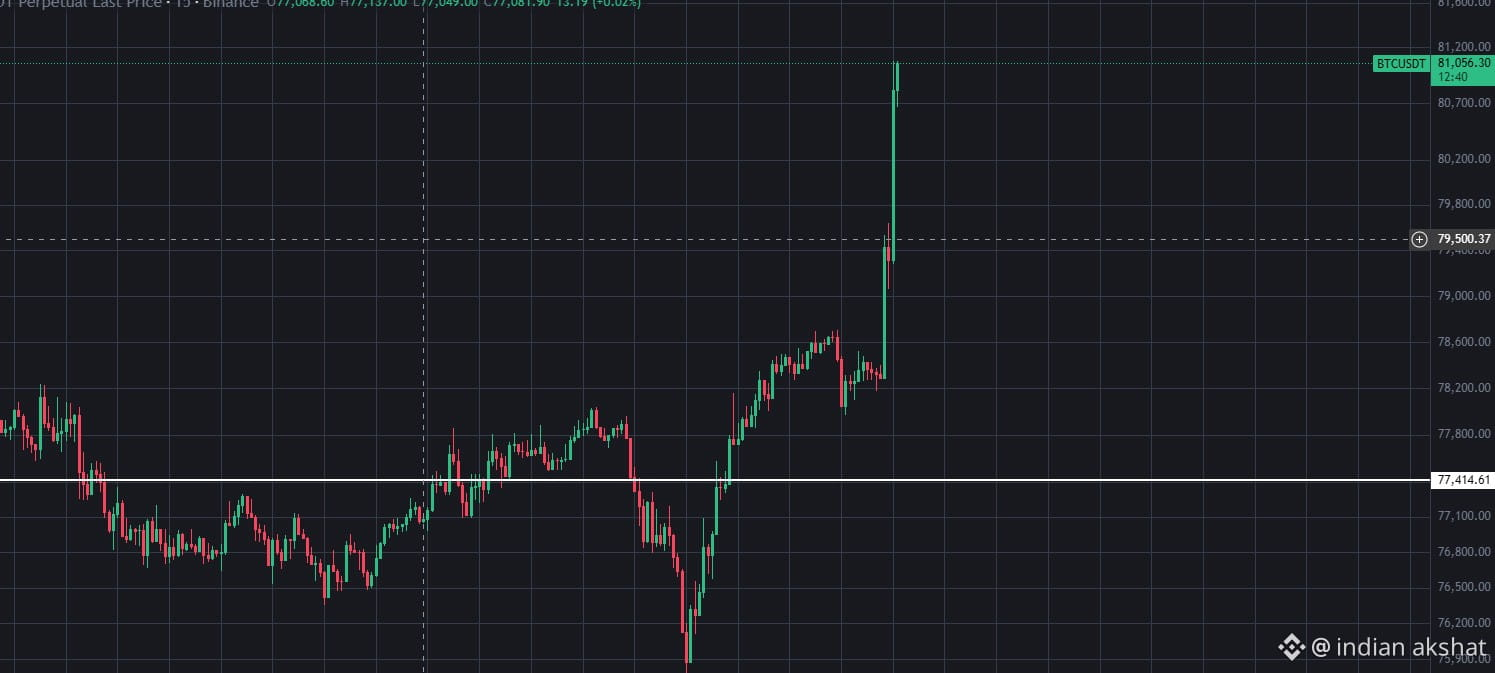
i am facing losses because of btc crash then coming news and crash.
$KORUB i am holding profit before crash at least 20 usdt holding profit.
i am facing losses because of btc crash then coming news and crash.
$KORUB i am holding profit before crash at least 20 usdt holding profit.
$KORUB i am holding profit before crash at least 20 usdt holding profit.
1
513
i am back to back getting loss in this coin $KITE
support me
i am back to back getting loss in this coin $KITE
support me
support me
129
i am liquidate this coin and getting loss. $KITE
i am liquidate this coin and getting loss. $KITE
128
i am liquidated in this coin many times $AIN
support me throught tips
i am liquidated in this coin many times $AIN
support me throught tips
support me throught tips
198
$ORDER i am getting loss in this coin many time. i am not gain profit
$ORDER i am getting loss in this coin many time. i am not gain profit
1
174
·
--
Рост
Would you give an AI your credit card? 🤖💳
Agents can already research and book. Paying safely is the unsolved part. @GoKiteAI answer: don't trust the agent, cap the damage with math.
Kite is a Layer 1 built only for agent payments. Mainnet and the Agent Passport went live on April 30, 2026.
🔐 3 layers of authority
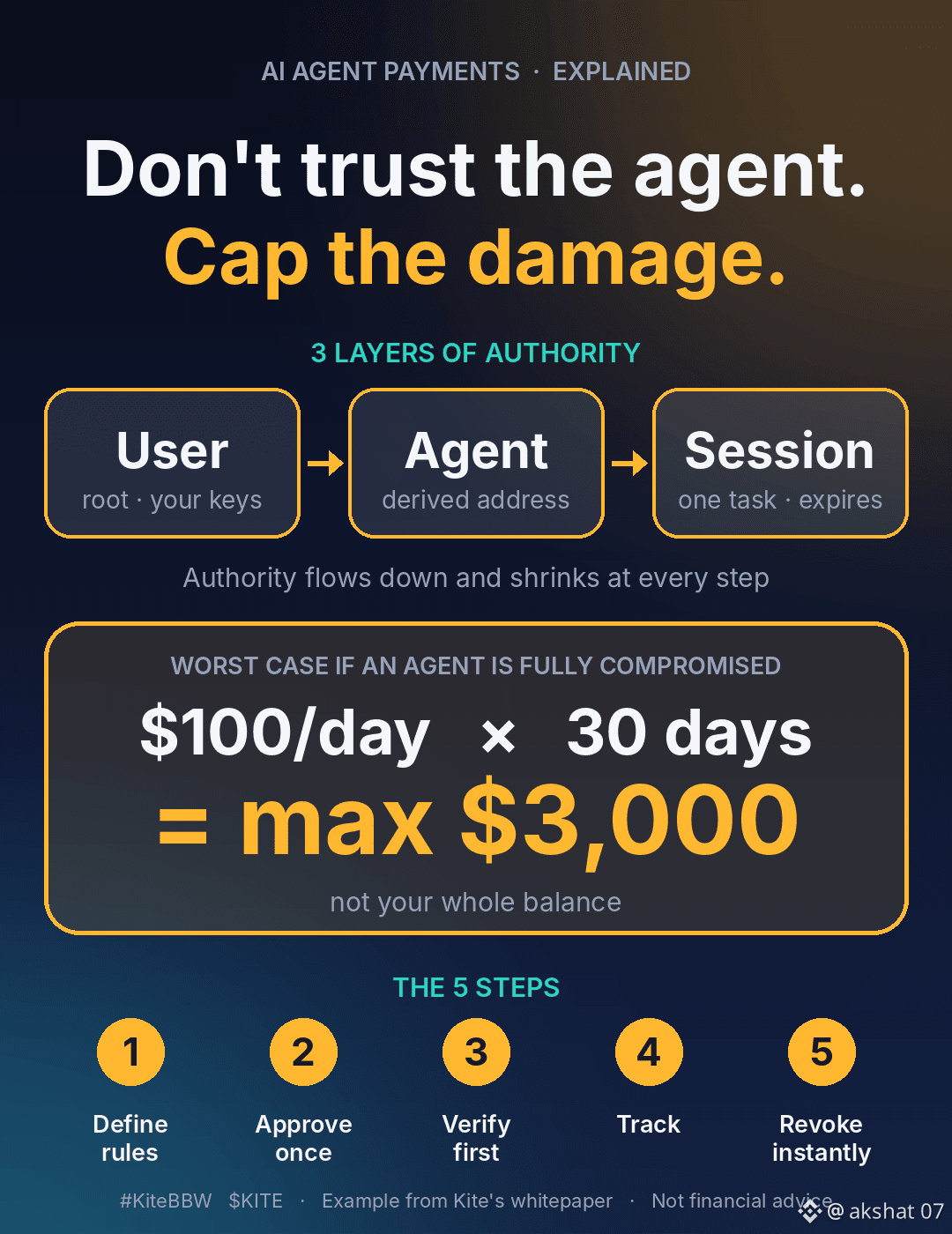
User (root) → Agent (own derived address, can't reach your key) → Session (one task, then it expires)
🧮 The safety math
You sign a Standing Intent with caps and an expiry. Per Kite's whitepaper, the worst case with a fully compromised agent is the daily cap × the duration. Example: $100/day for 30 days = max $3,000, not your whole balance.
✅ The 5 steps (see the video)
1. Define the rules 2. Approve once 3. Verify before money moves 4. Track 5. Revoke instantly
⚡ Payments
x402 revives the HTTP 402 "Payment Required" status. State channels target sub-100 ms and about $0.000001 per request (Kite's own claims).
🪙 $KITE
10B max supply. Used for gas, staking and governance. Builders must hold it, and a small commission on AI service transactions is swapped into KITE. The plan is to move from emissions to revenue-funded rewards.
⚠️ My take: it's early. Performance figures are Kite's claims, and the commission rate and vesting schedule weren't on the tokenomics page. I'm watching real payment volume, funded Passports and integrations.
What's the most you'd let an AI agent spend on its own: $10, $100 or $1,000? 👇
#KiteBBW $KITE @GoKiteAI
Not financial advice. DYOR.
Would you give an AI your credit card? 🤖💳
Agents can already research and book. Paying safely is the unsolved part. @KITE AI 中文 answer: don't trust the agent, cap the damage with math.
Kite is a Layer 1 built only for agent payments. Mainnet and the Agent Passport went live on April 30, 2026.
🔐 3 layers of authority
User (root) → Agent (own derived address, can't reach your key) → Session (one task, then it expires)
🧮 The safety math
You sign a Standing Intent with caps and an expiry. Per Kite's whitepaper, the worst case with a fully compromised agent is the daily cap × the duration. Example: $100/day for 30 days = max $3,000, not your whole balance.
✅ The 5 steps (see the video)
1. Define the rules 2. Approve once 3. Verify before money moves 4. Track 5. Revoke instantly
⚡ Payments
x402 revives the HTTP 402 "Payment Required" status. State channels target sub-100 ms and about $0.000001 per request (Kite's own claims).
🪙 $KITE
10B max supply. Used for gas, staking and governance. Builders must hold it, and a small commission on AI service transactions is swapped into KITE. The plan is to move from emissions to revenue-funded rewards.
⚠️ My take: it's early. Performance figures are Kite's claims, and the commission rate and vesting schedule weren't on the tokenomics page. I'm watching real payment volume, funded Passports and integrations.
What's the most you'd let an AI agent spend on its own: $10, $100 or $1,000? 👇
#KiteBBW $KITE @KITE AI 中文
Not financial advice. DYOR.
117
Статья
The Burger Flipper and the Coin: The Story of BNBThe Burger Flipper and the Coin
BNB is a coin that has been worth tens of billions of dollars, and it exists because a kid who once flipped burgers in Vancouver sold his apartment in Shanghai to buy Bitcoin. This is the story of that man, and of what the coin he made actually is.
Vancouver, August 1989
In August 1989 a twelve-year-old boy and his mother got off a plane in Vancouver. His father was already there, working on a doctorate at the University of British Columbia. The boy was Changpeng Zhao. He later told Maclean's that it was the first place he ever drank fresh milk, something that was rare in the China he had left.
Nobody at that airport was thinking about crypto. There was no crypto. The family was thinking about rent, and about how to start over in a country where none of them had a job.
Hold on to that picture, because everything below grows out of it. BNB looks like a financial product. It is also, in a very direct way, what that boy did next.
Dirt floors and night shifts
Zhao was born in 1977 in Jiangsu province, north of Shanghai, just as the Cultural Revolution was ending. His father, Shengkai, taught at a university and was labelled a "pro-bourgeois intellectual", which in those years meant being sent off to the countryside. According to a chapter-by-chapter summary of Zhao's memoir, Freedom of Money, the family lived in campus housing with dirt floors and no running water. In 1984 the father left for his doctorate in Canada. The rest of the family waited five years to follow.
Vancouver was better, but it was not easy. The same memoir summary says his mother took piece-rate work in a garment factory that damaged her health, and his father drove a beat-up Datsun. Zhao pitched in. He worked overnight shifts at a Chevron gas station, spent two years at McDonald's, and refereed volleyball on the side.
Then there was the computer. His father, a math-minded programmer, spent roughly $7,000 on a 286 DOS machine, a huge sum for a family that was counting every dollar. It was the thing that got the boy hooked, and he was soon taking programming classes in high school.
The programmer years
Zhao went east to McGill in Montreal, and then took the job that shaped his career: building software for trading. He worked on order-matching systems for a subcontractor of the Tokyo Stock Exchange, then spent years at Bloomberg Tradebook writing futures-trading software. Forbes reports he was promoted three times in under two years and still got restless.
In 2005 he quit and moved to Shanghai, one of the "sea turtles", Chinese-born people educated abroad who were heading back. He started Fusion Systems, which built fast trading systems for brokers and banks. Maclean's lists Goldman Sachs and Credit Suisse among the clients.
This part gets skipped in most CZ stories, and it matters. When he later built an exchange, he was not a guy who read about exchanges. He had spent years building the machinery inside them.
The bet
In 2013, at a poker game with friends, Zhao heard about Bitcoin, reportedly from several people in quick succession, one of them a venture capitalist. He dug into it seriously, and soon he was Blockchain.info's head of development, the third person on its team, and after that he spent under a year as CTO of OKCoin.
Then he did something his friends thought was foolish. He sold his Shanghai apartment and put roughly $1 million into Bitcoin at around $600 a coin. The memoir summary says the price fell about 70% within two months, a paper loss of more than $700,000, and that people around him mocked the move. He held anyway.
The same summary adds a near miss from early 2014. He was close to becoming CEO of the China arm of Mt. Gox. The exchange collapsed on February 7, 2014, and he lost 100 bitcoins that were sitting on it. He stayed in crypto anyway.
A hotpot dinner, and a coin
The memoir summary puts the turning point at a hotpot dinner in Chengdu on June 14, 2017. The 2017 token-sale boom was in full swing, and Zhao decided to run one of his own. A white paper came together within days. It promised 200 million of a new token that would pay fees on a new exchange.
The name came from an early partner, He Yi. Zhao had a different one in mind. She told him it sounded like a grocery store and suggested "Binance", a mash of binary and finance. She joined the company the night before launch, and Binance went live in mid-July 2017.
The token was BNB. Here is how the white paper split the supply.The pitch was $15 million raised at 15 cents a token. Forbes later looked at the blockchain records and argued the real public sale was much smaller, perhaps under $5 million, and that Binance kept control of most of the unsold supply. Binance has pushed back on Forbes in the past, and those figures are hard to check from outside, so treat them as a serious claim rather than a settled fact. What nobody disputes is what happened next.
In September 2017 China cracked down on crypto trading, and CZ left for Tokyo almost overnight. The summary describes a moment that same autumn when four token projects traded below their sale price and Binance covered about $6 million of its users' shortfalls, roughly 40% of its total assets, after a ten-minute call taken on a moving train. Then the platform simply took off. Forbes reported that by early 2018, around 180 days in, Binance was the largest exchange by volume, with about 6 million users. BNB had gone from roughly 10 cents to $13, and Forbes put CZ's crypto wealth at $1.1 to $2 billion.
What BNB actually does
BNB started life as a token on Ethereum, a discount coupon for the exchange. In 2019 Binance launched its own blockchain and holders swapped over to a native BNB coin. In 2020 came BNB Smart Chain, which runs smart contracts the way Ethereum does but with cheaper fees, so developers could move their apps over easily. The ecosystem now goes by BNB Chain, and Binance says the ticker stands for "Build'N'Build".
Today one coin does several jobs at once.
It is easiest to think of it as a toll on a highway. Every action on the chain costs a little BNB, so more activity means more demand for the coin. The trade-off is how the road is run. BNB Chain relies on a small group of validators (about two dozen at a time, as far as I know) instead of thousands. That keeps it fast and cheap. It is also why critics say it is more centralised than Ethereum.
The burn
The white paper promised that half of the 200 million coins would eventually be destroyed. Every quarter the BNB Chain Foundation now runs an Auto-Burn that does this on a published formula. The size of each burn depends on BNB's price and on how many blocks the chain produced that quarter. A slice of every transaction fee is also burned in real time.
The 2026 numbers are public. The January burn removed about 1.37 million BNB, worth around $1.28 billion at the time. April removed about 1.57 million. July removed about 1.62 million, worth roughly $932 million, which left a total supply of about 133.17 million.
Two things are worth noticing. First, July destroyed more coins than January (1.62 million against 1.37 million) yet was worth less in dollars ($932 million against $1.28 billion). The price fell by far more than the burn grew. Second, a burn does not guarantee a higher price. It shrinks supply, and the price still depends on whether anyone wants to buy. Foundation notes also say faster block times from recent upgrades mean the original formula has been running on different assumptions than the ones it was designed with, which is why the parameters have been adjusted.
The hard years
Binance never had a calm year for long. In May 2019 hackers took about 7,000 bitcoin, roughly $40 million at the time, and trading stopped for a week. In 2021 regulators in the UK and Japan said Binance was not authorised to operate there. Then came October 6, 2022, when an attacker tricked the bridge connecting BNB's chains into minting 1 million BNB twice. BNB Chain halted entirely for hours. SlowMist put the damage above $570 million across chains. Zhao himself put the real impact near $100 million. The chain restarted and kept going.
November 2022 was worse, and Binance was in the middle of it. After a report exposed how closely FTX and its sister trading firm Alameda were tied, CZ and FTX's Sam Bankman-Fried feuded in public. Binance sold off its large holding of FTX's token, FTT. According to the memoir summary, $6 billion left FTX within 72 hours. Binance signed a non-binding offer to buy FTX on November 8 and withdrew it the next day after seeing the books. FTX filed for bankruptcy on November 11. Binance did not create FTX's problems, but its sale set off the run.
After that the US government turned toward Binance. The CFTC sued in March 2023. The SEC followed in June with thirteen charges. Binance reported about $790 million in outflows after the SEC suit, senior executives left, and layoffs followed.
Four months
On November 21, 2023, Zhao pleaded guilty to violating US anti-money-laundering law, because Binance had not kept an effective compliance program while he ran it. He stepped down as CEO that day. Binance agreed to pay $4.3 billion, and Zhao was fined $50 million personally. Richard Teng took over the company.
At sentencing on April 30, 2024, prosecutors asked for three years. Zhao's lawyers asked for probation. Judge Richard Jones gave him four months. Zhao told the court he had accepted responsibility and "had a lot of quiet time alone to think and reflect." By the memoir summary, his side filed 161 letters of support.
He reported to a federal prison in Lompoc, California, worked on the prison farm, and lost about six kilos. He has said the experience was scary and also a time of personal growth. According to the summary, he wrote the first draft of his book on prison computers, in fifteen-minute sessions. He was released on September 27, 2024.
One detail from Maclean's is hard to skip. His father died of leukemia near Toronto in late 2021. Zhao skipped the funeral because of COVID restrictions, and said his father would not have cared much for ceremony anyway. The man who gave him the 286 computer never saw the prison, or the pardon.
That came on October 23, 2025, when President Trump pardoned him. White House press secretary Karoline Leavitt said "the Biden Administration's war on crypto is over." Axios reported that Binance had lobbied for the pardon for more than a year. The SEC had already dropped its separate civil case in May 2025. Zhao told an audience at Davos in January 2026 that the pardon lifted a "psychological burden."
He no longer runs Binance day to day but is still a major shareholder. He now invests through YZi Labs, backs a free-education project called Giggle Academy, and says he mainly holds Bitcoin and BNB. As of April 2026, Forbes put his net worth at about $111 billion, which would make him the richest Canadian. Maclean's has reported that he owns no house and no car.
Before you touch the coin
The story is easy to love: an immigrant kid, a gas station, a bet that looked crazy. It is also true that BNB's fate is tied to one company, and that company has had a rough decade. If Binance has a bad year, BNB feels it. Forbes argued in 2023 that Binance controlled a large share of the supply, a claim the company disputes. Reports in 2026 add more pressure: the Wall Street Journal said in March that the US Justice Department was looking into alleged sanctions evasion involving Iran, and Reuters reported in August that Binance had given Russian authorities user data. Those are reports, not findings, and Binance's side of each deserves to be read.
The price is just as restless. One tracker lists an all-time high of about $1,370 in October 2025. The coin traded above $900 in January 2026. Snapshots from different sites disagree about where it sits now, so check a live tracker rather than a number in an article.
If you live in India, crypto gains are currently taxed at 30%, with a 1% TDS on transfers and no offset for losses. Confirm the current rules before you trade. And treat any "guaranteed return" on BNB, any Telegram signal group and any airdrop that asks for your wallet phrase as a scam until proven otherwise.
I am not a financial advisor, and nothing here is advice to buy or sell. If your interest is the technology, there is a practical path: BNB Chain is compatible with Ethereum tooling, so Solidity skills carry over to both.
$BNB
{future}(BNBUSDT)
#bnb @CZ @BiBi
The Burger Flipper and the Coin: The Story of BNB
The Burger Flipper and the Coin
BNB is a coin that has been worth tens of billions of dollars, and it exists because a kid who once flipped burgers in Vancouver sold his apartment in Shanghai to buy Bitcoin. This is the story of that man, and of what the coin he made actually is.
Vancouver, August 1989
In August 1989 a twelve-year-old boy and his mother got off a plane in Vancouver. His father was already there, working on a doctorate at the University of British Columbia. The boy was Changpeng Zhao. He later told Maclean's that it was the first place he ever drank fresh milk, something that was rare in the China he had left.
Nobody at that airport was thinking about crypto. There was no crypto. The family was thinking about rent, and about how to start over in a country where none of them had a job.
Hold on to that picture, because everything below grows out of it. BNB looks like a financial product. It is also, in a very direct way, what that boy did next.
Dirt floors and night shifts
Zhao was born in 1977 in Jiangsu province, north of Shanghai, just as the Cultural Revolution was ending. His father, Shengkai, taught at a university and was labelled a "pro-bourgeois intellectual", which in those years meant being sent off to the countryside. According to a chapter-by-chapter summary of Zhao's memoir, Freedom of Money, the family lived in campus housing with dirt floors and no running water. In 1984 the father left for his doctorate in Canada. The rest of the family waited five years to follow.
Vancouver was better, but it was not easy. The same memoir summary says his mother took piece-rate work in a garment factory that damaged her health, and his father drove a beat-up Datsun. Zhao pitched in. He worked overnight shifts at a Chevron gas station, spent two years at McDonald's, and refereed volleyball on the side.
Then there was the computer. His father, a math-minded programmer, spent roughly $7,000 on a 286 DOS machine, a huge sum for a family that was counting every dollar. It was the thing that got the boy hooked, and he was soon taking programming classes in high school.
The programmer years
Zhao went east to McGill in Montreal, and then took the job that shaped his career: building software for trading. He worked on order-matching systems for a subcontractor of the Tokyo Stock Exchange, then spent years at Bloomberg Tradebook writing futures-trading software. Forbes reports he was promoted three times in under two years and still got restless.
In 2005 he quit and moved to Shanghai, one of the "sea turtles", Chinese-born people educated abroad who were heading back. He started Fusion Systems, which built fast trading systems for brokers and banks. Maclean's lists Goldman Sachs and Credit Suisse among the clients.
This part gets skipped in most CZ stories, and it matters. When he later built an exchange, he was not a guy who read about exchanges. He had spent years building the machinery inside them.
The bet
In 2013, at a poker game with friends, Zhao heard about Bitcoin, reportedly from several people in quick succession, one of them a venture capitalist. He dug into it seriously, and soon he was Blockchain.info's head of development, the third person on its team, and after that he spent under a year as CTO of OKCoin.
Then he did something his friends thought was foolish. He sold his Shanghai apartment and put roughly $1 million into Bitcoin at around $600 a coin. The memoir summary says the price fell about 70% within two months, a paper loss of more than $700,000, and that people around him mocked the move. He held anyway.
The same summary adds a near miss from early 2014. He was close to becoming CEO of the China arm of Mt. Gox. The exchange collapsed on February 7, 2014, and he lost 100 bitcoins that were sitting on it. He stayed in crypto anyway.
A hotpot dinner, and a coin
The memoir summary puts the turning point at a hotpot dinner in Chengdu on June 14, 2017. The 2017 token-sale boom was in full swing, and Zhao decided to run one of his own. A white paper came together within days. It promised 200 million of a new token that would pay fees on a new exchange.
The name came from an early partner, He Yi. Zhao had a different one in mind. She told him it sounded like a grocery store and suggested "Binance", a mash of binary and finance. She joined the company the night before launch, and Binance went live in mid-July 2017.
The token was BNB. Here is how the white paper split the supply.The pitch was $15 million raised at 15 cents a token. Forbes later looked at the blockchain records and argued the real public sale was much smaller, perhaps under $5 million, and that Binance kept control of most of the unsold supply. Binance has pushed back on Forbes in the past, and those figures are hard to check from outside, so treat them as a serious claim rather than a settled fact. What nobody disputes is what happened next.
In September 2017 China cracked down on crypto trading, and CZ left for Tokyo almost overnight. The summary describes a moment that same autumn when four token projects traded below their sale price and Binance covered about $6 million of its users' shortfalls, roughly 40% of its total assets, after a ten-minute call taken on a moving train. Then the platform simply took off. Forbes reported that by early 2018, around 180 days in, Binance was the largest exchange by volume, with about 6 million users. BNB had gone from roughly 10 cents to $13, and Forbes put CZ's crypto wealth at $1.1 to $2 billion.
What BNB actually does
BNB started life as a token on Ethereum, a discount coupon for the exchange. In 2019 Binance launched its own blockchain and holders swapped over to a native BNB coin. In 2020 came BNB Smart Chain, which runs smart contracts the way Ethereum does but with cheaper fees, so developers could move their apps over easily. The ecosystem now goes by BNB Chain, and Binance says the ticker stands for "Build'N'Build".
Today one coin does several jobs at once.
It is easiest to think of it as a toll on a highway. Every action on the chain costs a little BNB, so more activity means more demand for the coin. The trade-off is how the road is run. BNB Chain relies on a small group of validators (about two dozen at a time, as far as I know) instead of thousands. That keeps it fast and cheap. It is also why critics say it is more centralised than Ethereum.
The burn
The white paper promised that half of the 200 million coins would eventually be destroyed. Every quarter the BNB Chain Foundation now runs an Auto-Burn that does this on a published formula. The size of each burn depends on BNB's price and on how many blocks the chain produced that quarter. A slice of every transaction fee is also burned in real time.
The 2026 numbers are public. The January burn removed about 1.37 million BNB, worth around $1.28 billion at the time. April removed about 1.57 million. July removed about 1.62 million, worth roughly $932 million, which left a total supply of about 133.17 million.
Two things are worth noticing. First, July destroyed more coins than January (1.62 million against 1.37 million) yet was worth less in dollars ($932 million against $1.28 billion). The price fell by far more than the burn grew. Second, a burn does not guarantee a higher price. It shrinks supply, and the price still depends on whether anyone wants to buy. Foundation notes also say faster block times from recent upgrades mean the original formula has been running on different assumptions than the ones it was designed with, which is why the parameters have been adjusted.
The hard years
Binance never had a calm year for long. In May 2019 hackers took about 7,000 bitcoin, roughly $40 million at the time, and trading stopped for a week. In 2021 regulators in the UK and Japan said Binance was not authorised to operate there. Then came October 6, 2022, when an attacker tricked the bridge connecting BNB's chains into minting 1 million BNB twice. BNB Chain halted entirely for hours. SlowMist put the damage above $570 million across chains. Zhao himself put the real impact near $100 million. The chain restarted and kept going.
November 2022 was worse, and Binance was in the middle of it. After a report exposed how closely FTX and its sister trading firm Alameda were tied, CZ and FTX's Sam Bankman-Fried feuded in public. Binance sold off its large holding of FTX's token, FTT. According to the memoir summary, $6 billion left FTX within 72 hours. Binance signed a non-binding offer to buy FTX on November 8 and withdrew it the next day after seeing the books. FTX filed for bankruptcy on November 11. Binance did not create FTX's problems, but its sale set off the run.
After that the US government turned toward Binance. The CFTC sued in March 2023. The SEC followed in June with thirteen charges. Binance reported about $790 million in outflows after the SEC suit, senior executives left, and layoffs followed.
Four months
On November 21, 2023, Zhao pleaded guilty to violating US anti-money-laundering law, because Binance had not kept an effective compliance program while he ran it. He stepped down as CEO that day. Binance agreed to pay $4.3 billion, and Zhao was fined $50 million personally. Richard Teng took over the company.
At sentencing on April 30, 2024, prosecutors asked for three years. Zhao's lawyers asked for probation. Judge Richard Jones gave him four months. Zhao told the court he had accepted responsibility and "had a lot of quiet time alone to think and reflect." By the memoir summary, his side filed 161 letters of support.
He reported to a federal prison in Lompoc, California, worked on the prison farm, and lost about six kilos. He has said the experience was scary and also a time of personal growth. According to the summary, he wrote the first draft of his book on prison computers, in fifteen-minute sessions. He was released on September 27, 2024.
One detail from Maclean's is hard to skip. His father died of leukemia near Toronto in late 2021. Zhao skipped the funeral because of COVID restrictions, and said his father would not have cared much for ceremony anyway. The man who gave him the 286 computer never saw the prison, or the pardon.
That came on October 23, 2025, when President Trump pardoned him. White House press secretary Karoline Leavitt said "the Biden Administration's war on crypto is over." Axios reported that Binance had lobbied for the pardon for more than a year. The SEC had already dropped its separate civil case in May 2025. Zhao told an audience at Davos in January 2026 that the pardon lifted a "psychological burden."
He no longer runs Binance day to day but is still a major shareholder. He now invests through YZi Labs, backs a free-education project called Giggle Academy, and says he mainly holds Bitcoin and BNB. As of April 2026, Forbes put his net worth at about $111 billion, which would make him the richest Canadian. Maclean's has reported that he owns no house and no car.
Before you touch the coin
The story is easy to love: an immigrant kid, a gas station, a bet that looked crazy. It is also true that BNB's fate is tied to one company, and that company has had a rough decade. If Binance has a bad year, BNB feels it. Forbes argued in 2023 that Binance controlled a large share of the supply, a claim the company disputes. Reports in 2026 add more pressure: the Wall Street Journal said in March that the US Justice Department was looking into alleged sanctions evasion involving Iran, and Reuters reported in August that Binance had given Russian authorities user data. Those are reports, not findings, and Binance's side of each deserves to be read.
The price is just as restless. One tracker lists an all-time high of about $1,370 in October 2025. The coin traded above $900 in January 2026. Snapshots from different sites disagree about where it sits now, so check a live tracker rather than a number in an article.
If you live in India, crypto gains are currently taxed at 30%, with a 1% TDS on transfers and no offset for losses. Confirm the current rules before you trade. And treat any "guaranteed return" on BNB, any Telegram signal group and any airdrop that asks for your wallet phrase as a scam until proven otherwise.
I am not a financial advisor, and nothing here is advice to buy or sell. If your interest is the technology, there is a practical path: BNB Chain is compatible with Ethereum tooling, so Solidity skills carry over to both.
$BNB
#bnb @CZ @Binance BiBi
2
117


📊 Crypto Market Update
The crypto market never stops surprising us — green candles bringing hype one day, red candles bringing fear the next. 🔴🟢
💡 A few reminders for every trader/investor:
✅ Always DYOR (Do Your Own Research)
✅ Don't let FOMO drive your decisions
✅ Only invest what you can afford to lose
✅ Focus on the long-term, ignore the short-term noise
Whether the market's up or down, discipline is your biggest asset. 💪
#Crypto #Bitcoin #CryptoMarket #Investing #DYOR
2
91
Войдите, чтобы посмотреть больше материала
Присоединяйтесь к пользователям криптовалют по всему миру на Binance Square
⚡️ Получайте новейшую и полезную информацию о криптоактивах.
💬 Нам доверяет крупнейшая в мире криптобиржа.
👍 Получите достоверные аналитические данные от верифицированных создателей контента.
Эл. почта/номер телефона
В тренде
BitcoinRebounds$75KAsChipsLead
Просмотров: 1,082
38 обсуждают
Market Watch | Bitcoin Rebounds to $75,600 After Dip Below $75,000 as Chip Stocks Lead Rally on Jobs Beat
Binance News
·Лайков: 2
·Просмотров: 1.9k
JobsReportRaisesHikeOdds
Просмотров: 41,259
608 обсуждают
US Data Center Rules May Constrain AI Expansion
Просмотров: 5,925
67 обсуждают