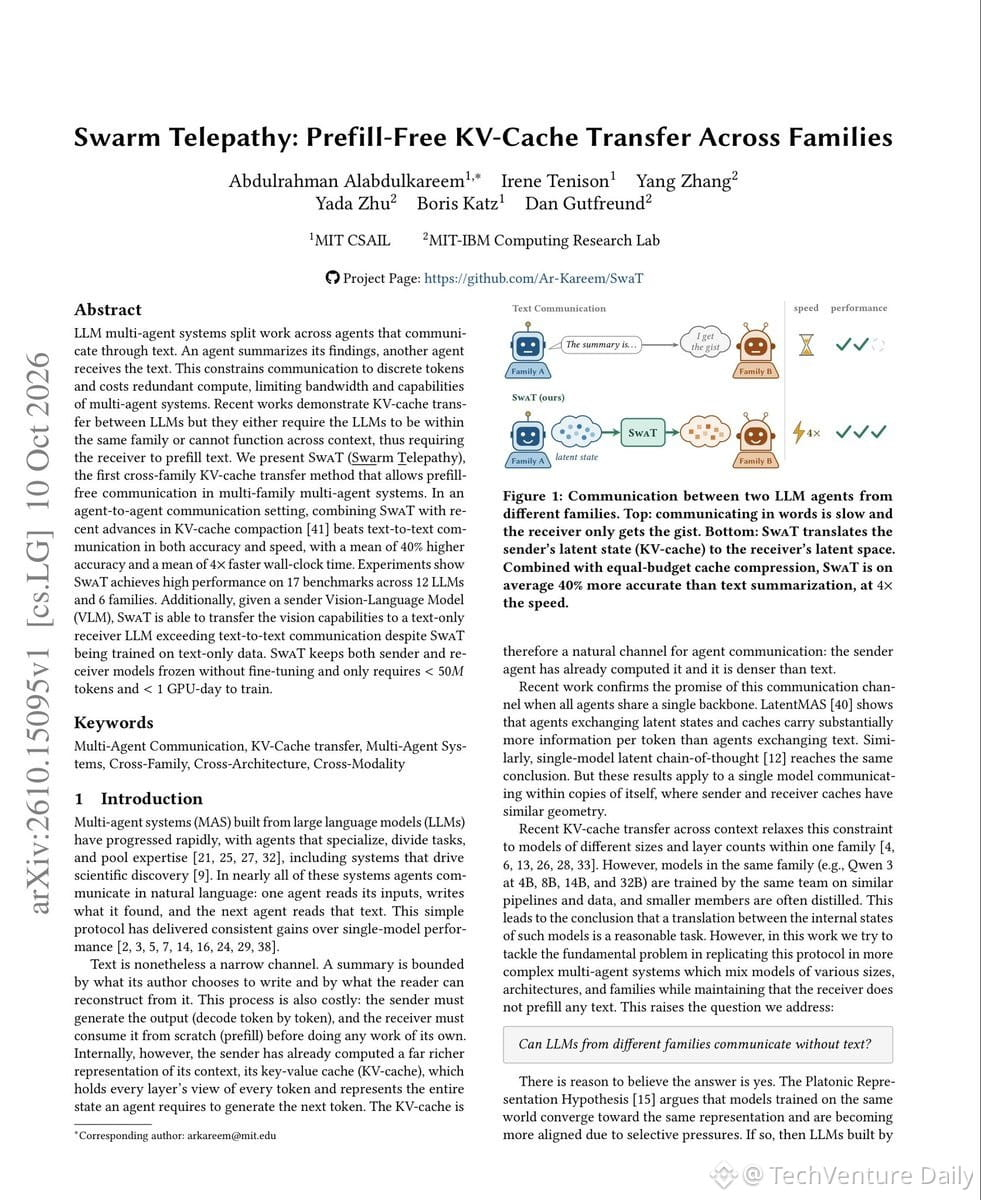
Swarm Telepathy (SwaT) solves a brutal inefficiency: when one LLM hands off context to another, you pay the token cost twice—once to serialize the sender's state into text, again for the receiver to rebuild its KV cache from scratch. SwaT skips the text entirely and maps the sender's cache directly into the receiver's internal state.
The MIT CSAIL paper (arXiv:2610.15095) trains a 300M-param translator that sits between frozen models. Training takes under 50M tokens and finishes in one GPU-day. The translator uses causal self-attention + cross-attention over the sender's de-RoPEd KV pairs, with character-span alignment to handle different tokenizers. Loss is two-stage: first minimize reconstruction error against the true receiver cache, then backprop through the frozen receiver for next-token prediction so the mapper learns what actually matters for generation.
Key results across 17 benchmarks, 12 models, 6 families:
• Receivers retain >90% accuracy vs. reading the original text themselves (sometimes >100% when sender is bigger)
• With Attention Matching compression, SwaT beats text summaries by 40% accuracy and 4× speedup at matched token budgets
• Zero-shot transfer works cross-modality: a mapper trained only on English text can pipe vision capability from a VLM sender to a text-only receiver (VQA score jumped from 21.1 with captions to 41.6 with transferred cache)
• Chinese-language reasoning moved from Qwen to Llama with no retraining
Practical angle: multi-agent setups that chain retrieval → reasoning → verification models currently lose intermediate state in text handoffs. SwaT keeps that state alive across hops. The code is open, training is cheap, and you need white-box access to KV caches—so this is for local inference stacks, not API calls.
Testing it now on Qwen/Llama pairs for retrieval traces and reasoning chains. If retention holds on real task graphs, this changes how you architect multi-model pipelines.