🚨 NVIDIA'S AI CHIP DOMINANCE IS UNDER THREAT. RIVALS NOW CONTROL 61% OF FUTURE FRONTIER AI COMPUTE COMMITMENTS.
A new JPMorgan analysis reveals a major shift in the AI semiconductor industry.
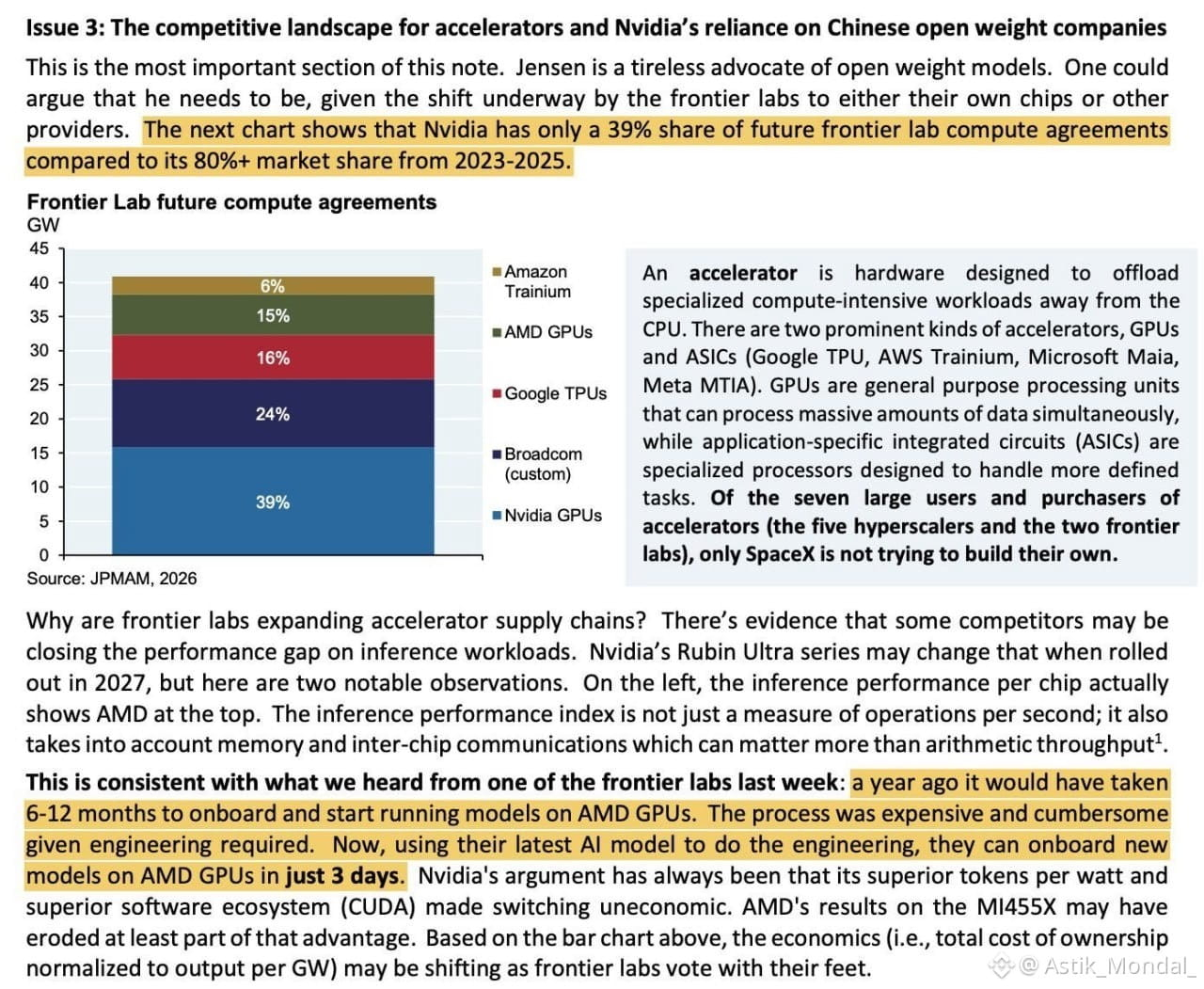
Nvidia's share of future frontier AI lab compute agreements has fallen to just 39%, compared with more than 80% of industry revenue between 2023 and 2025.
Here's where the remaining 61% is going:
🔹 Broadcom custom chips: 24%
🔹 Google TPUs: 16%
🔹 AMD GPUs: 15%
🔹 Amazon Trainium: 6%
But the most interesting development isn't the market share.
It's AMD's growing competitive threat.
According to JPMorgan, one major AI lab previously needed 6–12 MONTHS to onboard and run models on AMD GPUs.
Now, it can reportedly do it in just 3 DAYS.
Why?
AI models are increasingly helping engineers handle the technical work required to migrate workloads between different chips.
This could weaken one of Nvidia's biggest competitive advantages: its CUDA software ecosystem.
And there's more.
AI companies are increasingly developing their own custom accelerators instead of depending entirely on Nvidia.
The implications could be enormous for the semiconductor industry.
WHAT THIS MEANS FOR NVIDIA:
Nvidia still dominates AI computing, but its customers are actively diversifying their chip suppliers.
More competition could mean pricing pressure, changing profit margins, and a smaller share of future AI infrastructure spending.
However, JPMorgan's Michael Cembalest reportedly believes Nvidia remains attractive for long-term investors following its share-price decline.
THE BIGGER QUESTION:
Is Nvidia's dominance entering a new competitive phase, or will its next-generation chips and CUDA ecosystem keep competitors behind?
The AI chip war is getting more competitive.
And the biggest winners of the AI revolution may not necessarily be the companies dominating it today.
#NVIDIA #AMD #AI #Semiconductors #StockMarket $NVDA