


Bloomberg via Getty Images
America has spent the year building server farms at record speed. Sen. Bernie Sanders thinks the country is building the wrong thing.
The Vermont independent, who has been a longtime critic of corporate power, made the case on X on Nov. 1, two days before the midterm elections.
“Instead of building more AI data centers, which 66% of Americans oppose, I have a better idea,” Sanders wrote.
"Let’s build 7 million affordable homes & apartments."
AI data centers are huge warehouses packed with computer servers that train and run artificial intelligence systems.
They use enormous amounts of electricity.
Two in three Americans push back on new data centers
Sanders’ 66% figure comes from a Washington Post-ABC News-Ipsos poll conducted Oct. 9 to 13. Ipsos is a global market research and polling firm.
In the poll, 66% of U.S. adults said they oppose building new data centers in the country, while 30% support it.
Resistance grows when the project is closer to home.
Asked about a new data center in their own community, 72% said they would oppose it.
The pushback has also crossed party lines.
Democrats were the most opposed, at 76% against new data centers nationally. Exactly half of Republicans said the same.
That share climbed to 58% when the data center would be in their own community.
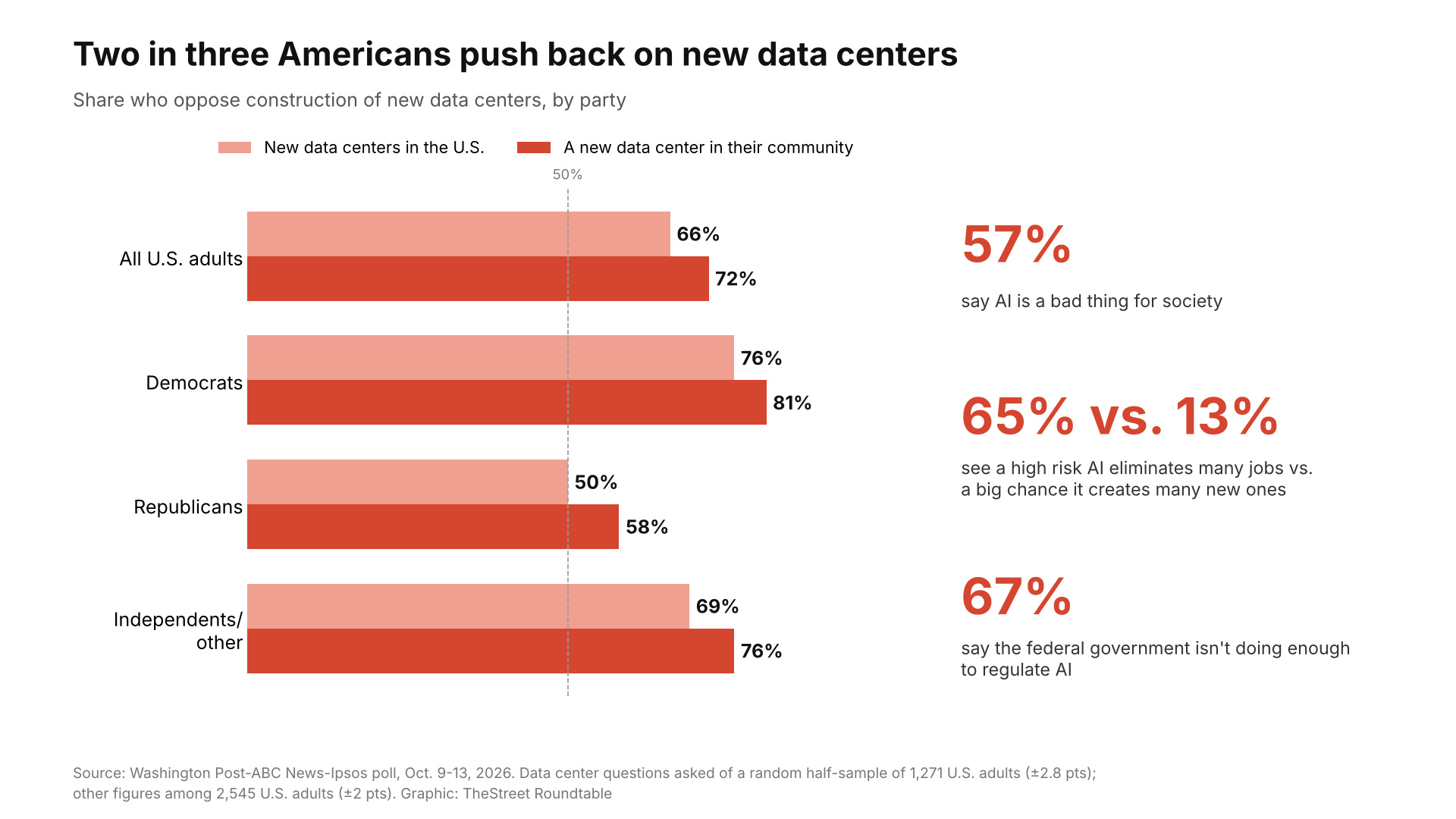 TheStreet Roundtable graphic on public opinion toward AI data centers, based on data from the Washington Post-ABC News-Ipsos poll (Oct. 9-13, 2026).
The worry runs deeper than the buildings. A 57% majority said AI is a bad thing for society.
Around 65% saw a high or very high risk that AI will eliminate many jobs. Only 13% saw a big chance it will create many new ones.
Two-thirds of Americans, 67%, also said the federal government isn’t doing enough to regulate AI. That includes 80% of Democrats and 54% of Republicans.
The poll surveyed 2,545 U.S. adults online, with a margin of error of plus or minus 2 percentage points.
From the Archives | Watch: Jim Chanos skeptical of economics around AI data centers
Jim Chanos skeptical of economics around AI data centers (1:44)
Trending on TheStreet Roundtable:
Sen. Hagerty hints U.S. could add to its Bitcoin reserve ‘very soon’
Billionaire Stanley Druckenmiller reveals his next investment
Bernie Sanders blasts crypto billionaires backing Trump ally
Sanders’ 7 million figure has a match in the data
Sanders didn’t say where his 7 million figure came from. But the figure lands close to one of the starkest numbers in U.S. housing.
The U.S. is short 7.2 million rental homes that renters with extremely low incomes can afford, according to The Gap 2026, a report published in March by the National Low Income Housing Coalition.
The coalition is a nonprofit that tracks rental affordability.
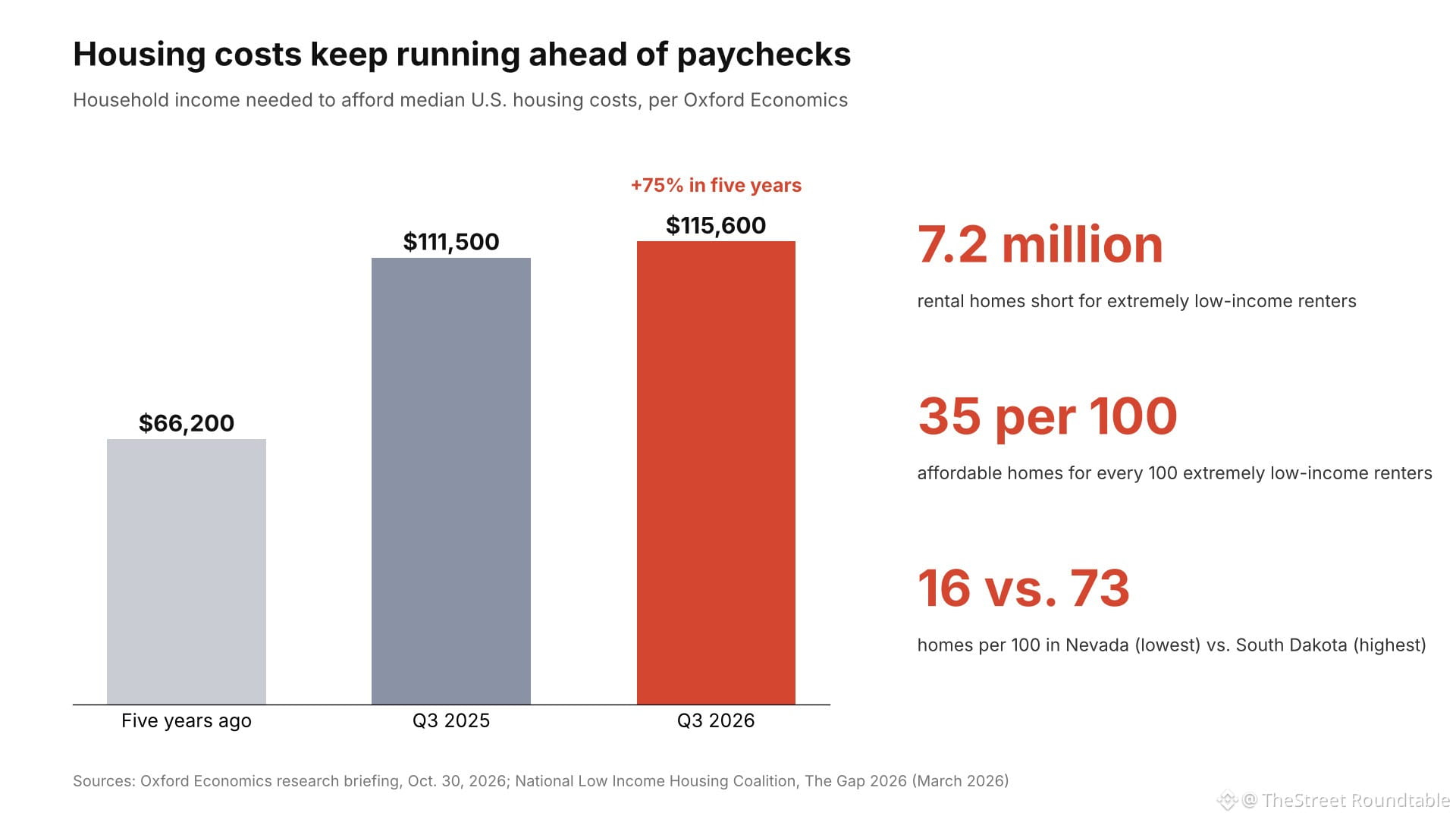 TheStreet Roundtable graphic on U.S. housing affordability, based on data from Oxford Economics and the National Low Income Housing Coalition.
Extremely low-income households earn at or below the federal poverty line, or 30% of their area’s median income, whichever is higher. For every 100 of them, only 35 affordable homes exist.
The shortage reaches every state. Nevada is the worst off, with 16 affordable homes per 100 such households. South Dakota is the best, with 73.
A $115,600 price tag on an ordinary home
The squeeze isn’t limited to the lowest earners.
The average U.S. household needed $115,600 in income to afford median housing costs in the third quarter of 2026, according to an Oct. 30 briefing from Oxford Economics, a global economic research firm.
That’s up from $111,500 a year earlier, and 75% more than the $66,200 needed five years ago.
The firm called the rising cost of living “the primary issue in the upcoming midterms.”
It also links Sanders’ two targets.
Oxford Economics lists “the surge in data centers, which has heightened electricity prices” among the forces pushing up household costs, alongside higher oil prices, tariffs and cuts to Affordable Care Act insurance subsidies.
“No metro has escaped the material deterioration in affordability,” the firm wrote.
Sanders’ post went further than housing.
He also called for more hospitals, schools and childcare centers, and for “an economy that works for all, not just the top 1 percent.”
His post doesn’t say how such a building program would be paid for.
Most Read on TheStreet Roundtable:
Binance major shareholder cites $1B SpaceX stake after Elon Musk mocks hack
Treasury Secretary Bessent reveals ultimate plan to ensure dollar dominance
Analysts clash over whether Binance hack is Bitcoin’s FTX moment
Bitcoin miners are leasing their power to AI
Some of the companies feeding the data center boom started out in crypto.
Bitcoin miners run warehouses of specialized computers that compete to process transactions on the Bitcoin network and earn new coins as a reward.
The work uses huge amounts of electricity, so miners spent years locking up access to power. AI developers now need that same power.
Several miners are now leasing “powered shells,” bare data center buildings already wired for electricity, to AI companies that bring their own chips.
Here are a few insights:
TeraWulf signed a 20-year lease with Anthropic in July for about 401 megawatts in Hawesville, Kentucky. The company says the lease is worth about $19 billion.
Hut 8 signed a second 15-year, 352-megawatt lease that month at its Beacon Point campus, bringing the campus’s base-term contract value to $19.6 billion.
In September, Cipher Digital extended its lease at its Barber Lake site in Colorado City, Texas, to 20 years, lifting expected revenue there to more than $9 billion.
IREN signed a five-year, $9.7 billion AI computing contract with Microsoft, according to terms it published.
IREN made the riskiest bet of the group.
Instead of leasing out space, it is buying the chips itself. In June, it closed $3.65 billion in financing to pay for them.
Related: Why Bitcoin shrugged off the largest crypto hack ever