


As of October 27, the total stablecoin market cap stands at around $299–305B, down approximately $2.4B over the past week and still well below the May peak of over $320B. The 30-day Supply Shock Index sits at –2.17%, placing it in the deep net-redemption zone, at the 3rd percentile of the published series.
What stands out is the shift in composition. USDT (approximately $182B) is only slightly lower over the past 30 days (–0.8%), while USDC (approximately $71B) has contracted more sharply (–5.5%). Several smaller stablecoins, including PYUSD, RLUSD and USDF, are expanding, showing clear 30-day growth even as the aggregate market cap declines.
Gross activity remains elevated, with roughly $110B minted and $114B burned over the past 30 days. However, the net result remains negative. The float is turning over rapidly, but it is not expanding.
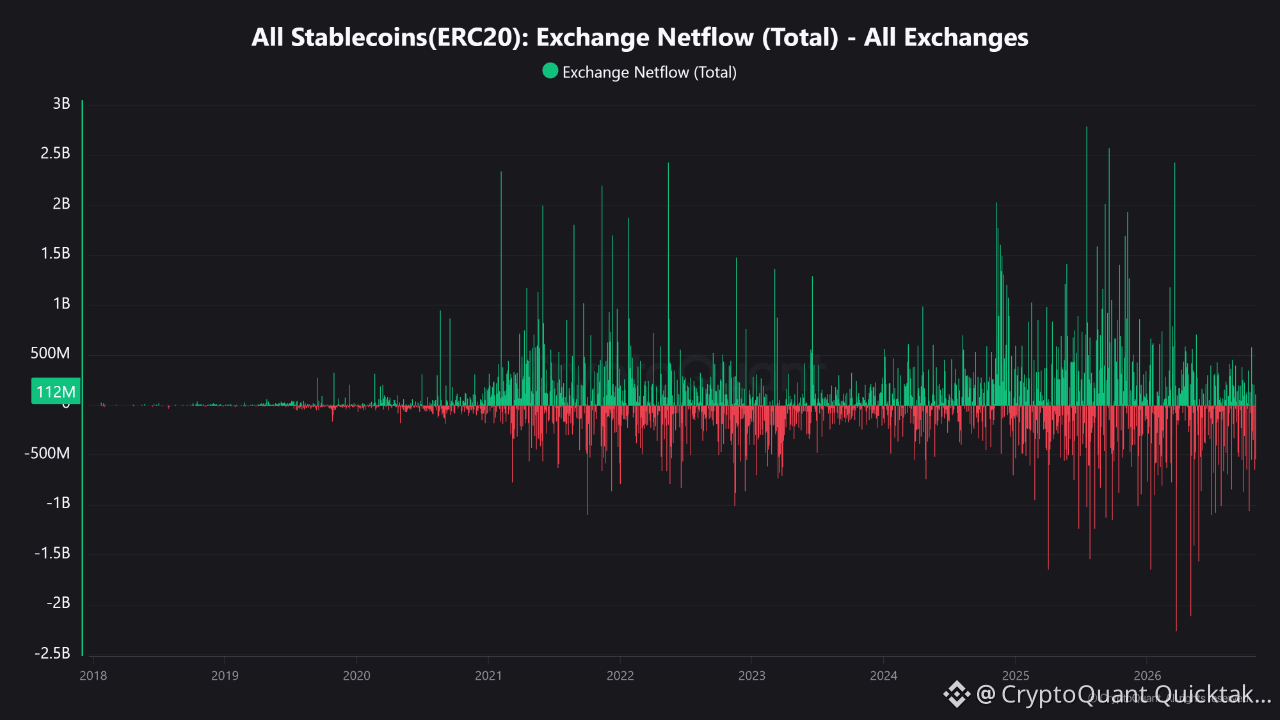
Exchange-side balances remain near their lowest levels of the year, limiting immediately deployable spot buying power. Crypto trading volume has also fallen to its lowest levels of 2026, just as the Fed and BOJ decisions approach.
Key Take
This is not simply a story of liquidity disappearing. It points to a selective rotation, with capital leaving the two largest fiat-backed stablecoins while a handful of newer or payment-oriented alternatives absorb some of the flow.
Until the Supply Shock Index turns positive and the contraction in major stablecoins slows, the market lacks the broad expansion in dry powder that typically supports stronger spot upside.
Over the next 7–10 days, watch the daily and weekly changes in total issued supply, alongside USDC’s relative performance against the expanding second-tier stablecoins.
Written by theophiluspep