


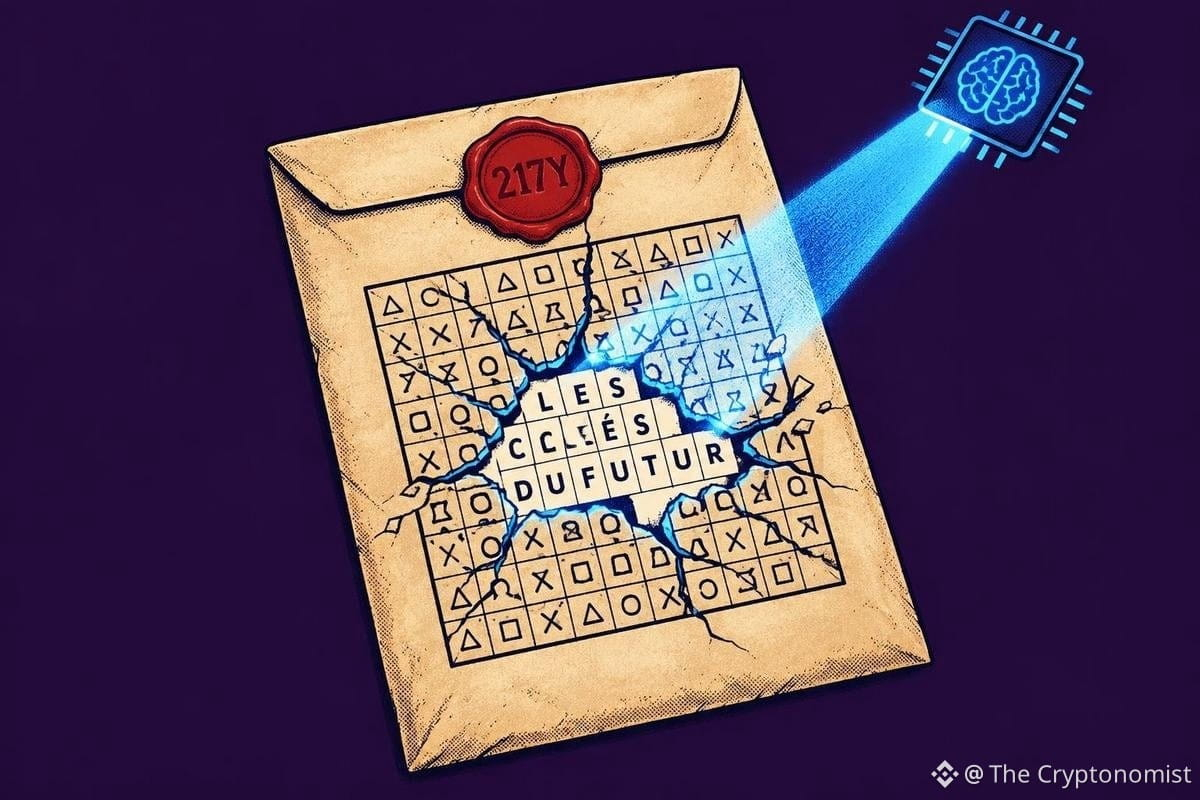
A coded letter written for one of Napoleon Bonaparte’s generals sat unread for 217 years until an AI engineer decided to test a GPT-6 codebreaking AI model against it. Carter Church, a staff AI engineer at cybersecurity company SentinelOne, fed OpenAI’s GPT-6 Astra a single scanned image of the cipher and a prompt asking it to solve the message. According to Tom’s Hardware, the model cracked the entire text in about six hours.
Key takeaways
GPT-6 Astra deciphered a 217-year-old Napoleonic cipher in roughly six hours from one scanned image.
The cipher had sat unsolved for decades on Cryptiana’s Unsolved Historical Ciphers list.
SentinelOne engineer Carter Church ran the whole decryption with a single prompt.
The recovered letter was a 1809 troop briefing sent to General Auguste de Marmont on Napoleon’s orders.
The deciphered passage fills a gap left in Napoleon’s own 1865 memoir.
Six hours, one image, one prompt
Church’s own account, cited by Tom’s Hardware, frames the result less as a cryptography trick and more as a demonstration of how far a general-purpose model can stretch. “What makes this impressive isn’t actually the codebreaking, but that Astra completed the entire multi-modal workflow in ~6 hours from a single image and goal,” Church wrote. According to Calcalist’s account, the document contained a single plain-French line atop 24 rows of numbers, letters and invented symbols, amounting to about 1,300 cipher units drawn from 155 distinct signs.
Earlier researchers had only ever matched 33 of those signs to known values, leaving most of the message untouched. Astra’s run changed that, working through transcription and cryptanalysis as one continuous process rather than two separate specialist tasks.
What the letter from Marmont’s era actually says
The decoded text turns out to be a troop briefing originating from the headquarters of Eugène de Beauharnais, Viceroy of Italy and Napoleon’s stepson, dated to March 1809 as Austria moved toward war with France. Napoleon had instructed Eugène on March 16 to send General Auguste de Marmont a coded letter carried by an “intelligent officer,” relaying the emperor’s orders and laying out troop positions across Bavaria, Poland, Saxony and Italy, along with Russian forces moving against Austria. Marmont, stationed in Dalmatia on the far side of the Adriatic from Napoleon’s main armies, would have needed his own military codebook to read it at the time; once that key disappeared, so did any hope of a straightforward decryption.
Notably, the recovered passage fills in wording missing from the surviving printed version of Napoleon’s instructions, found in his 1865 memoir, where a sentence about Marmont breaks off mid-thought at “a handful of …” The deciphered letter completes it as “a gathering of rabble.”
How Church verified the AI’s answer
Behind the scenes, the GPT-6 codebreaking AI run worked by splitting the scanned page into sections, identifying repeated symbols, then applying simulated annealing, essentially a large-scale trial-and-error search, to test letter and word assignments. Astra checked candidate French readings against period writing patterns from Alexandre Dumas, Victor Hugo and Marmont’s own texts, and it separately flagged signs standing in for whole words rather than single letters, according to Calcalist. Church then reran the analysis after stripping Napoleon- and Marmont-related material from the model’s available reference texts; the system reportedly produced the same reading, a check meant to rule out the model simply recalling information from elsewhere rather than genuinely solving the cipher.
Satoshi Tomokiyo, who maintains the Cryptiana database where the letter had been listed among unsolved historical ciphers for decades, has since marked the cipher as solved, Calcalist reported. The full solution package, along with a script that regenerates the reading, is available for download on Carter Church’s blog.
Article produced with the assistance of artificial intelligence and reviewed by the editorial team.