

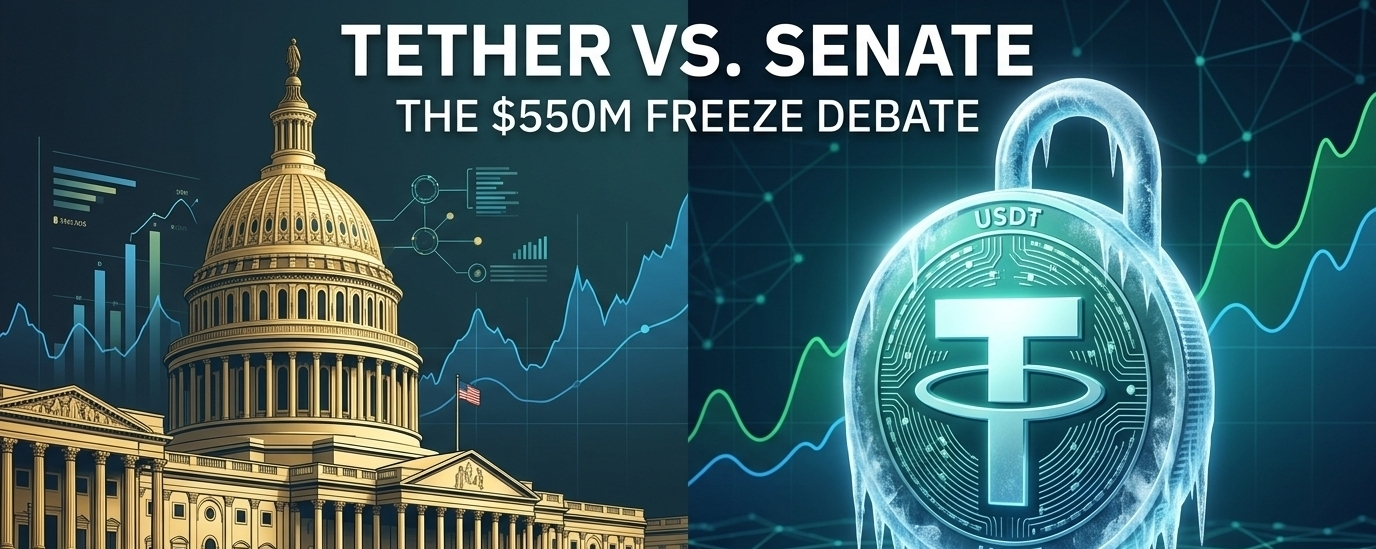

The global stablecoin market is facing intense geopolitical scrutiny following a major disclosure by U.S. lawmakers. A newly released congressional report reveals that Tether’s USDT has become a primary vehicle for regional finance and sanctions evasion, sparking a heated debate over whether corporate asset freezes are keeping pace with illicit flows.
A comprehensive investigation by Senate Democrats on the Permanent Subcommittee on Investigations (PSI) revealed that 84% of more than 800 sanctioned, Iran-linked crypto wallets utilized Tether’s USDT exclusively or predominantly.
On the exact same day the Senate findings went public, Tether issued a defensive counter-statement, announcing that it has helped law enforcement freeze approximately $550 million in Iran-linked USDT this year alone. The clashing reports highlight a massive disconnect between corporate compliance efforts and government expectations.
The Senate Findings: A "Shadow Banking" Lifeline
The Senate subcommittee’s analysis focused on 846 cryptocurrency wallets previously flagged, sanctioned, or targeted for asset seizure due to direct ties to the Iranian regime and its regional proxy networks.
Lawmakers state that the flagship stablecoin has effectively been weaponized to construct an alternative financial system. According to the committee, this network is actively used to stabilize volatile domestic fiat currency, fund regional operations, and bypass traditional banking rails entirely.
Citing these systemic vulnerabilities, the subcommittee has officially referred its findings to the U.S. Department of Justice (DOJ) and the Treasury Department, demanding a formal investigation into potential sanctions violations.
Tether’s Counter-Defense: The Half-Billion Dollar Wall
In response to the mounting political pressure, Tether heavily defended its compliance track record, positioning itself as a proactive partner to global law enforcement rather than an enabler.
The stablecoin issuer detailed its massive asset mitigation efforts throughout the year, which include two record-setting enforcement actions:
The April Intervention: Tether utilized its smart-contract controls to freeze $344 million across two prominent wallets tied by authorities to the Central Bank of Iran.
The July Tron Blockade: The company successfully blacklisted over $130 million spread across four separate addresses operating on the Tron blockchain network.
Management emphasized that public blockchain ledgers afford law enforcement tracking capabilities that traditional paper cash simply cannot match, arguing that USDT is an inherently hostile environment for sanctioned actors due to its traceable nature.
The Crucial Disconnect: Why Regulators Say It’s Not Enough
Despite the historic scale of Tether's $550 million freeze, the Senate report argues that looking at frozen balances alone paints an incomplete picture. U.S. investigators point to critical structural flaws in how stablecoins are monitored:
Reactionary Delays: The report alleges that asset freezes are heavily delayed. In several documented instances, illicit addresses continued to move tens of millions of dollars for weeks after public government designations before the corporate "kill switch" was finally flipped.
Velocity vs. Balance: While a $550 million freeze represents the funds caught at the exact moment of the block, it does not account for the total historical volume of billions in USDT that successfully flowed through those same wallets and escaped into the broader economy before intervention occurred.
The Transparency Gap: Analysts noted that while Tether's two major itemized actions account for roughly $474 million, a $76 million discrepancy remains unexplained in the public ledger data, fueling further demands for transparency.
As global regulators ramp up enforcement actions against digital asset rails, the spotlight on the stablecoin market has never been brighter. The ultimate question remains: Can a private corporate issuer effectively police a decentralized ecosystem, or will governments step in with sweeping legislative mandates?
What's your take, creators? Can compliance protocols fully secure centralized stablecoins, or will regulatory pressure force capital into decentralized alternatives? Let's discuss in the comments below!
Disclaimer: This post is for educational and informational purposes only and does not constitute financial, legal, or investment advice.