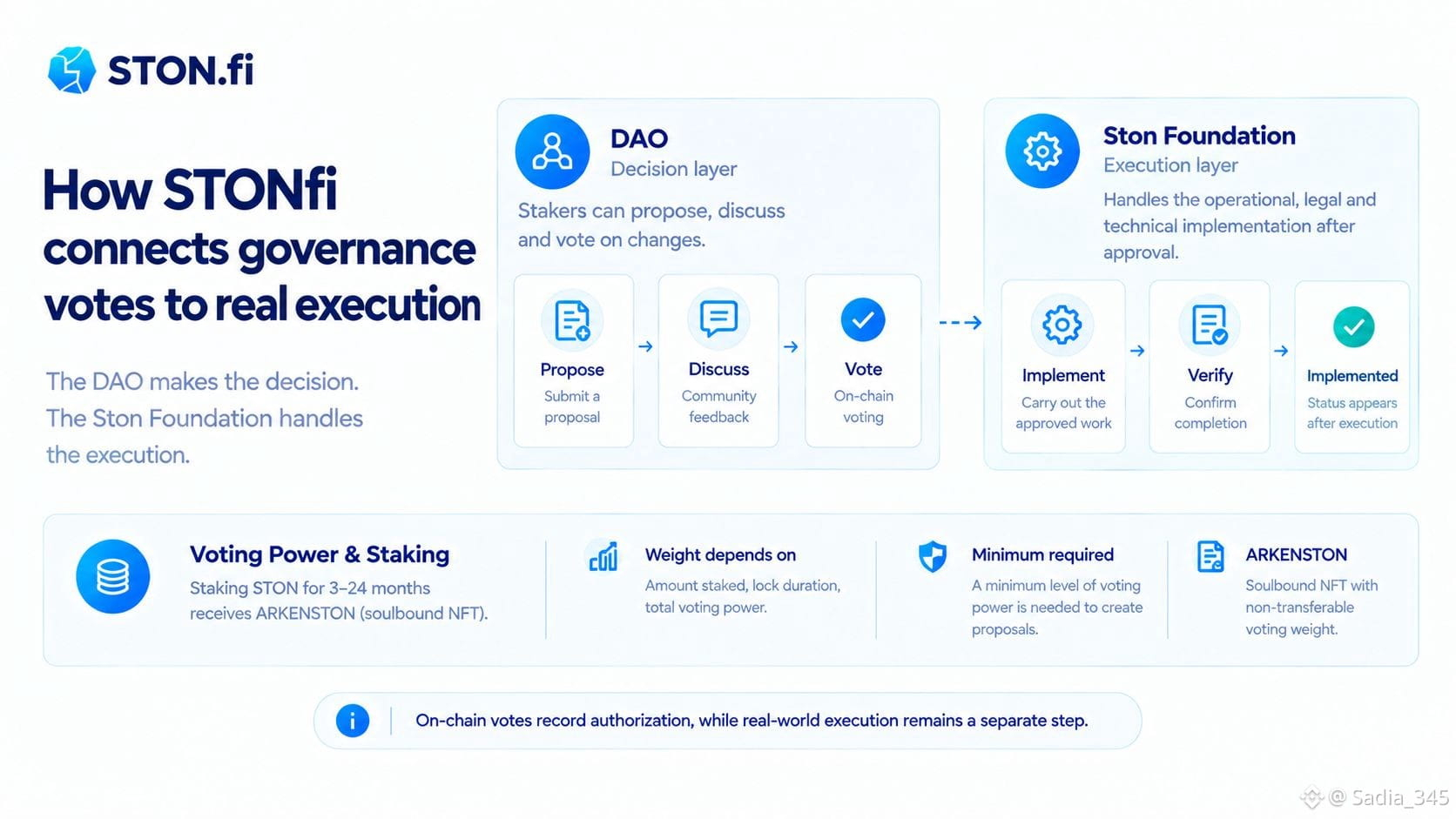
How STONfi connects governance votes to real execution
One practical detail in STONfi governance is the clear separation between decision-making and implementation.
The DAO is where stakers propose, discuss, and vote. A successful vote authorizes action, but it does not automatically complete the work. The Ston Foundation carries out the operational, legal, and technical steps after approval. The proposal only moves to “Implemented” once that work is finished.
Voting power comes from staking STON for 3 to 24 months. In return, users receive ARKENSTON, a soulbound NFT that holds non-transferable voting weight. The weight depends on the amount locked, the duration, and the overall voting power in the system. A minimum level of voting power is also required to create proposals.
This structure keeps the roles distinct: on-chain votes record authorization, while real execution remains a separate process. That distinction is useful when evaluating how governance decisions actually move forward.
Do you prefer systems where votes trigger automatic execution, or ones that keep implementation as a separate step?
#DEFİ #STONfi $GRAM
One practical detail in STONfi governance is the clear separation between decision-making and implementation.
The DAO is where stakers propose, discuss, and vote. A successful vote authorizes action, but it does not automatically complete the work. The Ston Foundation carries out the operational, legal, and technical steps after approval. The proposal only moves to “Implemented” once that work is finished.
Voting power comes from staking STON for 3 to 24 months. In return, users receive ARKENSTON, a soulbound NFT that holds non-transferable voting weight. The weight depends on the amount locked, the duration, and the overall voting power in the system. A minimum level of voting power is also required to create proposals.
This structure keeps the roles distinct: on-chain votes record authorization, while real execution remains a separate process. That distinction is useful when evaluating how governance decisions actually move forward.
Do you prefer systems where votes trigger automatic execution, or ones that keep implementation as a separate step?
#DEFİ #STONfi $GRAM