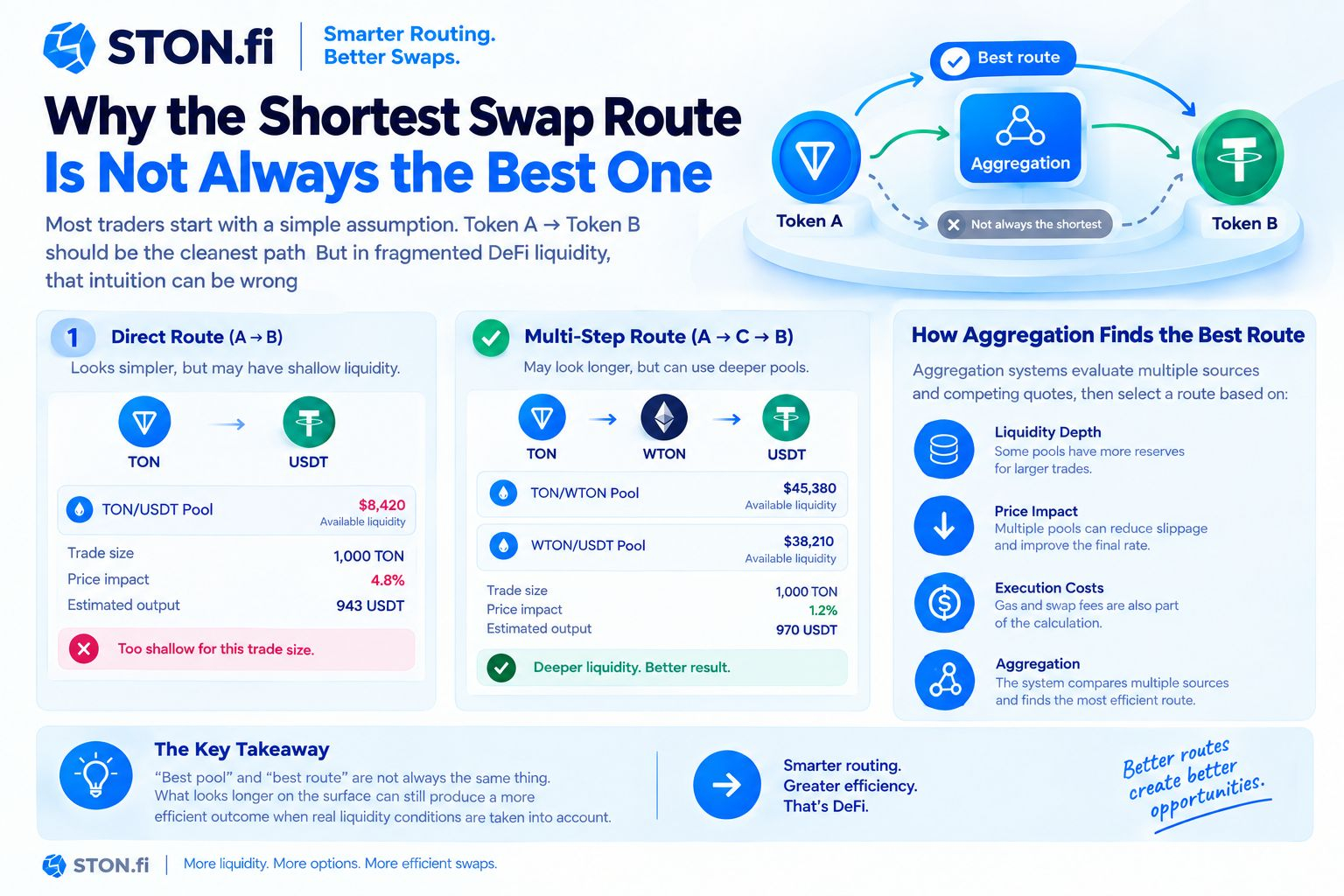
Why the shortest swap route is not always the best one
Most traders start with a simple assumption: Token A → Token B should be the cleanest path. But in fragmented DeFi liquidity, that intuition can be wrong.
A direct pool may exist and still be too shallow for the size of the trade. Another pool may offer deeper reserves. In those cases, a route that takes an extra step can produce a better final result because it reduces price impact or accesses better liquidity.
Aggregation systems are designed for this situation. They evaluate available liquidity and competing quotes across multiple sources, then select a route based on trade size, depth, and execution cost not just the number of hops.
This is why “best pool” and “best route” are not always the same thing. What looks longer on the surface can still be the more efficient option once real liquidity conditions are considered.
Curious how others approach this do you usually stick to direct routes or let aggregation decide?
#defi #STONfi $GRAM
Most traders start with a simple assumption: Token A → Token B should be the cleanest path. But in fragmented DeFi liquidity, that intuition can be wrong.
A direct pool may exist and still be too shallow for the size of the trade. Another pool may offer deeper reserves. In those cases, a route that takes an extra step can produce a better final result because it reduces price impact or accesses better liquidity.
Aggregation systems are designed for this situation. They evaluate available liquidity and competing quotes across multiple sources, then select a route based on trade size, depth, and execution cost not just the number of hops.
This is why “best pool” and “best route” are not always the same thing. What looks longer on the surface can still be the more efficient option once real liquidity conditions are considered.
Curious how others approach this do you usually stick to direct routes or let aggregation decide?
#defi #STONfi $GRAM