$ETH What is Ethereum Classic (ETC)? Everything You Need to Know! 🚀
If you’ve been exploring the crypto space, you’ve likely come across Ethereum Classic ($ETC). But what exactly is it, and how does it differ from Ethereum ($ETH )? Let’s break it down! 👇
🔹 1. The Origin Story
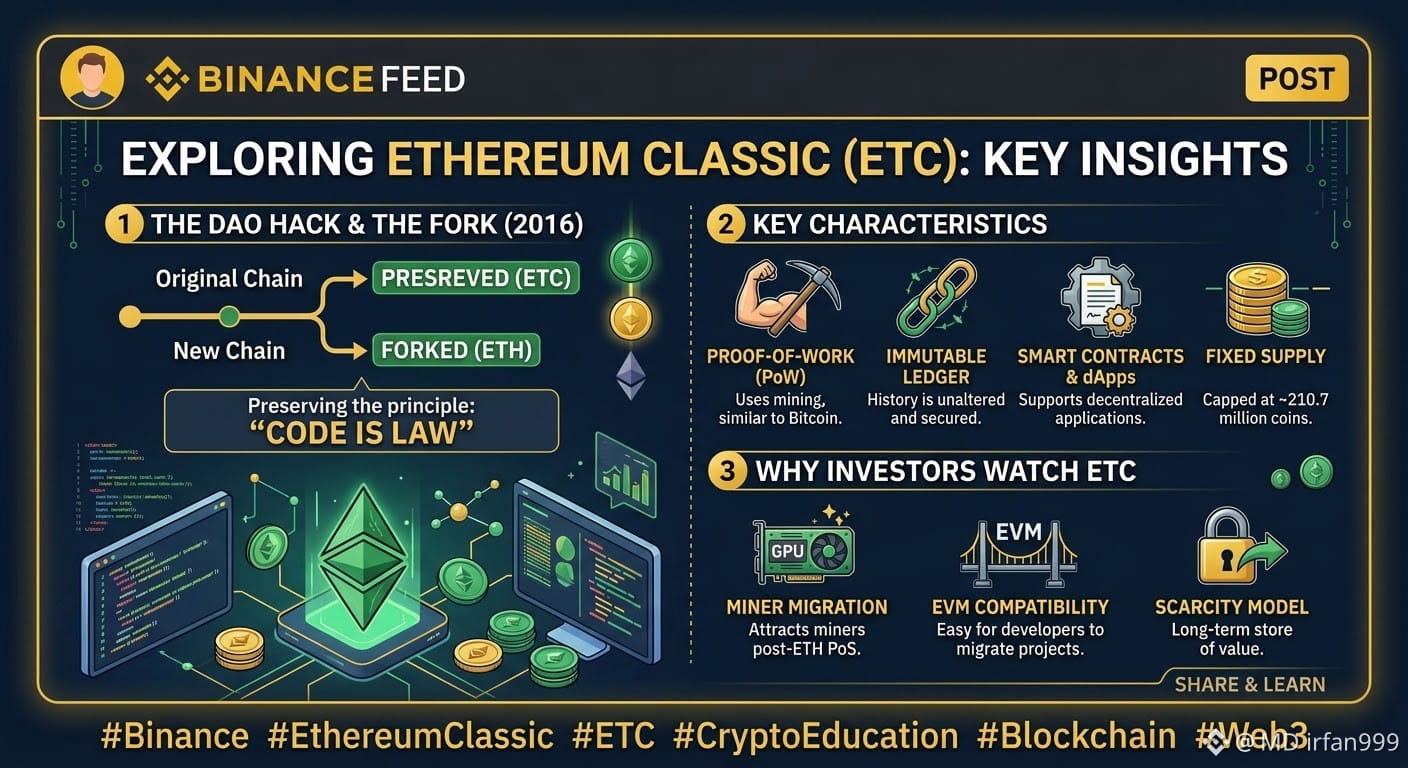
Back in 2016, the original Ethereum network experienced a major hack (The DAO attack). To recover the stolen funds, the majority of the community decided to hard fork the blockchain, creating what we know today as Ethereum ($ETH ).
However, a passionate group believed in the core crypto principle: "Code is Law" (immutability). They chose to preserve the original, unaltered chain—giving birth to Ethereum Classic ($ETC).
🔹 2. Key Features of $ETC
🔒 Proof of Work (PoW): While Ethereum migrated to Proof of Stake (PoS), Ethereum Classic remains committed to Proof of Work mining, making it one of the largest PoW smart contract platforms.
📜 Immutable Ledger: The transaction history on ETC has never been altered or reverted.
🛠️ Smart Contracts & dApps: ETC supports decentralized applications and smart contracts just like ETH, running on the Ethereum Virtual Machine (EVM).
🪙 Fixed Supply: Unlike ETH, ETC has a capped total supply of roughly 210.7 million coins, giving it a deflationary tokenomics structure similar to Bitcoin.
🔹 3. Why Do Investors Watch $ETC?
Miner Migration: As PoW mining became obsolete on ETH, many GPU miners shifted their hash power to ETC.
EVM Compatibility: Developers can easily deploy Ethereum-compatible dApps on the ETC network.
Scarcity Model: Its fixed supply cap makes it an interesting long-term store-of-value asset for PoW believers.
💡 Final Thought:
Ethereum Classic represents the original vision of a decentralized, immutable smart contract platform. Whether you are a miner, trader, or long-term holder, $ETC remains a key player in the Proof of Work ecosystem.
💬 What’s your take on $ETC? Are you bullish or bearish? Let us know in the comments below! 👇
#Binance #EthereumClassic #ETC #CryptoEducation #Blockchain #Web3
If you’ve been exploring the crypto space, you’ve likely come across Ethereum Classic ($ETC). But what exactly is it, and how does it differ from Ethereum ($ETH )? Let’s break it down! 👇
🔹 1. The Origin Story
Back in 2016, the original Ethereum network experienced a major hack (The DAO attack). To recover the stolen funds, the majority of the community decided to hard fork the blockchain, creating what we know today as Ethereum ($ETH ).
However, a passionate group believed in the core crypto principle: "Code is Law" (immutability). They chose to preserve the original, unaltered chain—giving birth to Ethereum Classic ($ETC).
🔹 2. Key Features of $ETC
🔒 Proof of Work (PoW): While Ethereum migrated to Proof of Stake (PoS), Ethereum Classic remains committed to Proof of Work mining, making it one of the largest PoW smart contract platforms.
📜 Immutable Ledger: The transaction history on ETC has never been altered or reverted.
🛠️ Smart Contracts & dApps: ETC supports decentralized applications and smart contracts just like ETH, running on the Ethereum Virtual Machine (EVM).
🪙 Fixed Supply: Unlike ETH, ETC has a capped total supply of roughly 210.7 million coins, giving it a deflationary tokenomics structure similar to Bitcoin.
🔹 3. Why Do Investors Watch $ETC?
Miner Migration: As PoW mining became obsolete on ETH, many GPU miners shifted their hash power to ETC.
EVM Compatibility: Developers can easily deploy Ethereum-compatible dApps on the ETC network.
Scarcity Model: Its fixed supply cap makes it an interesting long-term store-of-value asset for PoW believers.
💡 Final Thought:
Ethereum Classic represents the original vision of a decentralized, immutable smart contract platform. Whether you are a miner, trader, or long-term holder, $ETC remains a key player in the Proof of Work ecosystem.
💬 What’s your take on $ETC? Are you bullish or bearish? Let us know in the comments below! 👇
#Binance #EthereumClassic #ETC #CryptoEducation #Blockchain #Web3