Best Crypto Exchange APIs for Bots, Quants and HFT in 2027
The “fastest crypto exchange API” is not necessarily the one with the lowest ping.
For bots, quants and market makers, the real execution loop is:
Strategy → Serialization → Network → Gateway → Matching Engine → ACK → Market Data
That means raw RTT is only one piece of the latency puzzle.
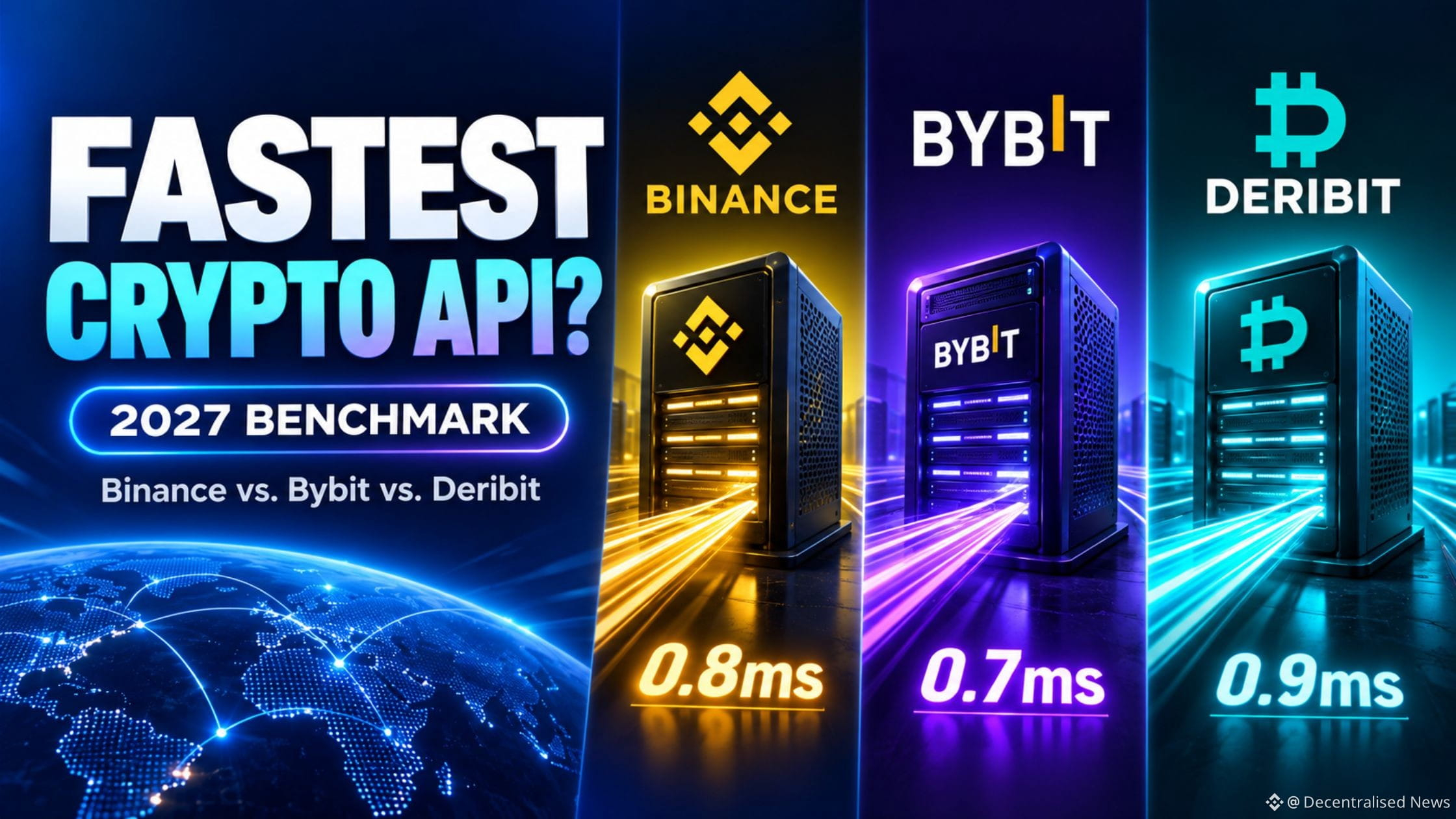
We built the DN API Latency Benchmark 2027 to compare the infrastructure behind major crypto exchanges across:
• WebSocket and REST architecture
• FIX and SBE support
• Order-entry throughput
• Order acknowledgement telemetry
• Market-data delivery
• Rate limits
• Failover and resilience
• Institutional connectivity
• P95/P99 latency stability
One of the biggest findings:
Latency variance can matter more than median latency.
A venue with a 15 ms median response but frequent 200–500 ms spikes can be harder to trade systematically than one with a stable 25–30 ms path.
That is why we introduced the DN Latency Stability Ratio:
P95 Order ACK Latency ÷ Median Order ACK Latency
The lower the ratio, the more predictable the execution path.
We also built an interactive DN API Latency Lab so traders can enter their own RTT, acknowledgement times, feed delay and disconnect data to calculate a live latency score.
Read the full benchmark on Decentralised.News
#Crypto #QuantTrading #AlgorithmicTrading #HFT #TradingBots #MarketMaking #WebSocket #FIX #CryptoTrading #APIs #FinTech
The “fastest crypto exchange API” is not necessarily the one with the lowest ping.
For bots, quants and market makers, the real execution loop is:
Strategy → Serialization → Network → Gateway → Matching Engine → ACK → Market Data
That means raw RTT is only one piece of the latency puzzle.
We built the DN API Latency Benchmark 2027 to compare the infrastructure behind major crypto exchanges across:
• WebSocket and REST architecture
• FIX and SBE support
• Order-entry throughput
• Order acknowledgement telemetry
• Market-data delivery
• Rate limits
• Failover and resilience
• Institutional connectivity
• P95/P99 latency stability
One of the biggest findings:
Latency variance can matter more than median latency.
A venue with a 15 ms median response but frequent 200–500 ms spikes can be harder to trade systematically than one with a stable 25–30 ms path.
That is why we introduced the DN Latency Stability Ratio:
P95 Order ACK Latency ÷ Median Order ACK Latency
The lower the ratio, the more predictable the execution path.
We also built an interactive DN API Latency Lab so traders can enter their own RTT, acknowledgement times, feed delay and disconnect data to calculate a live latency score.
Read the full benchmark on Decentralised.News
#Crypto #QuantTrading #AlgorithmicTrading #HFT #TradingBots #MarketMaking #WebSocket #FIX #CryptoTrading #APIs #FinTech