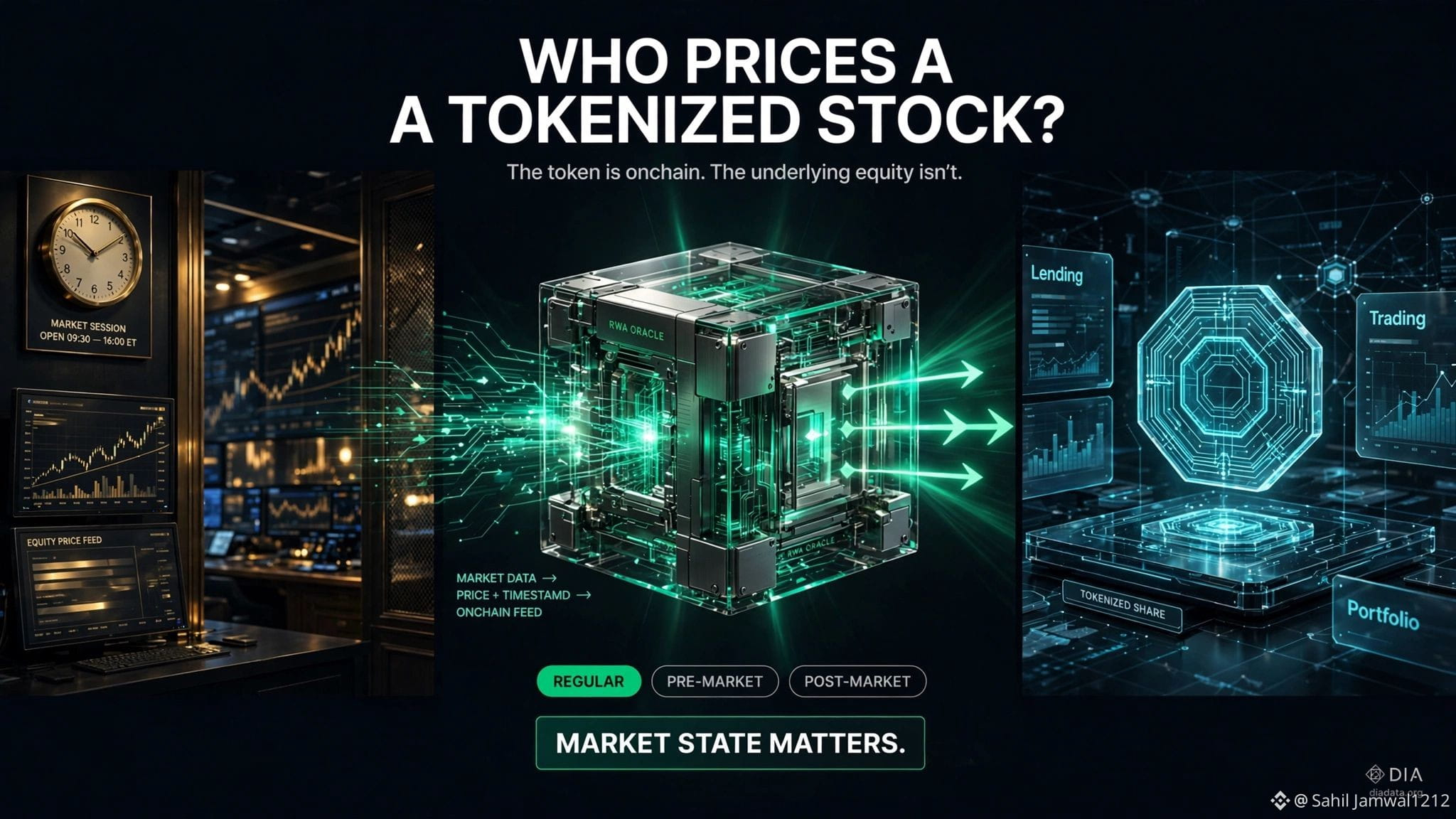
Tokenized stocks sound simple until you ask one question:
Where does the onchain price actually come from?
ST0x is building infrastructure for trading tokenized securities on Base, including U.S. stocks and ETFs. Its contracts allow tokenized securities to be held in self-custodied wallets and traded through public smart contracts.
But a tokenized Nvidia or Apple doesn't stop being an equity just because it became a token.
The underlying market still has:
→ Regular trading hours
→ Pre-market and post-market sessions
→ Market holidays
→ Corporate actions
→ Changing liquidity
That's where DIA's role gets interesting.
DIA provides RWA feeds for stocks, ETFs, commodities and FX, with data sourced from regulated market data providers and delivered onchain.
And the ST0x integration goes deeper than simply publishing a number.
$DIA
's feed acts as a reference midpoint for ST0x liquidity.
So freshness matters.
A price from the previous session can look perfectly valid onchain while representing the wrong market state.
DIA's implementation includes signed timestamps and session-aware feeds so the consuming application can distinguish market states.
That's the part I find most interesting.
Tokenization isn't just putting stocks on a blockchain.
You also need infrastructure that understands the market those tokens represent.
That's where RWA oracles become an important piece of the TradFi → DeFi bridge.
Where does the onchain price actually come from?
ST0x is building infrastructure for trading tokenized securities on Base, including U.S. stocks and ETFs. Its contracts allow tokenized securities to be held in self-custodied wallets and traded through public smart contracts.
But a tokenized Nvidia or Apple doesn't stop being an equity just because it became a token.
The underlying market still has:
→ Regular trading hours
→ Pre-market and post-market sessions
→ Market holidays
→ Corporate actions
→ Changing liquidity
That's where DIA's role gets interesting.
DIA provides RWA feeds for stocks, ETFs, commodities and FX, with data sourced from regulated market data providers and delivered onchain.
And the ST0x integration goes deeper than simply publishing a number.
$DIA
's feed acts as a reference midpoint for ST0x liquidity.
So freshness matters.
A price from the previous session can look perfectly valid onchain while representing the wrong market state.
DIA's implementation includes signed timestamps and session-aware feeds so the consuming application can distinguish market states.
That's the part I find most interesting.
Tokenization isn't just putting stocks on a blockchain.
You also need infrastructure that understands the market those tokens represent.
That's where RWA oracles become an important piece of the TradFi → DeFi bridge.