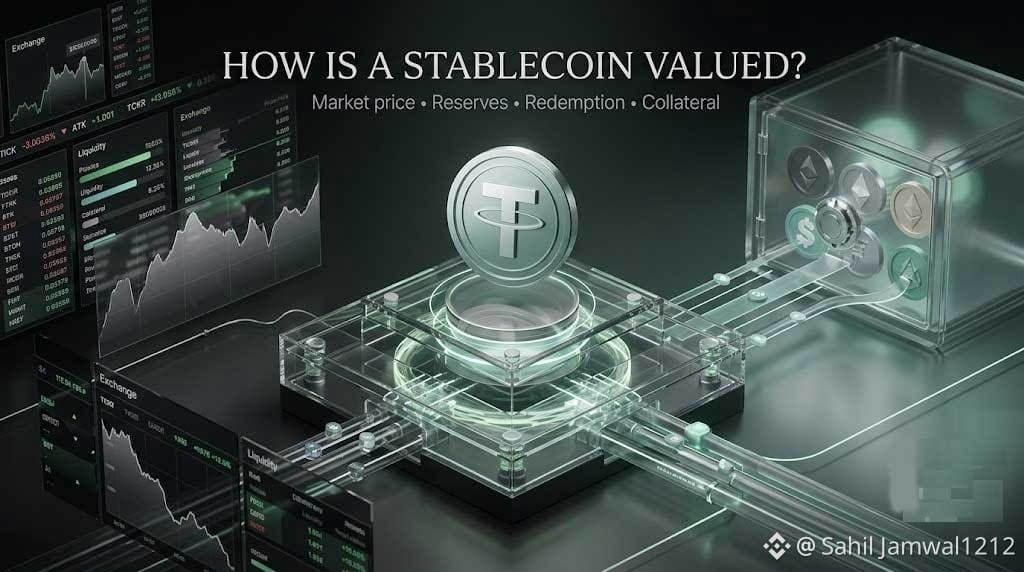
When people talk about stablecoin security, they usually mention collateral.
Then smart contracts.
Then governance.
I think there is another layer that deserves equal attention:
How is the value actually determined?
A stablecoin protocol may need reliable data to answer questions like:
Is the collateral worth what we think it is?
Has the asset fallen below its liquidation threshold?
What is the fair value when the secondary market becomes thin?
The October 2025 USDe episode was a useful example. USDe briefly fell to around $0.65 on Binance while on-chain markets remained much closer to $1. The incident showed how a localized pricing mechanism can create very different signals from broader market conditions.
This is where DIA's stablecoin work gets interesting to me.
DIA doesn't use one approach for every asset.
For satUSD+, it can use the vault's redemption rate.
For tGBP, its Proof-of-Reserves feed derives value from GBP reserves relative to on-chain supply.
For USDLR, $DIA has developed a collateral-ratio-based methodology.
That's an important distinction:
Market price isn't always the same thing as fundamental value.
For stablecoin infrastructure, having different verifiable pricing methodologies for different risk models could matter just as much as having the oracle itself.
That's the part I'm researching more closely.
Then smart contracts.
Then governance.
I think there is another layer that deserves equal attention:
How is the value actually determined?
A stablecoin protocol may need reliable data to answer questions like:
Is the collateral worth what we think it is?
Has the asset fallen below its liquidation threshold?
What is the fair value when the secondary market becomes thin?
The October 2025 USDe episode was a useful example. USDe briefly fell to around $0.65 on Binance while on-chain markets remained much closer to $1. The incident showed how a localized pricing mechanism can create very different signals from broader market conditions.
This is where DIA's stablecoin work gets interesting to me.
DIA doesn't use one approach for every asset.
For satUSD+, it can use the vault's redemption rate.
For tGBP, its Proof-of-Reserves feed derives value from GBP reserves relative to on-chain supply.
For USDLR, $DIA has developed a collateral-ratio-based methodology.
That's an important distinction:
Market price isn't always the same thing as fundamental value.
For stablecoin infrastructure, having different verifiable pricing methodologies for different risk models could matter just as much as having the oracle itself.
That's the part I'm researching more closely.