Tokenization will unlock trillions of dollars sitting in illiquid assets, real estate, private credit, small business equity, markets that have never had real secondary liquidity. I've read some version of this claim in nearly every RWA pitch deck for the past 2 years, Dusk's included. It's the kind of statement that's plausible enough to repeat and specific enough that it should actually be checked against what's happened so far.
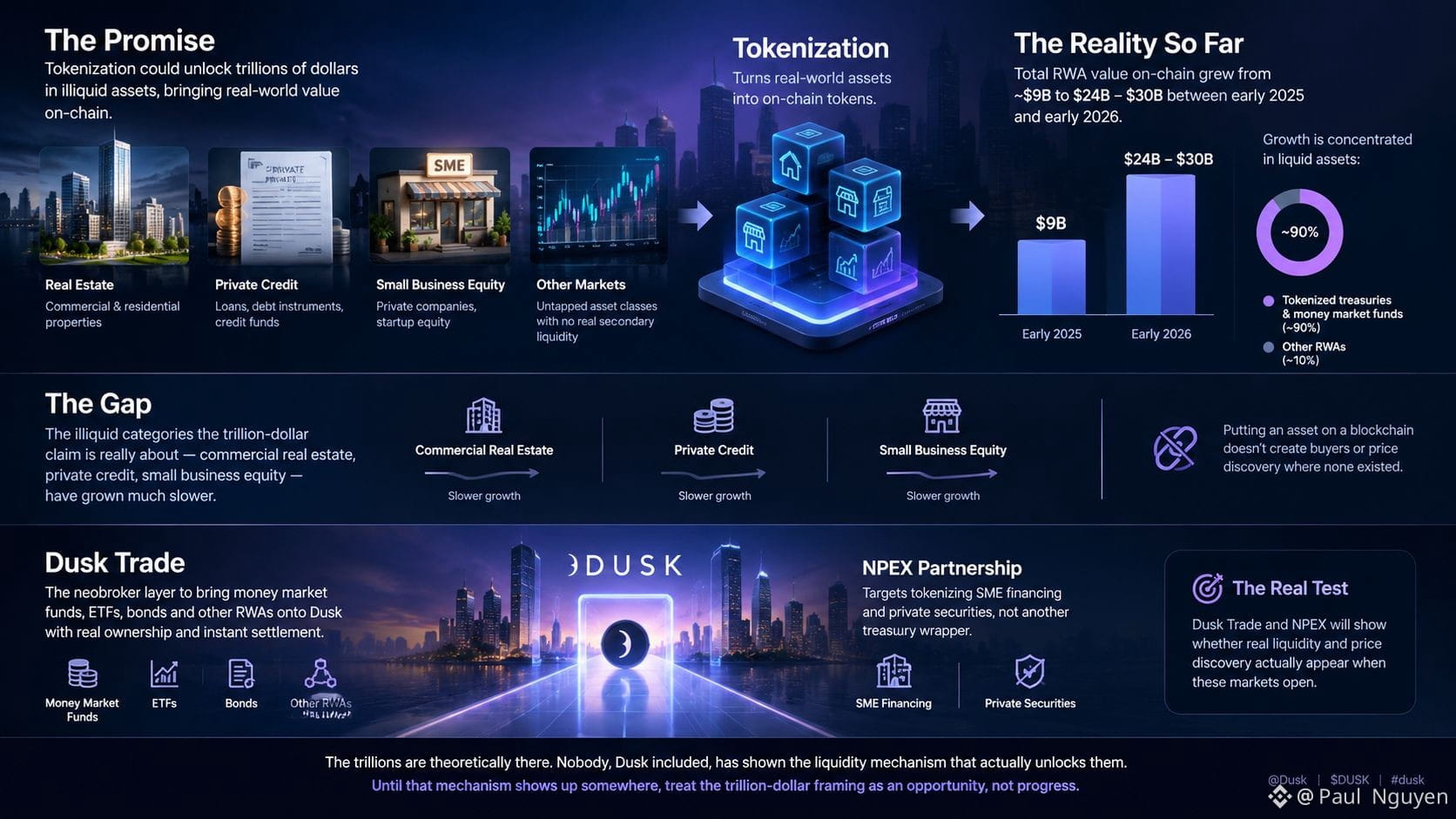
What's happened so far doesn't support it yet, at least not in the form usually claimed. Real-world asset value on-chain grew from roughly $9 billion to somewhere between $24 billion and $30 billion between early 2025 and early 2026, real growth by any measure. But independent data on that growth shows it's concentrated almost entirely in tokenized treasuries and money market funds, assets that had deep liquidity before tokenization touched them. The illiquid categories the trillion-dollar claim is actually about, commercial real estate, private credit, small business equity, have grown slower, since putting an asset on a blockchain doesn't manufacture buyers or price discovery where none existed. Dusk Trade, the neobroker layer meant to bring money market funds, ETFs, bonds and other RWAs onto Dusk with real ownership and instant settlement, is the actual test of whether that liquidity mechanism shows up once it opens.
This is the harder problem Dusk's NPEX partnership targets, tokenizing SME financing and private securities rather than another treasury wrapper. That makes Dusk's version of the claim more testable than most, and more honest, since it isn't hiding behind an easy liquid asset class to pad a headline number. It also means Dusk is making a harder bet than current RWA data has validated. The trillions are theoretically there. Nobody, Dusk included, has shown the liquidity mechanism that actually unlocks them. Until that mechanism shows up somewhere, I'd treat the trillion-dollar framing as a description of opportunity, not of progress already made.
@Dusk $DUSK #dusk
What's happened so far doesn't support it yet, at least not in the form usually claimed. Real-world asset value on-chain grew from roughly $9 billion to somewhere between $24 billion and $30 billion between early 2025 and early 2026, real growth by any measure. But independent data on that growth shows it's concentrated almost entirely in tokenized treasuries and money market funds, assets that had deep liquidity before tokenization touched them. The illiquid categories the trillion-dollar claim is actually about, commercial real estate, private credit, small business equity, have grown slower, since putting an asset on a blockchain doesn't manufacture buyers or price discovery where none existed. Dusk Trade, the neobroker layer meant to bring money market funds, ETFs, bonds and other RWAs onto Dusk with real ownership and instant settlement, is the actual test of whether that liquidity mechanism shows up once it opens.
This is the harder problem Dusk's NPEX partnership targets, tokenizing SME financing and private securities rather than another treasury wrapper. That makes Dusk's version of the claim more testable than most, and more honest, since it isn't hiding behind an easy liquid asset class to pad a headline number. It also means Dusk is making a harder bet than current RWA data has validated. The trillions are theoretically there. Nobody, Dusk included, has shown the liquidity mechanism that actually unlocks them. Until that mechanism shows up somewhere, I'd treat the trillion-dollar framing as a description of opportunity, not of progress already made.
@Dusk $DUSK #dusk