#dusk $DUSK @Dusk
At first I thought LUX was simply another name for $DUSK, a denomination most users could ignore.
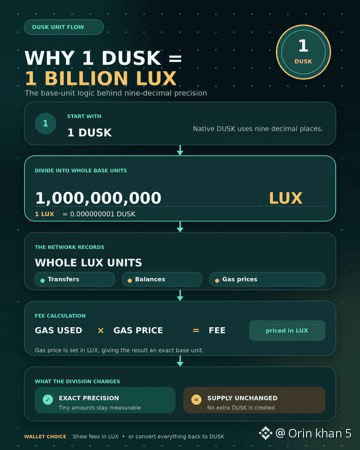
After looking closer at @Dusk, I realized it defines the network’s precision. Native DUSK has nine decimal places: 1 DUSK equals 1,000,000,000 LUX, while 1 LUX equals 0.000000001 DUSK.
The network records amounts in whole LUX units. Gas prices are also set in LUX, and the fee comes from gas used multiplied by gas price. This gives wallets and developers an exact base unit for transfers, balances and fees.
That is what I like about this approach. The division does not increase supply or make $DUSK more valuable. It simply makes tiny amounts measurable without using fractions below the network’s smallest unit.
I’m curious whether users will ever think in LUX, or whether wallets will keep it mostly invisible.
Would you rather see network fees in LUX or have wallets convert everything into DUSK?