“One-click leverage” sounds simple—until you look at what happens after the click.
I dug into TermMax’s leverage flow and the engineering is genuinely neat.
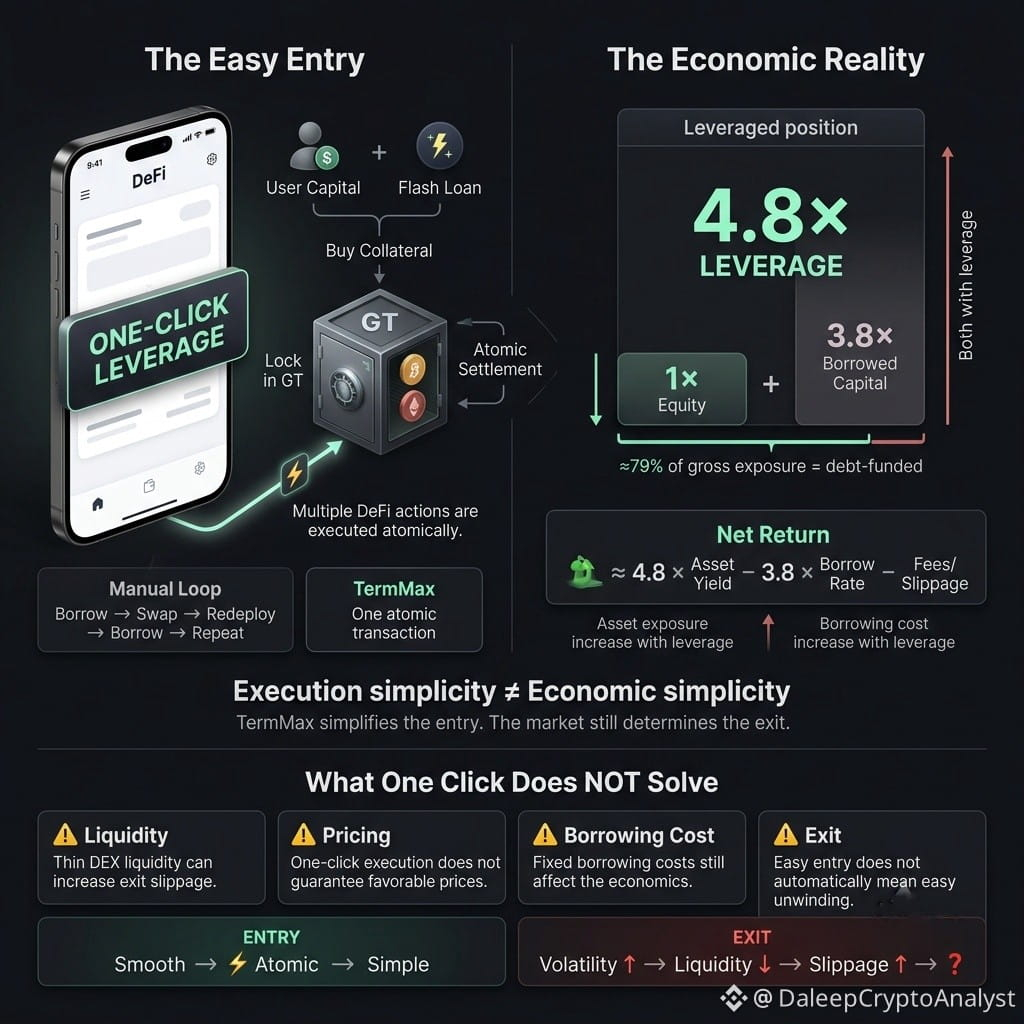
A flash loan combines your capital with borrowed funds, buys the collateral, locks the position inside a Gearing Token (GT), and settles everything atomically.
Compared with manually borrowing, swapping, redepositing, and looping, that’s a much cleaner execution path.
But there’s an important distinction:
Simple execution ≠ simple economics.
At 4.8× leverage, around 3.8× your equity is borrowed capital. That means roughly 79% of the gross position is debt-funded.
So the real calculation becomes something like:
Net return ≈ 4.8 × asset yield − 3.8 × borrow rate − fees/slippage
If the underlying asset or Principal Token performs well, leverage amplifies the exposure.
But borrowing costs scale too.
And this is where the “one-click” experience has limits.
Atomic execution can reduce gas overhead, transaction sequencing issues, and failed multi-step transactions. What it can't promise is deep liquidity, favorable execution prices, or a painless exit.
The borrower gets a beautifully packaged entry.
But underneath it, lenders still have to supply the range liquidity that makes the whole mechanism possible.
So the question I keep coming back to is:
When volatility spikes and DEX liquidity gets thinner, does exit slippage become the hidden cost of easy leverage?
TermMax may have made entering a leveraged position much easier.
I’m not yet convinced it has made getting out just as easy.
#TermMax #TMX #DeFi @TermMax
I dug into TermMax’s leverage flow and the engineering is genuinely neat.
A flash loan combines your capital with borrowed funds, buys the collateral, locks the position inside a Gearing Token (GT), and settles everything atomically.
Compared with manually borrowing, swapping, redepositing, and looping, that’s a much cleaner execution path.
But there’s an important distinction:
Simple execution ≠ simple economics.
At 4.8× leverage, around 3.8× your equity is borrowed capital. That means roughly 79% of the gross position is debt-funded.
So the real calculation becomes something like:
Net return ≈ 4.8 × asset yield − 3.8 × borrow rate − fees/slippage
If the underlying asset or Principal Token performs well, leverage amplifies the exposure.
But borrowing costs scale too.
And this is where the “one-click” experience has limits.
Atomic execution can reduce gas overhead, transaction sequencing issues, and failed multi-step transactions. What it can't promise is deep liquidity, favorable execution prices, or a painless exit.
The borrower gets a beautifully packaged entry.
But underneath it, lenders still have to supply the range liquidity that makes the whole mechanism possible.
So the question I keep coming back to is:
When volatility spikes and DEX liquidity gets thinner, does exit slippage become the hidden cost of easy leverage?
TermMax may have made entering a leveraged position much easier.
I’m not yet convinced it has made getting out just as easy.
#TermMax #TMX #DeFi @TermMax