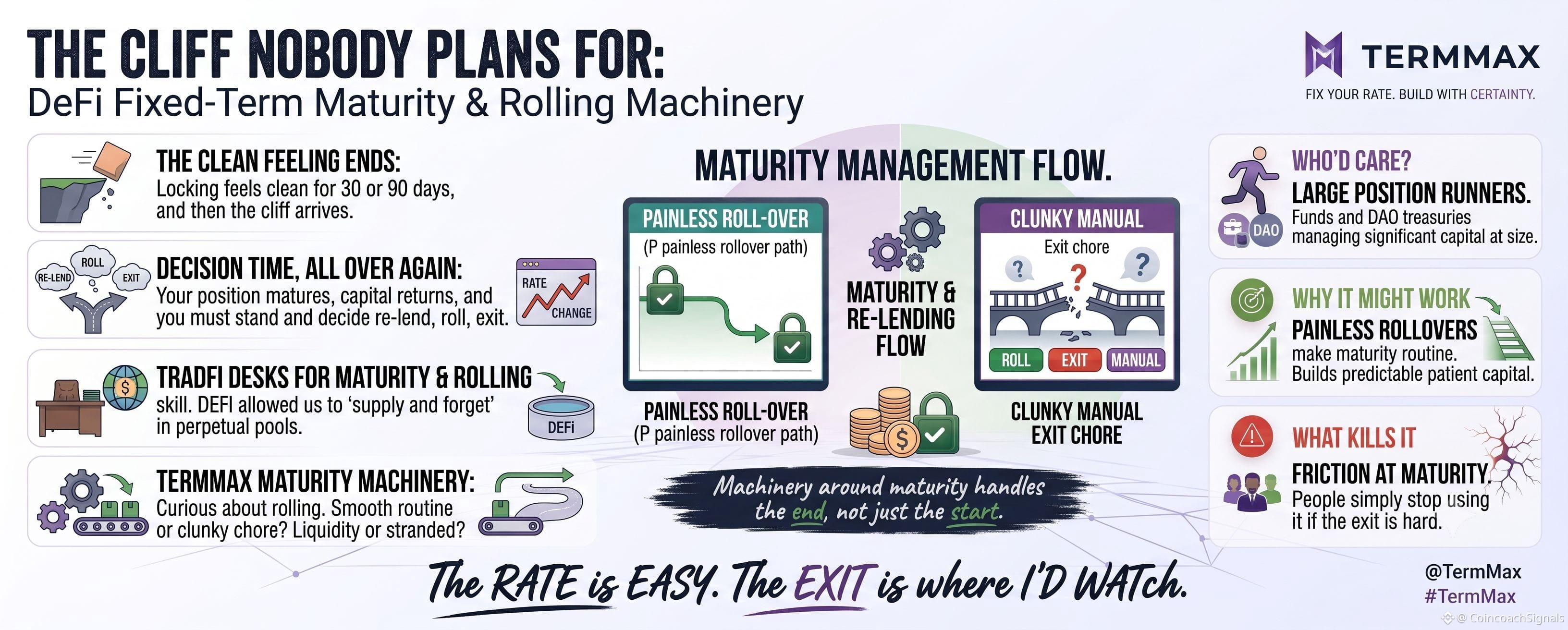
At first I thought the hard part of fixed-rate lending was the rate itself. Turns out that's the easy bit — the part I keep coming back to is what happens when the term ends.
Because it does end. You lock a rate for 30 or 90 days, feels clean, and then the cliff arrives: your position matures, capital comes back, and you're standing there deciding all over again — re-lend, roll, exit — right when rates might look nothing like they did when you started.
Traditional finance has whole desks built around exactly this. Rolling maturities, laddering, refinancing. It's a real skill. In #defi most of us never had to think about it, because everything was perpetual and floating — you just left it in the pool and forgot about it.
So the thing I'm actually curious about with @TermMax isn't the fixed rate. It's the machinery around maturity. Does rolling a position feel smooth, or is it a clunky chore every month? Is there liquidity waiting at the next maturity, or do you get stranded? A fixed-term product lives or dies on how it handles the end, not the start.
Who'd care? Anyone running this at size. Why it might work: painless rollovers make it routine. What kills it: friction at maturity that makes people just not bother.
The rate is easy. The exit is where I'd watch.
#TermMax
Top Trending pairs right now: $BOME $MAGMA $ONG
Because it does end. You lock a rate for 30 or 90 days, feels clean, and then the cliff arrives: your position matures, capital comes back, and you're standing there deciding all over again — re-lend, roll, exit — right when rates might look nothing like they did when you started.
Traditional finance has whole desks built around exactly this. Rolling maturities, laddering, refinancing. It's a real skill. In #defi most of us never had to think about it, because everything was perpetual and floating — you just left it in the pool and forgot about it.
So the thing I'm actually curious about with @TermMax isn't the fixed rate. It's the machinery around maturity. Does rolling a position feel smooth, or is it a clunky chore every month? Is there liquidity waiting at the next maturity, or do you get stranded? A fixed-term product lives or dies on how it handles the end, not the start.
Who'd care? Anyone running this at size. Why it might work: painless rollovers make it routine. What kills it: friction at maturity that makes people just not bother.
The rate is easy. The exit is where I'd watch.
#TermMax
Top Trending pairs right now: $BOME $MAGMA $ONG