I went back through the TermMax documentation twice before I felt like I understood what problem it is actually trying to solve at the deepest level.
My first reading gave me a surface answer. Fixed rates. Known maturity. Predictable yield.
That sounded right. Then I started pulling on one specific thread and the surface answer came apart.
#termmax
The thread was the curator system.
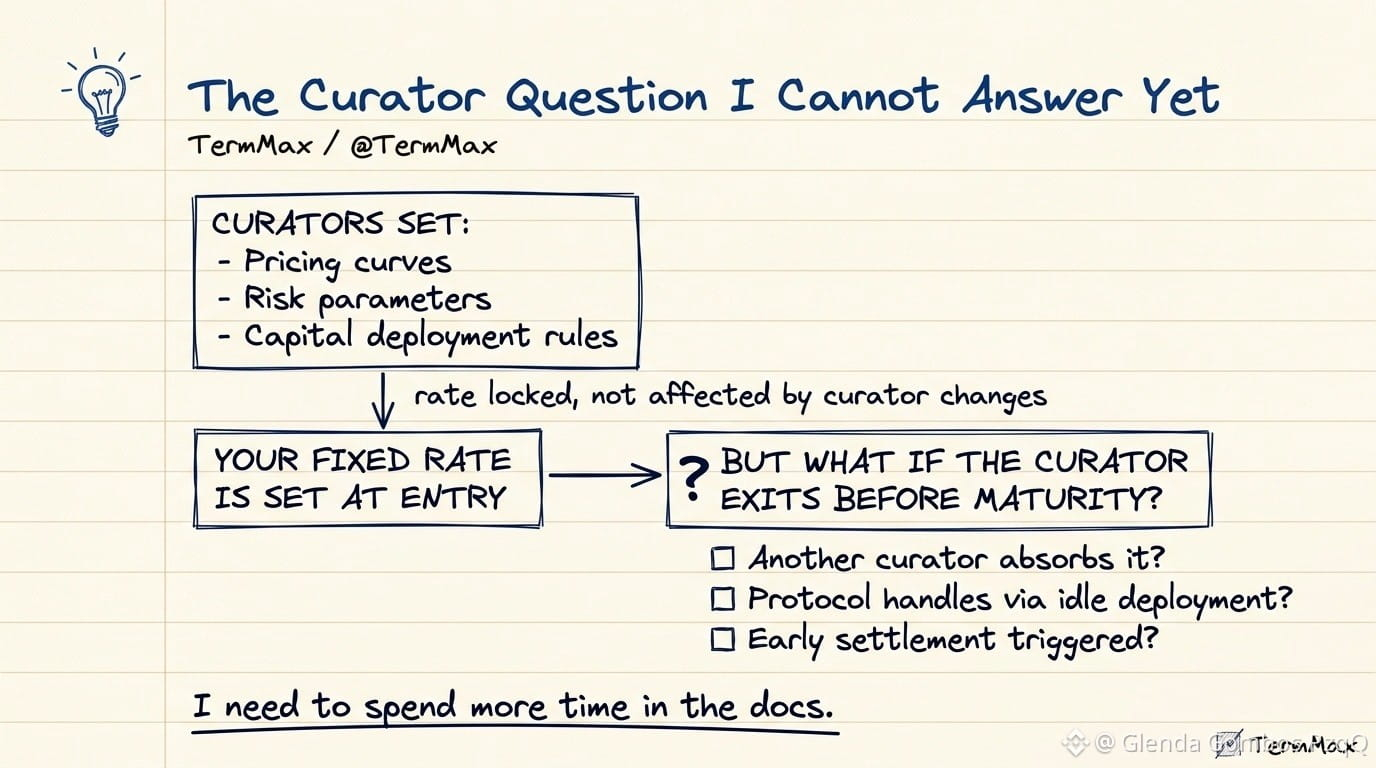
TermMax does not manage its own markets. Professional curators do. Keyrock. Hardcoded Lab. Edge Capital. AlphaPing. Origami Crypto. These are the entities that set pricing curves, determine risk parameters, and decide how capital gets deployed across each market.
When I first read this I thought: interesting, outsourced expertise, probably efficient.
Then I asked a different question. If curators set the parameters, what happens to your fixed rate when a curator decides to adjust those parameters mid-market?
The documentation is careful here. It separates the fixed rate that lenders locked in from the curator parameters that govern new market terms. Existing positions retain their locked rate. New positions enter under current curator settings.
That distinction matters enormously and I want to sit with it longer before drawing a conclusion.
What I cannot fully answer yet is what happens to a lender's position if a curator exits the market before maturity. Does another curator absorb it? Does the protocol handle it through the idle fund deployment mechanism? Does the lender face an early settlement?
I do not want to pretend I have that answer from what I have read so far.
For those who have studied the curator architecture more deeply: what happens to lender positions if a curator withdraws before the market matures?
#TermMax @TermMax $TMX #DeFi
My first reading gave me a surface answer. Fixed rates. Known maturity. Predictable yield.
That sounded right. Then I started pulling on one specific thread and the surface answer came apart.
#termmax
The thread was the curator system.
TermMax does not manage its own markets. Professional curators do. Keyrock. Hardcoded Lab. Edge Capital. AlphaPing. Origami Crypto. These are the entities that set pricing curves, determine risk parameters, and decide how capital gets deployed across each market.
When I first read this I thought: interesting, outsourced expertise, probably efficient.
Then I asked a different question. If curators set the parameters, what happens to your fixed rate when a curator decides to adjust those parameters mid-market?
The documentation is careful here. It separates the fixed rate that lenders locked in from the curator parameters that govern new market terms. Existing positions retain their locked rate. New positions enter under current curator settings.
That distinction matters enormously and I want to sit with it longer before drawing a conclusion.
What I cannot fully answer yet is what happens to a lender's position if a curator exits the market before maturity. Does another curator absorb it? Does the protocol handle it through the idle fund deployment mechanism? Does the lender face an early settlement?
I do not want to pretend I have that answer from what I have read so far.
For those who have studied the curator architecture more deeply: what happens to lender positions if a curator withdraws before the market matures?
#TermMax @TermMax $TMX #DeFi