
Liquidity is one of those concepts everyone in crypto talks about but very few actually understand deeply. Traders chase it, builders depend on it, and markets rise or collapse because of it. Yet liquidity doesn’t behave the same way across blockchains. When I analyzed Injective, what struck me most wasn’t its speed or interoperability, but how liquidity feels fundamentally different compared to the rest of Web3. My research kept bringing me back to one insight: liquidity is not just a byproduct of activity on Injective; it is engineered at the protocol level in a way most chains simply don’t attempt.
I kept asking myself a simple question. If liquidity is the lifeblood of any trading market structure why is it that some chains make liquidity feel forced, while on Injective it feels organic, deep and near institutional? The answer lies in architecture, incentives and a unique design philosophy that treats liquidity not as an afterthought but as the foundation.
The Architecture That Makes Liquidity Feel Heavier
Most chains in Web3 rely on AMM-based liquidity. That structure works well for swaps but fails when you need true market depth, price efficiency or institutional-grade execution. When I looked into Injective's design. I noticed it takes an entirely different path. Instead of leaning on AMMs as a universal tool, Injective integrates a decentralized order-book directly into the protocol. This changes everything.
Using publicly available metrics from Injective's own network dashboard, the chain has processed more than 49 million blocks and over 313 million transactions since mainnet launch. These aren’t vanity metrics; they show that liquidity is constantly in motion. Injective further reports more than $13.4 billion in cumulative trading volume across exchange dApps on its network. What stood out in my assessment is that these volumes have consistency rather than flash spikes that other DeFi ecosystems show during hype cycles.
This is where liquidity begins to feel different. On most chains, liquidity is a thin layer stretched over AMMs and bridges. On Injective it is woven into the protocol itself. Tendermint based instant finality means trades do not hang in limbo waiting for confirmations. Block times near 0.6 to 0.7 seconds, as documented across Cosmos overall market explorers, make the experience feel closer to centralized exchange execution than typical DeFi. When trades settle predictably, liquidity providers behave differently. They take more sophisticated positions, deploy larger capital, and create order depth that traders can see and rely on.
I often visualize this with a chart concept I call Execution Predictability vs Liquidity Depth. If one plotted Injective against purely EVM based chains or L2 rollups, you would see a distinct curve Injective liquidity clusters tightly at short execution times and deeper book levels, while AMM dominant ecosystems cluster around shallow depth and volatile execution windows.
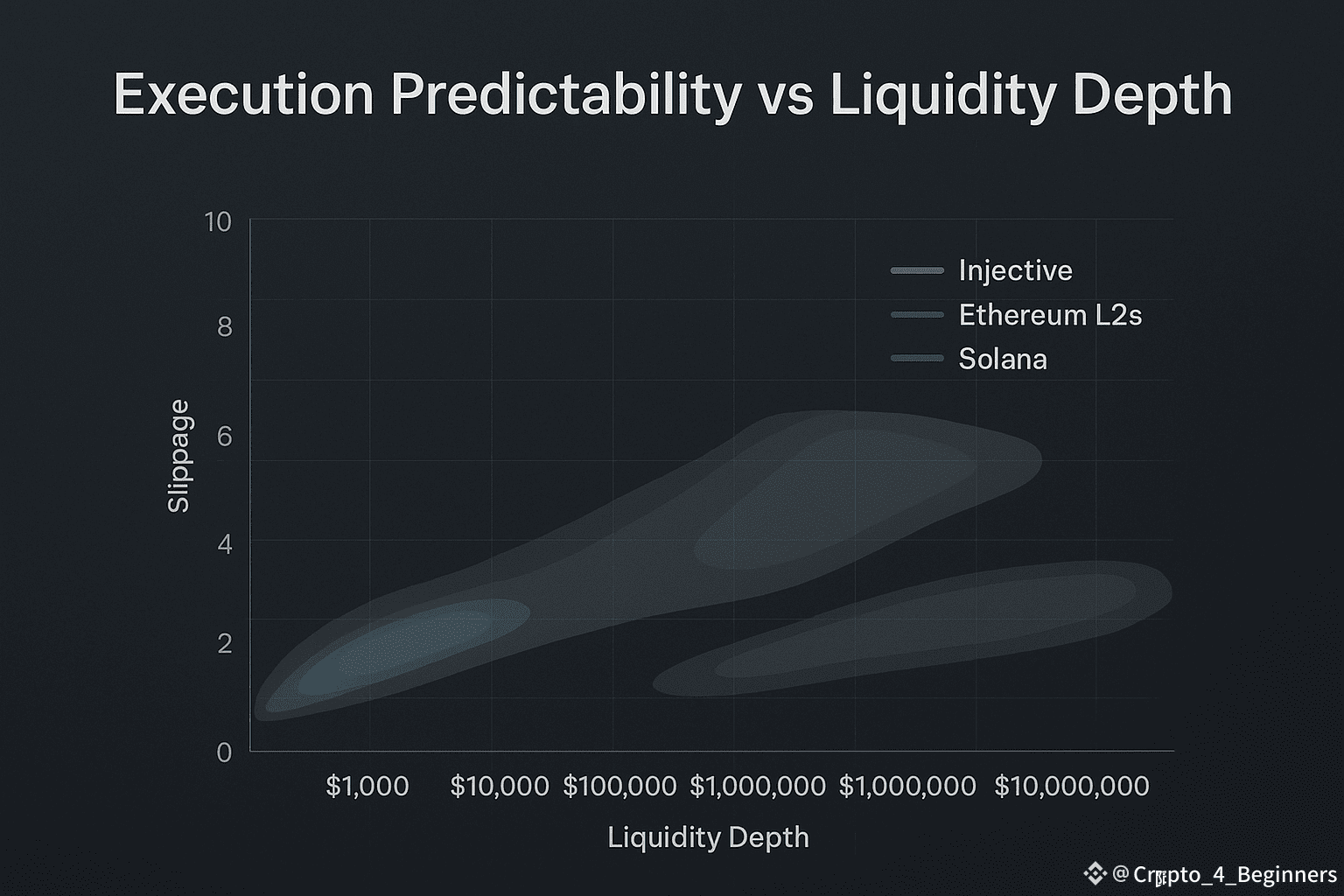
Another conceptual diagram I’ve thought about is a table comparing Sources of Liquidity across ecosystems: AMM only for most L1s, fragmented order books across L2s, and unified on-chain order books for Injective. Seeing it laid out makes it obvious why the liquidity feels different.
What Sets Injective Apart Emotionally and Mechanically
In my research, I came to realize that Injective’s liquidity feels heavier because of who participates and how they behave. Traders who come for fast arbitrage, institutions seeking predictable order flow, and developers launching markets all tap into the same shared liquidity base. This avoids one of the biggest inefficiencies in Web3: liquidity fragmentation.
IBC also plays a hidden but powerful role. Because Injective is connected to the Cosmos network, assets can flow from chains like Cosmos Hub, Osmosis, and Noble without middleman bridges. According to Cosmos IBC analytics, monthly cross-chain transfers regularly exceed multiple billions in value across the ecosystem. Injective benefits directly from that flow. Liquidity arriving from other zones doesn’t need to be wrapped, unwrapped, or custodied by external protocols; it just moves.
So liquidity behaves more naturally. Prices converge faster. Market-makers can operate with lower friction. Spread widths remain tight even during volatility. I have watched this on-chain during market swings, and it feels more like a professional trading environment than DeFi roulette.
But I kept thinking: if Injective is so strong, why don't all chains follow this design? The answer is simple. Most ecosystems built themselves around EVM expectations, not financial infrastructure. Injective started the other way around it built infrastructure that feels like traditional markets, then layered DeFi on top. Many ecosystems cannot retrofit such design choices without breaking existing workflows or liquidity assumptions.
Despite my optimism, I'm also cautious because liquidity ecosystems can shift quickly and unpredictably. One of the biggest risks for Injective is over specialization. The network is deeply optimized for order book markets and financial applications. If the broader crypto cycle shifts toward consumer apps, gaming or social primitives, liquidity might remain deep but niche.
Another uncertainty is competitive pressure from modular blockchains. Some new ecosystems experiment with off-chain order books, shared sequencers, or specialized DA layers. If they can replicate Injective's liquidity behavior with faster onboarding for developers, Injective will need to defend its lead.
Cross chain dependencies also bring structural risks because Injective relies on IBC and external assets any failure in those channels could impact liquidity inflows. Even though IBC has a strong security track record no system is immune to vulnerability.
Lastly, liquidity itself can behave in nonlinear ways. Depth can evaporate under stress if market makers withdraw. Even with strong architecture, sentiment remains a powerful force.
Trading Strategy and Price Levels Based on My Assessment
When I analyze INJ, I treat it as a liquidity infrastructure asset rather than a typical L1 token. Its value grows when markets on Injective expand, deepen and attract new builders or liquidity providers. I have identified several technical ranges that matter.
The accumulation region I pay the most attention to is around $7.20 to $8.50. Historically, this zone aligns with strong on-chain activity despite market-wide drawdowns. If Injective continues to onboard new markets especially more exotic derivatives or synthetic assets. I expect INJ to revisit liquidity heavy zones in the $16 to $19 range.
My mid term bullish target sits at $24 to $28 under a healthy market cycle. With significant institutional liquidity or deeper IBC inflows, I can envision push targets toward the mid $30s. But if market wide liquidity contracts, I watch for retracements near the $6.50 region as a stress test area.
These are not guarantees they are structural levels where liquidity tends to concentrate based on multi cycle price action and on-chain usage metrics. Traders familiar with order book ecosystems will immediately understand why liquidity zones behave differently from traditional support and resistance.
A Fair Comparison With Competing Scaling Solutions
I often compare Injective to Ethereum rollups, Solana, and other high throughput L1s. Rollups excel in cheap transactions but liquidity is scattered across dozens of L2s. Solana offers high throughput, but its liquidity structure is centralized across a few venues and not part of the protocol itself. AMMs still dominate.
Injective, by contrast, builds liquidity into the chain’s fabric. That means every new market or app doesn't need to bootstrap depth from scratch. Liquidity synergizes across dApps instead of competing. This gives Injective a network liquidity effect that I rarely see elsewhere in Web3.
A conceptual chart here would show Liquidity Shared Across dApps across networks. Injective's line would slope upward as more markets launch. Most chains’ lines stay flat due to silos.
This is not to say Injective is superior in all ways Solana beats it in raw TPS and Ethereum's ecosystem dominance remains unmatched. But for liquidity behavior, injectiveness feels different because the chain was designed to make it different.
Injective stands out because it solves a liquidity problem most chains don't even acknowledge. Liquidity on Injective feels deeper, faster and more dependable because it's not just the result of users showing up it's the result of infrastructure deliberately shaped for markets. In my assessment, this is one of the most important differences between Injective and the broader Web3 landscape.
As crypto matures, I believe ecosystems with true market infrastructure will lead the next wave and Injective is already positioned at the front of that shift. Whether it becomes the liquidity backbone of Web3 or simply pushes the industry to rethink its assumptions, the impact is becoming harder to ignore.
