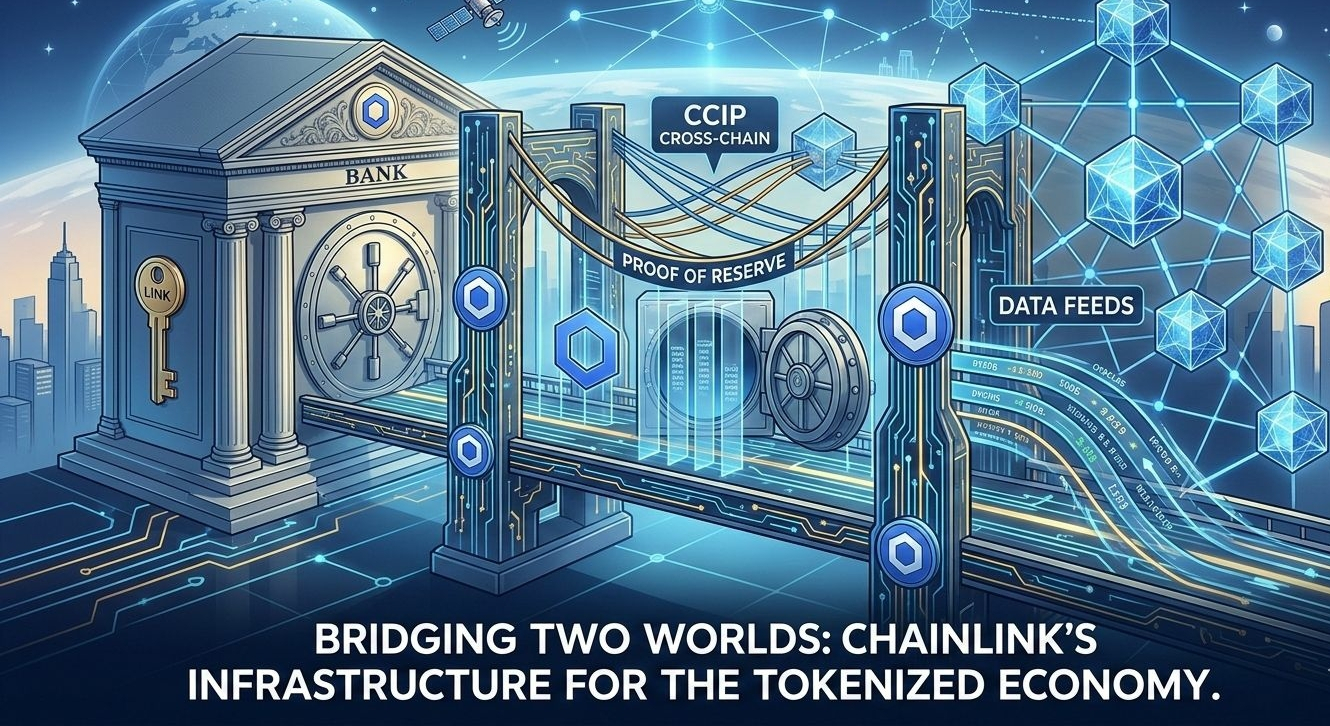
If blockchains are highly secure, digital vaults, smart contracts are the automated rules governing what happens inside them. However, there is a fundamental flaw in this design: blockchains are intentionally isolated. They cannot natively connect to the outside world to check the price of a stock, verify a shipping manifest, or confirm if a flight was delayed.
This isolation is known as the Oracle Problem, and Chainlink ($LINK ) was built entirely to solve it. Today, Chainlink is not just a cryptocurrency; it is the industry-standard decentralized oracle network functioning as the foundational infrastructure for the entire tokenized economy.
Solving the Oracle Problem
To execute a contract based on real-world events, blockchains need external data. If a blockchain relies on a single, centralized data source (like a single stock exchange API), it creates a single point of failure, defeating the entire purpose of a decentralized network.
Chainlink solves this by using a decentralized network of independent node operators. These nodes fetch data from multiple sources, aggregate it, verify its accuracy, and securely deliver it on-chain. This ensures that smart contracts can trigger based on real-world events without sacrificing security or relying on a middleman.
Beyond Price Feeds: Chainlink's Core Technology
While Chainlink started by providing the price feeds that made Decentralized Finance (DeFi) possible, its technology stack has expanded significantly. In 2026, the network is built on a few critical pillars:
* Data Feeds & Streams: Chainlink provides high-frequency, tamper-proof market data. This has recently expanded heavily into traditional finance (TradFi), offering 24/5 equities streams to bring global stock market data natively on-chain.
* CCIP (Cross-Chain Interoperability Protocol): Often described as the TCP/IP of blockchains, CCIP is a highly secure messaging system that allows different blockchains to communicate. It enables developers to build applications that span multiple networks and allows assets to move seamlessly without relying on vulnerable cross-chain bridges.
* Proof of Reserve (PoR): As the market for tokenized assets grows, investors need to know that digital tokens are actually backed by real assets. Chainlink’s PoR provides automated, near real-time verification of the off-chain reserves backing stablecoins, tokenized gold, and digital treasuries.
The 2026 Landscape: Institutional Adoption and RWAs
Chainlink has transitioned from a tool primarily used by crypto-native developers to an essential piece of infrastructure for Global Systemically Important Banks (GSIBs). The defining narrative for Chainlink in 2026 is the tokenization of Real-World Assets (RWAs).
* The Canton Network Integration: In early 2026, Chainlink deployed its data standard across the Canton blockchain ecosystem. This massive integration brings regulatory-grade oracle infrastructure to a network that processes hundreds of billions in daily U.S. Treasury repo transactions, cementing Chainlink’s role in institutional finance.
* Mainstream Financial Vehicles: The launch of the Bitwise Chainlink ETF (CLNK) in January 2026 marked a watershed moment, allowing regulated institutional capital to flow directly into the LINK ecosystem.
* Global Bank Partnerships: Chainlink’s ongoing infrastructure work with Swift—the backbone of the global financial system connecting over 11,000 banks—has moved from pilot phases toward production, bridging traditional banking systems with blockchain networks.
The Role of the LINK Token
The LINK token is the economic engine that powers this entire network. It serves two primary functions:
* Payment Unit: Developers and financial institutions must pay Chainlink node operators in LINK to retrieve data, generate verifiable randomness, or utilize CCIP for cross-chain transfers.
* Network Security: Node operators are required to stake LINK tokens as collateral. If a node acts maliciously or provides inaccurate data, its staked LINK can be slashed (penalized). This economic incentive ensures that the network remains honest and highly secure.