

#staking
staking
Просмотров: 2.2M
8,548 обсуждают
Популярные
Новые

·
--
🔍 Bitmine added 10,452 ETH last week—but accumulation isn’t the whole story.
Much of its treasury is staked, introducing reward potential and validator risk.
A bigger balance isn’t automatically better economics.
Which matters more: holdings or sustainable yield?
$ETH #Ethereum #CryptoTreasury #Staking
🔍 Bitmine added 10,452 ETH last week—but accumulation isn’t the whole story.
Much of its treasury is staked, introducing reward potential and validator risk.
A bigger balance isn’t automatically better economics.
Which matters more: holdings or sustainable yield?
$ETH #Ethereum #CryptoTreasury #Staking
Much of its treasury is staked, introducing reward potential and validator risk.
A bigger balance isn’t automatically better economics.
Which matters more: holdings or sustainable yield?
$ETH #Ethereum #CryptoTreasury #Staking
67

·
--
🚨 BitMine just resumed ETH staking, unlocking 5.23M ETH after weeks of stagnation. This massive on-chain activity signals renewed confidence in Ethereum's long-term value.
Market Implication: Increased staking supply could pressure short-term price action, but reinforces ETH's scarcity narrative for the future.
💬 Will this unlock trigger a wave of ETH redistribution or simply reinforce holder conviction? #Ethereum #Staking
$ETH #TradingSignal #CryptoAnalysis
🚨 BitMine just resumed ETH staking, unlocking 5.23M ETH after weeks of stagnation. This massive on-chain activity signals renewed confidence in Ethereum's long-term value.
Market Implication: Increased staking supply could pressure short-term price action, but reinforces ETH's scarcity narrative for the future.
💬 Will this unlock trigger a wave of ETH redistribution or simply reinforce holder conviction? #Ethereum #Staking
$ETH #TradingSignal #CryptoAnalysis
Market Implication: Increased staking supply could pressure short-term price action, but reinforces ETH's scarcity narrative for the future.
💬 Will this unlock trigger a wave of ETH redistribution or simply reinforce holder conviction? #Ethereum #Staking
$ETH #TradingSignal #CryptoAnalysis


·
--
Binance Earn (Flexible vs. Bloqueado)
💰 Deja de dejar tus stablecoins y criptoactivos dormidos 😴 en la billetera.
Con Binance Earn puedes generar rendimientos diarios sobre los activos que ya conservas a largo plazo (HODL):
🔹 Productos Flexibles: Depositas tu capital y puedes retirarlo en cualquier momento. Ideal para mantener liquidez.
🔹 Productos Bloqueados: Comprometes tus tokens por 30, 60 o 90 días a cambio de una tasa de interés (APR) significativamente mayor.
💡 Tip de estrategia: Guarda tu fondo de oportunidad en USDT/USDC flexible y coloca tus activos de convicción a largo plazo en productos bloqueados.
#BinanceEarn #staking #Criptotips #BinanceLatam
Binance Earn (Flexible vs. Bloqueado)
💰 Deja de dejar tus stablecoins y criptoactivos dormidos 😴 en la billetera.
Con Binance Earn puedes generar rendimientos diarios sobre los activos que ya conservas a largo plazo (HODL):
🔹 Productos Flexibles: Depositas tu capital y puedes retirarlo en cualquier momento. Ideal para mantener liquidez.
🔹 Productos Bloqueados: Comprometes tus tokens por 30, 60 o 90 días a cambio de una tasa de interés (APR) significativamente mayor.
💡 Tip de estrategia: Guarda tu fondo de oportunidad en USDT/USDC flexible y coloca tus activos de convicción a largo plazo en productos bloqueados.
#BinanceEarn #staking #Criptotips #BinanceLatam
💰 Deja de dejar tus stablecoins y criptoactivos dormidos 😴 en la billetera.
Con Binance Earn puedes generar rendimientos diarios sobre los activos que ya conservas a largo plazo (HODL):
🔹 Productos Flexibles: Depositas tu capital y puedes retirarlo en cualquier momento. Ideal para mantener liquidez.
🔹 Productos Bloqueados: Comprometes tus tokens por 30, 60 o 90 días a cambio de una tasa de interés (APR) significativamente mayor.
💡 Tip de estrategia: Guarda tu fondo de oportunidad en USDT/USDC flexible y coloca tus activos de convicción a largo plazo en productos bloqueados.
#BinanceEarn #staking #Criptotips #BinanceLatam

351

·
--
BitMine is closing in on 5% of all ETH. What happens next and why crypto should care.BitMine reported holdings of 6,051,933 ETH as of 2026-10-25, equal to roughly 4.95% of Ethereum’s reported supply. It added 10,452 ETH over the prior week and said more than 5.2M ETH is now staked. That means the “road to 5%” is basically becoming a “what does BitMine do after 5%?” story. According to the company’s latest release, it also held 215 BTC, strategic equity positions, and about $514M in cash and marketable securities.
There are several plausible paths:
1) It could simply hold and stake.
This would reinforce BitMine’s strategy as an ETH treasury plus staking vehicle. If a large portion of its ETH remains staked, fewer coins are readily liquid in the market. That does not guarantee higher prices, but it can make ETH’s tradable supply more sensitive to changes in ETF flows, exchange balances, leverage, and broader risk appetite.
2) It could keep buying beyond the 5% milestone.
The 5% figure has been a stated target, not necessarily proof of a permanent ceiling. Continued buying would preserve BitMine as a highly visible structural source of demand. But it would also intensify a key market risk: ETH would become more dependent on a small number of large institutional buyers continuing to allocate capital.
3) It could diversify into other assets or equity stakes.
BitMine already discloses small BTC holdings and strategic “moonshot” investments alongside ETH. If it begins allocating more meaningfully outside Ethereum, markets may read that as treasury diversification rather than an abandonment of ETH. The impact would depend on scale: a modest allocation is mostly narrative; a large one could redirect capital that had previously supported ETH accumulation.
4) It could prioritize buybacks and capital management.
The company repurchased 2.04M shares during the latest week. That suggests management is balancing crypto accumulation with equity-market considerations. For $BMNR holders, the question is not only ETH exposure—it is whether the company can grow ETH per share, manage financing risk, and avoid letting share issuance or valuation distort the treasury story.
What this means for ETH and crypto
The immediate takeaway is that Ethereum is becoming increasingly institutionalized through public-company treasury structures, staking operations, and investment vehicles. That can broaden access to ETH exposure, but it also creates concentration: one corporate treasury holding nearly 5% of supply becomes a market-relevant actor.
The bullish interpretation is straightforward: large-scale staking can reduce readily available supply and validate ETH as a productive treasury asset rather than only a speculative token.
The cautionary interpretation matters just as much: if BitMine reaches its target and slows purchases while ETH ETF flows remain weak, the market loses a prominent recurring buyer. Reports have highlighted significant ETH ETF outflows during October, making the marginal-demand question especially important.
BitMine reaching 5% would be less important as a “price target” event and more important as a market-structure event. The next catalyst is not the milestone itself—it is the company’s capital-allocation decision after the milestone: keep accumulating ETH, stake and compound, buy back shares or diversify.
#altcoins #staking $ETH
BitMine is closing in on 5% of all ETH. What happens next and why crypto should care.
BitMine reported holdings of 6,051,933 ETH as of 2026-10-25, equal to roughly 4.95% of Ethereum’s reported supply. It added 10,452 ETH over the prior week and said more than 5.2M ETH is now staked. That means the “road to 5%” is basically becoming a “what does BitMine do after 5%?” story. According to the company’s latest release, it also held 215 BTC, strategic equity positions, and about $514M in cash and marketable securities.
There are several plausible paths:
1) It could simply hold and stake.
This would reinforce BitMine’s strategy as an ETH treasury plus staking vehicle. If a large portion of its ETH remains staked, fewer coins are readily liquid in the market. That does not guarantee higher prices, but it can make ETH’s tradable supply more sensitive to changes in ETF flows, exchange balances, leverage, and broader risk appetite.
2) It could keep buying beyond the 5% milestone.
The 5% figure has been a stated target, not necessarily proof of a permanent ceiling. Continued buying would preserve BitMine as a highly visible structural source of demand. But it would also intensify a key market risk: ETH would become more dependent on a small number of large institutional buyers continuing to allocate capital.
3) It could diversify into other assets or equity stakes.
BitMine already discloses small BTC holdings and strategic “moonshot” investments alongside ETH. If it begins allocating more meaningfully outside Ethereum, markets may read that as treasury diversification rather than an abandonment of ETH. The impact would depend on scale: a modest allocation is mostly narrative; a large one could redirect capital that had previously supported ETH accumulation.
4) It could prioritize buybacks and capital management.
The company repurchased 2.04M shares during the latest week. That suggests management is balancing crypto accumulation with equity-market considerations. For $BMNR holders, the question is not only ETH exposure—it is whether the company can grow ETH per share, manage financing risk, and avoid letting share issuance or valuation distort the treasury story.
What this means for ETH and crypto
The immediate takeaway is that Ethereum is becoming increasingly institutionalized through public-company treasury structures, staking operations, and investment vehicles. That can broaden access to ETH exposure, but it also creates concentration: one corporate treasury holding nearly 5% of supply becomes a market-relevant actor.
The bullish interpretation is straightforward: large-scale staking can reduce readily available supply and validate ETH as a productive treasury asset rather than only a speculative token.
The cautionary interpretation matters just as much: if BitMine reaches its target and slows purchases while ETH ETF flows remain weak, the market loses a prominent recurring buyer. Reports have highlighted significant ETH ETF outflows during October, making the marginal-demand question especially important.
BitMine reaching 5% would be less important as a “price target” event and more important as a market-structure event. The next catalyst is not the milestone itself—it is the company’s capital-allocation decision after the milestone: keep accumulating ETH, stake and compound, buy back shares or diversify.
#altcoins #staking $ETH
There are several plausible paths:
1) It could simply hold and stake.
This would reinforce BitMine’s strategy as an ETH treasury plus staking vehicle. If a large portion of its ETH remains staked, fewer coins are readily liquid in the market. That does not guarantee higher prices, but it can make ETH’s tradable supply more sensitive to changes in ETF flows, exchange balances, leverage, and broader risk appetite.
2) It could keep buying beyond the 5% milestone.
The 5% figure has been a stated target, not necessarily proof of a permanent ceiling. Continued buying would preserve BitMine as a highly visible structural source of demand. But it would also intensify a key market risk: ETH would become more dependent on a small number of large institutional buyers continuing to allocate capital.
3) It could diversify into other assets or equity stakes.
BitMine already discloses small BTC holdings and strategic “moonshot” investments alongside ETH. If it begins allocating more meaningfully outside Ethereum, markets may read that as treasury diversification rather than an abandonment of ETH. The impact would depend on scale: a modest allocation is mostly narrative; a large one could redirect capital that had previously supported ETH accumulation.
4) It could prioritize buybacks and capital management.
The company repurchased 2.04M shares during the latest week. That suggests management is balancing crypto accumulation with equity-market considerations. For $BMNR holders, the question is not only ETH exposure—it is whether the company can grow ETH per share, manage financing risk, and avoid letting share issuance or valuation distort the treasury story.
What this means for ETH and crypto
The immediate takeaway is that Ethereum is becoming increasingly institutionalized through public-company treasury structures, staking operations, and investment vehicles. That can broaden access to ETH exposure, but it also creates concentration: one corporate treasury holding nearly 5% of supply becomes a market-relevant actor.
The bullish interpretation is straightforward: large-scale staking can reduce readily available supply and validate ETH as a productive treasury asset rather than only a speculative token.
The cautionary interpretation matters just as much: if BitMine reaches its target and slows purchases while ETH ETF flows remain weak, the market loses a prominent recurring buyer. Reports have highlighted significant ETH ETF outflows during October, making the marginal-demand question especially important.
BitMine reaching 5% would be less important as a “price target” event and more important as a market-structure event. The next catalyst is not the milestone itself—it is the company’s capital-allocation decision after the milestone: keep accumulating ETH, stake and compound, buy back shares or diversify.
#altcoins #staking $ETH
1
245

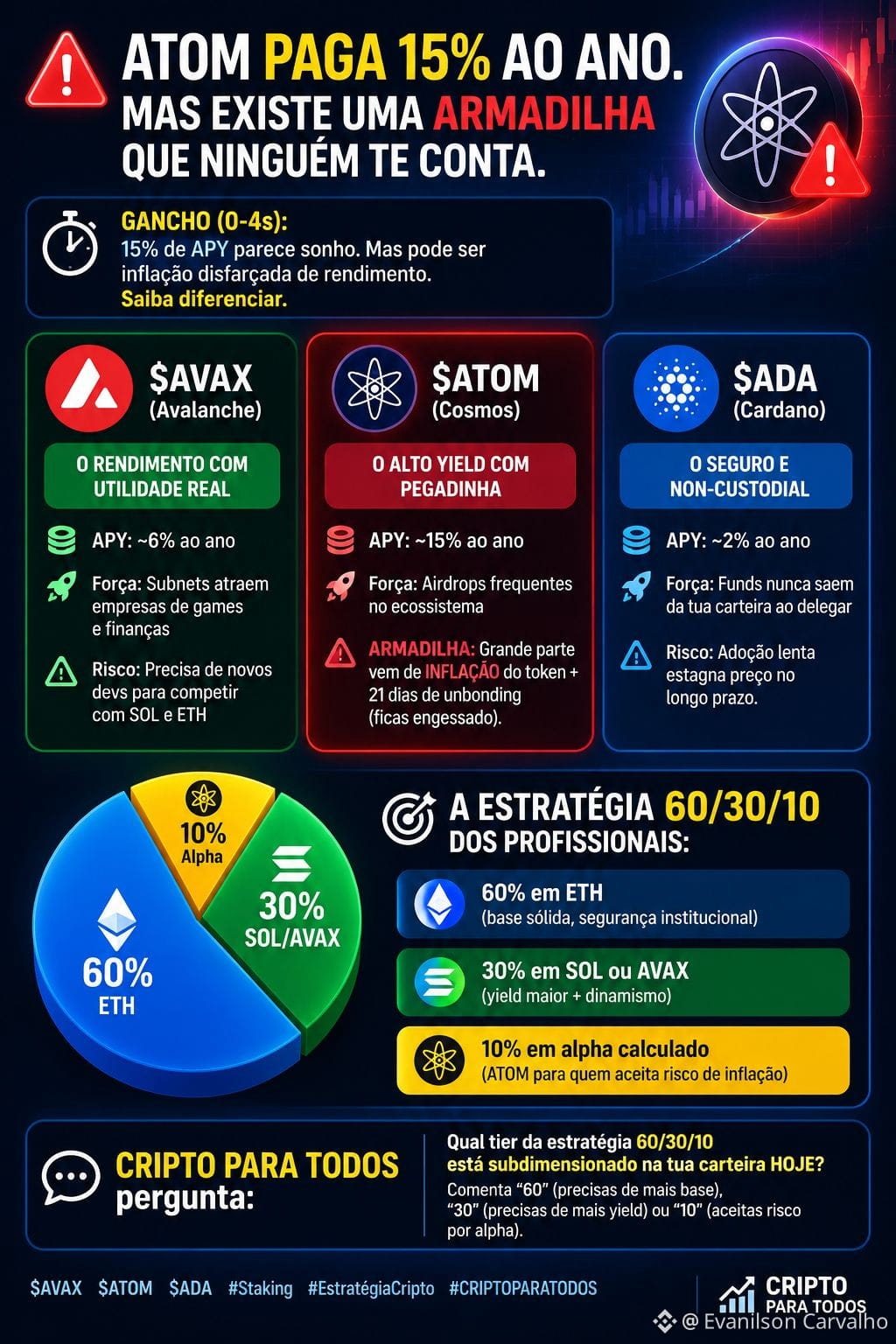
**🚨 ATOM PAGA 15% AO ANO. MAS EXISTE UMA ARMADILHA QUE NINGUÉM TE CONTA.**
15% de APY parece sonho. Mas pode ser inflação disfarçada de rendimento. Saiba diferenciar.
**$AVAX (Avalanche) - O Rendimento com Utilidade Real:**
• APY: ~6% ao ano
• Força: Subnets atraem empresas de games e finanças
• Risco: Precisa de novos devs para competir com SOL e ETH
**$ATOM (Cosmos) - O Alto Yield com Pegadinha:**
• APY: ~15% ao ano
• Força: Airdrops frequentes no ecossistema
• ARMADILHA: Grande parte vem de INFLAÇÃO do token + 21 dias de unbonding (ficas engessado)
**$ADA (Cardano) - O Seguro e Non-Custodial:**
• APY: ~2% ao ano
• Força: Funds nunca saem da tua carteira ao delegar
• Risco: Adoção lenta estagna preço no longo prazo
**🎯 A ESTRATÉGIA 60/30/10 DOS PROFISSIONAIS:**
• 60% em ETH (base sólida, segurança institucional)
• 30% em SOL ou AVAX (yield maior + dinamismo)
• 10% em alpha calculado (ATOM para quem aceita risco de inflação)
**CRIPTO PARA TODOS pergunta:**
**Qual tier da estratégia 60/30/10 está subdimensionado na tua carteira HOJE? Comenta "60" (precisas de mais base), "30" (precisas de mais yield) ou "10" (aceitas risco por alpha).**
$AVAX $ATOM $ADA #Staking #CRIPTOPARATODOS
**🚨 ATOM PAGA 15% AO ANO. MAS EXISTE UMA ARMADILHA QUE NINGUÉM TE CONTA.**
15% de APY parece sonho. Mas pode ser inflação disfarçada de rendimento. Saiba diferenciar.
**$AVAX (Avalanche) - O Rendimento com Utilidade Real:**
• APY: ~6% ao ano
• Força: Subnets atraem empresas de games e finanças
• Risco: Precisa de novos devs para competir com SOL e ETH
**$ATOM (Cosmos) - O Alto Yield com Pegadinha:**
• APY: ~15% ao ano
• Força: Airdrops frequentes no ecossistema
• ARMADILHA: Grande parte vem de INFLAÇÃO do token + 21 dias de unbonding (ficas engessado)
**$ADA (Cardano) - O Seguro e Non-Custodial:**
• APY: ~2% ao ano
• Força: Funds nunca saem da tua carteira ao delegar
• Risco: Adoção lenta estagna preço no longo prazo
**🎯 A ESTRATÉGIA 60/30/10 DOS PROFISSIONAIS:**
• 60% em ETH (base sólida, segurança institucional)
• 30% em SOL ou AVAX (yield maior + dinamismo)
• 10% em alpha calculado (ATOM para quem aceita risco de inflação)
**CRIPTO PARA TODOS pergunta:**
**Qual tier da estratégia 60/30/10 está subdimensionado na tua carteira HOJE? Comenta "60" (precisas de mais base), "30" (precisas de mais yield) ou "10" (aceitas risco por alpha).**
$AVAX $ATOM $ADA #Staking #CRIPTOPARATODOS
15% de APY parece sonho. Mas pode ser inflação disfarçada de rendimento. Saiba diferenciar.
**$AVAX (Avalanche) - O Rendimento com Utilidade Real:**
• APY: ~6% ao ano
• Força: Subnets atraem empresas de games e finanças
• Risco: Precisa de novos devs para competir com SOL e ETH
**$ATOM (Cosmos) - O Alto Yield com Pegadinha:**
• APY: ~15% ao ano
• Força: Airdrops frequentes no ecossistema
• ARMADILHA: Grande parte vem de INFLAÇÃO do token + 21 dias de unbonding (ficas engessado)
**$ADA (Cardano) - O Seguro e Non-Custodial:**
• APY: ~2% ao ano
• Força: Funds nunca saem da tua carteira ao delegar
• Risco: Adoção lenta estagna preço no longo prazo
**🎯 A ESTRATÉGIA 60/30/10 DOS PROFISSIONAIS:**
• 60% em ETH (base sólida, segurança institucional)
• 30% em SOL ou AVAX (yield maior + dinamismo)
• 10% em alpha calculado (ATOM para quem aceita risco de inflação)
**CRIPTO PARA TODOS pergunta:**
**Qual tier da estratégia 60/30/10 está subdimensionado na tua carteira HOJE? Comenta "60" (precisas de mais base), "30" (precisas de mais yield) ou "10" (aceitas risco por alpha).**
$AVAX $ATOM $ADA #Staking #CRIPTOPARATODOS
188
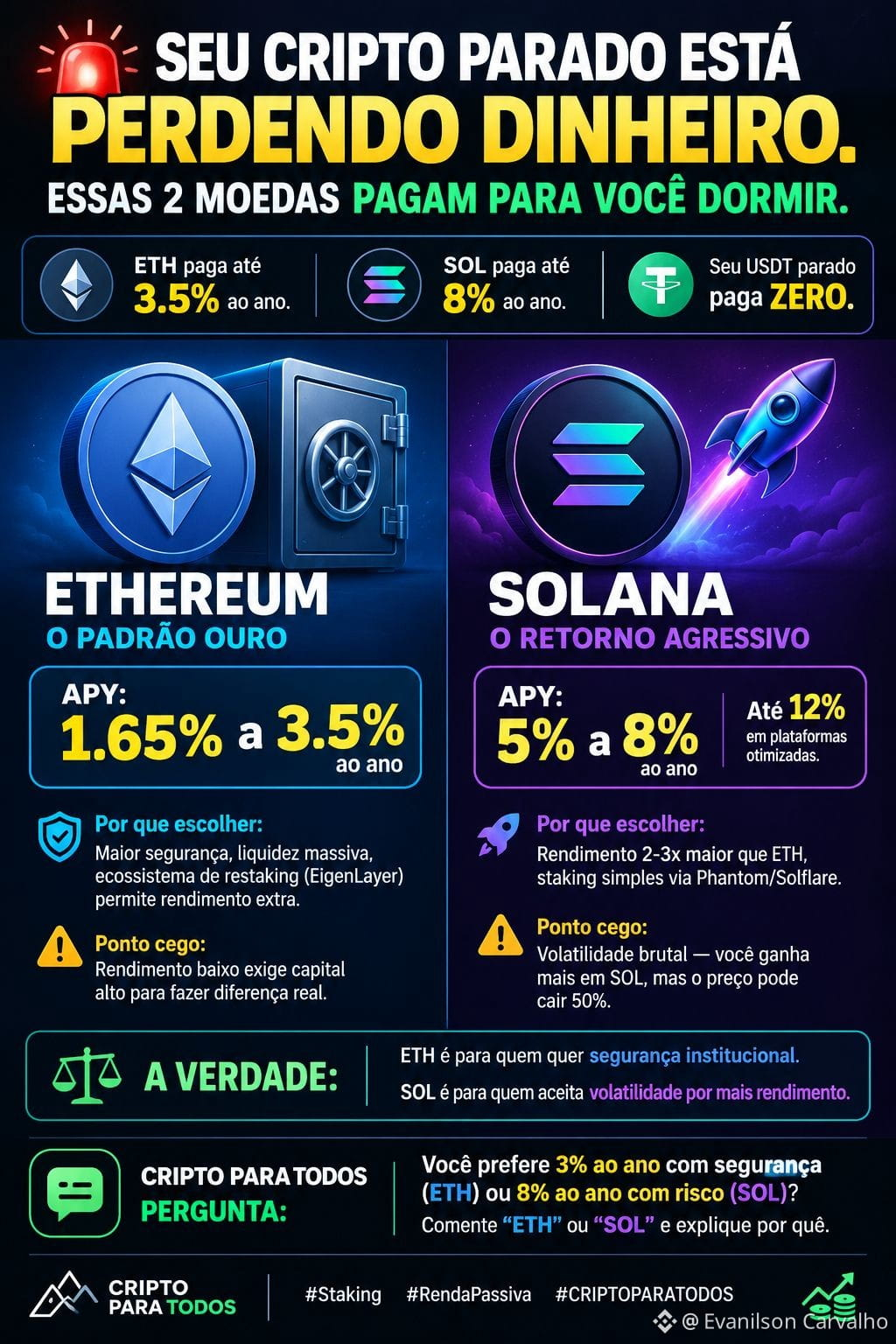
**🚨 SEU CRIPTO PARADO ESTÁ PERDENDO DINHEIRO. ESSAS 2 MOEDAS PAGAM PARA VOCÊ DORMIR.**
ETH paga até 3.5% ao ano. SOL paga até 8% [[22]]. Seu USDT parado paga ZERO.
**$ETH (Ethereum) - O Padrão Ouro:**
• APY: 1.65% a 3.5% ao ano [[2]]
• Por que escolher: Maior segurança, liquidez massiva, ecossistema de restaking (EigenLayer) permite rendimento extra
• Ponto cego: Rendimento baixo exige capital alto para fazer diferença real
**$SOL (Solana) - O Retorno Agressivo:**
• APY: 5% a 8% ao ano (até 12% em plataformas otimizadas) [[14]]
• Por que escolher: Rendimento 2-3x maior que ETH, staking simples via Phantom/Solflare
• Ponto cego: Volatilidade brutal — você ganha mais em SOL, mas o preço pode cair 50%
**A verdade:** ETH é para quem quer segurança institucional. SOL é para quem aceita volatilidade por mais rendimento.
**CRIPTO PARA TODOS pergunta:**
**Você prefere 3% ao ano com segurança (ETH) ou 8% ao ano com risco (SOL)? Comente "ETH" ou "SOL" e explique por quê.**
#Staking #RendaPassiva #CRIPTOPARATODOS
**🚨 SEU CRIPTO PARADO ESTÁ PERDENDO DINHEIRO. ESSAS 2 MOEDAS PAGAM PARA VOCÊ DORMIR.**
ETH paga até 3.5% ao ano. SOL paga até 8% [[22]]. Seu USDT parado paga ZERO.
**$ETH (Ethereum) - O Padrão Ouro:**
• APY: 1.65% a 3.5% ao ano [[2]]
• Por que escolher: Maior segurança, liquidez massiva, ecossistema de restaking (EigenLayer) permite rendimento extra
• Ponto cego: Rendimento baixo exige capital alto para fazer diferença real
**$SOL (Solana) - O Retorno Agressivo:**
• APY: 5% a 8% ao ano (até 12% em plataformas otimizadas) [[14]]
• Por que escolher: Rendimento 2-3x maior que ETH, staking simples via Phantom/Solflare
• Ponto cego: Volatilidade brutal — você ganha mais em SOL, mas o preço pode cair 50%
**A verdade:** ETH é para quem quer segurança institucional. SOL é para quem aceita volatilidade por mais rendimento.
**CRIPTO PARA TODOS pergunta:**
**Você prefere 3% ao ano com segurança (ETH) ou 8% ao ano com risco (SOL)? Comente "ETH" ou "SOL" e explique por quê.**
#Staking #RendaPassiva #CRIPTOPARATODOS
ETH paga até 3.5% ao ano. SOL paga até 8% [[22]]. Seu USDT parado paga ZERO.
**$ETH (Ethereum) - O Padrão Ouro:**
• APY: 1.65% a 3.5% ao ano [[2]]
• Por que escolher: Maior segurança, liquidez massiva, ecossistema de restaking (EigenLayer) permite rendimento extra
• Ponto cego: Rendimento baixo exige capital alto para fazer diferença real
**$SOL (Solana) - O Retorno Agressivo:**
• APY: 5% a 8% ao ano (até 12% em plataformas otimizadas) [[14]]
• Por que escolher: Rendimento 2-3x maior que ETH, staking simples via Phantom/Solflare
• Ponto cego: Volatilidade brutal — você ganha mais em SOL, mas o preço pode cair 50%
**A verdade:** ETH é para quem quer segurança institucional. SOL é para quem aceita volatilidade por mais rendimento.
**CRIPTO PARA TODOS pergunta:**
**Você prefere 3% ao ano com segurança (ETH) ou 8% ao ano com risco (SOL)? Comente "ETH" ou "SOL" e explique por quê.**
#Staking #RendaPassiva #CRIPTOPARATODOS
78

Staking explained in 30 seconds 🪙
Think of it like a savings account for crypto.
🔹 You lock your coins to help a blockchain run and stay secure
🔹 In return, the network pays you rewards
🔹 Your coins keep working while you hold them
But know the risks:
⚠️ Some staking has lock-up periods, so you can't sell instantly
⚠️ Rewards are paid in the same coin, so if its price drops, your total value can still fall
⚠️ Rates change over time and aren't guaranteed
Staking works best for coins you already planned to hold long term.
Do you stake anything? Which coin? 👇
$ETH $BNB $SOL
#staking #PassiveIncome #cryptoeducation #BinanceSquare
Not financial advice. DYOR.
Staking explained in 30 seconds 🪙
Think of it like a savings account for crypto.
🔹 You lock your coins to help a blockchain run and stay secure
🔹 In return, the network pays you rewards
🔹 Your coins keep working while you hold them
But know the risks:
⚠️ Some staking has lock-up periods, so you can't sell instantly
⚠️ Rewards are paid in the same coin, so if its price drops, your total value can still fall
⚠️ Rates change over time and aren't guaranteed
Staking works best for coins you already planned to hold long term.
Do you stake anything? Which coin? 👇
$ETH $BNB $SOL
#staking #PassiveIncome #cryptoeducation #BinanceSquare
Not financial advice. DYOR.
Think of it like a savings account for crypto.
🔹 You lock your coins to help a blockchain run and stay secure
🔹 In return, the network pays you rewards
🔹 Your coins keep working while you hold them
But know the risks:
⚠️ Some staking has lock-up periods, so you can't sell instantly
⚠️ Rewards are paid in the same coin, so if its price drops, your total value can still fall
⚠️ Rates change over time and aren't guaranteed
Staking works best for coins you already planned to hold long term.
Do you stake anything? Which coin? 👇
$ETH $BNB $SOL
#staking #PassiveIncome #cryptoeducation #BinanceSquare
Not financial advice. DYOR.
82

Статья
$APR - aPriori / Capricorn: The MEV + Liquid Staking Coin That Could Be The Next Big DeFi Play? Pros1. What Is $APR?
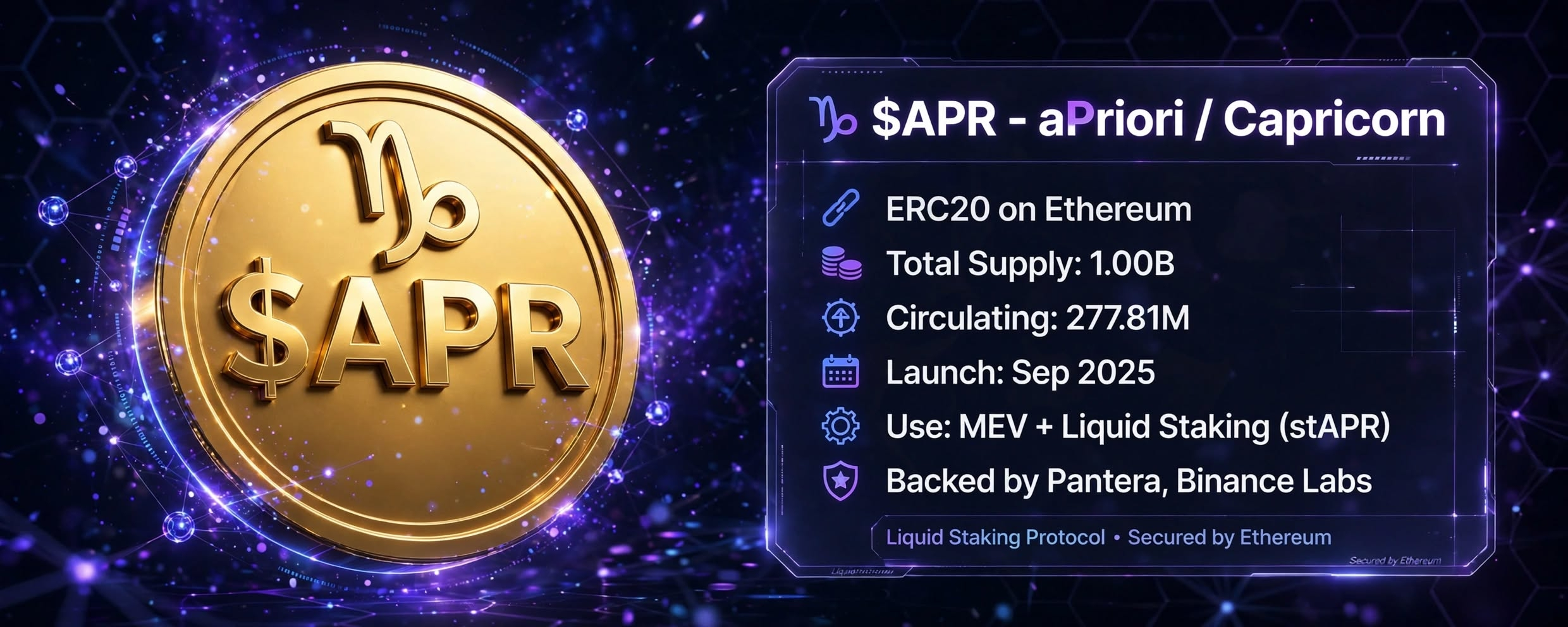
$APR is the native token of Capricorn, formerly known as aPriori. It launched on 15 September 2025 as an ERC20 token on Ethereum.
Founded in 2023 by Ray, a former trader at Jump Crypto and Flow Traders, aPriori raised $30 Million from top-tier investors including Pantera Capital, Binance Labs, and HashKey Capital.
The core mission is simple but powerful: make staking more profitable by optimizing MEV (Maximal Extractable Value) and offering liquid staking.
When you stake APR, you get stAPR in return - a liquid derivative token that lets you keep earning rewards while still using your assets in DeFi.
Tokenomics at a glance:
Total Supply: 1.00B APR
Circulating Supply: 277.81M APR
Network: Ethereum
Standard: ERC20
In 2026, the project rebranded to Capricorn, keeping the APR ticker. That rebrand, plus the August 2026 buyback of 5.3% of total supply from early investors, triggered a major price surge and put APR back on traders' radars.
2. Pros of $APR
A) Real Utility, Not Just Hype: Unlike meme coins, APR powers real infrastructure - MEV optimization and liquid staking. This is actual DeFi infrastructure that validators and stakers need.
B) Strong Backers: Pantera Capital, Binance Labs, HashKey Capital. When the biggest VCs in crypto back a project, it means serious due diligence was done.
C) Experienced Team: Founder from Jump Crypto and Flow Traders - one of the most respected trading firms in crypto. MEV is a trader's game, and this team understands it.
D) Buyback Pressure: The 5.3% buyback in 2026 showed the team is willing to reduce supply and support price. Less supply + growing demand = bullish tokenomics.
E) Liquid Staking Growth: The stAPR model is similar to Lido's stETH. If Monad ecosystem (where Capricorn is building) grows, APR could become its Lido equivalent.
F) Still Early: With only ∼27% of supply circulating, and market cap still small compared to LDO, JTO, etc., there is room for growth if adoption picks up.
3. Cons / Risks of $APR
A) High Volatility: APR saw extreme volatility in August 2026. For new investors, this can mean 40-60% swings in days. Not for weak hands.
B) Token Unlocks & Supply Inflation: 1B total supply but only 277M circulating. That means ∼722M tokens are yet to enter the market. If unlocks happen faster than demand, price pressure is real.
C) Rebrand Confusion: aPriori to Capricorn rebrand confused many holders. Rebrands can be powerful, but they also break brand recognition in the short term.
D) MEV Is Complex & Competitive: MEV is a highly competitive field. Projects like Flashbots, Jito, and others are fighting for the same market. APR needs to prove its tech is better.
E) Dependent on Monad / Ethereum: APR's future is tied to the success of the ecosystems it builds on. If Monad adoption slows, APR growth slows too.
F) Regulatory Risk: As with all staking tokens, regulations around staking and MEV could affect APR in the US and EU.
4. Future Outlook for $APR (2026-2027)
Bullish Case: If Capricorn becomes the leading liquid staking + MEV protocol for Monad, APR could follow the path of JTO and LDO. More TVL, more stakers, more fees, and continued buybacks could push APR to new all-time highs. The 2026 buyback signal shows long-term commitment.
Bearish Case: If token unlocks flood the market and DeFi yields drop across the board, APR could consolidate for months. Volatility will remain high.
My Take: APR is not a meme coin gamble - it's an infrastructure bet. It's high-risk, high-reward. For Binance Square readers: Don't FOMO. If you believe in the future of liquid staking and MEV on Monad, APR is one of the most interesting small-cap infrastructure plays to watch in 2026. Do your own research, start small, and watch TVL and stAPR adoption, not just price.
Disclaimer: This is not financial advice. Crypto is volatile. Always DYOR before investing.
Tags for Binance Square: #APR #staking
{future}(APRUSDT)
$APR - aPriori / Capricorn: The MEV + Liquid Staking Coin That Could Be The Next Big DeFi Play? Pros
1. What Is $APR ?
$APR is the native token of Capricorn, formerly known as aPriori. It launched on 15 September 2025 as an ERC20 token on Ethereum.
Founded in 2023 by Ray, a former trader at Jump Crypto and Flow Traders, aPriori raised $30 Million from top-tier investors including Pantera Capital, Binance Labs, and HashKey Capital.
The core mission is simple but powerful: make staking more profitable by optimizing MEV (Maximal Extractable Value) and offering liquid staking.
When you stake APR, you get stAPR in return - a liquid derivative token that lets you keep earning rewards while still using your assets in DeFi.
Tokenomics at a glance:
Total Supply: 1.00B APR
Circulating Supply: 277.81M APR
Network: Ethereum
Standard: ERC20
In 2026, the project rebranded to Capricorn, keeping the APR ticker. That rebrand, plus the August 2026 buyback of 5.3% of total supply from early investors, triggered a major price surge and put APR back on traders' radars.
2. Pros of $APR
A) Real Utility, Not Just Hype: Unlike meme coins, APR powers real infrastructure - MEV optimization and liquid staking. This is actual DeFi infrastructure that validators and stakers need.
B) Strong Backers: Pantera Capital, Binance Labs, HashKey Capital. When the biggest VCs in crypto back a project, it means serious due diligence was done.
C) Experienced Team: Founder from Jump Crypto and Flow Traders - one of the most respected trading firms in crypto. MEV is a trader's game, and this team understands it.
D) Buyback Pressure: The 5.3% buyback in 2026 showed the team is willing to reduce supply and support price. Less supply + growing demand = bullish tokenomics.
E) Liquid Staking Growth: The stAPR model is similar to Lido's stETH. If Monad ecosystem (where Capricorn is building) grows, APR could become its Lido equivalent.
F) Still Early: With only ∼27% of supply circulating, and market cap still small compared to LDO, JTO, etc., there is room for growth if adoption picks up.
3. Cons / Risks of $APR
A) High Volatility: APR saw extreme volatility in August 2026. For new investors, this can mean 40-60% swings in days. Not for weak hands.
B) Token Unlocks & Supply Inflation: 1B total supply but only 277M circulating. That means ∼722M tokens are yet to enter the market. If unlocks happen faster than demand, price pressure is real.
C) Rebrand Confusion: aPriori to Capricorn rebrand confused many holders. Rebrands can be powerful, but they also break brand recognition in the short term.
D) MEV Is Complex & Competitive: MEV is a highly competitive field. Projects like Flashbots, Jito, and others are fighting for the same market. APR needs to prove its tech is better.
E) Dependent on Monad / Ethereum: APR's future is tied to the success of the ecosystems it builds on. If Monad adoption slows, APR growth slows too.
F) Regulatory Risk: As with all staking tokens, regulations around staking and MEV could affect APR in the US and EU.
4. Future Outlook for $APR (2026-2027)
Bullish Case: If Capricorn becomes the leading liquid staking + MEV protocol for Monad, APR could follow the path of JTO and LDO. More TVL, more stakers, more fees, and continued buybacks could push APR to new all-time highs. The 2026 buyback signal shows long-term commitment.
Bearish Case: If token unlocks flood the market and DeFi yields drop across the board, APR could consolidate for months. Volatility will remain high.
My Take: APR is not a meme coin gamble - it's an infrastructure bet. It's high-risk, high-reward. For Binance Square readers: Don't FOMO. If you believe in the future of liquid staking and MEV on Monad, APR is one of the most interesting small-cap infrastructure plays to watch in 2026. Do your own research, start small, and watch TVL and stAPR adoption, not just price.
Disclaimer: This is not financial advice. Crypto is volatile. Always DYOR before investing.
Tags for Binance Square: #APR #staking
$APR is the native token of Capricorn, formerly known as aPriori. It launched on 15 September 2025 as an ERC20 token on Ethereum.
Founded in 2023 by Ray, a former trader at Jump Crypto and Flow Traders, aPriori raised $30 Million from top-tier investors including Pantera Capital, Binance Labs, and HashKey Capital.
The core mission is simple but powerful: make staking more profitable by optimizing MEV (Maximal Extractable Value) and offering liquid staking.
When you stake APR, you get stAPR in return - a liquid derivative token that lets you keep earning rewards while still using your assets in DeFi.
Tokenomics at a glance:
Total Supply: 1.00B APR
Circulating Supply: 277.81M APR
Network: Ethereum
Standard: ERC20
In 2026, the project rebranded to Capricorn, keeping the APR ticker. That rebrand, plus the August 2026 buyback of 5.3% of total supply from early investors, triggered a major price surge and put APR back on traders' radars.
2. Pros of $APR
A) Real Utility, Not Just Hype: Unlike meme coins, APR powers real infrastructure - MEV optimization and liquid staking. This is actual DeFi infrastructure that validators and stakers need.
B) Strong Backers: Pantera Capital, Binance Labs, HashKey Capital. When the biggest VCs in crypto back a project, it means serious due diligence was done.
C) Experienced Team: Founder from Jump Crypto and Flow Traders - one of the most respected trading firms in crypto. MEV is a trader's game, and this team understands it.
D) Buyback Pressure: The 5.3% buyback in 2026 showed the team is willing to reduce supply and support price. Less supply + growing demand = bullish tokenomics.
E) Liquid Staking Growth: The stAPR model is similar to Lido's stETH. If Monad ecosystem (where Capricorn is building) grows, APR could become its Lido equivalent.
F) Still Early: With only ∼27% of supply circulating, and market cap still small compared to LDO, JTO, etc., there is room for growth if adoption picks up.
3. Cons / Risks of $APR
A) High Volatility: APR saw extreme volatility in August 2026. For new investors, this can mean 40-60% swings in days. Not for weak hands.
B) Token Unlocks & Supply Inflation: 1B total supply but only 277M circulating. That means ∼722M tokens are yet to enter the market. If unlocks happen faster than demand, price pressure is real.
C) Rebrand Confusion: aPriori to Capricorn rebrand confused many holders. Rebrands can be powerful, but they also break brand recognition in the short term.
D) MEV Is Complex & Competitive: MEV is a highly competitive field. Projects like Flashbots, Jito, and others are fighting for the same market. APR needs to prove its tech is better.
E) Dependent on Monad / Ethereum: APR's future is tied to the success of the ecosystems it builds on. If Monad adoption slows, APR growth slows too.
F) Regulatory Risk: As with all staking tokens, regulations around staking and MEV could affect APR in the US and EU.
4. Future Outlook for $APR (2026-2027)
Bullish Case: If Capricorn becomes the leading liquid staking + MEV protocol for Monad, APR could follow the path of JTO and LDO. More TVL, more stakers, more fees, and continued buybacks could push APR to new all-time highs. The 2026 buyback signal shows long-term commitment.
Bearish Case: If token unlocks flood the market and DeFi yields drop across the board, APR could consolidate for months. Volatility will remain high.
My Take: APR is not a meme coin gamble - it's an infrastructure bet. It's high-risk, high-reward. For Binance Square readers: Don't FOMO. If you believe in the future of liquid staking and MEV on Monad, APR is one of the most interesting small-cap infrastructure plays to watch in 2026. Do your own research, start small, and watch TVL and stAPR adoption, not just price.
Disclaimer: This is not financial advice. Crypto is volatile. Always DYOR before investing.
Tags for Binance Square: #APR #staking
332

🚀 $ETH STAKING SURGE SIGNALS BULLISH BREAKOUT! 🟢
🦈📊 Smart money is locking a third of $ETH into staking, draining sell pressure and feeding the bullish engine. ⚡💡 This on‑chain commitment turns the liquidity pool into a launchpad, each new stake adding buying power and nudging price higher.
💬 How are you positioning as $ETH ’s staking wave builds momentum? 👇
⚠️ Not financial advice. Always manage your risk. 🛡️
🏷️ #ETH #Staking #Bullish #Crypto
🔥 💎
🚀 $ETH STAKING SURGE SIGNALS BULLISH BREAKOUT! 🟢
🦈📊 Smart money is locking a third of $ETH into staking, draining sell pressure and feeding the bullish engine. ⚡💡 This on‑chain commitment turns the liquidity pool into a launchpad, each new stake adding buying power and nudging price higher.
💬 How are you positioning as $ETH ’s staking wave builds momentum? 👇
⚠️ Not financial advice. Always manage your risk. 🛡️
🏷️ #ETH #Staking #Bullish #Crypto
🔥 💎
🦈📊 Smart money is locking a third of $ETH into staking, draining sell pressure and feeding the bullish engine. ⚡💡 This on‑chain commitment turns the liquidity pool into a launchpad, each new stake adding buying power and nudging price higher.
💬 How are you positioning as $ETH ’s staking wave builds momentum? 👇
⚠️ Not financial advice. Always manage your risk. 🛡️
🏷️ #ETH #Staking #Bullish #Crypto
🔥 💎
4

·
--
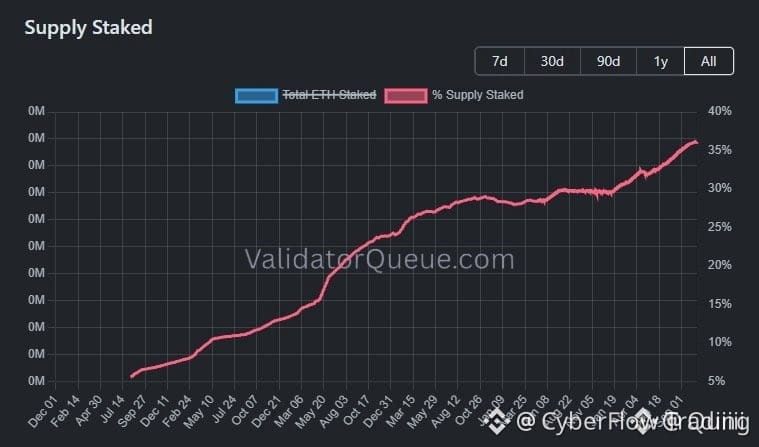
More than a third of all $ETH is now locked in staking — about 44.1 million coins at a fresh supply-share record.
Data checked around October 23–24, 2026 put roughly 44.1 million ETH on the beacon chain, more than 36% of supply, per CryptoSlate and Blockport figures from ValidatorQueue. About 1.38 million ETH still sat in the activation queue, with an estimated wait near 24 days and nine hours — down from August’s backlog near 2.06 million, but still weeks before new direct validators earn native rewards. Reported staking yield was about 2.2% on October 23, even as holders kept lining up to lock more ETH.
That share of supply offline from spot trading is a float story, not a price call: staking secures the network and pays rewards, while liquid-staking tokens can keep some flexibility. Watch the entry queue through late October 2026.
#Ethereum #ETH #Staking #Crypto
DYOR. Not financial advice.
{spot}(ETHUSDT)
More than a third of all $ETH is now locked in staking — about 44.1 million coins at a fresh supply-share record.
Data checked around October 23–24, 2026 put roughly 44.1 million ETH on the beacon chain, more than 36% of supply, per CryptoSlate and Blockport figures from ValidatorQueue. About 1.38 million ETH still sat in the activation queue, with an estimated wait near 24 days and nine hours — down from August’s backlog near 2.06 million, but still weeks before new direct validators earn native rewards. Reported staking yield was about 2.2% on October 23, even as holders kept lining up to lock more ETH.
That share of supply offline from spot trading is a float story, not a price call: staking secures the network and pays rewards, while liquid-staking tokens can keep some flexibility. Watch the entry queue through late October 2026.
#Ethereum #ETH #Staking #Crypto
DYOR. Not financial advice.
Data checked around October 23–24, 2026 put roughly 44.1 million ETH on the beacon chain, more than 36% of supply, per CryptoSlate and Blockport figures from ValidatorQueue. About 1.38 million ETH still sat in the activation queue, with an estimated wait near 24 days and nine hours — down from August’s backlog near 2.06 million, but still weeks before new direct validators earn native rewards. Reported staking yield was about 2.2% on October 23, even as holders kept lining up to lock more ETH.
That share of supply offline from spot trading is a float story, not a price call: staking secures the network and pays rewards, while liquid-staking tokens can keep some flexibility. Watch the entry queue through late October 2026.
#Ethereum #ETH #Staking #Crypto
DYOR. Not financial advice.

1
55


·
--
Which of Your 2025-26 Staking Rewards Actually Qualify for the CGT Discount?$ETH | Most Australian stakers lodging before 31 October assume every reward from the same stake gets the same tax outcome. It does not. Whether a given staking reward qualifies for the 50 percent CGT discount on later sale depends on the exact day that specific instalment was credited, not on when the underlying stake was opened.
## Why does the credit date matter more than the stake date?
Because the ATO runs staking through two separate events, not one. On the desk the mistake I still see newer stakers make is treating a position as a single timeline with a single discount outcome. SatoshiMacro's staking tax guide sets out the two-event structure directly: each reward is ordinary income at its AUD market value the day it is received and usable, then a second, independent CGT clock starts running from that same receipt date once the token is eventually sold, swapped or spent. One stake, but potentially dozens of separate reward instalments, each with its own cost base and its own twelve-month clock.
## What does this actually look like in a real position?
Take the guide's own worked example. An investor stakes 100 ETH on 1 July 2025 at AUD 5,000 per ETH, a AUD 500,000 position. Across the 2025-2026 financial year the stake earns 3.5 ETH in rewards, distributed roughly evenly, averaging AUD 5,400 per ETH at the moment each instalment lands. That produces AUD 18,900 of assessable income and about AUD 6,048 of tax at a 32 percent combined rate. Sell the 3.5 ETH on 1 September 2026 at AUD 6,200 per ETH and a second event fires: proceeds of AUD 21,700 against the AUD 18,900 receipt-day cost base, a AUD 2,800 capital gain. Because the average holding period across that reward batch sits under twelve months, the 50 percent discount does not apply to the gain, and the tax bill on it runs to roughly AUD 896. Add the two events together and staking activity on this one position has cost around AUD 6,944 in tax.
Here is the detail that gets lost when people round the whole stream to one average. Rewards credited in the first weeks of July 2025 are, by 1 September 2026, past the twelve-month mark. Rewards credited in May or June 2026 are nowhere close. My read is that most self-preparers are applying one discount outcome to the whole reward stream when the real position, instalment by instalment, is a mix of some rewards that would clear the discount and some that would not, and the guide itself notes that the way individuals actually capture the discount is by holding specific reward parcels past twelve months before disposing of them, not by holding the stake itself.
## Does the exchange or validator type change the rule?
No, and that is worth stating plainly before the deadline rush. Whether the reward lands through a CoinSpot Earn balance, a Binance Earn product, an Independent Reserve staking feature or a native validator, the treatment under Income Tax Assessment Act 1997 section 6-5 does not change: ordinary income on receipt, full stop. Where it genuinely gets contested is liquid staking derivatives such as stETH, where depositing into the protocol can itself be treated as a disposal of the underlying asset. The current draft tax ruling, TR 2025/D1, reaffirms the receipt-day valuation approach and addresses that liquid staking question directly, but it is still a draft. Anyone holding stETH, rETH or similar should treat that corner of the rule as unsettled rather than locked in.
## What changes inside an SMSF?
The rate, not the structure. An SMSF in accumulation phase pays 15 percent on the income leg and on any gain held under twelve months, dropping to an effective 10 percent once the one-third SMSF discount applies to long-held gains. Pension phase can bring both to zero, subject to the transfer balance cap. The sole purpose test still has to be met for the staking activity itself, and the fund's auditor will check that income was recognised in the correct period against the correct AUD value.
## Does tax software catch this automatically?
Only if it is tagging staking rewards at the instalment level, not averaging the batch the way the worked example above does for simplicity. Summ's 3,500-plus integration count includes native validator detection across several chains, which matters here precisely because it can hold each reward's own receipt date rather than collapsing a year of instalments into one blended figure. Koinly's 800-plus integrations are enough for most exchange-only stakers using CoinSpot, Binance or Independent Reserve products, where the discount question is simpler because the exchange issues rewards on a more predictable schedule. Either way, the software is only as good as the import. If an exchange export is missing timestamps, the tool has nothing to apply the twelve-month test to.
## Where does this leave someone filing in the next six days?
Pull the actual credit date on every reward instalment before assuming a single discount position across the whole stake. That is the difference between a defensible return and a rounding error dressed up as one. The honest limitation here is that this is educational material, not a substitute for a registered tax agent looking at your specific instalment history, your investor-versus-trader classification, and whether any of your rewards sit in the liquid staking grey zone TR 2025/D1 is meant to resolve. Software can tag every transaction correctly and still produce the wrong discount outcome if the dates behind it are not checked by a person.
https://satoshimacro.com/guides/crypto/staking-tax-australia/?utm_source=binance_square&utm_medium=social&utm_campaign=autopilot_article
#SatoshiMacro #CryptoTax #Staking #Bitcoin
Which of Your 2025-26 Staking Rewards Actually Qualify for the CGT Discount?
$ETH | Most Australian stakers lodging before 31 October assume every reward from the same stake gets the same tax outcome. It does not. Whether a given staking reward qualifies for the 50 percent CGT discount on later sale depends on the exact day that specific instalment was credited, not on when the underlying stake was opened.
## Why does the credit date matter more than the stake date?
Because the ATO runs staking through two separate events, not one. On the desk the mistake I still see newer stakers make is treating a position as a single timeline with a single discount outcome. SatoshiMacro's staking tax guide sets out the two-event structure directly: each reward is ordinary income at its AUD market value the day it is received and usable, then a second, independent CGT clock starts running from that same receipt date once the token is eventually sold, swapped or spent. One stake, but potentially dozens of separate reward instalments, each with its own cost base and its own twelve-month clock.
## What does this actually look like in a real position?
Take the guide's own worked example. An investor stakes 100 ETH on 1 July 2025 at AUD 5,000 per ETH, a AUD 500,000 position. Across the 2025-2026 financial year the stake earns 3.5 ETH in rewards, distributed roughly evenly, averaging AUD 5,400 per ETH at the moment each instalment lands. That produces AUD 18,900 of assessable income and about AUD 6,048 of tax at a 32 percent combined rate. Sell the 3.5 ETH on 1 September 2026 at AUD 6,200 per ETH and a second event fires: proceeds of AUD 21,700 against the AUD 18,900 receipt-day cost base, a AUD 2,800 capital gain. Because the average holding period across that reward batch sits under twelve months, the 50 percent discount does not apply to the gain, and the tax bill on it runs to roughly AUD 896. Add the two events together and staking activity on this one position has cost around AUD 6,944 in tax.
Here is the detail that gets lost when people round the whole stream to one average. Rewards credited in the first weeks of July 2025 are, by 1 September 2026, past the twelve-month mark. Rewards credited in May or June 2026 are nowhere close. My read is that most self-preparers are applying one discount outcome to the whole reward stream when the real position, instalment by instalment, is a mix of some rewards that would clear the discount and some that would not, and the guide itself notes that the way individuals actually capture the discount is by holding specific reward parcels past twelve months before disposing of them, not by holding the stake itself.
## Does the exchange or validator type change the rule?
No, and that is worth stating plainly before the deadline rush. Whether the reward lands through a CoinSpot Earn balance, a Binance Earn product, an Independent Reserve staking feature or a native validator, the treatment under Income Tax Assessment Act 1997 section 6-5 does not change: ordinary income on receipt, full stop. Where it genuinely gets contested is liquid staking derivatives such as stETH, where depositing into the protocol can itself be treated as a disposal of the underlying asset. The current draft tax ruling, TR 2025/D1, reaffirms the receipt-day valuation approach and addresses that liquid staking question directly, but it is still a draft. Anyone holding stETH, rETH or similar should treat that corner of the rule as unsettled rather than locked in.
## What changes inside an SMSF?
The rate, not the structure. An SMSF in accumulation phase pays 15 percent on the income leg and on any gain held under twelve months, dropping to an effective 10 percent once the one-third SMSF discount applies to long-held gains. Pension phase can bring both to zero, subject to the transfer balance cap. The sole purpose test still has to be met for the staking activity itself, and the fund's auditor will check that income was recognised in the correct period against the correct AUD value.
## Does tax software catch this automatically?
Only if it is tagging staking rewards at the instalment level, not averaging the batch the way the worked example above does for simplicity. Summ's 3,500-plus integration count includes native validator detection across several chains, which matters here precisely because it can hold each reward's own receipt date rather than collapsing a year of instalments into one blended figure. Koinly's 800-plus integrations are enough for most exchange-only stakers using CoinSpot, Binance or Independent Reserve products, where the discount question is simpler because the exchange issues rewards on a more predictable schedule. Either way, the software is only as good as the import. If an exchange export is missing timestamps, the tool has nothing to apply the twelve-month test to.
## Where does this leave someone filing in the next six days?
Pull the actual credit date on every reward instalment before assuming a single discount position across the whole stake. That is the difference between a defensible return and a rounding error dressed up as one. The honest limitation here is that this is educational material, not a substitute for a registered tax agent looking at your specific instalment history, your investor-versus-trader classification, and whether any of your rewards sit in the liquid staking grey zone TR 2025/D1 is meant to resolve. Software can tag every transaction correctly and still produce the wrong discount outcome if the dates behind it are not checked by a person.
https://satoshimacro.com/guides/crypto/staking-tax-australia/?utm_source=binance_square&utm_medium=social&utm_campaign=autopilot_article
#SatoshiMacro #CryptoTax #Staking #Bitcoin
## Why does the credit date matter more than the stake date?
Because the ATO runs staking through two separate events, not one. On the desk the mistake I still see newer stakers make is treating a position as a single timeline with a single discount outcome. SatoshiMacro's staking tax guide sets out the two-event structure directly: each reward is ordinary income at its AUD market value the day it is received and usable, then a second, independent CGT clock starts running from that same receipt date once the token is eventually sold, swapped or spent. One stake, but potentially dozens of separate reward instalments, each with its own cost base and its own twelve-month clock.
## What does this actually look like in a real position?
Take the guide's own worked example. An investor stakes 100 ETH on 1 July 2025 at AUD 5,000 per ETH, a AUD 500,000 position. Across the 2025-2026 financial year the stake earns 3.5 ETH in rewards, distributed roughly evenly, averaging AUD 5,400 per ETH at the moment each instalment lands. That produces AUD 18,900 of assessable income and about AUD 6,048 of tax at a 32 percent combined rate. Sell the 3.5 ETH on 1 September 2026 at AUD 6,200 per ETH and a second event fires: proceeds of AUD 21,700 against the AUD 18,900 receipt-day cost base, a AUD 2,800 capital gain. Because the average holding period across that reward batch sits under twelve months, the 50 percent discount does not apply to the gain, and the tax bill on it runs to roughly AUD 896. Add the two events together and staking activity on this one position has cost around AUD 6,944 in tax.
Here is the detail that gets lost when people round the whole stream to one average. Rewards credited in the first weeks of July 2025 are, by 1 September 2026, past the twelve-month mark. Rewards credited in May or June 2026 are nowhere close. My read is that most self-preparers are applying one discount outcome to the whole reward stream when the real position, instalment by instalment, is a mix of some rewards that would clear the discount and some that would not, and the guide itself notes that the way individuals actually capture the discount is by holding specific reward parcels past twelve months before disposing of them, not by holding the stake itself.
## Does the exchange or validator type change the rule?
No, and that is worth stating plainly before the deadline rush. Whether the reward lands through a CoinSpot Earn balance, a Binance Earn product, an Independent Reserve staking feature or a native validator, the treatment under Income Tax Assessment Act 1997 section 6-5 does not change: ordinary income on receipt, full stop. Where it genuinely gets contested is liquid staking derivatives such as stETH, where depositing into the protocol can itself be treated as a disposal of the underlying asset. The current draft tax ruling, TR 2025/D1, reaffirms the receipt-day valuation approach and addresses that liquid staking question directly, but it is still a draft. Anyone holding stETH, rETH or similar should treat that corner of the rule as unsettled rather than locked in.
## What changes inside an SMSF?
The rate, not the structure. An SMSF in accumulation phase pays 15 percent on the income leg and on any gain held under twelve months, dropping to an effective 10 percent once the one-third SMSF discount applies to long-held gains. Pension phase can bring both to zero, subject to the transfer balance cap. The sole purpose test still has to be met for the staking activity itself, and the fund's auditor will check that income was recognised in the correct period against the correct AUD value.
## Does tax software catch this automatically?
Only if it is tagging staking rewards at the instalment level, not averaging the batch the way the worked example above does for simplicity. Summ's 3,500-plus integration count includes native validator detection across several chains, which matters here precisely because it can hold each reward's own receipt date rather than collapsing a year of instalments into one blended figure. Koinly's 800-plus integrations are enough for most exchange-only stakers using CoinSpot, Binance or Independent Reserve products, where the discount question is simpler because the exchange issues rewards on a more predictable schedule. Either way, the software is only as good as the import. If an exchange export is missing timestamps, the tool has nothing to apply the twelve-month test to.
## Where does this leave someone filing in the next six days?
Pull the actual credit date on every reward instalment before assuming a single discount position across the whole stake. That is the difference between a defensible return and a rounding error dressed up as one. The honest limitation here is that this is educational material, not a substitute for a registered tax agent looking at your specific instalment history, your investor-versus-trader classification, and whether any of your rewards sit in the liquid staking grey zone TR 2025/D1 is meant to resolve. Software can tag every transaction correctly and still produce the wrong discount outcome if the dates behind it are not checked by a person.
https://satoshimacro.com/guides/crypto/staking-tax-australia/?utm_source=binance_square&utm_medium=social&utm_campaign=autopilot_article
#SatoshiMacro #CryptoTax #Staking #Bitcoin
81

·
--
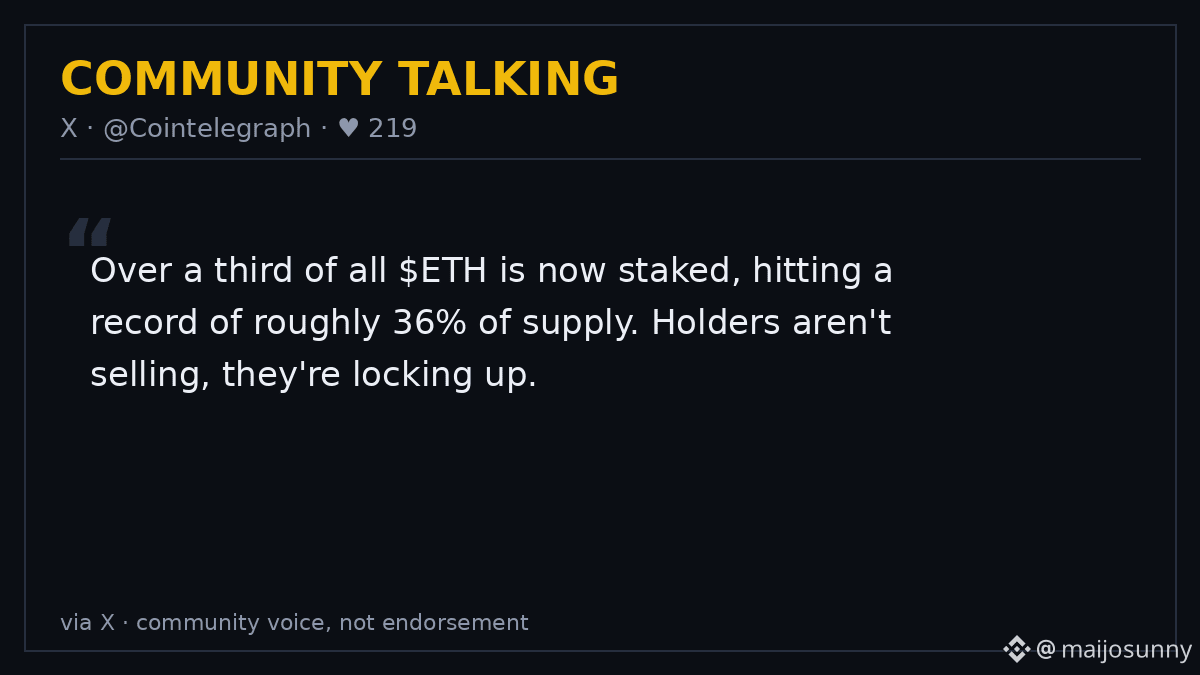
Price is down, staking is at a record high. Which one is lying?
A record 43.8M $ETH is now staked, 35.9% of total supply (Bitwise). Another 1.39M ETH waits in the entry queue, a 24+ day wait, even as yield slipped to 2.63%.
Institutions are doing the locking: staking ETFs and treasuries like Bitmine (5.23M ETH), while ETH trades at $2,342, down 2.5% in 24h.
My take: locked supply shrinks the sellable float, and a 24-day queue is demand you can measure. But one record doesn't flip a trend, and yields keep thinning as the ratio climbs toward 50%.
Is the queue the real bull signal, or is 2.63% too thin to hold it? 🐂🐻
Not financial advice. DYOR.
#Ethereum #crypto #Staking
Price is down, staking is at a record high. Which one is lying?
A record 43.8M $ETH is now staked, 35.9% of total supply (Bitwise). Another 1.39M ETH waits in the entry queue, a 24+ day wait, even as yield slipped to 2.63%.
Institutions are doing the locking: staking ETFs and treasuries like Bitmine (5.23M ETH), while ETH trades at $2,342, down 2.5% in 24h.
My take: locked supply shrinks the sellable float, and a 24-day queue is demand you can measure. But one record doesn't flip a trend, and yields keep thinning as the ratio climbs toward 50%.
Is the queue the real bull signal, or is 2.63% too thin to hold it? 🐂🐻
Not financial advice. DYOR.
#Ethereum #crypto #Staking
A record 43.8M $ETH is now staked, 35.9% of total supply (Bitwise). Another 1.39M ETH waits in the entry queue, a 24+ day wait, even as yield slipped to 2.63%.
Institutions are doing the locking: staking ETFs and treasuries like Bitmine (5.23M ETH), while ETH trades at $2,342, down 2.5% in 24h.
My take: locked supply shrinks the sellable float, and a 24-day queue is demand you can measure. But one record doesn't flip a trend, and yields keep thinning as the ratio climbs toward 50%.
Is the queue the real bull signal, or is 2.63% too thin to hold it? 🐂🐻
Not financial advice. DYOR.
#Ethereum #crypto #Staking
22


·
--
Рост
Частичная правда
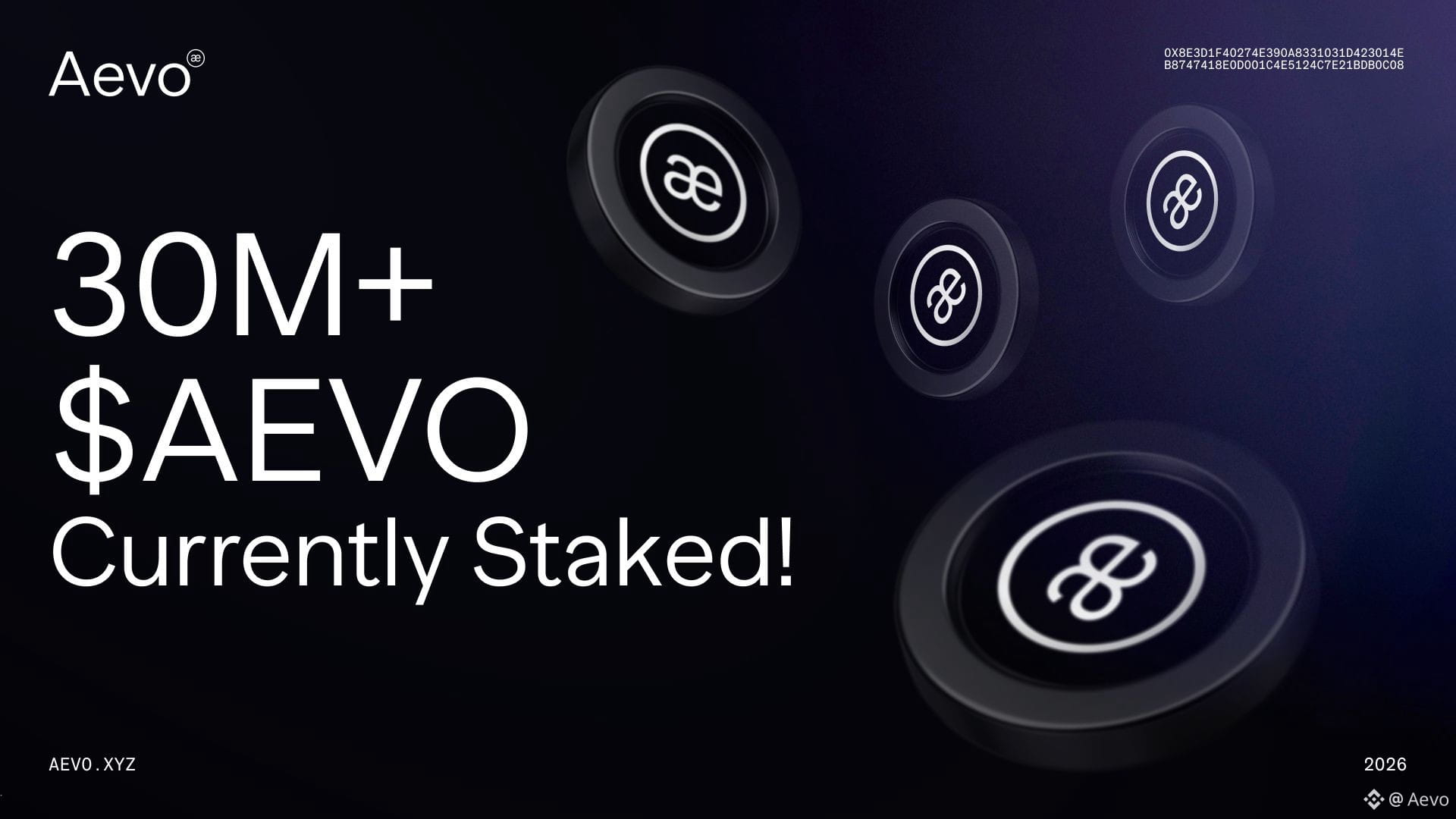
30M AEVO Tokens Are Now Staked 🔮
Across $AVAX & $INJ and others, most ecosystems and DeFi apps use locking mechanics to give holders a role beyond keeping tokens liquid.
Aevo has now crossed 30m AEVO staked, up from 27m earlier this month.
That milestone sits alongside 78m AEVO permanently removed through AGP-3 and monthly buybacks, equal to 7.8% of supply.
Staking and burning perform different functions. One measures the tokens holders choose to lock, while the other permanently reduces supply.
Aevo now has more than 30m AEVO staked alongside a permanent 7.8% supply reduction.
#staking
30M AEVO Tokens Are Now Staked 🔮
Across $AVAX & $INJ and others, most ecosystems and DeFi apps use locking mechanics to give holders a role beyond keeping tokens liquid.
Aevo has now crossed 30m AEVO staked, up from 27m earlier this month.
That milestone sits alongside 78m AEVO permanently removed through AGP-3 and monthly buybacks, equal to 7.8% of supply.
Staking and burning perform different functions. One measures the tokens holders choose to lock, while the other permanently reduces supply.
Aevo now has more than 30m AEVO staked alongside a permanent 7.8% supply reduction.
#staking
Across $AVAX & $INJ and others, most ecosystems and DeFi apps use locking mechanics to give holders a role beyond keeping tokens liquid.
Aevo has now crossed 30m AEVO staked, up from 27m earlier this month.
That milestone sits alongside 78m AEVO permanently removed through AGP-3 and monthly buybacks, equal to 7.8% of supply.
Staking and burning perform different functions. One measures the tokens holders choose to lock, while the other permanently reduces supply.
Aevo now has more than 30m AEVO staked alongside a permanent 7.8% supply reduction.
#staking
Feed-Creator-1dac5f045:
600000 долларов для экосистемы это много? Толку со стейкинга при 100% apy даже год, за день могут смело укатать цену
1
4
809

·
--
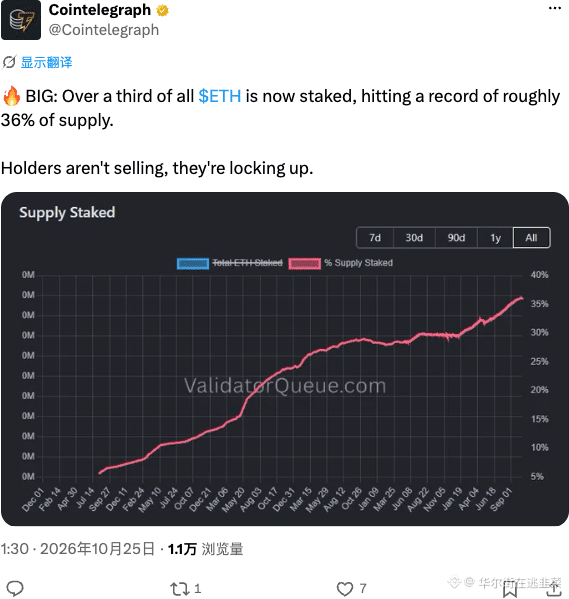
超过36%的ETH已经被锁死在质押里。供应端被抽走一大块,抛压直接消失。全是锁仓党,这种供需结构转好的信号,比什么利好都硬。
$ETH #Staking
超过36%的ETH已经被锁死在质押里。供应端被抽走一大块,抛压直接消失。全是锁仓党,这种供需结构转好的信号,比什么利好都硬。
$ETH #Staking
$ETH #Staking
281

🚀 $ETH STAKING SURGE HITS 36% – LIQUIDITY SQUEEZE AHEAD 🦈
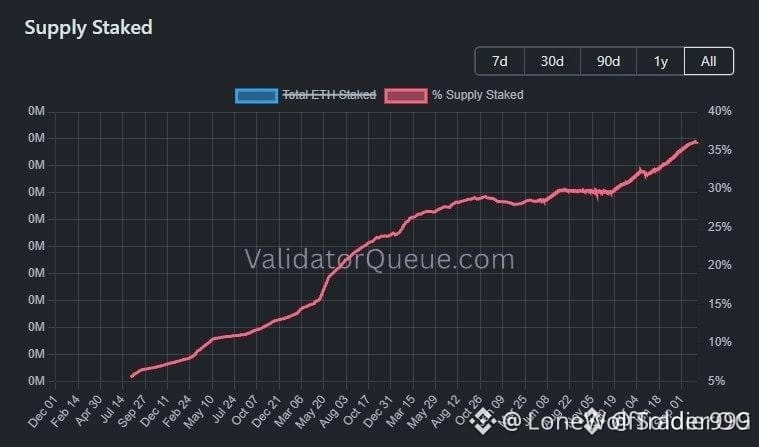
📊 A record one‑third of $ETH now sits in validators, a clear stamp of confidence from smart‑money whales. This lock‑up not only trims circulating supply but also sharpens the demand curve as new entrants chase the shrinking pool. ⚡ The on‑chain data shows staking inflows accelerating faster than the last bull run, hinting at a bullish sentiment shift.
🌊 Yet every lock‑in tightens liquidity, setting the stage for short‑term volatility spikes. Traders should watch for price wobble around key support zones as the market digests the new scarcity. 💬 Will you ride the bullish wave or brace for the liquidity crunch? 👇
⚠️ Not financial advice. Always manage your risk. 🛡️
🏷️ #ETH #Staking #LiquiditySqueeze #Crypto
🔥 💎
🚀 $ETH STAKING SURGE HITS 36% – LIQUIDITY SQUEEZE AHEAD 🦈
📊 A record one‑third of $ETH now sits in validators, a clear stamp of confidence from smart‑money whales. This lock‑up not only trims circulating supply but also sharpens the demand curve as new entrants chase the shrinking pool. ⚡ The on‑chain data shows staking inflows accelerating faster than the last bull run, hinting at a bullish sentiment shift.
🌊 Yet every lock‑in tightens liquidity, setting the stage for short‑term volatility spikes. Traders should watch for price wobble around key support zones as the market digests the new scarcity. 💬 Will you ride the bullish wave or brace for the liquidity crunch? 👇
⚠️ Not financial advice. Always manage your risk. 🛡️
🏷️ #ETH #Staking #LiquiditySqueeze #Crypto
🔥 💎
📊 A record one‑third of $ETH now sits in validators, a clear stamp of confidence from smart‑money whales. This lock‑up not only trims circulating supply but also sharpens the demand curve as new entrants chase the shrinking pool. ⚡ The on‑chain data shows staking inflows accelerating faster than the last bull run, hinting at a bullish sentiment shift.
🌊 Yet every lock‑in tightens liquidity, setting the stage for short‑term volatility spikes. Traders should watch for price wobble around key support zones as the market digests the new scarcity. 💬 Will you ride the bullish wave or brace for the liquidity crunch? 👇
⚠️ Not financial advice. Always manage your risk. 🛡️
🏷️ #ETH #Staking #LiquiditySqueeze #Crypto
🔥 💎
4

·
--
🚨 $ETH STAKING RECORD 36% OF SUPPLY SIGNALS SMART MONEY HOLD 💎
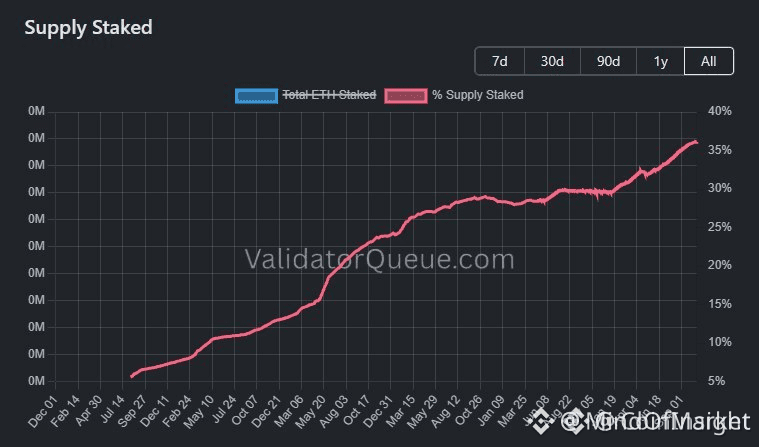
📊 The latest on‑chain snapshot shows over a third of $ETH locked in staking—an all‑time high near 36% of circulating supply. This concentration of locked assets acts as a liquidity moat, forcing any sell‑side pressure to chase scarce free supply. 🦈 Smart money is effectively tightening the demand curve, suggesting a bullish bias as the market digests reduced sell‑off potential. 🌊 With the staking pool expanding, expect tighter order blocks and a potential upward thrust on the next pullback.
💬 How will this elevated staking ratio reshape $ETH ’s next price swing? 👇
⚠️ Not financial advice. Always manage your risk. 🛡️
🏷️ #ETH #Staking #SmartMoney #Crypto
🦈 🔥
🚨 $ETH STAKING RECORD 36% OF SUPPLY SIGNALS SMART MONEY HOLD 💎
📊 The latest on‑chain snapshot shows over a third of $ETH locked in staking—an all‑time high near 36% of circulating supply. This concentration of locked assets acts as a liquidity moat, forcing any sell‑side pressure to chase scarce free supply. 🦈 Smart money is effectively tightening the demand curve, suggesting a bullish bias as the market digests reduced sell‑off potential. 🌊 With the staking pool expanding, expect tighter order blocks and a potential upward thrust on the next pullback.
💬 How will this elevated staking ratio reshape $ETH ’s next price swing? 👇
⚠️ Not financial advice. Always manage your risk. 🛡️
🏷️ #ETH #Staking #SmartMoney #Crypto
🦈 🔥
📊 The latest on‑chain snapshot shows over a third of $ETH locked in staking—an all‑time high near 36% of circulating supply. This concentration of locked assets acts as a liquidity moat, forcing any sell‑side pressure to chase scarce free supply. 🦈 Smart money is effectively tightening the demand curve, suggesting a bullish bias as the market digests reduced sell‑off potential. 🌊 With the staking pool expanding, expect tighter order blocks and a potential upward thrust on the next pullback.
💬 How will this elevated staking ratio reshape $ETH ’s next price swing? 👇
⚠️ Not financial advice. Always manage your risk. 🛡️
🏷️ #ETH #Staking #SmartMoney #Crypto
🦈 🔥
14

·
--
💰💰 Haz que tu Crypto trabaje para ti: Guía rápida de Binance Earn 🔥
Tener tus criptomonedas 'guardadas sin hacer nada' en el Spot Wallet es como dejar el dinero debajo del colchón. ¡Estás dejando pasar ingresos!
Con Binance Earn, puedes poner a rentar tus stablecoins (como USDT/FDUSD) y tus criptos principales (BTC, ETH, BNB) de forma segura y flexible.
🛠️ Las 3 opciones principales:
1️⃣ Flexible Earn: Retira tus fondos en cualquier momento mientras generas intereses diarios. Ideal para tu liquidez.
2️⃣ Locked Staking: Bloquea tus tokens por 30, 60 o 90 días a cambio de un rendimiento (APY) más alto.
3️⃣ BNB Vault / Launchpool: Mantén tu BNB en rendimiento y recibe nuevos tokens gratis de proyectos emergentes que se lanzan en Binance.
⚡ Estrategia Top: Si holdeas BNB, participa en todos los Launchpools para obtener lanzamientos aéreos (airdrops) recurrentes.
💬 ¿Cuál es tu producto favorito de Binance Earn actualmente? ¡Te leo en comentarios!
#BinanceEarnings #PassiveIncome #cryptouniverseofficial #Staking #BNB走势
{spot}(BTCUSDT)
{spot}(BNBUSDT)
{future}(USDCUSDT)
💰💰 Haz que tu Crypto trabaje para ti: Guía rápida de Binance Earn 🔥
Tener tus criptomonedas 'guardadas sin hacer nada' en el Spot Wallet es como dejar el dinero debajo del colchón. ¡Estás dejando pasar ingresos!
Con Binance Earn, puedes poner a rentar tus stablecoins (como USDT/FDUSD) y tus criptos principales (BTC, ETH, BNB) de forma segura y flexible.
🛠️ Las 3 opciones principales:
1️⃣ Flexible Earn: Retira tus fondos en cualquier momento mientras generas intereses diarios. Ideal para tu liquidez.
2️⃣ Locked Staking: Bloquea tus tokens por 30, 60 o 90 días a cambio de un rendimiento (APY) más alto.
3️⃣ BNB Vault / Launchpool: Mantén tu BNB en rendimiento y recibe nuevos tokens gratis de proyectos emergentes que se lanzan en Binance.
⚡ Estrategia Top: Si holdeas BNB, participa en todos los Launchpools para obtener lanzamientos aéreos (airdrops) recurrentes.
💬 ¿Cuál es tu producto favorito de Binance Earn actualmente? ¡Te leo en comentarios!
#BinanceEarnings #PassiveIncome #cryptouniverseofficial #Staking #BNB走势
Tener tus criptomonedas 'guardadas sin hacer nada' en el Spot Wallet es como dejar el dinero debajo del colchón. ¡Estás dejando pasar ingresos!
Con Binance Earn, puedes poner a rentar tus stablecoins (como USDT/FDUSD) y tus criptos principales (BTC, ETH, BNB) de forma segura y flexible.
🛠️ Las 3 opciones principales:
1️⃣ Flexible Earn: Retira tus fondos en cualquier momento mientras generas intereses diarios. Ideal para tu liquidez.
2️⃣ Locked Staking: Bloquea tus tokens por 30, 60 o 90 días a cambio de un rendimiento (APY) más alto.
3️⃣ BNB Vault / Launchpool: Mantén tu BNB en rendimiento y recibe nuevos tokens gratis de proyectos emergentes que se lanzan en Binance.
⚡ Estrategia Top: Si holdeas BNB, participa en todos los Launchpools para obtener lanzamientos aéreos (airdrops) recurrentes.
💬 ¿Cuál es tu producto favorito de Binance Earn actualmente? ¡Te leo en comentarios!
#BinanceEarnings #PassiveIncome #cryptouniverseofficial #Staking #BNB走势

74

·
--
Падение
Polygon multisig wallet transferred 52.928 million $POL
{future}(POLUSDT)
worth around 4.82 million USD to a staking contract.
Large transfers like this usually mean tokens are locked up for staking rewards rather than being sold directly on the open market. This increase in staking activity is linked to rising APY yields, which could help reduce sell pressure and bring some price stability to POL.
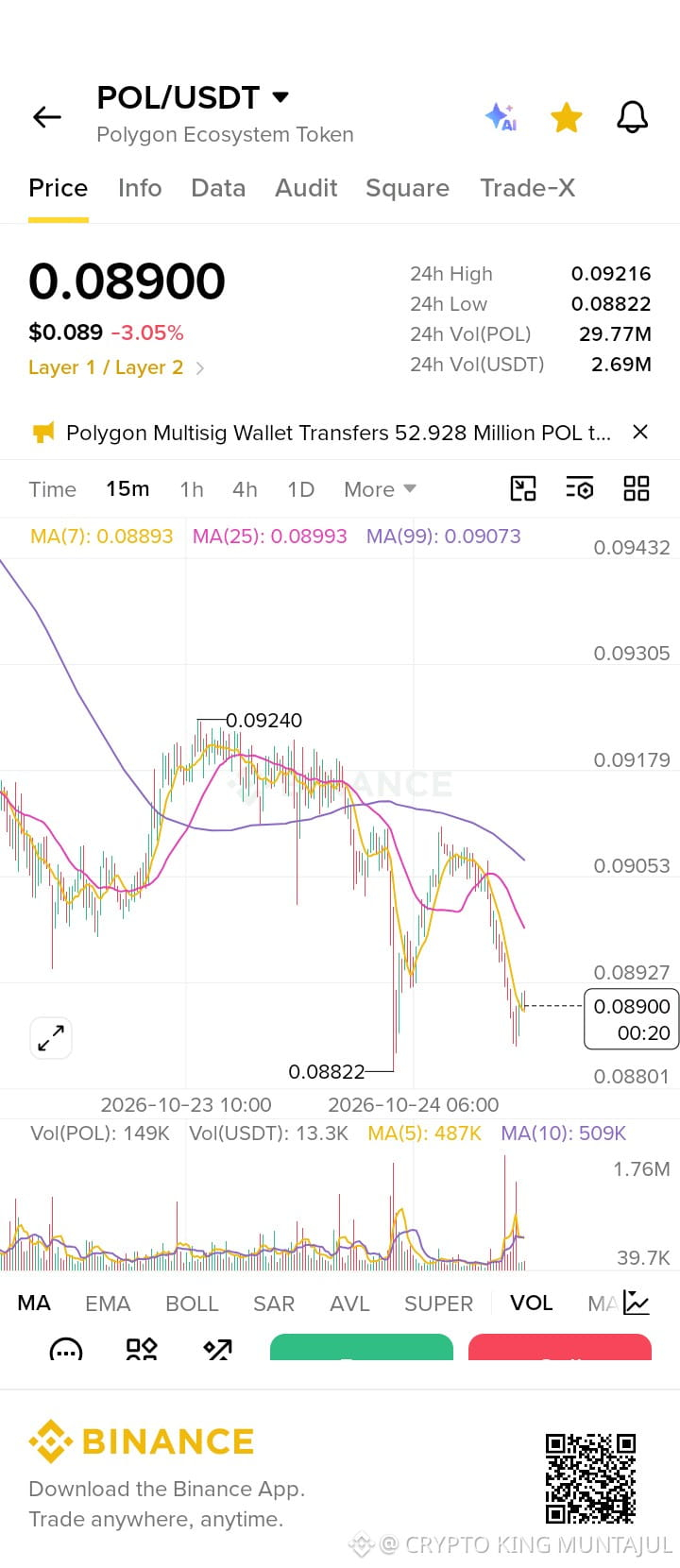
Looking at the current POL price chart, the token is trading around 0.08900 after dipping near local support around 0.08822. Taking coins out of liquid circulation into staking contracts can often cushion downside momentum over time.
Are you currently holding or staking POL, or watching for a bigger trend reversal first?
#POL #Polygon #Crypto #BinanceSquare #Staking
Polygon multisig wallet transferred 52.928 million $POL
worth around 4.82 million USD to a staking contract.
Large transfers like this usually mean tokens are locked up for staking rewards rather than being sold directly on the open market. This increase in staking activity is linked to rising APY yields, which could help reduce sell pressure and bring some price stability to POL.
Looking at the current POL price chart, the token is trading around 0.08900 after dipping near local support around 0.08822. Taking coins out of liquid circulation into staking contracts can often cushion downside momentum over time.
Are you currently holding or staking POL, or watching for a bigger trend reversal first?
#POL #Polygon #Crypto #BinanceSquare #Staking
worth around 4.82 million USD to a staking contract.
Large transfers like this usually mean tokens are locked up for staking rewards rather than being sold directly on the open market. This increase in staking activity is linked to rising APY yields, which could help reduce sell pressure and bring some price stability to POL.
Looking at the current POL price chart, the token is trading around 0.08900 after dipping near local support around 0.08822. Taking coins out of liquid circulation into staking contracts can often cushion downside momentum over time.
Are you currently holding or staking POL, or watching for a bigger trend reversal first?
#POL #Polygon #Crypto #BinanceSquare #Staking
Treder_Milon:
Plesse help me 50$AAPLB
1
2
104


Статья
Navigating Current Crypto Dynamics: Market Overview & Staking Opportunities for Long-Term GrowthThe crypto market is showing a mix of consolidation and subtle sector rotations. Looking at current top-tier rankings:
Bitcoin ($BTC) continues to dominate the liquidity landscape, hovering around (~$83,000 USD) with a market cap exceeding (~$1.68 Trillion USD). While price action remains relatively stable, volume metrics point toward a consolidation phase before the next major macro shift.
Ethereum (ETH) and major Layer-1s like Solana (SOL) are experiencing mild short-term consolidation, while utility-driven tokens and privacy-oriented assets are picking up localized momentum.
Stablecoins such as $USDT and $USDC maintain high 24-hour volume, indicating that traders are keeping dry powder ready for breakout signals.
Looking Ahead: High-Yield & Sustainable Staking Assets
For investors seeking steady yield generation while navigating market compression, focusing on coins with strong staking fundamentals, network security usage, and real economic value is essential.
Here are top assets to watch for future staking potential:
Ethereum (ETH)Why it matters: As the baseline of Web3 and DeFi yield, liquid staking (e.g., Lido, Rocket Pool) and native node consensus remain the safest risk-adjusted yield plays.Solana (SOL)Why it matters: High network throughput and active DeFi activity yield competitive native staking rates, driven by persistent ecosystem DEX volume.BNB (BNB)Why it matters: Beyond standard validator rewards, holding and staking BNB grants exposure to Binance Launchpool campaigns and transaction fee discount mechanisms.Cosmos (ATOM) & Near Protocol (NEAR)Why it matters: Both offer high nominal staking APRs alongside active governance participation and recurring ecosystem airdrops for stakers.
Key Takeaway :
While short-term price fluctuations test patience, accumulating resilient Layer-1 assets and compounding yield through staking remains a strong strategy for building capital efficiency.
Are you actively staking your holdings right now, or holding stablecoins waiting for a retest? Drop your thoughts below! 👇
#crypto #BTC #staking #BinanceSquare #CryptoMarket
Navigating Current Crypto Dynamics: Market Overview & Staking Opportunities for Long-Term Growth
The crypto market is showing a mix of consolidation and subtle sector rotations. Looking at current top-tier rankings:
Bitcoin ($BTC) continues to dominate the liquidity landscape, hovering around (~$83,000 USD) with a market cap exceeding (~$1.68 Trillion USD). While price action remains relatively stable, volume metrics point toward a consolidation phase before the next major macro shift.
Ethereum (ETH) and major Layer-1s like Solana (SOL) are experiencing mild short-term consolidation, while utility-driven tokens and privacy-oriented assets are picking up localized momentum.
Stablecoins such as $USDT and $USDC maintain high 24-hour volume, indicating that traders are keeping dry powder ready for breakout signals.
Looking Ahead: High-Yield & Sustainable Staking Assets
For investors seeking steady yield generation while navigating market compression, focusing on coins with strong staking fundamentals, network security usage, and real economic value is essential.
Here are top assets to watch for future staking potential:
Ethereum (ETH)Why it matters: As the baseline of Web3 and DeFi yield, liquid staking (e.g., Lido, Rocket Pool) and native node consensus remain the safest risk-adjusted yield plays.Solana (SOL)Why it matters: High network throughput and active DeFi activity yield competitive native staking rates, driven by persistent ecosystem DEX volume.BNB (BNB)Why it matters: Beyond standard validator rewards, holding and staking BNB grants exposure to Binance Launchpool campaigns and transaction fee discount mechanisms.Cosmos (ATOM) & Near Protocol (NEAR)Why it matters: Both offer high nominal staking APRs alongside active governance participation and recurring ecosystem airdrops for stakers.
Key Takeaway :
While short-term price fluctuations test patience, accumulating resilient Layer-1 assets and compounding yield through staking remains a strong strategy for building capital efficiency.
Are you actively staking your holdings right now, or holding stablecoins waiting for a retest? Drop your thoughts below! 👇
#crypto #BTC #staking #BinanceSquare #CryptoMarket
Bitcoin ($BTC) continues to dominate the liquidity landscape, hovering around (~$83,000 USD) with a market cap exceeding (~$1.68 Trillion USD). While price action remains relatively stable, volume metrics point toward a consolidation phase before the next major macro shift.
Ethereum (ETH) and major Layer-1s like Solana (SOL) are experiencing mild short-term consolidation, while utility-driven tokens and privacy-oriented assets are picking up localized momentum.
Stablecoins such as $USDT and $USDC maintain high 24-hour volume, indicating that traders are keeping dry powder ready for breakout signals.
Looking Ahead: High-Yield & Sustainable Staking Assets
For investors seeking steady yield generation while navigating market compression, focusing on coins with strong staking fundamentals, network security usage, and real economic value is essential.
Here are top assets to watch for future staking potential:
Ethereum (ETH)Why it matters: As the baseline of Web3 and DeFi yield, liquid staking (e.g., Lido, Rocket Pool) and native node consensus remain the safest risk-adjusted yield plays.Solana (SOL)Why it matters: High network throughput and active DeFi activity yield competitive native staking rates, driven by persistent ecosystem DEX volume.BNB (BNB)Why it matters: Beyond standard validator rewards, holding and staking BNB grants exposure to Binance Launchpool campaigns and transaction fee discount mechanisms.Cosmos (ATOM) & Near Protocol (NEAR)Why it matters: Both offer high nominal staking APRs alongside active governance participation and recurring ecosystem airdrops for stakers.
Key Takeaway :
While short-term price fluctuations test patience, accumulating resilient Layer-1 assets and compounding yield through staking remains a strong strategy for building capital efficiency.
Are you actively staking your holdings right now, or holding stablecoins waiting for a retest? Drop your thoughts below! 👇
#crypto #BTC #staking #BinanceSquare #CryptoMarket
95
Войдите, чтобы посмотреть больше материала
Присоединяйтесь к пользователям криптовалют по всему миру на Binance Square
⚡️ Получайте новейшую и полезную информацию о криптоактивах.
💬 Нам доверяет крупнейшая в мире криптобиржа.
👍 Получите достоверные аналитические данные от верифицированных создателей контента.
Эл. почта/номер телефона
В тренде
1
#CanMicrosoftDeliverOnAI
Просмотров: 1,022
73 обсуждают
2
#CanGoogleDefindItsCore
Просмотров: 619
70 обсуждают
3
#FOMCWatch
Просмотров: 9M
27,208 обсуждают
4
#EthereumDropsBelow$2300
Просмотров: 5,400
113 обсуждают
5
#BitcoinSlipsBelow$80KAgain
Просмотров: 17,719
82 обсуждают
6
#ThailandLaunchesWORPTStablecoinToQRPaymentApp
Просмотров: 30,433
516 обсуждают
7
#StrategySkipsBitcoinPurchasesSpends$205MOnSTRCBuybacks
Просмотров: 7,995
84 обсуждают
8
#BitmineAdds10452ETH
Просмотров: 67,668
910 обсуждают
9
#SouthKoreaConsidersEducationTaxOnCryptoExchanges
Просмотров: 36,324
672 обсуждают
10
#OCCUrgesCommunityBanksToEnterStablecoinPayments
Просмотров: 28,430
478 обсуждают