
#moneybasics
moneybasics
Просмотров: 1,022
5 обсуждают
Популярные
Новые


The 50/30/20 rule is the simplest budget I know. Here is how I adapt it for someone who also holds crypto.
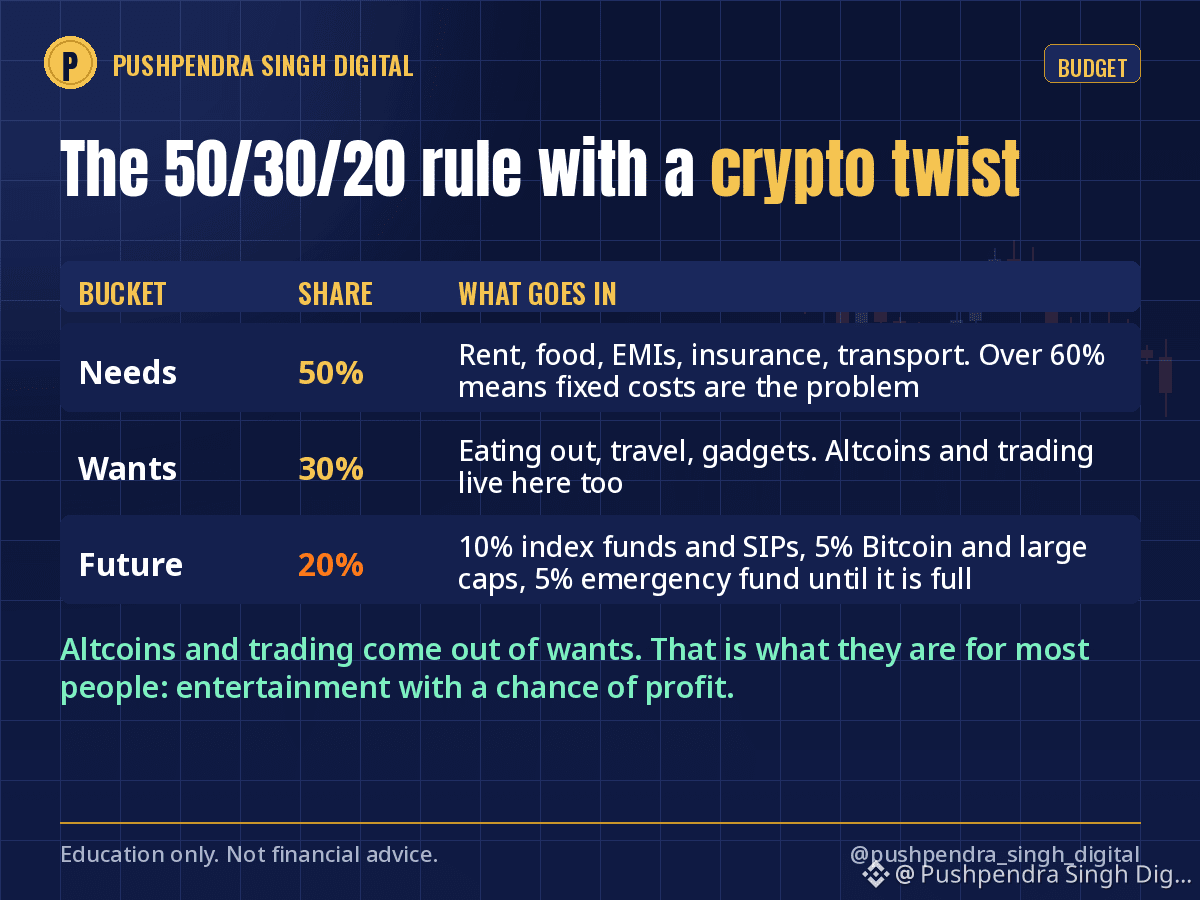
50% needs: rent, food, EMIs, insurance, transport. If this crosses 60%, the problem is not your investing, it is your fixed costs.
30% wants: eating out, travel, gadgets, subscriptions. Guilt free, as long as it stays inside the line.
20% future: this is where the twist comes in.
Out of that 20%, I split it like this:
10% to boring compounding: index funds, EPF or PPF, SIPs.
5% to Bitcoin and large caps, bought monthly, no timing.
5% to the emergency fund until it reaches 6 months of expenses, then to whichever bucket needs it.
Altcoins and trading do not get a budget line. They come out of the 30% wants, because that is what they are for most people: entertainment with a chance of profit.
Harsh, maybe. But it keeps one bad month from touching the money that actually builds your life.
What does your split look like right now, honestly?
Education only, not financial advice.
$BTC #PersonalFinance #Budgeting #MoneyBasics
The 50/30/20 rule is the simplest budget I know. Here is how I adapt it for someone who also holds crypto.
50% needs: rent, food, EMIs, insurance, transport. If this crosses 60%, the problem is not your investing, it is your fixed costs.
30% wants: eating out, travel, gadgets, subscriptions. Guilt free, as long as it stays inside the line.
20% future: this is where the twist comes in.
Out of that 20%, I split it like this:
10% to boring compounding: index funds, EPF or PPF, SIPs.
5% to Bitcoin and large caps, bought monthly, no timing.
5% to the emergency fund until it reaches 6 months of expenses, then to whichever bucket needs it.
Altcoins and trading do not get a budget line. They come out of the 30% wants, because that is what they are for most people: entertainment with a chance of profit.
Harsh, maybe. But it keeps one bad month from touching the money that actually builds your life.
What does your split look like right now, honestly?
Education only, not financial advice.
$BTC #PersonalFinance #Budgeting #MoneyBasics
50% needs: rent, food, EMIs, insurance, transport. If this crosses 60%, the problem is not your investing, it is your fixed costs.
30% wants: eating out, travel, gadgets, subscriptions. Guilt free, as long as it stays inside the line.
20% future: this is where the twist comes in.
Out of that 20%, I split it like this:
10% to boring compounding: index funds, EPF or PPF, SIPs.
5% to Bitcoin and large caps, bought monthly, no timing.
5% to the emergency fund until it reaches 6 months of expenses, then to whichever bucket needs it.
Altcoins and trading do not get a budget line. They come out of the 30% wants, because that is what they are for most people: entertainment with a chance of profit.
Harsh, maybe. But it keeps one bad month from touching the money that actually builds your life.
What does your split look like right now, honestly?
Education only, not financial advice.
$BTC #PersonalFinance #Budgeting #MoneyBasics
1
244
Before you buy your next coin or stock, check if your money has a home.
Here is the simple structure I share with every beginner:
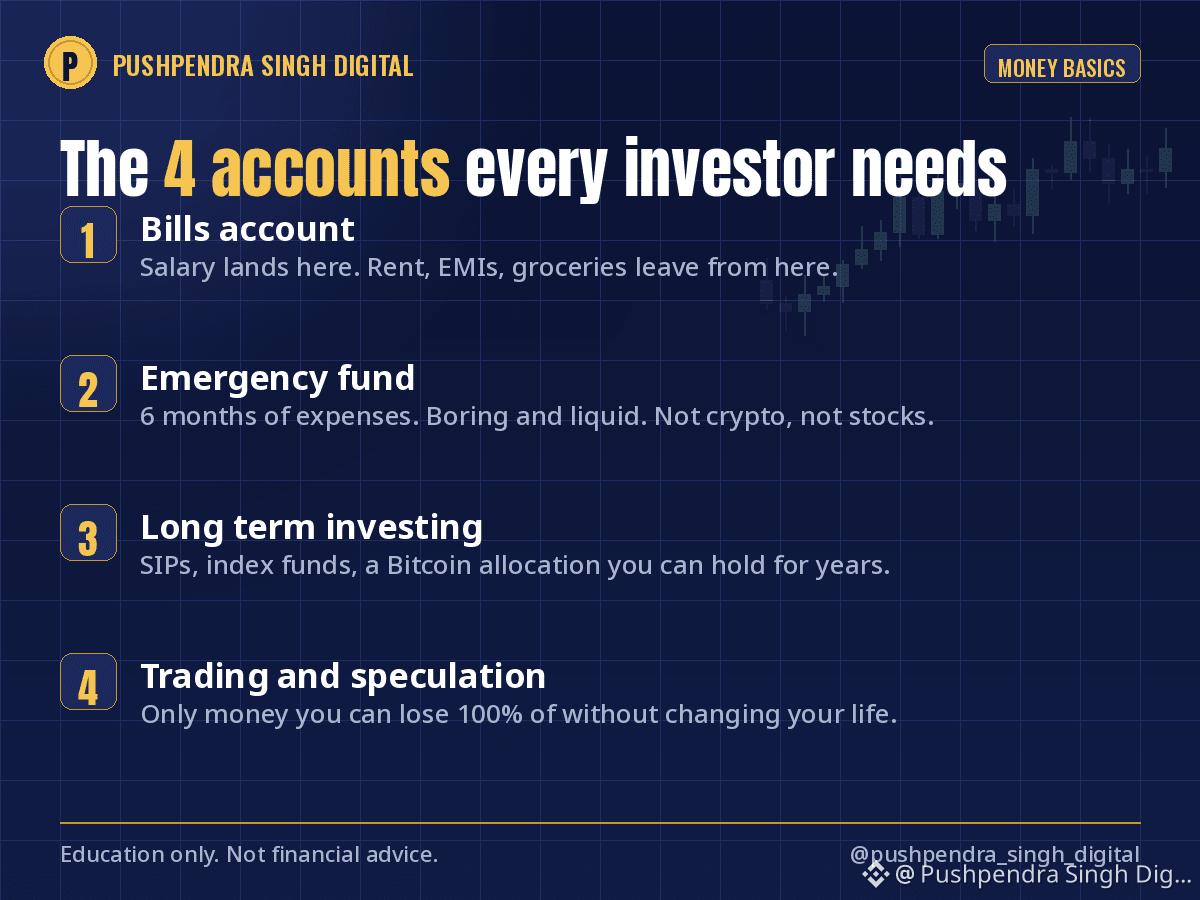
1. Bills account: rent, EMIs, groceries. Salary lands here, fixed costs leave from here.
2. Emergency fund: 6 months of expenses, kept boring and liquid. Not in crypto, not in stocks.
3. Long term investing: SIPs, index funds, and a Bitcoin allocation you can hold for years.
4. Trading and speculation: money you can lose 100% of without changing your life.
Most people skip step 2 and jump straight to step 4. Then one bad month forces them to sell good positions at the worst possible time.
Which of these four is missing in your setup right now? Reply honestly, I read every comment.
Education only, not financial advice.
$BTC #PersonalFinance #CryptoEducation #MoneyBasics
Before you buy your next coin or stock, check if your money has a home.
Here is the simple structure I share with every beginner:
1. Bills account: rent, EMIs, groceries. Salary lands here, fixed costs leave from here.
2. Emergency fund: 6 months of expenses, kept boring and liquid. Not in crypto, not in stocks.
3. Long term investing: SIPs, index funds, and a Bitcoin allocation you can hold for years.
4. Trading and speculation: money you can lose 100% of without changing your life.
Most people skip step 2 and jump straight to step 4. Then one bad month forces them to sell good positions at the worst possible time.
Which of these four is missing in your setup right now? Reply honestly, I read every comment.
Education only, not financial advice.
$BTC #PersonalFinance #CryptoEducation #MoneyBasics
Here is the simple structure I share with every beginner:
1. Bills account: rent, EMIs, groceries. Salary lands here, fixed costs leave from here.
2. Emergency fund: 6 months of expenses, kept boring and liquid. Not in crypto, not in stocks.
3. Long term investing: SIPs, index funds, and a Bitcoin allocation you can hold for years.
4. Trading and speculation: money you can lose 100% of without changing your life.
Most people skip step 2 and jump straight to step 4. Then one bad month forces them to sell good positions at the worst possible time.
Which of these four is missing in your setup right now? Reply honestly, I read every comment.
Education only, not financial advice.
$BTC #PersonalFinance #CryptoEducation #MoneyBasics
2
2
848
The emergency fund is the least exciting thing in personal finance. It is also the reason some people survive a crash and others do not.
Rules I follow:
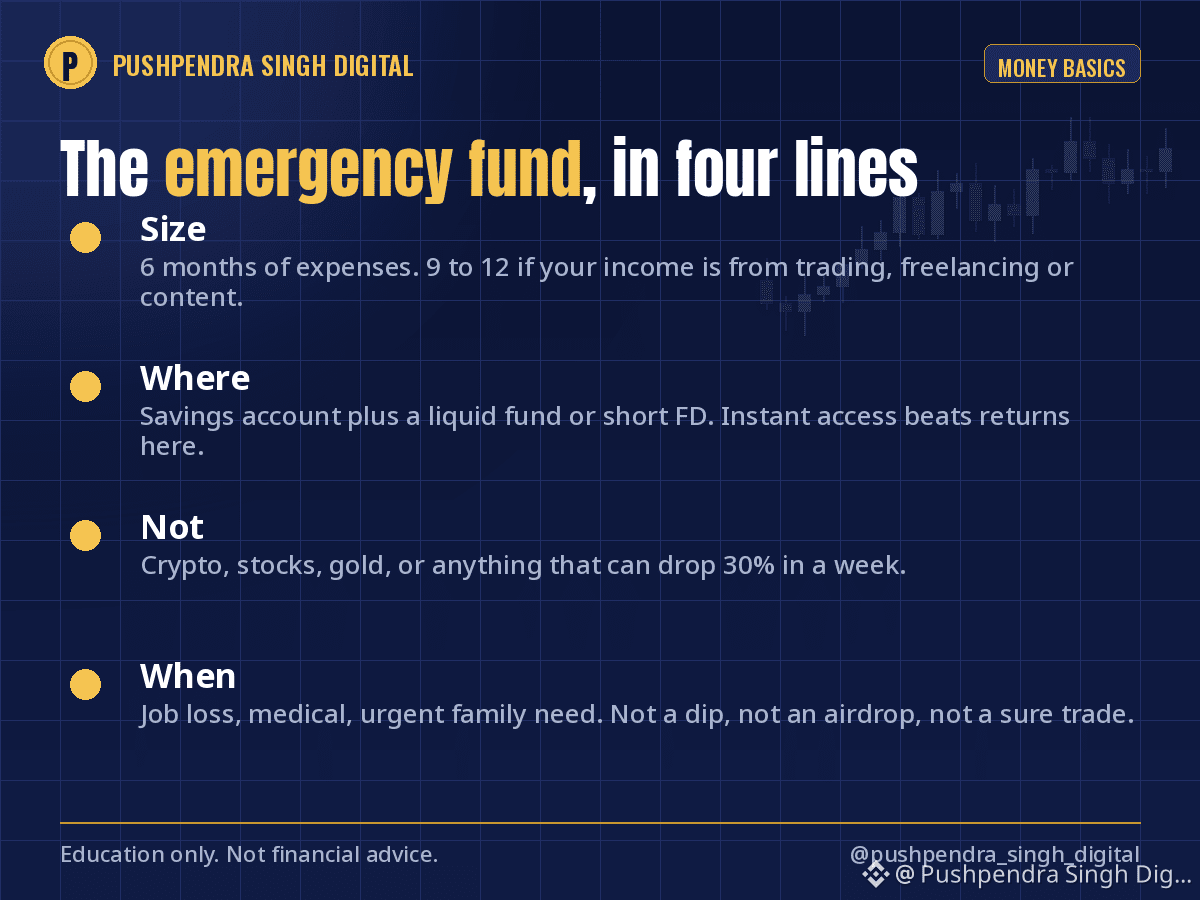
Size: 6 months of expenses. If your income comes from trading, freelancing or content, make it 9 to 12.
Where: split between a savings account and a liquid fund or short FD. Instant access matters more than returns.
Not: crypto, stocks, gold, or anything that can drop 30% in a week.
When to use: job loss, medical, urgent family need. Not a dip, not an airdrop, not a "sure" trade.
When the emergency fund is full, you stop making fear based decisions in the market. You can hold through a red month because rent is not depending on it.
How many months of expenses do you have set aside today? Be honest, no judgement here.
#EmergencyFund #PersonalFinance #MoneyBasics
The emergency fund is the least exciting thing in personal finance. It is also the reason some people survive a crash and others do not.
Rules I follow:
Size: 6 months of expenses. If your income comes from trading, freelancing or content, make it 9 to 12.
Where: split between a savings account and a liquid fund or short FD. Instant access matters more than returns.
Not: crypto, stocks, gold, or anything that can drop 30% in a week.
When to use: job loss, medical, urgent family need. Not a dip, not an airdrop, not a "sure" trade.
When the emergency fund is full, you stop making fear based decisions in the market. You can hold through a red month because rent is not depending on it.
How many months of expenses do you have set aside today? Be honest, no judgement here.
#EmergencyFund #PersonalFinance #MoneyBasics
Rules I follow:
Size: 6 months of expenses. If your income comes from trading, freelancing or content, make it 9 to 12.
Where: split between a savings account and a liquid fund or short FD. Instant access matters more than returns.
Not: crypto, stocks, gold, or anything that can drop 30% in a week.
When to use: job loss, medical, urgent family need. Not a dip, not an airdrop, not a "sure" trade.
When the emergency fund is full, you stop making fear based decisions in the market. You can hold through a red month because rent is not depending on it.
How many months of expenses do you have set aside today? Be honest, no judgement here.
#EmergencyFund #PersonalFinance #MoneyBasics
1
850
Before your first SIP, before your first Bitcoin, two things come first. Neither will ever make you money, and both decide whether your investing survives.
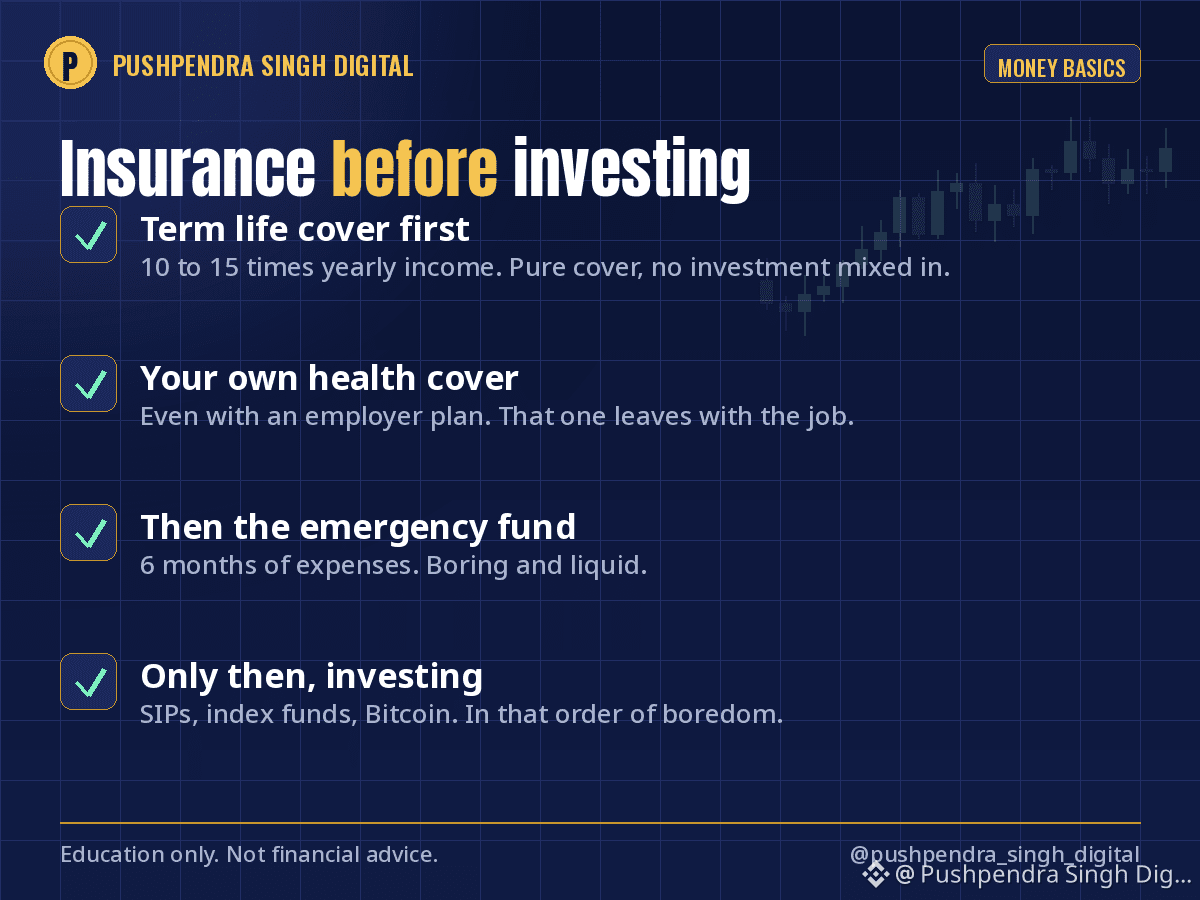
Term life insurance. Pure cover, no investment mixed in. Rule of thumb: 10 to 15 times your yearly income, running until your dependents no longer depend on you. A healthy 30 year old can usually get a 1 crore cover for roughly the cost of two restaurant dinners a month.
Health insurance. Your own, even if your employer gives you one, because that one disappears with the job. A 10 lakh base cover with a top up is the common starting point for a family, and it costs far less than people expect.
Why first: one hospital bill without cover does not come out of your savings account. It comes out of your investments, at whatever price the market is at that day. I have seen people sell Bitcoin at the bottom to pay a hospital. Insurance is what stops that sale.
Skip the plans that mix insurance with investment. Keep the two jobs separate and both get done better.
Do you have your own health cover, or only the one from work?
Education only, not financial or insurance advice.
$BTC #Insurance #PersonalFinance #MoneyBasics
Before your first SIP, before your first Bitcoin, two things come first. Neither will ever make you money, and both decide whether your investing survives.
Term life insurance. Pure cover, no investment mixed in. Rule of thumb: 10 to 15 times your yearly income, running until your dependents no longer depend on you. A healthy 30 year old can usually get a 1 crore cover for roughly the cost of two restaurant dinners a month.
Health insurance. Your own, even if your employer gives you one, because that one disappears with the job. A 10 lakh base cover with a top up is the common starting point for a family, and it costs far less than people expect.
Why first: one hospital bill without cover does not come out of your savings account. It comes out of your investments, at whatever price the market is at that day. I have seen people sell Bitcoin at the bottom to pay a hospital. Insurance is what stops that sale.
Skip the plans that mix insurance with investment. Keep the two jobs separate and both get done better.
Do you have your own health cover, or only the one from work?
Education only, not financial or insurance advice.
$BTC #Insurance #PersonalFinance #MoneyBasics
Term life insurance. Pure cover, no investment mixed in. Rule of thumb: 10 to 15 times your yearly income, running until your dependents no longer depend on you. A healthy 30 year old can usually get a 1 crore cover for roughly the cost of two restaurant dinners a month.
Health insurance. Your own, even if your employer gives you one, because that one disappears with the job. A 10 lakh base cover with a top up is the common starting point for a family, and it costs far less than people expect.
Why first: one hospital bill without cover does not come out of your savings account. It comes out of your investments, at whatever price the market is at that day. I have seen people sell Bitcoin at the bottom to pay a hospital. Insurance is what stops that sale.
Skip the plans that mix insurance with investment. Keep the two jobs separate and both get done better.
Do you have your own health cover, or only the one from work?
Education only, not financial or insurance advice.
$BTC #Insurance #PersonalFinance #MoneyBasics
443
Войдите, чтобы посмотреть больше материала
Присоединяйтесь к пользователям криптовалют по всему миру на Binance Square
⚡️ Получайте новейшую и полезную информацию о криптоактивах.
💬 Нам доверяет крупнейшая в мире криптобиржа.
👍 Получите достоверные аналитические данные от верифицированных создателей контента.
Эл. почта/номер телефона
В тренде
1
#WhoWillSucceedJensenHuangatNvidia?
Просмотров: 33,515
480 обсуждают
2
#WhatWillDriveCryptoandStocks’NextRebound?
Просмотров: 341,934
2,438 обсуждают
3
#USPPIMissMayEaseBTCPressure
Просмотров: 155,263
1,713 обсуждают
4
#TONStrategyReports$23.97MQ3NetLoss
Просмотров: 1,141
24 обсуждают
5
#PolkadotCommunityApprovesNewStrategyWith97%Vote
Просмотров: 6,238
117 обсуждают
6
#dYdXPlansV9.9UpgradeToShiftUSDCToInjective
Просмотров: 3,022
102 обсуждают
7
#TradFiForBeginners
Просмотров: 672,407
4,365 обсуждают
8
#MANTRAPausesUnstakingFor7DaysAfterKeplrSecurityIncident
Просмотров: 2,830
43 обсуждают
9
#BitcoinCoreDisclosesTorTrafficVulnerability
Просмотров: 68,828
940 обсуждают
10
#BitcoinBreaksBelow200WeekMovingAverage
Просмотров: 156,466
972 обсуждают