

#ethstakingratiohitsrecord34
ethstakingratiohitsrecord34
Просмотров: 514
21 обсуждают
Популярные
Новые

·
--
Here’s what happened when $ETH staking quietly climbed to a record 34% while the market was still sitting in Fear mode.
A lot of traders keep waiting for the “perfect” entry, then get confused when price doesn’t dump the way sentiment suggests. The pain is real: when more ETH gets locked, liquidity changes, exits get crowded differently, and chasing short-term candles becomes harder.
Case study: Ethereum’s staking ratio hitting 34% is not just a bullish headline. It tells us holders are choosing yield and network participation over keeping coins liquid on the sidelines. That matters because in past cycles, large staking or lock-up trends often reduced immediate sell pressure, but also created a new risk: if everyone leans into the same yield trade, any exit queue or reward compression can become the next stress point.
Compare this with $SOL, where staking has long been a bigger part of the culture, but also more sensitive to validator and routing narratives. Ethereum is different because its staking growth is happening while institutions, LSTs, and restaking products all compete for the same base asset. It starts to look less like simple “hold ETH” behavior and more like a full yield economy built on top of $ETH.
The lesson is simple: staking records are not automatic moon signals, especially when traders are hiding in $USDT and the Fear & Greed Index is still weak. But they do show where conviction is forming. In a cautious market, that can be more useful than another hype candle.
Do you think record ETH staking makes the next move stronger, or does it create a crowded exit risk later? #ETHStakingRatioHitsRecord34 #USJulyCPI #SolanaStakingNearsHaltOnRoutingError
Here’s what happened when $ETH staking quietly climbed to a record 34% while the market was still sitting in Fear mode.
A lot of traders keep waiting for the “perfect” entry, then get confused when price doesn’t dump the way sentiment suggests. The pain is real: when more ETH gets locked, liquidity changes, exits get crowded differently, and chasing short-term candles becomes harder.
Case study: Ethereum’s staking ratio hitting 34% is not just a bullish headline. It tells us holders are choosing yield and network participation over keeping coins liquid on the sidelines. That matters because in past cycles, large staking or lock-up trends often reduced immediate sell pressure, but also created a new risk: if everyone leans into the same yield trade, any exit queue or reward compression can become the next stress point.
Compare this with $SOL , where staking has long been a bigger part of the culture, but also more sensitive to validator and routing narratives. Ethereum is different because its staking growth is happening while institutions, LSTs, and restaking products all compete for the same base asset. It starts to look less like simple “hold ETH” behavior and more like a full yield economy built on top of $ETH .
The lesson is simple: staking records are not automatic moon signals, especially when traders are hiding in $USDT and the Fear & Greed Index is still weak. But they do show where conviction is forming. In a cautious market, that can be more useful than another hype candle.
Do you think record ETH staking makes the next move stronger, or does it create a crowded exit risk later? #ETHStakingRatioHitsRecord34 #USJulyCPI #SolanaStakingNearsHaltOnRoutingError
A lot of traders keep waiting for the “perfect” entry, then get confused when price doesn’t dump the way sentiment suggests. The pain is real: when more ETH gets locked, liquidity changes, exits get crowded differently, and chasing short-term candles becomes harder.
Case study: Ethereum’s staking ratio hitting 34% is not just a bullish headline. It tells us holders are choosing yield and network participation over keeping coins liquid on the sidelines. That matters because in past cycles, large staking or lock-up trends often reduced immediate sell pressure, but also created a new risk: if everyone leans into the same yield trade, any exit queue or reward compression can become the next stress point.
Compare this with $SOL , where staking has long been a bigger part of the culture, but also more sensitive to validator and routing narratives. Ethereum is different because its staking growth is happening while institutions, LSTs, and restaking products all compete for the same base asset. It starts to look less like simple “hold ETH” behavior and more like a full yield economy built on top of $ETH .
The lesson is simple: staking records are not automatic moon signals, especially when traders are hiding in $USDT and the Fear & Greed Index is still weak. But they do show where conviction is forming. In a cautious market, that can be more useful than another hype candle.
Do you think record ETH staking makes the next move stronger, or does it create a crowded exit risk later? #ETHStakingRatioHitsRecord34 #USJulyCPI #SolanaStakingNearsHaltOnRoutingError
20

**¿Qué es el staking de ETH y por qué importa el ratio del 34,4%?**
Cuando ves que "el staking de ETH alcanzó el 34,4%", significa que más de un tercio de todo el ETH en circulación está bloqueado en contratos de staking para asegurar la red Ethereum.
**¿Cómo funciona?** Desde la fusión (The Merge), Ethereum usa Proof of Stake. Los validadores bloquean al menos 32 ETH para proponer y validar bloques. A cambio, reciben recompensas (hoy cerca del 3-4% anual). Ese ETH bloqueado no puede venderse de inmediato: hay cola de salida.
**¿Por qué importa el ratio?** Cuanto más ETH está en staking, menos circula en exchanges. Eso reduce la oferta disponible para venta, lo que en teoría presiona al alza (si hay demanda). Pero también indica confianza a largo plazo: la gente prefiere lockear y ganar yield que vender.
Un ratio alto (>30%) es señal de que los holders están comprometidos con la red. Pero si el precio cae fuerte, puede generar presión latente: ese ETH eventualmente saldrá, y si todos quieren vender a la vez, la cola se alarga pero la presión existe.
Entender staking te ayuda a leer mejor la dinámica de oferta/demanda en ETH, especialmente cuando mirás flujos hacia exchanges o métricas on-chain.
¿Querés más guías claras sobre conceptos cripto? Seguime acá en Binance Square para contenido sin relleno.
#ETHStakingRatioHitsRecord34.4%
**¿Qué es el staking de ETH y por qué importa el ratio del 34,4%?**
Cuando ves que "el staking de ETH alcanzó el 34,4%", significa que más de un tercio de todo el ETH en circulación está bloqueado en contratos de staking para asegurar la red Ethereum.
**¿Cómo funciona?** Desde la fusión (The Merge), Ethereum usa Proof of Stake. Los validadores bloquean al menos 32 ETH para proponer y validar bloques. A cambio, reciben recompensas (hoy cerca del 3-4% anual). Ese ETH bloqueado no puede venderse de inmediato: hay cola de salida.
**¿Por qué importa el ratio?** Cuanto más ETH está en staking, menos circula en exchanges. Eso reduce la oferta disponible para venta, lo que en teoría presiona al alza (si hay demanda). Pero también indica confianza a largo plazo: la gente prefiere lockear y ganar yield que vender.
Un ratio alto (>30%) es señal de que los holders están comprometidos con la red. Pero si el precio cae fuerte, puede generar presión latente: ese ETH eventualmente saldrá, y si todos quieren vender a la vez, la cola se alarga pero la presión existe.
Entender staking te ayuda a leer mejor la dinámica de oferta/demanda en ETH, especialmente cuando mirás flujos hacia exchanges o métricas on-chain.
¿Querés más guías claras sobre conceptos cripto? Seguime acá en Binance Square para contenido sin relleno.
#ETHStakingRatioHitsRecord34.4%
Cuando ves que "el staking de ETH alcanzó el 34,4%", significa que más de un tercio de todo el ETH en circulación está bloqueado en contratos de staking para asegurar la red Ethereum.
**¿Cómo funciona?** Desde la fusión (The Merge), Ethereum usa Proof of Stake. Los validadores bloquean al menos 32 ETH para proponer y validar bloques. A cambio, reciben recompensas (hoy cerca del 3-4% anual). Ese ETH bloqueado no puede venderse de inmediato: hay cola de salida.
**¿Por qué importa el ratio?** Cuanto más ETH está en staking, menos circula en exchanges. Eso reduce la oferta disponible para venta, lo que en teoría presiona al alza (si hay demanda). Pero también indica confianza a largo plazo: la gente prefiere lockear y ganar yield que vender.
Un ratio alto (>30%) es señal de que los holders están comprometidos con la red. Pero si el precio cae fuerte, puede generar presión latente: ese ETH eventualmente saldrá, y si todos quieren vender a la vez, la cola se alarga pero la presión existe.
Entender staking te ayuda a leer mejor la dinámica de oferta/demanda en ETH, especialmente cuando mirás flujos hacia exchanges o métricas on-chain.
¿Querés más guías claras sobre conceptos cripto? Seguime acá en Binance Square para contenido sin relleno.
#ETHStakingRatioHitsRecord34.4%
54
·
--
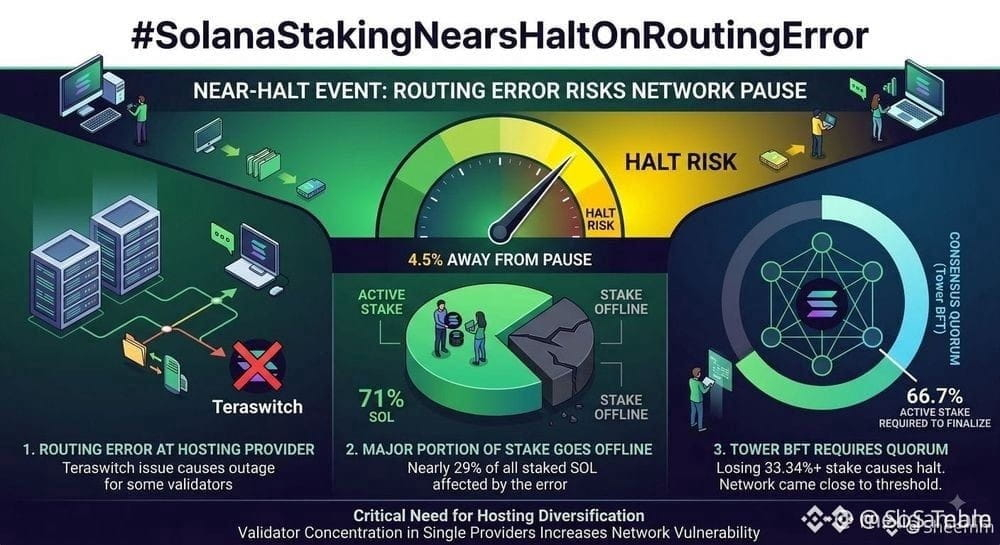
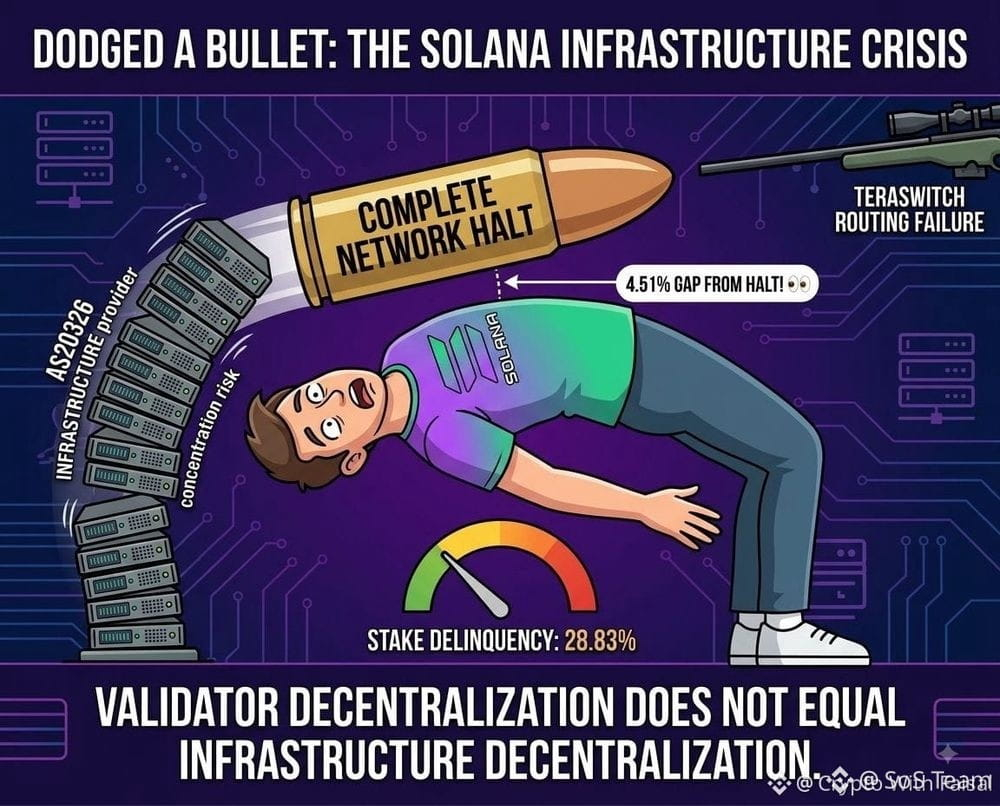
Why is nobody talking about the real lesson behind Solana staking nearly halting on a routing error?
Most traders only notice infrastructure risk after their entry is underwater. They FOMO into $SOL strength, stake for yield, then act shocked when a technical bottleneck exposes how dependent their position is on smooth validator and routing performance.
My hot take: this is not a “Solana is dead” moment. It is a reminder that staking is not passive income if you do not understand the operational risk. Yield looks clean on the screen, but behind it are validators, routing paths, uptime assumptions, unlock periods, and network coordination.
The actionable move is simple. If you hold $SOL, split your risk instead of staking everything through one route or one validator. Keep some liquidity in $USDT for forced dips, check validator performance before chasing APY, and know your unstaking timeline before volatility hits. The worst plan is needing an exit while your capital is locked.
Also, compare narratives honestly. $ETH staking hitting record levels gets treated like maturity, while Solana staking issues get treated like disaster. Both networks have trade-offs. The market is fearful right now, which means overreactions can create entries, but only for traders who already have a plan.
Are you reducing staking exposure, buying the fear, or waiting for cleaner confirmation on $SOL? #SolanaStakingNearsHaltOnRoutingError #ETHStakingRatioHitsRecord34 #USJulyCPI
Why is nobody talking about the real lesson behind Solana staking nearly halting on a routing error?
Most traders only notice infrastructure risk after their entry is underwater. They FOMO into $SOL strength, stake for yield, then act shocked when a technical bottleneck exposes how dependent their position is on smooth validator and routing performance.
My hot take: this is not a “Solana is dead” moment. It is a reminder that staking is not passive income if you do not understand the operational risk. Yield looks clean on the screen, but behind it are validators, routing paths, uptime assumptions, unlock periods, and network coordination.
The actionable move is simple. If you hold $SOL , split your risk instead of staking everything through one route or one validator. Keep some liquidity in $USDT for forced dips, check validator performance before chasing APY, and know your unstaking timeline before volatility hits. The worst plan is needing an exit while your capital is locked.
Also, compare narratives honestly. $ETH staking hitting record levels gets treated like maturity, while Solana staking issues get treated like disaster. Both networks have trade-offs. The market is fearful right now, which means overreactions can create entries, but only for traders who already have a plan.
Are you reducing staking exposure, buying the fear, or waiting for cleaner confirmation on $SOL ? #SolanaStakingNearsHaltOnRoutingError #ETHStakingRatioHitsRecord34 #USJulyCPI
Most traders only notice infrastructure risk after their entry is underwater. They FOMO into $SOL strength, stake for yield, then act shocked when a technical bottleneck exposes how dependent their position is on smooth validator and routing performance.
My hot take: this is not a “Solana is dead” moment. It is a reminder that staking is not passive income if you do not understand the operational risk. Yield looks clean on the screen, but behind it are validators, routing paths, uptime assumptions, unlock periods, and network coordination.
The actionable move is simple. If you hold $SOL , split your risk instead of staking everything through one route or one validator. Keep some liquidity in $USDT for forced dips, check validator performance before chasing APY, and know your unstaking timeline before volatility hits. The worst plan is needing an exit while your capital is locked.
Also, compare narratives honestly. $ETH staking hitting record levels gets treated like maturity, while Solana staking issues get treated like disaster. Both networks have trade-offs. The market is fearful right now, which means overreactions can create entries, but only for traders who already have a plan.
Are you reducing staking exposure, buying the fear, or waiting for cleaner confirmation on $SOL ? #SolanaStakingNearsHaltOnRoutingError #ETHStakingRatioHitsRecord34 #USJulyCPI
62
·
--
Have you noticed how Samsung and SK Hynix can lead a Seoul rally while crypto traders are still acting like the sky is falling?
That gap is where people lose money. They either FOMO into random “AI” narratives too late, or sit in $USDT waiting for the perfect entry that never feels safe.
My hot take: this rally is not just a stock market story. It is a liquidity case study. Big money is not avoiding risk completely, it is becoming selective. Semiconductors are getting bids because the AI infrastructure trade has real earnings, real demand, and clear winners. That is very different from buying every token with “AI” in the description.
For crypto, the lesson is uncomfortable. If Fear & Greed is sitting in fear while chip leaders are moving, the market may be telling us that capital is rotating into quality before it rotates broadly. That does not mean $BTC or $ETH must explode tomorrow, but it does mean the “no one wants risk” narrative is too lazy.
The better question is whether crypto can show the same quality signal: real usage, strong flows, and narratives backed by numbers instead of hype. Are you positioning for selective rotation, or still waiting for the crowd to feel bullish again? #SamsungSKHynixLeadSeoulRally #USJulyCPI #ETHStakingRatioHitsRecord34
Have you noticed how Samsung and SK Hynix can lead a Seoul rally while crypto traders are still acting like the sky is falling?
That gap is where people lose money. They either FOMO into random “AI” narratives too late, or sit in $USDT waiting for the perfect entry that never feels safe.
My hot take: this rally is not just a stock market story. It is a liquidity case study. Big money is not avoiding risk completely, it is becoming selective. Semiconductors are getting bids because the AI infrastructure trade has real earnings, real demand, and clear winners. That is very different from buying every token with “AI” in the description.
For crypto, the lesson is uncomfortable. If Fear & Greed is sitting in fear while chip leaders are moving, the market may be telling us that capital is rotating into quality before it rotates broadly. That does not mean $BTC or $ETH must explode tomorrow, but it does mean the “no one wants risk” narrative is too lazy.
The better question is whether crypto can show the same quality signal: real usage, strong flows, and narratives backed by numbers instead of hype. Are you positioning for selective rotation, or still waiting for the crowd to feel bullish again? #SamsungSKHynixLeadSeoulRally #USJulyCPI #ETHStakingRatioHitsRecord34
That gap is where people lose money. They either FOMO into random “AI” narratives too late, or sit in $USDT waiting for the perfect entry that never feels safe.
My hot take: this rally is not just a stock market story. It is a liquidity case study. Big money is not avoiding risk completely, it is becoming selective. Semiconductors are getting bids because the AI infrastructure trade has real earnings, real demand, and clear winners. That is very different from buying every token with “AI” in the description.
For crypto, the lesson is uncomfortable. If Fear & Greed is sitting in fear while chip leaders are moving, the market may be telling us that capital is rotating into quality before it rotates broadly. That does not mean $BTC or $ETH must explode tomorrow, but it does mean the “no one wants risk” narrative is too lazy.
The better question is whether crypto can show the same quality signal: real usage, strong flows, and narratives backed by numbers instead of hype. Are you positioning for selective rotation, or still waiting for the crowd to feel bullish again? #SamsungSKHynixLeadSeoulRally #USJulyCPI #ETHStakingRatioHitsRecord34

33
·
--
Here’s what happened when SpaceX reportedly jumped nearly 12% in valuation while crypto traders were still sitting in a Fear market.
The pain point is simple: when a big-name private market story starts trending, people often chase the nearest “space” narrative token without checking liquidity, supply, or whether the token has any real connection to the headline. That’s how FOMO turns a macro signal into a bad entry.
The case study here is not just “SpaceX went up.” It’s how attention moves. A high-conviction institutional story hits the market, retail sees strength, then capital starts hunting for proxies because most people can’t access the actual private equity exposure. In crypto, that usually means thin order books, sudden pumps, and fast exits by early holders.
What most people missed is that this happened while sentiment was still cautious, with Fear & Greed around 37. In that environment, traders often rotate into $USDT quickly after volatility, and even majors like $BTC and $ETH can become the liquidity source for narrative bets. The risk is buying the headline after the move has already been priced into whatever “related” asset people found first.
The lesson: strong real-world demand does not automatically equal a clean crypto trade. If the asset has no direct cash flow, no verified link, and no deep liquidity, you’re not investing in SpaceX momentum. You’re trading attention.
Where do you think this narrative goes from here? #SpaceXRisesNearly12 #USJulyCPI #ETHStakingRatioHitsRecord34
Here’s what happened when SpaceX reportedly jumped nearly 12% in valuation while crypto traders were still sitting in a Fear market.
The pain point is simple: when a big-name private market story starts trending, people often chase the nearest “space” narrative token without checking liquidity, supply, or whether the token has any real connection to the headline. That’s how FOMO turns a macro signal into a bad entry.
The case study here is not just “SpaceX went up.” It’s how attention moves. A high-conviction institutional story hits the market, retail sees strength, then capital starts hunting for proxies because most people can’t access the actual private equity exposure. In crypto, that usually means thin order books, sudden pumps, and fast exits by early holders.
What most people missed is that this happened while sentiment was still cautious, with Fear & Greed around 37. In that environment, traders often rotate into $USDT quickly after volatility, and even majors like $BTC and $ETH can become the liquidity source for narrative bets. The risk is buying the headline after the move has already been priced into whatever “related” asset people found first.
The lesson: strong real-world demand does not automatically equal a clean crypto trade. If the asset has no direct cash flow, no verified link, and no deep liquidity, you’re not investing in SpaceX momentum. You’re trading attention.
Where do you think this narrative goes from here? #SpaceXRisesNearly12 #USJulyCPI #ETHStakingRatioHitsRecord34
The pain point is simple: when a big-name private market story starts trending, people often chase the nearest “space” narrative token without checking liquidity, supply, or whether the token has any real connection to the headline. That’s how FOMO turns a macro signal into a bad entry.
The case study here is not just “SpaceX went up.” It’s how attention moves. A high-conviction institutional story hits the market, retail sees strength, then capital starts hunting for proxies because most people can’t access the actual private equity exposure. In crypto, that usually means thin order books, sudden pumps, and fast exits by early holders.
What most people missed is that this happened while sentiment was still cautious, with Fear & Greed around 37. In that environment, traders often rotate into $USDT quickly after volatility, and even majors like $BTC and $ETH can become the liquidity source for narrative bets. The risk is buying the headline after the move has already been priced into whatever “related” asset people found first.
The lesson: strong real-world demand does not automatically equal a clean crypto trade. If the asset has no direct cash flow, no verified link, and no deep liquidity, you’re not investing in SpaceX momentum. You’re trading attention.
Where do you think this narrative goes from here? #SpaceXRisesNearly12 #USJulyCPI #ETHStakingRatioHitsRecord34
147
·
--
The biggest money in perps is often made before the crowd realizes the real trade is not the token, but the market structure around it.
A lot of traders see “US perpetual contract market” and instantly think leverage, volume, and easy upside. I’ve been around long enough to know that when everyone gets excited about perps, liquidation maps start becoming more important than price predictions.
Hyperliquid pushing toward the US perpetuals space matters because perps are the engine room of crypto speculation. They let traders bet on $BTC, $ETH, and other assets without holding spot, using margin and funding rates to keep prices aligned. That sounds simple, but in practice it creates cycles of greed and fear: crowded longs get flushed, overconfident shorts get squeezed, and the patient trader waits for forced selling instead of chasing green candles.
With Fear & Greed sitting in fear territory, this is where education beats emotion. In past cycles, the best traders did not just ask “will this pump?” They asked who is overleveraged, where liquidity sits, and whether stablecoin flows like $USDT are supporting real demand or just temporary leverage.
If US-regulated perps expand, it could bring deeper liquidity and more institutional participation, but also sharper competition and stricter rules. That is not automatically bullish or bearish. It means the game may become more professional, and retail traders who treat leverage like a casino will keep paying tuition.
How are you reading Hyperliquid’s move into the US perps conversation from here? #HyperliquidSeeksUSPerpetualContractMarket #USJulyCPI #ETHStakingRatioHitsRecord34
The biggest money in perps is often made before the crowd realizes the real trade is not the token, but the market structure around it.
A lot of traders see “US perpetual contract market” and instantly think leverage, volume, and easy upside. I’ve been around long enough to know that when everyone gets excited about perps, liquidation maps start becoming more important than price predictions.
Hyperliquid pushing toward the US perpetuals space matters because perps are the engine room of crypto speculation. They let traders bet on $BTC , $ETH , and other assets without holding spot, using margin and funding rates to keep prices aligned. That sounds simple, but in practice it creates cycles of greed and fear: crowded longs get flushed, overconfident shorts get squeezed, and the patient trader waits for forced selling instead of chasing green candles.
With Fear & Greed sitting in fear territory, this is where education beats emotion. In past cycles, the best traders did not just ask “will this pump?” They asked who is overleveraged, where liquidity sits, and whether stablecoin flows like $USDT are supporting real demand or just temporary leverage.
If US-regulated perps expand, it could bring deeper liquidity and more institutional participation, but also sharper competition and stricter rules. That is not automatically bullish or bearish. It means the game may become more professional, and retail traders who treat leverage like a casino will keep paying tuition.
How are you reading Hyperliquid’s move into the US perps conversation from here? #HyperliquidSeeksUSPerpetualContractMarket #USJulyCPI #ETHStakingRatioHitsRecord34
A lot of traders see “US perpetual contract market” and instantly think leverage, volume, and easy upside. I’ve been around long enough to know that when everyone gets excited about perps, liquidation maps start becoming more important than price predictions.
Hyperliquid pushing toward the US perpetuals space matters because perps are the engine room of crypto speculation. They let traders bet on $BTC , $ETH , and other assets without holding spot, using margin and funding rates to keep prices aligned. That sounds simple, but in practice it creates cycles of greed and fear: crowded longs get flushed, overconfident shorts get squeezed, and the patient trader waits for forced selling instead of chasing green candles.
With Fear & Greed sitting in fear territory, this is where education beats emotion. In past cycles, the best traders did not just ask “will this pump?” They asked who is overleveraged, where liquidity sits, and whether stablecoin flows like $USDT are supporting real demand or just temporary leverage.
If US-regulated perps expand, it could bring deeper liquidity and more institutional participation, but also sharper competition and stricter rules. That is not automatically bullish or bearish. It means the game may become more professional, and retail traders who treat leverage like a casino will keep paying tuition.
How are you reading Hyperliquid’s move into the US perps conversation from here? #HyperliquidSeeksUSPerpetualContractMarket #USJulyCPI #ETHStakingRatioHitsRecord34
107

🔥 At 3am UTC, a $20K daily investor buzz ignited, fueled by the Trump family's crypto projects and XRP's sudden surge, leaving many to wonder if this is the start of something big for #XRP, #cryptoinvesting, and #cloudmining.
📊 As investors turned to regulated cloud mining for XRP ecosystem exposure, SHRMiner gained traction, with top traders net long (61.2%) on BTC and (57.9%) on ETH, according to futures market intelligence, while smart money signals from Capy, K-HOME, and BOIÚNA on Solana further accelerated the trend.
💡 But here's the twist: with the Bank of Russia set to limit retail crypto from Sep 1, as discussed under #BankOfRussiaToLimitRetailCryptoFromSep1, and the Solana staking ratio hitting a record 34.4%, as seen in #ETHStakingRatioHitsRecord34.4%, the real question is, will you be on the right side of this investor buzz, or will you miss out on the potential profits?
🔥 At 3am UTC, a $20K daily investor buzz ignited, fueled by the Trump family's crypto projects and XRP's sudden surge, leaving many to wonder if this is the start of something big for #XRP, #cryptoinvesting, and #cloudmining.
📊 As investors turned to regulated cloud mining for XRP ecosystem exposure, SHRMiner gained traction, with top traders net long (61.2%) on BTC and (57.9%) on ETH, according to futures market intelligence, while smart money signals from Capy, K-HOME, and BOIÚNA on Solana further accelerated the trend.
💡 But here's the twist: with the Bank of Russia set to limit retail crypto from Sep 1, as discussed under #BankOfRussiaToLimitRetailCryptoFromSep1, and the Solana staking ratio hitting a record 34.4%, as seen in #ETHStakingRatioHitsRecord34.4%, the real question is, will you be on the right side of this investor buzz, or will you miss out on the potential profits?
📊 As investors turned to regulated cloud mining for XRP ecosystem exposure, SHRMiner gained traction, with top traders net long (61.2%) on BTC and (57.9%) on ETH, according to futures market intelligence, while smart money signals from Capy, K-HOME, and BOIÚNA on Solana further accelerated the trend.
💡 But here's the twist: with the Bank of Russia set to limit retail crypto from Sep 1, as discussed under #BankOfRussiaToLimitRetailCryptoFromSep1, and the Solana staking ratio hitting a record 34.4%, as seen in #ETHStakingRatioHitsRecord34.4%, the real question is, will you be on the right side of this investor buzz, or will you miss out on the potential profits?
52
·
--
If you're still treating crypto regulation headlines as background noise, stop now.
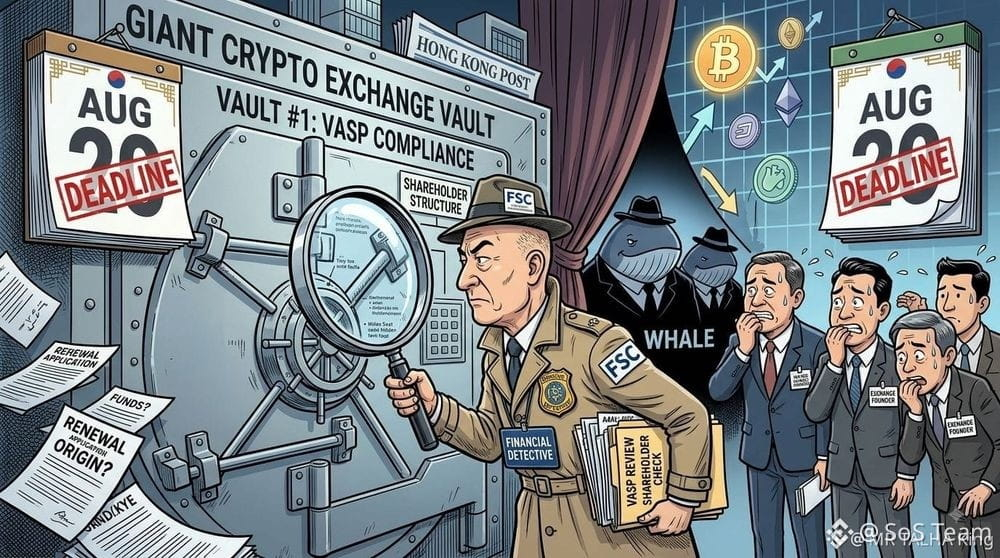
Plenty of traders lose money not because their $BTC thesis is wrong, but because they ignore the rulebook changing under their feet. South Korea expanding VASP reviews to major shareholders is exactly the kind of “boring” news that can quietly move liquidity, listings, and sentiment.
This reminds me of when exchange licensing crackdowns in other markets first looked like paperwork, then suddenly became a filter between platforms that could survive and platforms that got squeezed. Korea is not a tiny side quest either. Retail activity there has historically been loud enough to create its own premium, its own narratives, and occasionally its own chaos.
The interesting comparison is Japan’s tighter compliance model versus the more open, faster-moving markets. Stricter oversight can slow the casino down, but it can also make institutions more comfortable touching $ETH, $USDT, and larger listed assets. In a Fear market, “regulatory clarity” can either be a seatbelt or a handbrake.
So is South Korea’s tougher VASP review a long-term credibility boost for crypto, or another liquidity choke point traders are underestimating? #SouthKoreaExpandsVASPReviewToMajorShareholders #BankOfRussiaToLimitRetailCryptoFromSep1 #ETHStakingRatioHitsRecord34
If you're still treating crypto regulation headlines as background noise, stop now.
Plenty of traders lose money not because their $BTC thesis is wrong, but because they ignore the rulebook changing under their feet. South Korea expanding VASP reviews to major shareholders is exactly the kind of “boring” news that can quietly move liquidity, listings, and sentiment.
This reminds me of when exchange licensing crackdowns in other markets first looked like paperwork, then suddenly became a filter between platforms that could survive and platforms that got squeezed. Korea is not a tiny side quest either. Retail activity there has historically been loud enough to create its own premium, its own narratives, and occasionally its own chaos.
The interesting comparison is Japan’s tighter compliance model versus the more open, faster-moving markets. Stricter oversight can slow the casino down, but it can also make institutions more comfortable touching $ETH , $USDT, and larger listed assets. In a Fear market, “regulatory clarity” can either be a seatbelt or a handbrake.
So is South Korea’s tougher VASP review a long-term credibility boost for crypto, or another liquidity choke point traders are underestimating? #SouthKoreaExpandsVASPReviewToMajorShareholders #BankOfRussiaToLimitRetailCryptoFromSep1 #ETHStakingRatioHitsRecord34
Plenty of traders lose money not because their $BTC thesis is wrong, but because they ignore the rulebook changing under their feet. South Korea expanding VASP reviews to major shareholders is exactly the kind of “boring” news that can quietly move liquidity, listings, and sentiment.
This reminds me of when exchange licensing crackdowns in other markets first looked like paperwork, then suddenly became a filter between platforms that could survive and platforms that got squeezed. Korea is not a tiny side quest either. Retail activity there has historically been loud enough to create its own premium, its own narratives, and occasionally its own chaos.
The interesting comparison is Japan’s tighter compliance model versus the more open, faster-moving markets. Stricter oversight can slow the casino down, but it can also make institutions more comfortable touching $ETH , $USDT, and larger listed assets. In a Fear market, “regulatory clarity” can either be a seatbelt or a handbrake.
So is South Korea’s tougher VASP review a long-term credibility boost for crypto, or another liquidity choke point traders are underestimating? #SouthKoreaExpandsVASPReviewToMajorShareholders #BankOfRussiaToLimitRetailCryptoFromSep1 #ETHStakingRatioHitsRecord34
24
Войдите, чтобы посмотреть больше материала
Присоединяйтесь к пользователям криптовалют по всему миру на Binance Square
⚡️ Получайте новейшую и полезную информацию о криптоактивах.
💬 Нам доверяет крупнейшая в мире криптобиржа.
👍 Получите достоверные аналитические данные от верифицированных создателей контента.
Эл. почта/номер телефона
В тренде
1
#BinanceKZ
Просмотров: 8,752
50 обсуждают
2
#BTCFallsBelow$83000
Просмотров: 4,077
70 обсуждают
3
#BitgetDetailsSecurityIncidentTimeline
Просмотров: 47
17 обсуждают
4
#BitcoinSpotETFs$2.39BWeeklyNetInflow
Просмотров: 318
10 обсуждают
5
#FedProposesPaymentStablecoinRules
Просмотров: 17,886
394 обсуждают
6
#ChinaMayLetAlibabaByteDanceBuyNvidiaChips
Просмотров: 19,957
431 обсуждают
7
#USChinaRelease$30BTariffCutProductLists
Просмотров: 2,775
46 обсуждают
8
#SKoreaFSCConsidersVirtualAssetMarketMaker
Просмотров: 13,539
328 обсуждают
9
#ChinaIndustrialProfitGrowthSlowsFourthMonth
Просмотров: 13,151
320 обсуждают
10
#BitwiseFilesFinalNEARSpotETFProspectus
Просмотров: 132,183
1,917 обсуждают