

#cangoogledefinditscore
cangoogledefinditscore
As more users turn to AI for answers instead of search engines, can Google's core search advertising business continue to grow? Can its cloud business and AI investments bring new growth? Share your predictions and analysis of Google's ($GOOGL) quarterly earnings, show your Binance Pick prediction positions or your trades/positions, and join the discussion on whether Google will beat expectations.
Популярные
Новые


Статья
Earnings Season Session 3: Will Google & Microsoft Beat Earnings Expectations?Binance Square #EarningsSeason is updated with a new session. In this session, we focus on Google and Microsoft. Follow Google and Microsoft earnings on Square for the latest updates and data analysis, make your earnings predictions via [Binance Pick](https://app.binance.com/uni-qr/prophet?seasonId=prophet_1019_s1), and share your prediction takes to unlock Binance Pick points and traffic boost. Make the most of Earnings Season—all on Binance Square!
Here is your ultimate guide to #EarningsSeason on Binance Square.
Step 1: Stay Tuned to Key Data & Analysis of Google and Microsoft Earnings
Oct 26:[ Google & Microsoft earnings preview](https://www.binance.com/en/square/post/10-26-2026-alphabet-and-microsoft-earnings-preview-cloud-growth-meets-the-capex-bill-381383851799819)Oct 29: Google & Microsoft earnings recapOct 29:[ Post-earnings analyst livestream](https://www.binance.com/en/square/post/381427116820341) (12:00 UTC, Chinese)Oct 30: Post-earnings analyst livestream (14:00 UTC, English)
Step 2: Predict Google and Microsoft Earnings on Binance Pick
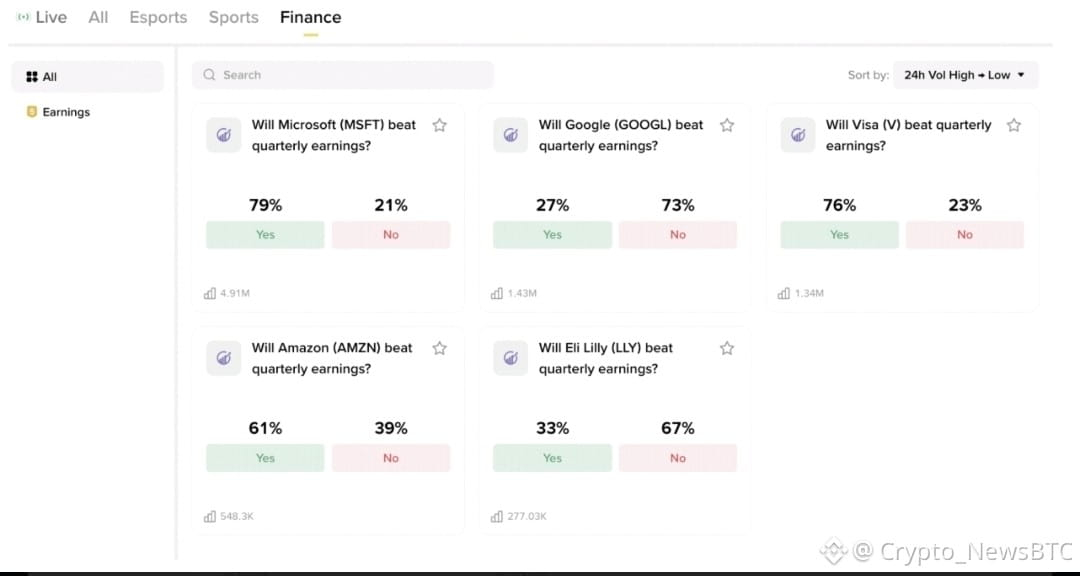
[Binance Pick](https://app.binance.com/uni-qr/prophet?seasonId=prophet_1019_s1) has launched a new [Finance Earnings] prediction section. Use points to predict how Google and Microsoft will perform in their upcoming earnings reports, which will earn you more points, and help you climb the leaderboard for a share of splitting up to 1,000,000 USDC.
Step 3: Share Your Earnings Views on Square to Earn Binance Pick Points and Traffic Boost
Share your Binance Pick earnings prediction positions on Binance Square and explain your calls on Google or Microsoft. You can also join Google or Microsoft topics discussion and analyze their earnings results.
Option 1: Share Your Prediction Positions to Earn Binance Pick Points
Post with #BinancePick (≥20 characters)Include a screenshot of your Google or Microsoft earnings prediction position from Binance Pick Pick any angle below and share your thoughts in the post.Angle 1: Will Google beat quarterly earnings expectations? Why do you think so?Angle 2: Will Microsoft beat quarterly earnings expectations? Why do you think so?You will earn 100 Binance Pick points per day.
Option 2: Join Google and Microsoft Topic Discussions & Earn Traffic Boost
#CanGoogleDefendItsCore?Post with #CanGoogleDefindItsCore Pick either angle and share your take in the post.Angle 1: How will you adjust your trades or positions before and after Google’s earnings report? Include a trade-sharing card to show your $GOOGL trade or position for a better chance of receiving traffic boost.Angle 2: More people are turning directly to AI for answers instead of using search engines. Do you think this will affect Google’s search advertising revenue and $GOOGL stock price?#CanMicrosoftDeliverOnAI?Post with #CanMicrosoftDeliverOnAI Pick either angle and share your take in the post.Angle 1: How will you adjust your trades or positions before and after Microsoft’s earnings report? Include a trade-sharing card to show your $MSFT trade or position for a better chance of receiving a traffic boost.Angle 2: Microsoft has launched Copilot Code, an AI tool that can handle tasks for you. If you had an AI coworker like this, what would you most want it to do?Submission window:2026-10-27 14:00 – 2026-10-29 10:00 (UTC)Quality posts meeting requirements may be selected for random traffic boosts. Posts featuring trade-sharing cards for GOOGL or MSFT trades or positions are more likely to be boosted.
Step 4: Explore Binance Square Earnings Season for More Earnings Data & Analysis
Session 1:[ Earnings Season: Micron Q4 Earnings — Bullish or Bearish?](https://www.binance.com/en/square/post/371847974675255)Session 2:[ Tesla & Meta Earnings — All Eyes on Magnificent 7](https://www.binance.com/en/square/post/379228984051459)
Earnings Season Session 3: Will Google & Microsoft Beat Earnings Expectations?
Binance Square #EarningsSeason is updated with a new session. In this session, we focus on Google and Microsoft. Follow Google and Microsoft earnings on Square for the latest updates and data analysis, make your earnings predictions via Binance Pick, and share your prediction takes to unlock Binance Pick points and traffic boost. Make the most of Earnings Season—all on Binance Square!
Here is your ultimate guide to #EarningsSeason on Binance Square.
Step 1: Stay Tuned to Key Data & Analysis of Google and Microsoft Earnings
Oct 26: Google & Microsoft earnings previewOct 29: Google & Microsoft earnings recapOct 29: Post-earnings analyst livestream (12:00 UTC, Chinese)Oct 30: Post-earnings analyst livestream (14:00 UTC, English)
Step 2: Predict Google and Microsoft Earnings on Binance Pick
Binance Pick has launched a new [Finance Earnings] prediction section. Use points to predict how Google and Microsoft will perform in their upcoming earnings reports, which will earn you more points, and help you climb the leaderboard for a share of splitting up to 1,000,000 USDC.
Step 3: Share Your Earnings Views on Square to Earn Binance Pick Points and Traffic Boost
Share your Binance Pick earnings prediction positions on Binance Square and explain your calls on Google or Microsoft. You can also join Google or Microsoft topics discussion and analyze their earnings results.
Option 1: Share Your Prediction Positions to Earn Binance Pick Points
Post with #BinancePick (≥20 characters)Include a screenshot of your Google or Microsoft earnings prediction position from Binance Pick Pick any angle below and share your thoughts in the post.Angle 1: Will Google beat quarterly earnings expectations? Why do you think so?Angle 2: Will Microsoft beat quarterly earnings expectations? Why do you think so?You will earn 100 Binance Pick points per day.
Option 2: Join Google and Microsoft Topic Discussions & Earn Traffic Boost
#CanGoogleDefendItsCore?Post with #CanGoogleDefindItsCore Pick either angle and share your take in the post.Angle 1: How will you adjust your trades or positions before and after Google’s earnings report? Include a trade-sharing card to show your $GOOGL trade or position for a better chance of receiving traffic boost.Angle 2: More people are turning directly to AI for answers instead of using search engines. Do you think this will affect Google’s search advertising revenue and $GOOGL stock price?#CanMicrosoftDeliverOnAI?Post with #CanMicrosoftDeliverOnAI Pick either angle and share your take in the post.Angle 1: How will you adjust your trades or positions before and after Microsoft’s earnings report? Include a trade-sharing card to show your $MSFT trade or position for a better chance of receiving a traffic boost.Angle 2: Microsoft has launched Copilot Code, an AI tool that can handle tasks for you. If you had an AI coworker like this, what would you most want it to do?Submission window:2026-10-27 14:00 – 2026-10-29 10:00 (UTC)Quality posts meeting requirements may be selected for random traffic boosts. Posts featuring trade-sharing cards for GOOGL or MSFT trades or positions are more likely to be boosted.
Step 4: Explore Binance Square Earnings Season for More Earnings Data & Analysis
Session 1: Earnings Season: Micron Q4 Earnings — Bullish or Bearish?Session 2: Tesla & Meta Earnings — All Eyes on Magnificent 7
Muhammad_Zarneeq:
Great
14
6
84
23.4k


·
--
Проверено
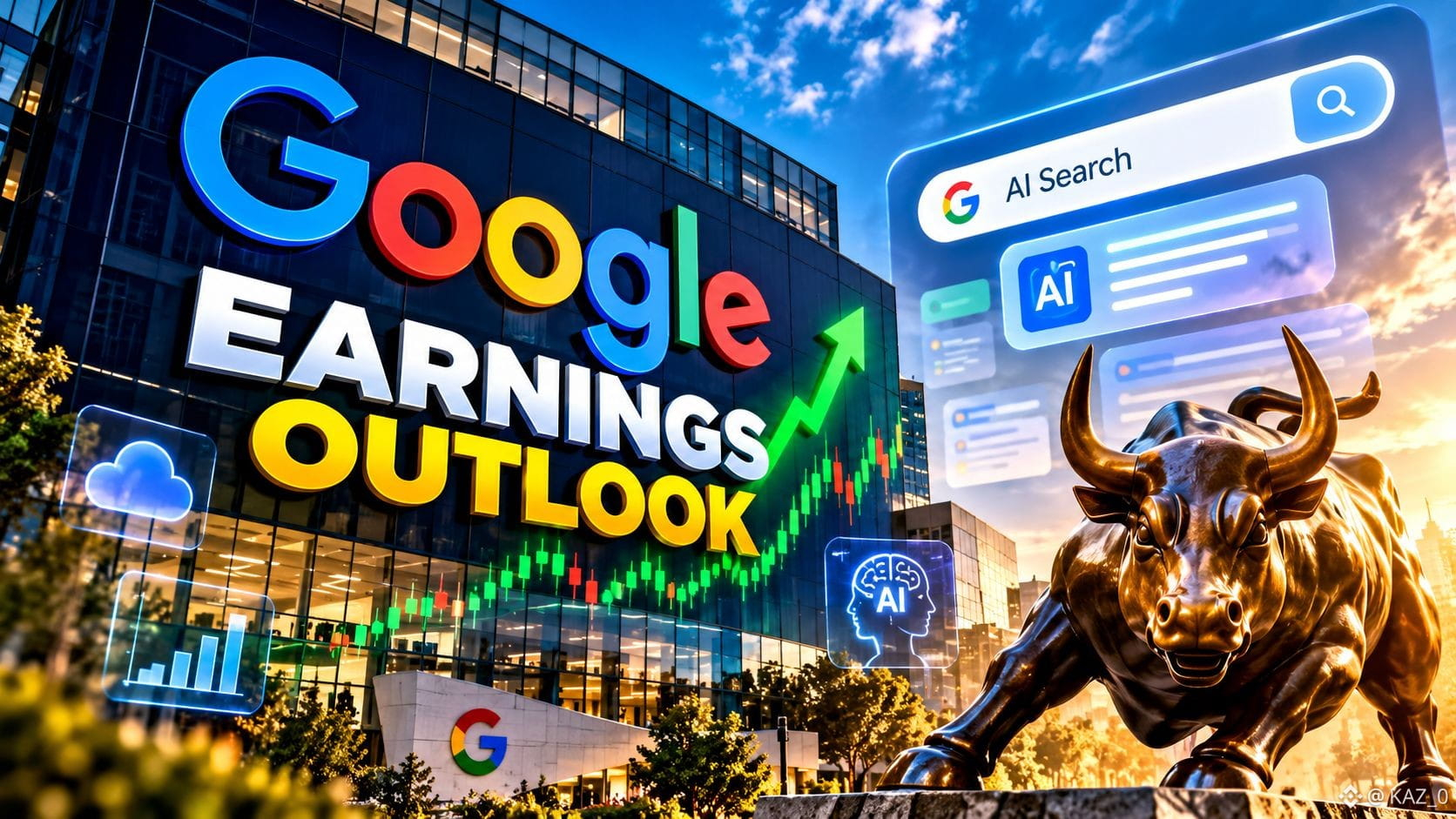
$GOOGL next earnings report could be more interesting than many people expect. For me, the biggest question is simple. Can Google keep its Search business strong while more people start using AI tools to find answers?
Google is already bringing AI into Search. That could help people find information faster and keep them using its services. But there is another side to this. If users start getting answers directly from AI instead of clicking on traditional search results, advertisers may begin to think differently. That is something worth watching closely.
This time, the market is also paying attention to revenue growth and Google Cloud. Estimates from Visible Alpha put Alphabet’s third-quarter revenue at around $127.86 billion and Google Cloud revenue at roughly $29.15 billion. These are analyst estimates, not confirmed results.
Honestly, I think three things matter most in this report. Is Search advertising still growing? Is Google Cloud gaining momentum? And is the company spending too much on AI infrastructure before seeing enough returns?
My view is that Google still has strong advantages, including its huge user base and advertising business. But investors will want more than promises about AI. They want to see real growth and better business results.
If Google delivers strong numbers and gives a positive outlook, $GOOGL could react well. However, if results disappoint or management raises concerns about future growth, the stock could face pressure.
I would not rush into a trade just because earnings are coming. I would rather wait for the actual numbers and see how the market reacts.
What do you think? Can Google protect its core Search business as AI changes the way people find information?
#CanGoogleDefindItsCore #EarningsSeason
1
662

#CanGoogleDefindItsCore #EarningsSeason
$GOOGL vs $MSFT: AI Is Booming. But Will the Profits Justify the Bill?
Wall Street is about to get a crucial test of the AI trade. Both companies are expected to report earnings on October 28, after the US market closes.
Here’s what I’m watching 👇
📊 The numbers to beat
🔹 Alphabet ($GOOGL) • Expected revenue: $127.9B • Expected EPS: ~$3.02 • Google Cloud growth forecast: 95.1% YoY
🔹 Microsoft ($MSFT) • Expected revenue: $90.6B • Expected EPS: ~$4.72 • Azure growth forecast: 47.7%
These are analyst expectations, not reported results.
⚔️ The real battle isn't revenue alone
Google's challenge is proving that explosive cloud growth can translate into sustainable profits while AI infrastructure spending rises.
Microsoft faces a similar test: can Azure and AI services keep accelerating fast enough to justify massive investments in data centers?
📈 My thesis
I'm watching Google's Cloud margins and Search resilience against Microsoft's Azure growth and AI monetization.
A revenue or EPS beat may not be enough. If spending rises faster than the returns it generates, even strong earnings could disappoint the market.
My prediction: Both companies have a credible path to strong results, but guidance and AI profitability will determine which stock earns the stronger reaction.
Which one will deliver the bigger upside surprise: $GOOGLB
{spot}(GOOGLBUSDT)
or $MSFTB
{spot}(MSFTBUSDT)
? And which has more to prove?
#CanGoogleDefindItsCore #EarningsSeason
$GOOGL vs $MSFT: AI Is Booming. But Will the Profits Justify the Bill?
Wall Street is about to get a crucial test of the AI trade. Both companies are expected to report earnings on October 28, after the US market closes.
Here’s what I’m watching 👇
📊 The numbers to beat
🔹 Alphabet ($GOOGL ) • Expected revenue: $127.9B • Expected EPS: ~$3.02 • Google Cloud growth forecast: 95.1% YoY
🔹 Microsoft ($MSFT) • Expected revenue: $90.6B • Expected EPS: ~$4.72 • Azure growth forecast: 47.7%
These are analyst expectations, not reported results.
⚔️ The real battle isn't revenue alone
Google's challenge is proving that explosive cloud growth can translate into sustainable profits while AI infrastructure spending rises.
Microsoft faces a similar test: can Azure and AI services keep accelerating fast enough to justify massive investments in data centers?
📈 My thesis
I'm watching Google's Cloud margins and Search resilience against Microsoft's Azure growth and AI monetization.
A revenue or EPS beat may not be enough. If spending rises faster than the returns it generates, even strong earnings could disappoint the market.
My prediction: Both companies have a credible path to strong results, but guidance and AI profitability will determine which stock earns the stronger reaction.
Which one will deliver the bigger upside surprise: $GOOGLB
or $MSFTB
? And which has more to prove?
339

Статья
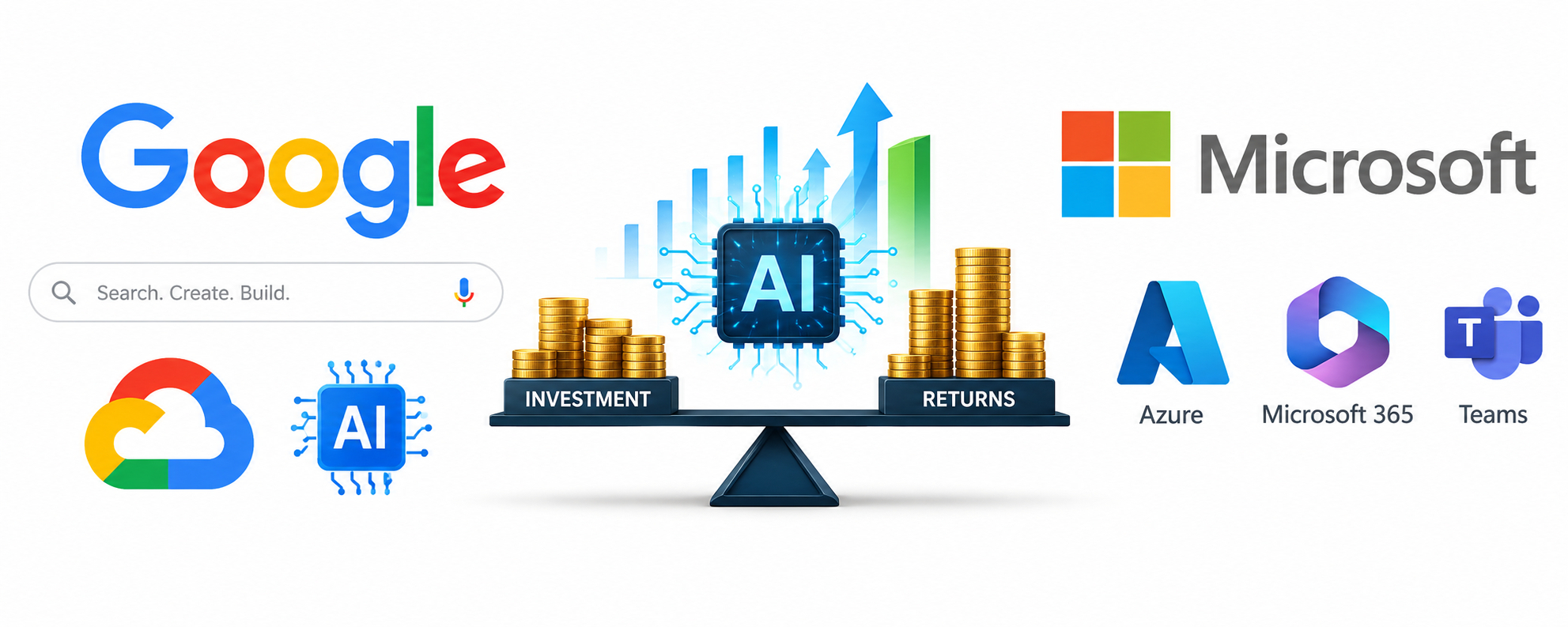
oogle & Microsoft Earnings: The AI Profitability Test BeginsGoogle and Microsoft enter this earnings session with one big question hanging over them: how much money can they actually make from the AI boom?
Both companies are spending heavily to build the infrastructure behind artificial intelligence, and investors want to see more than impressive technology or ambitious promises. They want proof that all this investment is turning into real revenue, stronger profits and sustainable growth.
Google has a business that millions of people use every day, often without thinking twice about it. From searching for products to watching YouTube videos, its services remain deeply connected to everyday life. But the way people find information is changing. AI tools can now answer questions, compare options and summarize information without requiring users to click through multiple search results. That creates new opportunities for Google, but it also raises questions about the future of its traditional advertising business.
Google Cloud could help balance that pressure. Businesses need computing power, storage and AI infrastructure to build their own products, and Google is competing for a growing share of that demand. Strong cloud growth would give investors another reason to believe the company can expand beyond its core search business. Still, revenue growth is only part of the picture. Building and operating data centers costs serious money, and investors will want to know whether that spending is producing worthwhile returns.
Microsoft faces a similar challenge, although its position is different. Its software is already part of everyday business operations, giving it a direct route to introduce AI tools to companies that want employees to work more efficiently. An AI assistant that helps prepare reports, analyze documents or write code has genuine value when it saves time and improves results. The real question is whether customers see enough benefit to keep paying for these services and expand their use.
Azure is central to that story. As businesses develop and deploy AI applications, they need more computing capacity, creating an opportunity for Microsoft to grow its cloud business. But meeting that demand requires investment in data centers, chips, electricity and other infrastructure. If costs rise too quickly, strong revenue growth may not translate into the kind of profits investors expect.
That is why this earnings session could produce some surprising stock reactions. A company can beat analysts' estimates and still see its shares fall if management signals slower growth, higher spending or weaker margins ahead. Markets are looking beyond the latest quarter and trying to work out whether today's AI investments will generate enough money in the years to come.
The expectations are already substantial. Before the reports, analyst estimates put Alphabet's quarterly revenue around $128 billion and Microsoft's around $90.6 billion. These are forecasts, not confirmed results, and even a small difference between expectations and actual performance could influence the market's reaction.
For Google, I would pay close attention to search advertising, Google Cloud growth and the cost of expanding its AI capabilities. For Microsoft, Azure demand, paid AI adoption and cash flow deserve particular attention. The details in management's outlook may matter just as much as the earnings figures themselves.
Both companies have strong businesses and clear opportunities, but neither gets a free pass simply because AI is attracting enormous investment. Investors need evidence that customers are willing to pay for these services and that the revenue can grow without costs eating away at the returns.
My view is that Google and Microsoft both have a credible chance of delivering solid results, but the bigger question is which company can demonstrate the clearest path from AI investment to lasting profitability. A strong earnings report would be encouraging. A strong report backed by convincing guidance and better visibility into future returns would be far more meaningful.
This is where the market's attention should stay. The AI race is no longer just about who can build the most powerful technology. It is about who can turn that technology into a business that consistently makes money.
The next set of results may offer a clearer answer, but the real test will be what happens after the headlines fade.
This is pre-earnings market commentary based on analyst expectations available on October 28, 2026. Forecasts are not confirmed results, and this article is for informational purposes only.
#EarningsSeason #CanGoogleDefindItsCore #FOMCWatch
$UNI $ZEC $BANK
oogle & Microsoft Earnings: The AI Profitability Test Begins
Google and Microsoft enter this earnings session with one big question hanging over them: how much money can they actually make from the AI boom?
Both companies are spending heavily to build the infrastructure behind artificial intelligence, and investors want to see more than impressive technology or ambitious promises. They want proof that all this investment is turning into real revenue, stronger profits and sustainable growth.
Google has a business that millions of people use every day, often without thinking twice about it. From searching for products to watching YouTube videos, its services remain deeply connected to everyday life. But the way people find information is changing. AI tools can now answer questions, compare options and summarize information without requiring users to click through multiple search results. That creates new opportunities for Google, but it also raises questions about the future of its traditional advertising business.
Google Cloud could help balance that pressure. Businesses need computing power, storage and AI infrastructure to build their own products, and Google is competing for a growing share of that demand. Strong cloud growth would give investors another reason to believe the company can expand beyond its core search business. Still, revenue growth is only part of the picture. Building and operating data centers costs serious money, and investors will want to know whether that spending is producing worthwhile returns.
Microsoft faces a similar challenge, although its position is different. Its software is already part of everyday business operations, giving it a direct route to introduce AI tools to companies that want employees to work more efficiently. An AI assistant that helps prepare reports, analyze documents or write code has genuine value when it saves time and improves results. The real question is whether customers see enough benefit to keep paying for these services and expand their use.
Azure is central to that story. As businesses develop and deploy AI applications, they need more computing capacity, creating an opportunity for Microsoft to grow its cloud business. But meeting that demand requires investment in data centers, chips, electricity and other infrastructure. If costs rise too quickly, strong revenue growth may not translate into the kind of profits investors expect.
That is why this earnings session could produce some surprising stock reactions. A company can beat analysts' estimates and still see its shares fall if management signals slower growth, higher spending or weaker margins ahead. Markets are looking beyond the latest quarter and trying to work out whether today's AI investments will generate enough money in the years to come.
The expectations are already substantial. Before the reports, analyst estimates put Alphabet's quarterly revenue around $128 billion and Microsoft's around $90.6 billion. These are forecasts, not confirmed results, and even a small difference between expectations and actual performance could influence the market's reaction.
For Google, I would pay close attention to search advertising, Google Cloud growth and the cost of expanding its AI capabilities. For Microsoft, Azure demand, paid AI adoption and cash flow deserve particular attention. The details in management's outlook may matter just as much as the earnings figures themselves.
Both companies have strong businesses and clear opportunities, but neither gets a free pass simply because AI is attracting enormous investment. Investors need evidence that customers are willing to pay for these services and that the revenue can grow without costs eating away at the returns.
My view is that Google and Microsoft both have a credible chance of delivering solid results, but the bigger question is which company can demonstrate the clearest path from AI investment to lasting profitability. A strong earnings report would be encouraging. A strong report backed by convincing guidance and better visibility into future returns would be far more meaningful.
This is where the market's attention should stay. The AI race is no longer just about who can build the most powerful technology. It is about who can turn that technology into a business that consistently makes money.
The next set of results may offer a clearer answer, but the real test will be what happens after the headlines fade.
This is pre-earnings market commentary based on analyst expectations available on October 28, 2026. Forecasts are not confirmed results, and this article is for informational purposes only.
#EarningsSeason #CanGoogleDefindItsCore #FOMCWatch
$UNI $ZEC $BANK
66

·
--
$GOOGLB
{spot}(GOOGLBUSDT)
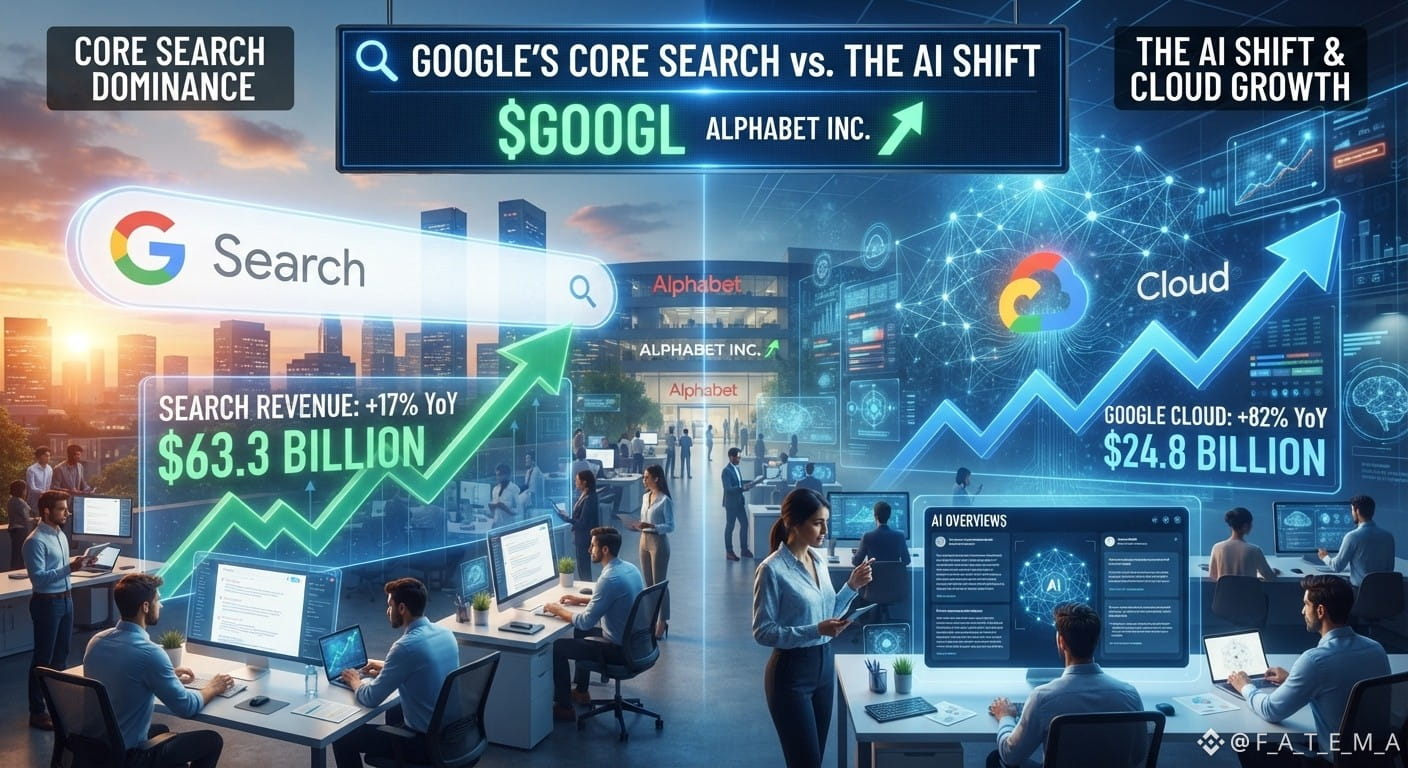
🔍 Google's Core Search vs. The AI Shift $GOOGL
Skeptics predicted AI tools would cannibalize Google's core business, but the numbers tell a different story. Alphabet's Search & other revenue recently hit $63.3 billion (+17% YoY), proving that advertising growth is holding strong even in the AI Overviews era. Coupled with Google Cloud surging 82% YoY to $24.8 billion,
Alphabet is proving its heavy AI pivot is paying off.
Can Google successfully defend and expand its search dominance against next-gen AI competitors? Drop your analysis below!
#CanGoogleDefindItsCore #GOOGL
$GOOGLB
🔍 Google's Core Search vs. The AI Shift $GOOGL
Skeptics predicted AI tools would cannibalize Google's core business, but the numbers tell a different story. Alphabet's Search & other revenue recently hit $63.3 billion (+17% YoY), proving that advertising growth is holding strong even in the AI Overviews era. Coupled with Google Cloud surging 82% YoY to $24.8 billion,
Alphabet is proving its heavy AI pivot is paying off.
Can Google successfully defend and expand its search dominance against next-gen AI competitors? Drop your analysis below!
#CanGoogleDefindItsCore #GOOGL
1
226
#CanGoogleDefindItsCore
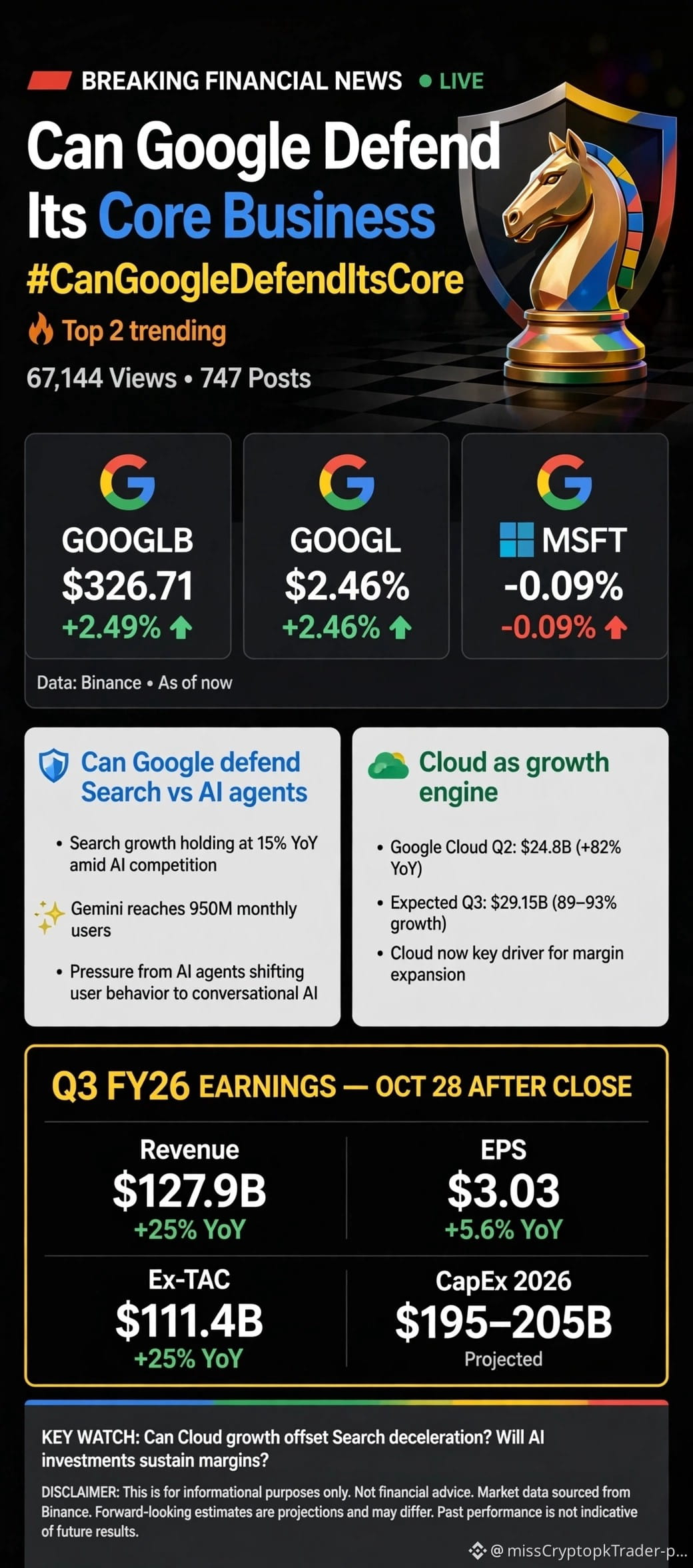
📈 Binance Data: $GOOGLB $326.71 +2.49% | GOOGL +2.46% | MSFT -0.09%
67,144 Views • 747 Post
Q3 FY26 Earnings - Oct 28 After Close
Revenue: $127.9B (+25% YoY) | EPS: $3.03 (+5.6%)
Ex-TAC: $111.4B | CapEx 2026: $195-205B
☁️ Cloud as Growth Engine:
Q2 $24.8B +82% → Q3 expected $29.15B +89-93%
Now key driver for margin expansion
🛡️ Can Google Defend Search vs AI Agents?
Search holding 15% YoY, Gemini 950M MAU
But AI agents shifting user behavior to conversational AI
Will Cloud growth offset Search deceleration?
#CanGoogleDefindItsCore $GOOGL #Google #Earnings $MSFT
94

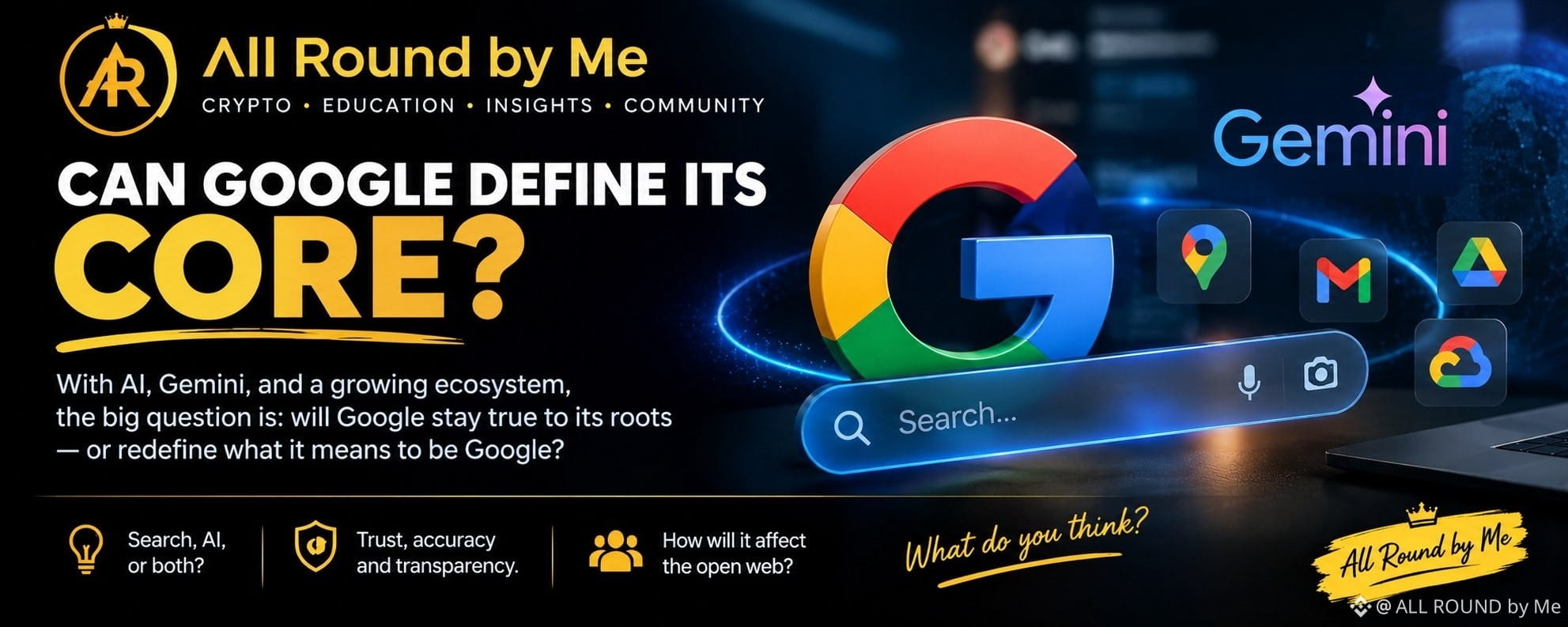
#CanGoogleDefindItsCore I think Google's biggest strength has always been helping people find the information they need. But with AI changing how we search, I’m curious to see how Google defines its core in the years ahead. 🤔
Gemini, AI Overviews, and AI-powered Search are exciting developments. Still, I think the real challenge is making sure people get reliable answers while keeping access to useful original sources.
For me, Google’s future isn't just about adding more AI features. It's about making information easier to understand without losing accuracy, transparency, or user trust.
And there's another interesting question: as AI answers become more common, how will websites and content creators continue to get discovered and receive traffic?
I can see a lot of potential, but the balance between AI convenience and the open web will be important.
What do you think Google's core should be in the AI era: Search, AI, or a combination of both? 👇
— All Round by Me
#CanGoogleDefineItsCore #GoogleAI #Gemini #Technology
41

·
--
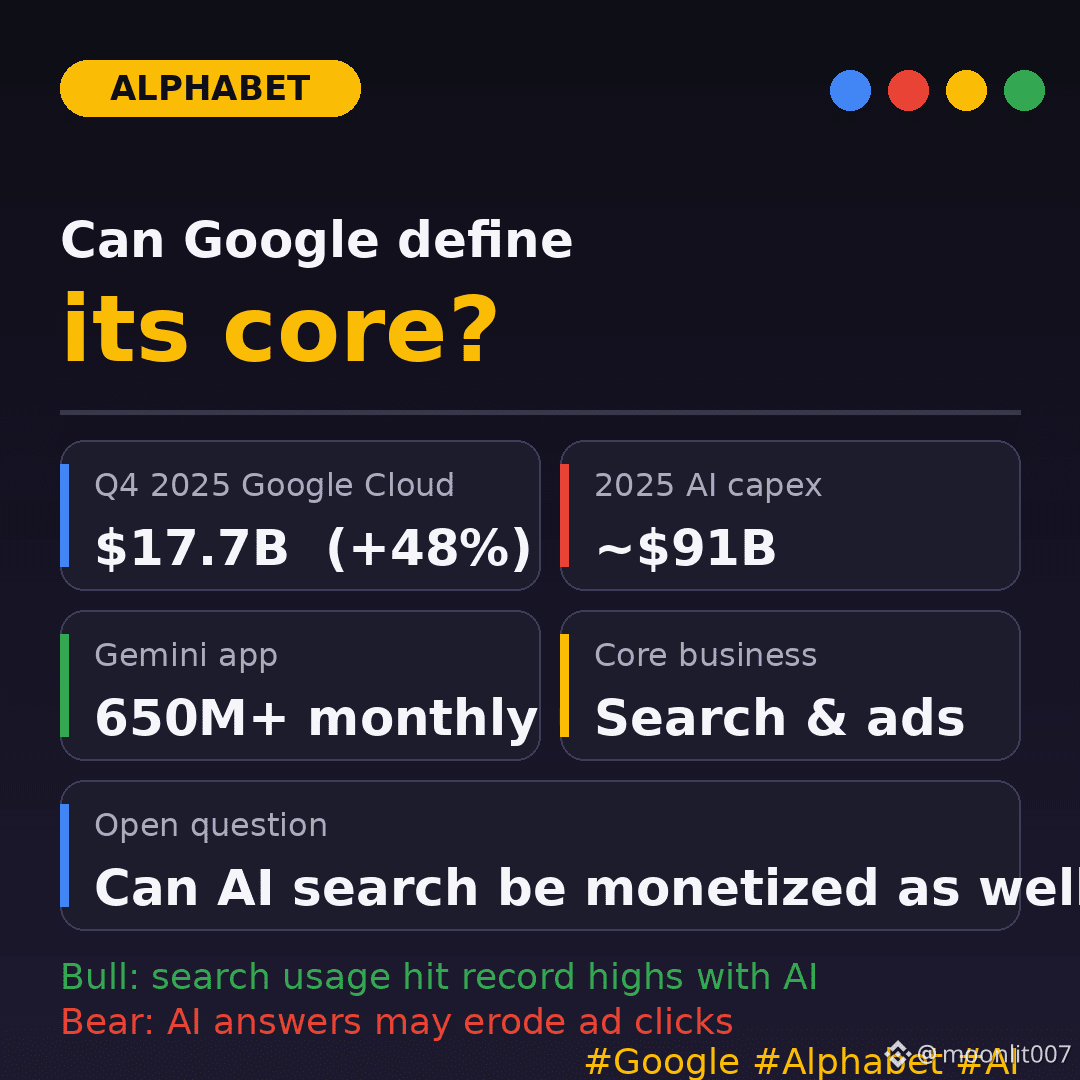
🔍 Can Google define its core?
Search is still Google’s cash engine, but AI is reshaping what that core looks like. Search usage hit record levels recently, and Google is building Gemini into Search, Gmail, and Chrome.
📊 Where the numbers stand:
Google Cloud revenue reached $17.7B in the latest quarter, up 48% Alphabet spent about $91B on capex last year, mostly on AI The Gemini app has over 650 million monthly users
⚖️ The open question: AI answers can keep people in the results page instead of sending them to websites, so the ad business has to adapt. Whether AI search earns as much per query as classic search is still unproven.
#CanGoogleDefindItsCore #googl
$GOOGL
{future}(GOOGLUSDT)
$msft
{future}(MSFTUSDT)
🔍 Can Google define its core?
Search is still Google’s cash engine, but AI is reshaping what that core looks like. Search usage hit record levels recently, and Google is building Gemini into Search, Gmail, and Chrome.
📊 Where the numbers stand:
Google Cloud revenue reached $17.7B in the latest quarter, up 48% Alphabet spent about $91B on capex last year, mostly on AI The Gemini app has over 650 million monthly users
⚖️ The open question: AI answers can keep people in the results page instead of sending them to websites, so the ad business has to adapt. Whether AI search earns as much per query as classic search is still unproven.
#CanGoogleDefindItsCore #googl
$GOOGL
$msft
100

·
--
Статья
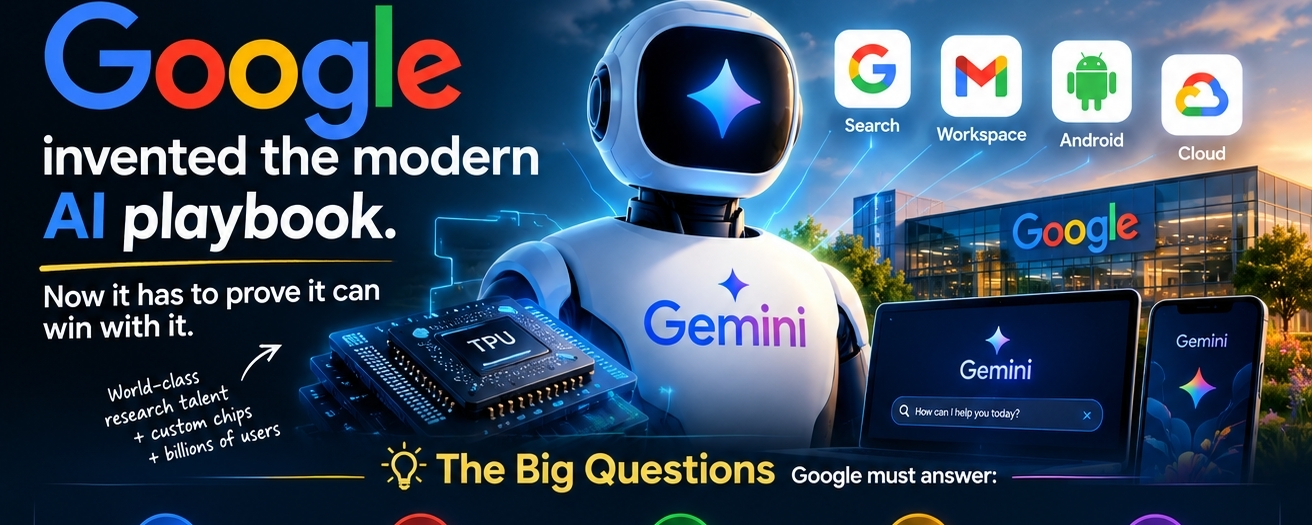
🚀 Google invented the modern AI playbook. Now it has to prove it can win with it.#CanMicrosoftDeliverOnAI
Google moved early, and it moved deep: Gemini across Search, Workspace, Android and Cloud; world-class research talent; custom chips; and billions of users who already live inside its products. On paper, few companies are better positioned. 📈
But execution is where the story gets complicated. 🤔
The big questions Google must answer:
🔹 Can AI and Search coexist? Search funds almost everything Google does. If AI answers reduce clicks, how does Google protect its ad engine while reinventing the product people use every day?
🔹 Can it move fast without breaking trust? Users and enterprises want powerful AI, but they also want accuracy, privacy and responsible behavior. One viral mistake can undo months of progress. 🔐
🔹 Can AI feel useful, not just impressive? A flashy demo gets applause. A tool that saves ten minutes every single day earns loyalty. 💡
🔹 Can it turn research leadership into product leadership? Being first in the lab is not the same as being first in people's habits. 🧠
🔹 Can it win the enterprise? Businesses need security, compliance, clear ROI and reliable support. Cloud customers will pay for outcomes, not hype. 💼
The real challenge: from innovation to adoption ⚙️
Google doesn't just need to ship smarter models. It needs to show that AI delivers measurable value at scale, in a form people can understand, afford and trust. Large user bases help, but they don't guarantee adoption. People switch when something is clearly better, not just newer.
What the winners will have in common 🏆
✅ Reliability: AI that works consistently, not just occasionally brilliantly
✅ Affordability: pricing that makes sense for individuals and businesses
✅ Integration: AI built into daily workflows, not bolted on as an extra tab
✅ Trust: transparent, secure and responsible by design
✅ Speed with discipline: shipping fast while staying accountable
The takeaway 🎯
The AI race won't be won by the loudest launch event or the biggest benchmark score. It will be won by the company that makes AI dependable, affordable and truly embedded in how people work, search, create and decide.
Google has the talent, the data, the infrastructure and the distribution. Now comes the harder part: proving that scale can become trust, and trust can become lasting value. 🌍✨
What do you think: who is best placed to win the AI race? 👇💬
#ArtificialIntelligence #Google #Gemini #TechStrategy #FutureOfWork
---
$GOOGLB
{spot}(GOOGLBUSDT)
#CanGoogleDefindItsCore #FOMCWatch #EthereumDropsBelow$2300 #BitcoinSlipsBelow$80KAgain
🚀 Google invented the modern AI playbook. Now it has to prove it can win with it.
#CanMicrosoftDeliverOnAI
Google moved early, and it moved deep: Gemini across Search, Workspace, Android and Cloud; world-class research talent; custom chips; and billions of users who already live inside its products. On paper, few companies are better positioned. 📈
But execution is where the story gets complicated. 🤔
The big questions Google must answer:
🔹 Can AI and Search coexist? Search funds almost everything Google does. If AI answers reduce clicks, how does Google protect its ad engine while reinventing the product people use every day?
🔹 Can it move fast without breaking trust? Users and enterprises want powerful AI, but they also want accuracy, privacy and responsible behavior. One viral mistake can undo months of progress. 🔐
🔹 Can AI feel useful, not just impressive? A flashy demo gets applause. A tool that saves ten minutes every single day earns loyalty. 💡
🔹 Can it turn research leadership into product leadership? Being first in the lab is not the same as being first in people's habits. 🧠
🔹 Can it win the enterprise? Businesses need security, compliance, clear ROI and reliable support. Cloud customers will pay for outcomes, not hype. 💼
The real challenge: from innovation to adoption ⚙️
Google doesn't just need to ship smarter models. It needs to show that AI delivers measurable value at scale, in a form people can understand, afford and trust. Large user bases help, but they don't guarantee adoption. People switch when something is clearly better, not just newer.
What the winners will have in common 🏆
✅ Reliability: AI that works consistently, not just occasionally brilliantly
✅ Affordability: pricing that makes sense for individuals and businesses
✅ Integration: AI built into daily workflows, not bolted on as an extra tab
✅ Trust: transparent, secure and responsible by design
✅ Speed with discipline: shipping fast while staying accountable
The takeaway 🎯
The AI race won't be won by the loudest launch event or the biggest benchmark score. It will be won by the company that makes AI dependable, affordable and truly embedded in how people work, search, create and decide.
Google has the talent, the data, the infrastructure and the distribution. Now comes the harder part: proving that scale can become trust, and trust can become lasting value. 🌍✨
What do you think: who is best placed to win the AI race? 👇💬
#ArtificialIntelligence #Google #Gemini #TechStrategy #FutureOfWork
---
$GOOGLB
#CanGoogleDefindItsCore #FOMCWatch #EthereumDropsBelow$2300 #BitcoinSlipsBelow$80KAgain
1
100

·
--
经过搜索,谷歌近期在核心业务定义上确实有所调整。2023年,谷歌宣布将人工智能(AI)作为其核心战略,据谷歌财报显示,AI相关支出已占全年研发预算的40%,远超传统搜索技术的投入。此外,谷歌在AI领域的研究成果显著,仅在2023年上半年,其AI专利申请量就达到了500项,同比增长25%。这些数据表明,谷歌正积极将业务重心转向AI,以应对日益激烈的市场竞争和技术的快速迭代。
谷歌的这一战略转型也引起了业界的广泛关注。分析师预计,到2025年,AI业务将贡献谷歌总收入的30%。这一数字反映了市场对谷歌未来发展的期待和信心。与此同时,谷歌也在努力平衡传统业务和新兴业务的关系,确保其多元化发展。
#CanGoogleDefindItsCore
$BTC
谷歌的这一战略转型也引起了业界的广泛关注。分析师预计,到2025年,AI业务将贡献谷歌总收入的30%。这一数字反映了市场对谷歌未来发展的期待和信心。与此同时,谷歌也在努力平衡传统业务和新兴业务的关系,确保其多元化发展。
#CanGoogleDefindItsCore
$BTC
30

·
--
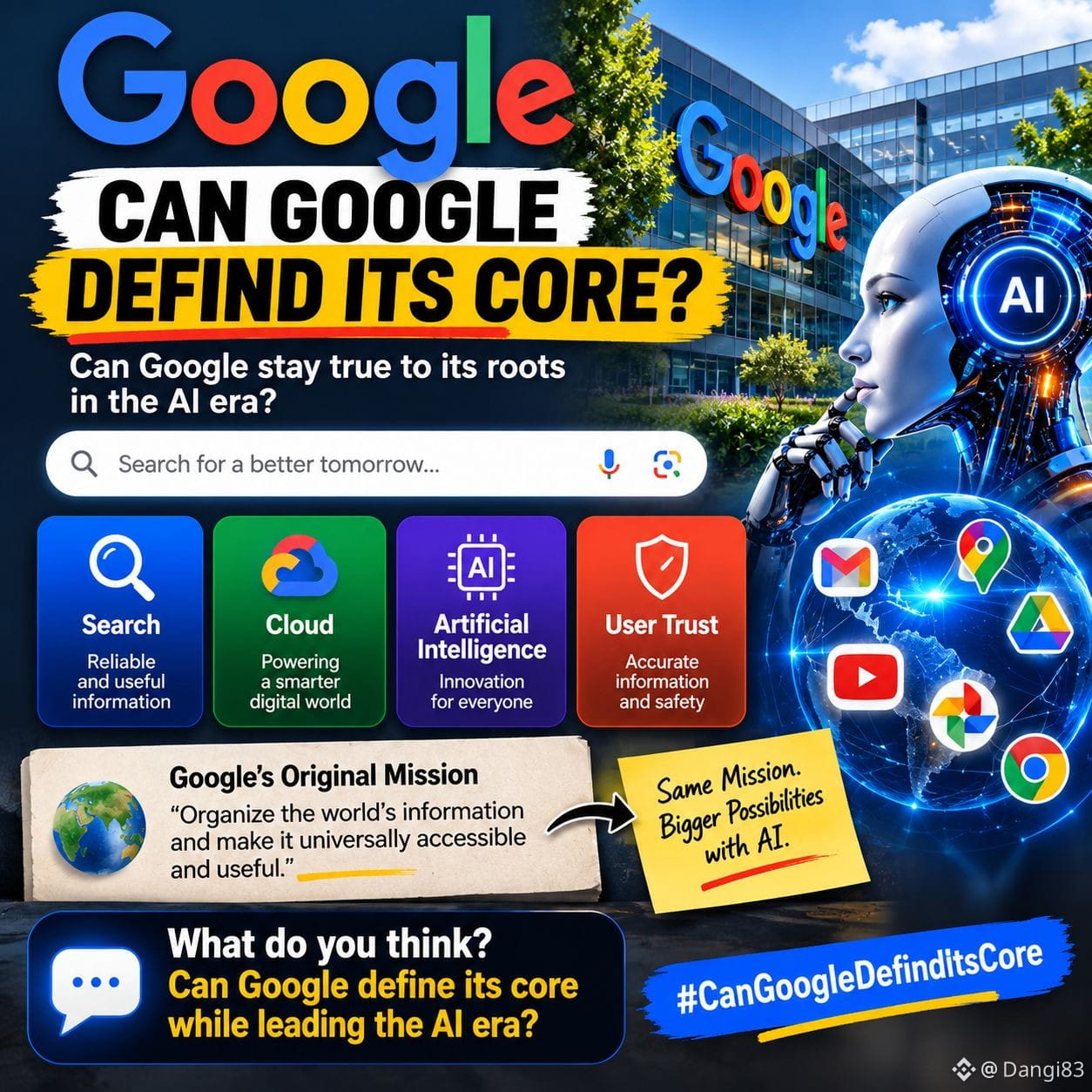
🔍 #CanGoogleDefindItsCore — Can Google Stay True to Its Roots?
Google started with a simple mission: organize the world's information and make it universally accessible and useful. 🌍💡
Today, AI is transforming search, cloud computing, and the entire digital ecosystem. 🤖🚀
But the big question is: Can Google embrace the AI revolution while protecting the core values that made it successful?
💡 What matters most?
✅ Reliable and useful search results
✅ Accurate information and user trust
✅ Responsible AI innovation
✅ A better experience for everyone
Innovation is important, but trust is the foundation of long-term success.
What do you think? Can Google define its core while leading the AI era? 👇
#Google #AI #ArtificialIntelligence #Technology $GOOGL $BTC $ETH
149

·
--
Google was once the most powerful search engine, having one of the best businesses on the internet through search and advertising, but AI is creeping into the shadows.
People have now turned against Google and started asking AI questions; it's like Google's prime is dimming.
Google has the advantage of its massive user base, powerful advertising tools, Gemini, and cloud.
The challenge is there are many new powerful AI tools. Will Google hold on to the race
The real question is can Google turn AI into a new advanced engine without losing its prime Aura?
Drop Your POV...
$GOOGLB
{spot}(GOOGLBUSDT)
#cangoogledefinditscore
Google was once the most powerful search engine, having one of the best businesses on the internet through search and advertising, but AI is creeping into the shadows.
People have now turned against Google and started asking AI questions; it's like Google's prime is dimming.
Google has the advantage of its massive user base, powerful advertising tools, Gemini, and cloud.
The challenge is there are many new powerful AI tools. Will Google hold on to the race
The real question is can Google turn AI into a new advanced engine without losing its prime Aura?
Drop Your POV...
$GOOGLB
#cangoogledefinditscore
4
3.2k

#CanGoogleDefindItsCore
Yes, but "defending" may cost it the old model.
Search is still the core. In Q3 2025, Google Search brought in $56.6B of Alphabet's $102.3B total revenue, so more than half of the company still depends on one product.
The bear case is that AI answers reduce clicks, and clicks are what advertisers pay for. A chatbot that fully answers a question gives Google nothing to sell against.
The bull case is distribution. Google already has the users, Chrome, Android and the ad relationships. It can put AI into the search page and then place ads inside AI answers. Recent results back this up: Search revenue kept growing (about 15% YoY in the latest report I found) even as AI tools spread.
My view: Google will defend the product but may not defend its margins. The open question is whether an AI answer earns as much per query as ten blue links. Nobody outside Google can verify that today.
What would change my mind:
• Search revenue growth turns negative while query volume rises
• Ad pricing per AI answer falls well below traditional results
• Apple or Samsung move their default search away from Google
207

·
--
Google is losing its center and that is great for crypto
Everyone talks about searches and ads breaking down
This panic tells me traditional moats are dying fast
Traders need to watch where real utility goes next
Old giants losing focus means capital flows elsewhere
I am staying completely out of this specific narrative
Noise about tech identity helps nobody trade better
A sudden surge in ad revenue would completely prove me wrong
Agree or not
#CanGoogleDefindItsCore #CryptoNews
15

·
--
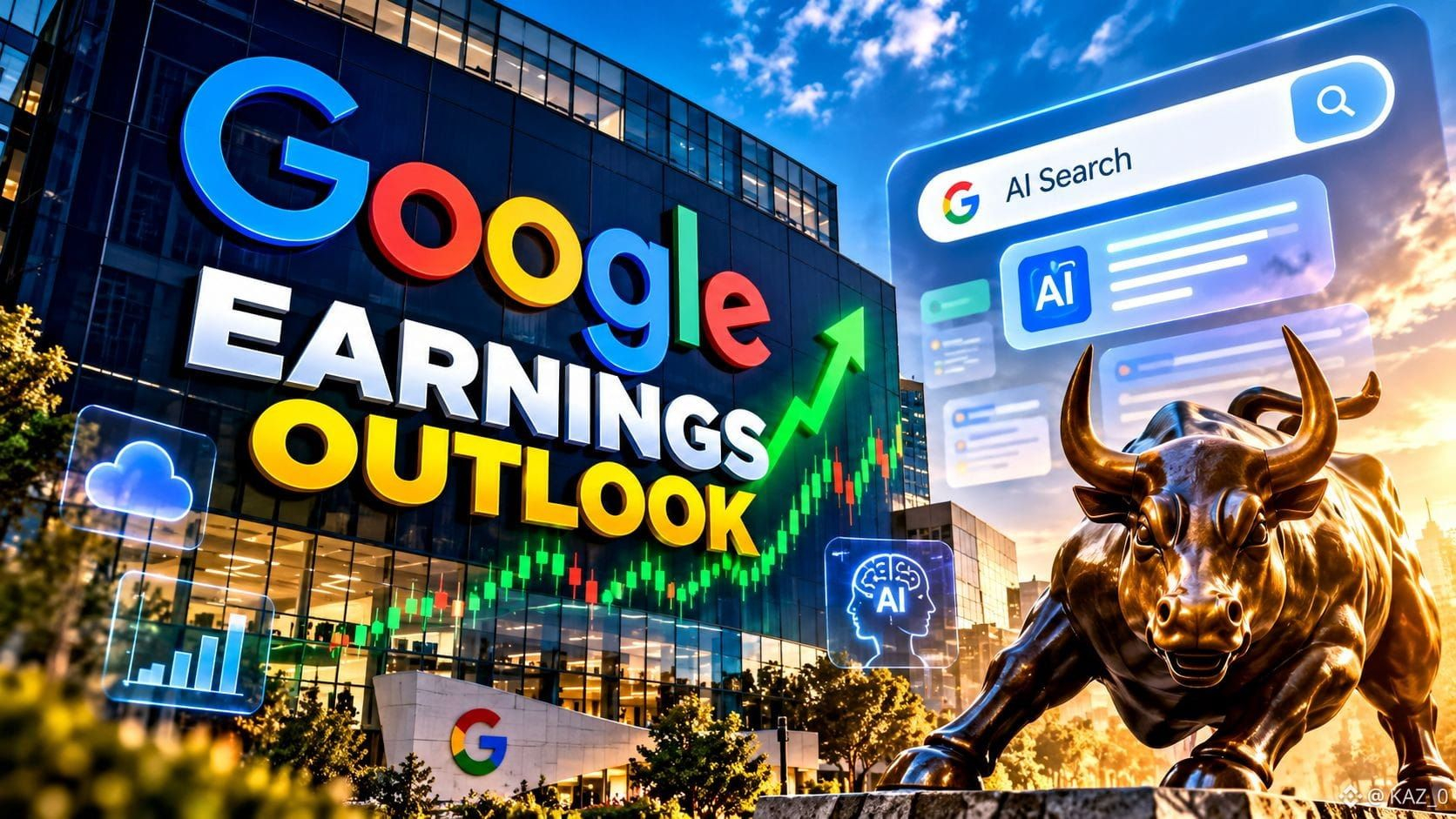
#cangoogledefinditscore
Google peut-il défendre sa domination dans la recherche à l’ère de l’IA ? 🔍🤖
Alors que de plus en plus d’utilisateurs se tournent directement vers les chatbots d’IA et les assistants intelligents pour obtenir des réponses, la grande question pour Alphabet ($GOOGL) est claire : comment la publicité liée à la recherche principale résistera-t-elle à l’évolution des habitudes des utilisateurs ? 📊💡
Alors que Gemini et les intégrations de l’IA se développent rapidement, le maintien des revenus publicitaires et de l’engagement des utilisateurs reste le test ultime. Google parviendra-t-il à protéger sa position dominante, ou la nouvelle vague de recherche par IA va-t-elle remodeler le paysage technologique ?
Quelles sont vos prévisions de résultats ? Partagez vos réflexions ci-dessous ! 👇💬
$EVAA
{future}(EVAAUSDT)
$BTW
{future}(BTWUSDT)
$GOOGL
{future}(GOOGLUSDT)
#cangoogledefinditscore
Google peut-il défendre sa domination dans la recherche à l’ère de l’IA ? 🔍🤖
Alors que de plus en plus d’utilisateurs se tournent directement vers les chatbots d’IA et les assistants intelligents pour obtenir des réponses, la grande question pour Alphabet ($GOOGL ) est claire : comment la publicité liée à la recherche principale résistera-t-elle à l’évolution des habitudes des utilisateurs ? 📊💡
Alors que Gemini et les intégrations de l’IA se développent rapidement, le maintien des revenus publicitaires et de l’engagement des utilisateurs reste le test ultime. Google parviendra-t-il à protéger sa position dominante, ou la nouvelle vague de recherche par IA va-t-elle remodeler le paysage technologique ?
Quelles sont vos prévisions de résultats ? Partagez vos réflexions ci-dessous ! 👇💬
$EVAA
$BTW
$GOOGL
1
4.7k

#CanGoogleDefendItsCore
🌐 **GOOGLE vs AI: CAN THE TECH GIANT DEFEND ITS TRILLION-DOLLAR EMPIRE?** 🤖📉
Google faces one of the biggest challenges in its history as artificial intelligence transforms the digital world.
🔍 **1️⃣ SEARCH DOMINANCE UNDER THREAT**
Google dominates traditional search, but AI-powered platforms like ChatGPT are changing how users find information.
⚠️ Could AI disrupt Google's advertising empire?
🤖 **2️⃣ GEMINI: GOOGLE'S SECRET WEAPON**
Google is investing heavily in Gemini AI, cloud computing, and AI-powered search.
✅ Powerful global ecosystem
✅ Advanced AI infrastructure
✅ Massive advertising network
✅ Growing cloud opportunities
💰 **3️⃣ FINANCIAL OUTLOOK**
Alphabet (GOOGL) has strong revenue streams, but rising AI infrastructure costs could pressure profitability.
📊 **Key indicators:**
📈 Advertising revenue
📈 Cloud growth
📈 AI monetization
📉 Operating costs
🚀 **4️⃣ CRYPTO MARKET CONNECTION**
AI expansion could increase interest in blockchain-based computing and AI crypto projects, although token gains are never guaranteed.
🎯 **FINAL VERDICT**
🟢 **Bullish:** Google successfully integrates AI and protects advertising revenue.
🔴 **Bearish:** AI competitors capture users and weaken Google's profitability.
🔥 **THE BIG QUESTION:**
Will Google dominate the AI revolution or lose i
#CanGoogleDefindItsCore
43
·
--
Google cannot find its core anymore because AI search broke the old moat
When the search giant tries to be everything at once the product just gets heavy
Traders love chasing these big tech narratives while completely missing the chart exhaustion
This attention spike on square tells me retail is just bored waiting for real volatility
I am watching from the sidelines and doing nothing with my capital here
If search traffic actually accelerates past old highs next quarter I will admit my bias was totally wrong
Agree
#CanGoogleDefindItsCore #CryptoNews
16

·
--
#CanGoogleDefindItsCore
Can Google still define its core mission in a world where technology is changing faster than ever?
For years, Google’s mission has been simple: to organize the world’s information and make it universally accessible and useful.
But today, the internet is changing. People are no longer just searching for information — they’re asking AI to explain things, solve problems, make decisions, and even think through complex ideas with them.
That raises an important question: Is Google still focused on helping people find information, or is it becoming something much bigger?
Innovation is necessary. AI is the future, and Google has the resources and talent to shape it. But in the race to build smarter technology, the real challenge is not just staying ahead of competitors. It’s staying true to the purpose that made people trust you in the first place.
Technology can change. Products can evolve. Business models can shift.
But the core mission should remain clear.
Because at the end of the day, people don't just need more information. They need reliable answers, transparency, and technology that genuinely makes their lives easier.
So, can Google clearly define its core in this new AI-driven era — and prove it through its actions?
What do you think? Is Google staying true to its original mission, or is its core identity changing?
#Google #ArtificialIntelligence #AI #Technology #DigitalFuture
106

#BinancePick
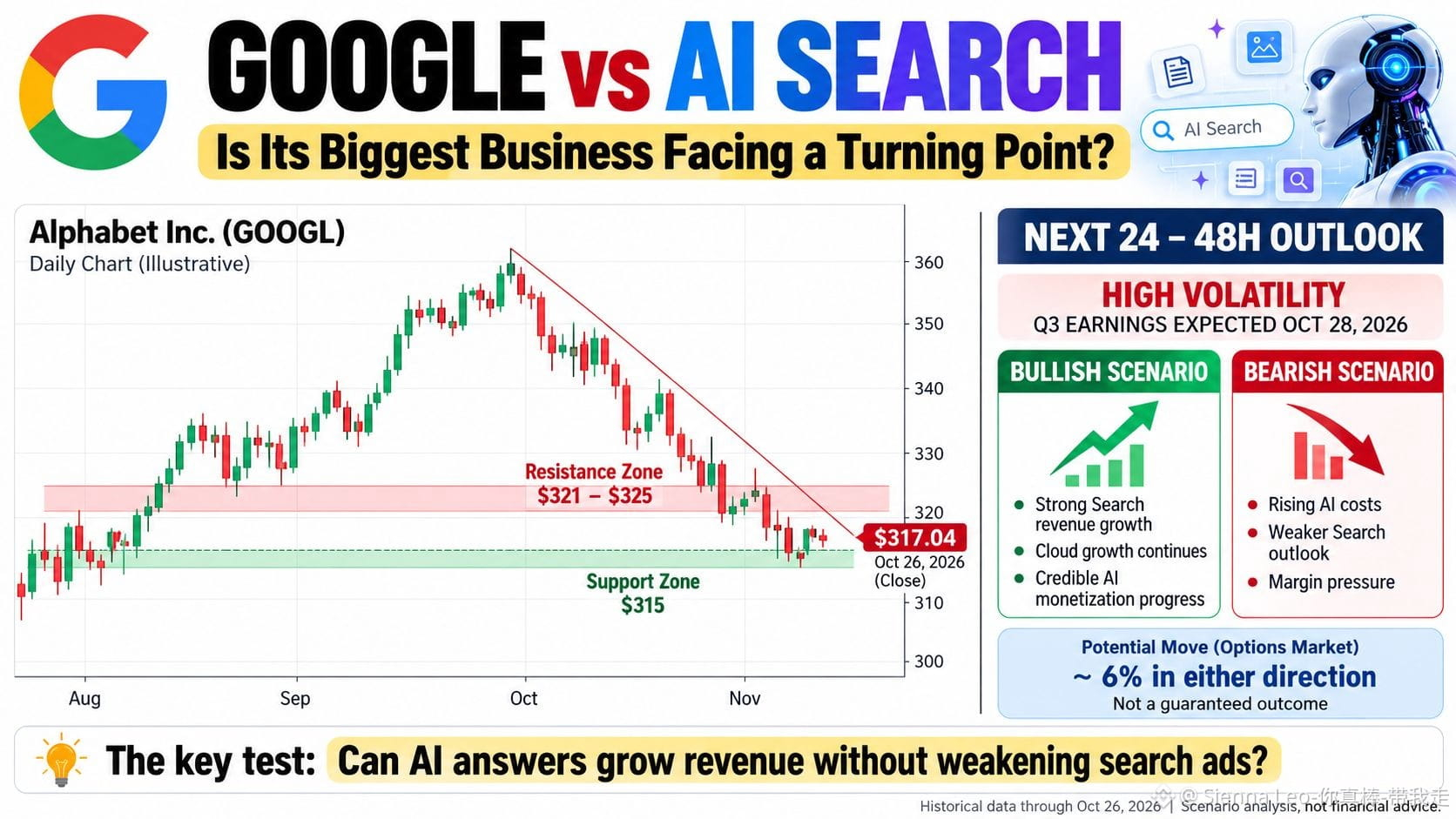
Google vs. AI Search: Is Its Biggest Business Facing a Turning Point? 🔍
The greatest threat to a giant is not always a rival. Sometimes, it is a new way of thinking.
Google built its empire by helping people find answers. But AI is changing the question: what if users no longer need to search through links?
AI-powered search tools can summarize information, compare options, and deliver direct answers. That challenges Google’s traditional search model, where advertising remains central to its business.
Yet the bigger picture matters.
In Q2 2026, Alphabet reported $119.8 billion in revenue, up 24% year over year, while Google Search and Other revenue grew 17%. AI has not erased its growth story. The real test is whether Google can monetize AI answers without weakening its advertising engine.
GOOGL Price: Approximately $320.04 during trading on October 27, 2026, at 11:16 a.m. ET.
Prediction | Next 24–48 Hours: Alphabet’s Q3 earnings, expected October 28, could trigger significant volatility. Strong search revenue, cloud growth, and credible AI monetization could support a rebound. Weak guidance, rising AI costs, or evidence of pressure on search economics could push shares lower. Options markets have indicated a potential move of roughly 6% in either direction, not a guaranteed outcome.
Traders may find opportunities in either direction, but chasing earnings volatility without risk management can turn a promising setup into a costly mistake.
The real battle is not Google versus AI. It is whether Google can reinvent search before user behavior leaves it behind.
Can Google turn AI into its next growth engine, or will AI rewrite its business model? 💭
For educational purposes only. Not financial advice.
#GrowWithSAC #EarningsSeason #CanGoogleDefindItsCore #CanMicrosoftDeliverOnAI $GOOGL $GOOGLB
2
237

Проверено
#CanGoogleDefindItsCore ❔
Google is a company under Alphabet, while Alphabet is the parent company.
Alphabet - the publicly traded parent company that owns $GOOGLB and other businesses.
Google - Alphabet’s largest business, covering Search, YouTube, Android, Google Cloud, and advertising.
$GOOGL ’s biggest strength is its biggest risk - advertising. In 2025, Alphabet generated $402.8 billion in revenue, with $294.7 billion coming from advertising. But competition, changing user behavior, and pressure on its advertising model remain key risks. #Mahanadi
{spot}(GOOGLBUSDT)
{future}(GOOGLUSDT)
#CanGoogleDefindItsCore ❔
Google is a company under Alphabet, while Alphabet is the parent company.
Alphabet - the publicly traded parent company that owns $GOOGLB and other businesses.
Google - Alphabet’s largest business, covering Search, YouTube, Android, Google Cloud, and advertising.
$GOOGL ’s biggest strength is its biggest risk - advertising. In 2025, Alphabet generated $402.8 billion in revenue, with $294.7 billion coming from advertising. But competition, changing user behavior, and pressure on its advertising model remain key risks. #Mahanadi

Question Session 🫰
От Digital Mahanadi
1
136

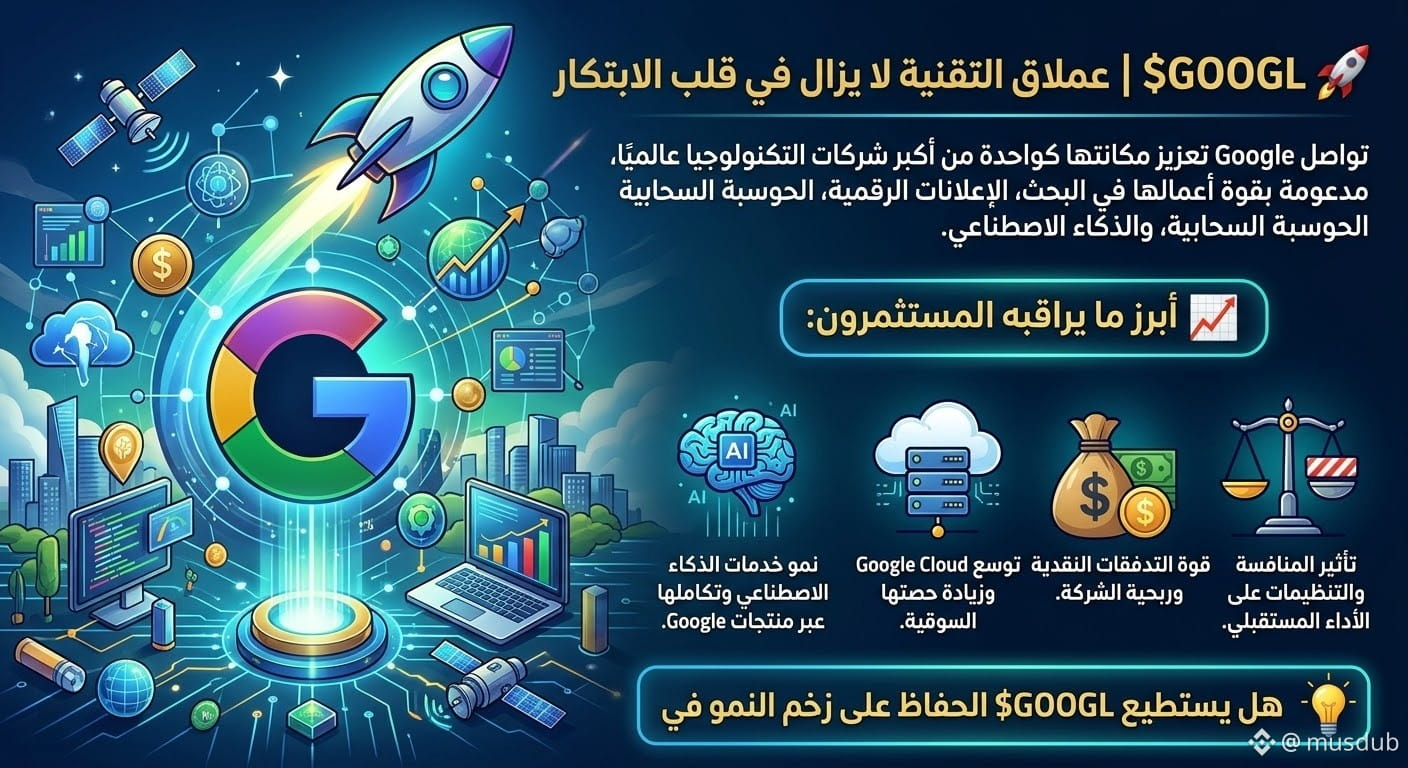
🚀 $GOOGL | عملاق التقنية لا يزال في قلب الابتكار
{future}(GOOGLUSDT)
تواصل Google تعزيز مكانتها كواحدة من أكبر شركات التكنولوجيا عالميًا، مدعومة بقوة أعمالها في البحث، الإعلانات الرقمية، الحوسبة السحابية، والذكاء الاصطناعي.
📈 أبرز ما يراقبه المستثمرون:
• نمو خدمات الذكاء الاصطناعي وتكاملها عبر منتجات Google.
• توسع Google Cloud وزيادة حصتها السوقية.
• قوة التدفقات النقدية وربحية الشركة.
• تأثير المنافسة والتنظيمات على الأداء المستقبلي.
💡 هل يستطيع $GOOGL الحفاظ على زخم النمو في عصر الذكاء الاصطناعي؟
#CanGoogleDefindItsCore #BinancePick
🚀 $GOOGL | عملاق التقنية لا يزال في قلب الابتكار
تواصل Google تعزيز مكانتها كواحدة من أكبر شركات التكنولوجيا عالميًا، مدعومة بقوة أعمالها في البحث، الإعلانات الرقمية، الحوسبة السحابية، والذكاء الاصطناعي.
📈 أبرز ما يراقبه المستثمرون:
• نمو خدمات الذكاء الاصطناعي وتكاملها عبر منتجات Google.
• توسع Google Cloud وزيادة حصتها السوقية.
• قوة التدفقات النقدية وربحية الشركة.
• تأثير المنافسة والتنظيمات على الأداء المستقبلي.
💡 هل يستطيع $GOOGL الحفاظ على زخم النمو في عصر الذكاء الاصطناعي؟
#CanGoogleDefindItsCore #BinancePick
3
1k
Войдите, чтобы посмотреть больше материала
Присоединяйтесь к пользователям криптовалют по всему миру на Binance Square
⚡️ Получайте новейшую и полезную информацию о криптоактивах.
💬 Нам доверяет крупнейшая в мире криптобиржа.
👍 Получите достоверные аналитические данные от верифицированных создателей контента.
Эл. почта/номер телефона
Связанные монеты
В тренде
1
#CanMicrosoftDeliverOnAI
Просмотров: 150,368
1,185 обсуждают
2
#CanGoogleDefindItsCore
Просмотров: 75,909
827 обсуждают
3
#FOMCWatch
Просмотров: 9.1M
28,460 обсуждают
4
#SKHynixUnveils$45BShareholderReturns
Просмотров: 87
5 обсуждают
5
#OSMOPlansToBurn100MTokensFromCommunityPool
Просмотров: 3,363
117 обсуждают
6
#EthereumDropsBelow$2300
Просмотров: 12,568
167 обсуждают
7
#BitcoinSlipsBelow$80KAgain
Просмотров: 35,634
133 обсуждают
8
#ThailandLaunchesWORPTStablecoinToQRPaymentApp
Просмотров: 78,958
935 обсуждают
9
#StrategySkipsBitcoinPurchasesSpends$205MOnSTRCBuybacks
Просмотров: 14,161
101 обсуждают
10
#BitmineAdds10452ETH
Просмотров: 131,707
1,363 обсуждают