

#bitresurrector
bitresurrector
Просмотров: 19
5 обсуждают
Популярные
Новые

Статья
Bitcoin Wallet Recovery: What Happens When Dormant BTC Wallets Become Active?Bitcoin Wallet Recovery: What Happens When Dormant BTC Wallets Become Active?
Dormant Bitcoin wallets often attract attention when an old address suddenly becomes active after years of inactivity. A transaction from an early-era wallet can raise questions about who controls the funds, why the wallet became active, and whether the Bitcoin is being moved or recovered.
Behind these events is a broader area of cryptocurrency security: Bitcoin wallet recovery.
Recovering access to an old wallet is very different from trying to guess a completely unknown private key or seed phrase. In legitimate recovery situations, the owner may still have partial information, such as known seed words, an old backup, a wallet type, or information about how the original wallet was created.
This is where specialized recovery software such as BitResurrector Professional aims to help users examine incomplete or damaged wallet backups locally.
Why Do Bitcoin Wallets Become Dormant?
Bitcoin has existed for many years, and some wallets created during its early history have not shown activity for long periods.
There are many possible reasons for a wallet to remain inactive. An owner may have lost access to an old computer, misplaced a backup, forgotten how a wallet was configured, or simply chosen to hold the Bitcoin for a long period.
An old wallet becoming active does not automatically reveal the identity or intentions of its owner. On-chain activity can show that coins moved, but additional information is normally required to understand why the transaction occurred.
The Difference Between Lost Access and a Completely Unknown Wallet
The idea of "recovering a lost Bitcoin wallet" can be misleading because different situations require very different approaches.
For example, an owner may still have:
Most of an original recovery phraseA damaged paper backupA backup containing words in an uncertain orderInformation about the wallet software previously usedAn old wallet addressKnowledge about the address format used by the wallet
These situations are fundamentally different from having no information at all.
A legitimate recovery process generally starts with information already available to the wallet owner rather than attempting to discover somebody else's credentials.
What Is BitResurrector Professional?
BitResurrector Professional is presented as a local Windows-based tool for examining certain Bitcoin wallet-recovery scenarios.
According to the product information supplied for this article, the software is designed around local processing and supports several Bitcoin address and derivation standards.
The stated approach is to allow users to work with incomplete wallet information while keeping sensitive recovery data on their own computer.
However, users should independently verify any software before using it with sensitive cryptocurrency information. A recovery application should never be treated as automatically trustworthy simply because it claims to work locally.
Local Processing and Wallet Security
One important consideration in cryptocurrency recovery is protecting sensitive information.
Seed phrases and private keys should never be shared publicly. They should also not be entered into websites, sent through messaging applications, or provided to unknown individuals.
Binance's security guidance similarly emphasizes that users should never share seed phrases or private keys and should be cautious about unknown software and suspicious recovery requests.
For this reason, local processing can be an important consideration when evaluating wallet-recovery software.
Users should still verify the software source, understand what the application does, and avoid running unknown programs on a computer containing valuable wallet information.
Supporting Different Bitcoin Address Formats
Bitcoin wallets have used different address and derivation standards over time.
Depending on the wallet and when it was created, users may encounter address formats such as:
Legacy addresses beginning with 1Nested SegWit addresses beginning with 3Native SegWit addresses beginning with bc1qTaproot addresses beginning with bc1p
A recovery process can therefore depend on knowing how the original wallet was configured.
BitResurrector's product description states that it supports multiple derivation paths, allowing users to focus their recovery work on the wallet standards relevant to their own backup.
This can be useful because testing unnecessary wallet configurations can add complexity to an already difficult recovery process.
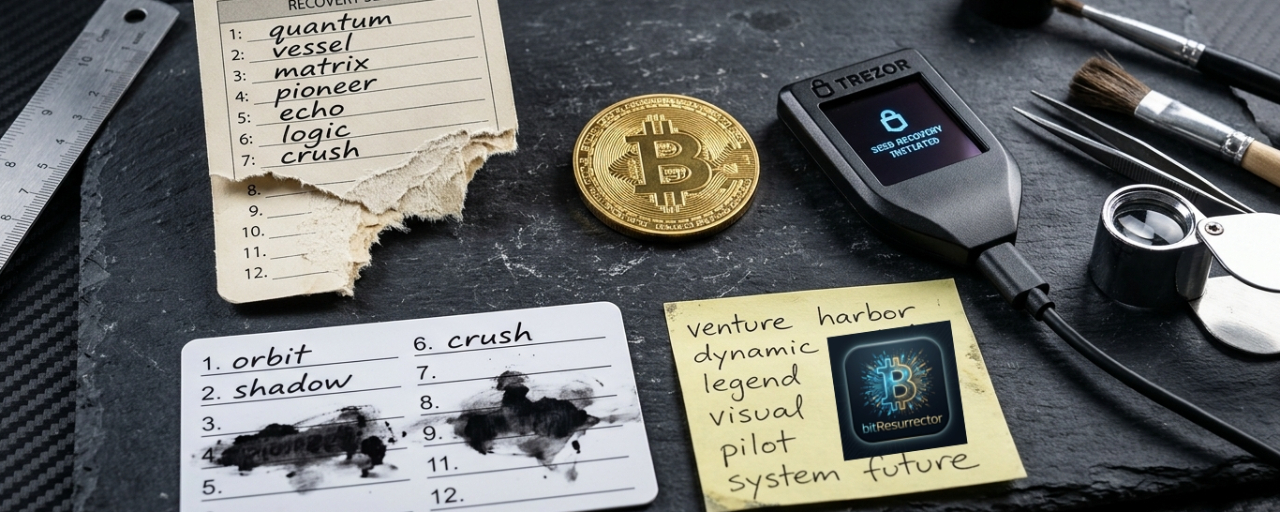
Recovering Damaged or Incomplete Backups
Physical backups can deteriorate over time.
Paper can become damaged by water, heat, or aging. Metal backups can also be lost or physically rearranged. In some cases, a wallet owner may know most of the original information but have uncertainty about one or more details.
Specialized recovery software attempts to work with these kinds of incomplete information.
BitResurrector is designed around several recovery scenarios described by its developers, including situations involving incomplete word information, uncertain ordering, and different wallet configurations.
The important point is that legitimate recovery should be based on information belonging to the wallet owner.
Why Random Seed-Guessing Is Not a Practical Recovery Strategy
A common misconception is that modern computers can simply guess any Bitcoin recovery phrase.
That is not how Bitcoin wallet security works.
A completely unknown cryptographic secret has an enormous search space. Recovery becomes more realistic only when the owner has meaningful information that reduces the possibilities.
For example, knowing most of a recovery phrase is fundamentally different from knowing nothing.
This is why wallet-recovery software focuses on identifying and testing possibilities based on information supplied by the legitimate owner rather than treating Bitcoin wallets as something that can simply be "cracked."
BitResurrector and Other Recovery Utilities
There are several categories of tools used for cryptocurrency wallet research and recovery.
Open-source projects such as BTCRecover can be useful for technically experienced users who need to investigate specific wallet-recovery scenarios.
Other utilities focus on narrower tasks, such as checking mnemonic formats or deriving addresses from known recovery information.
BitResurrector takes a different approach by presenting itself as a dedicated desktop recovery application with support for multiple wallet configurations and recovery scenarios.
Rather than claiming that one tool is universally better than another, users should choose software based on the specific recovery problem they are trying to solve, the information they already possess, and the security practices of the tool.
Important Security Precautions
Bitcoin wallet recovery requires extreme caution.
Before using any recovery software:
Never share your seed phrase or private key with another person.Do not enter recovery phrases into random websites.Verify the source of any wallet-recovery software before installing it.Avoid downloading unknown files from unsolicited messages.Keep sensitive wallet information offline whenever possible.Use recovery tools only for wallets and information you are authorized to recover.Consider testing unfamiliar software in an isolated environment before using it with sensitive information.
These precautions are especially important because scammers may use "wallet recovery" as a reason to request seed phrases, private keys, or cryptocurrency transfers. Binance has specifically warned users about recovery-phrase scams and suspicious third-party software.
The Bigger Picture: Bitcoin Security and Lost Coins
Dormant Bitcoin addresses are part of the larger story of cryptocurrency self-custody.
Unlike traditional financial accounts, self-custody places significant responsibility on the owner. Losing the information required to access a wallet can create a serious recovery problem.
At the same time, having partial backup information can sometimes make a legitimate recovery investigation possible.
Tools such as BitResurrector are designed around this type of problem: helping users work with incomplete wallet information while examining possible recovery paths locally.
The results will always depend on the information available, the original wallet configuration, and the specific recovery situation.
Final Thoughts
Old Bitcoin wallets can remain inactive for years before becoming active again. Behind some of these events may be ordinary wallet management, long-term holders, recovered backups, or changes in ownership.
Bitcoin wallet recovery is therefore less about "breaking" Bitcoin and more about carefully reconstructing information that the legitimate owner has lost or damaged.
BitResurrector Professional is one tool positioned toward this type of recovery work. Anyone considering it or another recovery utility should independently verify the software, protect sensitive wallet information, and understand the limitations of the recovery process.
Most importantly, never give a seed phrase or private key to someone claiming that they need it to recover your cryptocurrency.
Disclaimer: This article is for educational purposes only. It does not guarantee that any wallet, seed phrase, or cryptocurrency can be recovered. Users should independently verify any wallet-recovery software and never share private keys or recovery phrases with third parties.
#BTC #HODL #BitResurrector #bitcoin
Bitcoin Wallet Recovery: What Happens When Dormant BTC Wallets Become Active?
Bitcoin Wallet Recovery: What Happens When Dormant BTC Wallets Become Active?
Dormant Bitcoin wallets often attract attention when an old address suddenly becomes active after years of inactivity. A transaction from an early-era wallet can raise questions about who controls the funds, why the wallet became active, and whether the Bitcoin is being moved or recovered.
Behind these events is a broader area of cryptocurrency security: Bitcoin wallet recovery.
Recovering access to an old wallet is very different from trying to guess a completely unknown private key or seed phrase. In legitimate recovery situations, the owner may still have partial information, such as known seed words, an old backup, a wallet type, or information about how the original wallet was created.
This is where specialized recovery software such as BitResurrector Professional aims to help users examine incomplete or damaged wallet backups locally.
Why Do Bitcoin Wallets Become Dormant?
Bitcoin has existed for many years, and some wallets created during its early history have not shown activity for long periods.
There are many possible reasons for a wallet to remain inactive. An owner may have lost access to an old computer, misplaced a backup, forgotten how a wallet was configured, or simply chosen to hold the Bitcoin for a long period.
An old wallet becoming active does not automatically reveal the identity or intentions of its owner. On-chain activity can show that coins moved, but additional information is normally required to understand why the transaction occurred.
The Difference Between Lost Access and a Completely Unknown Wallet
The idea of "recovering a lost Bitcoin wallet" can be misleading because different situations require very different approaches.
For example, an owner may still have:
Most of an original recovery phraseA damaged paper backupA backup containing words in an uncertain orderInformation about the wallet software previously usedAn old wallet addressKnowledge about the address format used by the wallet
These situations are fundamentally different from having no information at all.
A legitimate recovery process generally starts with information already available to the wallet owner rather than attempting to discover somebody else's credentials.
What Is BitResurrector Professional?
BitResurrector Professional is presented as a local Windows-based tool for examining certain Bitcoin wallet-recovery scenarios.
According to the product information supplied for this article, the software is designed around local processing and supports several Bitcoin address and derivation standards.
The stated approach is to allow users to work with incomplete wallet information while keeping sensitive recovery data on their own computer.
However, users should independently verify any software before using it with sensitive cryptocurrency information. A recovery application should never be treated as automatically trustworthy simply because it claims to work locally.
Local Processing and Wallet Security
One important consideration in cryptocurrency recovery is protecting sensitive information.
Seed phrases and private keys should never be shared publicly. They should also not be entered into websites, sent through messaging applications, or provided to unknown individuals.
Binance's security guidance similarly emphasizes that users should never share seed phrases or private keys and should be cautious about unknown software and suspicious recovery requests.
For this reason, local processing can be an important consideration when evaluating wallet-recovery software.
Users should still verify the software source, understand what the application does, and avoid running unknown programs on a computer containing valuable wallet information.
Supporting Different Bitcoin Address Formats
Bitcoin wallets have used different address and derivation standards over time.
Depending on the wallet and when it was created, users may encounter address formats such as:
Legacy addresses beginning with 1Nested SegWit addresses beginning with 3Native SegWit addresses beginning with bc1qTaproot addresses beginning with bc1p
A recovery process can therefore depend on knowing how the original wallet was configured.
BitResurrector's product description states that it supports multiple derivation paths, allowing users to focus their recovery work on the wallet standards relevant to their own backup.
This can be useful because testing unnecessary wallet configurations can add complexity to an already difficult recovery process.
Recovering Damaged or Incomplete Backups
Physical backups can deteriorate over time.
Paper can become damaged by water, heat, or aging. Metal backups can also be lost or physically rearranged. In some cases, a wallet owner may know most of the original information but have uncertainty about one or more details.
Specialized recovery software attempts to work with these kinds of incomplete information.
BitResurrector is designed around several recovery scenarios described by its developers, including situations involving incomplete word information, uncertain ordering, and different wallet configurations.
The important point is that legitimate recovery should be based on information belonging to the wallet owner.
Why Random Seed-Guessing Is Not a Practical Recovery Strategy
A common misconception is that modern computers can simply guess any Bitcoin recovery phrase.
That is not how Bitcoin wallet security works.
A completely unknown cryptographic secret has an enormous search space. Recovery becomes more realistic only when the owner has meaningful information that reduces the possibilities.
For example, knowing most of a recovery phrase is fundamentally different from knowing nothing.
This is why wallet-recovery software focuses on identifying and testing possibilities based on information supplied by the legitimate owner rather than treating Bitcoin wallets as something that can simply be "cracked."
BitResurrector and Other Recovery Utilities
There are several categories of tools used for cryptocurrency wallet research and recovery.
Open-source projects such as BTCRecover can be useful for technically experienced users who need to investigate specific wallet-recovery scenarios.
Other utilities focus on narrower tasks, such as checking mnemonic formats or deriving addresses from known recovery information.
BitResurrector takes a different approach by presenting itself as a dedicated desktop recovery application with support for multiple wallet configurations and recovery scenarios.
Rather than claiming that one tool is universally better than another, users should choose software based on the specific recovery problem they are trying to solve, the information they already possess, and the security practices of the tool.
Important Security Precautions
Bitcoin wallet recovery requires extreme caution.
Before using any recovery software:
Never share your seed phrase or private key with another person.Do not enter recovery phrases into random websites.Verify the source of any wallet-recovery software before installing it.Avoid downloading unknown files from unsolicited messages.Keep sensitive wallet information offline whenever possible.Use recovery tools only for wallets and information you are authorized to recover.Consider testing unfamiliar software in an isolated environment before using it with sensitive information.
These precautions are especially important because scammers may use "wallet recovery" as a reason to request seed phrases, private keys, or cryptocurrency transfers. Binance has specifically warned users about recovery-phrase scams and suspicious third-party software.
The Bigger Picture: Bitcoin Security and Lost Coins
Dormant Bitcoin addresses are part of the larger story of cryptocurrency self-custody.
Unlike traditional financial accounts, self-custody places significant responsibility on the owner. Losing the information required to access a wallet can create a serious recovery problem.
At the same time, having partial backup information can sometimes make a legitimate recovery investigation possible.
Tools such as BitResurrector are designed around this type of problem: helping users work with incomplete wallet information while examining possible recovery paths locally.
The results will always depend on the information available, the original wallet configuration, and the specific recovery situation.
Final Thoughts
Old Bitcoin wallets can remain inactive for years before becoming active again. Behind some of these events may be ordinary wallet management, long-term holders, recovered backups, or changes in ownership.
Bitcoin wallet recovery is therefore less about "breaking" Bitcoin and more about carefully reconstructing information that the legitimate owner has lost or damaged.
BitResurrector Professional is one tool positioned toward this type of recovery work. Anyone considering it or another recovery utility should independently verify the software, protect sensitive wallet information, and understand the limitations of the recovery process.
Most importantly, never give a seed phrase or private key to someone claiming that they need it to recover your cryptocurrency.
Disclaimer: This article is for educational purposes only. It does not guarantee that any wallet, seed phrase, or cryptocurrency can be recovered. Users should independently verify any wallet-recovery software and never share private keys or recovery phrases with third parties.
#BTC #HODL #BitResurrector #bitcoin
Dormant Bitcoin wallets often attract attention when an old address suddenly becomes active after years of inactivity. A transaction from an early-era wallet can raise questions about who controls the funds, why the wallet became active, and whether the Bitcoin is being moved or recovered.
Behind these events is a broader area of cryptocurrency security: Bitcoin wallet recovery.
Recovering access to an old wallet is very different from trying to guess a completely unknown private key or seed phrase. In legitimate recovery situations, the owner may still have partial information, such as known seed words, an old backup, a wallet type, or information about how the original wallet was created.
This is where specialized recovery software such as BitResurrector Professional aims to help users examine incomplete or damaged wallet backups locally.
Why Do Bitcoin Wallets Become Dormant?
Bitcoin has existed for many years, and some wallets created during its early history have not shown activity for long periods.
There are many possible reasons for a wallet to remain inactive. An owner may have lost access to an old computer, misplaced a backup, forgotten how a wallet was configured, or simply chosen to hold the Bitcoin for a long period.
An old wallet becoming active does not automatically reveal the identity or intentions of its owner. On-chain activity can show that coins moved, but additional information is normally required to understand why the transaction occurred.
The Difference Between Lost Access and a Completely Unknown Wallet
The idea of "recovering a lost Bitcoin wallet" can be misleading because different situations require very different approaches.
For example, an owner may still have:
Most of an original recovery phraseA damaged paper backupA backup containing words in an uncertain orderInformation about the wallet software previously usedAn old wallet addressKnowledge about the address format used by the wallet
These situations are fundamentally different from having no information at all.
A legitimate recovery process generally starts with information already available to the wallet owner rather than attempting to discover somebody else's credentials.
What Is BitResurrector Professional?
BitResurrector Professional is presented as a local Windows-based tool for examining certain Bitcoin wallet-recovery scenarios.
According to the product information supplied for this article, the software is designed around local processing and supports several Bitcoin address and derivation standards.
The stated approach is to allow users to work with incomplete wallet information while keeping sensitive recovery data on their own computer.
However, users should independently verify any software before using it with sensitive cryptocurrency information. A recovery application should never be treated as automatically trustworthy simply because it claims to work locally.
Local Processing and Wallet Security
One important consideration in cryptocurrency recovery is protecting sensitive information.
Seed phrases and private keys should never be shared publicly. They should also not be entered into websites, sent through messaging applications, or provided to unknown individuals.
Binance's security guidance similarly emphasizes that users should never share seed phrases or private keys and should be cautious about unknown software and suspicious recovery requests.
For this reason, local processing can be an important consideration when evaluating wallet-recovery software.
Users should still verify the software source, understand what the application does, and avoid running unknown programs on a computer containing valuable wallet information.
Supporting Different Bitcoin Address Formats
Bitcoin wallets have used different address and derivation standards over time.
Depending on the wallet and when it was created, users may encounter address formats such as:
Legacy addresses beginning with 1Nested SegWit addresses beginning with 3Native SegWit addresses beginning with bc1qTaproot addresses beginning with bc1p
A recovery process can therefore depend on knowing how the original wallet was configured.
BitResurrector's product description states that it supports multiple derivation paths, allowing users to focus their recovery work on the wallet standards relevant to their own backup.
This can be useful because testing unnecessary wallet configurations can add complexity to an already difficult recovery process.
Recovering Damaged or Incomplete Backups
Physical backups can deteriorate over time.
Paper can become damaged by water, heat, or aging. Metal backups can also be lost or physically rearranged. In some cases, a wallet owner may know most of the original information but have uncertainty about one or more details.
Specialized recovery software attempts to work with these kinds of incomplete information.
BitResurrector is designed around several recovery scenarios described by its developers, including situations involving incomplete word information, uncertain ordering, and different wallet configurations.
The important point is that legitimate recovery should be based on information belonging to the wallet owner.
Why Random Seed-Guessing Is Not a Practical Recovery Strategy
A common misconception is that modern computers can simply guess any Bitcoin recovery phrase.
That is not how Bitcoin wallet security works.
A completely unknown cryptographic secret has an enormous search space. Recovery becomes more realistic only when the owner has meaningful information that reduces the possibilities.
For example, knowing most of a recovery phrase is fundamentally different from knowing nothing.
This is why wallet-recovery software focuses on identifying and testing possibilities based on information supplied by the legitimate owner rather than treating Bitcoin wallets as something that can simply be "cracked."
BitResurrector and Other Recovery Utilities
There are several categories of tools used for cryptocurrency wallet research and recovery.
Open-source projects such as BTCRecover can be useful for technically experienced users who need to investigate specific wallet-recovery scenarios.
Other utilities focus on narrower tasks, such as checking mnemonic formats or deriving addresses from known recovery information.
BitResurrector takes a different approach by presenting itself as a dedicated desktop recovery application with support for multiple wallet configurations and recovery scenarios.
Rather than claiming that one tool is universally better than another, users should choose software based on the specific recovery problem they are trying to solve, the information they already possess, and the security practices of the tool.
Important Security Precautions
Bitcoin wallet recovery requires extreme caution.
Before using any recovery software:
Never share your seed phrase or private key with another person.Do not enter recovery phrases into random websites.Verify the source of any wallet-recovery software before installing it.Avoid downloading unknown files from unsolicited messages.Keep sensitive wallet information offline whenever possible.Use recovery tools only for wallets and information you are authorized to recover.Consider testing unfamiliar software in an isolated environment before using it with sensitive information.
These precautions are especially important because scammers may use "wallet recovery" as a reason to request seed phrases, private keys, or cryptocurrency transfers. Binance has specifically warned users about recovery-phrase scams and suspicious third-party software.
The Bigger Picture: Bitcoin Security and Lost Coins
Dormant Bitcoin addresses are part of the larger story of cryptocurrency self-custody.
Unlike traditional financial accounts, self-custody places significant responsibility on the owner. Losing the information required to access a wallet can create a serious recovery problem.
At the same time, having partial backup information can sometimes make a legitimate recovery investigation possible.
Tools such as BitResurrector are designed around this type of problem: helping users work with incomplete wallet information while examining possible recovery paths locally.
The results will always depend on the information available, the original wallet configuration, and the specific recovery situation.
Final Thoughts
Old Bitcoin wallets can remain inactive for years before becoming active again. Behind some of these events may be ordinary wallet management, long-term holders, recovered backups, or changes in ownership.
Bitcoin wallet recovery is therefore less about "breaking" Bitcoin and more about carefully reconstructing information that the legitimate owner has lost or damaged.
BitResurrector Professional is one tool positioned toward this type of recovery work. Anyone considering it or another recovery utility should independently verify the software, protect sensitive wallet information, and understand the limitations of the recovery process.
Most importantly, never give a seed phrase or private key to someone claiming that they need it to recover your cryptocurrency.
Disclaimer: This article is for educational purposes only. It does not guarantee that any wallet, seed phrase, or cryptocurrency can be recovered. Users should independently verify any wallet-recovery software and never share private keys or recovery phrases with third parties.
#BTC #HODL #BitResurrector #bitcoin
1
147
Войдите, чтобы посмотреть больше материала
Присоединяйтесь к пользователям криптовалют по всему миру на Binance Square
⚡️ Получайте новейшую и полезную информацию о криптоактивах.
💬 Нам доверяет крупнейшая в мире криптобиржа.
👍 Получите достоверные аналитические данные от верифицированных создателей контента.
Эл. почта/номер телефона
В тренде
1
#BinanceKZ
Просмотров: 9,237
52 обсуждают
2
#EarningsSeason
Просмотров: 123,318
1,156 обсуждают
3
#BitwiseLaunchesFirstSpotNEARETF
Просмотров: 73
27 обсуждают
4
#USJobOpeningsFallToFiveMonthLow
Просмотров: 90
30 обсуждают
5
#ECBToTestAIAgentsInDigitalEuroPayments
Просмотров: 5,333
235 обсуждают
6
#JapanFSABacksFourthStablecoinTradeSettlementPilot
Просмотров: 6,576
300 обсуждают
7
#BitgetHackerFailsToMoveStolenFunds
Просмотров: 18,329
434 обсуждают
8
#BitMineETHHoldingsTop6Million
Просмотров: 18,990
576 обсуждают
9
#StrategyAdds1666BTCHoldingsReach847666
Просмотров: 15,467
407 обсуждают
10
#NvidiaApproves$150BBuyback
Просмотров: 3,853
65 обсуждают