

#tradingmath
tradingmath
Просмотров: 3,127
14 обсуждают
Популярные
Новые

·
--
The market doesn't reward being right. It rewards being right and sizing correctly.
You can have a 70% win rate and still blow up if your losses are 3x your wins in dollar terms. Conversely, a 40% win rate with a 3:1 reward/risk ratio compounds well.
Expected value = (win rate × avg win) − (loss rate × avg loss)
Run the math on your last 20 trades. The result tells you more than any chart pattern.
#TradingMath #RiskManagement #Crypto
The market doesn't reward being right. It rewards being right and sizing correctly.
You can have a 70% win rate and still blow up if your losses are 3x your wins in dollar terms. Conversely, a 40% win rate with a 3:1 reward/risk ratio compounds well.
Expected value = (win rate × avg win) − (loss rate × avg loss)
Run the math on your last 20 trades. The result tells you more than any chart pattern.
#TradingMath #RiskManagement #Crypto
You can have a 70% win rate and still blow up if your losses are 3x your wins in dollar terms. Conversely, a 40% win rate with a 3:1 reward/risk ratio compounds well.
Expected value = (win rate × avg win) − (loss rate × avg loss)
Run the math on your last 20 trades. The result tells you more than any chart pattern.
#TradingMath #RiskManagement #Crypto
2

РИСК И СУММА СДЕЛКИ: МАТЕМАТИКА, КОТОРАЯ СПАСЕТ ТВОЙ ДЕПОЗИТ С УЧЕТОМ КОМИССИЙ 🛡️🧮
Многие трейдеры считают риск на коленке, забывая про проскальзывание и комиссии биржи. Чтобы выжить на фьючерсах, твоя математика должна быть идеальной.
• Твой стоп-лосс должен рассчитываться от общего размера депозита (рискуешь 1% от баланса, а не от маржи сделки).
• Соотношение риска к прибыли (R:R) должно быть не менее 1:3. Это значит, что одна прибыльная сделка перекрывает три стопа.
👇 Открывай виджет SOL. Какое среднее соотношение риска к прибыли в твоей торговой системе?
#RiskManagement #TradingMath #Solana $SOL #CryptoFREEMEN
РИСК И СУММА СДЕЛКИ: МАТЕМАТИКА, КОТОРАЯ СПАСЕТ ТВОЙ ДЕПОЗИТ С УЧЕТОМ КОМИССИЙ 🛡️🧮
Многие трейдеры считают риск на коленке, забывая про проскальзывание и комиссии биржи. Чтобы выжить на фьючерсах, твоя математика должна быть идеальной.
• Твой стоп-лосс должен рассчитываться от общего размера депозита (рискуешь 1% от баланса, а не от маржи сделки).
• Соотношение риска к прибыли (R:R) должно быть не менее 1:3. Это значит, что одна прибыльная сделка перекрывает три стопа.
👇 Открывай виджет SOL. Какое среднее соотношение риска к прибыли в твоей торговой системе?
#RiskManagement #TradingMath #Solana $SOL #CryptoFREEMEN
Многие трейдеры считают риск на коленке, забывая про проскальзывание и комиссии биржи. Чтобы выжить на фьючерсах, твоя математика должна быть идеальной.
• Твой стоп-лосс должен рассчитываться от общего размера депозита (рискуешь 1% от баланса, а не от маржи сделки).
• Соотношение риска к прибыли (R:R) должно быть не менее 1:3. Это значит, что одна прибыльная сделка перекрывает три стопа.
👇 Открывай виджет SOL. Какое среднее соотношение риска к прибыли в твоей торговой системе?
#RiskManagement #TradingMath #Solana $SOL #CryptoFREEMEN
145
·
--
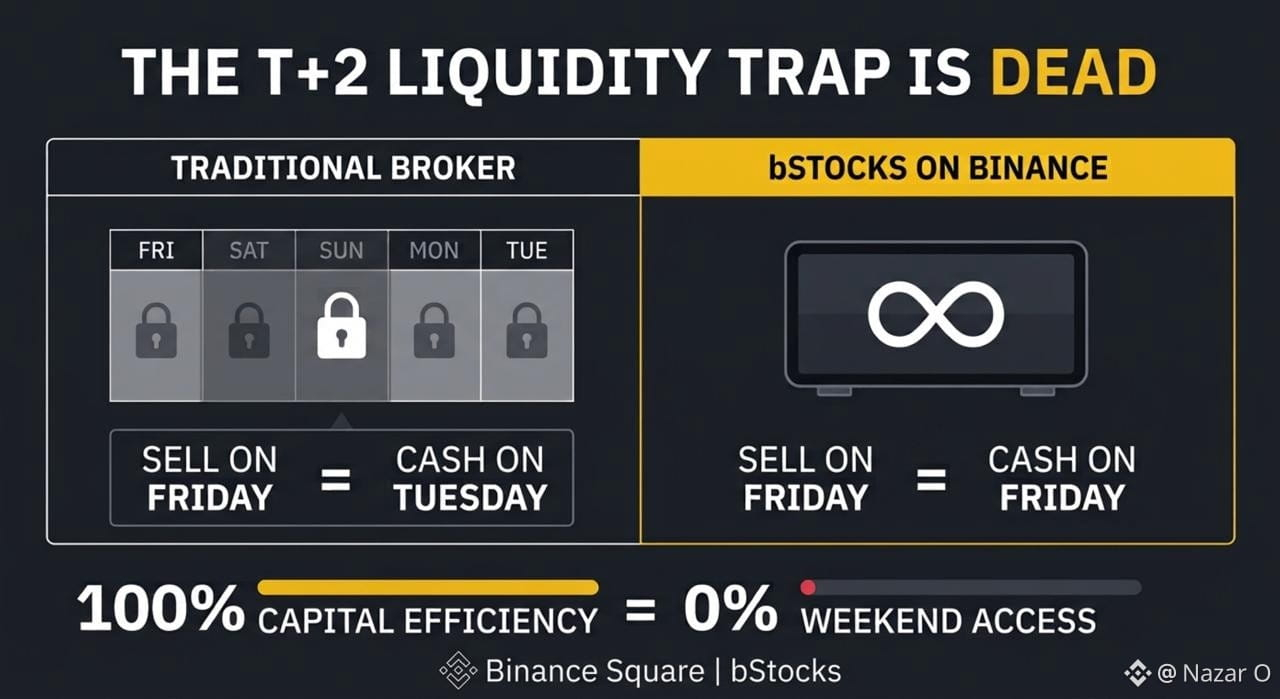
THE T+2 LIQUIDITY TRAP IS DEAD
I learned a painful lesson about liquidity last Friday night. I saw a massive dip in a major crypto asset and decided to sell a small portion of a traditional stock position to catch the entry. I hit sell, the trade executed, and then I waited. And waited.
In the old brokerage world, especially for those of us using international rails in the CIS, your money enters a black hole called T+2 settlement. My capital was legally mine, but I couldn't touch it for 48 hours. By the time the cash cleared on Tuesday morning, the crypto entry was gone.
This is exactly why I have started moving my equity exposure to bStocks. As a DeFi auditor, I hate seeing capital sit idle.
Let us look at the math of the settlement trap:
Scenario: You sell 1,000 dollars worth of a traditional stock on a Friday at 3:55 PM.
TradFi Route: The money is locked for the weekend plus two business days. You regain access on Tuesday morning. Total time locked: 64+ hours.
Opportunity Cost: If the crypto market moves 5% in your favor over that weekend, you just lost 50 dollars in potential gains simply because the banking system is slow.
bStocks Route: You sell 1,000 dollars of TSLAB for USDT. Settlement: Instant. You can swap that USDT for any crypto asset in the same minute.
The math is simple: Instant settlement means your capital efficiency is 100%. In TradFi, your capital efficiency drops significantly every time you need to rotate between assets.
I am currently holding SPCXB and NVDAB on Binance because I need my Real World Assets to move at the same speed as my crypto. I can even convert my bStocks back to direct stocks at a 1:1 ratio for free if I ever decide to go back to the slow lane, but honestly, why would I?
The 19th-century banking rules do not fit a 21st-century portfolio. If your capital cannot move 24/7, it is not truly yours.
Are you still letting brokers hold your cash hostage for two days, or have you switched to the instant settlement of bStocks?
@BinanceCIS #bstockscis #TradingMath #SpaceX $NVDAB $TSLAB
THE T+2 LIQUIDITY TRAP IS DEAD
I learned a painful lesson about liquidity last Friday night. I saw a massive dip in a major crypto asset and decided to sell a small portion of a traditional stock position to catch the entry. I hit sell, the trade executed, and then I waited. And waited.
In the old brokerage world, especially for those of us using international rails in the CIS, your money enters a black hole called T+2 settlement. My capital was legally mine, but I couldn't touch it for 48 hours. By the time the cash cleared on Tuesday morning, the crypto entry was gone.
This is exactly why I have started moving my equity exposure to bStocks. As a DeFi auditor, I hate seeing capital sit idle.
Let us look at the math of the settlement trap:
Scenario: You sell 1,000 dollars worth of a traditional stock on a Friday at 3:55 PM.
TradFi Route: The money is locked for the weekend plus two business days. You regain access on Tuesday morning. Total time locked: 64+ hours.
Opportunity Cost: If the crypto market moves 5% in your favor over that weekend, you just lost 50 dollars in potential gains simply because the banking system is slow.
bStocks Route: You sell 1,000 dollars of TSLAB for USDT. Settlement: Instant. You can swap that USDT for any crypto asset in the same minute.
The math is simple: Instant settlement means your capital efficiency is 100%. In TradFi, your capital efficiency drops significantly every time you need to rotate between assets.
I am currently holding SPCXB and NVDAB on Binance because I need my Real World Assets to move at the same speed as my crypto. I can even convert my bStocks back to direct stocks at a 1:1 ratio for free if I ever decide to go back to the slow lane, but honestly, why would I?
The 19th-century banking rules do not fit a 21st-century portfolio. If your capital cannot move 24/7, it is not truly yours.
Are you still letting brokers hold your cash hostage for two days, or have you switched to the instant settlement of bStocks?
@BinanceCIS #bstockscis #TradingMath #SpaceX $NVDAB $TSLAB
I learned a painful lesson about liquidity last Friday night. I saw a massive dip in a major crypto asset and decided to sell a small portion of a traditional stock position to catch the entry. I hit sell, the trade executed, and then I waited. And waited.
In the old brokerage world, especially for those of us using international rails in the CIS, your money enters a black hole called T+2 settlement. My capital was legally mine, but I couldn't touch it for 48 hours. By the time the cash cleared on Tuesday morning, the crypto entry was gone.
This is exactly why I have started moving my equity exposure to bStocks. As a DeFi auditor, I hate seeing capital sit idle.
Let us look at the math of the settlement trap:
Scenario: You sell 1,000 dollars worth of a traditional stock on a Friday at 3:55 PM.
TradFi Route: The money is locked for the weekend plus two business days. You regain access on Tuesday morning. Total time locked: 64+ hours.
Opportunity Cost: If the crypto market moves 5% in your favor over that weekend, you just lost 50 dollars in potential gains simply because the banking system is slow.
bStocks Route: You sell 1,000 dollars of TSLAB for USDT. Settlement: Instant. You can swap that USDT for any crypto asset in the same minute.
The math is simple: Instant settlement means your capital efficiency is 100%. In TradFi, your capital efficiency drops significantly every time you need to rotate between assets.
I am currently holding SPCXB and NVDAB on Binance because I need my Real World Assets to move at the same speed as my crypto. I can even convert my bStocks back to direct stocks at a 1:1 ratio for free if I ever decide to go back to the slow lane, but honestly, why would I?
The 19th-century banking rules do not fit a 21st-century portfolio. If your capital cannot move 24/7, it is not truly yours.
Are you still letting brokers hold your cash hostage for two days, or have you switched to the instant settlement of bStocks?
@BinanceCIS #bstockscis #TradingMath #SpaceX $NVDAB $TSLAB
1
198

Matematika Drawdown: Mengapa Kami Membatasi Risiko Maksimal 8 hingga 12 PersenKerugian portofolio bekerja secara asimetris terhadap modal tersisa. Saat modal turun 10 persen, kita memerlukan kenaikan 11,1 persen untuk kembali ke titik awal. Jika kerugian dibiarkan melebar hingga 50 persen, portofolio membutuhkan kenaikan 100 persen untuk kembali impas.
Hitungan sederhana ini menjadi dasar mengapa kami memasang batas cut loss pada penutupan lilin harian di kisaran 8 hingga 12 persen dari titik beli. Memangkas posisi yang gagal sejak dini menjaga kas USDT tetap utuh untuk dialokasikan ke setup berikutnya.
#RiskManagement #TradingMath #CapitalPreservation #BinanceSquare #DYOR
Matematika Drawdown: Mengapa Kami Membatasi Risiko Maksimal 8 hingga 12 Persen
Kerugian portofolio bekerja secara asimetris terhadap modal tersisa. Saat modal turun 10 persen, kita memerlukan kenaikan 11,1 persen untuk kembali ke titik awal. Jika kerugian dibiarkan melebar hingga 50 persen, portofolio membutuhkan kenaikan 100 persen untuk kembali impas.
Hitungan sederhana ini menjadi dasar mengapa kami memasang batas cut loss pada penutupan lilin harian di kisaran 8 hingga 12 persen dari titik beli. Memangkas posisi yang gagal sejak dini menjaga kas USDT tetap utuh untuk dialokasikan ke setup berikutnya.
#RiskManagement #TradingMath #CapitalPreservation #BinanceSquare #DYOR
Hitungan sederhana ini menjadi dasar mengapa kami memasang batas cut loss pada penutupan lilin harian di kisaran 8 hingga 12 persen dari titik beli. Memangkas posisi yang gagal sejak dini menjaga kas USDT tetap utuh untuk dialokasikan ke setup berikutnya.
#RiskManagement #TradingMath #CapitalPreservation #BinanceSquare #DYOR
120
·
--
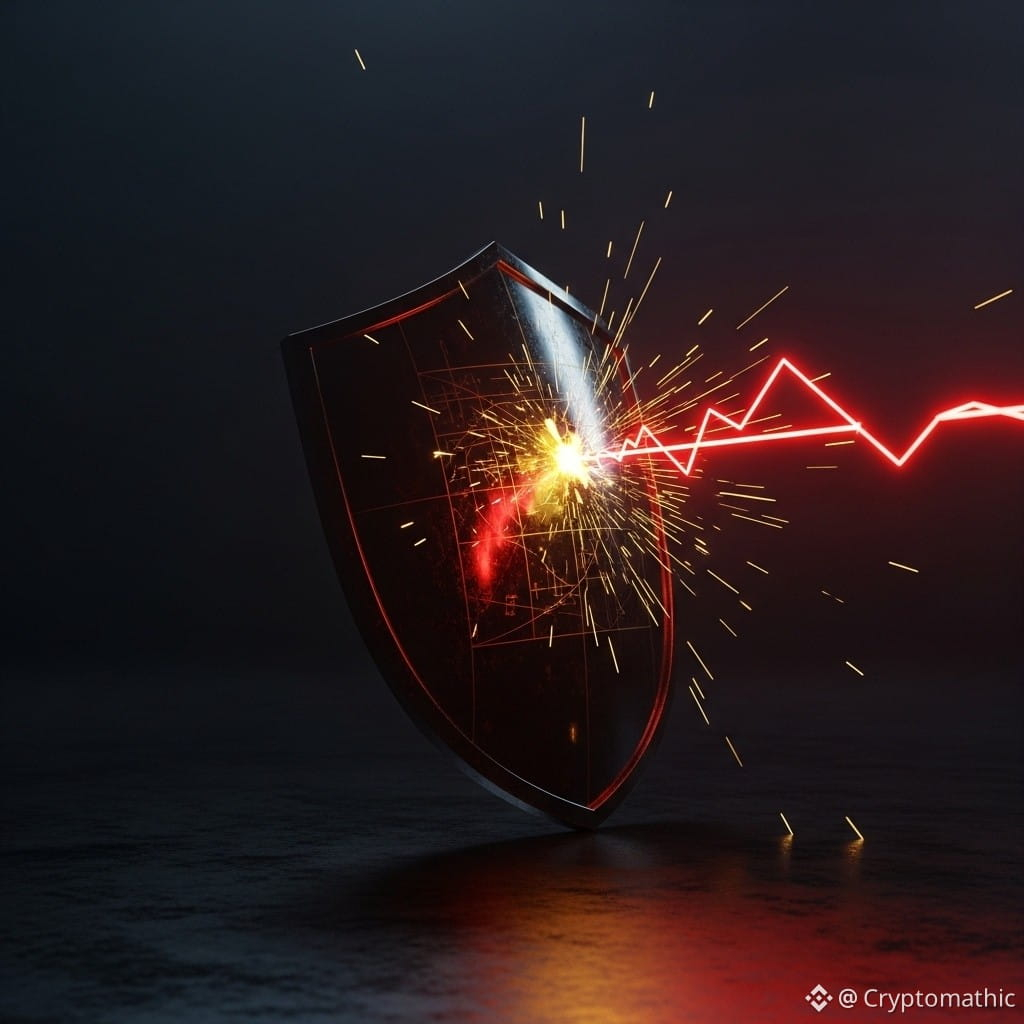
The Mathematical Shield ⚖️🛡️
Amateurs calculate how much they can win.
Professionals calculate exactly how much they will lose.
Here's the institutional difference:
• Smart money never risks >2% of total capital per trade.
• They know that losing 50% requires a 100% gain just to survive.
• An Invalidation Point is set mathematically before entry.
If you trade without a mathematical shield, you are not investing.
You are simply donating liquidity to those who do the math.
Cut losses mathematically.
Leave hope at the door.
Logic > Hope. ⚖️🛡️
#RiskManagement #TradingMath #smartmoney #crypto #Cryptomathic $BTC $BNB $ETH
The Mathematical Shield ⚖️🛡️
Amateurs calculate how much they can win.
Professionals calculate exactly how much they will lose.
Here's the institutional difference:
• Smart money never risks >2% of total capital per trade.
• They know that losing 50% requires a 100% gain just to survive.
• An Invalidation Point is set mathematically before entry.
If you trade without a mathematical shield, you are not investing.
You are simply donating liquidity to those who do the math.
Cut losses mathematically.
Leave hope at the door.
Logic > Hope. ⚖️🛡️
#RiskManagement #TradingMath #smartmoney #crypto #Cryptomathic $BTC $BNB $ETH
Amateurs calculate how much they can win.
Professionals calculate exactly how much they will lose.
Here's the institutional difference:
• Smart money never risks >2% of total capital per trade.
• They know that losing 50% requires a 100% gain just to survive.
• An Invalidation Point is set mathematically before entry.
If you trade without a mathematical shield, you are not investing.
You are simply donating liquidity to those who do the math.
Cut losses mathematically.
Leave hope at the door.
Logic > Hope. ⚖️🛡️
#RiskManagement #TradingMath #smartmoney #crypto #Cryptomathic $BTC $BNB $ETH
1
1
176

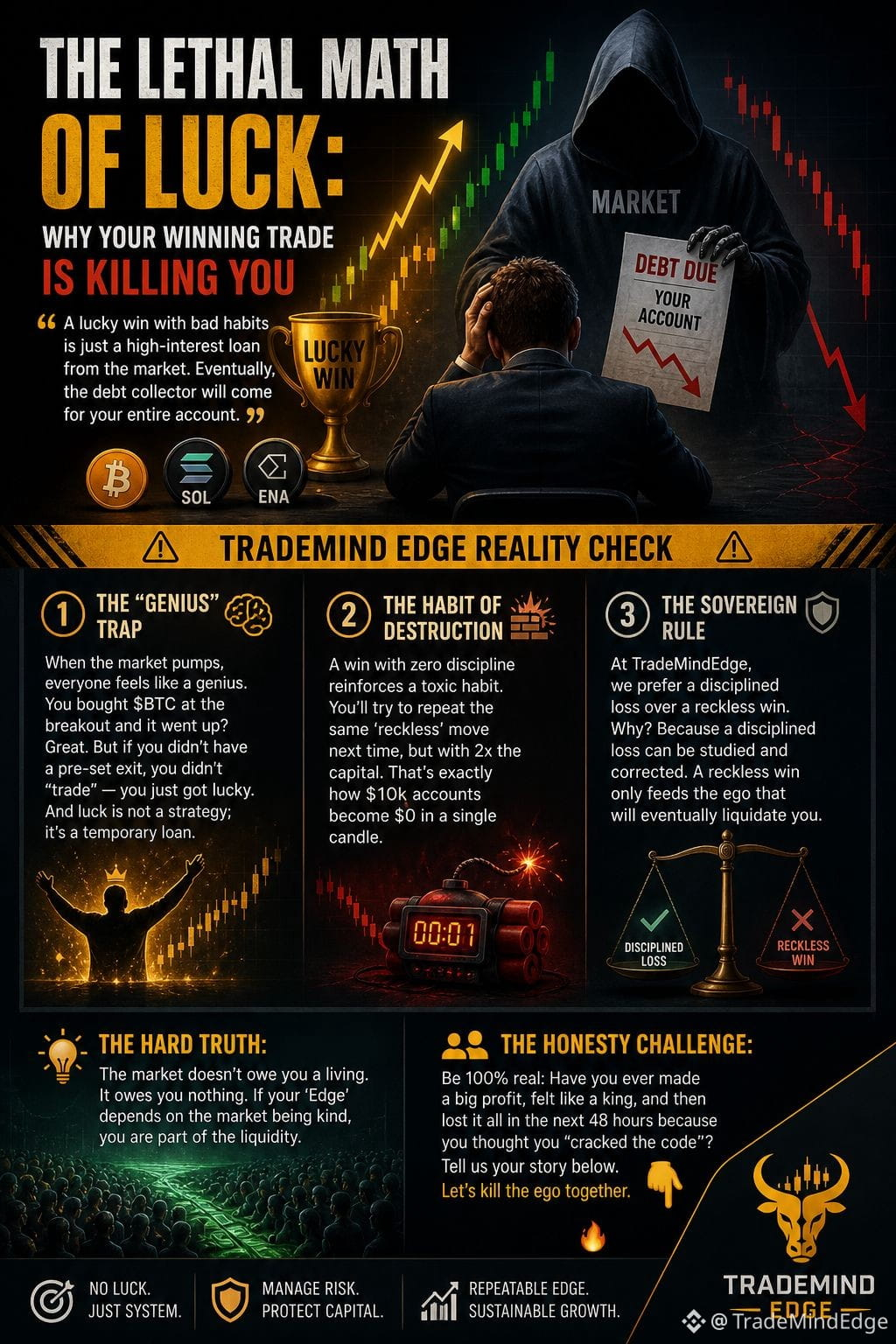
🛡️ THE LETHAL MATH OF LUCK: WHY YOUR WINNING TRADE IS KILLING YOU 📉
"A lucky win with bad habits is just a high-interest loan from the market. Eventually, the debt collector will come for your entire account."
Dear Friend,
The most dangerous person in the market isn't the one who just lost everything. It’s the one who just made 100% profit on $SOL or $ENA without a plan. 🏛️
🔍 THE TRADEMINDEDGE REALITY CHECK:
1️⃣ The "Genius" Trap: 🧠
When the market pumps, everyone feels like a genius. You bought $BTC at the breakout and it went up? Great. But if you didn't have a pre-set exit, you didn't "trade"—you just got lucky. And luck is not a strategy; it’s a temporary loan.
2️⃣ The Habit of Destruction: 🏗️🧨
A win with zero discipline reinforces a toxic habit. You’ll try to repeat the same 'reckless' move next time, but with 2x the capital. That’s exactly how $10k accounts become $0 in a single candle.
3️⃣ The Sovereign Rule: 🛡️
At TradeMindEdge, we prefer a disciplined loss over a reckless win. Why? Because a disciplined loss can be studied and corrected. A reckless win only feeds the ego that will eventually liquidate you.
💡 THE HARD TRUTH:
The market doesn't owe you a living. It owes you nothing. If your 'Edge' depends on the market being kind, you are part of the liquidity.
🤝 THE HONESTY CHALLENGE:
Be 100% real: Have you ever made a big profit, felt like a king, and then lost it all in the next 48 hours because you thought you "cracked the code"? Tell us your story below. Let’s kill the ego together. 👇🔥
#TradeMindEdge #TradingMath #BinanceSquare #BTC #SOL #ENA #RiskManagement #NoLuckJustSystem
🛡️ THE LETHAL MATH OF LUCK: WHY YOUR WINNING TRADE IS KILLING YOU 📉
"A lucky win with bad habits is just a high-interest loan from the market. Eventually, the debt collector will come for your entire account."
Dear Friend,
The most dangerous person in the market isn't the one who just lost everything. It’s the one who just made 100% profit on $SOL or $ENA without a plan. 🏛️
🔍 THE TRADEMINDEDGE REALITY CHECK:
1️⃣ The "Genius" Trap: 🧠
When the market pumps, everyone feels like a genius. You bought $BTC at the breakout and it went up? Great. But if you didn't have a pre-set exit, you didn't "trade"—you just got lucky. And luck is not a strategy; it’s a temporary loan.
2️⃣ The Habit of Destruction: 🏗️🧨
A win with zero discipline reinforces a toxic habit. You’ll try to repeat the same 'reckless' move next time, but with 2x the capital. That’s exactly how $10k accounts become $0 in a single candle.
3️⃣ The Sovereign Rule: 🛡️
At TradeMindEdge, we prefer a disciplined loss over a reckless win. Why? Because a disciplined loss can be studied and corrected. A reckless win only feeds the ego that will eventually liquidate you.
💡 THE HARD TRUTH:
The market doesn't owe you a living. It owes you nothing. If your 'Edge' depends on the market being kind, you are part of the liquidity.
🤝 THE HONESTY CHALLENGE:
Be 100% real: Have you ever made a big profit, felt like a king, and then lost it all in the next 48 hours because you thought you "cracked the code"? Tell us your story below. Let’s kill the ego together. 👇🔥
#TradeMindEdge #TradingMath #BinanceSquare #BTC #SOL #ENA #RiskManagement #NoLuckJustSystem
"A lucky win with bad habits is just a high-interest loan from the market. Eventually, the debt collector will come for your entire account."
Dear Friend,
The most dangerous person in the market isn't the one who just lost everything. It’s the one who just made 100% profit on $SOL or $ENA without a plan. 🏛️
🔍 THE TRADEMINDEDGE REALITY CHECK:
1️⃣ The "Genius" Trap: 🧠
When the market pumps, everyone feels like a genius. You bought $BTC at the breakout and it went up? Great. But if you didn't have a pre-set exit, you didn't "trade"—you just got lucky. And luck is not a strategy; it’s a temporary loan.
2️⃣ The Habit of Destruction: 🏗️🧨
A win with zero discipline reinforces a toxic habit. You’ll try to repeat the same 'reckless' move next time, but with 2x the capital. That’s exactly how $10k accounts become $0 in a single candle.
3️⃣ The Sovereign Rule: 🛡️
At TradeMindEdge, we prefer a disciplined loss over a reckless win. Why? Because a disciplined loss can be studied and corrected. A reckless win only feeds the ego that will eventually liquidate you.
💡 THE HARD TRUTH:
The market doesn't owe you a living. It owes you nothing. If your 'Edge' depends on the market being kind, you are part of the liquidity.
🤝 THE HONESTY CHALLENGE:
Be 100% real: Have you ever made a big profit, felt like a king, and then lost it all in the next 48 hours because you thought you "cracked the code"? Tell us your story below. Let’s kill the ego together. 👇🔥
#TradeMindEdge #TradingMath #BinanceSquare #BTC #SOL #ENA #RiskManagement #NoLuckJustSystem
1
285
Войдите, чтобы посмотреть больше материала
Присоединяйтесь к пользователям криптовалют по всему миру на Binance Square
⚡️ Получайте новейшую и полезную информацию о криптоактивах.
💬 Нам доверяет крупнейшая в мире криптобиржа.
👍 Получите достоверные аналитические данные от верифицированных создателей контента.
Эл. почта/номер телефона
В тренде
1
#BinanceKZ
Просмотров: 13,798
69 обсуждают
2
#TrumpRejectsAIRulesForVoluntaryAudits
Просмотров: 900
112 обсуждают
3
#BitgetHotWalletBreachTiedToThirdPartySecurityFlaw
Просмотров: 371
87 обсуждают
4
#OpenAIUnveilsAlwaysOnAgentDots
Просмотров: 1,532
135 обсуждают
5
#ChainlinkLaunchesBankSWIFTLedgerFramework
Просмотров: 3,117
122 обсуждают
6
#EarningsSeason
Просмотров: 442,347
3,341 обсуждают
7
#SECChairWantsStockMarketsOnChain
Просмотров: 6,495
192 обсуждают
8
#MulticoinInvestsInGrass
Просмотров: 3,918
134 обсуждают
9
#CEARenamesToBNBStandardUnderBNC
Просмотров: 5,035
135 обсуждают
10
#BitwiseLaunchesFirstSpotNEARETF
Просмотров: 60,279
767 обсуждают