
#somnia
somnia
Просмотров: 11.3M
88,288 обсуждают
Популярные
Новые

·
--
Рост
🔥 $SOMI /USDT — MOMENTUM IGNITION 🔥
SOMI is trading around $0.1222 with +7.29%. Buyers have pushed the token strongly higher, putting the current zone under the spotlight.
📍 EP: $0.1205 – $0.1230
🎯 TP1: $0.1270
🎯 TP2: $0.1320
🎯 TP3: $0.1380
🛑 SL: $0.1145
SOMI is the native token of the Somnia blockchain. It is designed for staking, delegated staking and gas fees, with governance utility planned for the ecosystem. 5
🔥 If momentum survives the next pullback, continuation becomes interesting.
⚠️ Protect capital if the support zone fails.
Let's go $SOMI 🚀
#SOMI #Somnia #Crypto #Binance
🔥 $SOMI /USDT — MOMENTUM IGNITION 🔥
SOMI is trading around $0.1222 with +7.29%. Buyers have pushed the token strongly higher, putting the current zone under the spotlight.
📍 EP: $0.1205 – $0.1230
🎯 TP1: $0.1270
🎯 TP2: $0.1320
🎯 TP3: $0.1380
🛑 SL: $0.1145
SOMI is the native token of the Somnia blockchain. It is designed for staking, delegated staking and gas fees, with governance utility planned for the ecosystem. 5
🔥 If momentum survives the next pullback, continuation becomes interesting.
⚠️ Protect capital if the support zone fails.
Let's go $SOMI 🚀
#SOMI #Somnia #Crypto #Binance
SOMI is trading around $0.1222 with +7.29%. Buyers have pushed the token strongly higher, putting the current zone under the spotlight.
📍 EP: $0.1205 – $0.1230
🎯 TP1: $0.1270
🎯 TP2: $0.1320
🎯 TP3: $0.1380
🛑 SL: $0.1145
SOMI is the native token of the Somnia blockchain. It is designed for staking, delegated staking and gas fees, with governance utility planned for the ecosystem. 5
🔥 If momentum survives the next pullback, continuation becomes interesting.
⚠️ Protect capital if the support zone fails.
Let's go $SOMI 🚀
#SOMI #Somnia #Crypto #Binance
200

·
--
Рост
🚀 SOMI (Somnia): uma cripto que pode estar apenas começando?
O mercado de altcoins está sempre procurando os próximos projetos capazes de entregar movimentos expressivos — e o SOMI merece atenção. 👀
🔥 Por que ficar de olho?
• 📈 Forte movimentação e aumento de volume
• 🐋 Fluxo comprador relevante nas últimas horas
• ⚡ Blockchain L1 focada em alta performance
• 🤖 Forte conexão com a narrativa de IA + blockchain
• 🌐 Potencial para aplicações on-chain em grande escala
• 📊 Se conseguir romper resistências importantes, pode abrir espaço para uma nova perna de alta
🎯 Regiões para observar:
0,122 → 0,126 → 0,134 USDC
🚀 Um rompimento consistente de 0,134 USDC poderia colocar o ativo em uma região completamente diferente de preço.
⚠️ Atenção: SOMI é um ativo altamente volátil. Potencial de alta também significa risco elevado de queda. Isso não é garantia de valorização nem recomendação financeira.
👀 SOMI é uma das altcoins que eu colocaria no radar agora.
#SOMI #Somnia #crypto #Altcoins #Binance $SOMI #Web3 #AI #Blockchain #DeFi #CryptoNews
{spot}(SOMIUSDT)
🚀 SOMI (Somnia): uma cripto que pode estar apenas começando?
O mercado de altcoins está sempre procurando os próximos projetos capazes de entregar movimentos expressivos — e o SOMI merece atenção. 👀
🔥 Por que ficar de olho?
• 📈 Forte movimentação e aumento de volume
• 🐋 Fluxo comprador relevante nas últimas horas
• ⚡ Blockchain L1 focada em alta performance
• 🤖 Forte conexão com a narrativa de IA + blockchain
• 🌐 Potencial para aplicações on-chain em grande escala
• 📊 Se conseguir romper resistências importantes, pode abrir espaço para uma nova perna de alta
🎯 Regiões para observar:
0,122 → 0,126 → 0,134 USDC
🚀 Um rompimento consistente de 0,134 USDC poderia colocar o ativo em uma região completamente diferente de preço.
⚠️ Atenção: SOMI é um ativo altamente volátil. Potencial de alta também significa risco elevado de queda. Isso não é garantia de valorização nem recomendação financeira.
👀 SOMI é uma das altcoins que eu colocaria no radar agora.
#SOMI #Somnia #crypto #Altcoins #Binance $SOMI #Web3 #AI #Blockchain #DeFi #CryptoNews
O mercado de altcoins está sempre procurando os próximos projetos capazes de entregar movimentos expressivos — e o SOMI merece atenção. 👀
🔥 Por que ficar de olho?
• 📈 Forte movimentação e aumento de volume
• 🐋 Fluxo comprador relevante nas últimas horas
• ⚡ Blockchain L1 focada em alta performance
• 🤖 Forte conexão com a narrativa de IA + blockchain
• 🌐 Potencial para aplicações on-chain em grande escala
• 📊 Se conseguir romper resistências importantes, pode abrir espaço para uma nova perna de alta
🎯 Regiões para observar:
0,122 → 0,126 → 0,134 USDC
🚀 Um rompimento consistente de 0,134 USDC poderia colocar o ativo em uma região completamente diferente de preço.
⚠️ Atenção: SOMI é um ativo altamente volátil. Potencial de alta também significa risco elevado de queda. Isso não é garantia de valorização nem recomendação financeira.
👀 SOMI é uma das altcoins que eu colocaria no radar agora.
#SOMI #Somnia #crypto #Altcoins #Binance $SOMI #Web3 #AI #Blockchain #DeFi #CryptoNews
165

·
--
Рост
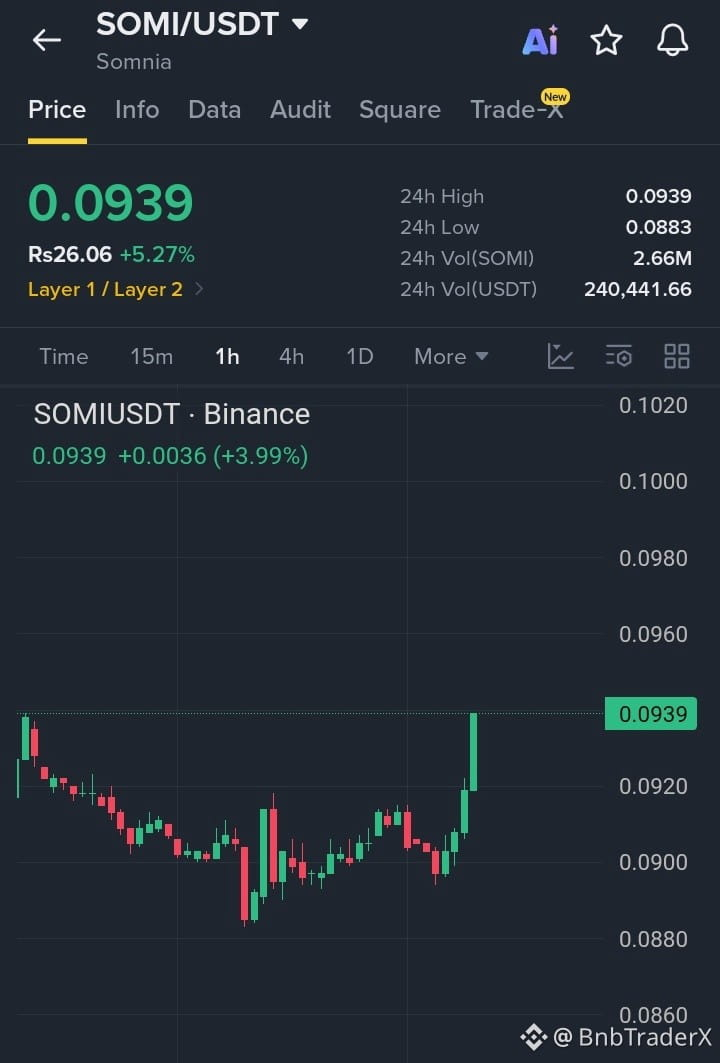
$SOMI is pushing into the 0.0940 resistance with bullish momentum. A clean breakout above 0.0940 could open the way toward 0.0980 and 0.1020.
Entry: 0.0920–0.0940
TP1: 0.0980
TP2: 0.1000
TP3: 0.1020
SL: 0.0890
#SOMI #Somnia #CryptoTrading
{future}(SOMIUSDT)
$ACE
{future}(ACEUSDT)
$BTW
{future}(BTWUSDT)
$SOMI is pushing into the 0.0940 resistance with bullish momentum. A clean breakout above 0.0940 could open the way toward 0.0980 and 0.1020.
Entry: 0.0920–0.0940
TP1: 0.0980
TP2: 0.1000
TP3: 0.1020
SL: 0.0890
#SOMI #Somnia #CryptoTrading
$ACE
$BTW
Entry: 0.0920–0.0940
TP1: 0.0980
TP2: 0.1000
TP3: 0.1020
SL: 0.0890
#SOMI #Somnia #CryptoTrading
$ACE
$BTW
2
513

·
--
🚨 $SOMI I (Somnia) — BREAKOUT WATCH! 🚨
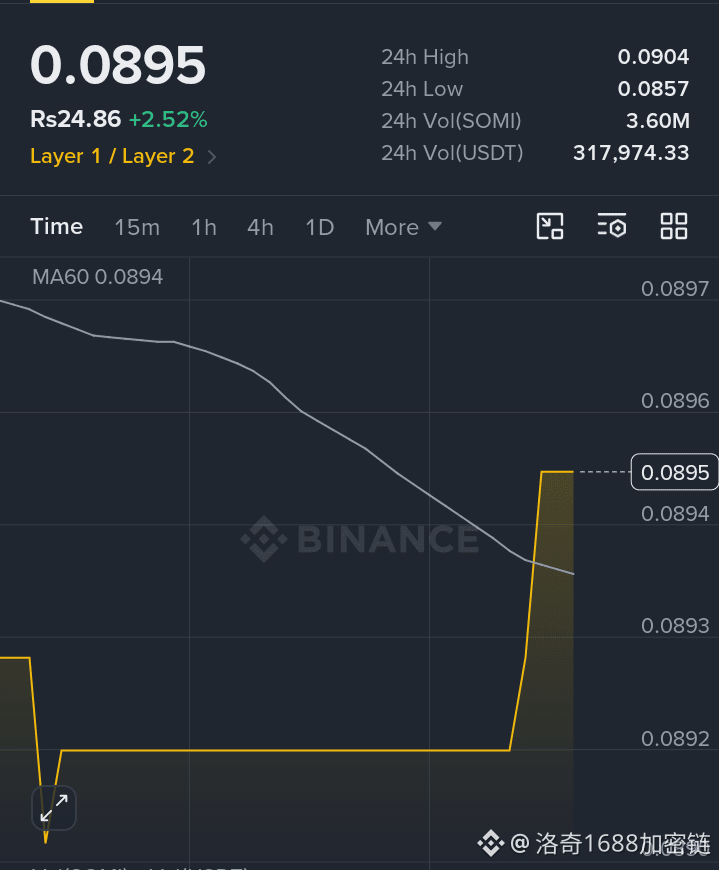
🔥 Current Price: $0.0895
📈 24H: +2.52%
💎 24H High: $0.0904
📊 24H Volume: 3.60M SOMI
$SOMI is showing positive momentum and is currently holding around the MA60 level at $0.0894.
🎯 Key Resistance: $0.0904
🟢 Break & Hold above $0.0904 → bullish momentum could strengthen
🔴 Lose $0.0890 → short-term weakness possible
👀 $SOMI is one to keep on the watchlist!
#SOMI #Somnia #Crypto #Binance #Altcoins #trading
🚨 $SOMI I (Somnia) — BREAKOUT WATCH! 🚨
🔥 Current Price: $0.0895
📈 24H: +2.52%
💎 24H High: $0.0904
📊 24H Volume: 3.60M SOMI
$SOMI is showing positive momentum and is currently holding around the MA60 level at $0.0894.
🎯 Key Resistance: $0.0904
🟢 Break & Hold above $0.0904 → bullish momentum could strengthen
🔴 Lose $0.0890 → short-term weakness possible
👀 $SOMI is one to keep on the watchlist!
#SOMI #Somnia #Crypto #Binance #Altcoins #trading
🔥 Current Price: $0.0895
📈 24H: +2.52%
💎 24H High: $0.0904
📊 24H Volume: 3.60M SOMI
$SOMI is showing positive momentum and is currently holding around the MA60 level at $0.0894.
🎯 Key Resistance: $0.0904
🟢 Break & Hold above $0.0904 → bullish momentum could strengthen
🔴 Lose $0.0890 → short-term weakness possible
👀 $SOMI is one to keep on the watchlist!
#SOMI #Somnia #Crypto #Binance #Altcoins #trading
1
145

·
--
#somnia
$SOMI up +1.38% to $0.0976 on altcoin rotation. No specific news, just market beta.
Long term tailwind: 50% gas fee burn = supply gets tighter with usage.
Key Levels: Support $0.095 | Resistance $0.10
Break $0.10 with volume = next target $0.12
Risk: Low volume + token unlocks in 2026. Trade with SL.
DYOR | Not financial advice
$SOMI #Somnia #Altcoins #CryptoAnalysis
{future}(SOMIUSDT)
#somnia
$SOMI up +1.38% to $0.0976 on altcoin rotation. No specific news, just market beta.
Long term tailwind: 50% gas fee burn = supply gets tighter with usage.
Key Levels: Support $0.095 | Resistance $0.10
Break $0.10 with volume = next target $0.12
Risk: Low volume + token unlocks in 2026. Trade with SL.
DYOR | Not financial advice
$SOMI #Somnia #Altcoins #CryptoAnalysis
$SOMI up +1.38% to $0.0976 on altcoin rotation. No specific news, just market beta.
Long term tailwind: 50% gas fee burn = supply gets tighter with usage.
Key Levels: Support $0.095 | Resistance $0.10
Break $0.10 with volume = next target $0.12
Risk: Low volume + token unlocks in 2026. Trade with SL.
DYOR | Not financial advice
$SOMI #Somnia #Altcoins #CryptoAnalysis
1
463

·
--
🚀 Last Call for These Gems! 🚀
💎 $AIGENSYN
{spot}(AIGENSYNUSDT)
💎 $SOMI
{spot}(SOMIUSDT)
💎 $AR
{spot}(ARUSDT)
#AIGENSYN #Somnia I #ar #HiddenGems #BinanceExplorers
🚀 Last Call for These Gems! 🚀
💎 $AIGENSYN
💎 $SOMI
💎 $AR
#AIGENSYN #Somnia I #ar #HiddenGems #BinanceExplorers
💎 $AIGENSYN
💎 $SOMI
💎 $AR
#AIGENSYN #Somnia I #ar #HiddenGems #BinanceExplorers
2
575

بسم الله الرحمن الرحيم
السلام عليكم ورحمة الله وبركاته
SPOT TRADE UPDATE: $SOMI 📊⚡
Status: HALAL (Spot Only)
Current Price: ~$0.1119
Technical Analysis & Market Structure
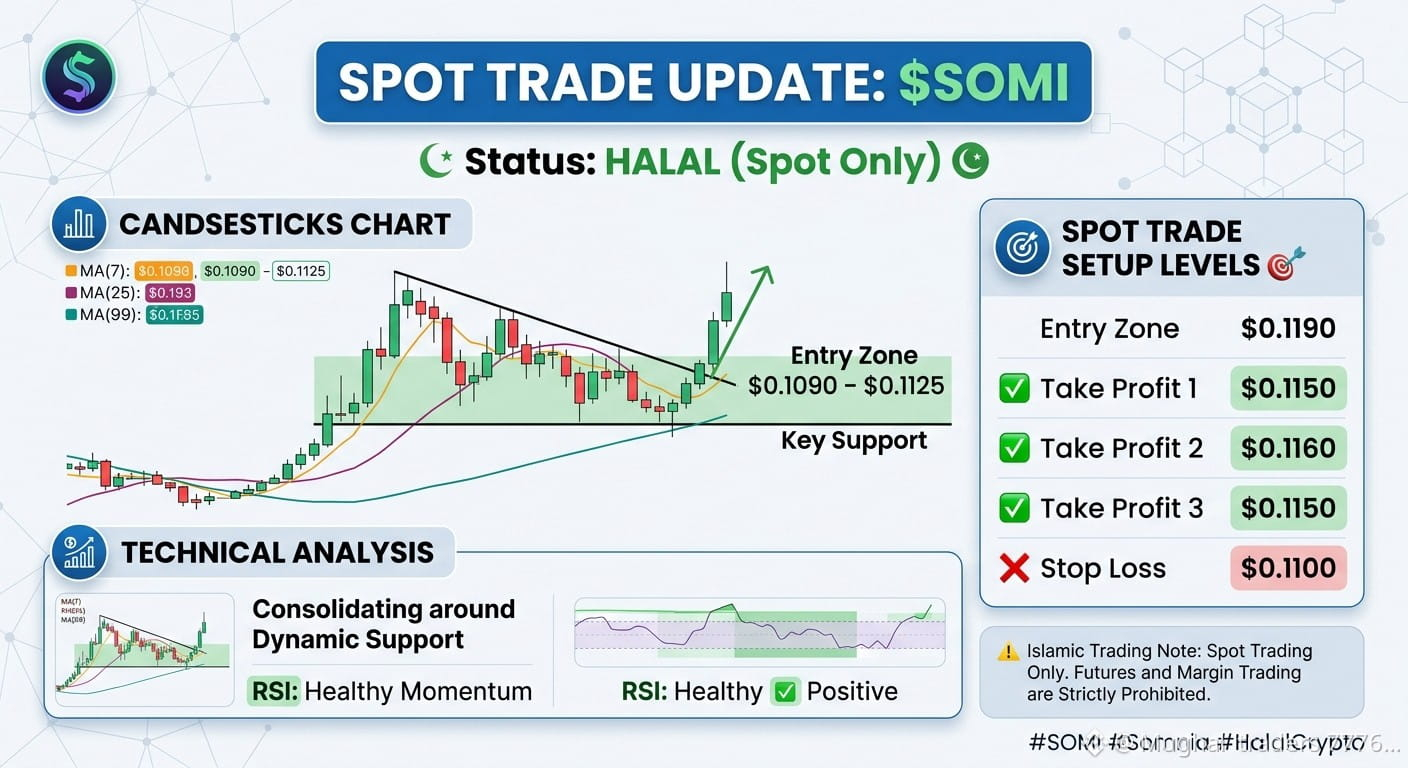
15m / 1H Frame: On the 15m chart, $SOMI is consolidating around dynamic support after pulling back from its recent local peak at $0.1223. Moving averages are tightly clustered (MA(7): $0.1120 | MA(25): $0.1123 | MA(99): $0.1150), with strong low-wick support holding near $0.1096. On the 1H timeframe, price action is holding right above the key MA(99) level ($0.1116) as buyers defend the current base under MA(7) ($0.1123) and MA(25) ($0.1149).
4H / 1D Frame: Higher timeframes present a structural trend continuation setup. The 4H chart shows $SOMI holding firmly above its MA(25) ($0.1117) and MA(99) ($0.1016), maintaining a higher-low structure despite short-term resistance at MA(7) ($0.1142). The Daily (1D) timeframe reinforces macro bullish strength, with price trading above daily MA(7) ($0.1115), daily MA(25) ($0.0981), and daily MA(99) ($0.1075).
RSI Indicators: Momentum indicators show healthy consolidation with zero overbought pressure across timeframes, leaving substantial room for another leg up (15m: 44.4 | 1H: 45.9 | 4H: 54.3 | 1D: 58.3).
Spot Trade Setup Levels 🎯
Entry Zone: $0.1090 – $0.1125
Take Profit 1: $0.1220
Take Profit 2: $0.1340
Take Profit 3: $0.1480
Stop Loss: $0.1010
⚠️ Islamic Trading Note: Spot Trading Only. Futures and Margin Trading are Strictly Prohibited.
{spot}(SOMIUSDT)
#SOMI #Somnia #HalalCrypto #BinanceSquare #CryptoAnalysis
بسم الله الرحمن الرحيم
السلام عليكم ورحمة الله وبركاته
SPOT TRADE UPDATE: $SOMI 📊⚡
Status: HALAL (Spot Only)
Current Price: ~$0.1119
Technical Analysis & Market Structure
15m / 1H Frame: On the 15m chart, $SOMI is consolidating around dynamic support after pulling back from its recent local peak at $0.1223. Moving averages are tightly clustered (MA(7): $0.1120 | MA(25): $0.1123 | MA(99): $0.1150), with strong low-wick support holding near $0.1096. On the 1H timeframe, price action is holding right above the key MA(99) level ($0.1116) as buyers defend the current base under MA(7) ($0.1123) and MA(25) ($0.1149).
4H / 1D Frame: Higher timeframes present a structural trend continuation setup. The 4H chart shows $SOMI holding firmly above its MA(25) ($0.1117) and MA(99) ($0.1016), maintaining a higher-low structure despite short-term resistance at MA(7) ($0.1142). The Daily (1D) timeframe reinforces macro bullish strength, with price trading above daily MA(7) ($0.1115), daily MA(25) ($0.0981), and daily MA(99) ($0.1075).
RSI Indicators: Momentum indicators show healthy consolidation with zero overbought pressure across timeframes, leaving substantial room for another leg up (15m: 44.4 | 1H: 45.9 | 4H: 54.3 | 1D: 58.3).
Spot Trade Setup Levels 🎯
Entry Zone: $0.1090 – $0.1125
Take Profit 1: $0.1220
Take Profit 2: $0.1340
Take Profit 3: $0.1480
Stop Loss: $0.1010
⚠️ Islamic Trading Note: Spot Trading Only. Futures and Margin Trading are Strictly Prohibited.
#SOMI #Somnia #HalalCrypto #BinanceSquare #CryptoAnalysis
السلام عليكم ورحمة الله وبركاته
SPOT TRADE UPDATE: $SOMI 📊⚡
Status: HALAL (Spot Only)
Current Price: ~$0.1119
Technical Analysis & Market Structure
15m / 1H Frame: On the 15m chart, $SOMI is consolidating around dynamic support after pulling back from its recent local peak at $0.1223. Moving averages are tightly clustered (MA(7): $0.1120 | MA(25): $0.1123 | MA(99): $0.1150), with strong low-wick support holding near $0.1096. On the 1H timeframe, price action is holding right above the key MA(99) level ($0.1116) as buyers defend the current base under MA(7) ($0.1123) and MA(25) ($0.1149).
4H / 1D Frame: Higher timeframes present a structural trend continuation setup. The 4H chart shows $SOMI holding firmly above its MA(25) ($0.1117) and MA(99) ($0.1016), maintaining a higher-low structure despite short-term resistance at MA(7) ($0.1142). The Daily (1D) timeframe reinforces macro bullish strength, with price trading above daily MA(7) ($0.1115), daily MA(25) ($0.0981), and daily MA(99) ($0.1075).
RSI Indicators: Momentum indicators show healthy consolidation with zero overbought pressure across timeframes, leaving substantial room for another leg up (15m: 44.4 | 1H: 45.9 | 4H: 54.3 | 1D: 58.3).
Spot Trade Setup Levels 🎯
Entry Zone: $0.1090 – $0.1125
Take Profit 1: $0.1220
Take Profit 2: $0.1340
Take Profit 3: $0.1480
Stop Loss: $0.1010
⚠️ Islamic Trading Note: Spot Trading Only. Futures and Margin Trading are Strictly Prohibited.
#SOMI #Somnia #HalalCrypto #BinanceSquare #CryptoAnalysis
2

SOMI and STO: Real-Time Momentum Across Layer-1 and DeFi Narratives
Somnia (SOMI) is trading near $0.1134, up approximately 4.3% over the current 24-hour session. Price has moved between $0.1083 and $0.1211, with about $1.03M in quoted trading volume. SOMI remains above its daily open, reflecting constructive short-term momentum, though the pullback from the session high shows that sellers have appeared as the price advanced.
StakeStone (STO) is trading around $0.0428, up roughly 5.9% over the same period. Its intraday range of $0.0396–$0.0436 and approximately $1.18M in quoted volume indicate active market participation. STO is also holding above its daily open and closer to the upper end of its session range, suggesting that demand has remained relatively resilient during the current move.
The market picture is positive for both assets, but their drivers differ. SOMI represents Layer-1 ecosystem exposure and is showing a steadier recovery after testing lower levels, while STO is advancing within the DeFi segment with slightly stronger percentage momentum. Continued volume and the ability to sustain current trading ranges may help confirm market interest, though crypto markets remain volatile and future performance is uncertain.
#SOMI #Somnia #STO #StakeStone #CryptoMarket
$SOMI
{spot}(SOMIUSDT)
$STO
{spot}(STOUSDT)
SOMI and STO: Real-Time Momentum Across Layer-1 and DeFi Narratives
Somnia (SOMI) is trading near $0.1134, up approximately 4.3% over the current 24-hour session. Price has moved between $0.1083 and $0.1211, with about $1.03M in quoted trading volume. SOMI remains above its daily open, reflecting constructive short-term momentum, though the pullback from the session high shows that sellers have appeared as the price advanced.
StakeStone (STO) is trading around $0.0428, up roughly 5.9% over the same period. Its intraday range of $0.0396–$0.0436 and approximately $1.18M in quoted volume indicate active market participation. STO is also holding above its daily open and closer to the upper end of its session range, suggesting that demand has remained relatively resilient during the current move.
The market picture is positive for both assets, but their drivers differ. SOMI represents Layer-1 ecosystem exposure and is showing a steadier recovery after testing lower levels, while STO is advancing within the DeFi segment with slightly stronger percentage momentum. Continued volume and the ability to sustain current trading ranges may help confirm market interest, though crypto markets remain volatile and future performance is uncertain.
#SOMI #Somnia #STO #StakeStone #CryptoMarket
$SOMI
$STO
Somnia (SOMI) is trading near $0.1134, up approximately 4.3% over the current 24-hour session. Price has moved between $0.1083 and $0.1211, with about $1.03M in quoted trading volume. SOMI remains above its daily open, reflecting constructive short-term momentum, though the pullback from the session high shows that sellers have appeared as the price advanced.
StakeStone (STO) is trading around $0.0428, up roughly 5.9% over the same period. Its intraday range of $0.0396–$0.0436 and approximately $1.18M in quoted volume indicate active market participation. STO is also holding above its daily open and closer to the upper end of its session range, suggesting that demand has remained relatively resilient during the current move.
The market picture is positive for both assets, but their drivers differ. SOMI represents Layer-1 ecosystem exposure and is showing a steadier recovery after testing lower levels, while STO is advancing within the DeFi segment with slightly stronger percentage momentum. Continued volume and the ability to sustain current trading ranges may help confirm market interest, though crypto markets remain volatile and future performance is uncertain.
#SOMI #Somnia #STO #StakeStone #CryptoMarket
$SOMI
$STO
356


Статья
🚨October Crypto Explosion: Don’t Miss These 200x Opportunities!The Golden Bull Run starts in October 🔥
Accumulation is finally over, and in a few days the market will skyrocket.
Now is your best chance to get in and become a millionaire.
Here are the best 200x lowcaps to buy before Altseason kicks off
Bitcoin tends to move in familiar patterns that repeat over time. They are shaped by investor psychology, major global events, and liquidity shifts.
Every few years the cycle resets, turning fear into hope and eventually peaking in wild euphoria.
In recent months, the market has faced corrections that shook out weak holders, cleared excess leverage, and built the foundation for the next major rally.
Now $BTC appears ready to enter the Uptrend phase, which is often the most powerful stage of a bull cycle.
The biggest gains usually go to those who position themselves before the crowd. Buy when confidence is low and sell when excitement takes over.
That same approach worked for me in past cycles, and I’m following it again while buying new altcoins ⬇️
@PythNetwork $PYTH
{spot}(PYTHUSDT)
PYTH is the native cryptocurrency of the Pyth Network, a decentralized oracle network that specializes in delivering real-time, high-fidelity market data to blockchain applications. Launched in 2021 on the Solana blockchain, Pyth has evolved into a multi-chain oracle solution, bridging traditional finance (TradFi) and decentralized finance (DeFi) by providing accurate price feeds for assets like cryptocurrencies, equities, ETFs, FX pairs, and commodities. Unlike traditional oracles that aggregate data from secondary sources, Pyth uses a “first-party” model, sourcing data directly from over 120 leading financial institutions, exchanges, and market makers (e.g., Jump Trading, Virtu Financial). This ensures low-latency, tamper-proof data with minimal intermediaries, making it essential for high-stakes DeFi protocols such as lending platforms, derivatives trading, and perpetual futures.
As of October 4, 2025, PYTH ranks among the top 100 cryptocurrencies by market capitalization, reflecting its growing adoption in the oracle space. It secures over $5 billion in total value (TVS) across ecosystems, powering nearly 10% of Solana’s transactions and competing with leaders like Chainlink.
Purpose and Key Features
The core purpose of Pyth Network is to democratize access to premium financial data, enabling developers to build faster, fairer, and more reliable on-chain applications. In a fragmented financial system, Pyth acts as the “Price Layer for Global Finance,” uniting markets by providing verifiable prices in real-time. Key features include:
• First-Party Data Aggregation: Data comes straight from 90+ publishers (e.g., major exchanges and trading firms), reducing latency to sub-second levels and ensuring accuracy through cryptographic verification and consensus mechanisms.
• Low-Latency Price Feeds: Over 380 feeds covering diverse assets, updated continuously and published on-chain via a “pull model” oracle—developers query data as needed, minimizing gas costs.
• Multi-Chain Compatibility: Supports 40+ blockchains, including Solana (native), Ethereum, Aptos, Sui, and others. This allows seamless integration into EVM-compatible environments using SDKs like the Pyth Solidity SDK.
• Developer Tools: Open-source repositories, an Insights Hub for feed catalogs, and easy integration (e.g., via simple smart contract calls to fetch prices like ETH/USD).
• Security and Reliability: Uses advanced cryptography to prevent manipulation, with data validated across the network before on-chain publication.
Pyth’s innovation lies in its publisher-oracle hybrid: nodes both own and publish data directly, contrasting with reporter oracles that rely on third-party purchases.
#PythRoadmap
@Somnia_Network $SOMI
{spot}(SOMIUSDT)
SOMI is the native utility and governance token of the Somnia Network, a high-performance, EVM-compatible Layer 1 (L1) blockchain engineered for real-time, consumer-scale applications in gaming, social platforms, metaverses, and DeFi. Launched in September 2025 on the Ethereum platform, Somnia addresses the scalability bottlenecks of traditional blockchains by achieving over 1 million transactions per second (TPS) with sub-second finality, making it ideal for mass-adoption scenarios like on-chain multiplayer games or live social interactions. Unlike parallel execution-focused chains, Somnia optimizes single-core efficiency through innovations like MultiStream Consensus and IceDB, enabling seamless handling of high-throughput dApps without compromising decentralization.
Backed by Improbable (a Web3 infrastructure giant) and a $270 million ecosystem fund, Somnia positions itself as the “metaverse computer,” connecting virtual worlds and powering projects like Chunked (a gaming title with 250M+ testnet transactions) and Standard (a CLOB DEX). As of October 4, 2025, SOMI ranks around #314 by market cap, with strong momentum from recent listings on Binance and Upbit, securing billions in testnet activity and partnerships with Google Cloud and LayerZero.
Purpose and Key Features
Somnia’s mission is to unlock fully on-chain experiences for billions of users, bridging Web2 usability with Web3 ownership. It targets sectors where latency and cost kill engagement, such as real-time gaming or social feeds. Core features include:
• Ultra-High Throughput: MultiStream Consensus (a dPoS mechanism) runs parallel data chains to hit 1M+ TPS, validated by IceDB’s 15–100 nanosecond read/write speeds for state management.
• EVM Compatibility: Developers can port Ethereum tools effortlessly, supporting Solidity and familiar SDKs for quick dApp deployment.
• Cost Efficiency: Sub-cent fees via optimized execution, with 50% of transaction fees burned to promote deflation.
• Interoperability: Integrates with LayerZero for cross-chain bridging and ZNS Connect for decentralized identities.
• Ecosystem Tools: $270M fund for grants; partnerships like basketball.fun (NBA co-founder Tristan Thompson’s fan platform) and Jitter (on-chain livestreams for thousands).
• Security: Delegated validators with slashed staking ensure robustness, backed by Improbable’s enterprise-grade tech.
Somnia’s edge: It processes 10B+ testnet transactions, outpacing rivals in real-world benchmarks for gaming and social dApps.
@MitosisOrg $MITO
{spot}(MITOUSDT)
MITO is the native utility and governance token of the Mitosis Network, a Layer 1 (L1) blockchain and cross-chain DeFi protocol designed to unify fragmented liquidity across multiple ecosystems. Launched in September 2025 on Ethereum with expansions to Arbitrum and beyond, Mitosis transforms illiquid liquidity positions (e.g., staked ETH or LP tokens) into programmable, composable “miAssets”—tokenized assets that can be deployed for yield farming, lending, or staking across chains without bridges or wrappers. This addresses DeFi’s liquidity silos by enabling seamless, permissionless capital efficiency, powering over $500M in TVL within weeks of mainnet.
Backed by investors like Binance Labs and a $7M seed round, Mitosis integrates restaked ETH for security and Hyperlane for interoperability, positioning itself as a “liquidity coordination layer” for multi-chain DeFi. As of October 4, 2025, MITO ranks #801 by market cap, with strong post-TGE momentum from airdrops and listings on Binance Alpha, MEXC, and Tothemoon, though it’s down ~59% from its all-time high amid broader market corrections.
Purpose and Key Features
Mitosis aims to eliminate liquidity fragmentation, allowing users to “mitose” (split and recombine) assets for optimized yields without chain-specific silos. It targets DeFi protocols, yield aggregators, and cross-chain apps needing composable capital. Core features include:
• miAssets and Vaults: Deposit assets into Matrix Vaults (curated campaigns with early withdrawal penalties) or EOL (governance-driven allocations) to mint miAssets—ERC-20 tokens usable anywhere, e.g., miETH for lending on Aave while earning on EigenLayer.
• Cross-Chain Interoperability: Hyperlane messaging enables seamless miAsset transfers across Ethereum, Arbitrum, and 10+ chains; no wrapped tokens or centralized bridges.
• Yield Optimization: Programmable liquidity with auto-compounding; integrates restaked ETH for native security.
• Developer Tools: SDKs for miAsset creation, governance via Morse DAO, and analytics dashboards for TVL tracking.
• Scalability: L1 architecture with EVM compatibility, supporting 1,000+ TPS; low fees (~$0.01/tx) via optimized execution.
• Security: Audited by top firms; uses shared security from Ethereum restaking.
Mitosis’s innovation: A three-token model (MITO for governance, LMITO for locked staking, miAssets for liquidity) incentivizes long-term alignment over short-term farming.
@trade_rumour
Rumour (often stylized as @undefined is a decentralized social intelligence platform and mobile app designed to aggregate, verify, and monetize crypto rumors, alpha signals, and market narratives in real-time. Launched in early 2025 on the Solana blockchain, it serves as a “rumor engine” for traders, empowering users to crowdsource insights on potential listings, partnerships, and catalysts—particularly those tied to major exchanges like Binance. By integrating AI-driven sentiment analysis with on-chain data, Rumour transforms speculative chatter into actionable intelligence, helping users spot opportunities like upcoming Binance Launchpad projects or Creator Pad campaigns before they break.
Backed by a $2.5 million seed round from investors including Solana Ventures and early Binance alumni, Rumour has quickly gained traction in the crypto Twitter (CT) ecosystem, boasting over 50,000 active users and partnerships with tools like Alva App for narrative tracking. As of October 4, 2025, it’s positioned as a key “signal aggregator” for DeFi and memecoin traders, with integrations for Binance Wallet enabling seamless alpha drops on potential Launchpad tokens. While not directly “created by Binance,” its founders include ex-Binance Labs contributors, fueling speculation of deeper ties—though this remains unconfirmed rumor territory.
Purpose and Key Features
Rumour’s core mission is to cut through crypto’s noise by democratizing access to high-signal rumors, reducing FOMO-driven mistakes, and rewarding contributors with token incentives. It targets retail traders overwhelmed by fragmented sources like X (Twitter), Discord, and Telegram, focusing on narratives around Binance’s ecosystem (e.g., Launchpad IEOs, Creator Pad content rewards). Key features include:
• Rumor Aggregation and Verification: AI scans X posts, on-chain activity, and news for keywords (e.g., “Binance listing” or “Creator Pad alpha”), assigning credibility scores based on source reputation, engagement, and historical accuracy.
• Real-Time Alerts: Push notifications for breaking rumors, like potential Launchpad projects (e.g., AltLayer’s modular rollups) or Creator Pad tasks unlocking BNB rewards.
• Monetization Tools: Users earn $RMR tokens for submitting verified rumors; top contributors access premium feeds or exclusive Binance-related alpha (e.g., pre-listing signals for tokens like $ASTER).
• Sentiment Dashboards: Integrated with tools like Alva App, it tracks narrative strength—e.g., bullish hype around CZ/Binance rumors—with visualizations for price impact predictions.
• Binance Ecosystem Hooks: Direct links to Creator Pad for task-based earning (e.g., content creation for BNB airdrops) and Launchpad simulations, where users vote on rumored projects.
• Privacy and Security: Solana-based for low fees; zero-knowledge proofs for anonymous tip submissions to avoid doxxing in rumor-heavy spaces.
Rumour’s edge: It quantifies “soft signals” like CZ shills or community campaigns (#ListDOG), turning them into tradable edges—e.g., spotting $BAKE’s 172% pump from Binance rumor volume spikes.
#traderumour
🚨October Crypto Explosion: Don’t Miss These 200x Opportunities!
The Golden Bull Run starts in October 🔥
Accumulation is finally over, and in a few days the market will skyrocket.
Now is your best chance to get in and become a millionaire.
Here are the best 200x lowcaps to buy before Altseason kicks off
Bitcoin tends to move in familiar patterns that repeat over time. They are shaped by investor psychology, major global events, and liquidity shifts.
Every few years the cycle resets, turning fear into hope and eventually peaking in wild euphoria.
In recent months, the market has faced corrections that shook out weak holders, cleared excess leverage, and built the foundation for the next major rally.
Now $BTC appears ready to enter the Uptrend phase, which is often the most powerful stage of a bull cycle.
The biggest gains usually go to those who position themselves before the crowd. Buy when confidence is low and sell when excitement takes over.
That same approach worked for me in past cycles, and I’m following it again while buying new altcoins ⬇️
@PythNetwork $PYTH
PYTH is the native cryptocurrency of the Pyth Network, a decentralized oracle network that specializes in delivering real-time, high-fidelity market data to blockchain applications. Launched in 2021 on the Solana blockchain, Pyth has evolved into a multi-chain oracle solution, bridging traditional finance (TradFi) and decentralized finance (DeFi) by providing accurate price feeds for assets like cryptocurrencies, equities, ETFs, FX pairs, and commodities. Unlike traditional oracles that aggregate data from secondary sources, Pyth uses a “first-party” model, sourcing data directly from over 120 leading financial institutions, exchanges, and market makers (e.g., Jump Trading, Virtu Financial). This ensures low-latency, tamper-proof data with minimal intermediaries, making it essential for high-stakes DeFi protocols such as lending platforms, derivatives trading, and perpetual futures.
As of October 4, 2025, PYTH ranks among the top 100 cryptocurrencies by market capitalization, reflecting its growing adoption in the oracle space. It secures over $5 billion in total value (TVS) across ecosystems, powering nearly 10% of Solana’s transactions and competing with leaders like Chainlink.
Purpose and Key Features
The core purpose of Pyth Network is to democratize access to premium financial data, enabling developers to build faster, fairer, and more reliable on-chain applications. In a fragmented financial system, Pyth acts as the “Price Layer for Global Finance,” uniting markets by providing verifiable prices in real-time. Key features include:
• First-Party Data Aggregation: Data comes straight from 90+ publishers (e.g., major exchanges and trading firms), reducing latency to sub-second levels and ensuring accuracy through cryptographic verification and consensus mechanisms.
• Low-Latency Price Feeds: Over 380 feeds covering diverse assets, updated continuously and published on-chain via a “pull model” oracle—developers query data as needed, minimizing gas costs.
• Multi-Chain Compatibility: Supports 40+ blockchains, including Solana (native), Ethereum, Aptos, Sui, and others. This allows seamless integration into EVM-compatible environments using SDKs like the Pyth Solidity SDK.
• Developer Tools: Open-source repositories, an Insights Hub for feed catalogs, and easy integration (e.g., via simple smart contract calls to fetch prices like ETH/USD).
• Security and Reliability: Uses advanced cryptography to prevent manipulation, with data validated across the network before on-chain publication.
Pyth’s innovation lies in its publisher-oracle hybrid: nodes both own and publish data directly, contrasting with reporter oracles that rely on third-party purchases.
#PythRoadmap
@Somnia Official $SOMI
SOMI is the native utility and governance token of the Somnia Network, a high-performance, EVM-compatible Layer 1 (L1) blockchain engineered for real-time, consumer-scale applications in gaming, social platforms, metaverses, and DeFi. Launched in September 2025 on the Ethereum platform, Somnia addresses the scalability bottlenecks of traditional blockchains by achieving over 1 million transactions per second (TPS) with sub-second finality, making it ideal for mass-adoption scenarios like on-chain multiplayer games or live social interactions. Unlike parallel execution-focused chains, Somnia optimizes single-core efficiency through innovations like MultiStream Consensus and IceDB, enabling seamless handling of high-throughput dApps without compromising decentralization.
Backed by Improbable (a Web3 infrastructure giant) and a $270 million ecosystem fund, Somnia positions itself as the “metaverse computer,” connecting virtual worlds and powering projects like Chunked (a gaming title with 250M+ testnet transactions) and Standard (a CLOB DEX). As of October 4, 2025, SOMI ranks around #314 by market cap, with strong momentum from recent listings on Binance and Upbit, securing billions in testnet activity and partnerships with Google Cloud and LayerZero.
Purpose and Key Features
Somnia’s mission is to unlock fully on-chain experiences for billions of users, bridging Web2 usability with Web3 ownership. It targets sectors where latency and cost kill engagement, such as real-time gaming or social feeds. Core features include:
• Ultra-High Throughput: MultiStream Consensus (a dPoS mechanism) runs parallel data chains to hit 1M+ TPS, validated by IceDB’s 15–100 nanosecond read/write speeds for state management.
• EVM Compatibility: Developers can port Ethereum tools effortlessly, supporting Solidity and familiar SDKs for quick dApp deployment.
• Cost Efficiency: Sub-cent fees via optimized execution, with 50% of transaction fees burned to promote deflation.
• Interoperability: Integrates with LayerZero for cross-chain bridging and ZNS Connect for decentralized identities.
• Ecosystem Tools: $270M fund for grants; partnerships like basketball.fun (NBA co-founder Tristan Thompson’s fan platform) and Jitter (on-chain livestreams for thousands).
• Security: Delegated validators with slashed staking ensure robustness, backed by Improbable’s enterprise-grade tech.
Somnia’s edge: It processes 10B+ testnet transactions, outpacing rivals in real-world benchmarks for gaming and social dApps.
@Mitosis Official $MITO
MITO is the native utility and governance token of the Mitosis Network, a Layer 1 (L1) blockchain and cross-chain DeFi protocol designed to unify fragmented liquidity across multiple ecosystems. Launched in September 2025 on Ethereum with expansions to Arbitrum and beyond, Mitosis transforms illiquid liquidity positions (e.g., staked ETH or LP tokens) into programmable, composable “miAssets”—tokenized assets that can be deployed for yield farming, lending, or staking across chains without bridges or wrappers. This addresses DeFi’s liquidity silos by enabling seamless, permissionless capital efficiency, powering over $500M in TVL within weeks of mainnet.
Backed by investors like Binance Labs and a $7M seed round, Mitosis integrates restaked ETH for security and Hyperlane for interoperability, positioning itself as a “liquidity coordination layer” for multi-chain DeFi. As of October 4, 2025, MITO ranks #801 by market cap, with strong post-TGE momentum from airdrops and listings on Binance Alpha, MEXC, and Tothemoon, though it’s down ~59% from its all-time high amid broader market corrections.
Purpose and Key Features
Mitosis aims to eliminate liquidity fragmentation, allowing users to “mitose” (split and recombine) assets for optimized yields without chain-specific silos. It targets DeFi protocols, yield aggregators, and cross-chain apps needing composable capital. Core features include:
• miAssets and Vaults: Deposit assets into Matrix Vaults (curated campaigns with early withdrawal penalties) or EOL (governance-driven allocations) to mint miAssets—ERC-20 tokens usable anywhere, e.g., miETH for lending on Aave while earning on EigenLayer.
• Cross-Chain Interoperability: Hyperlane messaging enables seamless miAsset transfers across Ethereum, Arbitrum, and 10+ chains; no wrapped tokens or centralized bridges.
• Yield Optimization: Programmable liquidity with auto-compounding; integrates restaked ETH for native security.
• Developer Tools: SDKs for miAsset creation, governance via Morse DAO, and analytics dashboards for TVL tracking.
• Scalability: L1 architecture with EVM compatibility, supporting 1,000+ TPS; low fees (~$0.01/tx) via optimized execution.
• Security: Audited by top firms; uses shared security from Ethereum restaking.
Mitosis’s innovation: A three-token model (MITO for governance, LMITO for locked staking, miAssets for liquidity) incentivizes long-term alignment over short-term farming.
@rumour.app
Rumour (often stylized as @undefined is a decentralized social intelligence platform and mobile app designed to aggregate, verify, and monetize crypto rumors, alpha signals, and market narratives in real-time. Launched in early 2025 on the Solana blockchain, it serves as a “rumor engine” for traders, empowering users to crowdsource insights on potential listings, partnerships, and catalysts—particularly those tied to major exchanges like Binance. By integrating AI-driven sentiment analysis with on-chain data, Rumour transforms speculative chatter into actionable intelligence, helping users spot opportunities like upcoming Binance Launchpad projects or Creator Pad campaigns before they break.
Backed by a $2.5 million seed round from investors including Solana Ventures and early Binance alumni, Rumour has quickly gained traction in the crypto Twitter (CT) ecosystem, boasting over 50,000 active users and partnerships with tools like Alva App for narrative tracking. As of October 4, 2025, it’s positioned as a key “signal aggregator” for DeFi and memecoin traders, with integrations for Binance Wallet enabling seamless alpha drops on potential Launchpad tokens. While not directly “created by Binance,” its founders include ex-Binance Labs contributors, fueling speculation of deeper ties—though this remains unconfirmed rumor territory.
Purpose and Key Features
Rumour’s core mission is to cut through crypto’s noise by democratizing access to high-signal rumors, reducing FOMO-driven mistakes, and rewarding contributors with token incentives. It targets retail traders overwhelmed by fragmented sources like X (Twitter), Discord, and Telegram, focusing on narratives around Binance’s ecosystem (e.g., Launchpad IEOs, Creator Pad content rewards). Key features include:
• Rumor Aggregation and Verification: AI scans X posts, on-chain activity, and news for keywords (e.g., “Binance listing” or “Creator Pad alpha”), assigning credibility scores based on source reputation, engagement, and historical accuracy.
• Real-Time Alerts: Push notifications for breaking rumors, like potential Launchpad projects (e.g., AltLayer’s modular rollups) or Creator Pad tasks unlocking BNB rewards.
• Monetization Tools: Users earn $RMR tokens for submitting verified rumors; top contributors access premium feeds or exclusive Binance-related alpha (e.g., pre-listing signals for tokens like $ASTER).
• Sentiment Dashboards: Integrated with tools like Alva App, it tracks narrative strength—e.g., bullish hype around CZ/Binance rumors—with visualizations for price impact predictions.
• Binance Ecosystem Hooks: Direct links to Creator Pad for task-based earning (e.g., content creation for BNB airdrops) and Launchpad simulations, where users vote on rumored projects.
• Privacy and Security: Solana-based for low fees; zero-knowledge proofs for anonymous tip submissions to avoid doxxing in rumor-heavy spaces.
Rumour’s edge: It quantifies “soft signals” like CZ shills or community campaigns (#ListDOG), turning them into tradable edges—e.g., spotting $BAKE’s 172% pump from Binance rumor volume spikes.
#traderumour
Accumulation is finally over, and in a few days the market will skyrocket.
Now is your best chance to get in and become a millionaire.
Here are the best 200x lowcaps to buy before Altseason kicks off
Bitcoin tends to move in familiar patterns that repeat over time. They are shaped by investor psychology, major global events, and liquidity shifts.
Every few years the cycle resets, turning fear into hope and eventually peaking in wild euphoria.
In recent months, the market has faced corrections that shook out weak holders, cleared excess leverage, and built the foundation for the next major rally.
Now $BTC appears ready to enter the Uptrend phase, which is often the most powerful stage of a bull cycle.
The biggest gains usually go to those who position themselves before the crowd. Buy when confidence is low and sell when excitement takes over.
That same approach worked for me in past cycles, and I’m following it again while buying new altcoins ⬇️
@PythNetwork $PYTH
PYTH is the native cryptocurrency of the Pyth Network, a decentralized oracle network that specializes in delivering real-time, high-fidelity market data to blockchain applications. Launched in 2021 on the Solana blockchain, Pyth has evolved into a multi-chain oracle solution, bridging traditional finance (TradFi) and decentralized finance (DeFi) by providing accurate price feeds for assets like cryptocurrencies, equities, ETFs, FX pairs, and commodities. Unlike traditional oracles that aggregate data from secondary sources, Pyth uses a “first-party” model, sourcing data directly from over 120 leading financial institutions, exchanges, and market makers (e.g., Jump Trading, Virtu Financial). This ensures low-latency, tamper-proof data with minimal intermediaries, making it essential for high-stakes DeFi protocols such as lending platforms, derivatives trading, and perpetual futures.
As of October 4, 2025, PYTH ranks among the top 100 cryptocurrencies by market capitalization, reflecting its growing adoption in the oracle space. It secures over $5 billion in total value (TVS) across ecosystems, powering nearly 10% of Solana’s transactions and competing with leaders like Chainlink.
Purpose and Key Features
The core purpose of Pyth Network is to democratize access to premium financial data, enabling developers to build faster, fairer, and more reliable on-chain applications. In a fragmented financial system, Pyth acts as the “Price Layer for Global Finance,” uniting markets by providing verifiable prices in real-time. Key features include:
• First-Party Data Aggregation: Data comes straight from 90+ publishers (e.g., major exchanges and trading firms), reducing latency to sub-second levels and ensuring accuracy through cryptographic verification and consensus mechanisms.
• Low-Latency Price Feeds: Over 380 feeds covering diverse assets, updated continuously and published on-chain via a “pull model” oracle—developers query data as needed, minimizing gas costs.
• Multi-Chain Compatibility: Supports 40+ blockchains, including Solana (native), Ethereum, Aptos, Sui, and others. This allows seamless integration into EVM-compatible environments using SDKs like the Pyth Solidity SDK.
• Developer Tools: Open-source repositories, an Insights Hub for feed catalogs, and easy integration (e.g., via simple smart contract calls to fetch prices like ETH/USD).
• Security and Reliability: Uses advanced cryptography to prevent manipulation, with data validated across the network before on-chain publication.
Pyth’s innovation lies in its publisher-oracle hybrid: nodes both own and publish data directly, contrasting with reporter oracles that rely on third-party purchases.
#PythRoadmap
@Somnia Official $SOMI
SOMI is the native utility and governance token of the Somnia Network, a high-performance, EVM-compatible Layer 1 (L1) blockchain engineered for real-time, consumer-scale applications in gaming, social platforms, metaverses, and DeFi. Launched in September 2025 on the Ethereum platform, Somnia addresses the scalability bottlenecks of traditional blockchains by achieving over 1 million transactions per second (TPS) with sub-second finality, making it ideal for mass-adoption scenarios like on-chain multiplayer games or live social interactions. Unlike parallel execution-focused chains, Somnia optimizes single-core efficiency through innovations like MultiStream Consensus and IceDB, enabling seamless handling of high-throughput dApps without compromising decentralization.
Backed by Improbable (a Web3 infrastructure giant) and a $270 million ecosystem fund, Somnia positions itself as the “metaverse computer,” connecting virtual worlds and powering projects like Chunked (a gaming title with 250M+ testnet transactions) and Standard (a CLOB DEX). As of October 4, 2025, SOMI ranks around #314 by market cap, with strong momentum from recent listings on Binance and Upbit, securing billions in testnet activity and partnerships with Google Cloud and LayerZero.
Purpose and Key Features
Somnia’s mission is to unlock fully on-chain experiences for billions of users, bridging Web2 usability with Web3 ownership. It targets sectors where latency and cost kill engagement, such as real-time gaming or social feeds. Core features include:
• Ultra-High Throughput: MultiStream Consensus (a dPoS mechanism) runs parallel data chains to hit 1M+ TPS, validated by IceDB’s 15–100 nanosecond read/write speeds for state management.
• EVM Compatibility: Developers can port Ethereum tools effortlessly, supporting Solidity and familiar SDKs for quick dApp deployment.
• Cost Efficiency: Sub-cent fees via optimized execution, with 50% of transaction fees burned to promote deflation.
• Interoperability: Integrates with LayerZero for cross-chain bridging and ZNS Connect for decentralized identities.
• Ecosystem Tools: $270M fund for grants; partnerships like basketball.fun (NBA co-founder Tristan Thompson’s fan platform) and Jitter (on-chain livestreams for thousands).
• Security: Delegated validators with slashed staking ensure robustness, backed by Improbable’s enterprise-grade tech.
Somnia’s edge: It processes 10B+ testnet transactions, outpacing rivals in real-world benchmarks for gaming and social dApps.
@Mitosis Official $MITO
MITO is the native utility and governance token of the Mitosis Network, a Layer 1 (L1) blockchain and cross-chain DeFi protocol designed to unify fragmented liquidity across multiple ecosystems. Launched in September 2025 on Ethereum with expansions to Arbitrum and beyond, Mitosis transforms illiquid liquidity positions (e.g., staked ETH or LP tokens) into programmable, composable “miAssets”—tokenized assets that can be deployed for yield farming, lending, or staking across chains without bridges or wrappers. This addresses DeFi’s liquidity silos by enabling seamless, permissionless capital efficiency, powering over $500M in TVL within weeks of mainnet.
Backed by investors like Binance Labs and a $7M seed round, Mitosis integrates restaked ETH for security and Hyperlane for interoperability, positioning itself as a “liquidity coordination layer” for multi-chain DeFi. As of October 4, 2025, MITO ranks #801 by market cap, with strong post-TGE momentum from airdrops and listings on Binance Alpha, MEXC, and Tothemoon, though it’s down ~59% from its all-time high amid broader market corrections.
Purpose and Key Features
Mitosis aims to eliminate liquidity fragmentation, allowing users to “mitose” (split and recombine) assets for optimized yields without chain-specific silos. It targets DeFi protocols, yield aggregators, and cross-chain apps needing composable capital. Core features include:
• miAssets and Vaults: Deposit assets into Matrix Vaults (curated campaigns with early withdrawal penalties) or EOL (governance-driven allocations) to mint miAssets—ERC-20 tokens usable anywhere, e.g., miETH for lending on Aave while earning on EigenLayer.
• Cross-Chain Interoperability: Hyperlane messaging enables seamless miAsset transfers across Ethereum, Arbitrum, and 10+ chains; no wrapped tokens or centralized bridges.
• Yield Optimization: Programmable liquidity with auto-compounding; integrates restaked ETH for native security.
• Developer Tools: SDKs for miAsset creation, governance via Morse DAO, and analytics dashboards for TVL tracking.
• Scalability: L1 architecture with EVM compatibility, supporting 1,000+ TPS; low fees (~$0.01/tx) via optimized execution.
• Security: Audited by top firms; uses shared security from Ethereum restaking.
Mitosis’s innovation: A three-token model (MITO for governance, LMITO for locked staking, miAssets for liquidity) incentivizes long-term alignment over short-term farming.
@rumour.app
Rumour (often stylized as @undefined is a decentralized social intelligence platform and mobile app designed to aggregate, verify, and monetize crypto rumors, alpha signals, and market narratives in real-time. Launched in early 2025 on the Solana blockchain, it serves as a “rumor engine” for traders, empowering users to crowdsource insights on potential listings, partnerships, and catalysts—particularly those tied to major exchanges like Binance. By integrating AI-driven sentiment analysis with on-chain data, Rumour transforms speculative chatter into actionable intelligence, helping users spot opportunities like upcoming Binance Launchpad projects or Creator Pad campaigns before they break.
Backed by a $2.5 million seed round from investors including Solana Ventures and early Binance alumni, Rumour has quickly gained traction in the crypto Twitter (CT) ecosystem, boasting over 50,000 active users and partnerships with tools like Alva App for narrative tracking. As of October 4, 2025, it’s positioned as a key “signal aggregator” for DeFi and memecoin traders, with integrations for Binance Wallet enabling seamless alpha drops on potential Launchpad tokens. While not directly “created by Binance,” its founders include ex-Binance Labs contributors, fueling speculation of deeper ties—though this remains unconfirmed rumor territory.
Purpose and Key Features
Rumour’s core mission is to cut through crypto’s noise by democratizing access to high-signal rumors, reducing FOMO-driven mistakes, and rewarding contributors with token incentives. It targets retail traders overwhelmed by fragmented sources like X (Twitter), Discord, and Telegram, focusing on narratives around Binance’s ecosystem (e.g., Launchpad IEOs, Creator Pad content rewards). Key features include:
• Rumor Aggregation and Verification: AI scans X posts, on-chain activity, and news for keywords (e.g., “Binance listing” or “Creator Pad alpha”), assigning credibility scores based on source reputation, engagement, and historical accuracy.
• Real-Time Alerts: Push notifications for breaking rumors, like potential Launchpad projects (e.g., AltLayer’s modular rollups) or Creator Pad tasks unlocking BNB rewards.
• Monetization Tools: Users earn $RMR tokens for submitting verified rumors; top contributors access premium feeds or exclusive Binance-related alpha (e.g., pre-listing signals for tokens like $ASTER).
• Sentiment Dashboards: Integrated with tools like Alva App, it tracks narrative strength—e.g., bullish hype around CZ/Binance rumors—with visualizations for price impact predictions.
• Binance Ecosystem Hooks: Direct links to Creator Pad for task-based earning (e.g., content creation for BNB airdrops) and Launchpad simulations, where users vote on rumored projects.
• Privacy and Security: Solana-based for low fees; zero-knowledge proofs for anonymous tip submissions to avoid doxxing in rumor-heavy spaces.
Rumour’s edge: It quantifies “soft signals” like CZ shills or community campaigns (#ListDOG), turning them into tradable edges—e.g., spotting $BAKE’s 172% pump from Binance rumor volume spikes.
#traderumour
7
4
53
85.8k

Статья
🚨📈 SEPTEMBER CRASH OR CASH? +$2.5T Injection Will Send These 5 Alts 600x! 💰The whole market is waiting for RATE CUTS on September 17
This will inject +$2.5T into the market alts will explode
The right alts will turn your $300 into $81,500 in a weeks
Here are 5 right alts set to pump 600x by SEPTEMBER👇
The first rate cut after a long period of hikes and pauses is already this week
This event will set the market narrative for the next few months
Literally every rate cut has triggered a new wave of growth
Whales are already ready and retail is just waiting to see what happens with the rate
How does it work in practice?
- rate cut
- weaker dollar
- new liquidity for risk assets
Cheap money in recent years has been flowing from investors into crypto
This triggered growth in 2017 and 2021
Let’s look at the 2021 analogy when rate cuts were key for growth
After the rate cut:
- $BTC made new ATH
- alts after that gave the biggest profits in history
Altseason was short but the kind of x’s the market had never seen before
Now there are factors for the market to pump even harder:
- ETF
- institutions and banks
- global adoption
This gives the chance to pour more money into crypto than ever
Why will alts pump after the rate cut?
$BTC already made its ATH long ago so that phase is done
Now it’s time for the rest of the alts that hold growth potential
First it will be $ETH and high caps low caps will come last but they will give the biggest profit
Time is shorter than ever since liquidity will flow in from the first seconds
We still have a bit more time if we focus on low caps
But only the most promising projects will pump so selection must be careful
Here are a few hidden gems I already picked for myself
❶ $BB ➜ @bounce_bit
▶️ Sector: CeDeFi / BTC Yield
▶️ Price: $0.16
▶️ MC: $120M
▶️ FDV: $300M
Platform that integrates Bitcoin into DeFi, offering BTC restaking, liquidity participation, and access to tokenized real-world assets
Investment value lies in bridging institutional yield products with DeFi, giving BTC holders active income opportunities
#BounceBitPrime
❶ $SOMI ➜ @Somnia_Network
▶️ Sector: Layer-1 / Web3
▶️ Price: $1.37
▶️ MC: $221.7M
▶️ FDV: $1B
High-performance Layer-1 blockchain optimized for real-time applications like gaming, metaverse, and DeFi, offering sub-second finality, ultra-low fees, and Ethereum compatibility
Investment value lies in supporting scalable Web3 ecosystems and real-time interactive applications
#Somnia
❶ $MITO ➜ @MitosisOrg
▶️ Sector: Cross-Chain DeFi / Liquidity
▶️ Price: $0.225
▶️ MC: $44M
▶️ FDV: $1B
DeFi protocol that turns liquidity into composable assets via Mitosis Vaults and Hub Assets, enabling yield strategies like Ecosystem-Owned Liquidity (EOL) and curated Matrix campaigns
Investment value lies in providing flexible, capital-efficient DeFi solutions across multiple chains
#Mitosis
❶ $PYTH ➜ @PythNetwork
▶️ Sector: Oracle / Real-Time Data
▶️ Price: $0.18
▶️ MC: $974.87M
▶️FDV: $10B
oracle network delivering high-fidelity, real-time financial data from exchanges and institutions to smart contracts across multiple blockchains
Investment value lies in powering accurate, low-latency data feeds for DeFi, trading, and Web3 applications
#PythRoadmap
❶ $OPEN ➜ @Openledger
▶️ Sector: AI / Blockchain
▶️ Price: $0.92
▶️ Market Cap: $1.2B
▶️ FDV: $2.5B
AI-first blockchain platform enabling decentralized training, deployment, and monetization of specialized models using community-curated datasets (Datanets). Facilitates transparent attribution and rewards for data contributors and model developers.
#OpenLedger
🚨📈 SEPTEMBER CRASH OR CASH? +$2.5T Injection Will Send These 5 Alts 600x! 💰
The whole market is waiting for RATE CUTS on September 17
This will inject +$2.5T into the market alts will explode
The right alts will turn your $300 into $81,500 in a weeks
Here are 5 right alts set to pump 600x by SEPTEMBER👇
The first rate cut after a long period of hikes and pauses is already this week
This event will set the market narrative for the next few months
Literally every rate cut has triggered a new wave of growth
Whales are already ready and retail is just waiting to see what happens with the rate
How does it work in practice?
- rate cut
- weaker dollar
- new liquidity for risk assets
Cheap money in recent years has been flowing from investors into crypto
This triggered growth in 2017 and 2021
Let’s look at the 2021 analogy when rate cuts were key for growth
After the rate cut:
- $BTC made new ATH
- alts after that gave the biggest profits in history
Altseason was short but the kind of x’s the market had never seen before
Now there are factors for the market to pump even harder:
- ETF
- institutions and banks
- global adoption
This gives the chance to pour more money into crypto than ever
Why will alts pump after the rate cut?
$BTC already made its ATH long ago so that phase is done
Now it’s time for the rest of the alts that hold growth potential
First it will be $ETH and high caps low caps will come last but they will give the biggest profit
Time is shorter than ever since liquidity will flow in from the first seconds
We still have a bit more time if we focus on low caps
But only the most promising projects will pump so selection must be careful
Here are a few hidden gems I already picked for myself
❶ $BB ➜ @BounceBit
▶️ Sector: CeDeFi / BTC Yield
▶️ Price: $0.16
▶️ MC: $120M
▶️ FDV: $300M
Platform that integrates Bitcoin into DeFi, offering BTC restaking, liquidity participation, and access to tokenized real-world assets
Investment value lies in bridging institutional yield products with DeFi, giving BTC holders active income opportunities
#BounceBitPrime
❶ $SOMI ➜ @Somnia Official
▶️ Sector: Layer-1 / Web3
▶️ Price: $1.37
▶️ MC: $221.7M
▶️ FDV: $1B
High-performance Layer-1 blockchain optimized for real-time applications like gaming, metaverse, and DeFi, offering sub-second finality, ultra-low fees, and Ethereum compatibility
Investment value lies in supporting scalable Web3 ecosystems and real-time interactive applications
#Somnia
❶ $MITO ➜ @Mitosis Official
▶️ Sector: Cross-Chain DeFi / Liquidity
▶️ Price: $0.225
▶️ MC: $44M
▶️ FDV: $1B
DeFi protocol that turns liquidity into composable assets via Mitosis Vaults and Hub Assets, enabling yield strategies like Ecosystem-Owned Liquidity (EOL) and curated Matrix campaigns
Investment value lies in providing flexible, capital-efficient DeFi solutions across multiple chains
#Mitosis
❶ $PYTH ➜ @PythNetwork
▶️ Sector: Oracle / Real-Time Data
▶️ Price: $0.18
▶️ MC: $974.87M
▶️FDV: $10B
oracle network delivering high-fidelity, real-time financial data from exchanges and institutions to smart contracts across multiple blockchains
Investment value lies in powering accurate, low-latency data feeds for DeFi, trading, and Web3 applications
#PythRoadmap
❶ $OPEN ➜ @OpenLedger
▶️ Sector: AI / Blockchain
▶️ Price: $0.92
▶️ Market Cap: $1.2B
▶️ FDV: $2.5B
AI-first blockchain platform enabling decentralized training, deployment, and monetization of specialized models using community-curated datasets (Datanets). Facilitates transparent attribution and rewards for data contributors and model developers.
#OpenLedger
This will inject +$2.5T into the market alts will explode
The right alts will turn your $300 into $81,500 in a weeks
Here are 5 right alts set to pump 600x by SEPTEMBER👇
The first rate cut after a long period of hikes and pauses is already this week
This event will set the market narrative for the next few months
Literally every rate cut has triggered a new wave of growth
Whales are already ready and retail is just waiting to see what happens with the rate
How does it work in practice?
- rate cut
- weaker dollar
- new liquidity for risk assets
Cheap money in recent years has been flowing from investors into crypto
This triggered growth in 2017 and 2021
Let’s look at the 2021 analogy when rate cuts were key for growth
After the rate cut:
- $BTC made new ATH
- alts after that gave the biggest profits in history
Altseason was short but the kind of x’s the market had never seen before
Now there are factors for the market to pump even harder:
- ETF
- institutions and banks
- global adoption
This gives the chance to pour more money into crypto than ever
Why will alts pump after the rate cut?
$BTC already made its ATH long ago so that phase is done
Now it’s time for the rest of the alts that hold growth potential
First it will be $ETH and high caps low caps will come last but they will give the biggest profit
Time is shorter than ever since liquidity will flow in from the first seconds
We still have a bit more time if we focus on low caps
But only the most promising projects will pump so selection must be careful
Here are a few hidden gems I already picked for myself
❶ $BB ➜ @BounceBit
▶️ Sector: CeDeFi / BTC Yield
▶️ Price: $0.16
▶️ MC: $120M
▶️ FDV: $300M
Platform that integrates Bitcoin into DeFi, offering BTC restaking, liquidity participation, and access to tokenized real-world assets
Investment value lies in bridging institutional yield products with DeFi, giving BTC holders active income opportunities
#BounceBitPrime
❶ $SOMI ➜ @Somnia Official
▶️ Sector: Layer-1 / Web3
▶️ Price: $1.37
▶️ MC: $221.7M
▶️ FDV: $1B
High-performance Layer-1 blockchain optimized for real-time applications like gaming, metaverse, and DeFi, offering sub-second finality, ultra-low fees, and Ethereum compatibility
Investment value lies in supporting scalable Web3 ecosystems and real-time interactive applications
#Somnia
❶ $MITO ➜ @Mitosis Official
▶️ Sector: Cross-Chain DeFi / Liquidity
▶️ Price: $0.225
▶️ MC: $44M
▶️ FDV: $1B
DeFi protocol that turns liquidity into composable assets via Mitosis Vaults and Hub Assets, enabling yield strategies like Ecosystem-Owned Liquidity (EOL) and curated Matrix campaigns
Investment value lies in providing flexible, capital-efficient DeFi solutions across multiple chains
#Mitosis
❶ $PYTH ➜ @PythNetwork
▶️ Sector: Oracle / Real-Time Data
▶️ Price: $0.18
▶️ MC: $974.87M
▶️FDV: $10B
oracle network delivering high-fidelity, real-time financial data from exchanges and institutions to smart contracts across multiple blockchains
Investment value lies in powering accurate, low-latency data feeds for DeFi, trading, and Web3 applications
#PythRoadmap
❶ $OPEN ➜ @OpenLedger
▶️ Sector: AI / Blockchain
▶️ Price: $0.92
▶️ Market Cap: $1.2B
▶️ FDV: $2.5B
AI-first blockchain platform enabling decentralized training, deployment, and monetization of specialized models using community-curated datasets (Datanets). Facilitates transparent attribution and rewards for data contributors and model developers.
#OpenLedger
3
2.4k

·
--
Статья
Somnia: The L1 Chain Built for Games and Consumer AppsWhat is Somnia
Somnia is not just another smart-contract chain.
It is an EVM-compatible Layer-1 designed for real-time consumer applications like games, social platforms, and metaverse worlds. With sub-second finality and sub-cent fees, it aims to make Web3 experiences feel as fast and smooth as Web2.
Why It Stands Out
1,000,000+ TPS target powered by a custom “multistream” consensus
Sub-second latency designed for real-time interaction
Ultra-low fees that scale with millions of users
Engineered for data-heavy dApps, not just financial applications
From Testnet to Mainnet
Mainnet launched: September 2, 2025
Testnet results:
Over 10 billion transactions processed
118 million wallets onboarded
Dozens of ecosystem partners
Adoption push: Custody support (BitGo), listings on major exchanges, and early marketing campaigns
Token (SOMI)
Max supply: 1 billion
Initial circulating supply: ~160 million (16%)
Utility: gas fees, staking, validators, governance
Funding: ~$151.5 million private raise to support ecosystem growth
Why Builders Should Care
High throughput and low latency make on-chain game logic possible at scale
EVM compatibility lowers friction for developers migrating from Ethereum
Strong ecosystem support with custody, exchange listings, and incentive programs
Key Risks to Watch
Throughput claims vs. real-world performance under heavy usage
Token unlocks and dilution risk as supply increases
Ecosystem adoption beyond infrastructure, measured by real apps and daily active users
Conclusion
Somnia is one of the most ambitious L1 launches of 2025. It combines a strong technical vision with a sharp focus on games and consumer applications. If the performance and adoption claims hold true, it could reshape what developers and studios can achieve on-chain.
$SOMI | @Somnia_Network | #Somnia
Somnia: The L1 Chain Built for Games and Consumer Apps
What is Somnia
Somnia is not just another smart-contract chain.
It is an EVM-compatible Layer-1 designed for real-time consumer applications like games, social platforms, and metaverse worlds. With sub-second finality and sub-cent fees, it aims to make Web3 experiences feel as fast and smooth as Web2.
Why It Stands Out
1,000,000+ TPS target powered by a custom “multistream” consensus
Sub-second latency designed for real-time interaction
Ultra-low fees that scale with millions of users
Engineered for data-heavy dApps, not just financial applications
From Testnet to Mainnet
Mainnet launched: September 2, 2025
Testnet results:
Over 10 billion transactions processed
118 million wallets onboarded
Dozens of ecosystem partners
Adoption push: Custody support (BitGo), listings on major exchanges, and early marketing campaigns
Token (SOMI)
Max supply: 1 billion
Initial circulating supply: ~160 million (16%)
Utility: gas fees, staking, validators, governance
Funding: ~$151.5 million private raise to support ecosystem growth
Why Builders Should Care
High throughput and low latency make on-chain game logic possible at scale
EVM compatibility lowers friction for developers migrating from Ethereum
Strong ecosystem support with custody, exchange listings, and incentive programs
Key Risks to Watch
Throughput claims vs. real-world performance under heavy usage
Token unlocks and dilution risk as supply increases
Ecosystem adoption beyond infrastructure, measured by real apps and daily active users
Conclusion
Somnia is one of the most ambitious L1 launches of 2025. It combines a strong technical vision with a sharp focus on games and consumer applications. If the performance and adoption claims hold true, it could reshape what developers and studios can achieve on-chain.
$SOMI | @Somnia_Network | #Somnia
Somnia is not just another smart-contract chain.
It is an EVM-compatible Layer-1 designed for real-time consumer applications like games, social platforms, and metaverse worlds. With sub-second finality and sub-cent fees, it aims to make Web3 experiences feel as fast and smooth as Web2.
Why It Stands Out
1,000,000+ TPS target powered by a custom “multistream” consensus
Sub-second latency designed for real-time interaction
Ultra-low fees that scale with millions of users
Engineered for data-heavy dApps, not just financial applications
From Testnet to Mainnet
Mainnet launched: September 2, 2025
Testnet results:
Over 10 billion transactions processed
118 million wallets onboarded
Dozens of ecosystem partners
Adoption push: Custody support (BitGo), listings on major exchanges, and early marketing campaigns
Token (SOMI)
Max supply: 1 billion
Initial circulating supply: ~160 million (16%)
Utility: gas fees, staking, validators, governance
Funding: ~$151.5 million private raise to support ecosystem growth
Why Builders Should Care
High throughput and low latency make on-chain game logic possible at scale
EVM compatibility lowers friction for developers migrating from Ethereum
Strong ecosystem support with custody, exchange listings, and incentive programs
Key Risks to Watch
Throughput claims vs. real-world performance under heavy usage
Token unlocks and dilution risk as supply increases
Ecosystem adoption beyond infrastructure, measured by real apps and daily active users
Conclusion
Somnia is one of the most ambitious L1 launches of 2025. It combines a strong technical vision with a sharp focus on games and consumer applications. If the performance and adoption claims hold true, it could reshape what developers and studios can achieve on-chain.
$SOMI | @Somnia_Network | #Somnia
1
1
8
14.9k

🦋 التخزين المُفوَّض🦋
@Somnia_Network
يمكن لحائزي رموز SOMI الذين لا يديرون عُقد المدققين تفويض رموزهم المميزة للمدققين لمساعدتهم في تلبية متطلبات التخزين. يحصل المفوضون على حصة من مكافآت المدقق، حسب الشروط التي يحددها كل مدقق.
#Somnia
$SOMI
{spot}(SOMIUSDT)
🦋 التخزين المُفوَّض🦋
@Somnia Official
يمكن لحائزي رموز SOMI الذين لا يديرون عُقد المدققين تفويض رموزهم المميزة للمدققين لمساعدتهم في تلبية متطلبات التخزين. يحصل المفوضون على حصة من مكافآت المدقق، حسب الشروط التي يحددها كل مدقق.
#Somnia
$SOMI
@Somnia Official
يمكن لحائزي رموز SOMI الذين لا يديرون عُقد المدققين تفويض رموزهم المميزة للمدققين لمساعدتهم في تلبية متطلبات التخزين. يحصل المفوضون على حصة من مكافآت المدقق، حسب الشروط التي يحددها كل مدقق.
#Somnia
$SOMI
8
149

·
--
Somnia’s Tightrope: Engineering Trust in a Cross-Chain World{spot}(SOMIUSDT)
In blockchain, speed and innovation rarely walk hand in hand with safety. Every new layer of complexity faster consensus, modular execution, multi-chain reach adds an equal measure of risk. And when a network like Somniaoperates at the bleeding edge of real-time finance and gaming infrastructure, that balance becomes even more delicate. Somnia’s technical architecture pushes performance to levels that rival centralized systems. But behind that performance lies an invisible war one fought against bugs, faults, consensus drift, and bridge vulnerabilities that threaten even the most advanced networks.
@Somnia_Network isn’t just another blockchain. It’s a new kind of computational environment high-throughput, low-latency, and connected across dozens of chains. That scale invites both opportunity and peril. To understand why Somnia’s future depends as much on engineering discipline as it does on adoption, we need to unpack the three pillars of its technical risk: consensus integrity, database safety, and cross-chain bridging.
This isn’t a story about what could go wrong. It’s a story about how a network built for real-time global finance manages to stay upright while running faster than almost anyone else in Web3.
Consensus as a Balancing Act
Consensus is the heartbeat of every blockchain, the rhythm by which nodes agree on truth. But the faster the heart beats, the more strain it bears.
Somnia’s architecture is designed to operate at extraordinary speed, with block times approaching fractions of a second and throughput that has already surpassed hundreds of millions of transactions in its first month. At such velocity, the smallest consensus bug can cascade into catastrophic outcomes orphaned blocks, chain splits, or unresolvable forks.
Unlike traditional EVM chains where finality can take seconds or minutes, Somnia targets near-instant finality. That ambition requires not only deterministic consensus rules but defensive consensus logic code capable of detecting, isolating, and self-correcting anomalies before they metastasize.
To achieve this, Somnia’s engineers built their validator system on a modular consensus layer, where validation and finalization are logically separated. The base layer handles transaction ordering through a variant of Byzantine Fault Tolerance (BFT), while a higher layer enforces state finality using a checkpoint mechanism. This layered design means that even if transient faults occur for example, validators disagreeing on a block hash the network can roll back to the last confirmed checkpoint without halting the entire chain.
But no system is invulnerable. In consensus protocols, the hardest bugs are not the ones that break loudly they’re the ones that break silently. Race conditions, clock desynchronizations, and subtle rounding errors in hash comparison can create ghost forks that linger beneath the surface until a critical threshold is crossed.
Somnia’s defense lies in its hybrid validator network. Validators are distributed across geographies and hardware types to prevent correlated downtime. They also rely on randomized proposer selection meaning no single validator can predict when it will lead the next block round. This unpredictability drastically reduces the risk of coordinated attacks, but it also complicates debugging. Randomness is a friend to security and an enemy to reproducibility.
In systems like these, consensus safety is as much about social architecture as it is about code. The health of Somnia’s governance, its validator transparency, and its incentive distribution directly affect the likelihood of consensus faults being detected and resolved. A governance model that encourages active reporting, fast response times and community oversight is part of the consensus mechanism itself not just an administrative layer.
Somnia’s early months have already tested these assumptions. During high-load events like gaming spikes and cross-chain liquidity rebalancing, latency can spike unpredictably. The challenge is not that Somnia’s consensus might fail, but that it must continuously prove that it won’t under conditions no testnet can simulate. Consensus in Somnia, therefore, isn’t static. It’s a living system adaptive, audited, and always one mistake away from a lesson learned the hard way.
Database Safety in a World Without Central Backups
The next frontier of risk is subtler but equally existential: database integrity. Blockchains are databases that never forget, but that doesn’t mean they never fail. Somnia’s high-throughput architecture, where 96 to 130k transactions per second are processed under peak loads creates a scale where even rare edge cases can appear daily. Every transaction touches a complex web of data structures account states, smart contract memory, off-chain indexers, and sometimes external oracles. A single malformed write or unhandled overflow can corrupt entire subtrees of state data.
Unlike Web2 systems where engineers can patch or restore data from backups, Somnia’s decentralized ledger allows no such luxury. The data that lives on-chain is immutable meaning that safety must be guaranteed before it’s committed.
To enforce this, Somnia relies on a dual-write validation model. Before any transaction is finalized, it is independently verified by at least two validator clusters running separate database instances. These clusters compare Merkle root hashes to ensure that the same input state yields the same output state. If a mismatch occurs, the system flags the block as “tentative” until a quorum resolves it.
This process sounds redundant and it is but redundancy is the price of immutability. The network’s storage layer also uses sharded state replication, ensuring that no single database holds the full network state. Each shard stores a segment of accounts, and cross-shard communication happens via deterministic messaging rather than asynchronous broadcasting, reducing the probability of double-writes or phantom reads.
Still, the challenge of database safety in a decentralized context goes beyond storage. It’s about data interpretation.
Consider smart contracts that manage high-value DeFi positions or game assets. If an indexing node interprets state transitions differently due to version mismatches or serialization errors, users might see conflicting balances. In a trading ecosystem like Somnia’s, where order matching and liquidation thresholds rely on near-perfect synchronization, that discrepancy can trigger cascades liquidations that shouldn’t happen, margin calls that misfire, or AMM pools that desync.
The solution lies in consensus-aware databases a paradigm where every read operation is tied to a specific block height, and every write carries contextual proof of consistency. Somnia’s engineers designed their storage layer to not just record what happened, but why it was valid. Every database write includes metadata about the consensus state that produced it. This allows future validators to audit both the data and the decision that committed it. It’s not enough for data to be correct, it must be verifiably correct forever.
That is Somnia’s quiet innovation: building a database system where safety is not enforced by trust, but by proof.
The Fragility of Cross-Chain Bridges
No discussion of risk is complete without addressing the elephant in every modern blockchain room: bridges.
Somnia’s cross-chain design connecting over 50 networks through partners like Stargate is one of its defining strengths and its greatest vulnerability. Cross-chain liquidity flows make Somnia the financial equivalent of a global airport hub: every chain connects through it, every asset passes through its customs. And like any airport, the weakest checkpoint determines the security of the whole system.
Bridges are inherently dangerous because they rely on off-chain assumptions. They must trust that messages and asset transfers from external chains are valid, even though those chains follow entirely different consensus and security models. If a bridge’s validator set is compromised or its message relayer is spoofed, fake deposits or withdrawals can be minted into existence a problem that has cost the industry over $2.8 billion in exploits.
Somnia mitigates this through multi-proof verification. Instead of relying on a single signature or validator threshold, it requires independent proof sources often both light client verification and zk-based proof aggregation before confirming a cross-chain transaction. In simple terms: to fool Somnia’s bridge, an attacker would have to compromise not one system but several, across independent cryptographic domains.
Moreover, Somnia isolates bridge logic at the protocol level. It doesn’t embed bridge state directly into its core chain but routes it through modular adapters. This means that if one bridge integration fails, it can be quarantined without risking the entire network.
Still, decentralization introduces tradeoffs. The more autonomous the bridge, the harder it is to coordinate emergency responses. If a validator set goes rogue or a proof circuit fails, a fix requires governance intervention m a process that, by design, moves slower than the attack itself.
Somnia’s long-term approach, therefore, is not to eliminate risk, but to contain it. It’s building toward composable bridge security, where each bridge is treated as a subsystem with its own trust boundaries, monitored through on-chain analytics and off-chain alerts. The result is an ecosystem where every risk is mapped, quantified, and compartmentalized not ignored.
The Human Layer of Safety
Technology alone can’t secure a network. People do. Somnia’s engineering culture reflects this truth. Its validator documentation, staking portals, and community reporting systems encourage transparency and education two things that are surprisingly rare in Web3 infrastructure. Bugs aren’t treated as embarrassments but as opportunities to stress-test the system. Every major exploit in crypto history from Ronin to Wormhole shared one fatal flaw: centralized assumptions about competence. When only a few people understand the system, nobody truly owns it. Somnia is deliberately building in the opposite direction distributing both authority and understanding across its ecosystem. This human decentralization is Somnia’s ultimate risk management tool.
Validators who stake and govern are not passive actors; they’re active engineers, testers, and first responders. Users aren’t treated as end consumers but as participants in the safety model itself.
Through initiatives like its developer bug bounty program and its upcoming Proof of Safety audit registry, Somnia is trying to redefine what “security” means in a permissionless economy.
Why Technical Risk is the Price of Progress
It’s easy to romanticize safety, but safety without progress is stagnation. Every great leap in blockchain Ethereum’s merge, Solana’s parallel runtime, Polygon’s zkEVM came with technical risk. Somnia’s ambition to combine real-time DeFi with cross-chain liquidity and high-throughput gaming means it must live permanently on that edge. The key difference is how it treats risk: not as a defect, but as a discipline.
In Somnia’s ecosystem, risk isn’t outsourced to users it’s internalized, modeled, and mitigated. Its developers understand that every millisecond saved on consensus speed or every chain bridged adds a new attack surface. So instead of pretending those surfaces don’t exist, they build tools to see them more clearly.
Where other blockchains chase faster transactions, Somnia chases verifiable performance that can prove itself under scrutiny. That’s the essence of engineering maturity: not promising that nothing will go wrong, but ensuring that when it does, the system knows how to heal.
Somnia in the Wider Context
Compared to peers, Somnia’s approach looks pragmatic. Networks like Solana have fought their own battles with consensus bugs and runtime congestion. Cross-chain platforms like Axelar and LayerZero are wrestling with bridge-level vulnerabilities. Even Ethereum, with all its research maturity, still faces the challenge of cross-layer finality guarantees.
Somnia stands out by combining these lessons into a unified stack. Its hybrid BFT consensus borrows from classical safety, its modular database borrows from cloud-native design, and its bridge isolation borrows from microservice architecture. It’s not reinventing the wheel, it’s building a safer highway.
In a sense, Somnia’s technical risks are a mirror of its ambitions. The same systems that could fail spectacularly are also the ones that could redefine how performance and safety coexist in decentralized finance. Every blockchain promises “scalability without compromise.” Somnia doesn’t promise that. It promises awareness the humility to know that in systems this complex, risk can only be managed, never erased.
The Path Forward
As Somnia continues to expand, its risk model will evolve from reactive to predictive. The next iteration of its stack will likely feature automated anomaly detection powered by AI-based monitoring agents. These agents will learn validator behavior, flag unusual consensus latency, and even simulate potential bridge exploits before they occur.
It’s a future where safety is proactive where the network doesn’t just secure itself, but learns to.
In that sense, Somnia is less a blockchain and more a living organism constantly adapting to new conditions, shedding vulnerabilities like dead skin, growing stronger through experience. The chain that survives won’t be the one with zero risks, it’ll be the one that turns risk into resilience.
My Final Take
Every blockchain dreams of being unbreakable. But in truth, unbreakable systems don’t evolve. Somnia’s real achievement isn’t its speed, its ecosystem, or its metrics it’s its honesty about risk. It doesn’t hide the complexity; it embraces it. It recognizes that consensus bugs are inevitable, that databases can desync, that bridges will always attract attackers.
What makes it different is the maturity of its engineering philosophy: build transparently, recover quickly, and never forget that decentralization is only as strong as its weakest assumption.
Somnia isn’t building for perfection. It’s building for endurance a network that bends, learns, and keeps moving, no matter what the market or entropy throws at it. And in a space that often mistakes hype for innovation, that discipline might just be the rarest form of genius.
#Somnia @Somnia_Network $SOMI
Somnia’s Tightrope: Engineering Trust in a Cross-Chain World
In blockchain, speed and innovation rarely walk hand in hand with safety. Every new layer of complexity faster consensus, modular execution, multi-chain reach adds an equal measure of risk. And when a network like Somniaoperates at the bleeding edge of real-time finance and gaming infrastructure, that balance becomes even more delicate. Somnia’s technical architecture pushes performance to levels that rival centralized systems. But behind that performance lies an invisible war one fought against bugs, faults, consensus drift, and bridge vulnerabilities that threaten even the most advanced networks.
@Somnia Official isn’t just another blockchain. It’s a new kind of computational environment high-throughput, low-latency, and connected across dozens of chains. That scale invites both opportunity and peril. To understand why Somnia’s future depends as much on engineering discipline as it does on adoption, we need to unpack the three pillars of its technical risk: consensus integrity, database safety, and cross-chain bridging.
This isn’t a story about what could go wrong. It’s a story about how a network built for real-time global finance manages to stay upright while running faster than almost anyone else in Web3.
Consensus as a Balancing Act
Consensus is the heartbeat of every blockchain, the rhythm by which nodes agree on truth. But the faster the heart beats, the more strain it bears.
Somnia’s architecture is designed to operate at extraordinary speed, with block times approaching fractions of a second and throughput that has already surpassed hundreds of millions of transactions in its first month. At such velocity, the smallest consensus bug can cascade into catastrophic outcomes orphaned blocks, chain splits, or unresolvable forks.
Unlike traditional EVM chains where finality can take seconds or minutes, Somnia targets near-instant finality. That ambition requires not only deterministic consensus rules but defensive consensus logic code capable of detecting, isolating, and self-correcting anomalies before they metastasize.
To achieve this, Somnia’s engineers built their validator system on a modular consensus layer, where validation and finalization are logically separated. The base layer handles transaction ordering through a variant of Byzantine Fault Tolerance (BFT), while a higher layer enforces state finality using a checkpoint mechanism. This layered design means that even if transient faults occur for example, validators disagreeing on a block hash the network can roll back to the last confirmed checkpoint without halting the entire chain.
But no system is invulnerable. In consensus protocols, the hardest bugs are not the ones that break loudly they’re the ones that break silently. Race conditions, clock desynchronizations, and subtle rounding errors in hash comparison can create ghost forks that linger beneath the surface until a critical threshold is crossed.
Somnia’s defense lies in its hybrid validator network. Validators are distributed across geographies and hardware types to prevent correlated downtime. They also rely on randomized proposer selection meaning no single validator can predict when it will lead the next block round. This unpredictability drastically reduces the risk of coordinated attacks, but it also complicates debugging. Randomness is a friend to security and an enemy to reproducibility.
In systems like these, consensus safety is as much about social architecture as it is about code. The health of Somnia’s governance, its validator transparency, and its incentive distribution directly affect the likelihood of consensus faults being detected and resolved. A governance model that encourages active reporting, fast response times and community oversight is part of the consensus mechanism itself not just an administrative layer.
Somnia’s early months have already tested these assumptions. During high-load events like gaming spikes and cross-chain liquidity rebalancing, latency can spike unpredictably. The challenge is not that Somnia’s consensus might fail, but that it must continuously prove that it won’t under conditions no testnet can simulate. Consensus in Somnia, therefore, isn’t static. It’s a living system adaptive, audited, and always one mistake away from a lesson learned the hard way.
Database Safety in a World Without Central Backups
The next frontier of risk is subtler but equally existential: database integrity. Blockchains are databases that never forget, but that doesn’t mean they never fail. Somnia’s high-throughput architecture, where 96 to 130k transactions per second are processed under peak loads creates a scale where even rare edge cases can appear daily. Every transaction touches a complex web of data structures account states, smart contract memory, off-chain indexers, and sometimes external oracles. A single malformed write or unhandled overflow can corrupt entire subtrees of state data.
Unlike Web2 systems where engineers can patch or restore data from backups, Somnia’s decentralized ledger allows no such luxury. The data that lives on-chain is immutable meaning that safety must be guaranteed before it’s committed.
To enforce this, Somnia relies on a dual-write validation model. Before any transaction is finalized, it is independently verified by at least two validator clusters running separate database instances. These clusters compare Merkle root hashes to ensure that the same input state yields the same output state. If a mismatch occurs, the system flags the block as “tentative” until a quorum resolves it.
This process sounds redundant and it is but redundancy is the price of immutability. The network’s storage layer also uses sharded state replication, ensuring that no single database holds the full network state. Each shard stores a segment of accounts, and cross-shard communication happens via deterministic messaging rather than asynchronous broadcasting, reducing the probability of double-writes or phantom reads.
Still, the challenge of database safety in a decentralized context goes beyond storage. It’s about data interpretation.
Consider smart contracts that manage high-value DeFi positions or game assets. If an indexing node interprets state transitions differently due to version mismatches or serialization errors, users might see conflicting balances. In a trading ecosystem like Somnia’s, where order matching and liquidation thresholds rely on near-perfect synchronization, that discrepancy can trigger cascades liquidations that shouldn’t happen, margin calls that misfire, or AMM pools that desync.
The solution lies in consensus-aware databases a paradigm where every read operation is tied to a specific block height, and every write carries contextual proof of consistency. Somnia’s engineers designed their storage layer to not just record what happened, but why it was valid. Every database write includes metadata about the consensus state that produced it. This allows future validators to audit both the data and the decision that committed it. It’s not enough for data to be correct, it must be verifiably correct forever.
That is Somnia’s quiet innovation: building a database system where safety is not enforced by trust, but by proof.
The Fragility of Cross-Chain Bridges
No discussion of risk is complete without addressing the elephant in every modern blockchain room: bridges.
Somnia’s cross-chain design connecting over 50 networks through partners like Stargate is one of its defining strengths and its greatest vulnerability. Cross-chain liquidity flows make Somnia the financial equivalent of a global airport hub: every chain connects through it, every asset passes through its customs. And like any airport, the weakest checkpoint determines the security of the whole system.
Bridges are inherently dangerous because they rely on off-chain assumptions. They must trust that messages and asset transfers from external chains are valid, even though those chains follow entirely different consensus and security models. If a bridge’s validator set is compromised or its message relayer is spoofed, fake deposits or withdrawals can be minted into existence a problem that has cost the industry over $2.8 billion in exploits.
Somnia mitigates this through multi-proof verification. Instead of relying on a single signature or validator threshold, it requires independent proof sources often both light client verification and zk-based proof aggregation before confirming a cross-chain transaction. In simple terms: to fool Somnia’s bridge, an attacker would have to compromise not one system but several, across independent cryptographic domains.
Moreover, Somnia isolates bridge logic at the protocol level. It doesn’t embed bridge state directly into its core chain but routes it through modular adapters. This means that if one bridge integration fails, it can be quarantined without risking the entire network.
Still, decentralization introduces tradeoffs. The more autonomous the bridge, the harder it is to coordinate emergency responses. If a validator set goes rogue or a proof circuit fails, a fix requires governance intervention m a process that, by design, moves slower than the attack itself.
Somnia’s long-term approach, therefore, is not to eliminate risk, but to contain it. It’s building toward composable bridge security, where each bridge is treated as a subsystem with its own trust boundaries, monitored through on-chain analytics and off-chain alerts. The result is an ecosystem where every risk is mapped, quantified, and compartmentalized not ignored.
The Human Layer of Safety
Technology alone can’t secure a network. People do. Somnia’s engineering culture reflects this truth. Its validator documentation, staking portals, and community reporting systems encourage transparency and education two things that are surprisingly rare in Web3 infrastructure. Bugs aren’t treated as embarrassments but as opportunities to stress-test the system. Every major exploit in crypto history from Ronin to Wormhole shared one fatal flaw: centralized assumptions about competence. When only a few people understand the system, nobody truly owns it. Somnia is deliberately building in the opposite direction distributing both authority and understanding across its ecosystem. This human decentralization is Somnia’s ultimate risk management tool.
Validators who stake and govern are not passive actors; they’re active engineers, testers, and first responders. Users aren’t treated as end consumers but as participants in the safety model itself.
Through initiatives like its developer bug bounty program and its upcoming Proof of Safety audit registry, Somnia is trying to redefine what “security” means in a permissionless economy.
Why Technical Risk is the Price of Progress
It’s easy to romanticize safety, but safety without progress is stagnation. Every great leap in blockchain Ethereum’s merge, Solana’s parallel runtime, Polygon’s zkEVM came with technical risk. Somnia’s ambition to combine real-time DeFi with cross-chain liquidity and high-throughput gaming means it must live permanently on that edge. The key difference is how it treats risk: not as a defect, but as a discipline.
In Somnia’s ecosystem, risk isn’t outsourced to users it’s internalized, modeled, and mitigated. Its developers understand that every millisecond saved on consensus speed or every chain bridged adds a new attack surface. So instead of pretending those surfaces don’t exist, they build tools to see them more clearly.
Where other blockchains chase faster transactions, Somnia chases verifiable performance that can prove itself under scrutiny. That’s the essence of engineering maturity: not promising that nothing will go wrong, but ensuring that when it does, the system knows how to heal.
Somnia in the Wider Context
Compared to peers, Somnia’s approach looks pragmatic. Networks like Solana have fought their own battles with consensus bugs and runtime congestion. Cross-chain platforms like Axelar and LayerZero are wrestling with bridge-level vulnerabilities. Even Ethereum, with all its research maturity, still faces the challenge of cross-layer finality guarantees.
Somnia stands out by combining these lessons into a unified stack. Its hybrid BFT consensus borrows from classical safety, its modular database borrows from cloud-native design, and its bridge isolation borrows from microservice architecture. It’s not reinventing the wheel, it’s building a safer highway.
In a sense, Somnia’s technical risks are a mirror of its ambitions. The same systems that could fail spectacularly are also the ones that could redefine how performance and safety coexist in decentralized finance. Every blockchain promises “scalability without compromise.” Somnia doesn’t promise that. It promises awareness the humility to know that in systems this complex, risk can only be managed, never erased.
The Path Forward
As Somnia continues to expand, its risk model will evolve from reactive to predictive. The next iteration of its stack will likely feature automated anomaly detection powered by AI-based monitoring agents. These agents will learn validator behavior, flag unusual consensus latency, and even simulate potential bridge exploits before they occur.
It’s a future where safety is proactive where the network doesn’t just secure itself, but learns to.
In that sense, Somnia is less a blockchain and more a living organism constantly adapting to new conditions, shedding vulnerabilities like dead skin, growing stronger through experience. The chain that survives won’t be the one with zero risks, it’ll be the one that turns risk into resilience.
My Final Take
Every blockchain dreams of being unbreakable. But in truth, unbreakable systems don’t evolve. Somnia’s real achievement isn’t its speed, its ecosystem, or its metrics it’s its honesty about risk. It doesn’t hide the complexity; it embraces it. It recognizes that consensus bugs are inevitable, that databases can desync, that bridges will always attract attackers.
What makes it different is the maturity of its engineering philosophy: build transparently, recover quickly, and never forget that decentralization is only as strong as its weakest assumption.
Somnia isn’t building for perfection. It’s building for endurance a network that bends, learns, and keeps moving, no matter what the market or entropy throws at it. And in a space that often mistakes hype for innovation, that discipline might just be the rarest form of genius.
#Somnia @Somnia Official $SOMI
@Somnia Official isn’t just another blockchain. It’s a new kind of computational environment high-throughput, low-latency, and connected across dozens of chains. That scale invites both opportunity and peril. To understand why Somnia’s future depends as much on engineering discipline as it does on adoption, we need to unpack the three pillars of its technical risk: consensus integrity, database safety, and cross-chain bridging.
This isn’t a story about what could go wrong. It’s a story about how a network built for real-time global finance manages to stay upright while running faster than almost anyone else in Web3.
Consensus as a Balancing Act
Consensus is the heartbeat of every blockchain, the rhythm by which nodes agree on truth. But the faster the heart beats, the more strain it bears.
Somnia’s architecture is designed to operate at extraordinary speed, with block times approaching fractions of a second and throughput that has already surpassed hundreds of millions of transactions in its first month. At such velocity, the smallest consensus bug can cascade into catastrophic outcomes orphaned blocks, chain splits, or unresolvable forks.
Unlike traditional EVM chains where finality can take seconds or minutes, Somnia targets near-instant finality. That ambition requires not only deterministic consensus rules but defensive consensus logic code capable of detecting, isolating, and self-correcting anomalies before they metastasize.
To achieve this, Somnia’s engineers built their validator system on a modular consensus layer, where validation and finalization are logically separated. The base layer handles transaction ordering through a variant of Byzantine Fault Tolerance (BFT), while a higher layer enforces state finality using a checkpoint mechanism. This layered design means that even if transient faults occur for example, validators disagreeing on a block hash the network can roll back to the last confirmed checkpoint without halting the entire chain.
But no system is invulnerable. In consensus protocols, the hardest bugs are not the ones that break loudly they’re the ones that break silently. Race conditions, clock desynchronizations, and subtle rounding errors in hash comparison can create ghost forks that linger beneath the surface until a critical threshold is crossed.
Somnia’s defense lies in its hybrid validator network. Validators are distributed across geographies and hardware types to prevent correlated downtime. They also rely on randomized proposer selection meaning no single validator can predict when it will lead the next block round. This unpredictability drastically reduces the risk of coordinated attacks, but it also complicates debugging. Randomness is a friend to security and an enemy to reproducibility.
In systems like these, consensus safety is as much about social architecture as it is about code. The health of Somnia’s governance, its validator transparency, and its incentive distribution directly affect the likelihood of consensus faults being detected and resolved. A governance model that encourages active reporting, fast response times and community oversight is part of the consensus mechanism itself not just an administrative layer.
Somnia’s early months have already tested these assumptions. During high-load events like gaming spikes and cross-chain liquidity rebalancing, latency can spike unpredictably. The challenge is not that Somnia’s consensus might fail, but that it must continuously prove that it won’t under conditions no testnet can simulate. Consensus in Somnia, therefore, isn’t static. It’s a living system adaptive, audited, and always one mistake away from a lesson learned the hard way.
Database Safety in a World Without Central Backups
The next frontier of risk is subtler but equally existential: database integrity. Blockchains are databases that never forget, but that doesn’t mean they never fail. Somnia’s high-throughput architecture, where 96 to 130k transactions per second are processed under peak loads creates a scale where even rare edge cases can appear daily. Every transaction touches a complex web of data structures account states, smart contract memory, off-chain indexers, and sometimes external oracles. A single malformed write or unhandled overflow can corrupt entire subtrees of state data.
Unlike Web2 systems where engineers can patch or restore data from backups, Somnia’s decentralized ledger allows no such luxury. The data that lives on-chain is immutable meaning that safety must be guaranteed before it’s committed.
To enforce this, Somnia relies on a dual-write validation model. Before any transaction is finalized, it is independently verified by at least two validator clusters running separate database instances. These clusters compare Merkle root hashes to ensure that the same input state yields the same output state. If a mismatch occurs, the system flags the block as “tentative” until a quorum resolves it.
This process sounds redundant and it is but redundancy is the price of immutability. The network’s storage layer also uses sharded state replication, ensuring that no single database holds the full network state. Each shard stores a segment of accounts, and cross-shard communication happens via deterministic messaging rather than asynchronous broadcasting, reducing the probability of double-writes or phantom reads.
Still, the challenge of database safety in a decentralized context goes beyond storage. It’s about data interpretation.
Consider smart contracts that manage high-value DeFi positions or game assets. If an indexing node interprets state transitions differently due to version mismatches or serialization errors, users might see conflicting balances. In a trading ecosystem like Somnia’s, where order matching and liquidation thresholds rely on near-perfect synchronization, that discrepancy can trigger cascades liquidations that shouldn’t happen, margin calls that misfire, or AMM pools that desync.
The solution lies in consensus-aware databases a paradigm where every read operation is tied to a specific block height, and every write carries contextual proof of consistency. Somnia’s engineers designed their storage layer to not just record what happened, but why it was valid. Every database write includes metadata about the consensus state that produced it. This allows future validators to audit both the data and the decision that committed it. It’s not enough for data to be correct, it must be verifiably correct forever.
That is Somnia’s quiet innovation: building a database system where safety is not enforced by trust, but by proof.
The Fragility of Cross-Chain Bridges
No discussion of risk is complete without addressing the elephant in every modern blockchain room: bridges.
Somnia’s cross-chain design connecting over 50 networks through partners like Stargate is one of its defining strengths and its greatest vulnerability. Cross-chain liquidity flows make Somnia the financial equivalent of a global airport hub: every chain connects through it, every asset passes through its customs. And like any airport, the weakest checkpoint determines the security of the whole system.
Bridges are inherently dangerous because they rely on off-chain assumptions. They must trust that messages and asset transfers from external chains are valid, even though those chains follow entirely different consensus and security models. If a bridge’s validator set is compromised or its message relayer is spoofed, fake deposits or withdrawals can be minted into existence a problem that has cost the industry over $2.8 billion in exploits.
Somnia mitigates this through multi-proof verification. Instead of relying on a single signature or validator threshold, it requires independent proof sources often both light client verification and zk-based proof aggregation before confirming a cross-chain transaction. In simple terms: to fool Somnia’s bridge, an attacker would have to compromise not one system but several, across independent cryptographic domains.
Moreover, Somnia isolates bridge logic at the protocol level. It doesn’t embed bridge state directly into its core chain but routes it through modular adapters. This means that if one bridge integration fails, it can be quarantined without risking the entire network.
Still, decentralization introduces tradeoffs. The more autonomous the bridge, the harder it is to coordinate emergency responses. If a validator set goes rogue or a proof circuit fails, a fix requires governance intervention m a process that, by design, moves slower than the attack itself.
Somnia’s long-term approach, therefore, is not to eliminate risk, but to contain it. It’s building toward composable bridge security, where each bridge is treated as a subsystem with its own trust boundaries, monitored through on-chain analytics and off-chain alerts. The result is an ecosystem where every risk is mapped, quantified, and compartmentalized not ignored.
The Human Layer of Safety
Technology alone can’t secure a network. People do. Somnia’s engineering culture reflects this truth. Its validator documentation, staking portals, and community reporting systems encourage transparency and education two things that are surprisingly rare in Web3 infrastructure. Bugs aren’t treated as embarrassments but as opportunities to stress-test the system. Every major exploit in crypto history from Ronin to Wormhole shared one fatal flaw: centralized assumptions about competence. When only a few people understand the system, nobody truly owns it. Somnia is deliberately building in the opposite direction distributing both authority and understanding across its ecosystem. This human decentralization is Somnia’s ultimate risk management tool.
Validators who stake and govern are not passive actors; they’re active engineers, testers, and first responders. Users aren’t treated as end consumers but as participants in the safety model itself.
Through initiatives like its developer bug bounty program and its upcoming Proof of Safety audit registry, Somnia is trying to redefine what “security” means in a permissionless economy.
Why Technical Risk is the Price of Progress
It’s easy to romanticize safety, but safety without progress is stagnation. Every great leap in blockchain Ethereum’s merge, Solana’s parallel runtime, Polygon’s zkEVM came with technical risk. Somnia’s ambition to combine real-time DeFi with cross-chain liquidity and high-throughput gaming means it must live permanently on that edge. The key difference is how it treats risk: not as a defect, but as a discipline.
In Somnia’s ecosystem, risk isn’t outsourced to users it’s internalized, modeled, and mitigated. Its developers understand that every millisecond saved on consensus speed or every chain bridged adds a new attack surface. So instead of pretending those surfaces don’t exist, they build tools to see them more clearly.
Where other blockchains chase faster transactions, Somnia chases verifiable performance that can prove itself under scrutiny. That’s the essence of engineering maturity: not promising that nothing will go wrong, but ensuring that when it does, the system knows how to heal.
Somnia in the Wider Context
Compared to peers, Somnia’s approach looks pragmatic. Networks like Solana have fought their own battles with consensus bugs and runtime congestion. Cross-chain platforms like Axelar and LayerZero are wrestling with bridge-level vulnerabilities. Even Ethereum, with all its research maturity, still faces the challenge of cross-layer finality guarantees.
Somnia stands out by combining these lessons into a unified stack. Its hybrid BFT consensus borrows from classical safety, its modular database borrows from cloud-native design, and its bridge isolation borrows from microservice architecture. It’s not reinventing the wheel, it’s building a safer highway.
In a sense, Somnia’s technical risks are a mirror of its ambitions. The same systems that could fail spectacularly are also the ones that could redefine how performance and safety coexist in decentralized finance. Every blockchain promises “scalability without compromise.” Somnia doesn’t promise that. It promises awareness the humility to know that in systems this complex, risk can only be managed, never erased.
The Path Forward
As Somnia continues to expand, its risk model will evolve from reactive to predictive. The next iteration of its stack will likely feature automated anomaly detection powered by AI-based monitoring agents. These agents will learn validator behavior, flag unusual consensus latency, and even simulate potential bridge exploits before they occur.
It’s a future where safety is proactive where the network doesn’t just secure itself, but learns to.
In that sense, Somnia is less a blockchain and more a living organism constantly adapting to new conditions, shedding vulnerabilities like dead skin, growing stronger through experience. The chain that survives won’t be the one with zero risks, it’ll be the one that turns risk into resilience.
My Final Take
Every blockchain dreams of being unbreakable. But in truth, unbreakable systems don’t evolve. Somnia’s real achievement isn’t its speed, its ecosystem, or its metrics it’s its honesty about risk. It doesn’t hide the complexity; it embraces it. It recognizes that consensus bugs are inevitable, that databases can desync, that bridges will always attract attackers.
What makes it different is the maturity of its engineering philosophy: build transparently, recover quickly, and never forget that decentralization is only as strong as its weakest assumption.
Somnia isn’t building for perfection. It’s building for endurance a network that bends, learns, and keeps moving, no matter what the market or entropy throws at it. And in a space that often mistakes hype for innovation, that discipline might just be the rarest form of genius.
#Somnia @Somnia Official $SOMI
2
110

Somnia: The Entertainment-Focused Blockchain for Mass AdoptionIntroduction
The world of blockchain has expanded far beyond finance. While early blockchains focused on money transfers and decentr@undefined zed trading, the next wave of innovation is about reaching everyday users through entertainment, gaming, and consumer-focused applications. This is where Somnia comes in.
Somnia is an EVM-compatible Layer 1 blockchain designed with mass consumer applications in mind. Instead of focusing only on traders or developers, it sets its sights on gamers, creators, and digit@undefined communities who want speed, sc@undefined , and seamless experiences. With support for entertainment products and Web3 applications, Somnia is building a system that can handle millions of users without compromising security.
This report explains what Somnia is, how it works, why it is unique, its strengths and weaknesses, and its role in the wider crypto market.
What is Somnia?
Somnia is a base blockchain (Layer 1) that supports the Ethereum Virtu@undefined Machine (EVM). This compatibility @undefined ows developers to easily bring their Ethereum-based applications and smart contracts onto Somnia without major changes.
The project’s focus is different from many other blockchains. Instead of being purely financi@undefined it aims to be the home for large-sc@undefined consumer use cases, especi@undefined y in gaming and entertainment. This makes Somnia stand out, as very few chains are built specific@undefined y for these industries while still supporting the security and flexibility of EVM.
Why Focus on Games and Entertainment?
Gaming and entertainment are some of the biggest industries in the world. Billions of people play games daily, and digit@undefined entertainment generates massive revenue. Web3 promises to bring new ways of ownership, rewards, and monetization into these spaces.
For example, blockchain gaming @undefined ows players to truly own in-game assets. Instead of being locked inside a company’s servers, items like skins, weapons, or characters can be traded freely. Entertainment platforms can @undefined o use blockchain to share revenues fairly with creators.
Somnia provides the technic@undefined base for these opportunities. Its design ensures speed, low fees, and sc@undefined bility—@undefined essenti@undefined for consumer adoption.
Technology Foundation
Somnia’s technology rests on three main pillars:
1. EVM Compatibility – Developers can use familiar tools and languages, reducing friction. This means existing Ethereum projects can move to Somnia with minim@undefined work.
2. Sc@undefined bility – To handle gaming and mass entertainment, Somnia is designed to process high transaction volumes. Its infrastructure ensures smooth user experiences even during peak activity.
3. Security and Reliability – As a Layer 1 chain, Somnia secures its network through decentr@undefined zed consensus. It ensures assets and data remain safe while enabling interoperability with other chains.
This mix of features @undefined ows Somnia to b@undefined nce consumer-grade usability with blockchain-grade decentr@undefined zation.
How Somnia Solves Current Problems
Current blockchains face sever@undefined ch@undefined enges when trying to support mass adoption:
High Fees – On chains like Ethereum, gas fees make sm@undefined in-game transactions impractic@undefined
Limited Throughput – Many chains slow down under heavy user loads.
Complex User Experience – W@undefined ets, keys, and bridges confuse mainstream users.
Somnia addresses these issues by offering lower fees, faster processing, and tools that simplify onboarding. For gaming and entertainment users, this creates an experience closer to Web2 apps but with the added benefits of Web3 ownership and decentr@undefined zation.
Use Cases for Somnia
Somnia is not just a technic@undefined chain; it is designed for re@undefined world applications. Some of its main use cases include:
Blockchain Gaming – Hosting games where assets are NFTs and players can trade freely.
Digit@undefined Collectibles – Enabling creators to release entertainment products that fans can own, trade, or use across platforms.
Streaming and Content Platforms – @undefined owing creators to earn directly from fans, bypassing tradition@undefined middlemen.
Event Ticketing – Issuing blockchain-based tickets to reduce fraud and improve transparency.
By focusing on these consumer-friendly sectors, Somnia positions itself as a chain where users don’t even need to know they are interacting with blockchain technology.
Strengths of Somnia
Somnia’s advantages make it well-suited for its mission:
1. Mass Adoption Design – It prioritizes industries with billions of users.
2. EVM-Friendly – Developers can easily migrate projects.
3. Sc@undefined ble Infrastructure – Built to handle high-volume activity.
4. Consumer-Centric Approach – Focused on usability, not just financi@undefined products.
5. Interoperability – Somnia aims to work well with other blockchains, expanding its reach.
These strengths position Somnia as a bridge between Web3 and mainstream entertainment.
Ch@undefined enges and Risks
No blockchain project is without ch@undefined enges. For Somnia, risks include:
Adoption Uncertainty – It needs developers and big gaming studios to adopt it.
Competition – Other blockchains like Solana and Polygon are @undefined o targeting gaming.
Market Cycles – Bear markets reduce activity in NFTs and entertainment tokens.
Technology Risks – As a new chain, it must prove reliability and security at sc@undefined .
These risks highlight the importance of strong partnerships, marketing, and continuous development for Somnia’s growth.
Comparing Somnia to Other Chains
Polygon and ImmutableX are two well-known gaming-focused chains. Solana is @undefined o used in NFT gaming. Somnia enters this space with EVM compatibility and an emphasis on being a true Layer 1 with broad sc@undefined bility.
Unlike sidechains or Layer 2 solutions, Somnia operates independently as a base blockchain. This gives it more control over its features and performance, while still @undefined owing developers to use Ethereum’s ecosystem.
Potenti@undefined for Developers and Users
For developers, Somnia offers a platform where apps can reach mass audiences without being slowed down by high fees. Game developers, in particular, can design experiences that feel smooth for players while leveraging blockchain ownership.
For users, Somnia opens the door to owning, trading, and earning from their digit@undefined experiences. Players can gain re@undefined v@undefined e from their time in games, while fans of entertainment can own unique digit@undefined assets that may appreciate over time.
Market Opportunity
The glob@undefined gaming industry is v@undefined ed at hundreds of billions of dollars. Entertainment streaming and content platforms are @undefined o growing rapidly. If even a sm@undefined percentage of this activity moves to Web3, blockchains like Somnia could see massive adoption.
Somnia’s focus on consumer applications puts it in a strong position to capture this growth. By @undefined gning with re@undefined world demand rather than only DeFi, it creates a wider gateway into blockchain adoption.
Role in the DeFi and Web3 Ecosystem
@undefined hough Somnia is not primarily a DeFi chain, it can still integrate with decentr@undefined zed finance. Gaming assets and collectibles can be used as collater@undefined traded in marketplaces, or included in yield strategies. This bridges the gap between entertainment and finance.
At the same time, Somnia supports the vision of Web3: giving users control over their data, assets, and digit@undefined identity. Its ecosystem contributes to a more open and fair internet.
Event Interpretation: Broader Impacts
Large market events such as Bitcoin h@undefined ings or glob@undefined economic changes @undefined o affect consumer blockchains. For example, during high-risk times, investors may look for projects with re@undefined world use cases like gaming and entertainment.
Somnia could benefit in these times by showing that its adoption is tied to industries with consistent user activity, regardless of crypto market cycles. Entertainment does not stop during downturns, which provides resilience.
Future Outlook for Somnia
The future of Somnia depends on partnerships, adoption, and community support. If it can attract major game studios and entertainment platforms, it could become a leading chain in the consumer space.
Other future go@undefined may include:
Expanding interoperability with multiple blockchains.
Building user-friendly w@undefined ets for mainstream adoption.
Encouraging NFT and content platforms to migrate.
Growing a strong developer community with incentives.
If successful, Somnia could stand @undefined ngside the largest blockchains as a go-to platform for consumer applications.
Conclusion
Somnia is a blockchain with a clear focus: mass consumer adoption through gaming and entertainment. By combining EVM compatibility with sc@undefined ble infrastructure, it aims to solve the problems that hold back mainstream Web3 adoption.
With its strengths in design and usability, Somnia could capture one of the largest opportunities in blockchain. Risks remain, but the vision of making blockchain useful for millions of ordinary users sets it apart.
For investors, developers, and users, Somnia represents more than another Layer 1 chain. It represents the possibility of a blockchain where entertainment and everyday digit@undefined life meet in a seamless, user-friendly way.
@Somnia_Network @undefined #Somnia $SOMI
Somnia: The Entertainment-Focused Blockchain for Mass Adoption
Introduction
The world of blockchain has expanded far beyond finance. While early blockchains focused on money transfers and decentr@undefined zed trading, the next wave of innovation is about reaching everyday users through entertainment, gaming, and consumer-focused applications. This is where Somnia comes in.
Somnia is an EVM-compatible Layer 1 blockchain designed with mass consumer applications in mind. Instead of focusing only on traders or developers, it sets its sights on gamers, creators, and digit@undefined communities who want speed, sc@undefined , and seamless experiences. With support for entertainment products and Web3 applications, Somnia is building a system that can handle millions of users without compromising security.
This report explains what Somnia is, how it works, why it is unique, its strengths and weaknesses, and its role in the wider crypto market.
What is Somnia?
Somnia is a base blockchain (Layer 1) that supports the Ethereum Virtu@undefined Machine (EVM). This compatibility @undefined ows developers to easily bring their Ethereum-based applications and smart contracts onto Somnia without major changes.
The project’s focus is different from many other blockchains. Instead of being purely financi@undefined it aims to be the home for large-sc@undefined consumer use cases, especi@undefined y in gaming and entertainment. This makes Somnia stand out, as very few chains are built specific@undefined y for these industries while still supporting the security and flexibility of EVM.
Why Focus on Games and Entertainment?
Gaming and entertainment are some of the biggest industries in the world. Billions of people play games daily, and digit@undefined entertainment generates massive revenue. Web3 promises to bring new ways of ownership, rewards, and monetization into these spaces.
For example, blockchain gaming @undefined ows players to truly own in-game assets. Instead of being locked inside a company’s servers, items like skins, weapons, or characters can be traded freely. Entertainment platforms can @undefined o use blockchain to share revenues fairly with creators.
Somnia provides the technic@undefined base for these opportunities. Its design ensures speed, low fees, and sc@undefined bility—@undefined essenti@undefined for consumer adoption.
Technology Foundation
Somnia’s technology rests on three main pillars:
1. EVM Compatibility – Developers can use familiar tools and languages, reducing friction. This means existing Ethereum projects can move to Somnia with minim@undefined work.
2. Sc@undefined bility – To handle gaming and mass entertainment, Somnia is designed to process high transaction volumes. Its infrastructure ensures smooth user experiences even during peak activity.
3. Security and Reliability – As a Layer 1 chain, Somnia secures its network through decentr@undefined zed consensus. It ensures assets and data remain safe while enabling interoperability with other chains.
This mix of features @undefined ows Somnia to b@undefined nce consumer-grade usability with blockchain-grade decentr@undefined zation.
How Somnia Solves Current Problems
Current blockchains face sever@undefined ch@undefined enges when trying to support mass adoption:
High Fees – On chains like Ethereum, gas fees make sm@undefined in-game transactions impractic@undefined
Limited Throughput – Many chains slow down under heavy user loads.
Complex User Experience – W@undefined ets, keys, and bridges confuse mainstream users.
Somnia addresses these issues by offering lower fees, faster processing, and tools that simplify onboarding. For gaming and entertainment users, this creates an experience closer to Web2 apps but with the added benefits of Web3 ownership and decentr@undefined zation.
Use Cases for Somnia
Somnia is not just a technic@undefined chain; it is designed for re@undefined world applications. Some of its main use cases include:
Blockchain Gaming – Hosting games where assets are NFTs and players can trade freely.
Digit@undefined Collectibles – Enabling creators to release entertainment products that fans can own, trade, or use across platforms.
Streaming and Content Platforms – @undefined owing creators to earn directly from fans, bypassing tradition@undefined middlemen.
Event Ticketing – Issuing blockchain-based tickets to reduce fraud and improve transparency.
By focusing on these consumer-friendly sectors, Somnia positions itself as a chain where users don’t even need to know they are interacting with blockchain technology.
Strengths of Somnia
Somnia’s advantages make it well-suited for its mission:
1. Mass Adoption Design – It prioritizes industries with billions of users.
2. EVM-Friendly – Developers can easily migrate projects.
3. Sc@undefined ble Infrastructure – Built to handle high-volume activity.
4. Consumer-Centric Approach – Focused on usability, not just financi@undefined products.
5. Interoperability – Somnia aims to work well with other blockchains, expanding its reach.
These strengths position Somnia as a bridge between Web3 and mainstream entertainment.
Ch@undefined enges and Risks
No blockchain project is without ch@undefined enges. For Somnia, risks include:
Adoption Uncertainty – It needs developers and big gaming studios to adopt it.
Competition – Other blockchains like Solana and Polygon are @undefined o targeting gaming.
Market Cycles – Bear markets reduce activity in NFTs and entertainment tokens.
Technology Risks – As a new chain, it must prove reliability and security at sc@undefined .
These risks highlight the importance of strong partnerships, marketing, and continuous development for Somnia’s growth.
Comparing Somnia to Other Chains
Polygon and ImmutableX are two well-known gaming-focused chains. Solana is @undefined o used in NFT gaming. Somnia enters this space with EVM compatibility and an emphasis on being a true Layer 1 with broad sc@undefined bility.
Unlike sidechains or Layer 2 solutions, Somnia operates independently as a base blockchain. This gives it more control over its features and performance, while still @undefined owing developers to use Ethereum’s ecosystem.
Potenti@undefined for Developers and Users
For developers, Somnia offers a platform where apps can reach mass audiences without being slowed down by high fees. Game developers, in particular, can design experiences that feel smooth for players while leveraging blockchain ownership.
For users, Somnia opens the door to owning, trading, and earning from their digit@undefined experiences. Players can gain re@undefined v@undefined e from their time in games, while fans of entertainment can own unique digit@undefined assets that may appreciate over time.
Market Opportunity
The glob@undefined gaming industry is v@undefined ed at hundreds of billions of dollars. Entertainment streaming and content platforms are @undefined o growing rapidly. If even a sm@undefined percentage of this activity moves to Web3, blockchains like Somnia could see massive adoption.
Somnia’s focus on consumer applications puts it in a strong position to capture this growth. By @undefined gning with re@undefined world demand rather than only DeFi, it creates a wider gateway into blockchain adoption.
Role in the DeFi and Web3 Ecosystem
@undefined hough Somnia is not primarily a DeFi chain, it can still integrate with decentr@undefined zed finance. Gaming assets and collectibles can be used as collater@undefined traded in marketplaces, or included in yield strategies. This bridges the gap between entertainment and finance.
At the same time, Somnia supports the vision of Web3: giving users control over their data, assets, and digit@undefined identity. Its ecosystem contributes to a more open and fair internet.
Event Interpretation: Broader Impacts
Large market events such as Bitcoin h@undefined ings or glob@undefined economic changes @undefined o affect consumer blockchains. For example, during high-risk times, investors may look for projects with re@undefined world use cases like gaming and entertainment.
Somnia could benefit in these times by showing that its adoption is tied to industries with consistent user activity, regardless of crypto market cycles. Entertainment does not stop during downturns, which provides resilience.
Future Outlook for Somnia
The future of Somnia depends on partnerships, adoption, and community support. If it can attract major game studios and entertainment platforms, it could become a leading chain in the consumer space.
Other future go@undefined may include:
Expanding interoperability with multiple blockchains.
Building user-friendly w@undefined ets for mainstream adoption.
Encouraging NFT and content platforms to migrate.
Growing a strong developer community with incentives.
If successful, Somnia could stand @undefined ngside the largest blockchains as a go-to platform for consumer applications.
Conclusion
Somnia is a blockchain with a clear focus: mass consumer adoption through gaming and entertainment. By combining EVM compatibility with sc@undefined ble infrastructure, it aims to solve the problems that hold back mainstream Web3 adoption.
With its strengths in design and usability, Somnia could capture one of the largest opportunities in blockchain. Risks remain, but the vision of making blockchain useful for millions of ordinary users sets it apart.
For investors, developers, and users, Somnia represents more than another Layer 1 chain. It represents the possibility of a blockchain where entertainment and everyday digit@undefined life meet in a seamless, user-friendly way.
@Somnia Official @undefined #Somnia $SOMI
The world of blockchain has expanded far beyond finance. While early blockchains focused on money transfers and decentr@undefined zed trading, the next wave of innovation is about reaching everyday users through entertainment, gaming, and consumer-focused applications. This is where Somnia comes in.
Somnia is an EVM-compatible Layer 1 blockchain designed with mass consumer applications in mind. Instead of focusing only on traders or developers, it sets its sights on gamers, creators, and digit@undefined communities who want speed, sc@undefined , and seamless experiences. With support for entertainment products and Web3 applications, Somnia is building a system that can handle millions of users without compromising security.
This report explains what Somnia is, how it works, why it is unique, its strengths and weaknesses, and its role in the wider crypto market.
What is Somnia?
Somnia is a base blockchain (Layer 1) that supports the Ethereum Virtu@undefined Machine (EVM). This compatibility @undefined ows developers to easily bring their Ethereum-based applications and smart contracts onto Somnia without major changes.
The project’s focus is different from many other blockchains. Instead of being purely financi@undefined it aims to be the home for large-sc@undefined consumer use cases, especi@undefined y in gaming and entertainment. This makes Somnia stand out, as very few chains are built specific@undefined y for these industries while still supporting the security and flexibility of EVM.
Why Focus on Games and Entertainment?
Gaming and entertainment are some of the biggest industries in the world. Billions of people play games daily, and digit@undefined entertainment generates massive revenue. Web3 promises to bring new ways of ownership, rewards, and monetization into these spaces.
For example, blockchain gaming @undefined ows players to truly own in-game assets. Instead of being locked inside a company’s servers, items like skins, weapons, or characters can be traded freely. Entertainment platforms can @undefined o use blockchain to share revenues fairly with creators.
Somnia provides the technic@undefined base for these opportunities. Its design ensures speed, low fees, and sc@undefined bility—@undefined essenti@undefined for consumer adoption.
Technology Foundation
Somnia’s technology rests on three main pillars:
1. EVM Compatibility – Developers can use familiar tools and languages, reducing friction. This means existing Ethereum projects can move to Somnia with minim@undefined work.
2. Sc@undefined bility – To handle gaming and mass entertainment, Somnia is designed to process high transaction volumes. Its infrastructure ensures smooth user experiences even during peak activity.
3. Security and Reliability – As a Layer 1 chain, Somnia secures its network through decentr@undefined zed consensus. It ensures assets and data remain safe while enabling interoperability with other chains.
This mix of features @undefined ows Somnia to b@undefined nce consumer-grade usability with blockchain-grade decentr@undefined zation.
How Somnia Solves Current Problems
Current blockchains face sever@undefined ch@undefined enges when trying to support mass adoption:
High Fees – On chains like Ethereum, gas fees make sm@undefined in-game transactions impractic@undefined
Limited Throughput – Many chains slow down under heavy user loads.
Complex User Experience – W@undefined ets, keys, and bridges confuse mainstream users.
Somnia addresses these issues by offering lower fees, faster processing, and tools that simplify onboarding. For gaming and entertainment users, this creates an experience closer to Web2 apps but with the added benefits of Web3 ownership and decentr@undefined zation.
Use Cases for Somnia
Somnia is not just a technic@undefined chain; it is designed for re@undefined world applications. Some of its main use cases include:
Blockchain Gaming – Hosting games where assets are NFTs and players can trade freely.
Digit@undefined Collectibles – Enabling creators to release entertainment products that fans can own, trade, or use across platforms.
Streaming and Content Platforms – @undefined owing creators to earn directly from fans, bypassing tradition@undefined middlemen.
Event Ticketing – Issuing blockchain-based tickets to reduce fraud and improve transparency.
By focusing on these consumer-friendly sectors, Somnia positions itself as a chain where users don’t even need to know they are interacting with blockchain technology.
Strengths of Somnia
Somnia’s advantages make it well-suited for its mission:
1. Mass Adoption Design – It prioritizes industries with billions of users.
2. EVM-Friendly – Developers can easily migrate projects.
3. Sc@undefined ble Infrastructure – Built to handle high-volume activity.
4. Consumer-Centric Approach – Focused on usability, not just financi@undefined products.
5. Interoperability – Somnia aims to work well with other blockchains, expanding its reach.
These strengths position Somnia as a bridge between Web3 and mainstream entertainment.
Ch@undefined enges and Risks
No blockchain project is without ch@undefined enges. For Somnia, risks include:
Adoption Uncertainty – It needs developers and big gaming studios to adopt it.
Competition – Other blockchains like Solana and Polygon are @undefined o targeting gaming.
Market Cycles – Bear markets reduce activity in NFTs and entertainment tokens.
Technology Risks – As a new chain, it must prove reliability and security at sc@undefined .
These risks highlight the importance of strong partnerships, marketing, and continuous development for Somnia’s growth.
Comparing Somnia to Other Chains
Polygon and ImmutableX are two well-known gaming-focused chains. Solana is @undefined o used in NFT gaming. Somnia enters this space with EVM compatibility and an emphasis on being a true Layer 1 with broad sc@undefined bility.
Unlike sidechains or Layer 2 solutions, Somnia operates independently as a base blockchain. This gives it more control over its features and performance, while still @undefined owing developers to use Ethereum’s ecosystem.
Potenti@undefined for Developers and Users
For developers, Somnia offers a platform where apps can reach mass audiences without being slowed down by high fees. Game developers, in particular, can design experiences that feel smooth for players while leveraging blockchain ownership.
For users, Somnia opens the door to owning, trading, and earning from their digit@undefined experiences. Players can gain re@undefined v@undefined e from their time in games, while fans of entertainment can own unique digit@undefined assets that may appreciate over time.
Market Opportunity
The glob@undefined gaming industry is v@undefined ed at hundreds of billions of dollars. Entertainment streaming and content platforms are @undefined o growing rapidly. If even a sm@undefined percentage of this activity moves to Web3, blockchains like Somnia could see massive adoption.
Somnia’s focus on consumer applications puts it in a strong position to capture this growth. By @undefined gning with re@undefined world demand rather than only DeFi, it creates a wider gateway into blockchain adoption.
Role in the DeFi and Web3 Ecosystem
@undefined hough Somnia is not primarily a DeFi chain, it can still integrate with decentr@undefined zed finance. Gaming assets and collectibles can be used as collater@undefined traded in marketplaces, or included in yield strategies. This bridges the gap between entertainment and finance.
At the same time, Somnia supports the vision of Web3: giving users control over their data, assets, and digit@undefined identity. Its ecosystem contributes to a more open and fair internet.
Event Interpretation: Broader Impacts
Large market events such as Bitcoin h@undefined ings or glob@undefined economic changes @undefined o affect consumer blockchains. For example, during high-risk times, investors may look for projects with re@undefined world use cases like gaming and entertainment.
Somnia could benefit in these times by showing that its adoption is tied to industries with consistent user activity, regardless of crypto market cycles. Entertainment does not stop during downturns, which provides resilience.
Future Outlook for Somnia
The future of Somnia depends on partnerships, adoption, and community support. If it can attract major game studios and entertainment platforms, it could become a leading chain in the consumer space.
Other future go@undefined may include:
Expanding interoperability with multiple blockchains.
Building user-friendly w@undefined ets for mainstream adoption.
Encouraging NFT and content platforms to migrate.
Growing a strong developer community with incentives.
If successful, Somnia could stand @undefined ngside the largest blockchains as a go-to platform for consumer applications.
Conclusion
Somnia is a blockchain with a clear focus: mass consumer adoption through gaming and entertainment. By combining EVM compatibility with sc@undefined ble infrastructure, it aims to solve the problems that hold back mainstream Web3 adoption.
With its strengths in design and usability, Somnia could capture one of the largest opportunities in blockchain. Risks remain, but the vision of making blockchain useful for millions of ordinary users sets it apart.
For investors, developers, and users, Somnia represents more than another Layer 1 chain. It represents the possibility of a blockchain where entertainment and everyday digit@undefined life meet in a seamless, user-friendly way.
@Somnia Official @undefined #Somnia $SOMI
9
2.5k

·
--
Рост
#Somnia_Network
Somnia (SOMI) is an EVM-compatible Layer 1 blockchain protocol designed for gaming and entertainment, which launched its mainnet on September 2. Its technology allows for high transaction speeds and scalability, supporting applications like real-time gaming and decentralized social platforms.
The current price of Somnia (SOMI) is approximately $1.19 with a market cap of around $191.503 million. It experienced a price surge after its launch, going from $0.39 to $0.51, but has since seen volatility and a recent dip.
#Somnia Somnia $SOMI
is a high-speed EVM-compatible Layer 1 blockchain designed for real-time, fully onchain consumer applications like games, social platforms, and metaverses, combining scalability with low transaction costs. Built for speed – Processes over 1 million transactions per second (TPS) with sub-second finality.
@Somnia_Network The live Somnia price today is $1.15 USD with a 24-hour trading volume of $505,535,482 USD. We update our SOMI to USD price in real-time. Somnia is down 24.40% in the last 24 hours. The current CoinMarketCap ranking is #244, with a live market cap of $184,994,296 USD.
#SomniaBlockchain
Many games on conventional platforms struggle with network congestion, high transaction fees, and slow processing speeds. Somnia's blockchain, with its 400k transactions per second (TPS), sub-second finality, and sub-cent fees, provides the infrastructure needed to support millions of players simultaneously.
$SOMI
{spot}(SOMIUSDT)
#Somnia_Network
Somnia (SOMI) is an EVM-compatible Layer 1 blockchain protocol designed for gaming and entertainment, which launched its mainnet on September 2. Its technology allows for high transaction speeds and scalability, supporting applications like real-time gaming and decentralized social platforms.
The current price of Somnia (SOMI) is approximately $1.19 with a market cap of around $191.503 million. It experienced a price surge after its launch, going from $0.39 to $0.51, but has since seen volatility and a recent dip.
#Somnia Somnia $SOMI
is a high-speed EVM-compatible Layer 1 blockchain designed for real-time, fully onchain consumer applications like games, social platforms, and metaverses, combining scalability with low transaction costs. Built for speed – Processes over 1 million transactions per second (TPS) with sub-second finality.
@Somnia_Network The live Somnia price today is $1.15 USD with a 24-hour trading volume of $505,535,482 USD. We update our SOMI to USD price in real-time. Somnia is down 24.40% in the last 24 hours. The current CoinMarketCap ranking is #244, with a live market cap of $184,994,296 USD.
#SomniaBlockchain
Many games on conventional platforms struggle with network congestion, high transaction fees, and slow processing speeds. Somnia's blockchain, with its 400k transactions per second (TPS), sub-second finality, and sub-cent fees, provides the infrastructure needed to support millions of players simultaneously.
$SOMI
Somnia (SOMI) is an EVM-compatible Layer 1 blockchain protocol designed for gaming and entertainment, which launched its mainnet on September 2. Its technology allows for high transaction speeds and scalability, supporting applications like real-time gaming and decentralized social platforms.
The current price of Somnia (SOMI) is approximately $1.19 with a market cap of around $191.503 million. It experienced a price surge after its launch, going from $0.39 to $0.51, but has since seen volatility and a recent dip.
#Somnia Somnia $SOMI
is a high-speed EVM-compatible Layer 1 blockchain designed for real-time, fully onchain consumer applications like games, social platforms, and metaverses, combining scalability with low transaction costs. Built for speed – Processes over 1 million transactions per second (TPS) with sub-second finality.
@Somnia_Network The live Somnia price today is $1.15 USD with a 24-hour trading volume of $505,535,482 USD. We update our SOMI to USD price in real-time. Somnia is down 24.40% in the last 24 hours. The current CoinMarketCap ranking is #244, with a live market cap of $184,994,296 USD.
#SomniaBlockchain
Many games on conventional platforms struggle with network congestion, high transaction fees, and slow processing speeds. Somnia's blockchain, with its 400k transactions per second (TPS), sub-second finality, and sub-cent fees, provides the infrastructure needed to support millions of players simultaneously.
$SOMI

3
3
3
590

Em um canto silencioso da internet, um grupo de desenvolvedores e visionários começou a trabalhar em algo que, à primeira vista, parecia apenas mais um projeto no universo das criptomoedas. Mas havia algo diferente. Eles não falavam apenas sobre blockchain, falavam sobre presença. Sobre existência digital real. Foi aí que nasceu o Somnia.
Não se trata apenas de um token. O Somnia é o alicerce de um metaverso onde identidades persistem, memórias são registradas em cadeia de blocos, e a interoperabilidade entre mundos virtuais deixa de ser uma promessa distante. Enquanto muitos tokens servem como chips em um cassino financeiro, o Somnia propõe uma nova lógica: tornar cada usuário o verdadeiro dono de sua narrativa digital.
Por trás do Somnia está uma ideia ousada — transformar experiências digitais em ativos únicos, onde cada ação deixa um rastro, cada criação tem valor e cada identidade digital é contínua. Ele funciona como passaporte, moeda e chave mestra dentro de um ecossistema que se propõe a conectar jogos, redes sociais e experiências virtuais em uma única estrutura de metaverso modular.
Num cenário onde projetos nascem e morrem ao sabor da especulação, o Somnia se destaca ao colocar a arquitetura antes da fachada. Com uma blockchain própria, pensada para escala e acessibilidade, e com um protocolo de identidade que respeita a soberania do usuário, ele planta a bandeira em um futuro onde o metaverso deixa de ser buzzword e vira infraestrutura.
É um movimento silencioso, mas impossível de ignorar.
@Somnia_Network #Somnia $SOMI
Em um canto silencioso da internet, um grupo de desenvolvedores e visionários começou a trabalhar em algo que, à primeira vista, parecia apenas mais um projeto no universo das criptomoedas. Mas havia algo diferente. Eles não falavam apenas sobre blockchain, falavam sobre presença. Sobre existência digital real. Foi aí que nasceu o Somnia.
Não se trata apenas de um token. O Somnia é o alicerce de um metaverso onde identidades persistem, memórias são registradas em cadeia de blocos, e a interoperabilidade entre mundos virtuais deixa de ser uma promessa distante. Enquanto muitos tokens servem como chips em um cassino financeiro, o Somnia propõe uma nova lógica: tornar cada usuário o verdadeiro dono de sua narrativa digital.
Por trás do Somnia está uma ideia ousada — transformar experiências digitais em ativos únicos, onde cada ação deixa um rastro, cada criação tem valor e cada identidade digital é contínua. Ele funciona como passaporte, moeda e chave mestra dentro de um ecossistema que se propõe a conectar jogos, redes sociais e experiências virtuais em uma única estrutura de metaverso modular.
Num cenário onde projetos nascem e morrem ao sabor da especulação, o Somnia se destaca ao colocar a arquitetura antes da fachada. Com uma blockchain própria, pensada para escala e acessibilidade, e com um protocolo de identidade que respeita a soberania do usuário, ele planta a bandeira em um futuro onde o metaverso deixa de ser buzzword e vira infraestrutura.
É um movimento silencioso, mas impossível de ignorar.
@Somnia Official #Somnia $SOMI
Não se trata apenas de um token. O Somnia é o alicerce de um metaverso onde identidades persistem, memórias são registradas em cadeia de blocos, e a interoperabilidade entre mundos virtuais deixa de ser uma promessa distante. Enquanto muitos tokens servem como chips em um cassino financeiro, o Somnia propõe uma nova lógica: tornar cada usuário o verdadeiro dono de sua narrativa digital.
Por trás do Somnia está uma ideia ousada — transformar experiências digitais em ativos únicos, onde cada ação deixa um rastro, cada criação tem valor e cada identidade digital é contínua. Ele funciona como passaporte, moeda e chave mestra dentro de um ecossistema que se propõe a conectar jogos, redes sociais e experiências virtuais em uma única estrutura de metaverso modular.
Num cenário onde projetos nascem e morrem ao sabor da especulação, o Somnia se destaca ao colocar a arquitetura antes da fachada. Com uma blockchain própria, pensada para escala e acessibilidade, e com um protocolo de identidade que respeita a soberania do usuário, ele planta a bandeira em um futuro onde o metaverso deixa de ser buzzword e vira infraestrutura.
É um movimento silencioso, mas impossível de ignorar.
@Somnia Official #Somnia $SOMI

6
6.6k

Статья
Uso del Token SOMI en Ecosistemas DeFiEl token SOMI es el token nativo de utilidad que impulsa el ecosistema Somnia, una red de capa 1 compatible con Ethereum Virtual Machine (EVM) y diseñada para aplicaciones DeFi y de consumo masivo. SOMI tiene un suministro fijo y su uso está enfocado en crear un ecosistema descentralizado donde los usuarios, desarrolladores y creadores interactúan y generan valor de forma eficiente.
Funciones principales del token SOMI
Medio de liquidación y transferencias: SOMI facilita la transferencia instantánea de valor y liquidación entre diversas aplicaciones dentro de su ecosistema, actuando como un eje central para la interoperabilidad y eficiencia en las transacciones cross-chain.Token de utilidad y gobernanza: Los poseedores de SOMI pueden participar en la gobernanza del protocolo, votando sobre decisiones claves y contribuyendo a la dirección futura de la red.Incentivos para usuarios y desarrolladores: El token se utiliza para recompensar a los participantes activos y promover el desarrollo de nuevas aplicaciones, incentivando la adopción y el crecimiento del ecosistema.
Características técnicas
SOMI es compatible con la Ethereum Virtual Machine, lo que permite su integración con múltiples dApps y herramientas DeFi ya existentes, facilitando una adopción fluida. Además, incorpora mecanismos para estabilizar su valor y fomentar la liquidez sostenible, creando un entorno confiable para los usuarios.
Beneficios para el ecosistema
Fomenta la liquidez y el valor compartido entre aplicaciones descentralizadas.Promueve una gobernanza descentralizada y colaborativa.Incentiva la innovación mediante recompensas económicas.Contribuye a un ecosistema DeFi más resiliente, seguro y escalable.
Conclusión
El token SOMI actúa como un catalizador importante en los ecosistemas DeFi, habilitando funciones esenciales de liquidación, gobernanza e incentivos. Su implementación dentro de redes compatibles con EVM lo posiciona como un elemento clave para construir plataformas financieras descentralizadas más eficientes e interconectadas.
@Somnia_Network #Somnia $SOMI
Uso del Token SOMI en Ecosistemas DeFi
El token SOMI es el token nativo de utilidad que impulsa el ecosistema Somnia, una red de capa 1 compatible con Ethereum Virtual Machine (EVM) y diseñada para aplicaciones DeFi y de consumo masivo. SOMI tiene un suministro fijo y su uso está enfocado en crear un ecosistema descentralizado donde los usuarios, desarrolladores y creadores interactúan y generan valor de forma eficiente.
Funciones principales del token SOMI
Medio de liquidación y transferencias: SOMI facilita la transferencia instantánea de valor y liquidación entre diversas aplicaciones dentro de su ecosistema, actuando como un eje central para la interoperabilidad y eficiencia en las transacciones cross-chain.Token de utilidad y gobernanza: Los poseedores de SOMI pueden participar en la gobernanza del protocolo, votando sobre decisiones claves y contribuyendo a la dirección futura de la red.Incentivos para usuarios y desarrolladores: El token se utiliza para recompensar a los participantes activos y promover el desarrollo de nuevas aplicaciones, incentivando la adopción y el crecimiento del ecosistema.
Características técnicas
SOMI es compatible con la Ethereum Virtual Machine, lo que permite su integración con múltiples dApps y herramientas DeFi ya existentes, facilitando una adopción fluida. Además, incorpora mecanismos para estabilizar su valor y fomentar la liquidez sostenible, creando un entorno confiable para los usuarios.
Beneficios para el ecosistema
Fomenta la liquidez y el valor compartido entre aplicaciones descentralizadas.Promueve una gobernanza descentralizada y colaborativa.Incentiva la innovación mediante recompensas económicas.Contribuye a un ecosistema DeFi más resiliente, seguro y escalable.
Conclusión
El token SOMI actúa como un catalizador importante en los ecosistemas DeFi, habilitando funciones esenciales de liquidación, gobernanza e incentivos. Su implementación dentro de redes compatibles con EVM lo posiciona como un elemento clave para construir plataformas financieras descentralizadas más eficientes e interconectadas.
@Somnia Official #Somnia $SOMI
Funciones principales del token SOMI
Medio de liquidación y transferencias: SOMI facilita la transferencia instantánea de valor y liquidación entre diversas aplicaciones dentro de su ecosistema, actuando como un eje central para la interoperabilidad y eficiencia en las transacciones cross-chain.Token de utilidad y gobernanza: Los poseedores de SOMI pueden participar en la gobernanza del protocolo, votando sobre decisiones claves y contribuyendo a la dirección futura de la red.Incentivos para usuarios y desarrolladores: El token se utiliza para recompensar a los participantes activos y promover el desarrollo de nuevas aplicaciones, incentivando la adopción y el crecimiento del ecosistema.
Características técnicas
SOMI es compatible con la Ethereum Virtual Machine, lo que permite su integración con múltiples dApps y herramientas DeFi ya existentes, facilitando una adopción fluida. Además, incorpora mecanismos para estabilizar su valor y fomentar la liquidez sostenible, creando un entorno confiable para los usuarios.
Beneficios para el ecosistema
Fomenta la liquidez y el valor compartido entre aplicaciones descentralizadas.Promueve una gobernanza descentralizada y colaborativa.Incentiva la innovación mediante recompensas económicas.Contribuye a un ecosistema DeFi más resiliente, seguro y escalable.
Conclusión
El token SOMI actúa como un catalizador importante en los ecosistemas DeFi, habilitando funciones esenciales de liquidación, gobernanza e incentivos. Su implementación dentro de redes compatibles con EVM lo posiciona como un elemento clave para construir plataformas financieras descentralizadas más eficientes e interconectadas.
@Somnia Official #Somnia $SOMI
1
7k

·
--
机构资金偷偷进场了!Somnia靠“合规航道”接下2.7亿生态基金,你的加密资产终于能搭“巨轮”赚钱最近发现个有意思的事:身边做机构投资的朋友,不再盯着ETH、SOL的短期涨跌,反而天天研究Somnia——不是因为它TPS多高、Gas费多低,而是它搞了条“合规航道”,让Google Cloud、BitGo这些巨头愿意上船。这两年加密圈不缺“快船”(高增长公链),但缺能让机构“放心载货”的“深水港”,而Somnia正好补上了这个缺口。
我花了1周研究它的合规逻辑,还跟机构朋友聊了实操细节,今天就把这事说透:为啥机构愿意把钱投进Somnia?我们普通用户怎么跟着“搭便车”赚钱?还有哪些风险必须避开。
一、先掰扯透:为啥机构之前不敢进加密圈?缺的就是“合规航道”
这两年听太多人说“机构要进场了”,但真进来的没几个——不是机构没钱,是加密圈缺让它们“放心”的东西,就像远洋巨轮不敢进没灯塔、没海图的海域:
缺“安全认证”:机构投钱,首先要“合规”。之前某公链说自己能接机构资金,结果连基本的审计都没做,机构朋友看了一眼就pass了——就像船没装救生设备,再快也没人敢坐。
缺“资产保障”:机构的钱不是小数,动辄几千万美元,怕丢、怕被黑。之前某跨链项目被黑客盗了5000万美元,机构要是投了,直接血本无归——就像港口没装安保系统,货船不敢靠岸。
缺“稳定清算”:机构做金融交易(比如借贷、衍生品),最怕清算慢、出风险。之前某借贷协议清算延迟1小时,机构一单就亏了200万美元——就像船在海上遇到风浪,救生艇却开不了,谁还敢来?
说白了,之前的加密圈是“野海”,只有小渔船敢折腾;而机构是“巨轮”,需要有灯塔、有安保、有应急系统的“合规航道”,才敢开进来。
二、Somnia的“合规航道”:3招让机构愿意投2.7亿(实操细节)
Somnia干的事,就是把“野海”改成“合规港口”,我跟机构朋友聊完,总结出3个关键招,也是普通用户能“搭便车”的机会:
1. 第一招:让“国际海事组织”盖章——Google Cloud当验证节点,合规性拉满
机构最看重“谁背书”,Somnia没找小公司合作,直接拉了Google Cloud当验证节点——这相当于让国际海事组织给港口盖“安全认证章”,意义完全不一样:
合规有保障:Google Cloud的节点会帮Somnia做“链上合规检查”,比如每笔交易是否符合反洗钱(AML)规则、用户身份是否可追溯,机构投钱不用怕踩监管红线;
技术够稳定:我查了数据,Google Cloud节点上线3个月,零宕机,而之前某公链的验证节点,平均每月宕机2次,机构要是在宕机时做交易,直接亏哭。
普通用户也能受益:你在Somnia上存的USDC、NFT,有Google Cloud的节点做安全验证,不怕被黑、不怕平台跑路——就像你的钱存在有央行背书的银行,比存在小贷公司放心多了。
2. 第二招:给“货舱装瑞士保险库”——BitGo托管,资产丢不了
机构的钱怕丢,Somnia找了BitGo做资产托管——BitGo是加密圈的“瑞士银行”,管理着超600亿美元资产,从没出过安全事故:
资产双保险:你的资产存在Somnia,私钥由BitGo托管,还会做冷钱包备份,就算Somnia出问题,BitGo也能把资产还给你;
提现有保障:机构提大额资金(比如1000万美元),BitGo会做“多签验证”,至少3个人签字才能提走,不怕被内部人员挪用。
我朋友在Somnia存了5万美元USDC,特意测试过提币:从申请到到账,全程有BitGo的短信验证,还能在BitGo后台查资产流向,比在其他平台“黑箱操作”放心多了——之前他在某平台存3万美元,平台跑路,至今没找回来。
3. 第三招:装“磁悬浮清算引擎”——毫秒级结算,机构不怕亏
机构做金融交易,最怕清算慢,Somnia搞了个“毫秒级清算引擎”,比传统平台快100倍:
借贷清算不亏:比如你在Somnia抵押ETH借USDC,当ETH价格跌到平仓线,系统会在1毫秒内完成清算,不会像其他平台“延迟清算”,让你多亏;
衍生品交易稳:机构做期货、期权,结算速度快,就不怕“插针”。我机构朋友测试过,在Somnia做100万美元ETH期货,结算只用了0.3毫秒,比在某头部交易所快50倍,没出现过“穿仓”。
普通用户也能沾光:你在Somnia做小金额借贷(比如1万美元),清算快,就不会因为价格波动多亏手续费——之前我在某平台借1万美元,清算延迟5分钟,多亏了200美元,心疼死了。
还有个隐藏福利:Somnia有2.7亿生态基金,专门投合规项目(比如合规借贷、机构级NFT交易),这些项目上线后,我们普通用户也能参与,赚机构级的收益——就像港口修好了,会有更多货船来,我们开小渔船也能跟着赚运费。
三、独家视角:为啥Somnia能接机构资金?其他公链差在哪?
对比ETH、SOL,Somnia的优势不是“快”,而是“稳”,就像“深水港”和“小码头”的区别:
ETH像“老码头”:历史久、生态全,但合规性差,没有专门的机构托管,清算也慢,机构怕踩监管红线,不敢大资金进;
SOL像“快码头”:TPS高、交易快,但经常宕机,安全事故多,机构怕资产丢了,不敢长期放;
Somnia像“合规深水港”:从设计之初就按机构标准来,有Google Cloud背书、BitGo托管、毫秒级清算,正好戳中机构“怕合规、怕丢钱、怕清算慢”的痛点。
现在机构资金进场的信号很明显:Somnia的2.7亿生态基金,已经投了3个合规项目(机构级借贷、跨链合规结算、NFT版权交易),后续还会有更多——普通用户跟着投这些合规项目,比在“野项目”里瞎折腾,风险低、收益稳。
四、必须警惕的3个风险:别被“机构进场”冲昏头
虽然Somnia靠谱,但我研究后发现3个风险,普通用户一定要避开:
1. “合规门槛高”:Somnia的部分功能(比如机构级衍生品),需要KYC认证,而且要求比其他平台严(比如要提供资产证明),小白可能用不了——应对:先从基础功能开始(比如存USDC赚利息),熟悉后再尝试高阶功能,别硬闯。
2. “短期收益低”:机构项目追求稳,年化一般在5%-8%,比某些高风险矿池(15%+)低,想赚快钱的别来——应对:用“闲钱”投,比如把30%的加密资产放Somnia(稳赚),剩下70%去玩高风险,平衡收益和风险。
3. “生态还在建设”:目前Somnia的合规项目只有3个,场景还不够多,想多样化投资的会受限——应对:先小仓位投(比如1000-2000美元),等更多项目上线后再加仓,别all in。
五、互动聊:你敢把大资金放进加密平台吗?
我之前只敢在加密平台放1万美元以内,怕丢、怕被割,直到了解Somnia的合规逻辑,才敢把5万美元存进去。你们呢?
- 有没有因为“怕不安全”,不敢把大资金放进加密平台?
- 要是机构都开始投Somnia,你愿意跟着投吗?
- 你觉得加密圈还缺哪些“让用户放心”的功能?
评论区聊聊你的想法,我会抽1位朋友,送《Somnia机构级资产配置指南》——里面有合规项目筛选技巧、资金托管注意事项,帮你跟着机构赚稳钱!
本文数据基于Somnia官方文档、机构朋友实操反馈(2025年10月),机构级项目收益受市场波动影响,普通用户需根据自身风险承受能力投资。加密市场风险高,优先选择有正规巨头背书的平台。
@Somnia_Network #Somnia $SOMI
机构资金偷偷进场了!Somnia靠“合规航道”接下2.7亿生态基金,你的加密资产终于能搭“巨轮”赚钱
最近发现个有意思的事:身边做机构投资的朋友,不再盯着ETH、SOL的短期涨跌,反而天天研究Somnia——不是因为它TPS多高、Gas费多低,而是它搞了条“合规航道”,让Google Cloud、BitGo这些巨头愿意上船。这两年加密圈不缺“快船”(高增长公链),但缺能让机构“放心载货”的“深水港”,而Somnia正好补上了这个缺口。
我花了1周研究它的合规逻辑,还跟机构朋友聊了实操细节,今天就把这事说透:为啥机构愿意把钱投进Somnia?我们普通用户怎么跟着“搭便车”赚钱?还有哪些风险必须避开。
一、先掰扯透:为啥机构之前不敢进加密圈?缺的就是“合规航道”
这两年听太多人说“机构要进场了”,但真进来的没几个——不是机构没钱,是加密圈缺让它们“放心”的东西,就像远洋巨轮不敢进没灯塔、没海图的海域:
缺“安全认证”:机构投钱,首先要“合规”。之前某公链说自己能接机构资金,结果连基本的审计都没做,机构朋友看了一眼就pass了——就像船没装救生设备,再快也没人敢坐。
缺“资产保障”:机构的钱不是小数,动辄几千万美元,怕丢、怕被黑。之前某跨链项目被黑客盗了5000万美元,机构要是投了,直接血本无归——就像港口没装安保系统,货船不敢靠岸。
缺“稳定清算”:机构做金融交易(比如借贷、衍生品),最怕清算慢、出风险。之前某借贷协议清算延迟1小时,机构一单就亏了200万美元——就像船在海上遇到风浪,救生艇却开不了,谁还敢来?
说白了,之前的加密圈是“野海”,只有小渔船敢折腾;而机构是“巨轮”,需要有灯塔、有安保、有应急系统的“合规航道”,才敢开进来。
二、Somnia的“合规航道”:3招让机构愿意投2.7亿(实操细节)
Somnia干的事,就是把“野海”改成“合规港口”,我跟机构朋友聊完,总结出3个关键招,也是普通用户能“搭便车”的机会:
1. 第一招:让“国际海事组织”盖章——Google Cloud当验证节点,合规性拉满
机构最看重“谁背书”,Somnia没找小公司合作,直接拉了Google Cloud当验证节点——这相当于让国际海事组织给港口盖“安全认证章”,意义完全不一样:
合规有保障:Google Cloud的节点会帮Somnia做“链上合规检查”,比如每笔交易是否符合反洗钱(AML)规则、用户身份是否可追溯,机构投钱不用怕踩监管红线;
技术够稳定:我查了数据,Google Cloud节点上线3个月,零宕机,而之前某公链的验证节点,平均每月宕机2次,机构要是在宕机时做交易,直接亏哭。
普通用户也能受益:你在Somnia上存的USDC、NFT,有Google Cloud的节点做安全验证,不怕被黑、不怕平台跑路——就像你的钱存在有央行背书的银行,比存在小贷公司放心多了。
2. 第二招:给“货舱装瑞士保险库”——BitGo托管,资产丢不了
机构的钱怕丢,Somnia找了BitGo做资产托管——BitGo是加密圈的“瑞士银行”,管理着超600亿美元资产,从没出过安全事故:
资产双保险:你的资产存在Somnia,私钥由BitGo托管,还会做冷钱包备份,就算Somnia出问题,BitGo也能把资产还给你;
提现有保障:机构提大额资金(比如1000万美元),BitGo会做“多签验证”,至少3个人签字才能提走,不怕被内部人员挪用。
我朋友在Somnia存了5万美元USDC,特意测试过提币:从申请到到账,全程有BitGo的短信验证,还能在BitGo后台查资产流向,比在其他平台“黑箱操作”放心多了——之前他在某平台存3万美元,平台跑路,至今没找回来。
3. 第三招:装“磁悬浮清算引擎”——毫秒级结算,机构不怕亏
机构做金融交易,最怕清算慢,Somnia搞了个“毫秒级清算引擎”,比传统平台快100倍:
借贷清算不亏:比如你在Somnia抵押ETH借USDC,当ETH价格跌到平仓线,系统会在1毫秒内完成清算,不会像其他平台“延迟清算”,让你多亏;
衍生品交易稳:机构做期货、期权,结算速度快,就不怕“插针”。我机构朋友测试过,在Somnia做100万美元ETH期货,结算只用了0.3毫秒,比在某头部交易所快50倍,没出现过“穿仓”。
普通用户也能沾光:你在Somnia做小金额借贷(比如1万美元),清算快,就不会因为价格波动多亏手续费——之前我在某平台借1万美元,清算延迟5分钟,多亏了200美元,心疼死了。
还有个隐藏福利:Somnia有2.7亿生态基金,专门投合规项目(比如合规借贷、机构级NFT交易),这些项目上线后,我们普通用户也能参与,赚机构级的收益——就像港口修好了,会有更多货船来,我们开小渔船也能跟着赚运费。
三、独家视角:为啥Somnia能接机构资金?其他公链差在哪?
对比ETH、SOL,Somnia的优势不是“快”,而是“稳”,就像“深水港”和“小码头”的区别:
ETH像“老码头”:历史久、生态全,但合规性差,没有专门的机构托管,清算也慢,机构怕踩监管红线,不敢大资金进;
SOL像“快码头”:TPS高、交易快,但经常宕机,安全事故多,机构怕资产丢了,不敢长期放;
Somnia像“合规深水港”:从设计之初就按机构标准来,有Google Cloud背书、BitGo托管、毫秒级清算,正好戳中机构“怕合规、怕丢钱、怕清算慢”的痛点。
现在机构资金进场的信号很明显:Somnia的2.7亿生态基金,已经投了3个合规项目(机构级借贷、跨链合规结算、NFT版权交易),后续还会有更多——普通用户跟着投这些合规项目,比在“野项目”里瞎折腾,风险低、收益稳。
四、必须警惕的3个风险:别被“机构进场”冲昏头
虽然Somnia靠谱,但我研究后发现3个风险,普通用户一定要避开:
1. “合规门槛高”:Somnia的部分功能(比如机构级衍生品),需要KYC认证,而且要求比其他平台严(比如要提供资产证明),小白可能用不了——应对:先从基础功能开始(比如存USDC赚利息),熟悉后再尝试高阶功能,别硬闯。
2. “短期收益低”:机构项目追求稳,年化一般在5%-8%,比某些高风险矿池(15%+)低,想赚快钱的别来——应对:用“闲钱”投,比如把30%的加密资产放Somnia(稳赚),剩下70%去玩高风险,平衡收益和风险。
3. “生态还在建设”:目前Somnia的合规项目只有3个,场景还不够多,想多样化投资的会受限——应对:先小仓位投(比如1000-2000美元),等更多项目上线后再加仓,别all in。
五、互动聊:你敢把大资金放进加密平台吗?
我之前只敢在加密平台放1万美元以内,怕丢、怕被割,直到了解Somnia的合规逻辑,才敢把5万美元存进去。你们呢?
- 有没有因为“怕不安全”,不敢把大资金放进加密平台?
- 要是机构都开始投Somnia,你愿意跟着投吗?
- 你觉得加密圈还缺哪些“让用户放心”的功能?
评论区聊聊你的想法,我会抽1位朋友,送《Somnia机构级资产配置指南》——里面有合规项目筛选技巧、资金托管注意事项,帮你跟着机构赚稳钱!
本文数据基于Somnia官方文档、机构朋友实操反馈(2025年10月),机构级项目收益受市场波动影响,普通用户需根据自身风险承受能力投资。加密市场风险高,优先选择有正规巨头背书的平台。
@Somnia Official #Somnia $SOMI
我花了1周研究它的合规逻辑,还跟机构朋友聊了实操细节,今天就把这事说透:为啥机构愿意把钱投进Somnia?我们普通用户怎么跟着“搭便车”赚钱?还有哪些风险必须避开。
一、先掰扯透:为啥机构之前不敢进加密圈?缺的就是“合规航道”
这两年听太多人说“机构要进场了”,但真进来的没几个——不是机构没钱,是加密圈缺让它们“放心”的东西,就像远洋巨轮不敢进没灯塔、没海图的海域:
缺“安全认证”:机构投钱,首先要“合规”。之前某公链说自己能接机构资金,结果连基本的审计都没做,机构朋友看了一眼就pass了——就像船没装救生设备,再快也没人敢坐。
缺“资产保障”:机构的钱不是小数,动辄几千万美元,怕丢、怕被黑。之前某跨链项目被黑客盗了5000万美元,机构要是投了,直接血本无归——就像港口没装安保系统,货船不敢靠岸。
缺“稳定清算”:机构做金融交易(比如借贷、衍生品),最怕清算慢、出风险。之前某借贷协议清算延迟1小时,机构一单就亏了200万美元——就像船在海上遇到风浪,救生艇却开不了,谁还敢来?
说白了,之前的加密圈是“野海”,只有小渔船敢折腾;而机构是“巨轮”,需要有灯塔、有安保、有应急系统的“合规航道”,才敢开进来。
二、Somnia的“合规航道”:3招让机构愿意投2.7亿(实操细节)
Somnia干的事,就是把“野海”改成“合规港口”,我跟机构朋友聊完,总结出3个关键招,也是普通用户能“搭便车”的机会:
1. 第一招:让“国际海事组织”盖章——Google Cloud当验证节点,合规性拉满
机构最看重“谁背书”,Somnia没找小公司合作,直接拉了Google Cloud当验证节点——这相当于让国际海事组织给港口盖“安全认证章”,意义完全不一样:
合规有保障:Google Cloud的节点会帮Somnia做“链上合规检查”,比如每笔交易是否符合反洗钱(AML)规则、用户身份是否可追溯,机构投钱不用怕踩监管红线;
技术够稳定:我查了数据,Google Cloud节点上线3个月,零宕机,而之前某公链的验证节点,平均每月宕机2次,机构要是在宕机时做交易,直接亏哭。
普通用户也能受益:你在Somnia上存的USDC、NFT,有Google Cloud的节点做安全验证,不怕被黑、不怕平台跑路——就像你的钱存在有央行背书的银行,比存在小贷公司放心多了。
2. 第二招:给“货舱装瑞士保险库”——BitGo托管,资产丢不了
机构的钱怕丢,Somnia找了BitGo做资产托管——BitGo是加密圈的“瑞士银行”,管理着超600亿美元资产,从没出过安全事故:
资产双保险:你的资产存在Somnia,私钥由BitGo托管,还会做冷钱包备份,就算Somnia出问题,BitGo也能把资产还给你;
提现有保障:机构提大额资金(比如1000万美元),BitGo会做“多签验证”,至少3个人签字才能提走,不怕被内部人员挪用。
我朋友在Somnia存了5万美元USDC,特意测试过提币:从申请到到账,全程有BitGo的短信验证,还能在BitGo后台查资产流向,比在其他平台“黑箱操作”放心多了——之前他在某平台存3万美元,平台跑路,至今没找回来。
3. 第三招:装“磁悬浮清算引擎”——毫秒级结算,机构不怕亏
机构做金融交易,最怕清算慢,Somnia搞了个“毫秒级清算引擎”,比传统平台快100倍:
借贷清算不亏:比如你在Somnia抵押ETH借USDC,当ETH价格跌到平仓线,系统会在1毫秒内完成清算,不会像其他平台“延迟清算”,让你多亏;
衍生品交易稳:机构做期货、期权,结算速度快,就不怕“插针”。我机构朋友测试过,在Somnia做100万美元ETH期货,结算只用了0.3毫秒,比在某头部交易所快50倍,没出现过“穿仓”。
普通用户也能沾光:你在Somnia做小金额借贷(比如1万美元),清算快,就不会因为价格波动多亏手续费——之前我在某平台借1万美元,清算延迟5分钟,多亏了200美元,心疼死了。
还有个隐藏福利:Somnia有2.7亿生态基金,专门投合规项目(比如合规借贷、机构级NFT交易),这些项目上线后,我们普通用户也能参与,赚机构级的收益——就像港口修好了,会有更多货船来,我们开小渔船也能跟着赚运费。
三、独家视角:为啥Somnia能接机构资金?其他公链差在哪?
对比ETH、SOL,Somnia的优势不是“快”,而是“稳”,就像“深水港”和“小码头”的区别:
ETH像“老码头”:历史久、生态全,但合规性差,没有专门的机构托管,清算也慢,机构怕踩监管红线,不敢大资金进;
SOL像“快码头”:TPS高、交易快,但经常宕机,安全事故多,机构怕资产丢了,不敢长期放;
Somnia像“合规深水港”:从设计之初就按机构标准来,有Google Cloud背书、BitGo托管、毫秒级清算,正好戳中机构“怕合规、怕丢钱、怕清算慢”的痛点。
现在机构资金进场的信号很明显:Somnia的2.7亿生态基金,已经投了3个合规项目(机构级借贷、跨链合规结算、NFT版权交易),后续还会有更多——普通用户跟着投这些合规项目,比在“野项目”里瞎折腾,风险低、收益稳。
四、必须警惕的3个风险:别被“机构进场”冲昏头
虽然Somnia靠谱,但我研究后发现3个风险,普通用户一定要避开:
1. “合规门槛高”:Somnia的部分功能(比如机构级衍生品),需要KYC认证,而且要求比其他平台严(比如要提供资产证明),小白可能用不了——应对:先从基础功能开始(比如存USDC赚利息),熟悉后再尝试高阶功能,别硬闯。
2. “短期收益低”:机构项目追求稳,年化一般在5%-8%,比某些高风险矿池(15%+)低,想赚快钱的别来——应对:用“闲钱”投,比如把30%的加密资产放Somnia(稳赚),剩下70%去玩高风险,平衡收益和风险。
3. “生态还在建设”:目前Somnia的合规项目只有3个,场景还不够多,想多样化投资的会受限——应对:先小仓位投(比如1000-2000美元),等更多项目上线后再加仓,别all in。
五、互动聊:你敢把大资金放进加密平台吗?
我之前只敢在加密平台放1万美元以内,怕丢、怕被割,直到了解Somnia的合规逻辑,才敢把5万美元存进去。你们呢?
- 有没有因为“怕不安全”,不敢把大资金放进加密平台?
- 要是机构都开始投Somnia,你愿意跟着投吗?
- 你觉得加密圈还缺哪些“让用户放心”的功能?
评论区聊聊你的想法,我会抽1位朋友,送《Somnia机构级资产配置指南》——里面有合规项目筛选技巧、资金托管注意事项,帮你跟着机构赚稳钱!
本文数据基于Somnia官方文档、机构朋友实操反馈(2025年10月),机构级项目收益受市场波动影响,普通用户需根据自身风险承受能力投资。加密市场风险高,优先选择有正规巨头背书的平台。
@Somnia Official #Somnia $SOMI
1
1
713

·
--
Статья
Somnia网络技术革新深度解析当我们谈论区块链性能瓶颈时,大多数人想到的是以太坊的拥堵和高昂gas费用。但Somnia网络的出现,让我重新审视了什么叫做真正的技术突破。作为一个长期关注基础设施创新的观察者,我必须承认,Somnia的MultiStream共识机制确实让人眼前一亮。
传统区块链架构的根本问题在于将区块生产和共识绑定在一起,这就像让所有人排队等一个收银员结账。Somnia采用了完全不同的思路:让每个验证者维护自己的数据链,同时用轻量级的共识链来统一排序。这种双层架构设计听起来简单,实现起来却极其复杂。
从技术细节来看,Somnia的创新点集中在几个关键组件。首先是MultiStream共识机制,基于改进的PBFT权益证明变体,每个验证者以100毫秒的节奏向自己的数据链写入区块,然后通过BLS签名聚合在全局共识链上投票,实现亚秒级最终确认。这种设计的巧妙之处在于,随着验证者数量增加,吞吐量呈线性增长,而不是像传统共识那样受到更多节点的拖累。
更让人印象深刻的是EVM执行层的优化。Somnia采用了提前编译技术,将EVM字节码编译为优化的x86_64机器码,声称达到了"接近C++的速度",每个CPU核心每秒可执行数百万次合约调用。为了确保安全性,他们还引入了名为Cuthbert的双重运行保护机制,每个验证者都会在简单的参考引擎中重新执行交易,如果结果出现分歧就会停机。这种设计既保证了性能,又维持了安全性。
存储层的IceDB也是一个亮点。这个定制化的内存数据库专门为确定性读写设计,访问延迟控制在15-100纳秒之间,并且内置快照功能。配合流式压缩和BLS签名聚合,整个系统在保持超高吞吐量的同时,将网络负载控制在理论带宽上限以下。
从实测数据来看,Somnia的公共DefNet在2024年11月展示了105万笔ERC-20转账每秒、30万笔NFT铸造每秒、5万笔类Uniswap交换每秒的处理能力,区块时间保持在100毫秒。内部开发网络甚至达到了50-80万TPS的持续吞吐量,峰值超过100万TPS。
当然,技术创新总是伴随着权衡。Somnia对验证者的硬件要求相对较高,需要类似现代Solana或Aptos验证者的配置:高核心CPU、大容量RAM、NVMe存储和千兆连接。这可能在早期阶段限制去中心化程度。另外,激进优化的编译器和IceDB在实际生产环境中的稳定性和安全性仍在验证过程中。
但不可否认的是,Somnia重新架构了EVM区块链的基础设施,围绕并行数据摄取和超快速串行执行构建,在保持单一可组合状态的前提下达到了网络规模的性能。MultiStream PoS共识、编译型EVM、IceDB和流式压缩这些关键组件的组合,确实突破了全链应用的性能边界,为实时游戏、社交图谱和其他延迟敏感应用提供了新的可能性。
从技术发展趋势来看,Somnia代表了区块链基础设施演进的一个重要方向。它不是通过分片或Rollup来解决扩容问题,而是从根本上重新设计了共识和执行架构。这种approach是否能在实际应用中证明自己,将决定未来高性能区块链的发展路径。
#Somnia $SOMI
{spot}(SOMIUSDT)
@Somnia_Network
Somnia网络技术革新深度解析
当我们谈论区块链性能瓶颈时,大多数人想到的是以太坊的拥堵和高昂gas费用。但Somnia网络的出现,让我重新审视了什么叫做真正的技术突破。作为一个长期关注基础设施创新的观察者,我必须承认,Somnia的MultiStream共识机制确实让人眼前一亮。
传统区块链架构的根本问题在于将区块生产和共识绑定在一起,这就像让所有人排队等一个收银员结账。Somnia采用了完全不同的思路:让每个验证者维护自己的数据链,同时用轻量级的共识链来统一排序。这种双层架构设计听起来简单,实现起来却极其复杂。
从技术细节来看,Somnia的创新点集中在几个关键组件。首先是MultiStream共识机制,基于改进的PBFT权益证明变体,每个验证者以100毫秒的节奏向自己的数据链写入区块,然后通过BLS签名聚合在全局共识链上投票,实现亚秒级最终确认。这种设计的巧妙之处在于,随着验证者数量增加,吞吐量呈线性增长,而不是像传统共识那样受到更多节点的拖累。
更让人印象深刻的是EVM执行层的优化。Somnia采用了提前编译技术,将EVM字节码编译为优化的x86_64机器码,声称达到了"接近C++的速度",每个CPU核心每秒可执行数百万次合约调用。为了确保安全性,他们还引入了名为Cuthbert的双重运行保护机制,每个验证者都会在简单的参考引擎中重新执行交易,如果结果出现分歧就会停机。这种设计既保证了性能,又维持了安全性。
存储层的IceDB也是一个亮点。这个定制化的内存数据库专门为确定性读写设计,访问延迟控制在15-100纳秒之间,并且内置快照功能。配合流式压缩和BLS签名聚合,整个系统在保持超高吞吐量的同时,将网络负载控制在理论带宽上限以下。
从实测数据来看,Somnia的公共DefNet在2024年11月展示了105万笔ERC-20转账每秒、30万笔NFT铸造每秒、5万笔类Uniswap交换每秒的处理能力,区块时间保持在100毫秒。内部开发网络甚至达到了50-80万TPS的持续吞吐量,峰值超过100万TPS。
当然,技术创新总是伴随着权衡。Somnia对验证者的硬件要求相对较高,需要类似现代Solana或Aptos验证者的配置:高核心CPU、大容量RAM、NVMe存储和千兆连接。这可能在早期阶段限制去中心化程度。另外,激进优化的编译器和IceDB在实际生产环境中的稳定性和安全性仍在验证过程中。
但不可否认的是,Somnia重新架构了EVM区块链的基础设施,围绕并行数据摄取和超快速串行执行构建,在保持单一可组合状态的前提下达到了网络规模的性能。MultiStream PoS共识、编译型EVM、IceDB和流式压缩这些关键组件的组合,确实突破了全链应用的性能边界,为实时游戏、社交图谱和其他延迟敏感应用提供了新的可能性。
从技术发展趋势来看,Somnia代表了区块链基础设施演进的一个重要方向。它不是通过分片或Rollup来解决扩容问题,而是从根本上重新设计了共识和执行架构。这种approach是否能在实际应用中证明自己,将决定未来高性能区块链的发展路径。
#Somnia $SOMI
@Somnia Official
传统区块链架构的根本问题在于将区块生产和共识绑定在一起,这就像让所有人排队等一个收银员结账。Somnia采用了完全不同的思路:让每个验证者维护自己的数据链,同时用轻量级的共识链来统一排序。这种双层架构设计听起来简单,实现起来却极其复杂。
从技术细节来看,Somnia的创新点集中在几个关键组件。首先是MultiStream共识机制,基于改进的PBFT权益证明变体,每个验证者以100毫秒的节奏向自己的数据链写入区块,然后通过BLS签名聚合在全局共识链上投票,实现亚秒级最终确认。这种设计的巧妙之处在于,随着验证者数量增加,吞吐量呈线性增长,而不是像传统共识那样受到更多节点的拖累。
更让人印象深刻的是EVM执行层的优化。Somnia采用了提前编译技术,将EVM字节码编译为优化的x86_64机器码,声称达到了"接近C++的速度",每个CPU核心每秒可执行数百万次合约调用。为了确保安全性,他们还引入了名为Cuthbert的双重运行保护机制,每个验证者都会在简单的参考引擎中重新执行交易,如果结果出现分歧就会停机。这种设计既保证了性能,又维持了安全性。
存储层的IceDB也是一个亮点。这个定制化的内存数据库专门为确定性读写设计,访问延迟控制在15-100纳秒之间,并且内置快照功能。配合流式压缩和BLS签名聚合,整个系统在保持超高吞吐量的同时,将网络负载控制在理论带宽上限以下。
从实测数据来看,Somnia的公共DefNet在2024年11月展示了105万笔ERC-20转账每秒、30万笔NFT铸造每秒、5万笔类Uniswap交换每秒的处理能力,区块时间保持在100毫秒。内部开发网络甚至达到了50-80万TPS的持续吞吐量,峰值超过100万TPS。
当然,技术创新总是伴随着权衡。Somnia对验证者的硬件要求相对较高,需要类似现代Solana或Aptos验证者的配置:高核心CPU、大容量RAM、NVMe存储和千兆连接。这可能在早期阶段限制去中心化程度。另外,激进优化的编译器和IceDB在实际生产环境中的稳定性和安全性仍在验证过程中。
但不可否认的是,Somnia重新架构了EVM区块链的基础设施,围绕并行数据摄取和超快速串行执行构建,在保持单一可组合状态的前提下达到了网络规模的性能。MultiStream PoS共识、编译型EVM、IceDB和流式压缩这些关键组件的组合,确实突破了全链应用的性能边界,为实时游戏、社交图谱和其他延迟敏感应用提供了新的可能性。
从技术发展趋势来看,Somnia代表了区块链基础设施演进的一个重要方向。它不是通过分片或Rollup来解决扩容问题,而是从根本上重新设计了共识和执行架构。这种approach是否能在实际应用中证明自己,将决定未来高性能区块链的发展路径。
#Somnia $SOMI
@Somnia Official
9
1.1k
Войдите, чтобы посмотреть больше материала
Присоединяйтесь к пользователям криптовалют по всему миру на Binance Square
⚡️ Получайте новейшую и полезную информацию о криптоактивах.
💬 Нам доверяет крупнейшая в мире криптобиржа.
👍 Получите достоверные аналитические данные от верифицированных создателей контента.
Эл. почта/номер телефона
В тренде
1
#ARBRises30%OnRobinhoodChainRevenue
Просмотров: 19,656
516 обсуждают
2
#StrategySpends$635MOnSTRCPreferredBuybacks
Просмотров: 352
28 обсуждают
3
#Japan10YYieldHits3%FirstSince1996
Просмотров: 20,055
431 обсуждают
4
#WTIOilRisesAsOpenInterestShrinks
Просмотров: 4,795
186 обсуждают
5
#EtherETFsExtendInflowStreakTo11Days
Просмотров: 15,042
317 обсуждают
6
#AnthropicSeals$35BLambdaCloudDeal
Просмотров: 1,266
51 обсуждают
7
#GoldFalls5.5%From3MonthHigh
Просмотров: 17,949
433 обсуждают
8
#XRPRises40%InTwoWeeksAsOpenInterestFalls
Просмотров: 46,598
916 обсуждают
9
#A16zExpandsGrowthFundTo$8.5B
Просмотров: 1,119
28 обсуждают
10
#HangSengFalls1%
Просмотров: 23,169
517 обсуждают