
#asic
asic
Просмотров: 73,306
159 обсуждают
Популярные
Новые

·
--
Does ASIC's Negative Balance Protection Really Cap an Unlimited Bitcoin Short Loss?$BTC | If ASIC caps crypto CFD leverage at 2:1 and guarantees negative balance protection, how can shorting Bitcoin still carry an unlimited loss? Negative balance protection guarantees your account cannot finish below zero. It does not guarantee the price at which a losing short actually closes, and that gap between guarantee and execution is where the real risk sits.
## What does negative balance protection actually promise?
ASIC requires every Australian crypto CFD broker to offer negative balance protection, and SatoshiMacro's guide to shorting Bitcoin treats it as one of two things that make a short survivable, alongside a stop loss placed above your entry. NBP is a balance-sheet guarantee from the broker: whatever happens to the market, your account cannot finish below zero. It says nothing about where your position actually gets closed on the way there. That distinction gets lost in most explainers, and it is the whole answer to why a loss that is technically "capped" can still feel unlimited while the trade is live.
## How is a short's loss profile really different from a long's?
Go long and the floor is zero, because Bitcoin cannot trade below nothing, so the most you can lose is your stake. Go short and there is no equivalent ceiling. In theory, losses on a short grow as the price climbs, and crypto can rally hard enough, fast enough, to outrun a normal order. That asymmetry is real, and it is why ASIC set the retail crypto CFD cap at 2:1, the lowest leverage ceiling ASIC applies to any asset class. A 500 dollar deposit controls a 1,000 dollar short at that cap. Half the leverage most other instruments get, and you still hold a position that can move against you faster than most new traders expect.
## So where does "unlimited" still apply if NBP exists?
Here is the mechanism most retail explainers skip. A stop loss is an instruction, not a guarantee of price. In a calm market it fills close to where you set it. In a short squeeze or a weekend gap, price can jump straight through a stop level without trading at it, and the position closes wherever liquidity actually exists next, not where you wanted out. If that fill is bad enough to blow past your account balance, NBP is the thing that absorbs the difference, not you. The broker eats that tail risk, which is exactly why it is mandated rather than offered voluntarily. My read is that NBP is not protection against a short losing badly. It is protection against a short losing so badly, so fast, that the stop loss itself fails to do its job.
## A worked example on the 500 dollar, 1,000 dollar short
Take the account from SatoshiMacro's own figures: 500 dollars margin, a 1,000 dollar short at 2:1. Say you decide upfront to risk 1 percent of that account, 5 dollars, and place your stop accordingly. In an ordinary session the stop triggers near that level and the loss stays close to 5 dollars. In a genuine squeeze, where price gaps past every resting order, the position might not close until it is 40 or 50 dollars underwater, 8 to 10 percent of the account, well past your intended 5 dollar risk. NBP's only job at that point is making sure the loss stops at the 500 dollars you funded, not that it protects the plan you actually sized. The stop loss was built to hold the 5 dollar line. It is also the part most likely to fail in exactly the conditions a short is most exposed to.
## What I would actually do before opening a short
Treat the 2:1 cap and negative balance protection as the floor under the building, not the building itself. Size every short so the stop loss, not the regulatory backstop, is doing the real work, and accept that Bitcoin's thinner weekend liquidity means a stop can gap. On the desk the rule was simple: never carry leveraged short size through a window where you cannot react to a gap, because the regulation only promises where the pain stops, not where your exit actually prices.
That window matters more for Australian traders than it looks. Crypto trades 24 hours a day, but you do not. A short opened before an AEDT evening and left unattended through a US data print or an Asian session squeeze is exactly the scenario where a stop gaps past its level and NBP, not your plan, decides how the loss ends. If you cannot watch the position, size it smaller, not larger, and accept a worse entry rather than no stop at all. None of this is a reason to avoid shorting Bitcoin in Australia. It is a reason to treat ASIC's two safeguards as what they are: a backstop for the broker's balance sheet and yours, not a substitute for your own risk control.
The honest limitation here is that SatoshiMacro's guide does not quantify how often Bitcoin shorts actually gap through a stop during a squeeze, and neither broker disclosures nor ASIC's rules publish that rate anywhere I have found. Treat the mechanism as real and the frequency as unknown, and size the trade on that basis rather than assuming negative balance protection makes the tail risk someone else's problem entirely.
https://satoshimacro.com/guides/forex/how-to-short-bitcoin/?utm_source=binance_square&utm_medium=social&utm_campaign=autopilot_article
#SatoshiMacro #BitcoinShort #ASIC #Bitcoin
Does ASIC's Negative Balance Protection Really Cap an Unlimited Bitcoin Short Loss?
$BTC | If ASIC caps crypto CFD leverage at 2:1 and guarantees negative balance protection, how can shorting Bitcoin still carry an unlimited loss? Negative balance protection guarantees your account cannot finish below zero. It does not guarantee the price at which a losing short actually closes, and that gap between guarantee and execution is where the real risk sits.
## What does negative balance protection actually promise?
ASIC requires every Australian crypto CFD broker to offer negative balance protection, and SatoshiMacro's guide to shorting Bitcoin treats it as one of two things that make a short survivable, alongside a stop loss placed above your entry. NBP is a balance-sheet guarantee from the broker: whatever happens to the market, your account cannot finish below zero. It says nothing about where your position actually gets closed on the way there. That distinction gets lost in most explainers, and it is the whole answer to why a loss that is technically "capped" can still feel unlimited while the trade is live.
## How is a short's loss profile really different from a long's?
Go long and the floor is zero, because Bitcoin cannot trade below nothing, so the most you can lose is your stake. Go short and there is no equivalent ceiling. In theory, losses on a short grow as the price climbs, and crypto can rally hard enough, fast enough, to outrun a normal order. That asymmetry is real, and it is why ASIC set the retail crypto CFD cap at 2:1, the lowest leverage ceiling ASIC applies to any asset class. A 500 dollar deposit controls a 1,000 dollar short at that cap. Half the leverage most other instruments get, and you still hold a position that can move against you faster than most new traders expect.
## So where does "unlimited" still apply if NBP exists?
Here is the mechanism most retail explainers skip. A stop loss is an instruction, not a guarantee of price. In a calm market it fills close to where you set it. In a short squeeze or a weekend gap, price can jump straight through a stop level without trading at it, and the position closes wherever liquidity actually exists next, not where you wanted out. If that fill is bad enough to blow past your account balance, NBP is the thing that absorbs the difference, not you. The broker eats that tail risk, which is exactly why it is mandated rather than offered voluntarily. My read is that NBP is not protection against a short losing badly. It is protection against a short losing so badly, so fast, that the stop loss itself fails to do its job.
## A worked example on the 500 dollar, 1,000 dollar short
Take the account from SatoshiMacro's own figures: 500 dollars margin, a 1,000 dollar short at 2:1. Say you decide upfront to risk 1 percent of that account, 5 dollars, and place your stop accordingly. In an ordinary session the stop triggers near that level and the loss stays close to 5 dollars. In a genuine squeeze, where price gaps past every resting order, the position might not close until it is 40 or 50 dollars underwater, 8 to 10 percent of the account, well past your intended 5 dollar risk. NBP's only job at that point is making sure the loss stops at the 500 dollars you funded, not that it protects the plan you actually sized. The stop loss was built to hold the 5 dollar line. It is also the part most likely to fail in exactly the conditions a short is most exposed to.
## What I would actually do before opening a short
Treat the 2:1 cap and negative balance protection as the floor under the building, not the building itself. Size every short so the stop loss, not the regulatory backstop, is doing the real work, and accept that Bitcoin's thinner weekend liquidity means a stop can gap. On the desk the rule was simple: never carry leveraged short size through a window where you cannot react to a gap, because the regulation only promises where the pain stops, not where your exit actually prices.
That window matters more for Australian traders than it looks. Crypto trades 24 hours a day, but you do not. A short opened before an AEDT evening and left unattended through a US data print or an Asian session squeeze is exactly the scenario where a stop gaps past its level and NBP, not your plan, decides how the loss ends. If you cannot watch the position, size it smaller, not larger, and accept a worse entry rather than no stop at all. None of this is a reason to avoid shorting Bitcoin in Australia. It is a reason to treat ASIC's two safeguards as what they are: a backstop for the broker's balance sheet and yours, not a substitute for your own risk control.
The honest limitation here is that SatoshiMacro's guide does not quantify how often Bitcoin shorts actually gap through a stop during a squeeze, and neither broker disclosures nor ASIC's rules publish that rate anywhere I have found. Treat the mechanism as real and the frequency as unknown, and size the trade on that basis rather than assuming negative balance protection makes the tail risk someone else's problem entirely.
https://satoshimacro.com/guides/forex/how-to-short-bitcoin/?utm_source=binance_square&utm_medium=social&utm_campaign=autopilot_article
#SatoshiMacro #BitcoinShort #ASIC #Bitcoin
86
·
--
$BTC | On the desk beginners treat ASIC's 2:1 crypto CFD cap as a safety net. It is not. SatoshiMacro's guide to trading crypto in Australia sizes risk at 1 to 2 percent per trade, and that rule, not leverage, caps the loss. An AUD 850 account risking 1.5 percent is AUD 12.75 on the trade, even though 2:1 lets you open AUD 1,700. Skip the stop and size off full margin, and one swing erases far more than 1.5 percent. Forex pairs get 30:1; crypto sits at 2:1 because it moves harder. My read: the cap limits what the broker lends you, not what you can lose. Spot gets the 50 percent CGT discount past 12 months; CFD profit is ordinary income instead. These are the AU rules, not advice on your account.
https://satoshimacro.com/guides/forex/how-to-trade-crypto/?utm_source=binance_square&utm_medium=social&utm_campaign=autopilot_short-2
#SatoshiMacro #CryptoCFD #ASIC #Bitcoin
https://satoshimacro.com/guides/forex/how-to-trade-crypto/?utm_source=binance_square&utm_medium=social&utm_campaign=autopilot_short-2
#SatoshiMacro #CryptoCFD #ASIC #Bitcoin
59
·
--
Does ASIC's 2:1 Crypto CFD Cap Actually Protect Retail Traders?$BTC | Does ASIC's 2:1 leverage cap on crypto CFDs actually stop Australians from blowing up an account, or does it just slow the bleed? My read after years of sizing leveraged positions on an institutional desk: the cap limits how violently one bad day can hurt you, but it does not change who ends up losing. Severity goes down. The base rate stays roughly where it always was.
## Why Is Crypto Leverage Capped at 2:1 When Forex Gets 30:1?
ASIC does not treat all CFDs the same. Major forex pairs are capped at 30:1 and gold at 20:1, but crypto sits in its own bracket at 2:1, a 50 percent margin requirement, the lowest cap of any asset class ASIC regulates. SatoshiMacro's crypto CFD guide traces this back to ASIC's Product Intervention Order, published as CP 322 on 14 April 2021: regulators looked at how fast crypto moves and decided retail clients needed a different ceiling entirely. A broker offering an Australian client higher crypto leverage than that is operating outside the ASIC framework, full stop.
## How Much Can a 2:1 Position Actually Swing in a Day?
Here is the part traders underweight. Bitcoin regularly moves 5 to 10 percent in a single day. At 2:1, that ordinary daily range translates to a 10 to 20 percent swing against your margin, not your position value. On a sharp day it is worse. Work the numbers plainly: an AUD 1,000 margin deposit controls an AUD 2,000 crypto position under the cap. A 10 percent adverse move in the coin is a 20 percent move against that margin before any swap charge gets deducted. The cap halves what a forex trader on 30:1 would be exposed to on the same dollar move, but it does not make crypto a low-volatility product. It just makes a reckless account harder to zero out in one candle.
## If the Cap Protects Traders, Why Do Most Still Lose?
This is the uncomfortable number. ASIC-mandated retail disclosures show 70 to 85 percent of retail CFD accounts lose money, and crypto is where SatoshiMacro's guide notes that tends to happen fastest, cap or no cap. On the desk, the lesson was never that a lower leverage ceiling fixes trader behaviour. It slows the clock. A trader who oversizes at 2:1 instead of overnight 5:1 or 10:1 on an unregulated venue still finds a way to erode an account, just over more sessions instead of one. The cap is a circuit breaker on magnitude, not a cure for poor position sizing, and I have watched disciplined traders lose slower and undisciplined traders lose anyway.
## What a 2:1 Cap Actually Buys You
Three honest things. First, it removes the single worst outcome, a total account wipeout from one leveraged candle, which is common on offshore venues running 50:1 or 100:1 crypto leverage. Second, it forces a trader to hold real skin in the game: a 50 percent margin requirement means half your exposure is actual deposited capital, not borrowed, so the maths of ruin are slower. Third, it buys time to react, since a position moving 10 to 20 percent of margin on a normal day still leaves room to adjust a stop before a margin call, where a higher cap would not.
What it does not buy you is competence. The cap says nothing about entry timing, position size relative to account equity, or whether a trade should exist at all. A trader risking the full margin allowance on every position is still one bad week away from the same outcome a 30:1 forex trader on half the position size would reach. Crypto's extra volatility and the overnight swap charge on any multi-day leveraged hold both still apply regardless of the cap.
## The Honest Limitation Here
Those 70 to 85 percent loss-rate figures come from each broker's own ASIC-mandated disclosure pages, not from an independent audit SatoshiMacro ran itself, and the exact number moves broker to broker and quarter to quarter. Treat it as a real range, not a precise forecast of what happens to your account specifically. It is also worth saying plainly that a crypto CFD is a cash-settled derivative, not ownership: no wallet, no coin, nothing to self-custody, and profits sit under ordinary income tax rather than the 50 percent CGT discount that applies to crypto held 12 months or more on an exchange. The cap governs the leverage question. It does not touch the tax question, and it does not touch whether a CFD was even the right product for the goal.
My actual read, having sat on both sides of leveraged risk limits: a 2:1 cap on a genuinely volatile asset is sound regulatory design, not box-ticking. It is simply a limit on how fast you can lose, sized to how fast the underlying moves. Position sizing, stop discipline and knowing when a weekend gap can run against you before the market reopens all still sit entirely on the trader. Nothing about a leverage cap, at 2:1 or otherwise, removes the job of managing risk yourself. Crypto CFDs are not financial advice and carry real loss risk; size accordingly.
https://satoshimacro.com/guides/forex/crypto-cfd-trading-australia/?utm_source=binance_square&utm_medium=social&utm_campaign=autopilot_article
#SatoshiMacro #Bitcoin #CryptoCFD #ASIC
Does ASIC's 2:1 Crypto CFD Cap Actually Protect Retail Traders?
$BTC | Does ASIC's 2:1 leverage cap on crypto CFDs actually stop Australians from blowing up an account, or does it just slow the bleed? My read after years of sizing leveraged positions on an institutional desk: the cap limits how violently one bad day can hurt you, but it does not change who ends up losing. Severity goes down. The base rate stays roughly where it always was.
## Why Is Crypto Leverage Capped at 2:1 When Forex Gets 30:1?
ASIC does not treat all CFDs the same. Major forex pairs are capped at 30:1 and gold at 20:1, but crypto sits in its own bracket at 2:1, a 50 percent margin requirement, the lowest cap of any asset class ASIC regulates. SatoshiMacro's crypto CFD guide traces this back to ASIC's Product Intervention Order, published as CP 322 on 14 April 2021: regulators looked at how fast crypto moves and decided retail clients needed a different ceiling entirely. A broker offering an Australian client higher crypto leverage than that is operating outside the ASIC framework, full stop.
## How Much Can a 2:1 Position Actually Swing in a Day?
Here is the part traders underweight. Bitcoin regularly moves 5 to 10 percent in a single day. At 2:1, that ordinary daily range translates to a 10 to 20 percent swing against your margin, not your position value. On a sharp day it is worse. Work the numbers plainly: an AUD 1,000 margin deposit controls an AUD 2,000 crypto position under the cap. A 10 percent adverse move in the coin is a 20 percent move against that margin before any swap charge gets deducted. The cap halves what a forex trader on 30:1 would be exposed to on the same dollar move, but it does not make crypto a low-volatility product. It just makes a reckless account harder to zero out in one candle.
## If the Cap Protects Traders, Why Do Most Still Lose?
This is the uncomfortable number. ASIC-mandated retail disclosures show 70 to 85 percent of retail CFD accounts lose money, and crypto is where SatoshiMacro's guide notes that tends to happen fastest, cap or no cap. On the desk, the lesson was never that a lower leverage ceiling fixes trader behaviour. It slows the clock. A trader who oversizes at 2:1 instead of overnight 5:1 or 10:1 on an unregulated venue still finds a way to erode an account, just over more sessions instead of one. The cap is a circuit breaker on magnitude, not a cure for poor position sizing, and I have watched disciplined traders lose slower and undisciplined traders lose anyway.
## What a 2:1 Cap Actually Buys You
Three honest things. First, it removes the single worst outcome, a total account wipeout from one leveraged candle, which is common on offshore venues running 50:1 or 100:1 crypto leverage. Second, it forces a trader to hold real skin in the game: a 50 percent margin requirement means half your exposure is actual deposited capital, not borrowed, so the maths of ruin are slower. Third, it buys time to react, since a position moving 10 to 20 percent of margin on a normal day still leaves room to adjust a stop before a margin call, where a higher cap would not.
What it does not buy you is competence. The cap says nothing about entry timing, position size relative to account equity, or whether a trade should exist at all. A trader risking the full margin allowance on every position is still one bad week away from the same outcome a 30:1 forex trader on half the position size would reach. Crypto's extra volatility and the overnight swap charge on any multi-day leveraged hold both still apply regardless of the cap.
## The Honest Limitation Here
Those 70 to 85 percent loss-rate figures come from each broker's own ASIC-mandated disclosure pages, not from an independent audit SatoshiMacro ran itself, and the exact number moves broker to broker and quarter to quarter. Treat it as a real range, not a precise forecast of what happens to your account specifically. It is also worth saying plainly that a crypto CFD is a cash-settled derivative, not ownership: no wallet, no coin, nothing to self-custody, and profits sit under ordinary income tax rather than the 50 percent CGT discount that applies to crypto held 12 months or more on an exchange. The cap governs the leverage question. It does not touch the tax question, and it does not touch whether a CFD was even the right product for the goal.
My actual read, having sat on both sides of leveraged risk limits: a 2:1 cap on a genuinely volatile asset is sound regulatory design, not box-ticking. It is simply a limit on how fast you can lose, sized to how fast the underlying moves. Position sizing, stop discipline and knowing when a weekend gap can run against you before the market reopens all still sit entirely on the trader. Nothing about a leverage cap, at 2:1 or otherwise, removes the job of managing risk yourself. Crypto CFDs are not financial advice and carry real loss risk; size accordingly.
https://satoshimacro.com/guides/forex/crypto-cfd-trading-australia/?utm_source=binance_square&utm_medium=social&utm_campaign=autopilot_article
#SatoshiMacro #Bitcoin #CryptoCFD #ASIC
95
·
--
Is Bitcoin's Five-Week Losing Streak Actually a Signal to Short It?$BTC | Bitcoin's run of weekly red candles is trending on Square, and the question traders keep asking is whether a losing streak like that is actually shortable through a regulated AU crypto CFD account. It is, but the ASIC 2:1 leverage cap, the account's negative balance protection, and the tax treatment of a CFD short all change the math more than a five-week slide alone does.
## What Does Shorting Bitcoin Through Plus500 Crypto Actually Involve?
A crypto CFD is a synthetic position. You never touch the underlying coin. Plus500 Crypto's own product page says the same thing for longs and shorts: you take a position whose profit and loss tracks the BTC price, you cannot withdraw the coin, stake it, or move it on-chain. Going short works the same mechanically as going long, just pointed the other way. Plus500AU Pty Ltd holds ASIC AFSL 417727, the Australian arm of an LSE-listed, FTSE 250 parent, and the page explicitly lists short-selling or hedging crypto exposure within an ASIC-regulated retail account as one of the use cases the product is built for. That is the honest answer to why a losing streak draws CFD traffic: shorting spot crypto outright is awkward in Australia without a derivatives wrapper, so the CFD is the mechanism, not a side door.
## How Does the 2:1 Cap Change the Sizing Math After a Losing Streak?
This is where the trend gets less exciting than the hashtag. Every ASIC-regulated crypto CFD broker, Plus500 included, caps retail leverage at 2:1 under the product intervention order that took effect 29 March 2021 and was made permanent the following year. On the AUD 200 minimum deposit the page quotes, that is AUD 400 of notional exposure, not the 20x or 50x an offshore perpetual venue would wave at the same account. On the desk, the losing streaks that actually hurt people were never the first short. They were the third or fourth, sized up specifically to make back the first two. The streak was never the real risk. The sizing was. The 2:1 cap does not stop that behaviour, but it puts a hard ceiling on how fast it can compound: to double your notional you have to double your deposited capital, not just click a bigger multiplier.
## What Happens if the Short Gets Squeezed?
A five-week slide ending in a sharp relief rally is the textbook short-squeeze setup, and it is the scenario the CFD structure is actually built to survive, not avoid. Retail accounts carry mandatory negative balance protection under the same 2021 ASIC order, so if a reversal gaps hard against an open short overnight, the most that account can lose is the funded balance. Plus500, not the trader, eats anything beyond zero. That protection is worth more on a losing-streak short than on a long, because a short's theoretical downside has no natural floor the way a long's does at zero.
## Does Shorting Through a CFD Dodge the Tax Question?
No. This is the part a losing-streak short gets wrong most often. The ATO treats CFD trading profits and losses as ordinary income for traders running it as a business, or as Section 70-25 trading-stock income for casual users, not as a capital gain. SatoshiMacro's Plus500 Crypto review flags that distinction specifically because people assume a short is tax-neutral in a way that selling spot coin is not; it is not. Spot crypto held as an investment still gets the 50 percent CGT discount past 12 months. A CFD short never qualifies for that discount regardless of how long the position runs, because it is not the asset class the discount applies to. If the point of shorting is to protect an existing long-term spot holding through a slide rather than sell it and trigger a disposal, that is a legitimate hedge. If the point is to speculate on five more red weeks, it is ordinary trading income from day one.
## Where the Page's Own Numbers Fall Short
The review does not break out whether Plus500 charges or pays overnight financing differently on a short position versus a long one, only that financing applies to leveraged positions generally and that pricing is spread-based with no separate commission. That is a real gap if the plan is to run a short across several weeks rather than close it the same session, since financing direction and cost compound daily and the published review simply does not have the number. Check the live platform's financing schedule before assuming a short either costs or pays the same as a long would.
My read is a five-week slide is a reason to check your setup and your sizing, not a reason to lever into it chasing the bounce. The 2:1 cap means the account grows a short the same slow way it grows a long. The negative balance protection is the backstop if the squeeze comes. The tax line is ordinary income either way, with no CGT discount shortcut for ducking out of a long position through a derivative.
Full review: https://satoshimacro.com/reviews/crypto/plus500-crypto-review/?utm_source=binance_square&utm_medium=social&utm_campaign=autopilot_article
#SatoshiMacro #Bitcoin #CryptoCFD #ASIC
Is Bitcoin's Five-Week Losing Streak Actually a Signal to Short It?
$BTC | Bitcoin's run of weekly red candles is trending on Square, and the question traders keep asking is whether a losing streak like that is actually shortable through a regulated AU crypto CFD account. It is, but the ASIC 2:1 leverage cap, the account's negative balance protection, and the tax treatment of a CFD short all change the math more than a five-week slide alone does.
## What Does Shorting Bitcoin Through Plus500 Crypto Actually Involve?
A crypto CFD is a synthetic position. You never touch the underlying coin. Plus500 Crypto's own product page says the same thing for longs and shorts: you take a position whose profit and loss tracks the BTC price, you cannot withdraw the coin, stake it, or move it on-chain. Going short works the same mechanically as going long, just pointed the other way. Plus500AU Pty Ltd holds ASIC AFSL 417727, the Australian arm of an LSE-listed, FTSE 250 parent, and the page explicitly lists short-selling or hedging crypto exposure within an ASIC-regulated retail account as one of the use cases the product is built for. That is the honest answer to why a losing streak draws CFD traffic: shorting spot crypto outright is awkward in Australia without a derivatives wrapper, so the CFD is the mechanism, not a side door.
## How Does the 2:1 Cap Change the Sizing Math After a Losing Streak?
This is where the trend gets less exciting than the hashtag. Every ASIC-regulated crypto CFD broker, Plus500 included, caps retail leverage at 2:1 under the product intervention order that took effect 29 March 2021 and was made permanent the following year. On the AUD 200 minimum deposit the page quotes, that is AUD 400 of notional exposure, not the 20x or 50x an offshore perpetual venue would wave at the same account. On the desk, the losing streaks that actually hurt people were never the first short. They were the third or fourth, sized up specifically to make back the first two. The streak was never the real risk. The sizing was. The 2:1 cap does not stop that behaviour, but it puts a hard ceiling on how fast it can compound: to double your notional you have to double your deposited capital, not just click a bigger multiplier.
## What Happens if the Short Gets Squeezed?
A five-week slide ending in a sharp relief rally is the textbook short-squeeze setup, and it is the scenario the CFD structure is actually built to survive, not avoid. Retail accounts carry mandatory negative balance protection under the same 2021 ASIC order, so if a reversal gaps hard against an open short overnight, the most that account can lose is the funded balance. Plus500, not the trader, eats anything beyond zero. That protection is worth more on a losing-streak short than on a long, because a short's theoretical downside has no natural floor the way a long's does at zero.
## Does Shorting Through a CFD Dodge the Tax Question?
No. This is the part a losing-streak short gets wrong most often. The ATO treats CFD trading profits and losses as ordinary income for traders running it as a business, or as Section 70-25 trading-stock income for casual users, not as a capital gain. SatoshiMacro's Plus500 Crypto review flags that distinction specifically because people assume a short is tax-neutral in a way that selling spot coin is not; it is not. Spot crypto held as an investment still gets the 50 percent CGT discount past 12 months. A CFD short never qualifies for that discount regardless of how long the position runs, because it is not the asset class the discount applies to. If the point of shorting is to protect an existing long-term spot holding through a slide rather than sell it and trigger a disposal, that is a legitimate hedge. If the point is to speculate on five more red weeks, it is ordinary trading income from day one.
## Where the Page's Own Numbers Fall Short
The review does not break out whether Plus500 charges or pays overnight financing differently on a short position versus a long one, only that financing applies to leveraged positions generally and that pricing is spread-based with no separate commission. That is a real gap if the plan is to run a short across several weeks rather than close it the same session, since financing direction and cost compound daily and the published review simply does not have the number. Check the live platform's financing schedule before assuming a short either costs or pays the same as a long would.
My read is a five-week slide is a reason to check your setup and your sizing, not a reason to lever into it chasing the bounce. The 2:1 cap means the account grows a short the same slow way it grows a long. The negative balance protection is the backstop if the squeeze comes. The tax line is ordinary income either way, with no CGT discount shortcut for ducking out of a long position through a derivative.
Full review: https://satoshimacro.com/reviews/crypto/plus500-crypto-review/?utm_source=binance_square&utm_medium=social&utm_campaign=autopilot_article
#SatoshiMacro #Bitcoin #CryptoCFD #ASIC
87

AUSTRALIA'S REGULATOR SAYS ZERO PREDICTION MARKET APPLICATIONS — POLYMARKET FACES A MAJOR ROADBLOCK🇦🇺 Australia's financial watchdog has delivered a tough message to the prediction-market industry.
The Australian Securities and Investments Commission (ASIC) has reportedly received ZERO applications from prediction-market operators seeking approval to operate in the country.
During a parliamentary hearing on October 29, 2026, ASIC Chair Sarah Court indicated that any future application would face strict scrutiny, with prediction markets assessed in a similar way to binary options.
📊 The Key Regulatory Developments
Zero applications: No prediction-market operator has applied for an Australian market licence, according to reports of the hearing.No licensed operators: No prediction-market platform currently holds an Australian financial market licence.Binary options comparison: ASIC sees similarities between prediction contracts and binary options because both can involve all-or-nothing outcomes.October 1, 2031: Australia's retail binary-options ban has been extended until this date.August 2026 warning: ASIC's Moneysmart guidance warned Australians about the risks of using unlicensed offshore prediction markets.
⚠️ Why Is ASIC Concerned?
Prediction markets allow users to trade YES-or-NO contracts on future events, including elections, economic developments, sports and global news.
But ASIC says these contracts can create serious risks:
Potential misuse of confidential or insider information.Market manipulation.Disputes over how event outcomes are determined.Retail users losing their entire stake.Limited legal protections when using offshore platforms.
ASIC has also stated that it is not currently convinced prediction markets for retail clients are in the public interest.
🪙 Crypto Tokens to Watch
$UMA — An oracle and dispute-resolution protocol associated with Polymarket's optimistic oracle system.$GNO — The Gnosis ecosystem is connected to decentralized prediction-market infrastructure.$LINK — Chainlink provides oracle infrastructure used across blockchain applications and data-driven markets.
These tokens have different roles in the wider prediction-market ecosystem. Australia's regulatory position does not automatically mean their networks or tokens are banned.
🎯 What Could Happen Next?
Australia's regulatory stance could create a significant obstacle for prediction-market platforms seeking access to its retail market.
However, this does not mean every prediction-market model is permanently prohibited. Any future application would need to satisfy Australia's licensing requirements and ASIC's public-interest assessment.
The big question: Will Australia eventually approve a regulated prediction-market platform, or will strict oversight keep these markets away from retail investors?
👇 Is ASIC protecting investors or slowing down financial innovation? Share your opinion!
Related tokens: $UMA $GNO $LINK
#ASIC #Australia #Polymarket #Regulation #asichasreceivednopredictionmarketapplications
{spot}(LINKUSDT)
{spot}(GNOUSDT)
{spot}(UMAUSDT)
AUSTRALIA'S REGULATOR SAYS ZERO PREDICTION MARKET APPLICATIONS — POLYMARKET FACES A MAJOR ROADBLOCK
🇦🇺 Australia's financial watchdog has delivered a tough message to the prediction-market industry.
The Australian Securities and Investments Commission (ASIC) has reportedly received ZERO applications from prediction-market operators seeking approval to operate in the country.
During a parliamentary hearing on October 29, 2026, ASIC Chair Sarah Court indicated that any future application would face strict scrutiny, with prediction markets assessed in a similar way to binary options.
📊 The Key Regulatory Developments
Zero applications: No prediction-market operator has applied for an Australian market licence, according to reports of the hearing.No licensed operators: No prediction-market platform currently holds an Australian financial market licence.Binary options comparison: ASIC sees similarities between prediction contracts and binary options because both can involve all-or-nothing outcomes.October 1, 2031: Australia's retail binary-options ban has been extended until this date.August 2026 warning: ASIC's Moneysmart guidance warned Australians about the risks of using unlicensed offshore prediction markets.
⚠️ Why Is ASIC Concerned?
Prediction markets allow users to trade YES-or-NO contracts on future events, including elections, economic developments, sports and global news.
But ASIC says these contracts can create serious risks:
Potential misuse of confidential or insider information.Market manipulation.Disputes over how event outcomes are determined.Retail users losing their entire stake.Limited legal protections when using offshore platforms.
ASIC has also stated that it is not currently convinced prediction markets for retail clients are in the public interest.
🪙 Crypto Tokens to Watch
$UMA — An oracle and dispute-resolution protocol associated with Polymarket's optimistic oracle system.$GNO — The Gnosis ecosystem is connected to decentralized prediction-market infrastructure.$LINK — Chainlink provides oracle infrastructure used across blockchain applications and data-driven markets.
These tokens have different roles in the wider prediction-market ecosystem. Australia's regulatory position does not automatically mean their networks or tokens are banned.
🎯 What Could Happen Next?
Australia's regulatory stance could create a significant obstacle for prediction-market platforms seeking access to its retail market.
However, this does not mean every prediction-market model is permanently prohibited. Any future application would need to satisfy Australia's licensing requirements and ASIC's public-interest assessment.
The big question: Will Australia eventually approve a regulated prediction-market platform, or will strict oversight keep these markets away from retail investors?
👇 Is ASIC protecting investors or slowing down financial innovation? Share your opinion!
Related tokens: $UMA $GNO $LINK
#ASIC #Australia #Polymarket #Regulation #asichasreceivednopredictionmarketapplications
1
489
#ASICHasReceivedNoPredictionMarketApplications 🚨 ASIC RECEIVES ZERO PREDICTION MARKET APPLICATIONS! 🇦🇺
Australia's financial regulator is raising serious concerns about prediction markets!
ASIC Chair Sarah Court confirmed on October 29 that no prediction market operator has applied for approval to operate in Australia.
🔥 KEY DEVELOPMENTS:
🔹 ASIC says any future application will face strict regulatory scrutiny.
🔹 The regulator questions whether prediction markets serve the public interest.
🔹 Concerns include market manipulation, insider information and all-or-nothing outcomes.
🔹 ASIC compares these contracts to binary options, which are banned for Australian retail clients.
📊 THE BIG PICTURE:
Australia is taking a cautious approach as prediction markets face increasing regulatory pressure.
Will stricter regulation reshape the global prediction market industry?
💬 What is your take?
#ASICHasReceivedNoPredictionMarketApplications #ASIC #CryptoRegulation #PredictionMarkets
2
148

#asichasreceivednopredictionmarketapplications
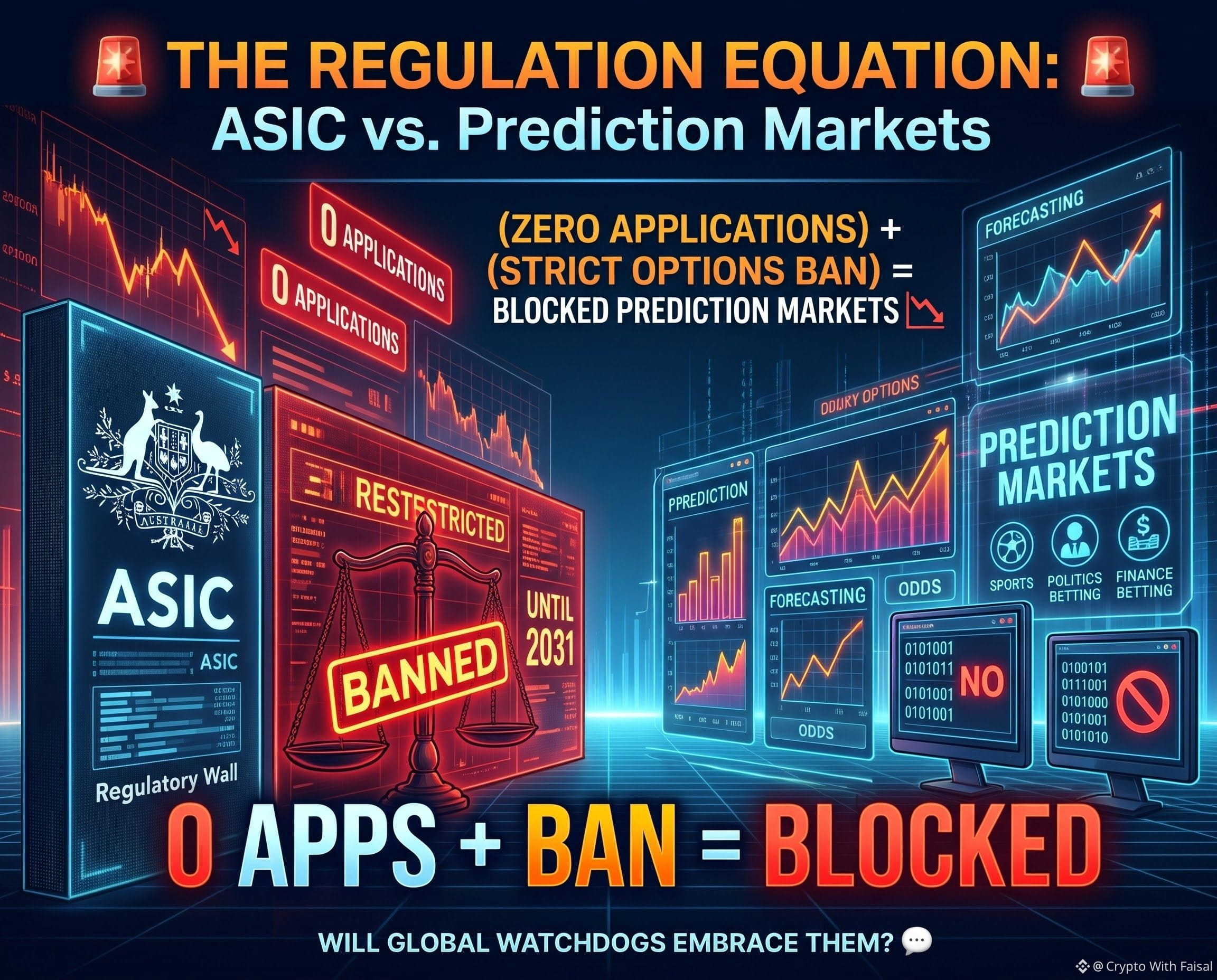
🚨 THE REGULATION EQUATION: ASIC vs. Prediction Markets 🚨
Australia is taking a hard stance. Let's break down the math 🧮👇
(Zero Applications) + (Strict Options Ban) = Blocked Prediction Markets 📉
The Asset Input:
(The Catalyst) = ASIC Chair Sarah Court confirmed to parliament that the regulator currently has zero applications from prediction market operators. Any future filings will face severe scrutiny.
The Key Deliverable:
(The Stance) ➔ ASIC officially classifies prediction platforms in the same high-risk bucket as binary options. Since binary options are strictly banned for retail clients in Australia until October 2031, prediction markets face a massive regulatory wall.
The Breakdown:
Local regulators are refusing to play ball. With zero local licenses, Australian users trading offshore have no financial protection if things go wrong.
Will global watchdogs eventually embrace prediction markets? 👇💬
$BTC
{future}(BTCUSDT)
$POL
{future}(POLUSDT)
$BNB
{future}(BNBUSDT)
#ASIC #Polymarket #predictionmarket
#asichasreceivednopredictionmarketapplications
🚨 THE REGULATION EQUATION: ASIC vs. Prediction Markets 🚨
Australia is taking a hard stance. Let's break down the math 🧮👇
(Zero Applications) + (Strict Options Ban) = Blocked Prediction Markets 📉
The Asset Input:
(The Catalyst) = ASIC Chair Sarah Court confirmed to parliament that the regulator currently has zero applications from prediction market operators. Any future filings will face severe scrutiny.
The Key Deliverable:
(The Stance) ➔ ASIC officially classifies prediction platforms in the same high-risk bucket as binary options. Since binary options are strictly banned for retail clients in Australia until October 2031, prediction markets face a massive regulatory wall.
The Breakdown:
Local regulators are refusing to play ball. With zero local licenses, Australian users trading offshore have no financial protection if things go wrong.
Will global watchdogs eventually embrace prediction markets? 👇💬
$BTC
$POL
$BNB
#ASIC #Polymarket #predictionmarket
1
191
·
--
Can You Run an Algorithmic Bitcoin CFD Strategy in Australia Under ASIC's Cap?$BTC | Can you run an EA or cAlgo strategy on Bitcoin CFDs in Australia and stay inside ASIC's retail rules? Yes. Pepperstone's crypto CFD desk runs on MT4, MT5 and cTrader with Expert Advisor and cAlgo scripting supported, but the mandatory 2:1 leverage cap means a strategy coded for an offshore account needs its position sizing rebuilt from the ground up, not just its API keys swapped over.
## Why does platform support matter more than the coin list here?
On the desk we never separated "is this broker any good" from "can my process actually run on it." A spot exchange like CoinSpot or Binance Australia gives you hundreds of coins and an API, but no charting platform built for running a strategy on the position itself. SatoshiMacro's review of Pepperstone's crypto CFD desk lists about 10 USD-denominated pairs, BTC through to MATIC, running across MT4, MT5, cTrader, TradingView integration and the native web and mobile apps, with EA and cAlgo scripting available on top of all of them. Narrower coin list, wider platform stack. That trade-off is the actual decision, not the headline rating.
## What does the 2:1 cap do to a strategy built elsewhere?
This is where most traders get it wrong. ASIC's leverage cap on retail crypto CFDs has sat at 2:1 since 29 March 2021 and was made permanent in 2022, under AFSL 414530. Take a strategy built on an offshore account running 50x. At 50x, a $1,000 margin unit opens roughly $50,000 of exposure. Drop the same logic onto a 2:1 Pepperstone account and that same $1,000 opens about $2,000, a position 25 times smaller than the backtest assumed. The strategy does not fail on the first signal. It fails three or four trades in, once a sizing error has quietly compounded.
## Where does an AUD 0 minimum deposit actually help?
It is the one number on the page that genuinely helps here. Pepperstone lists an AUD 0 minimum deposit, which means a trader can run a strategy through live execution, real spreads and overnight financing on genuinely small size before scaling up, instead of backtesting in isolation and meeting the real cost structure for the first time at full size. My read is that this does more for a trader porting a system than the leverage cap gets blamed for.
## Does running a bot change how the ATO treats the profit?
No. CFD profits and losses are generally assessed as ordinary income, not a capital gain, whether a human clicks the button or an EA does. The 50 percent CGT discount that applies to crypto held on a spot exchange past 12 months does not apply here, regardless of who or what places the trade. That is a tax outcome, not a technology one.
## What's the honest limitation?
Segregated client funds in Australian Tier-1 banks and negative balance protection stop the account from owing more than it holds. Neither one stops a strategy that is simply wrong. A systematic approach amplifies discipline when the logic holds and losses when it does not, at the same speed either way. This is not a strategy endorsement. A backtest run on offshore leverage and liquidity conditions is not evidence of anything once it is sitting at 2:1 on an ASIC-regulated book.
## My take
What I would actually do before porting anything across is run it on paper at the real 2:1 sizing first, then on the smallest live size the AUD 0 minimum allows, and only then compare the equity curve to the original backtest. If the two do not resemble each other, the leverage assumption was doing more of the work than the edge was.
https://satoshimacro.com/reviews/crypto/pepperstone-crypto-review/?utm_source=binance_square&utm_medium=social&utm_campaign=autopilot_article
#SatoshiMacro #Bitcoin #CryptoCFD #ASIC
Can You Run an Algorithmic Bitcoin CFD Strategy in Australia Under ASIC's Cap?
$BTC | Can you run an EA or cAlgo strategy on Bitcoin CFDs in Australia and stay inside ASIC's retail rules? Yes. Pepperstone's crypto CFD desk runs on MT4, MT5 and cTrader with Expert Advisor and cAlgo scripting supported, but the mandatory 2:1 leverage cap means a strategy coded for an offshore account needs its position sizing rebuilt from the ground up, not just its API keys swapped over.
## Why does platform support matter more than the coin list here?
On the desk we never separated "is this broker any good" from "can my process actually run on it." A spot exchange like CoinSpot or Binance Australia gives you hundreds of coins and an API, but no charting platform built for running a strategy on the position itself. SatoshiMacro's review of Pepperstone's crypto CFD desk lists about 10 USD-denominated pairs, BTC through to MATIC, running across MT4, MT5, cTrader, TradingView integration and the native web and mobile apps, with EA and cAlgo scripting available on top of all of them. Narrower coin list, wider platform stack. That trade-off is the actual decision, not the headline rating.
## What does the 2:1 cap do to a strategy built elsewhere?
This is where most traders get it wrong. ASIC's leverage cap on retail crypto CFDs has sat at 2:1 since 29 March 2021 and was made permanent in 2022, under AFSL 414530. Take a strategy built on an offshore account running 50x. At 50x, a $1,000 margin unit opens roughly $50,000 of exposure. Drop the same logic onto a 2:1 Pepperstone account and that same $1,000 opens about $2,000, a position 25 times smaller than the backtest assumed. The strategy does not fail on the first signal. It fails three or four trades in, once a sizing error has quietly compounded.
## Where does an AUD 0 minimum deposit actually help?
It is the one number on the page that genuinely helps here. Pepperstone lists an AUD 0 minimum deposit, which means a trader can run a strategy through live execution, real spreads and overnight financing on genuinely small size before scaling up, instead of backtesting in isolation and meeting the real cost structure for the first time at full size. My read is that this does more for a trader porting a system than the leverage cap gets blamed for.
## Does running a bot change how the ATO treats the profit?
No. CFD profits and losses are generally assessed as ordinary income, not a capital gain, whether a human clicks the button or an EA does. The 50 percent CGT discount that applies to crypto held on a spot exchange past 12 months does not apply here, regardless of who or what places the trade. That is a tax outcome, not a technology one.
## What's the honest limitation?
Segregated client funds in Australian Tier-1 banks and negative balance protection stop the account from owing more than it holds. Neither one stops a strategy that is simply wrong. A systematic approach amplifies discipline when the logic holds and losses when it does not, at the same speed either way. This is not a strategy endorsement. A backtest run on offshore leverage and liquidity conditions is not evidence of anything once it is sitting at 2:1 on an ASIC-regulated book.
## My take
What I would actually do before porting anything across is run it on paper at the real 2:1 sizing first, then on the smallest live size the AUD 0 minimum allows, and only then compare the equity curve to the original backtest. If the two do not resemble each other, the leverage assumption was doing more of the work than the edge was.
https://satoshimacro.com/reviews/crypto/pepperstone-crypto-review/?utm_source=binance_square&utm_medium=social&utm_campaign=autopilot_article
#SatoshiMacro #Bitcoin #CryptoCFD #ASIC
126

·
--
刷到澳洲 ASIC 这条:昆士兰州的 Brian Jacques Creigh,因无牌做加密投资基金被刑事起诉了。
硬点:墨尔本裁判法院 2026 年 10 月 19 日立案。检方指他 2021 年 4 月至 2022 年 6 月,通过 Panacea Capital 推销「Panacea Capital Cryptocurrency Investment Fund」,当时既无 AFS 牌照也非授权代表;另涉处理百万美元以上犯罪所得,对应未持牌业务吸纳的约 440 万美元投资款。联邦检方按 ASIC 刑事卷宗起诉,法院已批有条件保释。无牌从事金融服务最高 5 年;处理百万以上犯罪所得最高 25 年。此前他已于 2024 年 3 月因同一基金被永久禁业。
行政禁业之后又走到刑事指控,这条量级还是挺硬的。
#ASIC #加密监管 #澳大利亚

12
·
--
$BTC | On the desk, clients ask about the leverage cap first on a crypto CFD. The number that matters more is negative balance protection.
SatoshiMacro's Pepperstone Crypto review (AFSL 414530) notes ASIC's 2:1 cap started 29 March 2021, but negative balance protection only became permanent in 2022. A sharp swing cannot leave you owing the broker more than your margin. Add AFCA access on a dispute, and that is the real safety net, not the cap itself.
My read: price in the roughly 10 USD-quoted pairs on offer, against 500-plus coins on a spot exchange, before leverage enters the decision. The limit: protection covers broker-side blowups, not your own sizing mistakes. ASIC removes one risk, not all of them.
https://satoshimacro.com/reviews/crypto/pepperstone-crypto-review/?utm_source=binance_square&utm_medium=social&utm_campaign=autopilot_short-2
#SatoshiMacro #CryptoCFD #ASIC #Bitcoin
84




Canberra is tightening the screws on digital asset platforms. ASIC is pushing for tougher compliance mandates as the deadline for formal exchange licensing approaches fast. Stay sharp and track how regulatory shifts impact liquidity across $BTC and $ETH. #Write2Earn #CryptoRegulation #ASIC #Australia
Canberra is tightening the screws on digital asset platforms. ASIC is pushing for tougher compliance mandates as the deadline for formal exchange licensing approaches fast. Stay sharp and track how regulatory shifts impact liquidity across $BTC and $ETH . #Write2Earn #CryptoRegulation #ASIC #Australia

34

·
--
ASIC给澳洲交易所发作业:明春才正式收口澳洲ASIC把数字资产平台的「作业」摊开了:不是口号,是要进金融牌照体系。
官方媒体稿26-245MR开征询:咨询文件CP 392,落地《2026数字资产框架法》(DAF)。管两块——数字资产平台(DAP,替客户持有数字代币+平台服务),以及代币化托管平台(TCP,把底层资产记成数字代币)。新规目标生效日是2027年4月8日。
想继续玩,基本绕不开:申请或变更澳大利亚金融服务牌照(AFSL)、客户披露文件+平台规则,还有资产持有、交易结算、有形净资产等标准。现有牌照持有人、以及按INFO 225交过授权申请的,会走简化通道。征询截止2026年11月27日17:00(悉尼夏令时)。
委员Kirkland的口径是「同类活动、同类风险、同类监管结果」。ASIC说已收到140多份数字资产相关金融服务申请,其中INFO 225无行动期间就超110份。持$BTC、$ETH这类资产的平台以后要对齐传统金融那套——作业不多写,先把征询意见交上。
不构成投资建议。
#ASIC #澳洲监管 #数字资产 #加密合规 #Web3
ASIC给澳洲交易所发作业:明春才正式收口
澳洲ASIC把数字资产平台的「作业」摊开了:不是口号,是要进金融牌照体系。
官方媒体稿26-245MR开征询:咨询文件CP 392,落地《2026数字资产框架法》(DAF)。管两块——数字资产平台(DAP,替客户持有数字代币+平台服务),以及代币化托管平台(TCP,把底层资产记成数字代币)。新规目标生效日是2027年4月8日。
想继续玩,基本绕不开:申请或变更澳大利亚金融服务牌照(AFSL)、客户披露文件+平台规则,还有资产持有、交易结算、有形净资产等标准。现有牌照持有人、以及按INFO 225交过授权申请的,会走简化通道。征询截止2026年11月27日17:00(悉尼夏令时)。
委员Kirkland的口径是「同类活动、同类风险、同类监管结果」。ASIC说已收到140多份数字资产相关金融服务申请,其中INFO 225无行动期间就超110份。持$BTC 、$ETH 这类资产的平台以后要对齐传统金融那套——作业不多写,先把征询意见交上。
不构成投资建议。
#ASIC #澳洲监管 #数字资产 #加密合规 #Web3
193

·
--
澳洲加密牌照细节落地:咨询期开到11月27日
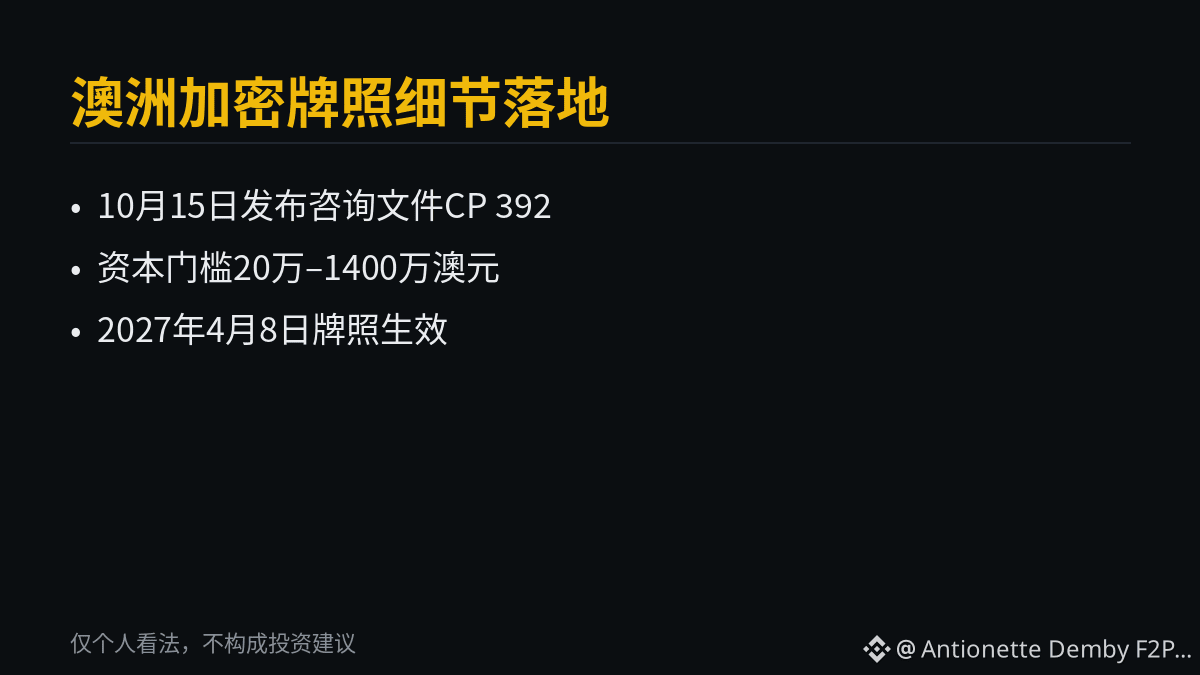
澳洲证券监管机构 ASIC 在 10 月 15 日发布了咨询文件 CP 392,针对数字资产平台(DAPs)和代币化托管平台(TCPs)提出资本、托管和交易规则。这是 2027 年 4 月 8 日牌照制度正式生效前的关键一步。
一,时间线。2026 年 4 月 8 日,Corporations Amendment (Digital Assets Framework) Act 获得御准;法律定于 2027 年 4 月 8 日生效;本次咨询截止 2026 年 11 月 27 日(AEDT 下午 5 点)。从征求意见到正式落地,行业过渡窗口不到半年。
二,资本门槛。提案给出三种备选资本模型,范围从 20 万澳元到 1400 万澳元。ASIC 同时要求限制平台自营交易,并对持有客户资产的钱包实行季度报告制度。
三,现状。ASIC 披露此前已收到 140 多份提供数字资产相关金融服务的授权申请,其中 110 多份来自 INFO 225 不采取行动声明期(2025 年 10 月至 2026 年 9 月 30 日)。排队等牌照的机构数量已经相当可观。
值得注意的是,规则还讨论了是否允许使用海外托管商,以及海外母公司或关联托管机构出问题时的保障措施——这对跨国平台是实打实的成本项。
我的看法:这套规则的严苛程度接近传统金融牌照,一旦落地,合规成本将成为小平台的出清门槛。对散户而言,资产隔离和季度披露意味着爆雷概率下降。这类监管落地通常长期利好、短期中性。仅个人看法,不构成任何投资建议。
$BTC
#澳洲 #加密监管 #ASIC
66

·
--
Australia’s securities regulator ASIC opened a consultation on proposed capital, custody and trading rules for crypto platforms, following the April passage of the Digital Assets Framework Act. The proposal outlines three capital models, including a baseline of 14 million Australian dollars ($9.7 million) in net tangible assets or 10 % of average revenue for firms without approved third‑party custody. It also calls for quarterly reporting of customer‑asset wallets, limits on platforms trading for their own account, and allows offshore custody while seeking feedback on safeguards if an overseas parent fails. Comments are due by 27 November, with final standards expected in March 2027 and the law taking effect on 8 April 2027, giving operators until 7 October 2027 to lodge licence applications.
#AustraliaCrypto #ASIC #CryptoRegulation
#AustraliaCrypto #ASIC #CryptoRegulation

77

Úc đề xuất trần đòn bẩy cho phái sinh tiền điện tử
- ASIC đề xuất giới hạn đòn bẩy cho phái sinh thanh toán bằng tài sản số
- Mở rộng bảo vệ chống số dư âm cho nhà đầu tư
- Áp dụng cho một số phái sinh nhất định
#BinanceSquare #CryptoNews #ASIC #Regulation
$btc $eth
#vlikevn Titanbot
Nguồn: CoinTelegraph
- ASIC đề xuất giới hạn đòn bẩy cho phái sinh thanh toán bằng tài sản số
- Mở rộng bảo vệ chống số dư âm cho nhà đầu tư
- Áp dụng cho một số phái sinh nhất định
#BinanceSquare #CryptoNews #ASIC #Regulation
$btc $eth
#vlikevn Titanbot
Nguồn: CoinTelegraph
270

·
--
ASIC拟对加密结算衍生品设杠杆上限,合规收紧信号明确
据Cointelegraph,ASIC提出将杠杆限制与负余额保护扩展至部分以加密资产结算的衍生品。这一动向值得注意,因为它意味着澳洲监管框架正从传统证券衍生品向加密结算工具延伸。
ASIC此举的核心在于把加密结算衍生品纳入更明确的投资者保护体系。过去部分衍生品因结算方式特殊,杠杆与负余额风险披露并不统一。若新规落地,相关产品的杠杆空间与风险结构可能被重新界定,交易所与做市商需要调整产品设计与风控参数。
从市场影响看,这属于区域性合规收紧,而非全球性杠杆压缩。对澳洲本地参与者而言,高杠杆加密衍生品交易成本与风险边界可能变化;对跨境平台而言,则需评估是否调整面向澳洲用户的杠杆设置。由于事实包未给出具体杠杆倍数、生效时间与适用范围,影响幅度仍需等待细则。
反方因素在于,监管收紧未必直接压制市场活跃度。部分投资者可能转向杠杆更透明、规则更清晰的产品,反而提升合规平台的相对吸引力。同时,若细则执行留有余地,市场调整幅度可能有限。
接下来值得观察ASIC是否公布具体杠杆上限、负余额保护机制以及适用产品范围。若细则明确且执行严格,澳洲加密衍生品结构或将出现阶段性调整。
#CryptoRegulation #ASIC
以上为信息整理与个人分析,不构成投资建议。
后续政策细节进一步明确后,我会继续更新。
12
Úc đề xuất giới hạn đòn bẩy cho phái sinh thanh toán bằng crypto
- ASIC (Cơ quan quản lý chứng khoán và đầu tư Úc) đề xuất áp dụng giới hạn đòn bẩy và bảo vệ chống số dư âm đối với một số sản phẩm phái sinh thanh toán bằng tài sản kỹ thuật số.
- Đề xuất này nhằm mở rộng các biện pháp bảo vệ hiện có sang lĩnh vực crypto-settled derivatives.
- Thông tin chi tiết về mức giới hạn cụ thể và thời gian áp dụng chưa được nêu trong mô tả RSS.
#CryptoNews #ASIC #CryptoRegulation #Derivatives #BinanceSquare
$btc $eth
vlikevn Titanbot
Nguồn: CoinTelegraph
144

Australia's regulator ASIC is proposing new leverage caps and negative balance protections for derivatives settled using digital assets. This move signals a tighter regulatory environment for high risk trading in the region.
#ASIC #LeverageCaps
Australia's regulator ASIC is proposing new leverage caps and negative balance protections for derivatives settled using digital assets. This move signals a tighter regulatory environment for high risk trading in the region.
#ASIC #LeverageCaps
#ASIC #LeverageCaps
17
Войдите, чтобы посмотреть больше материала
Присоединяйтесь к пользователям криптовалют по всему миру на Binance Square
⚡️ Получайте новейшую и полезную информацию о криптоактивах.
💬 Нам доверяет крупнейшая в мире криптобиржа.
👍 Получите достоверные аналитические данные от верифицированных создателей контента.
Эл. почта/номер телефона
В тренде
1
#HuangExitNvidiaStrategyInFocus
Просмотров: 108,837
1,185 обсуждают
2
#AnthropicRejectsIPODelayValuationinQuestion
Просмотров: 719,466
5,403 обсуждают
3
#HedgeFundsCMEBitcoinNetShortsFall89%
Просмотров: 1,617
48 обсуждают
4
#BitMineReports$6.3BNetLossForFiscal2026
Просмотров: 14,082
136 обсуждают
5
#AnthropicIPOAboutSixTimesOversubscribed
Просмотров: 600
34 обсуждают
6
#SoFiExpandsSoFiUSDStablecoinToPolygon
Просмотров: 2,836
65 обсуждают
7
#TetherGoldXAUTCompletesKPMGAudit
Просмотров: 3,097
65 обсуждают
8
#ChipStocksExtendLossesAfterNvidiaCEOChange
Просмотров: 43,206
493 обсуждают
9
#TrezorConfirmsMaliciousImplantsIn3Safe5Devices
Просмотров: 966
29 обсуждают
10
#TradFiForBeginners
Просмотров: 539,720
3,758 обсуждают