
Riyamoni1
302 Posts

Riyamoni1
Report
Block User
Open Trade
Frequent Trader
1 Years
112 Following
1.3K+ Followers
157 Liked
Posts
Portfolio
All
Quotes
Live
·
--
Bullish
I used to think permissions were something people actively managed. The more I watched how software works, the more I realized most permissions simply become invisible.
The first approval always feels important. People read the prompt, hesitate, maybe even double-check the address.
The tenth approval feels routine.
Eventually the permission itself disappears from attention, while the actions it enables continue quietly in the background.
That's what makes me wonder whether the real purpose of authorization isn't stopping bad actions.
Maybe it's reminding people that old decisions can still shape new outcomes.
As AI begins acting more frequently on our behalf, the hardest problem may not be deciding what an agent is allowed to do.
It may be remembering why we allowed it in the first place.
That shift in perspective is one reason Newton Protocol caught my attention.
@NewtonProtocol
$NEWT #Newt
{spot}(NEWTUSDT)
I used to think permissions were something people actively managed. The more I watched how software works, the more I realized most permissions simply become invisible.
The first approval always feels important. People read the prompt, hesitate, maybe even double-check the address.
The tenth approval feels routine.
Eventually the permission itself disappears from attention, while the actions it enables continue quietly in the background.
That's what makes me wonder whether the real purpose of authorization isn't stopping bad actions.
Maybe it's reminding people that old decisions can still shape new outcomes.
As AI begins acting more frequently on our behalf, the hardest problem may not be deciding what an agent is allowed to do.
It may be remembering why we allowed it in the first place.
That shift in perspective is one reason Newton Protocol caught my attention.
@NewtonProtocol
$NEWT #Newt
The first approval always feels important. People read the prompt, hesitate, maybe even double-check the address.
The tenth approval feels routine.
Eventually the permission itself disappears from attention, while the actions it enables continue quietly in the background.
That's what makes me wonder whether the real purpose of authorization isn't stopping bad actions.
Maybe it's reminding people that old decisions can still shape new outcomes.
As AI begins acting more frequently on our behalf, the hardest problem may not be deciding what an agent is allowed to do.
It may be remembering why we allowed it in the first place.
That shift in perspective is one reason Newton Protocol caught my attention.
@NewtonProtocol
$NEWT #Newt
1
72
·
--
The Future of Authorization Layers in On-Chain Finance and Newton's PositionThe more I think about authorization, the less I believe it is fundamentally about security.
Security is usually how authorization is introduced. It protects assets, restricts access, and prevents unauthorized actions. That's the language developers naturally use because software has always treated authorization as a technical problem.
{future}(BTCUSDT)
But finance has never been purely technical.
It has always been social.
Every financial system, from the earliest merchant agreements to today's smart contracts, exists because someone is willing to accept that another party is allowed to act within certain boundaries. Those boundaries rarely eliminate trust. They simply define where trust begins and where it ends.
That makes me wonder if authorization layers are quietly evolving into something much larger than access control.
Perhaps they are becoming the language through which autonomous systems negotiate responsibility.
For years, blockchains have answered one question remarkably well.
Can this transaction be executed?
Consensus, signatures, and state transitions determine whether an action is technically valid. Once those conditions are satisfied, execution follows almost automatically.
But autonomous software introduces a different kind of uncertainty.
A transaction may satisfy every cryptographic rule while still violating the intention of the person who originally delegated authority.
That distinction feels small today.
It may become one of the defining problems of autonomous finance.
The more responsibility moves from humans to software, the more authorization stops being a gate and starts becoming a conversation between intent and execution.
That is where Newton Protocol becomes interesting to me.
Not because it adds another security layer.
But because it implicitly asks a question that most blockchain infrastructure has never tried to answer.
Should technically valid always mean operationally acceptable?
Those ideas are often treated as identical.
Perhaps they aren't.
One proves that a transaction follows protocol rules.
The other asks whether the transaction still reflects the conditions under which authority was originally granted.
That difference may seem philosophical.
History suggests otherwise.
Most financial failures are not caused by cryptography breaking.
They happen because authority survives long after the assumptions behind that authority have changed.
Permissions are granted.
Circumstances evolve.
Software continues.
Humans forget.
The authorization itself isn't wrong.
Reality simply moves faster than the rules that once appeared reasonable.
Maybe that is why authorization layers deserve more attention than they currently receive.
Not because they eliminate mistakes.
They won't.
Policies can still be poorly designed.
Data sources can become outdated.
Governance can make incorrect decisions.
Authorization cannot guarantee wisdom.
It can only guarantee that decisions pass through the boundaries we intentionally created.
That may sound like a limitation.
I increasingly think it is the point.
Every generation of infrastructure quietly changes what people expect from technology.
Early blockchains taught us to expect immutability.
Smart contracts taught us to expect automation.
Perhaps authorization layers will teach us to expect accountability before execution rather than explanations after failure.
If that happens, Newton may eventually be remembered less as another infrastructure protocol and more as part of a broader transition in how financial authority is delegated to software.
Whether that future arrives quickly remains uncertain.
Markets rarely adopt infrastructure because it is intellectually elegant.
They adopt it when the absence of that infrastructure becomes expensive enough that ignoring it no longer feels rational.
That moment has not fully arrived.
But autonomous AI continues moving finance toward a world where software increasingly acts without continuous human supervision.
If that trajectory continues, the question may no longer be whether AI can execute transactions.
It may become whether society is comfortable allowing execution without first defining the limits of authority.
Perhaps that is the quiet role authorization layers will ultimately play.
Not replacing trust.
Not replacing human judgment.
But preserving the connection between intention and action long after the human who created that intention has stepped away.
The future of on-chain finance may not be decided by who builds the fastest execution layer. It may be decided by who defines the boundaries within which autonomous execution earns trust.
What do you think? Will authorization layers become a fundamental part of on-chain finance, or will they remain a niche solution until a major failure changes how the industry thinks about autonomous execution?
@NewtonProtocol
$NEWT #Newt #newt
The Future of Authorization Layers in On-Chain Finance and Newton's Position
The more I think about authorization, the less I believe it is fundamentally about security.
Security is usually how authorization is introduced. It protects assets, restricts access, and prevents unauthorized actions. That's the language developers naturally use because software has always treated authorization as a technical problem.
But finance has never been purely technical.
It has always been social.
Every financial system, from the earliest merchant agreements to today's smart contracts, exists because someone is willing to accept that another party is allowed to act within certain boundaries. Those boundaries rarely eliminate trust. They simply define where trust begins and where it ends.
That makes me wonder if authorization layers are quietly evolving into something much larger than access control.
Perhaps they are becoming the language through which autonomous systems negotiate responsibility.
For years, blockchains have answered one question remarkably well.
Can this transaction be executed?
Consensus, signatures, and state transitions determine whether an action is technically valid. Once those conditions are satisfied, execution follows almost automatically.
But autonomous software introduces a different kind of uncertainty.
A transaction may satisfy every cryptographic rule while still violating the intention of the person who originally delegated authority.
That distinction feels small today.
It may become one of the defining problems of autonomous finance.
The more responsibility moves from humans to software, the more authorization stops being a gate and starts becoming a conversation between intent and execution.
That is where Newton Protocol becomes interesting to me.
Not because it adds another security layer.
But because it implicitly asks a question that most blockchain infrastructure has never tried to answer.
Should technically valid always mean operationally acceptable?
Those ideas are often treated as identical.
Perhaps they aren't.
One proves that a transaction follows protocol rules.
The other asks whether the transaction still reflects the conditions under which authority was originally granted.
That difference may seem philosophical.
History suggests otherwise.
Most financial failures are not caused by cryptography breaking.
They happen because authority survives long after the assumptions behind that authority have changed.
Permissions are granted.
Circumstances evolve.
Software continues.
Humans forget.
The authorization itself isn't wrong.
Reality simply moves faster than the rules that once appeared reasonable.
Maybe that is why authorization layers deserve more attention than they currently receive.
Not because they eliminate mistakes.
They won't.
Policies can still be poorly designed.
Data sources can become outdated.
Governance can make incorrect decisions.
Authorization cannot guarantee wisdom.
It can only guarantee that decisions pass through the boundaries we intentionally created.
That may sound like a limitation.
I increasingly think it is the point.
Every generation of infrastructure quietly changes what people expect from technology.
Early blockchains taught us to expect immutability.
Smart contracts taught us to expect automation.
Perhaps authorization layers will teach us to expect accountability before execution rather than explanations after failure.
If that happens, Newton may eventually be remembered less as another infrastructure protocol and more as part of a broader transition in how financial authority is delegated to software.
Whether that future arrives quickly remains uncertain.
Markets rarely adopt infrastructure because it is intellectually elegant.
They adopt it when the absence of that infrastructure becomes expensive enough that ignoring it no longer feels rational.
That moment has not fully arrived.
But autonomous AI continues moving finance toward a world where software increasingly acts without continuous human supervision.
If that trajectory continues, the question may no longer be whether AI can execute transactions.
It may become whether society is comfortable allowing execution without first defining the limits of authority.
Perhaps that is the quiet role authorization layers will ultimately play.
Not replacing trust.
Not replacing human judgment.
But preserving the connection between intention and action long after the human who created that intention has stepped away.
The future of on-chain finance may not be decided by who builds the fastest execution layer. It may be decided by who defines the boundaries within which autonomous execution earns trust.
What do you think? Will authorization layers become a fundamental part of on-chain finance, or will they remain a niche solution until a major failure changes how the industry thinks about autonomous execution?
@NewtonProtocol
$NEWT #Newt #newt
Security is usually how authorization is introduced. It protects assets, restricts access, and prevents unauthorized actions. That's the language developers naturally use because software has always treated authorization as a technical problem.
But finance has never been purely technical.
It has always been social.
Every financial system, from the earliest merchant agreements to today's smart contracts, exists because someone is willing to accept that another party is allowed to act within certain boundaries. Those boundaries rarely eliminate trust. They simply define where trust begins and where it ends.
That makes me wonder if authorization layers are quietly evolving into something much larger than access control.
Perhaps they are becoming the language through which autonomous systems negotiate responsibility.
For years, blockchains have answered one question remarkably well.
Can this transaction be executed?
Consensus, signatures, and state transitions determine whether an action is technically valid. Once those conditions are satisfied, execution follows almost automatically.
But autonomous software introduces a different kind of uncertainty.
A transaction may satisfy every cryptographic rule while still violating the intention of the person who originally delegated authority.
That distinction feels small today.
It may become one of the defining problems of autonomous finance.
The more responsibility moves from humans to software, the more authorization stops being a gate and starts becoming a conversation between intent and execution.
That is where Newton Protocol becomes interesting to me.
Not because it adds another security layer.
But because it implicitly asks a question that most blockchain infrastructure has never tried to answer.
Should technically valid always mean operationally acceptable?
Those ideas are often treated as identical.
Perhaps they aren't.
One proves that a transaction follows protocol rules.
The other asks whether the transaction still reflects the conditions under which authority was originally granted.
That difference may seem philosophical.
History suggests otherwise.
Most financial failures are not caused by cryptography breaking.
They happen because authority survives long after the assumptions behind that authority have changed.
Permissions are granted.
Circumstances evolve.
Software continues.
Humans forget.
The authorization itself isn't wrong.
Reality simply moves faster than the rules that once appeared reasonable.
Maybe that is why authorization layers deserve more attention than they currently receive.
Not because they eliminate mistakes.
They won't.
Policies can still be poorly designed.
Data sources can become outdated.
Governance can make incorrect decisions.
Authorization cannot guarantee wisdom.
It can only guarantee that decisions pass through the boundaries we intentionally created.
That may sound like a limitation.
I increasingly think it is the point.
Every generation of infrastructure quietly changes what people expect from technology.
Early blockchains taught us to expect immutability.
Smart contracts taught us to expect automation.
Perhaps authorization layers will teach us to expect accountability before execution rather than explanations after failure.
If that happens, Newton may eventually be remembered less as another infrastructure protocol and more as part of a broader transition in how financial authority is delegated to software.
Whether that future arrives quickly remains uncertain.
Markets rarely adopt infrastructure because it is intellectually elegant.
They adopt it when the absence of that infrastructure becomes expensive enough that ignoring it no longer feels rational.
That moment has not fully arrived.
But autonomous AI continues moving finance toward a world where software increasingly acts without continuous human supervision.
If that trajectory continues, the question may no longer be whether AI can execute transactions.
It may become whether society is comfortable allowing execution without first defining the limits of authority.
Perhaps that is the quiet role authorization layers will ultimately play.
Not replacing trust.
Not replacing human judgment.
But preserving the connection between intention and action long after the human who created that intention has stepped away.
The future of on-chain finance may not be decided by who builds the fastest execution layer. It may be decided by who defines the boundaries within which autonomous execution earns trust.
What do you think? Will authorization layers become a fundamental part of on-chain finance, or will they remain a niche solution until a major failure changes how the industry thinks about autonomous execution?
@NewtonProtocol
$NEWT #Newt #newt
93
·
--
The Most Valuable Thing AI Might Preserve Isn't Our Time. It Might Be Our Intent.The more I think about automation, the less I believe its greatest promise is saving people time.
Time has always been easy to measure.
Intent hasn't.
Every financial system we've built assumes something simple: if an action is correctly authorized, it should happen. That's a reasonable assumption when humans remain close to every decision. We click the button. We review the transaction. We accept the consequence.
AI quietly changes that relationship.
The person making the decision and the moment the decision is executed no longer have to exist at the same time.
At first, that feels like progress.
Then another thought appeared.
Perhaps the biggest challenge isn't teaching AI how to make better decisions.
Perhaps it's making sure yesterday's decision still reflects tomorrow's intention.
Human intentions aren't static.
We change our minds.
Markets change.
Risks appear.
Information that seemed complete yesterday may feel dangerously incomplete today.
Yet automation has a tendency to keep moving unless something explicitly tells it to stop.
That made me wonder whether the future of financial automation depends less on making AI more intelligent and more on making human intent easier to preserve as circumstances evolve.
That's where Newton Protocol started feeling interesting to me.
Not because it promises perfect automation.
But because it introduces the idea that important actions can be evaluated against policies before they happen, rather than assuming every technically valid action should automatically proceed.
The difference seems small.
Philosophically, it isn't.
One asks whether an action can happen.
The other asks whether it still should.
Those aren't the same question.
And I wonder if we've spent so much time trying to remove friction from digital finance that we've started treating every delay as a problem.
Sometimes a pause isn't inefficiency.
Sometimes it's the last opportunity to notice that the world has changed since the original decision was made.
Technology often celebrates speed because speed is easy to demonstrate.
Judgment is harder.
You can't benchmark wisdom the way you benchmark transaction throughput.
You usually notice its value only after the absence of it becomes expensive.
Maybe that's why permission-based automation feels more significant than it first appears.
It doesn't make humans disappear from decision-making.
It creates a way for their original intent to remain present, even when they are no longer present themselves.
Whether that becomes essential or remains a niche idea depends on something far beyond cryptography.
It depends on whether autonomous AI becomes powerful enough that people begin worrying less about what it can do, and more about what it continues doing after they stop paying attention.
Perhaps the future of trust won't be built on making AI think more like humans.
It may be built on making sure AI never forgets what humans originally meant.
What do you think? As AI becomes more autonomous, will preserving human intent become more important than improving AI intelligence itself?
@NewtonProtocol
$NEWT #Newt
The Most Valuable Thing AI Might Preserve Isn't Our Time. It Might Be Our Intent.
The more I think about automation, the less I believe its greatest promise is saving people time.
Time has always been easy to measure.
Intent hasn't.
Every financial system we've built assumes something simple: if an action is correctly authorized, it should happen. That's a reasonable assumption when humans remain close to every decision. We click the button. We review the transaction. We accept the consequence.
AI quietly changes that relationship.
The person making the decision and the moment the decision is executed no longer have to exist at the same time.
At first, that feels like progress.
Then another thought appeared.
Perhaps the biggest challenge isn't teaching AI how to make better decisions.
Perhaps it's making sure yesterday's decision still reflects tomorrow's intention.
Human intentions aren't static.
We change our minds.
Markets change.
Risks appear.
Information that seemed complete yesterday may feel dangerously incomplete today.
Yet automation has a tendency to keep moving unless something explicitly tells it to stop.
That made me wonder whether the future of financial automation depends less on making AI more intelligent and more on making human intent easier to preserve as circumstances evolve.
That's where Newton Protocol started feeling interesting to me.
Not because it promises perfect automation.
But because it introduces the idea that important actions can be evaluated against policies before they happen, rather than assuming every technically valid action should automatically proceed.
The difference seems small.
Philosophically, it isn't.
One asks whether an action can happen.
The other asks whether it still should.
Those aren't the same question.
And I wonder if we've spent so much time trying to remove friction from digital finance that we've started treating every delay as a problem.
Sometimes a pause isn't inefficiency.
Sometimes it's the last opportunity to notice that the world has changed since the original decision was made.
Technology often celebrates speed because speed is easy to demonstrate.
Judgment is harder.
You can't benchmark wisdom the way you benchmark transaction throughput.
You usually notice its value only after the absence of it becomes expensive.
Maybe that's why permission-based automation feels more significant than it first appears.
It doesn't make humans disappear from decision-making.
It creates a way for their original intent to remain present, even when they are no longer present themselves.
Whether that becomes essential or remains a niche idea depends on something far beyond cryptography.
It depends on whether autonomous AI becomes powerful enough that people begin worrying less about what it can do, and more about what it continues doing after they stop paying attention.
Perhaps the future of trust won't be built on making AI think more like humans.
It may be built on making sure AI never forgets what humans originally meant.
What do you think? As AI becomes more autonomous, will preserving human intent become more important than improving AI intelligence itself?
@NewtonProtocol
$NEWT #Newt
Time has always been easy to measure.
Intent hasn't.
Every financial system we've built assumes something simple: if an action is correctly authorized, it should happen. That's a reasonable assumption when humans remain close to every decision. We click the button. We review the transaction. We accept the consequence.
AI quietly changes that relationship.
The person making the decision and the moment the decision is executed no longer have to exist at the same time.
At first, that feels like progress.
Then another thought appeared.
Perhaps the biggest challenge isn't teaching AI how to make better decisions.
Perhaps it's making sure yesterday's decision still reflects tomorrow's intention.
Human intentions aren't static.
We change our minds.
Markets change.
Risks appear.
Information that seemed complete yesterday may feel dangerously incomplete today.
Yet automation has a tendency to keep moving unless something explicitly tells it to stop.
That made me wonder whether the future of financial automation depends less on making AI more intelligent and more on making human intent easier to preserve as circumstances evolve.
That's where Newton Protocol started feeling interesting to me.
Not because it promises perfect automation.
But because it introduces the idea that important actions can be evaluated against policies before they happen, rather than assuming every technically valid action should automatically proceed.
The difference seems small.
Philosophically, it isn't.
One asks whether an action can happen.
The other asks whether it still should.
Those aren't the same question.
And I wonder if we've spent so much time trying to remove friction from digital finance that we've started treating every delay as a problem.
Sometimes a pause isn't inefficiency.
Sometimes it's the last opportunity to notice that the world has changed since the original decision was made.
Technology often celebrates speed because speed is easy to demonstrate.
Judgment is harder.
You can't benchmark wisdom the way you benchmark transaction throughput.
You usually notice its value only after the absence of it becomes expensive.
Maybe that's why permission-based automation feels more significant than it first appears.
It doesn't make humans disappear from decision-making.
It creates a way for their original intent to remain present, even when they are no longer present themselves.
Whether that becomes essential or remains a niche idea depends on something far beyond cryptography.
It depends on whether autonomous AI becomes powerful enough that people begin worrying less about what it can do, and more about what it continues doing after they stop paying attention.
Perhaps the future of trust won't be built on making AI think more like humans.
It may be built on making sure AI never forgets what humans originally meant.
What do you think? As AI becomes more autonomous, will preserving human intent become more important than improving AI intelligence itself?
@NewtonProtocol
$NEWT #Newt
1
44
·
--
The more I learn about AI automation in crypto, the more I wonder if "valid" should always mean "approved."
Today's blockchains are excellent at verifying transactions, but they can't tell whether a transaction truly reflects the user's intent.
As AI agents become more involved in managing wallets and assets, that gap could become much more important.
That's one reason I find @NewtonProtocol interesting. Instead of relying only on technical validity, it explores how transparent policies can evaluate actions before execution.
The goal isn't to slow innovation. It's to reduce costly mistakes while keeping automation accountable.
If this approach gains adoption, intent-aware infrastructure could become a key part of the next generation of Web3.
@NewtonProtocol $NEWT #NEWT #Newt
The more I learn about AI automation in crypto, the more I wonder if "valid" should always mean "approved."
Today's blockchains are excellent at verifying transactions, but they can't tell whether a transaction truly reflects the user's intent.
As AI agents become more involved in managing wallets and assets, that gap could become much more important.
That's one reason I find @NewtonProtocol interesting. Instead of relying only on technical validity, it explores how transparent policies can evaluate actions before execution.
The goal isn't to slow innovation. It's to reduce costly mistakes while keeping automation accountable.
If this approach gains adoption, intent-aware infrastructure could become a key part of the next generation of Web3.
@NewtonProtocol $NEWT #NEWT #Newt
Today's blockchains are excellent at verifying transactions, but they can't tell whether a transaction truly reflects the user's intent.
As AI agents become more involved in managing wallets and assets, that gap could become much more important.
That's one reason I find @NewtonProtocol interesting. Instead of relying only on technical validity, it explores how transparent policies can evaluate actions before execution.
The goal isn't to slow innovation. It's to reduce costly mistakes while keeping automation accountable.
If this approach gains adoption, intent-aware infrastructure could become a key part of the next generation of Web3.
@NewtonProtocol $NEWT #NEWT #Newt
1
1
68
·
--
The Quiet Value of Permission Boundaries — Why AI Doesn't Need More Freedom, It Needs Better LimitsThe more I read about Newton Protocol, the less I think its most important feature is automation.
What keeps drawing my attention is something much less exciting.
The ability to define where automation should stop.
Technology usually celebrates removing limits. Faster execution, fewer clicks, less human involvement. Progress often looks like giving software more freedom.
But finance has always evolved differently.
The systems people trust the most aren't the ones with unlimited authority. They're the ones where authority is carefully defined, monitored, and restricted.
That made me wonder if permission boundaries are doing more than protecting users.
Perhaps they're shaping behavior before anything even happens.
An AI agent that knows every important action must satisfy a predefined policy doesn't simply execute faster. It operates with the expectation that every decision exists inside a boundary chosen by someone else.
That changes the relationship between users and automation.
The goal is no longer blind trust.
It's predictable behavior.
Of course, boundaries aren't automatically good.
A poorly designed policy can block legitimate actions, while an overly broad one may approve actions that should have been questioned.
Technology can enforce limits.
It can't decide whether those limits reflect good judgment.
That's still a human responsibility.
Maybe that's the most interesting part of Newton Protocol.
It doesn't promise to replace human decisions.
It creates a framework where human decisions can continue shaping automated ones.
As AI becomes more capable, intelligence alone may not determine which systems people adopt.
The systems that earn lasting trust may be the ones that make their limits just as visible as their capabilities.
What do you think? In the future of AI-powered finance, will clearly defined boundaries become more valuable than giving AI greater freedom?
@NewtonProtocol #BTC
$NEWT #Newt
The Quiet Value of Permission Boundaries — Why AI Doesn't Need More Freedom, It Needs Better Limits
The more I read about Newton Protocol, the less I think its most important feature is automation.
What keeps drawing my attention is something much less exciting.
The ability to define where automation should stop.
Technology usually celebrates removing limits. Faster execution, fewer clicks, less human involvement. Progress often looks like giving software more freedom.
But finance has always evolved differently.
The systems people trust the most aren't the ones with unlimited authority. They're the ones where authority is carefully defined, monitored, and restricted.
That made me wonder if permission boundaries are doing more than protecting users.
Perhaps they're shaping behavior before anything even happens.
An AI agent that knows every important action must satisfy a predefined policy doesn't simply execute faster. It operates with the expectation that every decision exists inside a boundary chosen by someone else.
That changes the relationship between users and automation.
The goal is no longer blind trust.
It's predictable behavior.
Of course, boundaries aren't automatically good.
A poorly designed policy can block legitimate actions, while an overly broad one may approve actions that should have been questioned.
Technology can enforce limits.
It can't decide whether those limits reflect good judgment.
That's still a human responsibility.
Maybe that's the most interesting part of Newton Protocol.
It doesn't promise to replace human decisions.
It creates a framework where human decisions can continue shaping automated ones.
As AI becomes more capable, intelligence alone may not determine which systems people adopt.
The systems that earn lasting trust may be the ones that make their limits just as visible as their capabilities.
What do you think? In the future of AI-powered finance, will clearly defined boundaries become more valuable than giving AI greater freedom?
@NewtonProtocol #BTC
$NEWT #Newt
What keeps drawing my attention is something much less exciting.
The ability to define where automation should stop.
Technology usually celebrates removing limits. Faster execution, fewer clicks, less human involvement. Progress often looks like giving software more freedom.
But finance has always evolved differently.
The systems people trust the most aren't the ones with unlimited authority. They're the ones where authority is carefully defined, monitored, and restricted.
That made me wonder if permission boundaries are doing more than protecting users.
Perhaps they're shaping behavior before anything even happens.
An AI agent that knows every important action must satisfy a predefined policy doesn't simply execute faster. It operates with the expectation that every decision exists inside a boundary chosen by someone else.
That changes the relationship between users and automation.
The goal is no longer blind trust.
It's predictable behavior.
Of course, boundaries aren't automatically good.
A poorly designed policy can block legitimate actions, while an overly broad one may approve actions that should have been questioned.
Technology can enforce limits.
It can't decide whether those limits reflect good judgment.
That's still a human responsibility.
Maybe that's the most interesting part of Newton Protocol.
It doesn't promise to replace human decisions.
It creates a framework where human decisions can continue shaping automated ones.
As AI becomes more capable, intelligence alone may not determine which systems people adopt.
The systems that earn lasting trust may be the ones that make their limits just as visible as their capabilities.
What do you think? In the future of AI-powered finance, will clearly defined boundaries become more valuable than giving AI greater freedom?
@NewtonProtocol #BTC
$NEWT #Newt
1
71
·
--
Newton Protocol May Be Solving Tomorrow's Problem, Not Today's
The more I think about Newton Protocol, the more I wonder if its biggest challenge isn't technology—it's timing.
Permission-based AI and verifiable execution make sense, especially as AI agents begin handling real financial value.
But today's users rarely ask for an authorization layer. Most care about speed, convenience, and low fees. If existing tools already feel "good enough," why would they switch?
That makes me think Newton isn't really competing with other protocols.
It's competing with habit.
Infrastructure rarely succeeds because it's technically superior. It succeeds when the market reaches a point where the old way no longer feels safe enough.
If AI becomes a normal part of onchain finance, accountability may stop being a premium feature and become an expectation.
The question isn't whether Newton works. It's whether the market is ready for what it's building.
What do you think?
@NewtonProtocol
$NEWT #Newt
Newton Protocol May Be Solving Tomorrow's Problem, Not Today's
The more I think about Newton Protocol, the more I wonder if its biggest challenge isn't technology—it's timing.
Permission-based AI and verifiable execution make sense, especially as AI agents begin handling real financial value.
But today's users rarely ask for an authorization layer. Most care about speed, convenience, and low fees. If existing tools already feel "good enough," why would they switch?
That makes me think Newton isn't really competing with other protocols.
It's competing with habit.
Infrastructure rarely succeeds because it's technically superior. It succeeds when the market reaches a point where the old way no longer feels safe enough.
If AI becomes a normal part of onchain finance, accountability may stop being a premium feature and become an expectation.
The question isn't whether Newton works. It's whether the market is ready for what it's building.
What do you think?
@NewtonProtocol
$NEWT #Newt
The more I think about Newton Protocol, the more I wonder if its biggest challenge isn't technology—it's timing.
Permission-based AI and verifiable execution make sense, especially as AI agents begin handling real financial value.
But today's users rarely ask for an authorization layer. Most care about speed, convenience, and low fees. If existing tools already feel "good enough," why would they switch?
That makes me think Newton isn't really competing with other protocols.
It's competing with habit.
Infrastructure rarely succeeds because it's technically superior. It succeeds when the market reaches a point where the old way no longer feels safe enough.
If AI becomes a normal part of onchain finance, accountability may stop being a premium feature and become an expectation.
The question isn't whether Newton works. It's whether the market is ready for what it's building.
What do you think?
@NewtonProtocol
$NEWT #Newt
93
·
--
Bearish
I've been thinking about where VaultKit actually adds the most value.
At first, I assumed the goal was to place AI policy checks in front of every vault action.
The more I read, the more it seemed that's not the design.
VaultKit focuses on the moments that can fundamentally change how a vault is managed—operations like updating strategy, adjusting limits, or other privileged administrative decisions. Those are the actions where policy enforcement can reduce operational risk before execution.
That also means it's important not to overstate what it does. A vault protected by Newton doesn't imply every transaction has been evaluated by the same policy engine. The protection applies to the actions intentionally routed through the Shield, while the rest of the vault continues to behave according to its underlying protocol.
Understanding that boundary makes the architecture feel more deliberate rather than more limited.
#newt $NEWT @NewtonProtocol
I've been thinking about where VaultKit actually adds the most value.
At first, I assumed the goal was to place AI policy checks in front of every vault action.
The more I read, the more it seemed that's not the design.
VaultKit focuses on the moments that can fundamentally change how a vault is managed—operations like updating strategy, adjusting limits, or other privileged administrative decisions. Those are the actions where policy enforcement can reduce operational risk before execution.
That also means it's important not to overstate what it does. A vault protected by Newton doesn't imply every transaction has been evaluated by the same policy engine. The protection applies to the actions intentionally routed through the Shield, while the rest of the vault continues to behave according to its underlying protocol.
Understanding that boundary makes the architecture feel more deliberate rather than more limited.
#newt $NEWT @NewtonProtocol
At first, I assumed the goal was to place AI policy checks in front of every vault action.
The more I read, the more it seemed that's not the design.
VaultKit focuses on the moments that can fundamentally change how a vault is managed—operations like updating strategy, adjusting limits, or other privileged administrative decisions. Those are the actions where policy enforcement can reduce operational risk before execution.
That also means it's important not to overstate what it does. A vault protected by Newton doesn't imply every transaction has been evaluated by the same policy engine. The protection applies to the actions intentionally routed through the Shield, while the rest of the vault continues to behave according to its underlying protocol.
Understanding that boundary makes the architecture feel more deliberate rather than more limited.
#newt $NEWT @NewtonProtocol
2
2
38
·
--
VaultKit Doesn't Remove Trust. It Moves It. And That Changes EverythingOne of the biggest misconceptions in Web3 is that smart contracts eliminate trust.
They don't.What they actually do is change where trust lives.
That's why VaultKit caught my attention. Instead of claiming that users no longer need trust, it recognizes that trust should be transparent, programmable, and verifiable rather than hidden behind centralized decision-making.
In traditional finance, users trust institutions to protect assets, enforce permissions, and process transactions correctly. Most of those decisions happen behind closed doors, leaving users with little visibility into how the system works.
VaultKit approaches this differently.
Rather than relying on a single party's judgment, it allows security rules, permissions, and execution logic to become part of an auditable onchain framework. Trust shifts from "believing someone will do the right thing" to "verifying that the predefined rules were followed."
That distinction matters.It doesn't mean every risk disappears. Poorly written policies, incorrect configurations, or compromised credentials can still create problems. Technology can't eliminate human error.
But it can reduce uncertainty.When rules are visible, consistently enforced, and easy to audit, users gain confidence because they can verify outcomes instead of relying solely on promises.
This is especially important as AI agents begin handling more financial activity. Automation without clear guardrails can introduce new risks, but automation governed by transparent policies creates accountability.
In that sense, VaultKit isn't trying to replace trust.It's relocating trust—from organizations and individuals toward open, verifiable systems where every participant can inspect the rules before assets move.
That may sound like a subtle change.In reality, it's one of the biggest philosophical shifts blockchain has introduced.
The future of digital finance may not be trustless.
It may simply be trust that everyone can verify.
What do you think? Is the goal of Web3 to eliminate trust entirely, or to make trust transparent enough that anyone can independently verify it?
@NewtonProtocol $NEWT #newt
{spot}(NEWTUSDT)
VaultKit Doesn't Remove Trust. It Moves It. And That Changes Everything
One of the biggest misconceptions in Web3 is that smart contracts eliminate trust.
They don't.What they actually do is change where trust lives.
That's why VaultKit caught my attention. Instead of claiming that users no longer need trust, it recognizes that trust should be transparent, programmable, and verifiable rather than hidden behind centralized decision-making.
In traditional finance, users trust institutions to protect assets, enforce permissions, and process transactions correctly. Most of those decisions happen behind closed doors, leaving users with little visibility into how the system works.
VaultKit approaches this differently.
Rather than relying on a single party's judgment, it allows security rules, permissions, and execution logic to become part of an auditable onchain framework. Trust shifts from "believing someone will do the right thing" to "verifying that the predefined rules were followed."
That distinction matters.It doesn't mean every risk disappears. Poorly written policies, incorrect configurations, or compromised credentials can still create problems. Technology can't eliminate human error.
But it can reduce uncertainty.When rules are visible, consistently enforced, and easy to audit, users gain confidence because they can verify outcomes instead of relying solely on promises.
This is especially important as AI agents begin handling more financial activity. Automation without clear guardrails can introduce new risks, but automation governed by transparent policies creates accountability.
In that sense, VaultKit isn't trying to replace trust.It's relocating trust—from organizations and individuals toward open, verifiable systems where every participant can inspect the rules before assets move.
That may sound like a subtle change.In reality, it's one of the biggest philosophical shifts blockchain has introduced.
The future of digital finance may not be trustless.
It may simply be trust that everyone can verify.
What do you think? Is the goal of Web3 to eliminate trust entirely, or to make trust transparent enough that anyone can independently verify it?
@NewtonProtocol $NEWT #newt
They don't.What they actually do is change where trust lives.
That's why VaultKit caught my attention. Instead of claiming that users no longer need trust, it recognizes that trust should be transparent, programmable, and verifiable rather than hidden behind centralized decision-making.
In traditional finance, users trust institutions to protect assets, enforce permissions, and process transactions correctly. Most of those decisions happen behind closed doors, leaving users with little visibility into how the system works.
VaultKit approaches this differently.
Rather than relying on a single party's judgment, it allows security rules, permissions, and execution logic to become part of an auditable onchain framework. Trust shifts from "believing someone will do the right thing" to "verifying that the predefined rules were followed."
That distinction matters.It doesn't mean every risk disappears. Poorly written policies, incorrect configurations, or compromised credentials can still create problems. Technology can't eliminate human error.
But it can reduce uncertainty.When rules are visible, consistently enforced, and easy to audit, users gain confidence because they can verify outcomes instead of relying solely on promises.
This is especially important as AI agents begin handling more financial activity. Automation without clear guardrails can introduce new risks, but automation governed by transparent policies creates accountability.
In that sense, VaultKit isn't trying to replace trust.It's relocating trust—from organizations and individuals toward open, verifiable systems where every participant can inspect the rules before assets move.
That may sound like a subtle change.In reality, it's one of the biggest philosophical shifts blockchain has introduced.
The future of digital finance may not be trustless.
It may simply be trust that everyone can verify.
What do you think? Is the goal of Web3 to eliminate trust entirely, or to make trust transparent enough that anyone can independently verify it?
@NewtonProtocol $NEWT #newt
1
2
77
·
--
Can Newton Make AI Permissions Easier to Revoke Than to Grant?
I kept thinking about what happens after someone gives an AI agent permission to act.
Most conversations focus on how permissions are granted, but what if circumstances change?
A trading strategy no longer makes sense. A wallet owner loses confidence in an AI agent. A policy needs to become more restrictive after a new risk is discovered.
The real challenge may not be giving permission.
It may be changing or removing it safely.
From what I've read, Newton Protocol is designed around policy-based authorization rather than unlimited delegation. Protected actions require policy validation before execution, allowing permissions to be updated over time instead of remaining permanently trusted.
That struck me as an important design choice.
Security isn't only about deciding who can act today.
It's also about making tomorrow's decisions easy to change.
At the same time, changing a policy doesn't automatically guarantee better outcomes.
A poorly designed policy can still create unnecessary friction, while a policy that's too permissive may leave users exposed to risks they didn't intend to accept.
Technology can enforce the rules.
It can't decide whether the rules themselves are the right ones.
For me, that's where Newton becomes interesting.
The long-term value may come less from automation itself and more from giving users the confidence that automation remains under their control as conditions change.
What do you think? As AI agents become more capable, will the ability to update or revoke permissions become just as important as granting them in the first place?
@NewtonProtocol
$NEWT #Newt #newt
Can Newton Make AI Permissions Easier to Revoke Than to Grant?
I kept thinking about what happens after someone gives an AI agent permission to act.
Most conversations focus on how permissions are granted, but what if circumstances change?
A trading strategy no longer makes sense. A wallet owner loses confidence in an AI agent. A policy needs to become more restrictive after a new risk is discovered.
The real challenge may not be giving permission.
It may be changing or removing it safely.
From what I've read, Newton Protocol is designed around policy-based authorization rather than unlimited delegation. Protected actions require policy validation before execution, allowing permissions to be updated over time instead of remaining permanently trusted.
That struck me as an important design choice.
Security isn't only about deciding who can act today.
It's also about making tomorrow's decisions easy to change.
At the same time, changing a policy doesn't automatically guarantee better outcomes.
A poorly designed policy can still create unnecessary friction, while a policy that's too permissive may leave users exposed to risks they didn't intend to accept.
Technology can enforce the rules.
It can't decide whether the rules themselves are the right ones.
For me, that's where Newton becomes interesting.
The long-term value may come less from automation itself and more from giving users the confidence that automation remains under their control as conditions change.
What do you think? As AI agents become more capable, will the ability to update or revoke permissions become just as important as granting them in the first place?
@NewtonProtocol
$NEWT #Newt #newt
I kept thinking about what happens after someone gives an AI agent permission to act.
Most conversations focus on how permissions are granted, but what if circumstances change?
A trading strategy no longer makes sense. A wallet owner loses confidence in an AI agent. A policy needs to become more restrictive after a new risk is discovered.
The real challenge may not be giving permission.
It may be changing or removing it safely.
From what I've read, Newton Protocol is designed around policy-based authorization rather than unlimited delegation. Protected actions require policy validation before execution, allowing permissions to be updated over time instead of remaining permanently trusted.
That struck me as an important design choice.
Security isn't only about deciding who can act today.
It's also about making tomorrow's decisions easy to change.
At the same time, changing a policy doesn't automatically guarantee better outcomes.
A poorly designed policy can still create unnecessary friction, while a policy that's too permissive may leave users exposed to risks they didn't intend to accept.
Technology can enforce the rules.
It can't decide whether the rules themselves are the right ones.
For me, that's where Newton becomes interesting.
The long-term value may come less from automation itself and more from giving users the confidence that automation remains under their control as conditions change.
What do you think? As AI agents become more capable, will the ability to update or revoke permissions become just as important as granting them in the first place?
@NewtonProtocol
$NEWT #Newt #newt
2
66
·
--
The Real Test for Newton Protocol May Not Be Security—It May Be SimplicityThe more I read about Newton Protocol, the more I think its biggest challenge might not be building secure infrastructure.
It might be making that infrastructure feel invisible.
Crypto has a long history of creating better technology than the average user actually asks for.
Faster blockchains, better scalability, stronger cryptography, and more efficient execution are all valuable achievements. Yet most people never choose a product because they understand its architecture. They choose it because it feels easier to use than the alternative.
That made me wonder whether Newton's long-term success depends on something beyond security.
Newton is building around permission-based AI automation, where users define what an AI agent is allowed to do instead of granting unlimited authority. From a security perspective, that sounds like a logical direction. As AI becomes more involved in managing digital assets, having clear boundaries could become increasingly important.
But users don't usually think in terms of permission models.
They think in terms of outcomes.
Did my transaction succeed?
Did my assets remain safe?
Did everything work without unnecessary complexity?
If the answer is yes, most users never ask what happened behind the scenes.
That's why I think the future of protocols like Newton may depend on something surprisingly simple.
Can sophisticated security become effortless?
The strongest infrastructure is often the infrastructure people barely notice. Most internet users don't think about encryption every time they open a banking app. They simply expect it to protect them automatically.
Perhaps blockchain infrastructure will evolve in the same direction.
If permission-based AI eventually becomes the default experience rather than an advanced feature, users may benefit from Newton's architecture without even realizing it.
Ironically, that could be the greatest sign of success.
Not because people talk about the protocol every day.
But because they stop needing to.
The technology quietly does its job while users focus on their goals instead of the infrastructure beneath them.
That future won't depend only on cryptography or smart contract design.
It will depend on whether complex security can be delivered through a simple user experience.
In many ways, simplicity may become the most important feature of all.
What do you think? Will users choose AI infrastructure because it's more secure, or only when that security becomes almost invisible?
@NewtonProtocol
$NEWT #Newt
The Real Test for Newton Protocol May Not Be Security—It May Be Simplicity
The more I read about Newton Protocol, the more I think its biggest challenge might not be building secure infrastructure.
It might be making that infrastructure feel invisible.
Crypto has a long history of creating better technology than the average user actually asks for.
Faster blockchains, better scalability, stronger cryptography, and more efficient execution are all valuable achievements. Yet most people never choose a product because they understand its architecture. They choose it because it feels easier to use than the alternative.
That made me wonder whether Newton's long-term success depends on something beyond security.
Newton is building around permission-based AI automation, where users define what an AI agent is allowed to do instead of granting unlimited authority. From a security perspective, that sounds like a logical direction. As AI becomes more involved in managing digital assets, having clear boundaries could become increasingly important.
But users don't usually think in terms of permission models.
They think in terms of outcomes.
Did my transaction succeed?
Did my assets remain safe?
Did everything work without unnecessary complexity?
If the answer is yes, most users never ask what happened behind the scenes.
That's why I think the future of protocols like Newton may depend on something surprisingly simple.
Can sophisticated security become effortless?
The strongest infrastructure is often the infrastructure people barely notice. Most internet users don't think about encryption every time they open a banking app. They simply expect it to protect them automatically.
Perhaps blockchain infrastructure will evolve in the same direction.
If permission-based AI eventually becomes the default experience rather than an advanced feature, users may benefit from Newton's architecture without even realizing it.
Ironically, that could be the greatest sign of success.
Not because people talk about the protocol every day.
But because they stop needing to.
The technology quietly does its job while users focus on their goals instead of the infrastructure beneath them.
That future won't depend only on cryptography or smart contract design.
It will depend on whether complex security can be delivered through a simple user experience.
In many ways, simplicity may become the most important feature of all.
What do you think? Will users choose AI infrastructure because it's more secure, or only when that security becomes almost invisible?
@NewtonProtocol
$NEWT #Newt
It might be making that infrastructure feel invisible.
Crypto has a long history of creating better technology than the average user actually asks for.
Faster blockchains, better scalability, stronger cryptography, and more efficient execution are all valuable achievements. Yet most people never choose a product because they understand its architecture. They choose it because it feels easier to use than the alternative.
That made me wonder whether Newton's long-term success depends on something beyond security.
Newton is building around permission-based AI automation, where users define what an AI agent is allowed to do instead of granting unlimited authority. From a security perspective, that sounds like a logical direction. As AI becomes more involved in managing digital assets, having clear boundaries could become increasingly important.
But users don't usually think in terms of permission models.
They think in terms of outcomes.
Did my transaction succeed?
Did my assets remain safe?
Did everything work without unnecessary complexity?
If the answer is yes, most users never ask what happened behind the scenes.
That's why I think the future of protocols like Newton may depend on something surprisingly simple.
Can sophisticated security become effortless?
The strongest infrastructure is often the infrastructure people barely notice. Most internet users don't think about encryption every time they open a banking app. They simply expect it to protect them automatically.
Perhaps blockchain infrastructure will evolve in the same direction.
If permission-based AI eventually becomes the default experience rather than an advanced feature, users may benefit from Newton's architecture without even realizing it.
Ironically, that could be the greatest sign of success.
Not because people talk about the protocol every day.
But because they stop needing to.
The technology quietly does its job while users focus on their goals instead of the infrastructure beneath them.
That future won't depend only on cryptography or smart contract design.
It will depend on whether complex security can be delivered through a simple user experience.
In many ways, simplicity may become the most important feature of all.
What do you think? Will users choose AI infrastructure because it's more secure, or only when that security becomes almost invisible?
@NewtonProtocol
$NEWT #Newt
8
1
94
·
--
Approval Isn't the Same as Execution — And Newton Protocol Makes That ClearI’ve been thinking about one subtle design choice in Newton Protocol that could become more important as AI agents execute more on-chain actions.
Approval and execution are not treated as the same thing.
An approved intent confirms that the policy checks passed and the requested action is authorized under the defined rules. That tells the system it may proceed.
It doesn't guarantee that the blockchain transaction itself will succeed.
Execution can still fail for reasons outside the policy layer. The destination contract may revert, required conditions may no longer be true, or the transaction may simply encounter execution-level issues.
I actually think this separation reflects how decentralized systems work in practice.
Policy answers the question:
"Is this action allowed?"
Execution answers a different one:
"Can this action actually complete right now?"
Keeping those responsibilities separate creates a cleaner architecture. Policy engines don't pretend to predict every outcome on-chain, and execution failures don't automatically imply that policy enforcement was wrong.
For developers, this distinction can make debugging more precise because authorization and execution become two independent stages instead of one opaque process.
For users, however, the experience depends on how clearly wallets and applications explain these stages.
Seeing an "Approved" status naturally feels like success, even when it only means permission has been granted to attempt the action.
The technology seems straightforward.
The user experience may be the harder challenge.
As AI agents become more common, helping users understand the difference between authorization and execution could be just as important as the underlying security itself.
Do you think separating policy approval from transaction execution makes systems like Newton Protocol more transparent, or could it create confusion for everyday users?
#Newt @NewtonProtocol $NEWT $LAB $HMSTR
POLICY APPROVAL
✔ Authorization
✔ Attestation
✔ Permission
↓
EXECUTION
⚙ Target Call
✔ Success
or
✖ Revert
Approval Isn't the Same as Execution — And Newton Protocol Makes That Clear
I’ve been thinking about one subtle design choice in Newton Protocol that could become more important as AI agents execute more on-chain actions.
Approval and execution are not treated as the same thing.
An approved intent confirms that the policy checks passed and the requested action is authorized under the defined rules. That tells the system it may proceed.
It doesn't guarantee that the blockchain transaction itself will succeed.
Execution can still fail for reasons outside the policy layer. The destination contract may revert, required conditions may no longer be true, or the transaction may simply encounter execution-level issues.
I actually think this separation reflects how decentralized systems work in practice.
Policy answers the question:
"Is this action allowed?"
Execution answers a different one:
"Can this action actually complete right now?"
Keeping those responsibilities separate creates a cleaner architecture. Policy engines don't pretend to predict every outcome on-chain, and execution failures don't automatically imply that policy enforcement was wrong.
For developers, this distinction can make debugging more precise because authorization and execution become two independent stages instead of one opaque process.
For users, however, the experience depends on how clearly wallets and applications explain these stages.
Seeing an "Approved" status naturally feels like success, even when it only means permission has been granted to attempt the action.
The technology seems straightforward.
The user experience may be the harder challenge.
As AI agents become more common, helping users understand the difference between authorization and execution could be just as important as the underlying security itself.
Do you think separating policy approval from transaction execution makes systems like Newton Protocol more transparent, or could it create confusion for everyday users?
#Newt @NewtonProtocol $NEWT $LAB $HMSTR
POLICY APPROVAL
✔ Authorization
✔ Attestation
✔ Permission
↓
EXECUTION
⚙ Target Call
✔ Success
or
✖ Revert
Approval and execution are not treated as the same thing.
An approved intent confirms that the policy checks passed and the requested action is authorized under the defined rules. That tells the system it may proceed.
It doesn't guarantee that the blockchain transaction itself will succeed.
Execution can still fail for reasons outside the policy layer. The destination contract may revert, required conditions may no longer be true, or the transaction may simply encounter execution-level issues.
I actually think this separation reflects how decentralized systems work in practice.
Policy answers the question:
"Is this action allowed?"
Execution answers a different one:
"Can this action actually complete right now?"
Keeping those responsibilities separate creates a cleaner architecture. Policy engines don't pretend to predict every outcome on-chain, and execution failures don't automatically imply that policy enforcement was wrong.
For developers, this distinction can make debugging more precise because authorization and execution become two independent stages instead of one opaque process.
For users, however, the experience depends on how clearly wallets and applications explain these stages.
Seeing an "Approved" status naturally feels like success, even when it only means permission has been granted to attempt the action.
The technology seems straightforward.
The user experience may be the harder challenge.
As AI agents become more common, helping users understand the difference between authorization and execution could be just as important as the underlying security itself.
Do you think separating policy approval from transaction execution makes systems like Newton Protocol more transparent, or could it create confusion for everyday users?
#Newt @NewtonProtocol $NEWT $LAB $HMSTR
POLICY APPROVAL
✔ Authorization
✔ Attestation
✔ Permission
↓
EXECUTION
⚙ Target Call
✔ Success
or
✖ Revert
4
1
287
·
--
The real value of AI isn't how many tasks it can automate. It's how confidently users can let it act.
That's why I find Newton Protocol interesting.
Many projects focus on making AI more powerful. Newton focuses on making AI actions permission-based and verifiable. As autonomous agents become more common, trust may become just as important as speed.
Technology alone doesn't drive adoption. Confidence does.
Will users embrace AI faster if every action can be verified instead of simply trusted?
@NewtonProtocol $NEWT #Newt
The real value of AI isn't how many tasks it can automate. It's how confidently users can let it act.
That's why I find Newton Protocol interesting.
Many projects focus on making AI more powerful. Newton focuses on making AI actions permission-based and verifiable. As autonomous agents become more common, trust may become just as important as speed.
Technology alone doesn't drive adoption. Confidence does.
Will users embrace AI faster if every action can be verified instead of simply trusted?
@NewtonProtocol $NEWT #Newt
That's why I find Newton Protocol interesting.
Many projects focus on making AI more powerful. Newton focuses on making AI actions permission-based and verifiable. As autonomous agents become more common, trust may become just as important as speed.
Technology alone doesn't drive adoption. Confidence does.
Will users embrace AI faster if every action can be verified instead of simply trusted?
@NewtonProtocol $NEWT #Newt
1
67
·
--
#newt $NEWT @NewtonProtocol
The biggest challenge for AI isn't intelligence—it's trust.
As AI agents become capable of managing on-chain actions, users need confidence that every decision follows clear, verifiable rules.
That's what makes Newton Protocol interesting. During its Mainnet Beta, controlled policy approval may slow decentralization, but it can also reduce risk while the network matures.
The real question is: Should security come before full openness?
What do you think?
#Newt #NEWT @NewtonProtocol $NEWT
#newt $NEWT @NewtonProtocol
The biggest challenge for AI isn't intelligence—it's trust.
As AI agents become capable of managing on-chain actions, users need confidence that every decision follows clear, verifiable rules.
That's what makes Newton Protocol interesting. During its Mainnet Beta, controlled policy approval may slow decentralization, but it can also reduce risk while the network matures.
The real question is: Should security come before full openness?
What do you think?
#Newt #NEWT @NewtonProtocol $NEWT
The biggest challenge for AI isn't intelligence—it's trust.
As AI agents become capable of managing on-chain actions, users need confidence that every decision follows clear, verifiable rules.
That's what makes Newton Protocol interesting. During its Mainnet Beta, controlled policy approval may slow decentralization, but it can also reduce risk while the network matures.
The real question is: Should security come before full openness?
What do you think?
#Newt #NEWT @NewtonProtocol $NEWT
23
·
--
The Biggest Question for Newton Protocol Isn't Whether AI Can Act—It's Whether People Will Let It@NewtonProtocol people talk about AI in crypto, the conversation usually focuses on what AI can do.
Can it trade faster? Can it analyze more data? Can it automate complex on-chain actions?
Those are interesting questions, but I think they're missing something even more important.
Will people actually trust AI to act on their behalf?
This is where Newton Protocol caught my attention.
Many projects are trying to make AI more capable. Newton seems to be asking a different question: How can AI become more accountable?
That difference may sound subtle, but it changes the entire conversation.
Imagine two AI agents that produce the same result. One simply executes actions behind the scenes. The other can prove what it was allowed to do and why it did it.
From a technical perspective, both may succeed.
From a user's perspective, they don't feel the same.
Trust isn't created by intelligence alone. It's created when people feel they remain in control, even while delegating work to automation.
I also think this creates an interesting challenge.
The value of accountability often isn't obvious when everything is working normally. It becomes obvious when something goes wrong.
That's why infrastructure like Newton may appear "optional" today while becoming far more important as AI agents manage larger amounts of value.
The real competition may not be between blockchain protocols.
It may be between convenience and confidence.
People usually choose convenience first. But as autonomous AI becomes more common, confidence may become just as important.
If that shift happens, protocols designed around verifiable permissions could feel much more relevant than they do today.
The future may not belong to the AI that can do the most.
It may belong to the AI that people are willing to trust with the most.
What do you think? Will accountability become a requirement for AI agents, or will users continue prioritizing convenience over verification?
@NewtonProtocol $NEWT #Newt
The Biggest Question for Newton Protocol Isn't Whether AI Can Act—It's Whether People Will Let It
@NewtonProtocol people talk about AI in crypto, the conversation usually focuses on what AI can do.
Can it trade faster? Can it analyze more data? Can it automate complex on-chain actions?
Those are interesting questions, but I think they're missing something even more important.
Will people actually trust AI to act on their behalf?
This is where Newton Protocol caught my attention.
Many projects are trying to make AI more capable. Newton seems to be asking a different question: How can AI become more accountable?
That difference may sound subtle, but it changes the entire conversation.
Imagine two AI agents that produce the same result. One simply executes actions behind the scenes. The other can prove what it was allowed to do and why it did it.
From a technical perspective, both may succeed.
From a user's perspective, they don't feel the same.
Trust isn't created by intelligence alone. It's created when people feel they remain in control, even while delegating work to automation.
I also think this creates an interesting challenge.
The value of accountability often isn't obvious when everything is working normally. It becomes obvious when something goes wrong.
That's why infrastructure like Newton may appear "optional" today while becoming far more important as AI agents manage larger amounts of value.
The real competition may not be between blockchain protocols.
It may be between convenience and confidence.
People usually choose convenience first. But as autonomous AI becomes more common, confidence may become just as important.
If that shift happens, protocols designed around verifiable permissions could feel much more relevant than they do today.
The future may not belong to the AI that can do the most.
It may belong to the AI that people are willing to trust with the most.
What do you think? Will accountability become a requirement for AI agents, or will users continue prioritizing convenience over verification?
@NewtonProtocol $NEWT #Newt
Can it trade faster? Can it analyze more data? Can it automate complex on-chain actions?
Those are interesting questions, but I think they're missing something even more important.
Will people actually trust AI to act on their behalf?
This is where Newton Protocol caught my attention.
Many projects are trying to make AI more capable. Newton seems to be asking a different question: How can AI become more accountable?
That difference may sound subtle, but it changes the entire conversation.
Imagine two AI agents that produce the same result. One simply executes actions behind the scenes. The other can prove what it was allowed to do and why it did it.
From a technical perspective, both may succeed.
From a user's perspective, they don't feel the same.
Trust isn't created by intelligence alone. It's created when people feel they remain in control, even while delegating work to automation.
I also think this creates an interesting challenge.
The value of accountability often isn't obvious when everything is working normally. It becomes obvious when something goes wrong.
That's why infrastructure like Newton may appear "optional" today while becoming far more important as AI agents manage larger amounts of value.
The real competition may not be between blockchain protocols.
It may be between convenience and confidence.
People usually choose convenience first. But as autonomous AI becomes more common, confidence may become just as important.
If that shift happens, protocols designed around verifiable permissions could feel much more relevant than they do today.
The future may not belong to the AI that can do the most.
It may belong to the AI that people are willing to trust with the most.
What do you think? Will accountability become a requirement for AI agents, or will users continue prioritizing convenience over verification?
@NewtonProtocol $NEWT #Newt
2
2
80
·
--
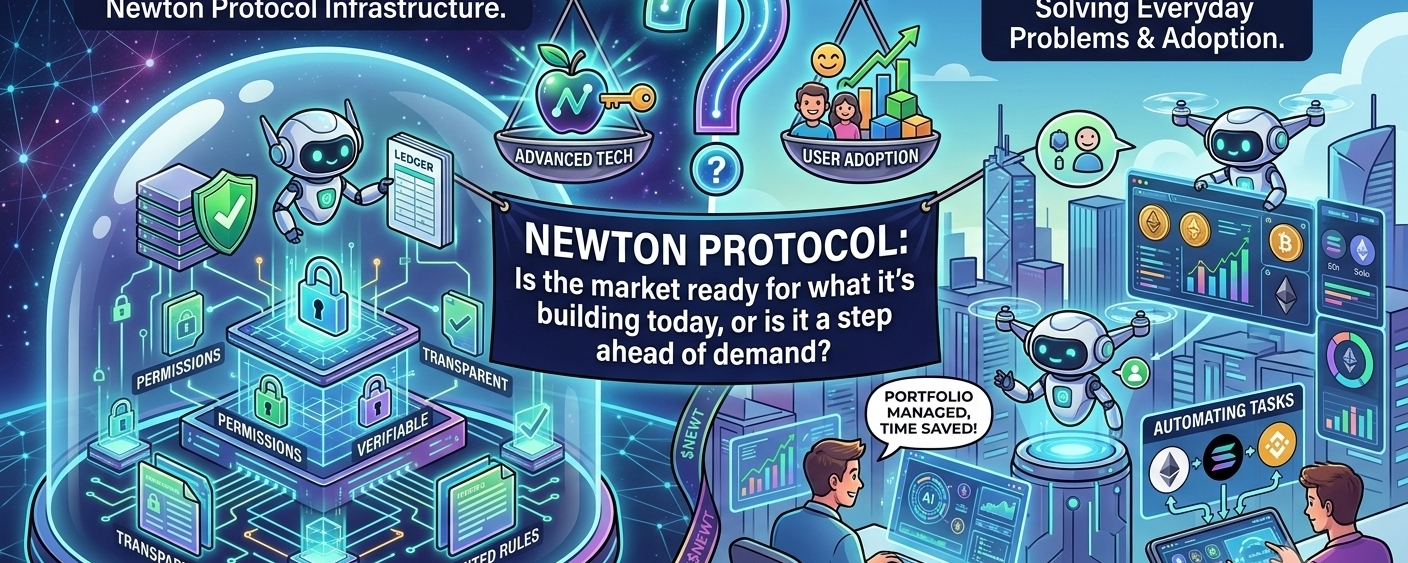
Article
The more I learn about Newton Protocol, the more I keep coming back to one simple question:Is the market ready for what it's building today, or is it still a step ahead of demand?
The vision is compelling. Instead of giving AI agents complete control over assets, Newton focuses on permission-based automation where users define what an agent can do. Every action is designed to be transparent, verifiable, and limited by clear rules.
From a technology perspective, that makes a lot of sense.
But the crypto market rarely rewards technology just because it's more advanced. Most users care about convenience, speed, and better outcomes. If something saves time and works reliably, they'll use it. If it adds complexity, many won't.
That's where $NEWT faces its biggest challenge.
The protocol doesn't just need to prove that its infrastructure is secure. It needs to prove that AI agents can solve real problems people face every day, whether that's managing portfolios across chains, automating repetitive tasks, or reducing costly mistakes.
If agentic finance becomes mainstream faster than expected, Newton could be in a very strong position.
If adoption takes longer, success will depend on building a healthy ecosystem of developers, useful applications, and active users who create demand beyond the initial excitement.
Many crypto projects have been technically right but launched before the market was ready. Great infrastructure only matters when enough people have a reason to use it.
That's why I'm watching more than the technology itself.
I'm watching whether developers choose to build on it, whether users genuinely find life easier with it, and whether AI agents become something people rely on instead of simply talking about.
In the end, the market doesn't reward the smartest technology.
It rewards the products that people actually choose to use.
@NewtonProtocol #newt $NEWT #NewtonProtocol #Aİ #Crypto
The more I learn about Newton Protocol, the more I keep coming back to one simple question:
Is the market ready for what it's building today, or is it still a step ahead of demand?
The vision is compelling. Instead of giving AI agents complete control over assets, Newton focuses on permission-based automation where users define what an agent can do. Every action is designed to be transparent, verifiable, and limited by clear rules.
From a technology perspective, that makes a lot of sense.
But the crypto market rarely rewards technology just because it's more advanced. Most users care about convenience, speed, and better outcomes. If something saves time and works reliably, they'll use it. If it adds complexity, many won't.
That's where $NEWT faces its biggest challenge.
The protocol doesn't just need to prove that its infrastructure is secure. It needs to prove that AI agents can solve real problems people face every day, whether that's managing portfolios across chains, automating repetitive tasks, or reducing costly mistakes.
If agentic finance becomes mainstream faster than expected, Newton could be in a very strong position.
If adoption takes longer, success will depend on building a healthy ecosystem of developers, useful applications, and active users who create demand beyond the initial excitement.
Many crypto projects have been technically right but launched before the market was ready. Great infrastructure only matters when enough people have a reason to use it.
That's why I'm watching more than the technology itself.
I'm watching whether developers choose to build on it, whether users genuinely find life easier with it, and whether AI agents become something people rely on instead of simply talking about.
In the end, the market doesn't reward the smartest technology.
It rewards the products that people actually choose to use.
@NewtonProtocol #newt $NEWT #NewtonProtocol #Aİ #Crypto
The vision is compelling. Instead of giving AI agents complete control over assets, Newton focuses on permission-based automation where users define what an agent can do. Every action is designed to be transparent, verifiable, and limited by clear rules.
From a technology perspective, that makes a lot of sense.
But the crypto market rarely rewards technology just because it's more advanced. Most users care about convenience, speed, and better outcomes. If something saves time and works reliably, they'll use it. If it adds complexity, many won't.
That's where $NEWT faces its biggest challenge.
The protocol doesn't just need to prove that its infrastructure is secure. It needs to prove that AI agents can solve real problems people face every day, whether that's managing portfolios across chains, automating repetitive tasks, or reducing costly mistakes.
If agentic finance becomes mainstream faster than expected, Newton could be in a very strong position.
If adoption takes longer, success will depend on building a healthy ecosystem of developers, useful applications, and active users who create demand beyond the initial excitement.
Many crypto projects have been technically right but launched before the market was ready. Great infrastructure only matters when enough people have a reason to use it.
That's why I'm watching more than the technology itself.
I'm watching whether developers choose to build on it, whether users genuinely find life easier with it, and whether AI agents become something people rely on instead of simply talking about.
In the end, the market doesn't reward the smartest technology.
It rewards the products that people actually choose to use.
@NewtonProtocol #newt $NEWT #NewtonProtocol #Aİ #Crypto
10
2
79
·
--
@NewtonProtocol I've been following Newton Protocol ($NEWT) for a while, and one thing stands out to me:
Building the technology is only half the challenge. Getting people to actually use it is the other half.
The vision of verifiable AI agents that can execute on-chain actions securely makes a lot of sense. As AI becomes more involved in finance and crypto, trust won't be optional—it will be essential.
The real question is timing.
Today's users mostly care about convenience, lower costs, and better results. They don't usually think about the infrastructure working behind the scenes unless it solves an immediate problem.
That said, many of crypto's most important infrastructure projects weren't fully appreciated when they first launched. They became valuable because the ecosystem eventually grew into them.
If autonomous AI agents become a normal part of Web3, Newton Protocol could already have the foundation in place.
Sometimes the biggest advantage isn't being first to gain attention—it's being ready before everyone else realizes the need.
Paid Partnership with
$NEWT #NewtonProtocol #newt #AI #Web3 #crypto
@NewtonProtocol I've been following Newton Protocol ($NEWT ) for a while, and one thing stands out to me:
Building the technology is only half the challenge. Getting people to actually use it is the other half.
The vision of verifiable AI agents that can execute on-chain actions securely makes a lot of sense. As AI becomes more involved in finance and crypto, trust won't be optional—it will be essential.
The real question is timing.
Today's users mostly care about convenience, lower costs, and better results. They don't usually think about the infrastructure working behind the scenes unless it solves an immediate problem.
That said, many of crypto's most important infrastructure projects weren't fully appreciated when they first launched. They became valuable because the ecosystem eventually grew into them.
If autonomous AI agents become a normal part of Web3, Newton Protocol could already have the foundation in place.
Sometimes the biggest advantage isn't being first to gain attention—it's being ready before everyone else realizes the need.
Paid Partnership with
$NEWT #NewtonProtocol #newt #AI #Web3 #crypto
Building the technology is only half the challenge. Getting people to actually use it is the other half.
The vision of verifiable AI agents that can execute on-chain actions securely makes a lot of sense. As AI becomes more involved in finance and crypto, trust won't be optional—it will be essential.
The real question is timing.
Today's users mostly care about convenience, lower costs, and better results. They don't usually think about the infrastructure working behind the scenes unless it solves an immediate problem.
That said, many of crypto's most important infrastructure projects weren't fully appreciated when they first launched. They became valuable because the ecosystem eventually grew into them.
If autonomous AI agents become a normal part of Web3, Newton Protocol could already have the foundation in place.
Sometimes the biggest advantage isn't being first to gain attention—it's being ready before everyone else realizes the need.
Paid Partnership with
$NEWT #NewtonProtocol #newt #AI #Web3 #crypto
69
·
--
@NewtonProtocol #newt I've been following @NewtonProtocol for a while, and I really like the direction they're taking. AI and blockchain together could unlock a lot of new possibilities. I'm excited to see how the ecosystem grows from here.
What do you think about $NEWT ?
$NEWT #NewtonProtocol #BinanceSquare
@NewtonProtocol #newt I've been following @NewtonProtocol for a while, and I really like the direction they're taking. AI and blockchain together could unlock a lot of new possibilities. I'm excited to see how the ecosystem grows from here.
What do you think about $NEWT ?
$NEWT #NewtonProtocol #BinanceSquare
What do you think about $NEWT ?
$NEWT #NewtonProtocol #BinanceSquare
4
92
·
--
@OpenGradient The request finished before the network had fully finished explaining why.
That was the detail that stayed with me.
One inference completed, payment settled in OPG, and the dashboard marked everything as done. But the output did not stop there. Another agent picked it up, another task started, and a new compute request appeared almost immediately.
That made me think about what happens after settlement.
A completed inference is not always the end of the process. Sometimes it becomes a signal for another model. Sometimes it updates an application. Sometimes it helps a developer improve a model version. Sometimes it creates another paid compute request without any manual action.
But activity alone is not enough.
If agents keep producing requests without creating useful outcomes, the system only becomes busier, not stronger. Repeated compute without real value is just noise.
For OPG, the interesting question may not be how many jobs settle. The better question is how many settled jobs generate meaningful work afterward.
A healthy network is not just one that completes compute. It is one where completed compute continues creating value across the ecosystem.
The real test for OpenGradient may be whether useful outputs keep moving forward after settlement instead of ending at the first transaction.
#OpenGradient #OPG $OPG
What metric best shows real demand for OPG: total settlements or useful follow-on activity after settlement?
@OpenGradient The request finished before the network had fully finished explaining why.
That was the detail that stayed with me.
One inference completed, payment settled in OPG, and the dashboard marked everything as done. But the output did not stop there. Another agent picked it up, another task started, and a new compute request appeared almost immediately.
That made me think about what happens after settlement.
A completed inference is not always the end of the process. Sometimes it becomes a signal for another model. Sometimes it updates an application. Sometimes it helps a developer improve a model version. Sometimes it creates another paid compute request without any manual action.
But activity alone is not enough.
If agents keep producing requests without creating useful outcomes, the system only becomes busier, not stronger. Repeated compute without real value is just noise.
For OPG, the interesting question may not be how many jobs settle. The better question is how many settled jobs generate meaningful work afterward.
A healthy network is not just one that completes compute. It is one where completed compute continues creating value across the ecosystem.
The real test for OpenGradient may be whether useful outputs keep moving forward after settlement instead of ending at the first transaction.
#OpenGradient #OPG $OPG
What metric best shows real demand for OPG: total settlements or useful follow-on activity after settlement?
That was the detail that stayed with me.
One inference completed, payment settled in OPG, and the dashboard marked everything as done. But the output did not stop there. Another agent picked it up, another task started, and a new compute request appeared almost immediately.
That made me think about what happens after settlement.
A completed inference is not always the end of the process. Sometimes it becomes a signal for another model. Sometimes it updates an application. Sometimes it helps a developer improve a model version. Sometimes it creates another paid compute request without any manual action.
But activity alone is not enough.
If agents keep producing requests without creating useful outcomes, the system only becomes busier, not stronger. Repeated compute without real value is just noise.
For OPG, the interesting question may not be how many jobs settle. The better question is how many settled jobs generate meaningful work afterward.
A healthy network is not just one that completes compute. It is one where completed compute continues creating value across the ecosystem.
The real test for OpenGradient may be whether useful outputs keep moving forward after settlement instead of ending at the first transaction.
#OpenGradient #OPG $OPG
What metric best shows real demand for OPG: total settlements or useful follow-on activity after settlement?
1
75
·
--
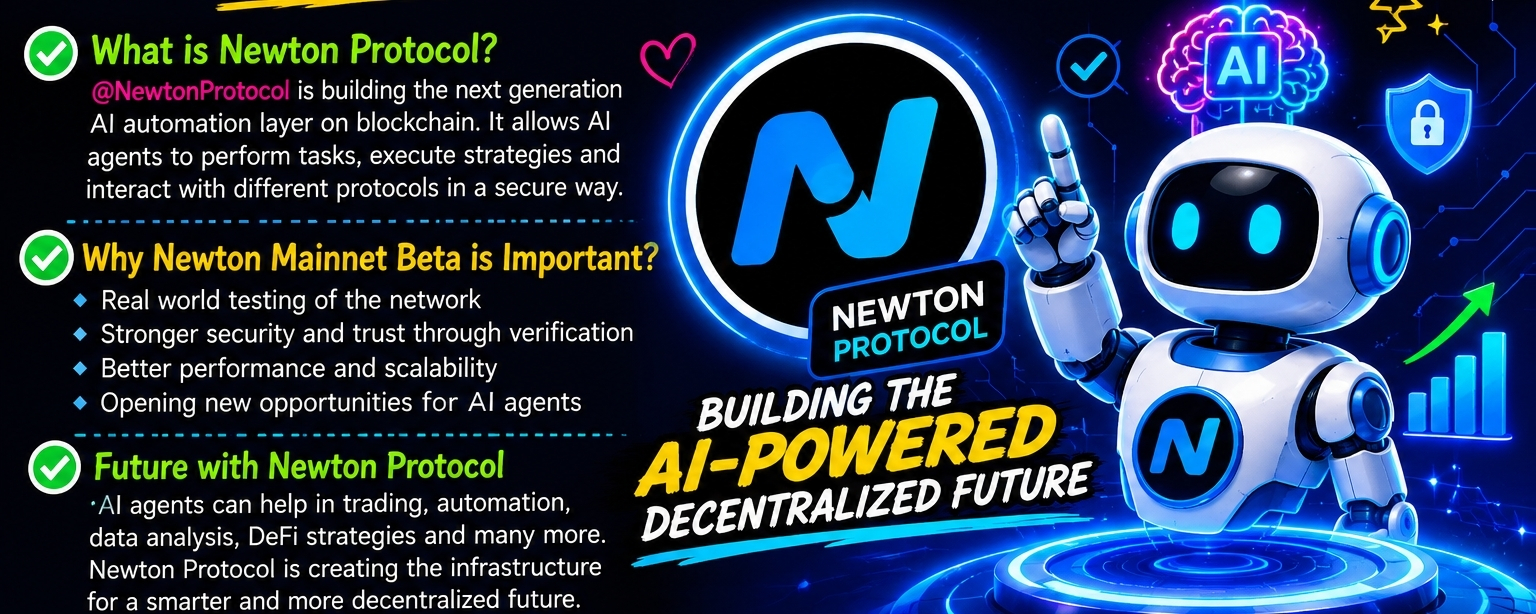
Article
My Thoughts on Newton Mainnet BetaRecently, I started learning about @NewtonProtocol and its Mainnet Beta. What interests me most is how the project combines AI and blockchain technology.
Newton Protocol is trying to create a secure environment where AI agents can perform tasks and help users in different ways. The Mainnet Beta is an important step because it allows the community to see how the technology works in real conditions.
I think AI automation will become more important in the future, and projects like Newton are exploring new possibilities. Developers may build useful AI applications, while users can benefit from more transparent and secure systems.
It will be interesting to watch how the ecosystem grows and how the community participates in the development of the network. I will continue following updates from @NewtonProtocol and learn more about the project as it evolves.
$NEWT #Newt @NewtonProtocol
My Thoughts on Newton Mainnet Beta
Recently, I started learning about @NewtonProtocol and its Mainnet Beta. What interests me most is how the project combines AI and blockchain technology.
Newton Protocol is trying to create a secure environment where AI agents can perform tasks and help users in different ways. The Mainnet Beta is an important step because it allows the community to see how the technology works in real conditions.
I think AI automation will become more important in the future, and projects like Newton are exploring new possibilities. Developers may build useful AI applications, while users can benefit from more transparent and secure systems.
It will be interesting to watch how the ecosystem grows and how the community participates in the development of the network. I will continue following updates from @NewtonProtocol and learn more about the project as it evolves.
$NEWT #Newt @NewtonProtocol
Newton Protocol is trying to create a secure environment where AI agents can perform tasks and help users in different ways. The Mainnet Beta is an important step because it allows the community to see how the technology works in real conditions.
I think AI automation will become more important in the future, and projects like Newton are exploring new possibilities. Developers may build useful AI applications, while users can benefit from more transparent and secure systems.
It will be interesting to watch how the ecosystem grows and how the community participates in the development of the network. I will continue following updates from @NewtonProtocol and learn more about the project as it evolves.
$NEWT #Newt @NewtonProtocol
74
·
--
#newt $NEWT @NewtonProtocol
I’ve been exploring projects at the intersection of AI and blockchain, and @NewtonProtocol caught my attention.
The idea of a secure rollup designed for AI agents, automated strategies, and developer marketplaces feels increasingly relevant as AI becomes more autonomous.
Infrastructure often matters more than hype, and it will be interesting to watch how Newton develops this ecosystem.
#Blockchain #NewtonProtocol
Paid partnership with @NewtonProtocol
#newt $NEWT @NewtonProtocol
I’ve been exploring projects at the intersection of AI and blockchain, and @NewtonProtocol caught my attention.
The idea of a secure rollup designed for AI agents, automated strategies, and developer marketplaces feels increasingly relevant as AI becomes more autonomous.
Infrastructure often matters more than hype, and it will be interesting to watch how Newton develops this ecosystem.
#Blockchain #NewtonProtocol
Paid partnership with @NewtonProtocol
I’ve been exploring projects at the intersection of AI and blockchain, and @NewtonProtocol caught my attention.
The idea of a secure rollup designed for AI agents, automated strategies, and developer marketplaces feels increasingly relevant as AI becomes more autonomous.
Infrastructure often matters more than hype, and it will be interesting to watch how Newton develops this ecosystem.
#Blockchain #NewtonProtocol
Paid partnership with @NewtonProtocol
1
1
83
Log in to explore more content
Join global crypto users on Binance Square
⚡️ Get latest and useful information about crypto.
💬 Trusted by the world’s largest crypto exchange.
👍 Discover real insights from verified creators.
Email / Phone number
Trending Topics
AppleDebutsFoldablePhone
8,518 views
203 Discussing
#appledebutsfoldablephone I Got My Hands on the iPhone Duo, Apple’s First Foldable Phone. Here’s What Stands Out
The palm-size phone is Apple's boldest handset in years, with a 5.4-inch cover screen and a 7.6-inch main display. I spent some time with the Duo before its October launch.It’s finally here: Apple on Wednesday unveiled its first foldable iPhone, called the iPhone Duo.
iPhone Duo design and build
The iPhone Duo is compact, with a passport-size design. It has a 7.6-inch display on the inside and a 5.4-inch outer display. It fits squarely in my palm, with dimensions similar to Samsung’s Galaxy Z Fold 8, which has a 7.6-inch inner display and a 5.5-inch cover display.
Apple says the Duo is the thinnest iPhone ever when open, measuring 5.2mm. It’s 11.3mm thick when closed. A titanium frame keeps it lightweight at 254 grams.
One of the key differences in feel between Apple’s and Samsung’s phones is that the iPhone Duo has a matte, nano-textured finish on the inner display, which reduces the phone’s crease while also curbing reflections. It has a satisfying feel and really makes the crease virtually disappear when the screen is on. I find it even harder to notice than the Z Fold 8’s, which also has an anti-reflective display.$ONG $IMX $TAC
Isabella-I
·4 Likes
·891 views
EUExtendsCentralContactPointToCASPs
0 views
0 Discussing
US10YTreasuryYieldHitsHighestSinceNov2023
12,536 views
240 Discussing